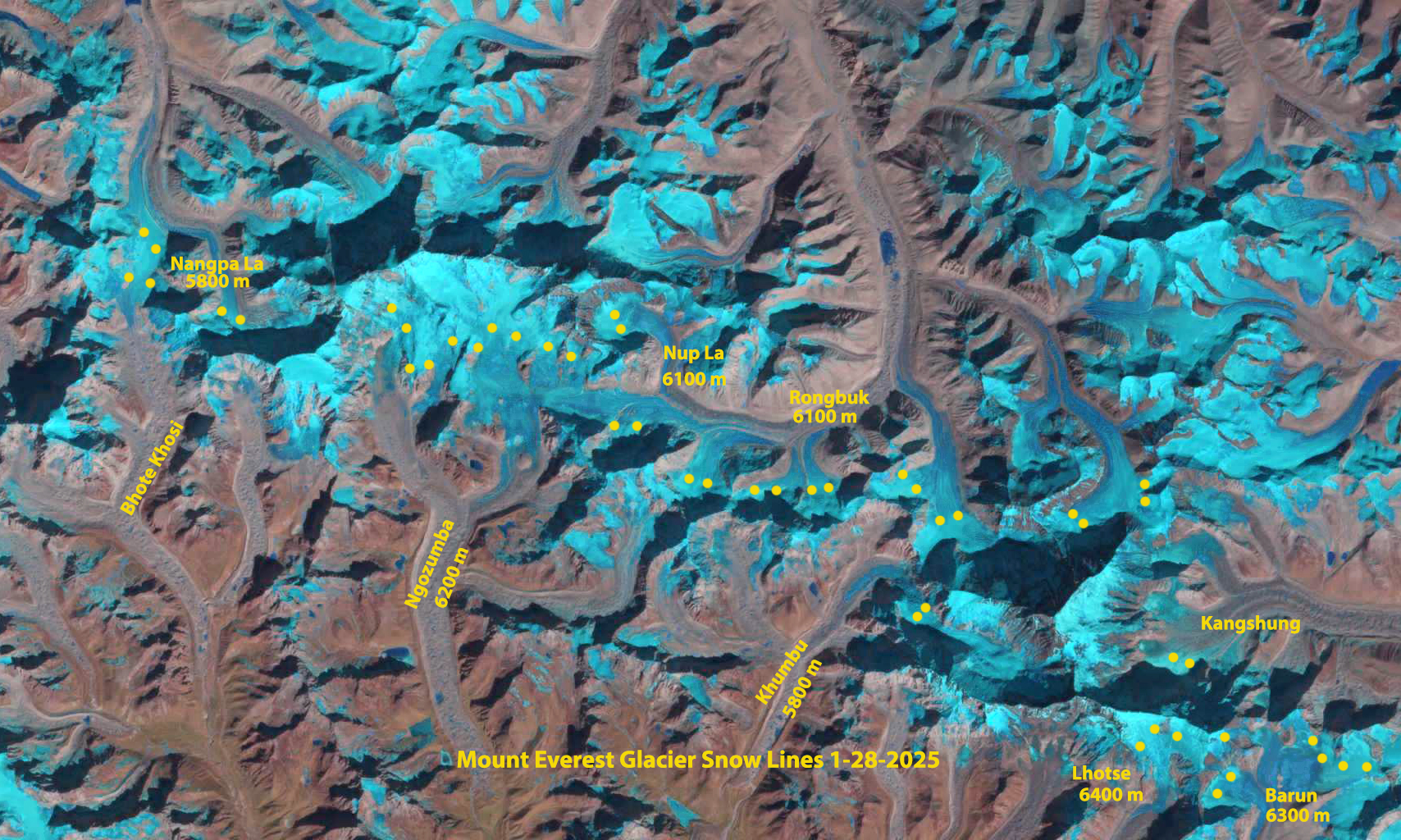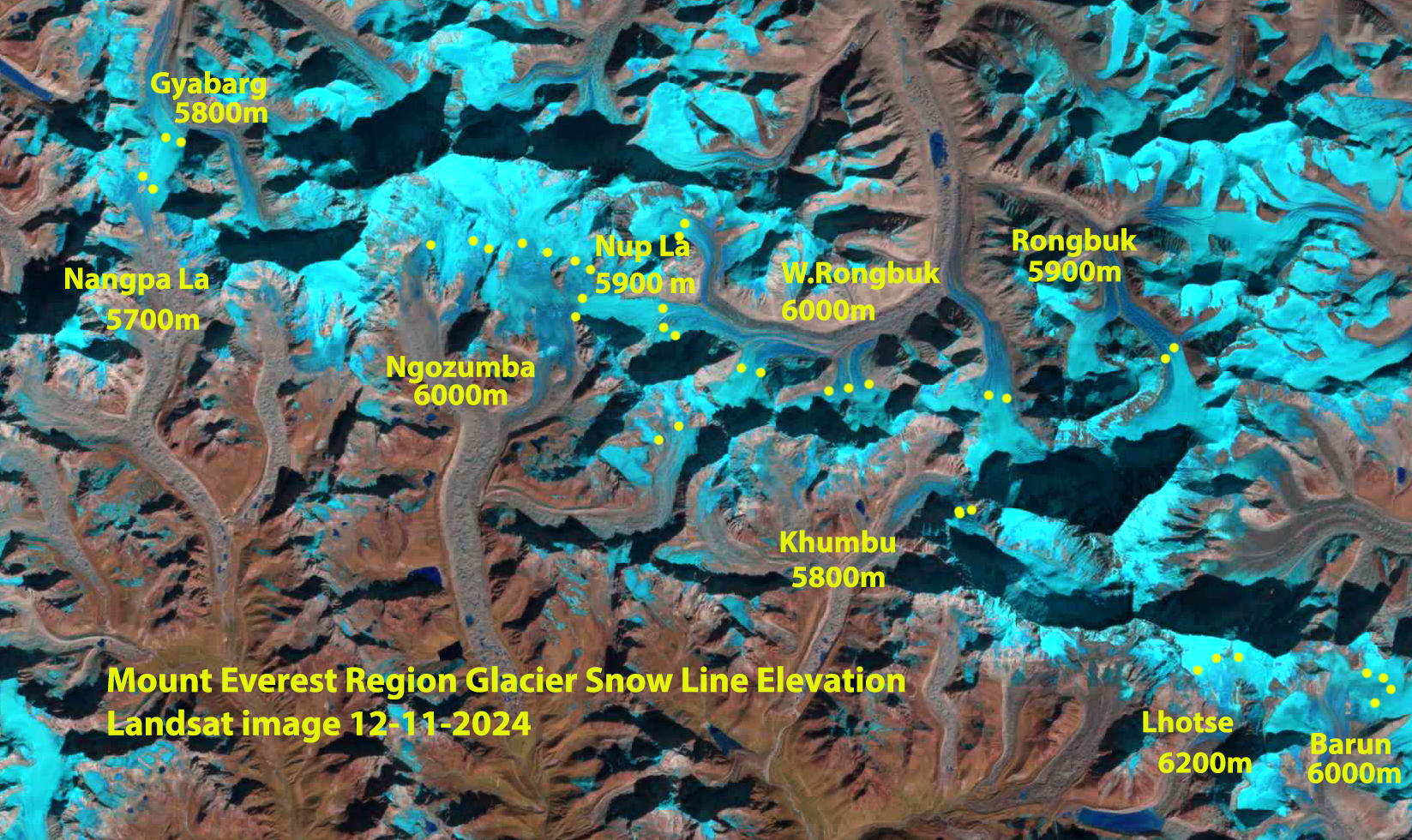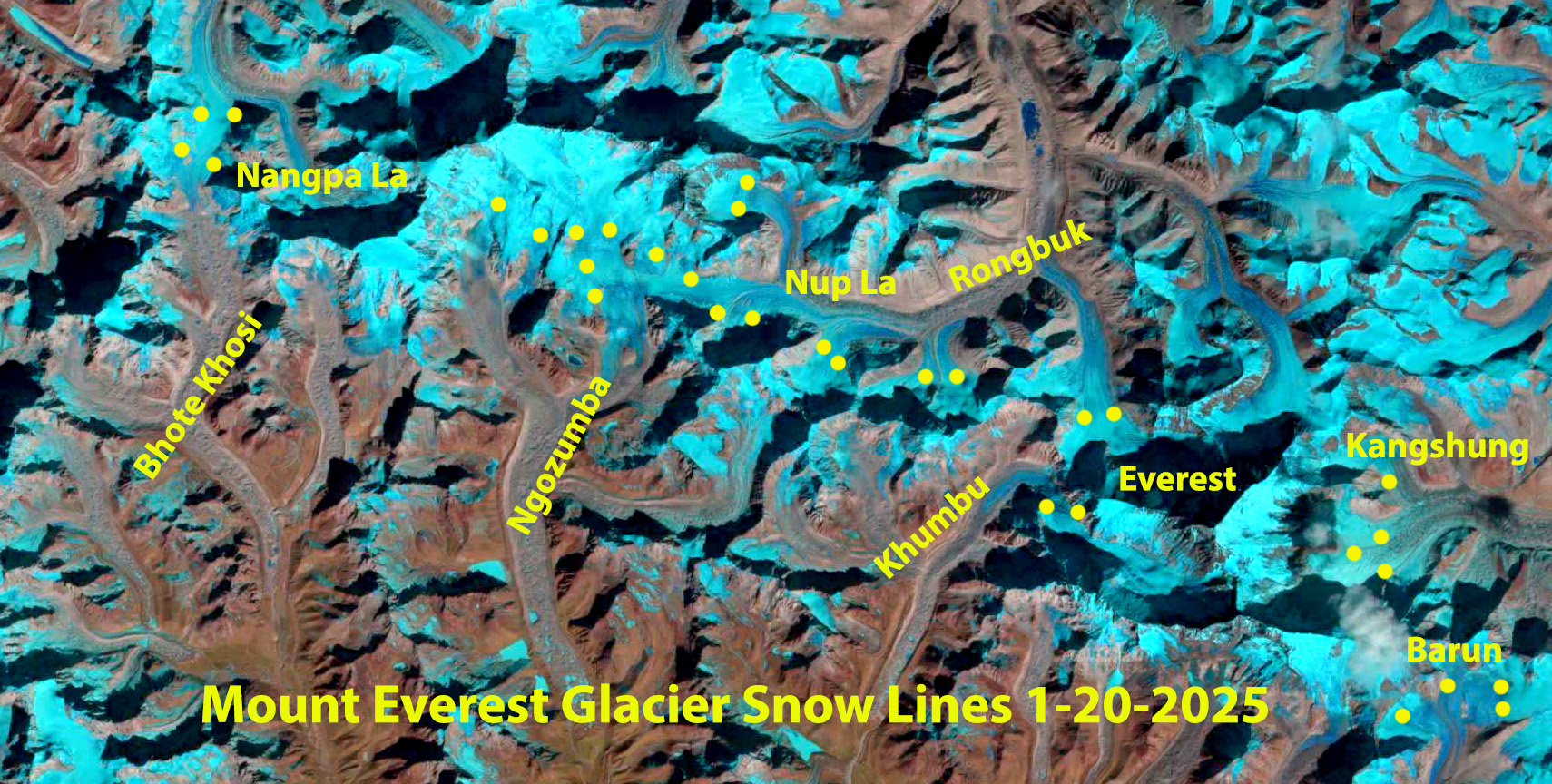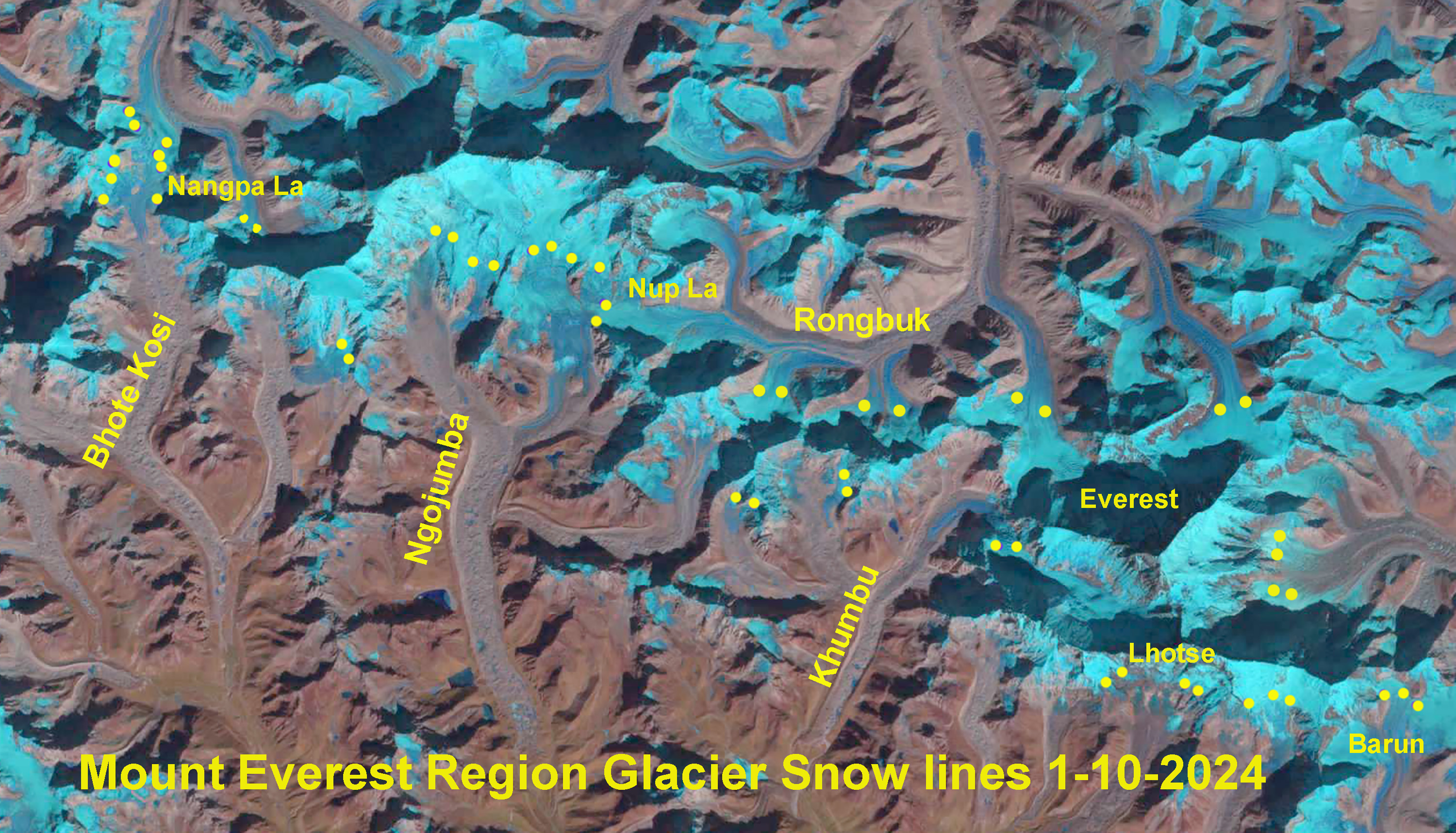
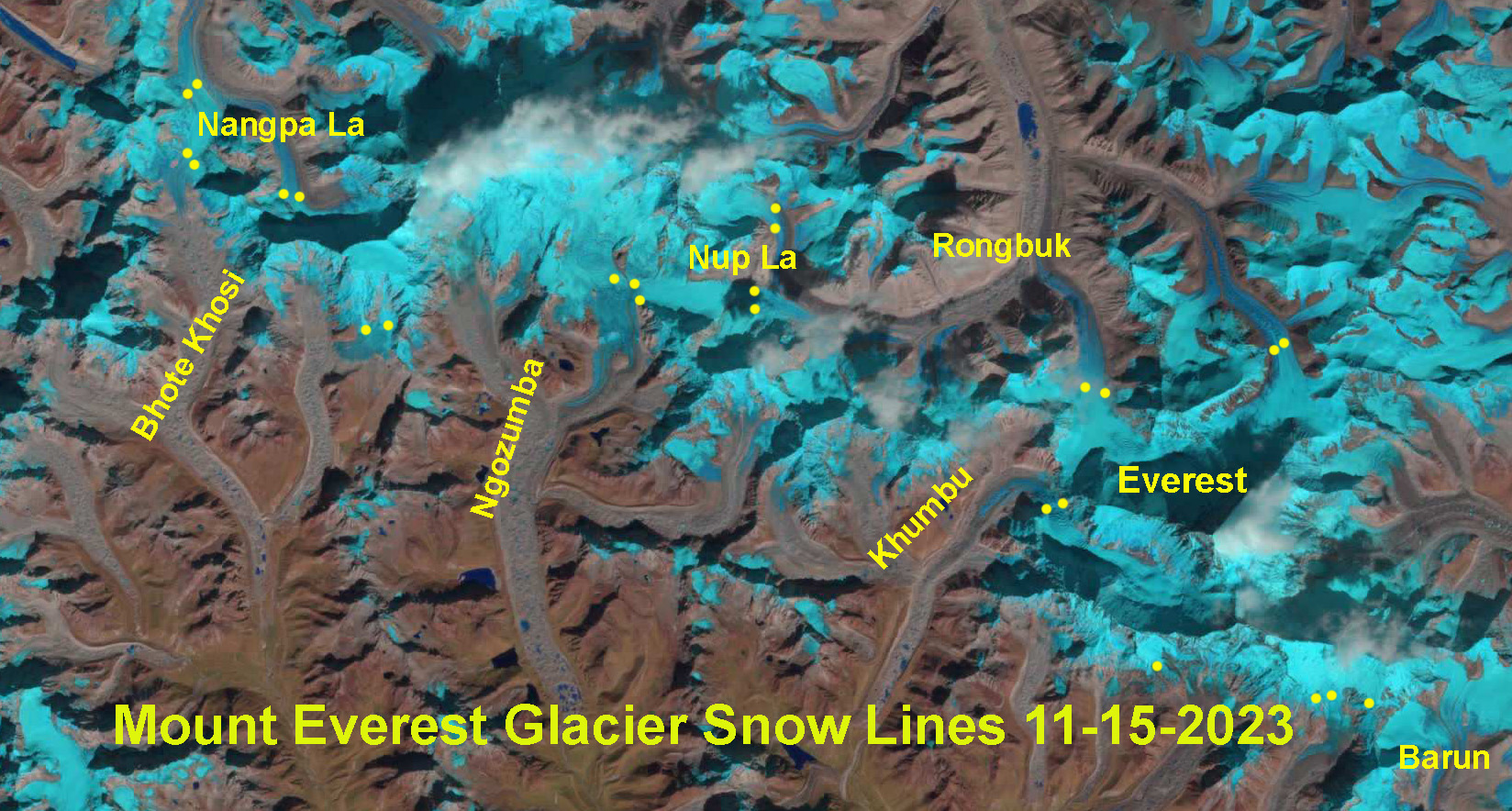
Mount Everest Region, Nepal glacier snow lines on Sentinel image from 11-12-2024. Mean elevation of snow lines is 5800 m.
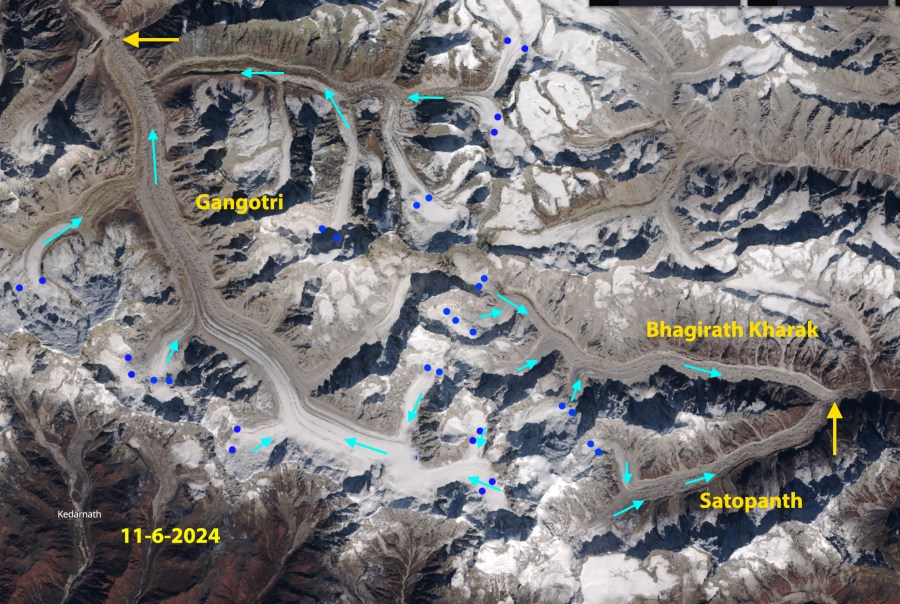
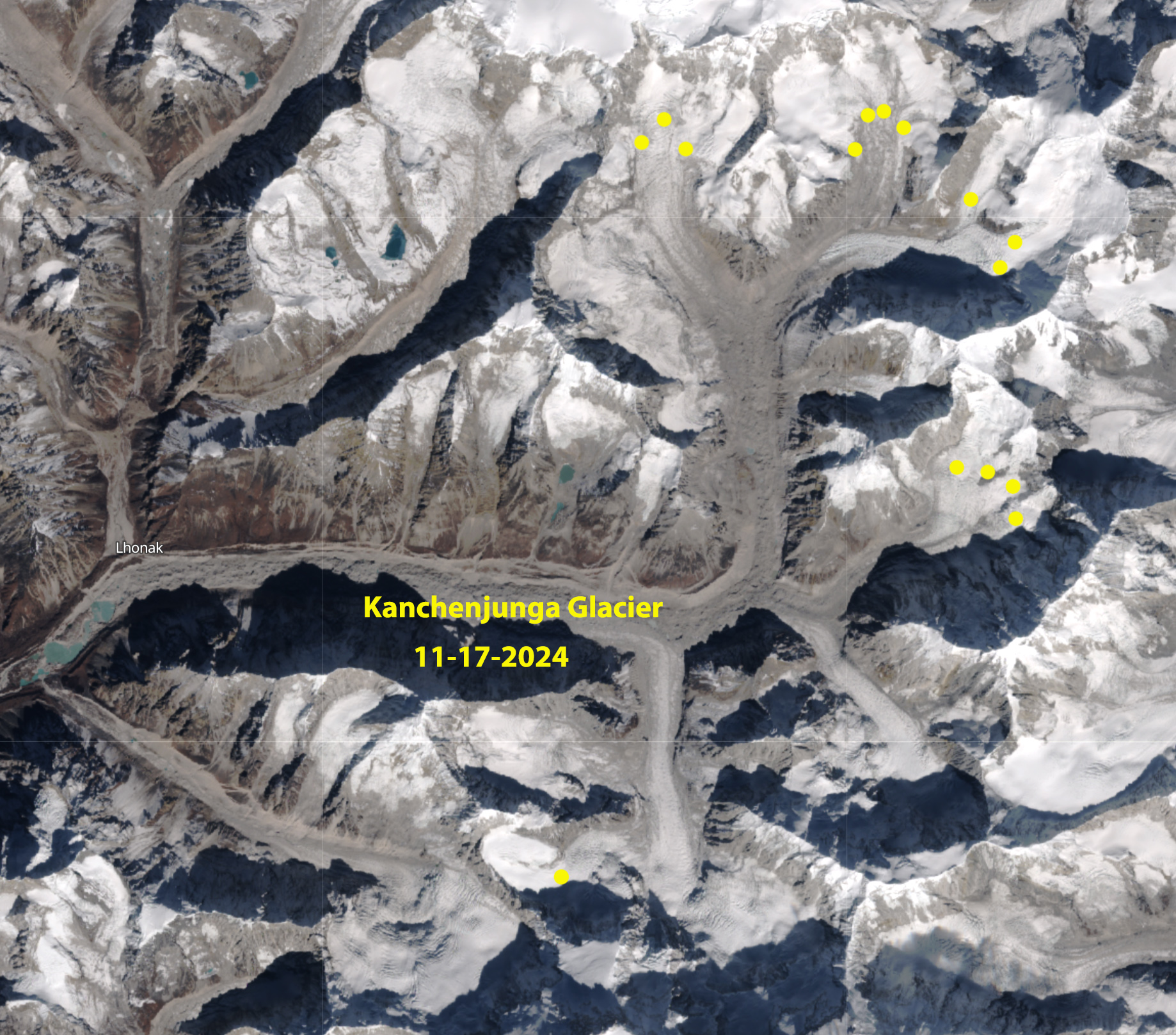
As the post-monsoon period progresses, glacier snow lines have been rising in the Himalaya. Will this be similar to last year and in 2020/21 when the snow line on many glaciers remained high right through much of the winter? Here we examine Sentinel 2 imagery from Kanchenjunga Glacier on the eastern border of Nepal to the Gangotri Glacier in Uttarakhand, India. In November snow lines are averaging from 5500 m to 6000 m (yellow dots are snowline). In each location there is clear upward shift of the snow line since the beginning of October, 2024.
The rising snow lines indicate significant ablation is occurring at least up to that point. There has been a trend in the last decade where ablation conditions are extending into the winter season most years (Pelto et al 2022). Will the winter 2024/25 follow this trend?.
Kanchenjunga Glacier with the November 17, 2024 snow line averaging 6000 m.Langtang Glacier, Nepal with the snow line on November, 17 2024 averaging 5500 m.Gangotri, Satopanth and Bhagirath Kharak Glacier snow line on Sentinel 2 image from 11-06-2024. Mean elevation is 5500 m.
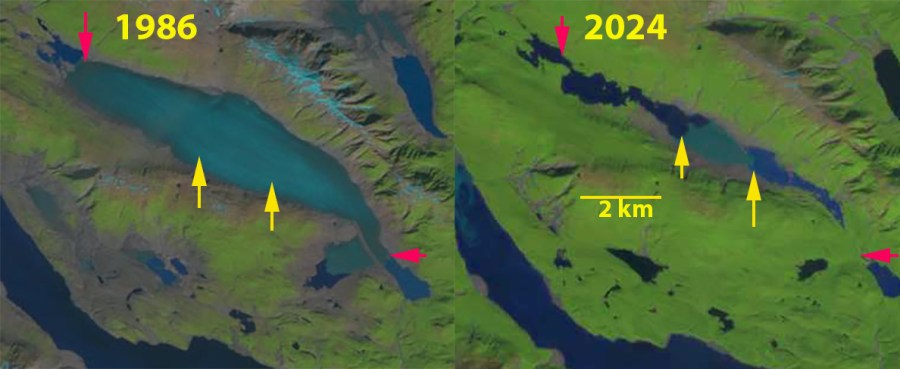
Yakutat, Alsek and Grand Plateau Glacier retreat from 1984 to 2024 has led to the three lakes expanding from 130 km2 to 240 km2 as illustrated by this pair of Landsat images. Fastest lake expansion in the nation in this period.
Three adjacent glaciers terminating on the coastal plain near Yakutat, Alaska have had a spectacular retreat in the last 40 years leading to rapid lake growth; Yakutat Glacier, Alsek Glacier and Grand Plateau Glacier. This is the story of the most rapid area of lake growth in the United States this century.
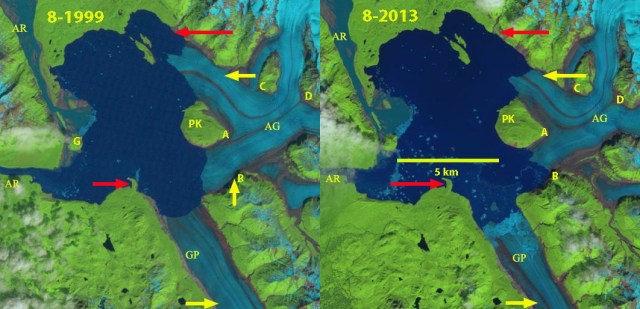
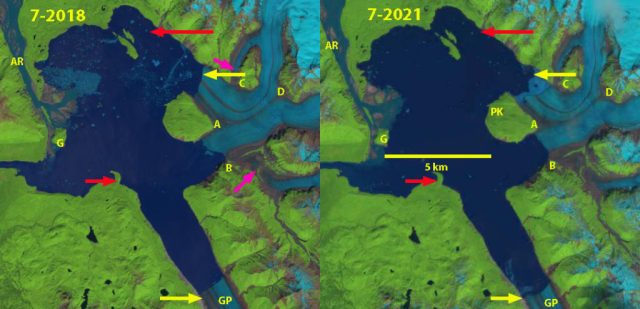
Alsek Glacier descends from the Fairweather Range terminating in Alsek Lake on the coastal plain. In the early part of the 20th century the glacier terminated at Gateway Knob (G) near the outlet of Alsek River from Alsek Lake, with just a small fringing lake present (Molnia, 2005). At that time it had a joint terminus with Grand Plateau Glacier. In 1960 the glacier had a single terminus downstream of an unnamed island in Alsek Lake, that Austin Post (USGS Glaciologisst) told me reminded him of a boats prow. This “Prow Knob” (P) much like Gateway Knob a century ago stabilized the terminus (Pelto, 2017). The glacier retreated 5-6 km by 1984 from Gateway Knob with the lake growing to an area of 45 km2. From 1984-2024 the retreat has been: 5.3 km for the northern terminus, 5.5 km for the southern terminus and 7.8 km for the northern arm of Grand Plateau Glacier. Alsek Lake has grown from 45 km2 to 75 km2 since 1984. In Octobrer 2024 there remains a narrow connection to Prow Knob that will not survive another year.
Alsek Glacier retreat from 1999-2013 in Landsat images. Red arrows mark the 1984 terminus location, yellow arrows the 2022 terminus location, AR=Alsek River, GP=Grand Plateau, PK=Prow Knob, G=Gateway Knob, A=glacier junction, B=tributary separation, C=tributary separation, D=tributary confluence.
Alsek Glacier retreat from 2018-2021 in Landsat images. Red arrows mark the 1984 terminus location, yellow arrows the 2022 terminus location, pink arrows indicate tributary separation, AR=Alsek River, GP=Grand Plateau, PK=Prow Knob, G=Gateway Knob, A=glacier junction, B=tributary separation, C=tributary separation, D=tributary confluence.
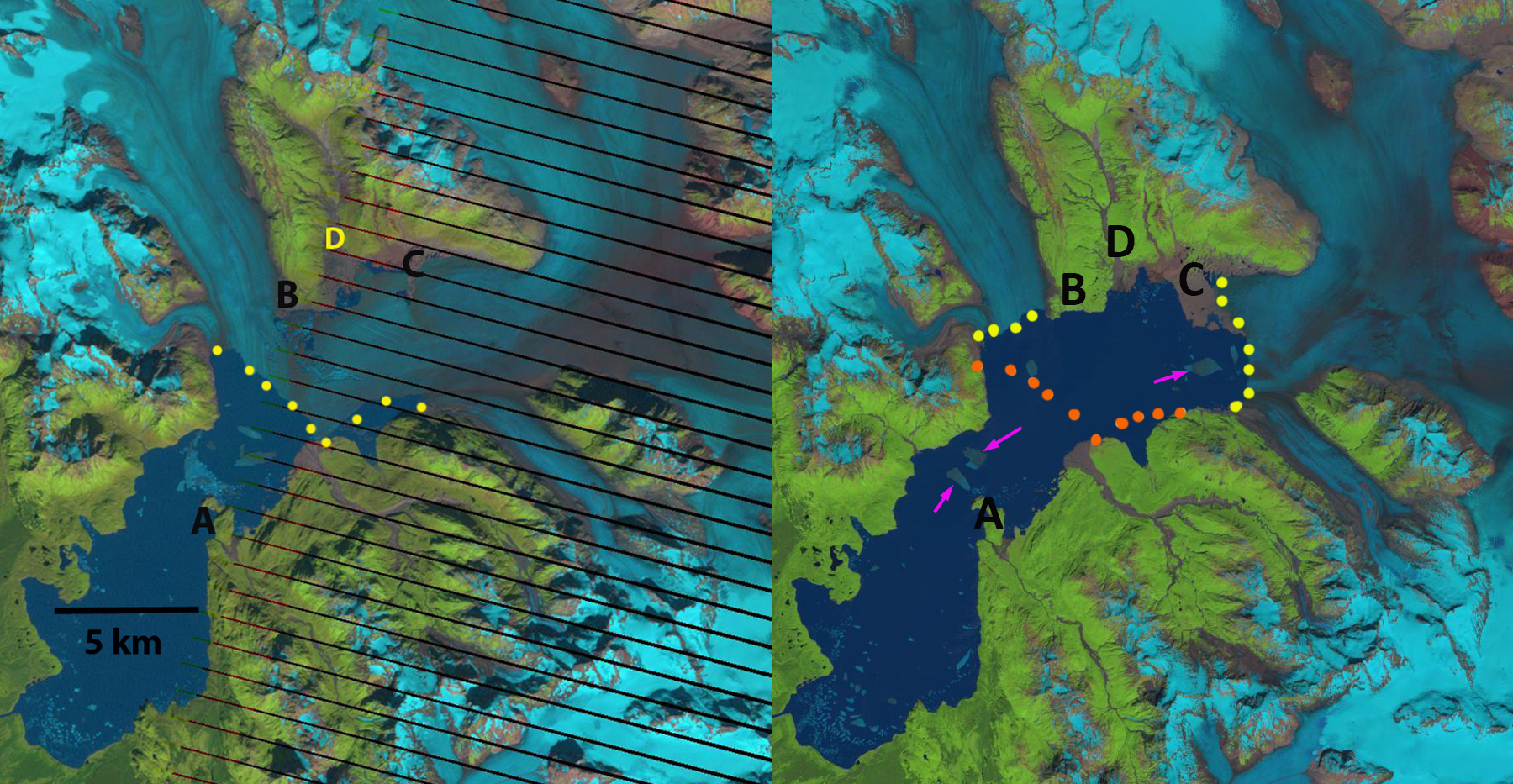
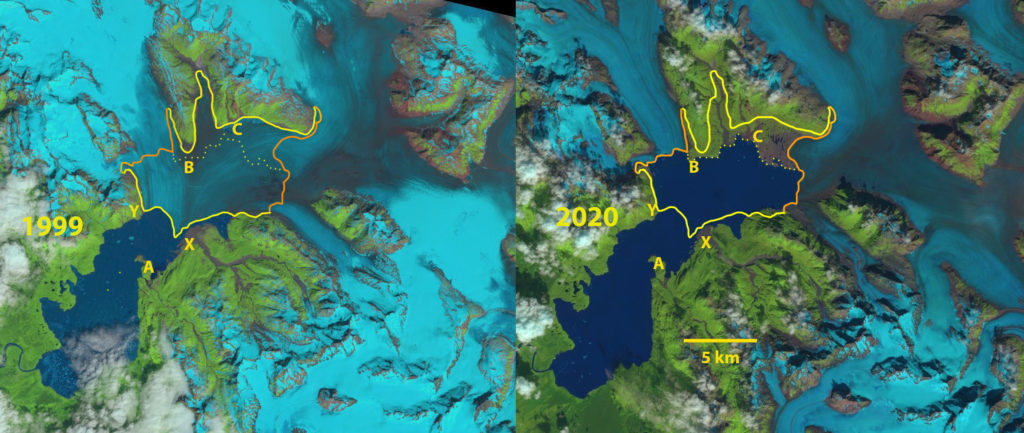
Yakutat Glacier, Alaska experienced a spectacular retreat losing 45 km² from 2010-2018, as a result of rising ELA leading to rapid thinning of the lower glacier (Truessel et al, 2013). The Yakutat Glacier during the 1894-1895 Alaskan Boundary Survey ended near a terminal moraine on a flat coastal outwash plain. By 1906 the glacier had retreated from the moraine and a new lake was forming, Harlequin Lake. By 1984 the lake had expanded to an area of 50 km2. The 2018 image compares the 2010 position (yellow dots) with 2018 (orange dots), indicating an area of 45 km² lost in less than a decade (NASA EO, 2018). There are some small icebergs in 2018. By 2024 further retreat has expanded the total lake area to 105 km2. The main terminus retreated 7 km. The ability to produce icebergs as large as in 2015 has been lost as the calving front has been restricted by the Peninsula which is now 3 km long, leaving less than a 3 km wide calving front. The narrower calving front and reduced water depth should in the short term reduce retreat. Truessel et al (2015) modelling indicated a reduced rate of retreat from 2020-2030, which supports the expected reduced calving. Their model also indicates the glacier will disappear between 2070 and 2110 depending on the warming scenario.
Expansion of Harlequin Lake due to retreat of Yakutat Glacier indicated on these 2010 and 2018 Landsat images. Yellow dots mark the ice front, orange dots the 2010 margin in 2018.Expansion of Harlequin Lake due to retreat of Yakutat Glacier, yellow boundary marks the deglaciated region on these Landsat images from 1999 and 2020.
Grand Plateau Glacier drains southwest from Mount Fairweather in southeast Alaska. The glacier advanced during the Little Ice age to the Alaskan coastline. Early maps from 1908 show no lake at the terminus of the glacier. The 1948 map (below) shows three small distinct lakes at the terminus of the main glacier and a just developing lake at the terminus of the southern distributary terminus (D). The distance from the Nunatak (N) to the terminus was 11 km in 1948. The lake at D is 400 m wide.In 2024 the lake area has grown further to 49 km2, as a result of a retreat of 8 km since 1948 and 5.5 km since 1984. Today a second island is emerging at the terminus, Point A. The distributary tongue to the southeast now terminates in a lake that is now 5.2 km long, a 4.8 km retreat since 1948 and 2.6 km since 1984. The combination of higher snowlines and increased calving into the terminus lake will continue to lead to retreat of this still mighty river of ice (Pelto, 2024).
There will be continued glacier retreat and lake expansion in 2025, as the new lake district continues to expand as a result of climate change. Loso et al (2021) note that retreat of Grand Plateau Glacier will change the outlet of Alsek Lake from Dry Bay to the Grand Plateau Lake, creating one larger lake.
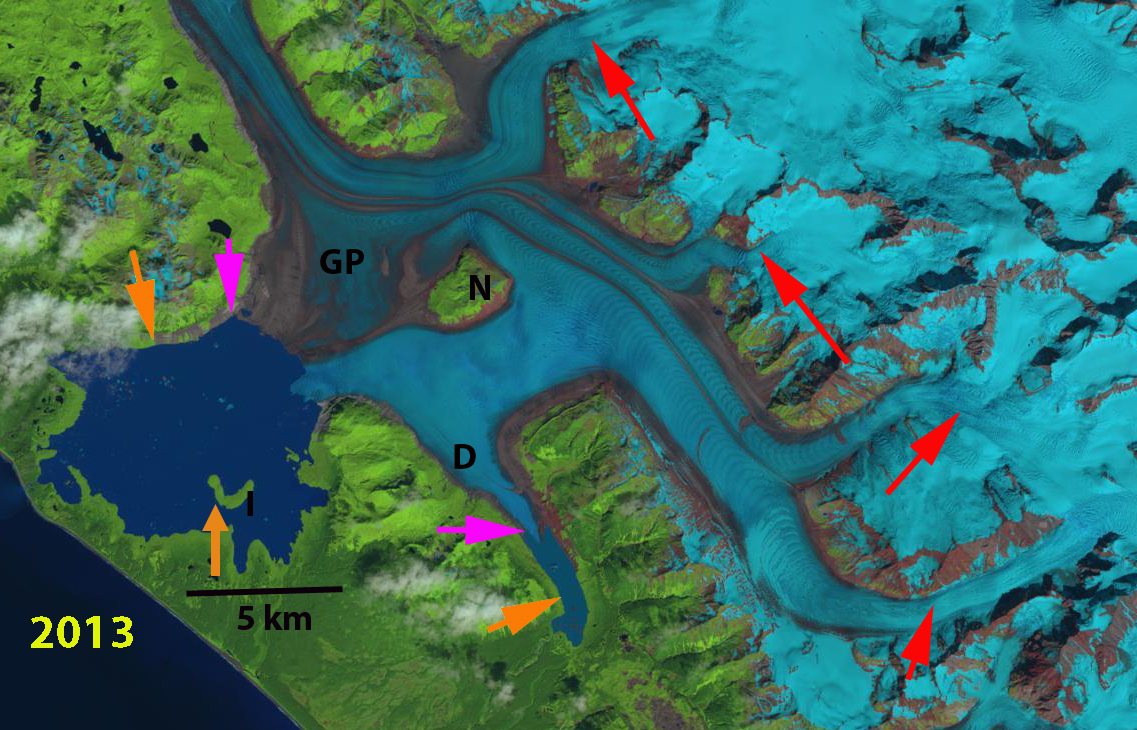
Grand Plateau Glacier retreat from 1984 to 2013 in Landsat images. Main tributaries indicated by red arrows also showing snowline. Orange arrows indicate 1984 terminus and pink arrows 2013 terminus.
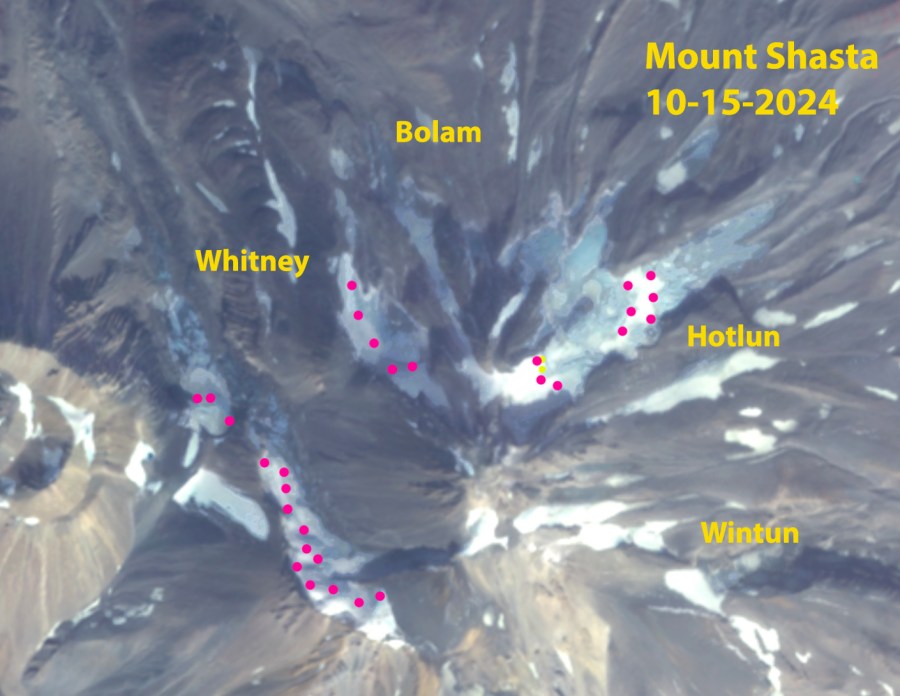
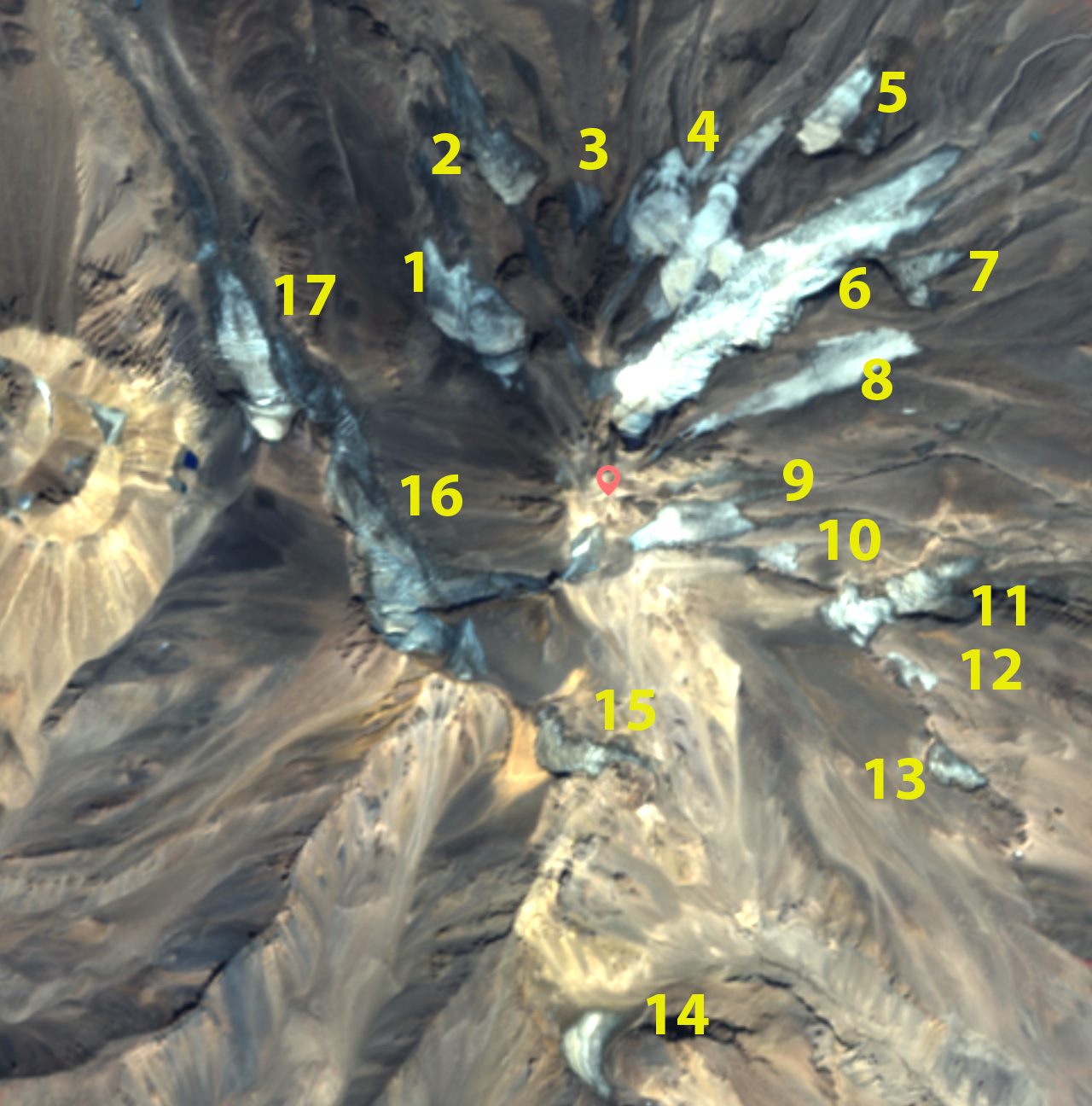
Snow cover extent on Mount Shasta glacier as the melt season ends in 2024. Oct. 15, 2024 Sentinel image, red dots indicate outline of snowcover areas ~25% of glacier area.
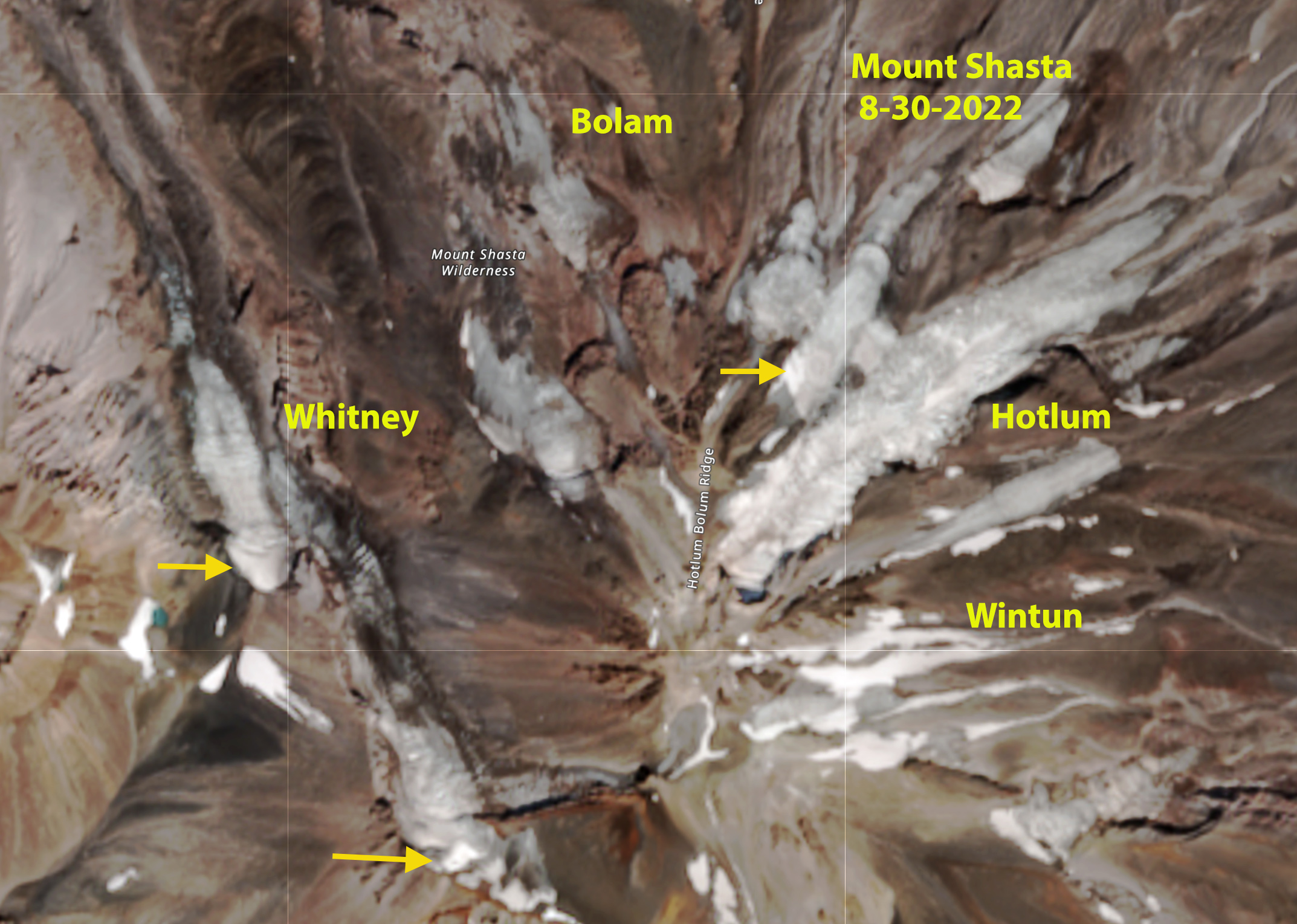
In 2021 and 2022 winters of below average snowfall , 4.50 m and 3.61 m at Snow Bowl, were followed by summers of persistent heat and several notable heat waves that left the glaciers of Mount Shasta nearly bare of snowcover, the resulting rapid volume loss and fragmentation of the glaciers was noted in detailed reports (Patel, 2021; Pelto, 2022). In 2021 less than 5% of the glaciers retained snowcover, and in 2022 less than 10% was retained.
In 2023 and 2024 a pair of winters with much above normal snowfall, 8.51 m and 8.43 m inches at Snow Bowl blanketed the mountain. How much of this snow has been retained by the glaciers as the 2024 melt season concludes.
Snow cover extent in September 2021 is less than 5% on Mount Shasta glaciers in this Sentinel image.
The summer of 2023 featured persisten warmth that led to ….In 2024 the melt season was again warm with the mean departure being 1.5-2.0 C in the Mount Shasta area. Regional Climate Center ACIS maps of the temperature anomaly for June-August provide a comparison of summer temperature for 2021-2024. Examining the remaining snowcover extent on Oct. 15, 2024 illustrates that
Summer temperature anomaly (in oF), for 2021-2024 for California. Each summer the departure has exceeded 1 C in the Mount Shasta region.ACIS maps
For Cascade range glaciers to maintain equilibrium they need 60% snowcover at the end of the melt season. Examining the remaining snowcover extent on Oct. 15, 2024 illustrates that the three primary glaciers Bolam, Hotlum and Whitney have 25% snowcover remaining. This indicates signficant loss of volume in 2024, though less than 2021 or 2022. This will drive continued thinning, retreat and loss of glaciers.
Snowcover extent on Aug. 30, 2022 on Munt Shasta Glaciers. Yellow arrows indicate that less than 10% of the glaciers are snowcovered.
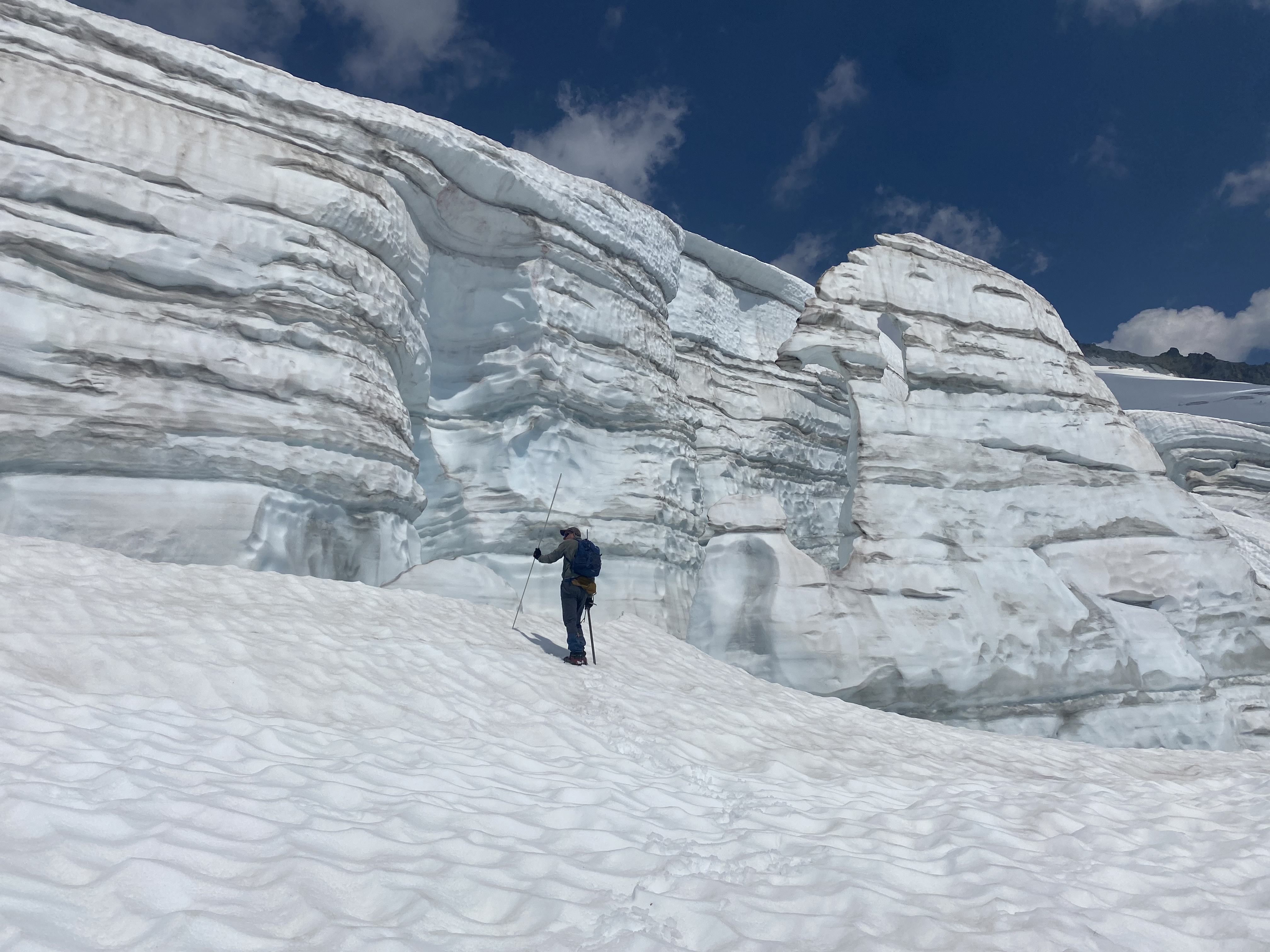
Serac on Easton Glacier at 2400 m indicating retained snowpack from previous years.
Climate Conditions Summary
The winter season of 2023/24 yielded a low snowpack across the North Cascades. Snowpack at six longer Snotel stations was 0.63 m w.e on April 1, vs. a 1984-2024 average of 1.02 m. This was the third lowest snowpack of this period, with 2005 and 2015 being lower. The melt season in May and June was cool, helping extend the low snowpack at elevations above 1500 m. July rivaled 2015 for the warmest of the last 50 years, quickly melting back the snowpack by the start of August. The end of the melt season was fairly typical with several new snowfalls and periods of heat. The main melt season for the glaciers is June-September and this year the average temperature was 18.3 C, which is 1.3 C above the long term mean. This was the fourth year in a row above 18 C and thus the fourth consecutive year of large glacier mass balance losses. The cumulative impact is glacier recession, thinning, loss of a number of glacier and overall steeper/dirtier ice. We conducted detailed field work on eight glaciers.
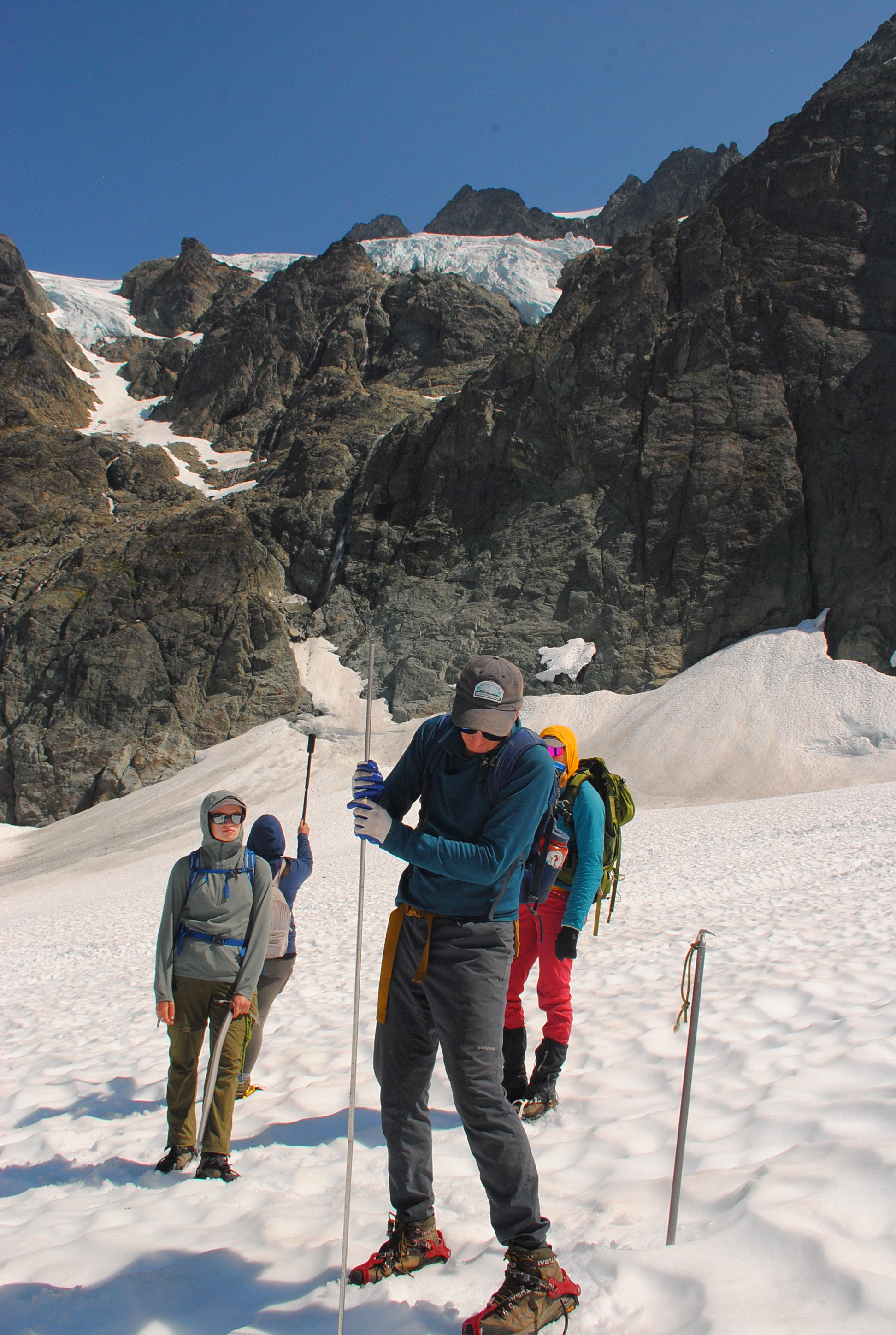
Probing snow pack depth on Lower Curtis Glacier. The 12 foot segmented steel probe cannot penetrate the icy surface from the previous summer.
Glacier Mass Balance
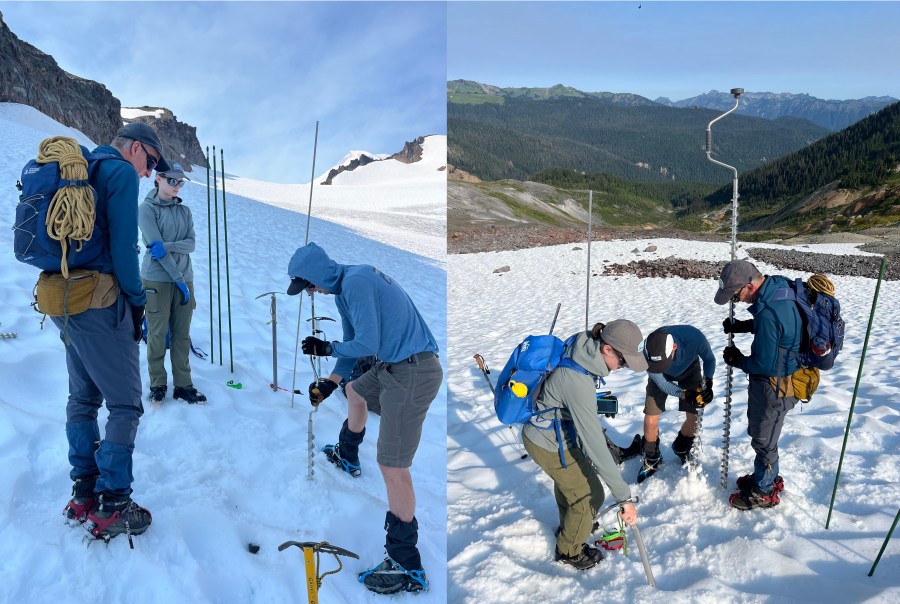
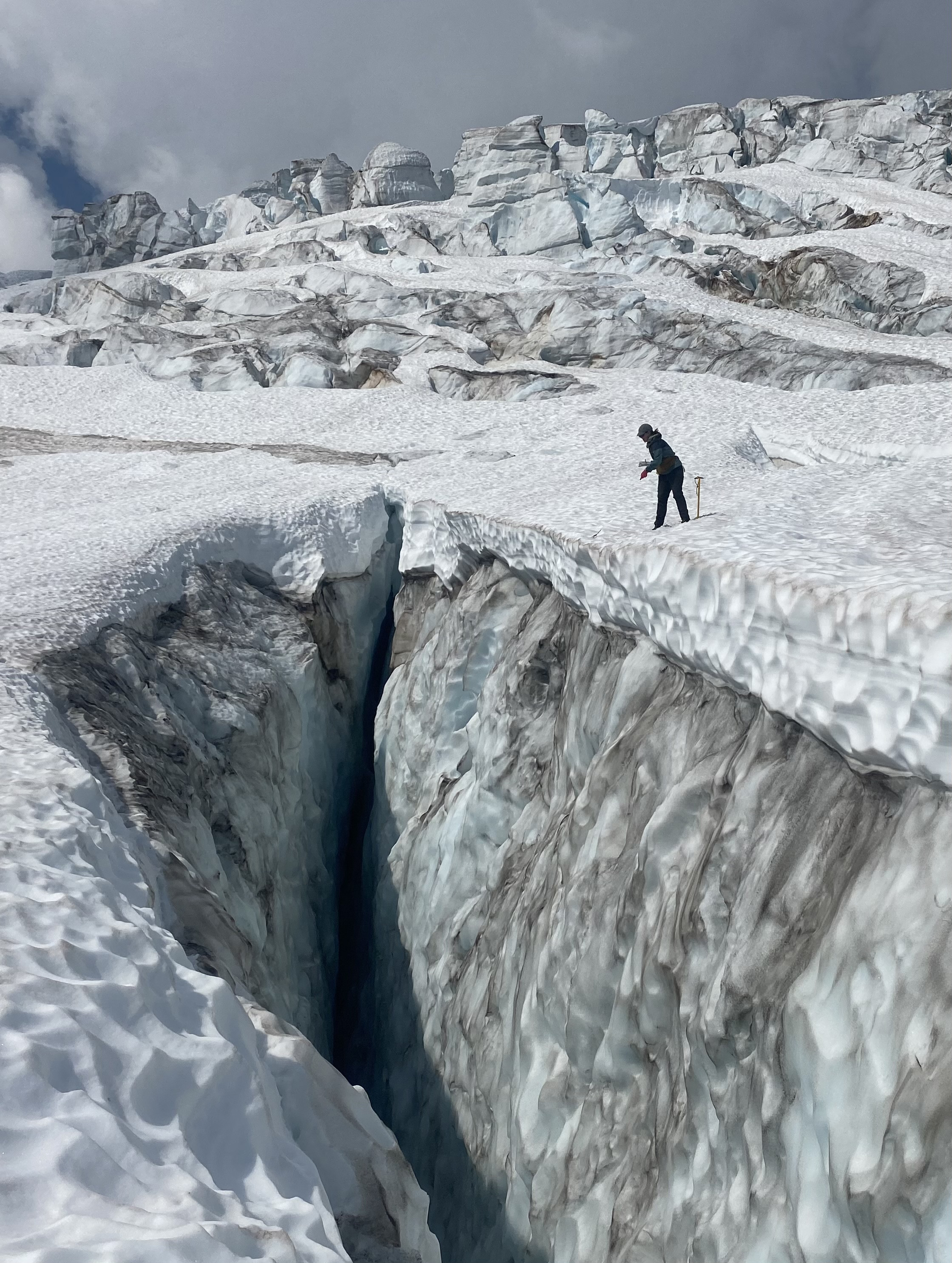
Annual mass balance is the difference between the mass of snow and ice accumulation on the glacier and the ablation of snow and ice on the glacier during a year. The data is reported in the average change across the glacier in water equivalent thickness. In 2024 we again utilized probing snow depth with a 12 foot long segmented steel probe (520 measurements), annual layer thickness measurement in vertically walled crevasses (140 measurements), and mapping snow line position in the field. To assess ablation we used snow line migration in satellite imagery and ablation stakes drilled into the glacier. The mass balance at the snowline is 0 m w.e., and as it transects areas of known snow depth that identifies ablation rate.
Ben Pelto deploying his ice augur to emplace ablaiton stakes on Sholes Glacier, Katie Hovind and Mauri Pelto assisting.Jill and Mauri Pelto in front of Columbia Glacier that has retreated forming a new lake. Avalanche accumulation on west side only snowcover retained by end of summer.
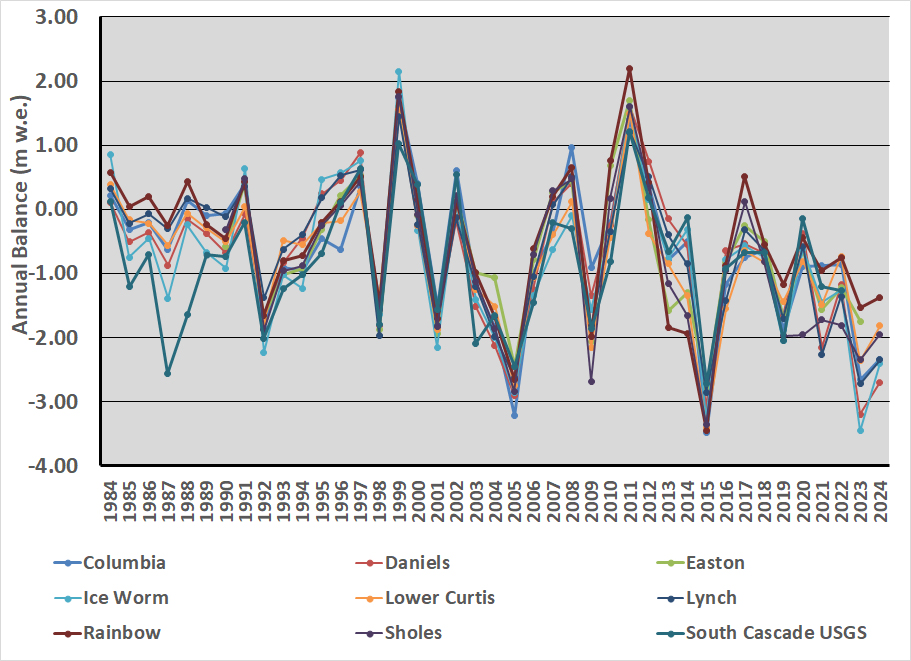
All eight glaciers had a negative balance exceeding 1.3 m w.e., with an average of -2.09 m w.e., this is equivalent to at ~2.25 m of glacier thinning. The loss during the last four years is unprecedented with 8 m of average thickness lost from 2021-2024. This is greater than the entire decade of loss for 184-1993, 1994-2003 or 2004-2013. The acceleration of loss continues even as the glaciers lose their highest melting terminus regions. This is an indication that none of the glaciers are approaching equilibrium. The cumulative mean mass balance loss has been -28.89 m w.e., ~33 m in thickness. This represents the loss of ~40% of volume of the glaciers we have observed, 1% loss per year overall but over 2% per year in the last decade.
Annual mass balance time series for the eight glaciers we monitor and the USGS monitored South Cascade Glacier. In 2024 Columbia=-2.34, Daniels=-2.70, Easton=-1.74, Ice Worm=-2.40, Lower Curtis=-1.82, Lynch=-2.35, Rainbow=-1.38, Sholes=-2.35.
The deglaciated area exposed by the retreat over the last four decades is substantial and is most visible below Easton Glacier. The retreat of 620 m since 1990, has included a retreat of over 100 m in the last two years. The thinning of this glacier along with neighboring Squak and Deming have led to emergence of bedrock areas high on the glacier as well.
Deglaciated area below Easton Glacier from the 1990 advance moraine to 2024.Bedrock areas that are emerging and expanding above 2100 m on the upper portions of Deming-Easton and Squak Glacier. Only one of these (upper right) existed before 2010.
Glacier Crevasses
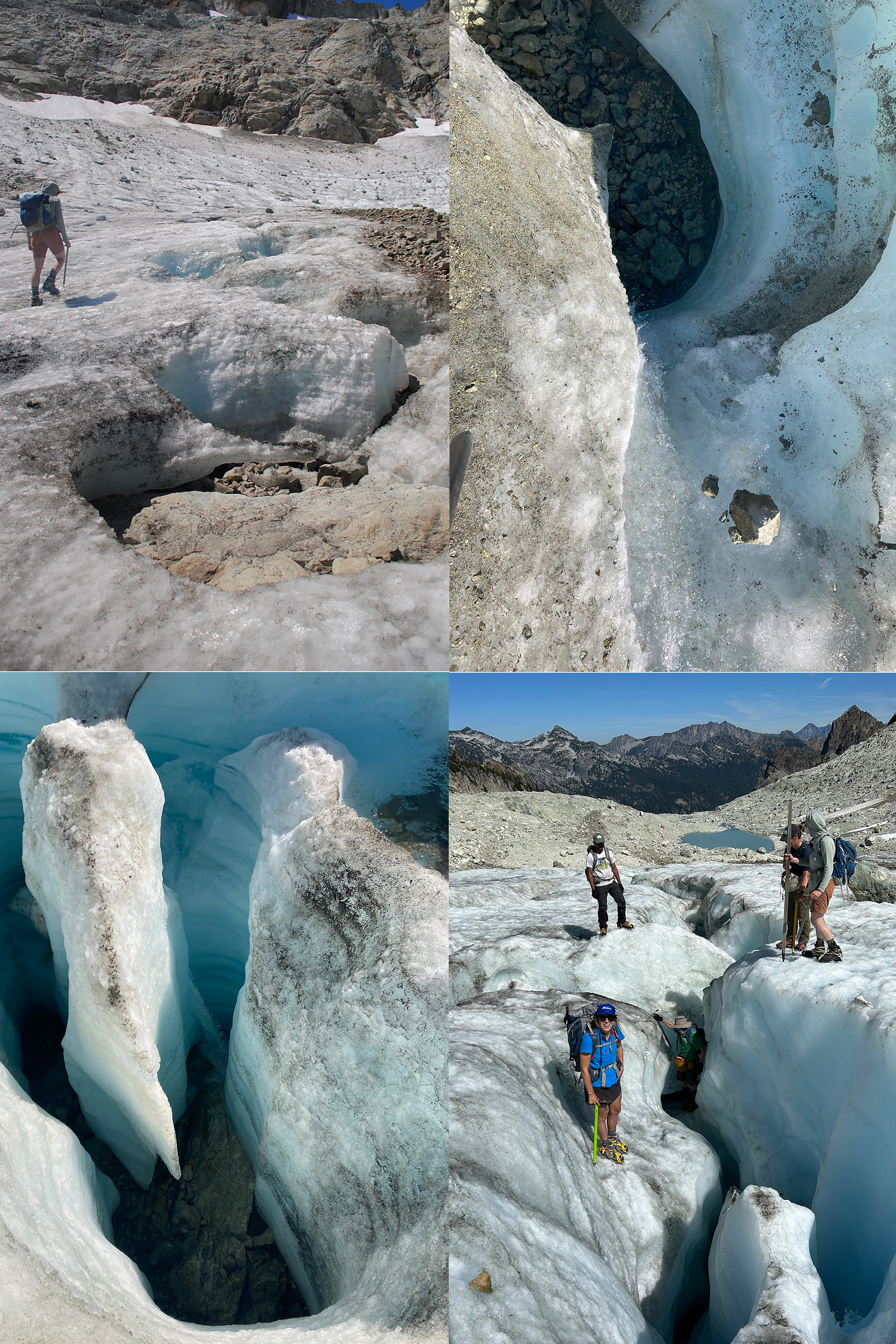
We have been assessing the depth and distribution of crevasses on several glaciers annually since 2013. We have noted a decline in the number of crevasses in specific icefall regions, such as on Lower Curtis, Rainbow and Easton Glacier. The depth also decline rapidly with glacial thinning during the last decade. In the main icefall on Easton Glacier in 2024 at 2300 m were the deepest crevasses we found at ~30 m. Below is Jill Pelto measuring crevasse depth using a camline.
Glaciers Lost
There are 31 active glaciers across the North Cascades that we observed since the 1980s that have now disappeared. The list below indicates the year they were lost, the area of the glaciers in the GLIMS inventory for initial area (1958-1984), 2015 area, and the area of the former glacier in 2022/24. This is not a complete list of glaciers lost in the North Cascade Range. The rate of loss is clearly accelerating.
When a glacier’s volume becomes too limited to generate motion, a combination of thickness below ~15-25 m, and area less than 0.02-0.05 km2, it is no longer a glacier.
North Cascade glaciers that we observed as glaciers in the 1980s that are now gone. The first two areas reported come from GLIMS.org inventories, and the last area and year of loss come from our observations.
Glacier Runoff
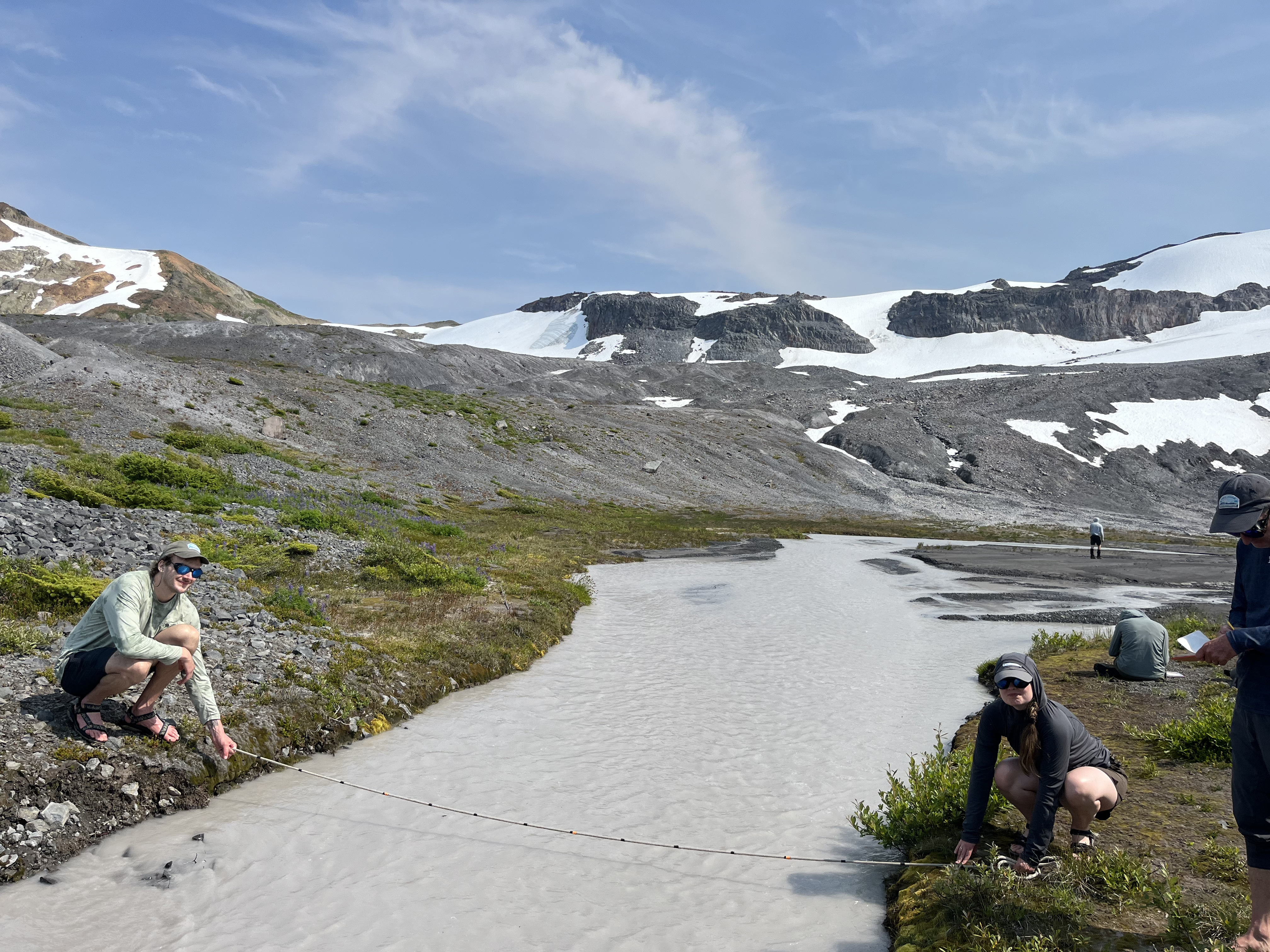
We directly measured runoff below Sholes Glacier and in the basin of former Ice Worm Glacier. In each continued glacier recession is reduing glacier runoff. The increased rate of melt is, exceeded by the reduced area available for melting. The result is declining summer streamflow and increased late summer stream temperatures.
The 2024 field season was our 41st, from the glaciers perspective it was the fourth consecutive year of exceptional mass loss, leading to thinning, retreat and glacier loss.Below are images from the field season and reflections on each from the varied perspectives of our field team and field partners.
Coleman Glacier, Mount Baker at the golden hour as we just finished work.
Jill Pelto: During the field season our typical day involves getting up with the sun and working out on a glacier until early evening. Going to Coleman Glacier on Mt. Baker this year was special because we got to work on it during golden hour, a rare thing to experience. We had the glacier to ourselves, and the nearby big camping area — despite this being a popular destination for ice climbers. This is only my third time in sixteen years working on this glacier, and its significant loss since we last saw it in 2019, when I sat and painted on it, was so apparent. But in spite of that, I was feeling joyful to be there — something about four of us out there on our own taking measurements as the summer sun set was so magical. I was so grateful to be there at that moment and experience this landscape as it is now.
Saddle at top of Rainbow Glacier looking to summit of Kulshan (Mount Baker). Ben, Jill and Mauri Pelto a combined 70+ years of experience on these glaciers.
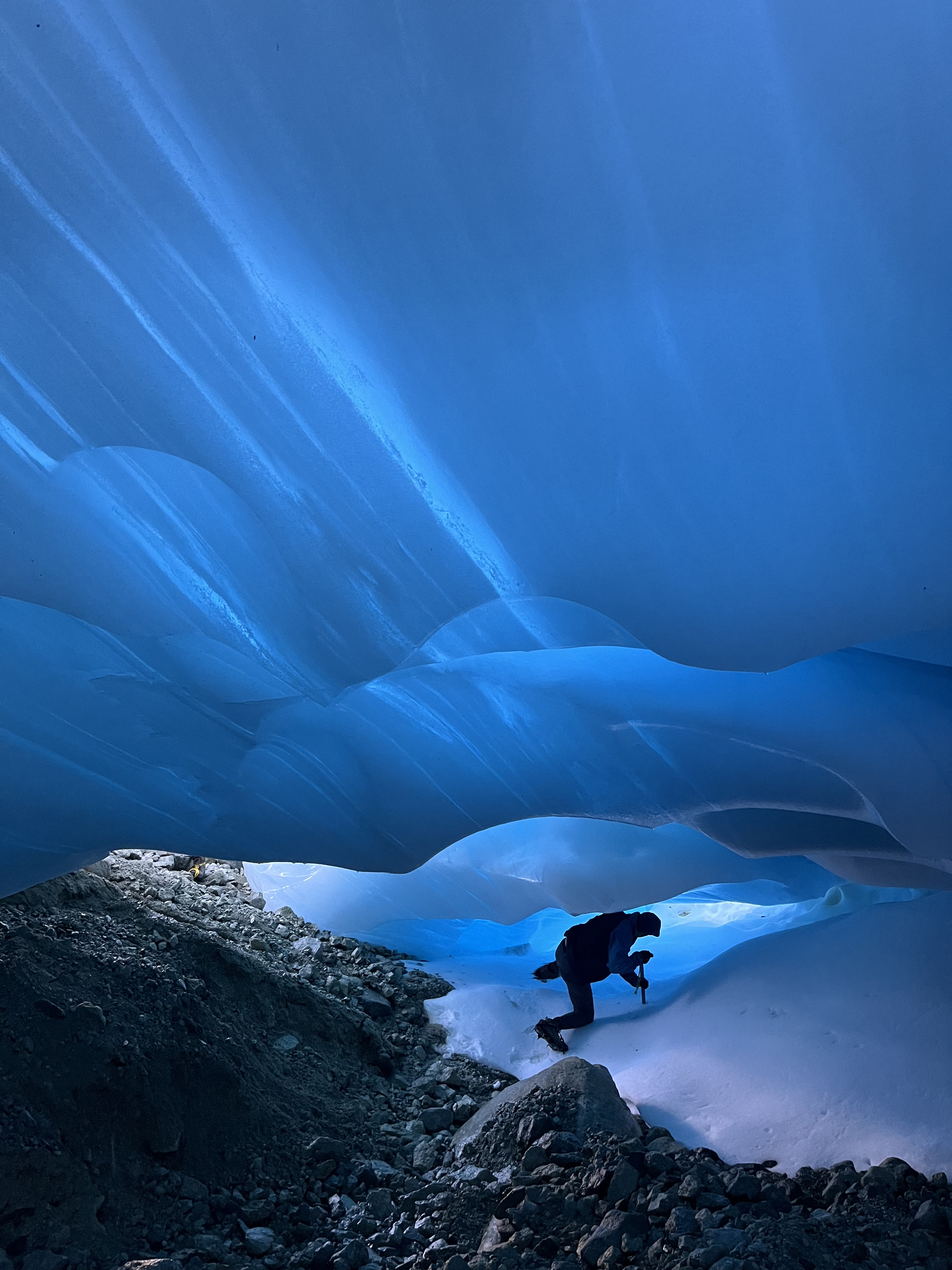
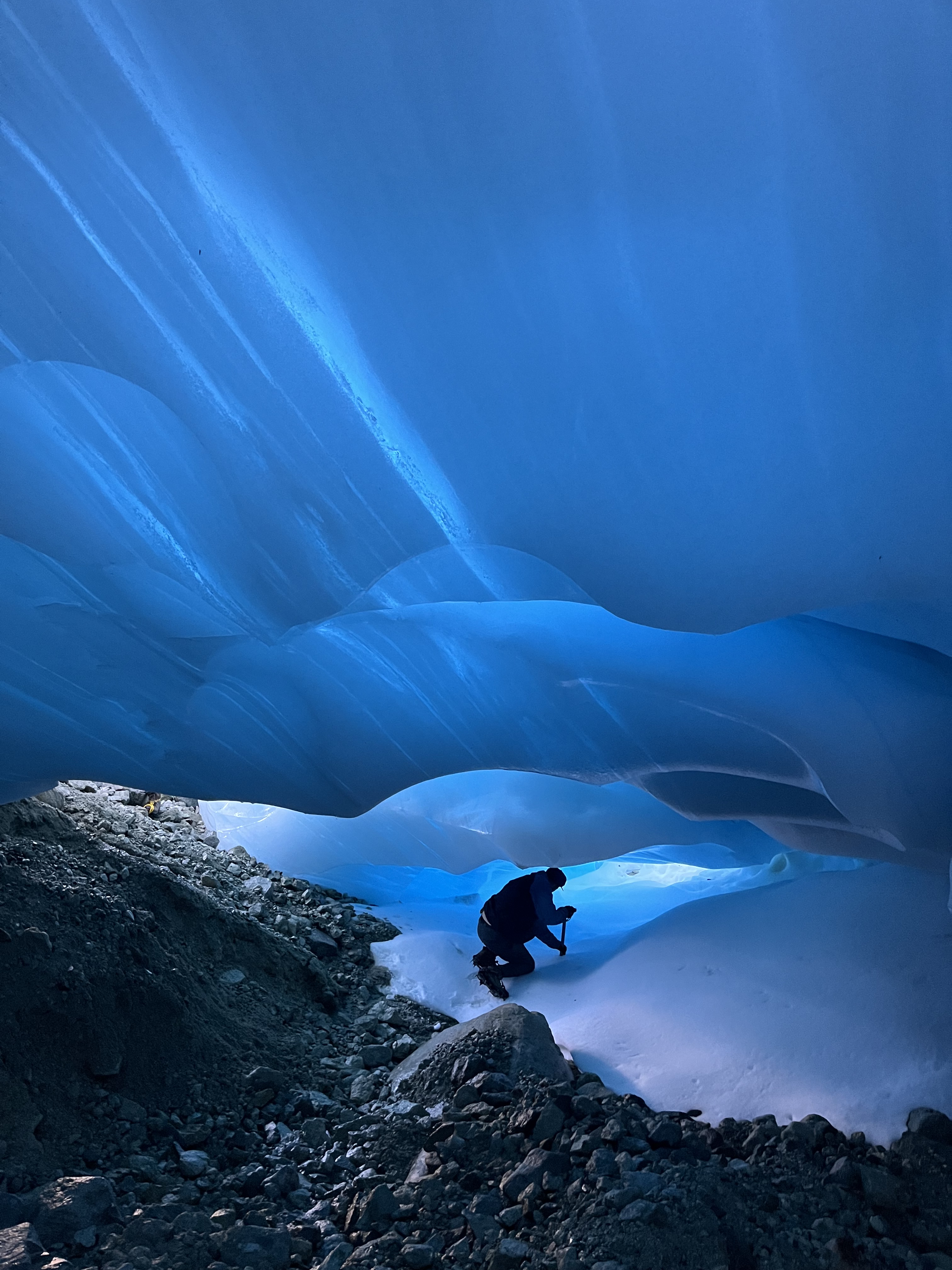
Mauri Pelto: Climate change has led to increased glacier melting on all of the glaciers we have observed. A combined 70+ years of field experience that Ben, Jill and I have provides a context that is crucial. The increased melt is apparent in the streams flowing across the surface very few meters carrying meltwater to the rivers and then the sea. This summer we saw the beauty of the final stages of decay of a glacier melting away in the ice caves that transected the former Ice Worm Glacier (image below). The cave started at the top of the glacier and continued right to the bottom, by next summer that too will be gone. The colors and atmosphere in the cave were spell binding. The landscape remains beautiful, but is losing the glaciers that are a powerful, beautiful and dynamic part of this landscape.
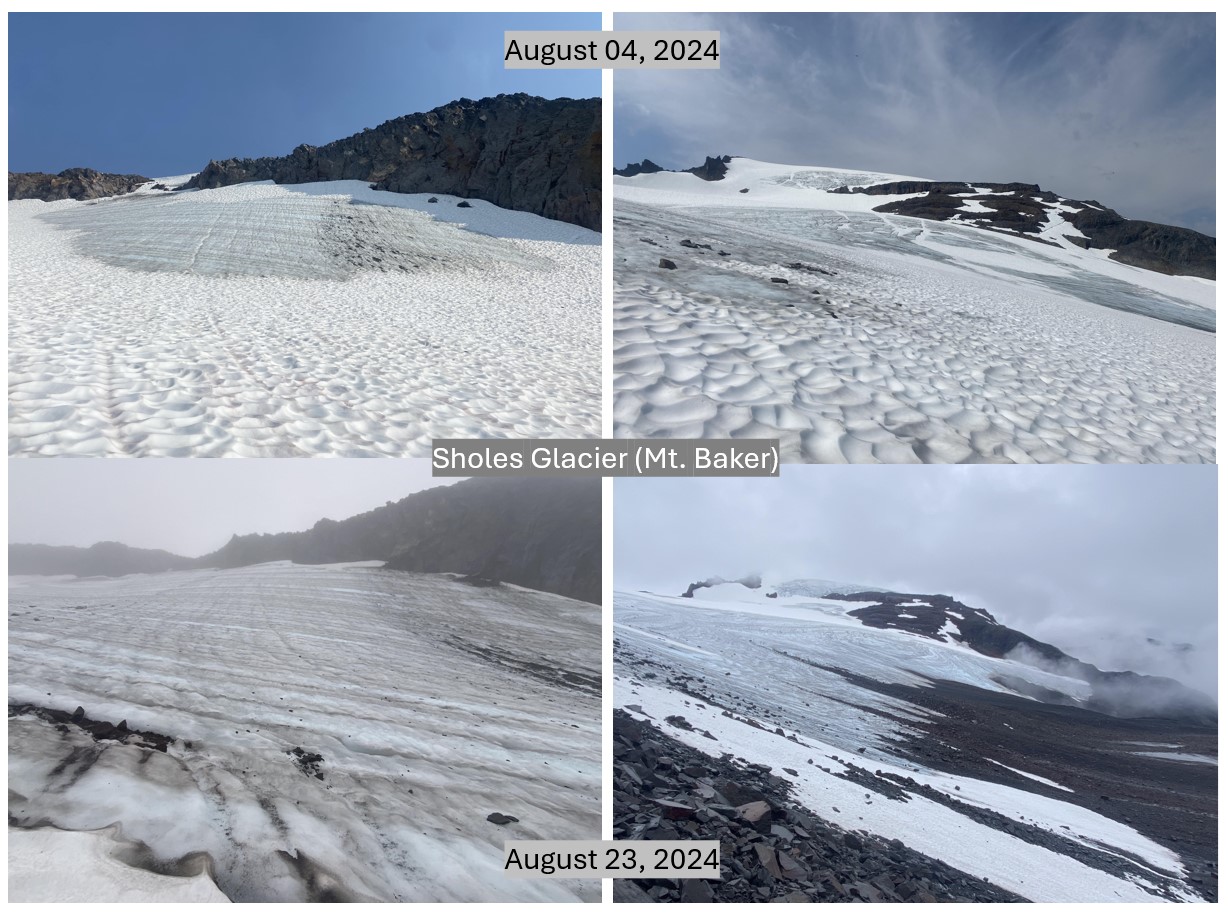
Katie Hovind: Nestled along Ptarmigan Ridge, overlooking Kulshan’s glacier-flanked slopes, was our longest campsite of the field season. Unzipping my tent to an increasingly familiar skyline four mornings in a row, I found myself developing a relationship with this place. I noticed patterns and changes alike, discovering not just the place but a sense of home in it. We followed transects across the Sholes, probing up and down the glacier; we explored a collapsed ice cave near its terminus, blue ice towering over me, ancient wisdom frozen in the dripping layers I ran my hands along; we took water measurements from the stream it feeds, pausing for a break next to the fresh melt as I sketched the textures of rock and snow and ice. We commuted across it twice to the Rainbow Glacier, a trek familiarizing me with the Sholes’ sweeping slopes and views; and we screwed an ice auger deeper than we could see, dropping stakes 3-4 feet below the surface. 19 days later, I returned to the coordinates of those four stakes, which were now all exposed, one sticking up to just over 3 feet above the surface. Reeling as I walked across the glacier I’d gotten to know, the near-incomprehensible volume of loss I saw. A feeling of belonging is so integral to caring. And then comes the question of how to transmit that connection, to spread to others the same sense of responsibility to protect a place? Being lucky enough to experience even a handful of days taking in just a small degree of the Sholes’ nuances, I felt deeply just how wrong and quick the melt is. But from the outside looking in, without any prior reference points, the severity of the glacier shrinking could be overlooked. Through these comparison photos, I hope to share just a glimpse, beauty and grief and all, of what it means to understand and love a glacier.
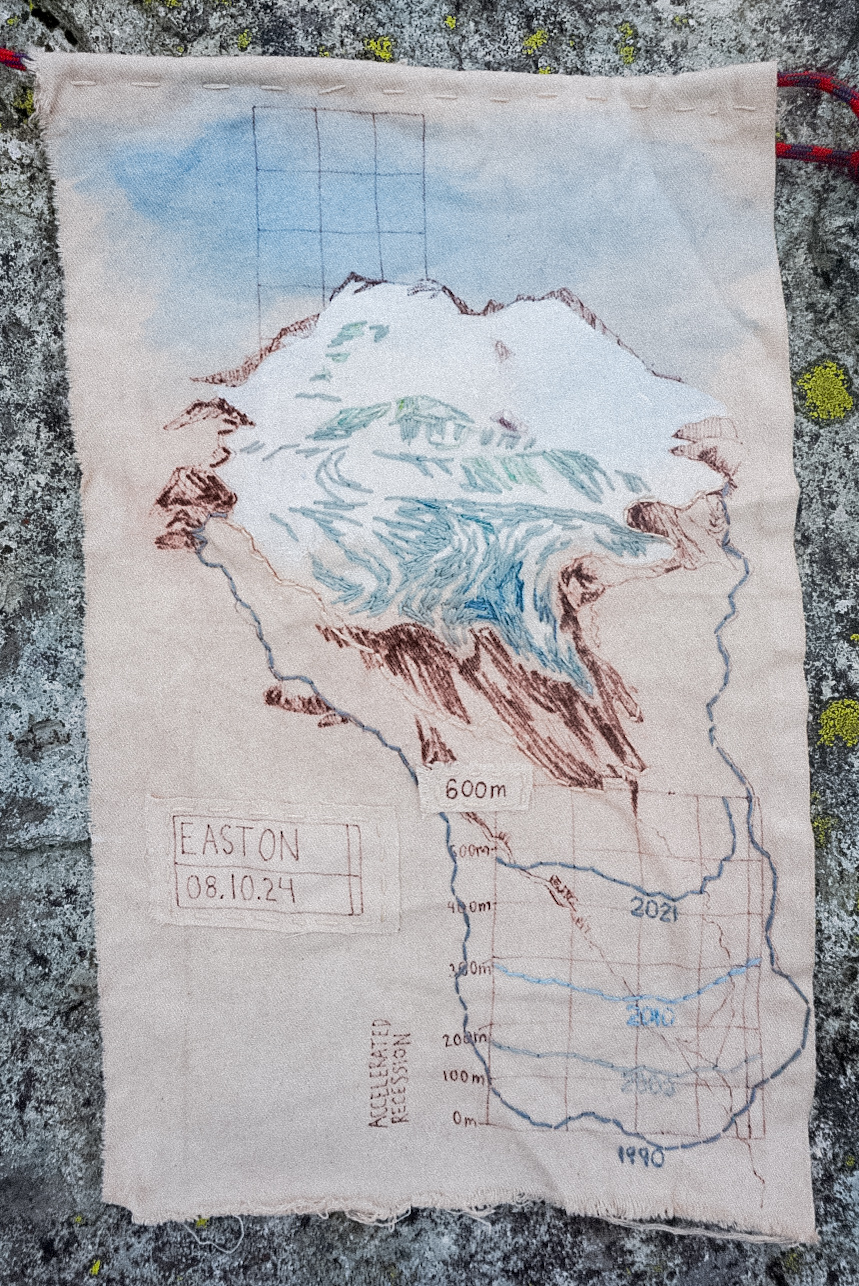
Emma Murray: Just a few minutes into our hike from camp to the Easton glacier, Science Director Mauri Pelto pointed out the rock that marked the spot where he put his crampons on in 1990. Looking up the valley, the ice felt SO far away. This glacier has retreated almost 600m in my lifetime already. In response to the melting at each of the six glaciers I visited during my time with the Project, I added paint, pen, and thread to canvas. These flags are both white-flag surrenders to all the melting we cannot stop and blowing-in-the-wind prayers for us all to act in the ways we can. I hope these pieces help people to visualize and feel the difference between where the ice was and where it is now. I think feeling that loss is groundwork for our urgent conversations about climate solutions, which can be uplifting and cool and pragmatic and creative!
Shari Macy: Mauri Pelto, peers into the melting terminus of the Lower Curtis Glacier; located on the southern slopes of Mount Shuksan in the North Cascades of Washington State. As founder of the North Cascade Glacier Climate Project, he has been measuring these shrinking giants since 1984. This image, to me, shows a man and what he dedicated his life to studying. A passion that drove him to spend over 700 nights in tents, camped out next to the glaciers of the North Cascades. These glaciers could use a lot more people like Mauri. Does everyone need to backpack to remote glaciers every summer? No. He already does. However, we could all be a little more dedicated to the health of our planet, our home. Our one and only. Our children’s one and only.
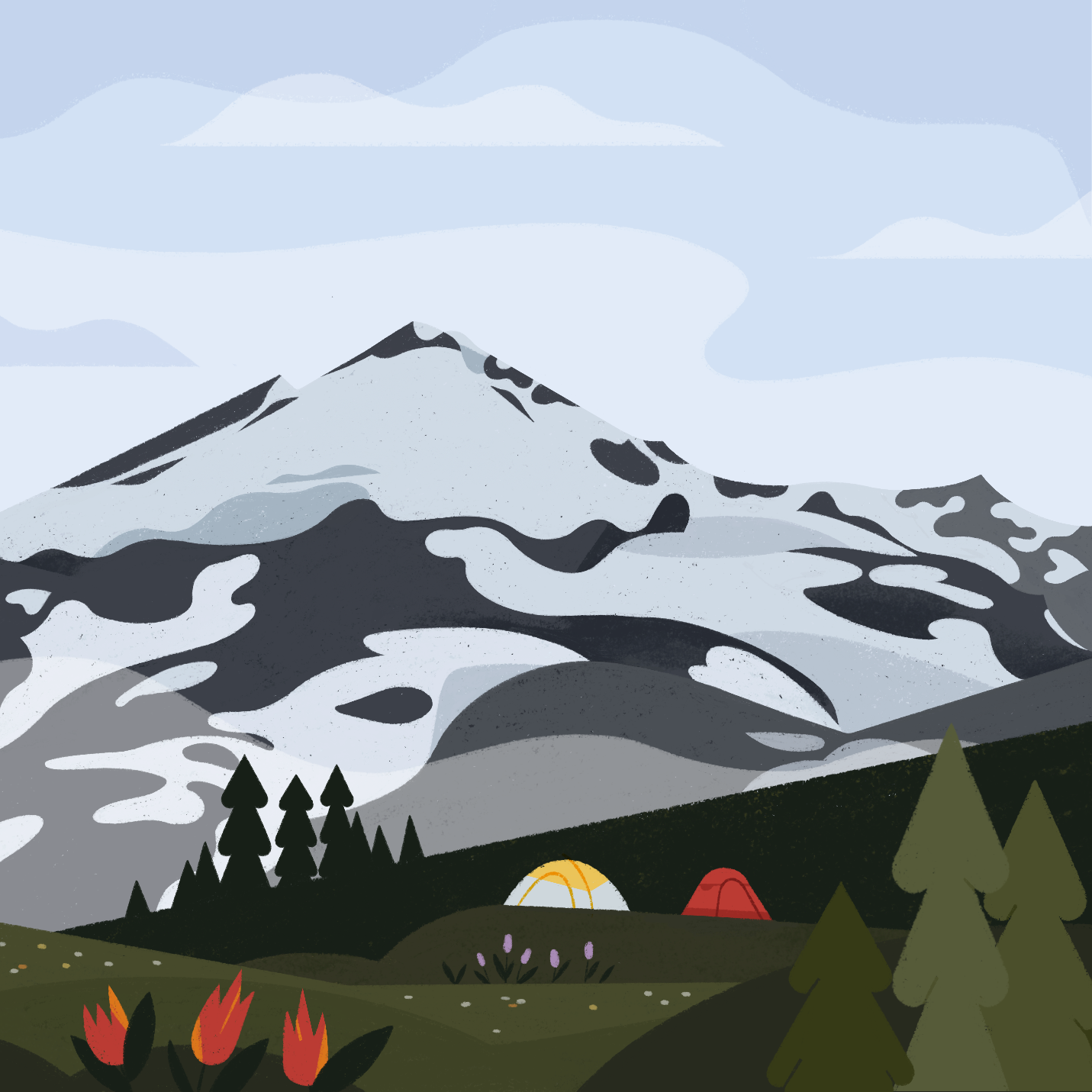
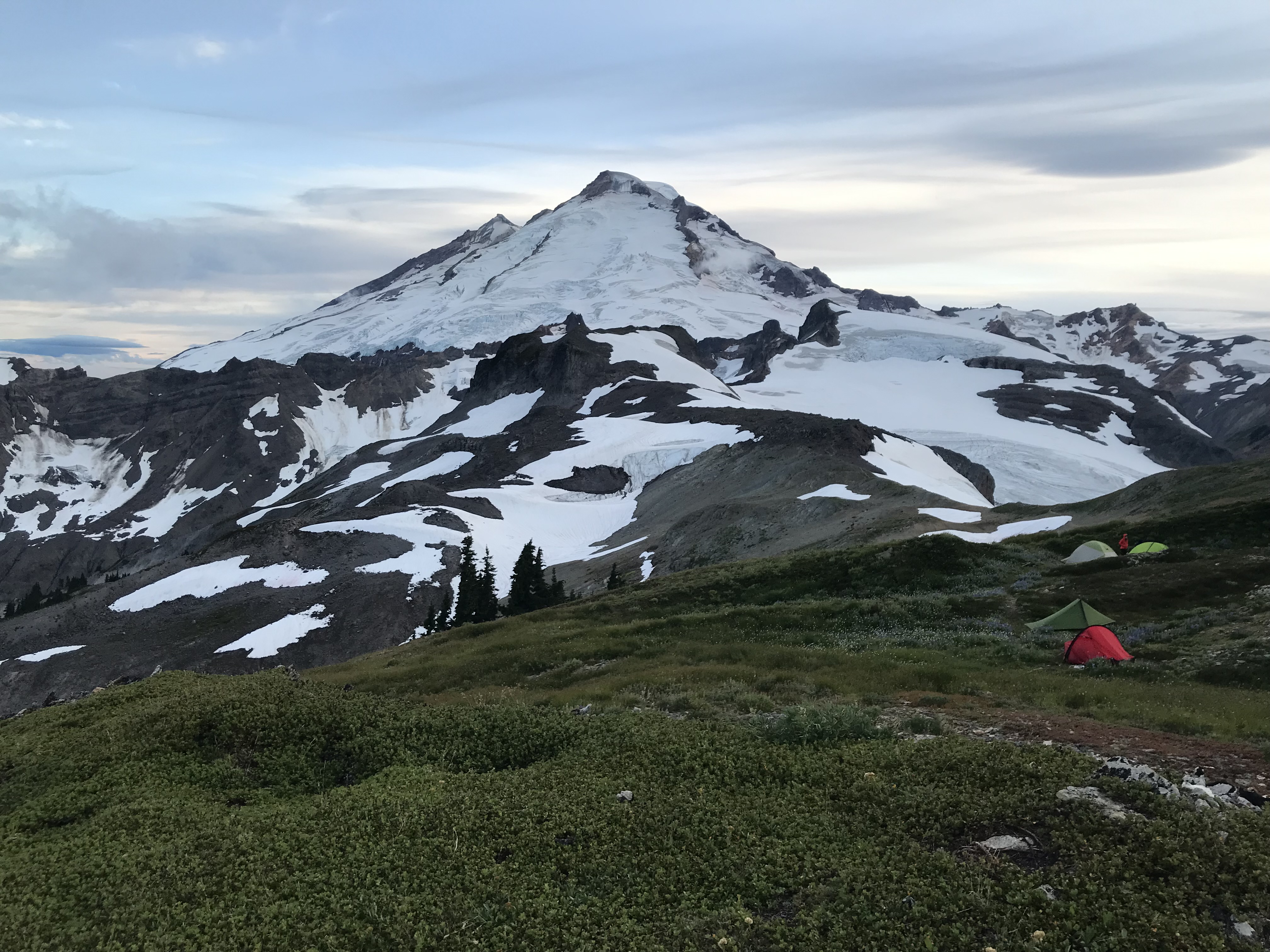
Megan Pelto: To me, Mt. Baker represents the North Cascades. Camping next to its looming presence makes me aware of how impactful it is, its glaciers helping support the ecosystem and the wildlife that surround it. Getting to be present in this wilderness feels like a gift and a chance to both disconnect and reconnect. Everything you have is contained in one little tent and the experience of camping in this landscape is magical. I wanted to capture that with our colorful little tents tucked into grassy hills with Baker above us. I have been able to visit this landscape over the past 10 years, and while the glaciers change each year, many things have remained peacefully the same.
Ben Pelto: Disappearing glaciers remind me of grandparents—I’m saddened by their decline, yet deeply grateful for the time I still have with them. This year, being in the field was especially meaningful, surrounded by an incredible group of people, just experiencing the mountains and soaking it all in. What I find hardest about glaciers vanishing is not just the loss of ice, but the disappearance of their dynamism and beauty from the landscape. These ancient giants bring a sense of magic and power to the mountains, and it breaks my heart to think that my children or grandchildren might never witness them as I have.
Cal Waichler: This season I ask what it means to be a voice for glaciers. How can I transmit my gratitude that I can stand on this earth, breathe glaciers’ breezes, seep in icy blue and alpenglow rose, pop alpine huckleberries in my mouth, and notice the shrinking snow and dissolving ice, while also alerting people to their vulnerabilities? Glaciers are a throughline in my explorations and art. I am so utterly enchanted by them. The awe and creative inspiration they bring to my life is a great gift. As a voice for shrinking glaciers, what stories can I share that will enchant other people with them? What will make us care enough to enact climate change mitigation and adaptation, and vote for climate leaders? Here, a snapshot of those most transient and irreplaceable things.
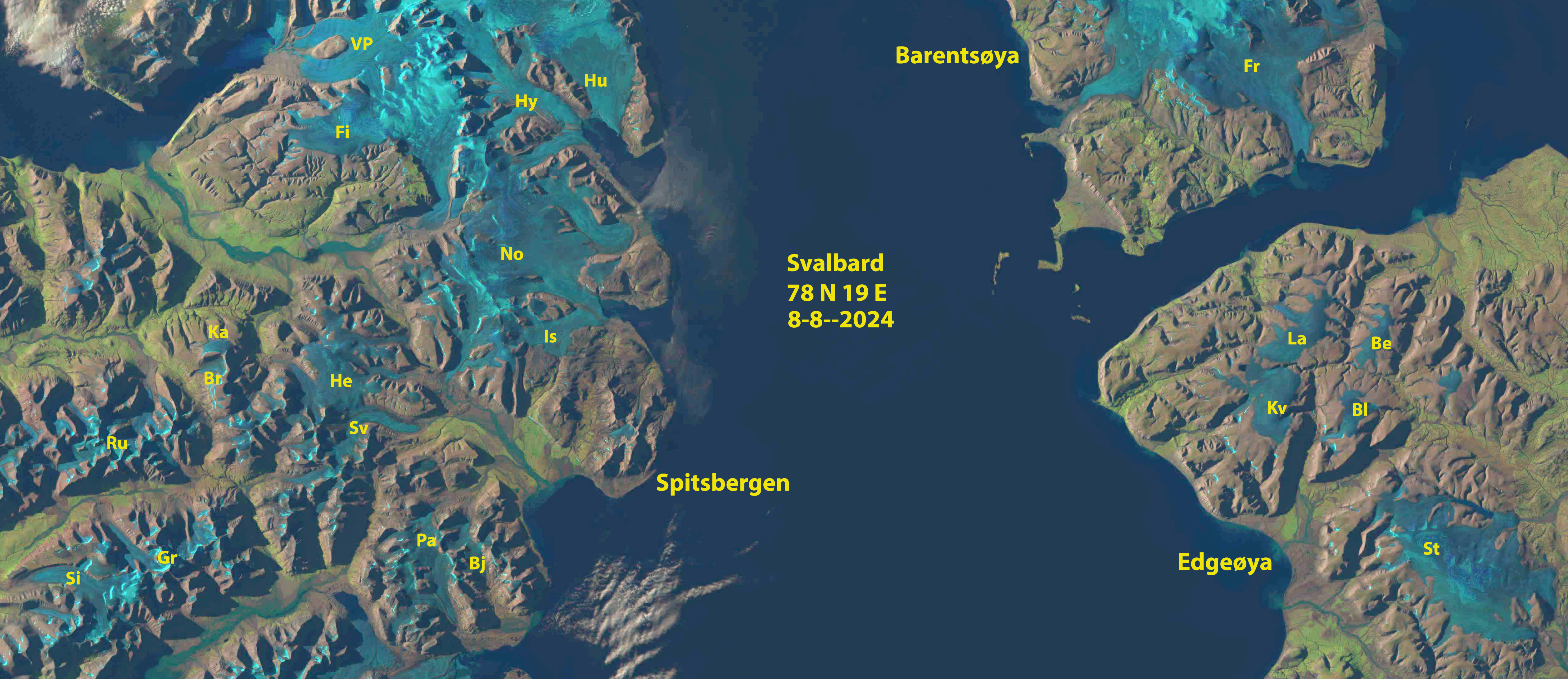
Most Svalbard glaciers in this Landsat image from 8-8-2024 are snow free. This view is centered on 78 N and 19 E spanning parts of Barentsoya, Edgeøya and Spitsbergen. On Langjokulen (La), Kvitisen (Kv), Bergfonna (Be), Blaisen (Bl) and Storskavlen (St) on Edgeøya snow cover is gone. Bjarmanbreen (Bj), Passfonna (Pa), Hellefonna (He), Sveigbreen (Sv), Nordmannsfonna (No), Isrosa (Is), Kamfonna (Ka), Breitfonna (Br), Rugaasfonna (Ru), Hayesbreen (Hy), Heuglinbreen (Hu) on Spitsbergen all snowcover is lost.There is a small amount of snowcover left in the upper reaches of a few glaciers including Freemanbreen (Fr), Gruvfonna (Gr), Siakbreen (Si), Von Postybreen (VP) and Fimbulisen (Fi).
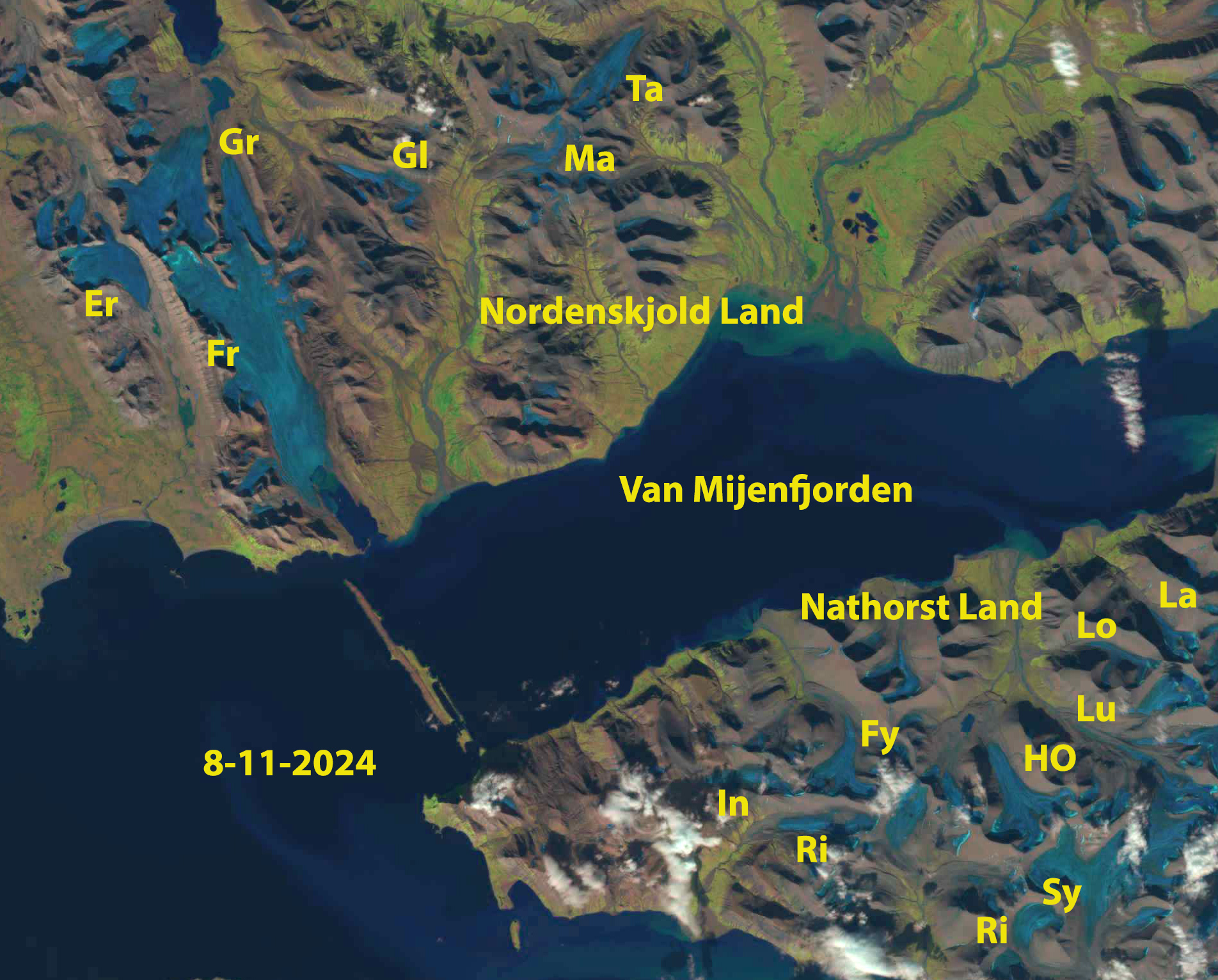
All the glaciers labelled in the Nathorst Land and Nordenskjold Land region of Svalbard are snow free on 8-11-2024 in this Landsat image. Er=Erdmannbreen, Fr=Fridtjovbreen, Gr=Gronfjorden, Ta=Taviebreen, Ma=Marstranderbreen, Gl=Gleditschfonna in Nordenskjold. HO=Hoegh Omdalbreen, Sn=Snokubreen, Fy=Frysjabreen, In=Instebreen, Ri=Richterbreen, Ri=Ringerbreen, La=Langlibreen, Lo=Loyndebreen, Lu=Lundbreen, Sy=Sysselmannbreen in Nathorst Land.
Warm temperatures across Svalbard in July and early August has resulted in many glaciers losing all of their snowcover. The result will be enhanced and significant thinning of these glaciers. This follows on 2022 which was the warmest summer on record in Svalbard and led to many snow free glaciers (Pelto, 2022). This record was exceeded in summer 2023 (Copernicus Climate Change Service, 2024). Here we look at Landsat images and Sentinel images across several islands from late July and early August illustrating the widespread nature of the extensive glacier snow cover loss.
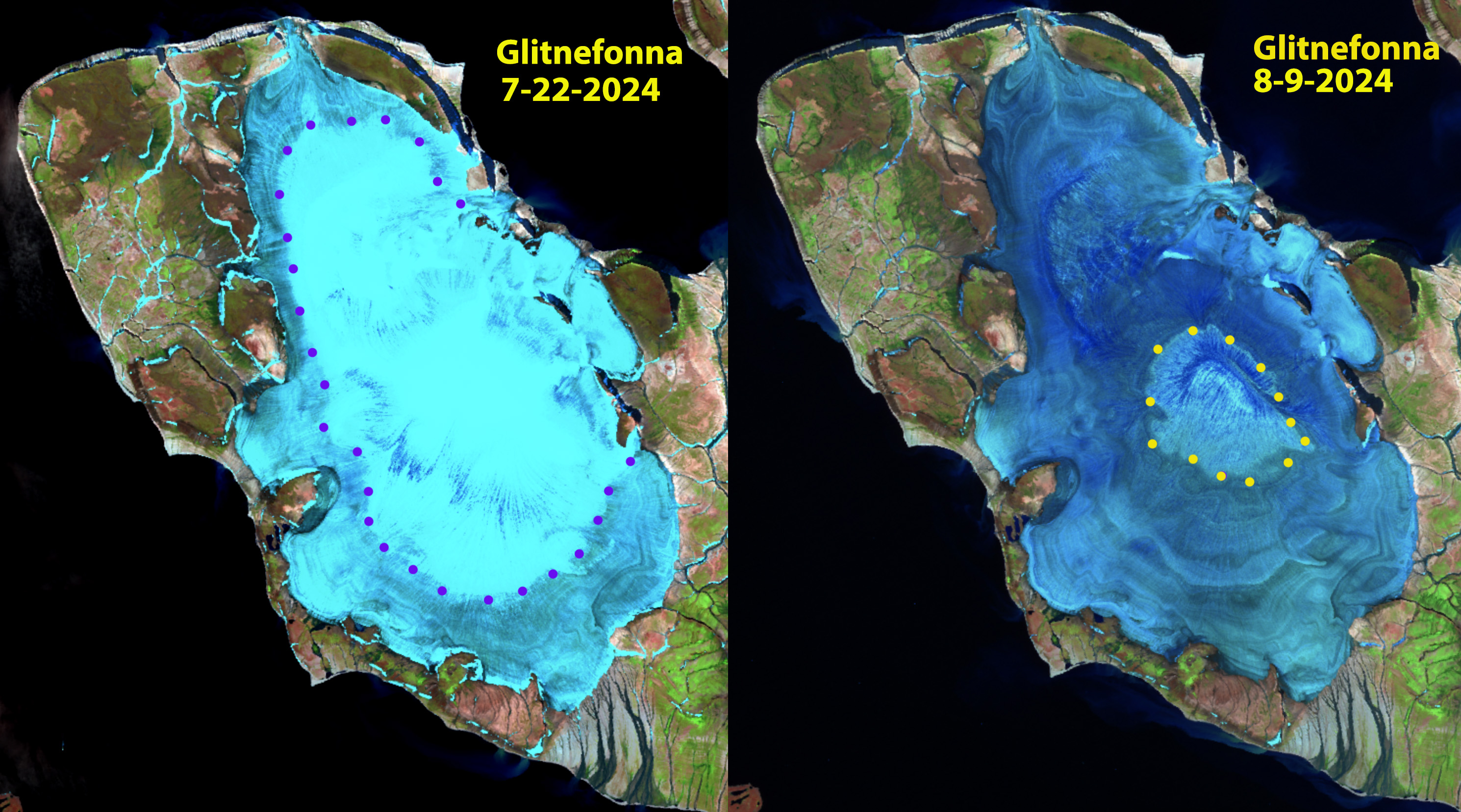
For ice caps such as Glitnefonna, Langjokulen (La), Kvitisen (Kv), Bergfonna (Be), Blaisen (Bl) and Storskavlen (St), because of their low top elevation and relatively flat slopes their ability to survive is dependent on much of meltwater generated on the higher plateau areas being refreezing within the firn instead of escaping the glacier (Noel et al 2020). In 2020 the snowcover was lost and the firn thickness diminished. In August 2022 the snowcover again was lost and there was little evident firn that could lead to refreezing of meltwater. In August 2024 snowcover loss has again occurred.
For the glaciers of Spitsbergen to maintain .equilibrium requires 50% of the glacier needs to be snowcovered at the end of summer. By early August with a month left of summer melt, the area is below 10% on every glacier noted above. How much more melt will occur. The net result will be extensive mass loss once again (NASA EO, 2024).
Glitnefonna is a 145 km2 ice cap in Gustav Albert Land where snowcover declined from 55% snowcover on 7-22 (purple dots) to 0% snowcover on 8-9-2024 in these Sentinel images. A small area of saturated firn/snow is evident, yellow dots.Glitnefonna is a 145 km2 ice cap in Gustav Albert Land where snowcover declined from 50% snowcover on 7-18 (yewllow dots) to 0% snowcover on 8-9-2024 in these Landsat images.
Mass balance change of North Cascade glaciers during our first 40 years, painting by Jill Pelto
41st Annual Field Program
2024 Field Season: For the 41st consecutive summer we are heading into the field to measure and communicate the impact of climate change on North Cascade glaciers. This year an overall focus of the project is observing, documenting and examining “What happens when a glacier disappears from the glacier to the sea?” We have three sponsors for the research this summer; Alpine Start (supplies), Heather’s Choice (supplies) and Protect Our Winters (grant funding).
This field season follows the 2021, 2022 and 2023 seasons that featured either historic heat waves and periods of extended warm weather. The heat led to a greater exposure of bare ice on glaciers with a higher albedo and greater density. The observed melt rates are 7-9 cm/day water equivalent during warm weather events vs 4-6 cm/day for snow surfaces. This led to substantial mass losses (glacier thinning) on North Cascade glacier for the three years of ~5 m. In 2024 winter snowpack in the North Cascades above 1200 m in 2024 was 60-75% of normal on May 1. May and June featured more new snow on the glaciers, mixed with periods of warm weather helped slow the loss of the limited snowpack above 1500 m.
Science objectives: We will complete detailed measurements on 10 glaciers, three of which are part of the World Glacier Monitoring Service reference glacier network (~45 glaciers globally), which have 30+ consecutive years of mass balance observations. This summer we will have an opportunity to assess the long-term ramifications of the 2021-2023 summers and measure the response of glaciers to the weather of 2024 with detailed mass balance, crevasse depths and glacier surface elevation profiling. We also focus on the impact of diminishing glacier size on downstream runoff. In four of our main field areas from 1984 we have observed a total of 25 glaciers disappear. In the Rainy Pass area, there are no longer glaciers for us to observe. See detailed observations.
Art Objectives: We will collaborate with several artists who will join us for a portion of the field season. They will be able to create their own work about the landscape and the science or may join us for fieldwork and make plans for future artwork. Artists include painters, a textile artist, illustrator, and an underwater photographer. We hope to use this art to share our research with a broader audience and highlight the beauty and importance of these places.
Communication Objectives: We will leverage the brands of our expedition sponsors this year which each have a climate change focus. These organizations can help spread our message. We will utilize a combination of artists and scientists to tell the story.
Field Team 2024:
Jill Pelto (she/her) is an artist and scientist from New England who grew up loving winter sports and trips to the mountains. She incorporates scientific research and data into paintings and prints to communicate environmental changes. Her multi-disciplinary work weaves visual narratives that reveal the reality of human impacts on this planet. She completed both her B.A. degrees in Studio Art and Earth and Climate Science, and her M.S. focused on studying the stability of the Antarctic Ice Sheet at the University of Maine, spending two field seasons at a remote camp in the southern Transantarctic Mountains. Jill will be joining the project for her 15th field season. She is excited about continuing to document the change in North Cascade glaciers that she has witnessed each of the last ten years — through science and art.
Mauri Pelto (he/him)has directed the project since its founding in 1984, spending more than 800 nights camped out adjacent to these glaciers. He is the United States representative to the World Glacier Monitoring Service. For 15 years he has been author of the blog “From a Glacier’s Perspective”, and associate editor for three science journals. He is on the Science Advisory Board for NASA’s Earth Observatory. His primary position is Associate Provost at Nichols College, where he has been a professor since 1989. He either runs on trails or skis on trails alpine and cross country every day.
Katie Hovind (she/her) is an undergraduate student at Western Washington University, majoring in Environmental Science, and exploring a range of minors from mathematics to Salish Sea studies. Born and raised next to the Cascades, she feels a deep connection to this region. Sailing, skiing, backpacking, and rock climbing have helped foster her love for the environment, and a determination to pursue a career studying and protecting it. As she starts mountaineering this year, she’s thrilled to combine that with glacier research. Having observed so much change in the mountains from afar, this is an amazing opportunity for her to gain hands-on experience and learn from the skilled scientists and artists collaborating to tell these glaciers’ stories.
Field Partners 2024-
Shari Macy (she/her) is a First Nations (Secwépemc) knowledge keeper, filmmaker, and underwater photographer. Feeling a strong ancestral duty to advocate for the health of our sacred lands and waters, she embarked upon a lifelong journey of dedication to creating impactful content that motivates, educates, and serves as a muse for change. From her award-winning nature documentary to scuba diving into Earth’s sacred bodies of water, she has an eye for the beauty that encompasses the planet we live upon. She is interested in observing changes in the glaciated waters of the Nooksack River and documenting those changes using underwater photography and film.
Emma Mary Murray (she/her) is an environmental artist focused on slow-crafting heirloom textile pieces that honor the landscapes they depict. She often up-cycles existing fabrics; her work combines her love of stitching and painting with her desire to work toward a more circular economy and a more sustainable future. When she is not moving her needle through canvas for hours upon hours, she explores the threads of connection between people and place by teaching at a place-based elementary school, teaching embroidery workshops for all ages, journaling outside, climbing, skiing, and trail romping. She hopes that by stitching the ever-changing light, topography, and textures of the North Cascades’ glaciers, she can spark greater appreciation for— and conservation of— the planet’s interconnected resources.
Karin Kirk (she/her) is a geologist, science journalist, and skier living in Bozeman, MT. She writes for Yale Climate Connections and NASA climate change. Karin is also a professional ski instructor at Bridger Bowl ski area and an avid backcountry skier. Her writing spans topics from Earth science to renewable energy data and often is centered around data-rich visualizations – always with the goal of explaining topics in a clear and relatable way. She regularly engages with policymakers and voters on matters of climate and energy, finding these interactions to be essential for developing her communications skills.
Ice Mermaid team: American ice swimmer Melissa Kegler, whose 2022 US record-breaking swim was documented in the film Ice Mermaid by Dan McComb, has set her sites on breaking the world record. But finding water cold enough for her to train and compete in year-around is becoming increasingly difficult. So this summer, we are teaming up to explore and swim in glacial lakes and to learn what disappearing glaciers could mean for the future of animals and humans downstream.
Claire Giordano is an environmental artist, writer, and educator creatively telling the stories of science, climate change, and the modern experience of nature. From creating rain-dappled sketches in an old growth forest to filming a watercolor class beside a glacier, careful observation of nature inspires her goal is to connect people and place through art. In 2021 she founded the Adventure Art Academy – a series of virtual watercolor classes filmed outside – to invite others into the joy of painting outside.
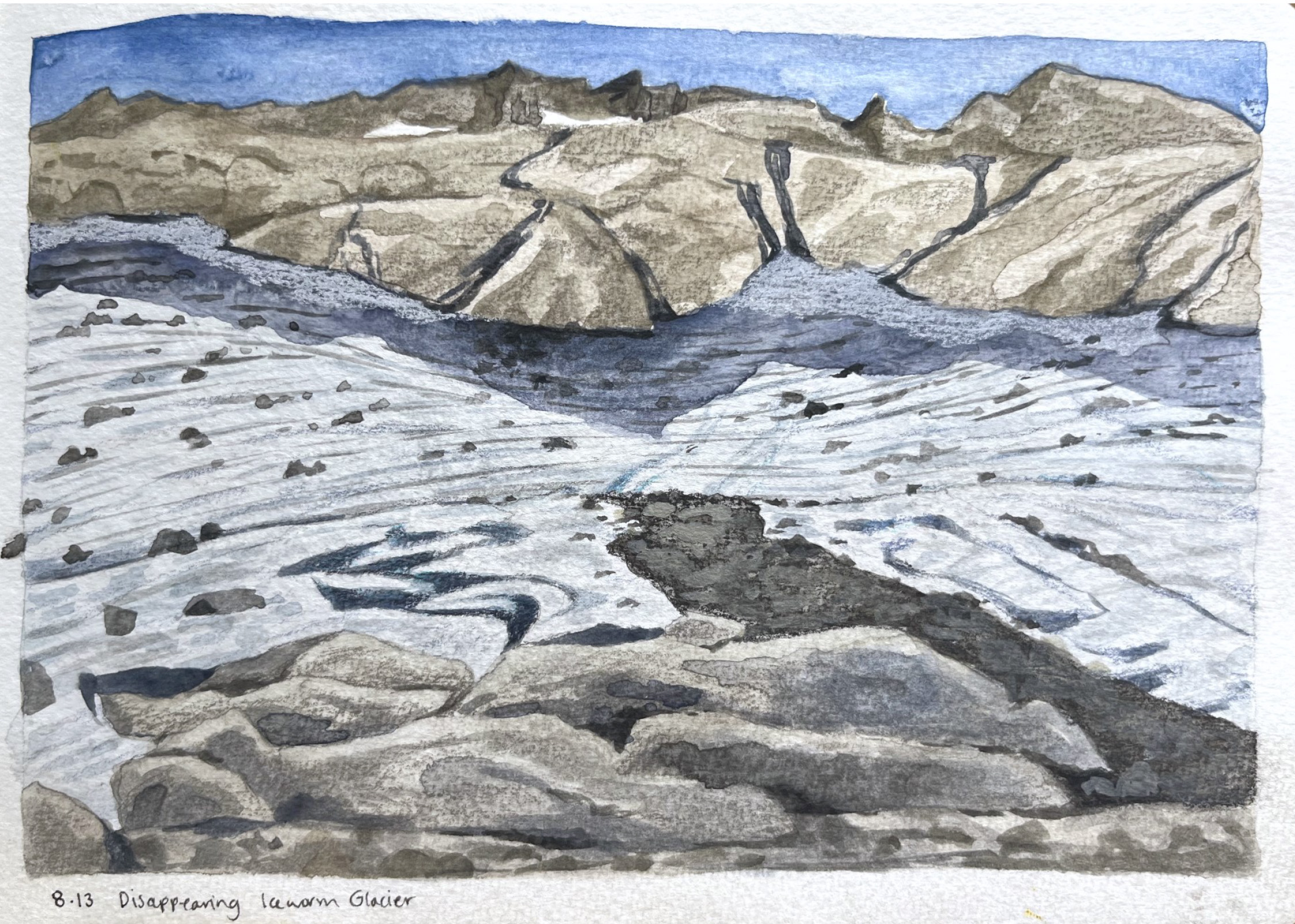
In 1984 there were nine glaciers spread across the Mount Daniel-Mount Hinman complex. You could traverse from one to the next with limited time off snow and ice. By late summer of 2023 only three glaicers remained. We monitored Daniel, Ice Worm and Lynch every years since 1984. Ice Worm no longer a glacier in 2023.
How much melt and glacier recession will we see this summer. Check back in one month and the results will be in.
Change in terminus position of coastal glaciers in the Sewqrd region. On this 2023 Landsat image yellow dots are ther 2023 terminus and red dots the 1986 terminus.
Turn east along the coast from Seward Alaska and you are offshore of the Sargent Icefield, turn west and you are offshore of the Harding Icefield. Each has several large glaciers that were either tidewater or end in lakes separated from the ocean by a narrow coastal zone. Here we compare the response to climate change of seven of these glaciers from 1986-2023.
Change in terminus position of coastal glaciers in the Sewqrd region. On this 1986 Landsat image-yellow dots are ther 2023 terminus and red dots the 1986 terminus.
Travelling south down Resurrection Bay and turning east you enter into Day Harbor, at the head of which is the outlet for Ellsworth Glacier. The glacier terminates in an expanding lake that was 3.5 km long in 1986 and in 2023 is 8 km long. The 4000 m retreat generated some large icebers still in the lake.
Elsworth Glacier retreat from 2016-2020 leading to quick lake expansion in Landsat Images
Travelling east from Day Harbor 15 km brings you into Johnstone Bay. Excelsior Glacier termiates just inland from the coast is a rapidly expanding lake. The lake was 5 km long in 1986, and by 2023 is 10.5 km long, a retreat of 5500 m. The glacier has separated with the Roan Glacier terminus to the east retreating from the lake. The Excelsior Glacier terminus currently is steep and nearing the north end of the lake.
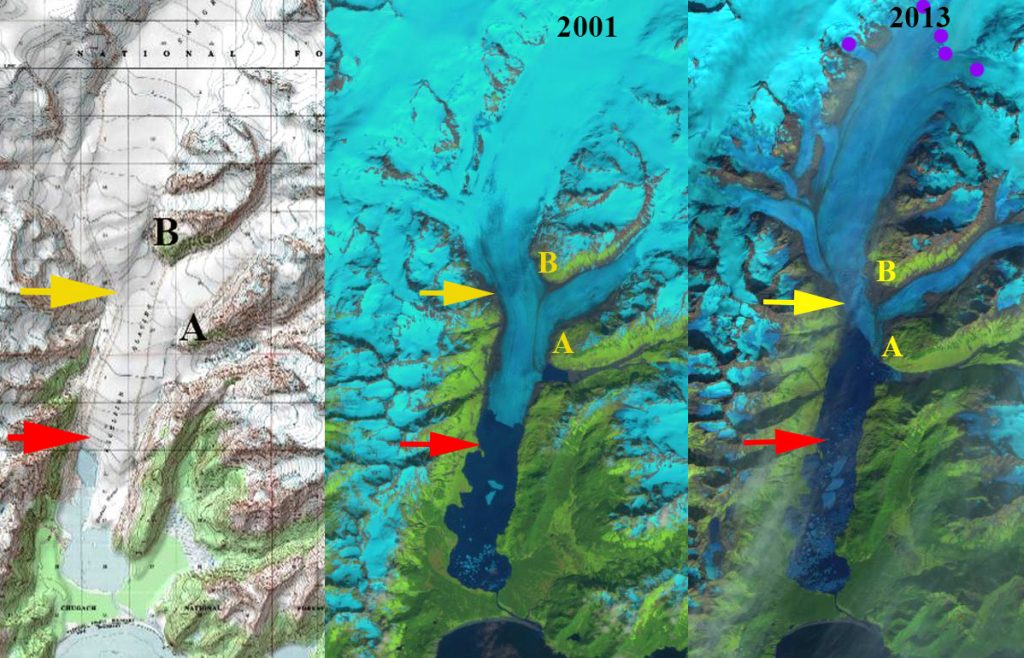
Rapid expansion of Big Johnstone lake due to Excelsior Glacier retreat. Map from 1950, Landsat images 2001 and 2013.
Heading south down Resurection Bay on the western shore is Bear Glacier. From 1950-1986 the glacier retreated 160 m, and by 1980 the terminus was calving small icebergs into an ice-marginal lake that was beginning to develop. As thinning continued, much of the terminus became afloat by 2000. Bruce Molnia, USGS observed that passive calving, characterized by the release of large tabular icebergs from Bear’s low gradient, floating terminus became frequent. Between 2000 and 2007, the terminus retreated about 3.5 km, yielding large icebergs that floated in the lake. The amount of calving has declined from the period of more rapid retreat from 2002-2008. Black et al (2022) reported Bear Glacier retreating 5170 m. losing 17.28 km2 of area from 1984-2021. From 1986 to 2024 the glacier has retreated 6200 m, leading to a lake with an area of km2.
The retreat of Bear Glacier from 1986 to 2024 leading to growth of the lake to 22 km2, in Landsat images.
Continuing around Aialik Peninsula and traveling north into Aialik Bay, along the western shore is Pedersen Glacier. The glacier drops quickly from the plateau of the icefield through a pair of icefalls terminating in a lake at 25 meters above sea level. Giffen et al (2014) observed that Pedersen Glacier retreated slow but steady from 1951-1986 at 706 m (20 m/a) and 434 m (23 m/year) from 1986-2005. Black et al (2022) reported a retreat of 3170 m and loss of 4.25 km2 from 1984-2021. We note a 3500 m retreat from 1986-2023.
Pederse Glacier retreat in Landsat images, leading to rapid lake expasion to 4 km2.
At the head of Aialik Bay is the tidewater Aialik Glacier. This glacier advanced 180 m from 1950-1986.From 1986-2006 the glacier retreated 290 m. Black et al (2022) observed the terminus was stable from 2000-2021 despite ongoing receession of the eastern margin of the glacier.
The Holgate Arm extends off of Aialik Bay on the west shore just south of Pedersen glacier. This tidewater glacier retreated 250 m from 1950-1986. The glacier has had several small periods of advance and retreat since 1986. Black et al (2022) note a period of advance from 2010-2021, the terminus has begun a small retreat from 2021-23 and is now just behind the 1986 position.
Northwestern Glacier is at the head of Northwestern Fjord off of Harris Bay, the next Bay west of Aialik Bay. This tidewater retreated 5200 m from 1950-1986, and an additional 1600 m since 1986. This retreat has led to a separation into two primary arms of the glacier. The rate of retreat has slowed since 2000 and the glaciers tidewater connection is limited, and will likely cease with even further minor retreat.
The Harding and Sargent icefield both have limited accumulation area above 1500 m. This means that they are prone to complete loss with a limited rise in snowline elevation. This is similar to the Juenau Icefield situation, where our research has indicated accelerated losses (APNews).
Grand Plateau Glacier on June 15, 2024 Sentinel image, illustrating 5.5 km retreat from Island (I) where terminus was located in 1984. N illustrates nunatak the glacier terminated 11 km from 1948 terminus. Point A is new island emerging at terminus. The Lake that barely existed in 1948, has more than doubled in size since 1984 to 49 km2.
Grand Plateau Glacier drains southwest from Mount Fairweather in southeast Alaska. The glacier advanced during the Little Ice age to the Alaskan coastline. Early maps from 1908 show no lake at the terminus of the glacier. The 1948 map (below) shows three small distinct lakes at the terminus of the main glacier and a just developing lake at the terminus of the southern distributary terminus (D). The distance from the Nunatak N to the terminus was 11 km in 1948. The lake at D is 400 m wide.
USGS 1948 topographic map of area Illustrating three small disconnected proglacial lakes at the terminus (I).
USGS 1948 topographic map of area Illustrating distribuatry tongue
Grand Plateau Glacier in 1984 Landsat image indicating 1984 terminus at orange arrows, 2013
Landsat images from 1984 indicates the fromation of a single connected proglacial lake with an area of 24 km2. Key reference points in each image are the Nunatak, N, and and Island, I. The retreat from 1984-2013 is evident with the orange arrows indicating the 1984 terminus and pink arrows showing the 2013 terminus location. The distance from the Nunatak to the terminus is 8.5 km in 1984 and 4 km in 2013. On the north shore of the lake the retreat between arrows is 2.7 km from 1984-2013. From the island the glacier retreated 3.3 km from 1984-2013, with the lake expanding to 43 km2. The distributary tongue (D) retreated 2.2 km from 1984-2013. The retreat was driven by higher snowlines in recent years, the snowline had been reported at 1000 m in the 1950’s. Satellite imagery of the last decade indicates snowlines averaging 1500 m, red arrows. The glacier snowline is evident in Landsat imagery in 1984 and 2013 red arrows.
In 2024 the lake area has grown further to 49 km2, as a result of a retreat of 8 km since 1948 and 5.5 km since 1984. Today a second island is emerging at the terminus, Point A. The distributary tongue to the southeast now terminates in a lake that is now 5.2 km long, a 4.8 km retreat since 1948 and 2.6 km since 1984. The combination of higher snowlines and increased calving into the terminus lake will continue to lead to retreat of this still mighty river of ice. This retreat parallels that of nearby Alsek Glacier and Yakutat Glacier. The rapid growth of the three lakes since 1984 when I visited them is amazing.
La Perouse Glacier in 2018 and 2023 Landsat images indicating the six developing proglacial lakes (1-6). The lakes in 2023 have a combined area of 1.3 km2. Debris cover has expanded notably at Points D.
La Perouse Glacier flows from the Fairweather Range to the Pacific Coast. The glacier advanced to the coast in the mid-late 19th century and has remained tidewater on the coast since (Gaglioti et al 2019). I first saw this glacier in 1982 and its terminus stretched 3.5 km along the coast, a second terminus ended inland and was 3.2 km wide. Both of the terminus are piedmont fed by a significant accumulation area above 2300 m, that flows through a spectacular icefall from 1100 to 1800 m. This high accumulation zone helps make the glacier more resilent to warming temperature (Pelto, 1987). Berthier et al (2010) noted a ~0.5 m/loss average loss for glaciers in this region from 1962-2006, which has generated this retreat. The glacier because of its size and large piedmont lobe is slow to respond to climate change, 20 km2 coastal lobe and 10 km2 inland lobe.
La Perouse Glacier coastal terminus area indicating the three developing proglacial lakes, yellow arrows. False color Sentinal images.
Up to 2018 the coastal terminus was thinning, but had not experienced significant recession or proglacial lake development. There was significant marginal recession by 2018 exposing a forest overrun by the glacier in the 1860’s (Gaglioti et al 2019). In 2018 the inland terminus had developed 3 proglacial lakes wiyth a combined area of 0.4 km2. By 2023 the inland terminus lakes spread across 90% of the width of the terminus, with a combined area of 0.7 km2. In 2023 the main terminus had developed three proglacial lakes each, #1 at 0.12 km2, #2 at 0.16km2 and #3 at 0.36 km2. Lake #3 has numerous bergs indicating the ability to rapidly expand by calving, due to having a greater water depth. In just five years the debris covered area has expanded notably. This combination of expanding glacial lakes and debris cover is an indication of ongoing rapid decline. The changes here are simialr to that at nearby Brady Glacier and progressing on the same trend as Fingers Glacier. Look for further lake development in 2024 particularly in the coastal lobe.
The snow line on Mount Everest Region glaciers on May 1,, 2024 indicated by yellow dots on the Landsat image. Note that Nangpa La and Nup La-two high passes (5800-5900 m) are both snow free. The average snow line is 6050 m.
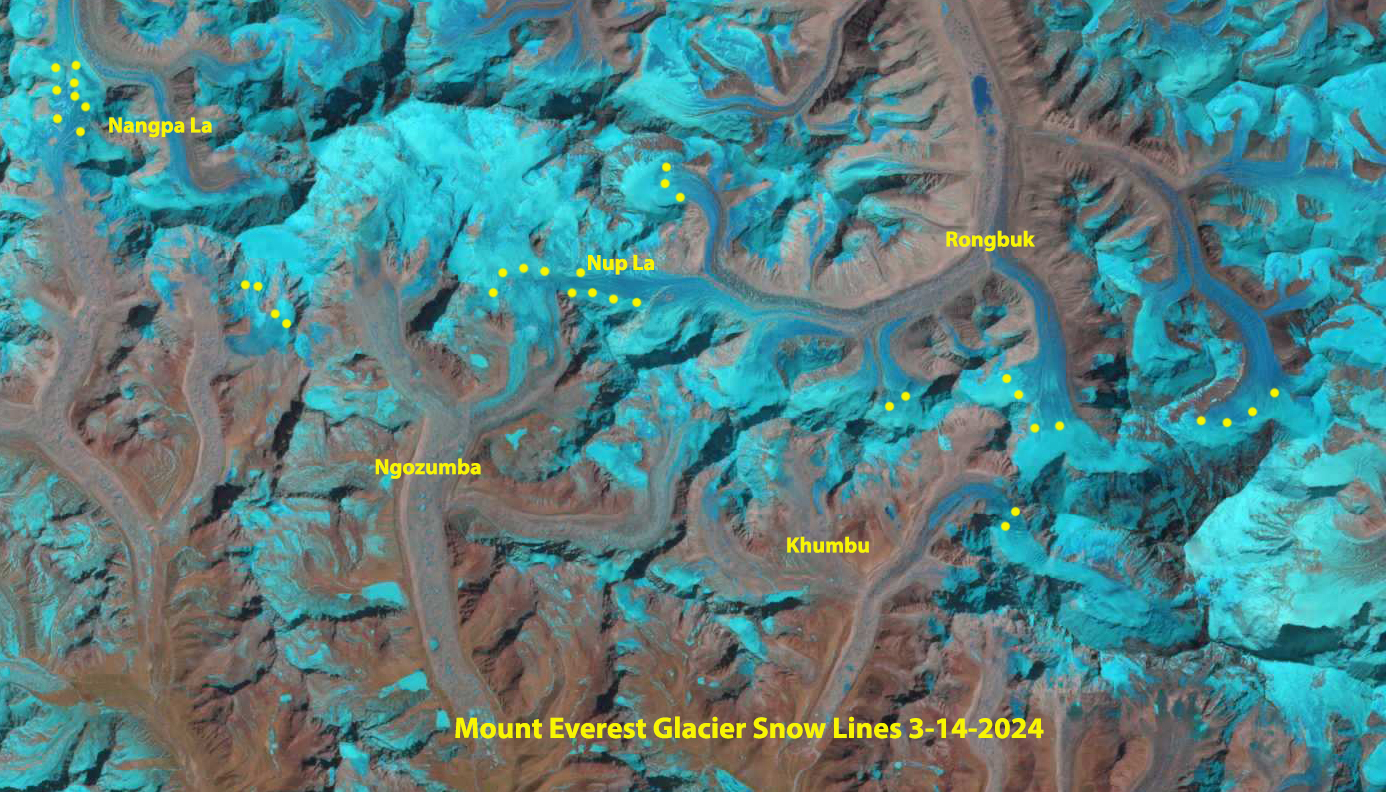
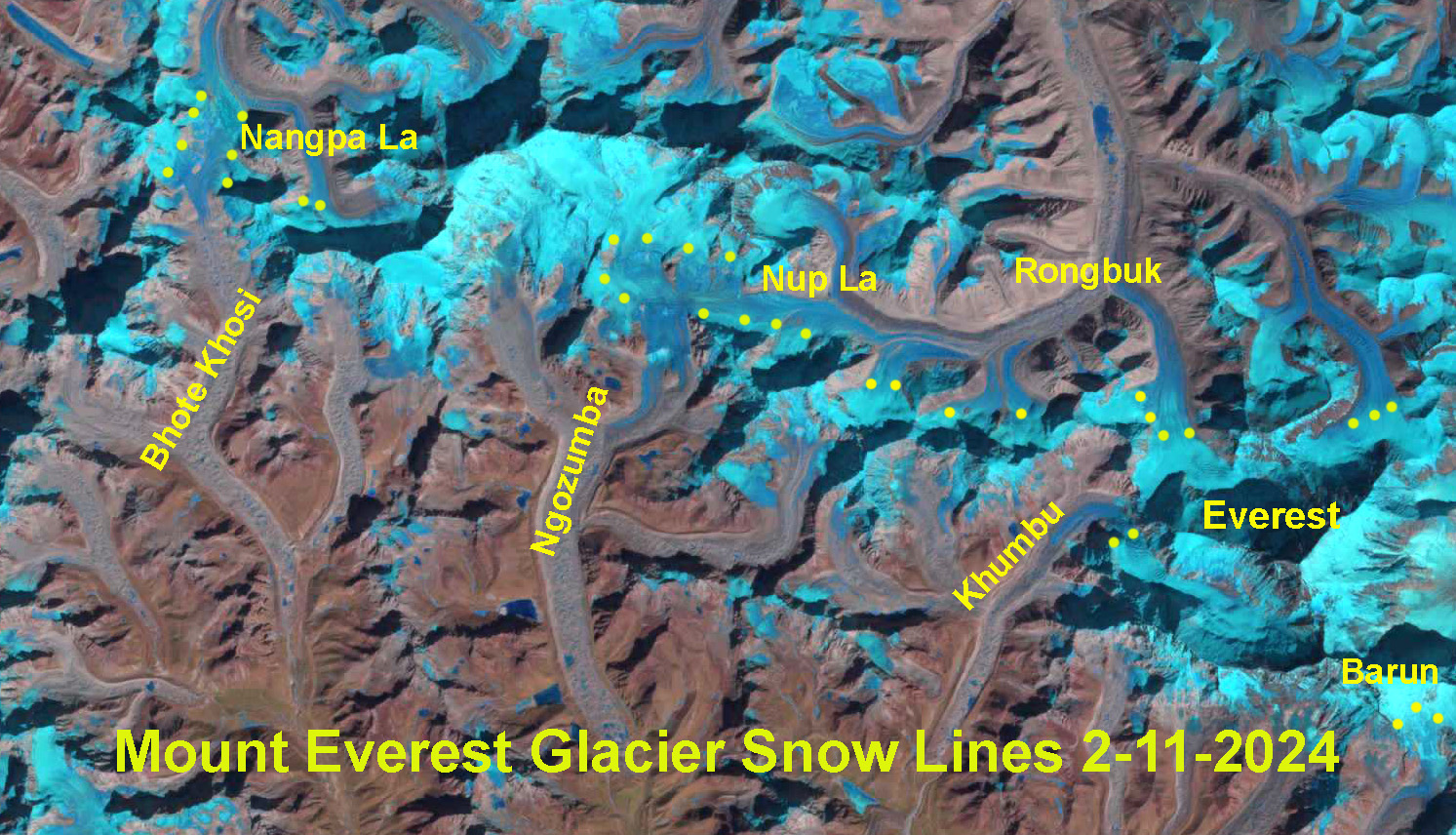
This is a update to a previous post examining high snow lines through the winter on Mount Everest Region glaciers. Here we examine imagery from October 2023 through early May 2024 illustrating the rise in snow line into January and the continue high elevation into the pre-monsoon season. The persistent high snow line over the last six months, indicates a lack of snow accumulation during the winter season. This is a dry season, yet typically leads to extensive, though not particularly deep snow cover. There were a few smaller snow events, but the snow cover did not persist indicating that ablation has continued even above 6000 m on Mount Everest. The lack of snow leads to less infilling of crevasses on Khumbu Glacier, which are further opened by persistent ablation. On May 1 there is evident blue ice and firn areas in the Western Cwm, above the Khumbu Icefall and on the Lhotse Face above the Western Cwm at the head of the Khumbu Glacier. The relatively bare slopes above the Western Cwm also cannot generate as much avalanches that would then accumulate snow in that basin. These same slopes will yield more rock fall, with more exposed unburied rock.
In the Khumbu Icefall velocities indicates by NASA ITS LIVE are ~1m/day which leads to considerable crevasse development in the six months from November into May with very limited snow accumulation and evident ablation, image below. This season is different than the high snow lines i 2020/21 that resulted from extraordinary January heat wave. Snow cover did develop at the end of the winter/early spring (Pelto et al 2021).
The snow line on Khumbu Glacier on May 1,, 2024 indicated by yellow dots on the Landsat image. Note that there are bare ice areas in the Western Cwm (WC) and on the Lhotse Face (LF).The snow line on Mount Everest Region glaciers on March 14, 2024 indicated by yellow dots on the Landsat image. Note that Nangpa La and Nup La-two high passes (5800-5900 m) are both snow free. The average snow line is 5950 m.
The snow line on Mount Everest Region glaciers on Feb. 11, 2024 indicated by yellow dots on the Landsat image. Note that Nangpa La and Nup La-two high passes (5800-5900 m) are both snow free. The average snow line is 6000 m.
The snow line on Mount Everest Region glaciers on Jan. 10, 2024 indicated by yellow dots on the Landsat image. Note that Nangpa La and Nup La-two high passes are both snow free. The average snow line is 5950 mKhumbu Glacier on Feb. 11, 2024 in Landsat image illustrating snow line near top of icefall at 6000 m, yellow dots. There is some blue ice showing on north side of Western Cwm (WC), Lhotse face too shadowed to see well, but some blue ice evident.The snow line on Mount Everest Region glaciers on Nov. 15, 2023 indicated by yellow dots on the Landsat image. Note that Nangpa La and Nup La-two high passes are both snow covered. The average snow line is 5800 m.The snow line on Mount Everest Region glaciers on Oct. 30, 2023 indicated by yellow dots on the Landsat image. Note that Nangpa La and Nup La-two high passes are both snow covered. The average snow line is 5700 m.Khumbu Glacier Icefall velocity from NASA ITS LIVE. Green arrows indicate primary rangeEverest Base Camp Precipitation from the National Geographic Perpetual Planet station.
Baird Glacier terminus tongue gone in April 26, 2024 Landsat image. Red arrow indicates now joined 5 km2 proglacial lake. Yellow dots terminus of Baird and North Baird Glacier
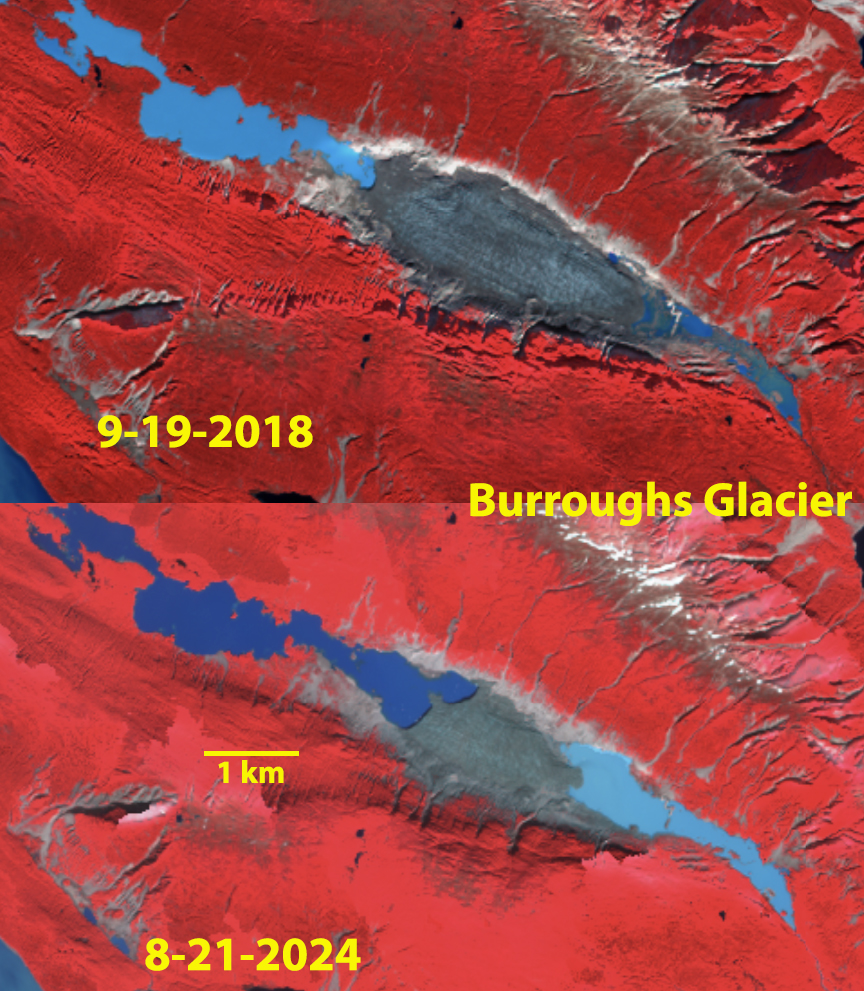
Baird Glacier drains the west side of the Stikine Icefield in southeast Alaska. It is the only glacier of the Stikine Iceifield that did not retreat significantly from 1960-2010. Pelto et al (2013) predicted the onset of significant retreat of this glacier, which like Brady Glacier had been slow to begin retreat despite thinning that was evident when I visited the glacier in 1984. The proglacial lake that has emerged with retreat has an area of 3.25 km2 and the glacier retreat is 2800 m from 1990-2024. The North Baird Glacier separated from Baird Glacier in 2019, with a proglacial lake extending downvalley to the tongue of Baird Glacier that separated this lake from the Baird Glacier proglacial lake until April 2024.
Baird Glacier in Landsat images from 1990 and 2023 illustrating retreat and proglacial lake expansion.Baird Glacier in false color Sentinel images from September 10 2023 and May 2 2024. Proglacial lake (PGL) expanded from 3.2 to 5.1 km². Tongue extending upvalley toward North Baird Glacier (NB) broke up in late April, yellow arrow.
Baird Glacier in false color Sentinel images from July 2022 and July 2023. Proglacial lake (PGL) expanded from 3.00 to 3.25 km² width of tongue extending upvalley toward North Baird Glacier (NB) has declined from 700 m to 400 m.
In 1990 the Baird Glacier was sitting on an outwash plain, with no lake at the terminus. The North Baird Glacier was 1 km wide where it joined the Baird Glacier. By 2015 the glacier has retreated 750 m and the lake (PGL) has an area of ~1 km². In 2022 the glacier has retreated leading to a lake expansion to 3.00 km². In July 2023 the tongue of ice extending across the front of the North Baird Glacier valley has thinned 40% since July 2022. The tongue remained throughout 2023 into April of 2024 before breaking up. This leaves the main terminus of the glacier more vulnerable to further rapid calving retreat. Baird Glacier is catching up to the rest of the Stikine Icefield that has experienced significant retreat, Dawes Glacier, Patterson Glacier and Great Glacier. With Sawyer Glacier retreating from tidewater in 2023.