The Rwenzori Range,Uganda typically referred to as Mountains of the Moon have been rapidly losing their glacier cover. The small, steep glaciers descend the peaks of Mt. Stanley: 5111 m, Mt. Speke: 4891 m and Mt. Baker:4873 m. 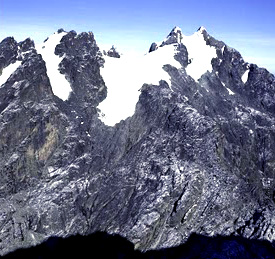 The Georg Kaser, University of Innsbruck visited the range twice in the early 1990’s to prepare maps of glacier change to compare to a 1906 map derived from documents of the Duke of Abruzzi’s expedition, the 1955 map made from vertical air-photos. They determined the area of the glaciers to be 6.5 km2 in 1906, 3.2 km2 in 1955 and 1.7 km2 in the 1990’s, note Speke Glacier as an example. This represents a 70% area loss.
  An updated satellite based analysis by Texas A&M’s Klein and Kincaid showed that the glaciers in the Rwenzori have decreased in area from 2.55 km2 in 1987 to 1.31 km2 in 2006. I have had the good fortune to work in the field with both Georg Kaser, Taku Glacier, Alaska and Andrew Klein, Easton Glacier, Washington, both have made tropical glaciers one of their specialties.
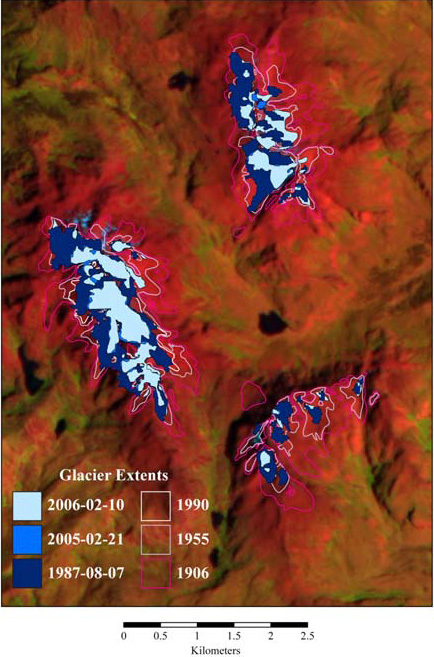 This is nearly a 50% loss in 20 years. The climate trends and glacier extent trends are not in favor of the glaciers lasting for long. This is reinforced by a comparison of images from Mount Stanley from the World Wildlife Fund.
Category: Glacier Observations
Post detailing changes in a glacier
Vista Glacier, Glacier Peak WA Retreat
Vista Glacier is the northernmost of the large valley glaciers on the east side of Glacier Peak. The glacier begins at 2475 m beneath Kennedy Peak. We examined all of the glaciers around Glacier Peak in detail in the 1990’s to document their changes since observed by C.E. Rusk 100 years earlier. The glacier during the LIA joined the Ermine Glacier and extended down to 1345 m. By 1900 when Asahel Curtis photographed this glacier it had retreated 1300 m. By 1946 the glacier had retreated an additional 600 m separating from Ermine Glacier to a minimum at 1900 m. In 1955 the glacier began a slow advance that had ended by 1975 with a total advance of 105 m. In 1985 at our first visit the glacier was again retreating, total retreat was 10-20 meters from the advance moraines. By 1994 the glacier had retreated nearly 100 m and by 1997 had retreated to the 1946 position. The retreat has continued and by 2006 the glacier had retreated 300 meters from its 1975 advance position. This glacier like all 47 glaciers we observe in the field in the North Cascades is continuing a significant retreat. Below is a sequence of images from the 1984 map, 1996 aerial photograph, and the 2006 satellite image. The latter has the orange 1975 terminus position noted, the purple line on the 2006 image is the current terminus. The dotted purple line on the aerial photograph marks the area that consistently retains accumulation. 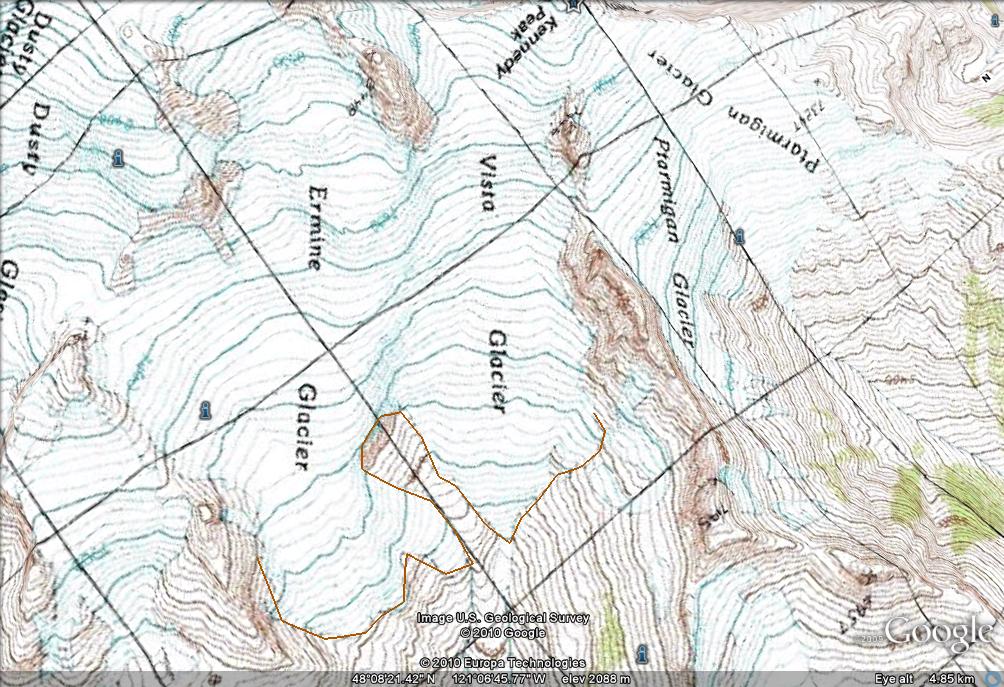
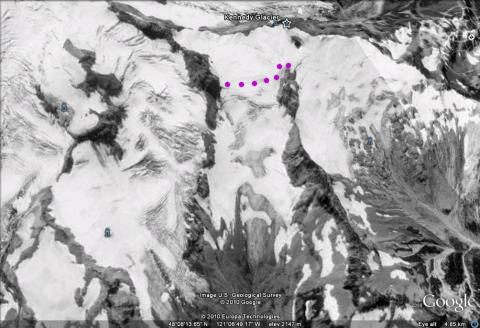
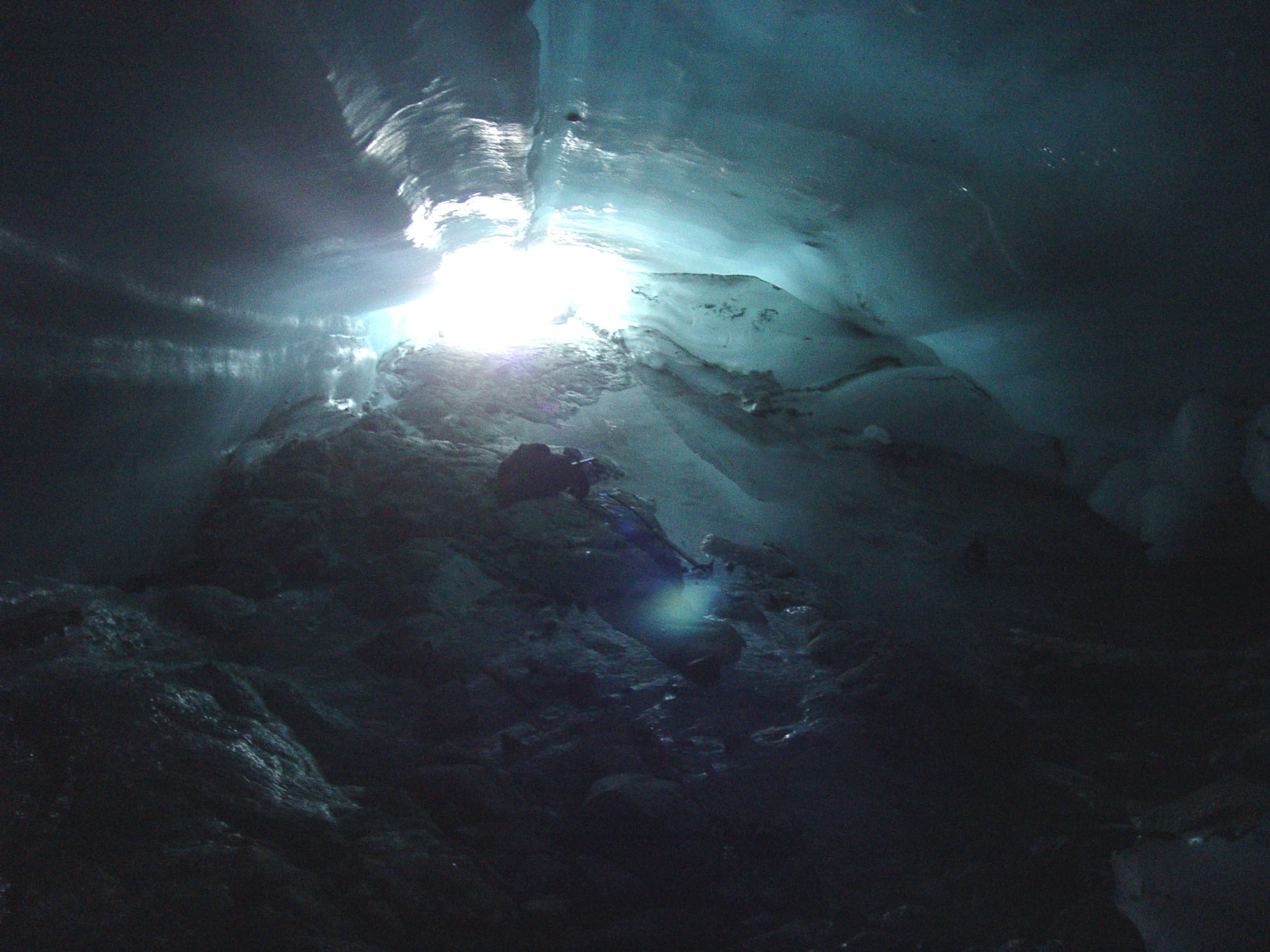
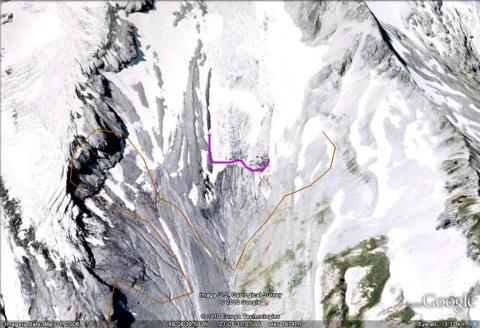 In 1994 Cliff Hedlund and I were surveying the terminus when we found a beautiful ice cave beneath the glacier. The rock just behind Cliff in the cave is apparent now out in the open in the 2006 satellite image. We surveyed the position in 1994.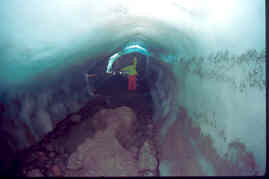
 The lower several hundred meters of the glacier are uncrevassed indicating limited flow on this fairly steep slope.
 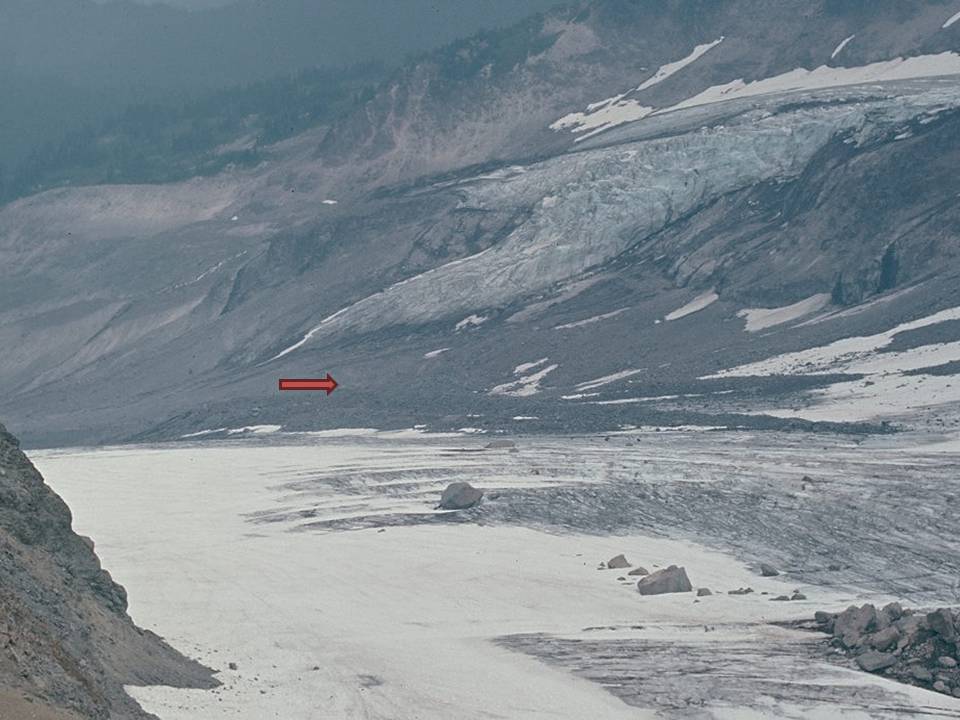 The arrow in the picture above indicates the ice surface level in 1985, the glacier has thinned 20 meters in this region. A view of the glacier from indicates the recession better, the blue dotted line is the ice margin in 1975. The picture below is from Sept. 2009 the lack of snowpack on the lower 70% of the glacier is evident. The blue dotted line is the glacier margin in 1975, and in 1985 it had changed little. This advance left a very evident moraine that will deteriorate with time.
 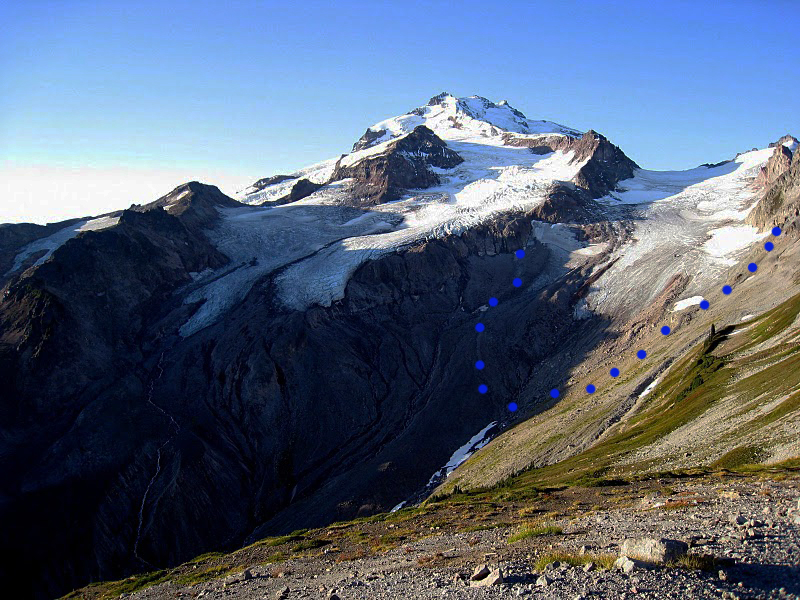 Measuring snow depth up the middle of this glacier in 1994 and 1997 we found limited areas with accumulation of greater than 2 m in early August. Note the annotated aerial photograph showing consistent snow covered area. This makes the glacier prone to losing most of its snow cover in many years such as occurred 2005 or 2009. This indicates considerable retreat will occur even with present climate. The last image is Cliff Hedlund and I on glacier in 1994, Cliff unfortunately is no longer with us, but was a great field companion and the only person I knew who could create a good spear point from rock using an antler.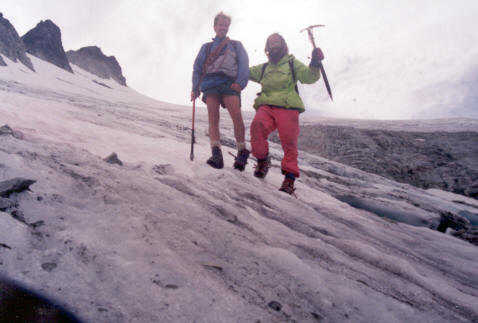
Taku Glacier Equilibrium Line Altitude Summer Rise
A key measure of the mass balance of a glacier is the equilibrium line altitude (ELA). Mass balance for non-calving glaciers is the difference between snow accumulation on a glacier and snow and ice loss from the glacier. The ELA is the point at which accumulation equals melting. On temperate alpine glaciers this is the snowline where snow transitions to bare glacier ice. Its elevation at the end of the summer marks the annual ELA. For a glacier to be in equilibrium at least 50-70% of the glacier must be in the accumulation zone still at the end of the summer. The range of percentages is determined by the specific regional climate and glacier geographic characteristics. A key observation for mass balance calculation is the shift of the ELA-snowline during the course of the melt season. The magnitude of the shift over a given time period is a measure of the melt rate. The shift can be observed in satellite imagery and when combined with field measurements quantifies melting. As the melt season begins the snow cover extent is large on a glacier. The key is how rapidly it rises during the melt season. On Taku Glacier for example in 2004 and 2006 a series of satellite images indicates the rise in the ELA. Below are images from May 26, 2006, then July 29, 2006 and then Sept. 15 2006. Indicating the rise of the snowline. These are followed by annotated images showing the rise of the ELA during the summer melt season in 2004 and 2006 on Taku Glacier. 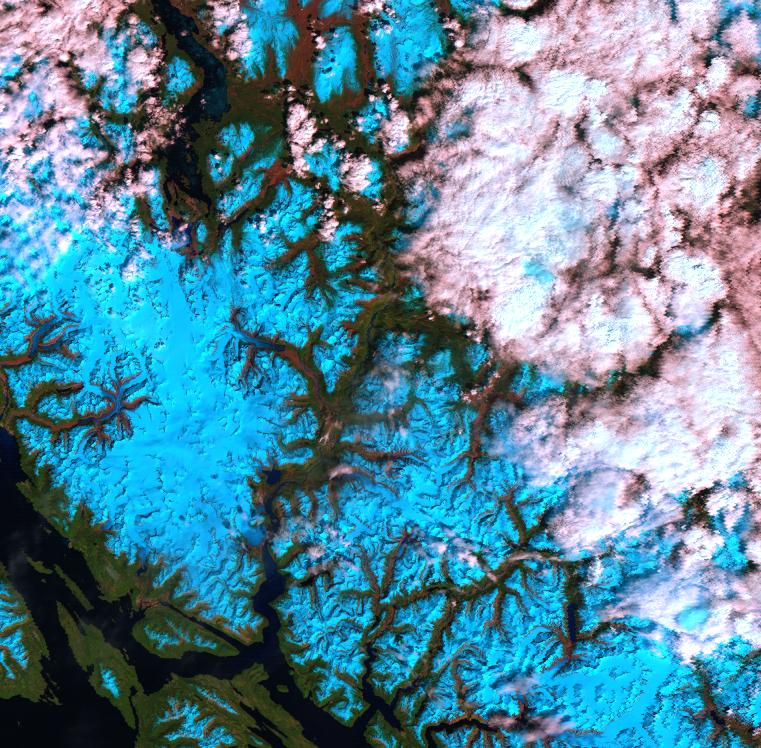


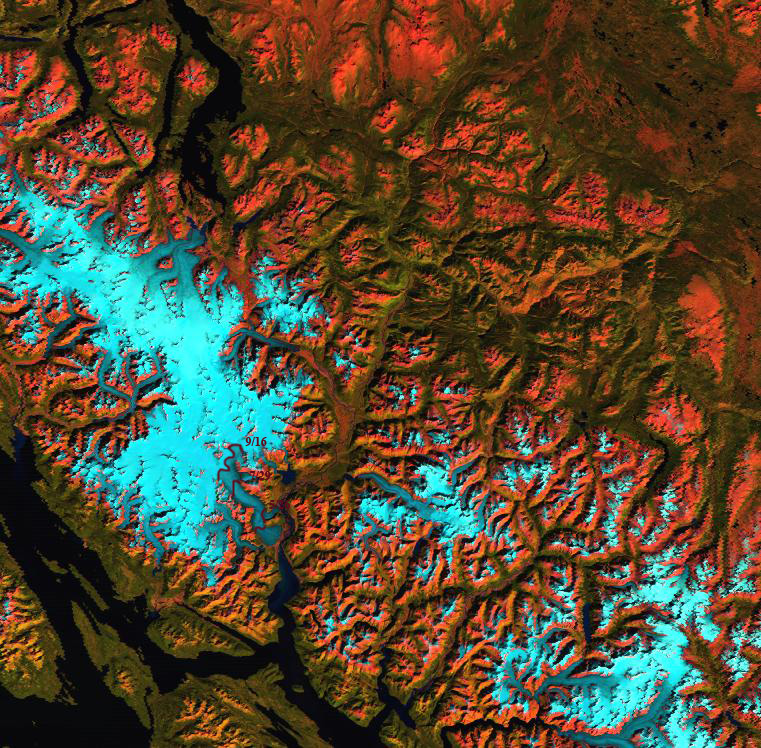

On the ground the Juneau Icefield Research Program measures the snow depths and snow melt during July and August. The above images from May 26, July 29 and Sept. 15 2006 indicate the rise of the ELA during the course of the melt season, from 1200 to 2600 to 3200 feet. Snow depths at the the Sept. 15 ELA, where snowpack=0, was 2 m on July 22. Thus, we had 2 meters of snow melt at 3200 feet between July 22 and Sept. 15. In 2004 the snowline was at 2800 feet on July 15, snowpack was 1.6 meters at the eventual Sept. 1 snow line of 3400 feet. In 45 days 1.6 m of snow was lost at 3400 feet. In 2004 the melt rate was 0.036 meters per day and in 2006 0.038 meters per day. In 2009 July began with a low ELA of 500 m after a cool snowy winter and spring. By the end of the month the ELA was over 800 meters. This 300 meter rise and the associated melt was a record for July as were temperatures in Southeast Alaska in July 2009. As the 2010 melt season begins the Taku Glacier remains snowcovered, though the blue colors near the terminus indicate melt water is saturating the snowpack on 4/10/2010. What will the 2010 melt season bring? Check back here to see. 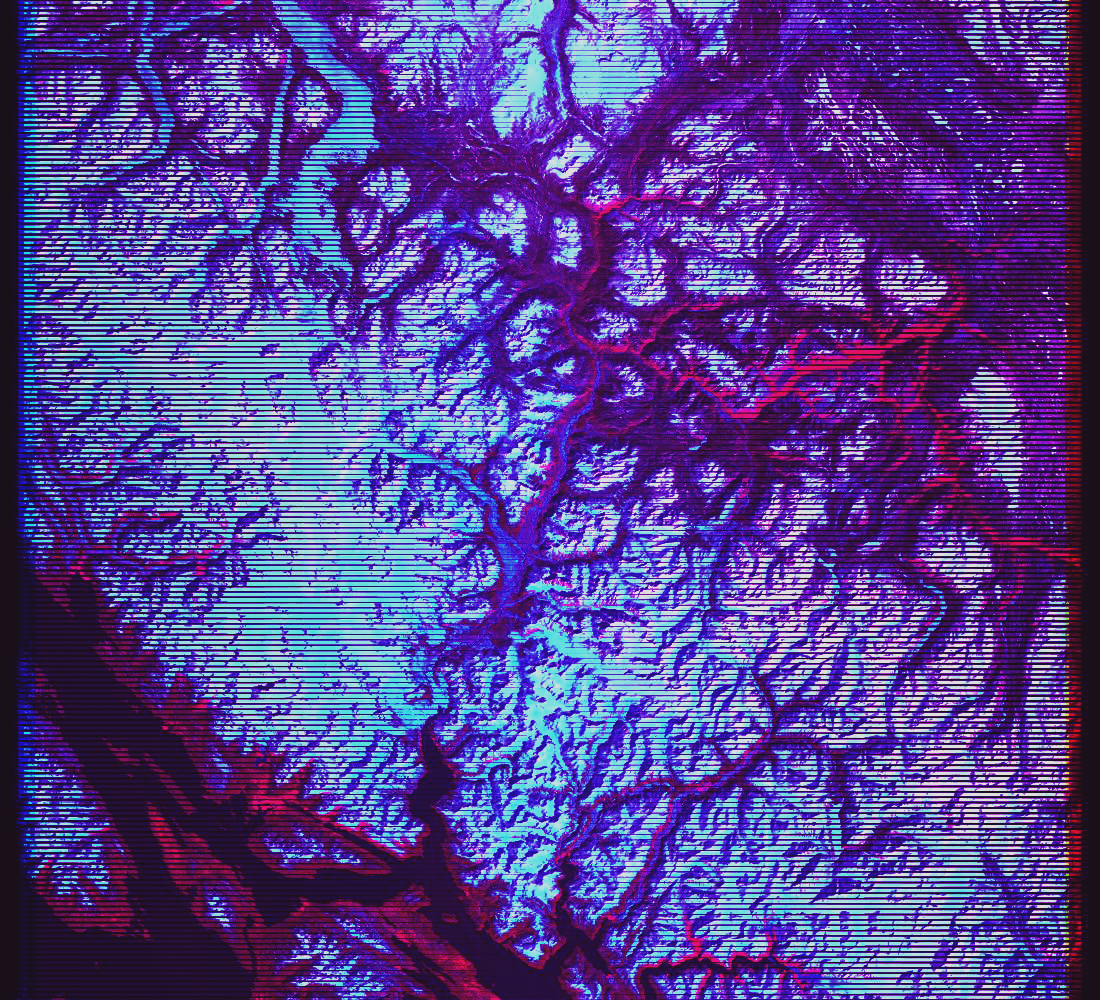
Donne Glacier Retreat New Zealand
Donne Glacier descends the spectacular east face of Mount Tutoka in southwest New Zealand. This glacier has been undergoing rapid retreat this decade creating a new alpine lake. The National Institute of Water & Atmospheric Research (NIWA) conducts an annual survey of the snowline of New Zealand glaciers. In order to thrive a glacier must have at 50-70% of its area snowcovered at the end of the summer melt season. For NZ glacier NIWA has noted 67% as the key to equilibrium conditions. If then snowline is above normal the glacier will lose mass, if the snowline is lower than normal the glacier will gain mass. Since 2000 the snowline has been above normal in nine of the ten years, only in 2005 was the snowline slightly lower than normal (NIWA, 2010). In 2009 the snowline was the highest of any of the years The result of a decade of high snowline’s is glacier mass loss and retreat. Below is a sequence of images from 2000, 2003, 2006 and 2009 of Donne Glacier the first and last images are from NIWA and the middle two are Google Earth images.


In 2000 the glacier reaches almost all the way across the newly forming unnamed lake. By 2003 the large debris covered section has detached and the lake has doubled in size. In 2006 the faint orange line indicates the 2003 terminus position. The retreat of 100 meters has led to further lake expansion. In the 2009 images the glacier is still ending in the expanding lake, and is still actively flowing. The number of crevasses and the snowcover existing even in poor snow years such as 2003, 2006 and 2009 indicate the glacier still has a persistent accumulation zone. The glacier begins near 2200 meters and descends to about 1300 meters in 2 kilometers. A persistent accumulation zone is key to survival. The retreat and formation of new alpine lakes is also occurring at two nearby glaciers that NIWA observes. Gunn Glacier (below) and Park Pass Glacier (above), in the Google Earth images. Both glaciers end in lakes still occupied by icebergs that used to be part the terminus of the glacier. The icebergs did not calve off so much as representing disintegration of the terminus. The tongue visible on Park Pass Glacier in the middle of the lake is now gone. 

Paradise Glacier Ice Caves Lost
From the 1930’s through the early 1980’s Paradise Glacier’s ice caves were world famous. Today they are gone. In 1906 Paradise Glacier was a single glacier that extended down to an elevation of 6000-6200 feet. The image below is from the book The Mountain that was God. 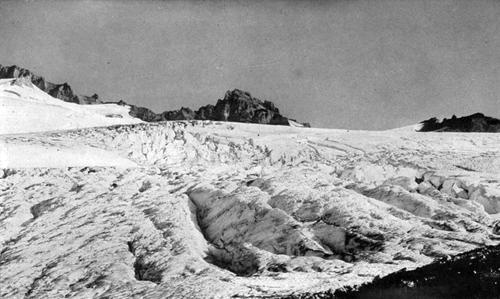 In the 1930’s the glacier separated into an upper and a lower part. The caves were in the lower part, that filled a relatively flat valley at an elevation of 6500 feet. Ice caves cannot form beneath a glacier that is moving substantially, as the movement would close up the cavities. Ice caves form under stagnant, melting sections of the glacier.
 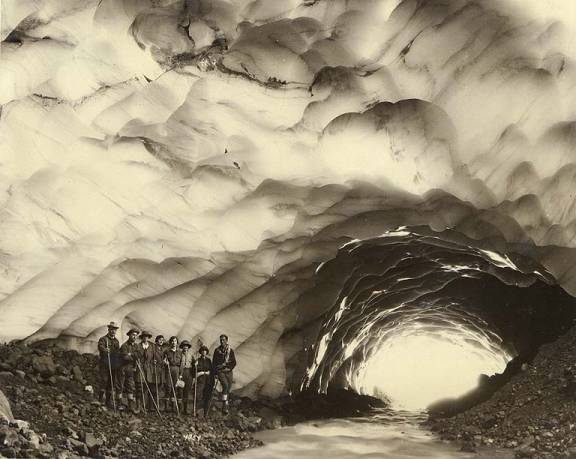 The 1971 USGS map, see below, indicated the lower Paradise Glacier was 1.1 km long and had an area of .14 square kilometers. By 1981 the glacier had retreated to the upper half of the valley that had been filled with ice caves, second image below. In the 1981 image, from Jim Kuresman, note the mountain peak in the center that is in the 1906 image as well. There is no remaining snowcover either on the lower glacier, a glacier cannot survive without an accumulation zone that has significant persistent snowcover even at summers end.
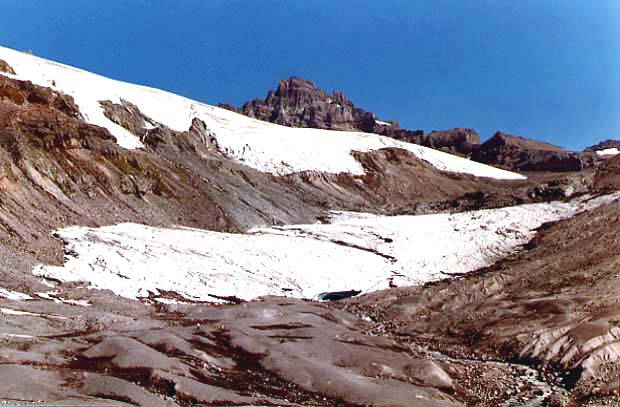 In 1985 I visited the ice caves, and they were still impressive, although much reduced in size, number and length.
  i returned to the ice caves in 1993 and found no ice caves remaining and no glacier either. The Paradise Ice Caves valley in 2005 (Greg Louie) and 2007 (David Head image) is beginning to sprout some vegetation where hikers tread through ice caves a generation before. The glacier fits the regional pattern of glacier retreat and loss.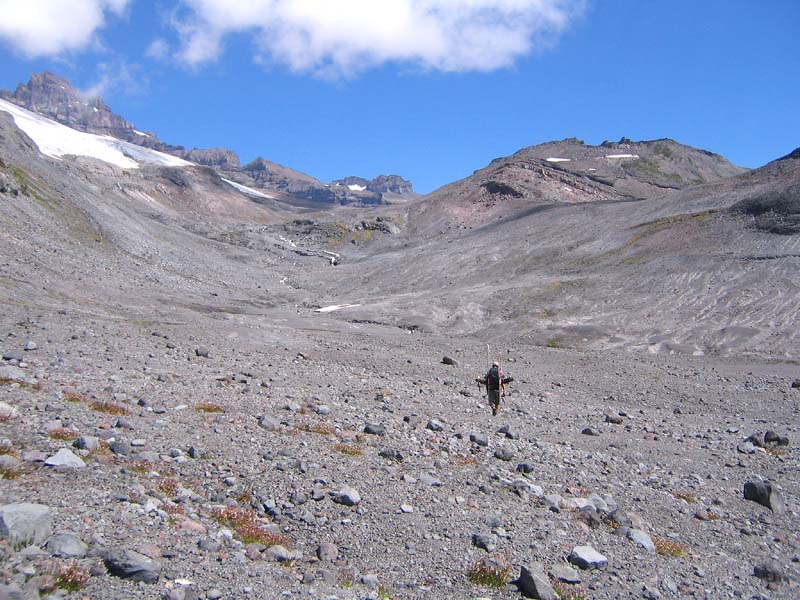

 You can observe in the upper left of the 2005 and 2007 images that the upper Paradise Glacier still exists, though it is retreating, the last picture is the terminus of the upper Paradise Glacier. In 2009 the upper Paradise Glacier lost all of its snowcover, not a good sign for its long term survival. Below is the Google Earth view of the area from 2009 imagery. A comparison with the map indicates that not only has the lower Paradise Glacier been lost, but so has the Williwakas Glacier.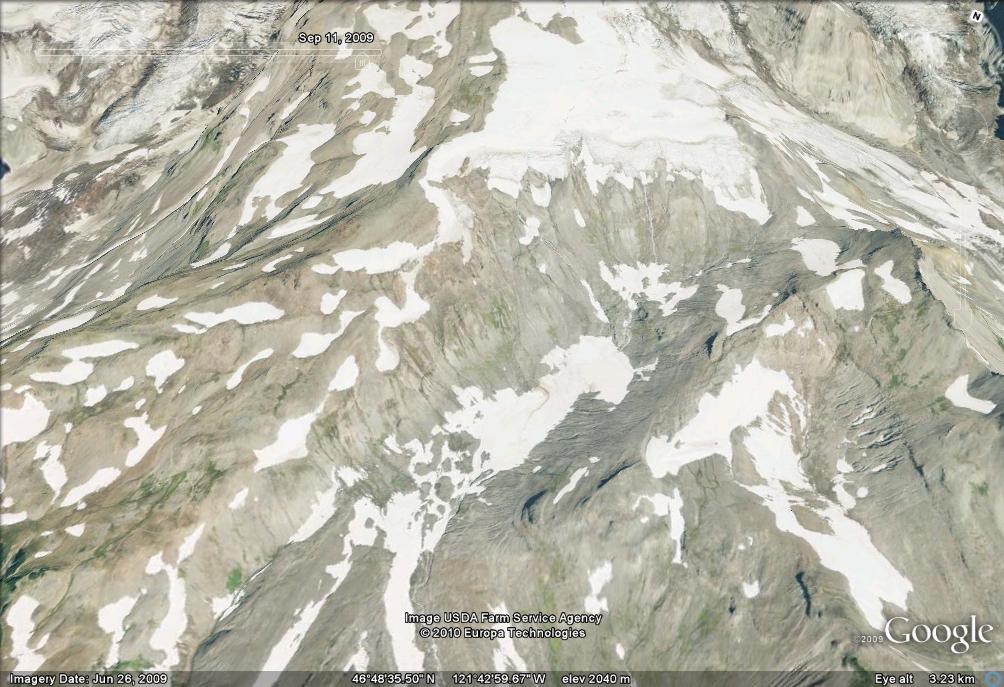
Fleming Glacier Acceleration and Retreat, Antarctica
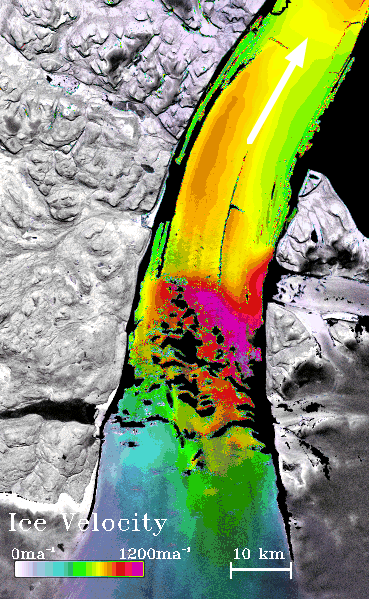
Recent observations indicate that the Fleming Glacier on the Antarctic Peninsula which used to feed the Wordie Ice Shelf is accelerating and thinning even faster(Wendt et al, 2010) This is leading to the production of numerous tabular icebergs from the glacier front as seen below from a 2009 Google Earth image.  . A is a rift that is also the ice front toward the upper right. B and C are rifts that will produce future tabular ice bergs. D is an iceberg with an area of just under 1 square kilometer. Wordie Ice Shelf was the northernmost large Ice shelf on the western AP. The ice shelf disintegrated between 1970 and 2000. From an area of 1900 km2 in 1970 to 100 km2 in 2009 as mapped by the British Antarctic Survey. The first image is from the BAS in 1989. Followed by a series of maps illustrating its demise put together by the BAS and USGS
 The breakup was suggested to have occurred due to a warming trend in the region that began in the 1970’s generating meltwater . There is also thinning and weakening around some of the pinning points where the ice shelf was grounded. This is similar to observations from Wilkins Ice Shelf.
The Wordie Ice Shelf was fed by several major tributary glaciers including the Fleming Glacier.
(Rignot and others (2005) used satellite radar interferometry to observe changes in behavior of Fleming Glacier from 1995 to 2004 identifying a 40-50% increase in glacier velocity from the terminus to 50 km above the terminus and a two meter per year thinning. More recent Airborne thickness data indicate thinning has increased to 3 or 4 m per year in the lower reach of the glacier during the 2004-2008 period (Wendt et al, 2010). Rignot and other (2005) further observed that 6.8 ± 0.3 km3/yr of ice, which is much larger than snow accumulation of 3.7 ± 0.8 km3/yr. This imbalance has certainly increased with acceleration.
Without the presence of a thick, slow moving ice shelf buttressing the Fleming Glacier it has accelerated. Below is a map from Wendt et al (2010) showing the Fleming Glacier former margins. Below that is Google Earth Image showing the nature of the calving front. Notice the tabular ice bergs that have and are about to break off. Below that is an image further up glacier, a nunatak has appeared in mid glacier that is not evident in the 1989 image. 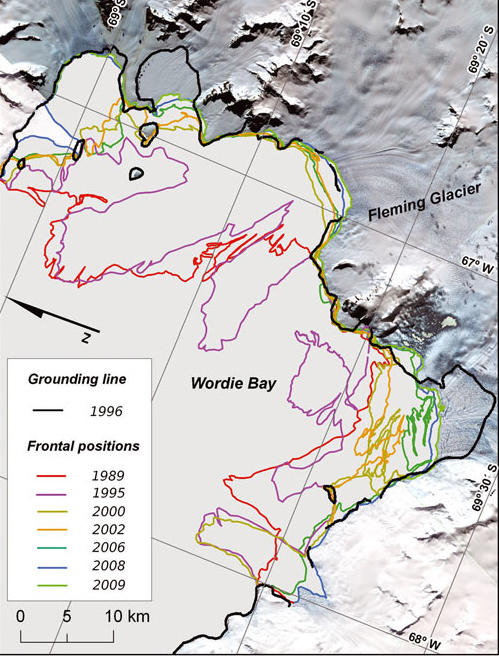
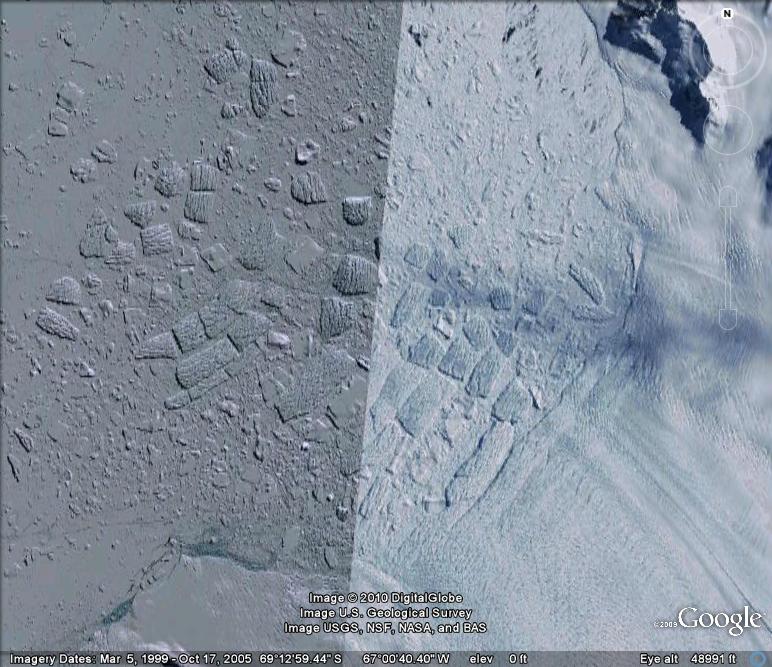
 As observed for the Jakobshavn and Pine Island Glacier thinning leads to reduced buttressing and increased glacier flow.
North Cascade Glacier 2010 Mass Balance Forecast
Beginning in 2006 the North Cascade Glacier Climate Project began to forecast glacier mass balance from atmospheric circulation index data. To be useful for water resource managers such a forecast must be made early in the spring. This is when snowpack begins melting at elevations below the glaciers and reservoirs can begin to be recharged. A first generation forecasting model that relied on October-March Pacific Decadal Oscillation and El Nino Southern Oscillation Index values was developed. The mass balance forecast method reliably determined if the mass balance of North Cascade glaciers would be negative, equilibrium or positive in 22 of the last 26 years. Most people may be under the impression that the snowmelt season is well underway, in fact 2010 has seen a record loss of snowpack extent through March this year in North America. A look at the snow cover depletion using data from the Rutgers Global Snow Lab beginning in either the 7th, 8th or 9th week and ending with the 14th week indicates this record melt. In the second image the rapid snow cover loss is further apparent. In the Northern Hemisphere for example February 2010 was the third most extensive snow cover extent of the last 44 years, March the 18th of the last 44 years, and April the 41st most of the last 44 years (Rutgers University Global Snow Lab). This change indicates a record snow cover melt off in 2010 for the last 44 years. This can happen on a glacier as well.
 However, for glaciers the snowmelt season usually ends close to May 1. The melt season in the North Cascades is still not upon us. Typical maximum accumulation occurs around May 10.
  The best long term snowpack data is for April 1, hence that date is often used to evaluate the end of winter snowpack for snow measurement stations most of which are well below glacier elevations. This year snowpack on April 1 averaged 0.82 meters. There has been no year with positive mass balance and snowpack on April 1 below 1.0 meters.
  If we look solely at the indices both PDO and ENSO had positive values this winter. This is similar to the case in 1987, 1993, 1994, 1995, 1998, 2003, 2004,and 2005 all negative balance years.
  The rule for the model is that if PDO and ENSO are positive glacier mass balance will be negative. Both of the indices reflect sea surface temperature in the Pacific, and positive values favor warmer SST’s near the west coast. Lastly we have the temperature forecast from NOAA for spring which for the area shows a high degree of confidence for above normal temperatures from April-June.
  All of the above indicate glacier mass balance will be negative in the North Cascades this year even though the galciers are deeply buried in snow right now.
Harrison Glacier, Glacier National Park Slow Recession
There continues to be a persistent misconception that all glaciers in Glacier National Park will be gone by 2030, I get asked that by journalists frequently and when I point out that is not the case they are surprised. An examination of 15 Glacier National Park glaciers using the recently published Alpine Glacier Survival Forecast method, indicates that 10 of the 15 glaciers are experiencing a disequilibrium response and will disappear, the other five have been shrinking little. A simpler and more visual look at the survival issue, illustrates why though they all are diminishing the glaciers will not all be gone by 2030. Blackfoot and Harrison Glacier are the two largest glaciers and show minimal changes in the accumulation zone. Both glaciers continue to retreat with the main termini retreating approximately 100-120 m since 1966. In this post we take a close look at the Harrison Glacier the most vigorous and slowest receding of the few remaining Glacier National Park glaciers. Key and Fagre (2003) utilized a model to construct the future of glaciers in the Blackfoot-Jackson watershed, and determined that all would be gone by 2030 with continued substantial warming, but not with limited additional warming. Based on the slow recession and equilibrium response of Blackfoot and Harrison Glacier to recent climate over the last 40 years these two glaciers are not going to disappear within the next 30 years. Harrison Glacier has according to the ongoing work of Northern Rocky Mountain Science Center (NOROCK) Has lost 9% of its areas between 1966 and 2005, a 40 year period. In the first image below the glacier is outlined in the 1966 map of Harrison glacier overlaid in Google Earth. The orange outline is left on the following three images all from Google Earth’s historic imagery files. The map indicates the area of crevasses above the main terminus. A look at the glacier over the last two decades indicates the glacier remains vigorous in terms of flow, as indicated by the many crevasses. In every image from 1991 second image to 2003 and 2005 last two images, even in these later summer images the glacier retains snowpack in its upper accumulation zone. This suggest a glacier that can survive current climate at a diminished size. 
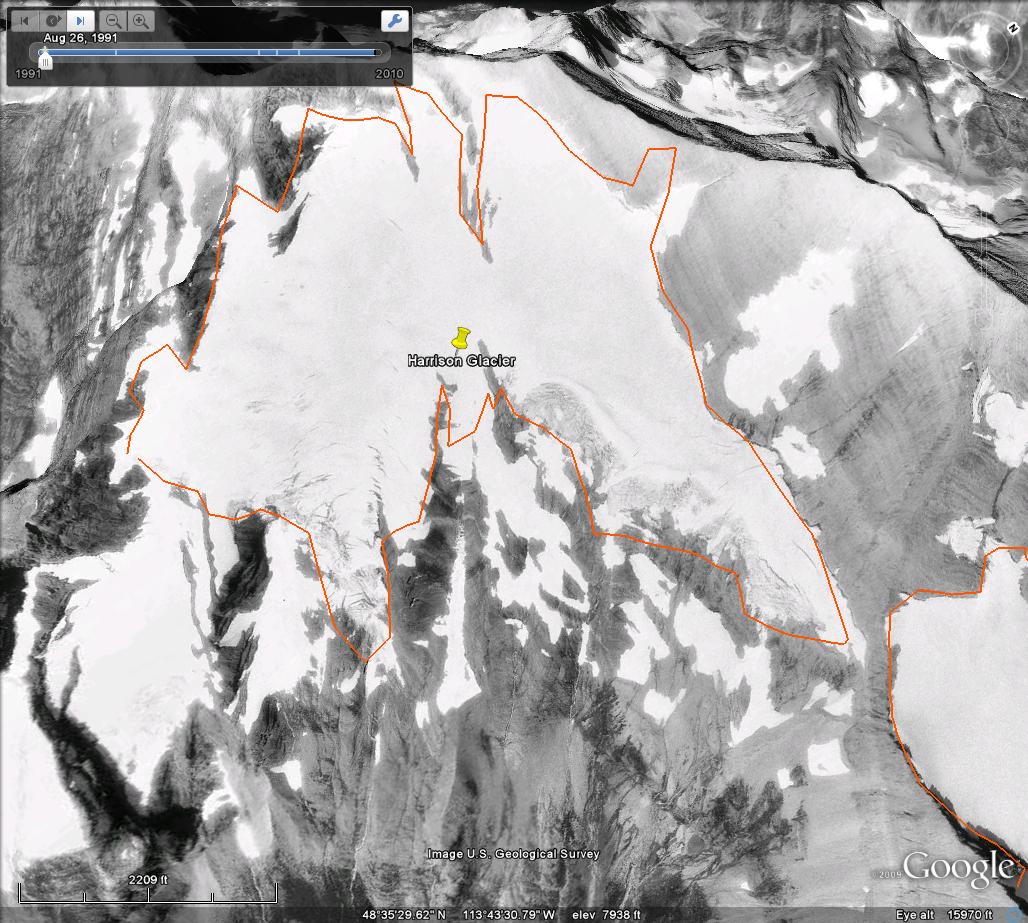
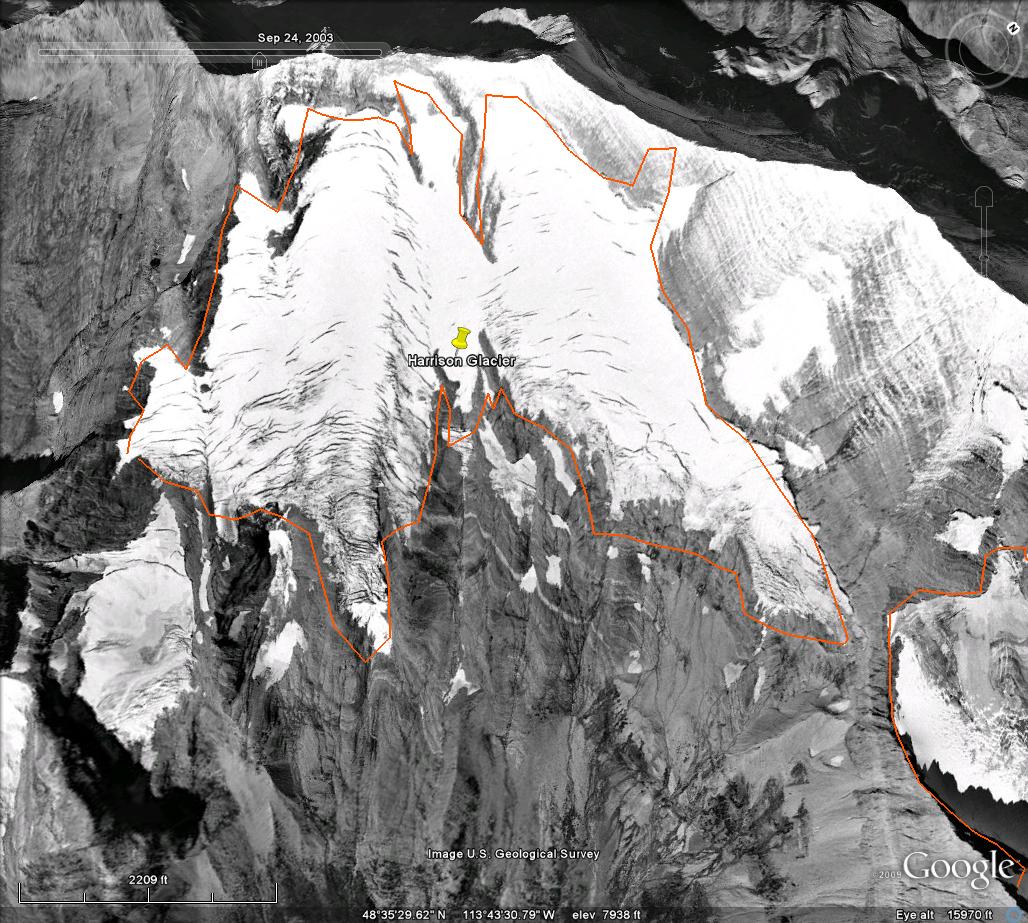
 The above images indicate the slow recent recession of the Harrison Glacier, which unlike the majority in the park is only slowly receding. This is in contrast to nearby Shepard Glacier and Grinnell Glacier which often are devoid of snow and are losing area at a rate of 10% per decade, four times that of Harrison Glacier. Why the difference? Most of the glaciers lay on the east or northeast slopes-lee side of the mountain ridges and have significant avalanching from the slopes above. Grinnell Glacier has a significant accumulation area at 7000 feet and Harrison Glacier at 9000 feet. Hence, the greater change in area as seen between the 1996 orange margin and 2006 recent margin for Grinnell Glacier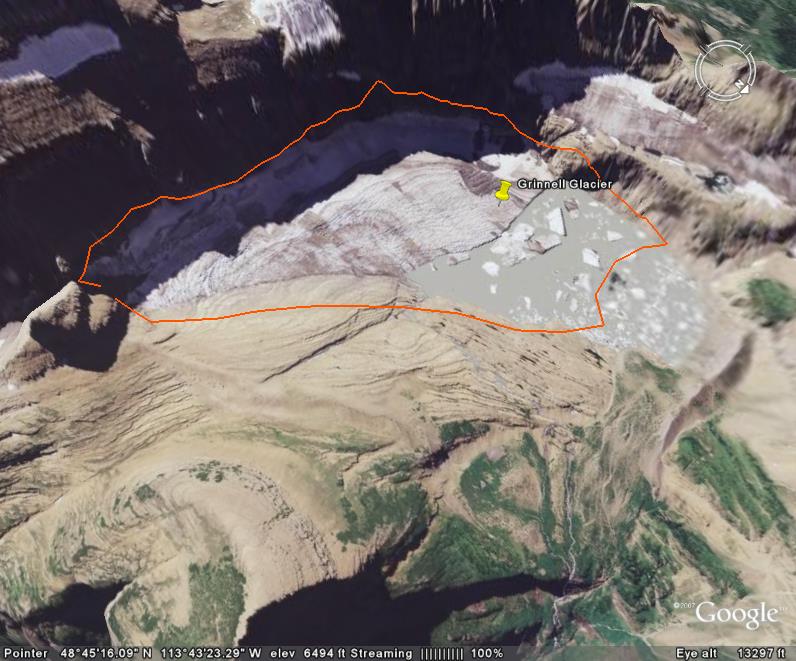
Mer de Glace, Glacier Retreat-A Receding Sea
Mer De Glace drains the north side of Mont Blanc. This is the largest glacier in this section of the Alps, it is 12 km long. The “sea of ice” terms not only refers to the size of the glacier, but also to the ogives, curved color bands formed at the base of the icefall. This sea of ice is slowing down as well as thinning and retreating. This has led to the lowest 12% of the glacier being stagnant and appears ready to melt away in the coming decades. A new paper Vincent et al (2014) model Mer de Glace into the future and generate a retreat of 1200 m by 2040, this is likely a minimum. 
Post has been relocated and update at
Mer de Glace
Petermann Glacier Retreat 2010-Rift Extension-2011 Update-2012 Update
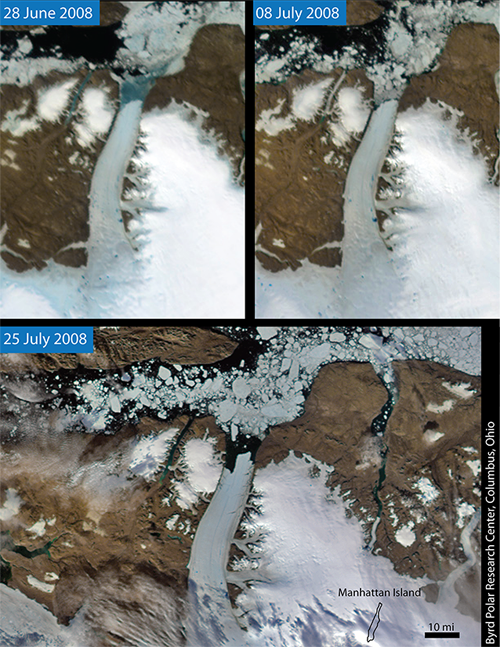
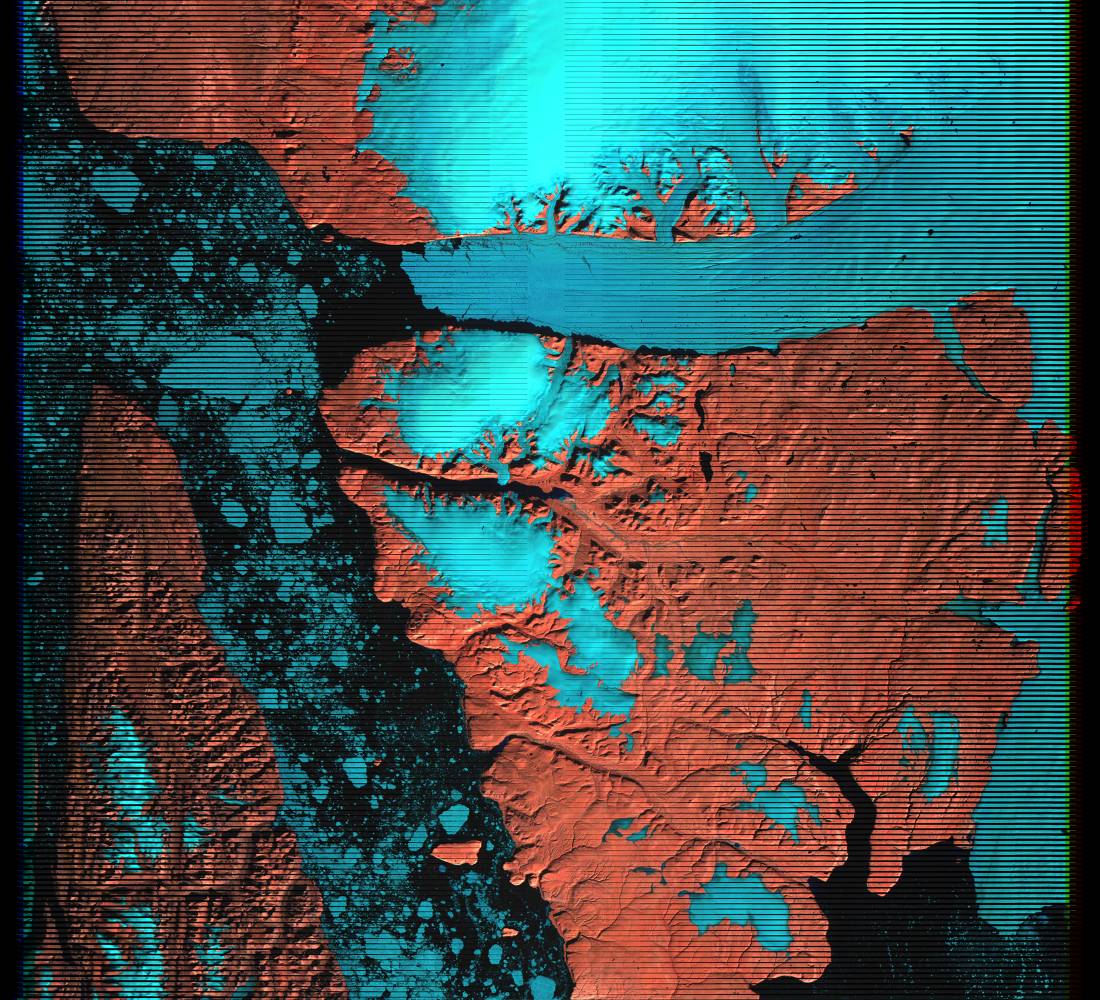
The Petermann Glacier in northwest Greenland is significantly different than the fast flowing large outlet glaciers, such as the Jakobshavn and Helheim Glacier we here so much about. It is also different from neighboring Humboldt Glacier. Petermann Glacier is much thinner at the calving front and moves much slower. The result is the volume flux from this glacier is much less than Jakobshavn which loses 40 cubic kilometers per year, versus 1 cubic kilometer at the calving front of Peteramann and 12 cubic kilometers at the grounding line. A detailed review of some of the differences is explored in an article I wrote for Realclimate in 2008.
In 2011 the fjord in front of the glacier emptied of ice by July 22. The glacier itself has yielded no substantial icebergs or retreat following on the spectacular losses in 2010 noted below. The main rift near the ice front has not shown significant expansion, in the MODIS image below from 8/31/2011, Middle image. This lack of response in 2011 is not a surprise as after a substantial calving event in 2008, it was not until 2010 that the next one occurred, 2012 seems like a better bet. The change from July 28, 2010 (top image) is still amazing.
Update July 2012, the rift has led to the anticipated iceberg calving event well documented at Icy Seas and Arctic Sea Ice, see last image in sequence for the 2012 event. The glacier becomes thicker with distance from the calving front as of now there are now incipient rifts to note in the NASA MODIS image below. This combined with the thicker ice suggests that another iceberg calving event is not imminent, and cannot be forecast as the previous two were with a lead time of at least a year. There is a small area of weak ice, a melange at the blue arrow that is likely to provide smaller icebergs during the course of this summer.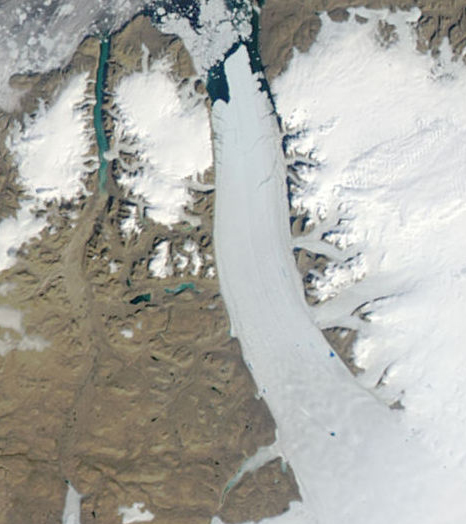
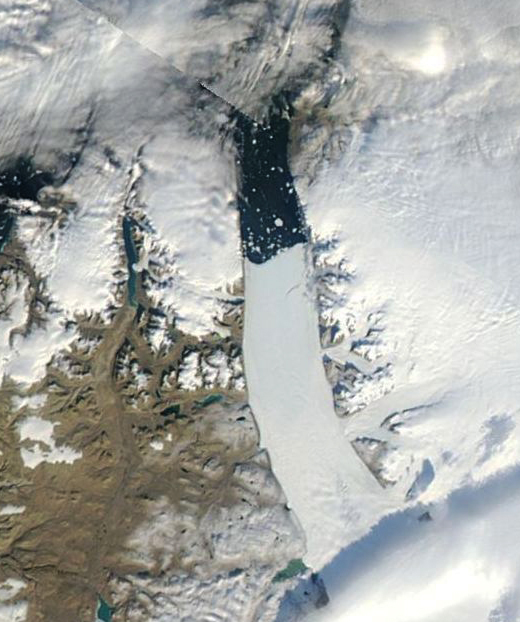

In 2008 Petermann Glacier lost a substantial area, 29 km2 due to calving as noted by Jason Box at Ohio State. and a crack well back of the calving front indicates another 150 km2 is in danger, Crack C. This preconditioned area of weakness noted in 2008 is explored in satellite images below. Of course recent events of Aug. 2010 have resulted in a number of updates to this post. Petermann Glacier has a floating section 16 km wide and 80 km long, that is, 1280 sq. km. This is the longest section of floating glacier in the Northern Hemisphere. As of 8/5/2010 this floating section is now reduced to about 250 sq km in area and 65 km long. This impending loss I commented upon two years ago, and that Pat Lockerby has been focussed on this summer, has now occurred. This does not herald the end of the retreat. The loss of this much frontal ice should lead to glacier acceleration and some additional rifting in the near future. Unlike most Antarctic ice shelves this glacier is well buttressed by fjord walls and not prone to a rapid collapse. Inland of the grounding line unlike on Pine Island Glacier the Petermann Glacier goes from 500 meters below sea level at its bed to near sea level in a distance of 100 km. This limits the ability to form an ice shelf. Crack C is the main rift existing behind the calving front. A comparison of this crack from 2008 and 2010 indicates it has extended considerably toward the middle of the glacier. I have annotated two very detailed NASA images labeling the Supraglacial stream (SGS) channel that was interrupted by the rift severing it from the previous supraglacial stream channel (PGS). I have also labelled the turns in Crack C, note the 2007 end of the rift at the and the 2010 rift end indicated by blue arrows in the 2010 image. Also note the right hand blue arrow indicating the SGS entering the C crack and creating a bit of open water. The rift has now extended nearly to the center of the glacier and the central supraglacial stream. 
 The crack is going to spread and will lead to another major calving event. It seems unlikely it will occur in 2011, 2012 more likely. The rift as of April 18, 2010 in the image below from the Danish Meterological Institute MODIS library, is nicely visible, the bright white is likely indicating the presence of snow that has drifted into the rift.
  In 2011 the fjord in front of the glacier emptied of ice by July 22. The glacier itself has yielded no substantial icebergs and the main rift near the ice front has not shown significant expansion, in image below from 8/31/2011
The cropped image from Pat Lockerby indicates the newly created iceberg the largest in the Northern Hemisphere.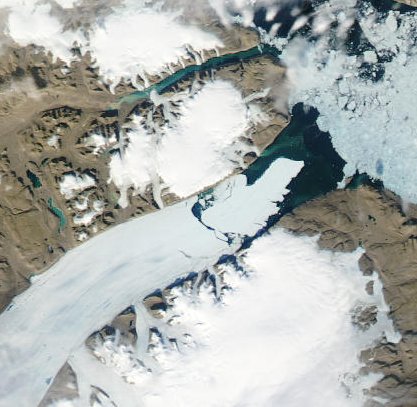 The area of floating ice on the Jakobshavns in contrast has varied from year to year with retreat but has remained less than 40 sq. km. The size of the floating tongue provides the potential for a longer exposure and greater melting at the base of the glacier. This is also due to the slow velocities, 1 kilometer per year. The slow velocity results in a greater duration of surface and basal melting, which effectively thins the glacier to a mere 60-70 meters at the calving front. Petermann Glacier loses 90% of its thickness before it reaches the calving front thinning from 600-700 m at the grounding line primarilly due to basal melting. The calving front protrudes a mere 5-10 m above sea level, not your typical towering ice cliff you generally envision for a large Greenland outlet glacier. This reflects the fact that the ice at the front is only 60-70 m thick (Higgins, 1990). Thus, at 500-600 meters of thickness is lost to melting. This is largely basal melting as demonstrated by Johnson and others (2010). The glacier velocity is close to 1 km per year, 3/meters day, about 10% of the velocity of Jakobshavn (Rignot, 2000). The volume of the ice lost is much less than that from the loss of a comparable area by Jakobshavn because the ice is an order of magnitude thinner. Radar assessment by Howard Zebkar, Stanford Univeristy of glacier velocity indicates the acceleration near the grounding line as the glacier narrows and friction is reduced, then deceleration as the glacier thins after becoming fully afloat.
A recent paper by Joughin et al (2010) illustrates why Petermann Glacier is the key glacier in NW Greenland. It is their Figure 3 shown here that indicates on the left the large inland extent of high velocity of this glacier and on the right the recent lack of acceleration. An acceleration will require further ice tongues losses. 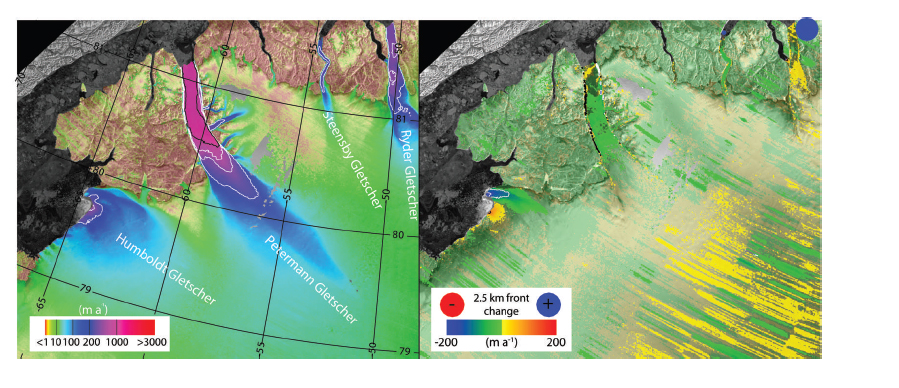 The key to this glacier’s second major ice loss this decade, after limited retreat in the last century, is thinning of the floating tongue. The thinning weakens the glacier and reduces the degree of anchoring to the fjord walls. The loss of this ice should then lead to acceleration, developing more crevassing and glacier retreat. The crack seen in the image of Petermann Glacier (ASTER image provided by Ian Howat of Ohio State) is more of a rift, like those on Larsen Ice Shelf, than a crevasse.
 The transverse rift is further connected to longitudinal-marginal rifts. Illustrating the poor connection of the Petermann Glacier to its margin and lack of a stabilizing force this margin has, even 15 km behind the calving front. This is not the only rift of its kind on the glacier. Also note that like on Larsen Ice Shelf the rift crosscuts surface streams. These illustrate the significance of surface melting, which reached a record in 2008 (Box and others, 2009). In 2010 the floating tongue lost its snow cover earlier than normal. This is important as Johnson et al (2010) have noted that basal melting is high closer to the grounding line, but not as high near the terminus, indicating that surface melting is a mechanism of thinning near the calving front. The surface melting does not enhance flow on this section of the glacier at all, as it is already afloat.
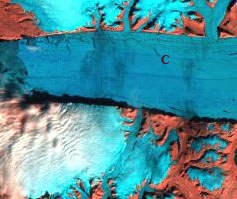
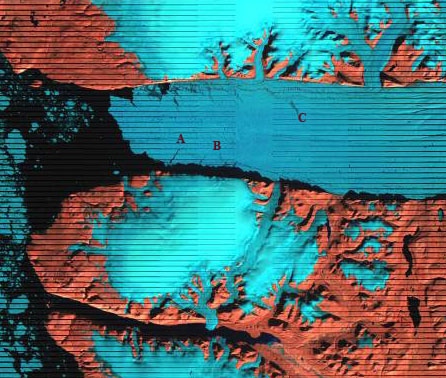
The images below are a series of Landsat images provided by the USGS, from 2002, 2006 and 2007. These illustrate the shift in the terminus and in the position of key rifts A, B and C. The distance back from the terminus has diminished for A and B from 2002 to 2007. In 2006 to 2007 the shift in the position of C is also evident.The final image is a larger scale indicating the entire valley section of the Petermann Glacier. The darker blue hue indicates that this is bare ice and is in the ablation zone. This is true in each year examined. The transition to the lighter hue, indicates the snowline, which is a short distance above the valley tongue. Petermann Glacier is poised to lose a greater area as it retreats than Jakobshavn Glacier, but a smaller total volume. 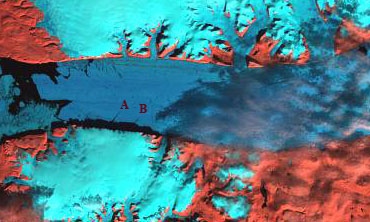
Higgins, A. 1990. Northern Greenland glacier velocities and calf ice production. Polar Forschung, 60, 1-23.
Gígjökull Retreat and Eruption Impact on this Glacier-Updated 2/2011
Gígjökull drains north from the Eyjafjallajökull Ice cap. Eyjafjallajokull began to erupt on March 20. In the initial eruption the fountains of lava were vented from a fissure in a relatively ice free area, east of the ice cap, and did not generate much flooding from ice melt. The vent indicated by NASA from early April has shifted closer to the main ice cap, but is still peripheral to it. The ash plume is also travelling east away from the still white ice cap on April 1. 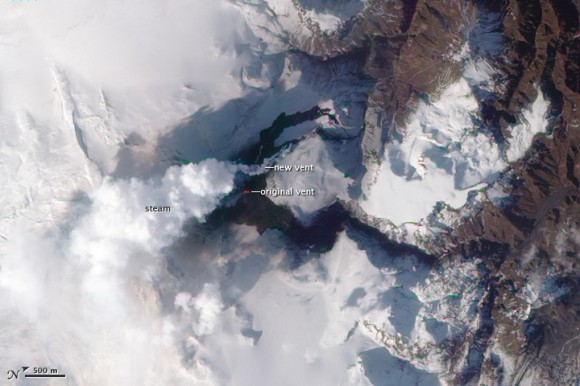 In the renewed eruption on April 13-16, 2010 the eruption has shifted closer to the summit of the ice cap melting several holes in the glacier visible in radar imagery from the Icelandic Coast Guard. These are located at the crest and just south of the crest of Gígjökull. The glacier has not been vaporized, but has experienced considerable melt.
  . The current eruption is close to the head of Gígjökull . Gígjökull is a 7.5 kilometer long glacier that empties out of the summit crater area at 1600 meters flowing across the ice cap plateau to 1500 meters then descending steeply in an icefall from the ice cap plateau to the terminus at 200 meters. There are pictures of lahars, Icelandic Met Service, from 4/16/2010 from just east of Gigjokull indicating this glacier is experiencing some substantial melt. The impact of the volcano will result in this glacier not being a good indicator of climate change impact on a glacier going forward, and will exacerbate the rapid recent retreat due to global warming. The Icelandic Met Office conducted a comparison of the runoff from glaciers draining the area around the volcano and from an ice cap in northeast and one in west Iceland indicate that the thick ash layer actually insulated the snow and ice underneath retarding glacier melt. Runoff in Jun-August 2010 a warm, dry period was just below normal in a gaged river draining the icecap near the volcano, and far above normal on ice caps farther from the volcano during summer 2010. Typically it takes a thickness of debris of 2 cm to switch from enhancing to retarding melting. The lahars visible in radar imagery on the 16th are mainly flowing to the south side of the ice cap. Contrast the series of images below from 4/17/2010 and 3/9/2010 from the Icelandic Met Office with the 2005 and 1992 images below. Below are the hydropgraphs from the Icelandic Met Office comparing the 2010 hydrograph of 2010 to those of 2006-2009, 2010 is the black year.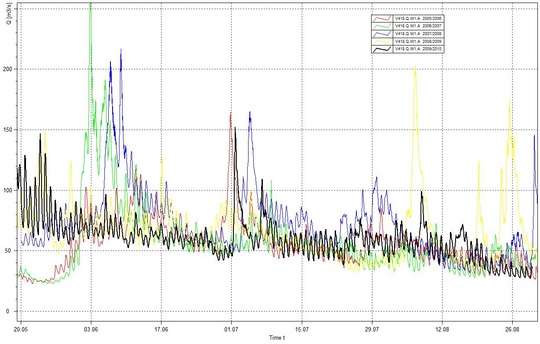
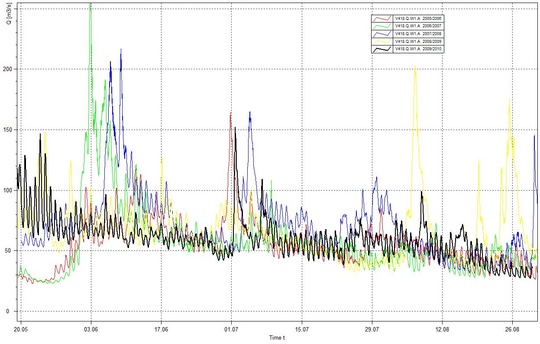 The climate induced retreat continued up to 2010 as the glacier lost its entire stagnant section adjacent to the lake. And now the lake has been filled in by mud in a matter of days. As of May 2nd the glacier still exists, many would think it had melted away completely, but glacier are tough to melt. The last image is from the Icelandic Institute of Earth Science (Sigrún Hreinsdóttir)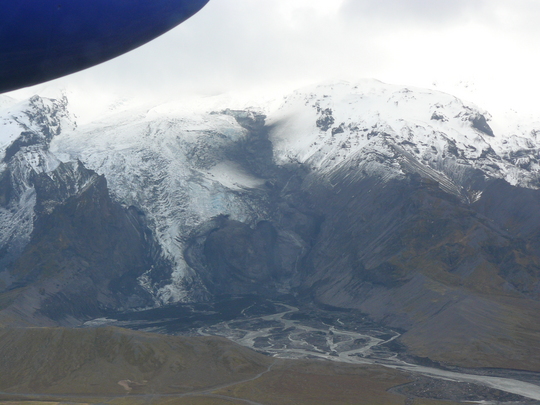


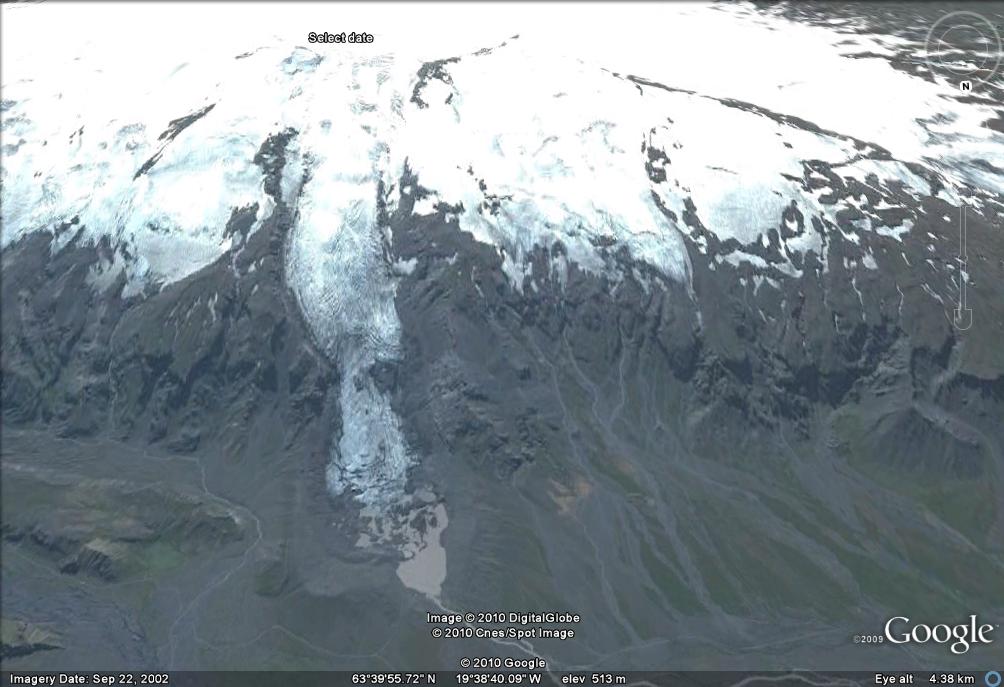
 The image above is from Tómas Jóhannesson, Icelandic Meteorologic Office, and shows that in 1992 there is no indication of stagnation and breakup in the proglacial lake at the teriminus. In addition compare the width of the glacier in that base of the icefall region. In 2005 the large exposed bedrock region is evident, in 1992 it is an active crevassed glacier across this entire region. Given the thickness of the glacier 100-200 meters in this region, this is a very rapid change in thickness. The glacier retreated in the first half of the 20th century but then began an advance that lasted until 1997. From 1997-2005 the glacier has retreated 700 meters according to data reported to the World Glacier Monitoring Service. This is leading to the expansion of the proglacial lake. The current rate of retreat is nearly 100 meters per year. The lower 1.1 kilometers is stagnant and poised for further fairly rapid retreat. The glacier is several hundred meters thick in this region and would melt slowly in place, but can breakup quickly via calving in the proglacial lake at its terminus. How far will this sub glacial trough extend upglacier from the current terminus will be key to understanding how fast this will occur. The view across the lake and a section of the terminus area that was breaking up in 2004 resulting in a retreat of 370 meters from 2003-2005 is seen in the image below from Ó. Ingólfsson
 Note that in the image above and below. The lower 1.1 kilometers of the glacier lack crevassing and further has as its upglacier end a large bedrock area that is exposed across half the width of the glacier. this indicates the lack of flow from the icefall region of the glacier into the stagnant terminus zone.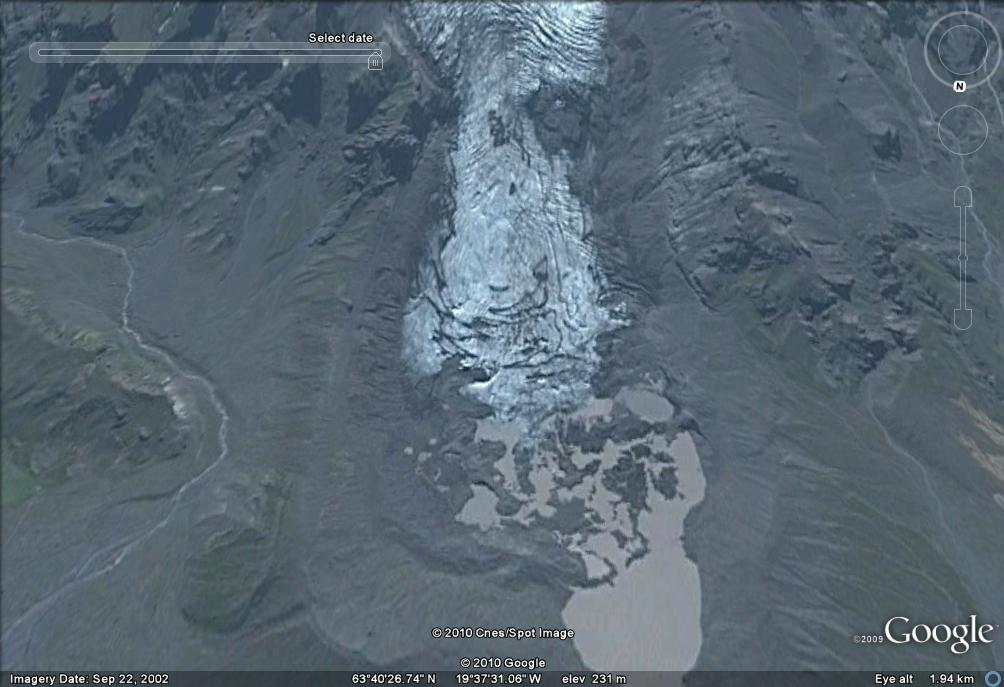

Tulsequah Glacier, British Columbia Jokuhlaups and Retreat
 Above is a paired Landsat image from 1984 left and 2013 right indicating the 2500 m retreat during this period of Tulsequah Glacier and formation of a new lake at the terminus. Tulsequah Glacier, British Columbia is a remote glacier draining from the Alaska-Canada boundary mountains of the Juneau Icefield. It is best known for its Jökulhlaups from lakes dammed by Tulsequah Glacier in northwestern British Columbia, Canada (Geertsema, 2000). This Tulsequah Glacier has retreated 1100 m since the Little Ice Age maximum in the 19th century. The continued retreat of the main glacier at a faster rate than its subsidiary glaciers raises the potential for an additional glacier dammed lake to form. The main terminus is disintegrating in a proglacial lake at present. This is not unlike the situation at the Gilkey Glacier just delayed. The images below are from Google earth in 2003 and 2007 and indicate the stagnant nature of the tongue in the lake, and lateral rifting that will be points of instability for a calving disintegration.


As part of the Juneau Icefield Research Program We completed extensive snow pack measurements in the upper reach of the glacier in 1981-1984 and found that snow depths by summers end between 1800-2000 meters averaged 4-6 meters. These observations completed along a transect across the glacier noted in the image below, provide a good example of the different sensitivities of the glacier to global warming. In 1981 a warm winter led to minimal snowpack at lower elevations in the Juneau Region, however, the upper regions of the icefield had above average snowpack. Jabe Blumenthal and I observed snowpack of over 5 meters on the upper Tulsequah Glacier. The areas above 1500 m are not very sensitive to winter temperatures as most as precipitation will fall as snow. In 1982 Juneau had good snowpack and the upper portion of the icefield was gripped by extended cold, the minimum thermometer at Camp 8 registered -44 F. In the images below the ELA for 1984 (right) and 2006 is indicated by a black dotted line, our Camp * a green dot and our accumulation profile is an orange line. In 2006 (left) the ELA is quite high and the accumulation are not large enough for an equilibrium balance. In 1984 the ELA was lower and mass balance was positive. 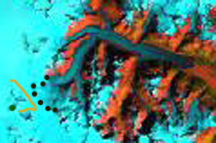

Such cold conditions indicate continental dry climate conditions persisting. The result good snowpack low on the glacier and below normal snowpack high on the glacier. From Camp 8 Brian Hakala and I surveyed the upper Tulsequah and found 4 meters of snowpack. In 1984 the highest snowpack of 6 m was noted as Wilson Clayton and I again measured the upper Tulsequah. The glacier still had healthy accumulation. The issue driving the retreat is that the equilibrium line where melting equals accumulation and bare glacier ice is exposed has risen and is now typically at 1400 meters.
When water stored behind, on or under a glacier is released rapidly this outburst is referred to as a jökulhlaup. These outburst floods can pose a serious threat to life and property, but not from the modest floods of the Tulsequah system along this relatively undeveloped watershed. Tulsequah Glacier has a long history of often annual jökulhlaups since the early twentieth century documented by the USGS. The floods resulted after decades of downwasting and retreat of Tulsequah Glacier. In particular a tributary glacier feeding the Tulsdequah retreated and downwasted faster than the main glacier. This valley then was dammed by the main stem of the glacier. There is no surface drainage evident from either Lake No Lake or Tulsequah Lake (labelled TL and NN in image above), indicating all discharge is through a subglacial tunnel.the main stem of the glacier emerging at the terminus and causing modest downstream flooding. 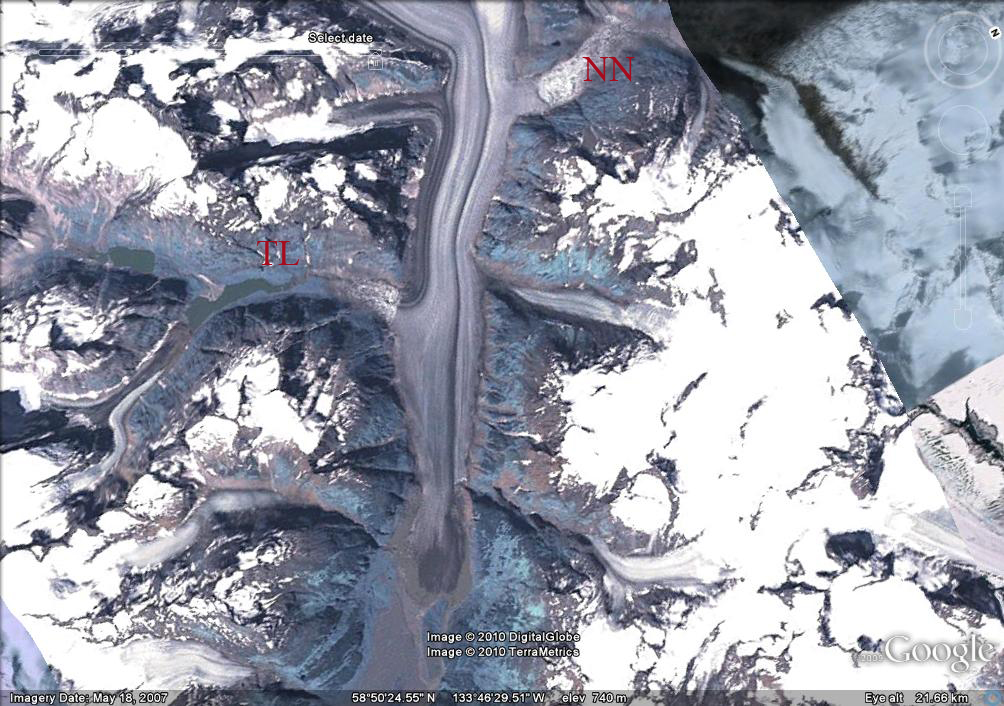
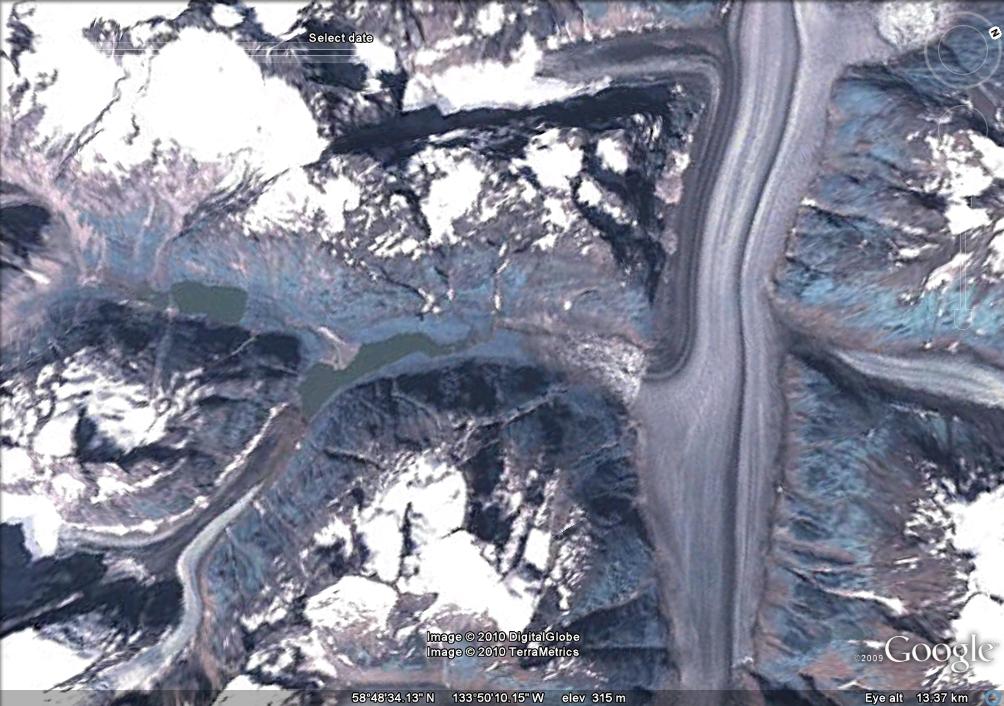
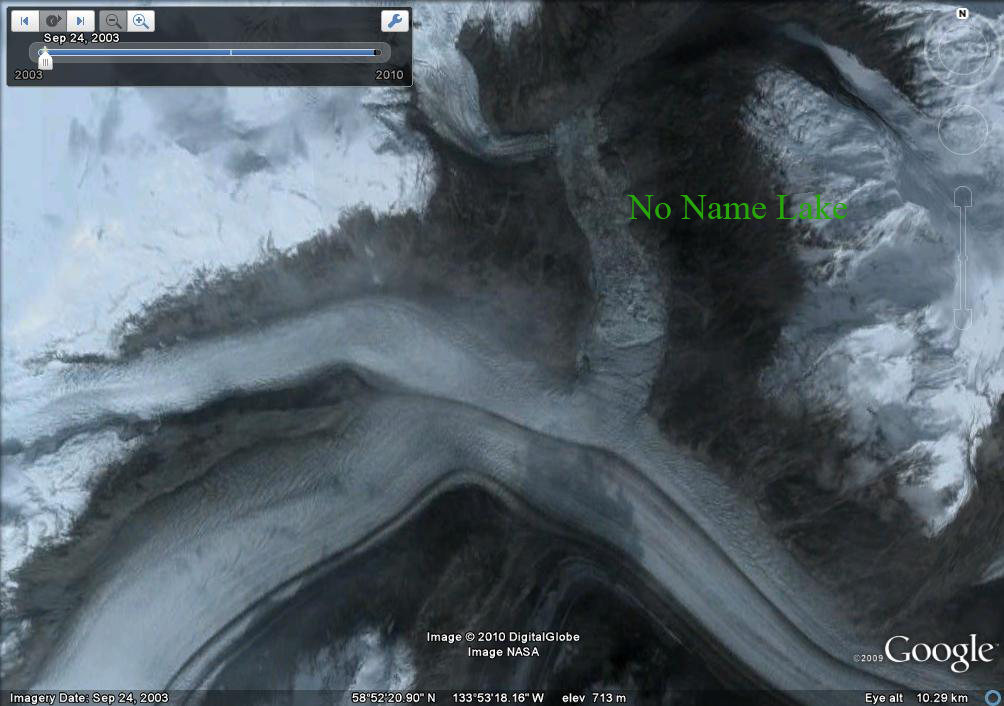
 Each summer as the lake filled with meltwater, its area, level and volume would increase to the extent that the hydrostatic pressure would float the glacier enough to begin flowing, this water then would further melt the ice enlarging its conduit. Most of the release occurs within several days. Hydrologic data are used to reconstruct the times and peak discharges of floods from the glacier-dammed lakes The first jökulhlaups from Tulsequah Lake were the largest. The history of this these jökulhlaups has been declining peak and total discharges as the lake became smaller. Today, Tulsequah Lake is small, and it will disappear completely if Tulsequah Glacier retreats any further. From 1941-1971 Tulsequah Lake discharged annually. Since 1990 a Lake No Lake has been discharging annually. Lake No Lake), has formed and grown in size as Tulsequah Lake has diminished. Lake No Lake developed from a subglacial water body in a tributary valley, 7 km upglacier from Tulsequah Lake. Like Tulsequah Lake, Lake No Lake rapidly grew in area and volume during its youth, and in the 1970s it began to generate its own jökulhlaups. Lake No Lake appears to be following the same evolutionary path as Tulsequah Lake – its volume is now decreasing due to downwasting of Tulsequah Glacier, and its jökulhlaups are beginning to diminish. As Tulsequah Glacier continues to shrink in response to climatic warming, additional glacier-dammed lakes may form, renewing the cycle of outburst flood activity, the tributary where this is most likely is labeled Future New Lake in the final image.
 From a Glaciers Perspective