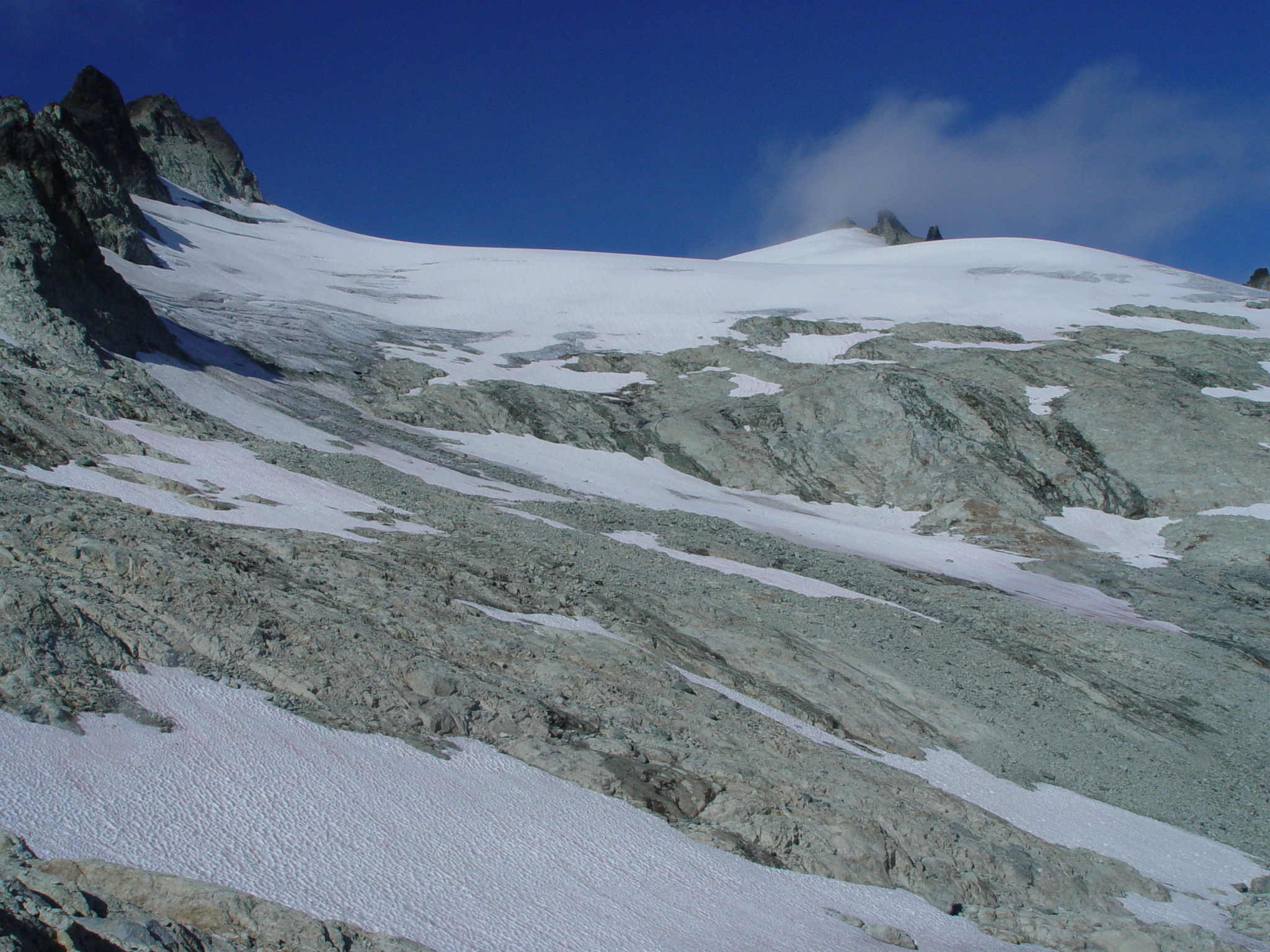
The Australian Antarctic Division manages Heard Island Island and has undertaken a project documenting changes in the environment on the island. One aspect noted has been the change in glaciers. The Allison, Brown and Stephenson Glacier have all retreated substantially since 1947 when the first good maps of their terminus are available. Fourteen Men by Arthur Scholes (1952) documents a year spent by fourteen men of the Australian National Antarctic Research Expedition. Their visit to the glacier noted that they could not skirt past the glacier along the coast. After crossing Stephenson Glacier they visited an old seal camp and counted 16,000 seals in the area Ensuing mapping and aerial photography has enabled a sequence of glacier boundary maps to be created that illustrate the changes in the glaciers. Thost and Truffer (2008) noted a 29% reduction in area of the Brown Glacier from 1947-2003. They also observed that the volcano Big Ben that the glaciers all drain from has shown no sign of changing geothermal output to cause the melting and that a 1 C warming has occurred over the same time period. Stephenson Glacier extends 8-9km down the eastern side of Big Ben. it 1947 it spread out into a piedmont lobe that was 3 km wide and extended to the ocean in two separate lobes around Elephant Spit. A picture from the Australian Antarctic Division taken in 1947 shows the glacier reaching the ocean and then in 2004 from the same location. 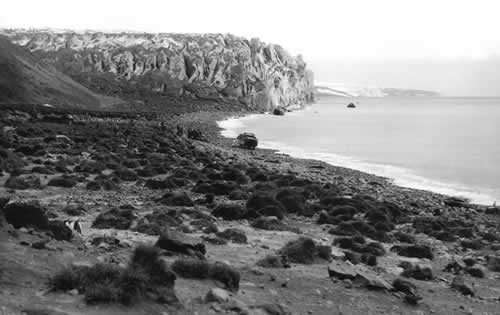
 around then broadens to form a piedmont lobe up to -3 km wideKiernan and McConnell (2002) an order of magnitude increase in the rate of ice loss from Stephenson Glacier after 1987. Retreat from the late 19th century to 1955 had been limited.
  As Kiernan and McConnell observed retreat began to increased and by 1971 the glacier had retreated 1 km from the south coast and several hundred meters from the northern side of the spit. This retreat by 1980 caused the formation of Stephenson Lagoon and by 1987 Doppler Lagoon had formed as well. After 1997 the two lagoons have joined as Stephenson Glacier has retreated rapidly. The terminus is now 2.2 km from the south coast and 3.1 km from the north coast. The highly crevassed area above the terminus indicates the rapid ongoing flow of the glacier. The terminus is highly fractured in Google Earth Imagery indicating this section will continue to retreat via calving of icebergs into the lagoon, which is quite full as it is. The first image below shows the terminus location over the last 60 years from the Australian Antarctic Division. The second image are the AAD overlays that can be imported into Google Earth. The last image is a closeup of the still disintegrating terminus into the combined lagoons from 2008.

 The Stephenson Glacier is undergoing a rapid calving retreat that began due to ongoing mass balance loss. This mass balance loss is shared by the other glaciers on the island are observations, though the actual terminus retreat may be less the volume losses of Brown Glacier recently have been large.
Category: Glacier Observations
Post detailing changes in a glacier
Ryder Glacier, Northern Greenland Transient snowline rise
Ryder Glacier drains from the northern margin of the Greenland Ice Sheet into Sherard Osborn Fjord. The glacier was first surveyed by Lauge Koch in 1917. By 1956 the glacier had lost 75% of its floating tongue. Since 1990 the glacier front has advanced slightly with much of this change beginning in a mini-surge in 1995. As noted in the Arctic Report Card 2010 since 2000, the net area change of the 35 widest marine-terminating glaciers is -1535 km2. This is an effective average glacier length change of -1.7 km since year 2000. While the overall area change indicates the largest observed retreat, 7 of 35 glaciers did advance in 2010 relative to 2009. The largest glacier advances were at Ryder and Storstrømmen glacier, each advancing 4.6 and 4.2 km2, respectively.The shelf front of Ryder Gletscher advanced has advanced recently at about the
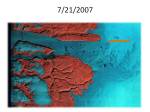
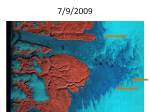
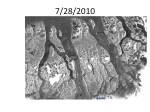
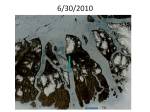
rate of flow, but it is thin <200 m and fractured in the floating region. This does not appear to be an advance driven by increased mass balance. In the last decade particularly since 2003 the transient snowline observable in satellite images has in most years reached 1000 m. The floating tongue has to date managed to avoid the large losses on Petermann Glacier. Both glaciers have experienced enhanced surface melt, the key has been greater basal melt to date at Petermann Glacier. This is in contrast to the 800 m level reported in the Satellite image Atlas of Greenland. The transient snowline (TSL) on the outlet glaciers of the local ice caps provides a crucial measure of annual balance and the extent of significant melting on the Ice Sheet. The number of satellite images available has increased dramatically providing the capability for TSL identification daily if clouds permit using MODIS. MODIS, Landsat 7, NOAA Microwave imagery and ENVISAT images below indicate the transient snowline for the Ryder Glacier area. Note that many of images from late June indicate a TSL in the 1000 m range even early in the melt season. To the west of Ryder Glacier (R), Steensby Glacier (S) and sometime Petermann Glacier (P) are evident n the outlet glaciers of Steensby Gletscher and Ryder Gletscher, where
it reaches an altitude of approximately 800 m. Ryder Glacier’s TSL lies very close to the southern boundary of the processed images from the Danish Meteorological Institute. The first slide is the topgraphy of the Ryder Glacier near the TSL, the second is a 1976 satellite image from the USGS Greenland Satellite Image Atlas 1386-c. The rest are annotated images downloaded from DMI or from the USGS for the Landsat images which are false color images. The TSL tends to rise from 975 m to the east of the glacier outlet to 1100 m south of and west of the fjord entrance.






Sara Umaga (Tos) Glacier, India snowline rise and retreat-Hydropower
Sara Umaga Glacier drains into the Beas River in the Himachal Pradesh region of India. The glacier has retreated over 1600 meters since initial 1970. The glacier is also a key water source for hydropower, this will be detailed below. The glacier is 15 km long extending from 5600 m to 3900 m. The glacier has retreated at a rate of 44 meters/year from 1989-2004 (Kulkarni, 2005). The glacier is adjacent to the Chota Shingri Glacier which has retreated at a rate of 7 m/year from 1970-1989 and 27 m/year from 1990-2000. The retreat is the result of the rise of the equilibrium line, approximately the snowline at the end of the summer, where ablation equals accumulation. In the late 1980’s the snowline averaged 4700 m. In recent years the snowline has been a high as 5180 meters (Wagnon et al., 2007). This same rise has led to high snowlines on the Sara Umaga Glacier. In recent satellite images the snowline is above 4900 m, and the snowline is below where the ELA will be at the end of the melt season. The snowline and the head of the glacier are noted in the image below. This leaves only 20 % of the length of the glacier in the accumulation zone. In terms of area 25-30% of the area of the glacier has been above the current ELA. For a glacier to be in equilibrium at least 50% of the glacier must be in the accumulation zone. The Sara Umaga is retreating as it cannot sustain the large lower elevation ablation area. Retreat has revealed two vegetation trimlines. The older is a Little Ice Age trimline-the former the trimline is from the 1950-1970 period.
  This is an attempt to restore equilibrium. An examination of the heavily debris covered ablation zone indicates that the lowest 2.25 km of the glacier is stagnant and will melt away. The end of the stagnant zone is indicated by the green arrow and the change in thickness to the Little Ice Age lateral moraine by the brown arrow and the current terminus by the pink arrow.
 . The lower section of the glacier is heavily debris covered which reduces melt rates. There is no apparent crevassing or convex shape to the glacier cross profile in the lower 2.25 km indicating stagnation. The debris covered section is not sensitive to soot deposition, as it is already sufficiently dark. The Glacier drains into the Beas River, which flows first through the Larji Hydropower project, which alters streamflow often leaving the stream below nearly dry. The Beas River is then impounded by the Pandoh Dam-and lake, third image below, which diverts water through a tunnel into the Saltuj (Sutlej) River, fourthimage, and thence the Bakrhra Dam at 1200 MW hydropower project. The tunnel from Pandoh is the largest tunneling project in Inida 13 km with a diameter of 8 m.
Larji Hydropower looking upstream to reservoir and beyond. Notice the influence of the dam on the river which is nearly dry below the dam on the date of the imagery near Markanada Temple.


Ried Glacier Rapid Glacier loss, Switzerland
Ried Glacier is beneath the Durrenhorn in the Pennine Alps of Switzerland. The glacier was 6.3 km long in 1973. In 2010 the glacier is 5.1 km long. From the Swiss Glacier Monitoring Network annual measurements, Ried Glacier retreated 300 m from 1955-1990, 8 meters/year. From 1990-2008 retreated an additional 300 m, 30 m/year. Than in 2009 the glacier retreated 500 m. A comparison of a 2004 image taken by M. Funk and a Sept. 2008 image from D. Gara
 indicate why the change was so abrupt. The glacier had been retreating upvalley with a long gentle terminus tongue. This section of the glacier separated from the glacier in late 2008, with the terminus now ending on a steep rock slope. There is still stagnant ice in the valley below the end of the current glacier. It is heavily debris covered and no longer connected to the glacier system. This glaciers recent rapid retreat parallels that of Dosde Glacier, Italy and Triftgletshcer, Switzerland and Rotmoosferner, Austria. A look at the glacier system and the terminus in Google Earth imagery provides a broader view of the glacier behavior. The terminus in this image still extends downvalley with the low sloping tongue that is now separated. Current terminus marked with red-T.

In the imagery above the glacier is still connected to the terminus tongue. It is evident that the glacier has two primary icefalls at that time. The upper icefall is the location of the annual snowline, where accumulation tends to persist throughout the year. Below this point only seasonal snowfall is retained. The retreat history from the Swiss Glacier Monitoring Network is seen below.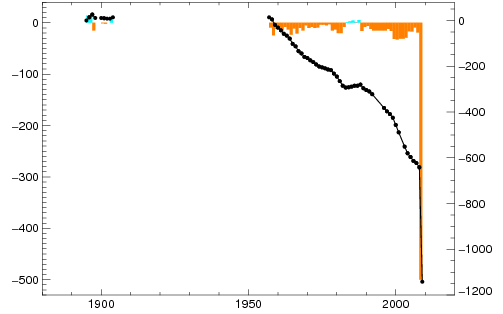
Quien Sabe Glacier Retreat
The Quien Sabe Glacier in the North Cascades of Washington has experienced rapid retreat in the last 20 years. This glacier is the largest in Boston Basin near Cascade Pass, its name translates to “who knows?”, well we all know it is not enjoying recent climate. In the 1960 Austin Post photograph he gave to me in 1994, the glacier was heavily crevassed and advancing. By 1975 the advance had ceased, but little retreat occurred until 1987. 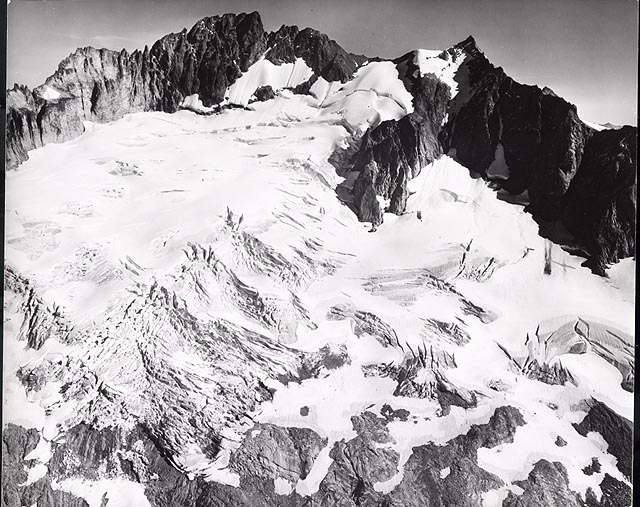 This glacier faces south and is fed by avalanching off of Forbidden and Sahale Peak. The glacier retreated 1200 meters from its Little Ice Age maximum (moraine indicated with blue arrows) until 1950. Richard Hubley noted the advance by 1955, the total advance was 55 meters by 1975 (advance moraines noted with orange arrows).
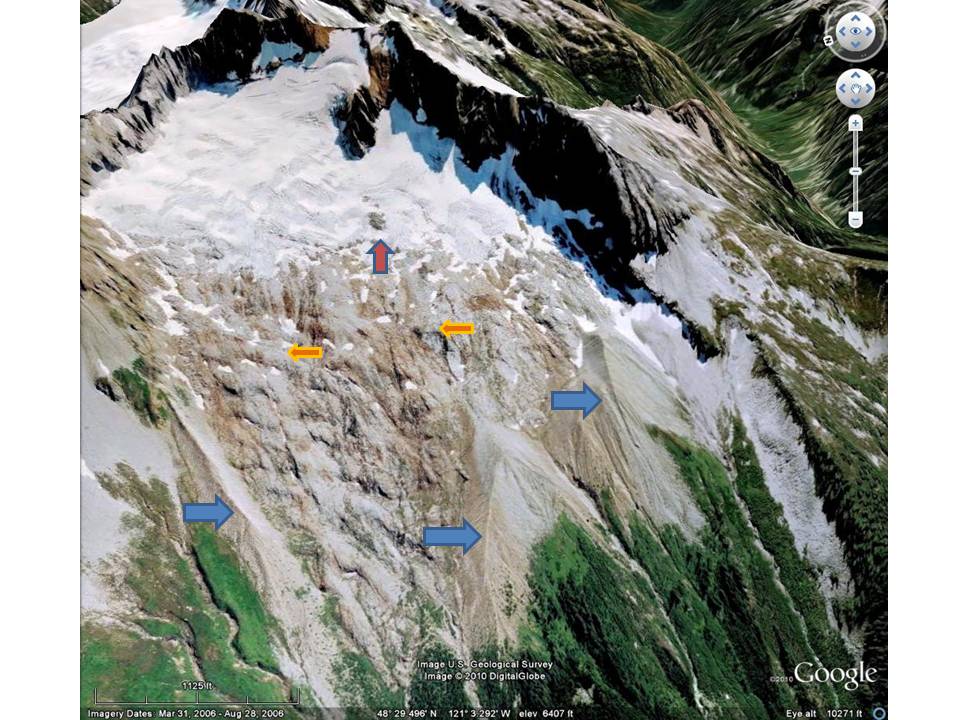 We were able to identify the advance moraine in 1985 when it was still quite evident. The smooth bedrock, Granodiorite in the basin, provides little friction for this glacier as it moves over the polished slabs. Today the terminus moraines from 1975 range from 150-250 meters from the current glacier terminus averaging just over 200 meters. For a glacier that averages 700 meters in length this is a significant loss of total area. There are a number of bedrock outcrops that have appeared above the terminus indicating how thin the terminal area is and that retreat is ongoing.
 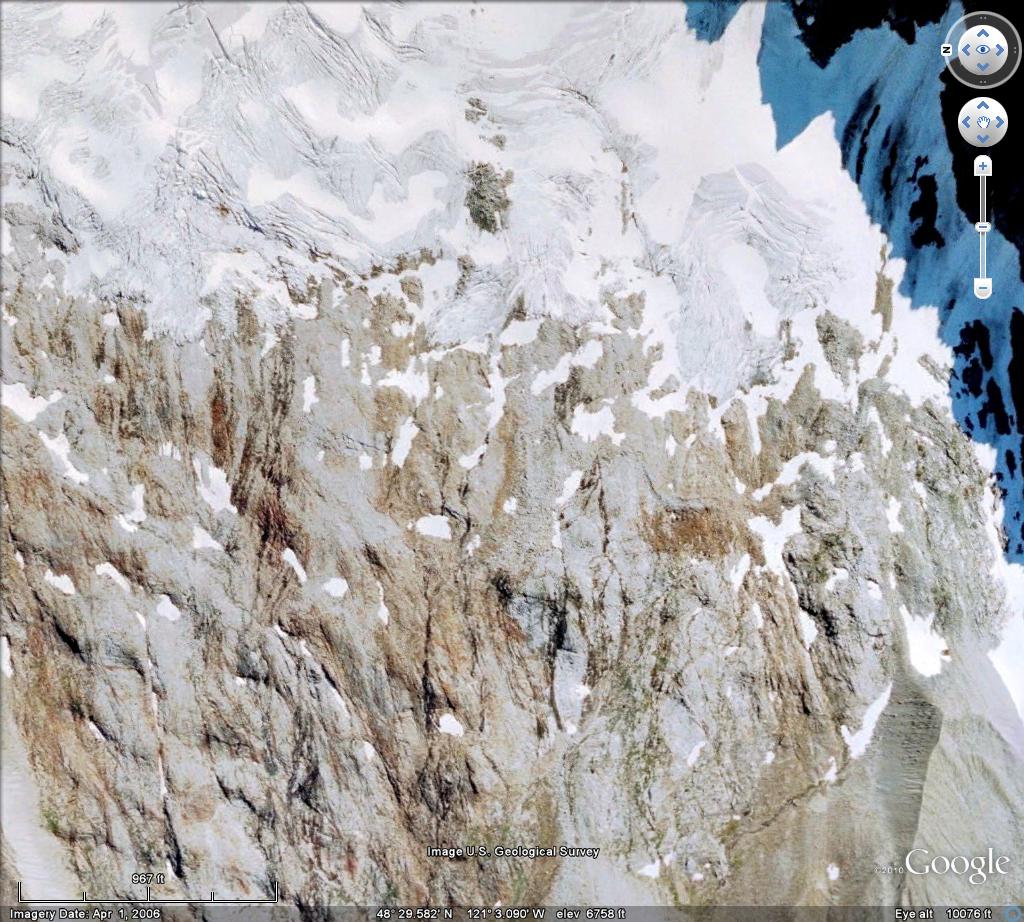 . In 2009 the glacier lost almost all of its snowcover an occurrence that has become frequent in the last 18 years. In this August image the glacier is 25% snowcovered.
  Fortunately 2010 was a better year in terms of snowcover, with more than 50% of the glacier snowcovered at the end of the summer, photograph from Neil Hinckley.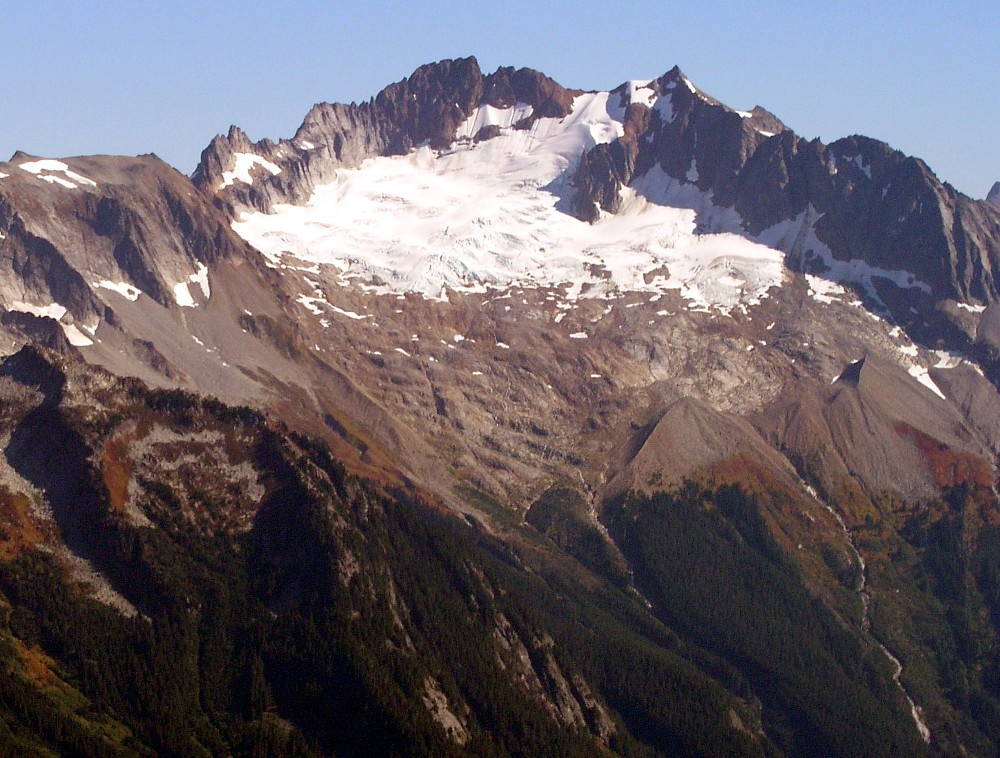
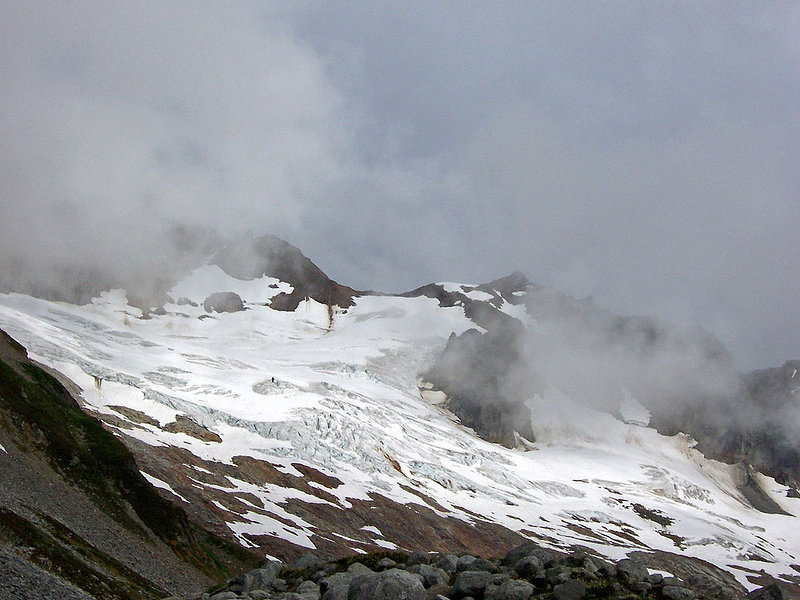
Quien Sabe Glacier viewed from a similar location on the western side of the glacier in 1985 and 2007. The reduction in crevassing, thickness is evident as is the marginal retreat and emerging bedrock. 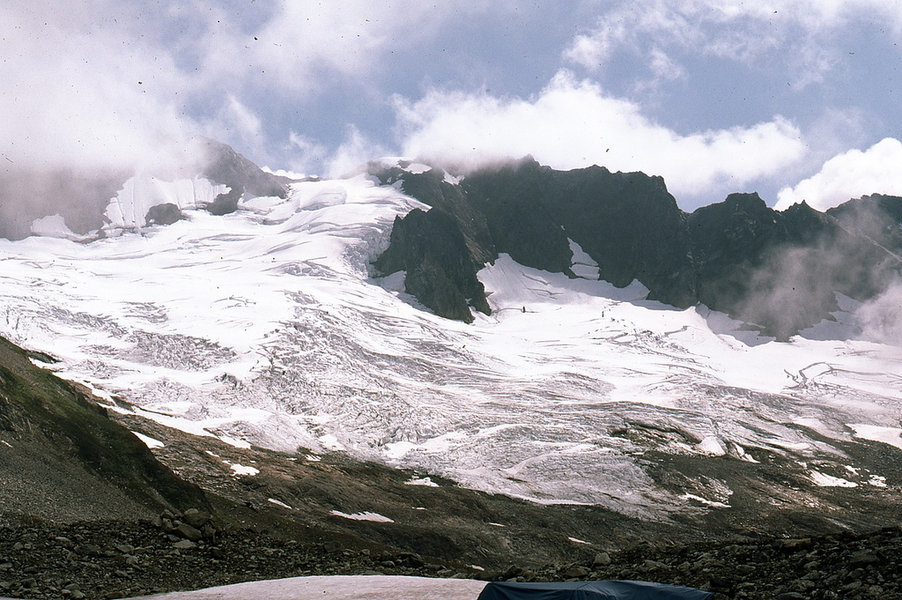
Dosde Glacier, Italy retreat and separation
Dosdè Glacier in the Dosdè-Piazzi Group of the Italian Alps has been the focus of research by the University of Milan Department of Geography in the last decade to both chronicle its retreat, examine the causes, and evaluate the impacts and potential mitigation steps. In 1954 there was a Dosdè Est, Dosdè Centrale and Dosdè Ovest glaciers with respective areas of 1.2 and 0.8 and 0.9 square kilometers. By 2003 the areas had been reduced to 0.8, 0.5 and 0.3 square kilometers. This is evident in the picture from 1932 and 2007 of the Dosdè Glacier group from Guglielmina Diolaiuti, University of Milan. I have added arrows annotating key changes Est is on the left, Centale in the middle and Ovest (labelled Ost) on the right.  The purple arrow indicates the separation of two glaciers. The blue arrow indicates the change in glacier size near the top of the peak. The orange arrow notes the thinning of the glacier near the current glacier tongue. The green arrow indicates the retreat at the head of the glacier indicating thinning even in the accumulation zone. This glacier lost all of its snowcover in several recent summers including 2010, in this Google Earth view the summer of 2010 is ongoing and their are a few white patches of snowpack from the previous winter, that were then lost. This inconsistency of the accumulation zone is a sign of a glacier that cannot survive
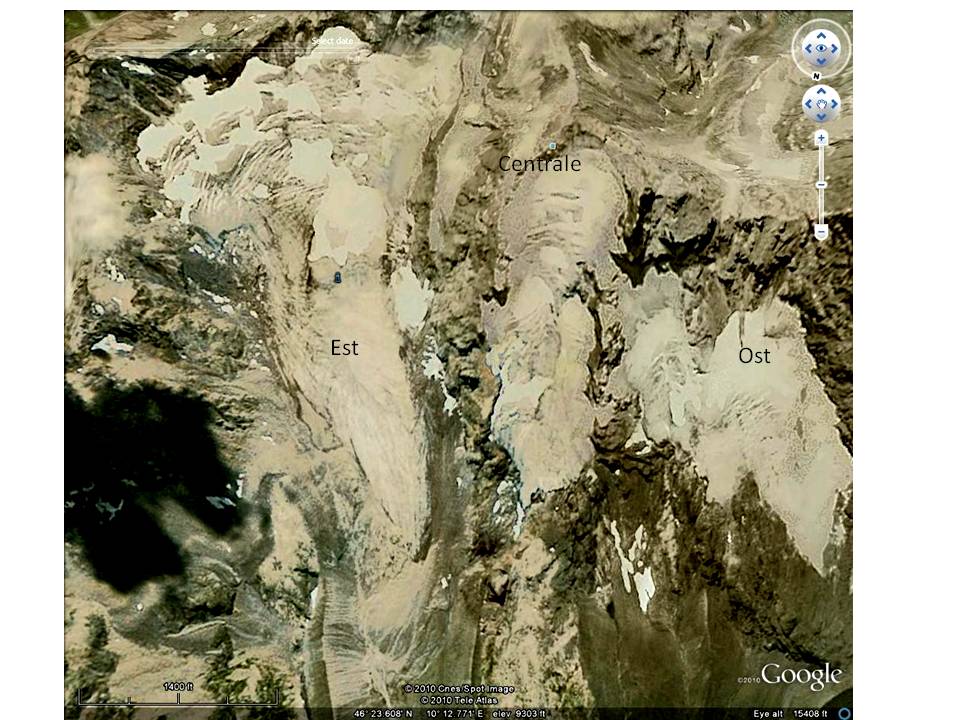 In this region at least 6 glaciers have been observed to disappear in the last 50 years. The continued decline in area and lack of accumulation zone persistence does not suggest that glaciers in this mountain massif will survive. Dosdè Est has retreated over 400 meters in the last 50 year, but of more importance to its survival is the degree of thinning apprarent from the terminus to its head. Dosdè Est has been the focus of study utilizing a covering blanket to examine its efficacy in reducing ablation as was done on Stubai Glacier in Austria. The University of Milan group reported a 43% decline in snow ablation and a 100% decline in ice ablation. The retreat of this glacier follows the trend of increasingly rapid and widespread retreat seen throughout the Italian Alps, as chronicled by the Italian Glacier Commission, which reported more than 95% of the over 100 glaciers examined retreating from 2000-2005. The smaller size and elevation range of the Dosdè Glacier group makes them more vulnerable to complete loss than Forni Glacier.
Neumayer Glacier, South Georgia Retreat
South Georgia sits amidst the furious if not screaming fifties latitude belt, the circum Antarctic westerlies. This region is famous for the endless march of storms parading around Antarctica. The island is south of the Antarctic Convergence, preventing any truly warm season from persisting. The cool maritime climate leads to numerous glaciers covering a majority of the island and quite low equilibrium line altitudes. Sugden, Clapperton and Pelto (1989-sorry no good link to this paper, one of the first I worked on), 1989 noted the ELA of Neumayer Glacier at 550 m. The tidewater glaciers of South Georgia in general maintained fairly advanced positions unitl 1980. Gordon et al., (2008) observed that larger tidewater and sea-calving valley and outlet glaciers generally remained in relatively advanced positions until the 1980s. After 1980 most glaciers receded; some of these retreats have been dramatic and a number of small mountain glaciers will soon disappear. Neumayer Glacier is one of the large tidewater glaciers on South Georgia. Maps from the British Antarctic Survey (BAS) and satellite imagery are used here to assess the changes in this glacier terminus position. A view of the entire glacier in 2006 from Google Earth, from beyond its calving terminus, indicates indicates the glacier remains vigorous with extensive crevassing at the calving front and extensive snowcover above the ELA.  The BAS has a mapping function that provides glacier front positions since early in the 20th century. For Neumayer Glacier the 1938 position is 3.5 km down fjord from the 2006 position. There was essentially no retreat up to 1974 and limited retreat up to 1993.
  . In 2004 and 2009 NASA provided two images of Neumayer Glacier indicating retreat from 2004 when the glacier extended to the down fjord edge of a tributary glacier from the south. By 2009 the glacier has retreated upglacier of this now former tributary, this retreat is 1300 m. Landsat Image from 1999 to 2014 indicates retreat of 4800 m from the red to the green arrow , this is 320 m/year. The glacier appears to have retreated into a deeper section of the fjord then where it ended from 1970-2002. This will enhance calving from the glacier, and promote additional mass loss and retreat. This retreat will impact Konig Glacier which is connected to the Neumayer Glacier. Calving rate increases with water depth and the degree of glacier. Pelto and Warren (1991) provided an expanded version of the relationship first quantified by Brown and others (1982). In the you would have never guessed it category, is the glacier retreat has been an aid to the rat population, as the glacier tongues used to corner populations.


Rainbow Glacier Mass Balance
In 2010 at the end of a four day period of cool rainy weather we hiked into to our base camp on Ptarmigan Ridge to measure the mass balance of the Rainbow Glacier on Mount Baker in the North Cascades of Washington for the 27th consecutive year. Below is a view of Rainbow Glacier as we approach it. This is a valley glacier that begins on the slopes of Mount Baker at 2200 m and descends to a terminus that is often avalanche covered at 1350 m. 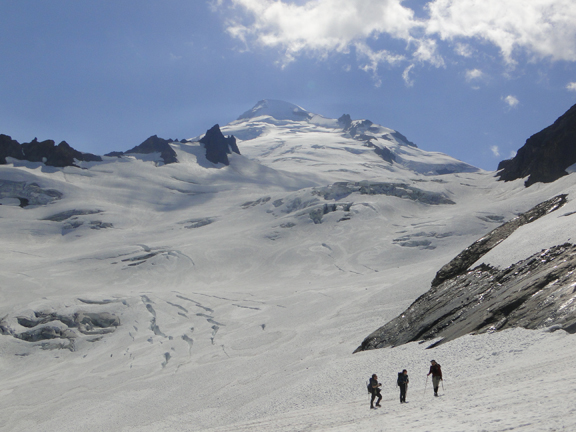 The year proved to be the most variable in terms of glacier mass balance of any of our 27 years. Assessing the mass balance requires melting the extent and depth of snowpack on the glacier. We had a chance to measure the snow depth in 121 locations using crevasse stratigraphy and probing. The below image has all of the measurement locations, blue dots, and the rough contours of mass balance marking the snowline in green-blue, the 1 meter of snowpack water equivalent (swe) in purple and the 2 m of swe in blue. Glacier margin is in orange-brown.
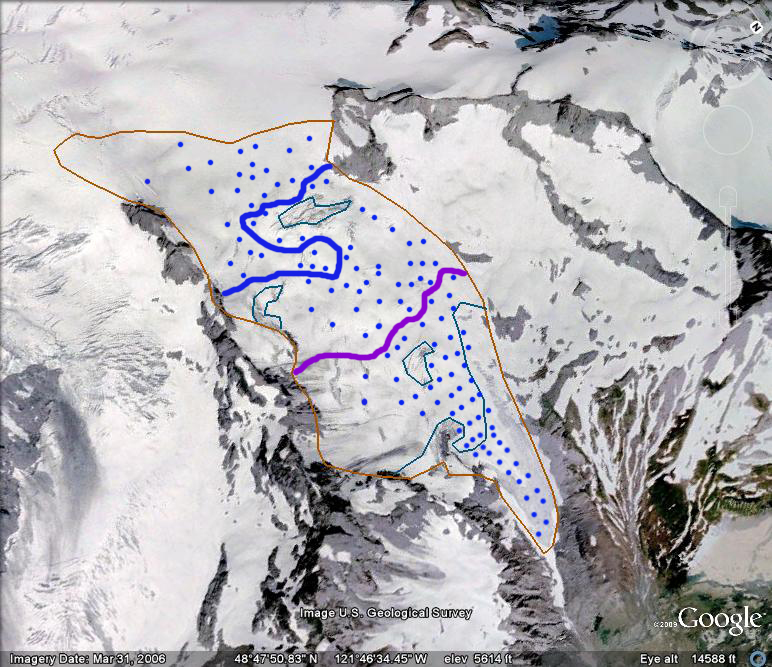 . The initial field assessment of mass balance for the Rainbow Glacier in 2010 was +0.81 m. At this time the significant melt season is at an end, new snow is projected for tomorrow 9/23. The average over the previous 26 years has been -0.40 m/year. Of the ten glaciers we monitor there was a split with six having negative balances and four positive, the variation is unusual. The probe is a half inch diameter steel rod that is easily driven through the snowpack until the hard icy layer marking last years summer surface is reached. This can either be bare glacier ice or the firn from the previous year. In either case it cannot be penetrated. The second means is to lower a tape measure down the wall of a vertically sided crevasse. This provides a two dimensional measure and view of snow depth versus the point measurement of probing. By late summer the density of the snowpack is uniform in the North Cascades. We survey the blue ice regions using a GPS to map the boundaries. Melting is assessed by observing the progressive ablation of snow and ice. On Rainbow Glacier snowpack was normal below 1800 m, where probing is dominantly used.
  The snowline was at 1450 m in early August and had risen to 1600 m by late September. Above 1600 m the snowpack increased very rapidly this year from 1.5 m at 1800 m to 5.5 m at 2100 m. This reflects the unusually warm winter that led to a dearth of snow below 1800 m by winters end. Above this elevation several winter events that were rain below were snow. Than melting was well below normal in the summer of 2010. Again spring snow storms retarded melt above 1800 m, while those were rain events below this elevation.
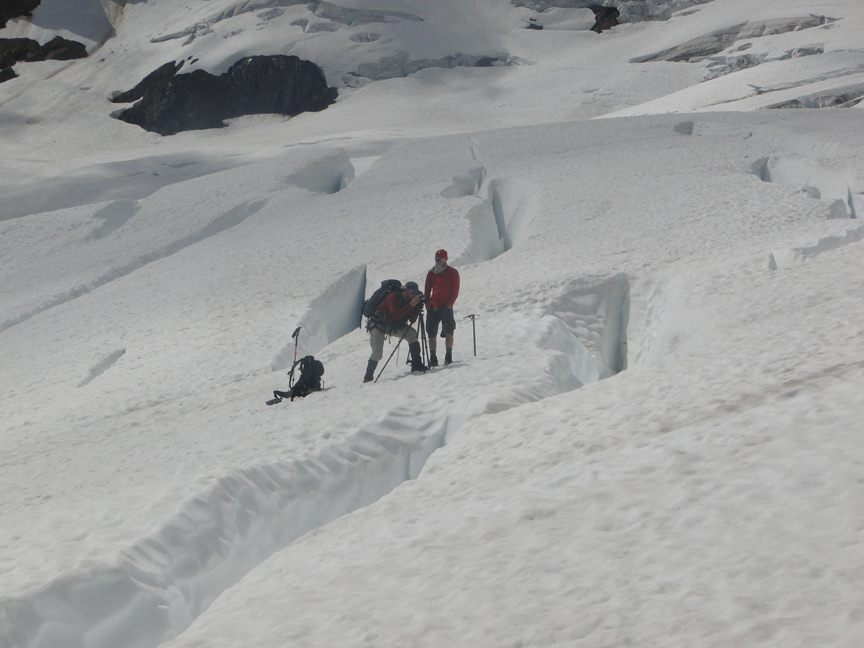
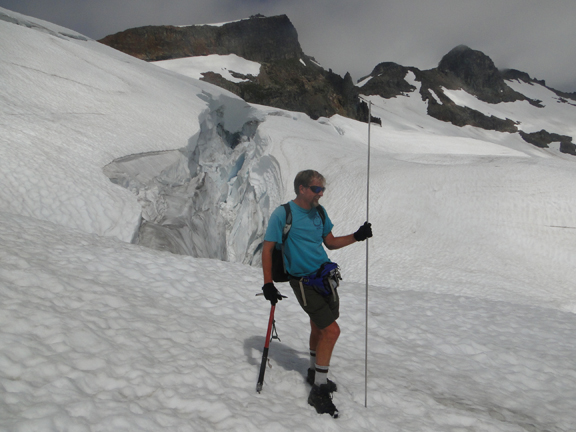
Crevasse stratigraphy was the dominant tool of measuring snowpack on the Rainbow up to is divide with Mazama Glacier. Navigating these crevasses takes considerable care using the snow probe as a crevasse probe. 
 .
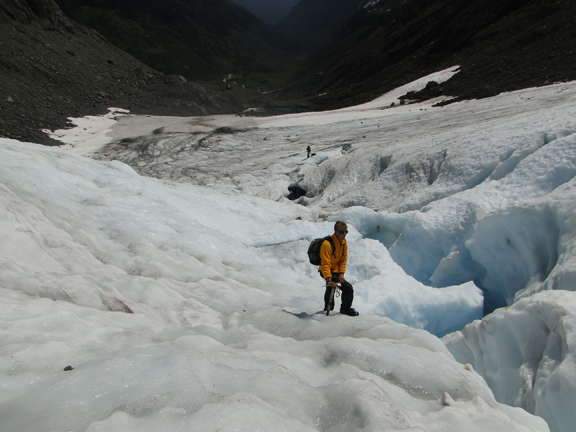
. The area of bare glacier ice is riven by some large streams, which are also the focus of annual observation.
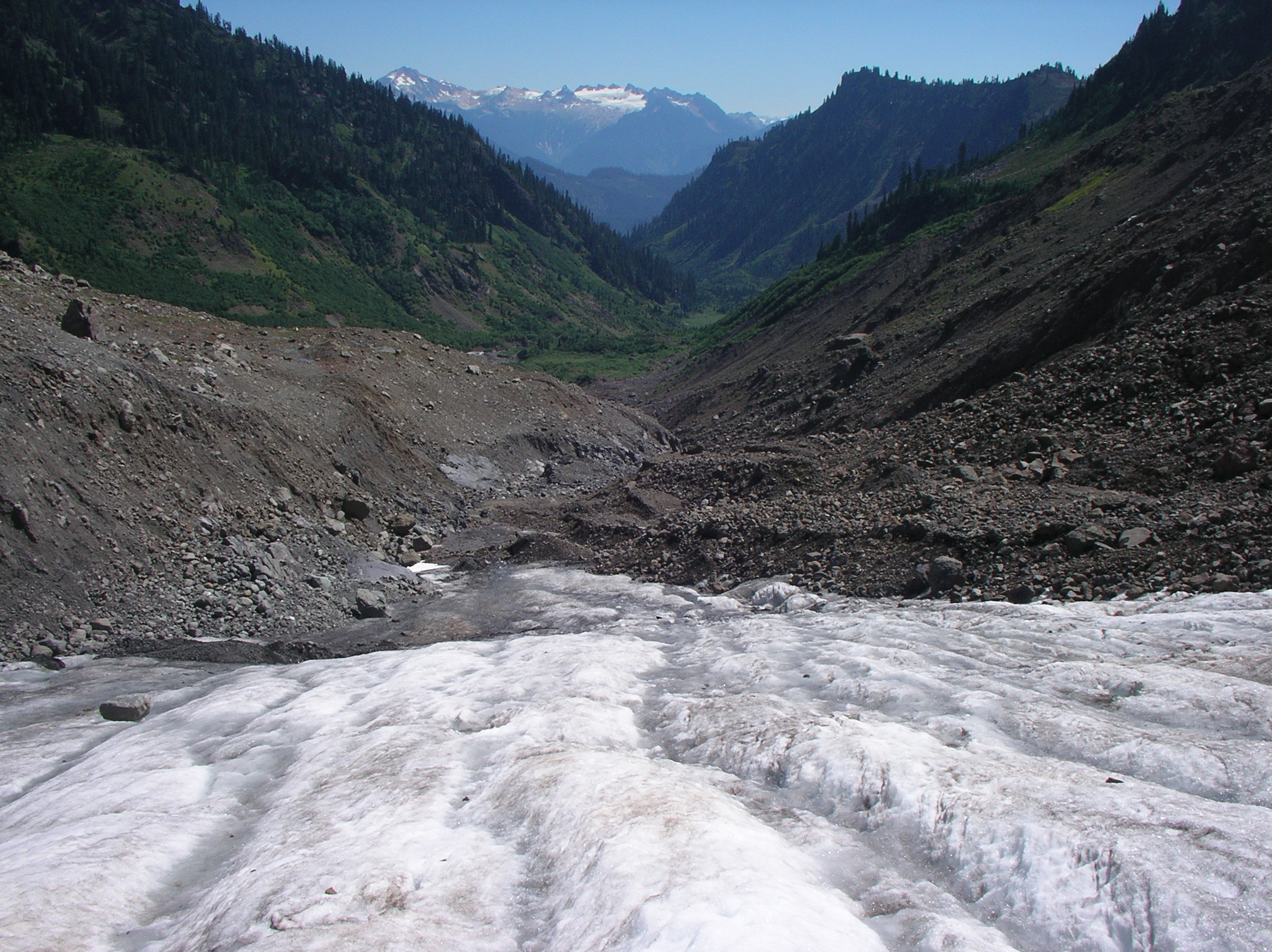
 T The terminus this summer was buried in snow from an avalanche, as was the case last year. In 2007 the terminus was fully exposed and we could measure the retreat at 450 m in the last 25 years.
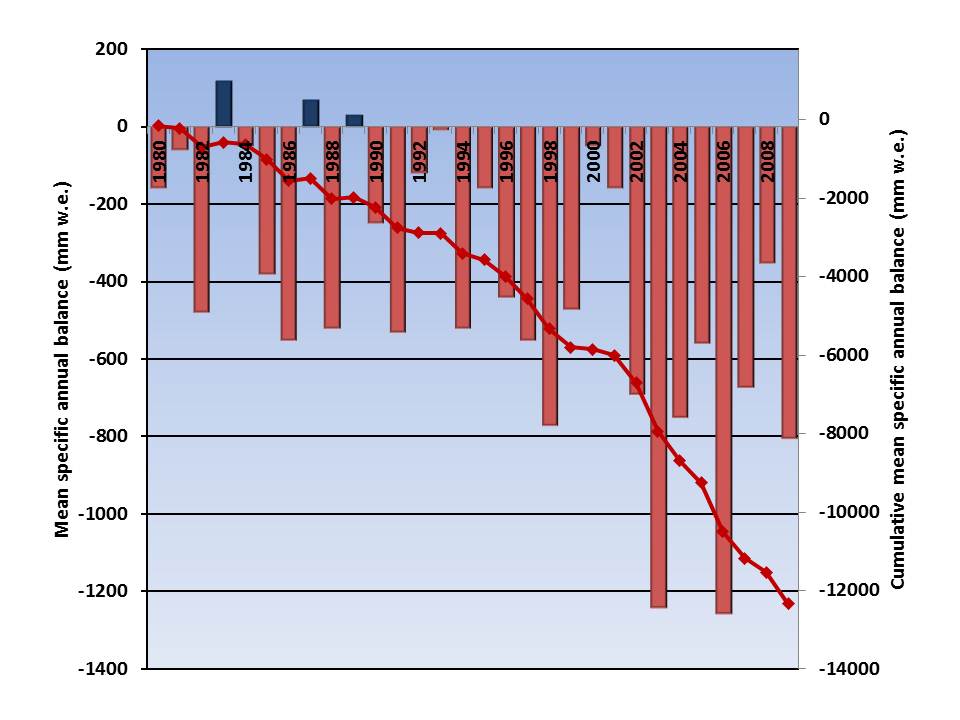
  This glacier’s mass balance history follows that of the other northwestern North American glaciers which also is right in line with global mass balance. All data is from the WGMS.
 One of the best parts of this location is the gorgeous campsite we use for a base camp. It is above the glacier so we have to hike uphill at the end of the day.
  . his area is noted for its mountain goats as well which we count annually.
  We will complete a final analysis in the next month and report this data to the World Glacier Monitoring Service.
Engabreen Glacier, Norway retreat
Engabreen is an outlet glacier of the Svartisen ice cap in northern Norway. It has an area of 40 km2. Most of the area lies between 1200 and 1450 m the high plateau of the ice cap. This glacier has been the focus of attention from the Norwegian Water Resources and Energy Directorate (NVE) for over 50 years. 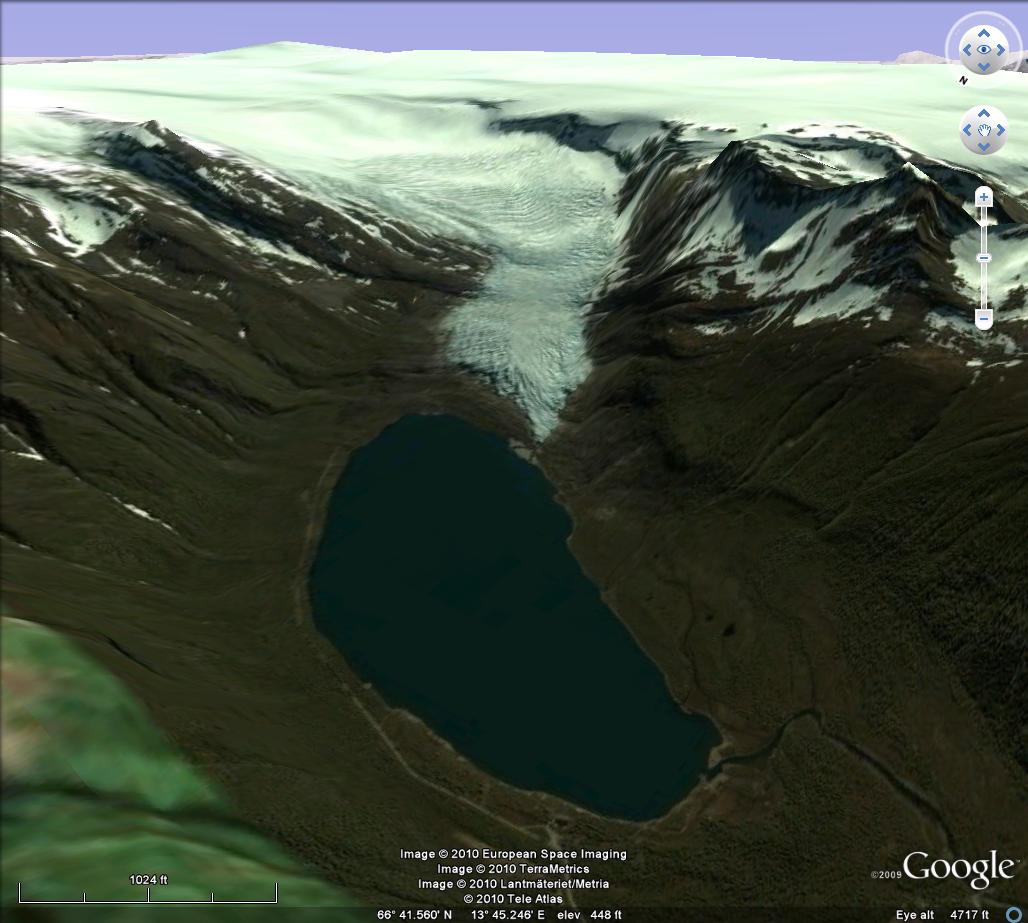 NVE maintains the most extensive and detailed glacier monitoring network in the world. The NVE annual mass balance measurements on Engabreen indicate that winter snow typically accumulate 3 m of water equivalent on the ice cap. This amounts to 5-7 m of snowpack as the melt season begins in May. The glacier terminus descends from the ice cap down nearly to Engabrevatnet, a lake at 7 m. At the terminus annual melting is 12 m.
The rivers from the northern and eastern side of Svartisen were regulated in the 1990’s for hydro power production by construction of a tunnel system partly underneath the glacier. Today about 60% of the potential runoff of the Engabreen is captured and sent through a bedrock tunnel to the hydropower facility. During completion of this tunnel access to the glacier base was opened. Today there is the world’s only ongoing subglacial laboratory here. The melt water from Engabreen is collected into this tunnel system at 620 m a.s.l. underneath 200 m of glacier ice in the ice fall.
Late in the 18th century Engabrevatnet started to appear as the glacier retreated upvalley.
In 1903 regular length change observations were initiated, a small advance ensued until 1910. By 1931 the glacier retreated 100 meters, and the glacier tongue was thinning. During the next decade calving led to rapid retreat revealing the rest of Engabrevatnet. The retreat ended in 1965, since then has advanced with three different pulses ending in 1971, 1984 and 1999, the last pulse reaching to within a few meters of the lake shore. From 1999-2009 Engabreen has retreated 255 m. Below are pictures from the NVE taken in 2000 and 2008 of Engabreen, note the large contraction of the terminus area. Also note the considerable reduction in crevassing at the terminus, indicating a velocity reduction and that retreat will continue in the near future. 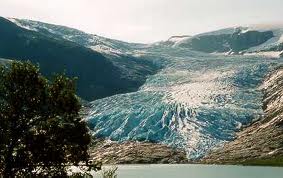
 The 2009 position is its point of furthest retreat since the Little Ice Age. The recent retreat indicates a recent trend of negative mass balance on the glacier. There is excellent flow off the ice cap that has persistent and consistent snowcover indicating this glacier will survive current climate.
Humboldt Glacier Retreat, Greenland
Humboldt Glacier in northwest Greenland terminates in a 100 km wide calving front in the sea. This is the longest such calving front in Greenland, capturing our imagination for potential havoc. The lack of confining topography prevents the development of the strong ice stream flow we see on Jakobshavn Glacier or the weaker ice stream flow of Petermann Glacier and its subsequent long floating tongue. Humboldt Glacier’s unique calving front leads to a different set of feedbacks to climate change that are worth examining. Pelto and Warren (1991) (Do not laugh at my figures in that paper, that is back in the drafted with ink days) noted that water depth at the calving front even in the case of polar or floating tongues provides a good estimate of calving velocity. More than width we then need to look at the water depth at the front for answers. Below is Humboldt Glacier in 2008 from a NASA image. The active portion of the terminus begins above the tag on the image 2000 approximate terminus position.

From when observed by Koch in 1912-13 the glacier changed little over the next 60 years. The glacier is a principal source of icebergs to the Kane Basin. Generally the icebergs are tabular icebergs less than 1 km in their largest diameter. Most icebergs come from the northern portion of the calving front is fed by an active ice stream, a nice view of these is from Jason Box at OSU. The glacier has lost 200 square kiometers of area since 1982, mostly since 2000, including this summer’s losses. What is particularly noteworthy is the amount of eroded sediment raising the turbidity and color of the water to that of coffee at the calving front in 2009 in the images from Jason Box and of Nick Cobbing of Greenpeace. This is indicative of where major subglacial meltwater streams enter the ocean. 
 . To understand the dynamics of Humboldt Glacier its pattern of velocity, ice thickness and ice bed depths need to be identified. Ian Joughin et al (2010) provide a detailed velocity map of Petermann and Humboldt Glacier shown below. The Petermann is the narrower tongue flowing towards the top, Humboldt to the left. The velocity does not exceed 80 m/year in the southern half of the calving front. The northern portion increases from 80 m/year at the equilibrium line to 200-300 m/year at the calving front. The low velocity of the southern half of the terminus indicates a terminus that is firmly grounded, not just at the glacier front, but also all along the flowline.
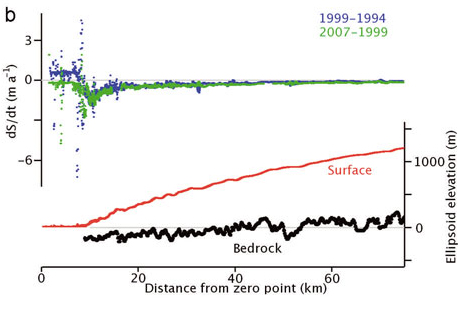
  The basal topography and surface topography of the ice sheet was captured by Thomas et al (2009). The graph below indicates that the bed is generally below sea level for 40 km inland of the calving front. The bed is not smooth. The bed is not deep, usually less than 200 m. The result is that ice less than 240 m thick cannot be afloat. The lack of smoothness and lack of a trough penetrating deep into the ice sheet indicates the lack of streaming flow dynamics that would erode and smooth such a channel. Behind the calving front the glacier slope is quite low the surface not reaching 1000 m until 60 km back of the calving front. In this span there is no specific bench of higher elevation either. The snowline, evident in the image below, on this glacier tends to be at 600 m. This is only 40-45 km inland from the calving front, compared to the 80 km long ablation zone on Petermann Glacier. There are three dotted lines I have added to this image. The first nearest the calving front indicates a clear zone of surface roughness that has to reflect the glacier is grounded and passing over a bedrock knob of sorts. The second is the transient snow line for that day. The third is the ela. Note the slightly wider distance to the ela on the north side indicating the lower slope and deeper bed that promotes the higher velocities in the area. One would anticipate an expansion of the calving embayment in the area where the embayment exists today, with retreat occuring mainly in this section. The size of the tabular bergs argues that at least locally the glacier is close to being afloat or is afloat at least sometimes during the tidal cycle.
We have a comparatively slow moving, not particularly thick, but wide glacier. The glacier does not have a deep bed penetrating to the core of the ice sheet. The volume produced by Humboldt compared to Jakobshavn and Petermann puts it in perspective. Jakobshavn annual flux 40 km3,(flux= annual depth average velocity x width x mean depth) Petermann Glacier has close to 12 km3 at the grounding line, but less than 1 km3 reaches the calving front, after all the melting along the ice tongue. With a shorter ice tongue the calving flux should rise.. Humboldt Glacier is closer to 4 km3. Helheim Glacier has been assessed at 26 km3. Thus, though the Humboldt Glacier has a magnificent and impressive front and taps into the core of the northwest corner of the ice sheet. It does not at present have the ability to discharge ice at volumes comparable to Jakobshavn or Helheim. The glacier does not have either a large floating section or a large ice stream section that lends itself to large rapid retreat or acceleration. The recent history of area and volume loss noted by Box indicates this glacier is more prone to a steadier progressive loss than many other outlet glaciers. The glacier continues to produce an impressive volume of icebergs as seen in the Nick Cobbing image below The depth at the calving front is a key variable and provides a good first estimate of average calving velocity. In the Pelto and Warren (1991) study four other polar glaciers have water depths that are in the vicinity of 100 m and have velocites at the calving front of 100-300 m/year. Humboldt fits this pattern. For Humboldt the relatively shallow water today across most of the front and in the future, noting depths behind the front, indicates the velocity of this glacier will remain comparatively low. Even the northern section has a limited section of higher velocity in width (25 km greater than 200 m) and distance inland from the ice front (50 km maximum). This region is centered on the main calving embayment. The northern margin is again well grounded.
Thanks to Neven and Pat Lockerby for all the inspiring arctic image work this year.
Bear Glacier, Kenai Alaska recedes, new lake formed
Bear Glacier in the Kenai Mountains of Alaska is a 25 km long outlet glacier of the Harding Icefield. When first mapped in 1909 it had a large piedmont lobe filling a basin and terminated 400 m from the edge of the forest, though it appeared the retreat had been quite recent within 25 years. By 1950 the glacier had retreated another 400 m. Austin Post observed in the 1960’s the drainage of a lake seven kilometers upglacier from the terminus indicating that slow thinning was occurring in the entire lower section of the glacier. The piedmont lobe slowly downwasted through the 20th century preconditioning the glacier for a rapid retreat. The repeat photographs of Bruce Molnia, USGS portray this spectacular change.  By 1980 the terminus had retreated 1 km, thinned by 150 m, and was calving small icebergs into an ice-marginal lake that was beginning to develop in the still narrow basin. As thinning continued, much of the terminus became afloat by 2000. Bruce Molnia, USGS observed that passive calving, characterized by the release of large tabular icebergs from Bear’s low gradient, floating terminus became frequent. Between 2000 and 2007, the terminus retreated about 3.5 km, yielding large icebergs that floated in the lake. The first image is from Google Earth the second taken by Bruce Molnia in 2002 followed by GoogleEarth images from 2005 and 2011. The terminus position in 2005 is in green and 2011 in red, retreat was 400 m during this six year period. The last image is a Landsat image from 8/3/2012 and indicates continued retreat along the east margin and expansion of the length of the calving front. The amount of calving has declined from the period of more rapid retreat from 2002-2008.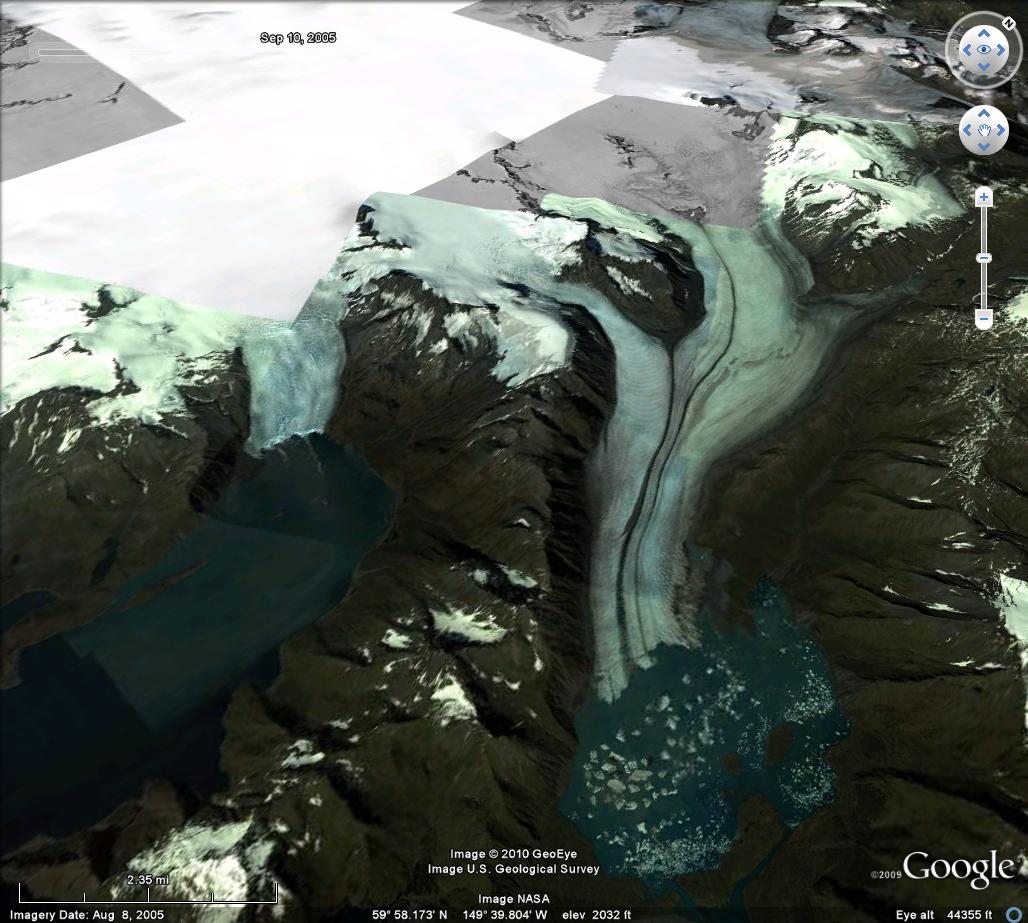


 An examination of the expanding lake identified locations with depths exceeding 75 meters. Retreat indicates the response of the terminus region of a glacier to climate in this case long term downwasting, but does not reflect how healthy the higher regions of the glacier are. How does the large 150-200 m of thinning in the terminus region compare to further upglacier? The U of Alaska-Fairbanks established a program of laser altimetry examining thickness changes along the Bear Glacier that have been reported by A.Arendt, K.Echelmeyer and C.Larson.
 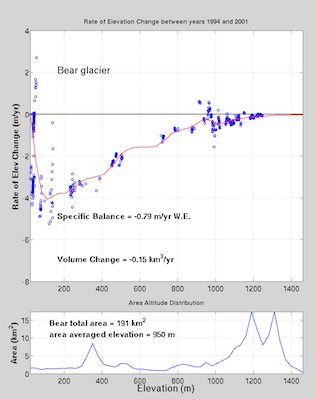 The graphs of the last decade of change indicate that little thinning has occurred above meters since 2007. In a satellite image of the region of the glacier from 2500-3500 feet, a small rock island (nunatak) generates a consistent and long term lateral moraine. in the lower center of the image below
 The size of the moraine and the size of this nunatak have not changed appreciably in the last decade, suggesting limited thinning in the region above 2700 feet. The accumulation zone of this glacier remains sizable, but insufficient to supply a large piedmont lobe-now gone, or a calving terminus. This is not unlike the retreat of the Gilkey Glacier, Norris Glacier or Field Glacier of the Juneau Icefield. In the St. Elias range Yakutat Glacier is another example.
Daniels Glacier Recession Increases 2010
The 2010 North Cascade Glacier Climate Project Field Season found extensive retreat and areal extent loss on Daniels Glacier earlier this week. Daniels Glacier is on the east face of Mount Daniels on the Cascade Crest. A sequence of images indicates the loss of the glacier tongue in the lower left of the glacier, and the recession of the entire bottom margin of the glacier with emergence of rock islands where glacier ice previously existed. The first two images from 1985 and 1990 indicate a large blue glacier ice tongue extending to 6400 feet on the left side of the glacier.


By 2000 this area is just a gentle snow slope over a now stagnant section of glacier ice. The terminus extending to the right is also rising across the entire width of the glacier. Images from 2007, 2009 and 2010 indicate the continued emergence of new rock outcrops formerly covered by the glacier. The terminus continues to retreat up slope and by 2010 has retreated over 500 meters in 25 years. The loss of area is now 30% of the 1984 glacier area. Note the lines showing the 1985 margin and 2010 margin. In 2009 and 2010 we did not find an area on this glacier with accumulation depths over a large enough area to sustain a glacier. We have measured the glacier’s mass balance each year since 1984. The cumulative loss of -14 meters is nearly a third of the volume lost as well. In 2010 our measurements indicated another year of negative mass balance will occur this year. We measured the snow depth in crevasses and using probing at 90 locations on Daniels Glacier. The steep slope 34 degrees makes for cautious but good glissading down glacier in the last image.