For the next three weeks I will be in the North Cascades of Washington visiting and measuring snowpack, snow melt and area change on North Cascade glaciers. There will be no new posts here during this period. Though you can take a look at the film documentary crews site travelling with us. Our main task is assessing glacier mass balance on 10 glaciers which are then reported to the World Glacier Monitoring Service (WGMS). We measure the snowpack by probing through it to the previous summer’s impenetrable surface, due to melting and refreezing or being blue glacier ice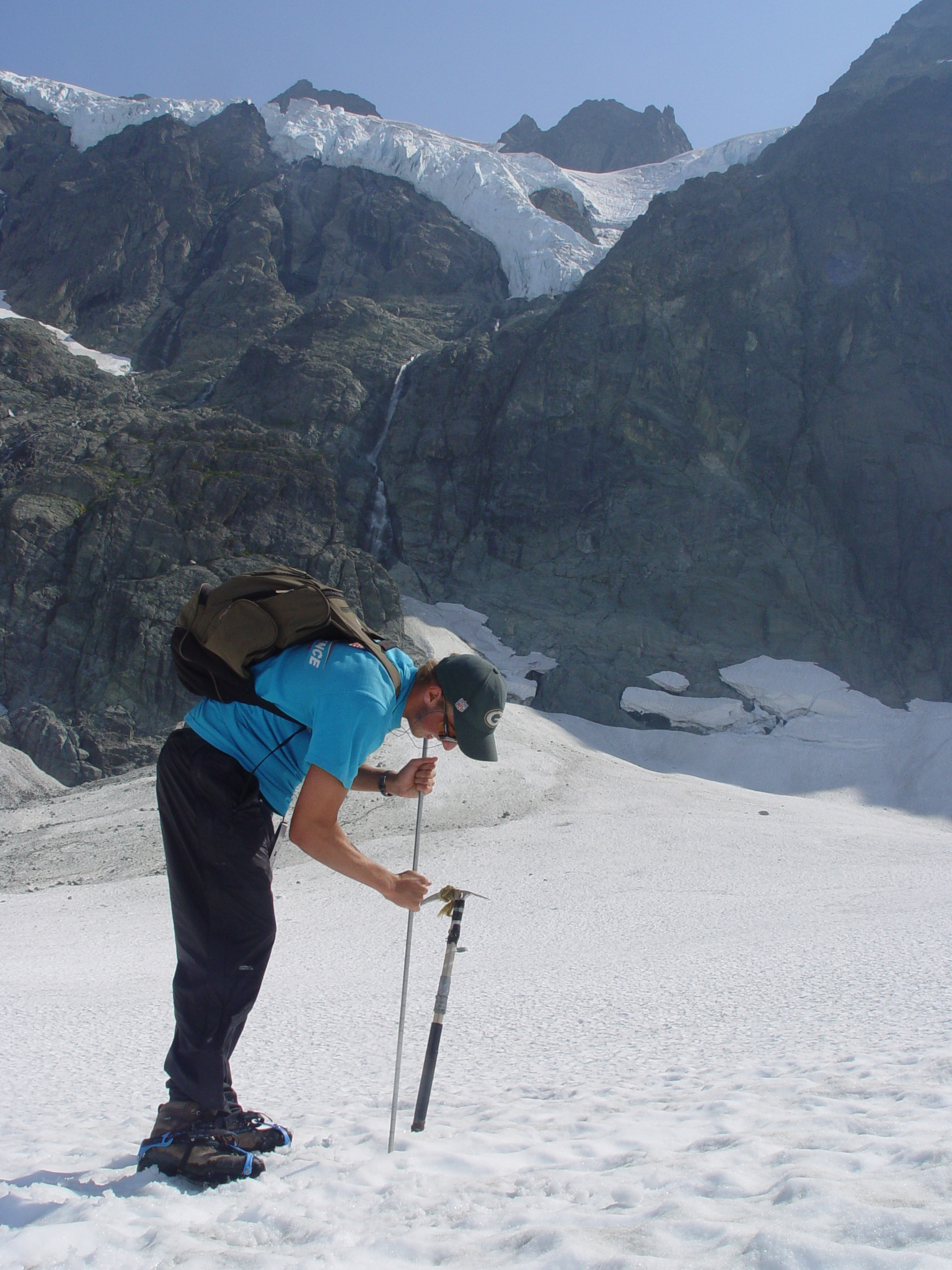 . The other means is examining snow depth in a crevasse using the evident stratigraphy
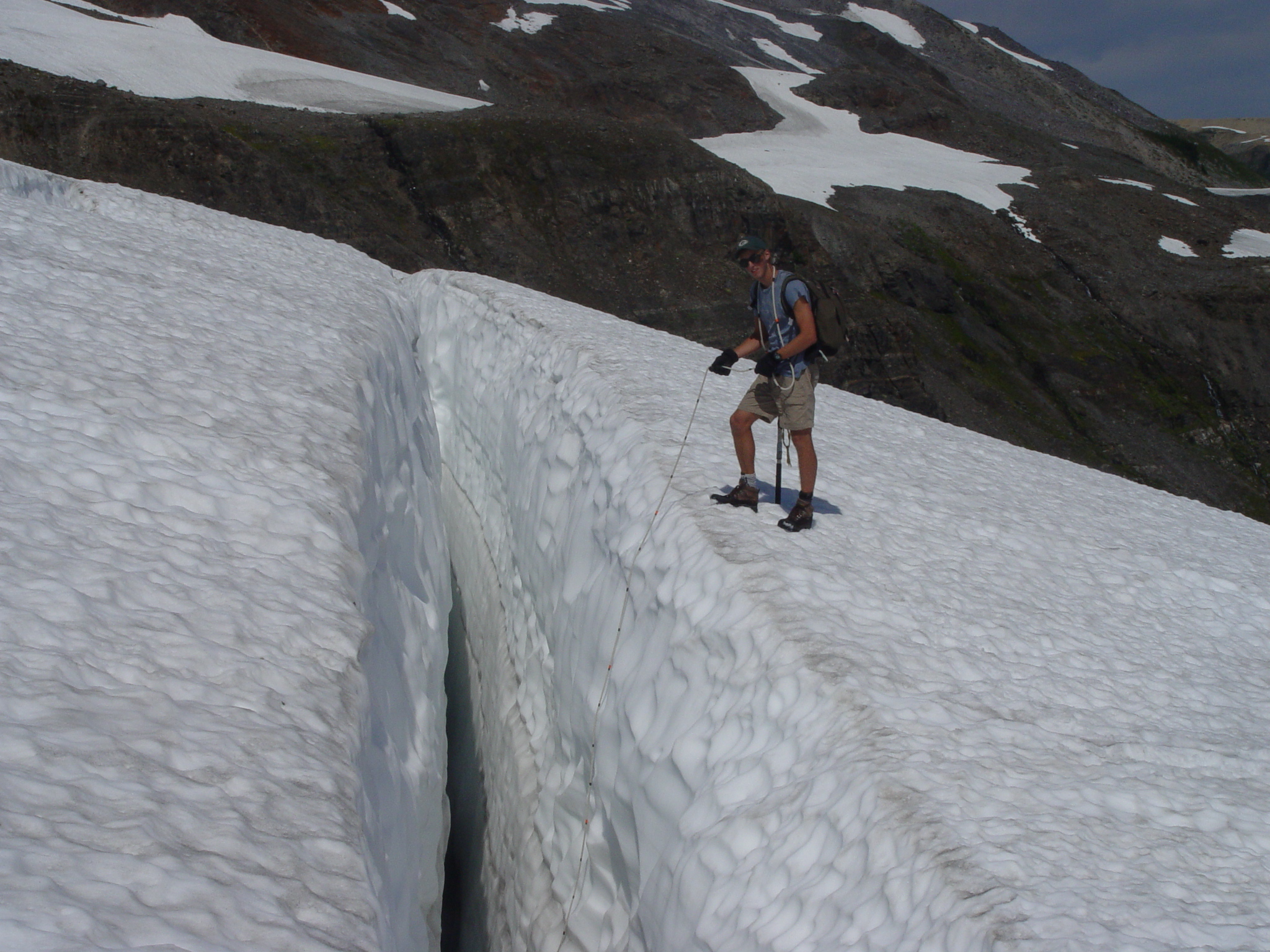 .
.  We monitor the snow melt and reset stakes in the glacier to monitor the snow melt as well.
 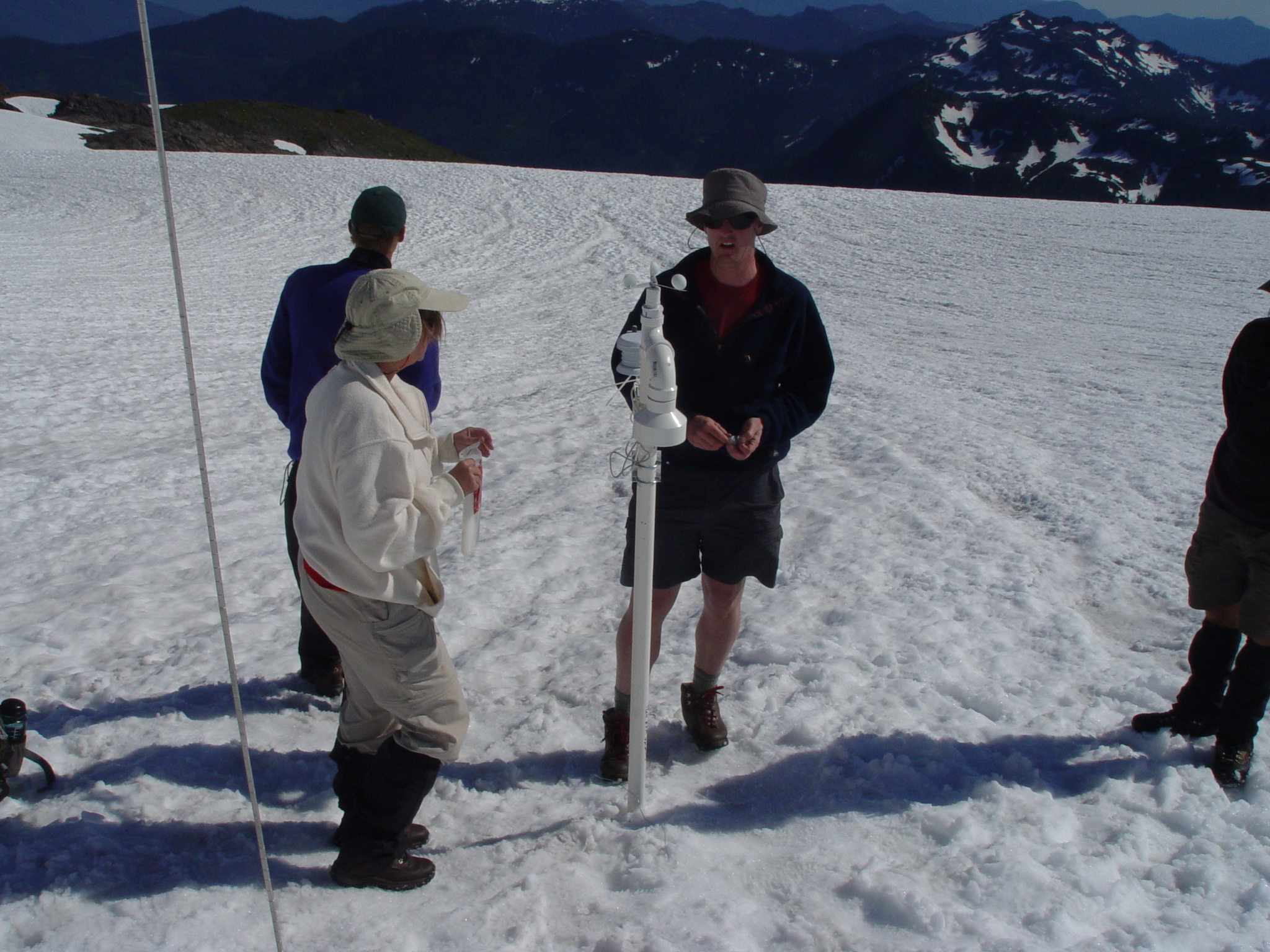 We also measure changes in surface elevation and margins of the glacier. We will report back shortly after our return on the status of these climate sensitive glaciers.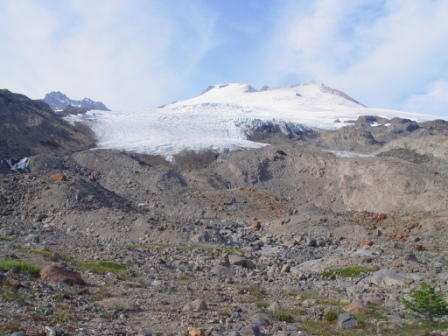
Category: Glacier Observations
Post detailing changes in a glacier
Lemon Creek Glacier Retreat Juneau Icefield Alaska
 Above is a paired Landsat image with 1984 left and 2013 right, indicating a 300 m retreat in this interval.
Annual balance measurements on the Lemon Creek Glacier, Alaska conducted by the Juneau Icefield Research Program from 1953 to 2013 provide a continuous 61 year record. This is one of the nine American glaciers selected in a global monitoring network during the IGY, 1957-58 and one of only two were measurements have continued.  These show cumulative ice losses of –13.9 m (12.7 m we) from 1957-1989, of –19.0 m (-17.1 m we) from 1957-1995 and –24.4 m (–22.0 m we) from 1957-1998. The mean annual balance of the 61 year record is -0.43 m/a and a loss of at least 30 m of ice thickness for the full 61 year period from 1953-2013. In the second graph the similarity with other North American glaciers is evident (Pelto et al, 2013).

This negative mass balance has fueled a terminal retreat of 800 m during the 1953-1998 period, and an additional 200 meters of retreat by 2013. 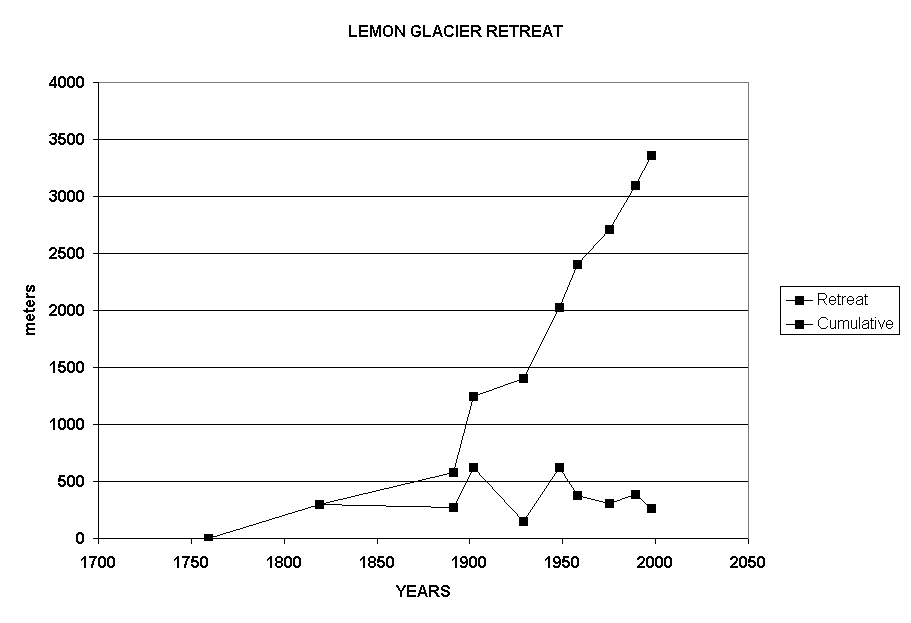 Below is a picture of the terminus enroute to Camp 17 in 1982, and below that from 2005.
 The annual balance trend indicates that despite a higher mean elevation and a higher elevation terminus, from thinning and retreat, mean annual balance has been strongly negative since 1977 (-0.60 meters per year). Dramatically negative mass balances have occurred since the 1990’s, with 1996, 1997 and 2003 being the only years with no retained accumulation since field observations began in 1948.
These data have been acquired primarily by employing consistent field methods, conducted on similar annual dates and calculated using a consistent methodology. The research is conducted from Camp 17 on a ridge above the glacier. This is a wet and windy place with three out of four summer days featuring mostly wet, windy and cool conditions in the summer. The camp was initially built for the IGY in 1957, and Maynard Miller and Robert Asher saw to its continued improvements through the 1980’s.  The mass balance record have been were until 1998 precise, but of uncertain accuracy. Then two independent verifications indicated the accuracy (Miller and Pelto, 1999). Comparison of geodetic surface maps of the glacier from 1957 and 1989 allowed determination of glacier surface elevation changes. Airborne surface profiling in 1995, and comparative GPS leveling transects in 1996-1998 further update surface elevation changes resulting from cumulative mass balance changes. Glacier mean thickness changes from 1957-1989, 1957-1995 and 1957-1998 were -13.2 m, -16.4 m, and –21.7 m respectively. It is of interest that the geodetic interpretations agree fairly well with the trend of sequential balances from ground level stratigraphic measurements. The snowline of the glacier lies a short distance above a tributary glacier from the north that has separated from the main glacier since 1982. The snowline on the glacier was just below this juncture in the 1950’s and 1960’s but now has typically been above this former juncture. The two images below are looking down and upglacier from this former tributary in 2005.

At the head of the glacier is a supraglacial Lake Linda, which now drains under the ice. Robert Asher in the late 1970’s and 1980’s mapped this lake system when it drained under the head of the glacier not down under the terminus of the glacier.
Triftgletscher spectacular retreat and lake formation 2000-2008
The Triftgletscher in the Bernese Alps of Switzerland has undergone a swift alteration in the last decade. The Swiss have been the most methodical chroniclers of glacier changes over the last century. The Swiss Glacier Commission faithfully recording the annual terminus change of approximately 100 glaciers. In 2009 81 glaciers retreated, 2 advanced and 5 were stationary. One of the retreating glaciers is the Trift, which after a period of limited retreat from 1955-1995 punctuated by a small advance, began a spectacular retreat in 1998, note the below graph from the Swiss Glacier Commission.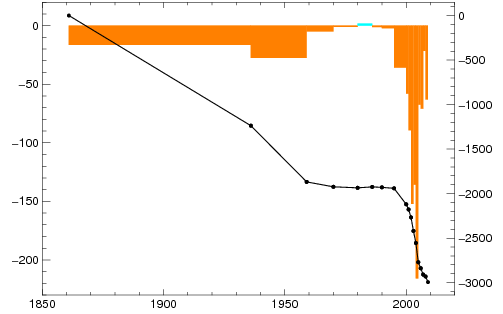 The retreat began to expose a new glacier lake at 5700 feet (1750 meters) at its terminus in 2000 and then as observed in photographs by Jürg Alean (Glaciers Online) the lake quickly grew to its full size from 2002 into 2003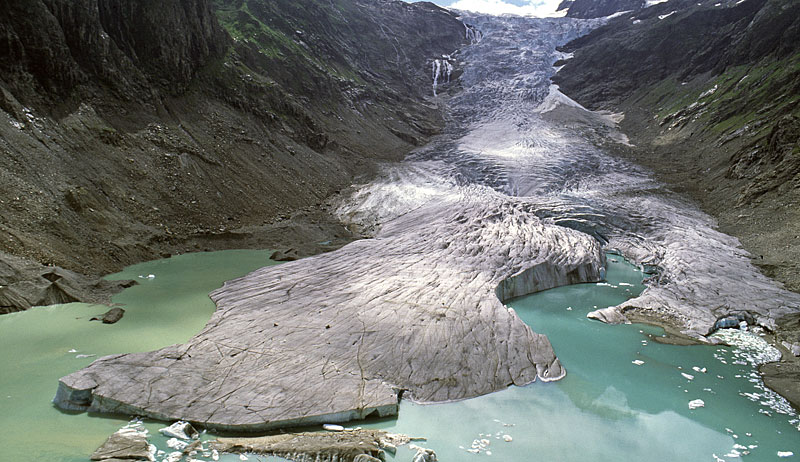
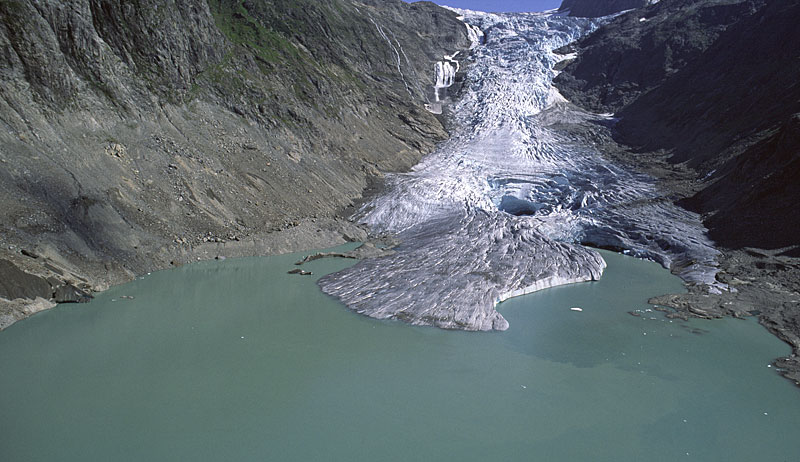 . The summer of 2003 featured remarkably high melt rates in the Swiss Alps mean losses of more than 2 meters of thickness, and no retained snowpack on two of the three glaciers examined for mass balance. and retreat of 99 of the 100 glacier examined, one was stationary. The lake is now 900 m long. By 2007 the glacier no longer was in contact with the lake, and had by 2008 retreated 180 meters from the lake margin. This is a retreat of 1100 meters since 2000. The lake will shrink as the river outlet from beneath the glacier fills part of the northern end of the lake with glacier sediment.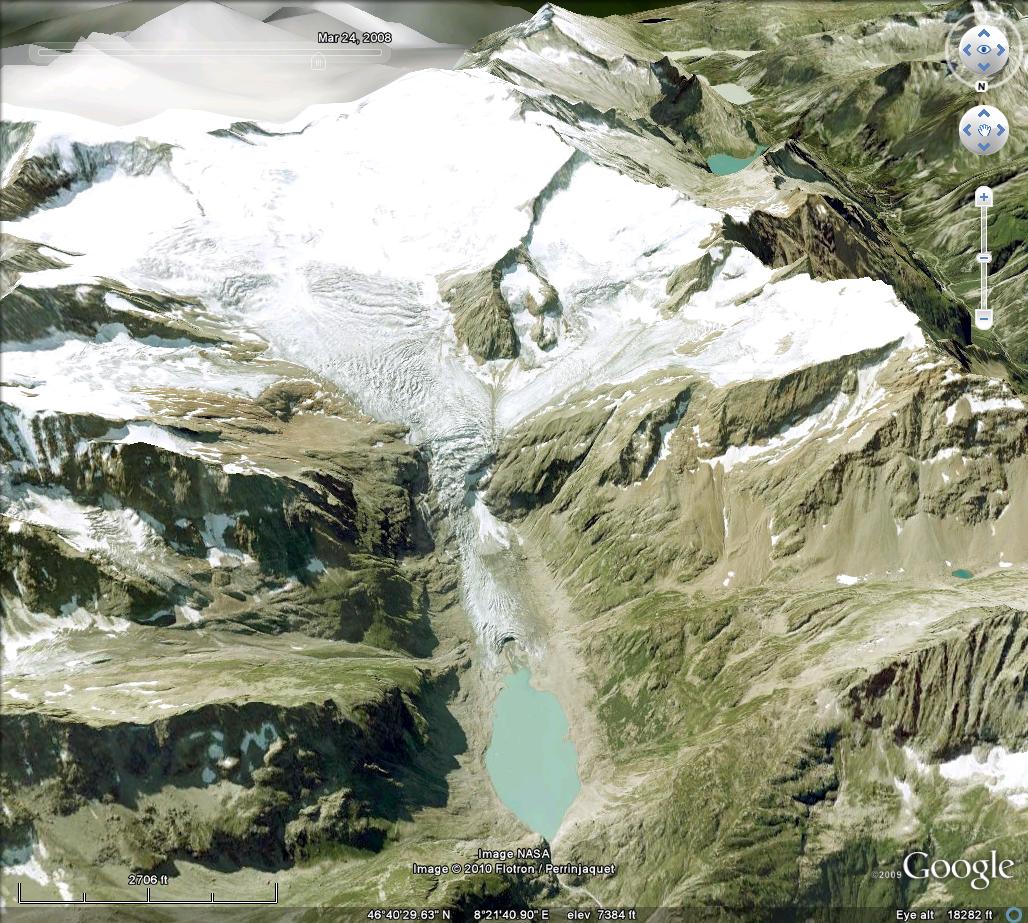
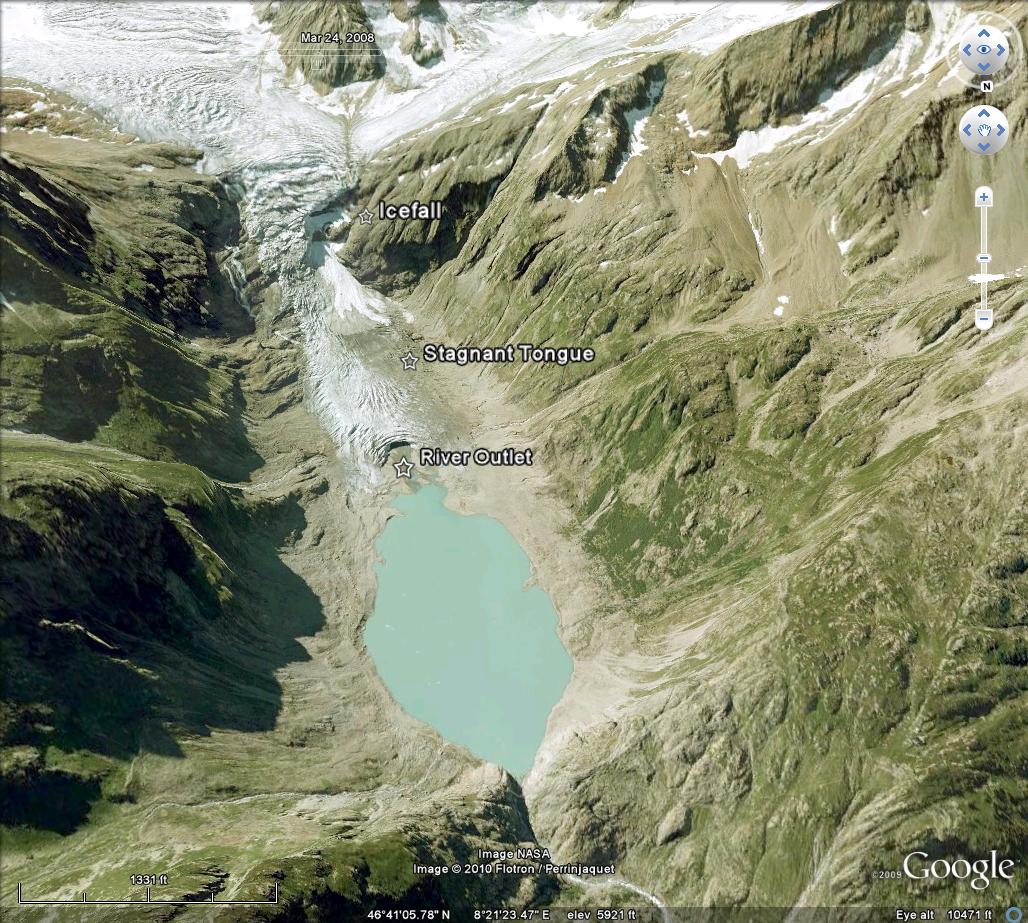 The glacier has a large upper accumulation zone above 9000 feet that retains substantial snowcover (2750 Meters), an upper icefall immediately below this point. The lower icefall descends from 7700 feet (2350) m to 6600 feet (2000 meters). the lower icefall has thinned considerably in the last decade feeding little new ice to the terminus tongue below the icefall the terminus tongue has become stagnant as a result and retreat of this tongue will continue. The story is similar to that of Rotmoosferner Glacier and is driven by the same melt conditions that has led to use of blankets to protect Stubai Glacier.A new suspension bridge has been built to restore access to the glacier that was lost with the rapid retreat.
The Lower Curtis Glacier on Mount Shuksan advanced from 1950-1975 and has retreated 150 meters from 1987-2009. A longitudinal profile up the middle of the glacier indicates that it thinned 30 meters from 1908-1984 and 10 m from 1984-2008. Compare the 1908 image taken by Asahel Curtis (glacier named for him) in 1908 and our annual glacier shot in 2003. 
 The thinning has been as large in the accumulation zone as at the terminus, indicating no point to which this glacier can retreat and achieve equilibrium with the present climate. However, the glacier is quite thick, and will take 50-100 years to melt away. This glacier is oriented to the south and fed by avalanches from the Upper Curtis Glacier and the southwestern flank of Mt. Shuksan. This allows it to survive in a deep cirque at just 5600 feet. Because of its heavy accumulation via avalanching the glacier moves rapidly and is quite crevassed at the terminus. Image below is a 2009 sideview, note the annual dark layers in the ice.
  The number of crevasses in the nearly flat main basin of the glacier has diminished as the glacier has thinned and slowed over the last 20 years. The glacier lost nearly all of its snowcover in several recent years 2005, 2006 and 2009. In one month we will back on this glacier investigating its mass balance and terminus position. It is a key glacier this year, as the winter was quite warm yet wet, spring was not. Thus, snowpack was much below average below 5000 feet and likely above average above 7000 feet, where the transition will be is the key. In the google earth images below Lower Curtis Glacier is in the left center. The terminus is exposed bare glacier ice and is heavily crevassed. Typically the terminus loses its snowcover in mid-June. Below the terminus there are frequent ice and rock falls, so it is best not to go below the terminus. For our measurements we need to, but we always finish by 9 am.
 .
.
Okpilak Glacier Retreat, Brooks Range, Alaska
The Brooks Range of Alaska contains many alpine glaciers. You hear little about them as there are no large ones and none that can be seen from a cruise ship as in southern Alaska. Though I have worked on many Alaskan glaciers for extended periods, it has always been in southeast Alaska on the larger Juneau Icefield. Hey one month until my 30th field season. The climate is much different as well, with the Arctic Ocean instead of the Pacific Ocean having a more dominant role. The Beaufort Sea Gyre is the nearest major ocean current feature. The Okpilak Glacier drains into the Arctic Ocean and is a large glacier by Brooks Range standards. Matt Nolan at the University of Alaska-Fairbanks has done a beautiful of duplicating a picture taken by Ernest Leffingwell in 1906 with pictures he has taken in 1994, 2004 and 2007. Below is the 1906 picture and the 1994 image, and the 2006 Google Earth view of the glacier. The large retreat is evident, the lateral moraine from the Little Ice Age today stands high above the glacier on the mountain side.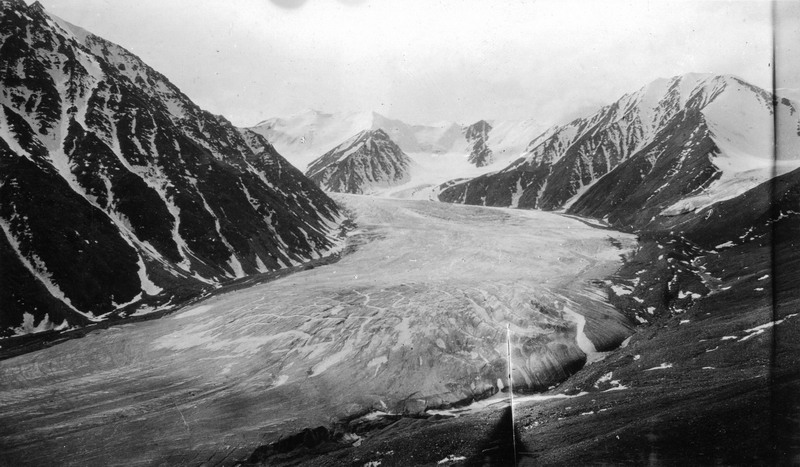

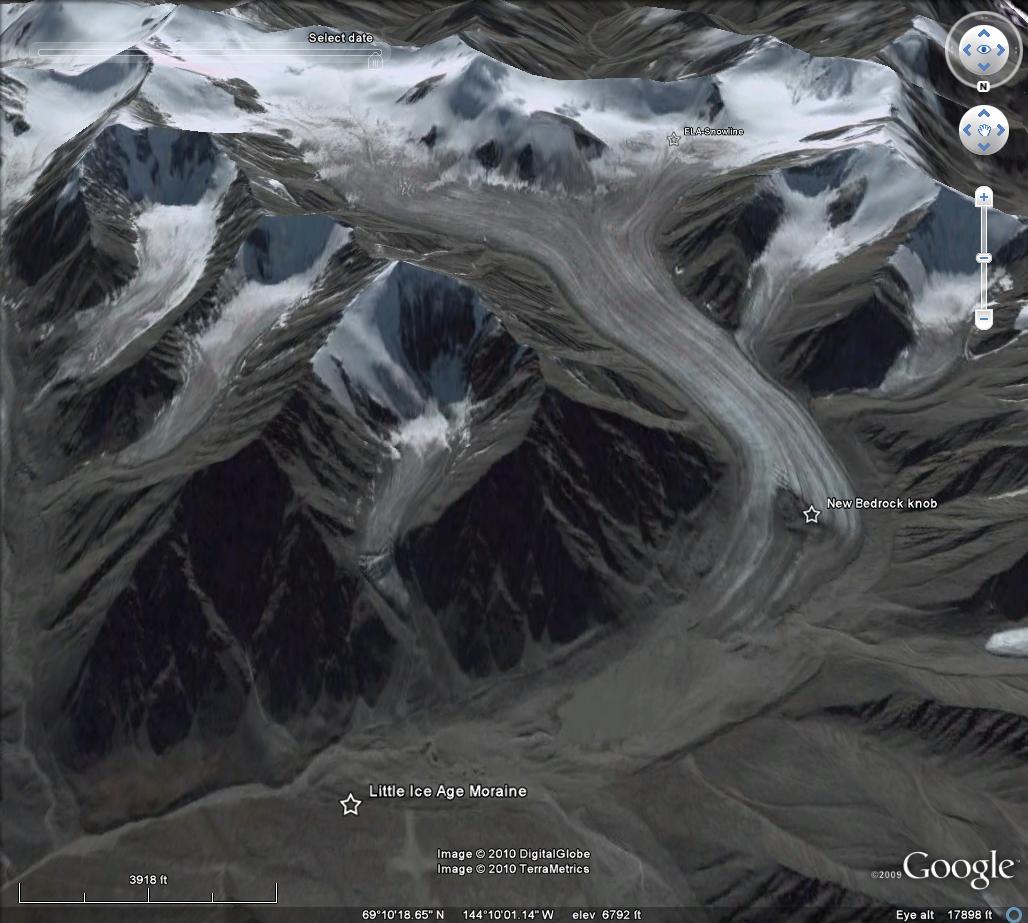 The glacier was still near its Little Ice Age maximum when Leffingwell took his picture. By 2006 the glacier had retreated just over 2 kilometers, note the Little Ice age moraine in the Okpilak Glacier image from Google Earth. There is a bedrock knob apparent in both the 1994 and 2006 image, though the ice thickness around the knob is much reduced by 2006. Also the lake at the end of the glacier in 1994 is quickly filling in with glacier sediment and by 2006 is not as prominent. Bernhard Rabus and Keith Echelmeyer-Univ. Alaska-Fairbanks had reported in 1998 that this glacier had retreated 420 meters between 1973 and 1993, 5% of its length and a rate of 20 meters per year. This is larger than the rate of 6-7 meters per year from 1907 and 1958 reported by Ed Sable, who photographed and surveyed the glacier in 1958. The rate of retreat has remained rapid. The 2006 image illustrates the problem, the ELA-snowline is too high and leaves only a small percentage of the glacier snowcovered at the end of the summer. This has been the pattern in recent decades and has led to a loss in average thickness of 30-40 cm per year. This loss though it is in a different climate region is remarkably similar to the losses observed on Lemon Creek Glacier. A view of the terminus of the glacier in 2006 from Google Earth indicates a bedrock knob that is 800 meters upglacier of the terminus.
 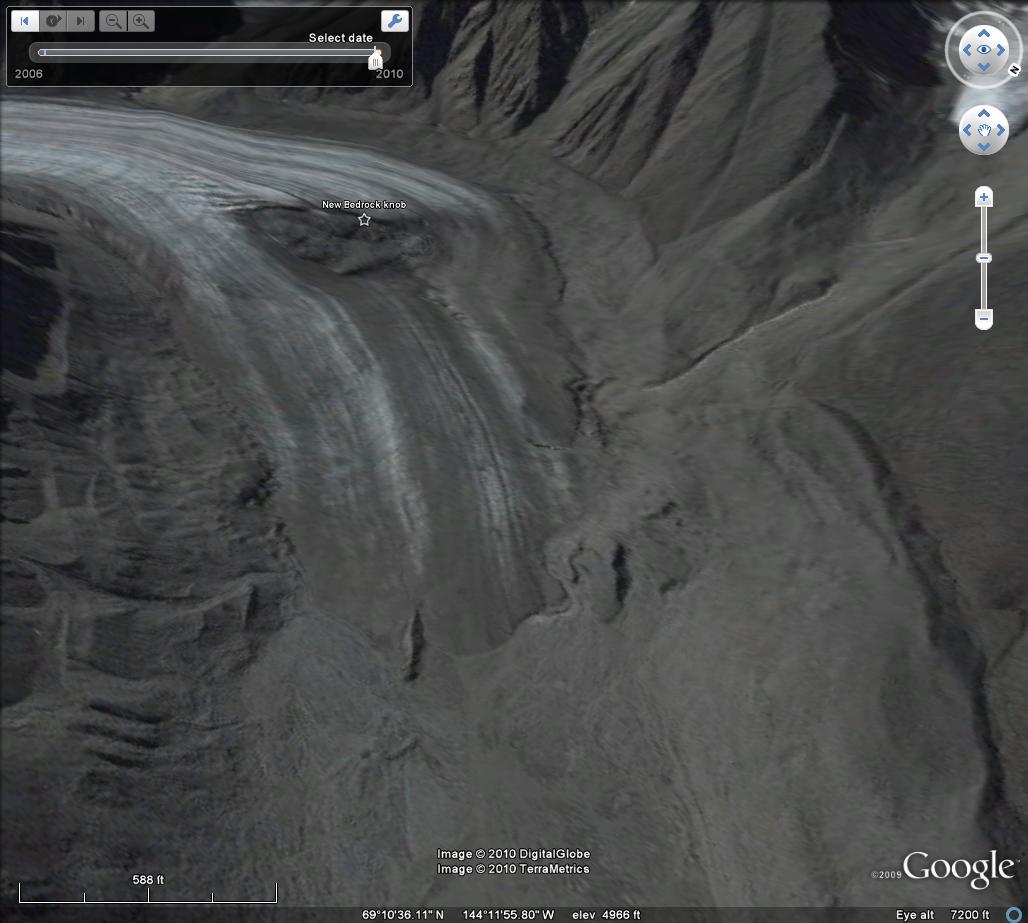 Below this knob there is little crevassing, the ice is thin, both suggesting stagnation and that this section of the glacier will soon be lost. As the sea ice to the north diminishes this area will be interesting to observe, as the potential is there for increased snowfall, while the open water will clearly lead to more warming as well.
Hoboe Glacier retreat, British Columbia
The Hoboe glacier is a distributary tongue of the Llewellyn Glacier draining the Juneau Icefied in Northwest Britsh Columbia. In 1984 I had the opportunity to hike the length of the glacier carrying supplies to the terminus for a master thesis research project of Richard Campbell at the Univ. of Idaho, during the JIRP summer field season. The glacier is 4 km long separating from the Llewellyn Glacier at 3800 feet and ending at approximately 3000 feet. This is our view from the glacier surface notice the evident trimline above the ice surface showing how thick the glacier used to be. This glacier has receded 2200 meters since early visitors to the area mapped its terminus around 1910, and 3900 m from its maximum advance of the Little Ice Age. The Google Earth views below are from 2001 images. The glacier has retreated 450-500 m in the fifty years that the Juneau Icefield Research Program has been examining it. The first view is looking up glacier and the next two looking down glacier. In all three a trimline is evident where vegetation has not had time to develop due to retreat of the last 75 years.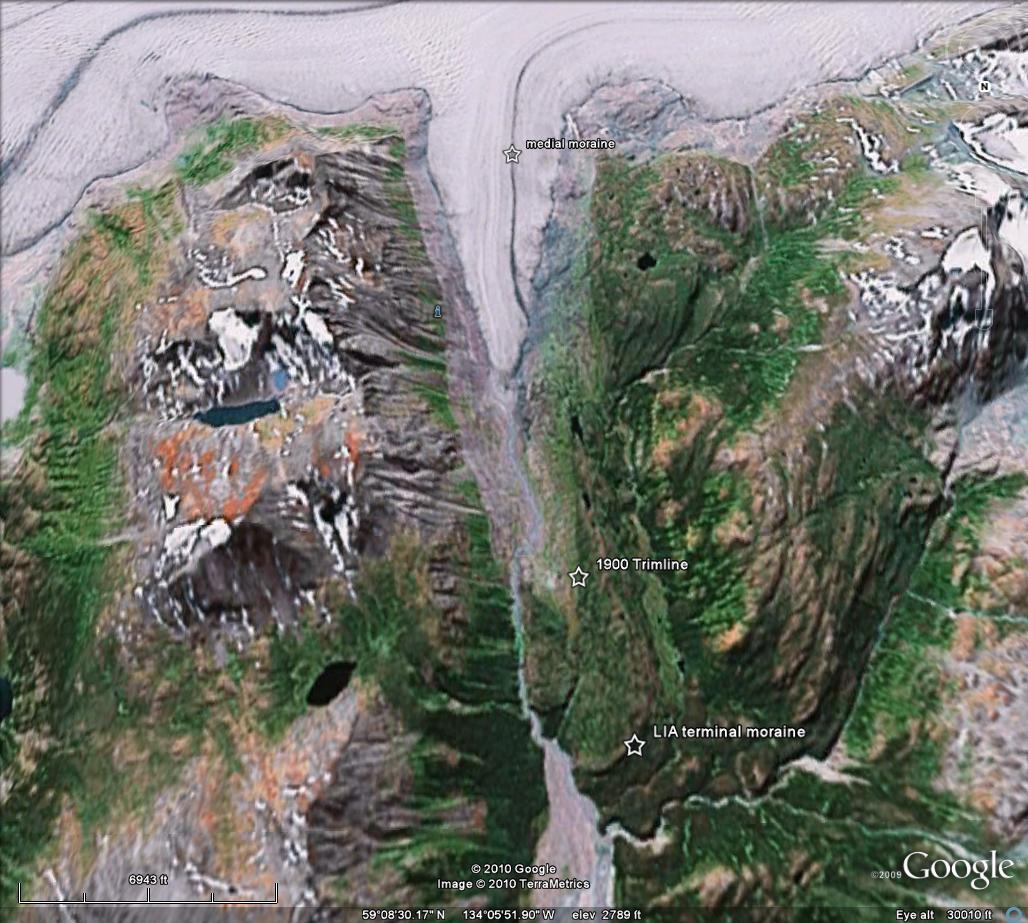
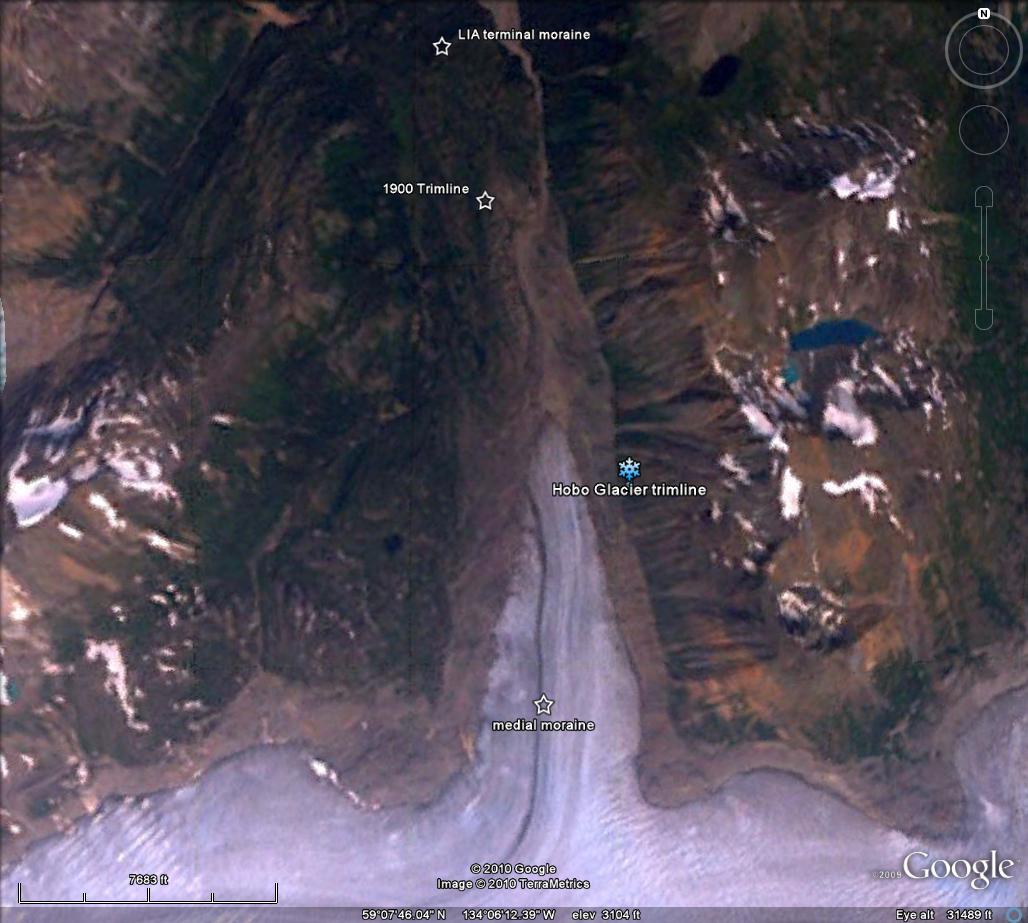
 The image above is an aerial photograph taken by Don McCully of JIRP. The trimline in the photograph is 75-85 meters above the glacier surface indicating the thinning that has occurred in the last century. Nearly one meter a year due to the recent climate change that has enhanced summer melting and reduced winter snowfall. The Hoboe Glacier is continuing its retreat like all but one of the nineteen outlet glaciers of the Juneau Icefield. Including the Gilkey Glacier and Tulsequah Glacier.
Grasshopper Glacier Wyoming disappearing
Grasshopper Glacier in the Wind River Range of Wyoming has a southern terminus calving into a lake , sometimes referred to as Klondike Glacier, and a northern terminus. The southern terminus is calving and retreating expanding the unnamed lake it terminates in. The southern glacier has retreated 350 m since 1966. This lakes drains north under the glacier and down the valley under the Grasshopper Glacier. This is quite unusual to have a stream draining under the glacier from a lake at a terminus of the glacier. The lake can drain to the east if it rises to the 12,000 foot threshold. This was the case in 1994. The terminus area is not being fed by the upper accumulation zone to the northwest any longer. The terminus is stagnant and will continue to melt away. The lake has existed since at least 1950. In 2003 it drained substantially and quickly below the glacier causing a downstream flood. An ice dam break released a glacier flood is a jokulhaup. The lake was reported by the USGS to have drained 90%. In the 2006 image it has largely refilled, but notenough to drain to the east again. It is likely given the stagnant nature of the glacier, that the drainage conduit will not be fully closed, and the lake can drain through the channel on more of an ongoing basis. The northern terminus has retreated 730 m the most extensive retreat in the Wind River Range. The main accumulation area on the west side of the glacier has become segmented by large bare rock areas as noted by comparing the 1966 map and 2006 image. The 1966 boundary indicated in orange noted area circled in burgundy in the second image below. 
 The combined retreat of the two terminus is over one kilometer this is 40 % of its 1966 length of 2.4 km. The significant thinning and marginal retreat at the head of the glacier is symptomatic of a glacier that will disappear with current climate. The glacier seldom has significant snowcover at the end of the melt season is with the current climate will melt away. In 2009 the glacier did have significant snowcover at the end of the melt season for only the third time in the last 10 years.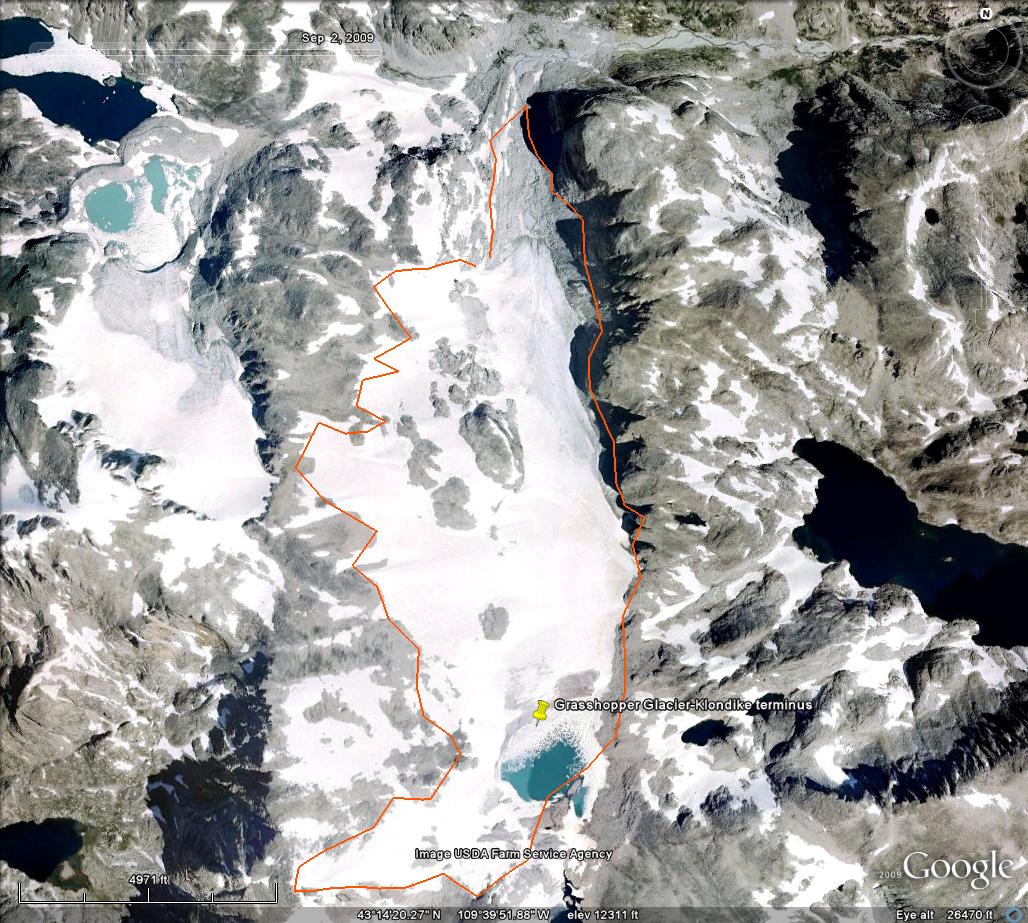
Spearhead Glacier and Decker Glacier retreat, Whistler, British Columbia
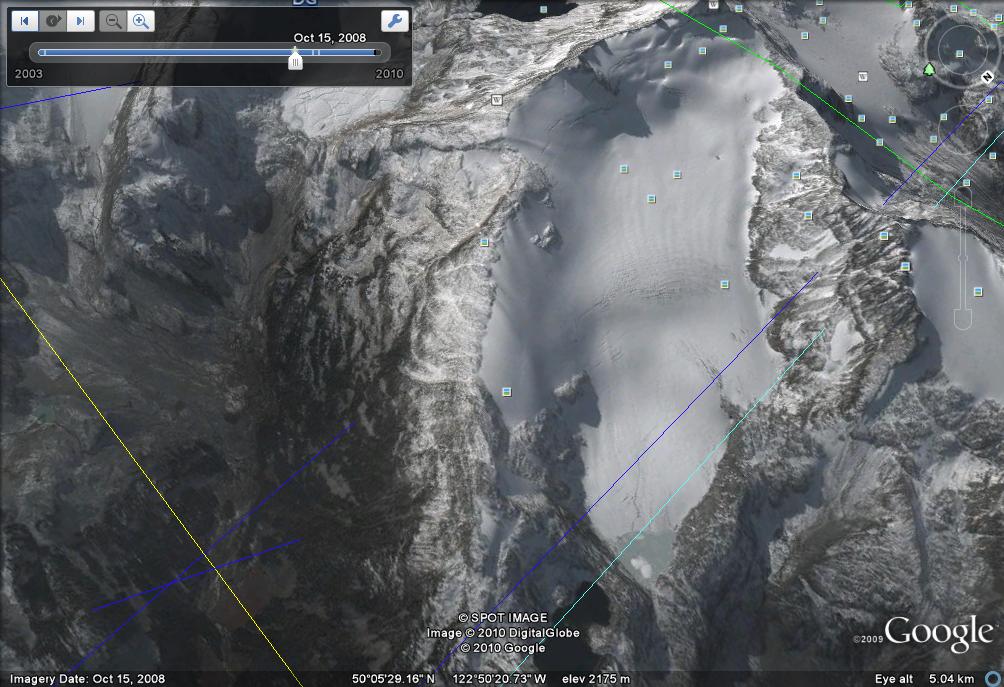
Spearhead Glacier is just east of the Whistler-Blackcomb Ski area in sw British Columbia and can be reached easily from the top Blackcomb lift. Adjacent to Spearhead is Decker Glacier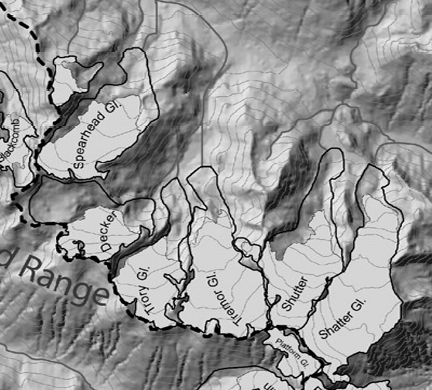 . Both glaciers flow northwest and have retreated extensively. Recently both have developed new alpine lakes at their termini that illustrate the recent increase in retreat that could continue thanks to these new lakes. Spearhead Glacier has retreated between 500 and 600 meters since 1928. The glacier lost 62 m in mean thickness since 1928 Koch and others (2009) found. A map of the region indicates the extent of the glaciers in the range from the Little Ie Age and today Osborn and others (2007). The first image is from 2003, the low sloped glacier has few crevasses and end in a gently sloping terminus at the edge of the bedrock basin. Notice in the fall 2008, second image, that a new lake has formed at the terminus Spearhead Glacier.
 This lake is expanded further in 2009 as seen in this view below across the lake back at the glacier.
 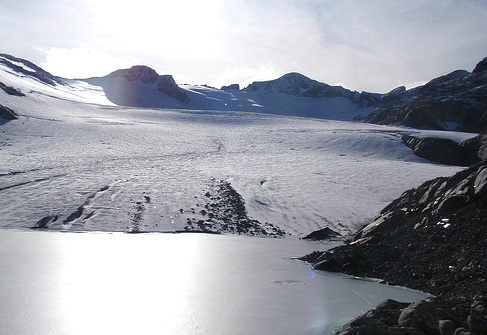 This looks much like the expanding lake view and stagnant terminus area of Colonial Glacier in the North Cascades. The glacier is largely confined to a single basin, that suggests the potential for considerable lake expansion as the glacier retreats. There is a step in the glacier in the image above, that indicates the likely maximum extent, notice the bedrock step on the right side of the glacier. Decker Glacier retreat is even more substantial as a percentage of glacier area. illustrated in a comparative image from Osborn and others (2007)
 The glacier has also developed a new lake, leading to the breakup of a portion of the end of the glacier, notice the rifted ice pieces in the image below from October 2008. That was not present in the lower image from 2003. This area of broken ice at the end of the glacier and near the image bottom, represents nearly a third of the total glacier area. It is not as apparent as it is in summer conditions when the lake is not frozen over.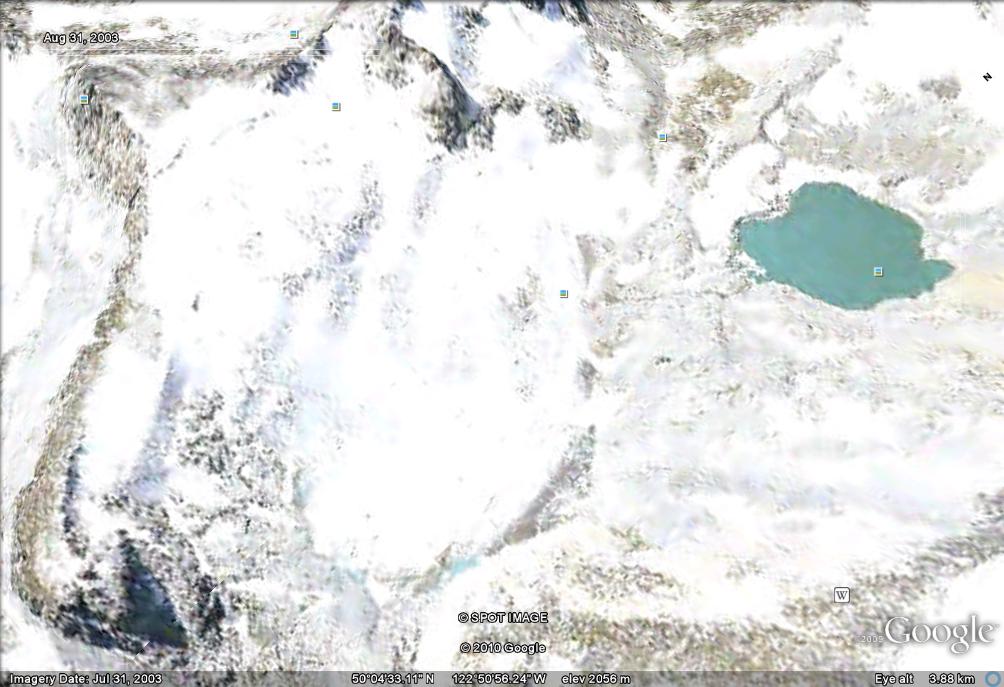

Impact of Artesonraju Glacier, Peru Retreat
Artesonraju Glacier is a 3.3 km long glacier in the Cordillera Blanca of Peru drains west from Nevado Artesonraju.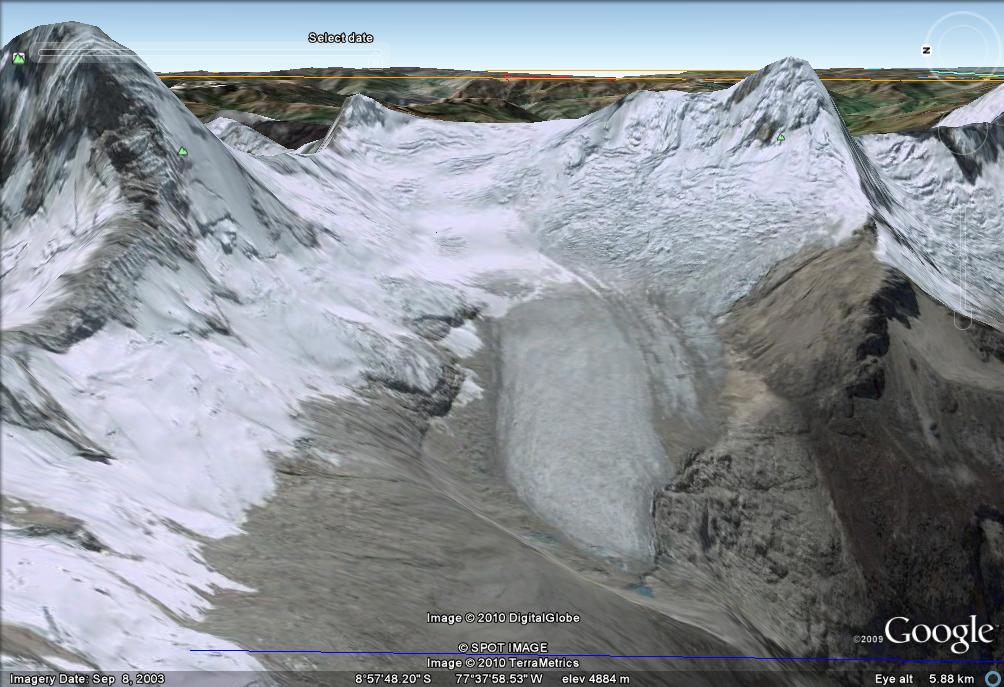 Updated July 2015 at
The glacier feeds both Lake Artesonraju, a new lake that formed after 1930 and Lago Paron. The two lakes are dammed by glacier moraines and together have posed a hazard of a glacier dammed lake outburst. In 1951 an outburst of water and alluvium traveled from the upper Artesonraju Lake into Lago Paron, raising the water level in Paron causing downstream flooding and concern about the strength of its moraine dam. 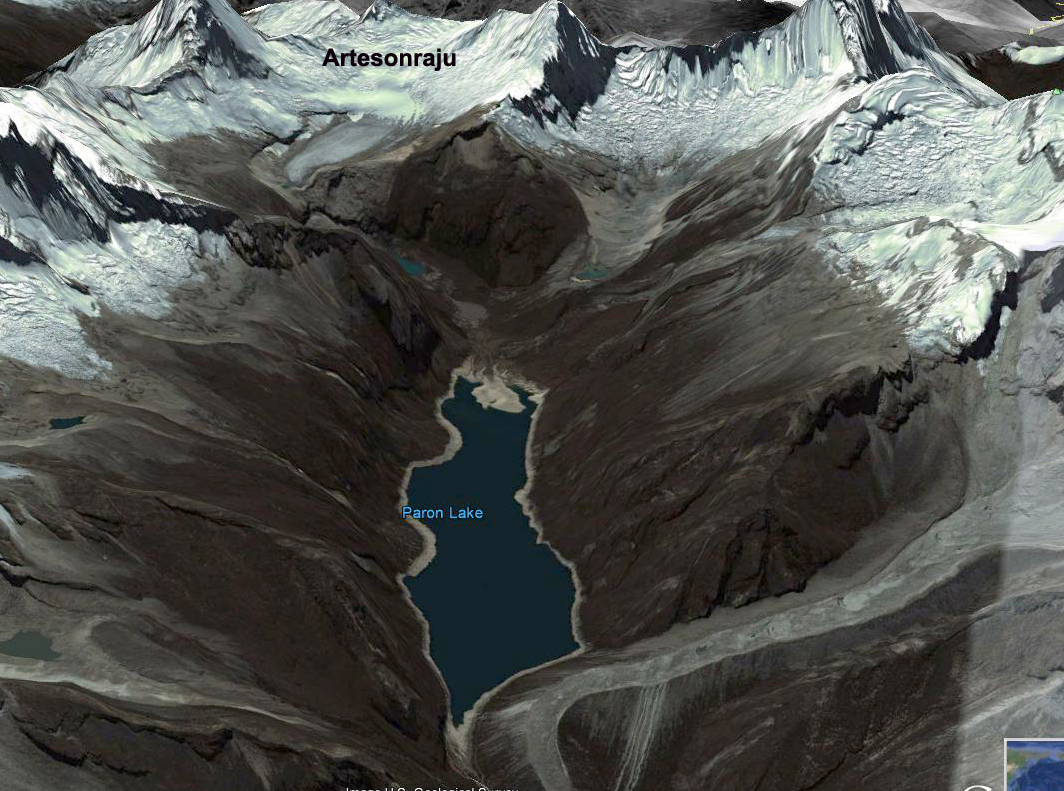
There are numerous moraine dammed lakes in Peru, the dams are just comprised of gravel, sand and clay dumped by the glacier. High water levels caused by upstream floods, avalanches or landslides can cause failure of these moraine dams and down stream flood damage prompted the Peruvian government to develop a strategy to address the problem. They began in the by building tunnels , concrete pipes, through the moraine to allow drainage to a safe level, they then rebuilt the moraine over the drainage system and strengthened it. Since development these systems have worked preventing serious flood issues from the lakes. At Lago Paron a hydropower project has been built that is fed by the tunnel drainage system and Lago Paron has been partially drained to service the hydropower facilities needs. The hydropower faility is owned by Egenor, owned largely by Duke Energy. The lake level has declined substantially by 2003 as the trimline indicates in the image above. This had led to a battle over water resources with local farmers. This Artesonraju Glacier that is the principal feeder to the two lakes retreated 1140 meters from 1932-1987 and by 2004 had retreated another 200 meters. From 2003 to 2013 the glacier continued to retreat and the terminus to narrow. An expanding lake at the terminus is evident in the Google Earth images of 2003 and 2012, pink arrow. A melt pond has also drained at the yellow arrow as the glacier thinned. In the 2013 Landsat image the terminus has further narrowed.
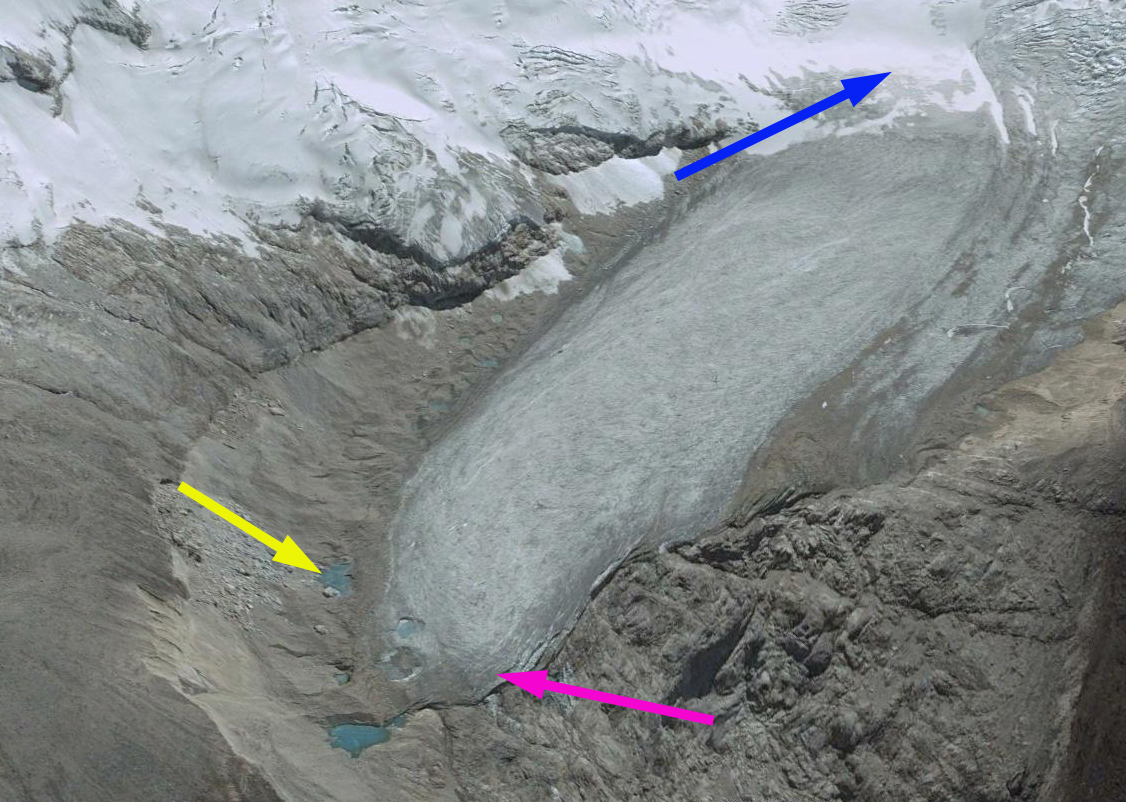
2003 Google Earth image

2012 Google Earth image
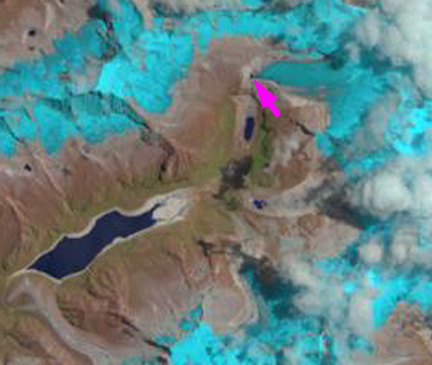
2013 Landsat Image
This is 30% of its length gone in the last 75 years.The lower section of the glacier is flat, uncrevassed and is continuing to thin and melt. The upper reaches of the glacier are heavily crevassed indicating continued vigorous flow fed by healthy accumulation on the flanks of Nevado Artesonraju and Nevado Piramide. The equilibrium line of this glacier is at 5150 m, investigations by the Tropical Glaciology Group, Innsbruck, Austria and Hydrology Resources and Glaciology group in Huarez, Peru. In 2005, the surface on many parts of the flat tongue showed that sublimation is important to the mass balance when short wave radiation is limited, and short wave radiation dominates melting during the day.
A new book by Mark Carey, In the Shadow of Melting Glaciers, examines the history of the impact of these glaciers on Andes towns in the Cordillera Blanca.
Rwenzori Glacier Retreat-Loss
The Rwenzori Range,Uganda typically referred to as Mountains of the Moon have been rapidly losing their glacier cover. The small, steep glaciers descend the peaks of Mt. Stanley: 5111 m, Mt. Speke: 4891 m and Mt. Baker:4873 m. 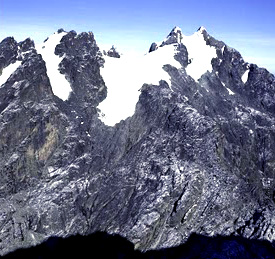 The Georg Kaser, University of Innsbruck visited the range twice in the early 1990’s to prepare maps of glacier change to compare to a 1906 map derived from documents of the Duke of Abruzzi’s expedition, the 1955 map made from vertical air-photos. They determined the area of the glaciers to be 6.5 km2 in 1906, 3.2 km2 in 1955 and 1.7 km2 in the 1990’s, note Speke Glacier as an example. This represents a 70% area loss.
  An updated satellite based analysis by Texas A&M’s Klein and Kincaid showed that the glaciers in the Rwenzori have decreased in area from 2.55 km2 in 1987 to 1.31 km2 in 2006. I have had the good fortune to work in the field with both Georg Kaser, Taku Glacier, Alaska and Andrew Klein, Easton Glacier, Washington, both have made tropical glaciers one of their specialties.
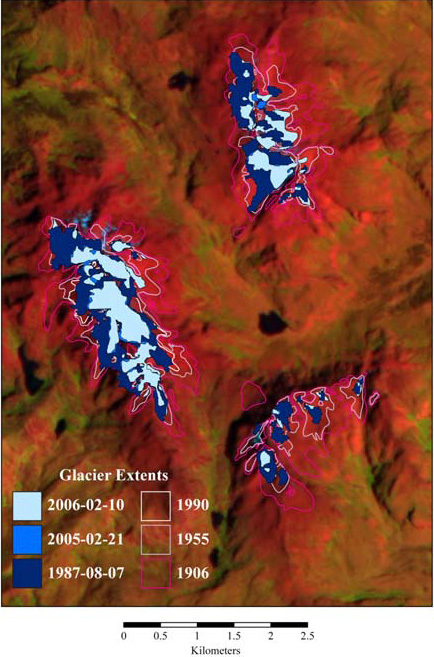 This is nearly a 50% loss in 20 years. The climate trends and glacier extent trends are not in favor of the glaciers lasting for long. This is reinforced by a comparison of images from Mount Stanley from the World Wildlife Fund.
Vista Glacier, Glacier Peak WA Retreat
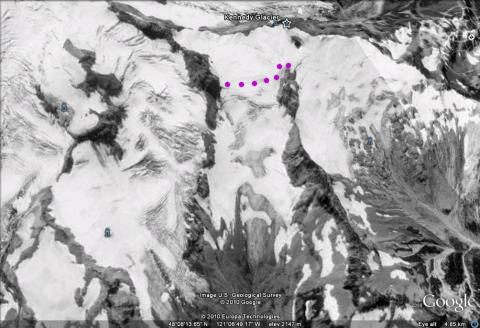
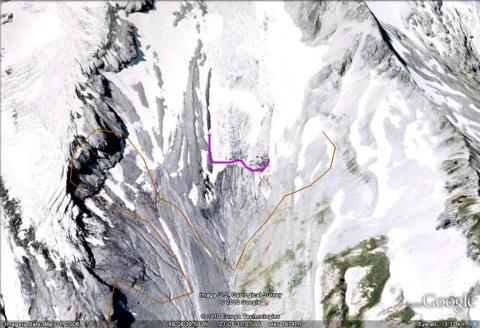
Vista Glacier is the northernmost of the large valley glaciers on the east side of Glacier Peak. The glacier begins at 2475 m beneath Kennedy Peak. We examined all of the glaciers around Glacier Peak in detail in the 1990’s to document their changes since observed by C.E. Rusk 100 years earlier. The glacier during the LIA joined the Ermine Glacier and extended down to 1345 m. By 1900 when Asahel Curtis photographed this glacier it had retreated 1300 m. By 1946 the glacier had retreated an additional 600 m separating from Ermine Glacier to a minimum at 1900 m. In 1955 the glacier began a slow advance that had ended by 1975 with a total advance of 105 m. In 1985 at our first visit the glacier was again retreating, total retreat was 10-20 meters from the advance moraines. By 1994 the glacier had retreated nearly 100 m and by 1997 had retreated to the 1946 position. The retreat has continued and by 2006 the glacier had retreated 300 meters from its 1975 advance position. This glacier like all 47 glaciers we observe in the field in the North Cascades is continuing a significant retreat. Below is a sequence of images from the 1984 map, 1996 aerial photograph, and the 2006 satellite image. The latter has the orange 1975 terminus position noted, the purple line on the 2006 image is the current terminus. The dotted purple line on the aerial photograph marks the area that consistently retains accumulation. 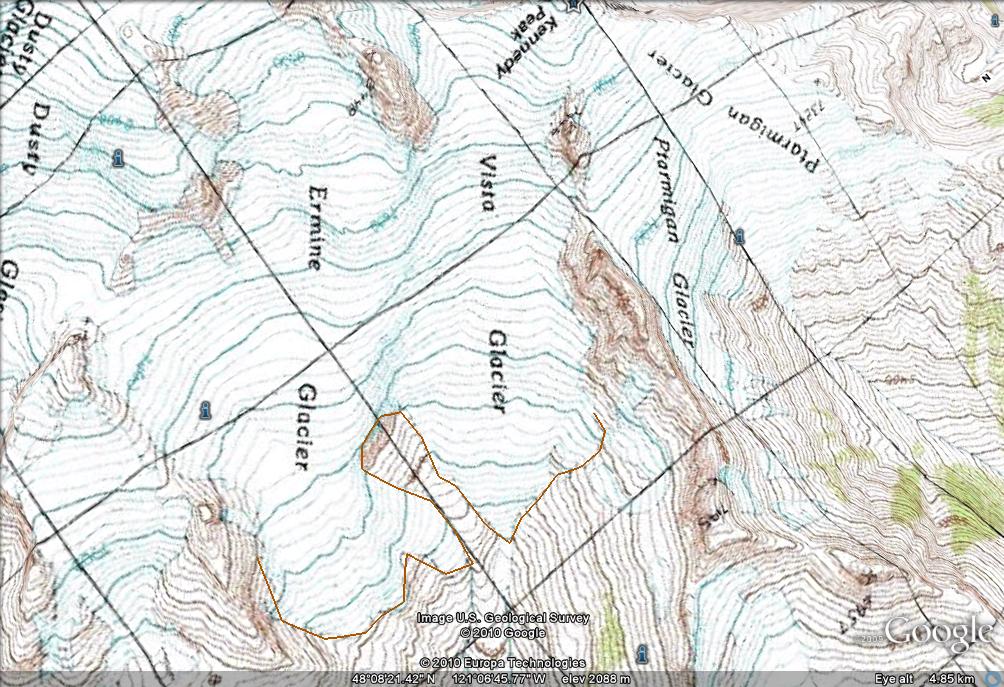
 In 1994 Cliff Hedlund and I were surveying the terminus when we found a beautiful ice cave beneath the glacier. The rock just behind Cliff in the cave is apparent now out in the open in the 2006 satellite image. We surveyed the position in 1994.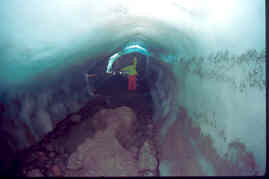
 The lower several hundred meters of the glacier are uncrevassed indicating limited flow on this fairly steep slope.
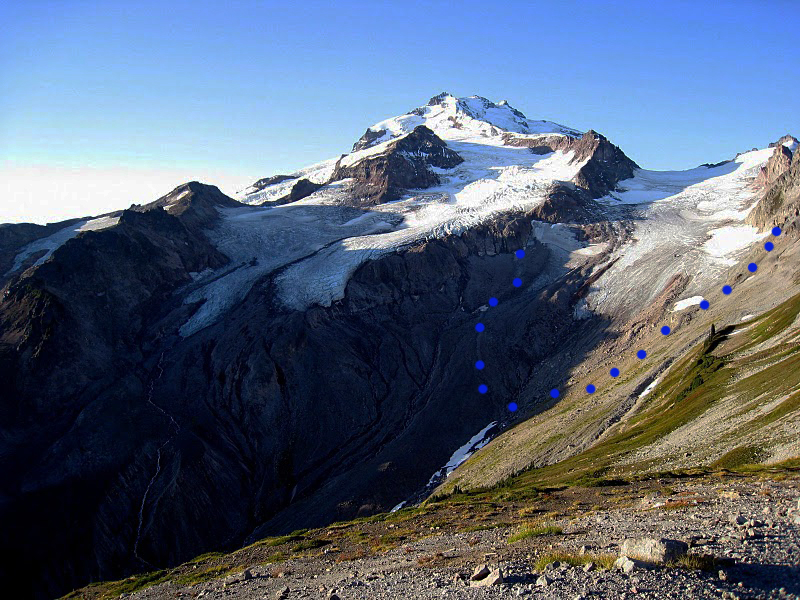
 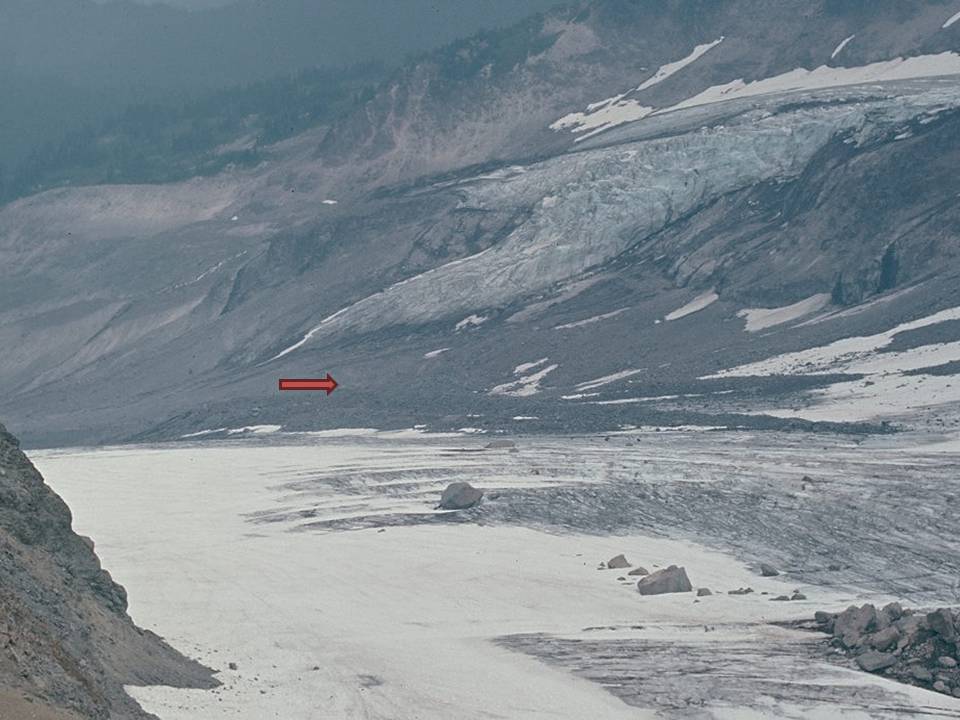 The arrow in the picture above indicates the ice surface level in 1985, the glacier has thinned 20 meters in this region. A view of the glacier from indicates the recession better, the blue dotted line is the ice margin in 1975. The picture below is from Sept. 2009 the lack of snowpack on the lower 70% of the glacier is evident. The blue dotted line is the glacier margin in 1975, and in 1985 it had changed little. This advance left a very evident moraine that will deteriorate with time.
  Measuring snow depth up the middle of this glacier in 1994 and 1997 we found limited areas with accumulation of greater than 2 m in early August. Note the annotated aerial photograph showing consistent snow covered area. This makes the glacier prone to losing most of its snow cover in many years such as occurred 2005 or 2009. This indicates considerable retreat will occur even with present climate. The last image is Cliff Hedlund and I on glacier in 1994, Cliff unfortunately is no longer with us, but was a great field companion and the only person I knew who could create a good spear point from rock using an antler.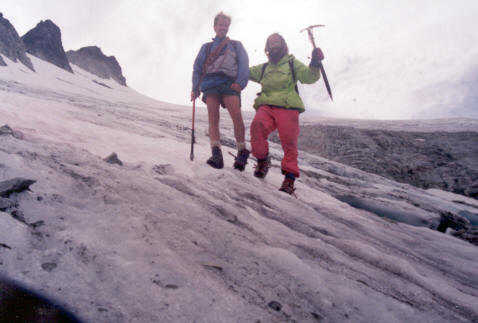
Taku Glacier Equilibrium Line Altitude Summer Rise
A key measure of the mass balance of a glacier is the equilibrium line altitude (ELA). Mass balance for non-calving glaciers is the difference between snow accumulation on a glacier and snow and ice loss from the glacier. The ELA is the point at which accumulation equals melting. On temperate alpine glaciers this is the snowline where snow transitions to bare glacier ice. Its elevation at the end of the summer marks the annual ELA. For a glacier to be in equilibrium at least 50-70% of the glacier must be in the accumulation zone still at the end of the summer. The range of percentages is determined by the specific regional climate and glacier geographic characteristics. A key observation for mass balance calculation is the shift of the ELA-snowline during the course of the melt season. The magnitude of the shift over a given time period is a measure of the melt rate. The shift can be observed in satellite imagery and when combined with field measurements quantifies melting. As the melt season begins the snow cover extent is large on a glacier. The key is how rapidly it rises during the melt season. On Taku Glacier for example in 2004 and 2006 a series of satellite images indicates the rise in the ELA. Below are images from May 26, 2006, then July 29, 2006 and then Sept. 15 2006. Indicating the rise of the snowline. These are followed by annotated images showing the rise of the ELA during the summer melt season in 2004 and 2006 on Taku Glacier. 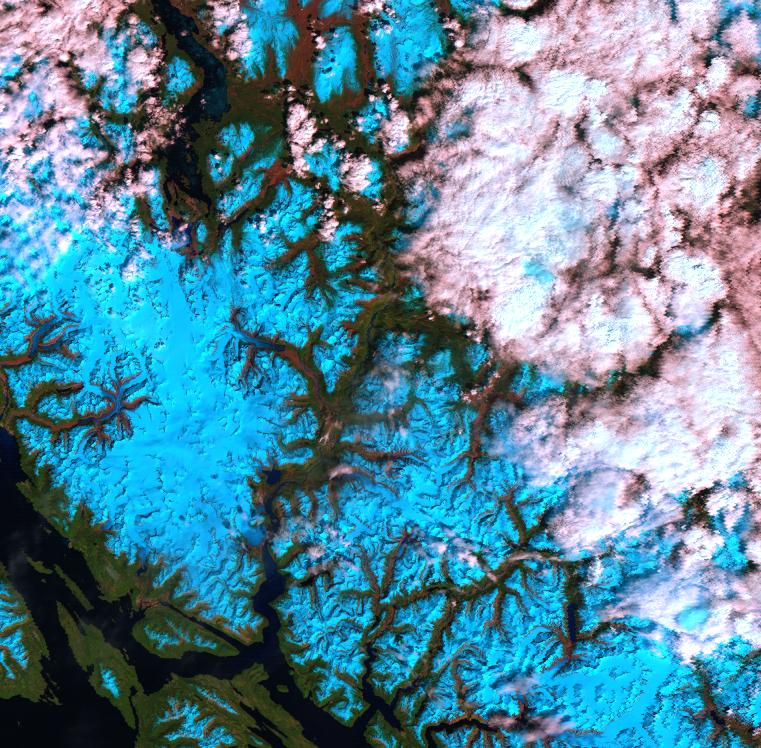


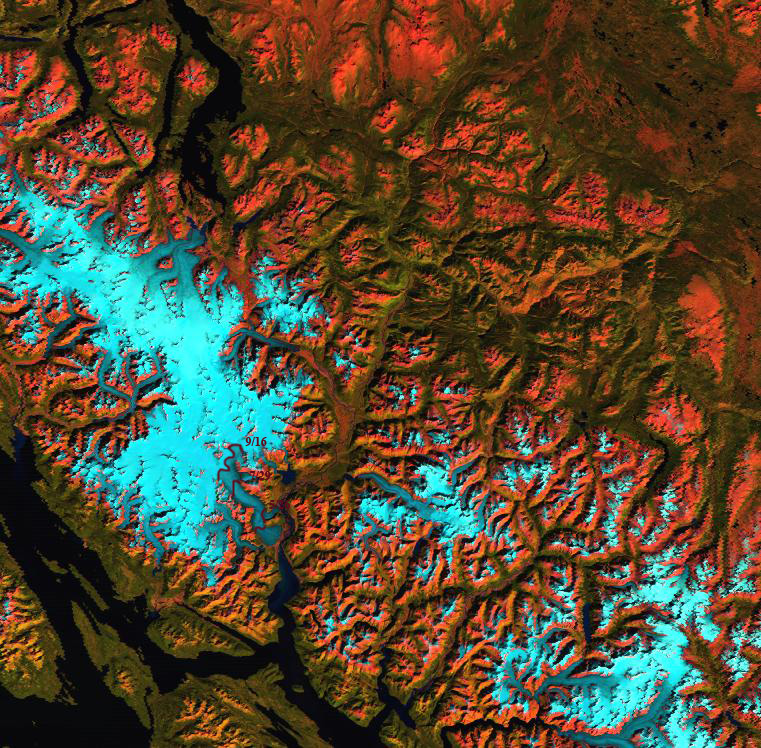

On the ground the Juneau Icefield Research Program measures the snow depths and snow melt during July and August. The above images from May 26, July 29 and Sept. 15 2006 indicate the rise of the ELA during the course of the melt season, from 1200 to 2600 to 3200 feet. Snow depths at the the Sept. 15 ELA, where snowpack=0, was 2 m on July 22. Thus, we had 2 meters of snow melt at 3200 feet between July 22 and Sept. 15. In 2004 the snowline was at 2800 feet on July 15, snowpack was 1.6 meters at the eventual Sept. 1 snow line of 3400 feet. In 45 days 1.6 m of snow was lost at 3400 feet. In 2004 the melt rate was 0.036 meters per day and in 2006 0.038 meters per day. In 2009 July began with a low ELA of 500 m after a cool snowy winter and spring. By the end of the month the ELA was over 800 meters. This 300 meter rise and the associated melt was a record for July as were temperatures in Southeast Alaska in July 2009. As the 2010 melt season begins the Taku Glacier remains snowcovered, though the blue colors near the terminus indicate melt water is saturating the snowpack on 4/10/2010. What will the 2010 melt season bring? Check back here to see.