Baqupu Glacier, China Merging Supraglacial Lakes 1998-2020

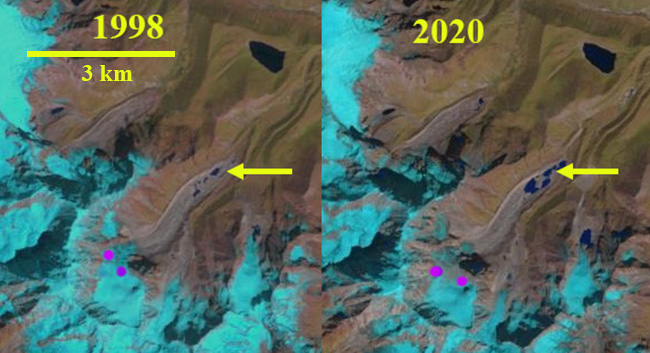
Baqupu Glacier in Landsat images from 1998 and 2020 indicating the expansion of supraglacial lakes in the terminus zone.  Purples dots indicate the snowline in October of each year.

Baqupu Glacier is in the Poiqu River watershed in southern Tibet, China.  The Poiqu River becomes the Bhote Koshi as it crosses into Nepal before joining the Sun Koshi River. The terminus of the glacier extending from 4500-4800 m is debris covered. An icefall extends from 4800-5300 m, above which the accumulation zone extends up to 5900 m. Shrestha et al (2010) examined the risk of a glacier lake outburst flood in the Sun Koshi basin from a Lumichimi Lake further north in the Poiqu Basin.  They identified the potential for damage to the  45 MW Bhote Koshi Hydropower Plant.  A  July 2016 GLOF in the basin did in fact severely damage the Bhote Koshi Hydropower Plant. In a 2020 ICIMOD report (Bajracharya et al 2020) inventory of glacial lakes and potentially dangerous ones in the Koshi, Gandaki and Karnali Basin’s was updated. In the Sun Koshi Basin they mapped 181 lakes with an area of over 0.02 km2 with four being potentially dangerous lakes. The developing Baqupu Lake is not listed as potentially dangerous.

In 1998 Baqupu Glacier features a 0.03 km2 network of small supraglacial ponds at its surface at ~4500 m.  The snowline is near the top of the icefall at 5200 m in October.  By 2000 some evident expansion of the ponds is evident.  The snowline in October is again near the top of the icefall at 5200 m.  By 2018 there are four substantial ponds that have nearly coalesced. In 2019 the ponds have coalesced into two lakes.  The snowline is just above the icefall at 5300 m.  In 2020 the supraglacial lake system has an area of 0.24 km2.  Average area of  glacial lakes in basin is 0.12 km2 (Bajracharya et al 2020). The snowline is above the icefall at ~5400 m.  The persistent equilibrium line above the icefall during this period is reducing the flux through the icefall to the debris covered tongue.  The tongue is increasingly stagnant and the thinning will lead to continued lake expansion into what will be a proglacial lake.  This expansion is similar to that on Rongbuk Glacier, while other nearby lakes have had expanding proglacial lakes, Drogpa Nagtsang Glacier and Yanong Glacier.

.Ya
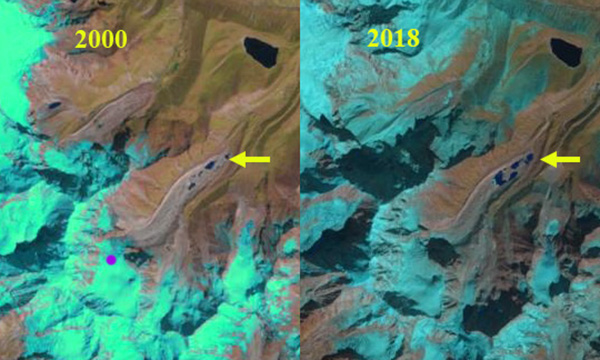
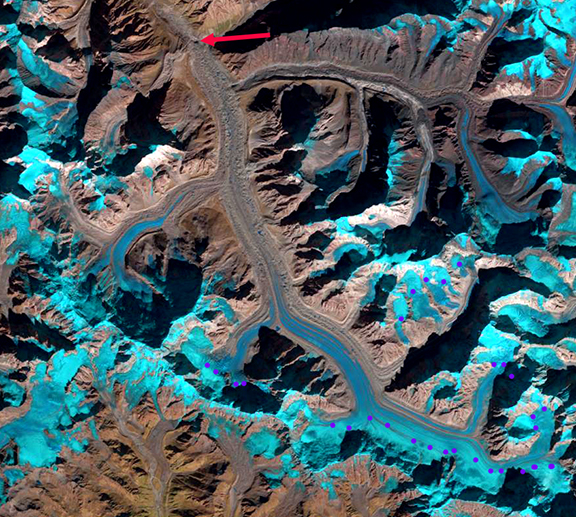
Baqupu Glacier in Landsat images from 2000 and 2018 indicating the expansion of supraglacial lakes in the terminus zone.  Purples dots indicate the snowline in October of each year.

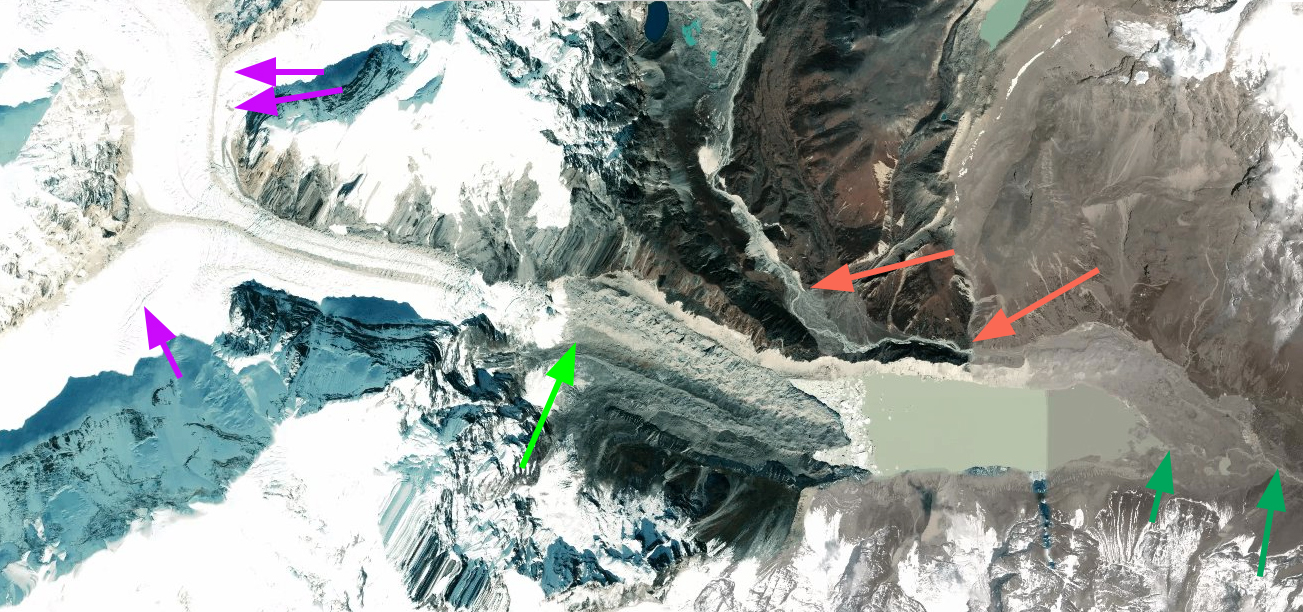
Baqupu Glacier in Digital Globe image from 2019. A=Accumulation zone; D=Debris cover, I=Icefall, S=Supraglacial lake. 

Jiemayangzong Glacier, Tibet Retreat, Separation and Lake Expansion 1991-2020

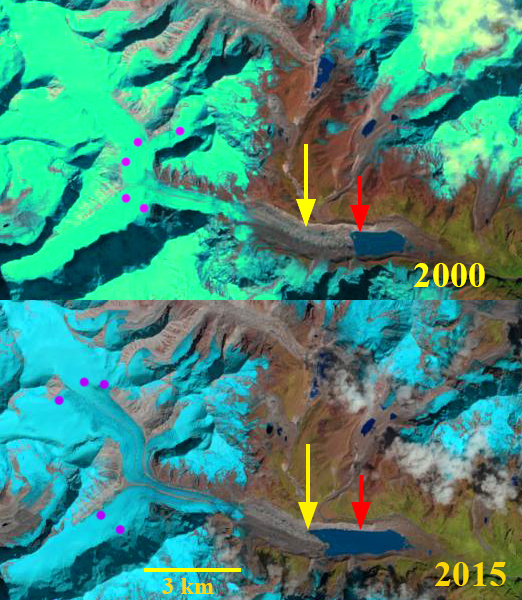
Jiemayangzong Glacier in 1991 and 2020 Landsat images.  The red arrow is the 1991 terminus location, yellow arrow is the 2020 terminus location and purple dots mark the snowline. Point A indicates a tributary that has disconnected, while bedrock expanded at Point B. 

Jiemayangzong Glacier drains east from 6200 m peaks along the Nepal-China border. The glacier ends in a lake- Jiemayangzong Tso. Ren et al (2016)  identify this as the headwaters of  the Yarlung Tsangpo (Zangbo), which becomes the Brahmaputra River. The Zangmu hydropower project was completed on the river in 2015, it is a 510 MW project. Here we examine Landsat and Google Earth imagery from the 1991-2014 period. This is a region where Li et al (2011) noted that increasing temperature during the 1961-2008 period, especially at altitude, led to the retreat of glaciers and expansion of glacial lakes in this region. Liu et al (2011) noted that this glacier’s area has decreased 5%, retreating 768m ( 21 m/year), leading to lake expansion of ~64% during the 1974-2010 period.

In 1991 the lake was 1.1 km long, the snowline was at 5500 m near the elevation where the northern tributary joined at Point A.  In 1998 the snowline was at 5600 m, the glacier had not retreated appreciably.  In 2017 tributary A no longer is connected to the main glacier, the snowline is at 5600 m and the lake has expanded to a length of 1.9 km.  In 2020 the snowline in mid-September, with the melt season still going, is at  5700 m. The glacier has retreated 1000 m from 1991-202o a rate of  ~33 m/year. The lake is now 2.1 km long and has an area of  1.3 km2.  The glacier has a wide stable moraine belt (M) and does not pose a GLOF threat. Immediately downstream of the lake is a 10 km2 braided valley/wetland area (W) as well that would mitigate any potential flood hazard. This glaciers retreat is similar to many others draining north into Tibet from the Himalayan crest, Chako Glacier, West Ganglung Glacierand Asejiaguo Glacier

Jiemayangzong Glacier in 1998 and 2017 Landsat images.  The red arrow is the 1991 terminus location, yellow arrow is the 2020 terminus location and purple dots mark the snowline. Point A indicates a tributary that has disconnected, while bedrock expanded at Point B. 

Jieayangzong Glacier (JG) in 2015 Digital Globe image indicating the expanding proglacial lake (JL), moraine belt (M) and large wetland (W)

Reqiang and Jicongpu Glacier Retreat, Lake Expansion and Moraine Stability Increase

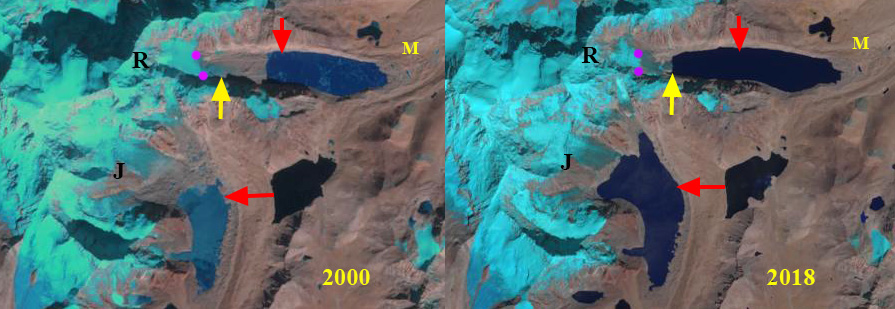
Reqiang Glacier (R) and Jicongpu Glacier (J) in 1993 and 2019 Landsat images.  M=Moraine, red arrow is the 1993 terminus location, yellow arrow the 2019 terminus location and purple dots the snowline.

Requiang Glacier, Tibet is just east of Shishapangma Mountain one of planets 14 peaks that exceed 8000 m and terminates in the rapidly expanding proglacial lake Gangxico at 5200 m. Jicongpu Glacier drains south from Shishapangma terminating in the proglacial lake Galongco at 5100 m. Both glaciers are fed by avalanching from the high slopes of  Shishapangma. Reqiang Glacier has been undergoing a rapid retreat since 1976, Li et al (2011) noted the retreat of 65.7 m/year from 1976-2006.  The retreat of this glacier fit the pattern of all 32 reported and was due to that increasing temperature. Zhang et al (2019)  observed that from 1974-2014 Galongco and Gangxico lakes expanded by ~500% (0.45 km2 /year) and ~107% (0.34 km/year.  As the lakes have expanded the wide moraines impounding the lakes have not experienced visible change. Here we examine the retreat of Reqiang and Jicongpu Glacier from 1993-2019 using Landsat imagery and the GLOF risk of Galongco and Gangxico.

Glacier lake outburst floods (GLOF) are a significant hazard in glaciated mountain ranges. The principal causes of GLOF are ice dam failure, moraine dam failure and/or avalanching into a lake.  Harrison et al (2018) noted there has been a decline in recent decades of GLOF events globally and in the Himalaya due to moraine dam failure.  In the Himalaya the main cause of moraine dam failure is ice avalanches into the lake. This decline has occurred during a period of rapid glacier retreat and the formation of many more alpine lakes. Hence, the number of locations where a potential GLOF could occur has increased, but the actual risk of any particular location generating a GLOF has declined even more.  Carrivick and Tweed (2016) observed that the number of GLOF’s due to all causes globally has declined since the mid 1990’s, and that this decline is not a reporting issue, since reporting has gotten better.  The main cause of the 1348 GLOF’s that they archived had been ice dam failure at 70%.  How has the retreat of Reqiang and Jicongpu Glacier impacted the risk of a GLOF?

In 1993 Reqiang Glacier terminated in a 3.1 km long Gangxico, which had an area of 2.9 km2.  The lowest 2.5 km of the glacier had a low slope and the snowline was above this at 5500 m.  Jicongpu Glacier terminated in a 2.8 km long Galongco with an area of 2.6 km2 and had a 3.5 km low slope debris covered terminus zone. By 2000 Reqiang Glacier had retreated 400 m and the low slope terminus tongue had a significant expansion of debris cover. Jicongpu Glacier had retreated 300-400 m.  By 2018 Reqiang Glacier had retreated 1900 m, the glacier snowline is only 1 km from the calving front at ~5500 m.  Jicongpu Glacier has retreated 2100 m on the east side and 1400 m on the western margin of the lake.  The debris covered area has been reduced to ~1 km2. From 1993-2019 Reqiang Glacier has retreated at a rate of ~95 m/year.  Gangxico  has expanded to an area of 4.6 km2 and is 5.0 km long. The snowline on Reqiang Glacier has been consistent in location in each of the years.  Jicongpu Glacier has retreated at an average rate of ~70 m/year.  Galongco has expanded to an area of 5.5 km2.

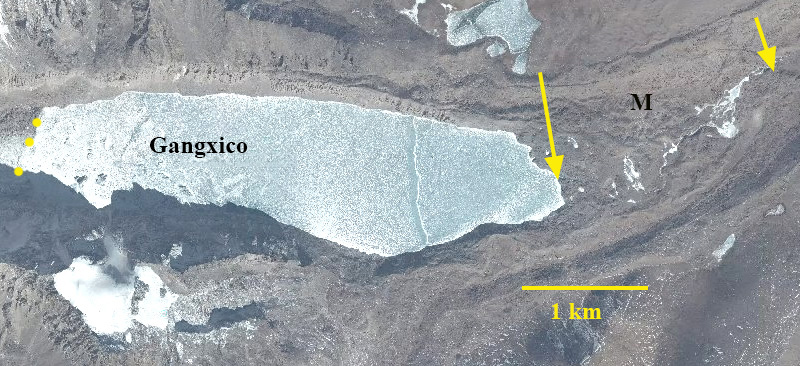
At Reqiang Glacier the moraine band impounding Gangxico is 1950 m wide and does not have visible signs of change.  With time since emplacement and retreat of the glacier into the lake the moraine will stabilize more.  Given the continued even if slow increased  moraine stability and the large moraines width the risk of dam failure is limited. At Jicongpu Glacier the moraine band is 1200 m wide impounding Galongco, again considerable.  These two glacier indicate the competing factors for GLOF risk, the size and stability of the moraine, versus the expanding volume of the lake.  Similarly a retreating glacier can reduce the ice avalanche hazard as the lake expands and ice slope diminish or the retreating glacier can provide access to steeper ice slope depending on the specific topography.  Zhang et al (2019) suggest both lakes have limited room to expand as they near a glacier surface slope increase.The retreat of these two glaciers follows that of many alpine glaciers in the region where lakes exist at the terminus which has enhanced retreat such as at Yanong Glacier and Drogpa Nagtsang Glacier.

Reqiang Glacier (R) and Jicongpu Glacier (J) in 2000 and 2018 Landsat images.  M=Moraine, red arrow is the 1993 terminus location, yellow arrow the 2019 terminus location and purple dots the snowline.

Gangxico Lake fed by Reqiang Glacier in Digital Globe image from 2015 indicating the moraine that impounds the lake with yellow arrows.

Galongco Lake fed by Jicongpu Glacier in Digital Globe image from 2015 indicating the moraine that impounds the lake with yellow arrows.


Mount Everest Region Glaciers December 2019 Limited Accumulation Area

Mount Everest region snowline identified on Dec. 11, 2019 Landsat image (yellow dots).  Green dots indicate the terminus and pink arrows flow direction of specific glaciers: T=Trakarding, DN=Drogpa Nagtsang, M=Melung, BK=Bhote Koshi, S=Shalong, Y=Yanong, G=Gyabarg, YN=Yanong North, GY=Gyachung, J=Jiuda, R=Rongbuk, ER=East Rongbuk, I=Imja, L=Lhotse, M=Marala, K=Khumbu, N=Ngozumpa.

The winter monsoon for the Himalaya is a dry cold period with limited new snow accumulation.  The Landsat image of Dec. 11, 2019 highlights the snowline at 5500-6200 m on glaciers around Mount Everest.  This high of an elevation indicates the accumulation area of the glaciers is too small to sustain the current ablation areas. This is explored in detail below. King et al (2019) found during the 2000-2015 period Himalaya mass balance losses of debris-covered and clean-ice glaciers to be substantially the same, with mass balance loss for lake-terminating glaciers being significantly higher. The overall mean was −0.39  m/year.  Maurer et al (2019) found a doubling of the average rate of loss across the Himalaya during 2000–2016 relative to the 1975–2000 interval. King et al (2017) observed the mass balance of 32 glaciers in the Mount Everest area from 2000-2015 finding a mean mass balance of all glaciers was −0.52 m/year, increasing to -0.7 m/year for lake terminating glaciers. Brun et al (2017) identify a mean balance of -0.33 m/year for 2000-2016 in Eastern Nepal, similar to King et al (2019) and not the highest loss rate in the region. Dehecq et al (2018) examined velocity changes across High Mountain Asia from the 2000-2017 period identifying a widespread slow down in the region.  The key take away is warming temperatures lead to mass balance losses, which leads to a velocity slow down, and both will generate ongoing retreat.

For an alpine glacier to be in equilibrium requires at least 50% of its area to be in the accumulation zone, this is the accumulation area ratio (AAR).  On Dec. 11, 2019 the snowline indicates where the accumulation zone begins.  The elevation ranges from 5500 m on Melung Glacier to 6200 m East Rongbuk Jiuda and Gyabarg Glacier.  The area above the snowline, AAR, is less than 30% of the total glacier on: Trakarding, Drogpa Nagtsang, Melung, Bhote Koshi, Shalong, Yanong, Gyabarg,  Jiuda, Rongbuk, East Rongbuk, Imja, Lhotse, Marala Glacier.  Gyachung and North Yanong Glacier have an AAR between 30 and 40%. Khumbu and Ngozumpa Glacier have a high mean elevation and an AAR of close to 50%.

In 2015 and again in 2018 high winter snowlines indicated the same process in the Mount Everest region. See below the rise from Nov. 2017 to Feb. 2018 to similar elevation as seen in Dec. 2019. The high snowlines indicate an accumulation area that is too small to maintain these glaciers, which drives continued retreat, such as reported at Drogpa Nagtsang and Yanong Glaciers.

Dec. 11, 2019 snowline:

6200 m =East Rongbuk, Jiuda, and Gyabarg

6100 m = Gyachung,

5900 m= Rongbuk, Imja, Lhotse

5800 m=Trakarding, Melung, Yanong North

5700 m= Ngozumpa, Drogpa N., Yanong, Shalong, Bhute Khosi

5600 m= Marala, Khumbu

5500 m= Melung

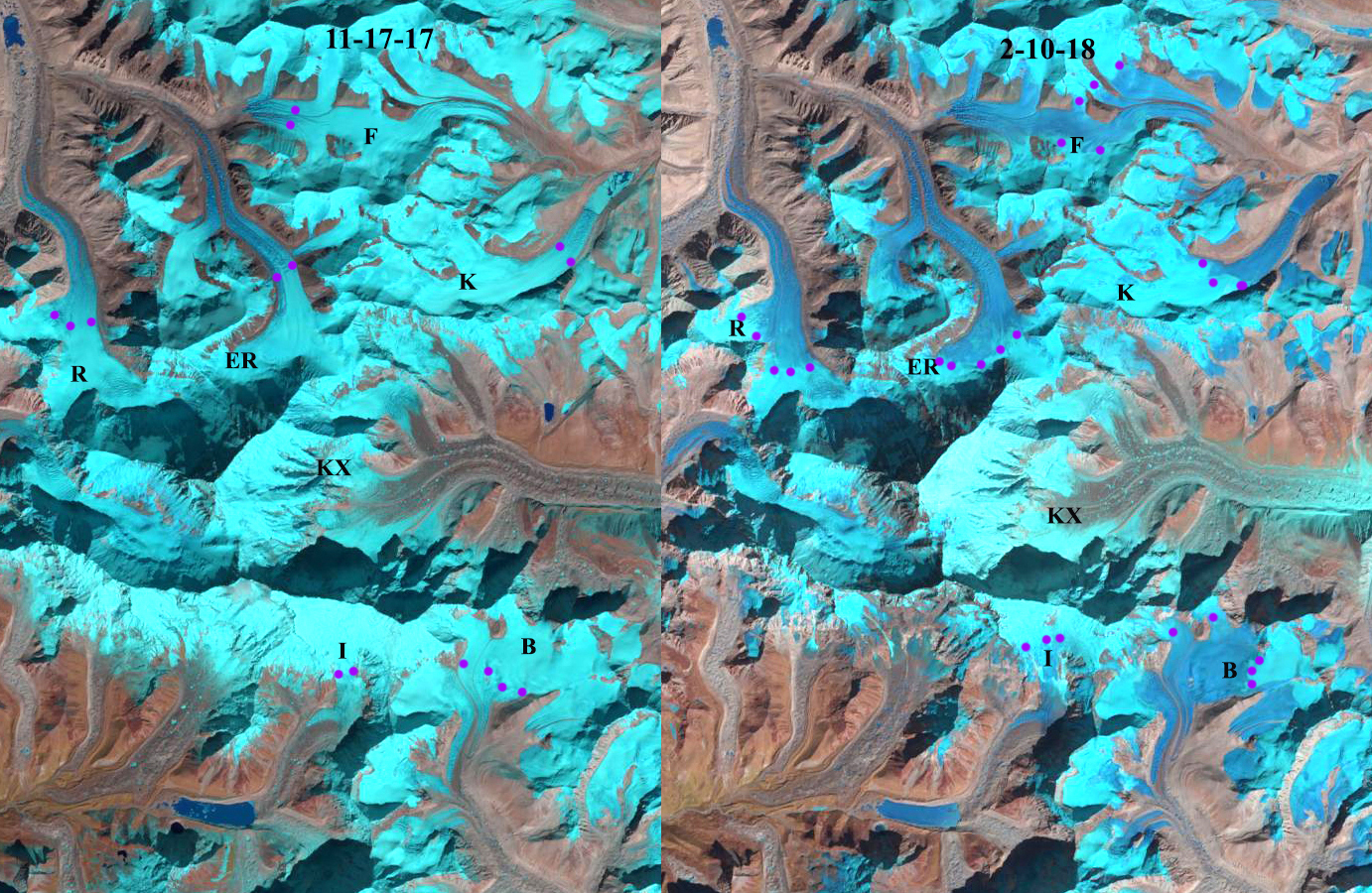
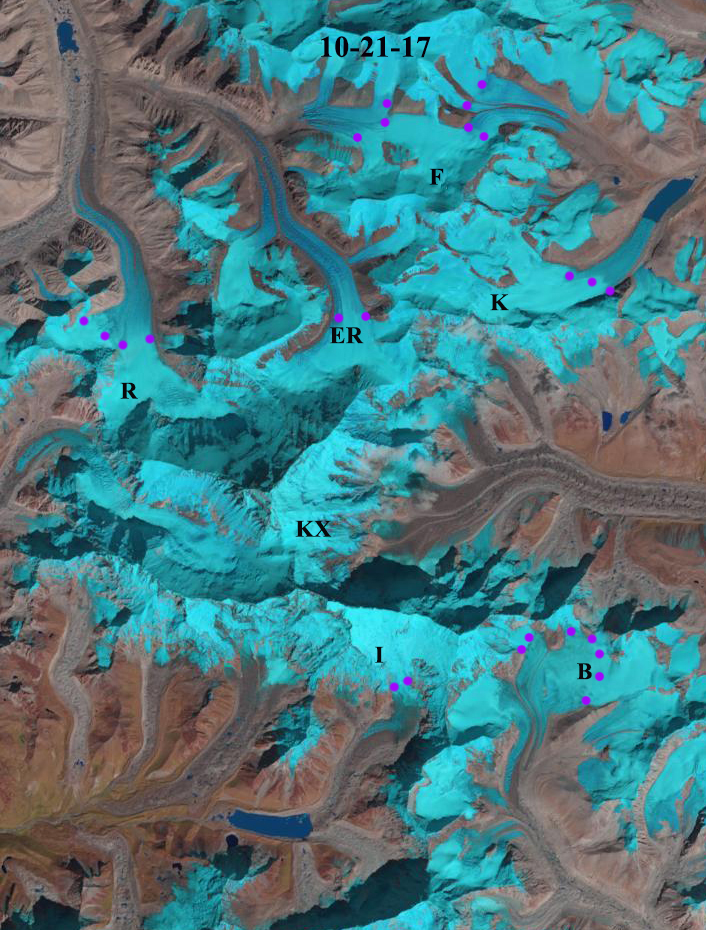
Landsat images from Nov. 17 2017 and Feb. 10 2018 indicate a rise in the snowline, purple dots, on glaciers east of Mount Everest, indicating ablation even in winter from the terminus to the snowline. Rongbuk Glacier=R, East Rongbuk Glacier=ER Far East Rongbuk Glacier=F, Kada Glacier=K,  Barun Glacier=B,  Imja Glacier=I and Kangshung Glacier=KX.

Retreat of West Barun Glacier and Barun Tsho expansion, Nepal 1994-2018

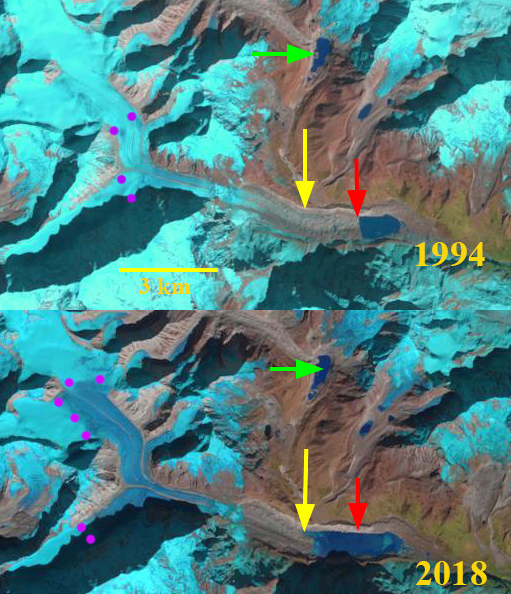
West Barun Glacier terminus retreat and lake expansion in 1994 and 2018 Landsat images. Red arrow is the 1994 terminus location, yellow arrow the 2018 terminus location, green arrow Seto Pohkari and purple dots the snowline.

The West Barun Glacier flows southwest from Baruntse Peak at 7100 meters ending at  Lower Barun Tsho (Barun Tsho) at 4500 meters. Comparison of Landsat images from 1994, 2000, 2015 and 2019 indicate the retreat of the glacier and expansion of the lake. In the early 1990’s the lake was observed to have an area of 0.7 km2 (ICIMOD, 2010). The importance of such lakes impounded in part by moraines, is the potential for glacier lake outburst floods (GLOF). The Lower Barun Tsho has no specific date for a GLOF observed. Rounce et al (2017) examined the risk posed by Lower Barun Tsho, part of which is another proglacial lake 3 km upstream, Seto Pohkari with an area of 0.41 km2 and it is considered to be a high hazard as the avalanche.  There are 33 buildings, 4 bridges and ~0-.8 km2 of agricultural land at risk of GLOF damage below Lower Barun Tsho (Rounce et al 2017) .

In 1994 the lake is 1100 m long and has an area of ~0.6 km2. By 2000 the lake was 1400 meters long and the area has increased to 0.9 km2.  The snowline in both 1994 and 2000 is ~5700 m.  In 2009 the lake was 2000 meters long and had an area of 1.4 km2 having doubled in size. By 2015 the lake is 2700 m long and has an area of ~1.6 km2Haritashya et al (2018) surveyed Lower Barun Tsho in 2015 and found a maximum depth of 205 m and a volume of 112.3 × 10⁶ m3. In 2018 the maximum length of the lake is 2800 m and the area 1.7 to 1.8 km2.  The snowline in 2015 and 2018 is at 6000 m, which is above the mean elevation of the glacier, indicating mass balance loss.  In the 2009 Digital Globe imagery below, right half of image, the glacier is stagnant below the light green arrow. The medial moraines evident at the purple arrows indicate the area around 5700-5800 m that typically is in the ablation zone. The orange arrows indicate the outflow from Seto Pohkari.  The dark green arrows indicate the wide moraine band.  There is some melt out of this 1 km wide band resulting in lake expansion and pond development.  The lake length and area has doubled since 2000.  Glacier retreat has been 1500 m from 1994-2018. Haritashya et al (2018) expect faster growth and increasing risk from Lower Barun Tsho.  The beginning of a stagnant zone below the icefall, light green arrow below, indicates rapid retreat can continue. The changes here are repeated at many glaciers in this region including Lumding, Lhonak,  Yanong and Thulagi

Kirschbaum et al (2019) examined the cascade of hazard impacts that can work together to generate or accentuate geologic hazards in this regions including earthquakes, monsoon flood events, avalanches and GLOFs.

West Barun Glacier: Purple arrows indicate upper reach of lateral moraines, light green arrow the start of the stagnant zone below an icefall, orange arrows indicate the river draining the Seto Pohkari and dark green arrows indicate the partially ice cored moraine belt.

West Barun Glacier terminus retreat and lake expansion in 2000 and 2015 Landsat images. Red arrow is the 1994 terminus location, yellow arrow the 2018 terminus location, green arrow Seto Pohkari and purple dots the snowline.

Drogpa Nagtsang Glacier, China Mass Balance Loss, Separation, Slow Down

Drogpa Nagtsang Glacier change in Landsat image from 1989 and 2018.  Yellow arrow indicates 2018 terminus location, red arrow 1989 terminus location, red dot the lowest elevation of clean glacier ice. Points A-E are the same locations for comparison.

Drogpa Nagtsang Glacier, China is a glacier that is 30 km west of Mount Everest that terminates in an expanding proglacial lake. The glacier begins on the Nepal border at 6400 m, and its meltwater enters the Tamakoshi River. The Upper Tamakoshi Hydropower project is a 456 MW peaking run of river  is a hydropower project on the Tamakoshi that is to be finished in 2019.  King et al (2017) observed the mass balance of 32 glaciers in the Mount Everest area including Drogpa Nagtsang and found a mean mass balance of all glaciers was −0.52 m water equivalent/year, increasing to -0.7 m/year for lake terminating glaciers. Dehecq et al (2018) in an exceptional paper examined velocity changes across High Mountain Asia from the 2000-2017 period identifying a widespread slow down in the region.  The key take away is the same we see for alpine glaciers around the globe, warming temperatures lead to mass balance losses, which leads to velocity slow down, Mass balance is the key driver in glacier response, a sustained negative mass balance leads to thinning, which leads to a glacier velocity declines whether the glacier is in the Himalaya, Alps or Andes. This study simply could not have been completed without the availability and affordability of Landsat imagery.  Here we look at one example in the region that highlights the important findings.

In 1989 Drogpa Nagtsang Glacier had a substantial number of coalescing supraglacial ponds on its relatively flat stagnant debris covered terminus.  At Point A the former tributary is are no longer contributing to the main glacier, while at B, C, D and E there is a still a contribution.  The snowline in 1989 is at ~5450 m.  The clean glacier ice extends almost to the tributary glacier at Point B at 5200 m, red dot. In 1992 the supraglacial ponds have further expanded, but a true proglacial lake has not formed. The snowline is at~5500 m. Quincey et al (2009) observed flow of less than 10 m/a in lower 5 km of glacier in 1996 and peaking at 20-30 m/a 8 km from terminus. By 2015 a 2.7 km long lake has developed.  The clean glacier ice now extends just past Point E at 5350 m.  The snowline is at 5600 m. The tributaries at Point B, C and E no longer reach the main glacier.  At Point D the medial moraines indicate that flow from this tributary has been reduced and now is a smaller contributor to the valley tongue. In 2018 the clean glacier ice extends to just 5400 m.  The lake has expanded to a length of 2.9 km indicating a retreat of the same distance from 1989-2018.  The snowline is exceptionally high at 5700 m. The former tributaries at B, C and E have also markedly retreated away from the main glacier. Only the tributary at Point D is still contributing to the main glacier. The high snowline observed in recent years are an indication that mass balance losses are even larger in this region, which causes further thinning, reduction in velocity, retreat and expansion of debris cover.  King et al (2018) observed the thinning and velocity profile on Drogpa Nagtsang and noted the velocity decreased over time and was stagnant in the debris covered zone, thinning occurred along the entire profile, which began close to the ELA. The stagnant nature of the terminus tongue is evident in the Digital Globe image below from 2017.  The red arrows show a deeply incised supraglacial stream that is over 2 km long, that would only develop on stagnant ice.  This process has played out on other nearby glaciers such as Yanong Glacier  and Lumding Glacier.  The high snowlines have also been observed at the nearby Nup La on Ngozumpa Glacier in recent years and on many glaciers in the Mount Everest region in recent winters such as in 2018.  This indicates continuing mass losses through a greater period of the year.

Drogpa Nagtsang Glacier change in Landsat image from 1992 and 2015.  Yellow arrow indicates 2018 terminus location, red arrow 1989 terminus location, red dot the lowest elevation of clean glacier ice. Points A-E are the same locations for comparison.

Digital Globe image with yellow dots indicating terminus, red arrows a supraglacial stream, blue arrows ice flow direction.  B is the same tributary has noted in the Landsat images above.

Reru Glacier, Kashmir Retreat and Lake Expansion

Reru Glacier in 1998 and 2018 Landsat images.  The red arrow indicates the 1998 terminus location, the pink arrow a recent landslide, Point 1 and 2 are tributaries that are losing connection with the main glacier and purple dots are the snowline.

Reru Glacier, Kashmir is at the headwaters of the Reru River, which drains into the Doda River and then the Zanskar River.  Murtaza et al (2017) noted a 17% loss in glacier area and a 80-300 m rise in the ELA of Kashimir glaciers form 1980-2013. This is similar to the rate of loss from 1962-2001 of 18% reported by Rai et al (2013) The Kolahoi Glacier has experienced an accelerated retreat in the last decade (Rashid et al, 2017)Babu Govindha Raj (2010) identified  the glacier retreating at an average rate of 12 m per year from 1975-2005,  with lake area expanding from 0.17  to 0.42 square kilometers.  Here we examine Landsat images from 1998-2018 to document changes of Reru Glacier.

In 1998 the glacier terminates in a 1 km long lake. The snowline is at 500 m, and tributaries at Point 1 and 2 flow into the main glacier. In 2002 the snowline is at 5300 m, the tributaries still join the main glacier and no landslide is evident at the pink arrow.  By 2014 the glacier terminates in the proglacial lake that has expanded to 1.6 km in length and tributary 1 has detached from the main glacier.  The snowline is at 5100 m.  In 2018 the glacier has retreated from the proglacial lake which is 1.7 km long.  The glacier has retreated 600-700 m since 1998.  A landslide is now evident at the pink arrow. Potentially from the period of intense flooding in 2015. Tributary #2 has a narrow but existing connection to the main glacier. The snowline in 2018 is particularly high at 5700 m. This is reflective of the high freezing levels in this area in 2018.  The retreat is significant, but not rapid.  This is similar to both Kolahoi Glacier and Durung Drung Glacier.

Reru Glacier in 2002 and 20184 Landsat images.  The red arrow indicates the 1998 terminus location, the pink arrow a recent landslide, Point 1 and 2 are tributaries that are losing connection with the main glacier and purple dots are the snowline.

Lapche Glacier, China Supraglacial Ponds Transitioning to Lake

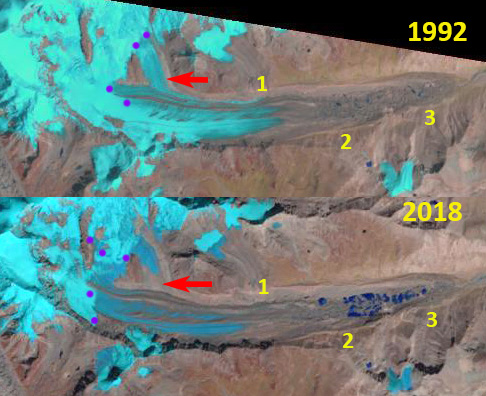
Lapche Glacier (Tibet 1), China in 1992 and 2018 Landsat images.  The expansion of supraglacial ponds is evident between Point 2 and 3. A tributary that detaches between 1992 and 2018 is indicated by red arrow.  The end of the clean ice and start of debris cover ice is just below Point 1 in 1992 and well above this Point in 2018. 

Lapche Glacier (Tibet 1), China flows east from Lapche Kang (Lobuche Kang) in the Bum Chu River Basin. King et al (2017) examined the mass balance of 32 glaciers in the Everest region for the 2000-2015 period including the Lapche, which they called Tibet 1, and found a mass loss of ~0.5 m/year, with the loss of lake terminating glaciers at ~-0.7 m/year.  King et al (2017) also observed that a number of these glaciers had nearly stagnant tongues with coalescing and expanding supraglacial ponds. Here we examine the expansion of the supraglacial ponds from 1992 to 2018 using Landsat images.

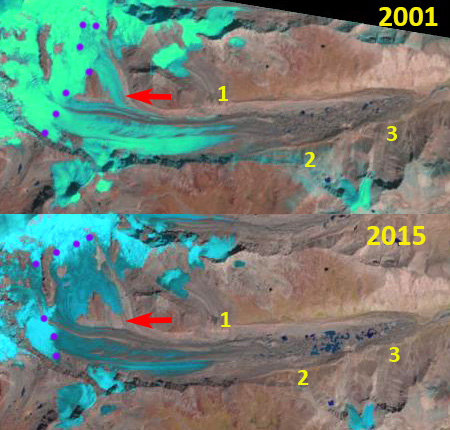
The lower four kilometers of Lapche Glacier in 1992 is relatively flat with the terminus at 5100 m and four kilometers upglacier at just 5200 m. In this stretch there are several small isolated supraglacial ponds between Point 2 and 3.  At Point 1 is the end of the clean ice section of the glacier, with debris cover obscuring the underlying ice below this point. There is a tributary joining the glacier at the red arrow. In 2001 the snowline is at 5600 m, and there are a few more supraglacial ponds, but with a total surface area under 0.1 square kilometers.  In 2015 the tributary at the red arrow has detached and the area covered by ponds has expanded and now cover ~0.5 square kilometers.  The snowline in 2015  is at 5650-5750 m. In 2018 the supraglacial ponds have largely coalesced, and have an area of ~1.0 square kilometers.  These lakes are on the verge of creating one larger lake as has happened on Rongbuk Glacier .  The debris covered portion of the glacier now begins above Point 1, 1 km upglacier of its 1992 location.  The snowline in 2018 is at 5650-5750 m.

King et al (2018) indicate a velocity of less than 10 m/year in the lower 5 km of the glacier, essentially stagnant.  Point 1 is just over 6 km above the 1992 terminus. The retreat here is difficult to discern, but with the proglacial lake development it will soon be identifiable and in line with that of other glaciers in the area Duiya and Yanong.   Zhang et al (2010) observed the loss of glacier area and lake expansion in the region from 1976-2006 driven by warming.

Lapche Glacier (Tibet 1), China in map view.  Point 1-3 same as in images, ice flow indicated by blue arrows, elevation contours labelled at 51oo and 5200 m. Debris cover beginning noted at DC.

Lapche Glacier (Tibet 1), China in 2001 and 2015 Landsat images.  The expansion of supraglacial ponds is evident between Point 2 and 3. A tributary that detaches between 2001 and 2015 is indicated by red arrow.  

High Glacier Snow Line Post-Monsoon 2018 on Bhutan-China Border

Angge Glacier (A) and Bailang Glacier (B) in China and Chubda Glacier (C) in Bhutan in Post Monsoon 1995 and 2018 Landsat images indicating the snowline purple dots is exceptionally high in 2018.  Red arrow is the 1995 terminus location and yellow arrows the 2018 terminus location. Point 1-3 are glacier passes from China into Bhutan.

The end of the monsoon season leads to finally some clear satellite images of snowlines and glaciers in the Himalaya.  A Landsat image from September 12, 2018 along the China-Bhutan  indicates high snowlines (5500 m) that reach the top of some glaciers and the glacier divide between nations on other glaciers.

Bailang Glacier and Angge Glacier, China are adjacent to the Chubda Glacier, Bhutan.  A These glaciers drain north and south from near Chura Kang on the Bhutan/China border.  Despite being in different nations on different flanks of the Himalaya, the retreat and resultant lake expansion is the same. These are all summer accumulation type glaciers that end in proglacial lakes.  All three lakes are impounded by broad moraines that show no sign of instability for a potential glacier lake outburst flood.  The number of glacier lakes in the region has increased 20%  (Che et al, 2014)   The Chubda Glacier terminates in Chubda Tsho, a glacier moraine dammed lake, Komori (2011) notes that the moraine is still stable and the lake is shallow near the moraine, suggesting it is not a threat for a glacier lake outburst flood.  Jain et al., (2015) noted that in the last decade the expansion rate of this lake has doubled. The glacier feeds the Chamkhar Chu Basin.

Here we examine 1995-2018 Landsat images from the post monsoon period to identify both retreat and the anomalously high snowlines in 2018.  In 1995 the highest observed snowline is at 5300 m, purple dots, Point 1 -3 are glacier passes from China into Bhutan that are snowcovered.  The glaciers terminate at the red arrows.  In 2000 the highest observed snowline is 5250-5300 m. There is limited retreat since 1990. In 2017 the highest observed snowline is at 5300-5350 m.  In 2018 the highest observed snowline is at 5500-5550 m.  The glacier passes at Point 1 and 2 lack any snowcover.  The glaciers at Point 3 have no retained snowcover despite top elevation above 5400 m.  Bailang Glacier has retreated 900 m from 1995 to 2018 that has led to lake expansion.   A retreat 1995-2018 retreat of 800 m of Angge Glacier has led to lake expansion.  A retreat of Chubda Glacier of 800 m  has led to lake expansion from 1995-2018 has led to lake expansion. 

2000 Landsat image from the post monsoon indicating the snowline purple dots.  Red arrow is the 1995 terminus location  Point 1-3 are glacier passes from China into Bhutan.

2017 Landsat image from the post monsoon indicating the snowline purple dots.  Red arrow is the 1995 terminus location  Point 1-3 are glacier passes from China into Bhutan.

Sept. 12 2018 Landsat image indicating the snowline purple dots is exceptionally high in 2018.  Red arrow is the 1995 terminus location and yellow arrows the 2018 terminus location. Point 1-3 are glacier passes from China into Bhutan.

Winter Season Ablation in 2018 Mount Everest Region, Himalaya

Landsat images from Nov. 17 2017 and Feb. 10 2018 indicate a rise in the snowline, purple dots, on glaciers east of Mount Everest, indicating ablation even in winter from the terminus to the snowline. Rongbuk Glacier=R, East Rongbuk Glacier=ER Far East Rongbuk Glacier=F, Kada Glacier=K,  Barun Glacier=B,  Imja Glacier=I and Kangshung Glacier=KX.

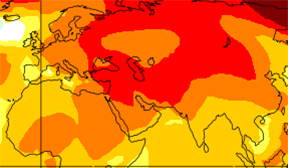
The Mount Everest region glaciers are summer accumulation type glaciers with 70% of the annual precipitation occurring during the summer monsoon. This coincides with the highest melt rates low on the glacier.  October has been considered the end of the melt season in the region. There is little precipitation early in the winter season (November-January). The limited snowpack with warmer winter temperatures have led to high snowlines during the first few months of the winter season in recent years. There is an expanded ablation season that extends beyond October into January or February. The melt rates do to solar radiation or sublimation are not rapid, but are significant on many glaciers. This has occurred with increasing air temperatures since the 1980’s. Mean annual air temperatures have increased by 0.62 °C per decade over the last 49 years; the greatest warming trend is observed in winter, the smallest in summer (Yang et al., 2011).    The winter season of 2017-18 has been warm in the region as indicated by global temperature anomalies from, NCDC/NOAA (at right). Here we examine Landsat images from Oct. 21 2017, Nov. 17 2018 and Feb. 10 2018  on the east side of Mount Everest to observe changes in the snowline during the winter period.  We observed the same phenomenon of high snowlines and winter ablation at Nup La on the west side of Mount Everest in January of 2016, On Chutenjima Glacier, China in 2016 and Gangotri Glacier, India in 2016 (see below).

At the end of the typical melt season on 10-21-2017, the snowline is at 5850 m on Rongbuk Glacier, 6250 m on East Rongbuk Glacier, 6300 m on Far East Rongbuk Glacier, 5900 m on Kada Glacier, 6050 m on Barun Glacier and ~6100 m on Imja Glacier.

A month later on 11-17-2017 the snowline has decreased to 5700 m on Rongbuk Glacier, 6200 m on East Rongbuk Glacier, 6200 m on Far East Rongbuk Glacier, 5820 m on Kada Glacier, 5950 m on Barun Glacier and still at ~6100 m on Imja Glacier.

Three months later on 2-10-2018 the snowline has risen indicating ablation from the terminus area up to the snowline.  The snowline is at 5900 m on Rongbuk Glacier, 6400 m on East Rongbuk Glacier, 6400 m on Far East Rongbuk Glacier, 5950 m on Kada Glacier, 6200 m on Barun Glacier and 6600 m on Imja Glacier. Notice on Far East Rongbuk Glacier the snowline reaches the glacier divide in February.  The mean rise in snowline from November 2017-February 2018 on the east side of Mount Everest is 200 m.

The ablation rates necessary to raise the snowline are not large on a daily basis, but cumulatively are significant as noted on Lirung Glacier by Chand et al (2015)

Kundu et al (2015) noted that from Sept. 2012 to January 2013 the snowline elevation on Gangotri Glacier varied little, with the highest elevation being 5174 m and the lowest 5080 m. Bolch et al (2011) observed strong thinning in the accumulation zone on Khumbu Glacier, though much less than the ablation zone. This can only happen with reduced retained snowpack particularly in winter.

Landsat image from Oct. 21 2017 indicate a rise in the snowline, purple dots, on glaciers east of Mount Everest, indicating ablation even in winter from the terminus to the snowline. Rongbuk Glacier=R, East Rongbuk Glacier=ER Far East Rongbuk Glacier=F, Kada Glacier=K,  Barun Glacier=B,  Imja Glacier=I and Kangshung Glacier=KX.


W

Purple dots indicate the transient snowline on Gangotri Glacier in the fall and early winter of 2016. Red arrow indicates the terminus of the glacier. Landsat 12-9-16

Landsat image from January 4, 2016 indicating the actual Nup La (N), west side of Mount Everest.  Purples dots is the snowline. Green arrows are expanding bedrock exposures and pink arrow a specific rock know amidst the glacier.

Zhongni Glacier Retreat, China and Hydropower

Zhongni Glacier changes from in Landsat images from 1994 to 2015. The red arrow is the 1994 terminus, yellow arrow the 2015 terminus, purple dots the snowline and purple arrows lakes adjacent to the margin of the western glacier in 1994.

Zhongni Glacier is 15 km northwest of Gangotri Glacier just across the border into China.  The glacier drains in to the Langgen Zangbo, which becomes the Sutlej River in India. The Sutlej River has a 1000 MW  Karcham Wangtoo hydropower plant and a 300 MW Baspa hydropower plant (see below). 

The glacier is comprised of three main tributaries separated by two prominent medial moraines.  The width of the medial moraine extending to the main terminus is over 200 m. Here we use Landsat imagery to identify the glacier changes from 1994 to 2017.

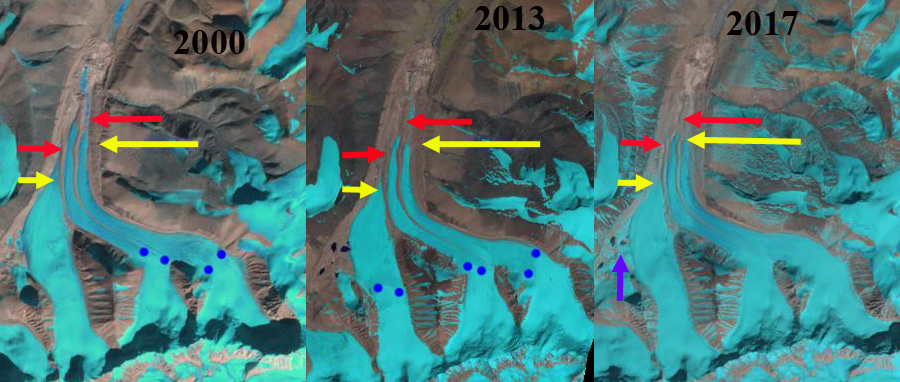
The western tributary acts as a separate glacier and in 1994 has several adjacent small melt lakes, purple arrow terminating with a narrow band of ice at the red arrow.  The snowline is at ~5900 m.  The eastern two tributaries extends 700 m  further downvalley before terminating. In 2000, there has been retreat of 100-200 m of the western tributary and main glacier, and the snowline is at 5750 m.  In 2013 the snowline is at 5800 m.  In 2015 the snowline is at 5750 m.  By 2015 the western tributary margin has receded from the lakes at the purple arrow. The snowline in 2015 is at 5750 m.  In each case the images are far from the fall and the snowline during the post-monsoon season is not the highest elevation.  In 2017 there is new snowfall in late November obscuring the snowline.  Overall retreat from 1994-2015 of the eastern tributary has been 500 m and of the western tributary 900 m.  The western tributary has also lost 200 m of width at the purple arrow. On nearby Gangotri Glacier, India it has been observed that the ablation season has been extending through fall into early winter. The retreat is less pronounced than glaciers terminating in pro-glacial lakes such as Chutanjima Glacier

Zhongni Glacier changes from in Landsat images of 2000, 2013 and 2017. The red arrow is the 1994 terminus, yellow arrow the 2015 terminus, purple dots the snowline and purple arrows lakes adjacent to the margin of the western glacier in 1994.

Zhongni Glacier in 2012 with the snowline at 5900 m in Digital Glacier imagery. Purple arrows indicate medial moraines.

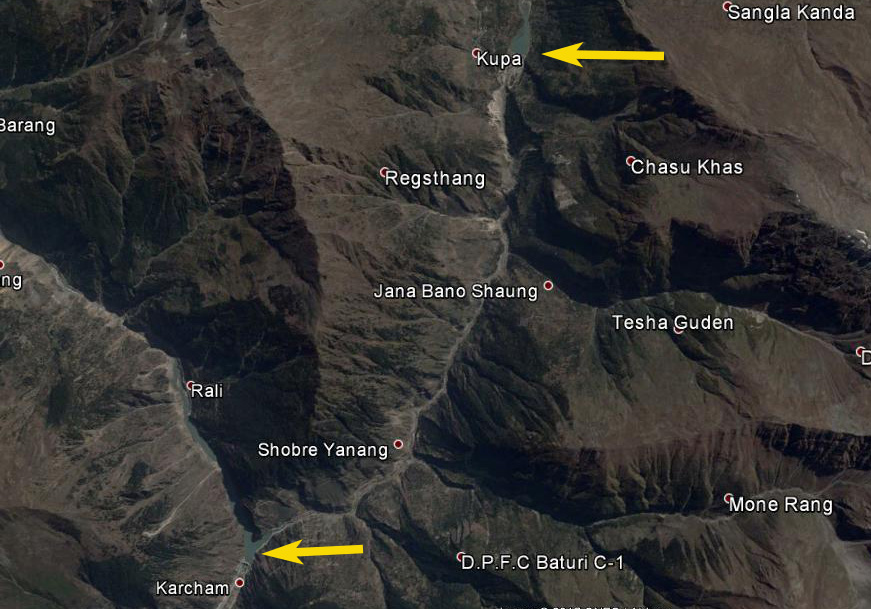
The Karcham Wangtoo Hydropower (lower yellow arrow) and Baspa Hydropwer station (upper yellow arrow) which both have small reservoirs.

Chaxiqudong Glacier, Tibet Retreat From Lake & Tributary Separation

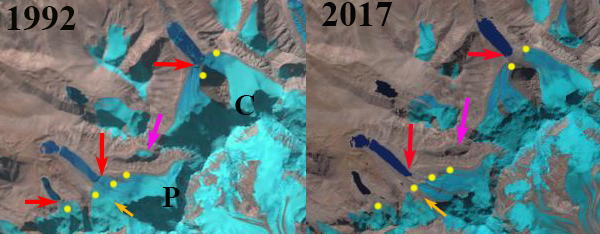
Chaxiqudong Glacier (C) at right and Paqu Glacier (P) at left in Landsat images from 1992 and 2017.  The red arrow indicates the terminus in 1992 and the yellow dots the 2017 margin.  Purple arrow indicates a glacier that disappeared and orange arrow separation of Paqu Glacier. Both glaciers no longer reach the lake. 

Chaxiqudong Glacier and Paqu Glacier are located in a sub-range north of the Nepal-China border.  Chaxiqudong Glacier is adjacent to Longmiojian Glacier. The glaciers drain into Nepal entering the Bhote Khosi River.  The Bothe Khosi had a hydropower project that has been put out of service by a 2015 earthquake and 2016 flood event.    King et al (2017) observe significant surface lowering in the ablation zone of both glaciers (Figure 2), though less than on neighboring larger glaciers.  Zhang et al (2010) observed the loss of glacier area and lake expansion in the region from 1976-2006. Here we examine Landsat imagery from 1992 to 2017 to observe changes. 

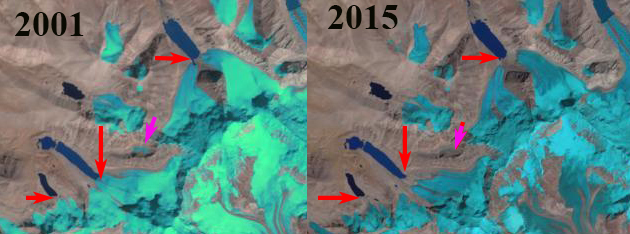
Chaxiqudong Glacier terminus in 1992 is in a proglacial lake at the junction of a pair of tributaries red arrow). Paqu Glacier has a wide terminus in a proglacial lake (red arrow).  By 2001 Chaxiqudong Glacier has separated with the eastern tributary still at the margin of the proglacial lake and the western tributary having receded from the lake. Paqu Glacier still is in contact with the lake on a narrow front on the west margin of the lake. By 2015 both tributaries of the Chaxiqudong Glacier have receded significantly from the lake.  Paqu Glacier has retreated from the lake and has separated into two sections, orange arrow.  By 2017 Chaxiqudong Glacier has retreated 400 m since 1992, no longer terminates in a lake and has separated into two glaciers (yellow arrow).  Paqu Glacier has retreated 5oo m no longer terminates in a lake and has separated into two glaciers (yellow arrow).  The retreat of each glacier has occurred without significant calving indicating a retreat driven by negative surface mass balance.  The retreat is less than on the larger Yanong and North Yanong Glacier to the east that also end in lakes still. The retreat of these glaciers from the lakes also reduces the threat of glacier lake outburst floods, as both the risk of  calving and avalanches caused rapid water level change have declined. At the purple arrow is a small cirque glacier in 1992.  This glacier still exists in 2001, but has disappeared by 2015. 

Chaxiqudong Glacier at right and Paqu Glacier at left in Landsat images from 2001 and 2015.  The red arrow indicates the terminus in 1992.  Purple arrow indicates a glacier that disappeared. Both glaciers no longer reach the lake.