Prándarjökull, Iceland Loses all Snow Cover in 2025-Accelerating Loss

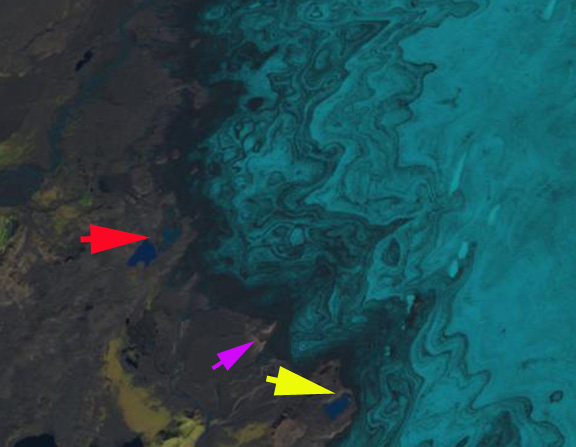
Prándarjökull on August 20, 2025 has no retained snowpack-with weeks left in the melt season (Sentinel false color image)

Prándarjökull is an icecap northeast of Vatnajokull that has a summit elevation of 1215 m, and a margin between 875 and 925 m. In 2003 the ice cap had an area of 17.3 km2, declining to 12.8 km2 by 2023 (Iceland Glacier Viewer). In 2024 all 10 glaciers in Iceland had significant mass loss (Pelto, 2025)

In 2021 the ice cap lost at least 90% of its snow cover as noted in the Sentinel image from 8-24-2021. In 2023 The ice cap again lost nearly all of its snow cover.

Prándarjökull on August 31, 2023 has only 5-10% retained snowpack-with weeks left in the melt season (Sentinel false color image)

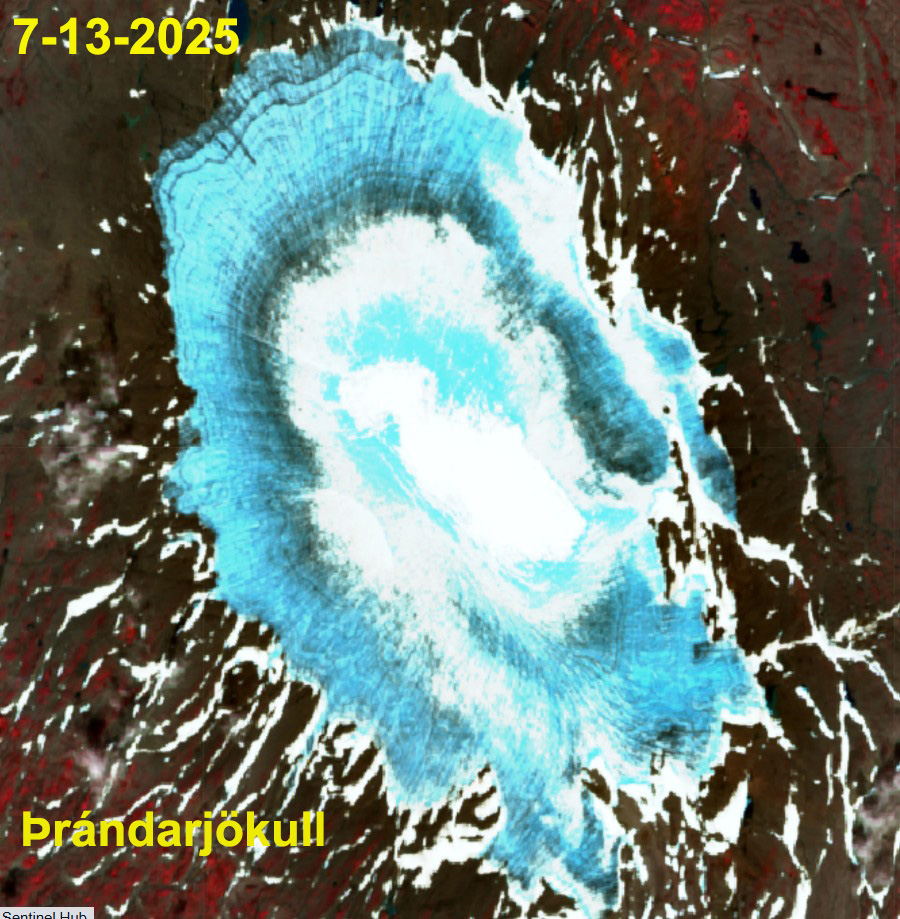
The spring and early summer of 2025 was one of record warmth for Iceland. This led to a rapid rise of the snowline to 900-1000 m on Vatnajokull. By mid-July 60% of the Prándarjökull was snow free. There is an area of water saturated snow-light blue amidst the snowpack.

Prándarjökull on July 13, 2025 the ice caphas 40% retained snow cover-with weeks left in the melt season (Sentinel false color image)

By August 20, 2025 the ice cap had no snow cover. The early exposure of ice in recent years is leading to the continued recession of the ice cap and the intrusion of bedrock areas into the ice cap at Point A and B. At Point C in 2021 recent firn is exposed, that has melted away by 2025. The area of the ice cap has declined to 11.5 km2. There is no recent retained firn-indicating that in the last five year no snow cover has persisted to the end of this summer. This indicates the lack of an accumulation zone, without which the glacier cannot survive.

Prándarjökull on August 31, 2023 has only 5-10% retained snowpack-with weeks left in the melt season (Sentinel false color image)

Öræfajökull and Vatnajökull, Iceland May High May 2025 Snow Line

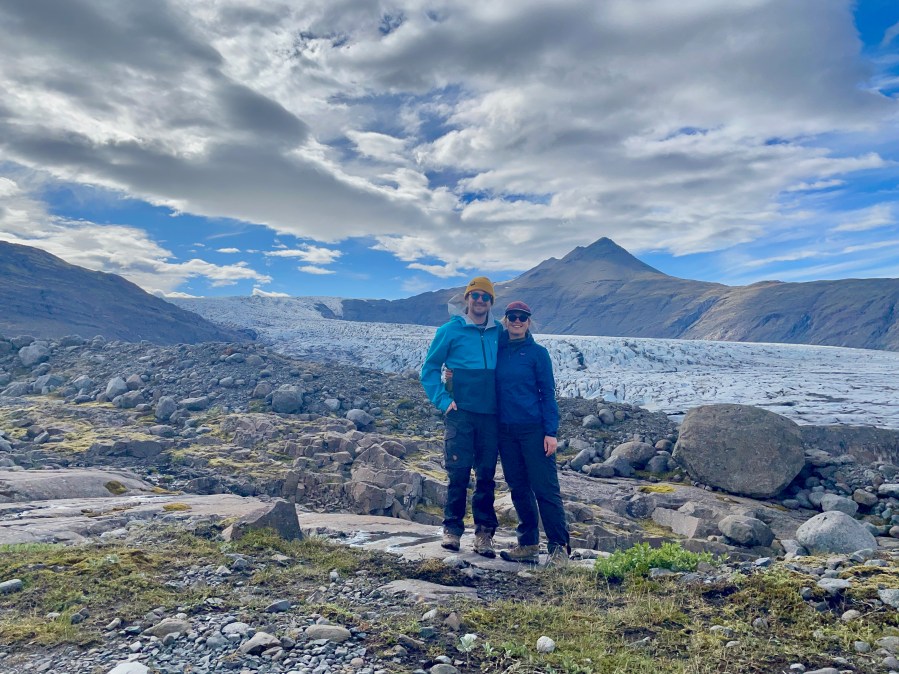
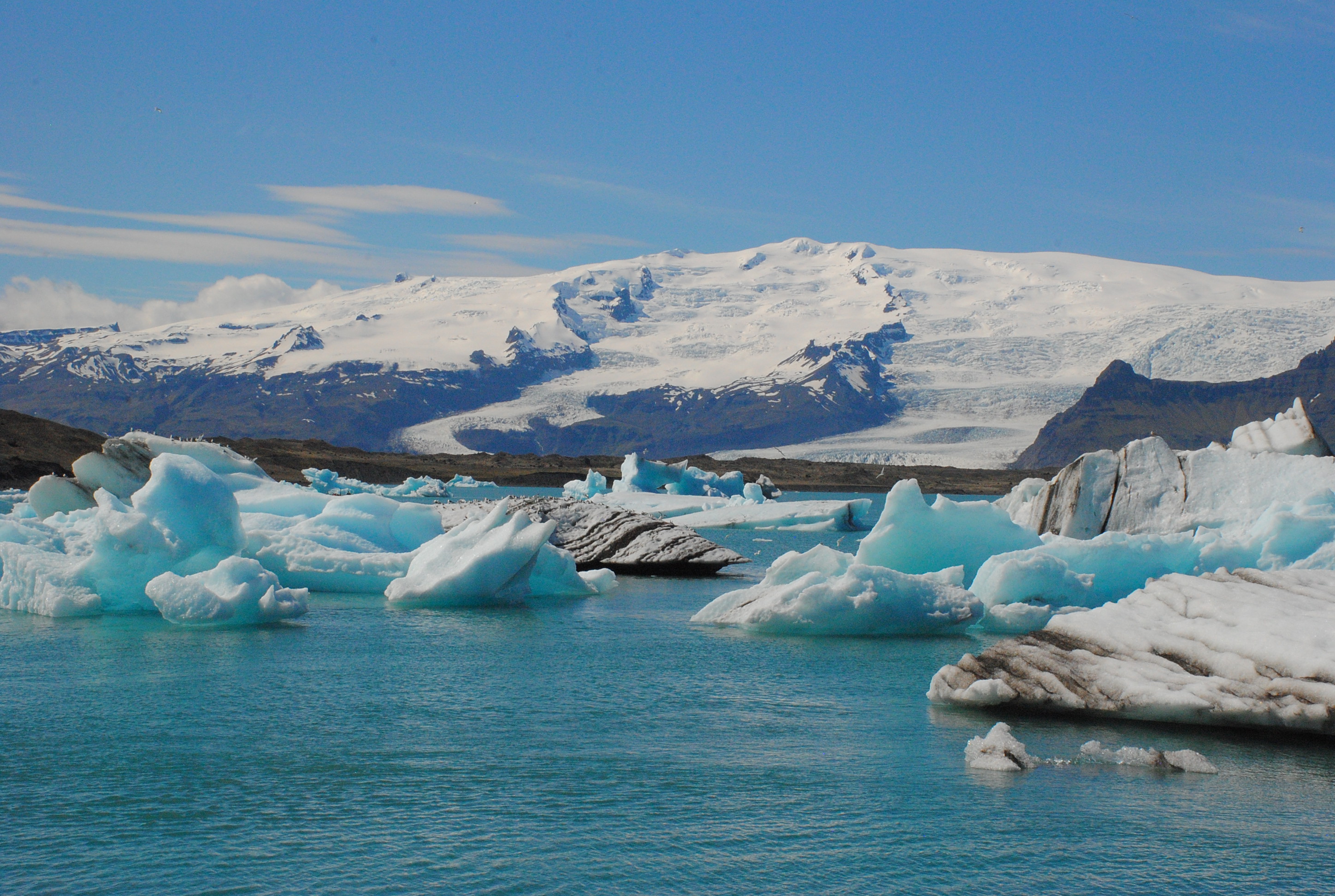
A view across Jokulsarlon Lagoon toward Fjalljökull and Hrutarjökull of the Öræfajökull Ice Cap on May 25 above. Below, is Skalafellsjokull of Vatnajökull Ice cap on May 26 with Jill and Kevin Duffy in foreground next to lateral moraine (Jill Pelto). Öræfajökull is a connected to Vatnajökull.

Iceland experienced an unusually warm and sunny May, with record high temperatures averaging 10 C above average. This led to a rapid rise in the snow line to elevations more typical of late June than May on the ice caps in southern Iceland, here both Vatnajökull and its southern extension Öræfajökull. We use Sentinel images (Mauri Pelto annotated) and photographs from (Jill Pelto) to illustrate. The University of Maine Sea to Sky Experience explored Iceland in May, and Jill as the artist faculty for the program had a chance to see Iceland with blue sky days.Most days during my two weeks in Iceland were full sun with high temperatures from 10-15 C. The record heatwave reaching into the low 20 C range, rare even for summer here. The lower parts of outlet glaciers already were mostly bare ice, even though melt season should not really have begun yet. Locals were shocked by the weather, and most I heard from were not happy about it, even though it was “nice” out.

On May 20, 2025 the snow line on the southern part of the Öræfajökull Ice Cap averages 800 m, purple dots. SK=Skaftafells, SV=Svinafells, HR=Hrutarjokull, KV=Kviar, FJ=Fjalls, JL=Jokulsarlon Lagoon, H1=Southern Highway.
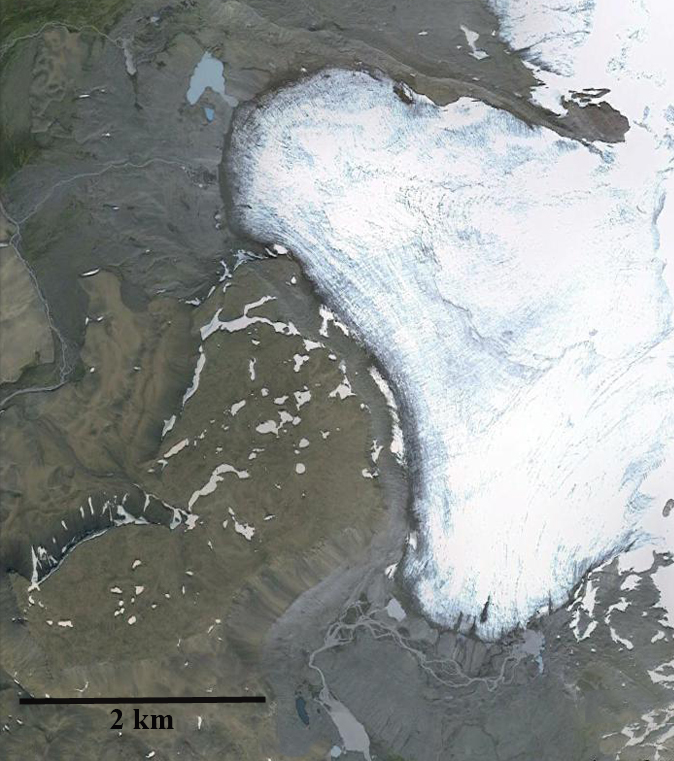
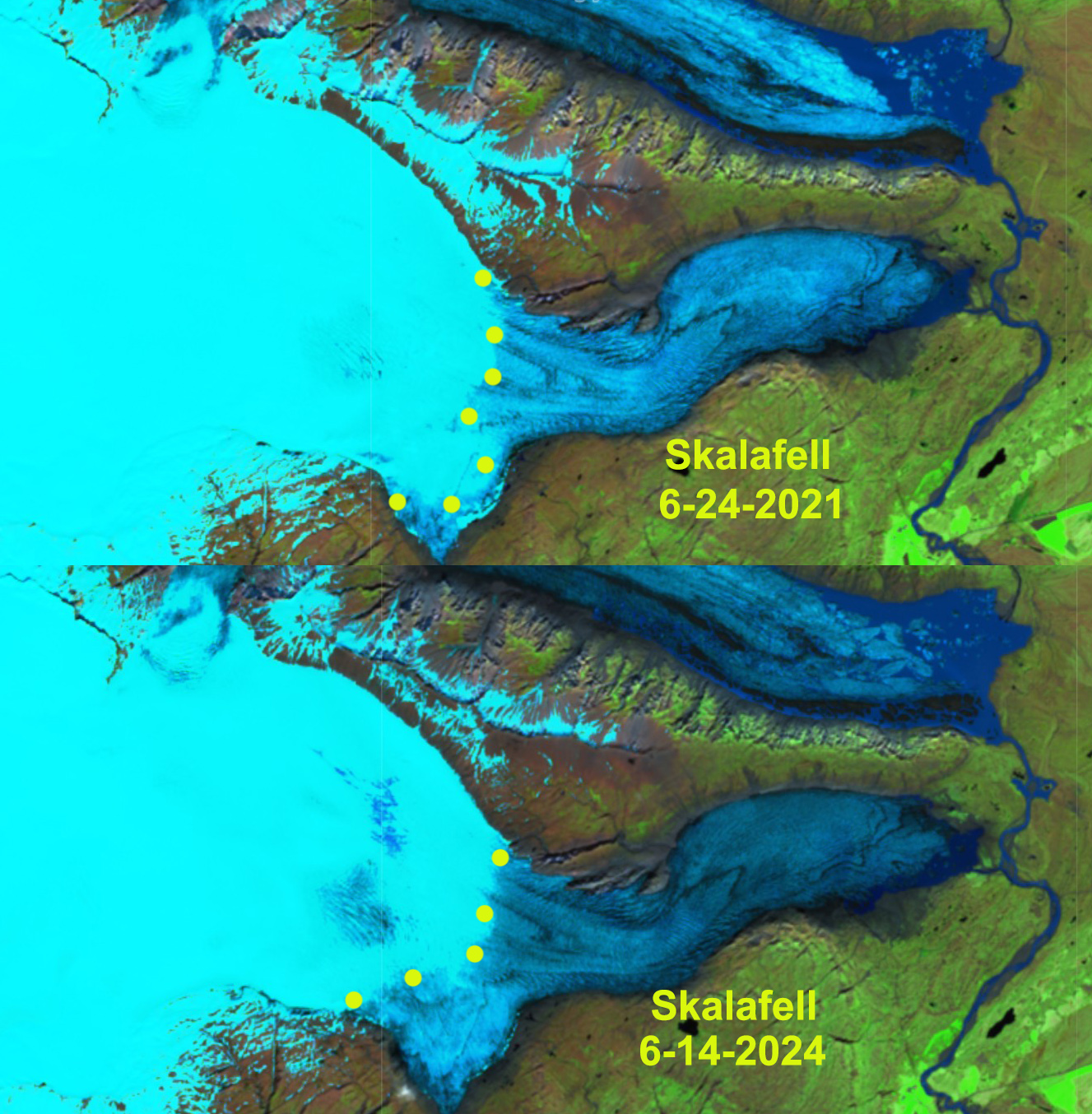
As May began conditions were typical with the snow line not far from the glacier terminus areas at 350-400 m, May 2 image of Skalafellsjökull. By May 20, the snow line had risen to 750-800 m, a rapid rise of ~400 m in three weeks, represents more than 50% of the rise that should occur by end of summer. By May 26, (Jill image) the snowline had risen further to 800 m+. This snow line elevation is above the typical elevation seen in latter June other years (see below). In 2024 all ten glaciers in Iceland had a negative mass balance (WGMS, 2025). The rapid melt in May 2025, indicates that 2025 will see similar widespread mass loss.

Hrutarjökull with snowline at 800 m on May 26, 2025.
Skalafellsjökull on May 2 and 20, 2025 illustrating rapid snow line rise (yellow dots). Contrast that to the images from mid-late June in 2021 and 2024, below.

Blondujökull, Iceland Retreat Exposes Broad Landscape

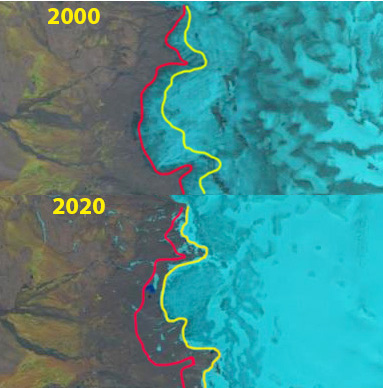
Blöndujökull in Landsat images from 2000 and 2020 illustrating terminus position, yellow line is 2020 and red line is 2000.

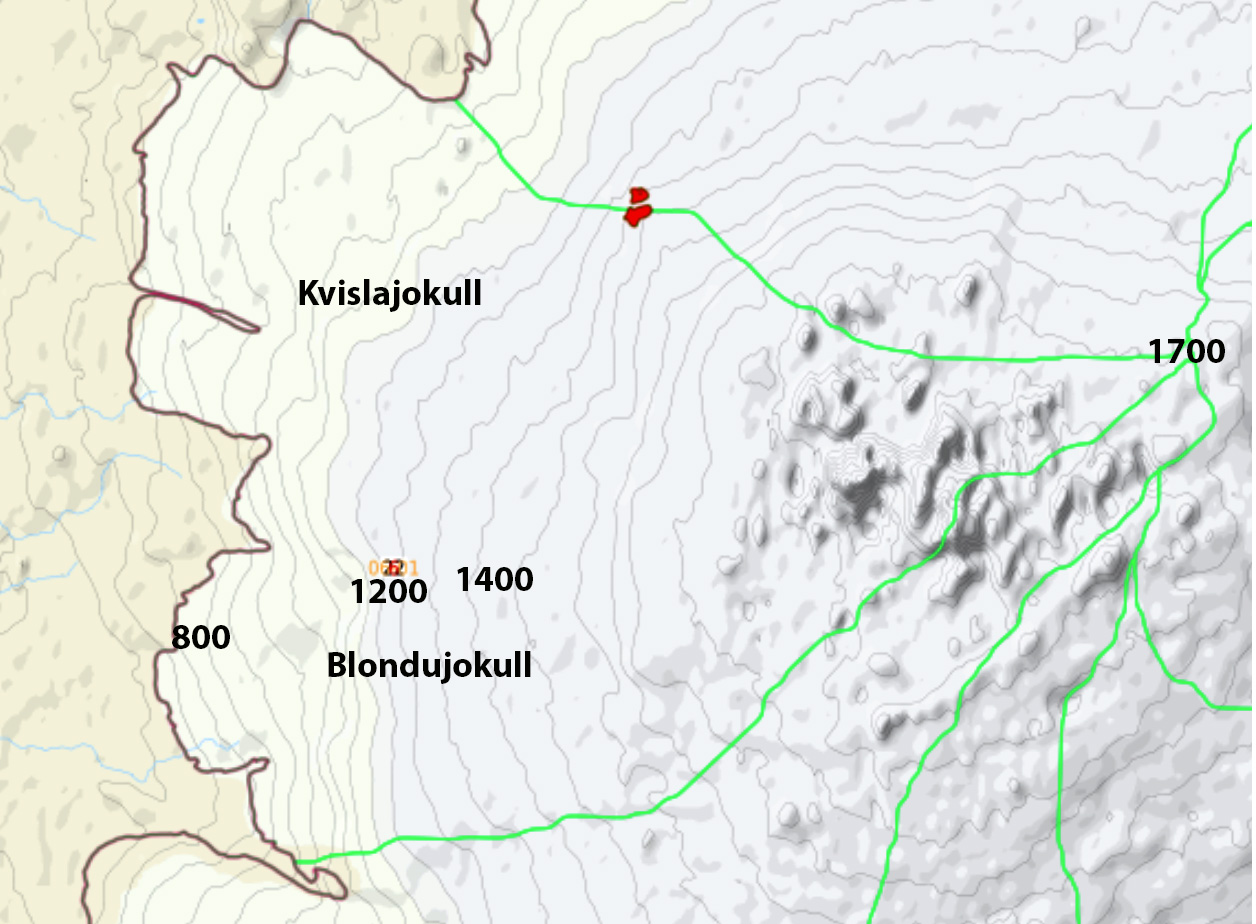
Blöndujökull  is an outlet glacier on the west side of Hofsjökull, Iceland. The National Land Survey of Iceland has developed a DEM application that provides a detailed view of the islands glaciers and their immediate landscape. Johannesson (1997) reported the response time for Blöndujökull  to a climate change as ~90-100 years, with significant warming beginning in 1985. Since 1995 Hofsjökull has had only two years with a positive mass balance (Aðalgeirsdóttir et al 2020).  They further report the ice cap has lost 56 m w.e. from 1890-2019 with ~50% of that loss since 1995. Belart et al (2019) reported near equilibrium conditions for 14 Icelandic glaciers from 1960-1994 and mass losses of ~-1.2 m w.e. per year from 1994-2010.The ice cap geometry leads to the maximum area being in the terminus zone.  The result is instead of a larger retreat distance of a narrow outlet terminus with a limited area loss, there is a smaller retreat distance with a large area loss (see below).  This leads to divergent flow at the terminus, which also enable better formation and preservation of glacial deposits as there is limited glacial runoff reworking. Here we examine the response of this outlet glacier using Landsat imagery from 2000-2020.

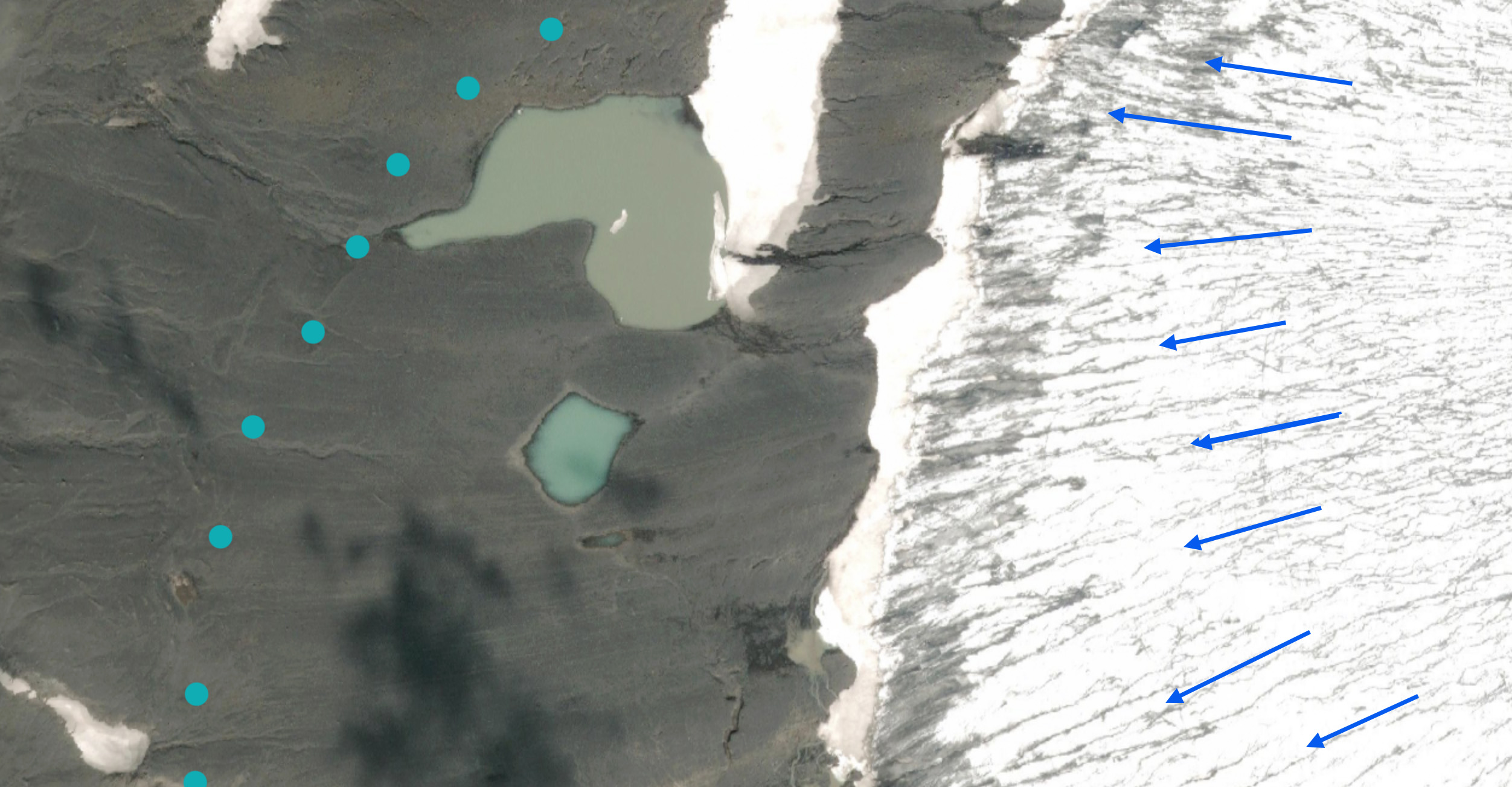
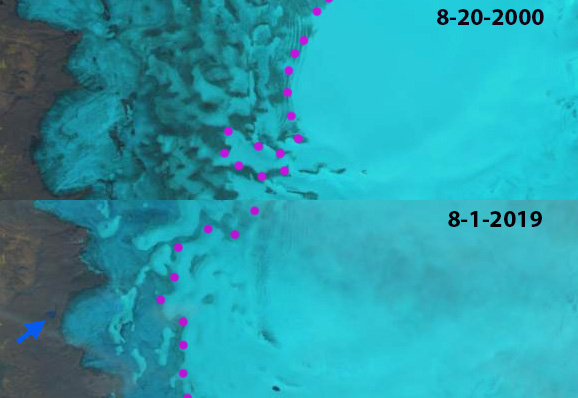
Blöndujökull in 2000 ends on a gently sloping at ~750 m and has no proglacial lake near the terminus.  The snowline is a patchwork  at ~1550 m this leads to an accumulation area ratio of  ~25%.  In 2019 the glacier has retreated exposing a proglacial lakes.  The snowline in 2019 is at 1200 m at the start of August.  A close up view of the proglacial lake using the National Land Survey of Iceland, also indicates the flow directions parallel the supraglacial streams. The image also reveals the fluted moraine on the newly deglaciated terrain. By 2020 the terminus has retreated on average ~550 m. This has exposed an area of nearly 4 km2 of deglaciated terrain.

Retreat has been the consistent response of more than 90% of  Iceland glaciers since 2000 (Iceland Glaciological Society), including the outlets of Hofsjökull, Tungnafellsjökull and NorðurjökullAðalgeirsdóttir et al (2020) note that mass losses of the largest Iceland Ice Caps has tripled from the 1900-1990 period to the 1995-2019 period, which give the response time noted earlier illustrates the glaciers are still far from having adjusted to the climate of the 1990-2020 period.

Terminus of Blöndujökull in National Land Survey of Iceland orthophoto. Flow direction indicated by blue arrow, which parallel supraglacial streams and which are also diverging. Blue dots indicate the 2000 terminus position with the new proglacial lakes evident.


Blöndujökull in Landsat image from 2000 and 2019 illustrating snowline-purple dots.

Kvislajökull and Blöndujökull drainage basin on Hofsjökull in GLIMS. Note the expanding width of the basin from the summit to terminus.

Tungnafellsjökull, Iceland Recession and Thinning 1999-2020

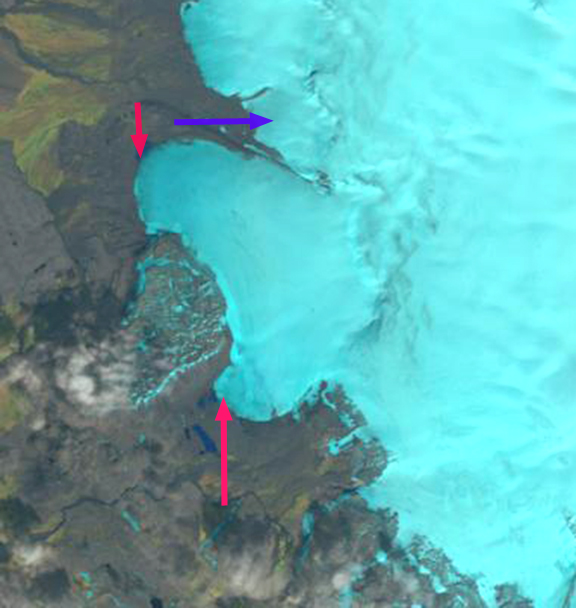
Tungnafellsjökull Ice Cap in 1999 and 2020 Landsat images indicating  terminus changes at three northern outlets, red arrows, and at four locations of bedrock exposure.

Tungnafellsjökull Ice Cap is a ~32km2 ice cap located between Vatnajökull and Hofsjökull.  Gunnlaugsson (2016) reported on the mass balance changes of the Tungnafellsjökull Ice Cap and found it had lost 20 of its volume and 16% of its area from 1960-2013.  The ice cap was essentially in balance from 1960-1986 and had a slight mass balance loss from 1986-1995.  Almost all of the loss has been since 1995. Belart et al (2020) report on losses from 14 smaller glacier in Iceland including Tungnafellsjökull and found signficant increase in mass loss from a near equilibrium 0.07 m/year from 1960-1994 to -1.20 m/year from 1995-2010. Here we examine the impact of the 25 years of sustained mass loss on Tungnafellsjökull using Landsat images.

In 1999 the transient snow line in August is at ~1200 m.  Point A,B and D indicate bedrock knobs amidst the ice cap and Point C a bedrock ridge that the ice cap flows over near Point C.  The three northern outlets terminate at the red arrows. From east to west they are Nordur Tungnafellsjökull, Innri Hagajökull and Fremri Hagajökull. In 2000 the transient snowline in August is again at ~1200 m. In 2014 the snowline was above 1500 m laving the ice cap without any retained snowpack from the previous winter.  The area of exposed firn encompasses 40% of the ice cap indicating the size of the accumulation zone in the several years prior to 2014. By 2016 the ice cap no longer flows over the ridge near Point C.  The transient snowline is at ~1400 m. In 2020 the transient snowline is at ~1350 m.  The bedrock knob at Point B is no longer surrounded by the ice cap. The bedrock at Point A and D have expanded.  The retreat from 1999-2020 is most significant at the three northern outlet glaciers, where Gunnlaugsson (2016)  indicated thinning was greatest. The retreat has been 200 m at Nordur Tungnafellsjökull,  600 m at Innri Hagajökull and  500 m at Fremri Hagajökull.

With an accumulation area covering approximately 40% of the ice cap, mass balance losses will continue and the ice cap will continue to retreat.  Retreat has been the consistent response of more than 90% of  Iceland glaciers since 2000 (Iceland Glaciological Society), such as at Norðurjökull.

Tungnafellsjökull Ice Cap in 2000 and 2016 Landsat images indicating  terminus changes at three northern outlets, red arrows, and at four locations of bedrock exposure.

Landsat image in August 2014 indicating the lack of retained snowcover.  The glacier surface is bare ice blue-gray and exposed firn indicated by the zone inside of the yellow dots.

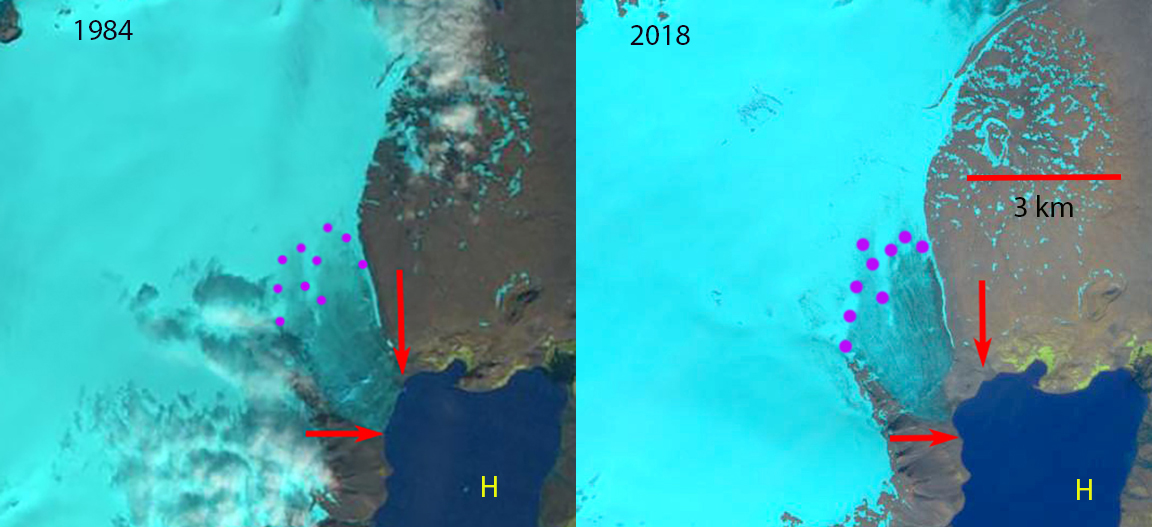
Norðurjökull Retreats from Hvítárvatn, Langjökull, Iceland

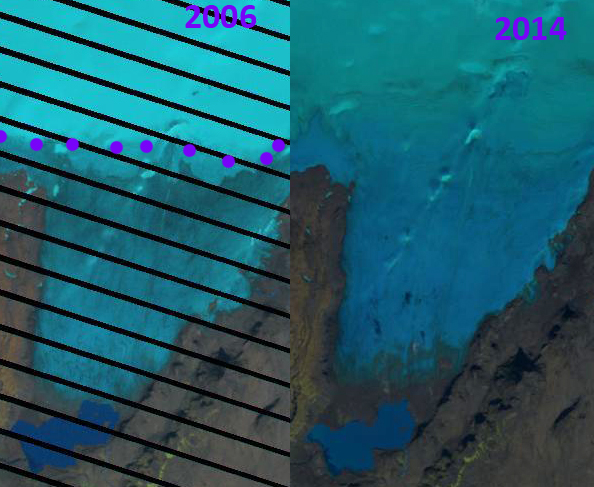
Norðurjökull in 1984 Landsat image and 2018 Sentinel image.  Red arrows indicate the margins of the glacier in 1984.  Purple dots indicate the snowline.

Langjökull is the second largest icecap in Iceland with an area of 920 square kilometers (Jóhannesson (2009). One of the main outlet glaciers of Langjökull is the Norðurjökull which has terminated in Hvítárvatn. Hvítárvatn is a large lake that recieves 70% of its inflow from Langjökull (Flowers et al, 2007). The lake has a maximum depth of 84 m and a surface area of 30 square kilometers.

The mass balance of Langjökull has been reported to the since 1997.  The mass balance has been negative in 20 of the 21 years of reported data, with a loss of 18 m of water equivalent since 1997 (VAT). This is 8-10% of the volume of the ice cap (Guðmundsson et al, 2008).  Pope et al (2010) observed that Langjökull has lost an area of 3.42.5 square kilometers/year over the decade.

Here we examine the changes in Norðurjökull from remote sensing imagery from 1984, 1994, 2006, 2014 and 2018.  In 1984 the glacier terminated in Hvítárvatn along a width of 1100 m and the snowline is at 800 m.  In 1994 the width of the terminus front in the lake has increased by 100 m indicating a small advance. By 2006 the width of the glacier front in Hvítárvatn has been reduced to 600 m and the snowline is at 1000 m.  By 2014 this connection with the lake is just 300 m.  In the two Sentinel images from 2018 the terminus no longer reaches the shore of Hvítárvatn. Iceberg calving will no longer be a consideration at this outlet glacier.  The snowline on 8/11/2018 is at 800 m rising to ~950 m by 8/25/2018. The retreat of this glacier is like that of other Langjökull outlets Hagafellsjokull and nearby Porisjokull. The retreat has been less significant than the thinning, Pope et al (2016) illustrated this for the 1994-2007 period.


Norðurjökull in 1994 Landsat image and 2018 Sentinel image.  Red arrows indicate the margins of the glacier in 1984.  Purple dots indicate the snowline.

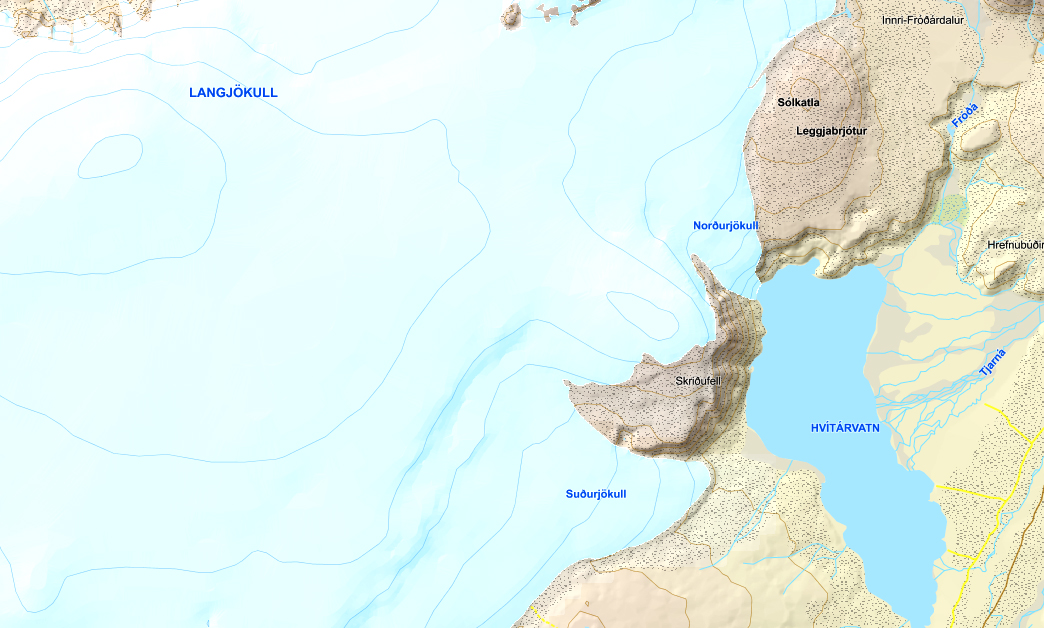
Langjökull map showing terminus.

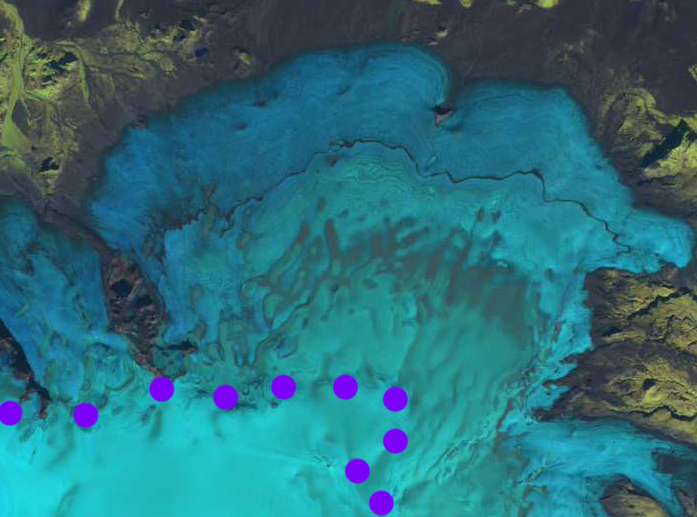
Aug. 1, 2019 Landsat image indicating the snowline reached the crest of the icecap at Norðurjökull in 2019.

Norðurjökull in 2006 Landsat image and 2014 Digital Globe image. Glacier still in contact with the lake.

Torfajökull, Iceland Accumulation Zone Demise Drives Recession

Torfajökull in 1994, adn 2014 Landsat images.  Note the lack of retained snowpack in 2014 and emerging bedrock areas within icecap, purple arrows.

Torfajökull is a small ice cap north of  Myrsdaljökull in Iceland.  The glacier’s lowest elevation is 750 m and the highest elevation is 1150 m.  This low of an elevation range in a climate driving higher snowlines places this type of ice cap at great risk for losing its accumulation zone and its ability to survive.   The Iceland Glaciological Society spearheads an annual terminus monitoring program led by Oddur Sigurðsson. In 2013 the report indicates all seven glaciers in the region near Torfajokull were in retreat.  In this post we look at the loss of the accumulation zone in 2014 and the longer term change in size noted by the Iceland Glaciological Society. This is not a good area for acquiring a suntan as the lack of clear imagery indicates for 2015 or 2016. 

In 2006 the Iceland Glaciological Society began monitoring the terminus of this glacier, the measurement is completed at the northeastern terminus.  From 2006-2014 the glacier has retreated 150 m.  The monitored terminus the location where areas of bedrock have begun to emerge from beneath the thinning ice cap, purple arrows. The bedrock areas exposed within the ice cap were not evident in 1994 images or the 2000 glacier outline. The loss of glacier area from 1946-2000 in the Iceland Glaciological Society map indicates area loss around the entire margin of the icecap including the highest elevations, located on the southern margin.  Recession at the head of a glacier suggests a glacier that lacks a persistent accumulation zone.

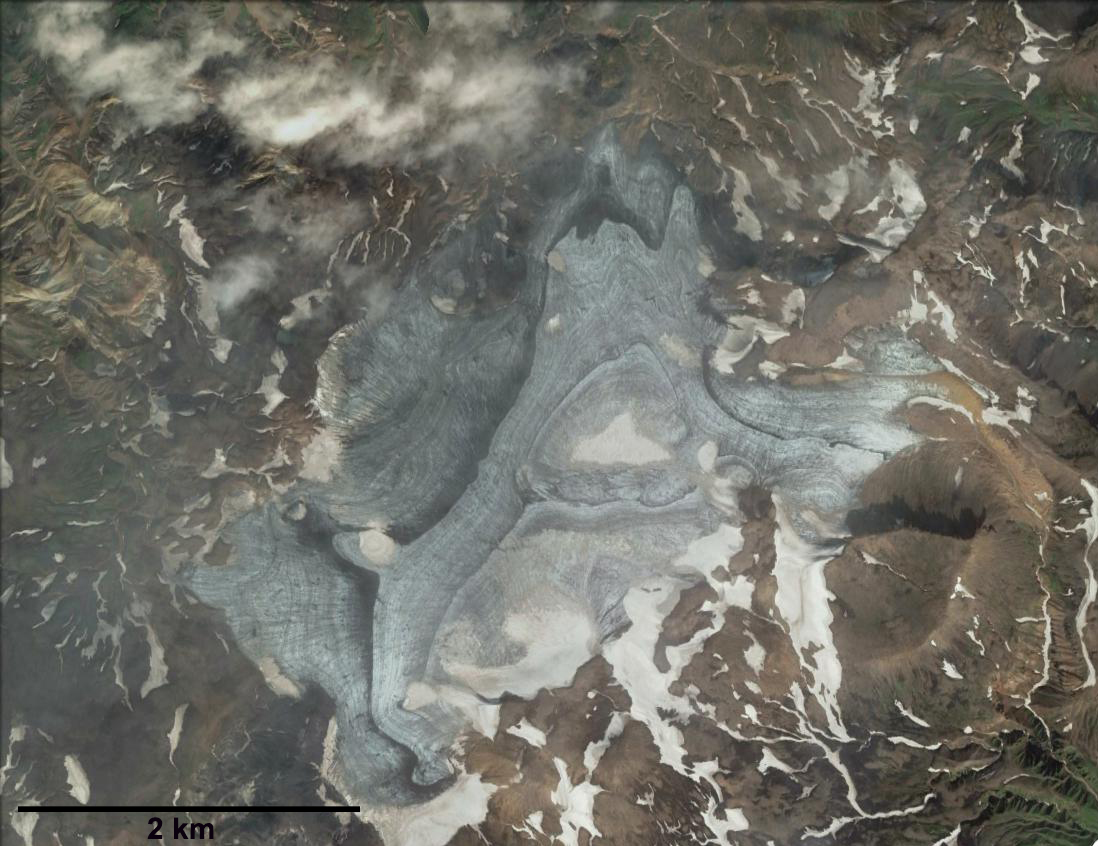
The change from 2000 to 2014 has been more pronounced on the eastern lobes that extend away from the main glacier.  The loss in ice cap area from 2000-2014 is ~10%.  In 2014 the glacier had 12% retained snowcover on August 12th, note Landsat image above and Google Earth below, by Sept.2014 there was no retained snowpack.  There is some retained firn the lightest blue, but even this is limited indicating that the snowpack from the previous few winters had not survived over most of the glacier either.

This is a recipe for glacier loss. The snowline on Aug. 12, 2014 shown below on Myrsdaljökull was at 1225 m, well above the top elevation of Torfajökull.  This glacier lacks the higher accumulation zone of some smaller Icelandic ice caps such as Eiriksjökull.


Iceland Glaciological Society map of glacier boundaries in 1890, 1946 and 2000, with the 2014 boundary added from the Landsat images above.  

Landsat image of Myrdalsjokull on 8/12/2014 with snowline at purple dots., 1225 m.

Hagafellsjokull, Iceland Reflects Langjokull Thinning & Retreat

hagafellsjokull-compare

Landsat comparison of the terminus of Hagafellsjökull from 2000 and 2016.  The red arrows are the 2000 terminus, the yellow arrows the 2016 terminus.  Purple arrows indicate upglacier thinning. 

Langjökull is the second largest iceap in Icalnd with an area of over 900 square kilometers. The mass balance of the icecap has been reported since 1997 and his lost over 1 m per year during this period (WGMS, 2016).  Pope et al (2010) noted that the icecap has lost an area of 3.4 ± 2.5 km2 yr-1 over the decade from 1997-2007.  Pope et al (2010) noted that the loss of ice volume confirms previously published predictions that Langjökull will likely disappear within the next 200 years if current trends continue. A key outlet of  Langjökull is  Hagafellsjökull which terminates in Hagvatn. Hagafellsjökull ended a sustained post Little Ice Age retreat in 1970.  The ensuing advance of approximately 1 km ended by 2000.  Here we examine Landsat imagery from 2000-2016 to identify recent changes in this outlet glacier.

In 2000 the glacier terminated on an island in Hagavatn, red arrow.  The east margin of the glacier featured several locations where secondary termini overflowed a low ridge on the east side of the glacier.  By 2006 the glacier had retreated 500-600 m from the island.  By 2016 the terminus had retreated across its entire width by 800-850 m, 50 m/year, yellow arrows.  A closeup view from the Iceland online map application illustrates the 2014 terminus red dots. The end of the glacier has a low slope, low velocity and is debris covered.  The western side has terminated on land during this entire period and has approximately the same retreat rate as the eastern half that still ends in the expanding lake. There is little evidence of iceberg release into the lake, which helps explain the similar retreat rate. The low slope and upglacier thinning noted at the purple arrows indicate the retreat will continue.  In 2014 the transient snowline reached near the head of the glacier at over 1100 m.  In 2000, 2006 and 2016 the snowline with several weeks left in melt season ranged from 859-950 m. The retreat is similar to that of Norðurjökull another outlet of the Langjökull and Porisjokull.

langjokull-south-outlet-ge-2010

Google Earth view of the terminus of Hagafellsjökull in 2014. Red arrow is the 2000 terminus position and yellow arrow the 2014 position.

 hagafellsjokull-ismap

Online Iceland Map Viewer indicating the terminus of Hagafellsjökull in 2014, red dots.

hagafellsjokull-tsl

2006 and 2014 Landsat images of Hagafellsjökull indicating the transient snowline off the image in 2014 and at 850 m in 2006.

Blágnípujökull, Iceland Retreat 1986-2015

blagni compare

Blágnípujökull comparison in Landsat imagery from 1986 and 2014. 

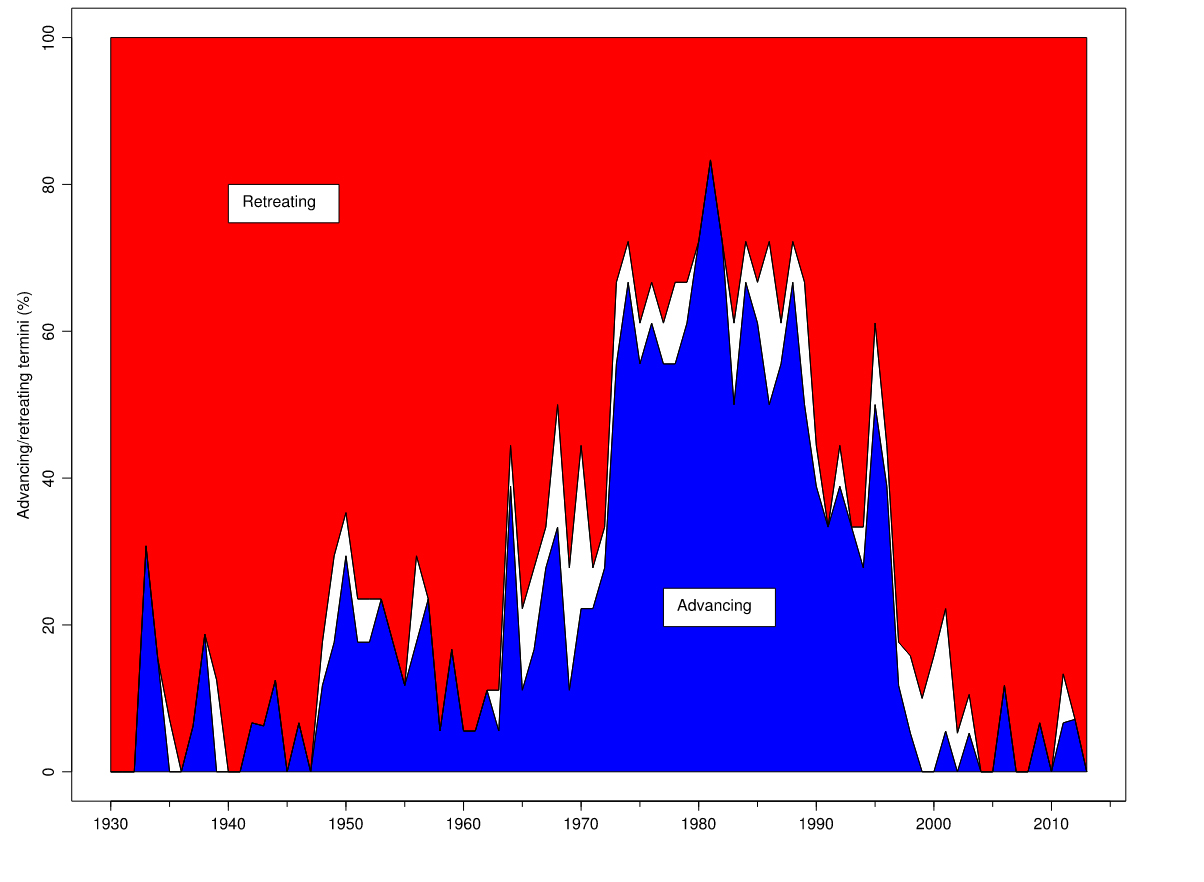
Blágnípujökull is an outlet glacier on the western side of Hofsjökull. The Iceland Glaciological Society spearheads an annual terminus monitoring program led by Oddur Sigurðsson. This data set enabled an examination of glacier response to climate change in Iceland from 1930-1995 by Tómas Jóhannesson, Icelandic Meteorological Office and Sigurðsson (1998). This illustrated that Hofsjökull glaciers retreated little from 1950 to 1990, but all retreating significantly after 2000. Here we examine Landsat imagery of Blágnípujökull terminus change from 1986 to 2015.

blagnipujokull map
Outlet map of the glacier from the Iceland Glaciological Society.

iceland retreat
Iceland Glaciological Society data on terminus change, notice change from advance to retreat in the 1990’s

In 1986 the glacier terminated at the red arrow. North of the main terminus is a separate glacier terminus, purple arrow. By 1998 there is limited retreat less than 200 m. By 2014 the terminus area around the purple area has been largely lost. The glacier has retreated from the red dots to the yellow dots, a distance of 600 meters. The thinning is also evident in the region between the two main termini of Blágnípujökull, the margin is not as close to the edge of the lava flow capping the hill that the glacier terminus parts around. The snowline is also quite high on the ice cap in 2014. In 2015 the image is after a summer snowstorm and the is not clear enough to accurately assess further terminus change. The changes in this glacier parallel those of other Iceland Glaciers: Porisjokull and Langjokull.

blagnipujokull 1986
1986 Landsat Image

blagnipujokull 1998
1998 Landsat Image

blagnipujokull 2014
2014 Landsat Image

blagnipujokull ge
Google Earth image

blagnipujokull 2015
2015 Landsat Image

Eiriksjökull Reeat, Iceland

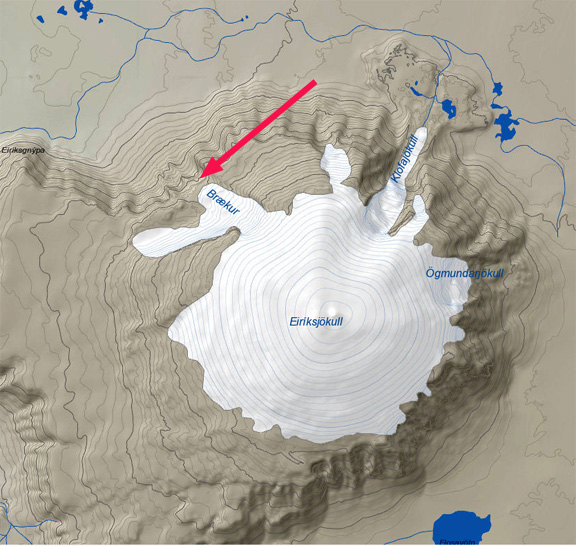
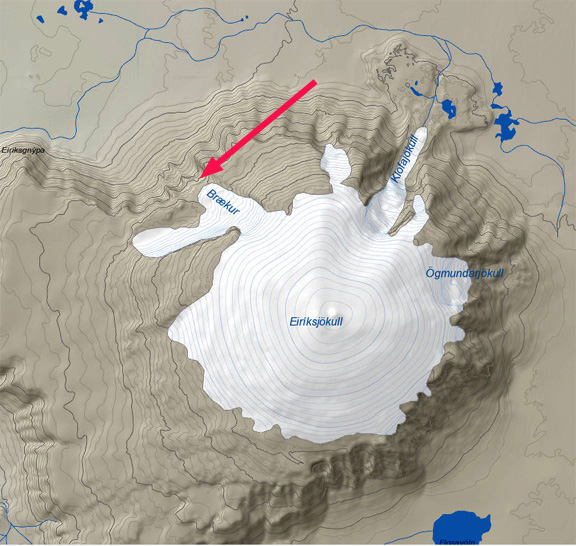
Eiriksjökull  is an ice cap just west of Langjökull In central Iceland.  Here we examine its main western outlet the Braekur using Landsat imagery from 1989 to 2014.  The Icelandic Glaciological Society website on terminus variations is the source of the map for the glacier. The IGS program monitors 50 glaciers, all of them are currently retreating.  Eiriksjökull ,  is not one that is in this monitoring program. eiriksjokull map

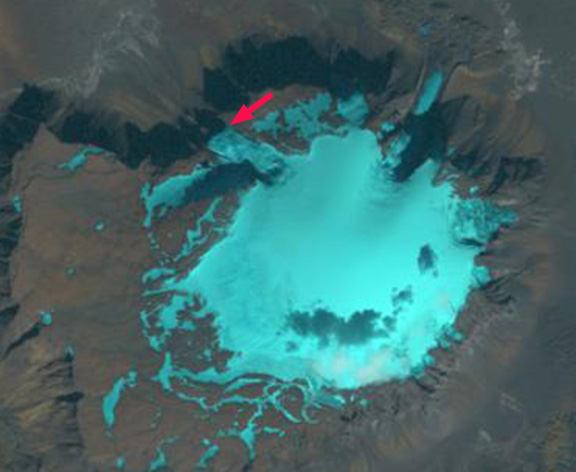
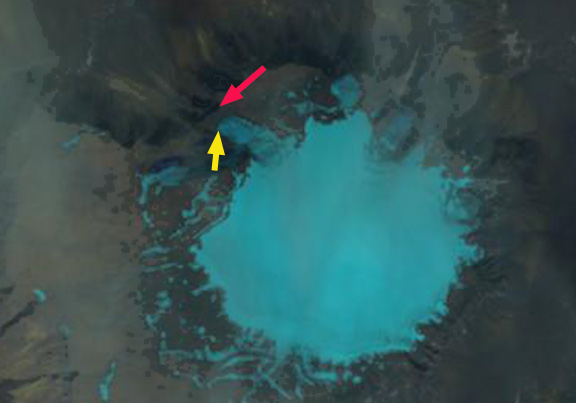
In 1989 the Braekur outlet flowed over the edge of a lava cliff at the red arrow.  The glacier terminated on the bench between the upper and lower cliff.  In 1994 the glacier still extended  to the edge of the cliff.  By 2010 the Google Earth images indicates a retreat from the edge of the cliff.  In 2014 the glacier has receded 200 m from the edge of the cliff and 300 m from is 1989 position and terminates at the yellow arrow. The high snowlines in recent years will lead to continued retreat. The retreat and area loss of Eiriksjökull is less than on nearby Norðurjökull a primary outlet of Langjökull or on Porisjokull a small ice cap just south of Langjökull.

eiriksjokull 1989

1989 Landsat image

eiriksjokull 1994

1994 Landsat image

eiriksjokull 2010

2010 Google Earth image

eiriksjokull 2014

2014 Landsat image

Eiriksjökull Retreat, Iceland

Eiriksjökull  is an ice cap just west of Langjökull In central Iceland.  Here we examine its main western outlet the Braekur using Landsat imagery from 1989 to 2014.  The Icelandic Glaciological Society website on terminus variations is the source of the map for the glacier. The IGS program monitors 50 glaciers, all of them are currently retreating.  Eiriksjökull ,  is not one that is in this monitoring program. eiriksjokull map

In 1989 the Braekur outlet flowed over the edge of a lava cliff at the red arrow.  The glacier terminated on the bench between the upper and lower cliff.  In 1994 the glacier still extended  to the edge of the cliff.  By 2010 the Google Earth images indicates a retreat from the edge of the cliff.  In 2014 the glacier has receded 200 m from the edge of the cliff and 300 m from is 1989 position and terminates at the yellow arrow. The high snowlines in recent years will lead to continued retreat. The retreat and area loss of Eiriksjökull is less than on nearby Norðurjökull a primary outlet of Langjökull or on Porisjokull a small ice cap just south of Langjökull.

eiriksjokull 1989

1989 Landsat image

eiriksjokull 1994

1994 Landsat image

eiriksjokull 2010

2010 Google Earth image

eiriksjokull 2014

2014 Landsat image

Tungnaarjökull Retreat, Iceland

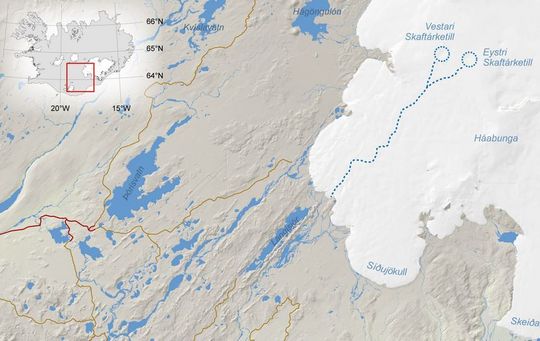
Tungnaarjökull drains the west side of the Vatnojökull Icecap. The glacier begins just west of the Grimsvotn Volcano at 1500 m. Just to the north of this large outlet glacier, 350 square kilometers, is the Loki Volcano. The first image below denotes these volcanoes and the epicenter of recent earthquakes. The volcanic activity is recorded in the dark ash layers that fall on the glacier in the accumulation area and are subsequently buried to emerge in the ablation zone. The snowline is visible in the imagery just above the highest ash horizon. The glacier drains into the Skaftá River which experiences jökulhlaups such as in June 2015.A June 6, 2015 Landsat image indicates little ablation being generated in the area.

tungnaar 2015

June 6, 2015 Landsat Image

 
Google Earth Images
skaftarkatlar_kort_en
Iceland Met Service map of Skaftá River and jökulhlaup source.

The glacier terminates at 800 m, and has a snowline since 2000 averaging 1300 m. Like many of the glaciers draining the Vatnajökull the glacier experiences periodic surges. Surging is a short term, several months to several years, acceleration and the associated advance of a glacier that is not primarily dictated by changes in mass balance or climate. A surge is related to a change in the basal water pressure that in this region is related to volcanic activity. The glacier surged in 1920, 1945 and 1995, that latter surge led to an advance of 1175 m in 1995. From 1955-1970 the glacier retreated at a rate of 75 m/year. From 1973-1992 the glacier retreated 1400 m. The surge led to an advance of 1175 m in 1995 bringing the glacier back close to its 1973 position. Since then the glacier has continued to retreat. Tungnaarjökull terminus is surveyed each year and the data reported to the WGMS. From 1996-2000 the glacier retreated 80 m. From 2001-2010 the glacier retreated 640 m. Below is the margin of the glacier indicating the moraine from which the glacier receded after the 1945 surge, the 1995 surge did not emplace a moraine. A comparison of Landsat images from 1999 and 2014 illustrates the retreat. Note the expansion of the lakes and the formation of a new one at the red and yellow arrow.  The exposure of new moraine ridges at the purple arrow also indicates retreat.

tungnarr 1999
1999 Landsat image

tungnarr 2015
2015 Landsat image

The mass balance of this glacier has also been measured since 2000. During that period the glacier has had a negative balance every year, 12 of the 13 years the mass balance loss has been larger than 0.8 meter of water equivalent. The total loss for the period of 15 m, will lead to continued retreat. This is a substantial thinning of the glacier, but a small part of the total volume given a glacier that averages more than 500 m in thickness. The equilibrium line has been high since 2000, leading to only 40% of the glacier being snow covered at the end of the summer. on a glacier like this that lacks avalanche accumulation due to its low and consistent slope at least 60% of the glacier must be snow covered to have an equilibrium balance this would be 1150 m. This height is close to the elevation midpoint of the glacier.

Beyond the terminus the retreat is exposing a large relatively flat plain that is rich with glacial geologic deposits, many linear examples are evident. These features are streamline features from glacier flow. The retreat here is similar to the Bruarjokull on the north side and Skeidararjokulli on the west side of the Vatnojokull.