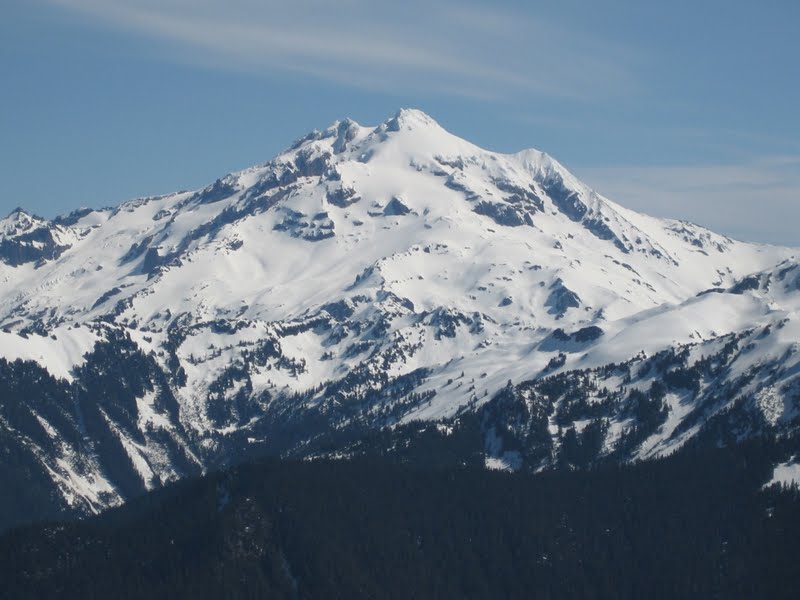
Conducting Long Term Annual Glacier Monitoring

2015 time lapse easton

Easton Glacier in 1990, 2003 and 2015 from same location. Below Painting by Jill Pelto of crevasse assessment using a camline.

camline

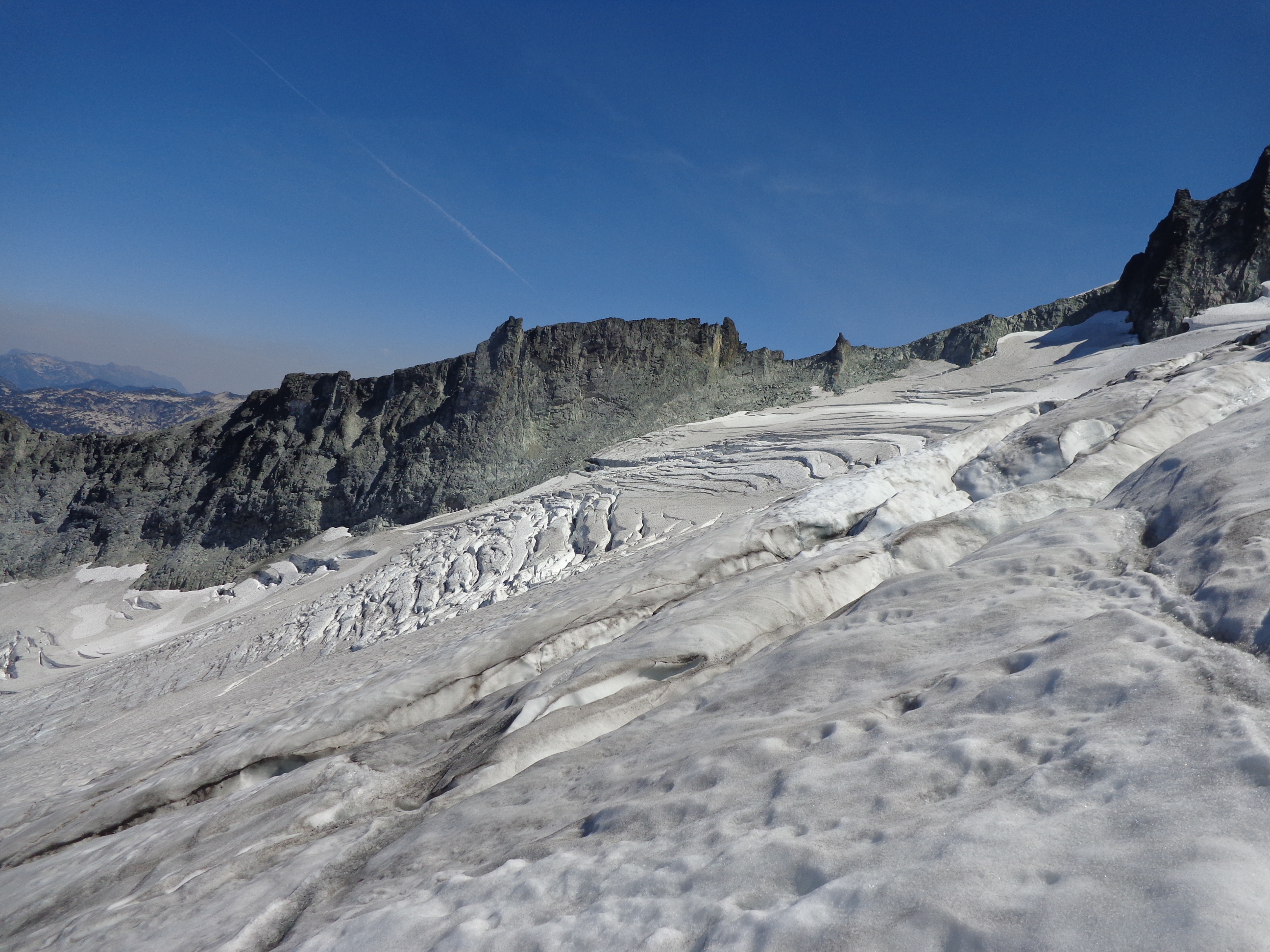
This is the story of how you develop and conduct a long term glacier monitoring program.  We have been monitoring the annual mass balance of Easton Glacier on Mount Baker, a stratovolcano in the North Cascade Range, Washington since 1990.  This is one of nine glaciers we are continuing to monitor, seven of which have a 32 year long record. The initial exploration done in the pre-internet days required visiting libraries to look at topographic maps and buying a guide book to trails for the area.  This was followed by actual letters, not much email then, to climbers who had explored the glacier in the past, for old photographs.  Armed with photographs and maps we then determined where to locate base camp and how to access the glacier.  The first year is always a test to make sure logistically you can reach enough of the glacier to actually complete the mass balance work with a sufficiently representative network of measurement sites.  The second test is if you can stand the access hike, campsite, and glacier navigation, to do this every year for decades; if the answer is no, move on.  That was the case on Boulder Glacier, also on Mount Baker:  poor trail conditions and savage bugs, were the primary issue. Next we return to the glacier at the same time each year, completing the same measurements each year averaging 210 measurements of snow depth or snow melt annually.  This occurs whether it is gorgeous and sunny, hot, cold, snowy, rainy, or recently on this glacier dealing with thunderstorms.  You wake up, have your oatmeal and coffee/cider/tea, and get to work.  Lunch on the snow features bagels, dried fruit, and trail mix. Happy hour features tang or hot chocolate depending on the weather.  It is then couscous, rice, pasta or quinoa for dinner, with some added dried vegetable or avocado.  The sun goes behind a mountain ridge and temperatures fall, and the tent is the haven until the sun returns.  Repeat this 130 times on this glacier and you have a 25 year record. During this period the glacier has lost 16.1 m of water equivalent thickness, almost 18 m of thickness.  For a glacier that averaged 70 m in thickness this is nearly 25% of the volume of the glacier gone.  The glacier has not maintained sufficient snow cover at the end of the summer to have a positive balance, this is the accumulation area ratio, note below.  The glacier has retreated 315 m from 1990-2015.  This data is reported annually to the World Glacier Monitoring Service.  The glacier has also slowed its movement as it has thinned, evidenced by a reduction in number of crevasses. During this time we have collaborated with researchers examining the ice worms, soil microbes/chemistry, and weather conditions on the ice. This glacier supplies runoff to Baker Lake and its associated hydropower projects.  Our annual measurements here and on Rainbow Glacier and Lower Curtis Glacier in the same watershed provide a direct assessment of the contribution of glaciers to Baker Lake.  The glacier is adjacent to Deming Glacier, which supplies water to Bellingham, WA. The Deming is too difficult to access, and we use the Easton Glacier to understand timing and magnitude of glacier runoff from Deming Glacier.

The glacier terminates at an elevation of 1650 m, but thinning and marginal retreat extends much higher.  A few areas of bedrock have begun to emerge from beneath the ice as high as 2200 m. The changes in ice thickness are minor above 2500 m, indicating this glacier can retreat to a new equilibrium point with current climate.

Mass balance, terminus and supra glacial stream assessment are illustrated in the video, Filmed by Mauri Pelto, Jill Pelto, Melanie Gajewski, with music from Scott Powers.

easton 2010
Mass balance Map in 2010 of Easton Glacier used in the field for reference in following years. 

easton aar

Accumulation Area Ratio/Mass balance relationship for Easton Glacier
North Cascade Winter Snowpack 2016, 33rd Field Season Approaches

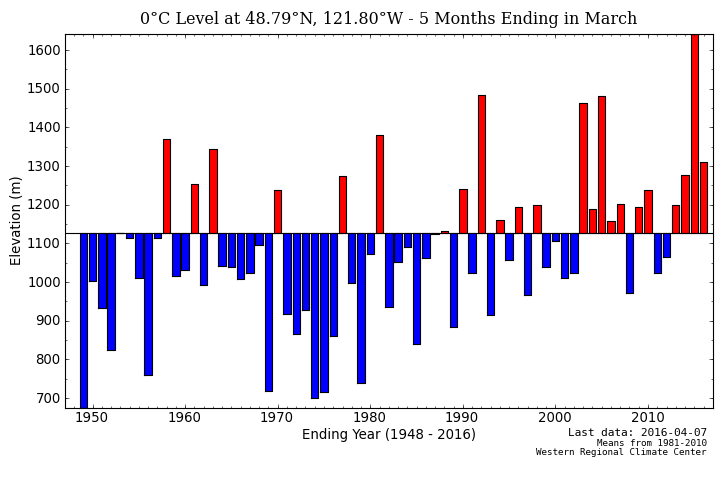
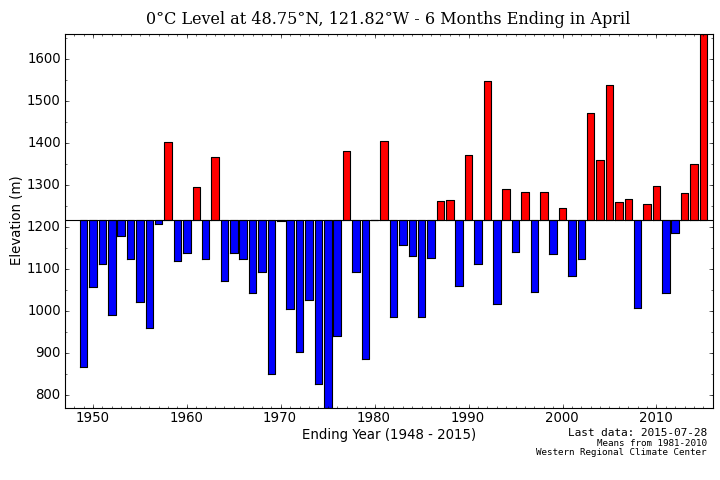
This 2016 winter has proved much different than in 2015.  In 2015 exceptional warmth led to record low snowpack despite above average precipitation.  The warmth is illustrated using the North American Freezing Level Tracker for our Sholes Glacier site. The highest mean level by far is 2015, 500 m above average versus 180 m above average this winter.  The low snowpack combined with a long warm melt season in 2015 led to the highest mass losses from North Cascade glaciers in our 32 years of observations.

2016 freezing level

Freezing Levels for the November-March period at Sholes Glacier in the North Cascades.

A key date for snowpack assessment has always been April 1.  As a result there is good data set from six of the invaluable  USDA SNOTEL sites in the North Cascades since 1946.  A comparison of snowpack water equivalent (SWE) and total precipitation yield a ratio of SWE retained on April 1 to total precipitation.   The result is the ratio between SWE and precipitation, snowpack storage efficiency has been in decline,  as noted by Mote et al (2008) and Pelto (2008). The best long term precipitation stations in the region are Diablo Dam and Concrete, we use the average of the two. The storage efficiency ratio  was a minimum in 2015 at only 19% of precipitation retained as snowpack.  In 2016, 43% of precipitation has been retained leading to snowpack that is 10% above the mean for the 1984-2015 period.Winter precipitation over the period has a positive trend and SWE a negative trend. This declining ratio led Jon Riedel of the North Cascades National Park Service to observe that we now need 120% of average precipitation to achieve average snowpack. It is interesting to note that 2014, 2015 and 2016 had quite similar November-March total precipitation.  With 2016 slightly exceeding 2014 for snowpack.

In 2014 the glaciers had a poor year, not due to low snowpack but to high melt season temperatures.  What will transpire in 2016 will be the focus on our 33rd consecutive annual field season monitoring North Cascade glaciers. In the last 10 days warm weather in the region has led to significant snowpack melt.  At low elevation sites snowpack depth and SWE have decreased by 20% at sites like Trinity 2930 feet. Just 10 miles away at Lyman Lake at 5980 feet the snow depth decreased from 170 inches to 142 inches, but SWE has not declined.  As is typical this early snowmelt period leads to percolation and either refreezing or storage within the snowpack. This is still an important ripening that must occur before SWE can drop.  Typically SWE reaches a maximum at the elevations of glaciers between May 1 and 10.  A 10 day warm period as has occurred may indicate an early peak, but April could also feature more snow storms that will lead to future increases. From Alaska to British Columbia  to Washington groups are heading into the field to assess snow depth on glaciers at the end of this winter season.  Snowpits, snow stakes emplaced last last summer and Ground Penetrating Radar will all be deployed.

swe-ppt ratio

Trends in winter precipitation November-march in the North Cascades , average of Concrete and Diablo Dam.  Mean SWE at six USDA SNOTEL station on April 1 (Fish Lake, Lyman Lake, Park Creek, Rainy Pass, Stampede Pass and Stevens Pass). Ratio of April 1 SWE and winter precipitation.

april 1 swe 84-16

Mean SWE at six USDA SNOTEL station on April 1 (Fish Lake, Lyman Lake, Park Creek, Rainy Pass, Stampede Pass and Stevens Pass.

DSC06954

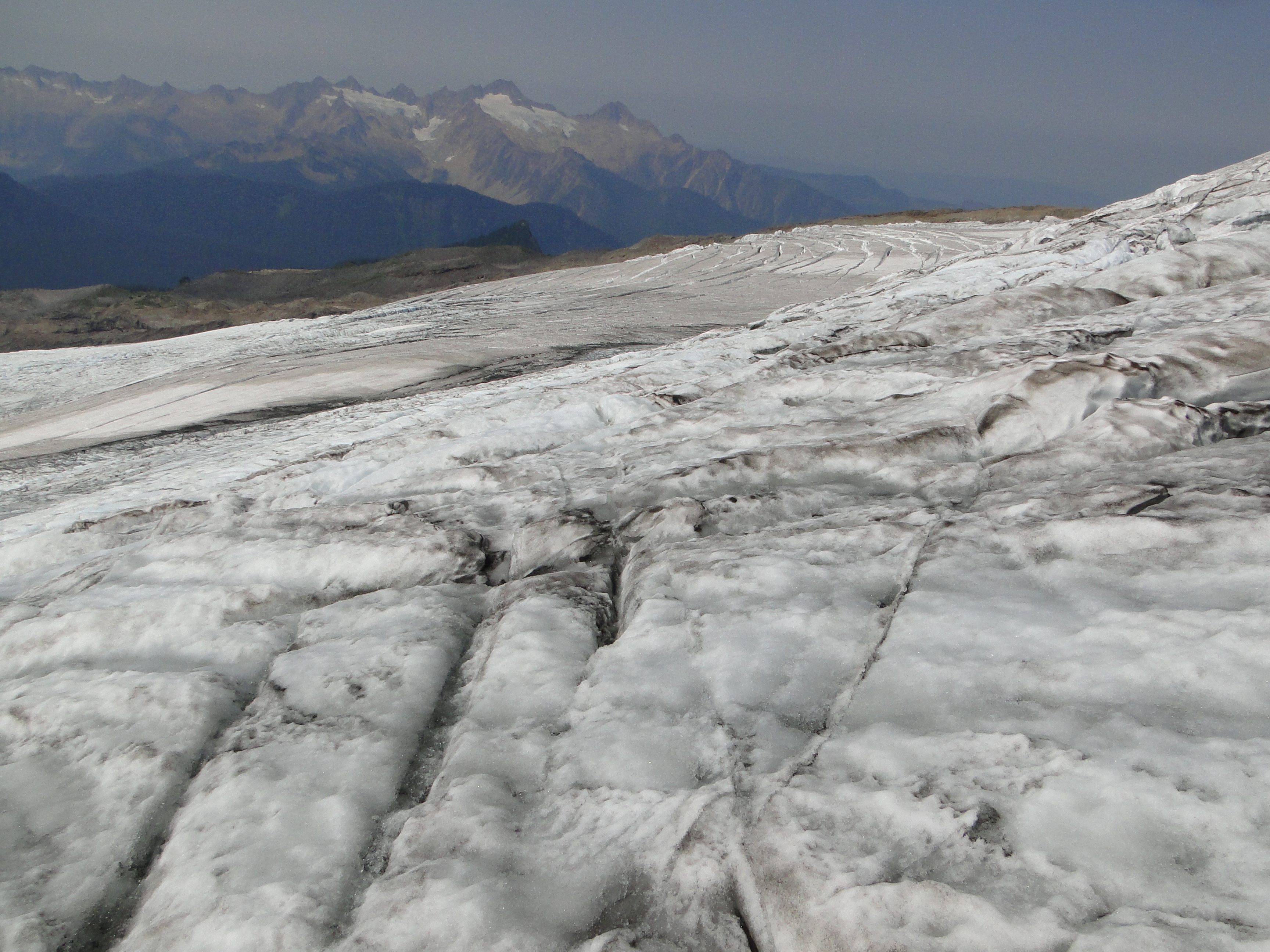
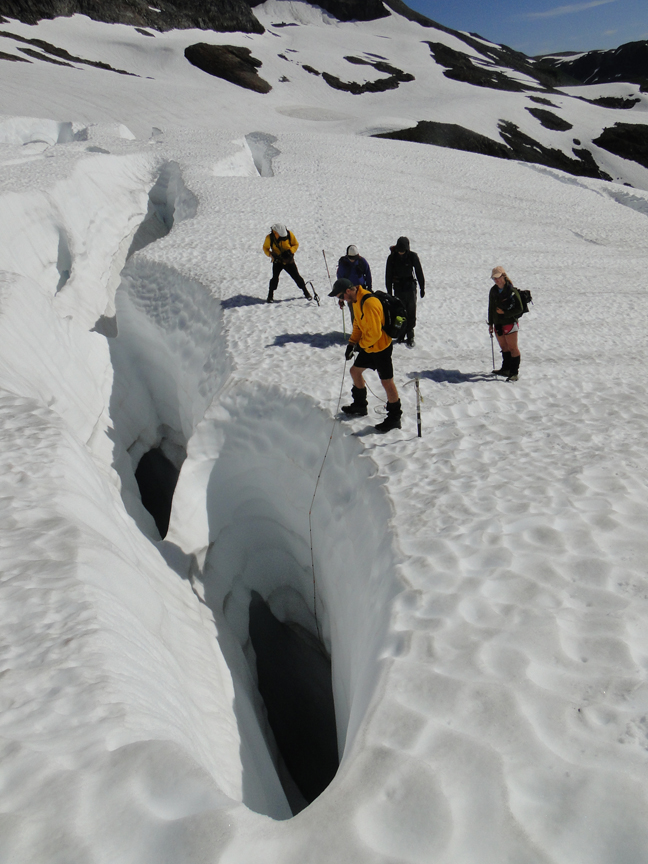
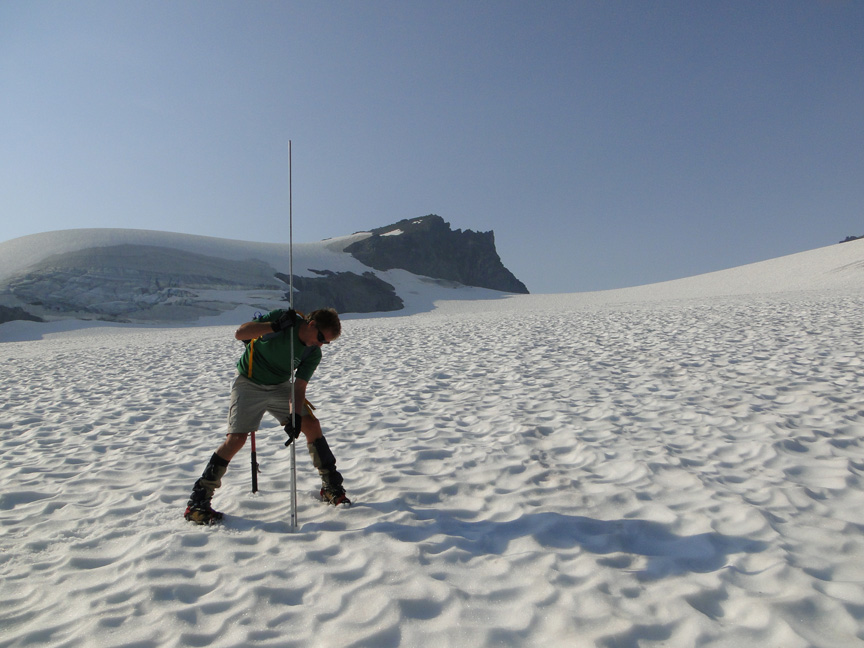
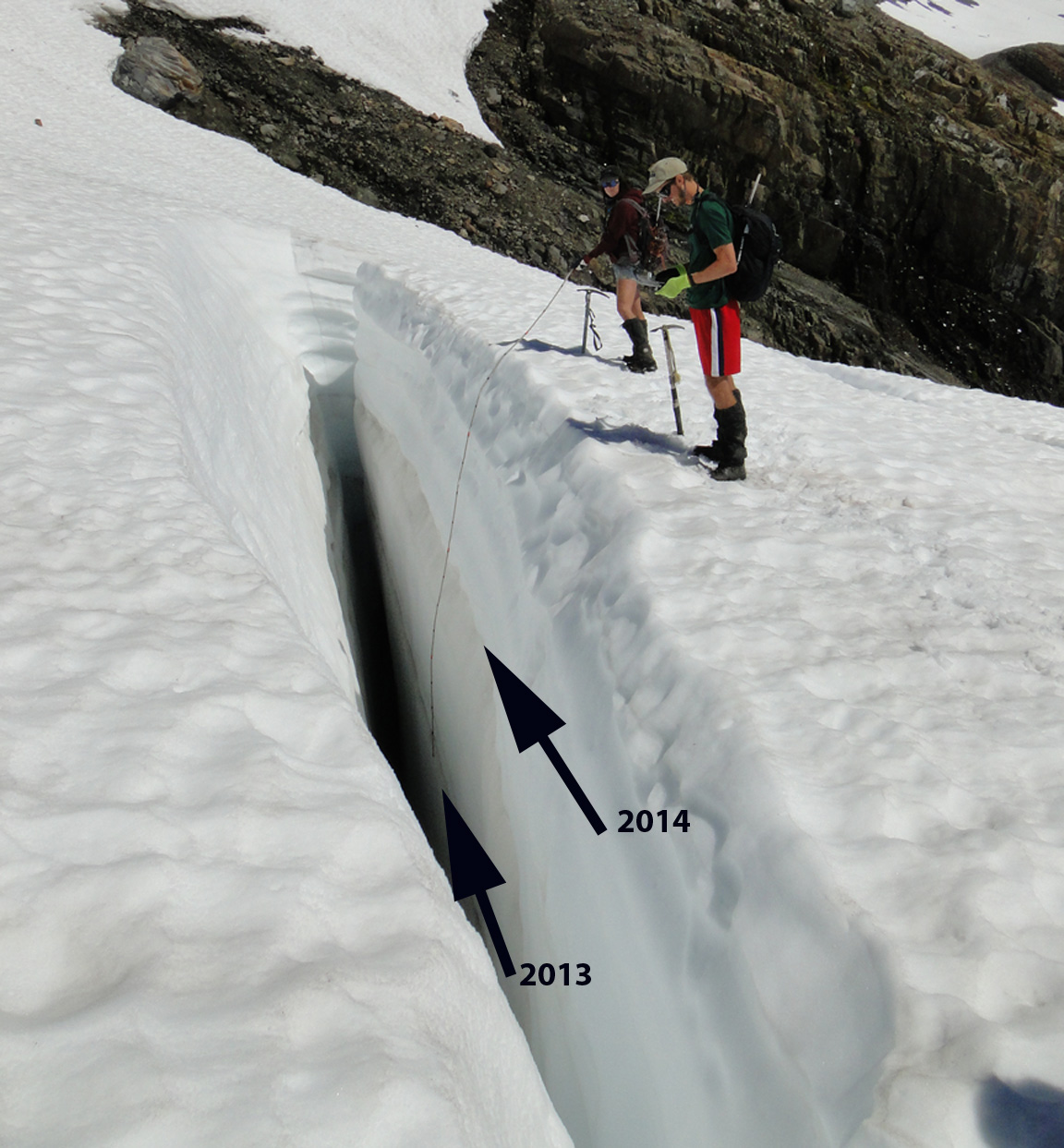
Assessing snow depth on Easton Glacier using crevasse stratigraphy. 

galcier peak raising three hikers april 2016

Image above of Glacier Peak and below of Monte Cristo Peaks in the North Cascades on April 9, 2016 from a trip to Bedal Peak by raising3hikers at NWHikers.net. The blanket of snow remains deep. 

monte cristo

Foss Glacier, WA Needs Snow Queen Elsa’s Help to Survive

foss compare

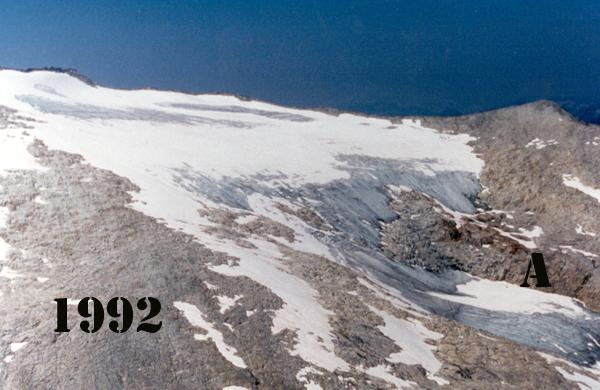
Comparison of Foss Glacier in 1988 and 2015 from the west ridge of Mount Daniel.  The glacier has lost 70% of its area in 30 years. Black arrows indicate bedrock area emerging amidst the glacier. 

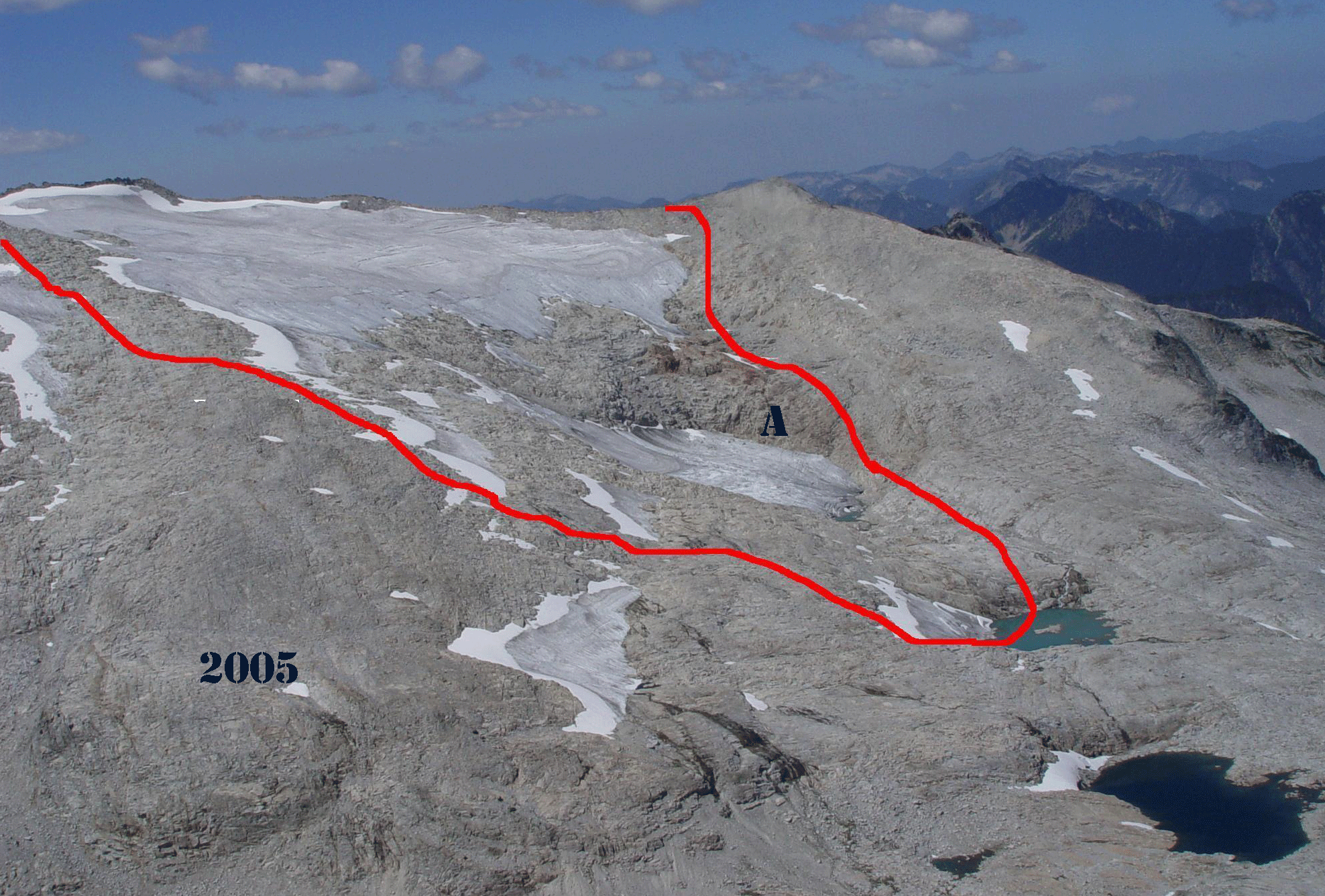
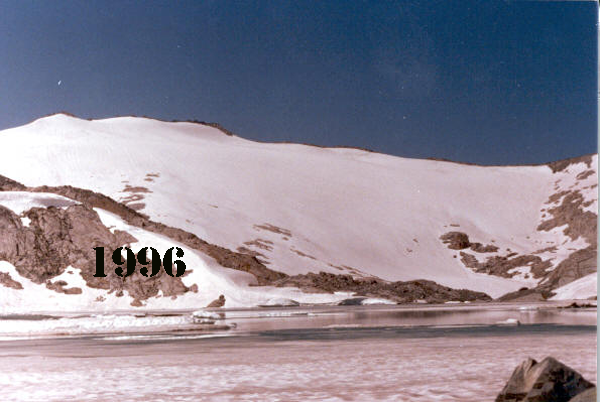
Foss Glacier is a slope glacier covering the northeast face of Mount Hinman at the head of the South Fork Skykomish River in the North Cascades of Washington. In the 1958 map of the region the glacier covered 0.8square kilometers.  By 1984 when we first mapped the glacier margin the glacier had lost little area, and was at 0.7 square kilometers. In 1988 the glacier extended from 2325  m to 1890 m in one continuous swoop.  Glacier thickness was in the 30-40 m range.  There were few crevasses, and some of the supraglacial streams were particularly long for this region, 600 m is the longest mapped which was more than 50% of the glacier length. By 1992 the glacier was developing some significant bedrock outcrops emerging amidst the glacier.  The terminus was retreating and the lower slope terminus lobe below 1950 m was clearly going to detach. Foss Glacier had by the middle of August lost all of its snowcover in 1992, 1993, 1994, 1998, 2003, 2005, 2009, 2014 and 2015.  This has led to thinning of the upper reaches of the glacier.  Thinning of the upper reaches of a glacier is an indicator of a glacier that cannot survive current climate. The lower section detached from the upper section in 2003 and melted away in 2015.  In 2015 the glacier has fragmented into four parts and will continue to melt away. Annual balance measurements indicate a loss of over 18 meters of average ice thickness, which for a glacier that averaged 30-40 m in thickness represents approximately 50% of the volume of the glacier lost.  In 2005 the glacier had lost 40% of its total area in 15 years, the terminus area had detached, Point A, and there was no snow retained (Pelto, 2015).  This was the third straight year of almost no retained snowcover. A glacier cannot survive without a consistent/persistent accumulation zone, which is where snow is retained.  A view of the changing area from the shore of Pea Soup Lake indicates how Foss Glacier  in 1996 dominated the slope of Mount Hinman to 2007 when it did not. By 2015 after 30 years of mass balance measurement, the program was discontinued as the glacier had now lost 70% of its area in the previous 30 years. Unless Snow Queen Elsa can put the freeze on during summer, this glacier will not survive long.

The importance here is for late summer streamflow in the Skykomish River.  Glacier retreat and changes in summer runoff have been pronounced in the Skykomish River Basin, North Cascades, Washington from 1950-2009 (Pelto, 2011). An analysis comparing USGS streamflow records for the 1950-1985 to the 1985-2009 period indicates that summer streamflow (July-September) has declined 26% in the watershed, spring runoff (April-June) has declined 6%, while winter runoff (November-March) has increased 10%.  From 1929-1985 streamflow was less than 14 cubic meters/second during the glacier melt season on a single day in 1951. From 1986-2015 there were, 264 days with discharge below 14 m3/s-1 with 11 periods lasting for 10 consecutive days. The minimum mean monthly August discharge from 1928-2015 occurred in 2015, 2003 and 2005 when streamflow was 11.8 m3s-1, 15.1 m3s-1 and 15.2 m3s-1 respectively.   Despite 15% higher ablation rates during the 1984-2009 period, the 45% reduction in glacier area led to a 35-38% reduction in glacier runoff between 1958 and 2009 (Pelto, 2011). The glacier runoff decline impacted river discharge only during low flow periods in August and September. In August, 2003 and 2005 glacier ablation contributed 1.5-1.6 m 3 s -1 to total discharge, or 10-11% of August discharge. While declining glacier area in the region has and will lead to reduced glacier runoff and reduced late summer streamflow, it has limited impact on the Skykomish River except during periods of critically low flow, below 14 m3 s -1 when glaciers currently contribute more than 10% of the streamflow.

foss92dg

A 1992 view downglacier illustrating the limited crevassing, surface streams and thin nature of the ice.

foss stream

Along a surface stream that has endured long enough to develop into a meandering system.

foss 1992

1992 view of Foss Glacier from Mount Daniel

foss 2005

By 2005 the glacier had separated into several segments and lost 30% of its area in the last 15 years.  The terminus lobe was now detached.  There is also no snow left.

foss96

1996 View of Foss Glacier across Pea Soup Lake

foss glacier 07

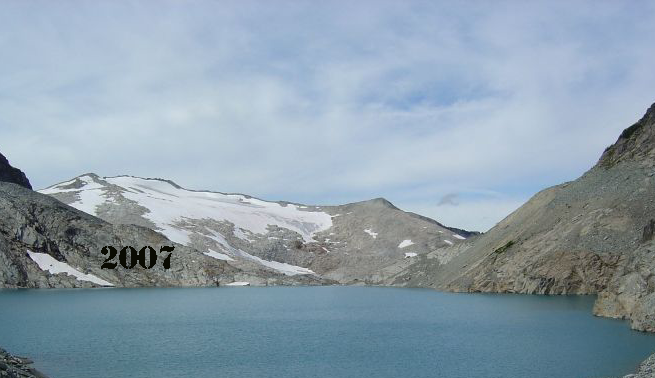
2007 View of Foss Glacier across Pea Soup Lake

foss 2015ov

2015 view of Foss Glacier from Mount Daniel. 


Climate Driven Retreat of Mount Baker Glaciers and Changing Water Resources

breakfast2

We have spent 300 nights in a tent just on this mountain collecting data from 1984-2015 in this study that the book documents.

This post has the same title as a book released last month as part of the Springer Briefs in Climate Studies series.  The nice thing about publishing research emerging from 30 years of field research in a book  is that I had a chance to include 104 figures in 107 pages.   Here I give a brief synopsis of the book and a key figure from each of the six chapters.This book presents the impact of climate change on Mount Baker glaciers, USA, and the rivers surrounding them. Glaciers are natural reservoirs that yield their resource primarily on warm dry summer days when other sources are at their lowest yield. This natural tempering of drought conditions will be reduced as they retreat. Mount Baker, a volcano in the Cascades of Washington, is currently host to 12 principal glaciers with an area of 36.8 km2. The glaciers yield 125 million cubic meters of water each summer that is a resource for salmon, irrigation and hydropower to the Nooksack River and Baker River watersheds. Recent rapid retreat of all 22 glaciers is altering the runoff from the glaciers, impacting both the discharge and temperature of the Nooksack and Baker River. Over the last 30 years we have spent 270 nights camped on the mountain conducting 10,500 observations of snow depth and melt rate on Mount Baker. This data combined with observations of terminus change, area change and glacier runoff over the same 30 years allow an unusually comprehensive story to be told of the effects of climate change to Mount Baker Glaciers and the rivers that drain them.

Red Channel|Green Channel|Blue Channel

Chapter 1: Panchromatic sharpened Landsat image of the glacier of Mount Baker in Aug. 2014, rendered by Ben Pelto (UNBC).  

We have worked on each of these glaciers except Thunder Glacier.  After advancing from 1950-1979, the glaciers have all been in retreat, in 2015 the average retreat was 390 m since 1985. 

easston compare

Chapter 2 Comparison of Easton Glacier from our base camp in 2003 and 2015, where we have spent over 90 nights.  We measure the retreat of each glacier in the field as they respond to climate change.

fig 3-23

Chapter 3 looks at mass balance of glaciers in the area including the Sholes Glacier Daily ablation measurements over the last 30 years allow determination of a relationship between daily melt and air temperature. Other factors matter, but  air temperature does yield a good relationship.

nfk glacier contributiion


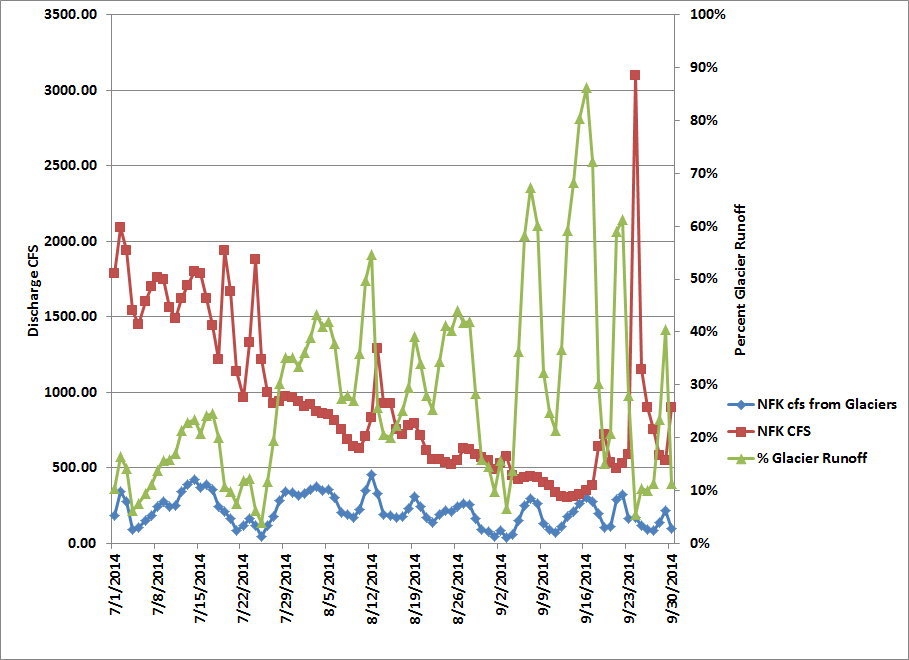
Chapter 4 Glacier runoff provides a critical water resource to the Nooksack River.  We measure meltwater runoff from Sholes Glacier and observe glacier melt on several glaciers in the basin.  This allows determination of the contribution of glaciers to the watershed.  In 2014 contributions from glaciers exceeded 40% of total North Fork Nooksack River streamflow on 21 days after Aug. 1.   This is a critical period for salmon migration in the watershed.

fig 5-6

Chapter 5 Glacier runoff is measured below the Sholes Glacier in conjunction with Oliver Grah and Jezra Beaulieu, Nooksack Tribe.  This is the record for part of the 2014 field season at the gage site.

fig 6-22

Chapter 6  Deming Glacier in 2011 Google earth image illustrating retreat. The glacier has retreated 420 m from 1979 to 2015. 


Visualizing Glacier Melt Impacts

Key questions emerge from the summer of 2015 in the Pacific Northwest glacier basins. That can both be visualized and quantified.

With record temperatures and minimum flows in most rivers in the Cascade Range during July and August of 2015, a key question was how much did glaciers contribute in basins that are glaciated?  Note the water pouring off the glacier and the lack of snowcover in the first few minutes of the video.

You can examine flow per unit watershed area as a first order observation. In the unglaciated South Fork discharge was 0.5 cfs/square mile, rising to 0.7 cfs/square mile in the lightly glaciated Skykomish River and 4.3 cfs/square mile in the heavily glaciated North Fork Nooksack.   For a more direct measure we measured ablation from July 29 to August 17th in the North Fork Nooksack and Skykomish River basin.  With the Nooksack Tribe we also measured discharge below glaciers in the North Fork but those recorders are still deployed in the field.

Because the glaciers had mostly ice, not snow at the surface, melting was enhanced.  We found in the Skykomish Basin that glacier runoff was 45 CFS versus a mean discharge of 375 CFS , this is 12% of the total flow despite covering only 1.3 % of the basin.  In the North Fork Nooksack glacier runoff was 340 CFS versus total flow of  460 CFS, this is 74% of the total flow though only 6.1 % of the basin has glacier cover. In both cases the glaciers contributed a river flow percentage 12 times greater than the percent of basin area they cover.  With a substantial loss in glacier area occurring this summer, next year glacier runoff for the given climate conditions will be reduced. Given this higher flow the glacier fed streams offer less stressful conditions this summer to salmon.

How much did glacier runoff water temperature amelioration?

In the South Fork Nooksack without glaciers stream temperature was above 20 C on eight days between Aug.1 and Aug. 20. In the North Fork Nooksack with glacier contribution, the stream temperature peaked at 13-14 C.

With the early loss of snowcover and exposure of the underlying ice, how are glacier ice worms impacted?  In the video note ice worms featured in the first minute in a glacier filled crevasse.

These worms live on snow algae primarily, which would seem to be in short supply in a summer with limited snowpack on the glaciers.  How well can they survive being on the glacier ice for extended periods?  For the 21st year we conducted ice worm population surveys.  The numbers were the lowest we have seen at 175-250 ice worms per square meter, but it should be next year when the full impact would be evident.

How much glacier area will be lost?  Note the visual of terminus retreat.
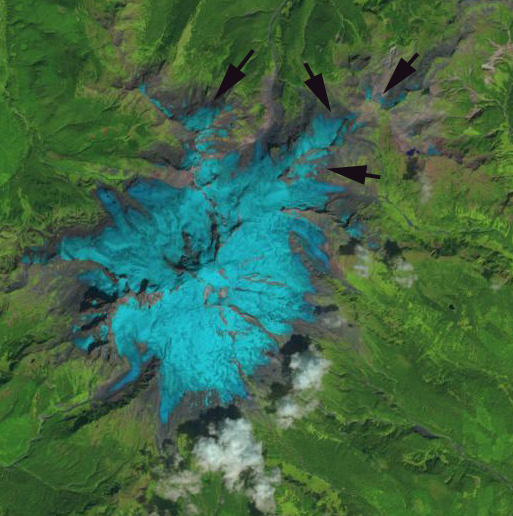
The summer is not over, but our observations indicate a 5-7 % volume loss will occur.  This should be approximately equaled by area loss.  Hopefully good satellite imagery in September will provide a specific answer.  The Aug. 17th Landsat image is excellent. Retreat just this summer has been 40 m on Easton Glacier, 32 meters on Columbia Glacier, 25 meters on Sholes Glacier and 30 meters on Lower Curtis Glacier.

mount baker 9172015


Aug. 17 Landsat image.  Arrows indicate areas where we observed rapid area loss of glacier ice this summer. 

Disastrous Year for North Cascade Glacier Mass Balance (Snow/Ice Economy)


Mass loss of North Cascade glaciers visualized.

A disastrous year is unfolding in 2015 for North Cascade glaciers, if normal melt conditions continue the range will lose 5-7% of its entire glacier volume in one year! For the 32nd consecutive year we were in the North Cascade Range, of Washington to observe the mass balance of glaciers across the entire mountain range. The melt season is not over, but already the mass loss is greater than any other year, with six weeks of melting left. An alpine glacier’s income is the snow that accumulates, and to be have an equilibrium balance sheet for a year, alpine glaciers typically need 50-65% snowcovered surfaces at the end of the melt season.  Below the accumulation zone, net assets are lost via ablation.

In 2015 of the 9 glaciers we examined in detail, 6 had less than 2% retained snowcover, which will be gone by the end of August.  Two more had no 2015 snowpack greater than 1.7 m in depth, which will also melt away before summer ends.  Average ablation during the August field season was 7 cm per day of snow, and 7.5 cm of ice. Only one glacier will have any retained snowcover at the end of the summer, we will be checking just how much in late September. This is the equivalent of a business having no net income for a year, but continuing to have to pay all of its bills. Of course that comes on top of more than 27 years of consecutive mass balance loss for the entire “industry” of global alpine glaciers.  The business model of alpine glaciers is not working and until the climate they run their “businesses” in changes, alpine glaciers have an unsustainable business model. Below this is illustrated glacier by glacier from this summer.  A following post will look at the glacier runoff aspect of this years field season.  The Seattle Times also featured our summer research.JillPeltoGMB_720_494_s_c1_c_c

Jill Pelto Painting of mass balance time series loss from 1984 to 2014. 

In a recent paper published in the Journal of Glaciology spearheaded by the WGMS group  (M. Zemp,  H. Frey, I.Gartner-Roer, S.Nussbaumer, M.Hoelzle, F.Paul, W.Haeberli and F.Denzinger), that I was co-author on, we examined the WGMS dataset on glacier front variations (~42 000 observations since 1600), along with glaciological and geodetic observations (~5200 since 1850).  The data set illustrated that “rates of early 21st-century mass loss are without precedent on a global scale, at least for the time period observed and probably also for recorded history.The rate of melting has been accelerating, and in the decade from 2001 to 2010, glaciers lost on average 75 centimetres of their thickness each year”, this is compared to the loss in the 1980’s and 1990’s 25 cm and 40 cm respectively each year (Pelto, 2015).  A comparison of the global and North Cascade Glacier mass balance records since 1980 indicate the cumulative loss, at bottom.

DSC08917

Columbia Glacier terminus August 3, 2015 with new expanding lake.

DSC00199

Upper portion of Columbia Glacier on Aug. 5, 2015 note lack of snowcover and all previous firn layers (firn is snow that survived a melt season but is not yet glacier ice).

DSC00503

Foss Glacier lacking snowcover and losing area fast this summer, this glacier will lose more than 15% of its volume in 2015.

DSC00435

Measuring firn from 2011-2014 retained in a crevasse on Easton Glacier, 2015 snowpack lacking.

DSC00429

The typical end of summer snowline elevation on Easton Glacier, bare ice and firn in 2015.

DSC09197

Rainbow Glacier amidst the normal accumulation zone, where there should be 3-4 m of snowpack, none left.

DSC09602

Lynch Glacier view across the typical end of summer snow line region on Aug. 17th 2015.

DSC00413

Terminus of Lower Curtis Glacier with many annual layers exposed to rapid melt, 31 m of retreat from spring to August 11th, 2015.

DSC00448

ice worm firn

Only firn from 2013 and 2014 and bare ice at surface of Ice Worm Glacier.

ba2014


Comparison of cumulative glacier mass balance in the North Cascades and Globally (WGMS)

DSC00348

Primary field team for the from left, Mauri Pelto (Nichols College), Jill Pelto (UMaine), Tyler Sullivan (UMaine), Ben Pelto (UNBC) and Erica Nied (U-Colorado) summer with contributions from Justin Wright, Tom Hammond, Oliver Grah and Jezra Beaulieu not pictured

Embarking on the 32nd Annual North Cascade Glacier Climate Project


sholes compare
Sholes Glacier snowcover Aug. 5, 2013 (Jill Pelto) and Sholes Glacier July 23, 2015 (Oliver Grah)

For the 32nd straight summer we will be investigating North Cascade glaciers and their response to climate change over the next three weeks (that means no new posts until Aug. 20).  In 1984 the program was initiated to study the impacts of climate change across an entire mountain range, instead of on just one glacier.  This had been a high priority of the National Academy of Science, I felt I could address.  The glaciers in the North Cascades provide water resources for irrigation, hydropower, salmon and municipal supply.  During our 32 years we have seen the loss of 25% of the entire glacier volume of the range.  Unfortunately 2015 is almost certainly going to be the worst year during this period.  We will likely lose over 5% of the volume of these glaciers in one year.  The problem has been high freezing elevations in the winter, note the difference from other years below.  Because of the drought conditions glaciers are even more crucial to runoff, note the daily spike in flow due to glacier melt in the Nooksack River in July, black arrows.  Blue arrow indicates rain storm.

winter 2015nooksack

Freezing levels on Mount Baker during winter 2015 versus previous winters.  Nooksack River discharge from the USGS in July.

This has been followed by the warmest June and now July the region has seen. This has led to record low streamflow from either rain, groundwater or snowpack from non-glacier areas.  The result is that in glacier fed basins glacier runoff which is above normal because of the warm temperatures is even more important.  We are measuring flow below glaciers and melting on glaciers to quantify the percent of total flow contributed by glaciers.  In 2014 in the North Fork Nooksack River glaciers contributed more than 40% of total stream discharge in the river on 21 days, all in August and September. We again with the Nooksack Indian Tribe will be examining the issue, particularly at Sholes Glacier. We will also be measuring the mass balance, terminus change and mapping ten glaciers we visit every year, including Columbia Glacier seen below.

columiba compare

Terminus of Columbia Glacier and accumulation zone looking bare in 2005, the lowest snowpack year of the last 32 until this year

The glaciers are all in Wilderness areas which means no motorized vehicles or equipment, we have to hike everything in.  This has provided the opportunity to spend over 600 nights in a tent examining the glaciers, hiking/skiing over 3000 miles across the glaciers, and eating oatmeal each morning for breakfast.  It has also provided the opportunity to train and work with more than 60 different scientists.  This year the field team consists of Erica Nied from the University of Colorado, Tyler Sullivan from the University of Maine, Jill Pelto from the University of Maine for the seventh year and myself for the 32nd year.  We will be joined at times by Justin Wright, Oregon State, Tom Hammond, University of Washington, Ben Pelto University of Northern British Columbia, Oliver Grah and Jezra Beaulieu of the Nooksack Indian Tribe. Below are three videos from last year that illustrate: 1: Visual report on initial 2015 findings 2: How and why we measure mass balance.3. The Nooksack Indian Tribe perspective on threats of glacier runoff and our measurements of it.


Big Four Glacier & Ice Caves, WA: a short future?

The Big Four ice caves area popular hiking destination 90 minutes northeast of Seattle in the North Cascades.  This ice mass is currently the lowest elevation glacier in the lower 48 states. It is fed by tremendous avalanching from higher on Big Four Mountain.  During the winter the snow piles up on the avalanche fan.  In the summer the waterfall from above carves tunnels under the snow-ice mass.  At some point in June or July the tunnels are enlarged enough to allow people, but also warm air to enter.  This leads to further tunnel expansion.  In warm summers the tunnels get large enough by late summer that collapses of the roof occur.  Unfortunately this year the caves are already in late summer form and an expected collapse tragically led to the 1 person killed and five injured this week.  Here we examine the formation and now demise of this odd glacier in the last decade. There are no pictures of the ice caves in this post, as it is not a place to enter this year.

The 1999-2002 period featured heavy winter snowpack and avalanching boosting Big Four.  The summer of 2003 was the first of three cruel seasons to Big Four.  In this image you cannot note the blue case to all but the very top of the avalanche cone, indicating it is older snow.  There is further two layers that look  to be annual layers on the right side of the image.  This suggests to me, the base is a 1999, layer, than a 2000 layer, than a broader dirty band and a 2002 layer, followed by a 2003 snowpack,.  The summer of 2001 was warm and no snowpack would have survived, causing the wider dirt band. In 2003-2005 a series of dismal winters and warm summers led to the near total loss of the Big Four Avalanche fan, at this point it was not a glacier.

From 2006-2012 a series of good summers led to redevelopment, which prompted David Head to contact me to investigate in 2009 if it was a glacier.  He provided a series of images from 2005-2008 indicating the changes.  We then headed to the glacier in 2009 to investigate in detail. In 2009 we mapped the glacier, from above and below. We found it had an area of 0.07 square kilometers, the glacier had a center length of 370 m, had a width at the toe of 270 m, an average slope of 22 degrees an average depth of 32 m a maximum depth of 55 m, and a volume of ~2 million cubic meters. There was blue glacier ice evident and a few crevasses on the upper portion. It was a glacier. The glacier gained at least 30 m in thickness over the majority of its area from 2005-2008, which is an extraordinarily short period. This year for the first time no avalanches reached the avalanche fan. Last summer was at record warmth, with the snowmass ablated to its smallest extent since 2005. The ice cave entrances were wide with a rainbow shaped arch, not an engineering setup for stability. This did not change over the winter. Hence, it is like having two summers in a row without winter. Contrast the June 2008 image to April 2015 (from Kellbell), quite a difference. There is no snow on Big Four even in April this year, the blue glacier ice is exposed and ablating starting then. The ice mass is rapidly ablating in the warm early summer of 2015 and will reach its smallest size since 2005 by the end of the summer. It is likely too thick to melt it all this year, but it may well surpass the 2005 minimum size. It will no longer be a glacier by the end of the summer. That is unusual to watch a glacier form and melt away in a decade. There will be more collapses in the ice caves this summer as it recedes to a meager size.

big four time lapse

2003-2007 Time lapse of Big Four
big four June 2008
June 2008 image
big four 10202008
October 2008 image
big four 2009
August 2009 image

big four20150327
April 2015 (Kellbell)

Nooksack River: Glacier Runoff Maintains Suitable Aquatic Conditions for Salmon

salmon glacier
Illustration from Megan Pelto above left

Sholes Glacier from our runoff measurement station above right.

Glaciers are a critical water resource in the North Cascades of Washington for hydropower, irrigation , municipal supply and aquatic life. In dry summers glaciers play an even larger role in the overall water budget and maintaining suitable aquatic conditions.  The summer of 2015 will pose particular challenges due to the drought emergency that is likely to persist and we will be investigating the role glaciers play. During the last three years in an ongoing study with the Nooksack Indian Tribe we have been working on quantifying the role glaciers play in that watershed. Glaciers comprise the headwaters of the Nooksack River and are a critical source of summer discharge and greatly influence summer stream temperatures. There are nine species of salmon in the watershed that the Nooksack Indian Tribe depends on for cultural, subsistence, and economic uses. Climate change is an additional new threat to salmon that has caused and will continue to cause an increase in winter flow, decreased summer baseflow, and increased summer water temperatures as noted by (Isaak et al, 2011). Abatzaglou et al (2014) note a reduction in summer and autumn precipitation coupled with increased potential evapotranspiration causing larger climatic water deficits over the past four decades in the Pacific Northwest.

fig
Nooksack Watershed map with Mount Baker glaciers.

This post will focus on the changing impact of glaciers on streamflow and the evolving water temperature threat. The Nooksack River watershed has three significant watersheds, South Fork, Middle Fork and North Fork. The South Fork has no glaciers.  The Middle Fork has four significant glaciers and 2% of the watershed area above the USGS gage is glaciated.  The North Fork has 12 significant glaciers that cover 6% of the watershed area above the USGS gage. This difference in glacier cover allows identification of the role of glaciers when combined with measurements of melt on and runoff from the glaciers. Here we examine stream discharge and water temperature at USGS gages on each stream to illustrate the different response to 12 warm weather events during the summers of 2009, 2010, 2012 and 2013. During each of these periods we have, along with Oliver Grah and Jezra Beaulieu, working for the Nooksack Tribe, been observing the ablation and runoff directly from the glaciers. The largest area of glaciers are those on Mount Baker, a strato volcano that is the highest mountain in the North Cascades. Pelto and Brown (2012) note that terminus observations on the nine principal Mount Baker glaciers, 1984–2009, indicate retreat ranging from 240 to 520 m, with a mean of 370 m or 14 m/year. Pelto and Brown (2012) observed that this is the result of a sustained mass balance loss averaging -0.5 m/year during the 1990-2010 period. This equates to an 11-m loss in glacier thickness, 12–20% of the entire 1990 volume of glaciers on Mount Baker. This summer we will for the 32nd consecutive year be measuring glacier mass balance on Mount Baker.

Rainbow strat
Measuring snow depth in crevasse on Mount Baker glacier.

sholes gage
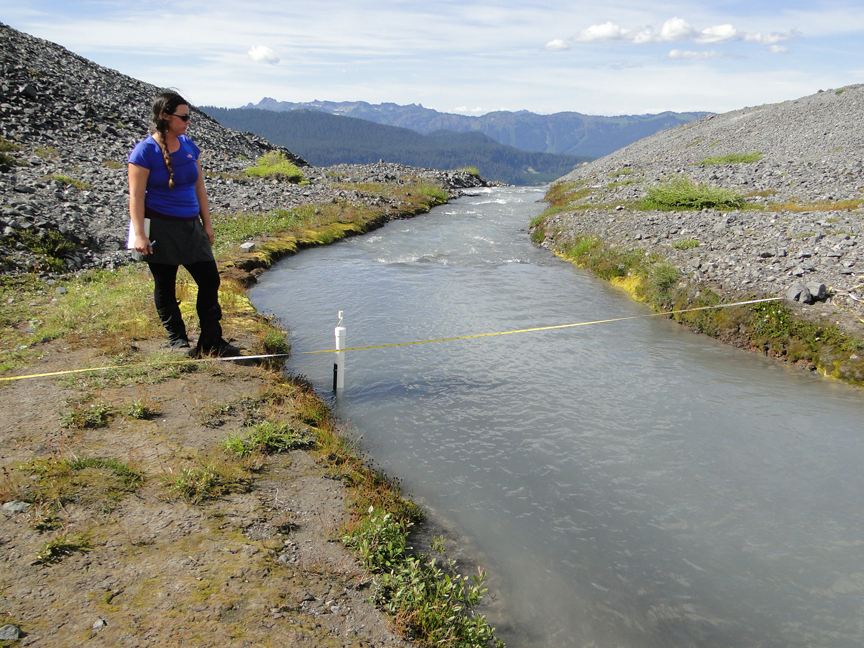
Jezra Beaulieu at Runoff measurement Gage

During each of these warm weather events ablation was measured on glaciers in the basin. For stream discharge, a 10% increase is set as the key threshold for significant response to each warm weather event. For the North Fork 10 of 12 warm weather events exceeded the limit, in the Middle Fork 4 of 12 events had a significant response and for the South Fork none of the 12 events led to a 10% flow increase. It is apparent that warm weather events increase glacier melt, thus enhancing flow in the North Fork. In a basin without glacier runoff the hydrologic system consistently experiences reduced discharge.

nooksack 2009t

2009 stream discharge  variation of the three Nooksack forks, warm water events within ellipse.

nooksack 2010t

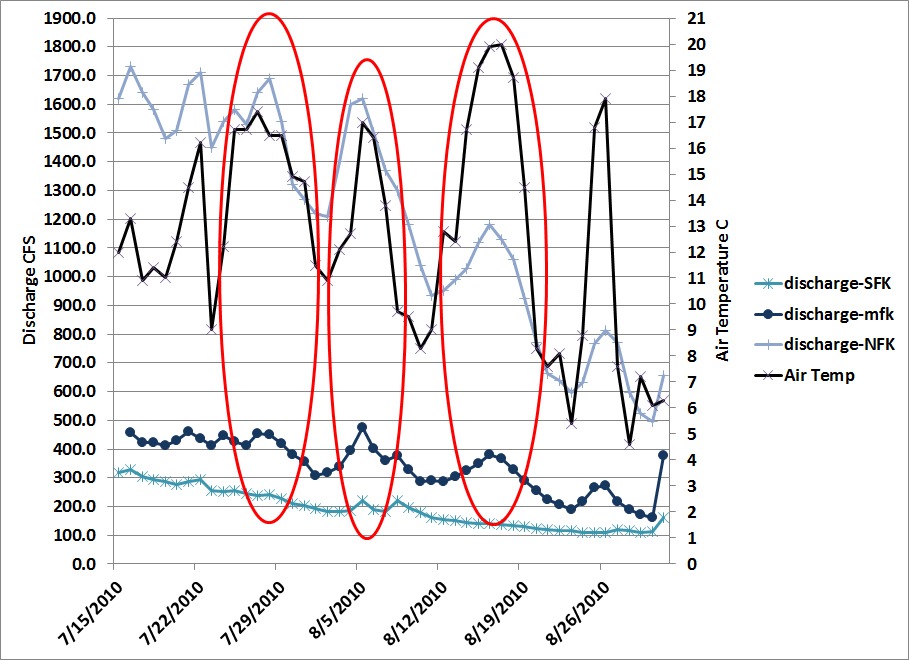
2010 stream discharge  variation of the three Nooksack forks, warm water events within ellipse.

For water temperature, an increase of 2° C is the threshold of significance used for response to warm weather events. In each the North Fork and Middle Fork, 2 of 12 events exceeded this threshold, and for the South Fork 12 of 12 events exceeded this threshold, each event is a gold ellipse on the charts below. Warm weather events consistently generate a significant increase in stream water temperature only in the non-glaciated South Fork Basin. During 6 of these 12 warm events, runoff measurements below Sholes Glacier and ablation measurements on Sholes and Easton Glacier indicate daily ablation ranging from 0.05-0.06 meters per day, which for the North Fork currently yields 9.5-11 m3/second. This is 40-50% of the August mean discharge of 24 m3/second, despite glaciers only covering 6% of the watershed. Increased glacier discharge largely offset the impact of increased air temperature on stream water temperature during the warm weather events. In the charts below note the red line with diamond markers that is the South Fork stream temperature and the in the graph above the top brightest blue line that is North Fork discharge and what happens during the warm events, gold ellipses. Also note the South Fork discharge bottom blue line in the graph above does not respond nor does the North Fork stream temperature red line with triangles, below.

nooksack response

The frequency of significant response of each watershed to the 12 warm weather events.

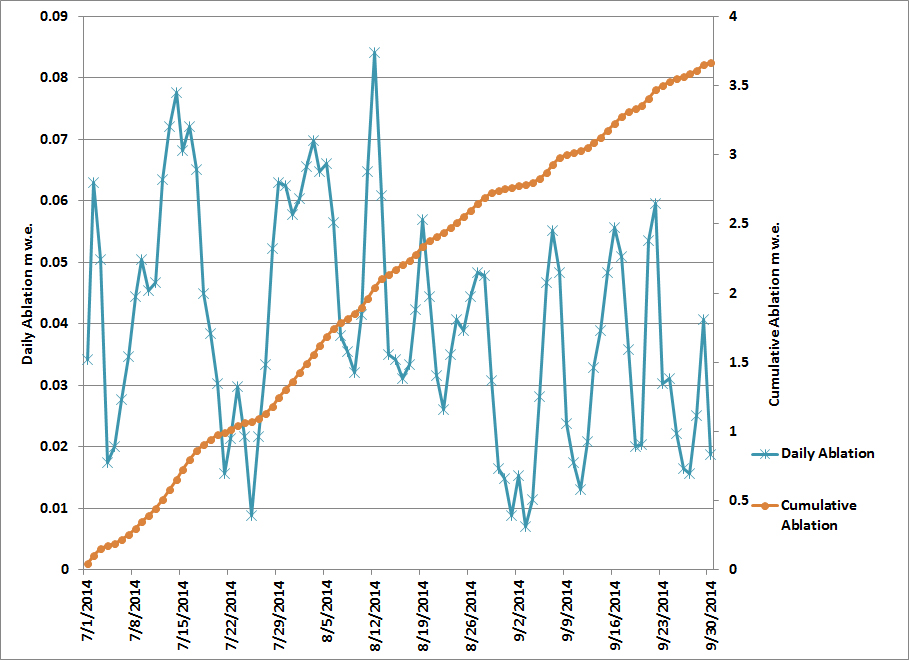
NFK glacier runoff Daily and cumulative ablation during the 2014 melt season.

nooksack 2009d
2009 Temperature record for the South Fork, North Fork and Middle Fork, warm water events within ellipse.

Nooksack 2010d
2010 Temperature record for the South Fork, North Fork and Middle Fork, warm water events within ellipse.<

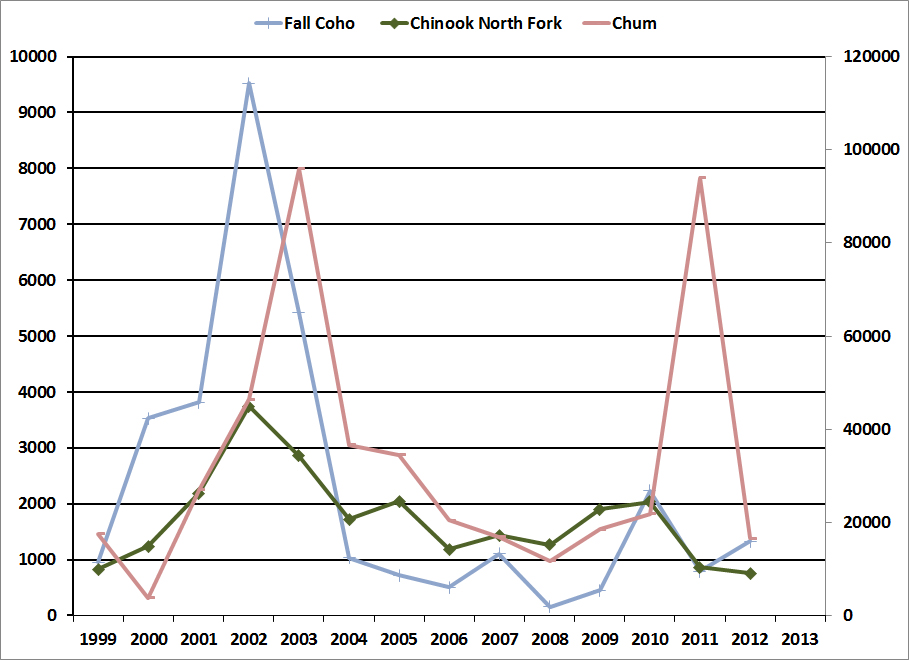
As the glaciers continue to retreat the North Fork will trend first toward the more limited impact of the Middle Fork and then the highly sensitive South Fork where warm weather leads to declining streamflow and warming temperatures. Our ongoing measurements of daily runoff and daily streamflow below Sholes Glacier allow determination of the contribution of glaciers to the North Fork Nooksack, which peaked in 2014 at 80% of total streamflow. Reductions in glacier runoff will put stress on the salmon in the watershed.  The Washington Dept of Fish and Wildlife monitors the salmon population, which in the North Fork migrate 40 km upstream of the junction with Nooksack River to Nooksack Falls. The salmon population which is threatened, shows no sign of recovery in the last decade, the good returns in 2002 reflect good water conditions in 1999-2000 for salmon fry. Continued glacier loss and reduced summer streamflow will lead to a situation similar to the Skykomish River where the number of low flow days has sharply increased. The retreating glaciers include the Sholes, Roosevelt,Deming and Mazama.

nfk glacier contributiion
Glacier runoff in the North Fork Nooksack in 2014, product of observed ablation and glacier area, also percent of total flow.
nooksack salmon
WFDW Governor’s Salmon Recovery Office data for North Fork Nooksack.

Skykomish River, Washington Reduced Minimum River Flow and Glacier Retreat

sky headwaters

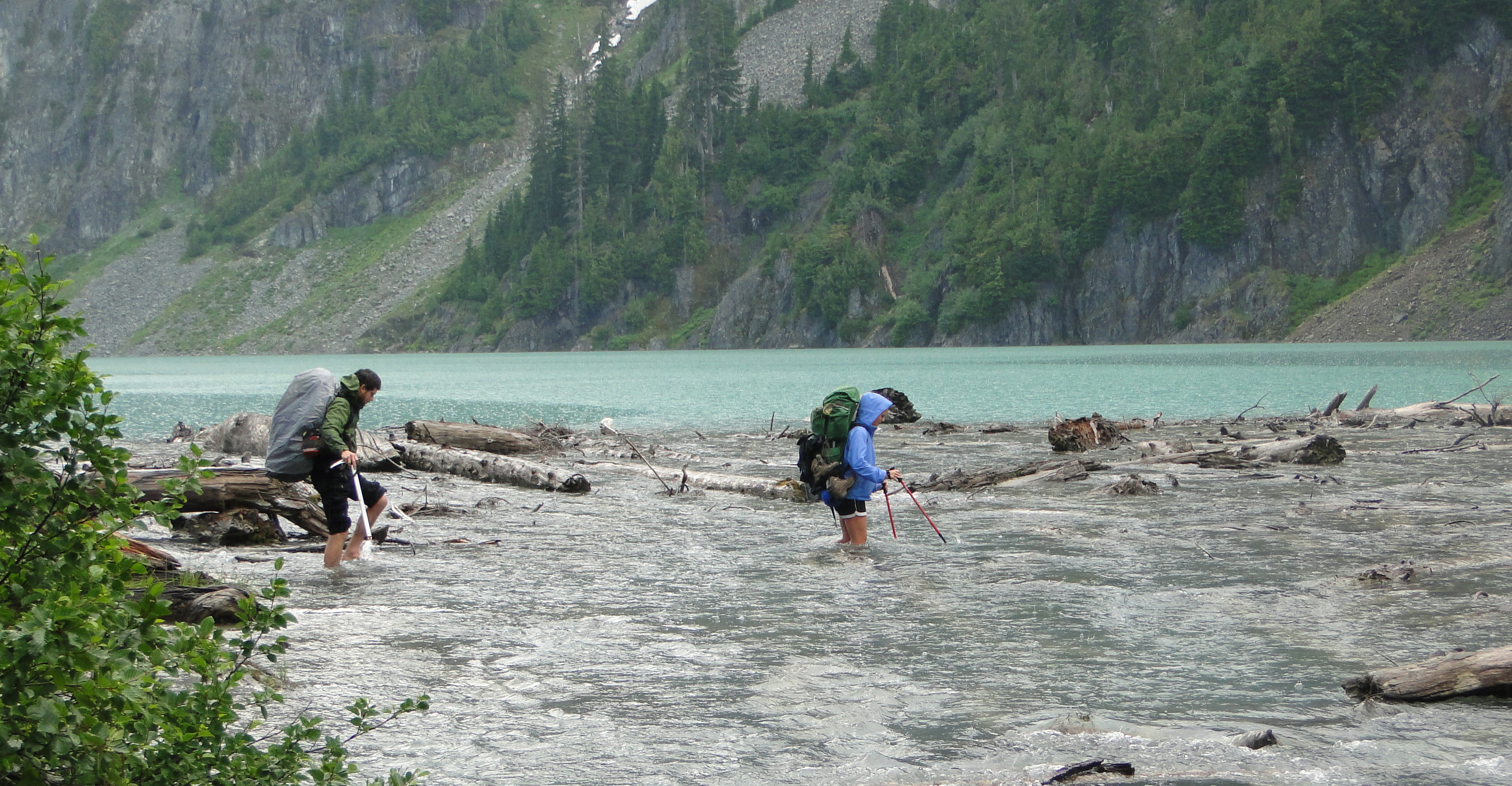
Fording the outlet of Blanca Lake, headwater North Fork Skykomish River.

The focus this spring has been on the developing drought in Washington as a result of record low snowpack, the winter was a record warmth though not dry. The focus of this article is on another component of many alpine watersheds, glacier runoff, both the ameliorating role and their reduced ability as they shrink to augment flow during low flow periods. Glaciers act as natural reservoirs storing water in a frozen state instead of behind a dam. Glaciers modify streamflow releasing the most runoff during the warmest, driest periods of summer, when all other sources of water are at a minimum. Annual glacier runoff is highest in warm, dry summers and lowest during wet, cool summers. This is the first of two posts looking at the response of specific alpine watersheds to glacier change and glacier runoff, the second will look at the Nooksack River.

Watersheds in mountainous Pacific Northwest are comprised of pluvial, nival and glacial segments. The pluvial segments have peak flows in the winter due to the winter storm events (Dery et al., 2009). Nival streams peak in the May and June with the high snowmelt, and glacially fed streams peak in July and August during peak glacier melt (Pelto, 2008; Dery et al., 2009). The loss of glaciers from a watershed then reduces streamflow primarily during minimum flow periods The amount of glacier runoff is the product of surface area and ablation rate. The glacier retreat and loss of glacier runoff has been quite pronounced in the Skykomish River Basin, North Cascades, Washington from 1950-2014 (Pelto, 2011). This summer we will return to make observations on 4 glaciers in this watershed for the 32nd consecutive year.  We will be measuring flow with the Nooksack Indian Tribe again this year below glaciers, and we will observe the drought impact on the glaciers and downstream.

skybasemap

Skykomish Basin Map-Light blue arrows indicate the four main glaciers: 1=Columbia, 2=Hinman, 3=Foss, 4=Lynch

An analysis comparing USGS streamflow records for the Skykomish River at Gold Bar for the 1950-1985 to the 1985-2009 period indicates that during the recent period the Skykomish River summer streamflow (July-September) has declined 26% in the watershed, spring runoff (April-June) has declined 6%, while winter runoff (November-March) has increased 10% (Figure 1). The reduction of the glacial melt component augmenting summer low flows is already resulting in more low-flow days in the North Cascade region. In the Skykomish River watershed from 1958-2009 glacier area declined from 3.8 km2 to 2.1 km2, a 45% decline (Pelto, 2011). Columbia, Foss, Hinman and Lynch Glacier, the primary glaciers in the basin, declined in area by 10%, 60%, 90% and 35% respectively since 1958. Annual mass balance measurements completed from 1984-2009 on Columbia, Foss and Lynch Glacier indicate a mass loss of 13.1 m w.e. Despite 15% higher ablation rates during the 1985-2009 period, the 45% reduction in glacier area led to a 38% reduction glacier runoff between 1958 and 2009. This means less glacier runoff in late summer.
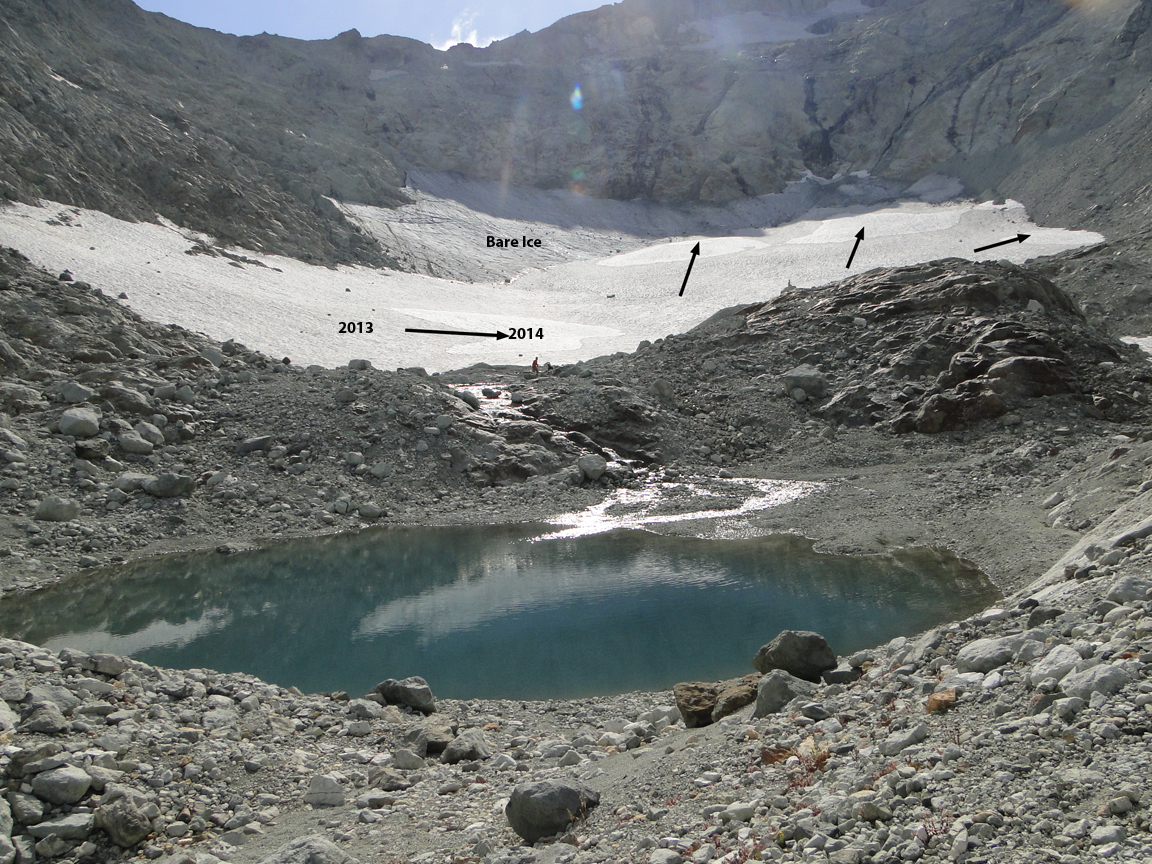
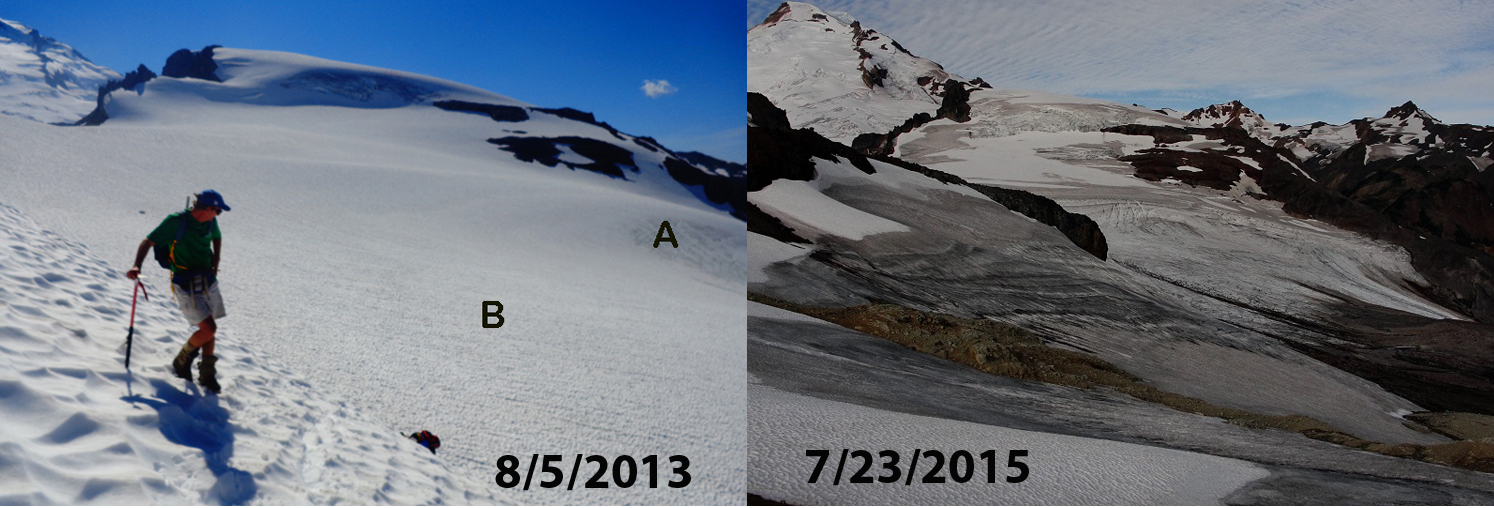
fig 3 esc

Change in seasonal discharge in the Skykomish River. Increase in winter, decrease in summer.

Slide9
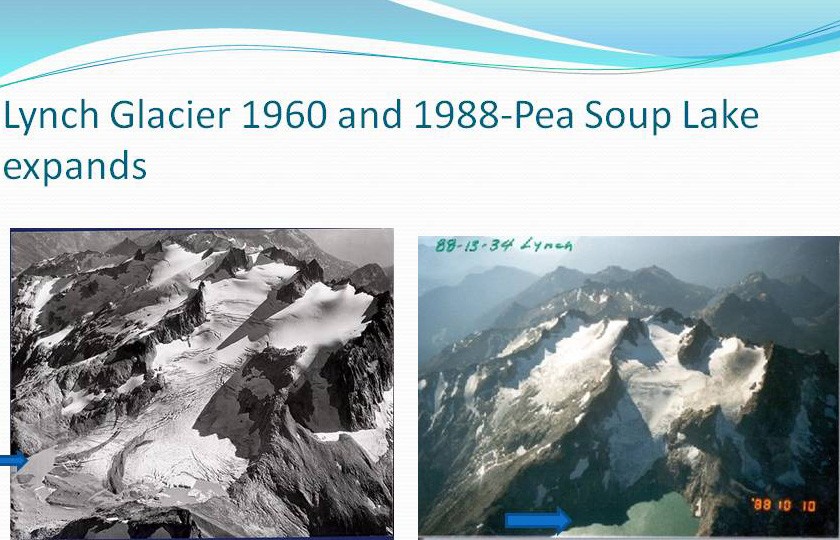
Foss Glacier retreat.
Slide3

Lynch glacier Retreat

Slide8

Hinman Glacier, view from former terminus

Slide15
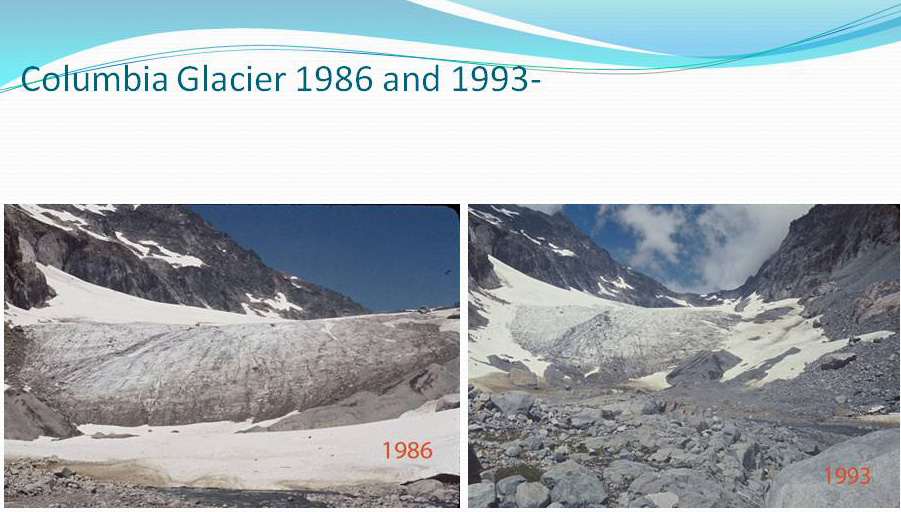
Columbia Glacier losing its snowcover in the accumulation zone.
Slide12
Columbia Glacier Retreat. Detailed report. 

A key threshold of in-stream flow levels considered insufficient to maintain short term survival of fish stocks is below 10% of the mean annual flow (Tennant, 1976). For the Skykomish River 10% of mean annual flow is 14 m3s-1. In the Skykomish River from 1950-2013 there have been 230 melt season days with discharge below 14 m3s-1. Of these 228, or 99% of the low flow days, have occurred since 1985. The loss of 30-40% of the glacier runoff is a key reason for the onset of critical low flow days. Of more concern for aquatic life is the occurrence of extended periods of low flow (Tennant, 1976). From 1929-2009 in the Skykomish River basin there have been eight years where streamflow dropped below 14 m3s-1 for 10 consecutive days during the melt season, 1986, 1987, 1992, 1998, 2003, 2005, 2006 and 2007.  It is likely that 2015 will join this list.

skymin

Number of days when flow fell below 10% of the long term mean annual flow. Only one day from 1950 to 1985 met this criteria. Precipitation has not declined substantially during this interval, hence earlier snowmelt, reduced glacier runoff and greater evapotranspiration must be causing the increase in late summer low flow periods. The 38% reduction in glacier runoff did not lead to a significant decline in the percentage summer runoff contributed by glaciers under average conditions; the contribution has remained in the range of 1-3% from July-September. The glacier runoff decline impacted river discharge only during low flow periods in August and September. In August, 2003 and 2005 glacier ablation contributed 1.5-1.6 m3s-1 to total discharge, or 10-11% of August discharge. While declining glacier area in the region has and will lead to reduced glacier runoff and reduced late summer streamflow, it has limited impact on the Skykomish River except during periods of critically low flow, below 14 m3s-1 when glaciers currently contribute more than 10% of the streamflow.

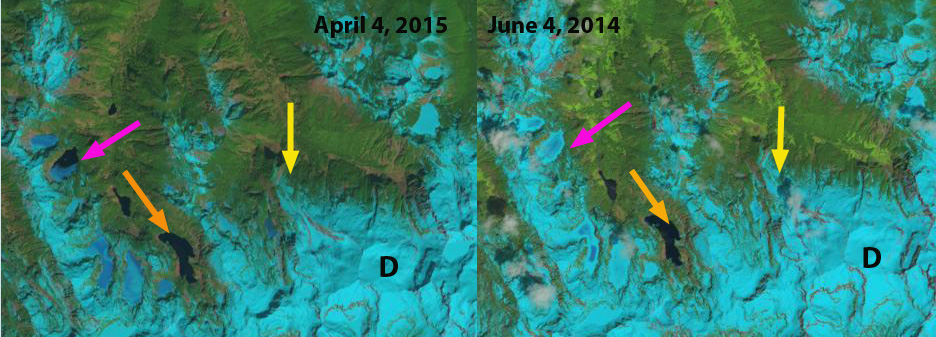
For 2015 the lack of snowpack in the Skykomish Basin is evident from a comparison of images from April 20th 2015 and June 4th, 2014. Snowpack during 2014, an average winter, was higher in mid-June than in mid-April in 2015. Arrows in each side by side are in same location. This indicates that the pluvial and nival segment of flow to the Skykomish River will be at a minimum late this summer. Currently flow at the USGS gage in Gold Bar is 28% of normal at 2050 CFS, which is an all time low for the record that begins in 1929, previous low in 1977 at 2755 CFS. The river has not reached 2750 CFS the entire month of May. Glacier flow has continued to decline with area extent losses. This combination makes it likely, that the Skykomish River will have an extended period of low flow this summer and into the fall. If the summer is drier than average, flows will likely reach a new minimum.
blanca lake compare
Snowpack comparison in the area of the North Fork Skykomish near Columbia Glacier (C) in April 2015 compared to a snowier June, 2014.
south fork compare
Snowpack comparison in the area of the South Fork Skykomish near Lynch Glacier (D) in April 2015 compared to a snowier June, 2014.
columbia2012
Terminus image of Columbia Glacier in March 2015 (below) with less overall snow than in the image above from August, 2013. (picture below from Rowan Stewart)
columbia terminus march

Sholes Glacier, Washington: Measuring Annual Glacier Mass Balance

Annual mass balance is the difference between ice and snow added to the glacier via accumulation and snow and ice lost via ablation and in some cases calving. Alpine glacier mass balance is the most accurate indicator of glacier response to climate and along with the worldwide retreat of alpine glaciers is one of the clearest signals of ongoing climate change (WGMS,2010). For 25 consecutive years we (North Cascade Glacier Climate Project) have measured the mass balance of Sholes Glacier. On Sholes Glacier in 2014 we completed 162 measurements of snowpack depth using probing and crevasse stratigraphy, mainly probing on this relatively crevasse free glacier.  We mapped the extent of snowcover on several occasions, and using the retreat of the snowline and stakes emplaced in the glacier observed the rate of ablation (melting). We also measured runoff from the glacier in a partnership with the Nooksack Indian Tribe, which provided an independent measure of ablation. The final mass balance in 2014 was -1.65 m of water equivalent, the same as a 1.8 meter thick slice of the glacier lost in one year. In 2014 we arrived at Sholes Glacier to find it already had 15% blue ice exposed, on August 7th. This had expanded to 25% by August 12th. This rapidly expanded to 50% by August 23rd, note Landsat comparison below. The snow free area expanded to 60% by the end of August and then close to 80% loss by the end of the summer. Glaciers in this area need 60% snowcover at the end of the melt season to balance their frozen checkbook. This percentage is the accumulation area ratio. This mass balance data is then reported to the World Glacier Monitoring Service, along with about 110 other glaciers around the world.  Unfortunately the WGMS record indicates that Global alpine glacier mass balance was negative in 2014 for the 31st consecutive year.  The video below explains how we measure mass balance each year with footage from the 2014 field season.  Of course a key aspect is hiking to the glacier and camping in a tent each year.

The Sholes Glacier thickness has not been measured, but there is a good relationship between area and thickness, that suggests the glacier would average between 40 and 60 m in thickness. The 15 m of water equivalent lost from 1990-2014 is equal to nearly 17 m of ice thickness, which would be at least 35% of the glaciers volume lost during our period of measurement.

DSC07194 sholes 915og

Sholes Glacier on August 7, 2014 and Sept. 15 2014, the glacier had lost 80% of its snowcover at this point an indicator of poor mass balance 2014.

sholes landsat 2014
Landsat 8 images of Sholes Glacier in 2014, with red line indicating snow line.

sholes probing snowpack rainbow stratigraphy

Measuring Accumulation on a glacier using Probing and crevasse stratigraphy.

DSC02001
Base Camp where we have spent more than 100 nights in a tent in the last three decades.

Columbia Glacier year by year

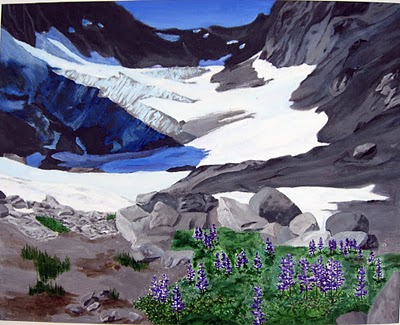
The following pictures give a year by year view of Columbia Glacier within one day of August 1. The best year was 1999, the worst, 2005.The snowy peaks of the Monte Cristo region can be seen from the Everett area. With 30 glaciers many at low altitudes, this region may receive more snow than any other region in the North Cascades. The largest and lowest is Columbia Glacier occupying a deep cirque above Blanca Lake and ranging in altitude from 4600 to 5700 feet. Kyes, Monte Cristo and Columbia Peak surround the glacier with summits over 2000 feet above the glacier. The Monte Cristo range is the first major rise that weather systems coming off the ocean encounter on the way east to the Cascade Crest. As a result precipitation is heavy. During the summer if it is raining anywhere in the North Cascades it will be in the Monte Cristo region. The glacier is the beneficiary of heavy orographic lifting over the surrounding peaks, and heavy avalanching off the same peaks. We measure the mass balance of this glacier each year and report the data to the World Glacier Monitoring Service. The location is gorgeous as seen in this painting by Jill Pelto Despite the advantages of snow accumulation the glaciers mass balance since 1984 has average -0.5 m a year for a cumulative loss of 13 m. For a glacier that averages 60 m in thickness this is over 20% of its volume. Details of the mass balance research and methods are at

Columbia Glacier has retreated 134 m since 1984. Lateral reduction in glacier width of 95 m in the lower section of the glacier and the reduction in glacier thickness are even more substantial as a percentage. The major issue is that the glacier is thinning as appreciably in the accumulation zone in the upper cirque basin as at the terminus. This indicates a glaciers that is in disequilibrium with current climate and will melt away with a continuation of the current warm conditions. The glacier has lost 17 m in thickness since 1984, but still remains a thick glacier, over 75 meters in the upper basin and will not disappear quickly.

A lateral moraine deposited during the Little Ice Age, is visible at the western edge of the glacier, descending below the glacier to 4250 feet. This moraine has little vegetation on the inside, but is vegetated on the outside. Just in front of the terminus are two terminal moraines deposited during retreat in the last 20 years. Facing southeast Columbia Glacier is protected from any afternoon sun except during the summer. During the winters storm winds sweep from the west across Monte Cristo Pass dropping snow in the lee on Columbia Glacier. Avalanches spilling from the mountains above descend onto and spread across Columbia Glacier. The avalanche fans created by the settled avalanche snows are 20 feet deep even late in the summer. Nearly a third of the glacier is covered by avalanche fans, but no summer avalanches have been observed. Avalanches, shading from the sum provided by the high peaks, and wind drift snow deposition permits Columbia Glacier to exist at such a low altitude.