Twins Glacier, Wind River Range Wyoming is Vanishing

Twins Glacier in Sentinel 2 images late in the melt season in 2021, 2023, 2024 and 2025. The darker blue is bare ice and the light blue is snow cover. This illustrates the lack of significant snow covered area each of these summers.

Twins Glacier in the Wind River Range of Wyoming is nestled on the north side of a ridge extending from Winifred Peak to The Buttress, in Titcomb Basin. Titcomb Basin is high alpine basin that lacks trees and has many alpine lakes. The basin was named for brothers Charles and Harold Titcomb, who were some of the first to explore the area in 1901. The Wind River Range was inhabited by the Sheepeater Shoshone (Tukudika) tribe as far back as 2000 BC. This tribe relied on bighorn sheep as a key staple and did not utilize horses, both adaptations useful for alpine terrain. Fur trappers were active in the region going back to the 1830s including Charles Fremont for which Fremont Peak on the east side of the basin is named. Titcomb Basin remains popular with climbers today.  

Devisser and Fountain (2015) identified Wind River Range glaciers lost 47% of their area from 1900-2006. Li et al (2025) indicate a thinning rate of 0.58 m/year on Wind River Range glaciers from 2000-2019, representing a cumulative loss of 11.6 m. The loss from 1968-2000 had been -0.08 m/year. This accelerated thinning this century has led to rapid area losses across the range. The mean June-September temperature for the Wind River (Wyoming-Division 9) rose 1.2oC from 1900 to 2024. The mean June-September temperature exceeded 16.5oC five times from 1900-1999 and nine times from 2000-2025. During the 1900-2024 period there is no trend in November-April total precipitation for the Wind River Division. It is the frequent warm summers that have accelerated glacier loss.

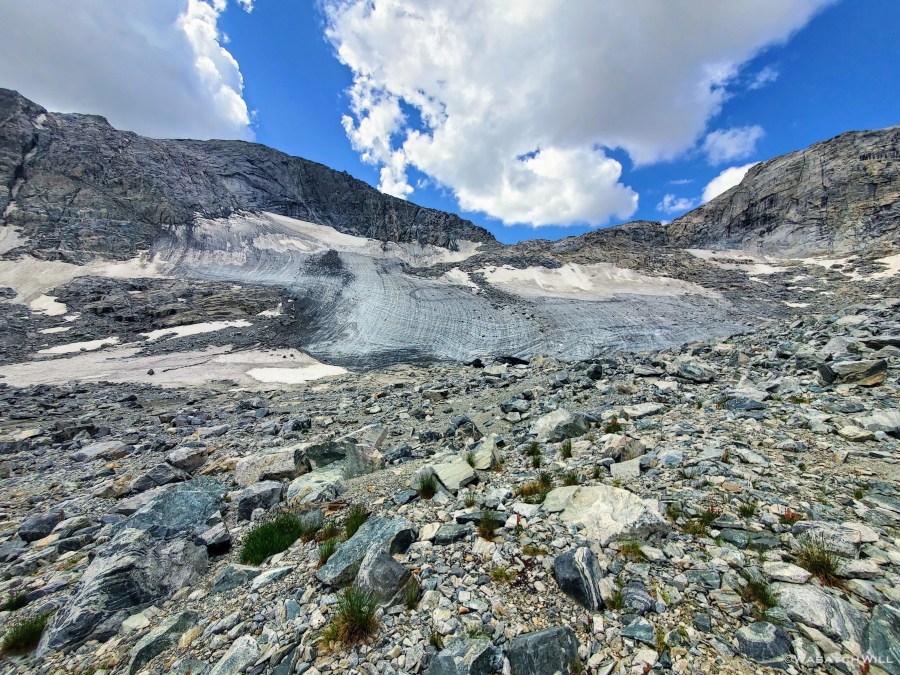
Twins Glacier in 1966 spread broadly across the mountain slope from Knapsack Col to The Buttress and had an area of 0.49 km2 (GLIMS). The glacier extending close to the top of a rounded ridge does recieve wind enhanced snow deposition, but no avalanching. By 2015 the area had declined 75% to 0.13 km2 and was primarily confined to an area below The Buttress (Fountain et al 2023). The 2013 image (from Bob Sihler) below illustrates a lack of snow or firn cover which indicates there is no longer a persistent accumulation zone, without which a glacier cannot survive (Pelto, 2010). From 2021-2025 each summer the glacier has lost all snow cover indicating it no longer has an accumulation zone. This has led to rapid thinning and development of a bedrock ridge that has nearly separated the glacier, note 2021 image (from Will Wickert). In 2025 the glacier lost all snowcover and was fragmenting into two sections with an area of 0.05 km2 and 0.03 km2 respectively. The ~50 visible annual layers indicates ice in the glacier is all from the last 75 years. The glacier is almost disappeared. The fragmentation and acceleration of area loss indicates this glacier cannot endure several more years of warm conditions that eliminates snow cover.
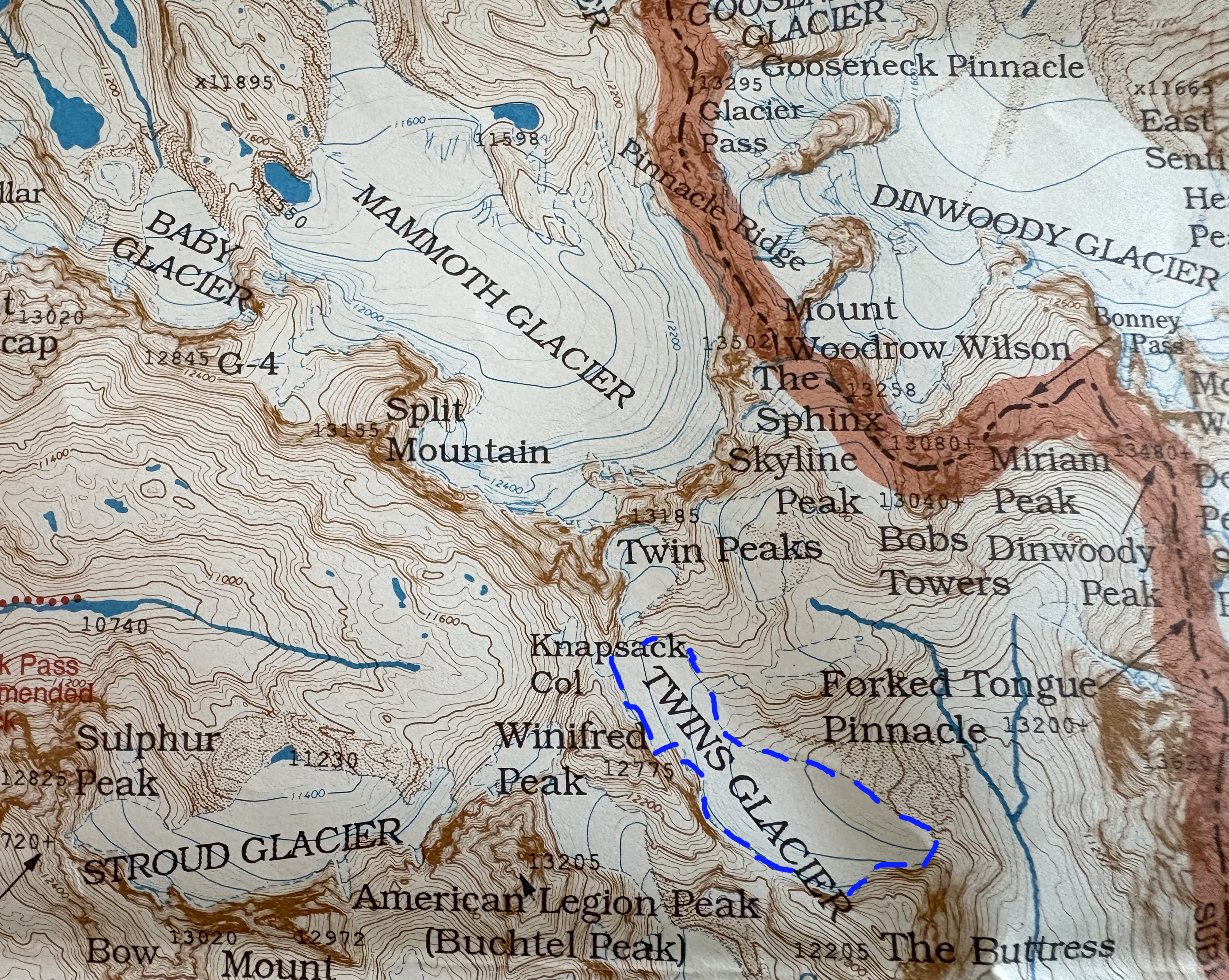
Twins Glacier outline in blue on USGS map based on 1966 aerial photographs. Glacier extends from Knapsack Col to east end of The Buttress.

Twins Glacier in 2013 seen from the northeast nestled below The Buttress. The diagonal bedrock ridge that is now fragmenting the glacier is not yet evident. The lack of snow or firn cover illustrates the glacier is not retaining snow cover. This image taken by Bob Sihler.

Twins Glacier in 2021 indicating rock rib extending diagonally across the glacier. There is limited retained snow or firn cover with a month left in the melt season. There are ~50 visible annual layers. The thin nature of the glacier is also evident. This is an image taken by Will Wickert.
Continental Glacier, Wyoming Fragmentation Accelerates

Continental glacier 1994-2023

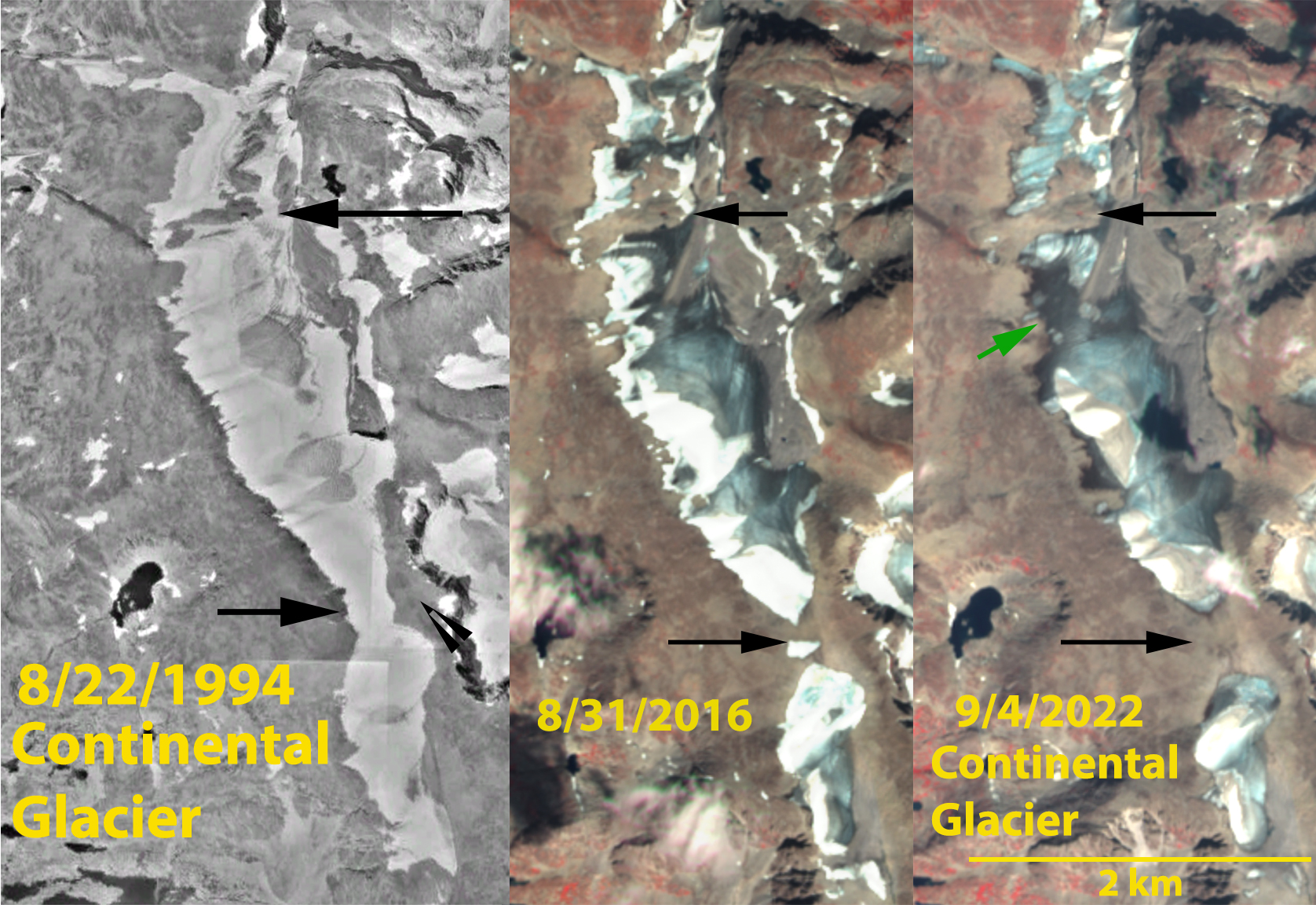
Continental Glacier in 1994 Google Earth and 2016 and 2022 Sentinel images, illustrating the separation at the black arrows, into the northern middle and southern parts, with an impending separation at green arrow.

Continental Glacier is a long plateau glacier draped along the continental divide in the Wind River Range, Wyoming. It drains into Torrey Creek and then the Wind River. In 1994 this glacier extended 5 km from south to north with an area of 2.4 km². In 2012 Van Looy et al (2013) used GPR to determine ice thickness and project how long the glacier could last.  They found 59% of the glacier was less than 40 m thick, with two cirque depressions filled with deeper ice exceeding 150 m. They found a thinning rate of 0.3 m/year for the 1966-2012 period. They did not include the southern part of the glacier in their study.

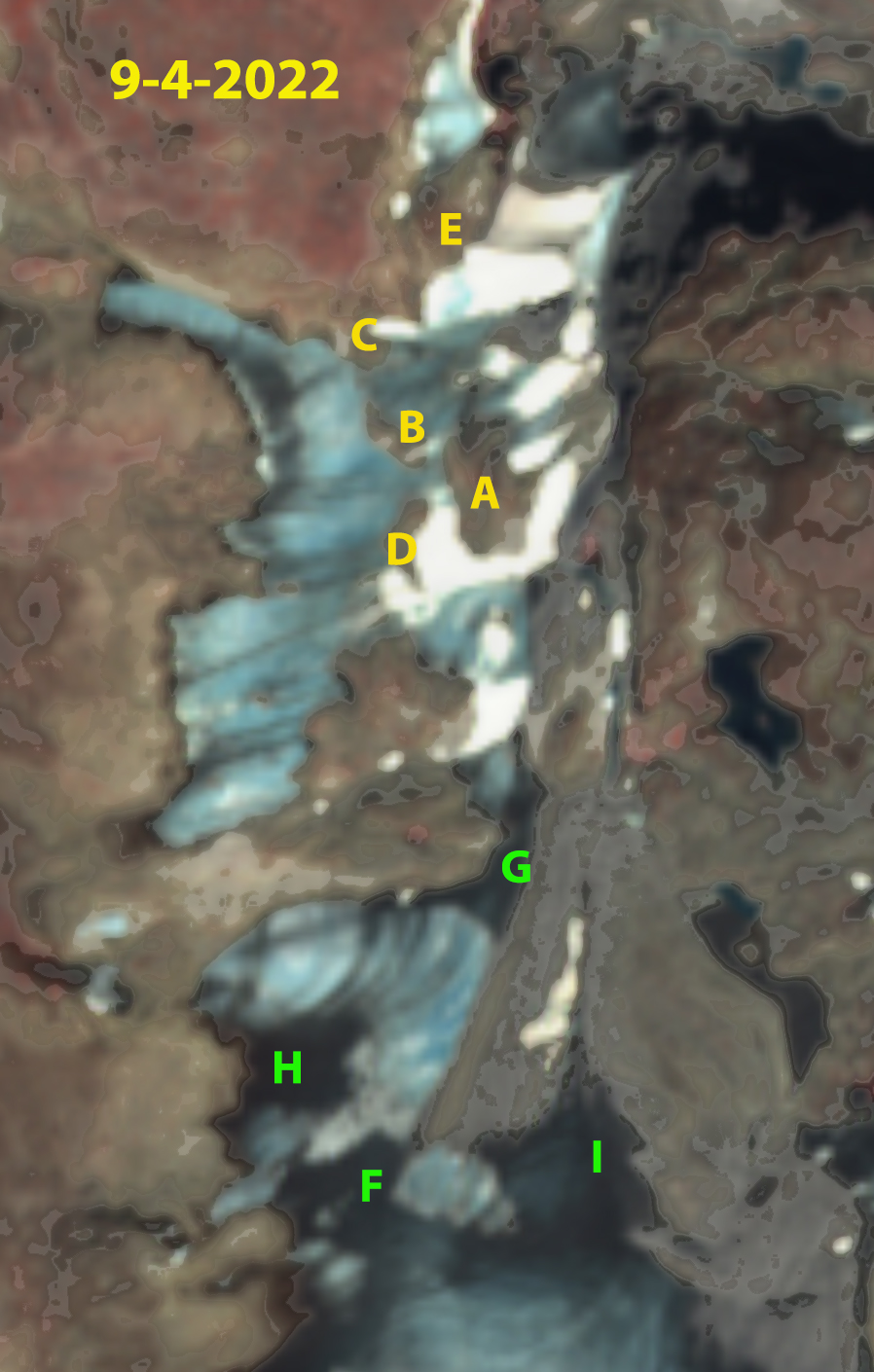
In 2016 the glacier is in three parts and glacier area has been reduced to 1.9 km². By 2022 additional fragmentation at the green arrow in the middle segment is imminent. The northern and southern parts are wasting away rapidly. A closeup of the northern section of the glacier in 2022 illustrates how thin, fragmented, and stagnant the ice has become. Point A-E indicate bedrock areas emerging amidst northern part. Point F-I indicate very thin, old, dark ice in the middle part. This glacier is following a similar path to the Grasshopper Glacier just to the south.  Van Looy et al (2013) noted that in the next century the volume would be reduced by 43% and the glacier would be lost in 300-400 years. The pace of loss has increased significantly with volume loss of ~2% per year since 2013, which will lead to loss of all areas with less than 40 m of ice in 2012 being lost by 2040. The two areas of deep ice will persist much longer. This same trend has led to the loss of Heap Steep Glacier, Harrower Glacier and Twins Glacier in the Wind River Range since 2015.

Screenshot
Screenshot

Continental Glacier in 9-4-2022 false colar Sentinel image. Point A-E are bare rock areas amidst northern part of glacier. Point F-I dark, old thin ice in the middle part.

Grasshopper Glacier, Wyoming Disintegration Underway

Grasshopper Glacier, Connie Glacier, J Glacier and Sourdough Glacier in 1966 map (black outline of glaciers) and in 2022 false color Sentinel image (green dots for glacier outline). The area of Grasshopper Glacier declined from 3.28 km² to 0.81 km². Closeup of area in 2021 and 2022 illustrates the many glacier fragments.

Grasshopper Glacier in the Wind River Range of Wyoming has a southern terminus calving into a lake, and a northern terminus. The southern terminus is calving and retreating expanding the unnamed lake it terminates in and retreated 350 m from 1966-2006 (Pelto, 2010).  The northern terminus retreated 730 m from 1966-2006 the most extensive retreat in the Wind River Range. (Pelto, 2010). The main accumulation area on the west side of the glacier has become segmented by large bare rock areas as noted by comparing the 1966 map and 2006 image. The area declined from 3.28 km² to 2.34 km², a 27% decline (DeVisser and Fountain, 2015).  Thompson et al (2011) noted a 38% loss in area of the 44 Wind River Range glaciers from 1966-2006. Maloof et al (2014) noted an even larger drop in volume of 63% of the same glaciers from 1966-2012.The combined retreat of the two terminus is over 1000 m is 26% of its 1966 length of 3.8 km. In 2006 it was clear that the significant thinning and marginal retreat at the head of the glacier was symptomatic of a glacier that would disappear with current climate.  Here we return to examine how this glacier has fared particularly in the exceptionally warm summers of 2021 and 2022 using false color Sentinel images and comparison with the 1966 map.

In 2021 and 2022 the glacier was nearly snowless by the end of August, this resulted in significant thinning and marginal recession. In 2021 and 2022 there are six glacier fragments with remaining glacier ice that are no longer connected to the glacier. In 2022 the glacier area has declined to 0.81 km², a 75% loss in area since 1966 and a 66% loss since 2006. The overall length from the north to south terminus is now 2.1 km in 2022. What is leading to the rapid area loss is the lack of avalanche accumulation on this glacier and increased summer temperatures, leading to additional ablation. The length is declining less than the area, because the central axis of the glacier has the thickest ice. Because the glacier in many years such as 2021 and 2022 has retained no snowpack, and any snowpack that had been retained in other years, as firn, has also been lost, the glacier no longer has an accumulation zone. With current climate it still will disappear. This is the same forecast as for most Wind River Range glaciers, such as Sacagawea and Mammoth.

Grasshopper Glacier in September 2021 and 2022 false color Sentinel images. Separated glacier fragments numbered 1-6.

Google Earth image with outline of glacier in 2006 and 1966 map outline in orange.

Grasshopper Glacier southern terminus in 2012 Sarah Meiser image.