Rainbow Glacier Fieldwork 8-7-2018

The video is of a single day of field work on Rainbow Glacier on 8-7-2018.  This was our 702nd day of fieldwork during the project that began in 1984.  On this day the field team consisted of Mariama Dryak, Erin McConnell, Jill Pelto and Mauri Pelto. Rainbow Glacier is a valley glacier on the northeast flank of Mount Baker, a stratovolcano and the highest mountain in the North Cascade Range, Washington.  The glacier begins at a saddle at 2200 m sharing a divide with Mazama and Park Glacier.  The glacier descends from the saddle through an icefall at 1950 m into the Rainbow Creek valley terminating at 1400 m.  The consistent accumulation area extends from 1800 m to the saddle region above 1950 m. The glacier tongue features a deeply incised supraglacial stream channel.  From 1984-2018 cumulative mass balance loss has exposed several bedrock knobs along the southern margin of the glacier.

Runoff from the glacier drains into Baker Lake, a reservoir for the Baker Dam hydropower facilities that have a generating capacity of 215 MW. Rainbow Glacier advanced during the 1950-1979 period building a terminal moraine.  At the time of the first field season in 1984 the glacier was still in contact with this moraine.  From 1984-2018 the glacier has retreated 620 m. In 2018 the mass balance was -0.53 m.

Terminus of Rainbow Glacier in 2018


Figure 1 is a map of the Rainbow Glacier indicating the mass balance measurement network.


Mass balance map of Rainbow Glacier in 2017 with mass balance isoline in m of water equivalent (Map by Ben Pelto)

San Lorenzo Sur Glacier, Argentina Retreat 1986-2020

San Lorenzo Sur Glacier in Landsat images from 1986 and 2020.  Yellow arrow is the 2020 terminus location, red arrow the 1986 terminus location, purple dots indicate the snowline. Point A indicates a location at 1400 m where debris cover has expanded.

San Lorenzo Sur Glacier is the main eastern outlet glacier of the Monte San Lorenzo range on the Chile-Argentina border. This Argentina glacier flows east from the border separating into an eastern (sometimes referred to as Rio Lacteo Glacier) and southern terminus tongue, that in 1986 terminated in two small developing proglacial lakes. From 1985 to 2005/2008 Monte San Lorenzo glaciers lost 18.6% of their area (Falaschi et al 2013). In this region glaciers thinned by ~0.5 m/year from 2000-2012 with most of the thinning on  San Lorenzo Sur Glacier occurring on the lower sloped valley section below 1400 m (Falaschi et al 2017). The glacial history of the region has been documented with detailed visual depictions including dated Holocene moraines and trimlines encircling the developing proglacial lakes by Davies et al (2020), see below example. Here we examine the changes in San Lorenzo Sur Glacier from 1986-2020 using Landsat images.

In 1986 the southern terminus ended in a 0.5 km2 proglacial lake, while the eastern terminus ended in a developing proglacial lake of 0.2 km2.  The snowline is at 1350 m and widespread debris cover begins below 1300 m, with Point A being above this elevation.  By 1999 retreat has led to lake expansion at the southern terminus to 0.8 km2 and 1.1 km2 at the eastern terminus.  The snowline is at 1600 m.  In 2016 debris cover has expanded to Point A and the snowline is at 1800-1900 m.  There are numerous small icebergs in the proglacial lake in front of the eastern terminus.  By 2020 the southern terminus has retreated 2.5 km since 1986, and the proglacial lake now has an area of 3.3 km2.  The eastern terminus has retreated 2.9 km since 1986 and the lake now has an area of 3.2 km2.  Debris cover is now widespread at Point A indicating the ablation zone expansion. The lower 2 km of the southern terminus is a heavily debris covered relatively stagnant zone, poised for retreat. The eastern terminus has a stagnant zone that is 0.5 km wide indicating more limited near term potential for retreat and lake expansion.  The snowline is again at 1800-1900 m.  The elevation of snowline is not sufficient to maintain the larger valley tongues of the glacier. The expansion in area and elevation of debris cover has been observed on Northern Patagonia Icefeld glaciers as well (Glassser et al, 2016), for example on Exploradores Glacier.

Retreat here follows that of adjacent Caluqueo Glacier and the Sierra de Sangra region, Argentina and glaciers of the Northern Patagonia Icefield, such as Fiero Glacier and Acodado Glacier.

San Lorenzo Sur Glacier in Landsat images from 1999 and 2016.  Yellow arrow is the 2020 terminus location, red arrow the 1986 terminus location, purple dots indicate the snowline. Point A indicates a location at 1400 m where debris cover has expanded.

In the map above from Davies et al (2020) GIS app.  The Black arrows indicate dated locations on moraines from ~2000-5000 years ago, while the green arrows indicate deglaciation dates from the Little Ice Age period. Yellow arrows on right hand image indicate Holocene moraines.

Calluqueo Glacier, Chile Retreat 1986-2020

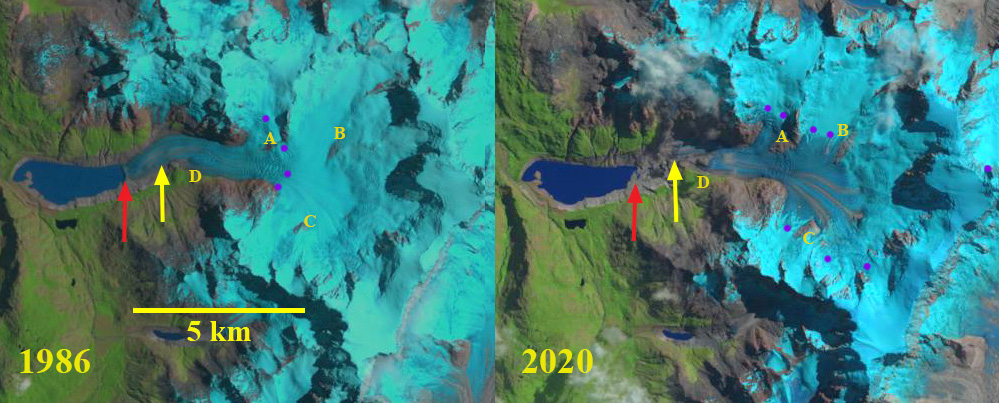
Calluqueo Glacier in Landsat images from 1986 and 2020.  Yellow arrow is the 2020 terminus location, red arrow the 1986 terminus location, purple dots indicate the snowline. Point A-D indicate bedrock areas that have expanded with glacier thinning.

Calluqueo Glacier is the largest glacier of the Monte San Lorenzo range on the Chile-Argentina border. This Chilean glaciers flows west from the border and in 1986 terminated in Lago “Calluqueo”. From 1985 to 2005/2008 Monte San Lorenzo glaciers lost 18.6% of their area (Falaschi et al 2013). In this region glaciers thinned by ~0.5 m/year from 2000-2012 with most of the thinning on Calluqueo Glacier occurring below 1300 m (Falaschi et al 2017). The glacial history of the region has been documented with excellent visual depictions including moraines and trimlines encircling Lago Calluqueo by Davies et al (2020), see below example. Here we examine the changes in Calluqueo Glacier from 1986-2020 using Landsat images.

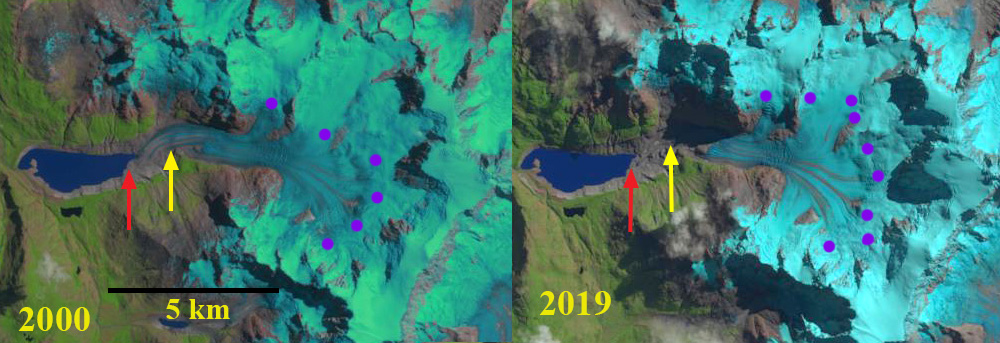
In 1986 Calluqueo Glacier terminated in Lago Calluqueo at an elevation of 450 m, with a 750 m wide calving front in the 1.7 km 2 glacial lake.  Lago Calluqueo is impounded by a stabilized moraine complex, see map below. The snowline was at 1400 m with Point A, B and C locations of limited bedrock exposure in 1986. By 2000 the glacier had retreated to the western shore of the lake that had expanded to 3.0 km2.  The snowline in 2000 was at 1700 m.  In 2019 the glacier has receded from the lake shore far enough so it no longer has any direct interaction or avalanche potential into the lake. The snowline in 2019 is at 1750-1800 m.  By 2020 the glacier has retreated 1500 m since 1986 to an elevation of 700 m, in the vicinity of bedrock knob Point D that emerged from beneath the ice. The bedrock ribs at Point A, B and C have all expanded by more than 100% since 1986 as the glacier thins. The snowline in 2020 is at 1750-1800 m.

Calluqueo Glacier will continue to retreat given the ongoing thinning and recent persistently high snowline +1700 m elevations. The glacial history and landforms generated in this region are illustrated by Davies (2018). Retreat here follows that of the Sierra de Sangra region, Argentina and glaciers of the Northern Patagonia Icefield, such as Fiero Glacier and Acodado Glacier.

Calluqueo Glacier in Landsat images from 2000 and 2019.  Yellow arrow is the 2020 terminus location, red arrow the 1986 terminus location, purple dots indicate the snowline.

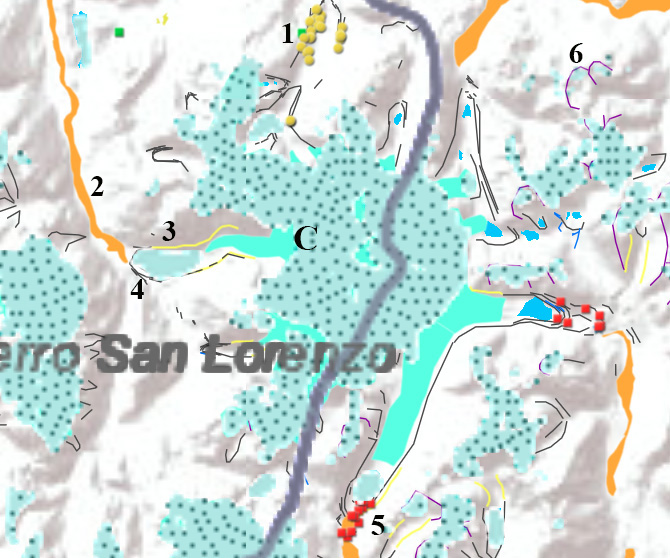
In the map above from Davies et al (2020) GIS app.  1) Cosmogenic Be10 based dates, 2) Sandur, 3) Glacial Trimline, 4) Glacial Moraine, 5) Lichenometry based dates, 6) Empty Cirque. Martin et al (2019) identify 3 and 4 as being of Holocene age formation.

 2) Sandur, 3) Glacial Trimline, 4) Glacial Moraine.  Point A-D same as in top image.

Yalik Glacier, Alaska Retreat and Lake Expansion 1986-2019

Yalik Glacier (Y) in 1986 and 2019 Landsat images.  Red arrow is the 1986 terminus location and yellow arrow the 2019 terminus location. Petrof Glacier (P) is the western neighbor.

Yalik Glacier drains an icefield on the Kenai Peninsula, glaciers draining east are in the  Kenai Fjords National Park, which has a monitoring program.  From 1950-2005 all 27 glaciers in the Kenai Icefield region examined  retreated (Giffen et al 2014).  Yalik Glacier retreated 1057 m from 1950-1986, a rate of-29 m/year and 797 m from 1986-2000, a rate of 57 m/year (Giffen et al 2014).  Here we update the retreat using Landsat images from 1986, 2000, 2018 and 2019.

In the 1950 USGS map of the region Yalik Glacier terminates on a braided outwash plain, and does not have a proglacial lake.  By 1986 there is a 300-400 m wide fringing proglacial lake particularly on the eastern margin with an area of 0.6 km2. The glacier has retreated from the outwash plain into the developing proglacial lake basin.  By 2000 the proglacial lake has expanded to 1.3 km2 due to the ~800 m retreat.  In 2018 the proglacial lake has expanded to 2.1 km2 and a second proglacial lake has formed on the eastern margin.  This proglacial lake will merge with the main lake as the terminus retreats from a peninsula extending from the eastern margin. A bedrock knob has emerged east of Point 1 indicating substantial glacier thinning since 2000. In 2019 the total proglacial lake area is 2.4 km2.  The glacier has retreated 1500 m since 1986 and 700 m since 2000, the latter period has a retreat rate of 34 m/year.  The former braided river  that exited the glacier is now a single meandering stream channel as it leaves the proglacial lake. The retreat of Yalik Glacier is more than nearby Grewingk Glacier and less than nearby Excelsior Glacier.

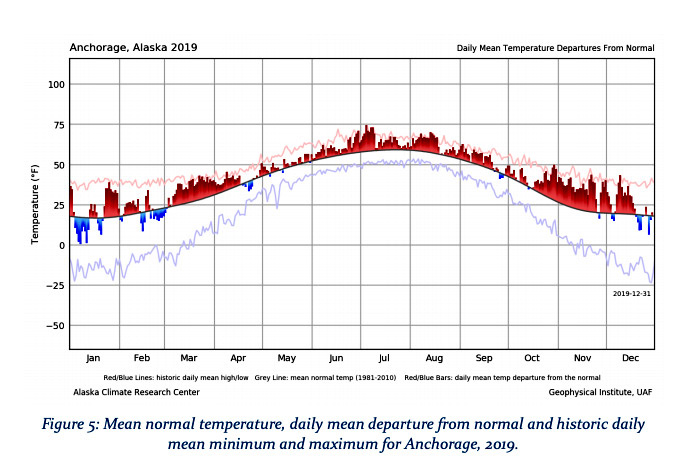
What is driving the retreat is continued warming including warm summers.  The glacier generated few icebergs during this retreat, indicating melting not calving is the key factor. The 2019 Alaska Climate Review indicates 2019 was the state’s warmest year, see Anchorage example from this report below. Temperatures in nearby Homer averaged 4.2 F above normal with June-August averaging 4.4 F above normal.  These conditions also led to forest fires in the area reducing the 2019 image clarity due to forest fire smoke from the Swan Lake fire that burned ~167K acres.

Yalik Glacier in 2000 and 2018 Landsat images.  Red arrow is the 1986 terminus location and yellow arrow the 2019 terminus location. Point 1 is west of a bedrock knob that has emerged due to glacier thinning.

USGS map of Yalik Glacier in 1951

From the 2019 Alaska Climate Review .

Glacier Retreat Drives 400% Lake Expansion Southern Alps, New Zealand 1990-2020

Landsat images  from 1990 and 2020 of the Mueller (M), Hooker (H), Tasman (T) and Murchison (Mn) Glacier.  Red arrows indicate the 1990 terminus location, yellow arrows the 2020 terminus location and pink arrows the upglacier extent of debris cover in 1990.

Glaciers of the Southern Alps of New Zealand have been losing ice volume since 1978, with an increasing rate in the last decade (Pelto, 2016).  Gjermundsen et al (2011) examined glacier area change in the central Southern Alps and found a 17% reduction in area mainly from large valley glaciers such as Hooker, Mueller, Tasman and Murchison Glacier. The NIWA glacier monitoring program noted that  30 per cent of New Zealand’s ice that was existed in the late 1970s has been lost in the past 40 years as snowlines have been rising. The retreat has been driven by a series of  increasingly warm summers (NIWA, 2019). The NIWA and University of Wellington 2020 snowline survey indicated improvement in 2020.  Lauren Vargo and Andrew Lorrey reported there was more retained snowcover compared to the very high snowlines in 2018 and 2019, despite the presence of ash/dust from Australian fires (NIWA, 2020).

If we look back to the 1972 Mount Cook map, see below, no lakes are evident at the terminus of Hooker (H), Mueller (M), Tasman Glacier (T), or Murchison Glacier that all drain into Lake Pukaki, pink dots indicate terminus location. In 1990 four lakes had developed one in front of each retreating glacier with a combined area of 2.5 km2.  By 2020 the combined lake area is 12.9 km2.

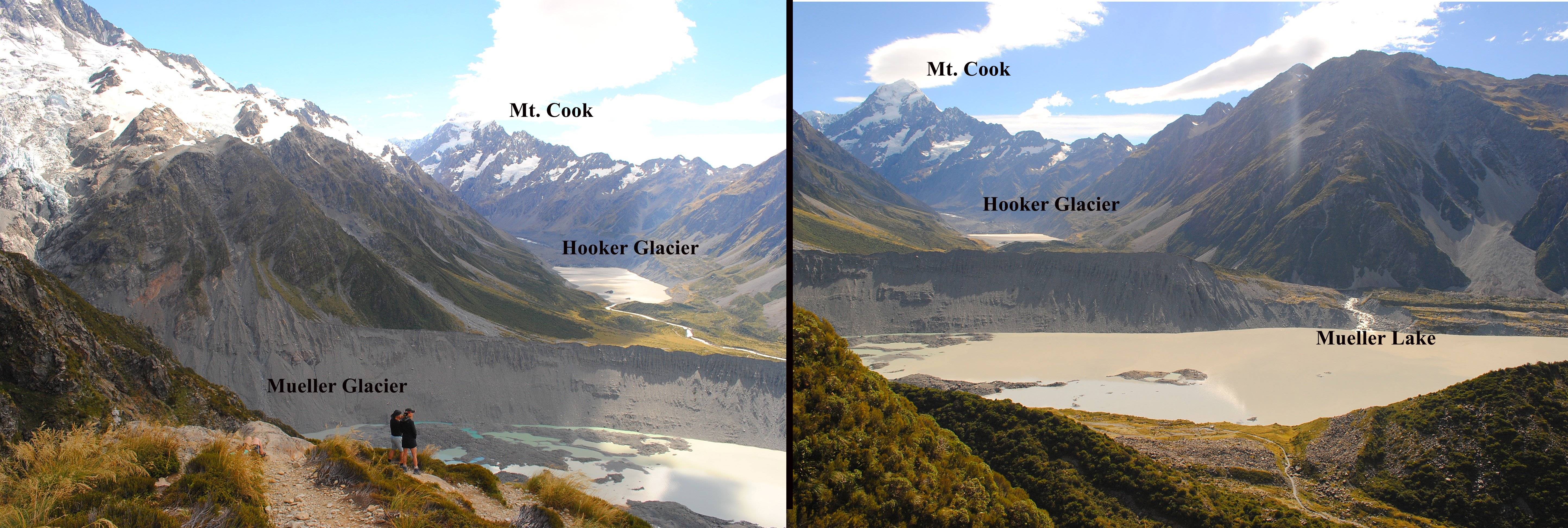
Mueller Glacier has had a 2300 m retreat from 1990-2020, which will continue in the future as the lower 1.2 km section of the glacier is stagnant. Mueller Lake area was under 0.2 km2 in 1990, expanding to 1.9 km2 by 2020. Mueller Glacier’s lower section is not a typical convex valley glacier, but a concave reach of debris covered ice with significant melt valleys and hollows indicating stagnation in the lowest 1.6 km.  In 1990 a fringing discontinuous area of water along the southern glacier margin existed.  By 2004 the Mueller Glacier Lake had expanded to a length of 700 meters.  Mueller Lake in 2010 had a surface area of 0.87 km2 and a maximum depth of 83 m (Robertson et al, 2012). By 2015 the lake had reached 1800 meters in length. From 2015-2020 the terminus collapsed into the lake with icebergs and other attached ice remnants.  Terminus images from 2018, taken by Jill Pelto, indicate the high turbidity of the lake, which is expected from a debris covered ablation zone.

Hooker Glacier retreated 1350 m from 1990 to 2020 with the retreat enhanced by calving in Hooker Lake. The lake had an area of 0.5 km2 in 1990, expanding to 1.5 km2 by 2020. The retreat was faster during the earlier part of this period with lake area reaching 1.22 km2 by 2011 (Robertson et al.,2013). Hooker Glacier has a low gradient which helps reduce its overall velocity and a debris covered ablation zone reducing ablation, both factors increasing response time to climate change  (Quincey and Glasser 2009). Hooker Lake which the glacier ends in began to form around 1982 (Kirkbride, 1993). The peak lake depth is over 130 m, with the terminus moving into shallow water after 2006 leading to declining retreat rates (Robertson et al, 2012). The debris cover now extends ~2 km further upglacier than in 1990.

Tasman Glacier retreated 4900 m from 1990 to 2020 primarily through calving into the expanding proglacial lake. In 1990 Tasman Lake had an area of 1.7 km2, expanding to 7.1 km2 by 2020.  Dykes et al (2011) note a maximum depth of 240 m, and an annual growth rate of 0.34 km2 . The proglacial lake at the terminus continues to expand as the glacier retreats upvalley. The lake is deep with most of the lake exceeding 100 metes in depth, and the valley has little gradient, thus the retreat will continue. It has been noted by researchers at Massey University that the lake can expand in this low elevation valley another 9 km, and that at the current rate this could occur over two decades. The debris cover now extends ~1.5  km further upglacier than in 1990.

Murchison Glacier has retreated 2700 m From 1990 to 2020.  In 1990 the lake had an area of under 0.2 km2, expanding to 2.5 km2 by 2020. The rapid retreat will continue as 2010, 2013 and 2015 imagery indicate other proglacial lakes have now developed 3.5 km above the actual terminus. The debris cover now extends ~2 km further upglacier than in 1990.

For each glacier debris cover now extends further upglacier which along with rising snowlines highlights the expansion of the ablation area, that also drives volume loss, retreat and lake expansion.

Glacier runoff is a key hydropower water resource. Water from Lake Pukaki is sent through a canal into the Lake Ohau watershed and then through six hydropower plants of the Waitaki hydro scheme: Ohau A, B and C. Benmore, Aviemore and Waitaki with a combined output of 1340 MW.  Meridian owns and operates all six hydro stations located from Lake Pūkaki to Waitaki.  Interestingly salmon have been introduced into the Waitaki River system for fishing near its mouth, though Lake Pukaki itself has limited fish.

Mueller Glacier terminus collapse in 2018, image from Jill Pelto.

1972 Map of region when Tasman, Mueller and Hooker Glacier lacked proglacial lakes.

Canals draining from Lake Tekapo to Lake Pukaki then upriver of Lake Benmore

Canal at Ohau hydropower, image from Jill Pelto.

Acodado Glacier, Chile Retreat Yields Tripling in Lake Area 1987-2020

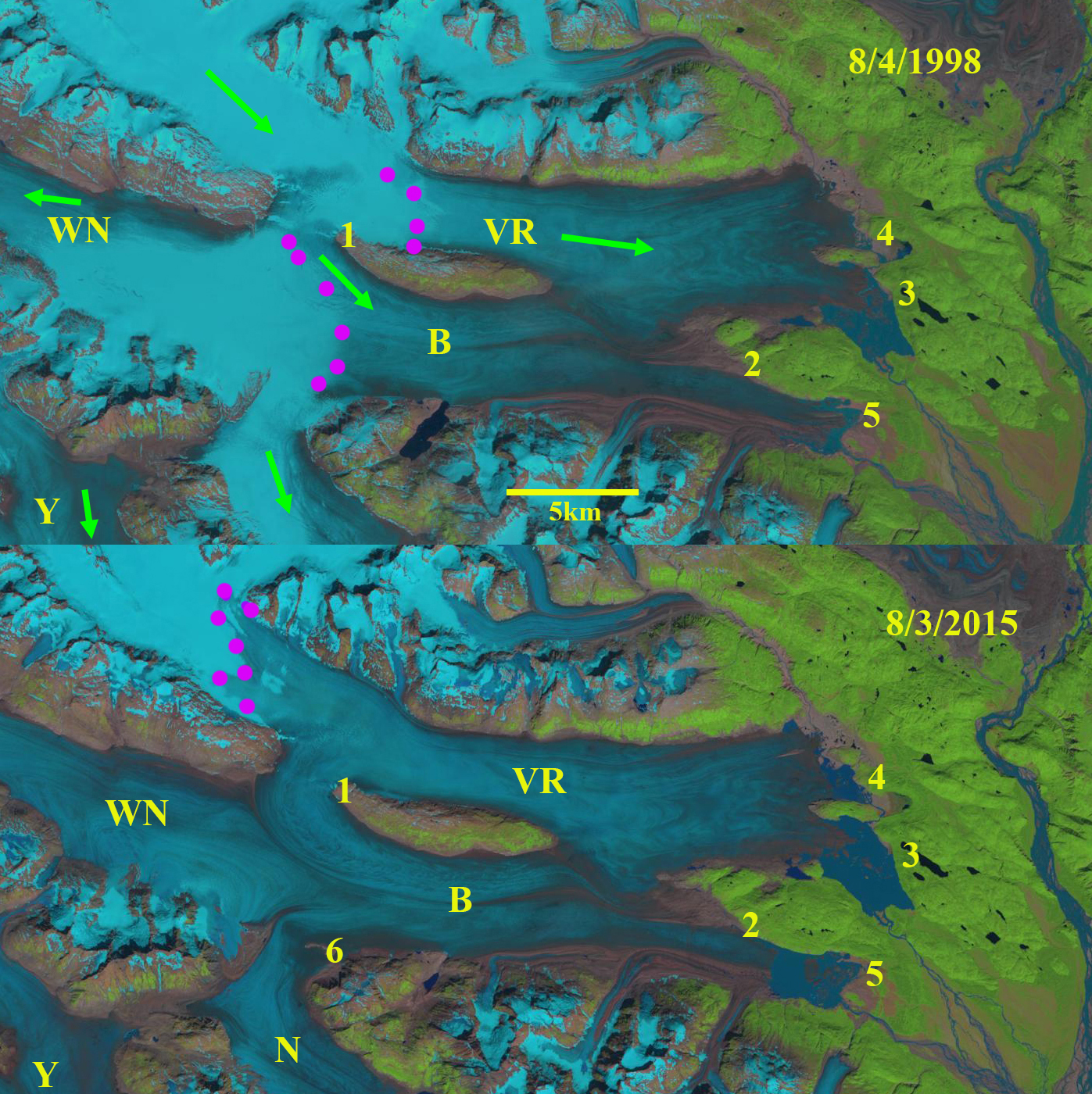
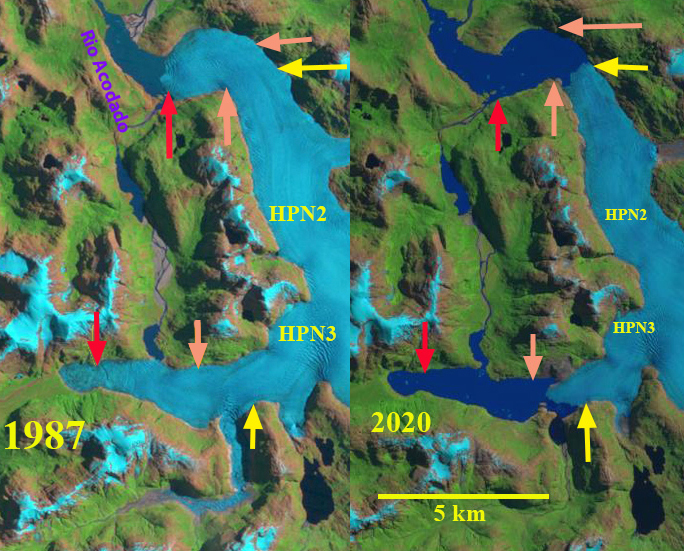
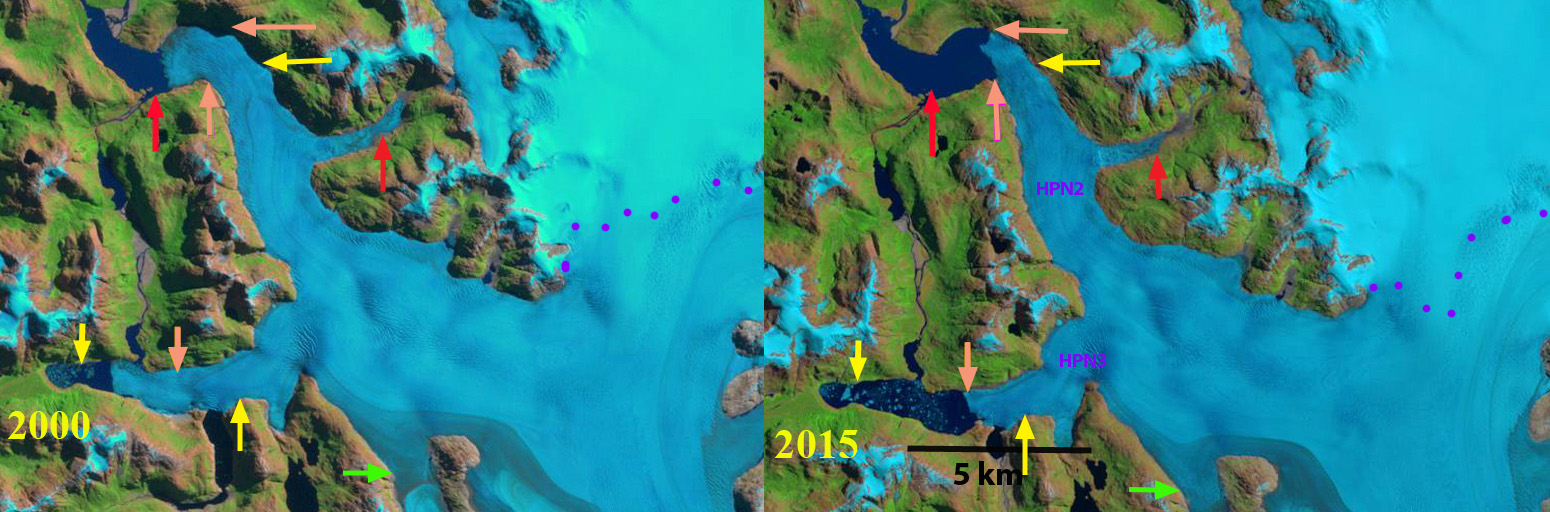
Acodado Glacier retreat and lake expansion observed in 1987 and 2020 Landsat images.  Red arrow is the 1987 terminus locations, orange arrows the 2015 terminus and yellow arrows the 2020 terminus location.  

Loriaux and Casassa (2013) examined the expansion of lakes of the Northern Patagonia Ice Cap (NPI). From 1945 to 2011 lake area expanded 65%, 66 km2. Rio Acodado has two large glacier termini at its headwater, HPN2 and HPN3. that are fed by the same accumulation zone and comprise the Acodado Glacier. The glacier separates from Steffen Glacier at 900 m. The lakes at the terminus of each were first observed in 1976 and had an area of 2.4 and 5.0 km2 in 2011 (Loriaux and Casassa, 2013).  Willis et al (2012) noted a 3.5 m thinning per year from 2001-2011 in the ablation zone of the Acodado Glacier, they also note annual velocity is less than 300 m/year in the ablation zone. Davies and Glasser (2012) noted that the Acodado Glacier termini, HPN2 and HPN3, had retreated at a steadily increasing rate from 1870 to 2011. Here we examine the substantial changes in Acodado Glacier from 1987 to 2020 using Landsat imagery.  Pelto, 2017 reported a retreat from 1987-2015 of 2100 m for HPN2 and 3200 m for HPN3.

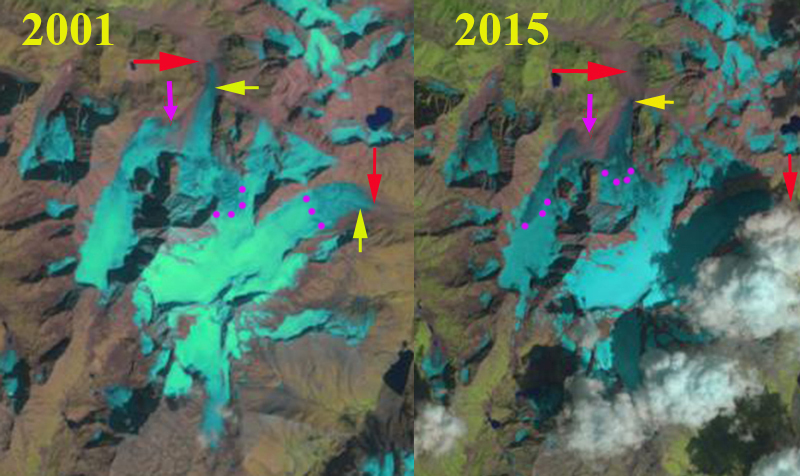
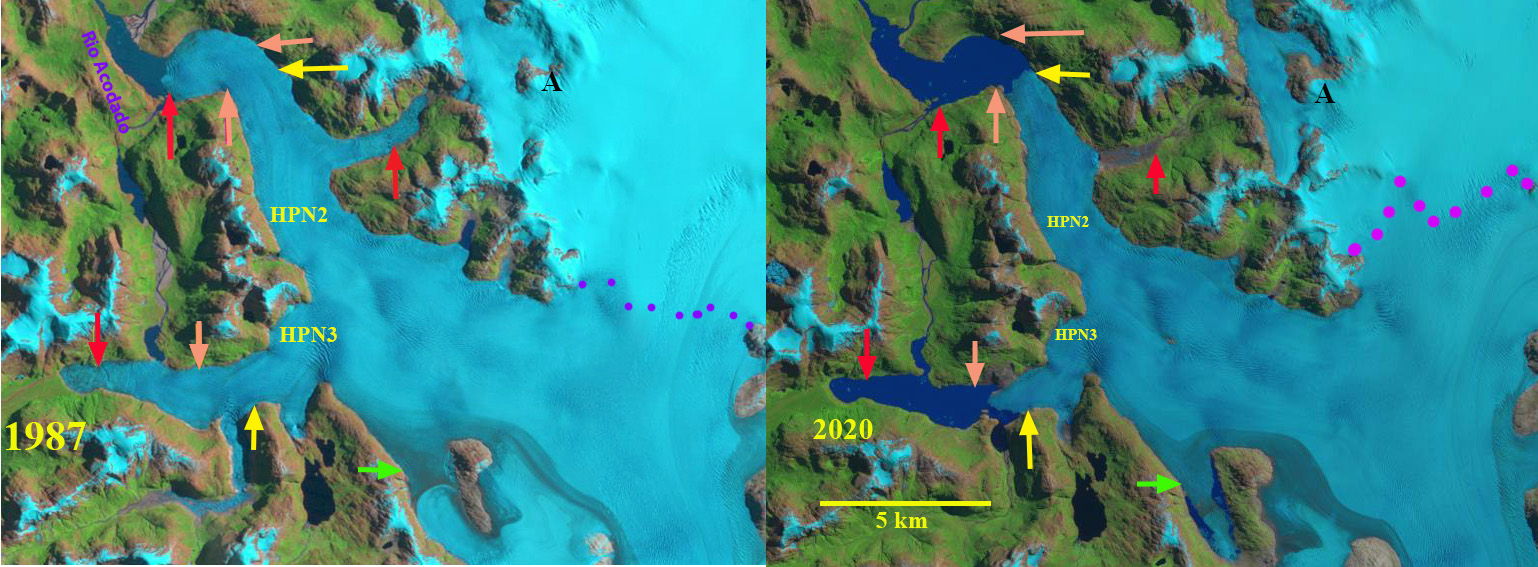
In HPN2 and HPN3 terminate at the red arrow in 1987 , the snowline is at the purple dots at 1000 m. By 2000 the glacier has retreated from the red and yellow arrow by 400 m and 900 m respectively, and the snowline is at 1100 m.  In 2015 it is apparent that HPN2 has retreated 2100 m from the red arrow to the orange arrow.   The snowline was again at 1100 m. In 2020 the snowline in early February was at 1100 m. From 1987-2020 Acodado Glacier terminus HPN2 has retreated 2700 m and HPN3 has retreated 4100 m.  The result of this retreat is an increase in lake area at HPN2 from 2.1 km2 in 1987 to 7.1 km2 in 2020.  At HPN3 lake area expanded from 1.4 km2 to 4.8 km2 . Glasser et al (2016) identified a 40% increase in lake area for the NPI from 1987-2015, much less than the increase at Acodado Glacier. They also note the recent 100 m rise in snowline elevations for the NPI.  The higher snowline indicates warmer temperatures generating high ablation rates, which will leads to reduced ice flux from the accumulation zone to the terminus, which will drive more retreat. Near Point A there are three locations noted in the accumulation zone image below that indicate the reduced ice flow from the accumulation zone into an adjacent outlet glacier. HPN3 has a sharp rise in elevation ~1.5 km above the terminus, before it joins the main Acodado Glacier, it should retreat rapidly toward this point and then calving will end and retreat will slow.  HPN2 has a more gradual slope indicating substantial potential for lake expansion, with a slope significant increase 3 km above the 2020 terminus ,just beyond the former tributary on the east margin.

The retreat here is synonymous with the pattern observed at other NPI outlet glaciers each with rapid calving retreats in expanding proglacial lakes (Glasser et al 2016); Fraenkel Glacier, Benito Glacier and Reichert Glacier and Steffen Glacier. All the outlet glaciers of NPI have retreated significantly in the last 30 years most leading to expanding proglacial lakes (Loriaux and Casassa, 2013;  Pelto, 2017).

Acodado Glacier retreat and lake expansion observed in 1987 and 2020 Landsat images.  Red arrow is the 1987 terminus locations, orange arrows the 2015 terminus and yellow arrows the 2020 terminus location.  The transient snowline is purple dots, the green arrow marks upglacier proglacial lake and Point A is the area of focus of detailed accumulation image below.

Acodado Glacier retreat and lake expansion observed in 2000 and 2015 Landsat images.  Red arrow is the 1987 terminus locations, orange arrows the 2015 terminus and yellow arrows the 2020 terminus location.  The transient snowline is purple dots, the green arrow marks upglacier proglacial lake and Point A is the area of focus of detailed accumulation image below.

Note the expansion of bedrock at points 1,2 and 3 indicating reduced flow from the accumulation to the ablation zone near Point A

Ålfotbreen, Norway Mass Balance Large Loss in 2019

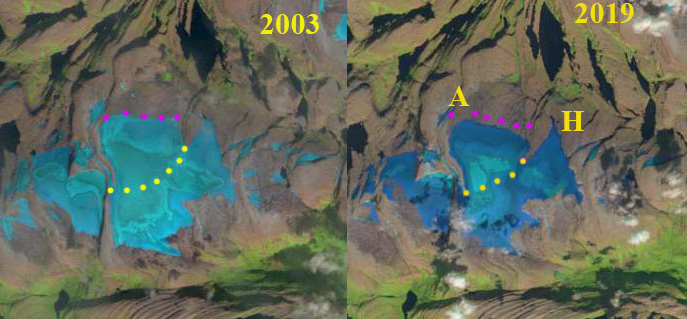
Ålfotbreen (A) in August 2003 and 2019 Landsat images.  The yellow line marks the divide between Ålfotbreen and Hansebreen (H). Pink dots indicate the 2003 margin.  There is no retained snowpack in 2003.  In 2019 there are two small patches near the divide  on Aug. 26 that melt away by the end of the summer.

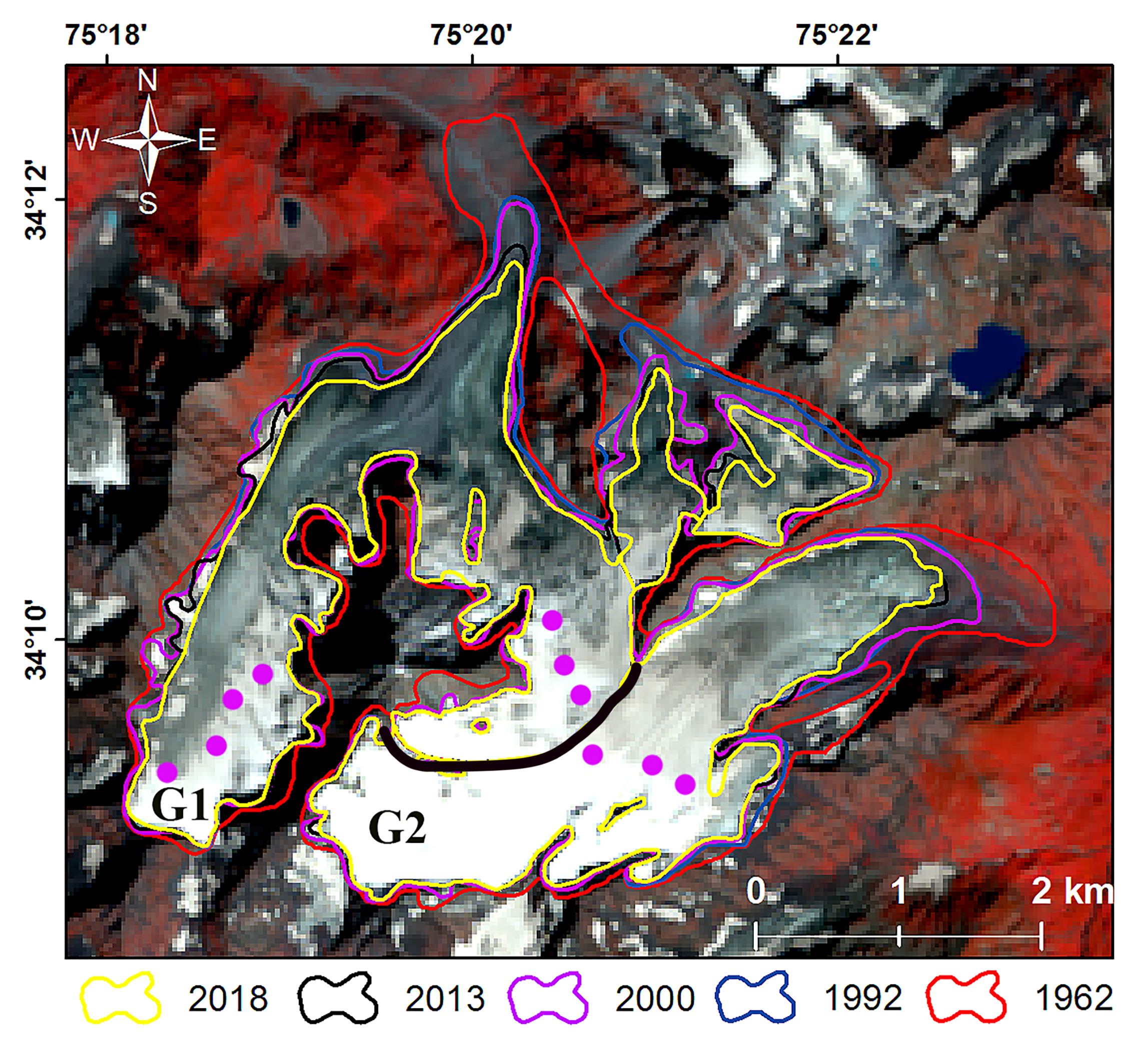
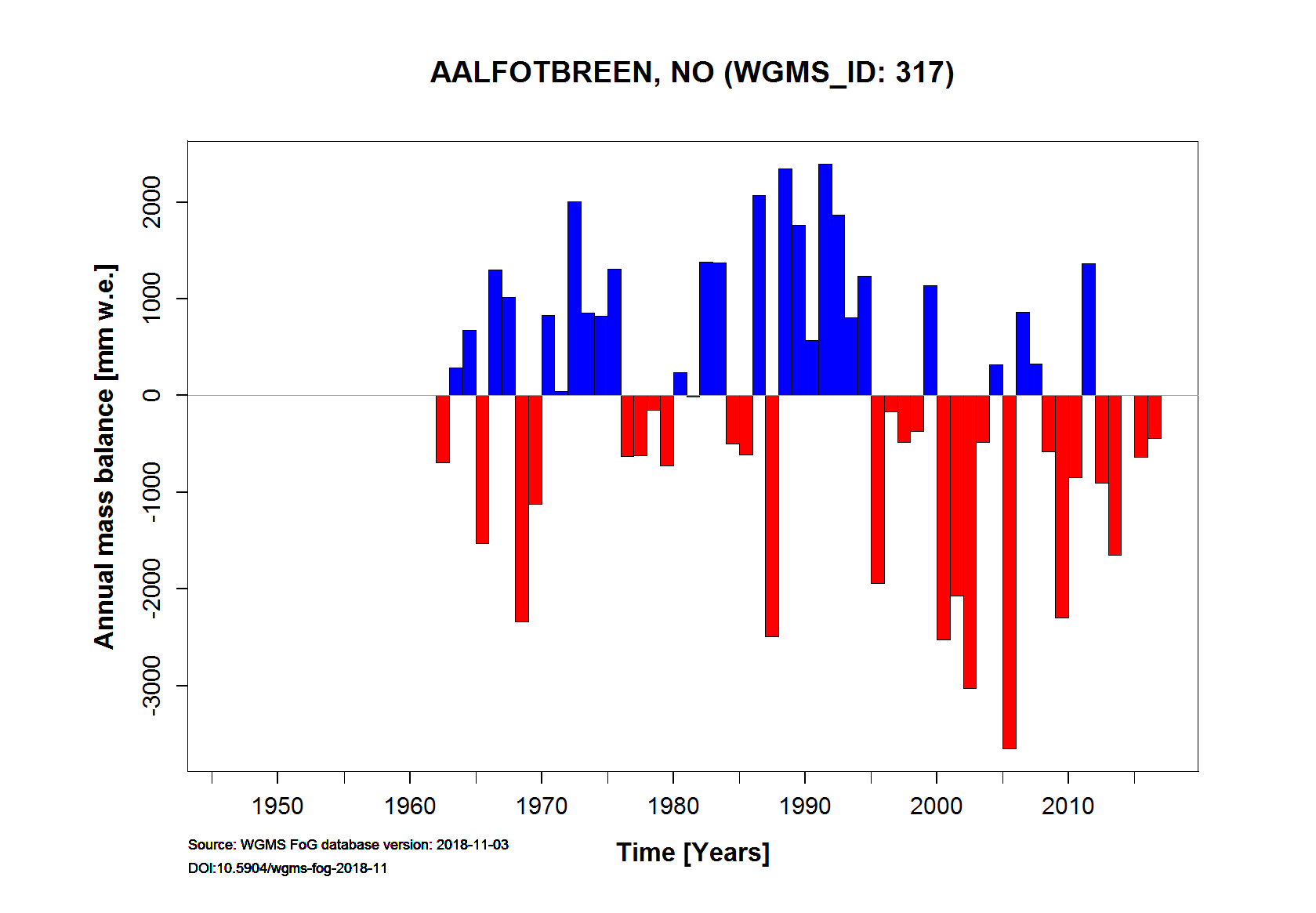
The Ålfotbreen Ice Cap , Norway (61°45’N, 5°40’E; area=17 km2) is the westernmost and most maritime glacier in Norway. Mass balance studies have been carried out on one of the glaciers of the ice cap since 1963, Ålfotbreen and since 1986 on Hansebreen, by the Norwegian Water Resources and Energy Directorate. Both of these glaciers supply runoff to the Askara Kraftwerk an 85 MW hydropower plant completed in 1973.  Ålfotbreen is a reference glacier for the World Glacier Monitoring Service (WGMS). From 1963-2000 the mean annual mass balance of Ålfotbreen was +0.9 m/year (see below).  From 2001-2019 the mean annual mass balance has been -1.7 m/year.  From 2001-2019 there have been seven years where the mass loss has been greater than 2 m.  This only occurs when all of the retained accumulation from the previous winter is lost.

To be in equilibrium Ålfotbreen must have at least 55% of its area still covered by snow at the end of the summer.  In On August 3, 2003 the glacier had lost all of its snowcover, with more than a month left in the melt season.  The majority of the glacier surface is firn that is several years old, but not fully transformed to glacier ice.  The mass balance in 2003 was  very negative at -3.03 m.  The winter mass balance measured in early May was 2.26 m with a summer balance of -5.29 m.  Glacier runoff during the melt season of 2003 from Ålfotbreen is the product of its area at that time 4.4 km2 and summer balance, which yields 23 million m3. On Aug. 26, 2019 the glacier has two small areas of retained snowpack near the divide, light blue. There is a substantial area of darker blue-glacier ice exposed and medium blue firn exposed. The accumulation area ratio is 15% on Aug. 26, 2019 and was 0% by the end of the melt season.  The final mass balance in 2019 was -2.4 m with a winter balance of 2.38 m and a summer balance of -4.82 m.  The glacier area in 2019 is ~3.8 km2, yielding melt season glacier runoff of 18 million m3. This is 20-25% less runoff than in 2020 due to 10% lower melt per unit area and a ~15% reduction in glacier area. In 7 of the last 19 summers no snowcover remained at the end the melt season, this indicates the accumulation zone is not persistent, suggesting this glacier cannot survive current climate. This glacier has no slopes to deliver avalanche accumulation and is dependent on direct snowfall and wind drifted snowfall.

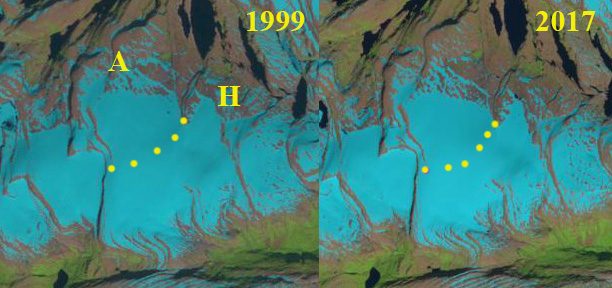
In contrast snowcover was 100% on July 17, 2017 and August 3, 1999, both years ended the melt season with smaller negative balances of -0.75 m and -0.37 m respectively. This illustrates the vast difference in exposed glacier ice between large negative balance years such as 2003 and 2019 and years with a smal negative or postiive balance.

The loss in glacier area has been due to a retreat of the broad terminus of the glacier, pink dots, ~150 m from 2003-2019. This retreat is less than at Harbardsbreen or Tunsbergdalsbreen.  Continued reductions in glacier area, will lead to a continued decline in glacier runoff and available water resources for summer hydropower production.

Ålfotbreen (A) in August 1999 and July 2017 Landsat images.  The yellow line marks the divide between Ålfotbreen and Hansebreen (H).

Map of the Ålfotbreen ice Cap form the Norway Glacier Atlas 

Mass balance record of the Alfotbreen from the WGMS.


Boydell Glacier Accumulation Zone Rapid Melt Feature Development February 2020

Boydell Glacier terminates at the island adjacent to Point A.  The accumulation zone between Point A, B and C is on January 12, 2020 has limited gray area indicating bare firn.  By Feb. 13 there is considerable cobalt blue snow/firn areas saturated with melt water. The yellow dots mark the margin of the ice sheet and pink dots the margin of the ablation zone on Feb. 13, 2020. 

The Boydell Glacier, Antarctic Peninsula is fed in part by a plateau to its north.  Boydell Glacier has experienced a substantial retreat of 6.5 km from 2001-2017 and in 1990 was part of the Prince Gustav Ice shelf that has disintegrated (Cook and Vaughan, 2010). Antarctic temperature records were set at Esperenza and Marambio Base. in early February 2020.  Here we examine the  impact of period of record warm weather over the Antarctic Peninsula on a portion of the Boydell Glacier’s accumulation zone north of its terminus (64.1 S 58.9 W), ~100 km from Esperanza, using Landsat images from January 12-February 13, 2020 to identify surface melt extent and surface melt feature development. A.

Xavier Fettweis, University of Liege Belgium, using the MAR climate model output forced by the Global Forecast System (GFS) to generate daily melt maps for Antarctica, for Esperanza the melt map for recent weeks, shown below indicates that daily melt increased to above 30 mm/day, with a maximum temperature on the warmest day of 18.3 C (65 F). On the Boydell Glacier accumulation plateau  is dominated by surface snowpack on January 12, 2020.  On Feb. 13, 2020 significant cobalt blue snow/firn melt water saturated zones have developed in the accumulation zone covering 4 km2 and in a few localities in the ablation zone. This melt water will likely refreeze in the firn/snowpack of the accumulation zone and not be lost from the system, whereas melt in the ablation zone near Point A and Point D would be quickly lost from the system.  The ablation zone is denoted by pink dots for Feb. 13, 2020..

The Boydell Glacier accumulation zone in 207 and 2018 lacks any melt water saturation features.

The accumulation zone in REMA Antarctica image indicating surface contours at 100 m intervals.

Meltwater production time series at Esperanza Base from MAR-GFS From Xavier Fettweis


Record Antarctic Temperatures in Feb. 2020 Impact on Eagle Island Ice Cap

Eagle Island Ice Cap, Antarctica in Landsat images from Feb. 4, 2020 and Feb. 13, 2020.  Point E indicates an are area of snow/firn that is saturated with meltwater. Point A and B indicate locations where the amount of bare rock/ground and hence albedo have changed dramatically.
This post was source for an article by Kasha Patel published by NASA Earth Observatory
, CNN and Washington Post.

Update in December 2022 snowcover is less extensive than observed in 2020 or 2021.

The impact of period of record warm weather over the Antarctic Peninsula has been the rapid development of melt features on some of the glaciers near the tip of the Peninsula, where the temperature records were set at Esperenza and Marambio Base. Here we examine Landsat imagery of the Eagle Island Ice Cap (63.65 S 55.50W), 40 km from Esperanza, from January 12-February 13, 2020 to identify surface melt extent and surface melt feature development. Xavier Fettweis, University of Liege Belgium, using the MAR climate model output forced by the Global Forecast System (GFS) to generate daily melt maps for Antarctica, for Esperanza the melt map for recent weeks, shown below indicates that daily melt increased to above 30 mm/day, with a maximum temperature on the warmest day of 18.3 C (65 F). This compares to melt rates seen on the warmest days on temperate glaciers, such as the North Cascade Range, Washington of 80 mm/day and averaging 24 mm/day for the warmest months (Pelto, 2018).  This short term weather event fits into the pattern of overall regional warming that has led to a rapid glaciological response, with 87% of glaciers around the Antarctic Peninsula receding Davies et al (2012). The event regionally was examined by Robinson et al (2020),who noted implications for flora.

On January 12, 2020 Landsat imagery indicates a substantial area of bare ice/firn (gray-blue) on the western outlet glacier near Point A.  The brighter electric blue color indicates accumulated snow from the most recent winter season, this covers 60% of the ice cap.  The Jan. 27 image shows little change in the snowcover extent or the extent of older firn and ice exposed by melt.  The Feb. 4, 2020 image indicates a new snowfall has covered the ice cap. The precipitation graph provided by Xavier Fettweis indicates two snow events between Jan. 28 and Feb. 4 of approximately 5 mm water equivalent each.  The warm temperatures began on Feb 5 and continued up to the date of the Landsat image on Feb. 13. At Point E is a ~1.5 km2 area of cobalt blue that indicates snow/firn pack that is saturated with meltwater that has quickly developed.  There is an additional ring of saturated snow/firn northeast of Point E.  The snow swamp that has developed is due to the combination of melt, a total of 106 mm by Xavier’s model from Feb.6-Feb.11 and a rain event that occurred on Feb. 12 of ~6 mm. Peak melt reached 30 mm on Feb.6 similar to that at Esperanza. Point E is at the summit of the icecap between 250 and 300 m elevation. The area of bare ice (blue-gray) has expanded at Point A and Point B.  This higher albedo will enhance ablation in the near future before new snowfall covers the ice cap again.  The bedrock area near Point B has also expanded merging a couple of isolated bedrock knobs.

The impact of short term melt events like this on an ice cap like this, is visible and significant for annual mass balance, but not large in terms of long term glacier mass balance (volume change) and area.  The accumulation rate on nearby James Ross Island is ~600 mm/year.  Hence, this one melt event represents the loss of ~20% of the seasonal accumulation (Abram et al. 2011).  In Antarctica specific anomalously warm days are when most mass balance losses occur. Barrand et al (2013) note a strong positive and significant trend in melt conditions in the region.The increasing frequency and cumulative impact of events like this is significant to mass balance. Mass balance regionally has been negative driving retreat and ice shelf disintegration as noted at nearby Mondor Glacier, Muller Ice Shelf and Eyrie Bay.

Eagle Island Ice Cap, Antarctica in Landsat images from Jan. 12, 2020 and Jan. 27, 2020.  Point E indicates the top of the ice cap and it is an area of snowcover. Point A is adjacent to outlet glacier that has bare ice exposed. Point B is above a fringing area of bare firn and ice at the southern margin of the ice cap and island.

Meltwater production time series at Esperanza Base from MAR-GFS From Xavier Fettweis

Meltwater production time series at Eagle Island from MAR-GFS From Xavier Fettweis

Precipitation time series at Eagle Island from MAR-GFS From Xavier Fettweis

Eagle Island in Antarctica REMA viewer from Feb. 2017 indicating the snocovered ice cap with some melt area near the outlet glacier to the northwest and on the southern margin. the right hand image is the DEM of the area contoured in 25 m intervals With summit area of the ice cap above 250 m.

Eyrie Bay, Antarctic Peninsula Retreat 2000-2020

From REMA Landsat images from Feb. 2016 and Oct. 2019 indicating the front of the Cugnot Ice Piedmont (CP)  and Broad Valley (BV) ice fronts in Eyrie Bay.  Point A, B, and C indicate specific bedrock knobs near the ice front.  Point D is just south of a side glacier entering the bay.

Eyrie Bay is near the tip of the Antarctic Peninsula and is rimmed by tidewater glaciers including the Cugnot Ice Piedmont.  The changes of the ice front fed by the Cugnot and from Broad Valley were mapped by Ferrigno et al (2008)   They noted a retreat from 1956-1977 averaging 36 m/year from 1977-1988 a retreat of 12 m/year, and 6 m/year from 1988-2000. Here we examine Landsat imagery from 2000-2020 to identify changes of the two glacier fronts. The continued significant warming air temperatures on the Antarctic Peninsula have increased surface ablation in the region (Barrand et al 2013), with 87% of glaciers around the Antarctic Peninsula now receding Davies et al (2012) . The most dramatic response has been the collapse of several ice shelves, Jones, Prince Gustav, Wordie, Larsen A and Larsen B. The  nearby Prince Gustav Ice Shelf connecting James Ross Island to the Trinity Peninsula collapsed after 1995 (Glasser et al 2011).

In 2000  the Broad Valley terminus (BV) extended 500 m beyond bedrock knob at Point A and 1400 m eastward beyond the bedrock knobPoint B. The Cugnot Ice Piedmont terminus (CP) extended from the northern tip of the bedrock knob at Point C. In 2016 the BV terminus in Eyrie Bay was 600 m east of the Point A bedrock knob and 1200 m east of the Point B bedrock knob.  By October 2019 the BV ice front had retreated to the bedrock knob at Point B and terminated near the western end of the bedrock knob at Point A, with just a narrow band of fringing ice around Point A. At Point C a small embayment has developed along the west margin of the CP terminus and the embayment near Point D has become wider and move concave.

The surface slope upglacier of the BV terminus rises quickly indicating a rising bedrock topography too, which should slow retreat in the near future.  The CP terminus has a gradual even slope suggesting there will be continued retreat. The retreat of glaciers in this region has been attributed to both atmospheric warming in the region driving surface melt increases , and in some cases increasing ocean temperatures and ice shelf bottom melting (Barrand et al 2013; Davies et al 2014).

Landsat images from 2000 and 2020 indicating the front of the Cugnot Piedmont (CP)  and Broad Valley (BV) ice fronts in Eyrie Bay.  Point A, B, and C indicate specific bedrock knobs near the ice front.  Point D is just south of a side glacier entering the bay.

From REMA Antarctica contour of Broad Valley (BV) and  Cugnot Ice Piedmont (CP), contour interval is 25 m.

Scott Glacier, Alberta Retreat 1987-2019

Scott Glacier, Alberta in 1987 and 2019 Landsat images. Yellow arrow indicates the 2019 terminus location and Point A and B are areas of bedrock expansion amidst the glacier.

Scott Glacier is the largest outlet glacier of the Hooker Icefield the drains into the Whirpool River and then the Athabasca River.  The icefield straddles the BC/Alberta border. Jiskoot et al (2009) examined the behavior of the Clemenceau-Chaba Icefield, 25 km south finding that from the mid 1980’s to 2001 the Clemenceau Icefield glaciers lost 42 square kilometers, or 14% of their area. On Columbia Icefield 60 km to the southeast Tennant and Menounos (2013) found that from 1919-2009 glaciers had a mean retreat of 1150 m and mean thinning of 49 m for glaciers, with the fastest rate of loss from  2000-2009.

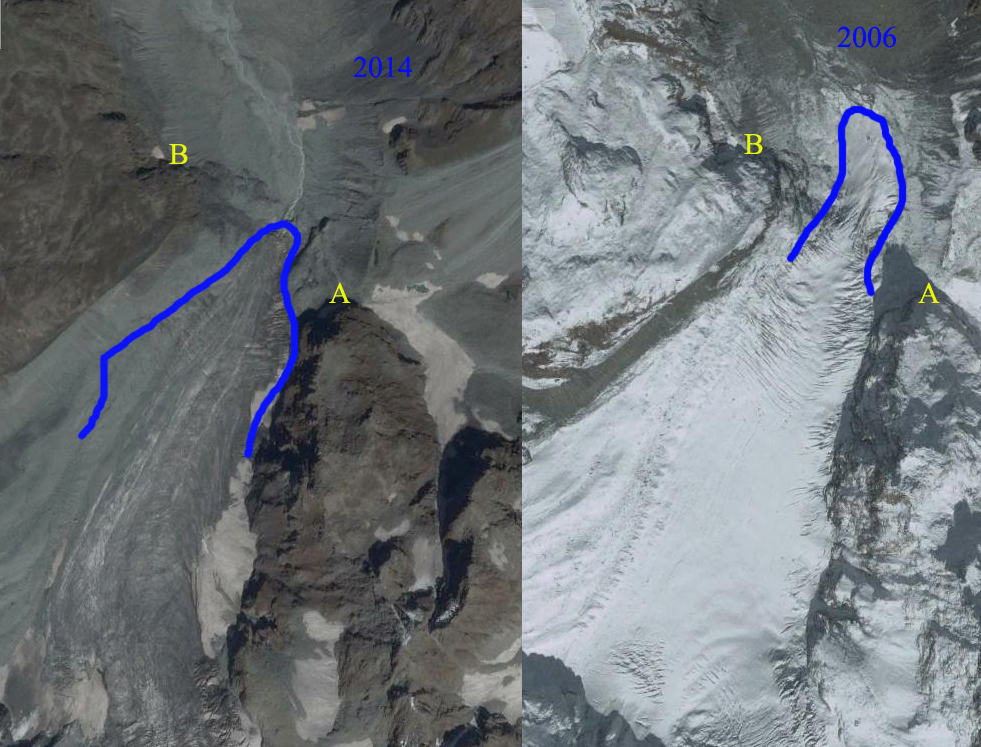
The Scott Glacier in 1987 had terminated at 1500 m, within 300 m of an alpine lake.  At Point A there is a convex aspect to the glacier as it passes over a subglacial knob.  The snowline is near this knob at 2200 m.  In 1998 there is limited retreat of the main terminus and Point A is still beneath the ice. The snowline is just above Point A at 2250 m. In 2014 the glacier has retreated to the base of a step at ~1800 m.  The snowline is well above Point A at 2450 m.  In 2019 the terminus has retreated 750 m since 1987.  Point A has emerged as a bedrock knob at the glacier surface.  At Point B a rock rib has widened since 1987 and extends further into the heart of the glacier. The snowline in 2019 is at 2400 m at the end of July.

Scott Glacier’s retreat is less extensive than other nearby glaciers such as Chaba Glacier ,  Cummins Glacier and  Columbia Glacier.

Scott Glacier, Alberta in 1998 and 2014 Landsat images. Yellow arrow indicates the 2019 terminus location and Point A and B are areas of bedrock expansion amidst the glacier.

Scott Glacier map indicating the glacier margins in the 1990’s.


Scott Glacier Digital Globe image indicating 1987 terminus location (red arrow) and 2019 terminus location yellow arrow. Point A is where bedrock is emerging and Point B is where the bedrock ridge is extending across glacier. Both Point A and B indicate bedrock steps that the glacier steepens as it flows over. The glacier remains crevassed to the front indicating no stagnant zone.


Reqiang and Jicongpu Glacier Retreat, Lake Expansion and Moraine Stability Increase

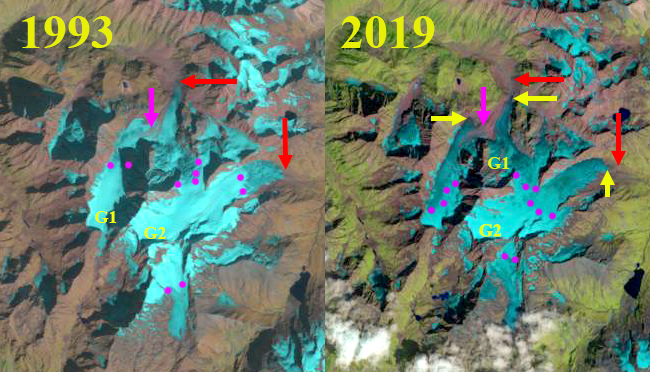
Reqiang Glacier (R) and Jicongpu Glacier (J) in 1993 and 2019 Landsat images.  M=Moraine, red arrow is the 1993 terminus location, yellow arrow the 2019 terminus location and purple dots the snowline.

Requiang Glacier, Tibet is just east of Shishapangma Mountain one of planets 14 peaks that exceed 8000 m and terminates in the rapidly expanding proglacial lake Gangxico at 5200 m. Jicongpu Glacier drains south from Shishapangma terminating in the proglacial lake Galongco at 5100 m. Both glaciers are fed by avalanching from the high slopes of  Shishapangma. Reqiang Glacier has been undergoing a rapid retreat since 1976, Li et al (2011) noted the retreat of 65.7 m/year from 1976-2006.  The retreat of this glacier fit the pattern of all 32 reported and was due to that increasing temperature. Zhang et al (2019)  observed that from 1974-2014 Galongco and Gangxico lakes expanded by ~500% (0.45 km2 /year) and ~107% (0.34 km/year.  As the lakes have expanded the wide moraines impounding the lakes have not experienced visible change. Here we examine the retreat of Reqiang and Jicongpu Glacier from 1993-2019 using Landsat imagery and the GLOF risk of Galongco and Gangxico.

Glacier lake outburst floods (GLOF) are a significant hazard in glaciated mountain ranges. The principal causes of GLOF are ice dam failure, moraine dam failure and/or avalanching into a lake.  Harrison et al (2018) noted there has been a decline in recent decades of GLOF events globally and in the Himalaya due to moraine dam failure.  In the Himalaya the main cause of moraine dam failure is ice avalanches into the lake. This decline has occurred during a period of rapid glacier retreat and the formation of many more alpine lakes. Hence, the number of locations where a potential GLOF could occur has increased, but the actual risk of any particular location generating a GLOF has declined even more.  Carrivick and Tweed (2016) observed that the number of GLOF’s due to all causes globally has declined since the mid 1990’s, and that this decline is not a reporting issue, since reporting has gotten better.  The main cause of the 1348 GLOF’s that they archived had been ice dam failure at 70%.  How has the retreat of Reqiang and Jicongpu Glacier impacted the risk of a GLOF?

In 1993 Reqiang Glacier terminated in a 3.1 km long Gangxico, which had an area of 2.9 km2.  The lowest 2.5 km of the glacier had a low slope and the snowline was above this at 5500 m.  Jicongpu Glacier terminated in a 2.8 km long Galongco with an area of 2.6 km2 and had a 3.5 km low slope debris covered terminus zone. By 2000 Reqiang Glacier had retreated 400 m and the low slope terminus tongue had a significant expansion of debris cover. Jicongpu Glacier had retreated 300-400 m.  By 2018 Reqiang Glacier had retreated 1900 m, the glacier snowline is only 1 km from the calving front at ~5500 m.  Jicongpu Glacier has retreated 2100 m on the east side and 1400 m on the western margin of the lake.  The debris covered area has been reduced to ~1 km2. From 1993-2019 Reqiang Glacier has retreated at a rate of ~95 m/year.  Gangxico  has expanded to an area of 4.6 km2 and is 5.0 km long. The snowline on Reqiang Glacier has been consistent in location in each of the years.  Jicongpu Glacier has retreated at an average rate of ~70 m/year.  Galongco has expanded to an area of 5.5 km2.

At Reqiang Glacier the moraine band impounding Gangxico is 1950 m wide and does not have visible signs of change.  With time since emplacement and retreat of the glacier into the lake the moraine will stabilize more.  Given the continued even if slow increased  moraine stability and the large moraines width the risk of dam failure is limited. At Jicongpu Glacier the moraine band is 1200 m wide impounding Galongco, again considerable.  These two glacier indicate the competing factors for GLOF risk, the size and stability of the moraine, versus the expanding volume of the lake.  Similarly a retreating glacier can reduce the ice avalanche hazard as the lake expands and ice slope diminish or the retreating glacier can provide access to steeper ice slope depending on the specific topography.  Zhang et al (2019) suggest both lakes have limited room to expand as they near a glacier surface slope increase.The retreat of these two glaciers follows that of many alpine glaciers in the region where lakes exist at the terminus which has enhanced retreat such as at Yanong Glacier and Drogpa Nagtsang Glacier.

Reqiang Glacier (R) and Jicongpu Glacier (J) in 2000 and 2018 Landsat images.  M=Moraine, red arrow is the 1993 terminus location, yellow arrow the 2019 terminus location and purple dots the snowline.

Gangxico Lake fed by Reqiang Glacier in Digital Globe image from 2015 indicating the moraine that impounds the lake with yellow arrows.

Galongco Lake fed by Jicongpu Glacier in Digital Globe image from 2015 indicating the moraine that impounds the lake with yellow arrows.