Lemon Creek Glacier 2018 Ablation and Glacier Runoff

Lemon Creek Glacier (L) with the snowline (black line) indicated in Landsat images from July 5, July 30 and Sept. 16 2018. P=Ptarmigan Glacier, T=Thomas Glacier, red arrow is the 1948 terminus location. A,B and C mark firn horizons exposed by the loss of all snowpack in the accumulation zone.

The summer of 2018 was exceptional for warmth in Southeast Alaska.  July was the most unusual with Juneau recording daily highs above 70 F on 18 days, including 12 consecutive days at the end of the month.  The average temperature in July in Juneau was 2.4 C above average and the warmest average monthly temperature in history. Precipitation was recorded on just 6 days of precipitation at the Long Lake SNOTEL site in the mountains near Juneau. This resulted in the highest observed snowline of the 70 year record on Taku Glacier, a 25 km2 snow swamp developing in three days on Lowell Glacier and the loss of all snowpack on Lemon Creek Glacier.  For a glacier to be in equilibrium most glaciers need to be more than 50% snowcovered.  On Lemon Creek Glacier at the end of the summer the glacier must be covered 62% to be in equilibrium (Pelto et al 2013).  The Lemon Creek Glacier is a reference glacier of the World Glacier Monitoring Service, with mass balance measured since 1953 by the Juneau Icefield Research Program (JIRP).  The USGS began monitoring the glacier in 2016 and currently reports mass balance to WGMS, Chris McNeil (USGS) is leading a reanalysis of the mass balance record. The cumulative mass loss from 1953-2018 is ~37 m w.e, with 2018 having the most negative balance of -2.31 m w.e. The area of the glacier has declined from 12.8 square kilometers in 1948 to 9.7 square kilometers in 2018, a 24% decline.  For the glacier to provide an equivalent runoff ablation rates would have had to rise by 24%.

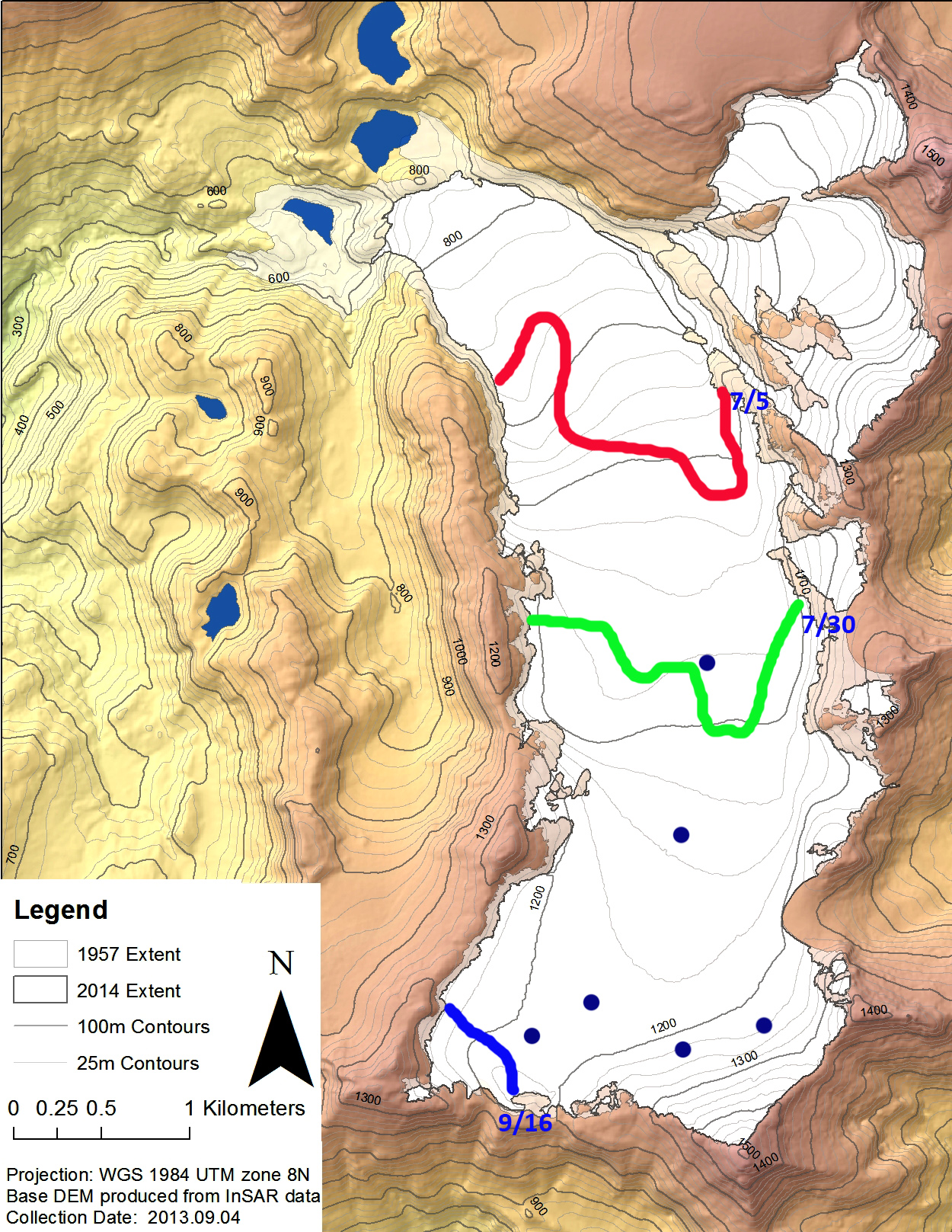
In 2018 on July 5 2018 the snowline on Lemon Creek Glacier was at 950 m.  From July 4-6 a series of snowpits were dug on the glacier by JIRP yielding a retained snowpack ranging from 0.9 m (water equivalent=w.e.) to 1.2 m (w.e.).  One of the snowpits with 0.9 m w.e. was at 1075 m.  On July 30 the snowline had reached 1100 m, indicating approximately 0.9 m of snow ablation in that 21 day interval. Because ice ablates faster than snow, 36% faster on Lemon Creek Glacier this would equate to  ~1.2 m of ice ablation. By September 2 the snowline had risen above the top of the glacier, with one small snowpatch in the northwest corner at 1200 m, firn horizon exposed by snowpack loss are evident .  This remains the case in the Sept. 16 image.  The small snowpatch also melted away by the end of September.  There was no accumulation zone for the third time in the last five years,indicating this glacier cannot survive current climate (Pelto, 2010).

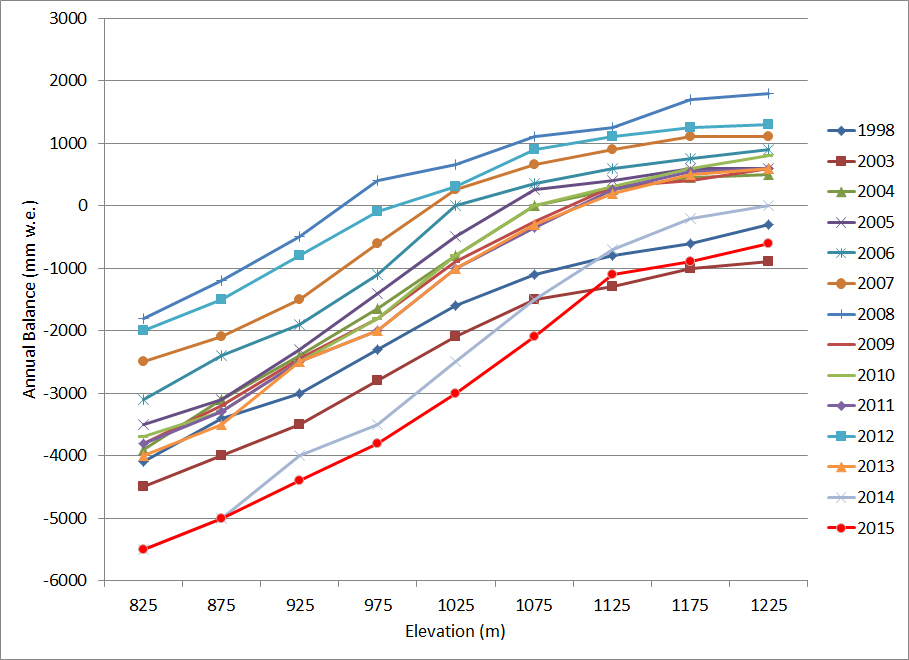
The consistency of the balance gradient, seen below from year to year allows for determination of melt rates and runoff based on the rise of the snowline.  The transient snow line migration rate times the balance gradient yields ablation rate at the snowline (Pelto, 2011). The impact of a greater area of surface ice exposed is increased ablation.  To illustrate this impact if we as an example take a day with a mean temperature of 10 C:

This would yield 350,000 m3 of melt on July 5, the glacier was 23% bare ice and 77% snow cover on this date.

This would yield 382,000 m3 of melt on July 30, the glacier was 41% bare ice and 59% snow cover on this date.

This would yield 480,000 m3 of melt on Sept. 16, the glacier was 97% bare ice/old firn and 3% snow cover on this date.

The actual July 5 temperature for Lemon Creek Glacier was 12 C. This yields 420,000 m3 of runoff.

The actual July 30 temperature for Lemon Creek Glacier was 11.5 C. This yields 440,000 m3 of runoff.

The actual Sept. 16 temperature for Lemon Creek Glacier was 1.5 C. This yields 72,000 m3 of runoff.

Base map of Lemon Creek Glacier from 2014 prepared by Chris McNeil (JIRP and USGS).  The blue dots are JIRP 2018 snowpit locations and the lines are the snowline on the respective dates. Camp 17 is the JIRP camp used for Lemon Creek Glacier research, including the upcoming 2019 field season.

USGS topographic map based on 1948 aerial photographs. On right is the hillshade image from 2011, margin is the black dots.

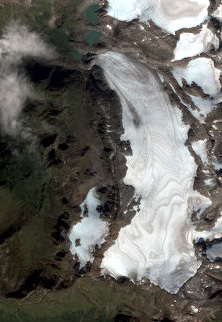
Image of the glacier on 9/2/2018 indicating firn horizons and the small remaining snowpack in the southwest corner.

Balance gradient of Lemon Creek Glacier, note the consistency.


Skilak Glacier, Alaska Retreat and Salmon Connection

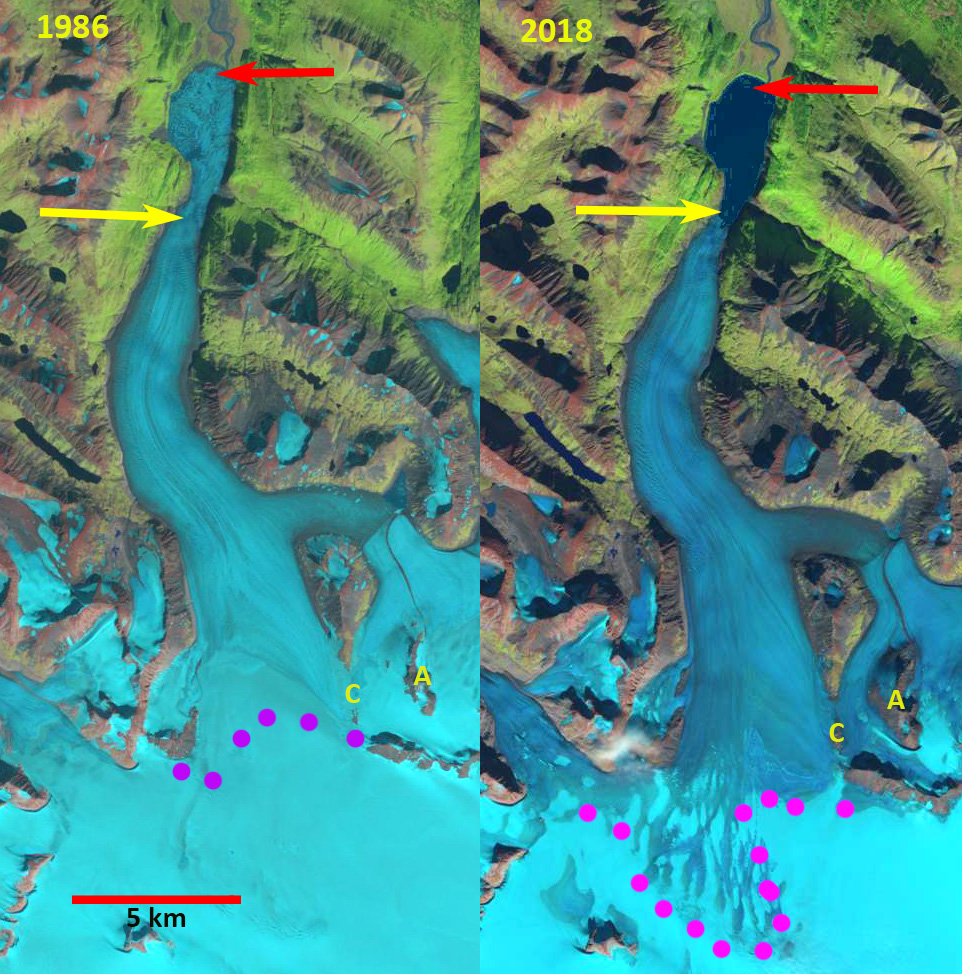
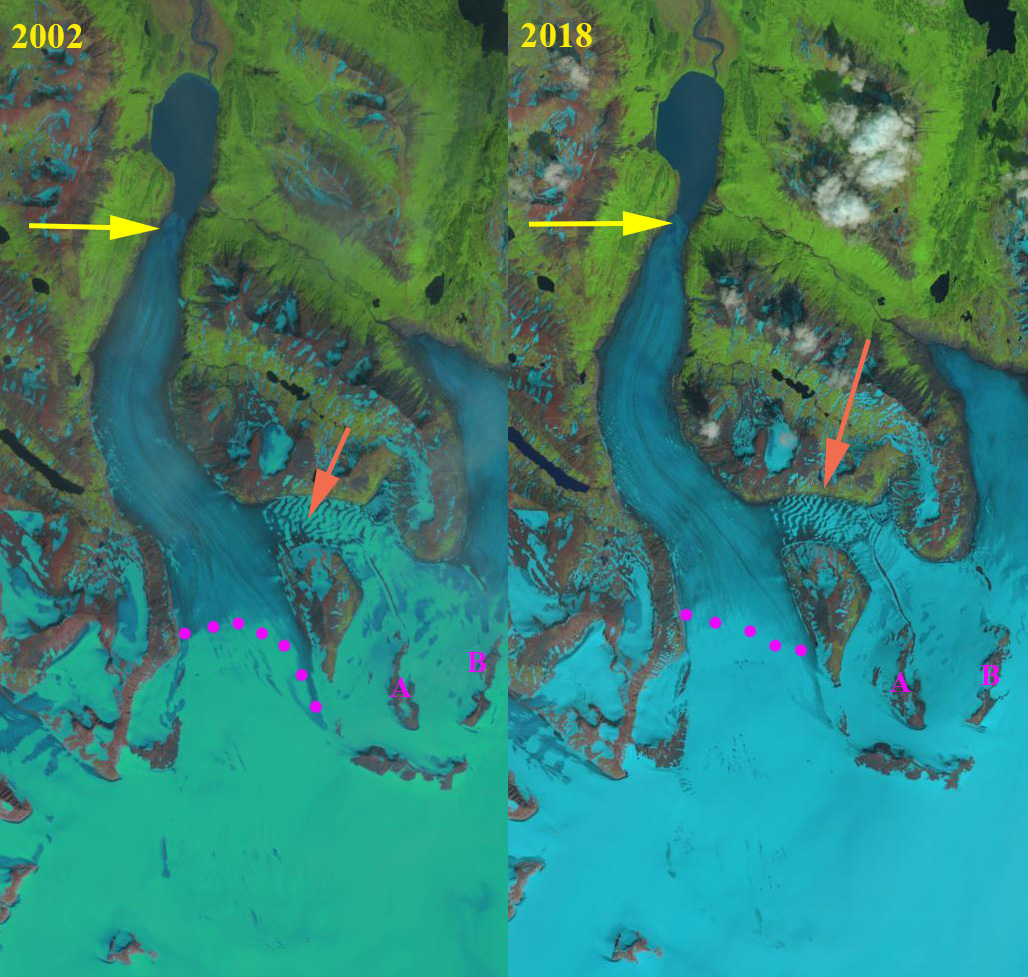
Skilak Glacier in 1986 and Sept. 2018 Landsat images.  In 1986 icebergs and remnant glacier fill nearly the entire lake.  The snowline in 1986 is at 1200 m and is at 1300 m in 2018. Red arrow is the 1982 terminus location and yellow arrow is the 2018 terminus location. Point A and C are bedrock outcrops at around 1200 m that have expanded.

Skilak Glacier is an outlet glacier on the northwest side  of the Harding Icefield, Kenai Peninsula, Alaska. From 1952-1982 Skilak glacier terminated on a proglacial plain with a broad nearly flat terminal lobe, see map below. The glaciers that drain eastward are in the Kenai Fjords National Park, which has a monitoring program.  From 1950-2005 all 27 glaciers in the Kenai Icefield region examined  retreated (Giffen et al 2014).  Giffen et al (2014) observed that retreated 1,800 m from from 1986-2000, with no retreat from 2000-2005. Here we examine Landsat imagery from 1986-2018 to illustrate the retreat of this glacier, recent snowline elevation and other upglacier changes. The glacier supplies meltwater to Skilak Lake which is a critical salmon habitat for the Kenai.  Chinook Salmon spawn on a section of the Kenai River between Kenai Lake and Skilak Lake. With Skilak Lake being the resulting home for ninety percent of the salmon fry for the Kenai River, and with the most of any nursery in the Cook Inlet area.  Escapements of chinook in the Kenai River exceed 50,000 annually in two runs (Heard et al 2007). Sockeye salmon is the largest run in the river with over 1,000,000 annual in the Kenai River run (Schoen et al, 2017).

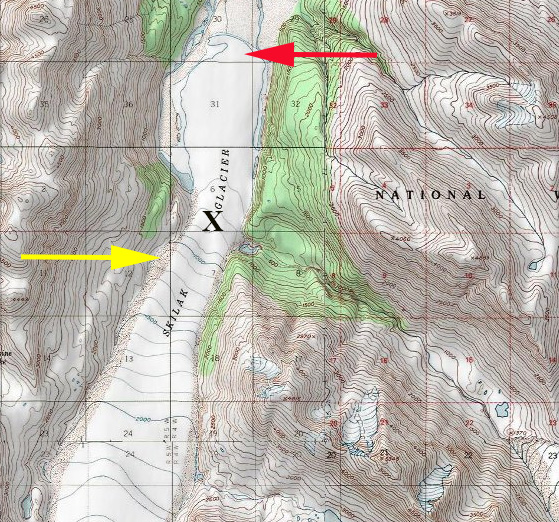
In the 1958 USGS map from there is no lake evident at the terminus of the glacier.  The lower 2 km of the glacier is nearly flat.  By 1986 the flat terminus was breaking up with icebergs filling the lake. By 2002 the glacier had retreated 4 km generating a lake with an area of 6.2 square kilometers. The snowline in 2002 was at 1200 m.  The glacier retreated 300 m from 2002 to 2018.  From July 2018 to Sept. 2018 the snowline rose from 1050 m to 1300 m.  Though retreat has been slow since 2002 upglacier thinning has been substantial At Point A and C from 1986 to 2018 and at Point A and B from 2002-2018. This will drive additional retreat.  The retreat rate should be more in line with that of the neighboring Harris Glacier. 

Skilak Glacier  1958 Map prior to lake formation.

Skilak Glacier in 2002 and July 2018 Landsat images.  In 2002 is at 1100 m and is at 1150 m in July 2018. Red arrow is the 1982 terminus location and yellow arrow is the 2018 terminus location. The orange arrow indicates indicated banded snow formation.  Point A and B are bedrock outcrops at around 1200 m that have expanded.


Hindle Glacier Retreat, South Georgia 2 km 2015-2019

Hindle Glacier comparison in 2017 and 2019 Landsat images.  Red arrow is 1989 terminus, pink arrow the 2015 terminus, yellow arrow the 2017 terminus location and green arrow the 2019 terminus location. 

South Georgia is south of the Polar Front preventing any truly warm season, with the cool maritime climate leading to numerous glaciers covering a majority of the island.  Hindle Glacier enters Royal Bay on the east coast of South Georgia Island.  The British Antarctic Survey (BAS) has been the principal research group examining glacier change on South Georgia Island.  Cook et al (2010) and Gordon et al (2008) noted a pattern island wide with many calving glaciers having the fastest retreat.  Gordon et al., (2008) observed that larger tidewater glaciers remained in relatively advanced positions from the 1950’s until the 1980’s, followed by significant recession.   Alison Cook at British Antarctic Survey identified that 212 of the Peninsula’s 244 marine glaciers have retreated over the past 50 years and rates of retreat are increasing.   In 2017 we examined Landsat imagery from 1989 to 2017 to identify the rapid retreat rate.  NASA Earth  piggy backed on this assessment, with excellent imagery, since the retreat rate has increased. Here we update the retreat with 2019 Landsat images.

For Ross-Hindle the retreat was minimal from 1960 to 1989 with the glaciers joined   In 1989 the glaciers joined 2.5  km from the terminus. The glacier spanned Royal Bay with a 3.2 km wide calving front.  By 2002 the glacier front had retreated 800 m, but they were still joined. By 2008 the glaciers had separated due to an additional retreat of  1.4 km. The front was now retreating south up a separate embayment from Ross Glacier.  The calving front in 2008 was 1.6 km wide.  By 2015 further retreat led to the separation of Hindle from an eastern tributary at the first prominent headland in the fjord, a 1.6 km retreat in seven years.  By 2017 an additional 600 m of retreat had occurred.  From 2017 to 2019 the terminus retreated another 1.5 km back to a prominent rock knob separating the two main tributaries of the glacier with total retreat of  6.1 km in 30 years. This is a rate of over 200 m/year, which is an exceptional rate.  Over the 2015-2019 period the glacier retreaeted over 2 km, more than 500 m/year. The western tributary appears to be at the head of the fjord, while the eastern tributary has another 1 km to an increase in slopes that likely is close to head of the fjord. The new fjord is 4.5 km long and averages 1.1 km in width.  This embayment will open up new areas for Gentoo Penguins and elephant seals to immigrate into.  Levy et al (2016) discuss the shift and dispersal of colonies in the region, that climate change is an important driver of.

Map of terminus retreat of Ross and Hindle Glacier from the BAS.  Green Pin Locations are Gentoo Penguin colonies. 

Hindle Glacier comparison in 1989 and 2015 Landsat images.  Red arrow is 1989 terminus, pink arrow the 2015 terminus, yellow arrow the 2017 terminus location and green arrow the 2019 terminus location. 


Boulder Glacier, Mount Baker Washington Retreat 1980-2018

Boulder Glacier terminus position 1980-2018 as measured in the field. Note Lahar path that descends from Sherman Crater.  Lahars have also occurred subglacially during our field observations.

Boulder Glacier flows down the east side of Mount Baker a strato volcano in the North Cascades of Washington. This steep glacier responds quickly to climate change and after retreating more than 2 kilometers from its Little Ice Age Maximum, it began to advance in the 1950’s as observed by William Long (Pelto, 1993). The glacier advance had ceased by 1979. From 1988-2008 we (NCGCP) have visited this glacier at least every five years recording its changes.

In 1988 the glacier had retreated only 25 meters from its furthest advance of the 1950-1979 period.  The advance moraine was a well defined ridge, with a diversity of plant life just beyond the moraine. By 1993 the glacier had retreated 100 m from this position. At this time the lower 500 meters of the glacier was clearly stagnant. By 2003 the glacier had retreated an additional 300 m. In 2008 the glacier had retreated 490 meters from its 1980 advance position, a rate of 16 meters per year. The glacier as seen in 2008 despite the steep slope has few crevasses in the debris covered lower 400 meters of the glacier. This indicates this section of the glacier is stagnant and will continue to melt away. The transition to active ice is at the base of the icefall on the right-north side of the glacier. Below is the glacier in 1993 note the darkened cliff at adjacent to and right of the terminus. The picture below that is from 1998 again note cliff, than in 2003 from the same location as the 1993. Than an image from 2008 of the terminus from further upvalley, as it is not clearly in view from the previous location. The picture from Asahel Curtis taken in 1908 illustrates the width of the active glacier in the zone where it terminates in the 1990’s. The 2017 image illustrates the debris band from the lahar.  Retreat from 1980-2018 has averaged 730 m, with the rate being relatively consistent.  The retreat amounts to 20% of the total glacier length lost and the terminus elevation has increased by ~175 m. This glacier after nearly 40 years of retreat is still not approaching equilibrium and will continue to retreat.   There is active crevassing closer to the current terminus than at any point since our observations began suggesting the retreat could slow in the near future.  Note the 2015 LIDAR image from the Washington DNR, red path is the terminus. During he 2013-2018 period the end of summer snowline has been particularly high averaging ~2100 m.  This is a reflection of continued negative mass balance as measured on the adjacent Easton Glacier. Boulder Glacier does respond fast to climate change, and the climate has not been good for this glacier. The glacier does have a consistent accumulation zone and can survive current climate (Pelto, 2010). For 35 years the North Cascade Glacier Climate Project has focused on observing the response of glaciers to climate change and will continue to do so.

.

Picture from August, 1993 of the terminus of Boulder Glacier

Picture from August 1998 of the terminus of Boulder Glacier

Picture from August 2003 of the terminus of Boulder Glacier

.

Boulder Glacier in August 2008.

Asahel Curtis image of Boulder Glacier in 1908.

Boulder Glacier in 2017 from Rainbow Ridge, taken by Tom Hammond

LIDAR image of Boulder Glacier from 2015 note the crevassing close to the terminus, red line.

Boydell Glacier, Antarctica Rapid Retreat 2001-2017

Boydell Glacier, Antarctica retreat in Landsat images from 2001 and 2017,  terminus in 2001 at red dots in 2017 at yellow dots.  A-E are reference points. 

Boydell Glacier flows east from the northern Antarctic Peninsula and prior to the 1980’s was joined with the Sjogren Glacier as a principal feeder glacier to Prince Gustav Ice Shelf.  This 1600 square kilometer ice shelf connecting the Peninsula to James Ross Island disintegrated in the mid-1990’s and was gone by 1995 (Cook and Vaughan, 2010).  Scambos et al (2014) noted a widespread thinning and retreat of Northern Antarctic Peninsula glaciers with the greatest changes where ice shelf collapse had occurred, Boydell/Sjogren Glacier being one of the locations.  A new paper by Seehaus et al (2016)  focuses on long term velocity change at Sjögren Glacier as it retreated.  This study illustrates the acceleration after 1996 from 0.7 m/day to 2.0 m/day in  2003 and then after separation Boydell Glacier, which is slower, has declined from  a velocity of 1.6 m/day in 2007 to  a velocity of 1.0 km day in 2015. Here we examine Landsat images from 1990, 2001, 2005 and 2017 to illustrate changes in terminus position of Boydell Glacier.

In the 1990 Landsat image Boydell/Sjögren Glacier feed directly into the Prince Gustav ice Shelf which then By 1993 Seehaus et al (2016) note that Boydell/Sjögren Glacier had retreated to the mouth of Sjögren Inlet in 1993, this is marked Point A on Landsat Images. By 2001 the glacier had retreated to Point B,  a distance of 7 km.  Between 2001 and 2005  a 2.5 km ot 3 km retreat led to a separation of Boydell Glacier and Sjogren Glacier and a retreat to Point C.  In 2017, Boydell Glacier has retreated 6.5 km since 2001.  This is less then the  Sjögren Glacier retreat of 10-11 km from the 2001 location.   Seehaus et al (2016) Figure 1  indicates that the area of high velocity over 1.0 m/day on Boydell Glacier in the last decade extends the entire 12 km length of the valley reach, which is fed by an icefall from a higher plateau region. The high velocity and limited change in fjord width in the lower 6 km indicates there is not a new pinning point to slow retreat appreciably in this stretch. Figure 1 also illustrates the retreat from 1993-2014. The pattern of ice shelf loss and glacier retreat after loss has also played out at Jones Ice Shelf and Rohss Bay.

sjogren glacier 1990

1990 Landsat Image of Boydell/Sjogren Glacier and Prince Gustav Ice Shelf, terminus marked by red dots.

2005 Landsat Image of Boydell/Sjogren Glacier terminus marked by red dots.

Antarctic REMA Explorer view of Boydell (B)  and Sjogren (S) in 2002.

Cachalote Glacier, Chile Retreats From Lake and Separates

Cachalote Glacier in a 1984 Landsat image and 2019 Sentinel Image.  Red arrow is 1984 terminus location, yellow arrow the 2019 terminus location and the pink arrow a tributary to the glacier in 1984 that separates.

Cachalote Glacier is on the western edge of the Southern Patagonia Icefield, Chile. The glacier is not fed by the main icefield, but is connected to glaciers that are.  The glaciers of the SPI have been experiencing significant mass loss and overall retreat. Willis et al (2012) observed significant mass loss from 2000-2012 of −20.0  Gt per year. Davies and Glasser (2012) indicate this area had its most rapid retreat of the 1870-2011 period after 1986.

In 1984 Cachalote Glacier terminated in a proglacial that was ~600 m long, red arrow.  The glacier was joined by a tributary from the west ~1 km from the terminus, pink arrow.  By 2001 the tributary had separated from the main glacier. The glacier still terminated in the proglacial lake, but had retreated 1.5 km and the proglacial lake was now just over 2 km long.  In 2017 the glacier no longer reached the proglacial lake. In 2019 the glacier has retreated 2.6 km from its 1984 position, 30% of its entire length lost in the span of 35 years. The glacier no longer terminates in a lake and ends near the top of a steep slope, both suggest that retreat should decline for the near future.

This is a less spectacular retreat than at HPS-12 Glacier which is a short distance to the norther and is the fastest retreating glacier in the region or Dickson Glacier on the east side of the icefield, but as a percent of glacier length lost is as substantial.

Cachalote Glacier in a 2001 and 2017 Landsat images.  Red arrow is 1984 terminus location, yellow arrow the 2019 terminus location and the pink arrow a tributary to the glacier in 1984 that separates by 2001.

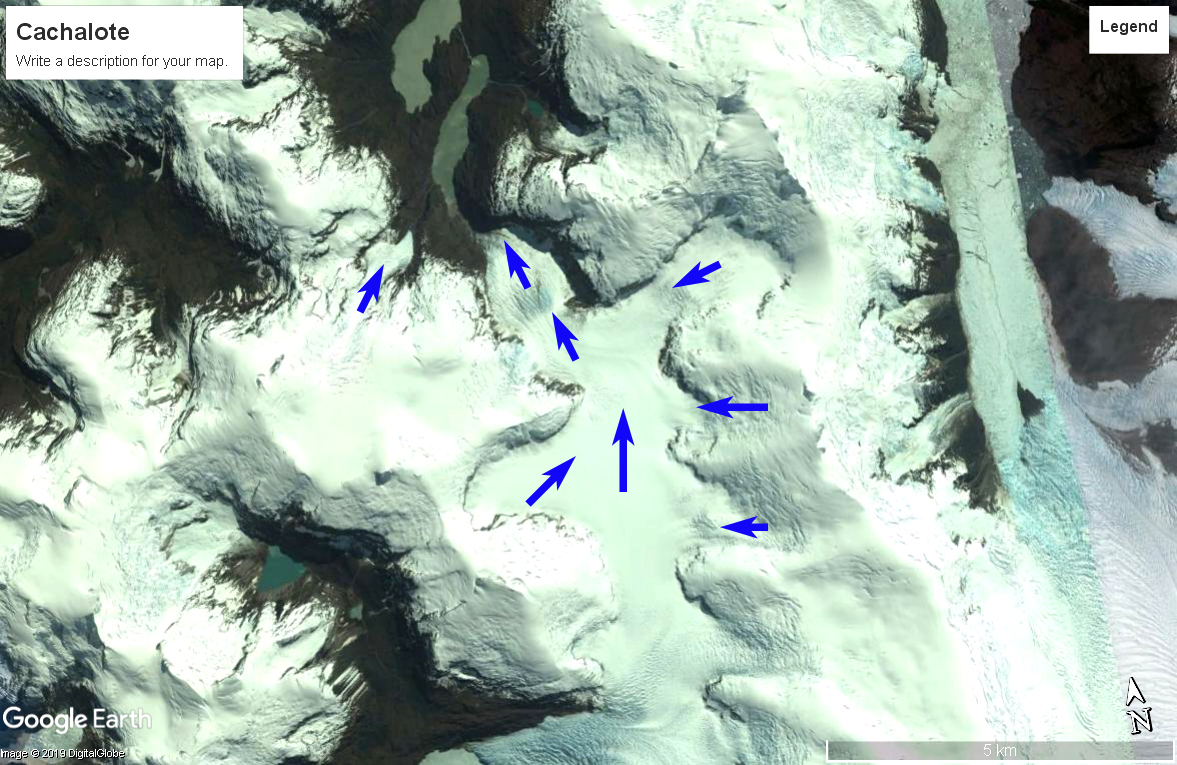
Cachalote Glacier with flow lines indicated. 

Heard Island Retreat of Glaciers Enables Lagoon Development

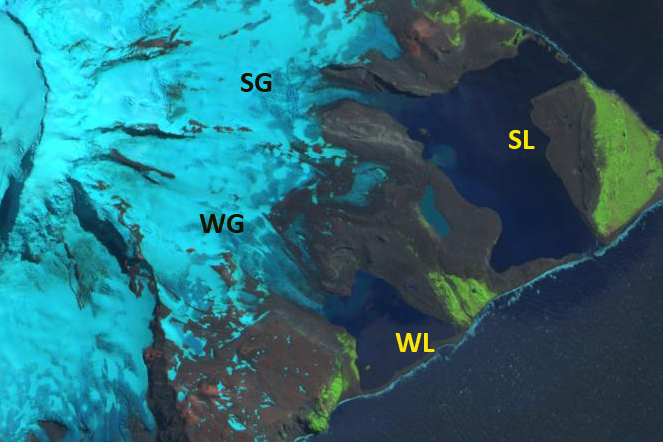
Stephenson Glacier (SG), Sephenson Lagoon (SL), Winston Glacier (WG) and Winston Lagoon (WL) in 2019 Sentinel Image.

The Australian Antarctic Division (AAD) manages Heard Island and has undertaken a project documenting changes in the environment on the island. One aspect noted has been the change in glaciers. The Winston, Brown and Stephenson Glacier have all retreated substantially since 1947 when the first good maps of their terminus are available. Fourteen Men by Arthur Scholes (1952) documents a year spent by 14 men of the Australian National Antarctic Research Expedition that documented the particularly stormy, inclement weather of the region. Their journey to the east end of the island noted that they could not skirt past the glaciers along the coast. After crossing Stephenson Glacier they visited an old seal camp and counted 16,000 seals in the area. It is a rich area for wildlife, that will benefit from the lagoon formation overall. Three species of seal commonly breed on Heard Island, southern elephant seals, Antarctic fur seal and sub-antarctic fur seals (AAD, 2019).

Here we examine the retreat of Stephenson Glacier and Winston Glacier from 2001-2019 and the consequent lagoon expansion. As Kiernan and McConnell observed retreat of Stephenson Glacier had begun by 1971 the glacier had retreated 1 km from the south coast and several hundred meters from the northern side of the spit. This retreat by 1980 caused the formation of Stephenson Lagoon.

Retreat of Stephenson Glacier and Winston Glacier from 2001 (red arrows) to 2018 (yellow arrows) in Landsat images.

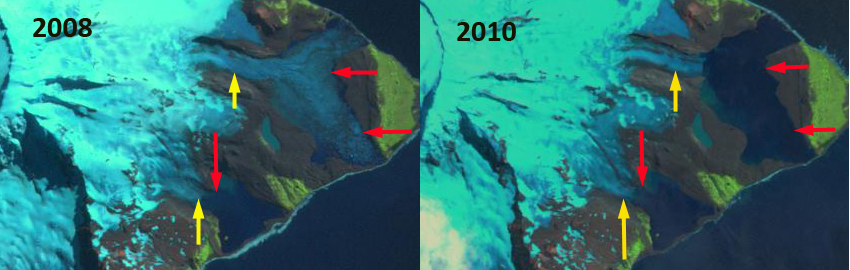
In 2001 Stephenson Glacier has two separate termini, red arrows terminating in two separate lagoons, Doppler to the south and Stephenson to the east. There are numerous icebergs in Doppler lagoon but none in Stephenson Lagoon, indicating the retreat is underway. Winston Glacier terminates where the lagoon widens. In 2008 the two lagoons in front of Stephenson Glacier are joined with a narrow eastern channel, the lagoons are filled with icebergs as a terminus collapse is underway. Winston Glacier has retreated into a narrower inlet from the wider Winston Lagoon.  By 2010 Stephenson Glacier had retreated from the main now singular Stephenson Lagoon, and like Winston Glacier in 2001 terminates at narrow point where the glacier enters the main lagoon.  By 2018 Stephenson glacier has retreated from the main lagoon, the northern arm of the glacier experienced a 1.8 km retreat from 2001 to 2018 and the southern arm as 3.5 km retreat.  The lagoon is free of ice for the first time in several centuries if not several millennia. The period of rapid retreat due to calving of icebergs into the lagoon is over and the retreat rate will now be slower.  Winston Glacier has retreated 600 m from 2001-2018.  The overall lagoon expansion has been limited as the glacier has retreated up an inlet that is 500 m wide.

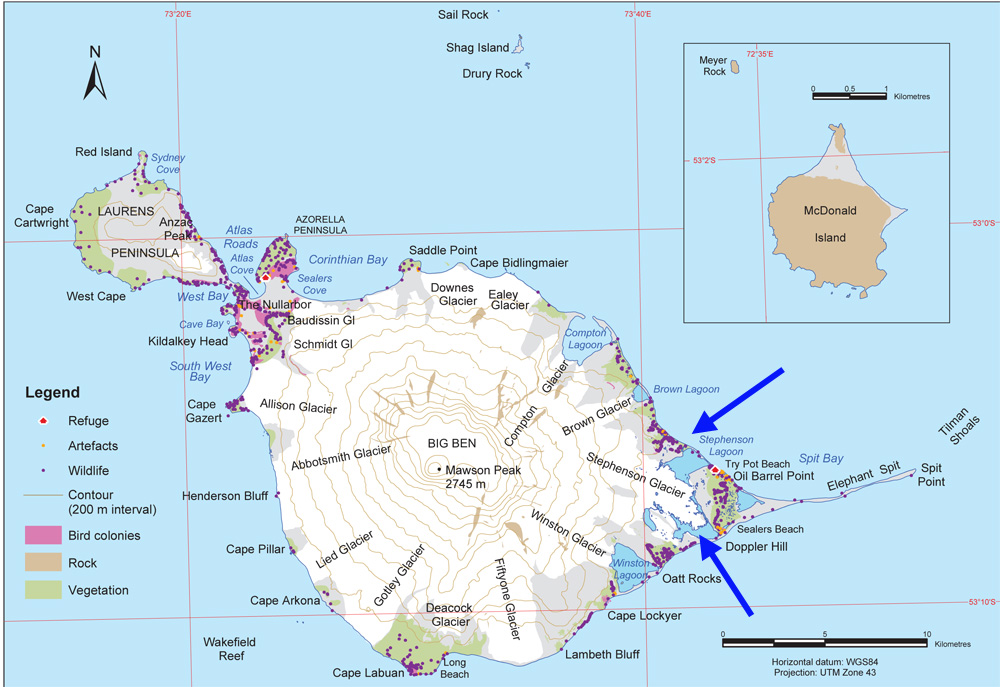
The AAD has a number of images in their gallery of Heard Island glaciers including Stephenson Glacier. The climate station at Atlas Cove indicates a 1 C temperature rise in the last 60 years.  The AAD will also certainly be looking at how this new lagoon impacts the local seal and penguin communities. The population of king penguins increased sharply from the 1940’s into the 21st century, while rockhopper, gentoo and macaroni  penguins numbers declined over the same period (AAD, 2019).The map below indicates the importance of Stephenson Lagoon and Winston Lagoon for wildlife, king penguins and cormorants are noted by AAD.  The retreat of this glacier follows the pattern of glacier retreat at other glaciers on islands in the circum-Antarctic region Cook Ice Cap, Kerguelen Island Hindle Glacier and Neumayer Galcier, South Georgia.

HIMI_general.pdf

Map of  Heard Island from AAD

Stephenson Glacier and Winston Glacier in Landsat images from 2008 and 2010.  Terminus location of 2001 red arrows and terminus location in 2018  at yellow arrows.


Turbio Glacier Retreat, Argentina Generates New Lake

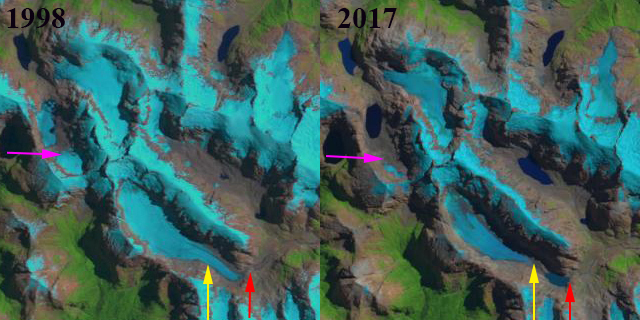
Turbio Glacier retreat from 1986 to 2018 in Landsat images.  Red arrow is 1986 terminus location, yellow arrow 2018 terminus location and pink arrow glacier across the border in Chile.

Turbio Glacier is at the headwaters of the Turbio River, Argentina and flows into Lago Puelo.  The glacier descends east from  Chile/Argentina border at 1500 m descending into a low slope valley at 1300-1000 m.  From 1986-2018 this glacier like many others nearby has retreated substantially leading to development of a new lake.  Wilson et al (2018) noted a substantial growth in the number of lakes in the central and Patagonian Andes due to the ongoing rapid retreat.  Masiokas et al (2008) reported that significant warming and decreasing precipitation over the 1912–2002 interval in the region. Harrison et al (2018) observed the number of glacier lake outburst floods have declined despite the increase in lakes.

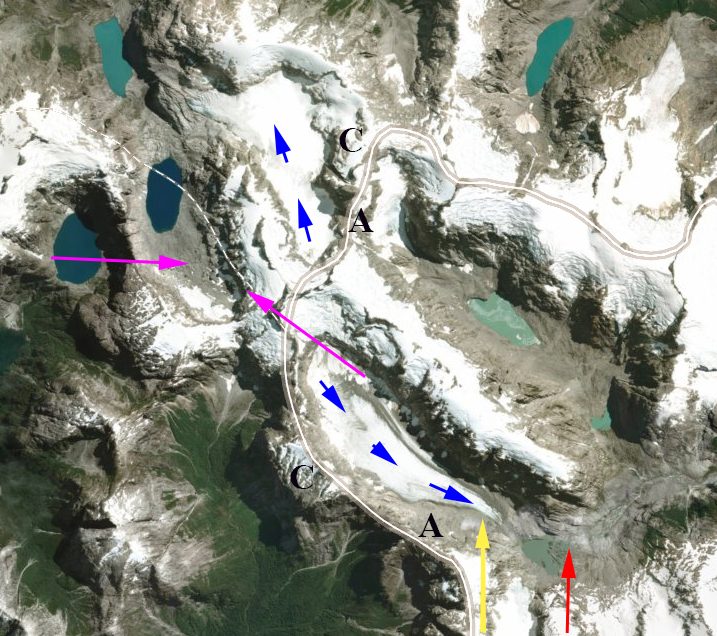
In 1986 the glacier terminated at the southeast end of a buttress at the junction with another valley, red arrow. The glacier was 4.3 km long and was connected to a headwall segment that extends to 1500 m. There is no evidence of a lake at the terminus of Turbio Glacier.  Across the divide in Chile the glacier with a pink arrow has a length of 3 km.  In 1998 the retreat from 1986 has been modest and no lake has formed at Turbio.  Across the border in Chile the glacier has divided into two sections.  By 2017 Turbio Glacier has retreated exposing a new lake.  The glacier is essentially devoid of retained snowpack illustrating the lack of  a significant accumulation zone that can sustain it.  Across the border in Chile the glacier has nearly disappeared with the lower section revealing a new lake and little retained snowpack indicating it cannot survive.  By 2018 Turbio Glacier has retreated 1.3 km, which is over 30% of its total length in 32 years. The glacier is separated from the headwall glacier, which can still shed avalanches onto the lower glacier. It is possible that with additional retreat another lake will be revealed in this valley.  The substantial retreat here is comparable with that of nearby Argentina glaciers such as Pico Alto Glacier and Lago Cholila .  The retreat is greater than on Tic Toc Glacier to the southwest in Chile.

Turbio Glacier retreat from 1998 to 2017 in Landsat images.  Red arrow is 1986 terminus location, yellow arrow 2018 terminus location and pink arrow glacier across the border in Chile.

Turbio Glacier in a Digital Globe image from 2013.  Red arrow is 1986 terminus location, yellow arrow 2018 terminus location, blue arrows show glacier flow and pink arrow glacier across the border in Chile.  The border is also indicated.

Tic Toc Glacier, Chile Rapid Losses with Time 1986-2019

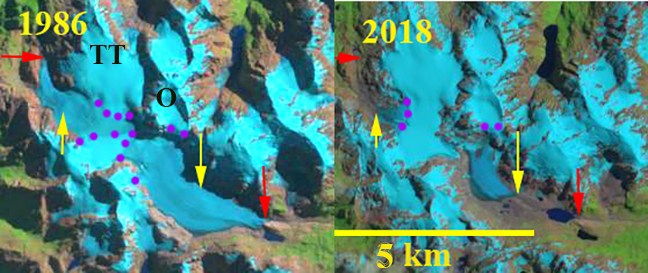
Tic Toc Glacier (TT) and Oeste Glacier (O) in 1986 and 2018 Landsat images.  Red arrow is the 1986 terminus, yellow arrow is the 2018 terminus location, purple dots the snowline.

Tic Toc Glacier at the headwaters of the Rio Tic Toc and the adjacent Rio Oeste headwater glacier Oeste Glacier are in the Parque Nacionale Corcovado of Palena Province of Chile.  Davies and Glasser (2012) noted that overall glaciers in this region lost 14% of their area from 1986 to 2011. Carrivick et al (2016) reported the glaciers in the region had an average thickness of 41 m, this is relatively thin. Here we examine glacier change from 1986 to 2018 using Landsat imagery, with a 2019 Sentinel image for further visual identification of features.

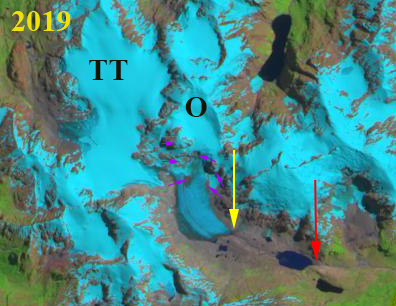
In 1986 Oeste Glacier extended downvalley terminating beyond the east end of a basin, near the west end of an adjacent bedrock knob to its south. The glacier has a 3 km long, 1 km wide valley tongue fed by a higher accumulation zone to the north.  Tic Toc Glacier has a terminus tongue that turns from west to north  extending 800 m downvalley. This glacier has a larger accumulation zone than Oeste Glacier, the snowline in 1986 is at 1350 m the divide between the glaciers. By 1999 Oeste Glacier has retreated from the bedrock knob and a small fringing lake is developing.  Tic Toc Glacier has lost much of the northern terminus tongue.  The snowline in 1999 is at 1500 m.  By 2016 Oeste Glacier has retreated upvalley revealing a new lake.  Tic Toc Glacier has retreated out of the north trending valley that it had terminated in. The divide between the glacier is now mostly bedrock indicating it is consistently above the snowline.  The snowline in 206 is above 1500. By 2018 Oeste Glacier has retreated 1700 m losing the majority of its valley tongue.  It is poorly connected to the upper snowfield as revealed by both Digital Globe imagery and 2019 Sentinel imagery below, indicating the lack of a substantial contributing accumulation zone. Tic Toc Glacier has retreated 1500 m since 1986, most of its valley length. There is still a significant accumulation zone for this glacier. In both cases the majority of the valley portion of these glaciers has been lost since 1986 and the substantial divide connection has been severed. The large scale loss of these two glaciers is typical for the region as noted by the references above and by the examples of Erasmo Glacier and Hornopiren Glacier.


Tic Toc Glacier (TT) and Oeste Glacier (O) in 1999 and 2016 Landsat images.  Red arrow is the 1986 terminus, yellow arrow is the 2018 terminus location, purple dots the snowline and purple arrow the divide.
Digital Glacier image indicating Tic Toc Glacier and Oeste Glacier.  Red arrows indicate 1986 terminus locations, far from the current terminus location.
A 2019 Sentinel image of Tic Toc and Oeste Glacier.  Red arrow 1986 terminus, yellow arrow 2018 terminus and purple arrows bedrock areas separating Oeste Glacier from the accumulation zone.

Novosilski Glacier, South Georgia 2.5 km Retreat 2001-2018

Novosilski Glacier in Landsat images from 2001 and 2018. Red arrow indicates 2001 terminus location, yellow arrow the 2018 terminus location, pink arrows the fringing grounded sections of marginal ice.

Novosilski Glacier is a large tidewater outlet glacier on the west (cloudier) coast of South Georgia terminating in Novosilski Bay It shares a divide with the rapidly retreating Ross and Hindle Glacier on the east coast.  Gordon et al. (2008) observed that larger tidewater and calving outlet glaciers generally remained in relatively advanced positions from the 1950’s until the 1980s. After 1980 most glaciers receded; some of these retreats have been dramatic.   The change in glacier termini position have been documented by Cook et al (2010) at British Antarctic Survey in a BAS retreat map,  identified that 212 of the Peninsula’s 244 marine glaciers have retreated over the past 50 years and rates of retreat are increasing. Pelto (2017) documented the retreat of 11 of these glaciers during the 1989-2015 period. Here we examine Landsat images from 2001-2018  and the British Antarctic Survey GIS of the island to identify the magnitude of glacier change.

In 2001 Novosilski Glacier terminated in shallow water just east of a small island that acted as a pinning point, red arrow.  By 2009 the glacier had retreated only a minor amount from this island into deeper water.  A rapid retreat ensued and by 2016 the glacier had retreated into a narrower fjord reach. The north and south margins featured remanant ice that was based above tidewater, pink arrows.  The blue arrows in the 2016 Landsat image indicating the large accumulation area feeding Novosilski.  By 2018 the 2 km wide calving front had retreated 2.5 km from the 2001 position. There is little evident thinning upglacier of the terminus and, there is a significant increase in surface slope suggesting that unless calving rate increases, the terminus can remain near its current position.  The snowline is low below 500 m in each of the satellite images of the glacier.  This is not a particularly hospitable section of coastline and the BAS has only identified Gentoo Penguins having colonies in the area.

Novosilski Glacier in Landsat image from 2016. Red arrow indicates 2001 terminus location, yellow arrow the 2018 terminus location, pink arrows the fringing grounded sections of marginal ice, and blue arrows the glacier flow directions. Below is the South Georgia BAS map of the area indicating glacier margin position and elevation contours.

Novosilski Glacier in Landsat image from 2009. Red arrow indicates 2001 terminus location and, yellow arrow the 2018 terminus location.


Cape Longing, Antarctica Transitioning to Island via Glacier Retreat

Cape Longing, Antarctica in 2001 and 2018 Landsat images. Point A-G are at specific locations. Yellow dots mark the margin of the glacier connecting the Cape to the main Antarctic Peninsula.

Cape Longing is on the Antarctic Peninsula between Larsen Inlet and Prince Gustav Channel.  Larsen Inlet along the south shore of Cape Longing was covered by the Larsen A Ice Shelf until its collapse in 1995. The Prince Gustav Ice Shelf extended across the channel from the north shore of Cape Longing until the 1980’s.  This 1600 square kilometer ice shelf disintegrated in the mid-1990’s and was gone by 1995 (Cook and Vaughan, 2010).   Here we examine changes in the glacier connecting Cape Longing to the Antarctic Peninsula from 2000 to 2018 using Landsat imagery.

In 2000 the glacier connecting Cape Longing with the main peninsula extended along a front from Point F to Point E. Northeast of Point G there is an area of rifted ice indicative of ice that had been grounded going afloat. On the southern margin the ice front extends southwest from Point A.  The glacier from the northern to the southern margin is ~9 km across.  In 2001 the southern margin has not changed, but the northern margin indicates an expanded ice melange between the active glacier and the ice front, making the exact terminus difficult to pinpoint.  By 2017 the northern ice margin has retreated to a line between Point B and Point G.  The southern margin extends west from Point A.  In 2018 it is 3.5 km from the northern to southern margin, more than 60% of this glacier connection to Cape Longing has been lost since 2000.  This connection appears to have a below sea level bed though the glacier is grounded.  This grounding should lead to a slower retreat. The ice shelf/glacier retreat at Cape Longing is significant though much less than the more dynamic nearby Sjogren Glacier.
View of Cape Longing in REMA Antarctic Explorer, which is the 2000 Landsat image.

Cape Longing, Antarctica in 2000 and 2017 Landsat images. Point A-G are at specific locations. Yellow dots mark the margin of the glacier connecting the Cape to the main Antarctic Peninsula.


Drogpa Nagtsang Glacier, China Mass Balance Loss, Separation, Slow Down

Drogpa Nagtsang Glacier change in Landsat image from 1989 and 2018.  Yellow arrow indicates 2018 terminus location, red arrow 1989 terminus location, red dot the lowest elevation of clean glacier ice. Points A-E are the same locations for comparison.

Drogpa Nagtsang Glacier, China is a glacier that is 30 km west of Mount Everest that terminates in an expanding proglacial lake. The glacier begins on the Nepal border at 6400 m, and its meltwater enters the Tamakoshi River. The Upper Tamakoshi Hydropower project is a 456 MW peaking run of river  is a hydropower project on the Tamakoshi that is to be finished in 2019.  King et al (2017) observed the mass balance of 32 glaciers in the Mount Everest area including Drogpa Nagtsang and found a mean mass balance of all glaciers was −0.52 m water equivalent/year, increasing to -0.7 m/year for lake terminating glaciers. Dehecq et al (2018) in an exceptional paper examined velocity changes across High Mountain Asia from the 2000-2017 period identifying a widespread slow down in the region.  The key take away is the same we see for alpine glaciers around the globe, warming temperatures lead to mass balance losses, which leads to velocity slow down, Mass balance is the key driver in glacier response, a sustained negative mass balance leads to thinning, which leads to a glacier velocity declines whether the glacier is in the Himalaya, Alps or Andes. This study simply could not have been completed without the availability and affordability of Landsat imagery.  Here we look at one example in the region that highlights the important findings.

In 1989 Drogpa Nagtsang Glacier had a substantial number of coalescing supraglacial ponds on its relatively flat stagnant debris covered terminus.  At Point A the former tributary is are no longer contributing to the main glacier, while at B, C, D and E there is a still a contribution.  The snowline in 1989 is at ~5450 m.  The clean glacier ice extends almost to the tributary glacier at Point B at 5200 m, red dot. In 1992 the supraglacial ponds have further expanded, but a true proglacial lake has not formed. The snowline is at~5500 m. Quincey et al (2009) observed flow of less than 10 m/a in lower 5 km of glacier in 1996 and peaking at 20-30 m/a 8 km from terminus. By 2015 a 2.7 km long lake has developed.  The clean glacier ice now extends just past Point E at 5350 m.  The snowline is at 5600 m. The tributaries at Point B, C and E no longer reach the main glacier.  At Point D the medial moraines indicate that flow from this tributary has been reduced and now is a smaller contributor to the valley tongue. In 2018 the clean glacier ice extends to just 5400 m.  The lake has expanded to a length of 2.9 km indicating a retreat of the same distance from 1989-2018.  The snowline is exceptionally high at 5700 m. The former tributaries at B, C and E have also markedly retreated away from the main glacier. Only the tributary at Point D is still contributing to the main glacier. The high snowline observed in recent years are an indication that mass balance losses are even larger in this region, which causes further thinning, reduction in velocity, retreat and expansion of debris cover.  King et al (2018) observed the thinning and velocity profile on Drogpa Nagtsang and noted the velocity decreased over time and was stagnant in the debris covered zone, thinning occurred along the entire profile, which began close to the ELA. The stagnant nature of the terminus tongue is evident in the Digital Globe image below from 2017.  The red arrows show a deeply incised supraglacial stream that is over 2 km long, that would only develop on stagnant ice.  This process has played out on other nearby glaciers such as Yanong Glacier  and Lumding Glacier.  The high snowlines have also been observed at the nearby Nup La on Ngozumpa Glacier in recent years and on many glaciers in the Mount Everest region in recent winters such as in 2018.  This indicates continuing mass losses through a greater period of the year.

Drogpa Nagtsang Glacier change in Landsat image from 1992 and 2015.  Yellow arrow indicates 2018 terminus location, red arrow 1989 terminus location, red dot the lowest elevation of clean glacier ice. Points A-E are the same locations for comparison.

Digital Globe image with yellow dots indicating terminus, red arrows a supraglacial stream, blue arrows ice flow direction.  B is the same tributary has noted in the Landsat images above.