Wrangell Mountain Icefields, Alaska Lose their Snowcover 2016 and 2017

Mount Gordon Icefield (MG) Mesa Creek Icefield (MC) and Icefield Plateau (IP) in 2016 and 2017 Landsat imagery.  The purple dots indicate the areas with retained snowcover in both years. Nabesna Glacier (N) is the largest glacier in the Wrangell Mountains, just a corner seen here.

Mount Gordon Icefield (MG) Mesa Creek Icefield (MC) and Icefield Plateau (IP) are three neighboring Icefields in the Wrangell-Saint Elias National Park and Preserve in Alaska.  Each has a principal accumulation area between 2300 and 2550 m, with a limited area above .  The area of Mount Gordon Icefield is ~10 square kilometers, Mesa Creek Icefield ~12 square kilometers and Icefield Plateau ~35 square kilometers. This is a region that has been experiencing significant mass loss.  Das et al (2014) used repeat altimetry measurements to identify accelerated mass loss over the Wrangell Mountains, from –0.07 ± 0.19 m w.e./year during 1957–2000 to –0.24  m w.e./year during 2000–07.  Larsen et al (2015) identified that the Wrangell Mountains experienced a mass balance of -0.5 to -1 m/year  from 1994–2013 using laser altimetry.

On August 17, 2016 less than 10% of the Icefield Plateau is snowcovered, with the snowline at 2500 m.  The snowline is at 2400 m on Mount Gordon Icefield and Mesa Creek Icefield with 30% of each icefield retaining snowcover.  On August 4, 2017 there is insignificant retained snowcover on Mesa Creek Icefield.  The snowline is at 2500 m on both Mount Gordon Icefield and Icefield Plateau with less than 10% overall retained snowcover.  The lack of retained snowcover across most of the former accumulation area from 2300-2550 m indicates these icefields will have substantial icefield wide thinning.  In addition the lack of a persistent substantial accumulation zone indicates the icefield will not survive, though a small mountain glacier may remain on the est side of Mount Gordon and the southern edge of the Icefield Plateau. In 2018 there is not a good cloud free August image from this region. The high snowline and rapid melt on nearby Lowell Glacier suggest the snowline would again have been high. This will lead to substantial retreat of the icefield margins and is indicative of the retreat of large glaciers in the range such as Nizina Glacier or Yakutat Glacier in the Saint Elias Range.

Mount Gordon Icefield (MG) Mesa Creek Icefield (MC) and Icefield Plateau (IP) in topographic map.

Mount Gordon Icefield (MG) Mesa Creek Icefield (MC) and Icefield Plateau (IP) in 1999 Landsat image.  The purple dots indicate areas with retained snowcover. N=Nabesna Glacier.

Mount Gordon Icefield (MG) Mesa Creek Icefield (MC) and Icefield Plateau (IP) in 2001 Landsat image.  The icefield are nearly fully covered with snow. N=Nabesna Glacier.


Lapche Glacier, China Supraglacial Ponds Transitioning to Lake

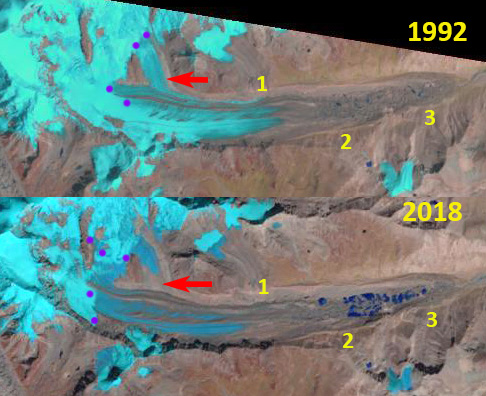
Lapche Glacier (Tibet 1), China in 1992 and 2018 Landsat images.  The expansion of supraglacial ponds is evident between Point 2 and 3. A tributary that detaches between 1992 and 2018 is indicated by red arrow.  The end of the clean ice and start of debris cover ice is just below Point 1 in 1992 and well above this Point in 2018. 

Lapche Glacier (Tibet 1), China flows east from Lapche Kang (Lobuche Kang) in the Bum Chu River Basin. King et al (2017) examined the mass balance of 32 glaciers in the Everest region for the 2000-2015 period including the Lapche, which they called Tibet 1, and found a mass loss of ~0.5 m/year, with the loss of lake terminating glaciers at ~-0.7 m/year.  King et al (2017) also observed that a number of these glaciers had nearly stagnant tongues with coalescing and expanding supraglacial ponds. Here we examine the expansion of the supraglacial ponds from 1992 to 2018 using Landsat images.

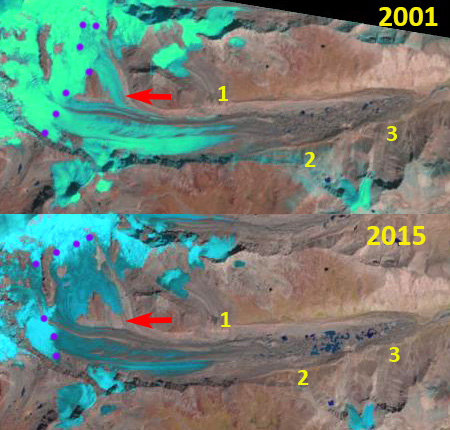
The lower four kilometers of Lapche Glacier in 1992 is relatively flat with the terminus at 5100 m and four kilometers upglacier at just 5200 m. In this stretch there are several small isolated supraglacial ponds between Point 2 and 3.  At Point 1 is the end of the clean ice section of the glacier, with debris cover obscuring the underlying ice below this point. There is a tributary joining the glacier at the red arrow. In 2001 the snowline is at 5600 m, and there are a few more supraglacial ponds, but with a total surface area under 0.1 square kilometers.  In 2015 the tributary at the red arrow has detached and the area covered by ponds has expanded and now cover ~0.5 square kilometers.  The snowline in 2015  is at 5650-5750 m. In 2018 the supraglacial ponds have largely coalesced, and have an area of ~1.0 square kilometers.  These lakes are on the verge of creating one larger lake as has happened on Rongbuk Glacier .  The debris covered portion of the glacier now begins above Point 1, 1 km upglacier of its 1992 location.  The snowline in 2018 is at 5650-5750 m.

King et al (2018) indicate a velocity of less than 10 m/year in the lower 5 km of the glacier, essentially stagnant.  Point 1 is just over 6 km above the 1992 terminus. The retreat here is difficult to discern, but with the proglacial lake development it will soon be identifiable and in line with that of other glaciers in the area Duiya and Yanong.   Zhang et al (2010) observed the loss of glacier area and lake expansion in the region from 1976-2006 driven by warming.

Lapche Glacier (Tibet 1), China in map view.  Point 1-3 same as in images, ice flow indicated by blue arrows, elevation contours labelled at 51oo and 5200 m. Debris cover beginning noted at DC.

Lapche Glacier (Tibet 1), China in 2001 and 2015 Landsat images.  The expansion of supraglacial ponds is evident between Point 2 and 3. A tributary that detaches between 2001 and 2015 is indicated by red arrow.  

Sermip Nunataa, Greenland No Longer a Nunatak

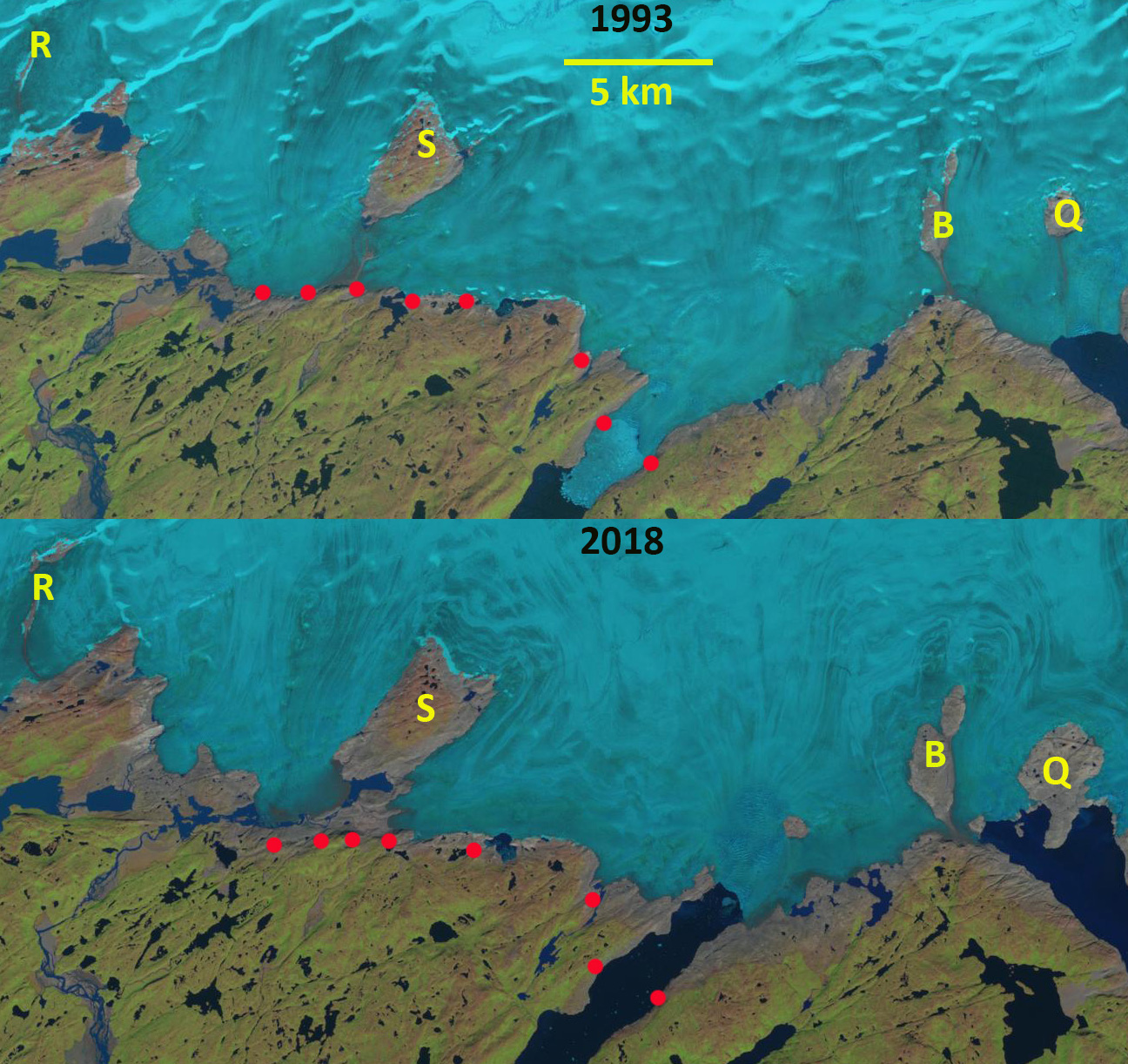
Sermip Nunataa (S) and nearby nunataks in 1993, Q, R and B in 1993 and 2018 Landsat images.  Red dots indicate the 1993 margin. 

Sermip Nunataa (Nunatak-Island within ice sheet glacier) was a nunatak of the southern Greenland Ice Sheet between Sermilik Brae and Sondre Qipisaqqu Brae.  Here we examine changes from 1993-2018 of the margin of the ice sheet in the area and the impact on this and neighboring nunataks.

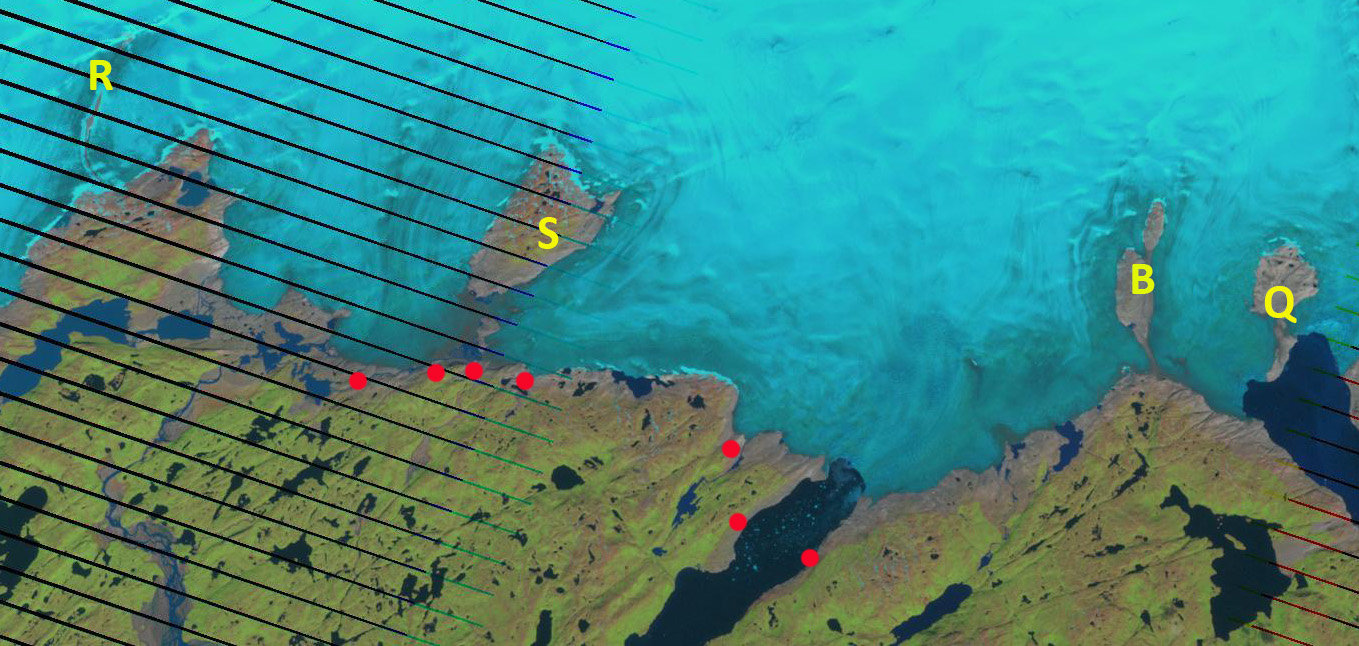
In 1993 the Sermip Nunatak was 2.5 km inland from the ice sheet margin.  At Nunatak R there is a single short ridge, 1.5 km long.  Nunatak Q is 3 km from margin and Nunatak B is 1.5 km from margin.  By 2004 the two glacier tongues encircling Sermip are beginning to separate. Nunatak R is 2 km long. Nunatak B has expanded in length and width. Nunatak Q is now just reaching the glacier front.  By 2017 Sermip is no longer a nunatak and a second ridge has formed at Nunatak R.  By 2018 only one of the four nunataks remains surrounded by ice and is still an a nunatak.  The mass loss and recession in this area is due to surface melt as there is very limited calving at the ice fronts.   The retreat of Qaleraliq (Nunatak B and Q) and of Tasermiut are other example of local glacier retreat. Glaciers in this region have experienced substantial retreat since 1990 Weidick et al (2012) and Howat and Eddy (2011)NSIDC (2018) illustrates that 2018 had a positive melt day anomaly in this region of the GIS.

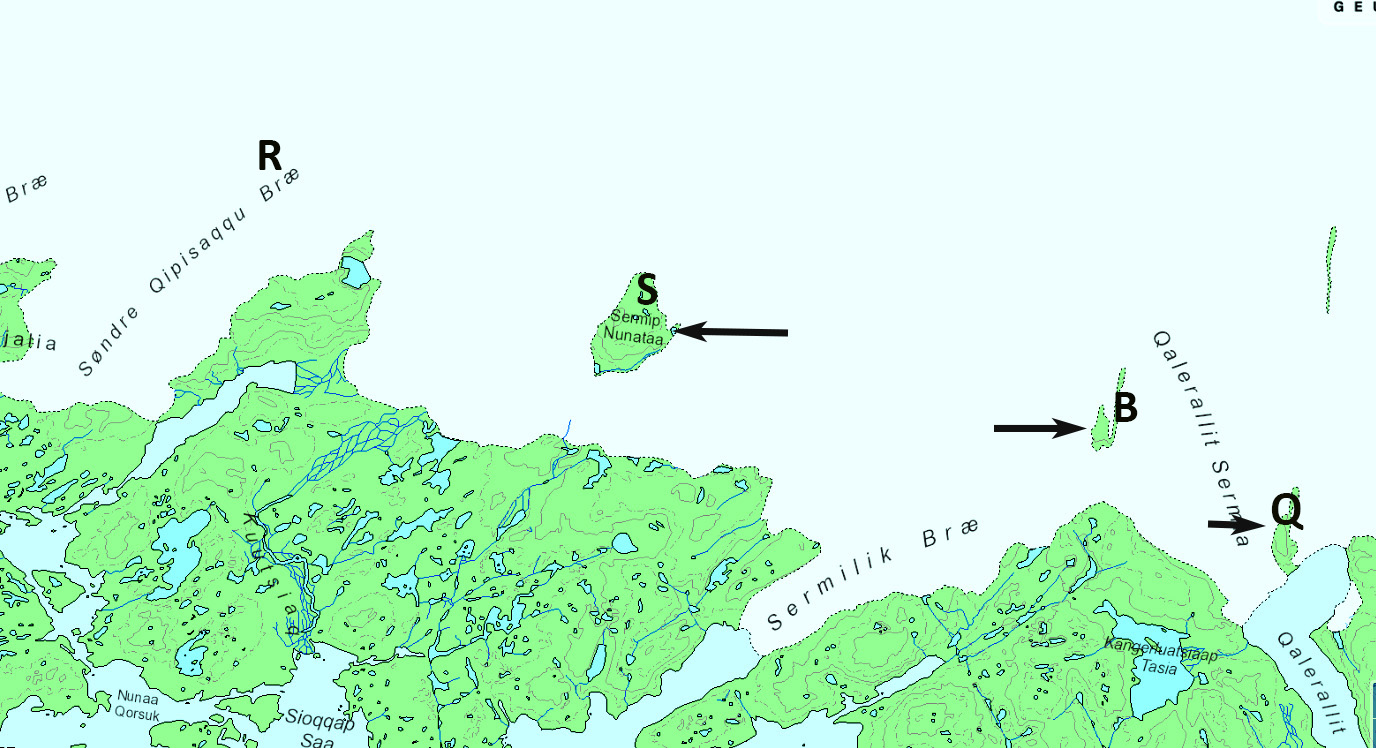
Sermip Nunataa (S) and nearby nunataks in Greeland Topographic map.

Sermip Nunataa (S) and nearby nunataks in 1993, Q, R and B in 2004 Landsat image.  Red dots indicate the 1993 margin. 

Sermip Nunataa (S) and nearby nunataks in 1993, Q, R and B in 2017 Landsat image.  Red dots indicate the 1993 margin. 

Talchako Glacier, British Columbia Retreat 1987-2018

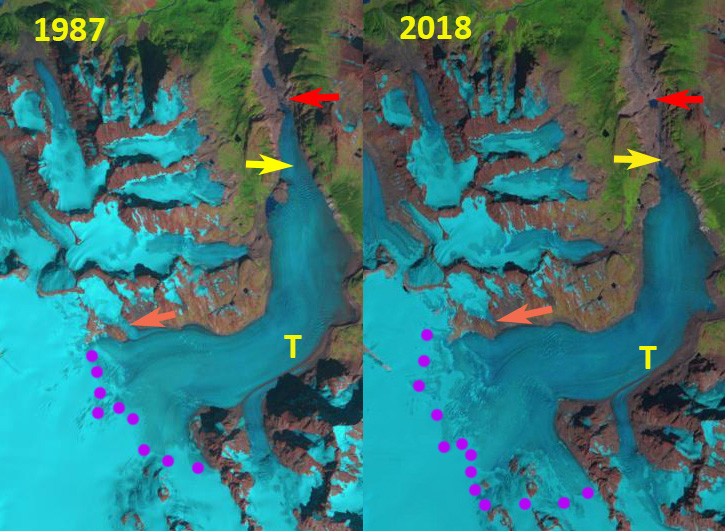
Talchako Glacier change revealed in 1987 and 2018 Landsat images.  Red arrow is 1987 terminus location, yellow arrow 2018 terminus, orange arrow a tributary from the north and purple dots the snowline. 

Talchako Glacier is the largest outlet glacier of the Monarch Icefield in the Coast Range of British Columbia and is the headwaters of the Talchako River. VanLooy and Forster (2008) noted that the glacier retreated at a rate of 11 meters/year from 1974 to 1992 and 23 meters/year from 1992-2000. Here we examine Landsat imagery from 1987 to 2018 to reveal changes over the last three decades.

In 1987 the glacier terminated at 800 m on an outwash plain just south of a small lake.  The glacier snowline was at 1950 m.  The orange arrow indicates a tributary joining from the north side of the valley tongue.  By 2000 the glacier has retreated 600 m and terminates above a knob at ~950 m.  The snowline is at 2000 m, and the tributary still joins the glacier.  In 2016 the snowline is between 2100 and 2150 m.  The tributary has now detached.  In 2018 the terminus has retreated 1800 m since 1987 a rate of 60 m/year, a considerable acceleration from the late 20th century.  In 2018 the snowline is between 2100 and 2150 m.  The high elevation of  the snowline in recent years is indicative of negative mass balance that will drive further retreat as has been noted at other glaciers in the region (Tennant et al 2012).  The Talchako River is host to  chinook, coho, chum, and pink salmon, rainbow and cutthroat trout, steelhead and Dolly Varden.  Coho salmon reach the headwater sections of the Talchako River.  There is no hydropower on this river.

This glacier is part of the fabric of dwindling glaciers in British Columbia. The retreat is similar to the retreat of other glaciers in the immediate area: Jacobsen Glacier, Klippi Glacier and Klinaklini Glacier.

Talchako Glacier change revealed in 2000 and 2016 Landsat images.  Red arrow is 1987 terminus location, yellow arrow 2018 terminus, orange arrow a tributary from the north and purple dots the snowline. 

Meade Glacier, Alaska 4 km Retreat 1986-2018

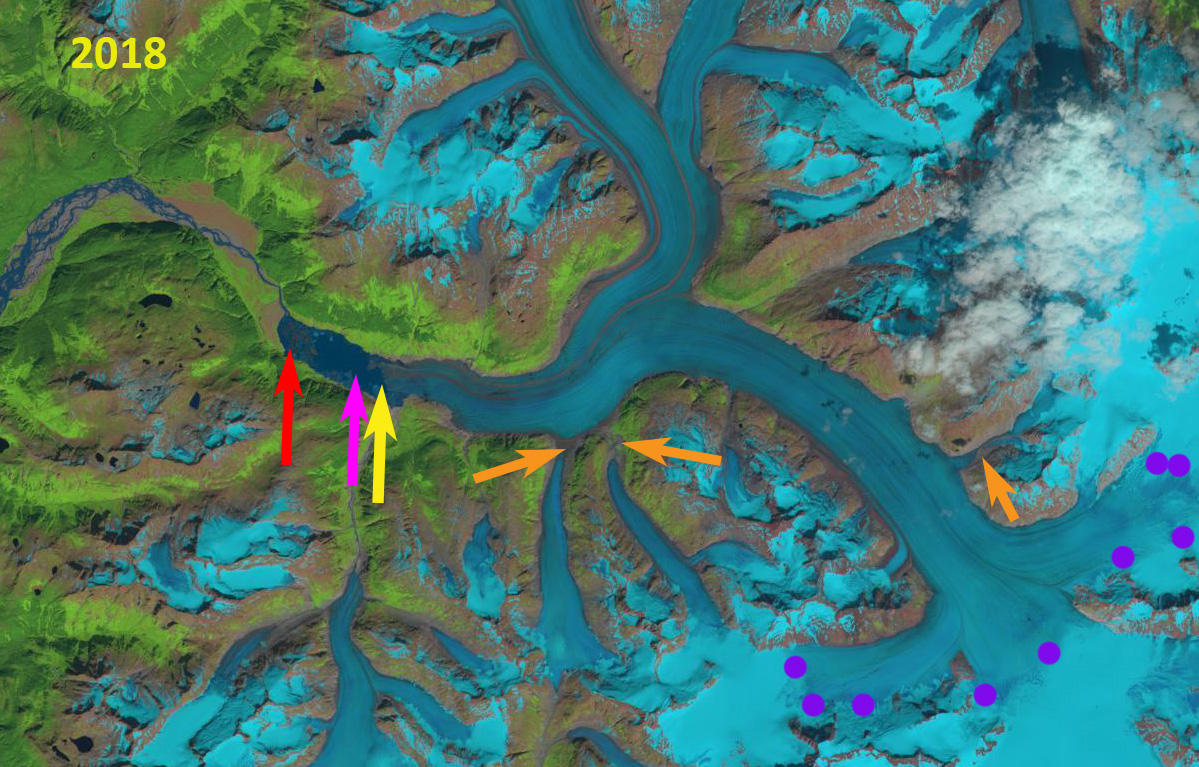
Meade Glacier in Landsat images from 1986 and 2018.  The red arrow indicates the 1986 terminus, pink arrow the 2014 terminus, yellow arrow the 2018 terminus, orange arrows tow tributaries to Meade Glacier and the purple dots the snowline.

Meade Glacier drains the northwest portion of the Juneau Icefield, with meltwater entering the Katzehin River and then Chilkoot Inlet. The glacier begins in British Columbia and ends in Alaska. Here we use Landsat imagery to examine changes in the glacier from 1986 to 2018. The glacier experienced a slow continuous retreat from 1948 to 1986 of 400 m, with the glacier ending on an outwash plain.

In 1986 the terminus is indicated by a red arrow, the snowline is at 1250 m in 1986, there is no evident lake at the terminus of glacier just an expanding outwash plain. Both tributaries from the south, orange arrows, are 750 m+ wide where they join Meade Glacier. By 2004 a 400 m long proglacial lake has formed at the terminus. The two tributaries from the south, at the orange arrows, no longer are connected to the glacier. The snowline is at 1450-1500 m. In 2014 the proglacial lake is 3.5 km long, the entire lower 2.5 km of the glacier has collapsed since 2004. There is still considerable relict ice floating in the lake. There is a substantial lake along the southern margin of the glacier where a tributary streams enters the main valley. This indicates the glacier will quickly retreat to this point by further collapse into the lake.  The snowline in 2014 is at 1450 m on Aug. 2, the date of the imagery, the high snowline ensures continued mass loss and glacier retreat.  By 2018 Mead Glacier has retreated 4.1 km since 1986.  The snowline is at 1450 m on October 2, when fall snow should have already begun.  A third tributary entering the glacier from the east at 1200 m no longer reaches the main stem.  Based on surface slope changes the glacier appears to be within 1 km of the inland limit of the proglacial lake.  The inland limit should be near the prominent bedrock knob on the south side of the glacier a short distance inland of the current terminus. When this is reached the glacier retreat will be reduced.  The retreat parallels that of most Juneau Icefield glaciers including the next glaciers to the south Field Glacier and Gilkey Glacier.  The glacier shares a divide with Warm Creek Glacier that terminates in British Columbia that is also retreating rapidly in an expanding lake.

Meade Glacier in Landsat image from 2004.  The red arrow indicates the 1986 terminus, pink arrow the 2014 terminus, yellow arrow the 2018 terminus, orange arrows tow tributaries to Meade Glacier and the purple dots the snowline.

Meade Glacier in Landsat image from 2014.  The red arrow indicates the 1986 terminus, pink arrow the 2014 terminus, yellow arrow the 2018 terminus, orange arrows tow tributaries to Meade Glacier and the purple dots the snowline.

Meade Glacier in Landsat image from 2018.  The red arrow indicates the 1986 terminus, pink arrow the 2014 terminus, yellow arrow the 2018 terminus, orange arrows tow tributaries to Meade Glacier and the purple dots the snowline.

Vera Glacier, Novaya Zemlya Retreat

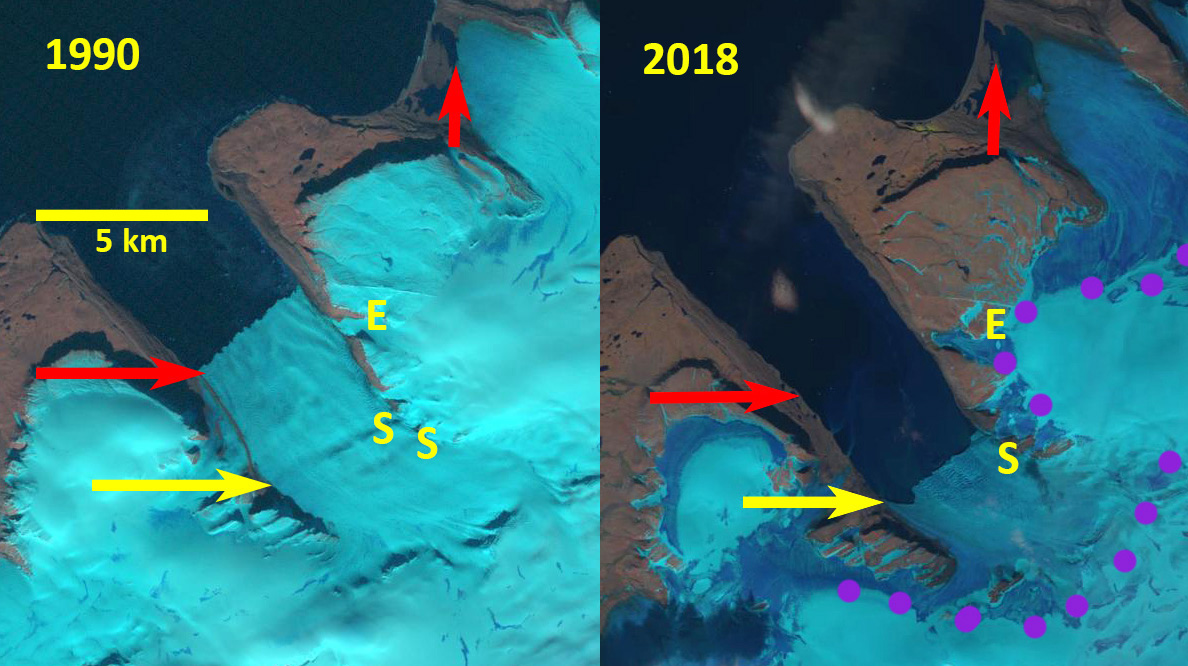
Vera Glacier in Landsat images from 1990 and 2018. Red arrow is the 1990 terminus and yellow arrow the 2018 terminus location.  Purple dots indicate the snowline, E indicates the eastern tributary and S the bedrock step.

Vera Glacier is on the west coast of Northern Noyaya Zemlya terminating in a fjord  Carr et al (2017) examined Novaya Zemlya glacier retreat between 1973/76 and 2015, finding that between 2000 and 2013, retreat rates were significantly higher on marine-terminating outlet glaciers than during the previous 27 years. Here we examine changes in Vear Glacier from 1990-2018 using Landsat imagery.

In 1990 the glacier terminated at the red arrow 1 km beyond a tributary entering from the east.  There is a marked rib at the yellow arrow in the 1990 image, suggesting a bedrock step beneath the glacier.   In 1995 the tributary from the east no longer reaches the main glacier, the terminus front has retreated several hundred meters and the snowline is at 300 m.  By 2016 the terminus has retreated well south of the eastern tributary nearly doubling the length of the fjord.  The terminus is now close to the bedrock step seen in the 1990 image.  By 2018 the glacier has retreated The snowline is again at  300 m. By 2018 Vera Glacier has retreated 3500 m since 1990, including past a second eastern tributary.  The fjord is now over10 km long.  The glacier is at the bedrock step with another bedrock step 500-1000 m upglacier.  Each step should indicate a reduced water depth and reduced calving.  The snowline in early August in 2018 is at 300 m, but rises to 600 m by the end of the month on neighboring Inostrantseva Glacier.  Pelto (2017) and Carr et al (2017)  discuss the role reduced Barents Sea Ice duration played in the retreat.  The retreat here is similar to that of other nearby Novaya Zemlya glaciers such as Mack and Velkena Glacier or  Inostrantseva Glacier.

The glaciers in this region are also a potential source for radiation from nuclear weapons testing by Russia from 1957-1962.

Vera Glacier in Landsat images from 1995 and 2016. Red arrow is the 1990 terminus and yellow arrow the 2018 terminus location.  Purple dots indicate the snowline and E indicates the eastern tributary.

Inostrantseva Glacier, Novaya Zemlya Retreat Drives Separation

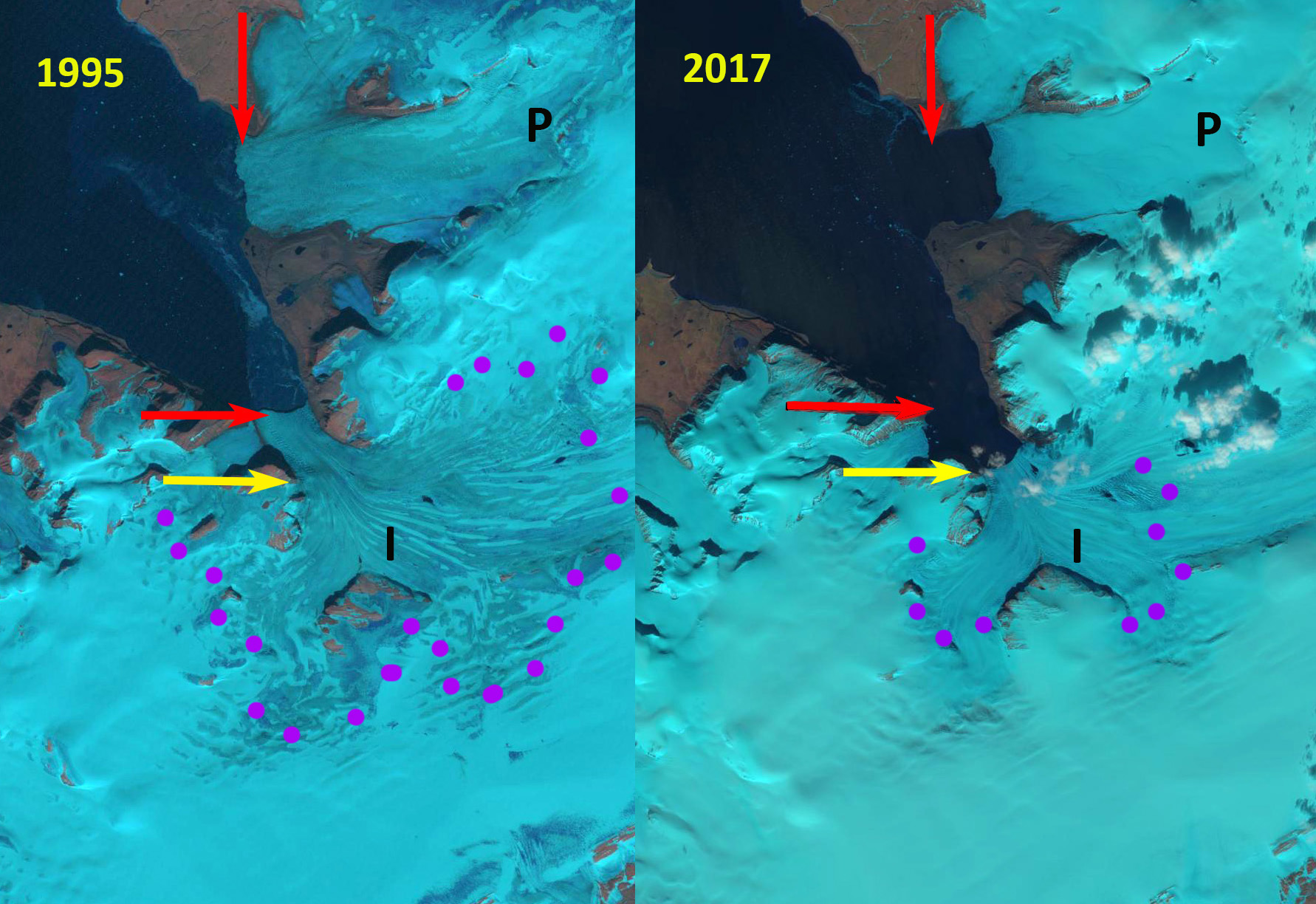
Inostrantseva Glacier (I) and Pavlova Glacier (P), Novaya Zemlya in 1995 and 2017 Landsat images.  Red arrow indicates the 1995 terminus, yellow arrow the 2017 terminus and purple dots the snowline. 

Inostrantseva Glacier is on the west coast of Northern Noyaya Zemlya terminating in Inostrantseva Bay along with Pavlova Glacier.  Carr et al (2017) examined Novaya Zemlya glacier retreat between 1973/76 and 2015, finding that between 2000 and 2013, retreat rates were significantly higher on marine-terminating outlet glaciers than during the previous 27 years. Here we examine changes in Inostrantseva Glacier from 1995-2018 using Landsat imagery.

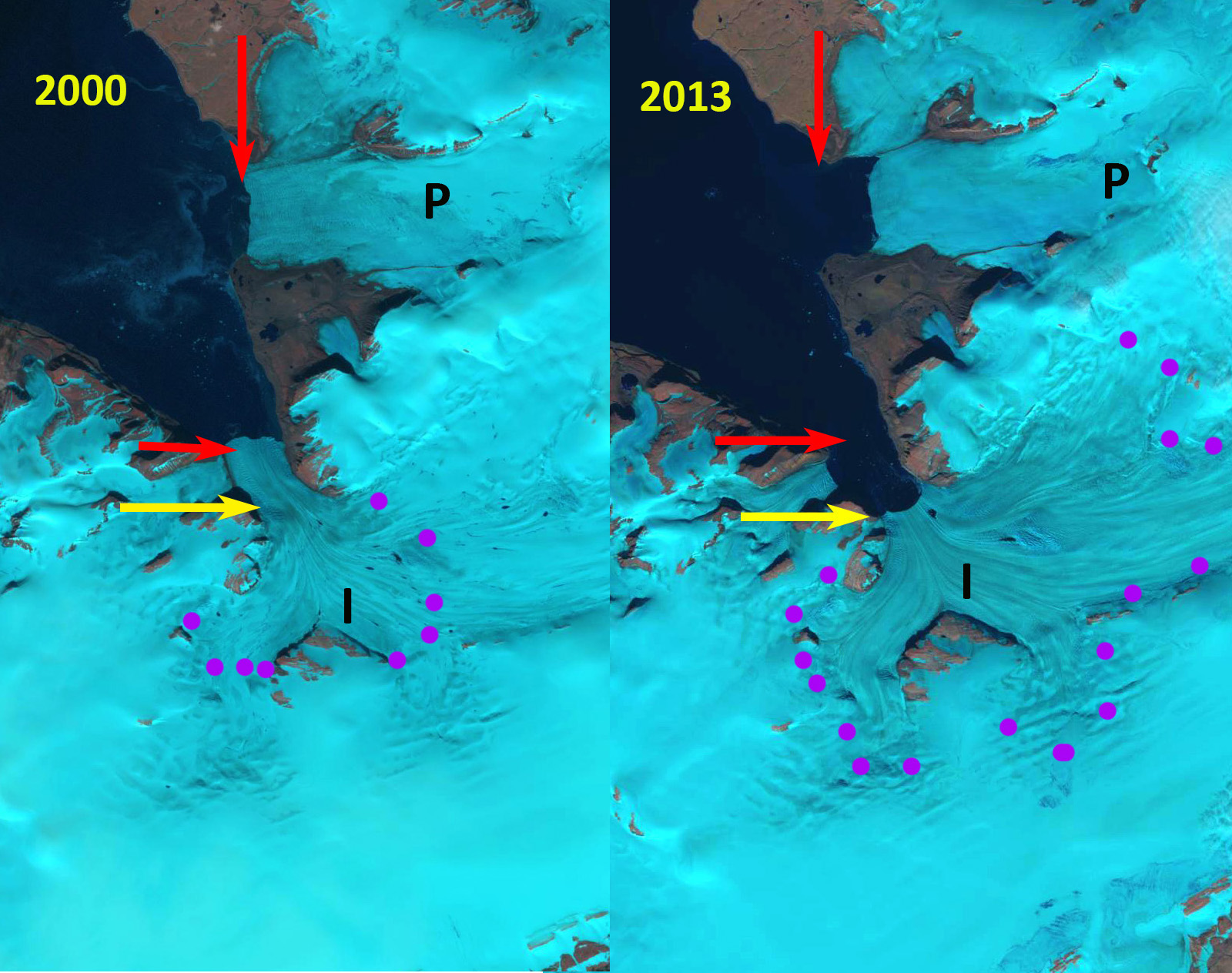
In 1995 the glacier terminated at the red arrow, just beyond the junction with a tributary joining from the west.  The snowline is at 400-450 m, with the divide of the icefield at ~600 m. Pavlova Glacier terminus is at outer margin of its embayment.  In 2000 there is limited terminus change, and the snowline in this July image is at 250-300 m. By 2013 Inostrantseva Glacier has separated has separated from the western tributary and has retreated 2800 m since 2000.  The snowline is at 350-400 m.  Pavlova Glacier has retreated creating an embayment that is 1.5-2.0 km long.  In 2017 the terminus has retreated 2800-3000 m since 1995. The snowline is at 300 m.  In 2018 there is not a clear view of the terminus of the Inostrantseva Glacier, what is noteworthy is that the melt zone/snow line for the first time I have seen crosses the entire icefield, being higher than the divide at 600 m.  On August 8, there is still some snowpack remaining along the divide.  By August 31 the melt zone extends across the entire icefield. The high snowline indicates 2018 will be a year of significant mass loss on this portion of the Novaya Zemlya ice cap. Pelto (2017) and Carr et al (2017)  discuss the role reduced Barents Sea Ice duration played in the retreat.  Carr et al (2017) indicate the fastest retreat of Inostrantseva was from 2005-2010. The retreat here is similar to that of other nearby Novaya Zemlya glaciers such as Vera Glacier,  Mack and Velkena Glacier or Chernysheva Glacier.

Inostrantseva Glacier (I) , Novaya Zemlya 8/8/2018 and 8/31/2018 Landsat images.  Red arrow indicates the 1995 terminus, yellow arrow the 2017 terminus and purple dots the snowline. Note the east margin of the icefield is shown and that the snowline/melt zone extends across the entire icefield.

Inostrantseva Glacier (I) and Pavlova Glacier (P), Novaya Zemlya in 2000 and 2013 Landsat images.  Red arrow indicates the 1995 terminus, yellow arrow the 2017 terminus and purple dots the snowline. 

High Glacier Snow Line Post-Monsoon 2018 on Bhutan-China Border

Angge Glacier (A) and Bailang Glacier (B) in China and Chubda Glacier (C) in Bhutan in Post Monsoon 1995 and 2018 Landsat images indicating the snowline purple dots is exceptionally high in 2018.  Red arrow is the 1995 terminus location and yellow arrows the 2018 terminus location. Point 1-3 are glacier passes from China into Bhutan.

The end of the monsoon season leads to finally some clear satellite images of snowlines and glaciers in the Himalaya.  A Landsat image from September 12, 2018 along the China-Bhutan  indicates high snowlines (5500 m) that reach the top of some glaciers and the glacier divide between nations on other glaciers.

Bailang Glacier and Angge Glacier, China are adjacent to the Chubda Glacier, Bhutan.  A These glaciers drain north and south from near Chura Kang on the Bhutan/China border.  Despite being in different nations on different flanks of the Himalaya, the retreat and resultant lake expansion is the same. These are all summer accumulation type glaciers that end in proglacial lakes.  All three lakes are impounded by broad moraines that show no sign of instability for a potential glacier lake outburst flood.  The number of glacier lakes in the region has increased 20%  (Che et al, 2014)   The Chubda Glacier terminates in Chubda Tsho, a glacier moraine dammed lake, Komori (2011) notes that the moraine is still stable and the lake is shallow near the moraine, suggesting it is not a threat for a glacier lake outburst flood.  Jain et al., (2015) noted that in the last decade the expansion rate of this lake has doubled. The glacier feeds the Chamkhar Chu Basin.

Here we examine 1995-2018 Landsat images from the post monsoon period to identify both retreat and the anomalously high snowlines in 2018.  In 1995 the highest observed snowline is at 5300 m, purple dots, Point 1 -3 are glacier passes from China into Bhutan that are snowcovered.  The glaciers terminate at the red arrows.  In 2000 the highest observed snowline is 5250-5300 m. There is limited retreat since 1990. In 2017 the highest observed snowline is at 5300-5350 m.  In 2018 the highest observed snowline is at 5500-5550 m.  The glacier passes at Point 1 and 2 lack any snowcover.  The glaciers at Point 3 have no retained snowcover despite top elevation above 5400 m.  Bailang Glacier has retreated 900 m from 1995 to 2018 that has led to lake expansion.   A retreat 1995-2018 retreat of 800 m of Angge Glacier has led to lake expansion.  A retreat of Chubda Glacier of 800 m  has led to lake expansion from 1995-2018 has led to lake expansion. 

2000 Landsat image from the post monsoon indicating the snowline purple dots.  Red arrow is the 1995 terminus location  Point 1-3 are glacier passes from China into Bhutan.

2017 Landsat image from the post monsoon indicating the snowline purple dots.  Red arrow is the 1995 terminus location  Point 1-3 are glacier passes from China into Bhutan.

Sept. 12 2018 Landsat image indicating the snowline purple dots is exceptionally high in 2018.  Red arrow is the 1995 terminus location and yellow arrows the 2018 terminus location. Point 1-3 are glacier passes from China into Bhutan.

Taku Glacier, Alaska in 2018 Highest Snowline in 70+ years

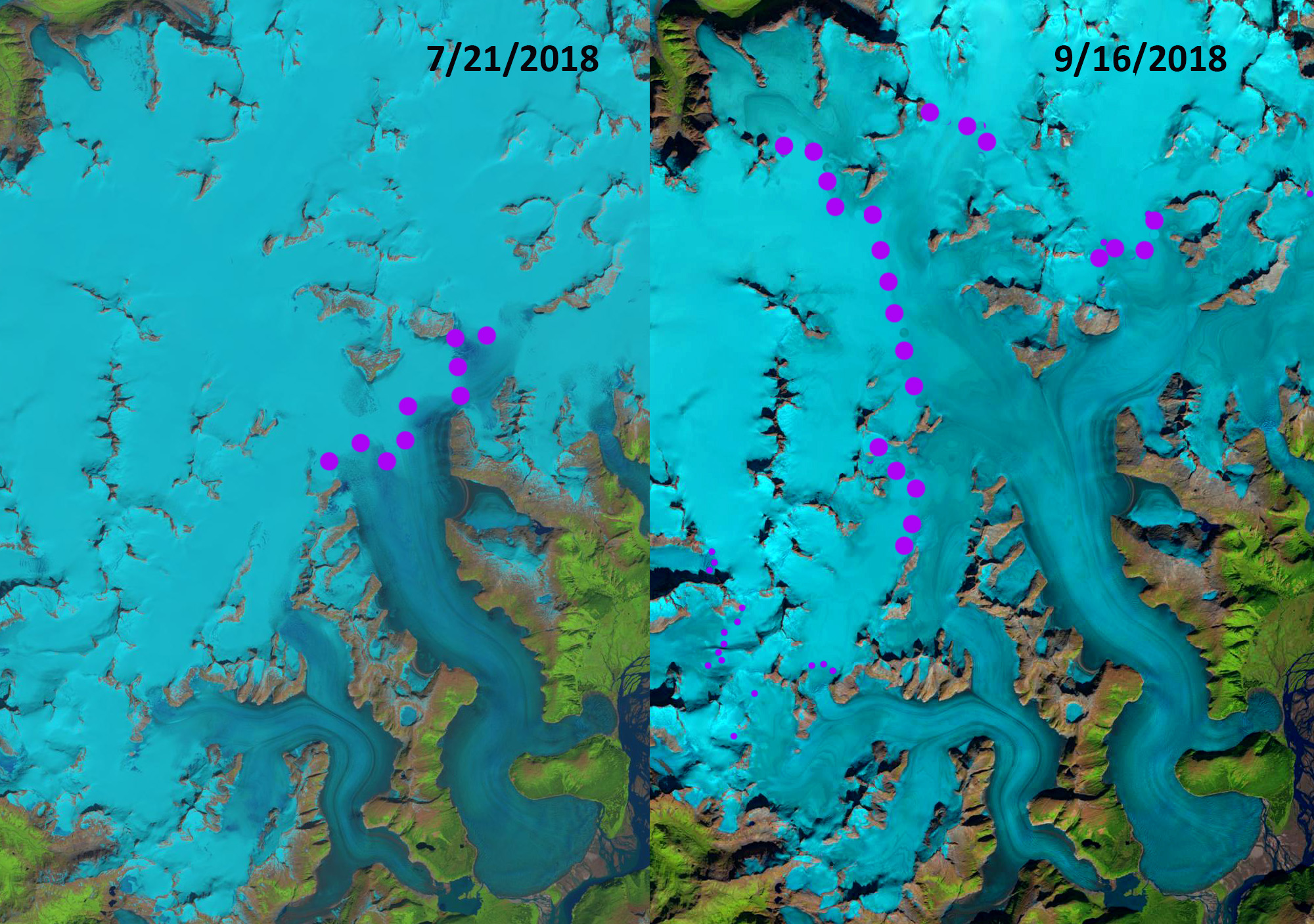
Taku Glacier transient snowline (purple dots) in Landsat images from 7/21 and 9/16/2018.

The Juneau Icefield Research Program (JIRP) has been examining the glaciers of the Juneau Icefield since 1946. Until the NASA Landsat program began, field measurements and aerial observations were the only means to observe the glaciers of the icefield. For more than 40 years it was Maynard Miller, U of Idaho, who led this expedition that has trained so many of today’s glaciologists, today it is led by Seth Campbell, U of Maine who followed Jeff Kavanaugh, U of Alberta.   Landsat images have become a key resource in the examination of the mass balance of these glaciers (Pelto, 2011). The overall mass balance record of the glaciers was published this by Pelto et al (2013). On Taku Glacier, the mean annual equilibrium line altitude (ELA) has risen 85 m from the 1946–1985 period to the 1986–2018 period.  Mean annual mass balance from 1946-1985 and 1986-2018, with 2018 values being preliminary, were +0.40 m/yr and −0.18 m/yr respectively, indicative of the snow line rise resulting in cessation of the long-term thickening of the glacier.

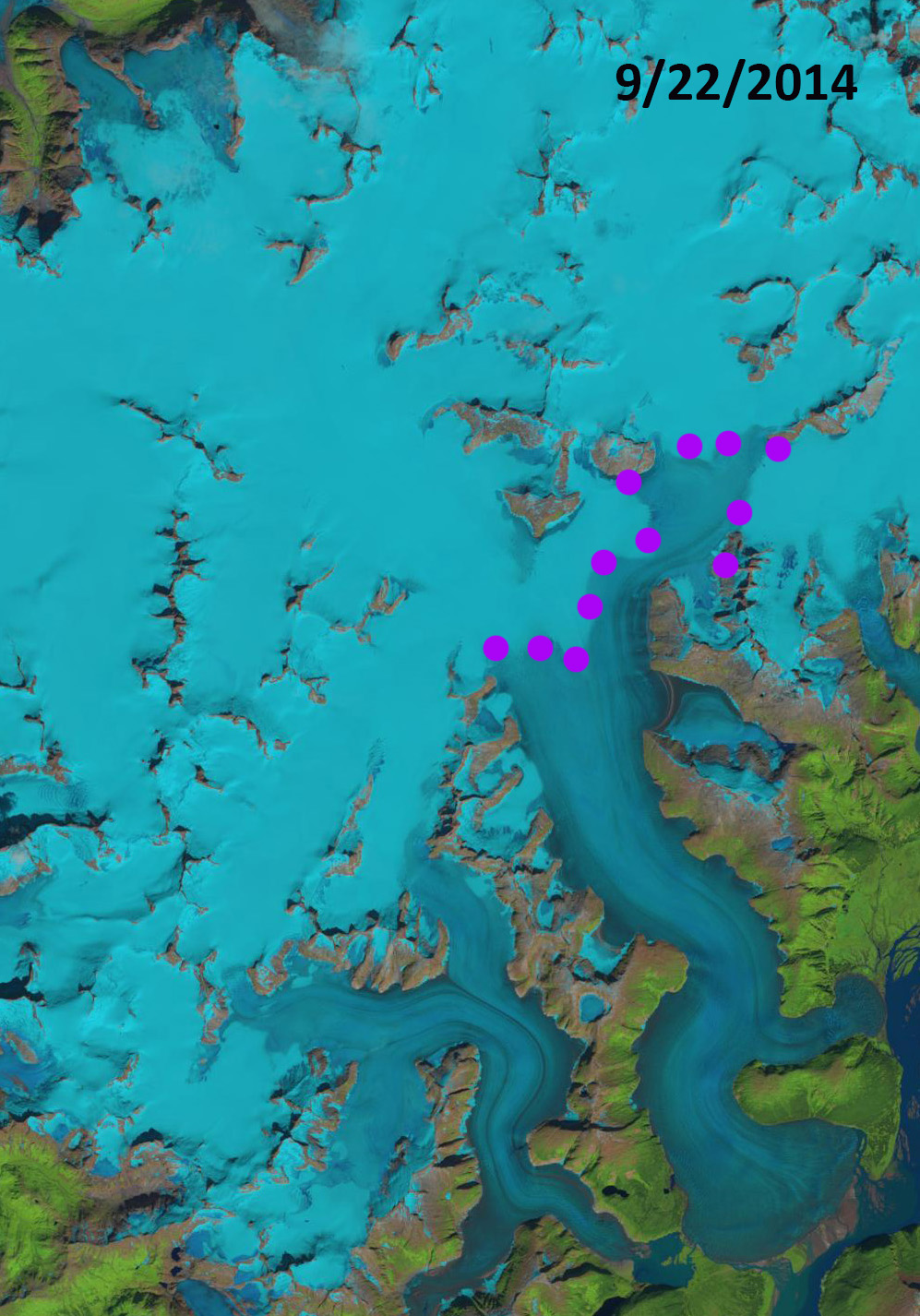
The height of the transient snowline (purple dots) at the end of the summer represents the ELA for the glacier, where ablation equals accumulation.  This also is a good estimator of mass balance. The end of the summer melt season typically occurs in September. In the last three decades the average ELA has been 1000 m.  In 2018 the transient snowline on July 21 was at 975 m, and by July 30 the TSL was above 1075 m.  On Sept. 16, 2018 the snowline was at 1400 m on average, the highest observed since records began in 1946. This is a rise of 425 m in ~57 days.  Given the balance gradient observed on the glacier of  ~3.3 mm/m this represents ablation of 1.4 m w.e. snow, or 2.0 m of snow depth  (Pelto et al 2013 and Roth et al 2018)  The snowline on Brady Glacier, Glacier Bay was also the highest that had been observed in 2018. In the images below the TSL in 2013 is at 1000 m, in 2014 at 1100 m, 2015 at 1140 m, and in 2017 at 1150 m. Pelto (2017) identifies the response of the entire icefield to climate changes from 1984-2013. The 2014-2018 period has been the most negative balance 5 year period for the icefield, which will lead to continued thinning and volume loss.


Annual equilibrium line altitude on Taku Glacier 1946-2018, 2018 is the highest and 1985 the lowest.

Taku Glacier transient snowline (purple dots) in Landsat image from 9/15/2013.

Taku Glacier transient snowline (purple dots) in Landsat images from 9/22/2014.

Taku Glacier transient snowline (purple dots) in Landsat images from 9/8/2015.

Taku Glacier transient snowline (purple dots) in Landsat images from 9/20/2017.

Brady Glacier, Alaska Nunatak Expansion and High Snowline 2018

Emergence of Nunataks at Point A, B and C at 850 m on Brady Glacier from 1986 and 2018 Landsat Images.  Transient snowline on 9/21/2018 indicated by purple dots.

Brady Glacier,  is a large Alaskan tidewater glacier, in the Glacier Bay region that is beginning a period of substantial retreat Pelto et al (2013). Pelto et al (2013) noted that the end of season observed transient snowline averaged 725 m from 2003-2011, well above the 600 m that represents the equilibrium snowline elevation, for the glacier to sustain its current size. In 2015, 2016 and 2018 the snowline has been at 900-1000 m.  This is leading to thinning across of what was much of the accumulation zone.  Here we examine Landsat images from 1986 to 2018 to identify signs of this thinning.

In 1986 Point A and B have insignificant rock exposure, while C has a limited single rock nunatak.  By 2000, below there is bedrock exposed west of Point A and B, with two small nunataks near C.  By 2015 there is a 2 km long bedrock ridge at Point A and a ~1 km long bedrock ridge at Point B.  The snowline in 2015 is just above Point B and C at 900 m.  In 2016 on Oct. 1 2016 after the end of the typical melt season the snowline is at 900 m. In 2018 the snowline on Sept. 21 is at 1000 m.  At Point A the bedrock Ridge is now 2300 m long and up to 300 m wide.  At Point A the ridge is 1100 m long.  At Point C a third nunatak has emerged and the series of nunataks will soon merge into a single ridge.

The persistent high snowlines indicate the consistent accumulation zone is now above 900 m, below this point thinning will continue.  The mean elevation of the glacier is at 720 m and thinning is significant below 1000 m from 1995-2011(Johnson et al 2013).  That far less than 50% of the glacier is retaining snowpack and widespread thinning will drive further retreat of the distributary glacier termini in expanding lakes noted by Pelto et al (2013) and a the 2016 blog post.   Brady Glacier abuts the adjacent Lampugh Glacier that has and will be impacted by a large landslide.

Trick Lakes: In 1986 North and South Trick Lake are proglacial lakes in contact with the glacier. By 2016 the two lakes are no longer in contact with the glacier, water levels have fallen and a third lake East Trick Lake has formed. The more recently developed East Trick Lake is the current proglacial Trick Lake, a large glacier river exits this lake and parallels the glacier to the main Brady Glacier terminus, going beneath the glacier for only several hundred meters.

North Deception Lake had a limited area in 1986 with no location more than 500 m long. By 2016 retreat has expanded the lake to a length over 2 km. The width of the glacier margin at North Deception Lake will not change in the short term, but the valley widens 2 km back from the current calving front, thus the lake may grow considerably in the future.

South Dixon Lake This new lake does not have an official name. It did not exist in 1986, 2004, 2007 or 2010. It is nearly circular today and 400 m in diameter.

Dixon Lake: It is likely that retreat toward the main valley of the Brady Glacier will lead to increased water depths at Dixon Lake, observations of depth of this lake do not exist. Retreat from 1986 to 2016 has been 600 m.

Bearhole LakeBearhole Lake is expanding up valley with glacier retreat, and there are no significant changes in the width of the valley that would suggest a significant increase in calving width could occur in the near future. Currently the lake is 75 m deep at the calving front and there has been a 1400 m retreat since 1986 Capps et. al. (2013).

Spur Lake:It is likely that retreat toward the main valley of the Brady Glacier will lead to increased water depths at Spur Lake. the depth has fallen as the surface level fell from 1986-2016 as the margin retreated 600 m, leaving a trimline evident in the 2016 imagery.

Oscar Lake has experienced rapid growth with the collapse of the terminus tongue. Depth measurements indicate much of the calving front which has increased by an order of magnitude since 1986 is over 100 m. The tongue as seen in 2014 Google Earth image will continue to collapse and water depth should increase as well. The central narrow tongue has retreated less than 200 m since 1986, but the majority of the glacier front has retreated more than 1 km since 1986.

Abyss Lake: Continued retreat will lead to calving width expansion> The retreat from 1986 to 2016 has been 400 m. The water depth has been above 150 m at the calving front for sometime and should remain high.

Emergence of Nunataks at Point A, B and C at 850 m on Brady Glacier from 2000 and 2015 Landsat Images.  Transient snowline on 9/21/2018 indicated by purple dots.

Landsat image of Brady Glacier on 9/21/2018 indicating the snowline (purple dots)  and the emerging nunataks at Point A-C. Lakes noted are: A=Abyss, B=Bearhole, D=Dixon, N=North Deception, O=Oscar, Sd=South Dixon, Sp=Spur, T=Trick.

Landsat image of Brady Glacier on 10/1/2016 indicating the snowline (purple dots)  and the emerging nunataks at Point A-C.

Duiya Glacier, China Retreat Drives Lake Expansion

Duiya Glacier, China in 1990 and 2017 Landsat images.  Red arrow indicates 1990 terminus, yellow arrow the 2017 terminus, pink arrow the terminus area of Duosangpuxi purple dots the snowline

Duiya Glacier, China is in the Pumqu Basin northwest of Mount Everest.  The glacier terminates in an expanding lake.  King et al (2018) report the proglacial lake is dammed by a full moraine loop, and the glacier loses mass via calving as and surface melt.  Here we use Landsat imagery to identify changes from 1990-2018. The Pumqu River becomes the Arun River in Nepal , which has a proposed 900 MW hydropower plant under development .

In 1990 the glacier terminated in a small proglacial lake, 500 m across at 5500 m.  The snowline in 1990 was at 6000 m.  The Duosangpuxi Glacier to the east also terminates in a proglacial lake.  In 2000 the lake has expanded to 800 m in length due to retreat.  The glacier snowline is at 6000 m again.   The Duosangpuxi Glacier to the east has retreated from the lake it formerly terminated in.  By 2017 the glacier had retreated 1020 m a rate of 37 m/year. The lake is now over 1.5 km long.  The snowline in 2017 is at 6200 m.  In September 2018 the snowline has likely not reached its highest elevation but is just below 6200 m.  The terminus is obscured by clouds, but has not changed significantly from 2017.  There icebergs in the lake indicating calving continues.  The high snowline in recent years indicate continued mass loss that will drive further retreat.

King et al (2017) examined the mass balance of 32 glaciers in the Everest region for the 2000-2015 period including the Duiya and found a mass loss of ~0.5 m/year, with the loss of lake terminating glaciers at ~-0.7 m/year.  The retreat of this glacier is like that of Yanong Glacier and Chaxiqudong Glacier whereas Rongbuk Glacier has experienced supraglacial lake expansion, and thinning without as much retreat.

Duiya Glacier, China in 2000 and 2018 Landsat images.  Red arrow indicates 1990 terminus, yellow arrow the 2017 terminus, pink arrow the terminus area of Duosangpuxi purple dots the snowline.

Broader view of the Duiya Glacier (Du) and neighboring glaciers Cuolangma (C) and Duosangpuxi (Dx), each terminating in a lake in 1990. 

Yakutat Glacier Terminus Collapse Nears Completion, 45 km2 lost 2010-2018

Landsat images from 2010 and 2018 with terminus indicated by yellow dots in both, the orange dots indicate 2010 margin on 2018 image. Point A indicates the 1987 terminus location, pink arrows indicate icebergs. Main terminus now extends south near Point C. Northern terminus extends west from Point B.

Yakutat Glacier, Alaska has experienced a spectacular retreat in the last decade losing 45 km² from 2010-2018.  The Yakutat Glacier during the 1894-1895 Alaskan Boundary Survey ended near a terminal moraine on a flat coastal outwash plain. By 1906 the glacier had retreated from the moraine and a new lake was forming, Harlequin Lake.  From 1906-1948 the glacier retreated an additional 5 km. From 1948-1958 the glacier retreated 3.6 km. Here we examine Landsat imagery to quantify the retreat from 2010-2018. This is an update to a Yakutat Glacier 2016 post

In 2010 the glacier has just retreated from the peninsula at Point A, the valley at D was deglaciated, a small strip of bedrock-sediment was exposed at C from that had been beneath the glacier, and B was still well inland of the terminus. An aerial image of the glacier indicates significant rifting, blue arrows,  in 2010 that leads to the substantial 2013 breakup.  Rifts are not just crevasses, as they typically extend to the base of the glacier along part of the glacier.  They typically form in areas of a glacier that are near flotation.  In this case an area that has thinned until approximate flotation (Benn, Warren ann Mottram, 2007). In 2013 there is a large area of icebergs and melange in front of the terminus, yellow dots. By 2013 the northern arm of the glacier had retreated 6.4 km from the peninsula at A toward the peninsula at B. The central arm of the glacier toward C had retreated 7.5 km and the retreat on the southern edge of the glacier was 6.5 km.  In 2015 the snowline is quite high at 2200 m, leaving very little of the glacier in the accumulation zone. In 2015 a large iceberg detached pink arrow, that is 5 km by ~1 km. In 2016 the snowline is again around 2200 m. From 2013 to 2016 the glacier retreated from Point B to Point C on the northern side and to Point E on the southern side this is a distance of 10.2 km in thirty years since 1987 or 340 m/year. In 2016 the Peninsula extending across the lake from Point C is 2.5 km long. The terminus is resting on this and adjacent shoals across 50% of its width.  The iceberg has diminished to 2.5 km long and 700 m wide, pink arrow.  The northern terminus extending west from Point B has changed little from 2013-2016. The 2018 image compares the 2010 position (yellow dots) with 2018 (orange dots), indicating an area of 45 km² lost.  The main terminus retreated 7 km. There are some small icebergs in 2018.  The ability to produce icebergs as large as in 2015 has been lost as the calving front has been restricted by the Peninsula which is now 3 km long, leaving less than a 3 km wide calving front.   The narrower calving front and reduced water depth should in the short term reduce retreat. The northern terminus near Point B has experienced limited retreat since 2013.

The glacier has thinned by more 200 m on average according to the preliminary thickness change maps from a U. Alaska-Fairbanks project (Truessel et al 2013) and updated by Truessel et al (2015). The Yakutat Glacier does not have a high accumulation zone and the recent increase in the snowline elevation and thinning of the glacier have led to a substantial shrinking of the accumulation zone and thinning of the glacier in the accumulation (Truessel et al 2013). This glacier does not have a persistent significant accumulation zone in 2015, 2016 and 2018 and cannot survive (Pelto, 2010).  Truessel et al (2015) modelling indicates a reduced rate of retreat from 2020-2030, which supports the expected reduced calving.  Their model also indicates the glacier will disappear between 2070 and 2110 depending on the warming scenario.  For a calving glacier to be in equilibrium it needs to have more than 60 % of its area snowcovered at the end of the summer, this was not achieved in 2015, 2016 or 2018.. The glacier is in the midst of a large ongoing retreat. The retreat rate and calving mechanism is similar to that of Grand Plateau GlacierAlsek Glacier and Gilkey Glacier. However, unlike these Yakutat Glacier lacks an accumulation zone, a better analog is East Novatak Glacier, which also has a lower elevation accumulation zone.

2010 image of the Yakutat Glacier terminus reach with blue arrows indicating rifts.

Landsat images from 2013 with terminus indicated by yellow dots. Point A indicates the 1987 terminus location. Note large area of melange and icebergs.

Landsat images from 2015 with terminus indicated by yellow dots. Point A indicates the 1987 terminus location.  Main terminus now extends south near Point C. Northern terminus extends west from Point B. Note large iceberg that calved in 2015, pink arrow.

Landsat images from 2016 with terminus indicated by yellow dots. Point A indicates the 1987 terminus location. Main terminus now extends south near Point C. Northern terminus extends west from Point B.Note large iceberg that calved in 2015, pink arrow.