
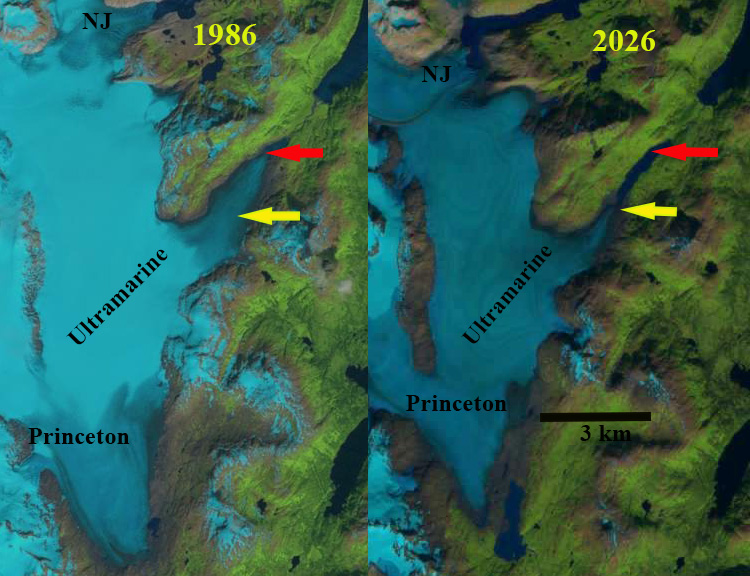
Ultramarine Glacier is an outlet glacier of the Sargent Icefield. The terminus extends northwest from the glacier and icefield. To the south is Princeton Glacier and the north is Nellie Juan Glacier. The glacier terminus has been in an expanding proglacial lake, but appers to be retreating from this lake. The glacier has a low elevation accumulaiton between 300 and 525 m, with a terminus tongue extending down to 100 m.
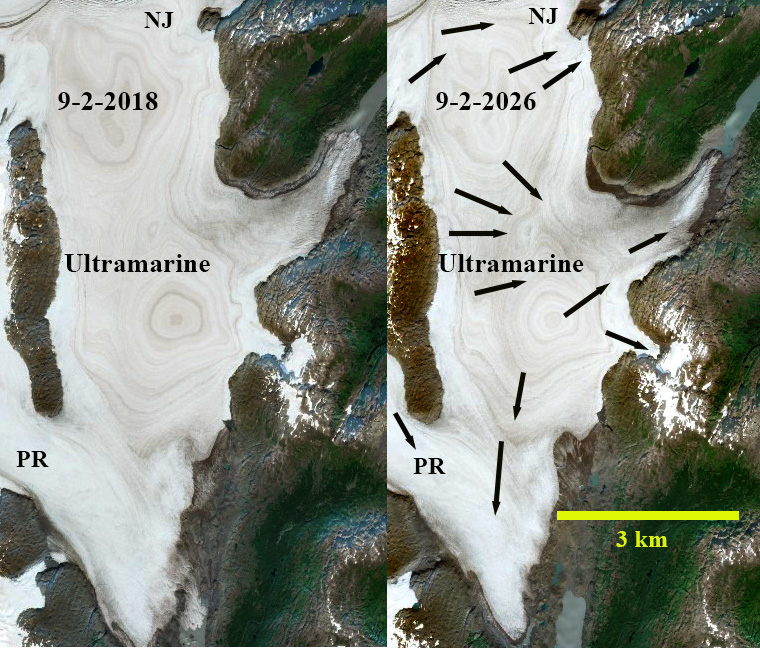
The glacier has retreated 2.2 km since 1986, similar to the 2.8 km retreat of Nellie Juan Glacier. In 2018, 2019, 2020, 2021, 2022, 2024 and 2026 the glacier lost all of its snow cover. The firn layers are evident in the Landsat image above and the Sentinel images below, these layers are not visible when snow cover exists. The ring pattern marks the ice divides where ice flows either to the Nellie Juan, Ultramarine or Princeton Glacier. A glacier without a persistent accumulation zone cannot survive. This is the situation for Ultramarine Glacier, with an area of 17 km2 it will endure for several decades. The Contact Glacier to the north that was connected to the Nellie Juan Glacier as well, is in the same situation, but with an area of 2.5 km2 will disappear sooner. The glacier fits well the regional pattern including in Kenai Fjords National Park (Black and Kurtz, 2021) and Excelsior Glacier on the south side of the icefield.
Ultramarine Glacier with no snow cover in 2018 and 2026. The firn layers are evident which also highlight the flow divides of the glacier. (NJ=Nellie Juan Glacier, PR+=Princeton Glacier)

