Central Andean Glaciers Laid Bare for Last Half of Summer 2022

Volcan Overo in Sentinel image continues to fragment with no retained snowcover this summer, and bedrock expansion at Point A.

For an alpine glacier to survive it must remain mostly snowcovered throughout the year, even at the end of the summer. This is one reason for the majesty of glaciated mountains, they shine brightly even in summer.  This year in the Central Andes of Argentina and Chile I have chronicled the near total loss of snowpack in January due to early summer warmth, leading to dirty/dark glaciers.  This is a similar story to what we saw in the Pacific Northwest last summer. Here is an update at the end of the summer using Sentinel imagery to highlight that these glaciers have remained largely bare for two months. The darker surfaces of the glacier melt faster leading to more rapid area and volume loss.  This includes fragmentation and rapid expansion of bedrock areas amidst the glacier. Earlier observations indicate this is a regional issue this summer with snowpack lost from Bajo del Plomo Glacier Cortaderal GlacierPalomo Glacier, Volcan Overo Glaciers, Volcan San Jose Glaciers , Cobre Glacier and Olivares Beta and Gamma Glaciers across the Central Andes of Chile and Argentina

Cortaderal Glacier in Sentinel image with no retained snowcover this summer, and bedrock expansion at Point A.

Volcan San Jose Glaciers in Sentinel image continues to fragment with ~5% retained snowcover this summer, and bedrock expansion at Point A.

Las Vacas Glaciers in Sentinel image continues to fragment with no retained snowcover this summer, and bedrock expansion at Point A.

Olivares Beta and Gamma Glacier  in Sentinel image with no retained snowcover this summer, retreating away from proglacial lakes and bedrock expansion at Point A.

Bajo del Plomo Glacier in Sentinel image with no retained snowcover this summer, and rapid bedrock expansion at Point A.

Palomo Glacier in Sentinel image with no retained snowcover this summer, and bedrock expansion at Point A.

Volcan Peteroa Glacier in Sentinel image continues to fragment with ~2% retained snowcover this summer, and bedrock expansion at Point A.
Volcan Overo, Argentina Glaciers No Retained Snowcover at Midsummer

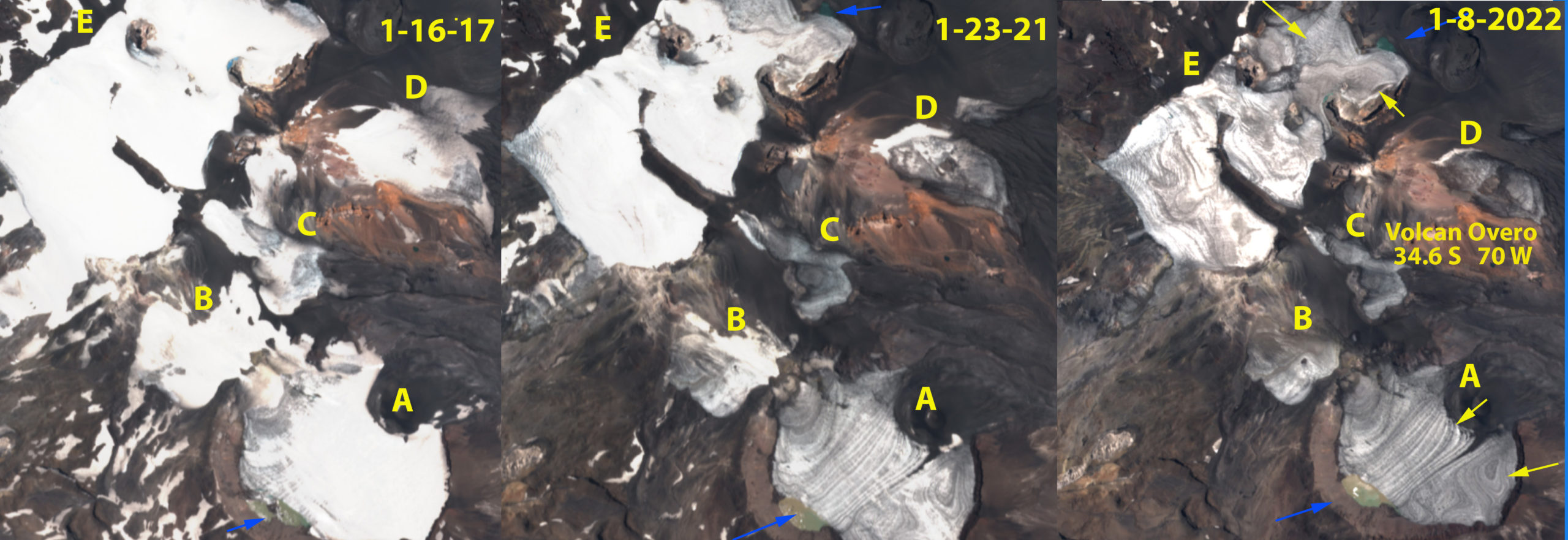
Volcan Overo glaciers in Sentinel images from January-2017, 2021 and 2022 illustrating fragmentation and no retained snowcover in 2022 with half the summer to go.

Volcan Overo is a 4619 m high Andean mountain in Argentina with a relatively low sloped broad summit region above 4000 m. This mountain has been the site of sulfur mining, with both an old tram and mining road leading to the summit region. The summit region is host to a glacier complex that is shrinking and fragmenting. In mid-January, 2022 the glacier has lost all of its snow cover.  La Quesne et al (2009) reported significant annual thinning in the latter half of the 20th century on nearby glaciers in Argentina and Chile. Dussaillant et al (2019) identified a slower mass loss  -0.28 m/year in this region from 2000-2018, than further south in the Patagonia Andes or north in the Tropical Andes. Here we examine Landsat images from 1986-2022 to identify longer term changes and with Sentinel images from 2017-2022 the recent changes including the impact of the recent January heat wave (Washington Post, 2022).

In 1986 there are four discrete glaciers around the caldera, covering ~12 km2 the largest E around the summit ranges in elevation from 4200-4500 m.  D is an isolated area at 4000-4100 m. A,B and C is a single glacier extending from 3900-4300 m. F is an area of rapidly diminishing glacier ice. In the early February image snowcover is good across all ice areas except F. In 2003 there is limited evident change with good snowcover across all except D. By 2013 A, B and C have fragmented into three separate glaciers and F is nearly gone. Only E has significant snowcover. In 2022 C and D have declined to less than 50% of their 1986 area, the overall Volcan Overo glaciated area has decline to ~8.1 km2.  It is not quite mid-summer on January 8, 2022 yet all snowcover has been lost from the glaciers of Volcan Overo. The glacier remnants at F are now gone.

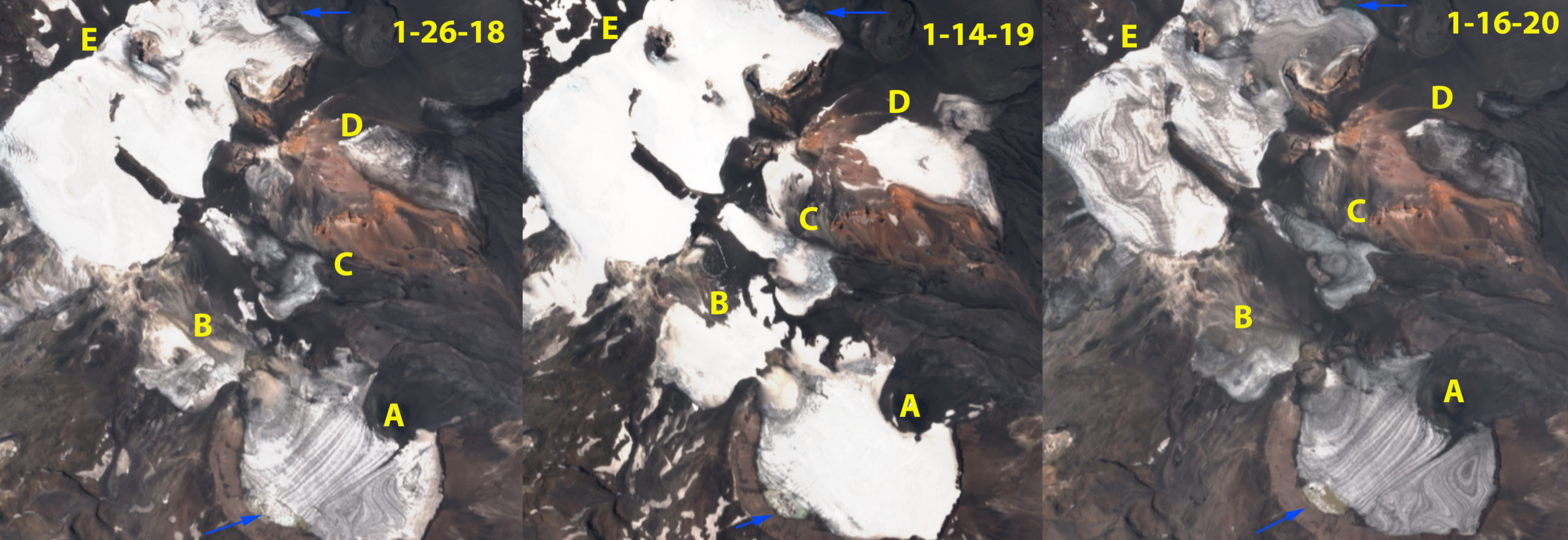
Sentinel images in January of 2017 indicate good snowcover across the caldera glaciers with a total glacier area of 9.4 km2.  In January 2018 snowpack has been lost from A-D, exposing annual layers on A. Only the higher elevation E has retained snowcover. In January 2019 snowcover is good across all of the glaciers. In January 2020 snowcover is minimal on all glaciers except E. In January 2021 A, C and D have lost nearly all snowcover while B and E both are at least 50% snowcovered. In January 2022 there is no retained snowcover on any of the glaciers. The glacier area has been reduced as well. Glacier A, B, C and D no longer retain snowcover consistently and cannot survive current climate. Glacier B, C and D will continue rapidly diminishing.  Glacier A is much thicker and will take longer to disappear. The persistent lack of an accumulation zone indicates the glacier cannot survive (Pelto, 2010). Glacier E continues to recede at a slower rate, and continues to maintain snowcover most summers, but not in 2022.

The minimal snowcover of January 2022 on Volcan Overo matches that of Corataderal Glacier, Chile 30 km due west.

.

Volcan Overo glaceir complex in Landsat images from 1986-2022. The three main glaciers in 1986 have fragmented into five glaciers by 2022 and one glacier (F) has disappeared. Glacier area declined by ~30% and no snowcover is retained in mid-January of 2022.

Volcan Overo glaciers in Sentinel images in January-2018, 2019 and 2020 illustrating fragmentation and snowcover.