
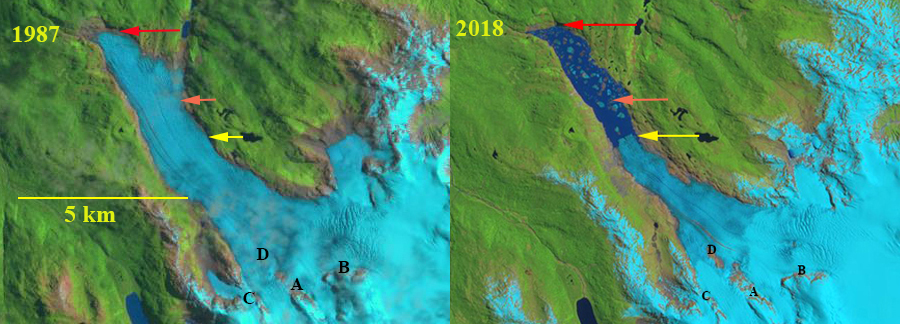
Erasmo Glacier retreat in Landsat image from 1987 and Sentinel image from 2018. Red arrow is 1987 terminus, orange arrow 2016 terminus and yellow arrow 2018 terminus. Points A-D mark areas of expanding bedrock exposure.
Cerro Erasmo at 46 degrees South latitude is a short distance north of the Northern Patagonia Icefield and is host to a number of glaciers the largest of which flows northwest from the mountain. This is referred to as Erasmo Glacier with an area of ~40 square kilometers. Meltwater from this glacier enters Cupquelan Fjord, which is host to a large aquaculture project for Atlantic salmon, producing ~18,000 tons annually. This remote location allows Cooke Aquaculture to protect its farm from environmental contamination. Runoff from Erasmo Glacier is a key input to the fjord, while Rio Exploradores large inflow near the fjord mouth limits inflow from the south. Davies and Glasser (2012) mapped the area of these glaciers and noted a 7% decline in glacier area from 1986-2011 of Cerro Erasmo. The recent retreat of the largest glacier in the Cerro Erasmo massif indicates this area retreat rate has increased since 2011. Meier et al (2018) note a 48% reduction in glacier area in the Cerro Erasmo and Cerro Hudson region, since 1870 with half of that occurring since 1986.
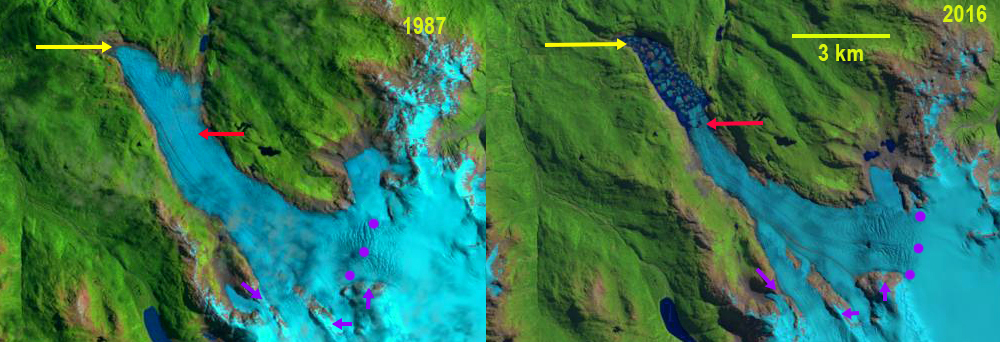
In 1987 Erasmo Glacier had a land based terminus at the end of a 6 km long low sloped valley tongue. The snowline was at 1100 m. In 1998 there is thinning, but limited retreat and the snowline is at 1250 m. By 2013 a proglacial lake had formed and there are numerous icebergs visible in the lake, note Digital Globe image below. The snowline is at 1200-1250 m in 2013 at the top of the main icefall. By 2016 a large lake had formed and the snowline is at 1200 m again at the top of the icefall. By 2016 the terminus has retreated 2.9 km since 1987 generating a lake of the same length. The snowline in 2016 was at 1200 m at the top of the icefall From 2016 to 2018 a further 0.9 km retreat occurred. The 3.8 km retreat from 1998 to 2018 is a rate of ~200 m/year. Thinning upglacier to the expanding ridge from Point A-D is evident. Thinning at Point C has eliminated the overflow into the distributary glacier that had existed. The collapse is ongoing as indicated by the number of icebergs in the lake in 2018. there is an increased glacier surface slope 1 km behind the 2018 glacier front, suggesting the lake will not extend passed this point. The retreat is consistent with retreat documented at Reichert Glacier, Hornopirén Glacier and Cordillera Lago General Carrera Glacier. The impact on inflow to Cupquelan Fjord due to glacier retreat will be increased stream runoff during the wet winter season and reduced flow during the drier summer period December-February. The summer season is still relatively wet.
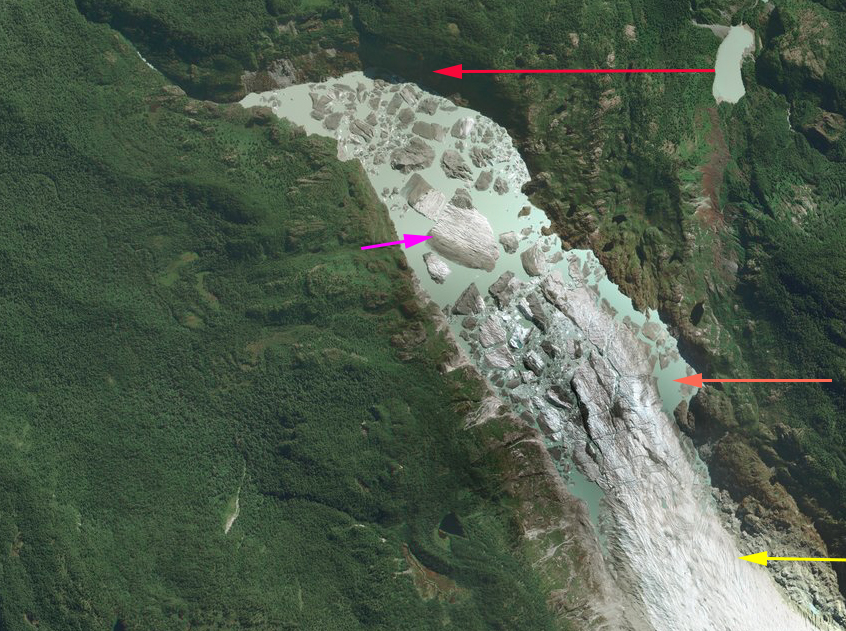
Breakup of Erasmo Glacier terminus in Digital Globe image from 2013. Purple arrow indicates largest iceberg.

Erasmo Glacier retreat in Landsat image from 1998 and 2016. Red arrow is 1987 terminus, orange arrow 2016 terminus and yellow arrow 2018 terminus.
 From a Glaciers Perspective