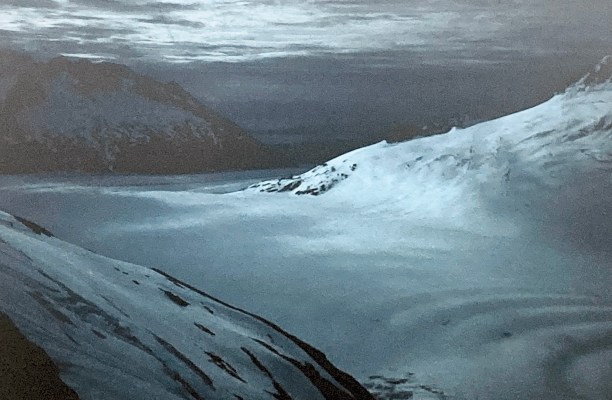
North Cascade Glacier Climate Project 2019, 36th Annual Assessment


The summer of 2019 found the North Cascade Glacier Climate Project in the field for the 36th consecutive summer monitoring the response of North Cascade glaciers to climate change.  This long term monitoring program was initiated partly in response to a challenge in 1983 from Stephen Schneider to begin monitoring glacier systems before and as climate change became a dominant variable in their behavior.

The field team was comprised of Clara Deck, Ann Hill, Abby Hudak, Jill Pelto and myself.  All of us have worked on other glaciers. The bottom line for 2019 is the shocking loss of glacier volume. Ann Hill, UMaine grad student observed, that “Despite having experience studying glaciers in southeast Alaska and in Svalbard, I was shocked by the amount of thinning each glacier has endured through the last two and a half decades.”  Glaciers are typically noted as powerful moving inexorably.  Clara Deck, UMaine MS graduate, was struck by “the beauty and fragility of the alpine environment and glaciers.”  Fragile indeed in the face of climate change. Abby Hudak, Washington State grad student, looked at both the glacier and biologic communities as under stress, but glaciers cannot migrate, adapt or alter there DNA.

Over the span of 16 days in the field, every night spent in the backcountry adjacent to a glacier, we examined 10 glaciers in detail. All glaciers are accessed by backpacking.  The measurements completed add to the now 36 year long data base, that indicate a ~30% volume loss of these glaciers during that period (Pelto, 2018). Here we review preliminary results from each glacier. Each glacier will have a mass balance loss of  1.5 -2.25 m, which drives continued retreat.  Columbia and Rainbow Glacier are reference glaciers for the World Glacier Monitoring Service, with Easton Glacier joining the ranks later this year. Below and above is the visual summary. Specific mass balance and retreat data will be published here and with WGMS after October 1.
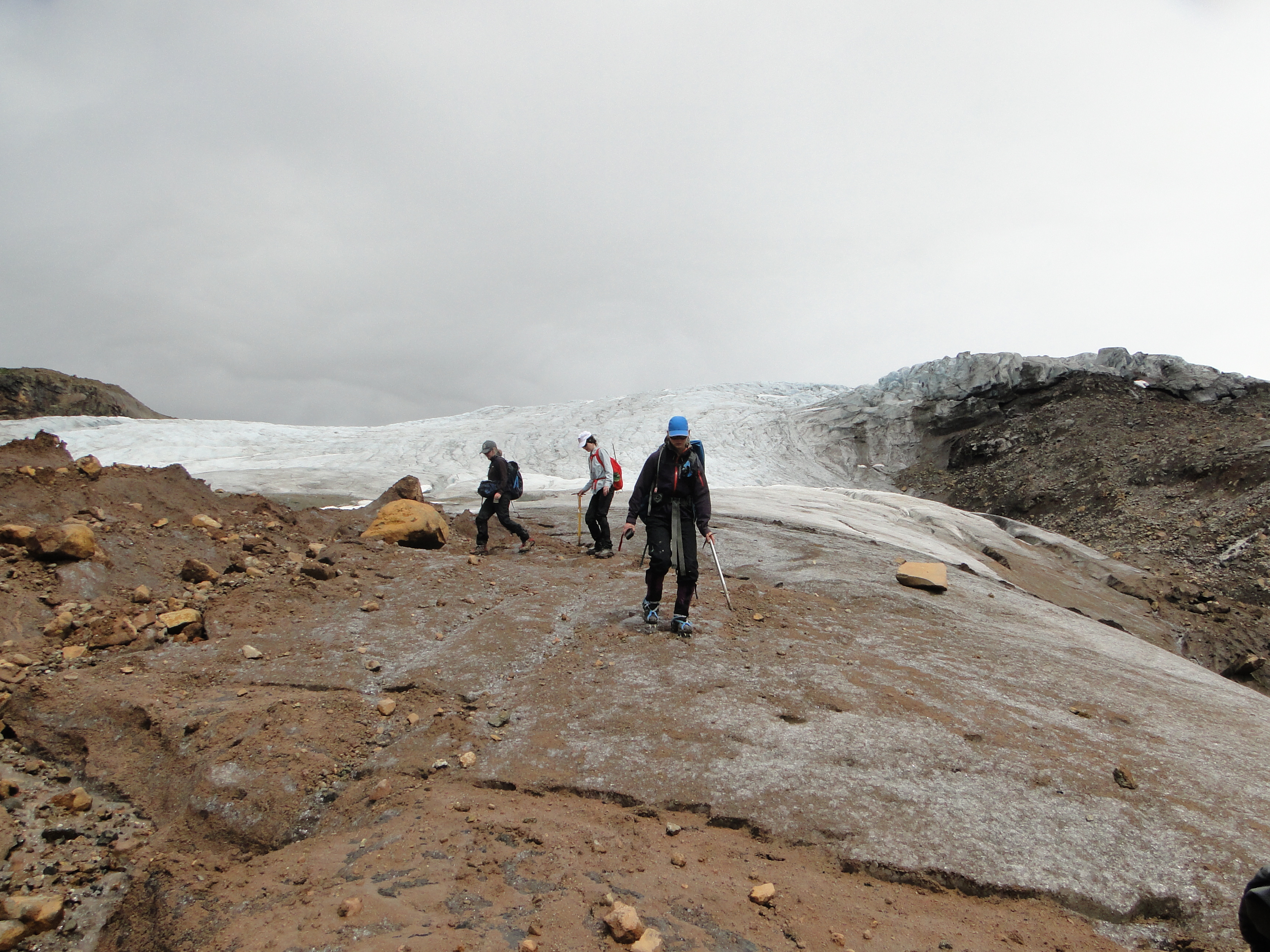
Easton Glacier, Mount Baker.  Terminus has become thin and uncrevassed as a rapid retreat of 15 m per year continued, 405 m retreat since 1990.

Easton Glacier icefall at 2200 m typically has 1.8 m w.e. at the end of the summer, this year it will be 0 m. The overall mass balance will be ~2 m of loss.

Deming Glacier, Mount Baker has now receded over 700 m since our first visit 35 years ago.

On Lower Curtis Glacier a key accumulation source the NE couloir now shows bedrock. Overall by summers end ~25% of the glacier will retain snowcover, far short of what is needed to maintain its volume.

The Lower Curtis Glacier terminus continues to retreat at 8 m/year, but thinning and slope reduction has been more notable.  

In early August the majority of Sholes Glacier has lost its snowpack.  The thin nature of the terminus indicates the glacier is poised for continued rapid retreat that has exceeded 15 m per year during the last 7 years.
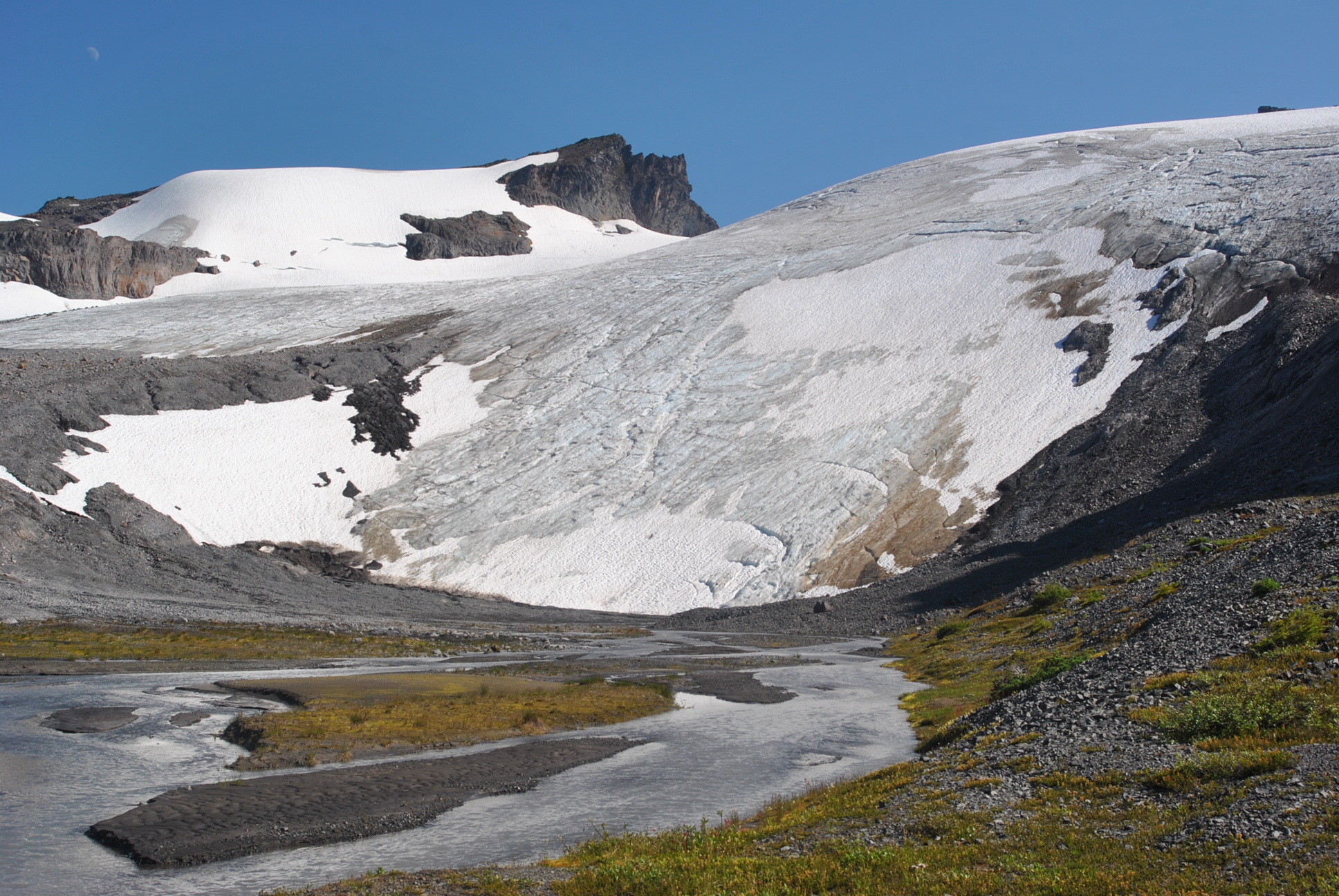
Runoff assessment confirmed ablation stake measurement of 11 cm of ablation/day from 8/6-8/8 on Sholes Glacier.

High on Rainbow Glacier there are still plenty of regions lacking snowcover, instead of a thick mantle of snowpack.
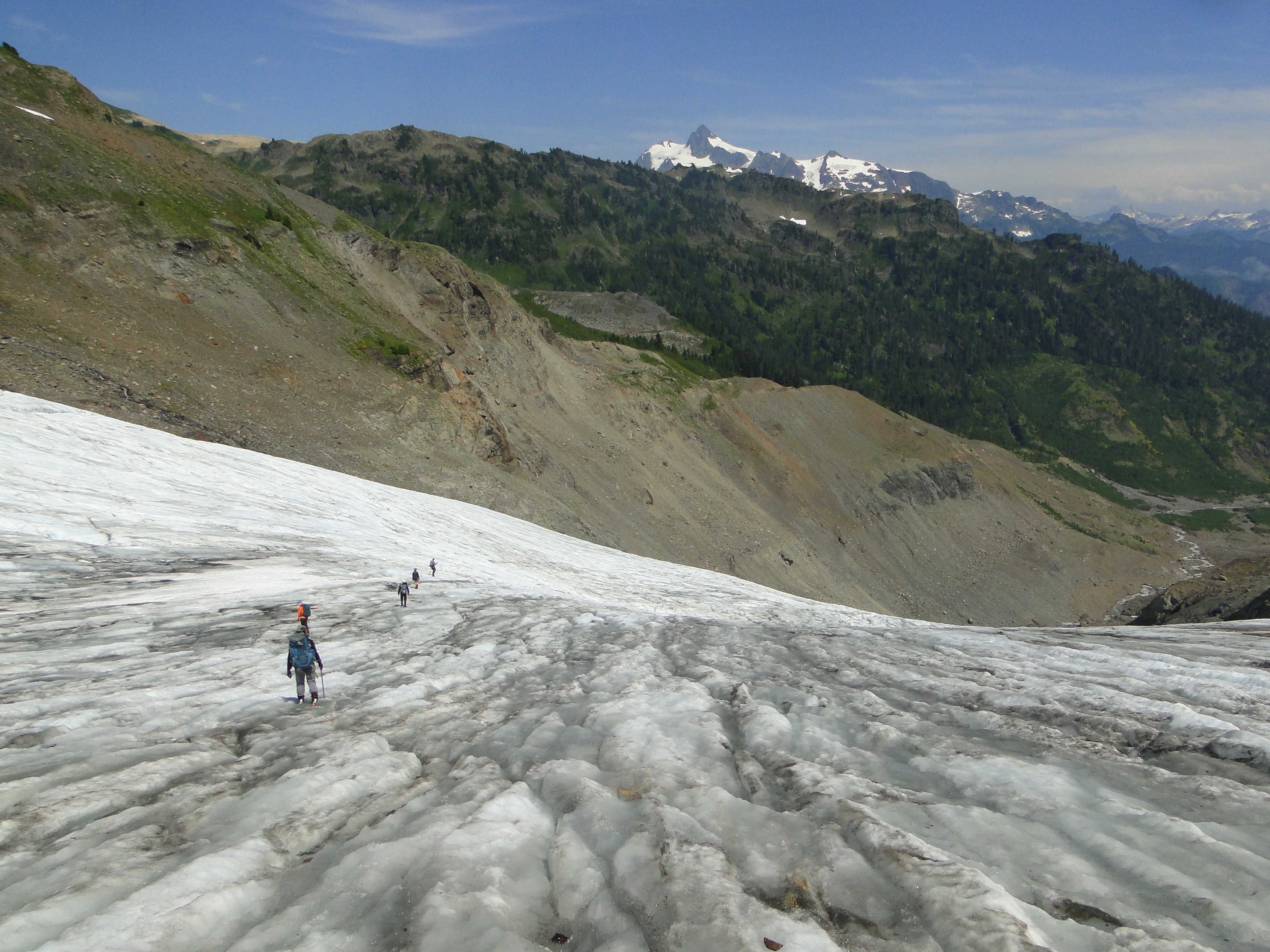
Rainbow Glacier was awash in meltwater streams, see video.  This area should have 1 m of snowpack left. Rainbow Glacier has retreated 650 m since 1984.

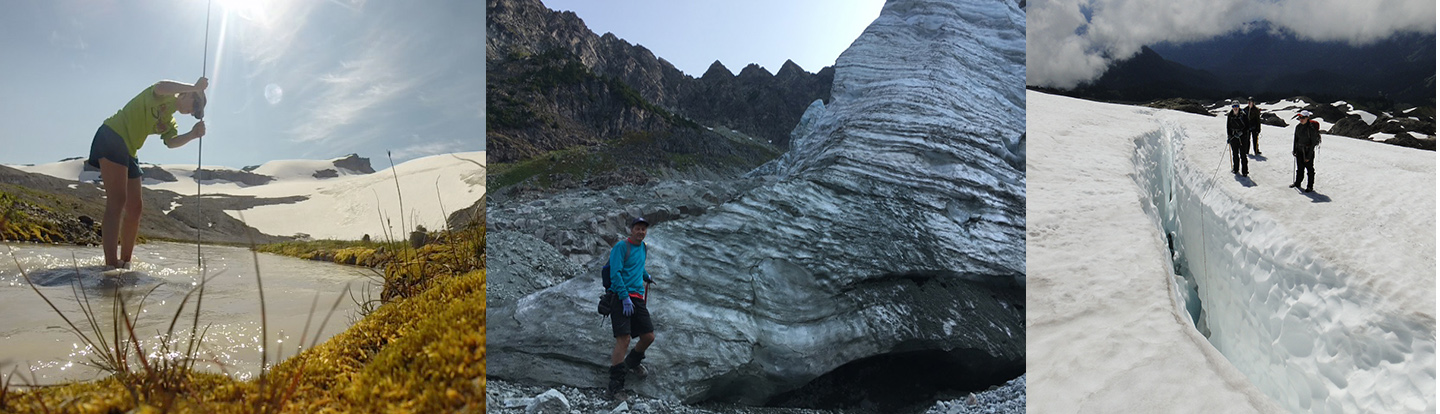
Just getting to each glacier does involve overcoming various miseries.
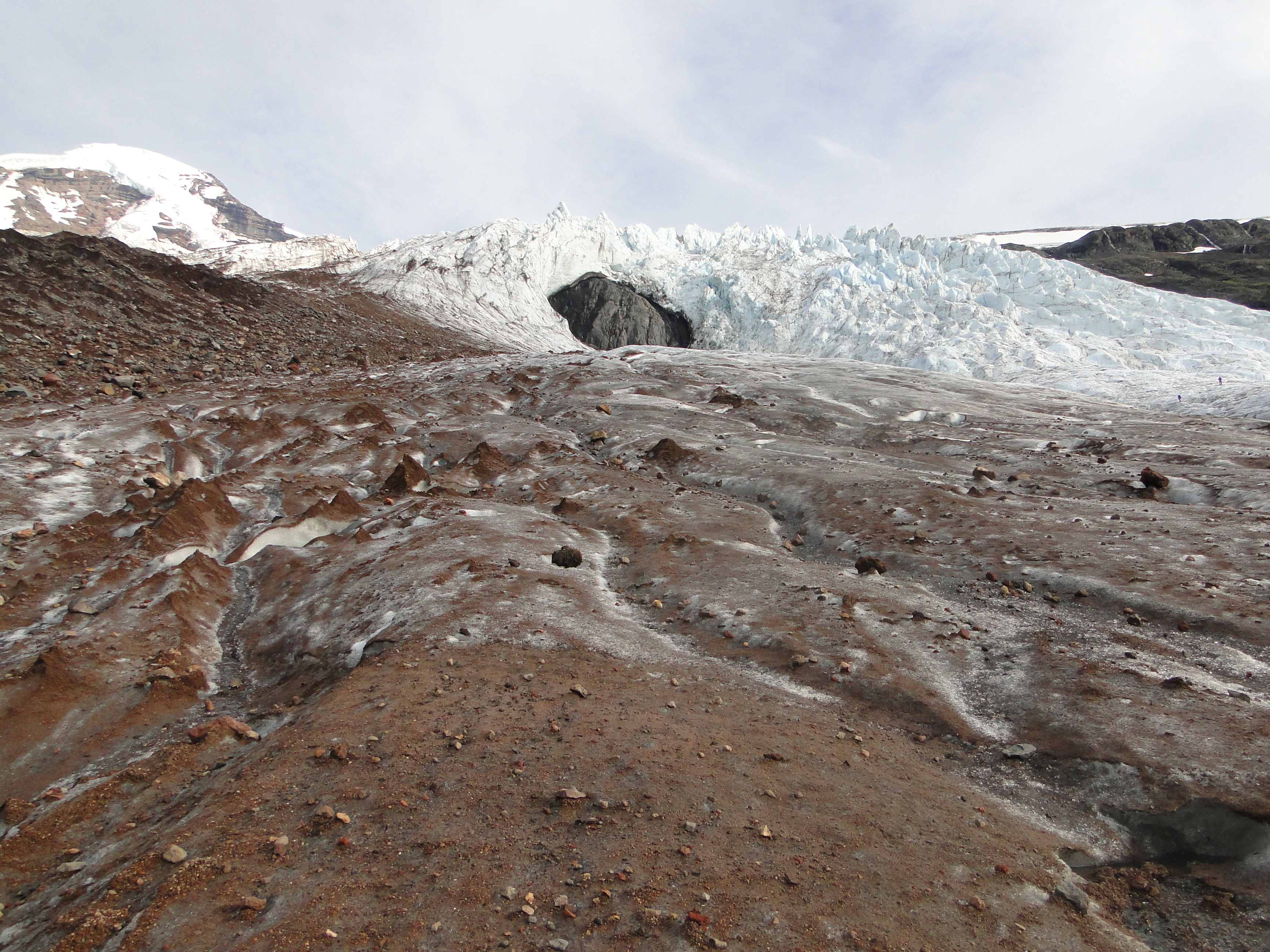
A transect across lower Coleman Glacier, Mount Baker indicates 38 m of thinning since 1988.

Limited snowpack remaining on Columbia Glacier, with six weeks of melt left. Lake in foreground expanded dramatically in last two years.  Retreat ~45 m from 2017-2019 and 210 m from 1984-2019, more than 10% of its length.

Upper basin of Columbia Glacier mainly bare of retained snowpack.

Ice Worm Glacier terminates in expanding lake.

Ice Worm Glacier continues to retreat at the top and bottom of the glacier.  Mass loss is leading to a more concave shape each year.

Daniels Glacier had a maximum snowpack of 1.75 m, instead of 4 m.

Foss Glacier measurements discontinued as it disintegrates, only 20% snowcover in mid-August.

Lynch Glacier less than 50% snowcovered with six weeks of melt left.


The team which completed over 1200 mass balance measurements, 40,000 vertical feet and 110 miles of travel across glacier clad mountains.
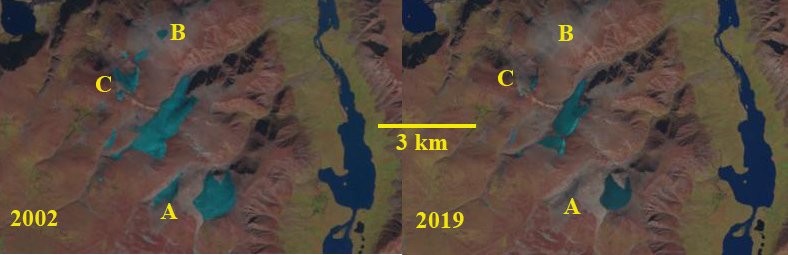
 

The Disappearance of Multiple Baffin Island Glaciers 2002-2019

Glaciers at Point A and B have melted completely away.

The commemoration of a single disappearing glacier in Iceland, Okjokull has brought attention to what is quite a common event this decade, glacier disappearance. Here we report on a number of glaciers in the southern part of the Cumberland Peninsula, Baffin Island  that have either disappeared or separated into several parts  from 2002-2019. Way (2015) noted that on the next peninsula to the west, Terra Nivea and Grinnell Ice Cap had lost 20% of their area in the last three decades. The retreat and disappearance of ice caps in the area have led to a INSTAAR project at UColorado-Boulder examining vegetation that had been buried and is now being exposed.  This year the high snowlines by early June have led to the near complete loss of snowpack across glaciers of the region.  The melt rate of the exposed ice is higher than that of the snowcovered portion of the glaciers.

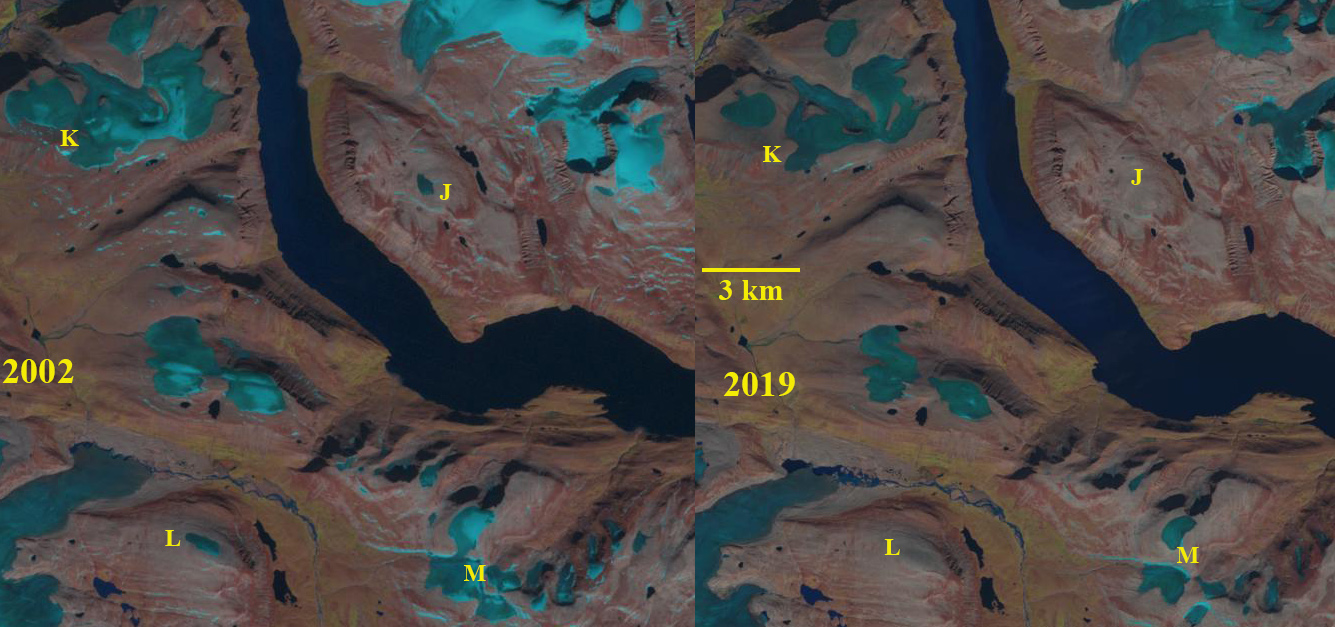
In the first image a small valley glacier at Point A has melted completely away.  At Point B a small plateau glacier is gone.  At Point C a remanent is left, though it cannot survive long now.  Below  the slope glacier at Point F is gone.  The plateau glacier at point G is gone.  The niche glacier at point E has separated into three small parts.

Glaciers at Point F and G have melted completely away.

Glacier at Point H has melted completely away.

At Point H a plateau glacier has been lost. At Point I two interconnected glaciers have separated into five smaller glaciers. Below the plateau glaciers at Point J and L have been lost.  At Point K a combination icecap-valley galciers has now separated into three parts.  At Point M an interconnected ice cap now consists of of six small glacier parts. The plateau glacier an Point N has been lost.  The slope glacier at Point O has been lost.  The disintegration and separation has been noted at other locations in the region such as Coutts Ice Cap and Borden Peninsula.

Glaciers at Point J and L have melted completely away.

Glaciers at Point N and O have melted completely away.

Alpine Glaciers-BAMS State of Climate 2018

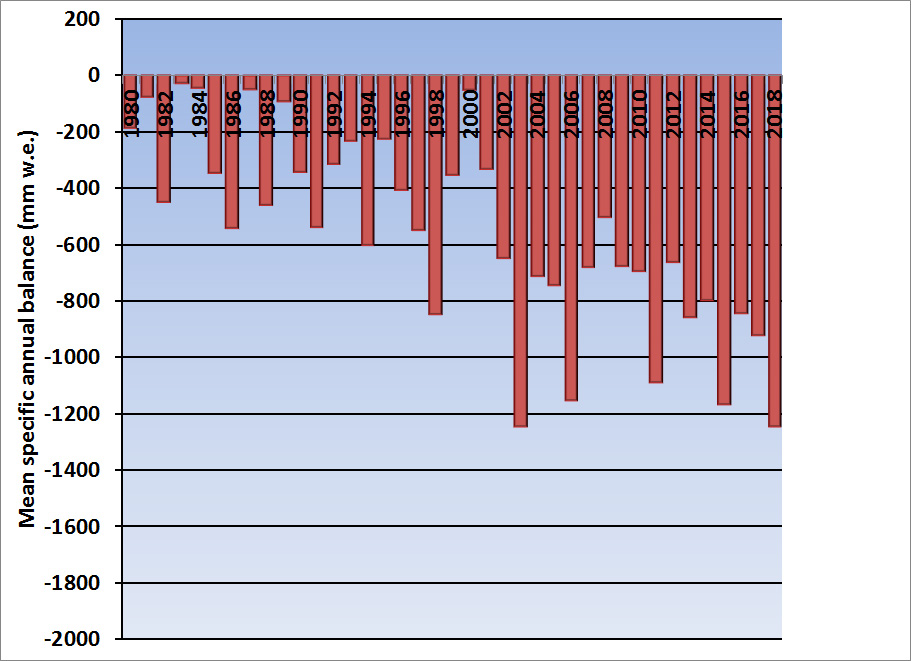
Figure 1. Global Alpine glacier annual mass balance record of reference glaciers submitted to the World Glacier Monitoring Service, with a minimum of 30 reporting glaciers.

For the last decade I have written the section on Alpine Glaciers for the BAMS State of the Climate report, the 2018 report was published this week, below is the section on alpine glaciers.  The key data resources is  the World Glacier Monitoring Service (WGMS) record of mass balance and terminus behavior (WGMS, 2017), which provides a global index for alpine glacier behavior.  Glacier mass balance is the difference between accumulation and ablation, reported here in mm of water equivalence (mm).  Mean annual regionalized glacier mass balance in 2017 was -921 mm for the 42 long term reference glaciers , with an overall mean of -951 mm for all 142 monitored glaciers.  Preliminary data reported from reference glaciers to the WGMS in 2018 from Argentina, Austria, China, France, Italy, Kazakhstan, Kyrgyzstan, Nepal, Norway, Russia, Sweden, Switzerland and United States indicate that 2018 will be the 30th consecutive year of significant negative annual balance (.-200mm); with a mean balance of -1247 mm for the 25 reporting reference glaciers, with one glacier reporting a positive mass balance (WGMS, 2018).  This rate of mass loss may result in 2018 exceeding 2003 (-1246 mm) as the year of maximum observed loss. as a mean. This WGMS mass balance record has now been regionally averaged before determining the global mean, this has not been done yet for 2018, which will reduce the magnitude of the negative balance.

Ongoing global glacier retreat is currently affecting human society by increasing the rate of sea-level rise, changing seasonal stream runoff, and increasing geo-hazard potential (Huss et al, 2017).  The recent mass losses 1991-2010 are due to anthropogenic forcing (Marzeion et al. 2014).

The cumulative mass balance from 1980-2018 is -21.7 m, the equivalent of cutting a 24 m thick slice off the top of the average glacier (Figure 1).  The trend is remarkably consistent across regions (WGMS, 2017).  WGMS mass balance from 42 reference glaciers, which have a minimum 30 years of record, is not appreciably different from that of all glaciers at -21.5 m.  Marzeion et al (2017) compared WGMS direct observations of mass balance to remote sensing mass balance calculations, and climate driven mass balance model results and found that each method yields reconcilable estimates relative to each other and fall within their respective uncertainty margins. The decadal mean annual mass balance was -228 mm in the 1980’s, -443 mm in the 1990’s, 676 mm for 2000’s and – 921 mm for 2010-2018.  Glacier retreat reflects sustained negative mass balances over the last 30 years (Zemp et al., 2015).  The increasing rate of glacier mass loss  during a period of retreat indicates alpine glaciers are not approaching equilibrium and retreat will continue to be the dominant terminus response (Pelto, 2018).

Exceptional glacier melt was noted across the European Alps, leading to high snowlines and contributing to large negative mass balance of glaciers.  In the European Alps, annual mass balance has been reported from 17 glaciers in Austria, France, Italy and Switzerland.  All 17 had negative annual balances, with 15 exceeding -1000 mm with a mean of -1640 mm.  This continues the pattern of substantial negative balances in the Alps, which will equate to further terminus retreat.  Of 81 observed glaciers in 2017 in Switzerland, 80 retreated, and 1 was stable (Huss et al, 2018).  In 2017, 83 glaciers were observed in Austria,; 82 retreated, and 1 was stable.  Mean terminus retreat was 25 m, the highest observed since 1960, when mean length change reporting began (Lieb and Kellerer-Pirklbauer, 2018).

In Norway and Sweden, mass balance surveys with completed results are available for eight glaciers; all had negative mass balances with an average loss of -1420 mm w.e.  All 25 glaciers with terminus observations during the 2007-2017 period have retreated  (Kjøllmoen et al, 2018).

In western North America data has been submitted from 11 glaciers in Alaska and Washington in the United States.  All eleven glaciers reported negative mass balances with a mean loss of -870 mm.  The longest mass balance record in North America is from Taku Glacier in Alaska.  In 2018 the glacier had its most negative mass balance since the beginning of the record in 1946 and the highest end of summer snowline elevation at 1400 m. The North Cascade Range, Washington from 2014-2018 had the most negative five-year period for the region of the 1980-2018 WGMS record.

In the High Mountains of Asia (HMA) data was reported from ten glaciers including from China, Kazakhstan, Kyrgyzstan and Nepal.  Nine of the ten had negative balances with a mean of -710 mm.  This is a continuation of regional mass loss that has driven thinning and a slowdown in glacier movement in 9 of 11 regions in HMA from 2000-2017 (Dehecq et al 2018).


Figure 2. Taku Glacier transient snowline in Landsat 8 images from July 21, 2018  and September 16, 2018.  The July 21 snowline is at 975 m and the September 16 snowline is at 1400 m.  The average end of summer snowline from is m with the 2018 snowline being the highest observed since observations began in 1946.

References

Huss, M., B. Bookhagen, C. Huggel, D. Jacobsen, R. Bradley, J. Clague, M. Vuille,  W. Buytaert, D. Cayan, G. Greenwood, B. Mark, A. Milner, R. Weingartner and M. Winder, 2017a: Toward mountains without permanent snow and ice. Earth’s Future, 5: 418–435. doi:10.1002/2016EF000514

Huss, M., A. Bauder, C. Marty and J. Nötzli, 2018: Neige, glace et pergélisol 2016/17.  Les Alpes94(8), 40-45. (http://swiss-glaciers.glaciology.ethz.ch/downloadPubs/alpen_15-16_f.pdf).

Dehecq, A., N. Gorumelon, A. Gardner, F. Brun, D. Goldberg, P. Nienow, E. Berthier, C. Vincent, P. Wagnon, and E. Trouve, 2019: Twenty-first century glacier slowdown driven by mass loss in High Mountain Asia. Nature Geoscience 12, 22–27.

Kjøllmoen B., L. Andreassen, H. Elvehøy, and M. Jackson, 2018: Glaciological investigations in Norway in 2017. NVE Report 82 2018.

Lieb, G.K. and A. Kellerer-Pirklbauer ,2018: Gletscherbericht 2016/17 Sammelbericht über die Gletschermessungen des Österreichischen Alpenvereins im Jahre 2017. Letzter Bericht: Bergauf 2/2017, Jg. 72 (142), S. 18–25. (http://www.alpenverein.at/).

Marzeion, B., J. Cogley, K. Richter and D. Parkes, 2014: Attribution of global glacier mass loss to anthropogenic and natural causes. Science, 345(6199), 919–921, doi: 10.1126/science.1254702)

Marzeion, B., Champollion, N., Haeberli, W. et al.: Observation-Based Estimates of Global Glacier Mass Change and Its Contribution to Sea-Level Change. Survey of Geophys, 38: 105, doi: 10.1007/s10712-016-9394-y.

Pelto, M., 2018: How Unusual Was 2015 in the 1984–2015 Period of the North Cascade Glacier Annual Mass Balance? Water 10, 543, doi: 10.3390/w10050543.

WGMS 2017: Global Glacier Change Bulletin No. 2(2017). Zemp, M., and others(eds.), ICSU(WDS)/IUGG(IACS)/UNEP/UNESCO/WMO, World Glacier Monitoring Service, Zurich, Switzerland, 244 pp.: doi:10.5904/wgms-fog-2017-10.

WGMS 2018: Fluctuations of Glaciers Database. World Glacier Monitoring Service, Zurich, Switzerland. doi: 10.5904/wgms-fog-2018-11. http://dx.doi.org/10.5904/wgms-fog-2018-11

Zemp and others 2015: Historically unprecedented global glacier decline in the early 21st century. J. Glaciology, 61(228), 745-763, doi: 10.3189/2015JoG15J017.


36th Annual North Cascade Glacier Climate Project Field Season Begins

Fieldwork includes terminus surveys, glacier runoff measurement and mass balance measurements

Field Season Begins August 1

Who we are? The North Cascade Glacier Climate Project (NCGCP) was founded in 1983 to identify the response of North Cascade glaciers to regional climate change, particularly changes in mass balance, glacier runoff and terminus behavior.   This was prompted by the  National Academy of Sciences listing this as a high priority and a personal appeal from Stephen Schneider. NCGCP is a field project that has a broader interdisciplinary scope and is the most extensive glacier mass balance field program in the United States.  Two of the 41 reference glaciers in the world are in our network, and as of next year that will become three glaciers.  We do this research cost effectively relying on no permanent camps, helicopter support or salary for the director. The field season includes no days off and each day is spent completing measurements on glaciers.  The focus is on glacier mapping, mass balance measurement, terminus observations and glacier runoff monitoring.  Each year we utilize several field assistants to complete the annual glacier surveys, with 2019 being the 36th field season.  Our goal in choosing assistants is not to pick the most experienced, but the individuals who are capable and can benefit the most.  We are a self-contained unit. Recently Hakai Magazine described our process well.

Why study glaciers in the North Cascades? Glaciers are one of the world’s best climate monitors and are a critical water resource to many populated glaciated regions. This is particularly true in the North Cascades where 700 glaciers yield 200 billion gallons of summer runoff and glaciers have lost 30 % of their area since 1980. These glaciers have lost 25-30% of their volume during the course of our study, three of our primary study glaciers have disappeared. We also monitor ice worms and mountain goats since we are in the same locations at the same time each year.

2019 Outlook: For North Cascade glaciers the accumulation season provides that layer of snow, that must then last through the melt season.  A thin layer sets the glaciers up for a mass balance loss, much like a bear with a limited fat layer would lose more mass than ideal during hibernation. The 2019 winter season in the North Cascade Range, Washington has been unusual.  On April 1 the retained snow water equivalent in snowpack across the range at the six long SNOTEL sites is 0.72 m, which is ~70% of average.  This is the fifth lowest since 1984.  The unusual part is that freezing levels were well above normal in January, in the 95% percentile at 1532 m, then were the lowest level, 372 m of any February since the freezing level record began in 1948.  March returned to above normal freezing levels.  As is typical periods of cold weather in the regions are associated with reduced snowfall in the mountains and more snowfall at low elevations.  In the Seattle metropolitan area February was the snowiest month in 50 years, 0.51 m of snow fell, but in the North Cascades snowfall in the month was well below average. From Feb. 1 to April 1, snowpack SWE at Lyman Lake, the SNOTEL site closest to a North Cascade glacier, usually increases from 0.99 m to 1.47 m, this year SWE increased from 0.83 m to 1.01 m during this period. The melt season from May-Mid-July has also been warmer than average.  This combination will lead to significant glacier mass loss in 2019, in one month we will report back on our measurements that will indicate just how negative.

2019 Field Team:

Clara Deck: is an earth scientist from Chicago with a passion for science communication, education, and outreach. She completed a B.A. in geology at the College of Wooster in Wooster, Ohio, where she began a journey in climatological research which led to a love for the cryosphere. In the summer of 2018, Clara contributed to glacial field work in the eastern Alaska Range, and was fascinated by the dynamic day-to-day changes in glacial features she was tasked with measuring. At the University of Maine, she is wrapping up her M.S. focused on numerical modeling of Antarctic ice shelf instabilities, but Clara’s favorite part of her college career has been sharing science with students as a teaching assistant. During her first visit to the North Cascades, she is excited to learn about ongoing glacial change and to explore accessible ways to share the findings with public audiences.

Abby Hudak is a native Floridian that has always had a deep calling to the mountains and frozen landscapes. Her passions revolve around understanding our changing climate and natural world which led her to attain a B.S. in Biological Sciences from the University of Central Florida. After starting her M.S. in Biological Sciences at Washington State University, she immediately indulged in snow sports and mountaineering in the Cascade Range. The beauty and vulnerability of these landscapes have driven her to expand her research interests to understanding aspects of the changing cryosphere. She is eager to intertwine her love for the Cascade Range and her desire to pursue scientific questions pertaining to climate impacts on alpine glaciers by working with the North Cascade Glacier Climate Project this summer.

Ann Hill, ever since she was a young child growing up in Minneapolis, Ann has been fascinated by ice and snow, however it wasn’t until her Sophomore year studying Geosciences at Skidmore College that she realized she could study ice as a career path. Consequently, during her junior year she traveled to Svalbard to gain hands-on experience studying and exploring glaciers. Determined to learn more, Ann spent a summer with the Juneau Icefield Research Program, which exposed her to glaciers that looked and behaved differently. In the fall, Ann will begin her M.S. in Earth and Climate Sciences at the University of Maine. Ann is thrilled to study the North Cascade glaciers to understand how their movement and characteristics compare to those she previously observed in Svalbard and Alaska.

Jill Pelto is an artist and scientist from New England who grew up loving winter sports and trips to the mountains. She incorporates scientific research and data into paintings and prints to communicate environmental changes. Her multi-disciplinary work weaves visual narratives that reveal the reality of human impacts on this planet. She completed both her B.A. degrees in Studio Art and Earth and Climate Sciences and her M.S. focused on studying the stability of the Antarctic Ice Sheet at the University of Maine. She spent two field seasons at a remote camp in the southern Transantarctic Mountains to map glacial deposits and collect samples from them for dating. Jill will be joining the project for her 11th field season. She is excited about continuing to document the change in North Cascade glaciers that she has witnessed each of the last ten years — through science and art.
Mauri Pelto has directed the project since its founding in 1984, spending more than 700 nights camped out adjacent to these glaciers. He is the United States representative to the World Glacier Monitoring Service, author of the AGU blog “From a Glacier’s Perspective”, and associate editor for three science journals.  His primary job is Dean of Academic Affairs at Nichols College, where he has been a professor since 1989.

Schedule

Aug. 1:  Arrive Hike into Easton Glacier

Aug. 2:  Easton Glacier survey

Aug. 3:  Easton Glacier survey

Aug. 4:  Hike out  Hike in Lower Curtis Glacier

Aug. 5:  Lower Curtis Glacier Survey

Aug. 6:  Hike out Lower Curtis Glacier Hike in Ptarmigan Ridge

Aug. 7:  Sholes Glacier

Aug. 8:  Rainbow Glacier

Aug. 9:  Hike out- Coleman Glacier survey

Aug. 10:  Hike in Columbia Glacier

Aug. 11:  Columbia Glacier survey

Aug. 12:  Columbia Glacier survey

Aug. 13:  Hike out Columbia Hike in Mount Daniels

Aug. 14:  Ice Worm Glacier survey

Aug. 15:  Lynch and Daniels Glacier survey

Aug. 16:  Hike out

Porcupine Glacier Major Iceberg Turns 3 Years Old, What Next?

Porcupine Glacier in Landsat images from 2016 and 2018 and 2019 Sentinel Image.  Iceberg A and Ice tongue B are indicated on each. The haziness in 2019 is forest fire smoke. The yellow arrows mark the 2019 terminus location.

Porcupine Glacier is a 20 km long outlet glacier of an icefield in the Hoodoo Mountains of Northern British Columbia that terminates in an expanding proglacial lake. During 2016 the glacier had a 1.2 km2 iceberg break off, the iceberg is still present. This is an unusually large iceberg to calve off in a proglacial lake, the largest I have ever seen in British Columbia or Alaska. NASA  generated better imagery to illustrate this observation. Here we examine the  change in terminus position and iceberg deterioration from 2016-2019  using Landsat images from 2015, 2016, 2018 and 2019.

In 1988 a tongue of the glacier in the center of the lake reached to within 1.5 km of the far shore of the lake, red arrow (see below). The yellow arrow indicates the 2016 terminus position.  In 2015 the glacier had retreated 3.1 km from the 1988 location.  In 2015 there are two tongues of the glacier vulnerable to calving at Point A and B.  In 2016 Iceberg A has calved generating an immediate retreat of 1.7 km. In June of 2017 the iceberg size has been reduced 10-15%, with little change in position.  The iceberg is plugging smaller icebergs from moving down the lake. In August 2018 the iceberg because of its size has still drifted little and at 0.6 km2 has lost half of its area in the two years.  This has enabled smaller icebergs to move past the iceberg down the lake. In July of 2019 the iceberg has diminished further to 0.45 km2, but is enmeshed in a melange of other icebergs as well.  The glacier has continued to retreat from 2016 to 2019 as expected, ~500 m.  The glacier tongue at Point B has narrowed considerably from 2015 to 2019 and is poised to separate.  The narrowness and potentially shallower depth of this inlet may make it difficult for a single iceberg to emerge from the collapse of this glacier tongue that will occur in the next couple of years, I will be watching this summer. The snowline is already approaching a typical end of summer elevation in this image is from July 1, 2019.

In Antarctica it is not unusual to see an iceberg endure for many years.  In the northern hemisphere whether in a lake or in the ocean it is rare to see an iceberg last for three years as has occurred at Porcupine.  This is not due to slow melt, but simply due to the size and thickness of the iceberg, and the fact that this is a wave quiet environment. The retreat here mirrors that of other glacier to the south Klinaklini Glacier and Bridge Glacier  in BC and the north Excelsior Glacier and Yakutat Glacier in Alaska.

Porcupine Glacier in Landsat images from 1988, 2015 and 2017 .  Iceberg A and Ice tongue B are indicated in the latter two.  The yellow arrows mark the 2019 terminus location. The red arrow in 1988 marks its terminus location. The orange and purple arrows in 1988 indicate the margin where the terminus meets the lake shore.


Mendenhall Glacier, Alaska Accumulation Zone Shrinks

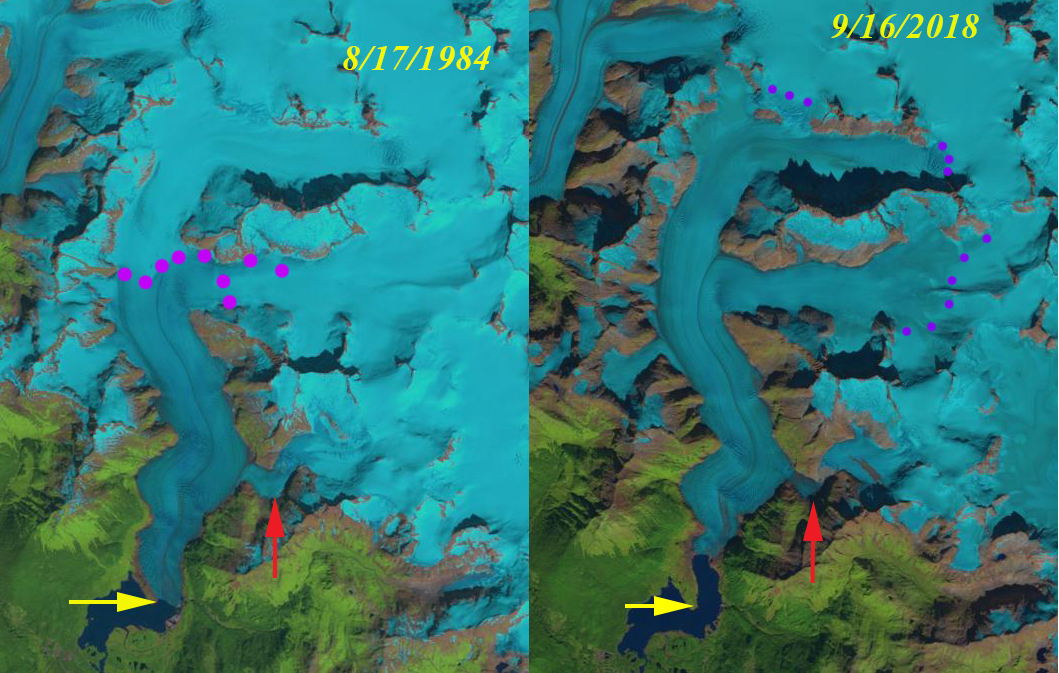
Mendenhall Glacier in Landsat images from 1984 and 2018.  Yellow arrows indicates 1984 terminus location, read arrow the Suicide Basin tributary and the purple dots the snowline.

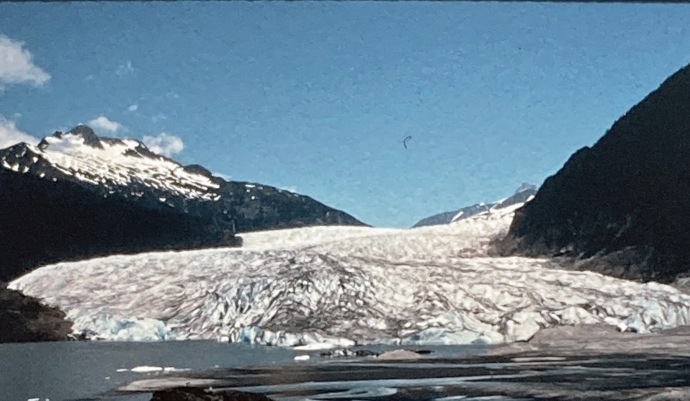
Mendenhall Glacier is the most visited and photographed terminus in the Juneau Icefield region. The glacier can be seen from the suburbs of Juneau.  Its ongoing retreat from the Visitor Center and the expansion of the lake it fills is well chronicled.  Here we document the rise in the snowline on the glacier that indicates increased melting and reduced mass balance that has driven the retreat.  The change in snowline from 1984-2018 and the associated retreat are documented. The snowline as July begins in 2019 is already in the end of summer range.  In 1984 I had a chance to ski across the upper portion of this glacier. Photo736861842897_inner_76-402-615-387-84-752-620-741

Top of the Mendenhall Glacier at 1500 m looking towards ocean in 1984.

Mendenhall Lake did not exist until after 1910, in 1948 it was 2.2 km across and by 1984 the lake was 2.7 km across.  Boyce et al (2007) note the glacier had two period of rapid retreat one in the 1940’s and the second beginning in the 1990’s, both enhanced by buoyancy driven calving. The latter period has featured less calving particularly in the last decade and is a result of greater summer melting and a higher snowline by the end of the summer, which has averaged 1250 m since 2003 vs 1050 m prior to that (Pelto et al, 2016).  In 2005, the base of the glacier was below the lake level for at least 500 m upglacier of the terminus (Boyce et al (2007).  This suggests the glacier is nearing the end of the calving enhanced retreat.  It is likely another lake basin would develop 0.5 km above the current terminus, where the glacier slope is quite modest.

Photo736861827670_inner_51-268-606-268-57-633-606-633

Terminus of Mendenhall Glacier before the 1982 field season on the Juneau Icefield.

The glacier in 1984 ended at the tip of a prominent peninsula in Mendenhall Lake. The snowline is at 950 m. In 1984 with the Juneau Icefield Research Program we completed both snowpits and crevasse stratigraphy that indicated retained snowpack at the end of summer is usually more than 2 m at 1500-1600 m. The red arrow indicates a tributary that joins the main glacier, where Suicide Basin, currently forms. In 2014 the snowline in late August  is at 1050 m.  The terminus has retreated to a point where the lake narrows, which helps reduce calving. In 2015 the snowline is at 1475 m.  In  2017 the snowline reached 1500 m.  There is a small lake in Suicide Basin. In September 2018 the snowline reached 1550 m the highest elevation the snowline has been observed to reach any year.  In Suicide Basin the lake drained in early July. In 2018 Juneau Icefield Research Program snowpits indicates only 60% of the usual snowpack left on the upper Taku Glacier, near the divide with Mendenhall Glacier. On July 1. 2019 the snowline is already as high as it was in late August of 1984.  This indicates the snowline is likely to reach near a record level again.  The USGS and NWS is monitoring Suicide Basin for the drainage of this glacier melt filled lake. In 2019 the lake rapidly filled from early June until July 8, water level increasing 40 feet.  It has drained from July 8 to 16 back to it early June Level. The high melt rate has thinned the Mendenhall Glacier in the area reducing the elevation of the ice dam and hence the size of the lake in 2019 vs 2018.

The snowline separates the accumulation zone from the ablation (melting) zone and the glacier needs to have more than 60% of its area in the accumulation zone.  The end of summer snowline is the equilibrium line altitude where mass balance at the location is zero. With the snowline averaging 1500 m during recent years this leaves less 30% of the glacier in the accumulation zone. This will drive continued retreat even when the glacier retreats from Mendenhall Lake. The declining mass balance despite retreat is evident across the Juneau Icefield (Pelto et al 2013).  Retreat from 1984-2018 has been 1900 m.  This retreat is better known, but less than at nearby Gilkey Glacier and Field Glacier.

Mendenhall Glacier in Landsat image from 2014.  Yellow arrows indicates 1984 terminus location and the purple dots the snowline.

Mendenhall Glacier in Landsat image from 2015.  Yellow arrows indicates 1984 terminus location and the purple dots the snowline.

Mendenhall Glacier in Landsat image from 2017.  Yellow arrows indicates 1984 terminus location and the purple dots the snowline.

Mendenhall Glacier in Landsat image from 2019.  Yellow arrows indicates 1984 terminus location and the purple dots the snowline.

Penny Ice Cap NW Thinning and Retreat Evident

The Northwest (NW) and Northnorthwest (NNW) outlet of the Penny Ice Cap in 1991 and 2019 Landsat images. Red arrow indicates the 1991 terminus location. Point 1 is a large proglacial, Point 2-4 are areas of emerging and expanding bedrock amidst the ice cap.

The two largest outlet glaciers of the NW quadrant of the Penny Ice Cap feed the Isurtuq River.  In 1991 both outlet glaciers terminated at 600 m. Schaffer et al. (2017) noted a substantial reduction in velocity of the six largest outlet glaciers of the Penny Ice Cap from 1985-2011, 12% per decade. This is driven by mass balance losses, which drive thinning and retreat as well. Here we examine the changes from 1991-2019 of the Northwest (NW) and Northnorthwest (NNW) outlet of the Penny Ice Cap. The summer of 2019 is shaping up to feature substantial mass balance losses.

In the 1991 Landsat image the NW outlet reaches the Isurtuq River. The large 7 km2 proglacial lake #1 is impounded by the glacier, it is mostly covered by lake ice in this image.  At Point #3 there is no bedrock that has emerged.  The NNW outlet terminates 1 km south of the Isurtuq River, upglacier Point #2 is a single bedrock outcrop and Point #4 is barely evident.  In 2000 the NW outlet has receded from the river, the proglacial lake is still 7 km2 and Point #3 has no evident bedrock. The NNW outlet has receded 100-200 m and bedrock at Point #2 and 4 are more evident.  In 2016 the proglacial lake has diminished and now is several small lakes.  At Point 3 bedrock is evident.  At Point #2 there are two areas of bedrock covering 0.25 km2. The snowline in 2016 is above this portion of the icecap. In 2019 the NW outlet has retreated 500 m, proglacial lake #1 has three separate parts that total less than 2 km2. Bedrock at Point #2-4 has expanded significantly indicating ice cap thinning.  On June 30 2019 the snowline is already above this section of the ice cap, +1100 m with two months of melting to come.  Point #2 has an exposed bedrock area of 0.8 km2. Look for a merging of the bedrock at Point 2 and further expansion at 3 and 4. The high snowline at +1100 m, for this early in the summer was also observed at Fork Beard Glacier just east of Penny Ice Cap and is due to very warm temperatures in June in the region.

Way (2015) noted that the Grinnell Ice Cap also on Baffin Island, has lost 18% of its area from 1974 to 2013 and that the rate of loss has greatly accelerated due so summer warming. Grinnell Ice Cap also has seen a loss of snowpack even at its crest.

The Northwest and Northnorthwest outlet of the Penny Ice Cap in 2000 and 2016 Landsat images. Red arrow indicates the 1991 terminus location. Point 1 is a large proglacial, Point 2-4 are areas of emerging and expanding bedrock amidst the ice cap.

Map of the region

Fork Beard Glacier, Baffin Island High June 2019 Temperatures and Snowline

Fork Beard (F) and Nerutusoq Glacier (N) Baffin Island on June 1, 2019,  June 18, 2019 Sentinel images and June 30 Landsat image. Purple dots indicate the snowline. 

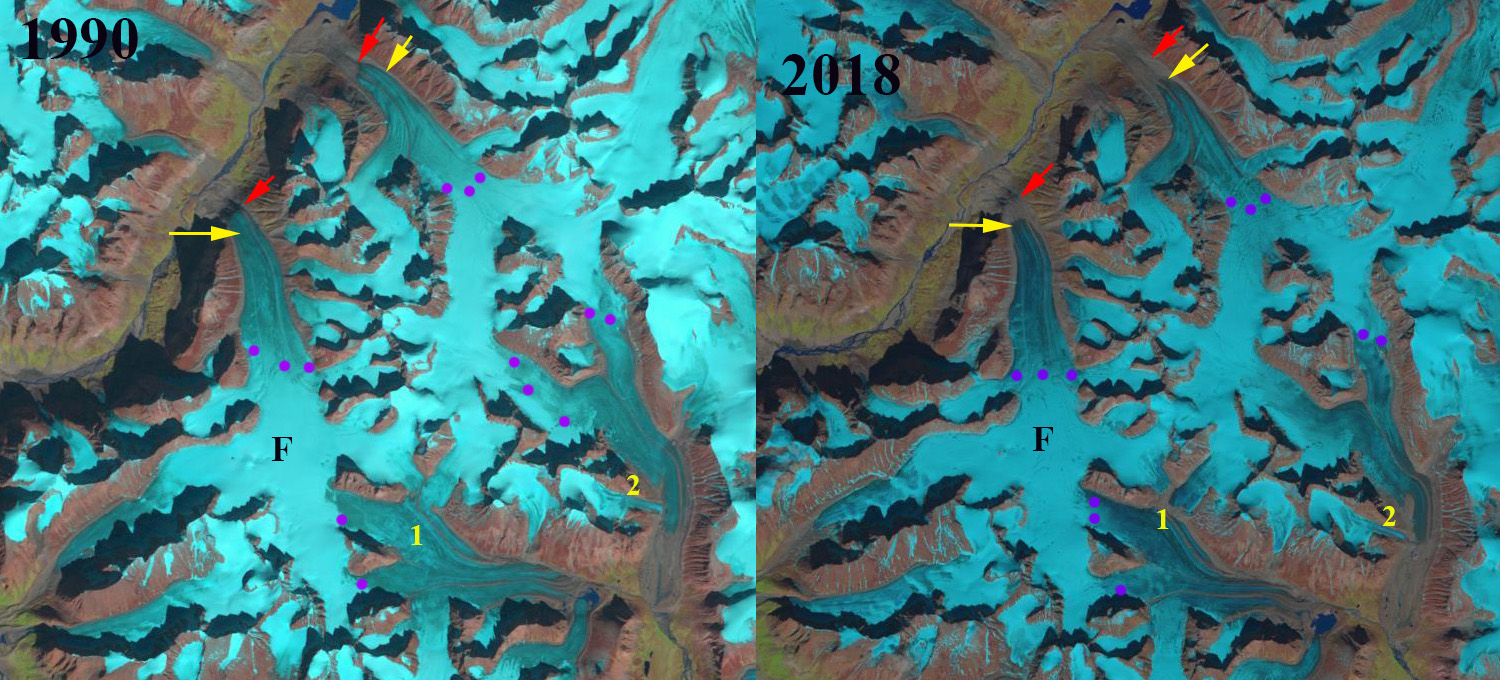
Fork Beard Glacier (F) is an outlet glacier of a mountain glacier complex just southeast of Penny Ice Cap on Baffin Island.  Nerutusoq Glacier  (N) also drains from the same complex. Here we examine the rapid rise of the snowline from June 1 to June 30, 2019.  This 30-day period at nearby Pangnirtung featured four days with record temperatures for that date June 5 (15.1), June 11 (13.5) and June 12 (13.6), and June 19 (14.4). There were 14 days with a maximum temperature above 10 C. Landsat images are utilized to identify the retreat and separation of Fork Beard Glacier and Nerutusoq Glacier and several neighboring glaciers from 1990-2018.  Gardner et al (2012) and Sharp et al (2011) both note that the first decade of the 21st century had the warmest temperatures of the last 50 years in the region, the period of record, and they identified that the mass loss had doubled in the last decade versus the previous four for Baffin Island. This has led to fragmentation of Coutts Ice Cap and loss of snowpack at Borden Ice Cap and disappearance of ice caps near Clephane Bay all on Baffin Island.

In late July of 1990 Fork Beard Glacier terminates near the top of a steep slope at 650 m, red arrow. At Point 1 and 2 tributaries connect to the main stem of two unnamed glaciers adjacent to Fork Beard Glacier. Nerutusoq Glacier terminates at 700 m. The snowline in mid August of 1990 on Fork Beard and its adjacent glacier to the southeast is 1050 m. In 2000 at Point 1 and 2 the tributaries still connect.  The terminus of Fork Beard and Nerutusoq Glacier have retreated 200-300 m since 1990. The snowline in this mid-August image is at 1150 m. By 2018 Fork Beard Glacier has retreated 600-700 m and now terminates at an elevation of 750 m. Nerutusoq Glacier has retreated 600-700 m and now terminates at an elevation of 825 m. In this late July image the snowline on Fork Beard and the adjacent glacier to the southeast (S) is again at 1050 m.  At Point 1 and 2 tributary glaciers have separated from the main stem glaciers. In Sentinel images from 2019 the snowline on Fork Beard Glacier and Nerutusoq Glacier  is at 800 m on June 1 rising rapidly to 1100 m by June 18.  On June 30 the snowline has risen to 1150 m. from This is a higher elevation than typically seen a month or two months later in the melt season during other years.  The retreat in  the region is driven by warmer temperatures and rising snowlines.  The glacier of Baffin Island are already primed for another poor year in 2019.

Fork Beard (F) and Nerutusoq Glacier (N), Baffin Island in 1990 and 2018 Landsat images. Red arrow indicates 1990 terminus, yellow arrow 2018 terminus, purple dots the snowline. 


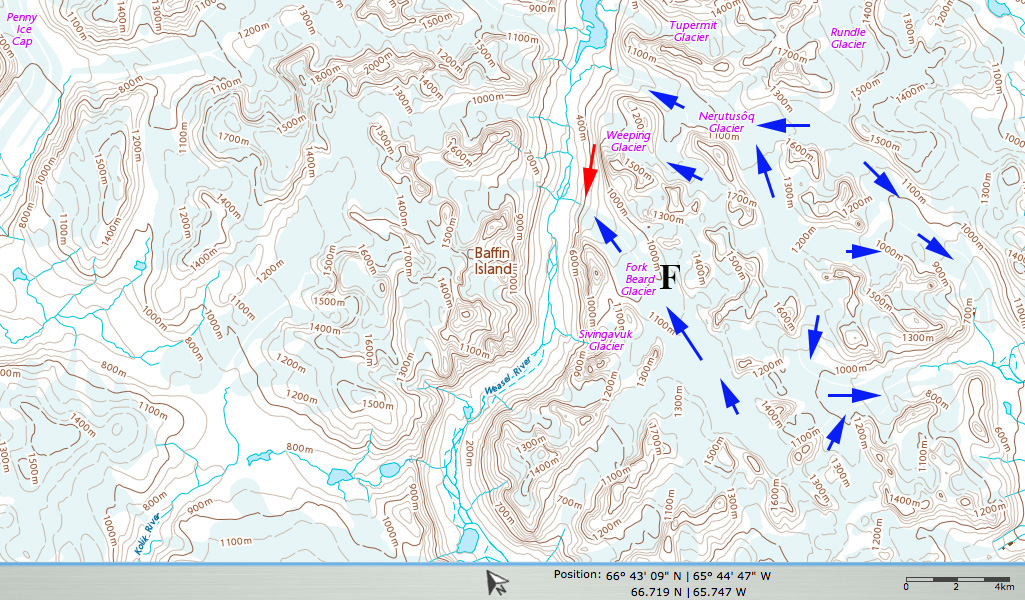
Map of the region indicating flow on Fork Beard, Nerutusoq and two unnamed adjacent glaciers. Red arrow indicates 1990 terminus of Fork Beard at top of steep bench.

Fork Beard (F) and Nerutusoq Glacier (N), Baffin Island in 2000 Landsat image. Red arrow indicates 1990 terminus and purple dots the snowline. 

Yelverton Glacier, Ellesmere Island Extensive Retreat and Sikussak loss 1999-2018

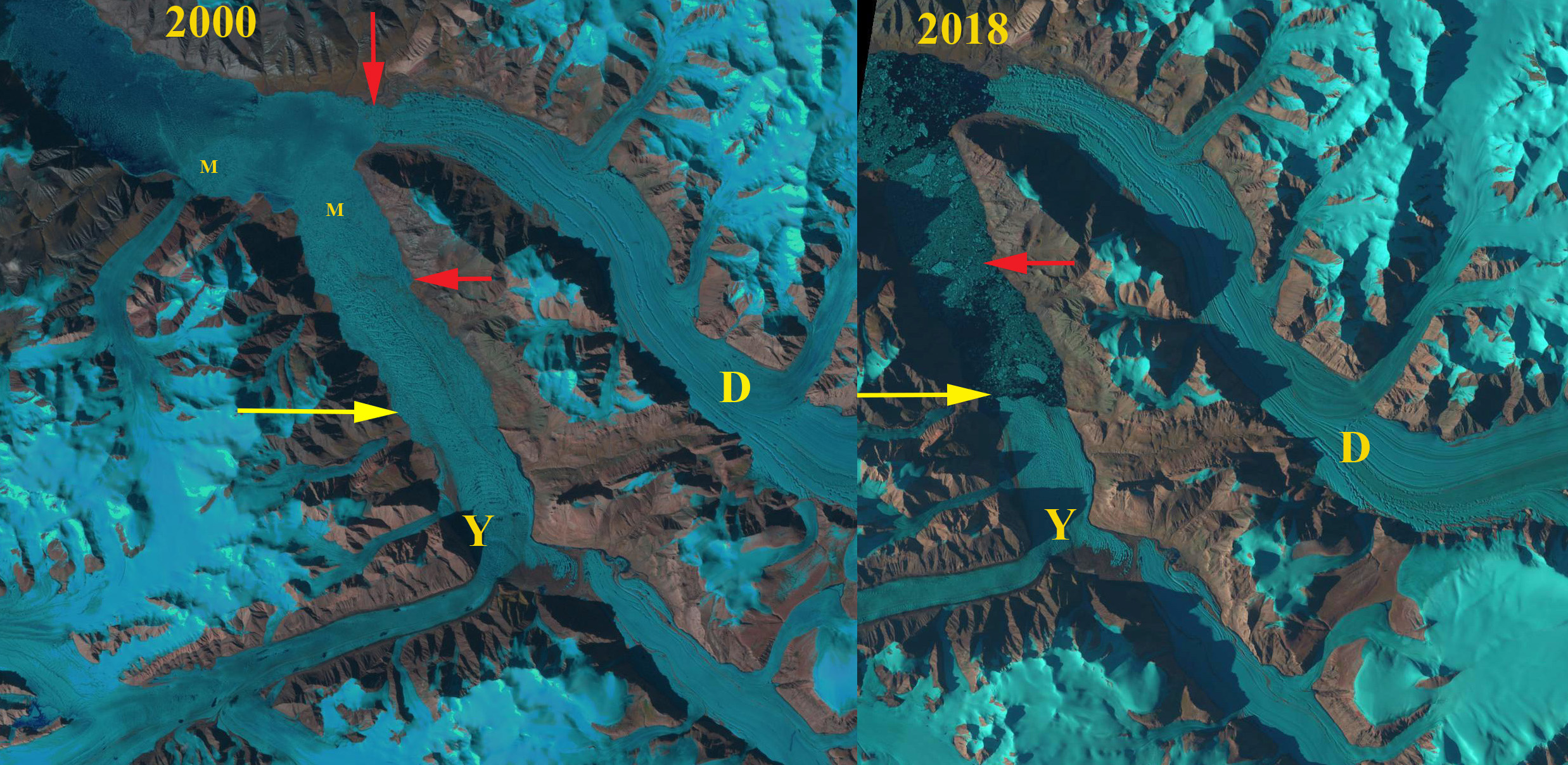
Yelverton Glacier (Y) and De Vries Glacier (D) in 1999 and 2018 Landsat images.  Red arrows and red dots indicate the 1999 terminus and yellow arrow the 2018 terminus.  Point M indicates the area of melange or sikussak, the boundary of this area is marked by orange dots. Purple dots mark the snowline.

Yelverton Glacier is an outlet glacier from an ice cap on Northern Ellesmere Island. White and Copland (2019) identified an 85% reduction in are of eight floating ice tongues in the Yelverton Bay area.  They further observed that many of the glacier including Yelverton lost a substantial area of melange that had protected the glacier fronts from contact with open water.  The melange is comprised of icebergs and mulit-year sea ice and is referred to as sikussak. Here we examine Landsat images from 1999-2018 to identify the retreat of Yelverton Glacier and the loss of sikussak.

In 1999, the sikussak extends to the end of the Yelverton Glacier inlet, while the glacier terminus is 4.5 km up the inlet.  De Vries Glacier terminates adjacent to the northern tip of the peninsula separating De Vries and Yelverton.  In 2000, there is no change in the terminus or sikussak, the snowline is at 900 m.  In 2002, the terminus region and sikussak remain unchanged, the snowline is again close to 900 m. By 2015, Yelverton Glacier has retreated to its grounding line.  The sikussak that had existed is gone. In 2018, the terminus is exposed to open water and has retreated 8 km since 1999, the snowline is at 900 m. The area of sikussak that had been 6 km long has not returned and persisted since it disappeared. Pope and Copland (2012) noted the loss of multi-year land fast sea ice in the region beginning in 2005 and concluding with total loss by 2010 driven by warming.  This same climate change has also driven the retreat of Trinity Wickeham Glacier and Devon Ice Cap that also released new islands.  The Canadian Arctic Islands have seen widespread glacier area/mass balance loss particularly during the last two decades ( Noël, 2018).

Yelverton Glacier (Y) and De Vries Glacier (D) in 2002 and 2015 Landsat images.  Red arrows indicate the 1999 terminus and yellow arrow the 2018 terminus.  Point M indicates the area of melange or sikussak. 

Yelverton Glacier (Y) and De Vries Glacier (D) in 2000 and 2015 Landsat images.  Red arrows indicate the 1999 terminus and yellow arrow the 2018 terminus.  Point M indicates the area of melange or sikussak. 

Arnesenbreen, Svalbard Retreat, Separation and Surge

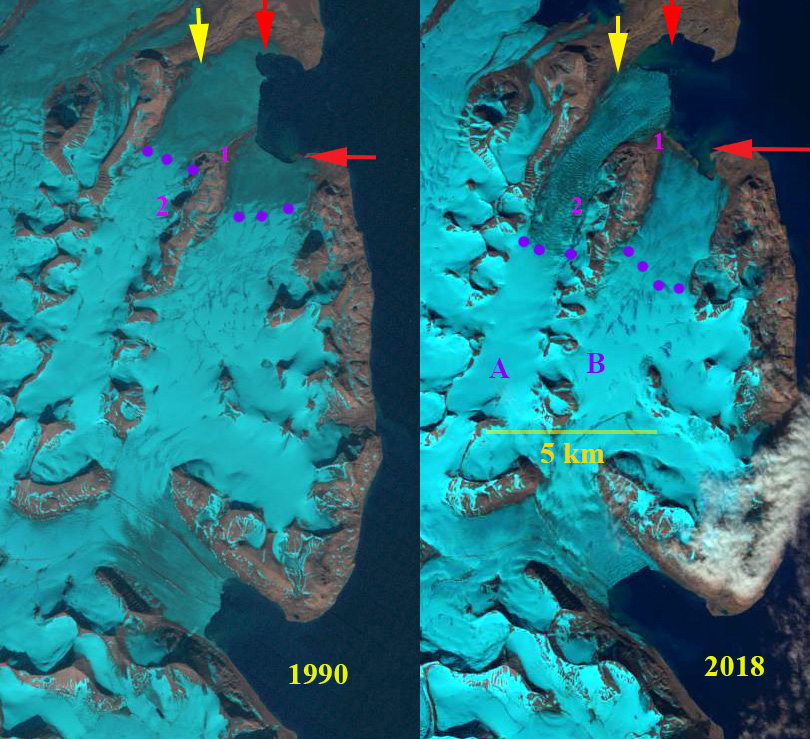
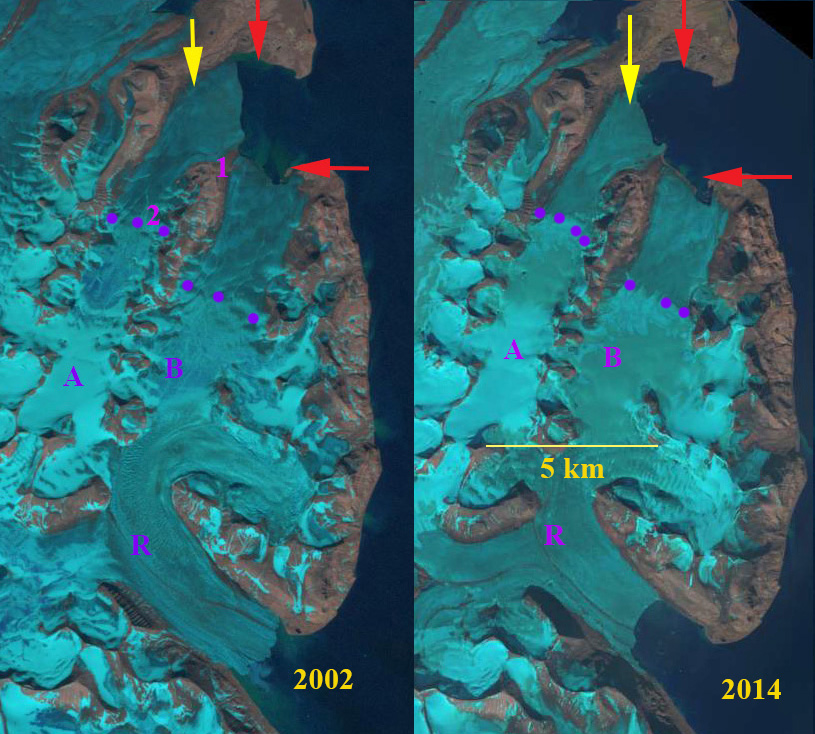
Arnesenbreen (A) and Bereznikovbreen (B) in 1990 and 2018 Landsat images.  Red arrow is 1990 terminus location, yellow arrow the 2018 terminus location and purple dots the transient snowline.

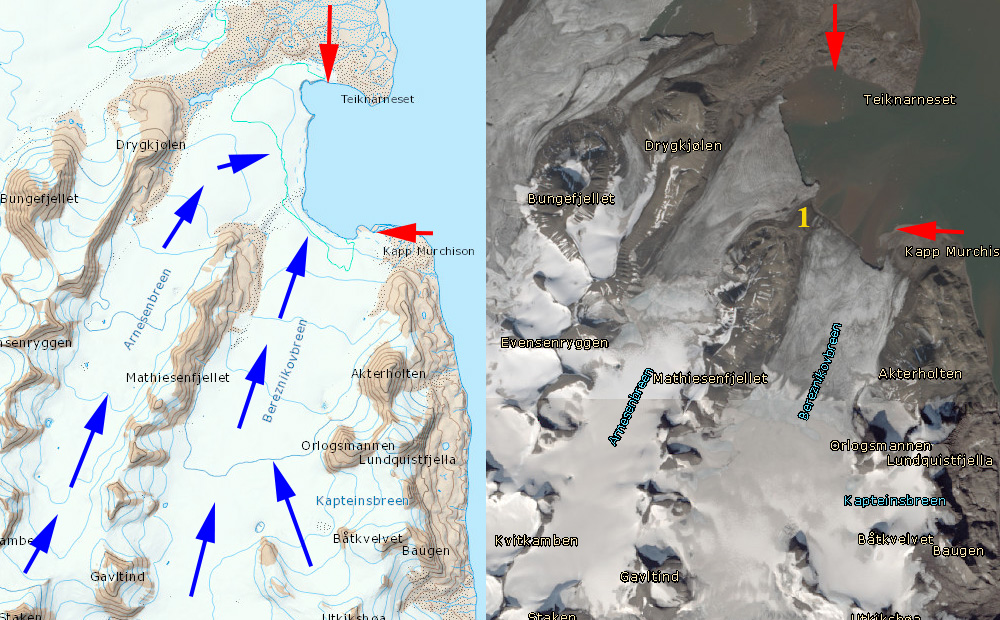
Arnesenbreen and Bereznikovbreen are glaciers in Svalbard on the east coast of Spitsbergen that in 1990 had a joint calving front near Kapp Murchison. Blaszczyk et al’s (2009) analysis identified 163 Svalbard glaciers that are tidewater with the total length calving ice−cliffs at 860 km for the 2001-2006 period. They observed that 14 glaciers had retreated from the ocean to the land over the last 30–40 year period. Some of these are surging glaciers, which are common in Svalbard.  Arnesenbreen was observed to surge in the 1930’s and in 2018 a surge was observed that was initiated from its terminus, which is a more unusual type of surge (Holmund, 2018).  Sevestre et al (2018) document mechanisms that help generate terminus initiated surges, include tidewater retreat from a pinning point and/or crevasses allowing meltwater rainwater to access the bed. The surge generated considerable crevassing that extended from the tidewater terminus to an elevation of 300 m, 5 km inland of the terminus. Here we examine the behavior of these glaciers using Landsat imagery from 1990-2018.

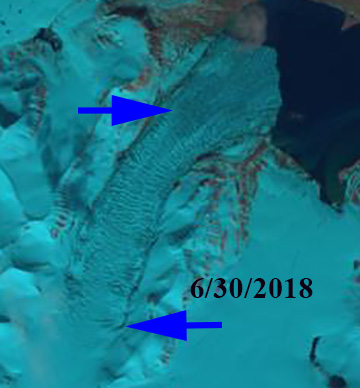
In 1990 Arnesenbreen-Bereznikovbreen had a shared 5 km long tidewater front. The transient snowline in this July image is at 200 m. The glacier terminus reach is not extensively crevassed.  In 2002 the two glaciers are separating at Point 1 each having retreated ~400-500 m, crevassing remains limited.  The transient snowline in 2002 is at 300 m. By 2014, Arsenenbreen has retreated 1400 m since 1990 and crevassing remains limited.  The transient snowline is at 300 m, though there is a saturated zone of snowpack above this line, that suggests extensive melt up to 500 m.  In 2018 the surge crevassing was most apparent in the April image of Holmund (2018).  On June 30 the extensive crevassing is still evident, particularly in the 200-250 m elevation band near Point 2, but is reduced from April in the terminus zone near Point 1.  By July 21 the image indicates much reduced calving in the terminus zone of the glacier.  Sevestre et al (2018) note a pattern of terminus initiated surge progression, “Upward migration of the surge coincided with stepwise expansion of the crevasse field.” This is exactly what is seen at Arnesenbreen, we are also seeing the surge terminating with calving reduction at the terminus first.  The short lived nature of the surge indicates the limited impact on the longer term retreat. The surge did not lead to a reconnection with Bereznikovbreen. Bereznikovbreen has retreated 700-800 m since 1990 and Arnesenbreen has retreated ~1500 m from 1990-2018.

The ongoing retreat here is like that of Svalbard glaciers in general including surging glaciers (Nuth et al 2013).  Strongbreen Glacier has separated from key tributaries. The ongoing retreat has prompted the question on other surging Svalbard glaciers, can the glaciers continue to surge? On Fridtjovbreen it appears a future significant surge is unlikely.  For Arnesenbreen the terminus reach below 150 m is where the glacier expands laterally and is an area of reduced slope.  This configuration remains and would allow further surges unless further retreat of more than ~1500 m occurs.

Arnesenbreen (A) and Bereznikovbreen (B) in 2002 and 2014 Landsat images.  Red arrow is 1990 terminus location, yellow arrow the 2018 terminus location and purple dots the transient snowline.

Arnesenbreen in Landsat image from6/3/2018 indicating zone of most extensive crevassing.

Arnesenbreen (A) and Bereznikovbreen (B) in Toposvalbard map and recent Landsat imagery from Toposvalbard.

Varied Snowcover Extent Diagnostic of Glacier NP Glacier Climate Response

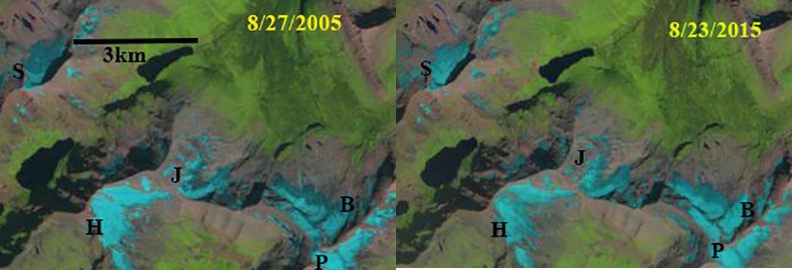
Snowcover extent in Landsat images from August, 1998 and 2018. S=Sperry, H=Harrison, J=Jackson, B=Blackfoot and P=Pumpelly

Five of the eight largest glaciers in Glacier National Park are clustered in a small area: Jackson Glacier, Sperry Glacier, Pumpelly Glacier, Harrison Glacier, and Blackfoot Glacier. The USGS in Glacier National Park has over the last 15 years maintained an extensive glacier monitoring program led by Dan Fagre.  This program has led to consistent mass balance observations on Sperry Glacier, and repeat mapping of the 37 named glaciers, 25 of which still qualify as glaciers.  The repeat mapping indicates the area lost from 1966 to 2015, (USGS, 2017).  There is considerable variation between glaciers , some have lost more than 80% of their area and others having lost less than 20% during this 50 year period. Snowcover extent in late summer is a good indicator of glacier mass balance, which controls changes in glacier volume/glacier area.  Glaciers that lack a persistent accumulation zone cannot survive current conditions (Pelto, 2010).  Observations of the snowcover extent in years of limited snowpack illustrate which glaciers do have a persistent snowcover and can survive vs those that cannot (Pelto, 2011). Here we examine Landsat imagery from mid to late August in 1998, 2005, 2015 and 2018, all years of extensive mass loss to identify the difference in snowcover extent, which will drive mass balance loss and subsequent retreat. These images are not at the minimum snowcover extent, which usually occurs n September. For a glacier to be in equilibrium it needs more than 50% of its area to be snowcovered at the end of the melt season.

In 1998 glacier mass balance losses were significant in the region, in mid-August the accumulation area (snowcovered area) on Harrison Glacier exceeded 80%, Blackfoot Glacier was ~60 % snowcovered,  Jackson Glacier ~50% snowcovered and Sperry Glacier ~30% snowcovered.  In 2005 another year of minimum mass balance in the region in late August, Harrison Glacier had ~80% snowcover, Blackfoot Glacier~60% snowcover, Jackson Glacier ~40% snowcover and Sperry Glacier ~20% snowcover. In 2015 glacier volume losses in the region were again large, with Sperry Glacier having a loss of -1.22 m. The retained area of accumulation on Harrison Glacier in mid-August of 2015 was ~60%, on Blackfoot Glacier 50%, on Jackson Glacier 30-40% and on Sperry Glacier less than 20%. In mid-August of 2018 snowcover extent was greater than 75% on Blackfoot, Harrison and Jackson Glacier, while Sperry Glacier had ~40%.

The USGS identified the area of Blackfoot Glacier in 2015 as 1.5 km2, a reduction of 18% from 1966-2015 and 8% from 1998-2015 (USGS, 2017).  Harrison Glacier had an area of 1.7 km2, losing 17% of its area from 1966-2015, and 10% from 1998-2015. Jackson Glacier had an area of 0.8 km2, losing 40% of its area from 1966-2015, and 6% from 1998-2015.  Sperry Glacier had an area of 0.8 km2 in 2015 having lost 40% of its area from 1966-2015, and 16%  from 1998-2015. The persistent pattern of limited snowcover extent on Sperry Glacier indicates why the percentage of area loss has been greater than on the other glaciers. The lack of significant retained snowcover indicates Sperry Glacier cannot survive current climate.  The retention of significant snowcover on Blackfoot and Harrison Glacier even in low snowpack years indicate these glaciers, unlike most in the National Park, can survive the current climate. The Jackson Glacier is in between these two scenarios.

Jackson is the lowest elevation glacier and Harrison is the highest.  Blackfoot, Jackson and Sperry are all north facing. Pumpelly which faces south has lost the least area of the five glaciers from 1998-2015. This underscores the utility of Landsat imagery in assessing glacier mass balance response. Three of the glaciers that retain significant snowcover indicates these glaciers are not as vulnerable to warming and will continue to persist until 2050 at least.

USGS Data on glacier area.

Observation Year LIA 1966 1998 2005 2015
Jackson 3.1 1.3 0.8 0.8 0.8
Harrison 3.5 2.1 1.8 1.7 1.7
Blackfoot 5.0 1.8 1.6 1.6 1.5
Sperry 3.8 1.3 1.0 0.9 0.8

Snow cover extent in Landsat images from August, 2005 and 2015. S=Sperry, H=Harrison, J=Jackson, B=Blackfoot and P=Pumpelly

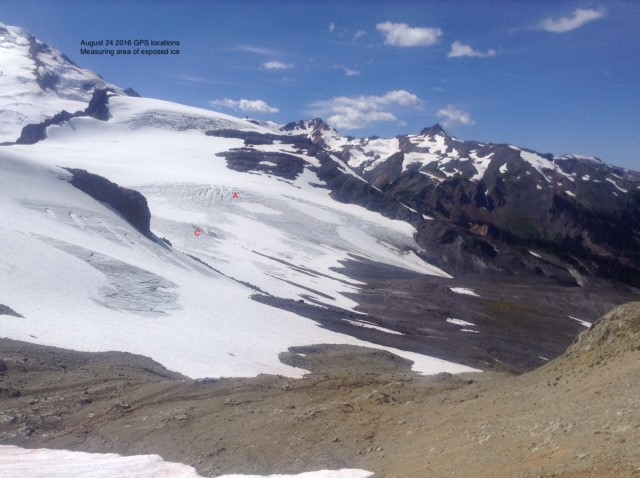
Sholes Glacier August, 24 2016 with the snowcover extent vs the exposed glacier ice.

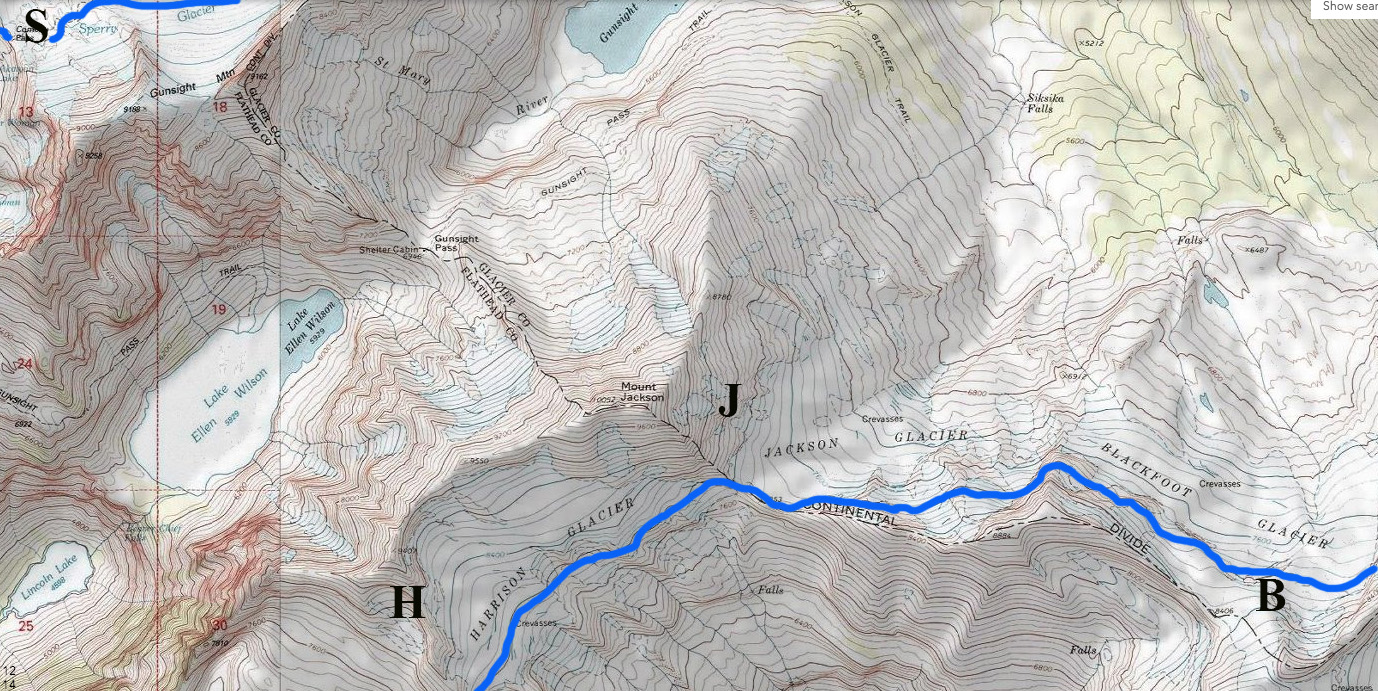
USGS Topo Map of the area with the blue line indicating the 8000 foot contour.

Daishapu Glacier, China Retreat Lake Expansion

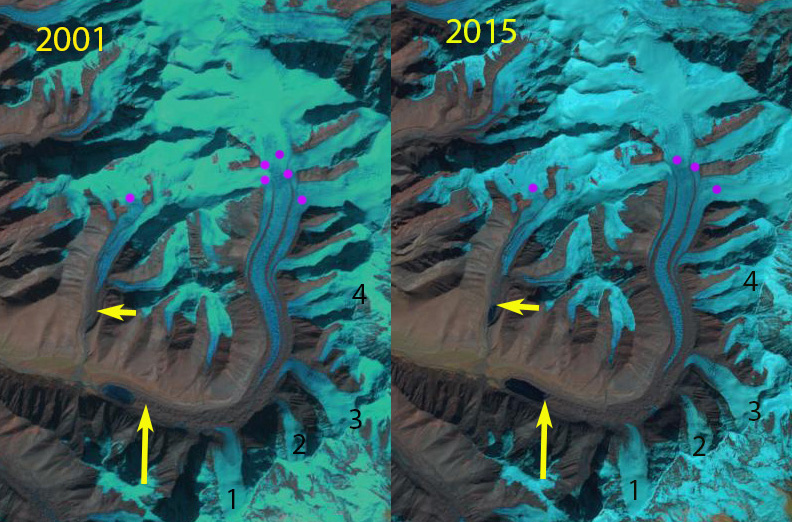
Daishapu Glacier (D) and Ruorangqubu Glacier (R) in 1993 and 2018 Landsat images.  The yellow arrows indicate the 2018 terminus location of both glaciers and the purple dots the snowline. Notice the lake expansion at the terminus of both glaciers. Locations 1-4 are tributaries.

Daishapu Glacier and Ruorangqubu Glacier are in the eastern Himalaya located just north of the Himalayan divide and draining north into the Yarlung Zangbo. This is a remote area with little development downstream for 100+ km.  Li et al (2010) examined glacier change over the last several decades in China and found ubiquitous glacier retreat and commonly lake formation as glaciers retreated.

In 1993 Daishapu Glacier has a debris covered terminus ending in a 1 km long proglacial lake at 5000 m.  Tributaries 1-4 all reach the main Daishapu trunk. The snowline in 1993 is at 5600 m in December.  Rurorangqubu Glacier had a low slope debris covered terminus without a proglacial lake at 5300 m.  A tributary from the east joins the glacier 1 km above the terminus.  By 2001 Daishapu has retreated several hundred meters, while tributaries 1-4 all still connect. The snowline is at 5800 m in December. Rurorangqubu still has no proglacial lake. In 2015 both glaciers have proglacial lakes at the terminus. Tributary #2 no longer reaches the main Daishapu.  The eastern tributary no longer reaches the main trunk of Rurorangqubu Glacier.  In 2018 the proglacial lake at the end of the Daishapu Glacier is 1800 m long, with a retreat of 700-800 m since 1993.  Tributary #4 has now begun to detach. Rurorangqubu Glacier has a 600 m long proglacial  that has formed which represents the retreat of the glacier since 1993.  The snowline in 2018 is at 6000 m in December.  The high snowline persisting into December is a trend in the area that is not positive for glacier mass balance, this has been observed around Mount Everest  and on the China-Bhutan border. These two glaciers at the crest of the Eastern Himalaya are both retreating, have expanding proglacial lakes and separating tributaries.  This is a common story in the region as seen at Thong Wuk Glacier and Jiongla Glacier.

Daishapu Glacier (D) and Ruorangqubu Glacier (R) in 2001 and 2015 Landsat images.  The yellow arrows indicate the 2018 terminus location of both glaciers and the purple dots the snowline. Notice the lake expansion at the terminus of both glaciers. Locations 1-4 are tributaries.