Kerguelen Island Glacier Retreat Expands Lake District

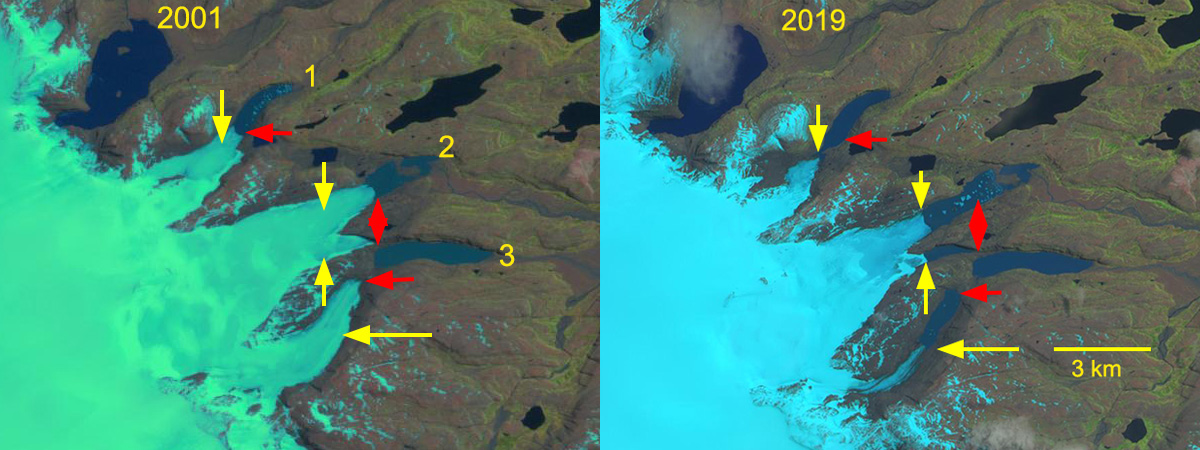
Eastern Outlet glaciers of Cook Ice Cap in a 2001 Landsat and 2019 Sentinel image indicating retreat from 2001 terminus positions (red arrows) to 2019 terminus location (yellow arrows).

The east side of the Cook Ice Cap on Kerguelen Island outlet glaciers have retreated expanding and forming a new group of lakes (Pelto, 2016).  Here we examine the changes from 2001-2019 along using Landsat and Sentinel imagery. Retreat of glacier in the region was examined by Berthier et al (2009) and is exemplified by the retreat of Ampere Glacier.  Verfaillie et al (2016) examined the surface mass balance using MODIS data, field data, and models.  The accelerating glacier wastage on Kerguelen Island was observed do be due to reduced net accumulation and resulting rise in the transient snowline since the 1970s, when a significant warming began.  This has led to nunatak expansion on the ice cap.

In 2001 the northern outlet glacier terminates in a wide portion of the proglacial lake #1.  The central outlet, #2, has two terminus locations the northern is in a proglacial lake that is 2.5 km long and the southern arm terminates on land.  The southern outlet terminates on land.  By 2011 the northern outlet has retreated into a narrow section of the proglacial lake. The center terminus has retreated with a new lake forming in front of its southern arm. The southern outlet has retreated revealing a new developing lake.  In 2014 the northern terminus has retreated from the primary proglacial lake. The central terminus is producing icebergs from both arms. The lake continues to expand at the southern outlet.  The 2019 image is from early in the melt season. The northern terminus has retreated 1100 m since 2001 and is no longer calving in a substantial lake. The central terminus has retreated with the northern and southern arm retreated 1500-1800 m, with a new lake forming in front of the southern arm.  The southern outlet glacier has retreated the most, 2100 m since 2001, leading to the formation of a new lake of the same length. Outlet glaciers of the ice cap that are not calving are also retreating indicating that the retreat has been driven by rising snowline and enhanced by calving. The central and southern outlets continue to calve and should continue retreat more rapidly than the northern outlet.

Eastern Outlet glaciers of Cook Ice Cap in a 2011 and 2014 Landsat images indicating retreat from 2001 terminus positions (red arrows) to 2019 terminus location (yellow arrows).
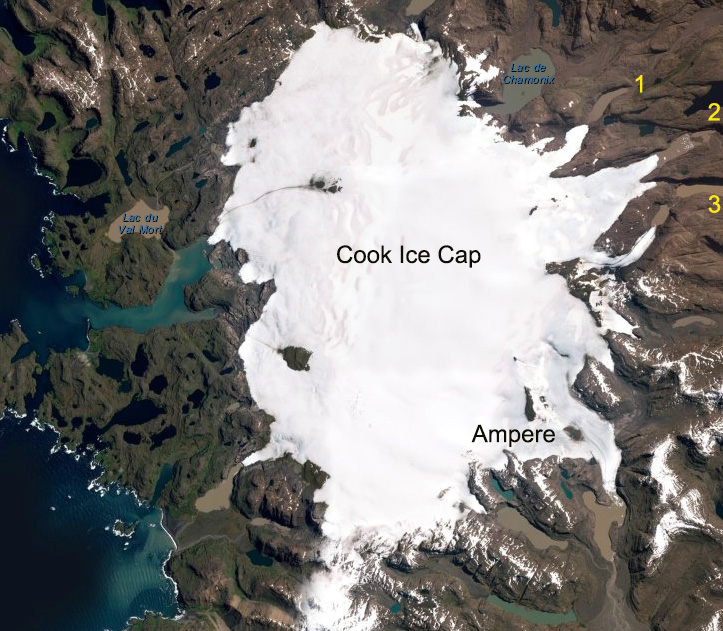
Digital Globe image of the Cook Ice Cap, with the main outlet, Ampere Glacier and the three glaciers examined here 1-3.

 

Cook Ice Cap Retreat & Nunatak Expansion, Kerguelen Island

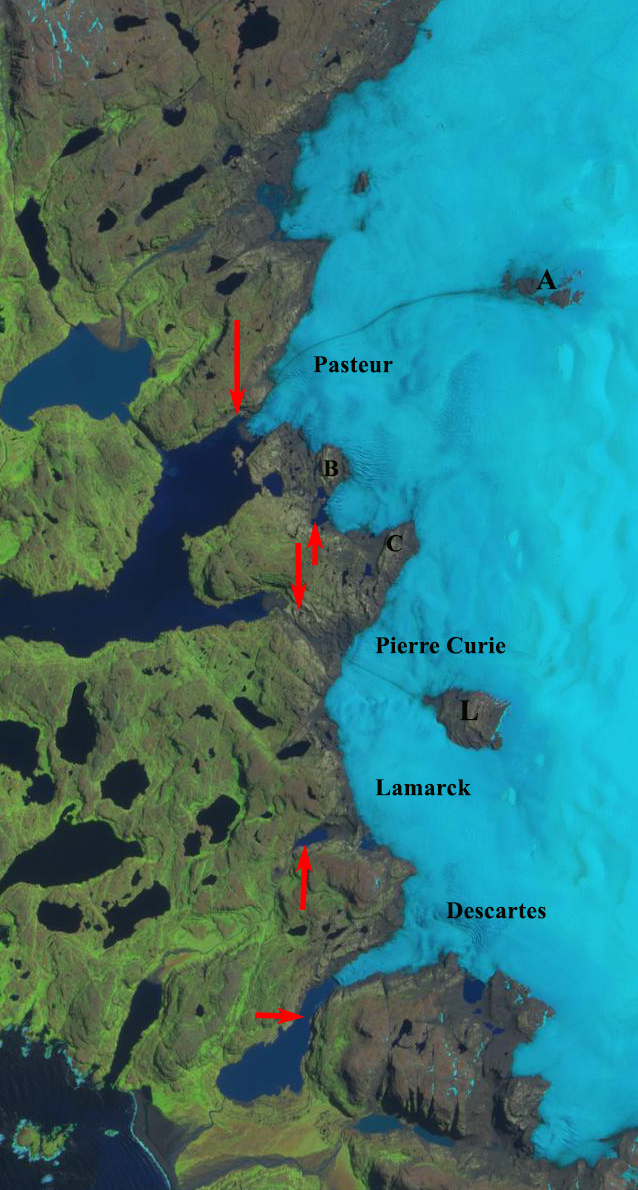
West margin of Cook Ice Cap in 2001 and 2018 Landsat images.  Red arrows indicate terminus margin in 2001 in both images. Nunataks A-D and Nunatak Lacroix (L) are also shown.

On the west side of the Cook Ice Cap on Kerguelen Island a series of outlet glaciers have retreated and several nunataks have either expanded or are no longer surrounded by ice.   The glacier include Pasteur, Pierre Curie, Larmarck and Descartes from north to south. Here we examine the changes from 2001-2018 along using Landsat imagery.  This is a very cloudy region and no other images allowed a clear view, except a Sentinel image also from 2018. Retreat of glacier in the region was examined by Berthier et al (2009) and is exemplified by the retreat of Ampere Glacier.  Verfaillie et al (2016)examined the surface mass balance using MODIS data, field data, and models.  They identified that accelerating glacier wastage on Kerguelen Island is due to reduced net accumulation and resulting rise in the transient snowline since the 1970s, when a significant warming began.

On the west side of Cook Ice Cap in 2001 there is one significant Nunatak in the midst of the ice cap Nunatak Lacroix (L). Nunatak A and D do not exist.  Nunatak C is encircled by ice and Nunatak B is nearly surrounded. Pasteur Glacier reaches tidewater across a broad front in 2001. By 2018 Nunatak D has emerged 1.2 km inland from the margin. Nunatak A has also emerged 4.0 from the ice margin. Nunatak C is now a ridge separated from the ice cap. Lacroix Nunatak is much expanded. Pasteur Glacier is narrower has retreated 600 m and does not reach tidewater, but terminates on a proglacial delta. Pierre Curie Glacier 1.2 km and is now just 2 km from the ice cap margin. Lamarck Glacier that terminated in a proglacial lake has now retreated from that lake, a retrated 1100 m.  Descartes Glacier  has retreated 1000 m with a narrow arm of the lake extending northward. A new proglacial lake has also formed down glacier of Nunatak D.  The retreat of the western margin of the Cook Ice Cap supports the mass balance losses determined by  Verfaillie et al (2016).  The east side of the Cook Ice Cap is also retreating forming a new lake district.

West margin of Cook Ice Cap in  2018 Sentinel image.  Red arrows indicate terminus margin in 2001 in both images.  Nunataks A-D and Nunatak Lacroix (L) are also shown. Retreat of outlet glaciers at the five arrows is 900 m.


Lower Curtis Glacier Annual Terminus Response to Climate Change

Side view of Lower Curtis Glacier in 2013, 2015 and 2017, illustrating the reduced slope and height of glacier front in just four years.

Terminus observations have been reported to the WGMS from 2500 glaciers with 46,500 specific observations since the late 19th century, which you can explore with the glacier viewer application. Here we examine what it looks like to report from a glacier each year.  I have visited this glacier 34 consecutive years, each time camping in a tent near the glacier, a fun spot indeed when the weather cooperates. The Lower Curtis Glacier is an avalanche fed cirque glacier on Mount Shuksan in the North Cascades of Washington. It is a south facing and low elevation glacier for the range. This is an unusual combination that is supported by the heavy accumulation via avalanching from the upper slopes of Mount Shuksan. The glacier displays a magnificent set of annual layers in its terminus tongue. The terminus tongue is a spectacular wall of seracs that quickly rises 55 m above the bedrock. There are typically 50 layers visible indicating that this most of the ice in the glacier is 50 years of less in age.

Lower Curtis Glacier Front in 2007 and 2017 taken from same location.  Both retreat and thinning of the front in the decade is evident. 

From 1908 to 1950 the glacier retreated from the valley bottom into the cirque. The glacier advanced from 1950-1985 down slope and has retreated since.  Each year we survey the terminus location, measure the mass balance and survey the glacier surface elevation on a cross profile. Here we report on the annual terminus survey from 2007-2017.  The frontal change reported to the World Glacier Monitoring Service has been 2007=-13 m, 2008=-17 m, 2009=-20 m, 2010=-7 m, 2011=-5 m, 2012=-6 m, 2013=-5 m, 2014=-12 m, 2015=16 m, 2016=-16 m and 2017=12 m. This is a total of 129 m of retreat in 11 years, nearly 12 m per year. A longitudinal profile up the middle of the glacier indicates that it thinned 30 meters from 1908-1984 and 22 m from 1985-2016. Because of its heavy accumulation via avalanching the glacier moves rapidly and is quite crevassed at the terminus with large high seracs at the glacier front. In 2007 the height of the terminus seracs was 45 m, by 2014 the seracs were 37 m high and in 2017 had shrunk to 26 m high and not as steep.  The imposing tongue has certainly diminished. The glacier retreat fits the pattern in the region, with all Mount Baker a glaciers retreating (Pelto, 2015).