Mueller Glacier, NZ Terminus Collapse

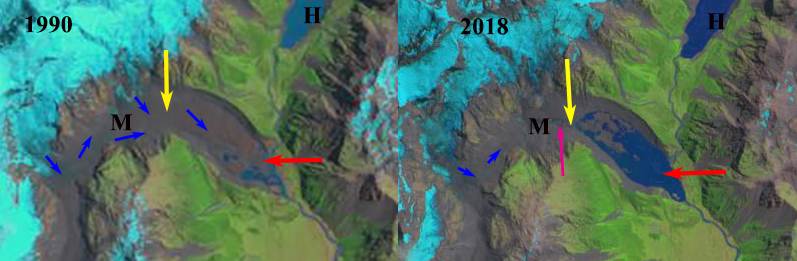
Mueller Glacier (M) in a Landsat image from 1990 and a Sentinel image from 2018. Red arrow is 1990 terminus, yellow arrow 2018 terminus, blue arrow glacier flow, and pink arrow in 2018 ablation valley cut into glacier.

Glaciers of the Southern Alps of New Zealand have been losing ice volume since 1978, with an increasing rate in the last decade (Pelto, 2017).  The NIWA glacier monitoring program has noted that volume of ice in New Zealand’s Southern Alps has decreased 5.8 cubic kilometres, more than 10% in the past 30 years. More than 90% of this loss is from 12 of the largest glaciers in response to rising temperatures over the 20th century. Three of these glaciers are the Tasman, Mueller and Hooker Glacier.   If we look back to the 1972 Mount Cook Map, see below, no lakes are evident at the terminus of Hooker (H), Mueller (M) or Tasman Glacier (T), pink dots indicate terminus location, top image. Now it is a developing lake district.

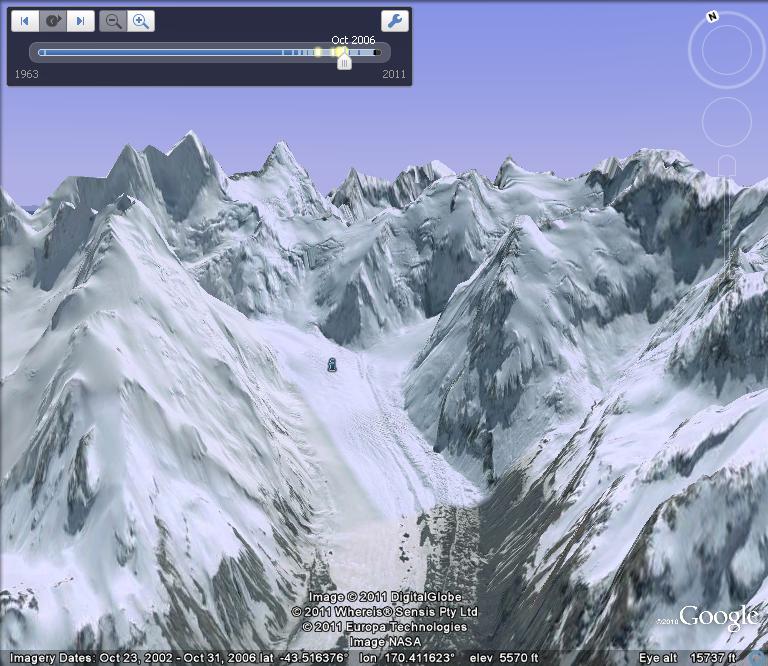
Mueller Glacier drains the eastern side of Mount Sefton, Mount Thompson and Mount Isabel. The lower section of the glacier is debris covered in the 2.5 km long valley reach from the terminus at 950 m to 1250 m. A comparison of the Mueller Glacier in a sequence of Landsat images indicates a fringing discontinuous area of water along the southern glacier margin in 1990. In 2000 the lake at the end of Hooker Glacier had developed and was 400 meters long. By 2004 the Mueller Glacier Lake had expanded to a length of 700 meters. By 2011 the lake had reached 1400 meters in length. By 2015 the lake had reached 1800 meters in length. Mueller Lake had a surface area of 0.87 km2 and a maximum depth of 83 m (Robertson et al, 2012). From 2015-2018 the terminus has collapsed into the lake with icebergs and other attached ice remnants.  The retreat has left a lake that is 2700 m long,  a retreat of 2300 m since 2000.  The lake basin is 1.6 km2 with 15% filled with remnant ice. Above the current terminus in not a typical convex valley glacier, but a concave reach of debris covered ice with significant melt valleys and hollows indicating stagnation in the lowest 1.6 km.  Pictures of the terminus from 2018 taken by Jill Pelto, UMaine indicate the high turbidity of the lake, which is expected from a debris covered ablation zone. The lack of relief of the relict ice is also evident.

Mueller Glaier drains into Lake Pukaki,a along with Murchison,Hooker and Tasman Glacier, where water level has been raised 9 m for hydropower purposes. Water from Lake Pukaki is sent through a canal into the Lake Ohau watershed and then through six hydropower plants of the Waitaki hydro scheme: Ohau A, B and C. Benmore, Aviemore and Waitaki with a combined output of 1340 MW.  Meridian owns and operates all six hydro stations located from Lake Pūkaki to Waitaki.  Reductions in glacier area in the watershed will lead to reduced summer runoff into the Lake Pukaki system.

The glacier has been fed by three different glaciers flowing off of Mount Sefton. Two of them Tuckett and Huddlesoton (pink arrow) are no longer delivering significant ice to the Mueller, only modest avalanching now spills onto the Mueller Glacier. Only the Frind Glacier (yellow arrow) is contributing to the Mueller Glacier. This is similar to the situation on nearby Murchison Glacier. Further the lack of ice connection from Huddleston and Tuckett Glaciers to Mueller is again evident, pink arrow. The lake will continue to expand through minor calving and downwasting.

Field work images from Jill Pelto looking across Mueller Lake towards Hooker Lake and Mt. Cook. Some remnant ice is visible.
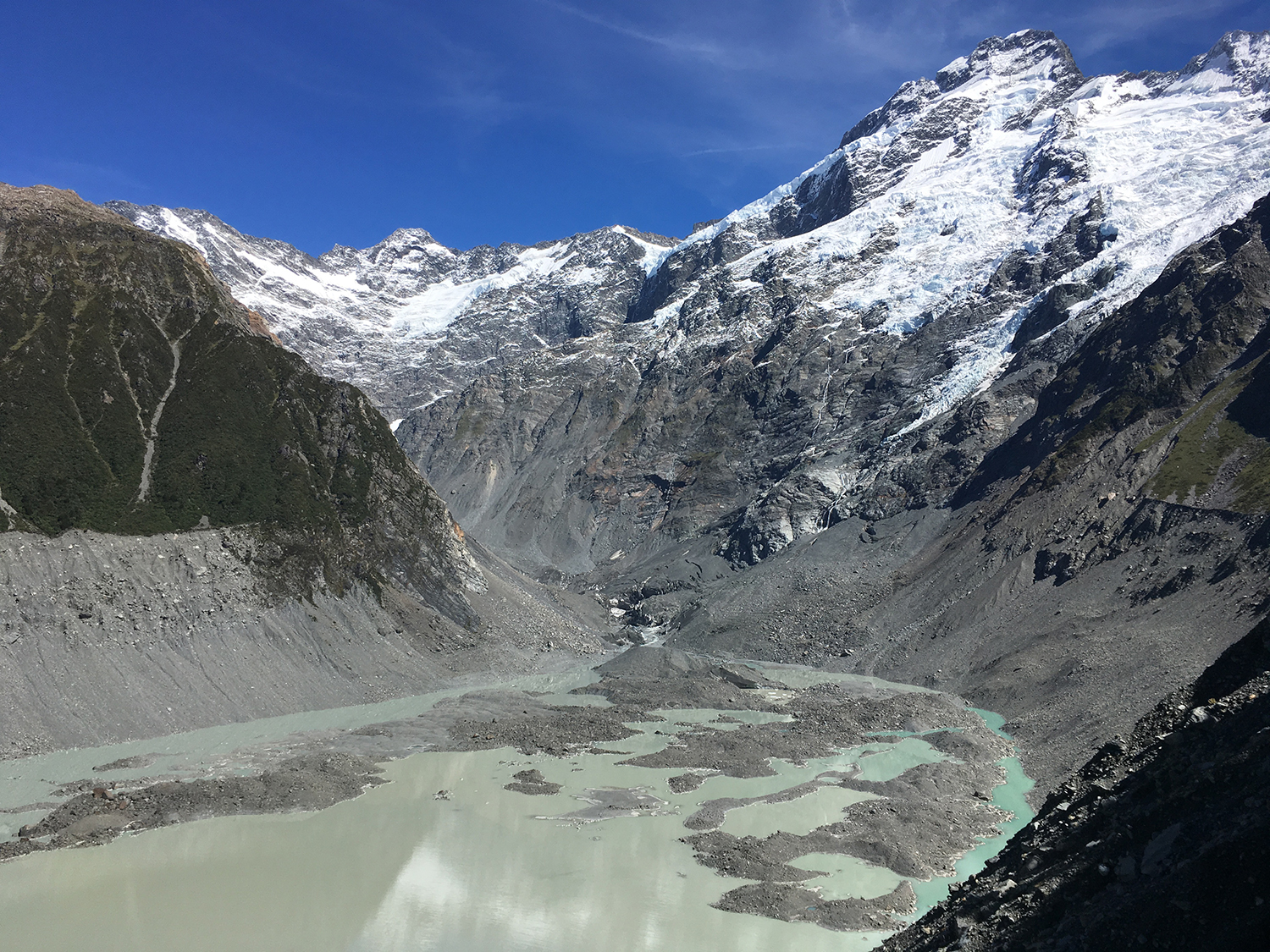
View southwest toward the head of Mueller Lake and terminus of Mueller Glacier notice stream dissecting stagnant ice at head of lake.  Picture is from Noel Potter, UMaine,  2/2018 


Mueller Glacier (M) in a Landsat image from 2000 and 2015. Red arrow is 1990 terminus, and yellow arrow 2018 terminus.

1972 Map of region when Tasman, Mueller and Hooker Glacier lacked proglacial lakes and Landsat image in 2011 after lake development.

 

Murchison Glacier, New Zealand Rapid Retreat Lake Expands 1990-2015

murchison compare

Murchison Glacier change revealed in Landsat images from 1990 and 2015.  The red arrow indicates 1990 terminus location, the yellow arrow indicates 2015 terminus location and the purple arrow indicates upglacier thinning.

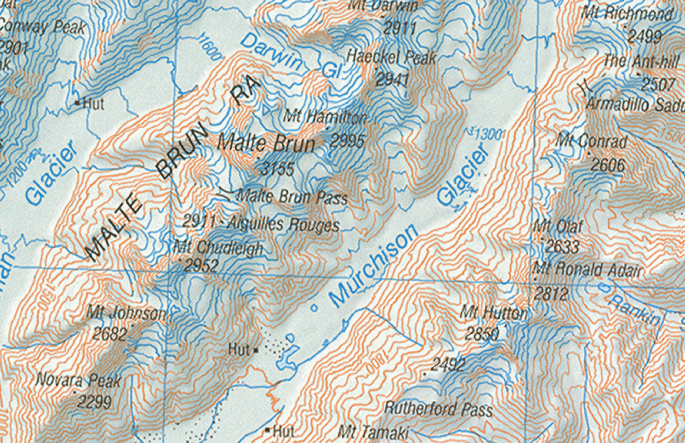
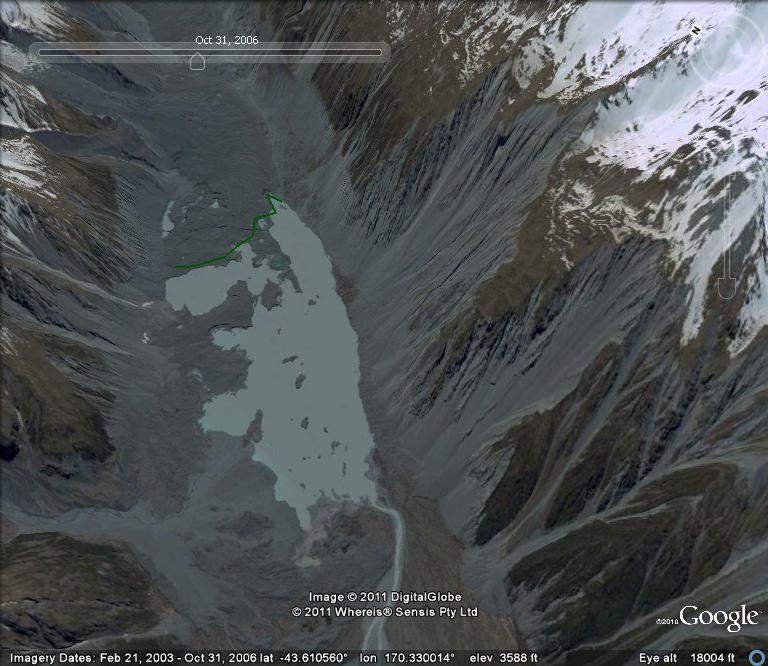
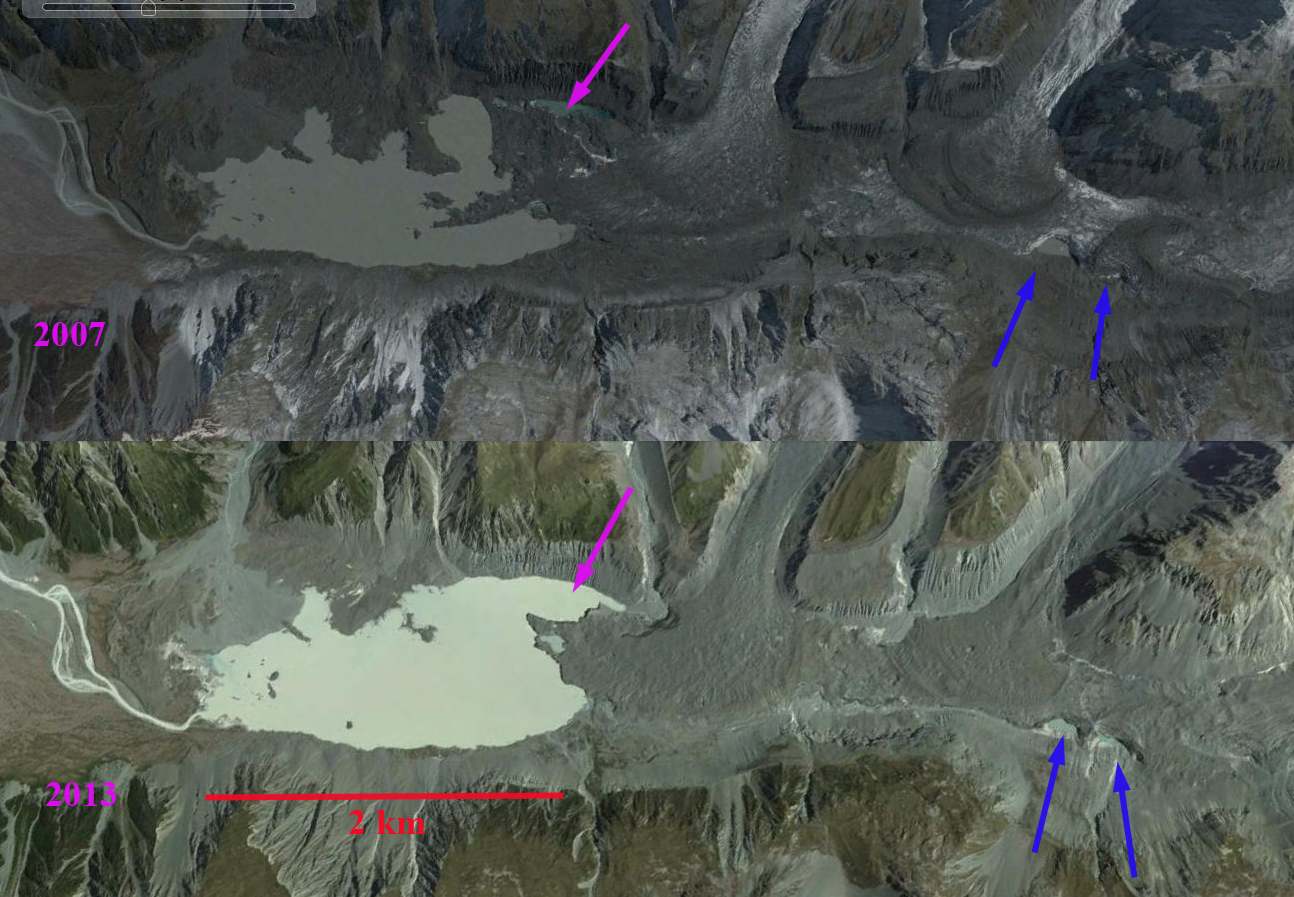
Murchison Glacier is the second largest in New Zealand.  The glacier drains south in the next valley east of Tasman Glacier and terminates in a lake that is rapidly developing as the glacier retreats. The lower 6 km section  is debris covered, stagnant, relatively flat and will not survive long. There was not a lake in the 1972 map of the region.  In 1990 the newly formed lake was limited to the southeast margin of the terminus . From 1990 to 2015 the terminus has retreated 2700 m. A rapid retreat will continue as 2010, 2013 and 2015 imagery indicate other proglacial lakes have now developed 3.5 km above the actual terminus. These lakes are glacier dammed and may not endure but do help increase ablation, and in the image below show a glacier that is too narrow to provide flow to the lower 3.5 km. The demise of the lower section of this glacier will parallel that of Tasman Glacier.  The expanding lake will continue to enhance the retreat in part by sub-aqueous calving noted by Robertson et al (2012) on nearby glaciers. The increased retreat has been forecast by the NIWA and Dykes et al (2011). The glacier still has a significant accumulation area above 1650 m to survive at a smaller size.  The ongoing retreat is triggered by warming and a rise in the snowline in the New Zealand Alps observed by the NIWA. Notice the changes upglacier indicated at the purple arrows above, where tributary flow has declined, bedrock areas in accumulation zone have expanded and the snowline is higher.  Gjermundsen et al (2011) examined the change in glacier area in the central Southern Alps and found a 17% reduction in area mainly from reductions of large valley glaciers such as Murchison Glacier.

mucrhison terminus reach compare

Terminus reach of Murchison Glacier in Google Earth images from 2007 and 2013.  Note expansion at pink arrow on the terminus lake and the development of proglacial lakes 3.5 km upglacier at blue arrows.

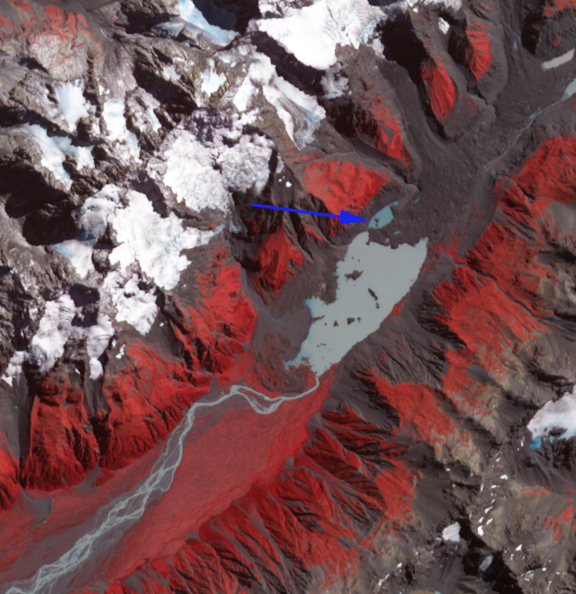
The Feb. 2011 earthquake near Christchurch led to a major calving event of a portion of the rotten stagnant terminus reach of the Tasman Glacier. There was no evident calving event from Murchison Glacier.This has led to increased exposure of bedrock high on the glacier and reduction of tributary inflow noted at purple arrows.

Murchison Glacier drains into Lake Pukaki,a along with Hooker, Mueller and Tasman Glacier, where water level has been raised 9 m for hydropower purposes. Water from Lake Pukaki is sent through a canal into the Lake Ohau watershed and then through six hydropower plants of the Waitaki hydro scheme: Ohau A, B and C. Benmore, Aviemore and Waitaki with a combined output of 1340 MW.  Meridian owns and operates all six hydro stations located from Lake Pūkaki to Waitaki. Reductions in glacier area in the watershed will lead to reduced summer runoff into the Lake Pukaki system. Below the Benore Dam is pictured,.  Interestingly salmon have been introduced into the Waitaki River system for fishing near its mouth. Benmore Lake itself is an internationally renowned trout fishing spot, providing habitat for both brown trout and rainbow trout.

benmore dam

Google Earth Image with Benmore Dam in foreground and Benmore Lake.  This hydropower system is fed by a canal from Lake Pukaki which in turn is fed by Murchison Glacier.


Balfour Glacier, New Zealand Retreat 1990-2015

Balfour Glacier drains west from Mount Tasman in the Southern Alps of New Zealand.  The ablation is a low slope, 8 km long debris covered tongue extending from the terminus near 800 m to 1600 m.  The glacier is fed by avalanching off of Mount Tasman to the west, the southern flank of the Fox Range to the north and the northern flank of the Balfour Range to the south.  Gjermundsen et al (2011) examined the change in glacier area in the central Southern Alps and found a 17% reduction in area mainly from reductions of large valley glaciers such as Balfour Glacier. The volume loss of New Zealand glaciers is reported as 36% from 1978 to 2015, from 54 cubic km to 34 cubic km.

balfour map

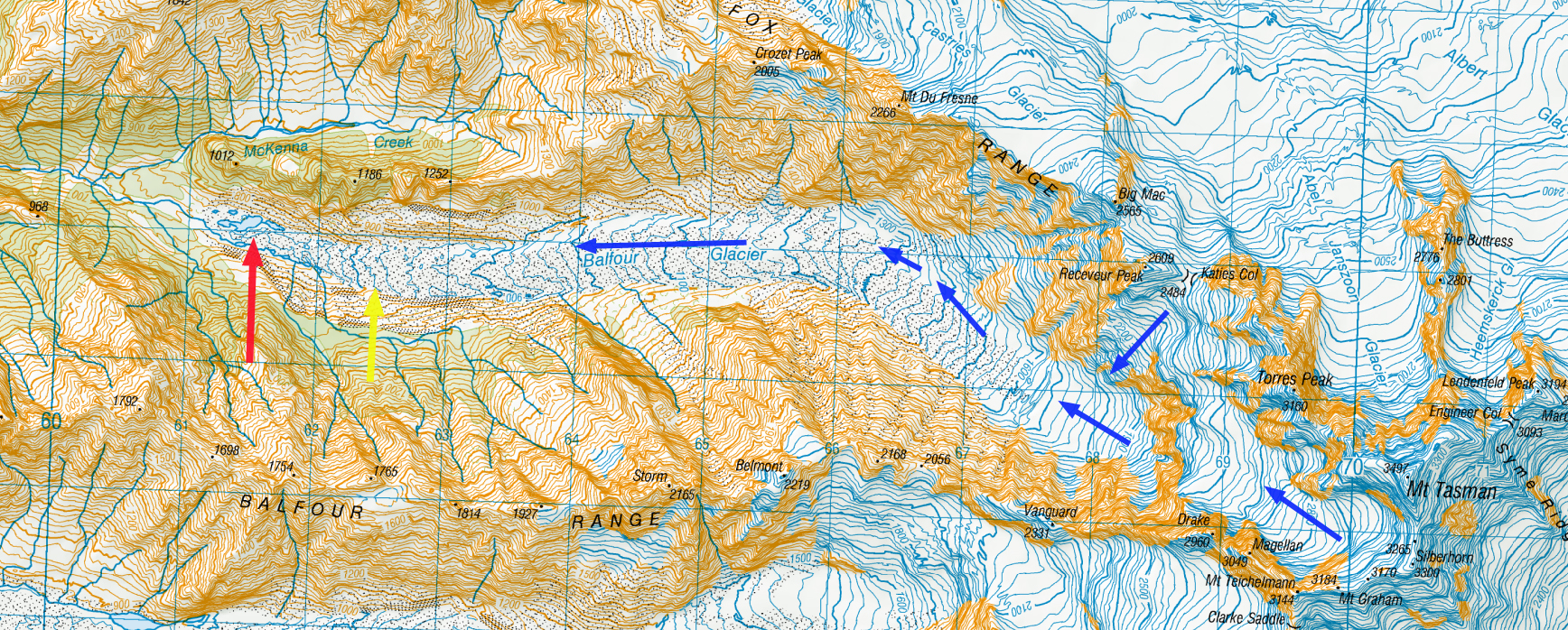
Topographic map of Balfour Glacier area of New Zealand from http://www.topomap.co.nz/ . Blue arrows indicate flow, red arrows at 1990 terminus and yellow arrow at 2015 terminus

In 1990 the glacier ended at 700 m with a snowline at 1600 m. The lower 18 km of the Balfour Glacier is debris covered. Only the upper 8 km has snowcover.  In 2015 the terminus has retrated 1250 m, the snowline is at 1800 m, with the lower 20 km debris covered. The terminus reach has continued to appear stagnant from 1990 to 2015.  Balfour Glacier has not developed a significant proglacial lake at its terminus, which has limited the retreat compared to Tasman Glacier or Mueller Glacier. Google Earth indicates the retreat of stagnant debris. The main glacier meltwater outlfow issues from the glacier at the yellow arrow in 2012, 600 m above the terminus.

balfour compare

Landsat Analysis of 1990 above and 2015 Below of Balfour Glacier.  Red arrow is at 1990 terminus and yellow arrow at 2015 terminus.  The purple arrows indicate area of thinning upglacier. 

balfour 2006

2006 Google Earth image of Balfour Glacier above and 2012 image below.  The red arrow is at the terminus location in 2006, the yellow arrow is at the 2012 location where the glacier stream issues from beneath the glacier. The purple arrows

balfour 2012

Douglas Neve Glacier Retreat, New Zealand

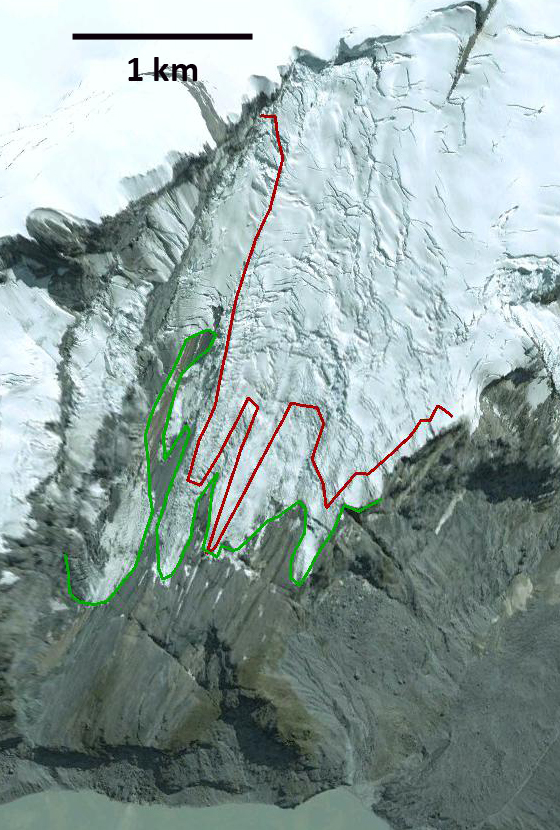
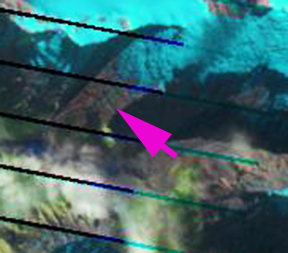
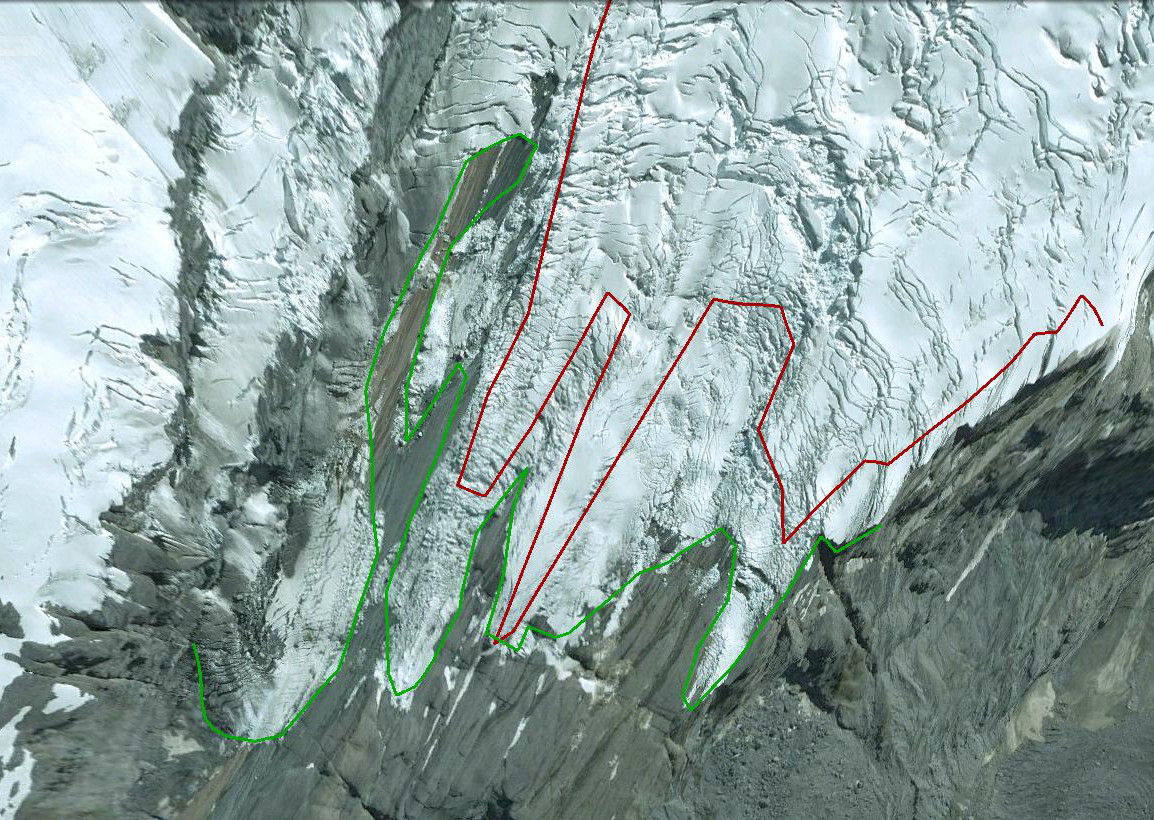
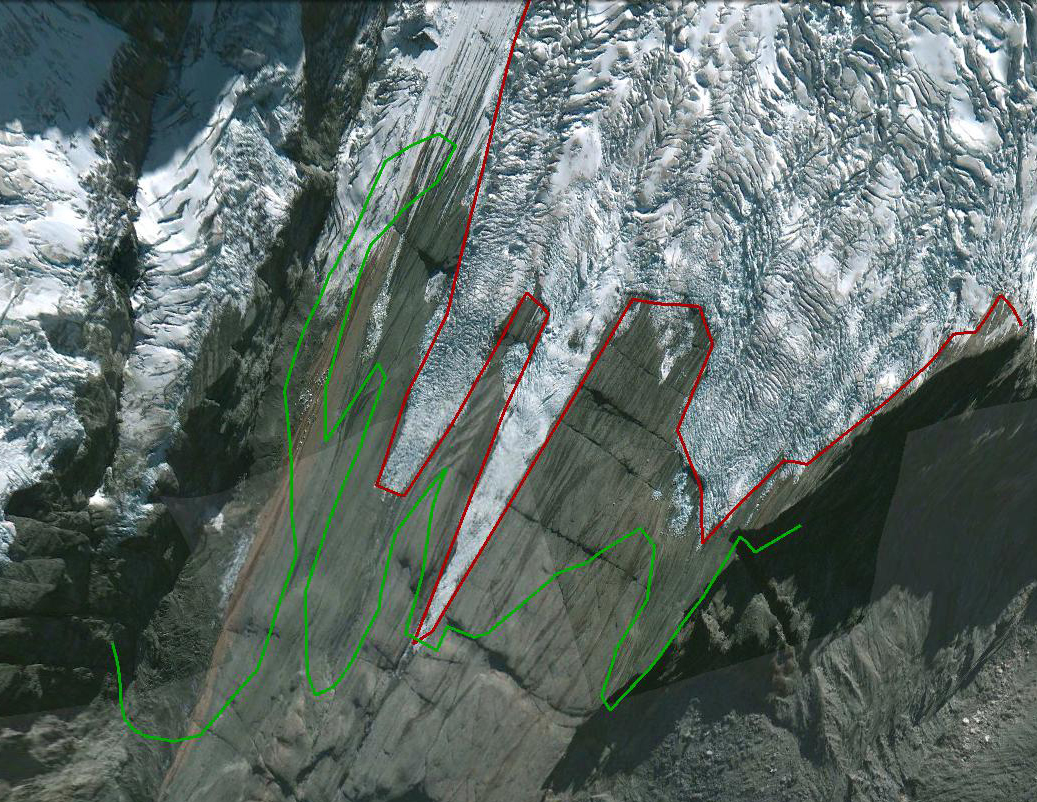
The primary portion of the Douglas Glacier was a debris covered valley tongue that is separated from the slopes feeding the terminus reach. The feeder glacier tongues, pink arrows, end on the bedrock slopes above a steep cliff and do not reach the valley glacier below, blue arrows. One section of the glacier, the furthest west portion noted by a pink arrow, the Douglas Neve flows down a steep mountains side. The bedrock slope at the base of the glacier is particularly smooth, which combined with the steep slope,, 40% grade or 22 degree slope, enhances basal sliding. On small alpine glacier the resulting high velocity leads to extensive crevassing. This crevassing can literally penetrate to the base of the glacier near the thin terminus. This leads to portions of the glacier simply separating from the rest of the glacier and avalanching down the slope or melting in place. Here we utilize Landsat images from 2000 and 2012 and Google Earth imagery from 2004 and 2009 to examine the retreat of this glacier. The sequence of images below are in order 2000, 2004, 2009 and 2012. In 2000 the terminus of the glacier terminates at a prominent bedrock fracture at 1640 meters above sea level. In 2004 the terminus still reaches this fracture. The green line in the Google Earth imagery is the 2004 terminus and the burgundy line the 2009 terminus. By 2009 the terminus has retreated 400 meters, and consists of two unsustainable narrow tongues, both less than 100 meterw side. By 2012 the two narrow tongues have been lost, resulting in a 700 m retreat from 2000 to 2012 with the terminus now at 1800 meters. As the retreat of an alpine glacier progresses crevassing typically is reduced as glacier speed declines. Here we see an increase in crevassing from 2004 above to 2009 below in the terminus area, suggesting that the retreat will continue via pieces of the glacier separating from the glacier and avalanching. This process is a much different setting, but similar in practice to ice shelf loss through rifting that reaches the critical point where the rifts lead to icebergs breaking off. At this point the terminus remains unsustainable. This retreat is similar to that of New Zealand glaciers in general as noted by the NIWA and Trevor Chinn, and examined in detail on Murchison Glacier, Mueller Glacier and Gunn Glacier

Murchison Glacier Retreat Increasing

Murchison Glacier drains southeast from the Mount Cook region, one valley east of Tasman Glacier. The end of the glacier terminates in a lake that is rapidly developing as the glacier retreats. This retreat will become rapid as 2010 imagery indicates other proglacial lakes have now developed 3.5 km above the actual terminus. These lakes are at a higher elevation and may not endure but do help increase ablation, and in the image below show a glacier that is too narrow to provide flow to the lower 3.5 km. The increased retreat has been forecast by the NIWAand Dykes et al (2009) This lower section is debris covered, stagnant, relatively flat and will not survive long. The demise of the lower section of this glacier will parallel that of Tasman Glacier. The glacier has retreated 2200 meters from the moraines at the south end of the lake. There was not a lake in the 1972 map of the region. A comparison of 2006 and 2010 imagery indicates the decrease in glaciated area in the lake basin. The bottom image is from NASA after the Feb. 2011 earthquake near Christchurch that led to a major calving event of a portion of the rotten stagnant terminus reach of the Tasman Glacier. There is no evident calving event from Murchison Glacier. The lake on the western margin of the valley, separated from the main lake has since April 2010 expanded notably. The glacier still has a significant accumulation area above 1650 m to survive at a smaller size. The lower debris covered tongue is 6 km long and extends from the terminus at 1050 meters to 1200 meters, a very low gradient to supply healthy flow from the accumulation area. The ongoing retreat is triggered by warming and a rise in the snowline in the New Zealand Alps observed by the NIWA.

Donne Glacier Retreat New Zealand

Donne Glacier descends the spectacular east face of Mount Tutoka in southwest New Zealand. This glacier has been undergoing rapid retreat this decade creating a new alpine lake. The National Institute of Water & Atmospheric Research (NIWA) conducts an annual survey of the snowline of New Zealand glaciers. In order to thrive a glacier must have at 50-70% of its area snowcovered at the end of the summer melt season. For NZ glacier NIWA has noted 67% as the key to equilibrium conditions. If then snowline is above normal the glacier will lose mass, if the snowline is lower than normal the glacier will gain mass. Since 2000 the snowline has been above normal in nine of the ten years, only in 2005 was the snowline slightly lower than normal (NIWA, 2010). In 2009 the snowline was the highest of any of the years The result of a decade of high snowline’s is glacier mass loss and retreat. Below is a sequence of images from 2000, 2003, 2006 and 2009 of Donne Glacier the first and last images are from NIWA and the middle two are Google Earth images.
In 2000 the glacier reaches almost all the way across the newly forming unnamed lake. By 2003 the large debris covered section has detached and the lake has doubled in size. In 2006 the faint orange line indicates the 2003 terminus position. The retreat of 100 meters has led to further lake expansion. In the 2009 images the glacier is still ending in the expanding lake, and is still actively flowing. The number of crevasses and the snowcover existing even in poor snow years such as 2003, 2006 and 2009 indicate the glacier still has a persistent accumulation zone. The glacier begins near 2200 meters and descends to about 1300 meters in 2 kilometers. A persistent accumulation zone is key to survival. The retreat and formation of new alpine lakes is also occurring at two nearby glaciers that NIWA observes. Gunn Glacier (below) and Park Pass Glacier (above), in the Google Earth images. Both glaciers end in lakes still occupied by icebergs that used to be part the terminus of the glacier. The icebergs did not calve off so much as representing disintegration of the terminus. The tongue visible on Park Pass Glacier in the middle of the lake is now gone.