40th Field Season of North Cascade Glacier Climate Project Underway

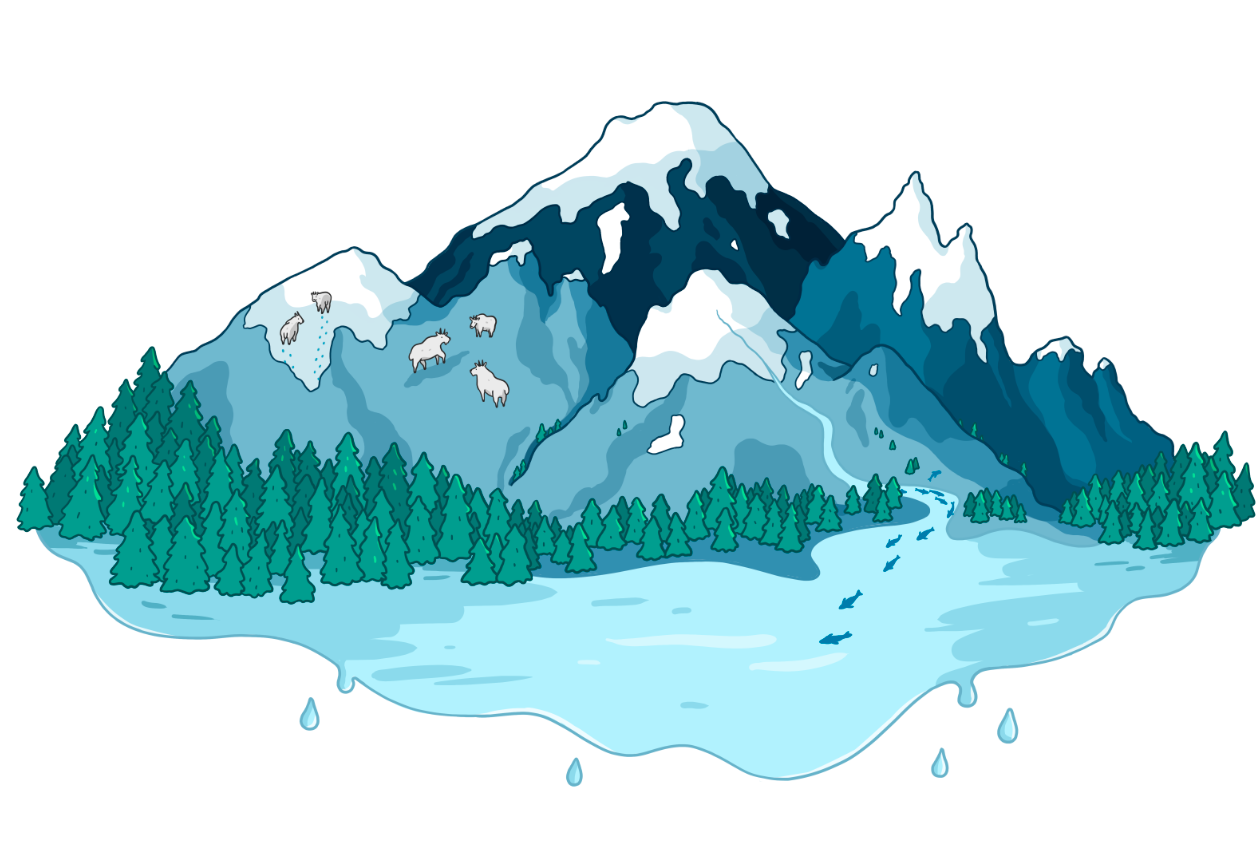
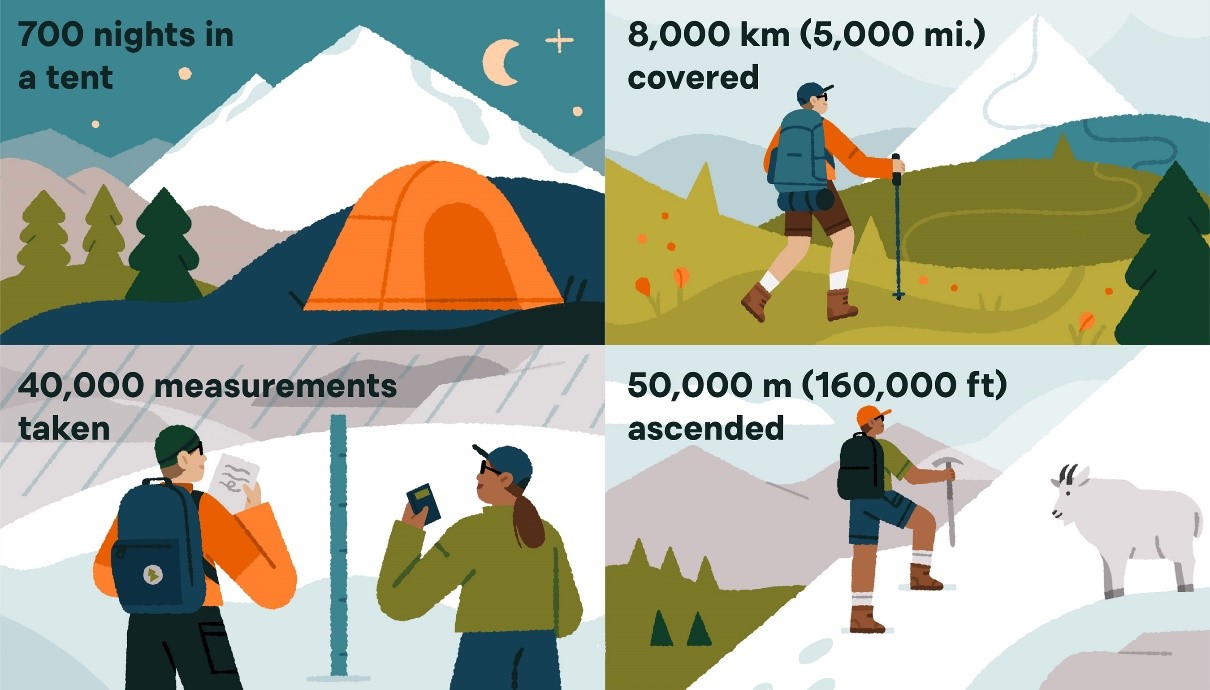
Illustration by Megan Pelto of key numbers behind what it takes to undertake a 40 year field study on glaciers.

For the 40th consecutive summer the North Cascade Glacier Climate Project is heading into the field to measure and communicate the impact of climate change on North Cascade glaciers. This field season follows the 2021 and 2022 seasons that featured a historic heat wave and periods of extended warm weather. The heat led to a greater exposure of bare ice on glaciers, particularly at higher elevations. For ice surfaces with a higher albedo and greater density the observed melt rates are 7-9 cm per day water equivalent during warm weather events vs 4-6 for snow surfaces. This led to substantial mass losses on North Cascade glacier for the two years of -2.5 m. Winter snowpack in the North Cascades in 2023 was 80-90% of normal on April 1 and May 1.

Science objectives: We will complete detailed measurements on 10 glaciers, three of which are part of the World Glacier Monitoring Service reference glacier network (42 glaciers globally), which have 30+ consecutive years of mass balance observations. This summer we will have an opportunity to assess the long-term ramifications of the 2021 and 2022 summers and measure the response of glaciers to the weather of 2023 with detailed mass balance, crevasse depths and glacier surface elevation profiling.

Art Objectives: We will collaborate with several artists who will join us for a portion of the field season. They will be able to create their own work about the landscape and the science or may join us for fieldwork and make plans for future artwork. Potential artists include painters, a podcast creator, a photographer, and a printmaker. We hope to use this art to share our research with a broader audience and highlight the beauty and importance of these places.

Communication Objectives: We are seeking expedition sponsors this year with brands who have a climate change focus. These organizations can help spread our message; we have two so far. We are looking to support the production of podcasts as well.

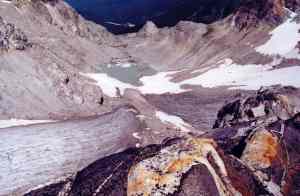
Terminus change at two World Glacier Monitoring Service reference glaciers. Columbia and Eastson Glacier. 

Field Team 2023:

Jill Pelto  (she/her)is an artist and scientist from New England who grew up loving winter sports and trips to the mountains. She incorporates scientific research and data into paintings and prints to communicate environmental changes. Her multi-disciplinary work weaves visual narratives that reveal the reality of human impacts on this planet. She completed both her B.A. degrees in Studio Art and Earth and Climate Science, and her M.S. focused on studying the stability of the Antarctic Ice Sheet at the University of Maine, spending two field seasons at a remote camp in the southern Transantarctic Mountains. Jill will be joining the project for her 15th field season. She is excited about continuing to document the change in North Cascade glaciers that she has witnessed each of the last ten years — through science and art.
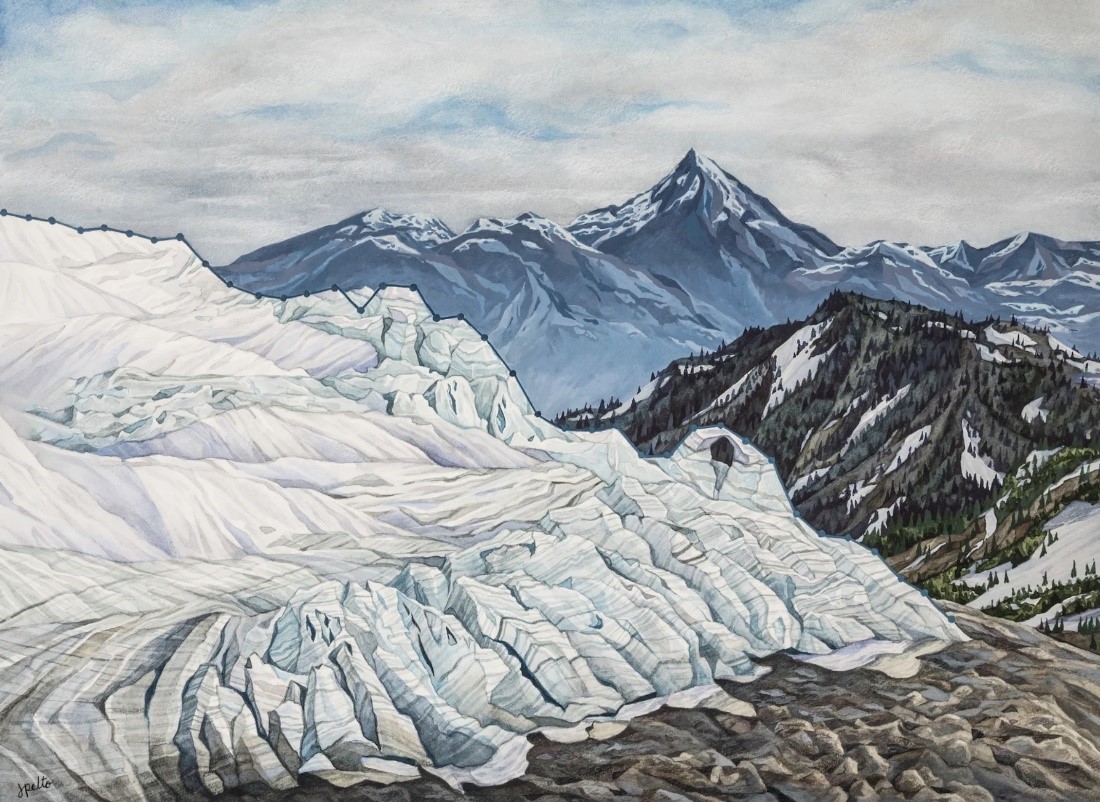
Painting by Jill Pelto that incorporates mass balance data from NCGCP from 1983-2022 along the top of the glacier.

Mauri Pelto (he/him) has directed the project since its founding in 1984, spending more than 800 nights camped out adjacent to these glaciers. He is the United States representative to the World Glacier Monitoring Service. For a decade he has been author of the AGU blog “From a Glacier’s Perspective,” and associate editor for three science journals.  He is on the Science Advisory Board for NASA’s Earth Observatory. His primary position is Associate Provost at Nichols College, where he has been a professor since 1989. He either runs on trails or ski’s on trails alpine and cross country everyday.

Mauri Pelto looking at deglaciated envioronment below Easton Glacier

Mariama Dryak-Vallies (she/her) is the Director for the Polar Science Early Career Community Office (PSECCO) hosted by CIRES at University of Colorado Boulder. Mariama grew up on a farm in west-central Wisconsin before earning her B.A. in physical geography and archaeology at Durham University (UK)—where her passion for studying, researching, and teaching about glaciers, climate change, and the natural environment was born. She completed her M.S. in Earth and Climate Sciences at the University of Maine, studying Antarctic glaciology and ice-ocean interactions. During graduate school she was actively involved advocating for polar early career scientists as board member and co-chair of the US Association of Polar Early Career Scientists (USAPECS). Mariama is passionate about working towards building accessible Earth and polar sciences spaces for all.
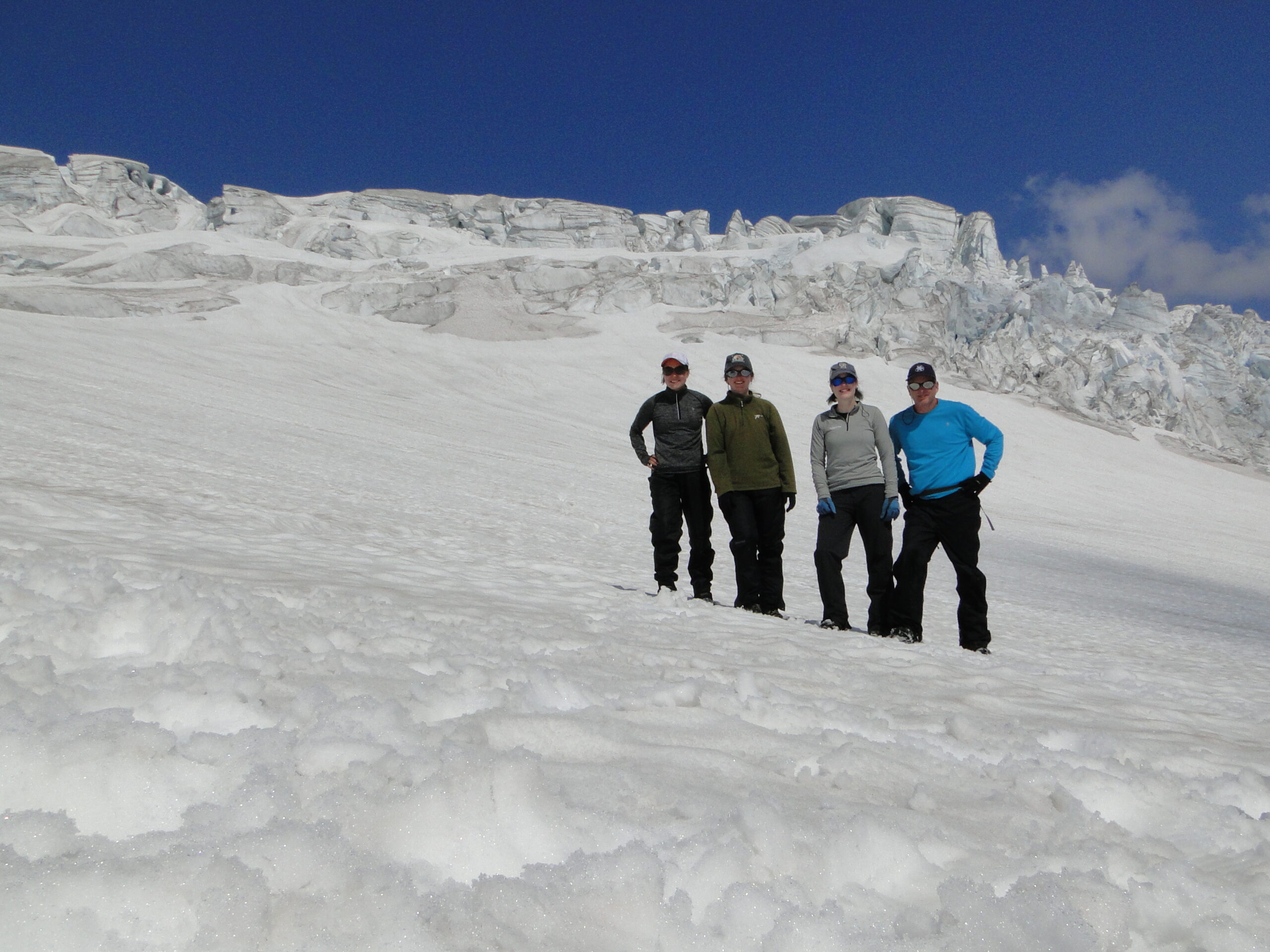
2018 field team including Jill, Mauri, Mariama and Erin

Kaiyuan Wang (he/himis a recent graduate from McGill University with a B.Sc in Honours Physical Geography, a minor in Geology. Originally from China, he developed an aspiration for Geoscience in the Great White North while living on the former bed of the Laurentide Ice Sheet. His passion for the cryosphere has led him to fieldwork on glaciers in the Kluane National Park in Yukon, Jasper National Park in Alberta, and a glaciological conference in Iceland. He will be doing his Ph.D. in Arctic Hydrology at the Northern Change Research Laboratory at Brown University. Kai is thrilled to be part of the 40-year-long effort of documenting glaciers as a living testimony to a warming world.

Shivaprakash Muruganandham (he/him) is currently a PhD candidate in Ocean Science and Engineering at the Georgia Institute of Technology, Atlanta, USA. He is back in school after a few years as a strategy consultant, during which time he specialized in satellites and space applications: earth observation and satellite communications in particular. Prior to this, he graduated with Master’s degrees in Space Technology and Cybernetic Systems/Control. Shiva is fascinated by ice, and his research focus on ice sheet/glacier modeling is motivated by his interests in the downstream impacts of cryosphere-climate interactions on coastal and mountain communities..

Field Partners 2023

Lizz Ultee (she/they) is an Assistant Professor of Earth & Climate Science at Middlebury College, Vermont.  They earned a B.Sc. in mathematical physics at Queen’s University (Canada) and a Ph.D. in climate science at the University of Michigan, specializing in mathematical methods to understand and predict glacier change.  Lizz finds ice endlessly inspiring.  Beyond inspiring, though, glaciers are important for downstream communities — motivating Lizz’s present research focus on glacier contributions to sea-level rise and water resource availability.

Alia Khan’s research team including grad students Sally Vaux, Colby Rand, and Anne Wilce focus on environmental chemistry in the cryosphere, including black carbon and snow algae to document global change of glacier and snow melt in mountainous and polar regions.Western Washington University Cryosphere Studies and Aquatic Biochemistry Lab.

Claire Giordano is an environmental artist, writer, and educator creatively telling the stories of science, climate change, and the modern experience of nature. From creating rain-dappled sketches in an old growth forest to filming a watercolor class beside a glacier, careful observation of nature inspires her goal is to connect people and place through art. In 2021 she founded the Adventure Art Academy – a series of virtual watercolor classes filmed outside – to invite others into the joy of painting outside.

Field study by Claire Giordano, artist in residence with the NCGCP for her 4th year. She creates these incredible pages with notes, paintings, and sketches from her days out exploring the landscape.

Kathleen Shannon is a freelance journalist & radio producer telling science and environmental justice stories across the West. She is based in Missoula and earned a master’s degree in Environmental Science and Natural Resource Journalism from the University of Montana in 2023. Her work has appeared on NPR, in High Country News and elsewhere.

Julia Ditto is a science illustrator from Anchorage, Alaska who specializes in environmental and ecological graphics. Julia spends much of her time recreating in the backcountry, which inspires much of her work. She has always used art as a tool for observing and communicating her experiences, both inand out of the field. She is currently attending CSU Monterey Bay’s Graduate Science Illustration Program.

Who are we? NCGCP was founded in 1983 to identify and communicate the response of North Cascade glaciers to regional climate change. NCGCP is a field project including scientists and artists that has a broad interdisciplinary scope and examines more glaciers than any other program in North America.  We do so cost effectively relying on no permanent camps or helicopter support. The field season includes no days off and each day is spent completing measurements on glaciers.  The focus is on glacier mapping, mass balance measurement, terminus observations, glacier runoff monitoring and capturing the environment with art.  

Why study glaciers in the North Cascades? Glaciers are one of the world’s best climate monitors and are a critical water resource to many populated glaciated regions. This is particularly true in the North Cascades where 700 glaciers yield 200 billion gallons of summer runoff and glaciers have lost 30 % of their area in the last century. This has reduced glacier runoff in late summer in the region as the reduction in glacier area has exceeded the increase in melt rate. During heat waves this role is even more profound with the glacier fed North Fork Nooksack River discharge rising ~24% due to greater melt, while unglaciated South Fork Nooksack River discharge declines by ~20%. The increased discharge limits the rise in river temperature during heat waves to 0.7 C in the North Fork, with the South Fork increasing by 2 C, increasing stress on the salmon in the South Fork (Pelto et al., 2022).
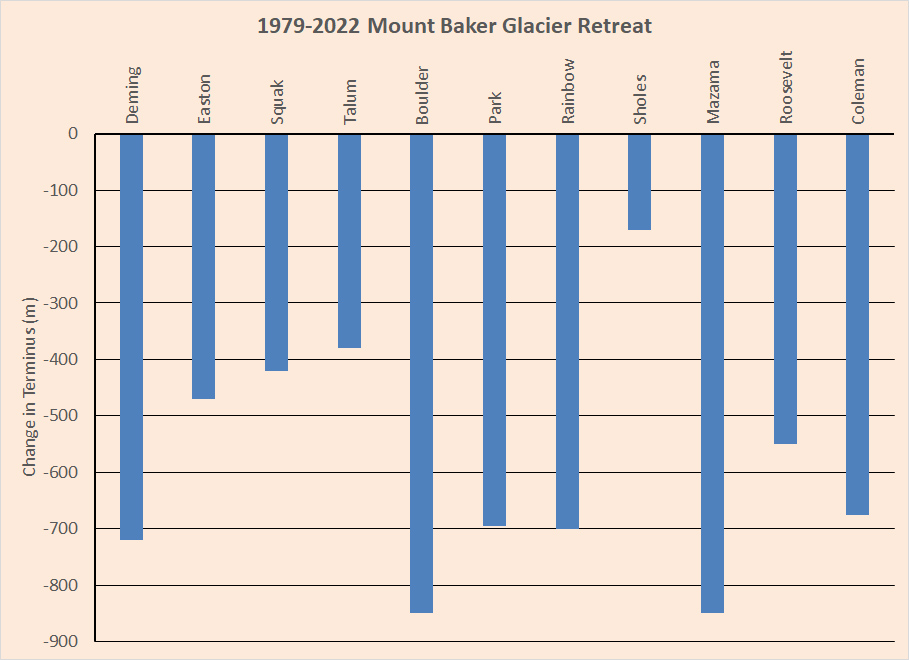
Retreat of Mount Baker glaciers documented by our program

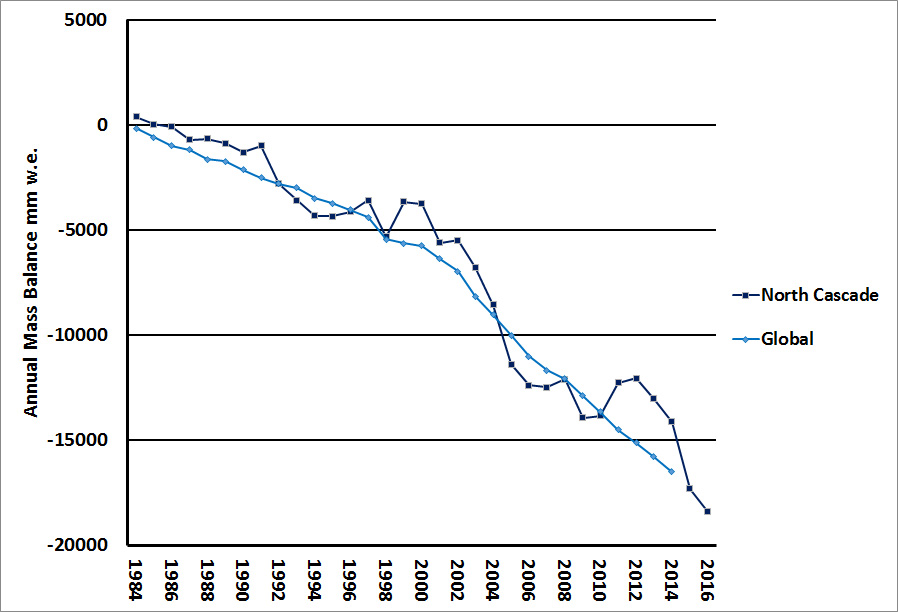
The mass balance record we have compiled since 1984

Summer temperature records from NOAA WA Division 5
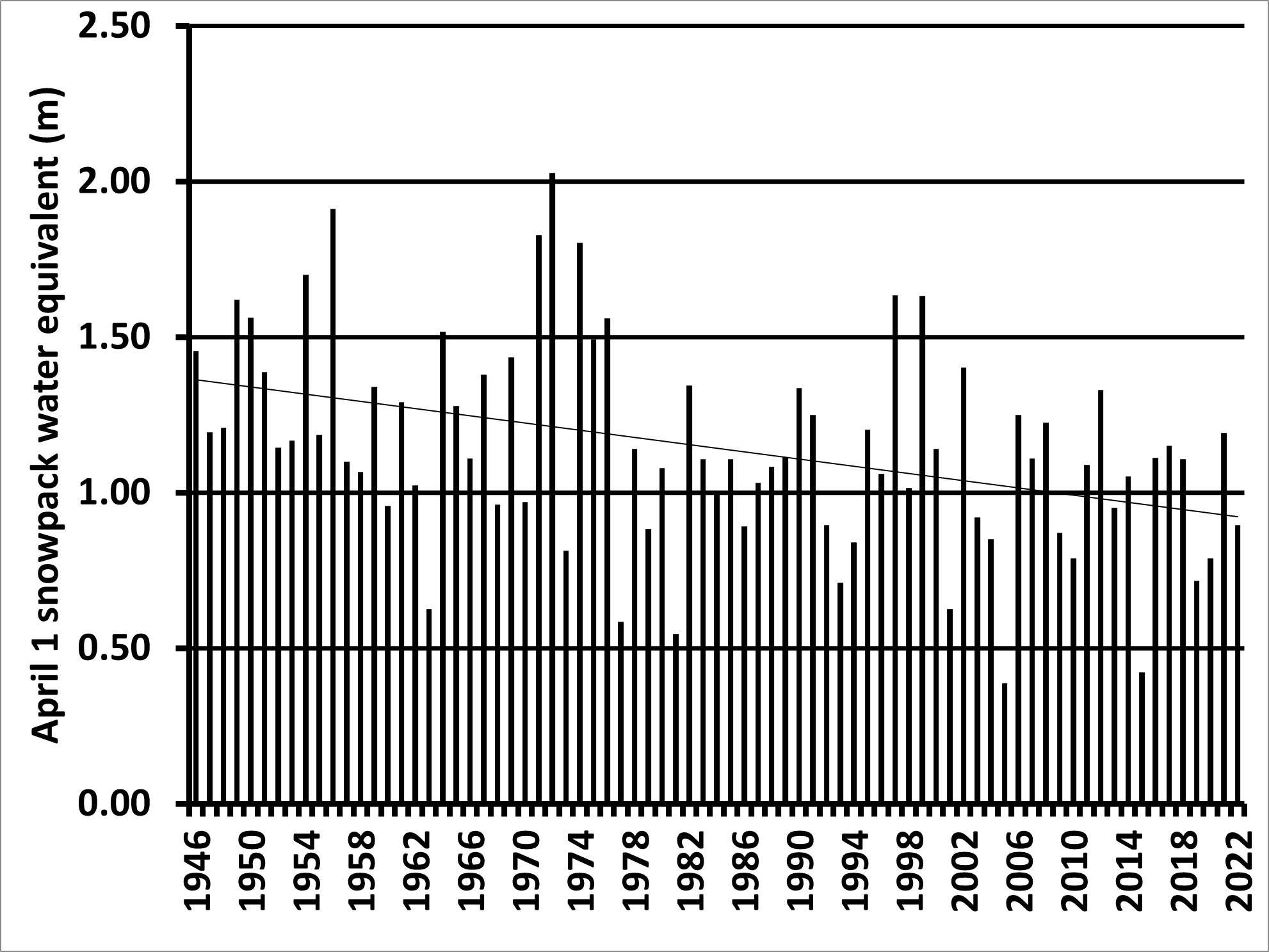
Winter Snowpack from North Cascade long term Snotel stations on April 1
36th Annual North Cascade Glacier Climate Project Field Season Begins

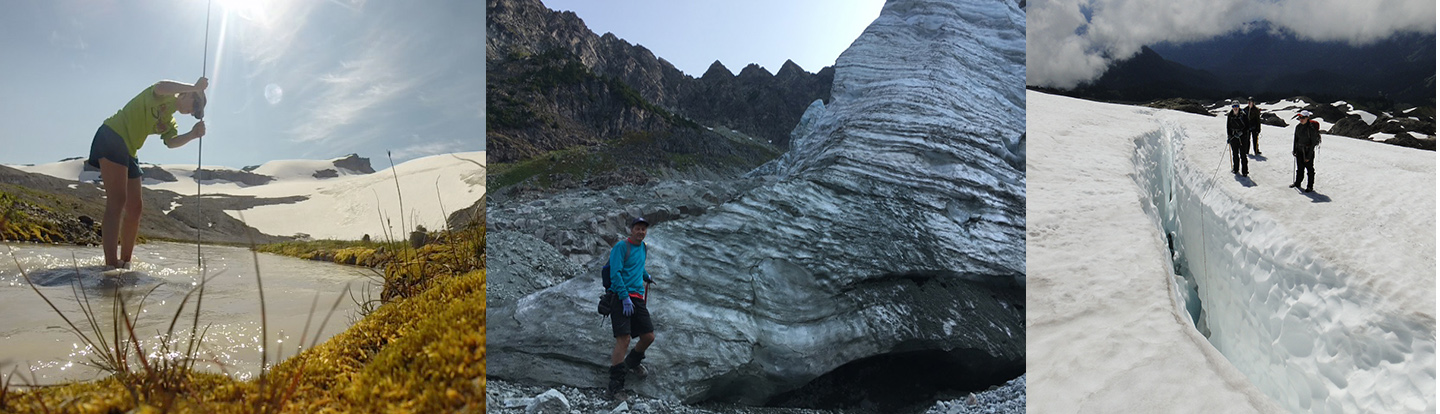
Fieldwork includes terminus surveys, glacier runoff measurement and mass balance measurements

Field Season Begins August 1

Who we are? The North Cascade Glacier Climate Project (NCGCP) was founded in 1983 to identify the response of North Cascade glaciers to regional climate change, particularly changes in mass balance, glacier runoff and terminus behavior.   This was prompted by the  National Academy of Sciences listing this as a high priority and a personal appeal from Stephen Schneider. NCGCP is a field project that has a broader interdisciplinary scope and is the most extensive glacier mass balance field program in the United States.  Two of the 41 reference glaciers in the world are in our network, and as of next year that will become three glaciers.  We do this research cost effectively relying on no permanent camps, helicopter support or salary for the director. The field season includes no days off and each day is spent completing measurements on glaciers.  The focus is on glacier mapping, mass balance measurement, terminus observations and glacier runoff monitoring.  Each year we utilize several field assistants to complete the annual glacier surveys, with 2019 being the 36th field season.  Our goal in choosing assistants is not to pick the most experienced, but the individuals who are capable and can benefit the most.  We are a self-contained unit. Recently Hakai Magazine described our process well.

Why study glaciers in the North Cascades? Glaciers are one of the world’s best climate monitors and are a critical water resource to many populated glaciated regions. This is particularly true in the North Cascades where 700 glaciers yield 200 billion gallons of summer runoff and glaciers have lost 30 % of their area since 1980. These glaciers have lost 25-30% of their volume during the course of our study, three of our primary study glaciers have disappeared. We also monitor ice worms and mountain goats since we are in the same locations at the same time each year.

2019 Outlook: For North Cascade glaciers the accumulation season provides that layer of snow, that must then last through the melt season.  A thin layer sets the glaciers up for a mass balance loss, much like a bear with a limited fat layer would lose more mass than ideal during hibernation. The 2019 winter season in the North Cascade Range, Washington has been unusual.  On April 1 the retained snow water equivalent in snowpack across the range at the six long SNOTEL sites is 0.72 m, which is ~70% of average.  This is the fifth lowest since 1984.  The unusual part is that freezing levels were well above normal in January, in the 95% percentile at 1532 m, then were the lowest level, 372 m of any February since the freezing level record began in 1948.  March returned to above normal freezing levels.  As is typical periods of cold weather in the regions are associated with reduced snowfall in the mountains and more snowfall at low elevations.  In the Seattle metropolitan area February was the snowiest month in 50 years, 0.51 m of snow fell, but in the North Cascades snowfall in the month was well below average. From Feb. 1 to April 1, snowpack SWE at Lyman Lake, the SNOTEL site closest to a North Cascade glacier, usually increases from 0.99 m to 1.47 m, this year SWE increased from 0.83 m to 1.01 m during this period. The melt season from May-Mid-July has also been warmer than average.  This combination will lead to significant glacier mass loss in 2019, in one month we will report back on our measurements that will indicate just how negative.
2019 Field Team:

Clara Deck: is an earth scientist from Chicago with a passion for science communication, education, and outreach. She completed a B.A. in geology at the College of Wooster in Wooster, Ohio, where she began a journey in climatological research which led to a love for the cryosphere. In the summer of 2018, Clara contributed to glacial field work in the eastern Alaska Range, and was fascinated by the dynamic day-to-day changes in glacial features she was tasked with measuring. At the University of Maine, she is wrapping up her M.S. focused on numerical modeling of Antarctic ice shelf instabilities, but Clara’s favorite part of her college career has been sharing science with students as a teaching assistant. During her first visit to the North Cascades, she is excited to learn about ongoing glacial change and to explore accessible ways to share the findings with public audiences.

Abby Hudak is a native Floridian that has always had a deep calling to the mountains and frozen landscapes. Her passions revolve around understanding our changing climate and natural world which led her to attain a B.S. in Biological Sciences from the University of Central Florida. After starting her M.S. in Biological Sciences at Washington State University, she immediately indulged in snow sports and mountaineering in the Cascade Range. The beauty and vulnerability of these landscapes have driven her to expand her research interests to understanding aspects of the changing cryosphere. She is eager to intertwine her love for the Cascade Range and her desire to pursue scientific questions pertaining to climate impacts on alpine glaciers by working with the North Cascade Glacier Climate Project this summer.

Ann Hill, ever since she was a young child growing up in Minneapolis, Ann has been fascinated by ice and snow, however it wasn’t until her Sophomore year studying Geosciences at Skidmore College that she realized she could study ice as a career path. Consequently, during her junior year she traveled to Svalbard to gain hands-on experience studying and exploring glaciers. Determined to learn more, Ann spent a summer with the Juneau Icefield Research Program, which exposed her to glaciers that looked and behaved differently. In the fall, Ann will begin her M.S. in Earth and Climate Sciences at the University of Maine. Ann is thrilled to study the North Cascade glaciers to understand how their movement and characteristics compare to those she previously observed in Svalbard and Alaska.

Jill Pelto is an artist and scientist from New England who grew up loving winter sports and trips to the mountains. She incorporates scientific research and data into paintings and prints to communicate environmental changes. Her multi-disciplinary work weaves visual narratives that reveal the reality of human impacts on this planet. She completed both her B.A. degrees in Studio Art and Earth and Climate Sciences and her M.S. focused on studying the stability of the Antarctic Ice Sheet at the University of Maine. She spent two field seasons at a remote camp in the southern Transantarctic Mountains to map glacial deposits and collect samples from them for dating. Jill will be joining the project for her 11th field season. She is excited about continuing to document the change in North Cascade glaciers that she has witnessed each of the last ten years — through science and art.

Mauri Pelto has directed the project since its founding in 1984, spending more than 700 nights camped out adjacent to these glaciers. He is the United States representative to the World Glacier Monitoring Service, author of the AGU blog “From a Glacier’s Perspective”, and associate editor for three science journals.  His primary job is Dean of Academic Affairs at Nichols College, where he has been a professor since 1989.

Schedule

Aug. 1:  Arrive Hike into Easton Glacier

Aug. 2:  Easton Glacier survey

Aug. 3:  Easton Glacier survey

Aug. 4:  Hike out  Hike in Lower Curtis Glacier

Aug. 5:  Lower Curtis Glacier Survey

Aug. 6:  Hike out Lower Curtis Glacier Hike in Ptarmigan Ridge

Aug. 7:  Sholes Glacier

Aug. 8:  Rainbow Glacier

Aug. 9:  Hike out- Coleman Glacier survey

Aug. 10:  Hike in Columbia Glacier

Aug. 11:  Columbia Glacier survey

Aug. 12:  Columbia Glacier survey

Aug. 13:  Hike out Columbia Hike in Mount Daniels

Aug. 14:  Ice Worm Glacier survey

Aug. 15:  Lynch and Daniels Glacier survey

Aug. 16:  Hike out

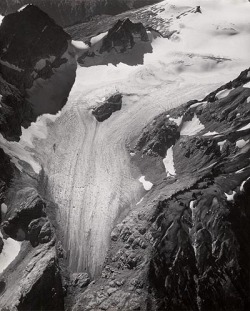
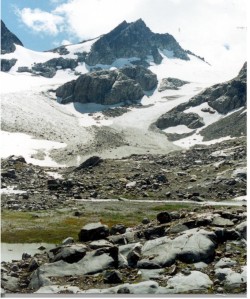
Honeycomb Glacier Retreat, Washington New Lake Lost Nunatak

Honeycomb Glacier in Google Earth imagery from 1998 and 2016.  The dark orange line is the 1998 margin, we mapped the margin in the field in 1995 and in 2002.  The light orange line is the 2007 margin and the yellow line the 2016 margin. Note crevassing diminished as well. 

Honeycomb Glacier is one of the longest and largest glaciers in the North Cascades.   In 1979 it was 3.9 km long and had an area of 3.5 km2. By 2016 the area had declined to 2,6 km2 and it has retreated 2.6 kilometers since its Little Ice Age Maximum. The glacier was an imposing site to C.E. Rusk who recounted his early 20th century exploration (1924). Like all 47 glaciers observed by the North Cascade Glacier Climate Project it has retreated significantly since 1979. The glacier feeds the headwaters of the Suiattle River, which is also an important salmon stream, for chinook, coho, sockeye and pink salmon (WDFW,2018).

A 1960 photograph taken by Austin Post, USGS shows the glacier ending with no lake at its terminus. The terminus is gentle and has no crevasses, indicating it is relatively stagnant and poised to melt away. The glacier has retreated 1.3 km from its Little Ice Age moraines at this point. In 1967 another Austin Post image indicates a new small lake forming at the terminus.
honeycomb

In 1995 we mapped  the margin of the glacier ending in this lake, where the glacier ended in 1967 and took a photograph back to the glacier. As seen below retreat to this point was 400 m.

honeycomb 1995

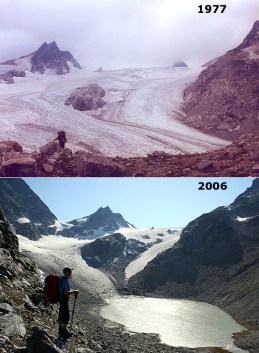
A pair of images from Bill Arundell in 1973 and Lowell Skoog in 2006 indicate the scale of the retreat, these images do not show the actual terminus but do show the main nunatak-rock island and how much it has become exposed in the 33 years. This nunatak was hardly evident in 1960, and in a 1940 image of the glacier literally did not yet exist.honeycomb-glacier-1977-2006

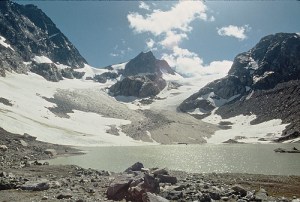
The terminus had retreated 400 m from the 1967 position to 1995. In 1987 a new lake began to form at the terminus of the glacier at 1680 m. The glacier is shown ending in this lake in 2002 from both the far end of the lake and the nunatak above the lake, the glacier had retreated 210 m since 1995. In 2006 the glacier retreated from the end of this lake. This is a shallow lake that may eventually be filled in by glacier sediments. The terminus is flat and stagnant ending at 1680 m in the lake. Thus, the rapid retreat will continue, the glacier is still not close to acheiving a post LIA equilibrium. Glacier retreat from 1940-1967 averaged 9 m/year. Retreat was minor between 1967 and 1979. The retreat rate from 1979-1998 was greater at 16 m/year, with a total retreat of 300 m. The retreat than increased from 1998-2016 with the west branch retreating 800 m and the east branch 500 m. The nunatak in the middle of the glacier, which was beneath the ice in 1940 was 90 m above the ice in 2002 when we mapped it.  By 2009 it was no longer a nunatak as the glacier did not merge downstream of the this bedrock knob.

The retreat of this section of the glacier results in a reduced melt area of ~1 km2 in the last 40 years.  This in turn reduces summer glacier runoff as there is no longer snow/ice melting each day under the warm summer conditions. Flow in the Suiattle River in late summer and early fall has declined as a result. In 2002 during mapping of the glacier images from above and below the nunatak indicate the stagnant nature of the ice below the nunatak.

honeycomb new lakehoneycomb2002a


34th Annual, 2017 North Cascade Glacier Climate Project Field Season

2017 Field Season Video

For the thirty fourth consecutive summer we headed into the field to monitor the continued response of North Cascade glaciers to climate change.  In 1984 when I began this program we selected 10 key glaciers to monitor.  Two of these have now disappeared.  All the glaciers have retreated extensively and lost considerable volume.  The mass balance loss is 19 m of water equivalent thickness, which is over 20 m of ice thickness loss on glaciers that averaged less than 75 m thick. This is significant with 25-30% of their entire volume lost. This project continues to monitor glacier loss and the runoff they provide.  We also complete an annual inventory of ice worms on Sholes Glacier and mountain goats on Ptarmigan Ridge region.  In 2017 our key project was a continue partnership with the Nooksack Indian Tribe monitoring glacier melt and runoff in the North Fork Nooksack River basin.  We have not yet had the chance to determine the daily glacier discharge and the resultant contribution to the North Fork Nooksack River. The dry conditions of August certainly will lead to many days with  more than 40% of the flow coming from glacier melt as was the case in 2015. 

The snowpack on April 1st snowpack was 110% of normal, by June 1st, the snowpack was trending down steeply, but
remained well above the last four years and similar to 2012. Summer turned out to be the driest on record in Seattle and

June 1 snowpack comparison

tied for the warmest for the June 21-Sept. 22nd period (KOMONews).  In the mountains the overall melt season temperatures for May 1 through Sept. 30th was 0.15 C cooler than 2015 values, due to a cooler spring.  The most striking feature of the field season was the forest fire smoke largely from British Columbia that obscured views most days. 

Of the glaciers observed one had a significant positive balance, one a slight positive balance-essentially equilibrium and seven had negative mass balances.  The two glaciers with the most positive balance were the Sholes and Rainbow Glacier, adjacent glacier on the north side of Mount Baker.  The nearby Mount Baker ski area reported 860 inches of snow in 2017, significantly above average.  Compared to other locations in the range this winter snowfall was a positive anomaly, that also was observed on the nearby glaciers. The snow water equivalent in multiple crevasses on Rainbow Glacier at 2000 m in early August was 3.8-4.1 m.  On both Easton and Rainbow Glacier the mass balance gradient was steeper than usual.  On Rainbow Glacier the mass balance was -3 m at 1500 m, 0 at 1700 m and +2.5 m at 200 m as summer ended. We also observed terminus retreat on every glacier.   Retreat averaged 12 m in 2017, lower than in 2015 or 2016.  More striking than retreat in some cases is thinning that reduces slope and frontal thickness.  On Lower Curtis Glacier the terminus seracs are 15 m shorter than two years ago.  On Columbia Glacier the lowest 200 m of the glacier has a slope that has declined by 5 degrees in the last three years and the glacier terminus has retreated 60 m in two years. 


34th Annual Field Program NORTH CASCADE GLACIER CLIMATE PROJECT 2017


2016 Field Season Video

NORTH CASCADE GLACIER CLIMATE PROJECT 2017

For the thirty fourth consecutive summer it is time to head into the field to monitor the continued response of North Cascade glaciers to climate change.  In 1984 when I began this program we selected 10 key glaciers to monitor.  Two of these have now disappeared.  All the glaciers have retreated extensively and lost considerable volume.  The mass balance loss is 19 m of water equivalent thickness, which is over 20 m of ice thickness loss on glaciers that averaged less than 75 m thick. This is significant with 25-30% of their entire volume lost. This project looks at the implications of the glacier loss as we complete an annual inventory of ice worms on Sholes Glacier, mountain goats on Ptarmigan Ridge region and monitor runoff all summer below Sholes Glacier with the Nooksack Indian tribe. 

Illustration of research (Megan Pelto and Jill Pelto)

The result of volume loss and area loss is that despite higher melt rates, the reduction in area of melting glaciers has led to a decline in glacier runoff in the region. The reduced runoff effects salmon, hydropower and irrigation. Details of the runoff impacts are detailed in a Book “Climate Driven Retreat of Mount Baker Glaciers and Glacier Runoff and summarized in Salmon Challenges from the Glaciers to the Salish Sea.

The focus will be on mass balance observations, longitudinal profiles and terminus observations. For Mount Baker, Washington the winter freezing level was much lower than the previous two winters, and was 100 m below the long term mean. The snowpack on April 1st snowpack was 110% of normal, by June 10th, the snowpack is trending down steeply, but remained just above average.  Since then a persistent dry period and the impending heat wave that begins today, Aug. 1 has led to rapid snow loss.  The most recent  comparable year is 2009, which featured a good winter snowpack and very warm mid to late summer conditions. We will first travel north to Mount Baker and the Easton Glacier.    Of the 40 glacier in the World Glacier Monitoring Service Reference glacier list we have two Columbia and Rainbow, as soon as Easton Glacier has 30 years, the minimum requirement it will be added, that is in 2019. The field team consists of Mauri Pelto, 34th year, Jill Pelto, UMaine for the 9th year, Anthony Himmelberger, Clark University 1st year.  Tom Hammond, 14th year will join us for a selected period as will Pete Durr, Mt. Baker Ski Area, 2nd year.   We will report on our findings in a month. Field photos will be posted periodically on Twitter.

Measuring terminus change and snowpack thickness in 2016

Aug.   2:  Hike into Easton Glacier
Aug.   3:  Easton Glacier
Aug.   4:  Easton Glacier
Aug.   5:  Hike Out Easton Glacier, Hike in Ptarmigan Ridge
Aug.   6:  Sholes Glacier
Aug.   7:  Rainbow Glacier
Aug.   8:  Sholes Glacier
Aug.   9:  Hike out and into Lower Curtis Glacier
Aug. 10:  Lower Curtis Glacier
Aug. 11: Hike out Lower Curtis Glacier- Hike in Blanca Lake
Aug. 12:  Columbia Glacier
Aug. 13:  Columbia Glacier
Aug. 14:  Hike out Columbia Glacier; Hike in Mount Daniels
Aug. 15:  Ice Worm Glacier
Aug. 16:  Daniels and Lynch Glacier
Aug. 17:  Ice Worm Glacier, Hike out Mount Daniels-Hike out-

Thirty-third Annual North Cascade Glacier Climate Project Field Season Underway

fig8-1
Base Map of the region showing main study glaciers, produced by Ben Pelto.

From President Reagan to President Obama each August since 1984 I have headed to the North Cascade Range of Washington to measure the response of glaciers to climate change.  Specifically we will measure the mass balance of nine glaciers, runoff from three glaciers and map the terminus change on 12 glaciers. The data is reported to the World Glacier Monitoring Service.  Three glaciers that we have monitored annually have disappeared since 1984.

In 2016 for Mount Baker, Washington the freezing level from January-April was not as high as the record from 2015, but still was 400 m above the long term mean. The snowpack on June 1st was three weeks behind last year’s record melt, but still three to four weeks of head of normal. July has been exceptionally cool reducing this gap. With all the snow measurement stations losing snowcover by July 1, the gap is uncertain until we arrive on the glaciers. This will not be a good year, but will be a significant improvement over last year, likely more in the 2012 or 2013 category.  Each location is accessed by backpacking in and camping in tents.

We will first travel north to Mount Baker and the Easton Glacier, we will be joined by Oliver Lazenby, Point Roberts Press.  We will then circle to the north side where I expect we will be joined by Jezra Beaulieu and Oliver Grah, Nooksack Indian Tribe.  Jen Lennon from the Sauk-Suiattle Tribe and Pete Durr, Mount Baker Ski Patrol are also planning to join us here.   When we head into Columbia Glacier Taryn Black from U of Washington will join us. The field team consists of Mauri Pelto, 33rd year, Jill Pelto, UMaine for the 8th year, Megan Pelto, 2nd year, and Andrew Hollyday, Middlebury College.  Tom Hammond, 13th year will join us for a selected period.

[ngg_images source=”galleries” container_ids=”38″ display_type=”photocrati-nextgen_basic_imagebrowser” ajax_pagination=”1″ template=”/nas/wp/www/sites/blogsorg/wp-content/plugins/nextgen-gallery/products/photocrati_nextgen/modules/ngglegacy/view/imagebrowser-caption.php” order_by=”sortorder” order_direction=”ASC” returns=”included” maximum_entity_count=”500″]

Aug.   1:  Hike into Easton Glacier.
Aug.   2:  Easton Glacier
Aug.   3:  Easton Glacier
Aug.   4:  Hike Out Easton Glacier, Hike in Ptarmigan Ridge
Aug.   5:  Sholes Glacier
Aug.   6:  Rainbow Glacier
Aug.   7:  Sholes Glacier and/or Rainbow Glacier
Aug.   8:  Hike out and into Lower Curtis Glacier
Aug.   9:  Lower Curtis Glacier
Aug. 10: Hike out Lower Curtis Glacier- Hike in Blanca Lake Mail Pickup Maple Falls, WA 98266
Aug. 11:  Hike in Columbia Glacier
Aug. 12:  Columbia Glacier
Aug. 13:  Hike out Columbia Glacier; Hike in Mount Daniels
Aug. 14:  Daniels and Lynch Glacier
Aug. 15:  Ice Worm Glacier
Aug. 16:  Ice Worm Glacier, Hike out Mount Daniels-Hike out

Neve Glacier Retreat, North Cascades, Washington

I have had the opportunity to visit the Neve Glacier on eight occasions, it is not easy to get to. In the North Cascades it is one of a handful of glaciers with a large higher elevation accumulation zone, that is not on a volcano. The glacier feeds Diablo Lake, part of the Skagit River hydropower system. The terminus of the glacier in 1975 was in basin that receives considerable avalanche deposition slowing the retreat. In this post we focus on the thinning of the glacier leading to expansion of bedrock exposures at four locations above the former terminus, that by 2011 had led to this low lying basin being dynamically cutoff from the upper glacier. In each image the red letters A-D are located in the same spot, and the purple arrow on the Google Earth images indicates the terminus position. The first image is an aerial view of the glacier from Austin Post, USGS from 1975: at point A there is a quite small exposure of bedrock, at Point B and C there is a good connection of feeder glaciers from the higher slopes to the main valley glacier. At Point D there is continuous glacier cover. This was the case during my first two visits to the glacier in 1985 and 1988, second image. The third image is from 1990 and reflects limted change from 1975 as well, the blue arrows indicate glacier flow.

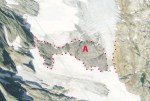
. By 1996 notable thinning of the glacier was apparent adjacent to Point A, in 2001 and 2002 the thin nature of the ice around the bedrock at Point A is evident. . The accumulation zone of the glacier around Point B and D in 2001 indicates no bedrock exposure at D and a connection of the upper glacier at Point B; however at Point D in 2009 the large new bedrock areas that have resulted from thinning has occurred. A comparison of the Google Earth imagery from 1990, 2006 and 2009 indicate the expanding bedrock at each Point. A closeup of Point A from 2009 has the bedrock delineated with red dots indicating that the left arm of the glacier that formerly encircled Point A, now ends above Point A and that the right hand arm is only 35 m wide and despite the steep slope has no crevassing and is stagnant. At Point B the upper glacier no longer reaches the main trunk. At Point C the connection to the main glacier has decreased by 50% in its width from 140 m to 70 m, and at Point D several large bedrock areas have emerged. In 2013 or 2014 the upper glacier will likely separate from the former terminus region below the Point A bedrock region. The thinning of this glacier is typical of North Cascade glaciers (Pelto, 2007), though the retreat has been unusually small (Pelto, 2010).

Suiattle Glacier Retreat and Outcrop Emergence, North Cascades

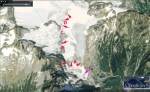
C.E. Rusk in 1906 hiked right to the terminus of Suiattle Glacier, which is labelled Lion’s Paw in Rusk (1924). The glacier had retreated 1400 m since its Little Ice Age maximum and based on the lack of reported brush below the glacier, this retreat had occurred primarily in the previous 30 years. By 1940 the glacier had retreated another 900 m back to within 120 m of its current position. Suiattle Glacier retreated more from its LIA maximum than any other glacier in the area, probably due to the low slope of the Suiattle Valley, from 1550-1700 m, down which the glacier had advanced. Rusk, noted the lack of any terminal moraine near the end of this glacier, this was unusual in his experience. In other words typically in this period a terminal moraine was not too distant from the current termini position. This glacier had already retreated so far that the terminal moraine was not only well down valley, but buried by aggrading sediments from the glacial stream. This retreat continued until 1967, below is a 1967 photograph of the glacier from Austin Post (USGS).
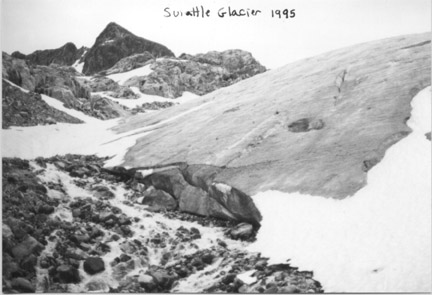
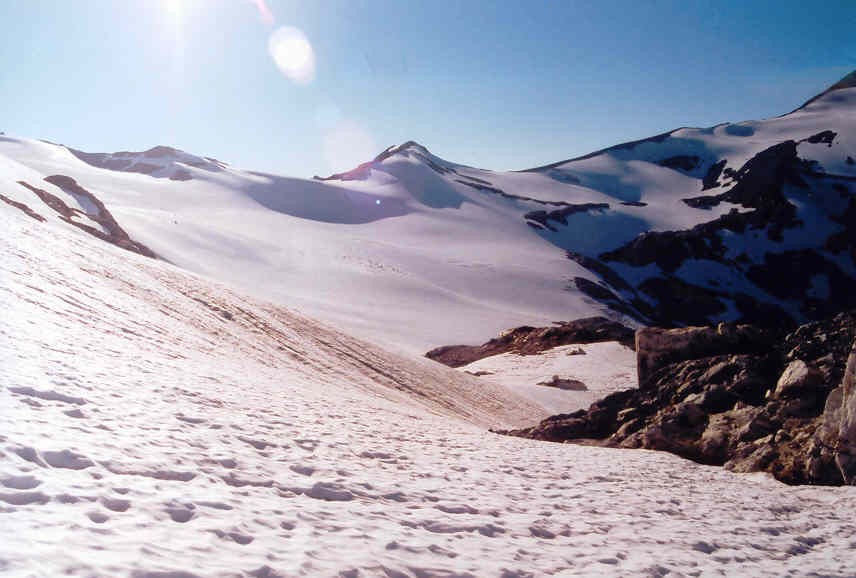
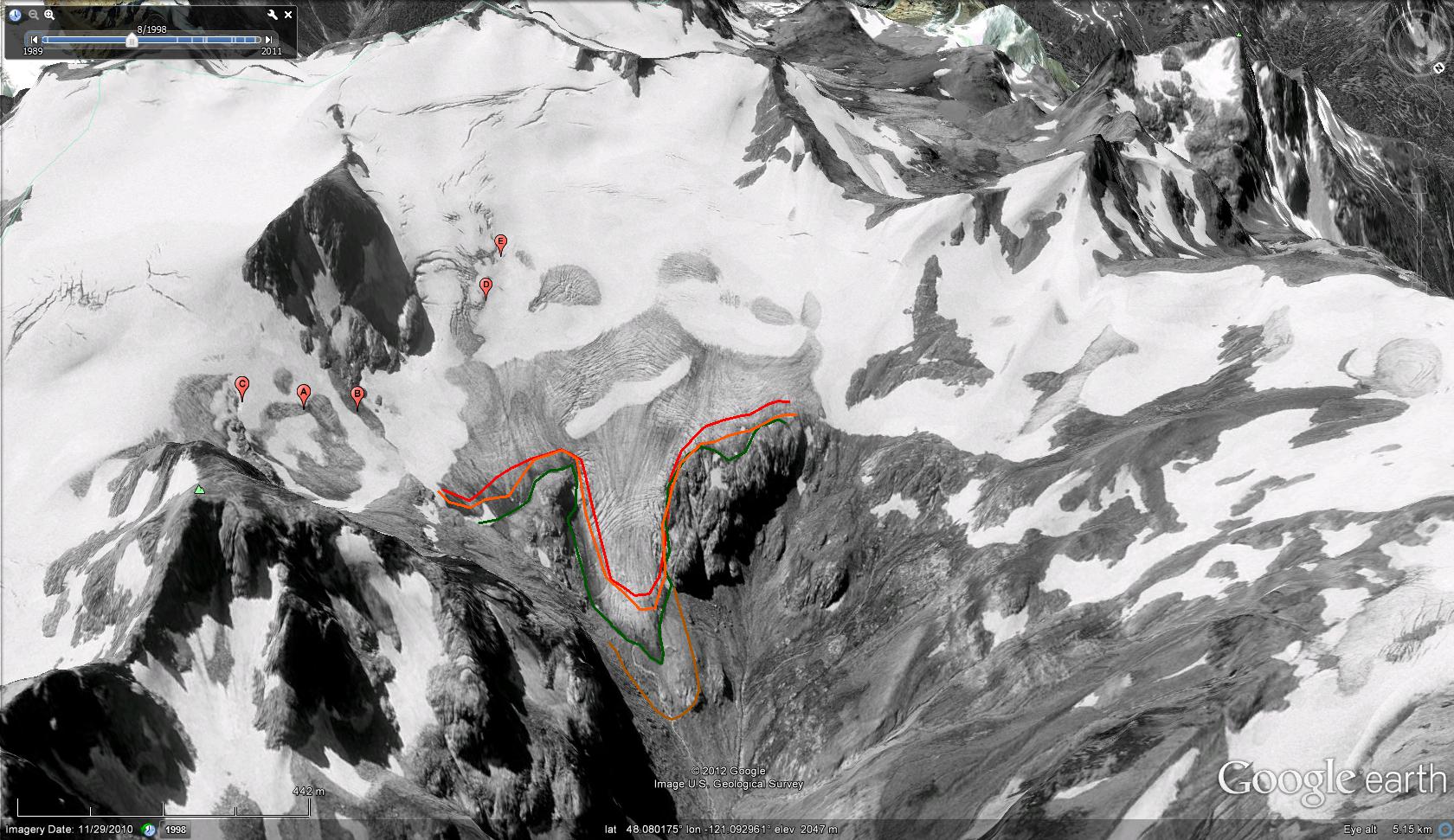
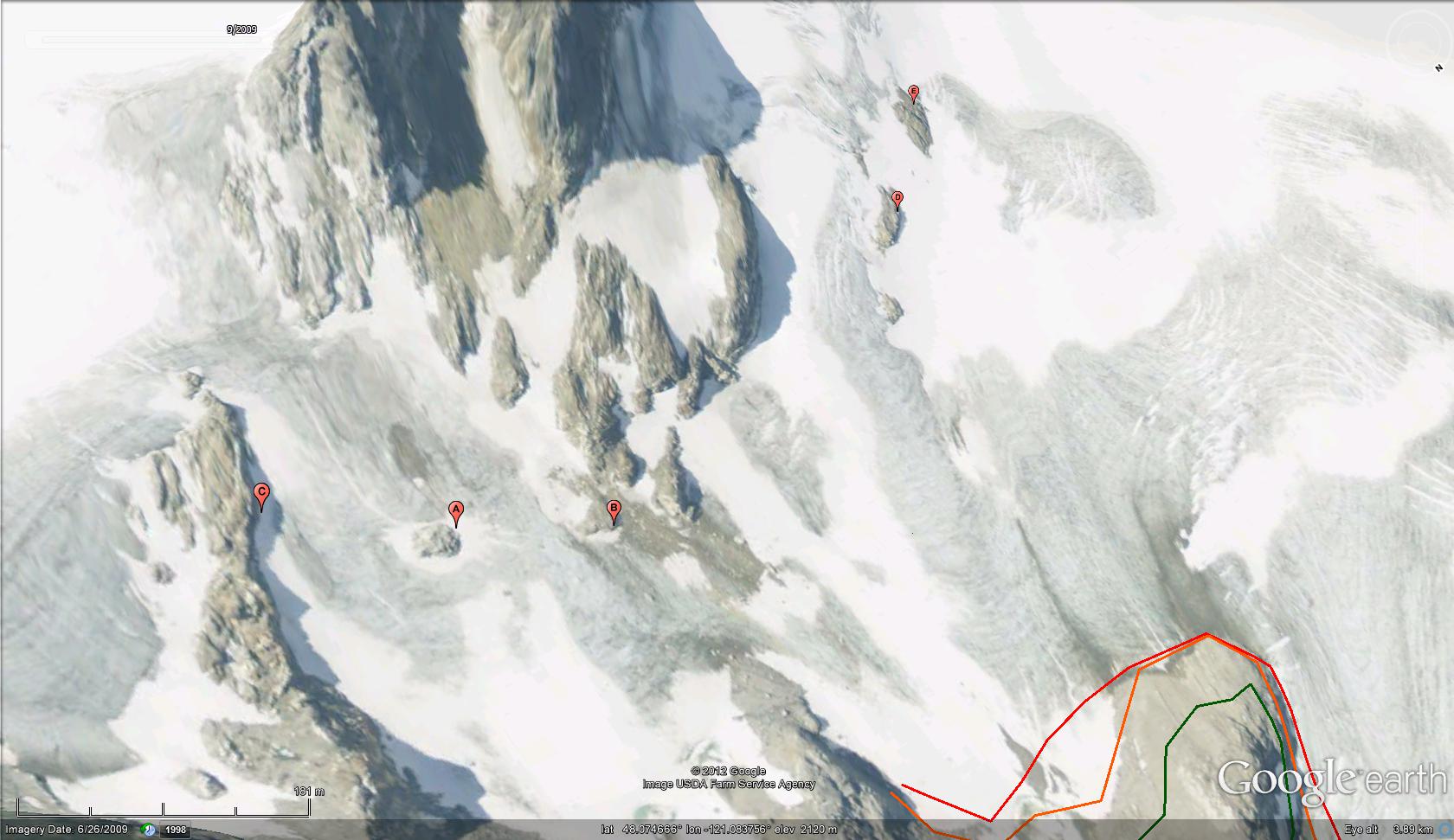
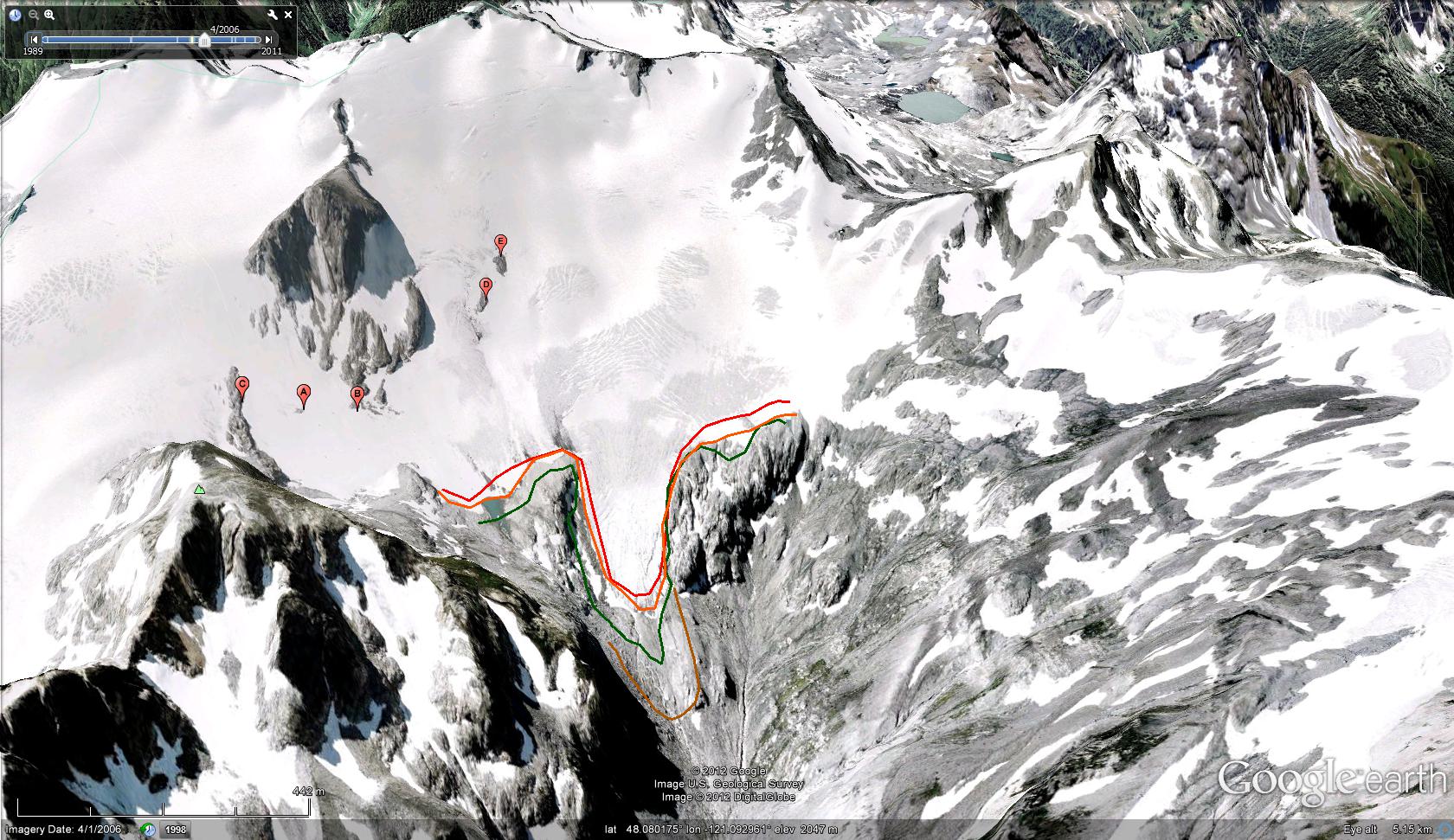
Between 1967 and 1979 Suiattle Glacier stopped retreating and began a small advance. Suiattle Glacier advanced 15-20 m during the 1970’s. Our visit in 1988 to the glacier indicated retreat had just begun, and by 1995 the glacier had retreated only 28 m from 1988 to 1995 (top image). The retreat than accelerated with another 150 m of retreat by by our 2002 survey. The terminus remained crevassed steep and convex through 1995 forcing us to the eastern margin to reach the terminus. By 2002 (second and third image) the terminus was no longer that steep or crevassed and we could walk right down the middle. The overall retreat of this glacier as seen in the Google Earth imagery sequence of 1998, 2006, 2009 and 2011 indicate the retreat with the brown line being the 1985 terminus, the green line the 1998 terminus, the orange line the 2006 terminus and the red line the 2009 terminus. Total retreat from the advance moraine of the 1970’s is 270 m. What is a more important reflection of the is glaciers current state is the thinning that is apparent. Outcrops of rock are emerging as the glacier thins even well above the terminus (A-E). The majority of the outcrops are on the eastern side of the glacier. Even after a year of good positive mass balance for the glaciers in 2011, the outcrops remain exposed. The upper portion of the glacier appears robust still. Unlike its counterpart over the glacier gap on its western margin where the west arm of the Whitechuck Glacier melted away.
On Suiattle Glacier in 2002 we undertook a detailed ice worm study, setting up six square meter plots and counting the ice worms. The recorded mean density was 1800 to 2600 ice worms per square meter in 2002. With an area of 2.7 square kilometers, this represents 5-7 BILLION ice worms on this glacier! This is comparable to the earth’s entire human population on just one glacier. Good thing they do not use many natural resources each. This is also the highest population we have identified in the North Cascades. The picture below is from this survey, the quality is tough because they only come out in low light and this was prior to having a digital camera.

Mazama Glacier Retreat, North Cascades, Washington

Mazama Glacier flows down the north side of Mount Baker, a strato volcano in the North Cascades of Washington. The glacier begins at the summit plateau, 3260 meters, and terminates at the head of Wells Creek 1470 meters. This is a glacier we visit briefly each summer since 1984, but is not a focus of detailed observations. In 2010 we descended from its divide with Rainbow Glacier at 2100 meters to just above the terminus. In the 1970’s the USGS map (top image in sequence) indicates the terminus extended down valley to 1200 meters, this was after a period of advance for the glacier. The glacier advance 450 meters from 1950-1980 (Pelto and Hedlund, 2001). In 1987 we observed the glacier to have begun to retreat. By 1993 the glacier had retreated 200 meters. From 1993 (middle) to 2009 (bottom image) the glacier retreated an additional 750 meters. The rate of retreat has been higher for this glacier because of the loss of the low elevation debris covered terminus that had existed from the 1950’s-1990’s. The glacier is still heavily crevassed and active. The retreat will continue as indicated by thinning near the snowline of the glacier from 1993 to 2009. Note the expansion of the rock outcrop in glacier center (A) from the top image, 1993 to 2009 bottom image. There is also considerably less crevassing near Point A. Also note the stranded glacier ice at Point B and C in 2009. This loss has been due to 7 of the last 10 years having a snowline that rose above the elevation necessary for equilibrium. In 2009 at the end of the summer just 36% of the glacier was snowcovered, 65% needs to be snowcovered for equilibrium. .
In two weeks we will be visiting Mazama Glacier again. Given the heavy 2011 snowpack it is unlikely we will get to see the terminus which should be under avalanche debris.

Ptarmigan Ridge Glacier Retreat and Separation, North Cascades

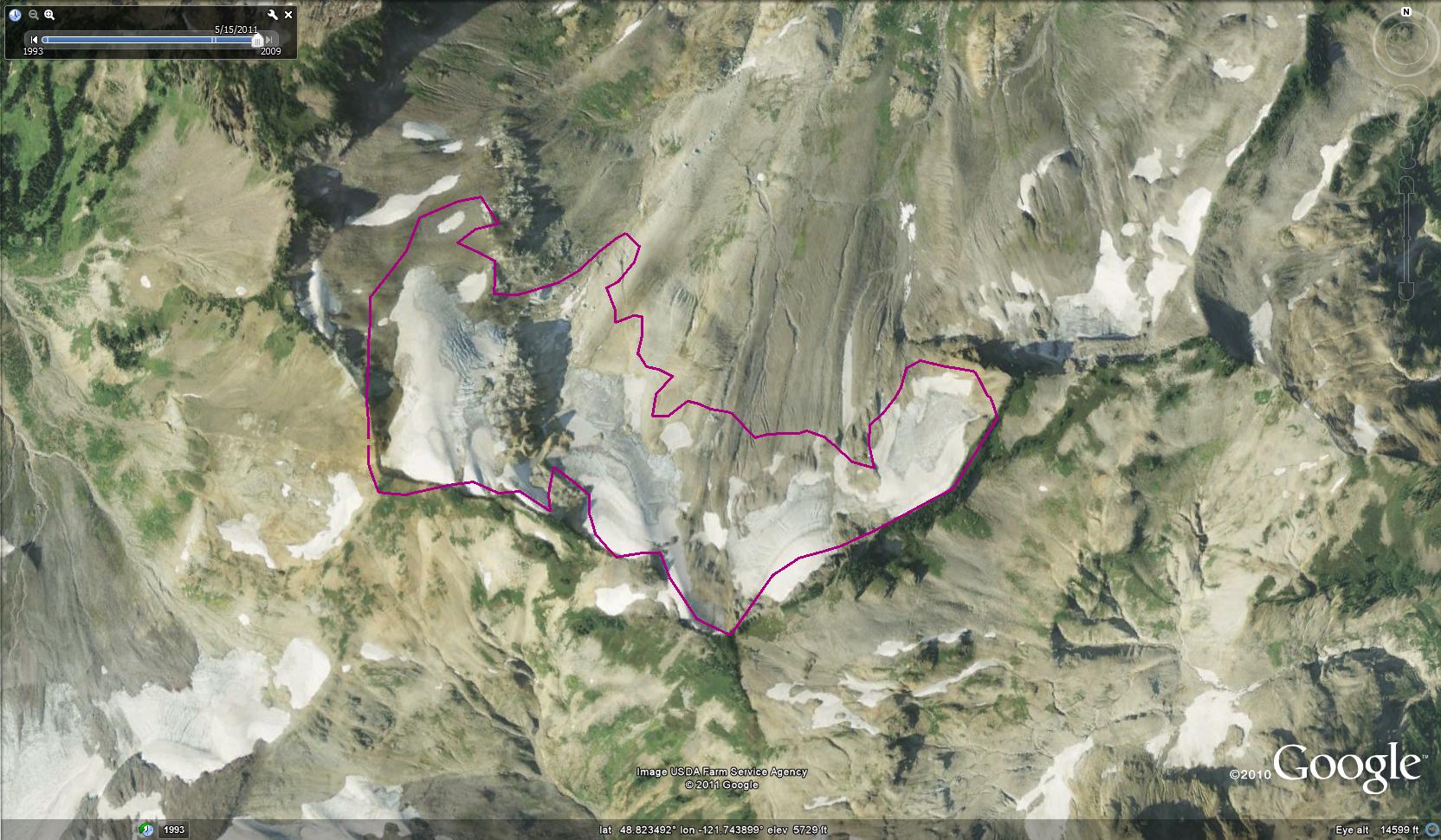
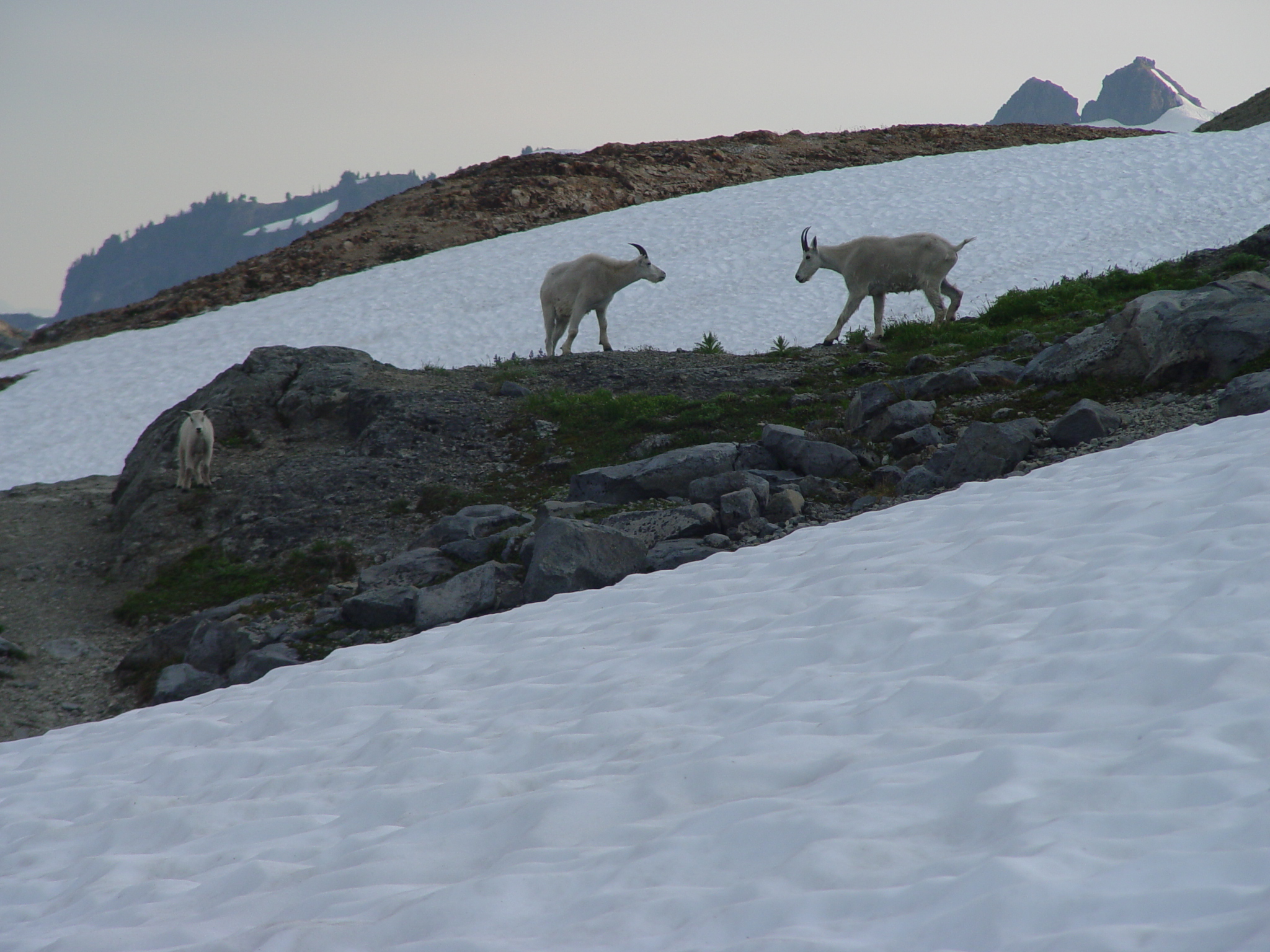
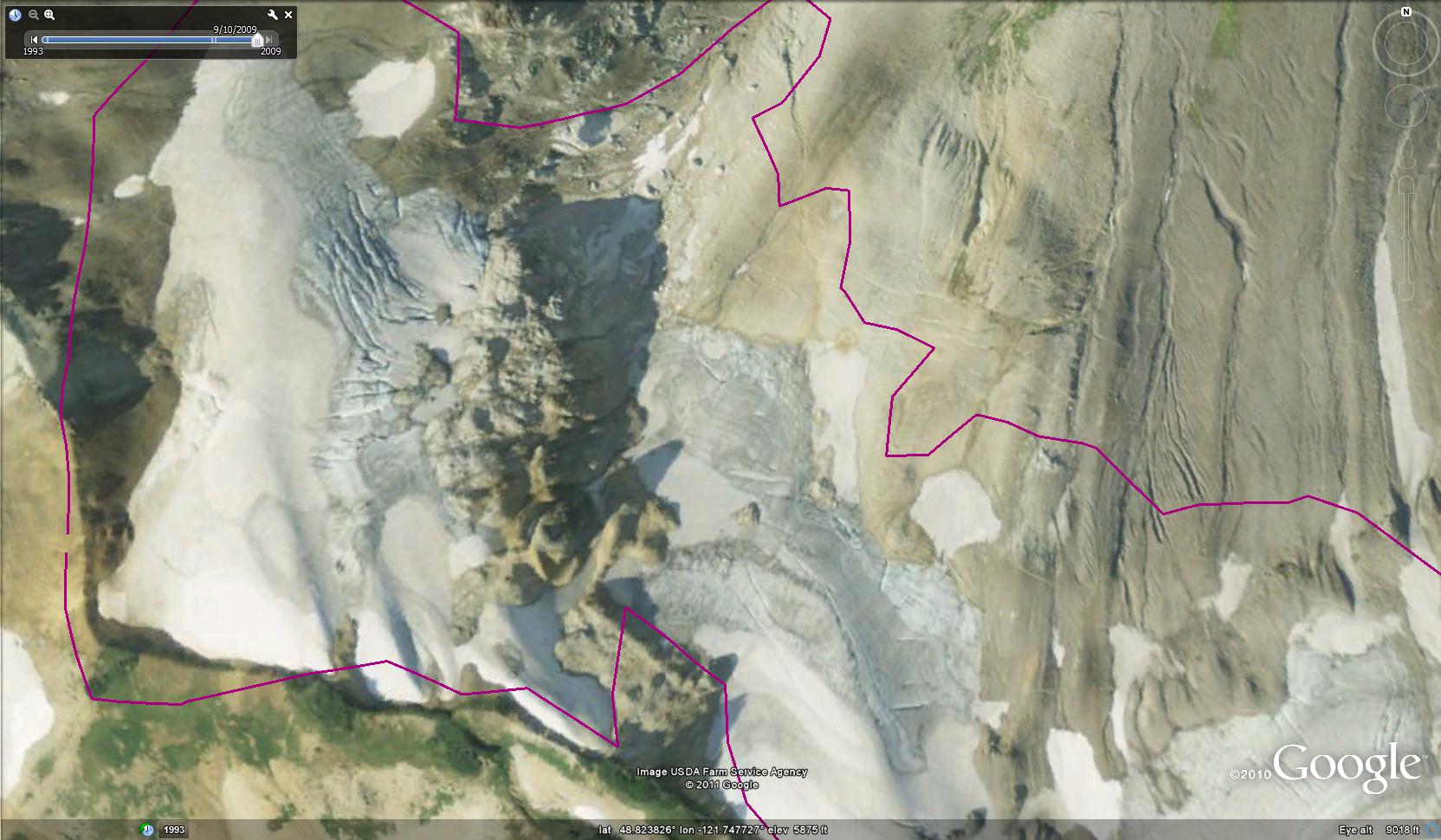
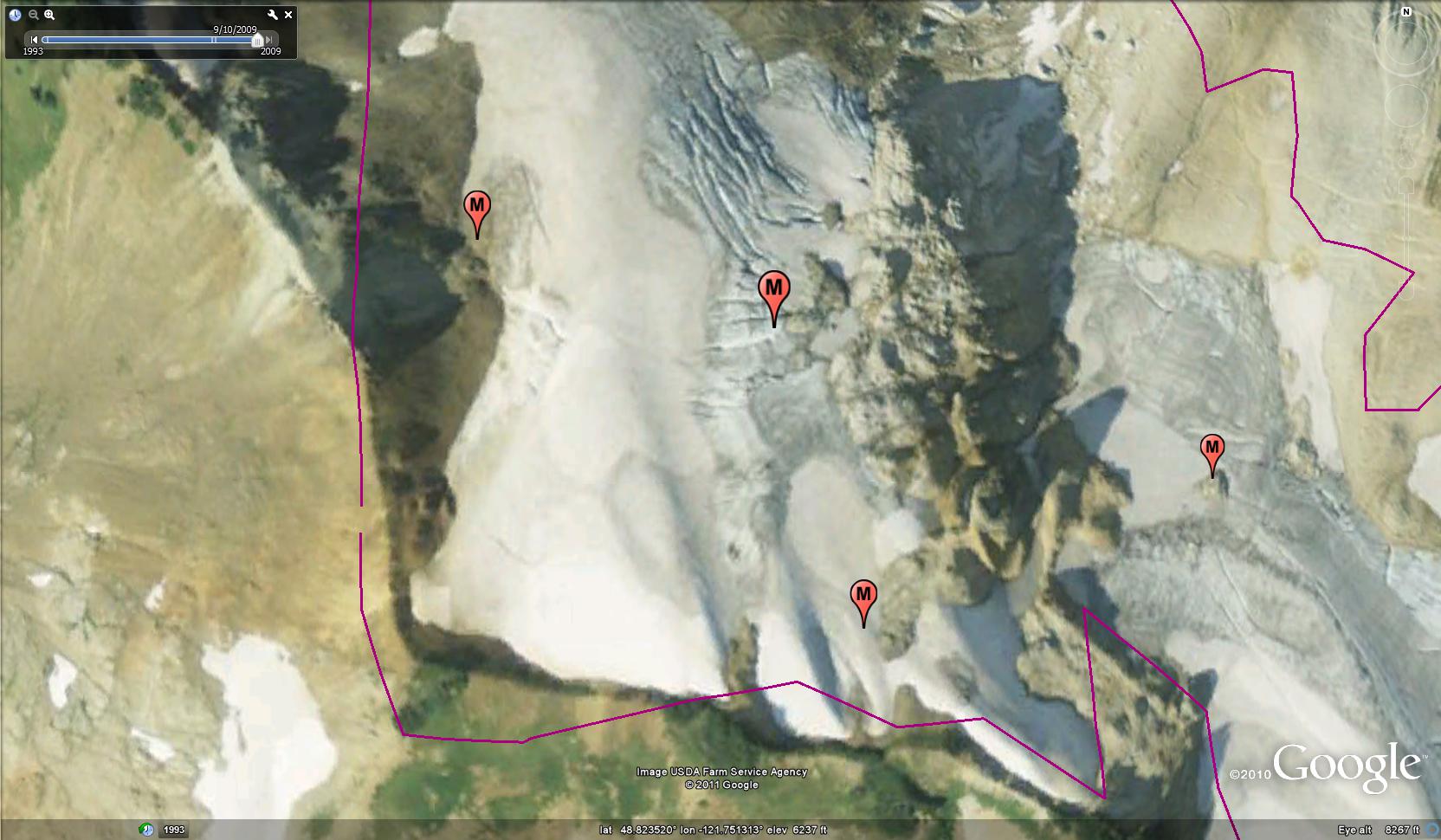
Ptarmigan Ridge Glacier is nestled on the north side of Ptarmigan Ridge in the North Cascades of Washington. This is a small glacier that has been retreating and has separated into several smaller glaciers over the last 20 years. From 1984-2010 we have visited this glacier every year assessing the terminus in half of those years, in others it has still been buried by snowpack. The main terminus has retreated 120 meters. Given the total maximum glacier length is 360 m in 2010, this is a substantial loss. The sequence of images below indicate the retreat from the top a map based extent 1979, to a 1993 USGS aerial photograph middle, and the 2009 satellite image from Google Earth. The glacier boundary from the map is in magenta. . The glacier retreat has been associated with an earlier melt out of this alpine region in general. This has been beneficial to the local mountain goats with a sharp population rise after 2002. We do a mountain goat census here every year at the request of the United States Forest Service. Despite the population increase along the ridge there is no sign of overgrazing. A closeup look at the terminus region illustrates not just retreat, but thinning as well when comparing the 1993 and 2009 imagery. The locations of thinning are shown by M thumbtacks in the bottom image. The terminus remains thin even on the steep slope as seen in the 2005 image of the terminus below. Above the terminus the steep slopes are typically well snowcovered into August as in 2007 second image. In 2011 a La Nina winter was predicted to lead to substantial snowfall and a cool winter inn the Pacific Northwest. The first half of the winter did not live up to the forecast, but the second half right through April did. The result is extensive snowpack. A comparison of the snowpack at Lyman Lake the best high altitude site that the USDA Snotel system has in the North Cascades indicates that as of May 10 the snowpack is quite high in 2011 (bottom image). It is not unusual at this site to have snowpack not decline significantly before May 20. This suggests that summer will not feature a substantial melt out of the Ptarmigan Ridge Glacier. This is my daughter Jill’s favorite field area and this year maybe we will not have to paint on a positive mass balance.

Banded Glacier a new alpine lake

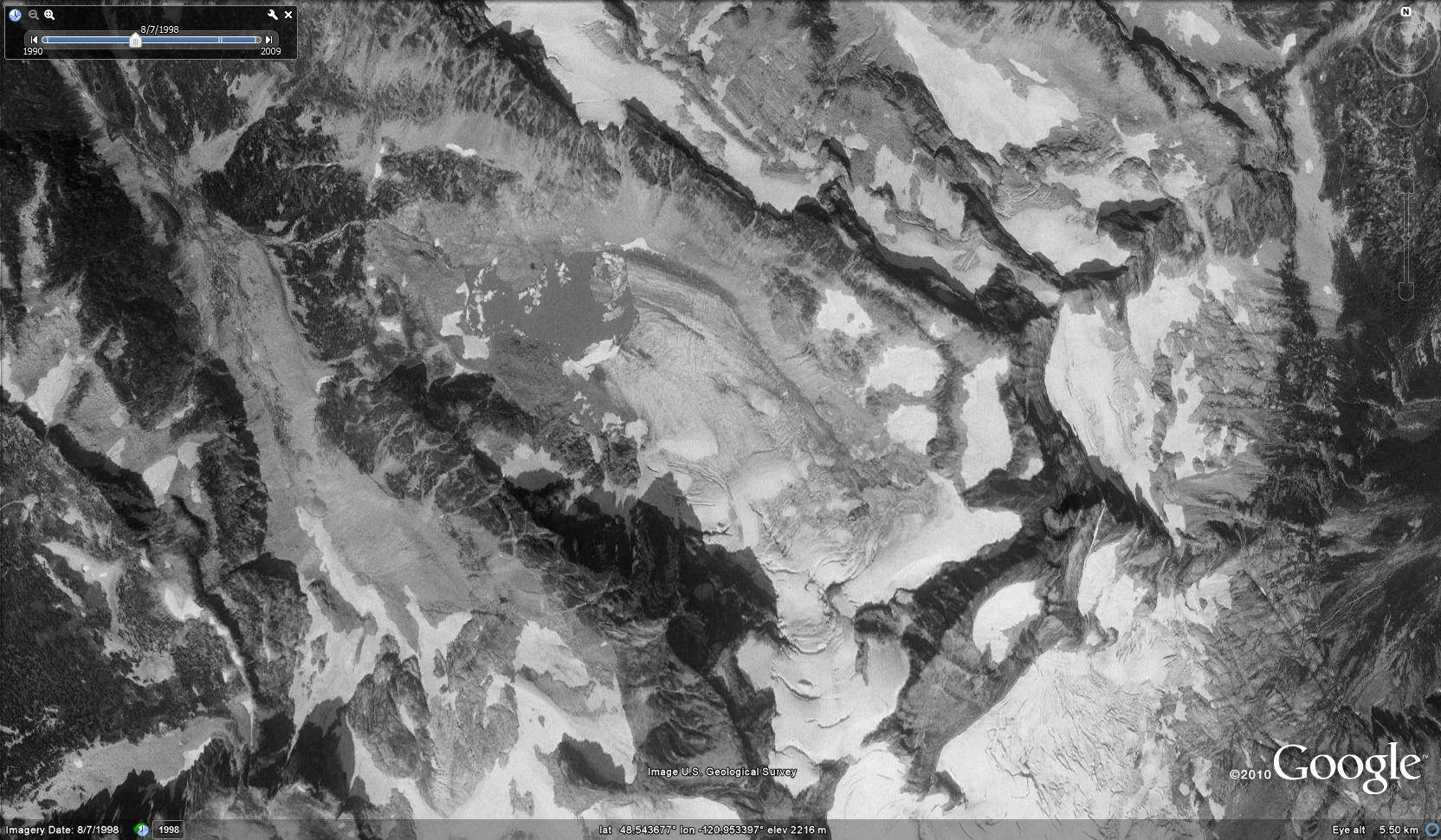
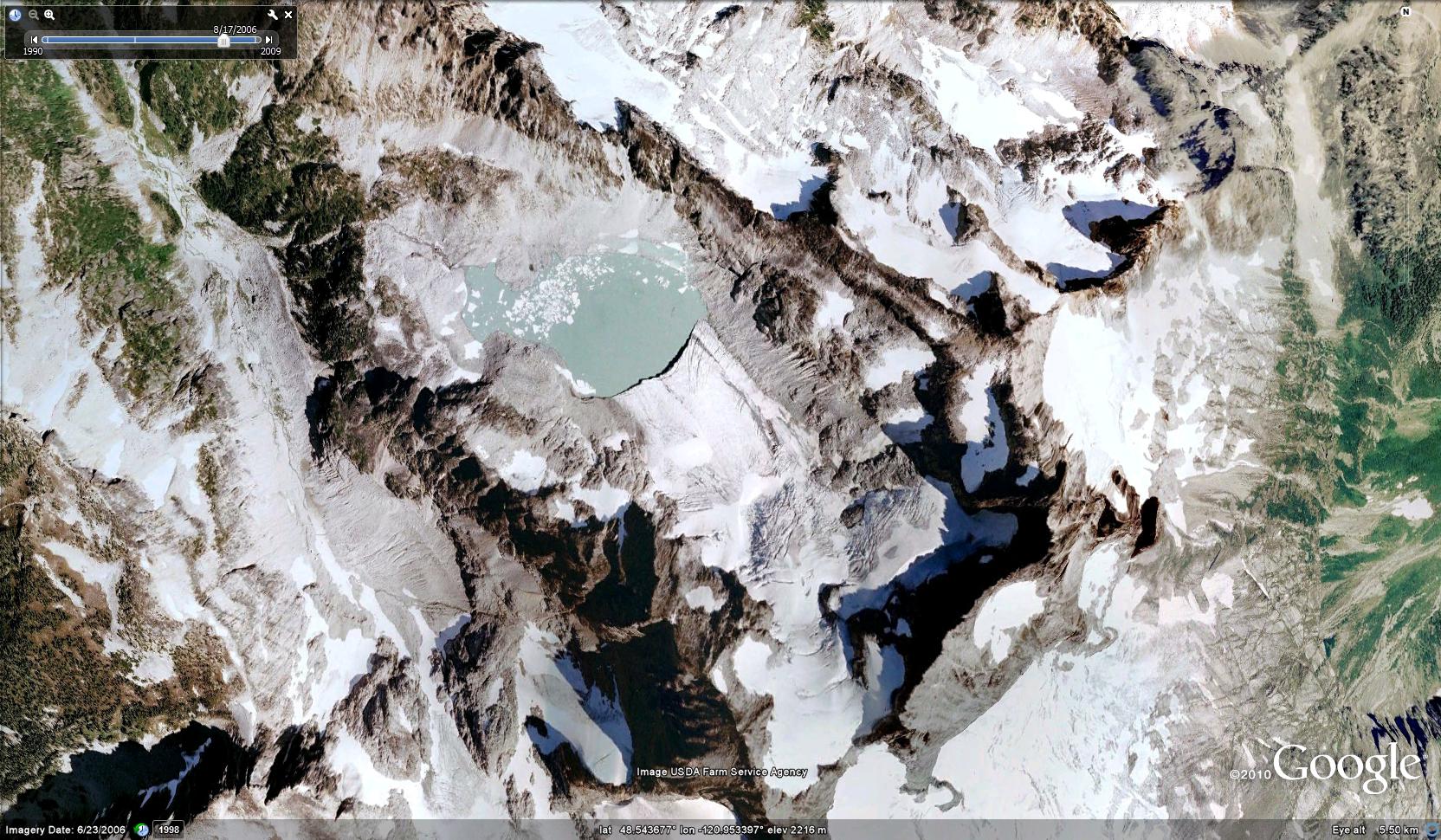
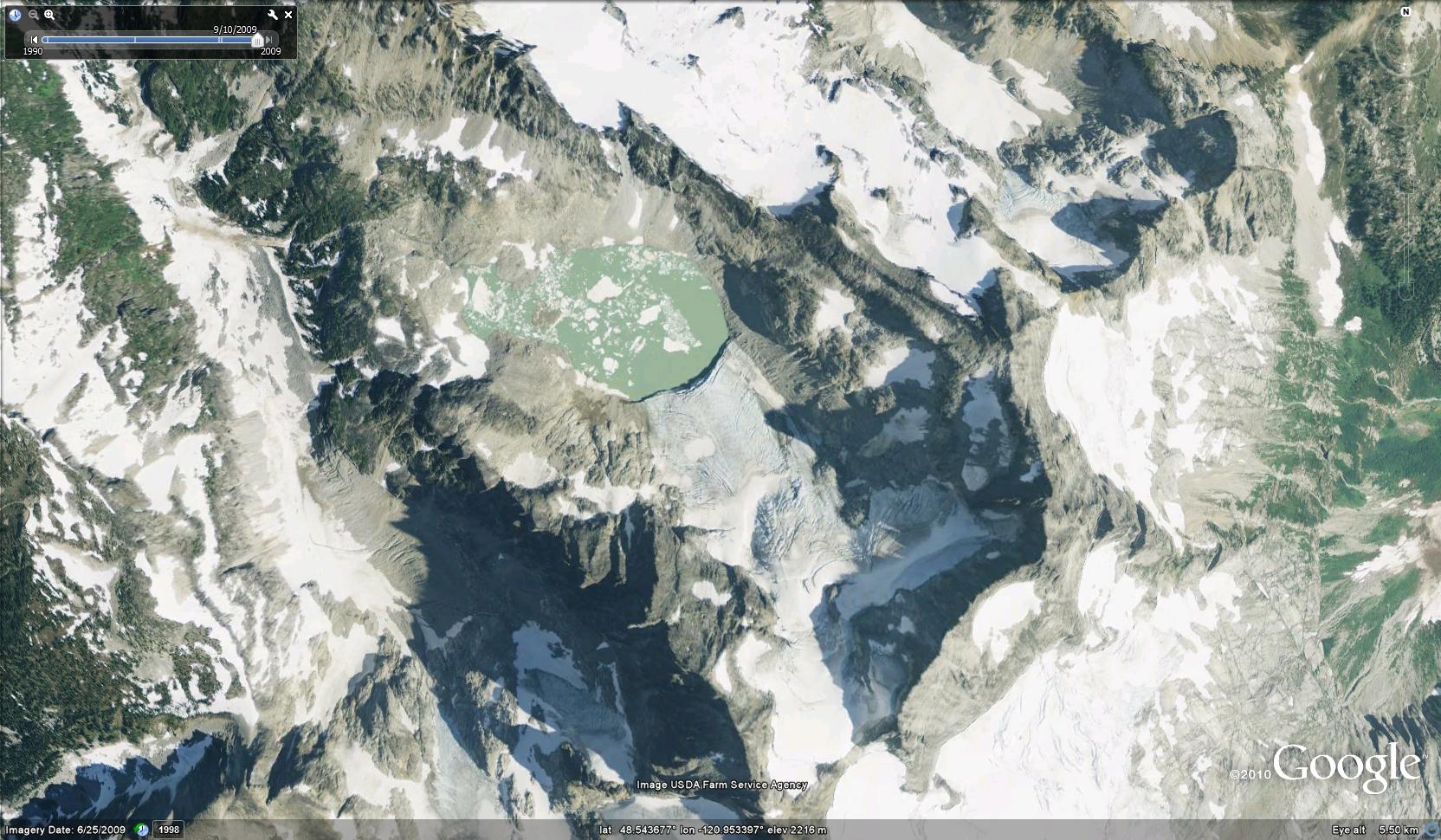
The Banded Glacier on Mount Logan in the North Cascades of Washington has retreated since 1960 creating a new alpine lake. The glacier has retreated 450 m in from 1960 to the 2006 satellite image expanding the proglacial alpine lake. This glacier is retreating as are all North Cascade glaciers. The 1960 image is from Austin Post (USGS). The 2006 image has a blue dotted line at the 1960 terminus. Note the spread of rock outcrops in the accumulation zone suggesting this glacier will have trouble surviving, a blue arrow indicates the new rock outcrops..The glacier has lost 40% of its area in this 46 year period. The north side (left side in the image) is very short at this point. The new lake has a number of icebergs in it. The number of crevasses has also diminished as the glacier has thinned, become shorter and as a result moves slower. The images below are from 1960, 1998, 2006 and 2009. The retreat from 1998-2009 is 270 meters.banded19600 The slower movement is despite an increase in surface slope as the glacier has retreated from the flatter lake basin area onto the slopes leading to the summit of Mount Logan. This glacier is difficult to view unless you are right in the basin where it is. In 2005 and 2009 this glacier lost almost all of its snowcover, not a good sign for a glacier to survive.