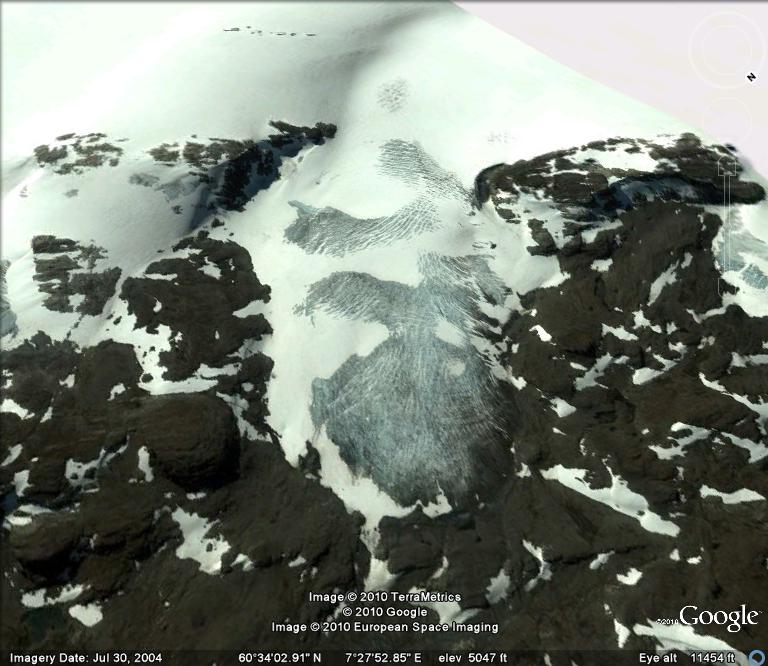
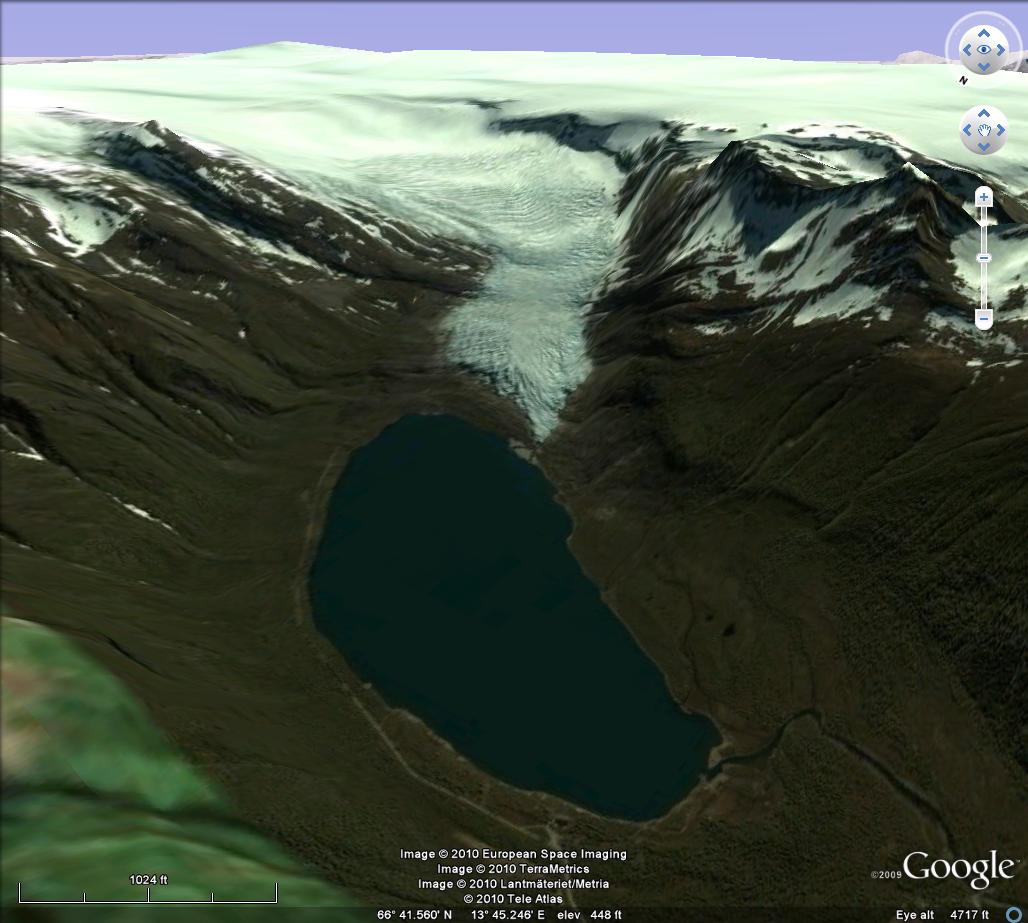
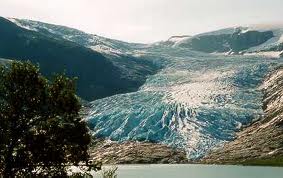
Flatisen Glacier, Norway Retreats from Lake & Separates

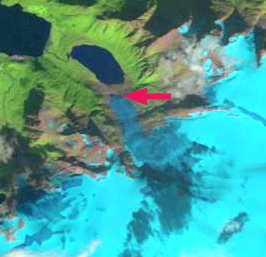
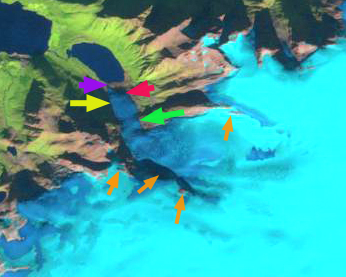
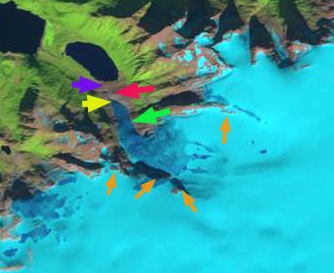
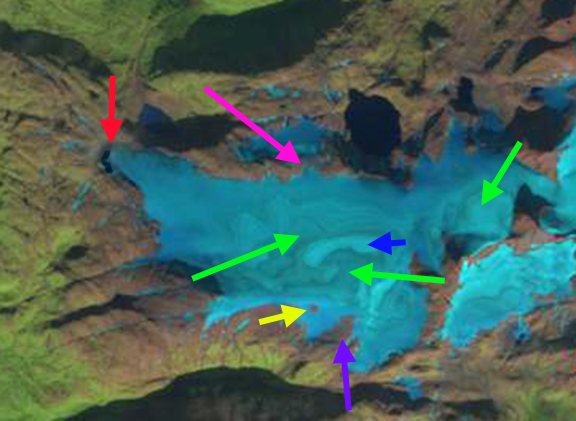
Flatisen Glacier in Landsat images from 1990 and 2018.  The glacier terminates in the proglacial lake in 1990 at the red arrow and in 2018 at the yellow arrow no longer terminating in the lake.  The pink arrows indicate three connections of the ice cap to the terminus tongue in 1990, with two lost by 2018. 

Flatisen is the primary outlet glacier on the southern side of the second largest ice cap in Norway the Western Svartisen. From 1945-2000 the glacier terminated in a proglacial lake that expanded from 1.5 km long in 1945, to 3 km in 1985 (Theakstone, 1990) to km in 2000.  Haug et al (2009)  indicate significant mass loss of the Western Svartisen Ice Cap from 1985-2000.

In 1990 the glacier terminated in the proglacial lake that was ~3.5 km long.  There were significant feeders from the ice cap both north and south of the terminus tongue, pink arrows. In 1999 the glacier has retreated several hundred meters, still terminates in the lake and is still connected to the ice cap at the three noted locations, pink arrows.  By 2014 the glacier has retreated out of the lake and has lost the two eastern connections from the ice cap to the terminus tongue.  There is not retained snowcover on the valley tongue of the glacier.  By 2018 the glacier has retreated 1400 m from the 1990 position, has only one narrow connection to the main ice cap to the north and has very limited retained snowpack even on 8/6/2018.  There will be continued large mass balance loss for this glacier in 2018 reflective of the warm melt season in Norway. Once the glacier connection entering from the northwest is lost the glacier will have a limited accumulation zone.  The retreat of this glacier is greater given the size of the glacier than at two other key glaciers of the ice cap, Engabreen and Storglombreen.
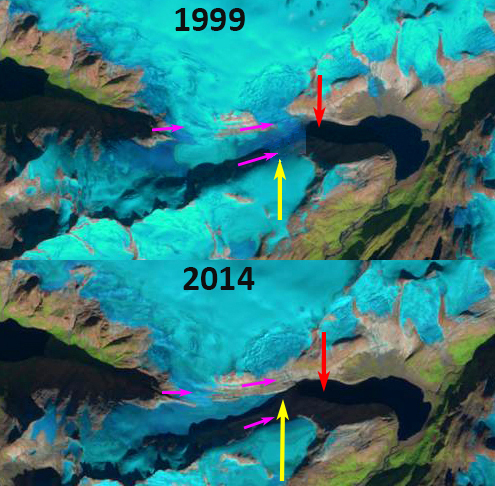
 

Flatisen Glacier in Landsat images from 1990 and 2018.  The glacier terminates in the proglacial lake in 1990 at the red arrow and in 2018 at the yellow arrow no longer terminating in the lake.  The pink arrows indicate three connections of the ice cap to the terminus tongue in 1990, with two lost by 2018.

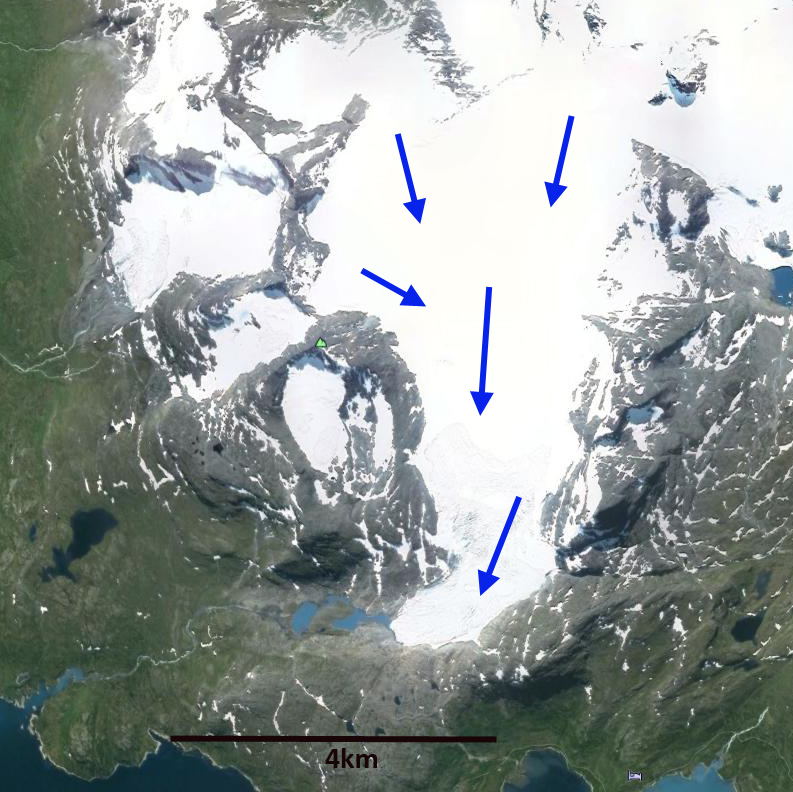
Map of Flatisen Glacier from the Norway Glacier Atlas indicating the margin in 1990 dark green and 1999 light green.
Harbardsbreen, Norway Margin Retreat and Separation

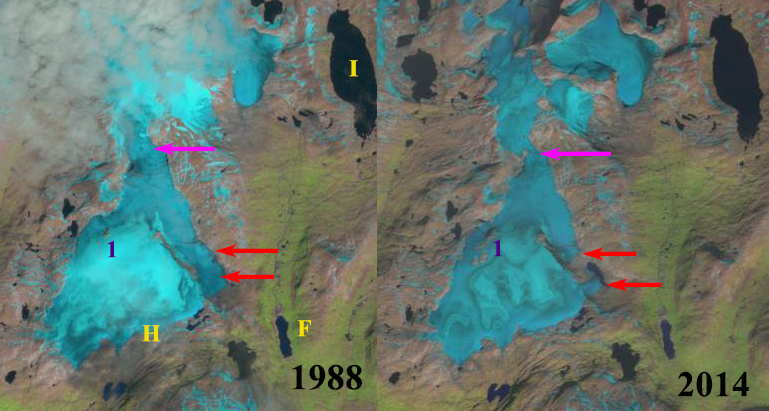
Harbardsbreen (H) the 13th largest ice cap in Norway in 1988 and 2014 Landsat images.  Red arrows indicate the main terminus on the east side that has separated since 1988. Point 1 is the sole nunatak in 1988 now there are more.  The Pink arrow is the location of the narrowing connection with the northern section of the icecap.  The east side of the ice cap feeds the hydropower system of Fivelmyr (F) and Illvatnet Reservoir (I).

Harbardsbreen (H) is the 13th largest ice cap in Norway in the Norwegian Glacier Inventory with an area of 24.8 square kilometers in 2006.  The ice cap is east of Jostedalsbreen. Here we examine Landsat imagery to indicate changes amidst and at the margin of this ice cap from 1988-2016. The east side of this ice cap drains into Fivelmyrane Reservoir (F) and its hydro power.  The Fivelmyr Power Plant was built in 1962 and has an 8 GWh annual capacity.  This water via pumped storage  is also part of the Herva Power Plant that produces 129 GWh annually.
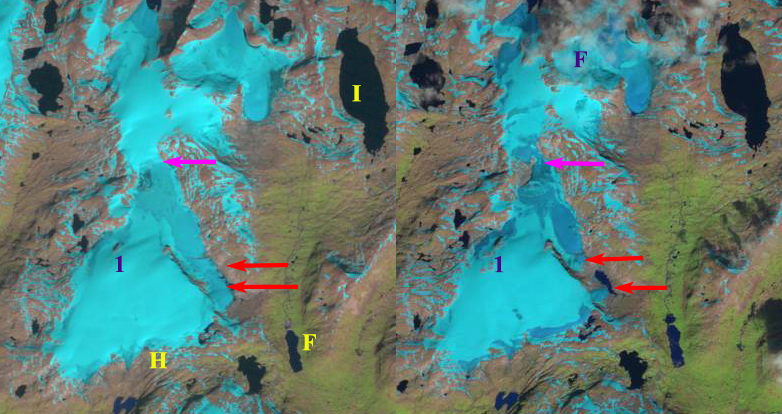
In 1988 the main outlet of the ice cap was a tongue of ice fed from both north and south outlet glaciers on the east side of the ice cap, not red arrows.  There is a  connection to the northern end at the pink arrow is nearly 1 km wide.  At Point 1 there is a single nunatak amidst the ice cap.  Up to 1998 there is limited change in the icecap.  In 2014 the snowline is at 1700 m near the crest of the ice cap.  The eastern terminus of Harbardsbreen has separated at the red arrows.  A new lake has formed that is in contact with the southern terminus. The connection at the pink arrow to the northern segment is now just 200 m wide. There are now three new bedrock outcrops near Point 1 and the expanded former solitary nunatak. The expansion of the bedrock knobs indicate the impact of the rising snowline converting portions of the ice cap into an ablation zone that had been an accumulation zone. In 2016 the southeastern terminus of Harbardsbreen barely reaches the new lake that has formed. The glacier termini are now separated by 800 m from each other. The reduced size of the glacier means less area for melting, in this case the reduced natural ice storage can be replaced by the artificial pumped storage in Illvatnet.  This same story is being told at nearby Spørteggbreen and Tunsbergdalsbreen.

Harbardsbreen (H) the 13th largest ice cap in Norway in 1998 and 2016 Landsat images.  Red arrows indicate the main terminus on the east side that has separated since 1998. Point 1 is the sole nunatak in 1998 now there are more.  The Pink arrow is the location of the narrowing connection with the northern section of the icecap.  The east side of the ice cap feeds the hydropower system of Fivelmyr (F) and Illvatnet Reservoir (I).


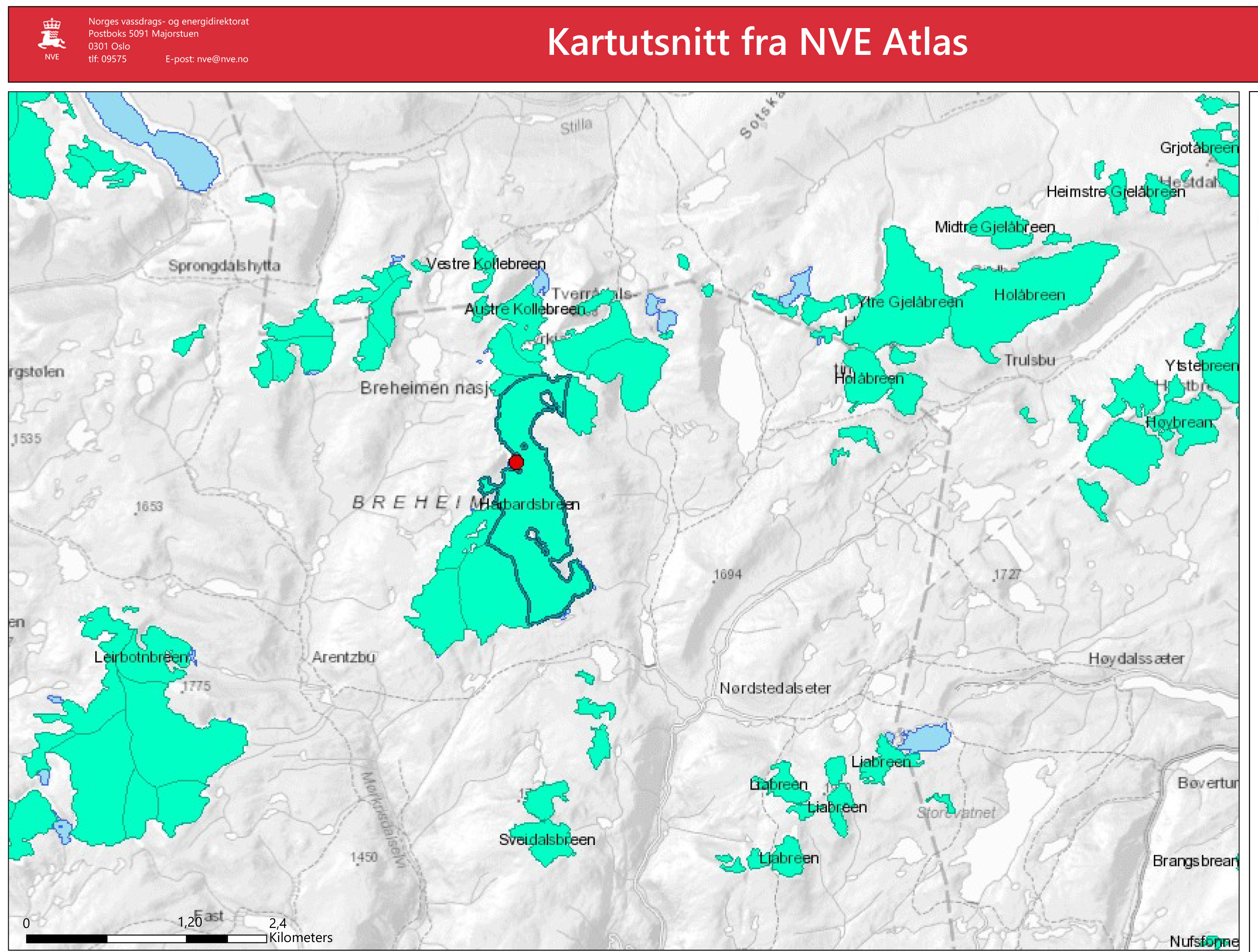
Harbardsbreen in the NVE Atlas showing 2006 glacier margins


Engabreen Glacier, Norway Retreat

Engabreen is an outlet glacier of the Svartisen ice cap in northern Norway. It has an area of 40 km2. Most of the area lies between 1200 and 1450 m the high plateau of the ice cap. This glacier has been the focus of attention from the Norwegian Water Resources and Energy Directorate (NVE) for over 50 years. 

engabreen ge

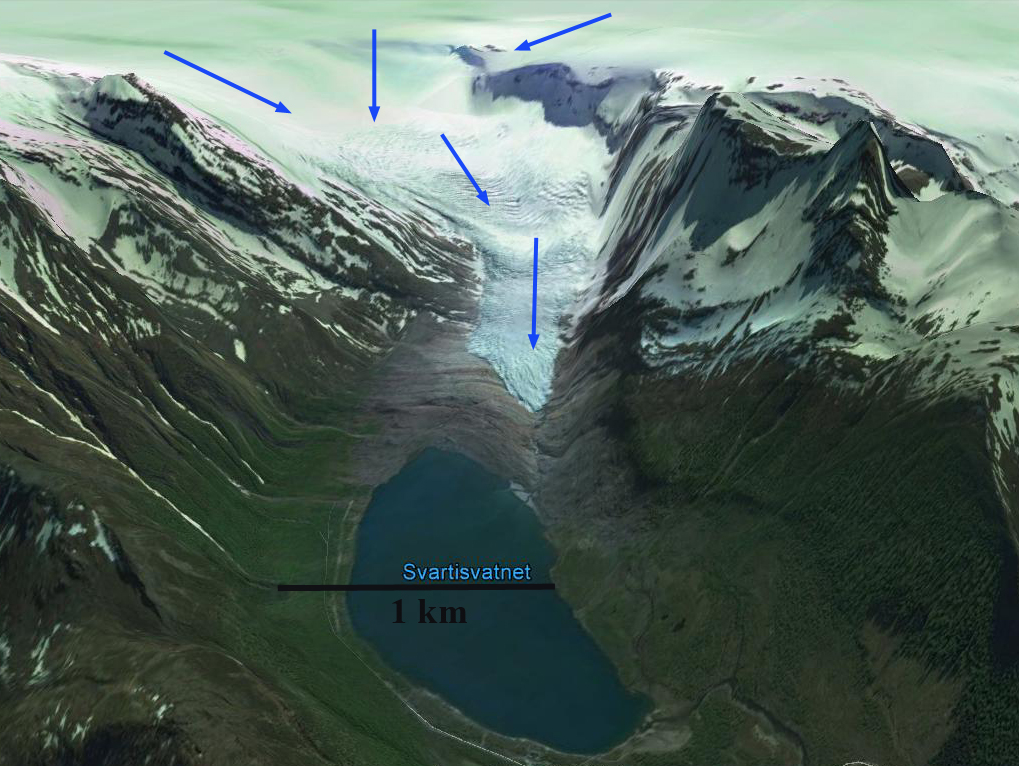
Google Earth image of Engabreen Glacier, 2014. 

NVE maintains the most extensive and detailed glacier monitoring network in The NVE annual mass balance measurements on Engabreen indicate that winter snow typically accumulate 3 m of water equivalent on the ice cap. This amounts to 5-7 m of snowpack as the melt season begins in May. The glacier terminus descends from the ice cap down nearly to Svartisvatnet, a lake at 7 m. At the terminus annual melting is 12 m. The rivers from the northern and eastern side of Svartisen were regulated in the 1990’s for hydro power production by construction of a tunnel system partly underneath the glacier. Today about 60% of the potential runoff of the Engabreen is captured and sent through a bedrock tunnel to the hydropower facility. During completion of this tunnel access to the glacier base was opened. Today there is the world’s only ongoing subglacial laboratory here The melt water from Engabreen is collected into this tunnel system at 620 m a.s.l. underneath 200 m of glacier ice in the ice fall.  The sub-glacial blog has further details of this mainly winter research location

Late in the 18th century Svartisvatnet,the lake below the terminus, started to appear as the glacier retreated upvalley. In 1903 regular length change observations were initiated, a small advance ensued until 1910. By 1931 the glacier retreated 100 meters, and the glacier tongue was thinning. During the next decade calving led to rapid retreat revealing the rest of Engabrevatnet. This period of  retreat ended in 1965, Engabreen  advanced with three different pulses ending in 1971, 1984 and 1999, the last pulse reaching to within a few meters of the lake shore.Below are pictures from the NVE taken in 2000 and 2008 of Engabreen, note the large contraction of the terminus area.   This is further illustrated in Landsat images below. engabreen 2000-2008

NVE images of Engabreen Glacier

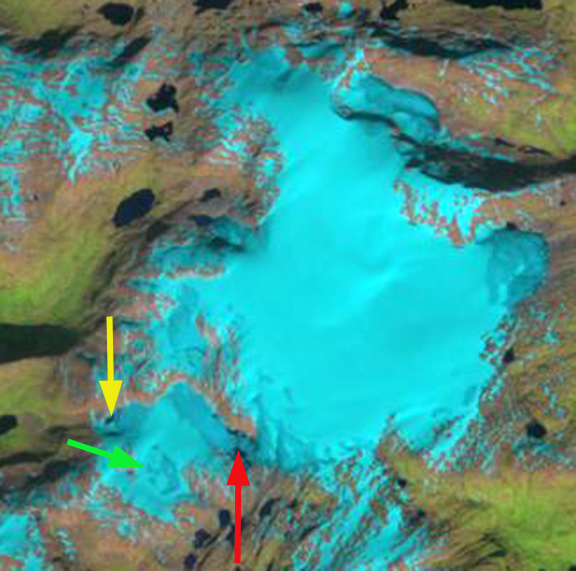
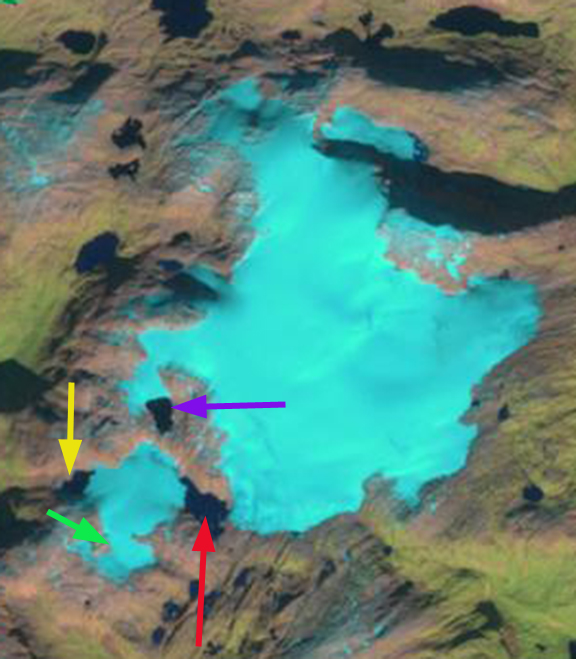
From 1990 the glacier ended at the red arrow before advancing by 1999 to the purple arrow.  Retreat followed to the yellow arrow in 2015, this is a 350 m retreat.  From 1999-2013 NVE amual terminus assessment indicates a retreat of 317 m.. At the green arrow the width of the glacier declined from 475 m in 1999 to 325 m in 2015.  At the orange arrows thinning is evident higher on the glacier as bedrock areas have expanded.  The snowline in 2014 is above these areas and is at all but one in 2015. This thinning suggest retreat will continue. The 2015 position is its point of furthest retreat since the Little Ice Age. The recent retreat indicates a recent trend of negative mass balance on the glacier. There is excellent flow off the ice cap that has persistent and consistent snowcover indicating this glacier will survive current climate.  This is also leading to the retreat of Storglombreen  and Flatisen from the same ice cap

engabreen 1990

1990 Landsat image

engabreen 1999

1999 Landsat image

engabreen 2014

2014 Landsat Image

engabreen 2015

2015 Landsat image


Langfjordjokulen, Norway Retreat-Thinning

Langfjordjokulen is in the Finnmark region of northern Norway. This is a plateau glacier with a valley glacier extending east toward Langfjordhamm. The Norwegian Water Resources and Energy Directorate has monitored the length change and mass balance of this glacier from 1989-2014. The mean mass balance has been significantly negative averaging -0.7 m/year, with every year being a net loss since 1997. This is no way to sustain a glacier or a business. Retreat of the glacier has averaged 27 m/year from 2000-2014. Here we examine Landsat imagery of the glacier from 1989-2014 to identify key changes.
langford ge

In 1989 the glacier terminated at the red arrow, two glacier tongues descended from the plateau and merged below the purple arrow indicating the northern arm. A ridge extends some distance into the main plateau separating the catchment areas of the two glacier tongues, marked by the letter A.  The glacier is mainly snowcovered in August 1989 and had a negative mass balance of -0.55 m.  In 1994 the two glacier tongues are still joined,  and snowcover is extensive, retreat is limited since 1989.  In 2000 snowpack is quite limited at the time of the image, the two glacier tongues have separated and the main terminus has retreated from the red arrow. In 2014, Norway’s warmest year, snowpack retained is minimal, the glacier mass balance reported by NVE to the World Glacier Monitoring Service was -0.78 m, an improvement over the record low year of 2013, -2.61 m.  A new area of bedrock is emerging near Point A, due to glacier thinning in the plateau area which should be the accumulation zone.  The two glacier tongues are further separated.  The main terminus is at the yellow arrow a retreat of 600-700 m since 1989.  This retreat rate is faster than other periods since 1900. The retreat is similar to that of  the larger nearby Strupbreen and Koppangsbreen.  The cumulative mass loss experienced by Langfjordjokulen is a significant portion of its total volume, 25-35% assuming typical glacier thickness for a glacier with this area.  In 2014 NVE reported In Norway terminus fluctuation data from 38 glaciers  with ongoing assessment indicate, 33 retreating, and 3 were stable.  The average terminus change was -12.5 m

langford 1989
1989 Landsat image

lanford 1994
1994 Landsat image

langford 2000
2000 Landsat image

langford 20142014 Landsat image

Spørteggbreen Separation and Retreat, Norway

Spørteggbreen is a small ice cap just east of Jostdalsbreen, Norway’s largest ice cap.  The Norway Glacier atlas chronicles the area of the 10 glaciers that comprise the ice cap at 23.8 square kilometers in 2006 (Andreassen and Winsvold, 2012). The Norwegian Water Resources and Energy Directorate (NVE) has an excellent glacier monitoring program that monitors 10 glaciers that drain Jostedalsbreen from 2008-2013 the net change was retreat on all 10. This is exemplified by Tunsbergdalsbreen. In 2014, 33 of 38 glaciers observed in Norway retreated and 5 did not change. Laumann and Nesje (2014) examined Spørteggbreen during the Holocene.  They noted the glacier disappeared from 7300 years before present and reformed approximately 5400 years before present.  Their model simulates minor changes from 2011 to 2050. Here we focus on changes to the southwest side of this ice cap using Landsat imagery from 1988-2014 and implications for the near future.
sporteggbreen 2010Norway Glacier atlas image looking southwest toward Jostdalsbreen.  The foreground is the main Sporteggbreen, the new lake is in midground and then the separated southwest extension.  There is no retained snowcover evident on the southwest extension and it is thin.

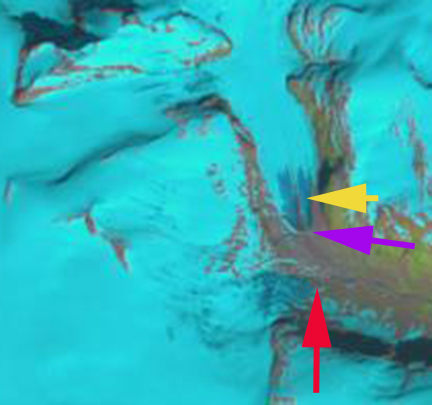
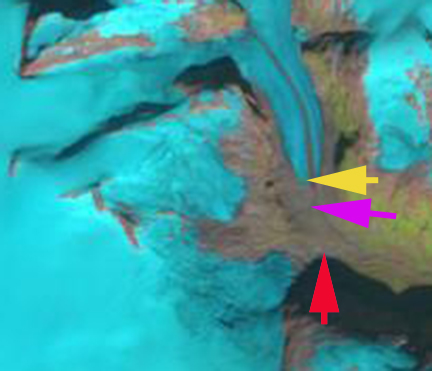
In 1988 at the southwest side of Spørteggbreen the main ice cap joins the southwest extension of the ice cap in a small lake at the red arrow. At the purple and yellow arrow are small peripheral proglacial lakes. The green arrow indicates a narrow section in the southwest extension. In August 1998 there is substantially more snow and lake ice, which makes identification of change difficult. In 2010 the southwest extension is well separated by a lake from the main ice cap, red arrow. This lake is m across, with the glaciers reaching the shore at both ends. The lakes at the purple and yellow arrow have also expanded. The width of the narrow section of the southwest extension has narrowed from 600 m to 300 m. In 2014 the main Spørteggbreen Ice Cap no longer reaches the eastern shore of the lake, red arrow. The lake is 750 m across. The lake at the purple arrow is now equivalent to the glacier that ends in the lake and is m long. The width of the glacier at the narrow section is down to 200 m. The most noteworthy item is that in this mid-September image the ice cap has 25% of its area still covered in snowpack, note the areas marked with pink letter A. The other areas are either firn from previous years or bare glacier ice.  By the end of the melt season at the end of the month this will likely be closer to 20% . Remember a glacier typically needs 55-65 % snowcover to be have an equilibrium balance.  This will lead to a large negative balance and thinning right to the top of the ice cap. This was the case in 2013 as well. Hence, the Spørteggbreen Ice Cap is currently experiencing significant volume and area losses. The retreat is not as large in terms of distance as on nearby Tunsbergdalsbreen.

sporteggbreen 1988a


1988 Landsat image.

sporteggbreen 1998

1998 Landsat image

sporteggbreen 2010a

2010 Landsat image

sporteggbreen 2014a
2014 Landsat image

Vestisen Glacier Retreat, Norway

Vestisen Glacier is the second largest glacier of the Oksindan Icecap flows west. The glacier drains west into the Rossaga River, which has a Statkraft Hydropower plant, though upstream of the glacier inflow. Here we examine Landsat imagery from 1992-2014 to observe recent changes.
vestisen map
Vestisen Mapcarta view

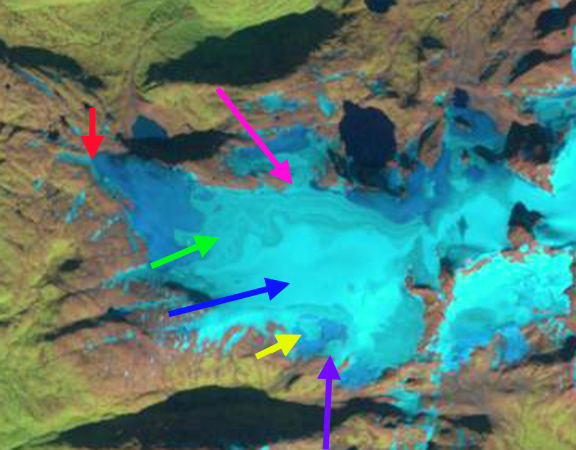
In 1994 the glacier terminus is at the red arrow. The areal extent of snowcover is more than 50% of the glacier area, blue arrow. A small glacier to the north is connected to the Vestisen at the pink arrow. The purple arrow is a small bedrock ridge that intrudes into the glacier a small distance from the south, and the yellow arrow is a small side terminus of the glacier. In 1999 the snowcovered area is 35% of the glacier. The region of firn, snow that survived the first summer, but is not ice yet, green arrow, is extensive suggesting that the 1999 mass balance was more negative than recent years. In 2006 the ridge at the south edge of the glacier has expanded at the purple arrow. At the pink arrow the connection to the glacier to the north is still comprised of glacier ice. In early september of 2014 the snowcovered area is very low at 15-20% of the glacier. The glacier has separated from the glacier to the north at the pink arrow. A small outcrop of rock has appeared amidst a secondary terminus at the south side of the glacier, yellow arrow. The ridge intruding into the southern edge of the glacier is now 300-400 meters longer and is wider. A lake has formed at the main terminus. This lake has formed due to a combination of thinning and retreat of the terminus, a retreat of 250-300 m has occurred. The Mid-September 2014 image indicates the snowcovered area, blue arrow is down to 5%. The firn area, green arrow, that represents snow that had survived previous summers, is being consumed by the substantial melt of the 2014 season. To have an equilibrium mass balance glaciers in Norway need to be 55-60% snowcovered at the end of the melt season. Glacier mass balance will be quite negative in 2014, which will lead to further retreat of the main terminus and secondary terminus regions, NVE will continue its long term mass balance monitoring that will report on the particular quantities. The retreat here is less than that of Austsre Oksindbreen, just to the northeast, but it is poised for greater retreat in the near future, with poorer retained snowcover. The glacier is following a pattern of thinning and retreat over the last 15 years in Norway. The Norwegian Water Resources and Energy Directorate (NVE) reports that 23 of 24 Norway glaciers examined consistently since 2000 have retreated significantly. vestisen 1994
1994 Landsat image
vestisen 1999
1999 Landsat image
vestisen 2006
2006 Landsat image
vestisen 2014es
2014 early September Landsat image
vestisen 2014ms
2014 Late September Landsat image

Austre Okstindbreen Retreat, Norway

Austre Okstindbreen is the largest glacier of the Okstindan Icecap. It flows north from the 1700 m to a terminus in a proglacial lake at 900 m. The lake drains into Grasvatnet. The glacier had a sustained retreat of 2 km from 1908-1980, emplacing annual moraine ridges during the 1950-1968 period (Worsley and Ward, 1974). The other main glacier of the Oksindan Icecap is Vestisen. Knudsen and Theakstone (1988) identified a series of glacier dammed lake draining events from 1976-1987, with glacier retreat this is no longer occurring. Jacobsen et al (1997) noted that the lower glacier in particular had slowed down from 1976 to 1995. They also reported during a series of positive balance years the ELA averaged 1250 m. The Norwegian Water Resources and Energy Directorate (NVE) reports annual terminus of this glacier, noting a 118 m retreat from 2010-2013. Here we examine changes in the glacier from 1994-2014 using Landsat imagery. okstindbreen ge
Google Earth Image

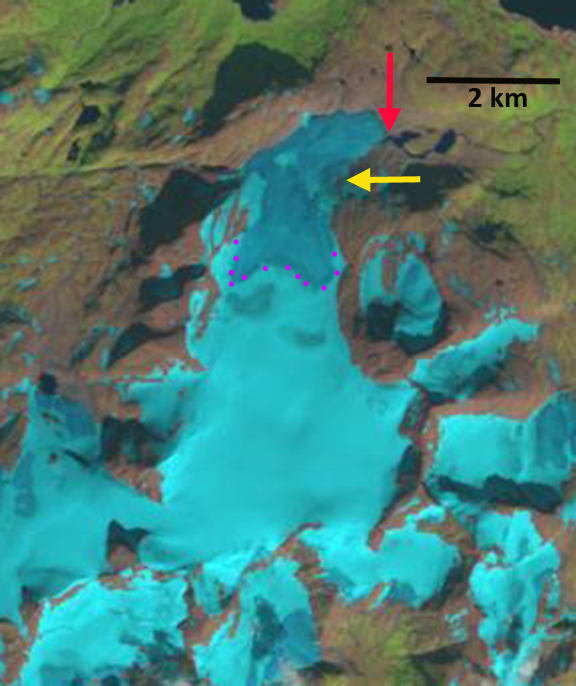
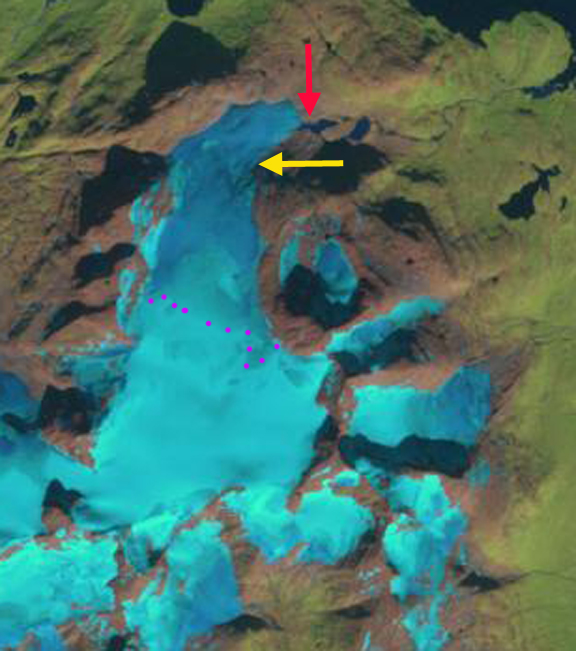
In 1994 the glacier terminates at the red arrow, the snowline (purple dots) is at 1300 m. The width of the glacier at the eastward turn, yellow arrow is 1500 m. In 1999 the glacier has retreated a short distance and the snowline is at 1400 m. In 2006 the proglacial lake has continued to expand. The glacier width at the east turn is 1300 m. The snowline is at 1450 m. In 2014 the snowline is at 1550 m. The glacier width at the yellow arrow is down to 1100 m. The retreat from the red arrow is 400 m, which is 20 meters/year. The persistent high snowline above 1300 m in images that are not even at the end of the melt season indicate a significant rise. The 400 m reduction in the width of the glacier at the east turn, which is 1.5 km above the terminus, indicate the retreat will continue. The glacier retreat parallels that of Norway glaciers in general since 2000, with 23 of 24 glaciers examined consistently by (NVE) retreating during this interval, one was close to equilibrium. Engabreen, Tunsbergdalsbreen and Blamannsisen.

okstindbreen 1994
1994 Landsat image

okstindbreen 1999
1999 Landsat image
okstindbreen 2006
2006 Landsat image
okstindbreen 2014a
2014 Early September Landsat image
oksstindbreen 2014
2014 Mid-September Landsat image

Lodalsbreen Retreat, Norway

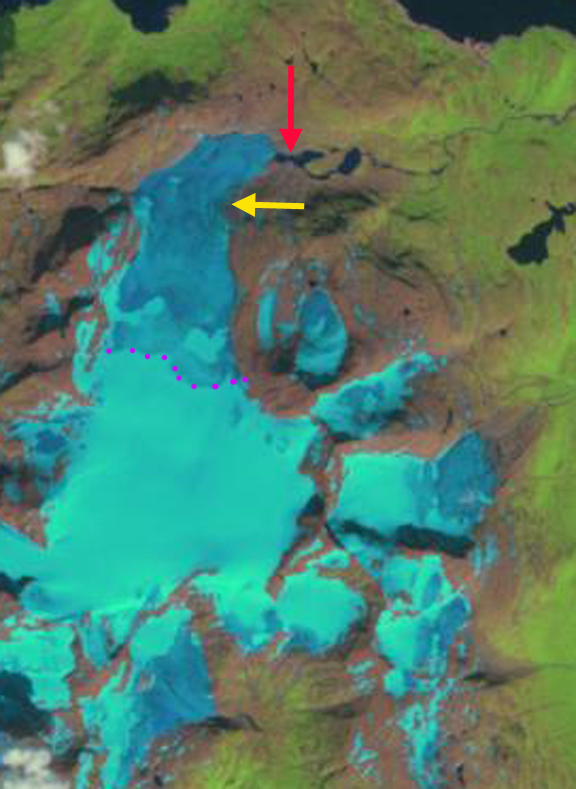
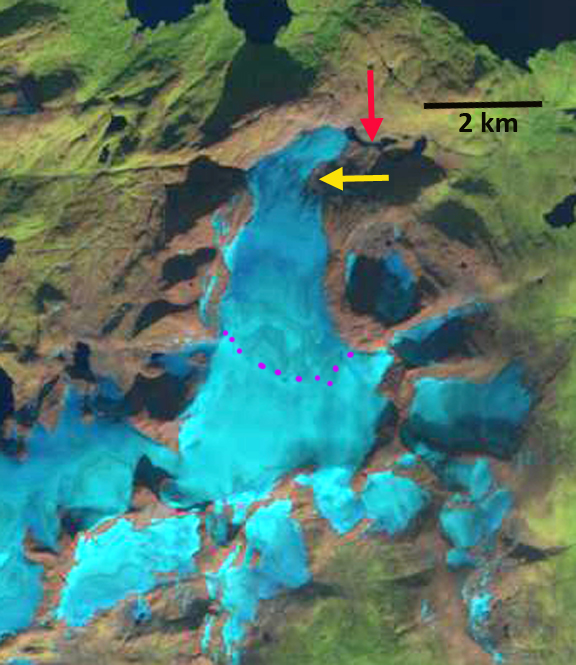
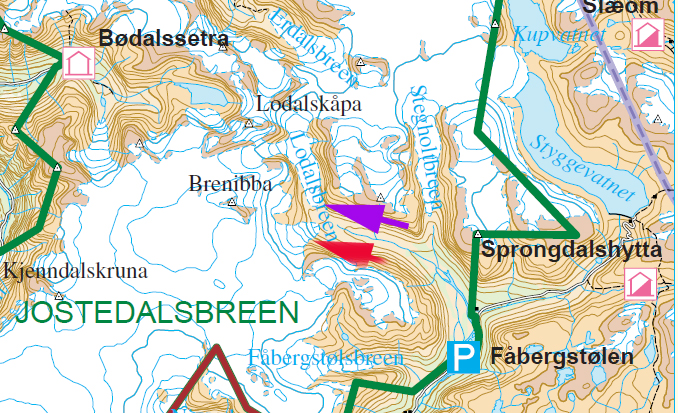
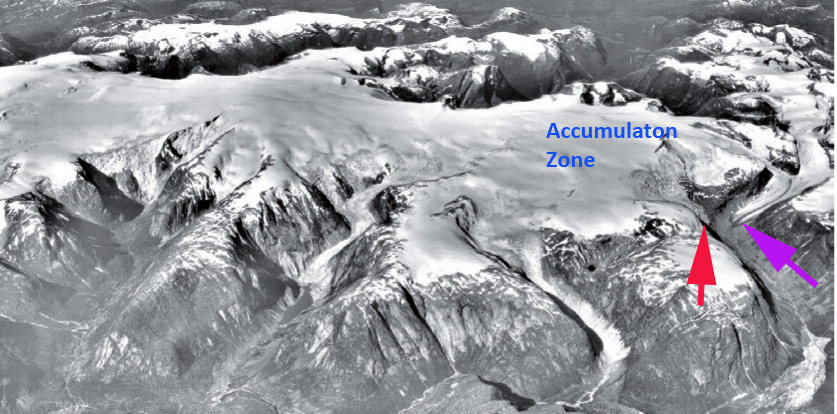
Lodalsbreen is an outlet glacier from the northeast region of the Jostedalsbreen Icecap of Norway. This particular outlet is difficult to reach and not often investigated, for this icecap in general all 10 glaciers observed from 2000-2010 have retreated (Norwegian Water Resources, 2010). Recent work by Nussbaumer et al (2011) and Imhof et al (2011) have focussed on the changes in terminus postion of Jostedalsbreen glaciers since the Little Ice Age including Lodalsbreen. The glacier reached a maximum around 1750 and has retreated 4.5 km up to 2006 as noted in the second image below modified only slightly from Nussbaumer et al (2011). The third image indicates Lodalsbreen and the western tributary and the large accumulation zone of Jostedsalsbreen that feeds the many outlet glaciers, image source is the WGMS-UN publication Global Glacier Change:s Facts and Figures. The glacier was 6 km long in 2005. A comparison of 1989, 2000, 2002, 2010 and 2012 Landsat imagery indicates the retreat of the main tongue, purple arrow for 1989 and yellow arrow 2010 and western tributary that was previously joined to the glacier, red arrow at 1989 terminus. From 1989 to 2010 Lodalsbreen has retreated 240 meters. The western tributary terminated in the valley bottom at 750 meters above sea level in 1989, and by 2010 has retreated 500 meters up the valley wall to 1000 meters above sea level. Most of the retreat of the tributary has been since 2000. The retreat of this glacier is similar to that of other Norwegian glaciers in the area, Tunsbergdalsbreen and Midtdalsbreen . The Jostedalsbreen has a large accumulation area above 1500 meters that feeds the many outlet glaciers, which are no in danger of disappearing with current climate.

Tunsbergdalsbreen Glacier Retreat, Norway

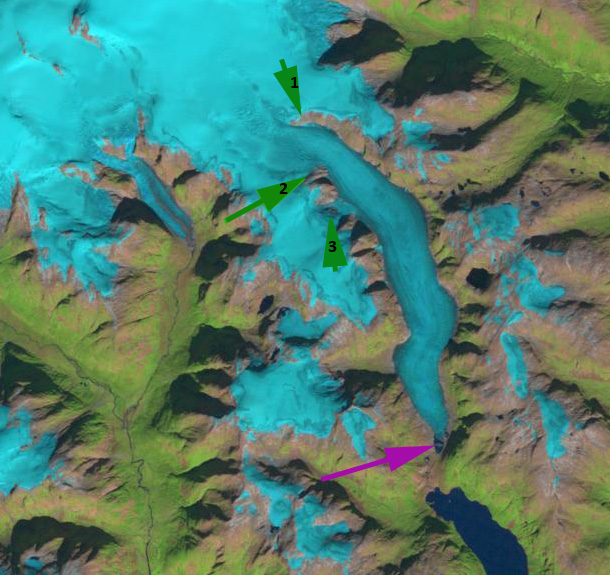
The Norwegian Water Resources and Energy Directorate (NVE) has an excellent glacier monitoring program. Of these ten drain the largest ice cap in Norway the Jostedalsbreen, from 2008-2013 the net change was retreat on all 11. The largest outlet glacier Tunsbergdalsbreen is not one of the closely monitored glaciers. This glacier flows southeast from the icecap, is 18 km long and terminates at 670 meters in a new proglacial lake.

Examination of Tunsbergdalsbreen in Landsat imagery from 1989, 2003, 2011 and 2014. The violet arrows indicate the terminus. In 1989 no lake is evident. By 2003 the lake has begun to develop and has icebergs in it. In 2011 the lake is 400 meters across and has numerous icebergs in it. In 2014 the lake has expanded to a length of 700 m. The glacier is fed by several tributaries coming off the ice cap. At the #3 green arrow, bedrock is by 2010 in the midst of an icefall from the upper ice sheet that was underneath the glacier in 1989 and 2003. At green arrows #1 and #2 the area of bedrock exposure is expanding, indicating thinner and less ice draining from the ice cap into the tongue of the Tunsbergdalsbreen. In 2003, 2011 and 2014 the snowline is at 1450 m, too high to sustain the glacier, the negative mass balance will drive further retreat.

1989 Landsat image

2003 Landsat image

2011 Landsat image
tunsbergdalsbreen 2014
2014 Landsat image

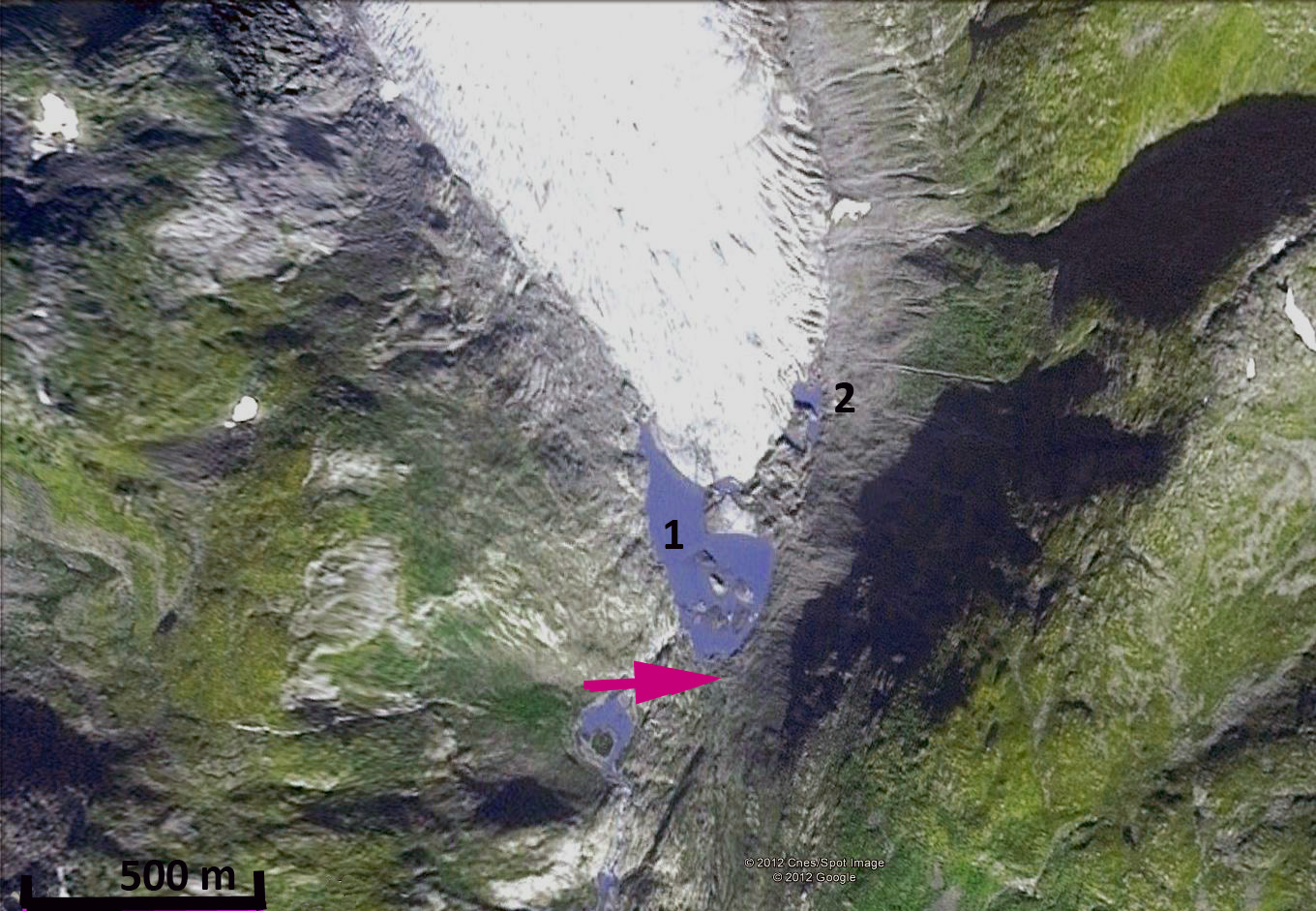
A closeup of the terminus from Google Earth indicates a number of debris covered ice bergs in the lake. This combined with the observed thinning upglacier indicates that retreat will continue. Exposure of bedrock upglacier occurs because of thinning, which only occurs because of mass balance loss which also results in velocity and discharge reductions.

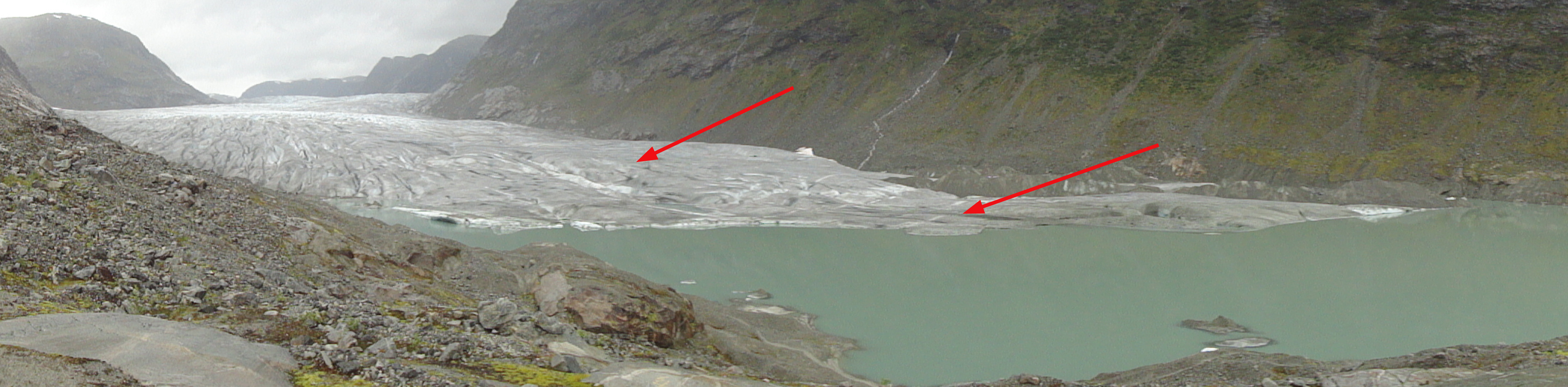
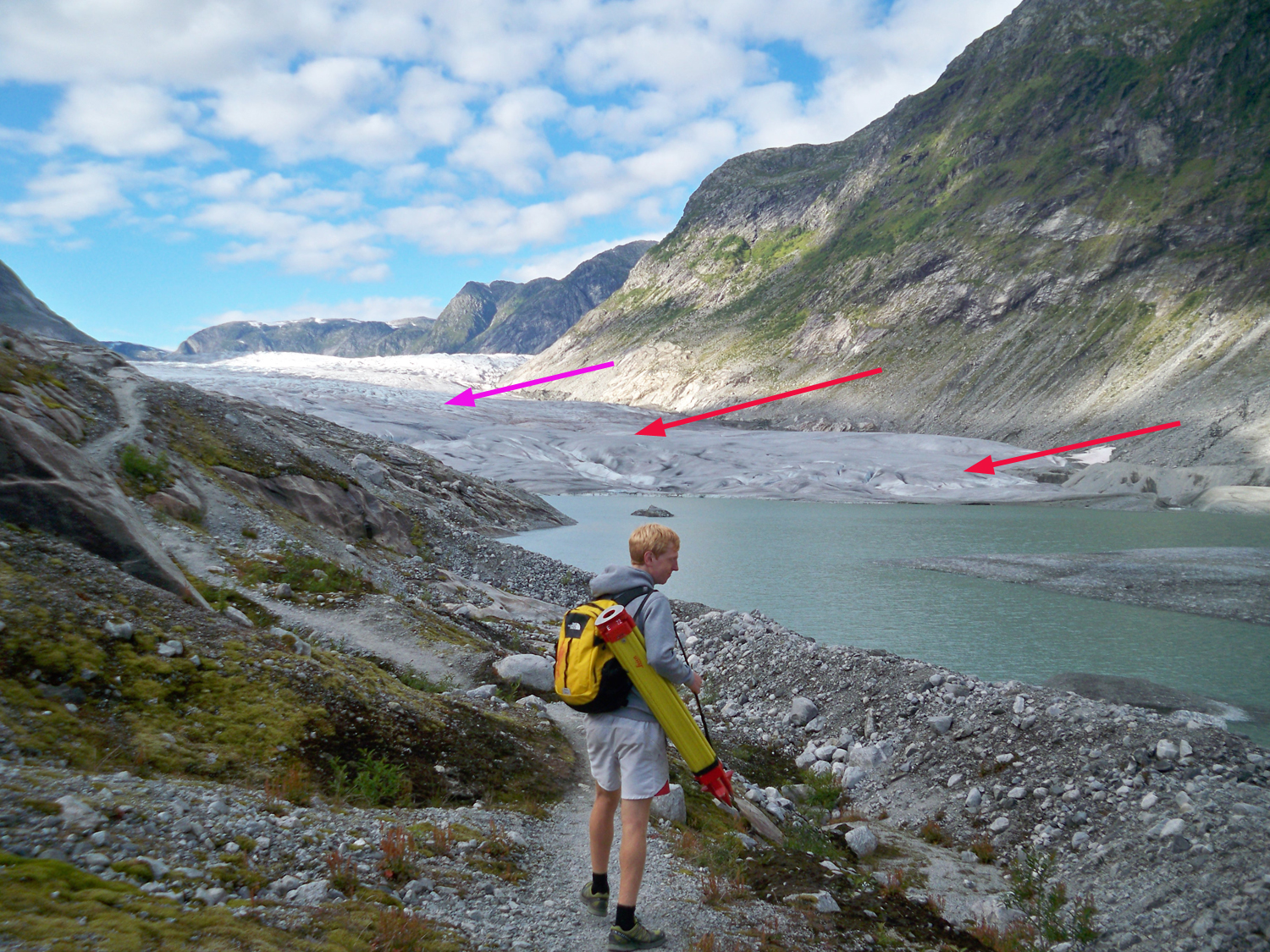
At present the Tunsbergdalsbreen is the focus of an ongoing field  project that aims to monitor the glacier on an annual basis documenting the impact of climate change. This project is focussing on monitoring the elevation of the glacier surface, the ice velocity and the front position. Video of the project are also worth examining.  In two of these images below, the red arrows in each indicate the thin relatively uncrevassed lower reach.  The low slope suggests the lake basin will continue to expand as this area is lost.  These are 2013 images and in fact some of this retreat has occurred.  Upglacier of the red arrows there is limited crevassing but the slope does increase.
In 2010 -2014 glacier mass balances across Norway were negative. The nearby Sporteggbreen Glacier is experiencing signficant area and volume loss.

2012 Google Earth Image.

tunsberg panorama
tunsberg terminus 2013

Images above from Pål Gran Kielland at the Norsk Bremuseum, a partner in the Tunsbergdalsbreen Project.

Midtdalsbreen Glacier, Norway retreat Continues in 2010

The Norwegian Water Resources and Energy Directorate is the most extensive national glacier monitoring program in the world. They noted in 2010 that 27 of 31 glaciers monitored retreated. Midtdalsbreen near Finse drains the eastern portion of the Hardangerjøkulen (Hardanger ice Cap). This glacier retreated 34 meters from 2009 to 2010 and has retreated 143 meters in the last 10 years. This retreat is less than the retreat of Rembesdalsskaka Glacier which drains west from the Hardangerjokulen and has retreated 311 meters in the last decade. The 2010 Image below indicates the area beyond the terminus that is quite fresh and lacks any new vegetation as yet, the small hillocks and ridges are ice cored. The debris has not stabilized yet. The terminus is quite lacking in crevasses and the slope modest, suggesting the retreat will be ongoing. Beyond the current margin are a series of low moraines some of them forming annually with no retreat from October-May and then summer retreat. Moraines like this tend to be ice cored when formed and are prominent. The moraine is really a 20-50 cm or debris overlying a core of dirty ice. Once this ice melts years later the once obvious moraines are hardly noticeable. The terminus of the glacier is well defined. The upper section of the glacier that drains the ice cap lacks clear margins. The ice cap generally does retain snowpack throughout the summer season, continuing to feed the glacier outlets. The reduction in the area and depth of this seasonal snowpack by summers end leads to less outflow from the ice cap through the outlet glaciers and hence terminus retreat.

Engabreen Glacier, Norway retreat

Engabreen is an outlet glacier of the Svartisen ice cap in northern Norway. It has an area of 40 km2. Most of the area lies between 1200 and 1450 m the high plateau of the ice cap. This glacier has been the focus of attention from the Norwegian Water Resources and Energy Directorate (NVE) for over 50 years. NVE maintains the most extensive and detailed glacier monitoring network in the world. The NVE annual mass balance measurements on Engabreen indicate that winter snow typically accumulate 3 m of water equivalent on the ice cap. This amounts to 5-7 m of snowpack as the melt season begins in May. The glacier terminus descends from the ice cap down nearly to Engabrevatnet, a lake at 7 m. At the terminus annual melting is 12 m.
The rivers from the northern and eastern side of Svartisen were regulated in the 1990’s for hydro power production by construction of a tunnel system partly underneath the glacier. Today about 60% of the potential runoff of the Engabreen is captured and sent through a bedrock tunnel to the hydropower facility. During completion of this tunnel access to the glacier base was opened. Today there is the world’s only ongoing subglacial laboratory here. The melt water from Engabreen is collected into this tunnel system at 620 m a.s.l. underneath 200 m of glacier ice in the ice fall.
Late in the 18th century Engabrevatnet started to appear as the glacier retreated upvalley.
In 1903 regular length change observations were initiated, a small advance ensued until 1910. By 1931 the glacier retreated 100 meters, and the glacier tongue was thinning. During the next decade calving led to rapid retreat revealing the rest of Engabrevatnet. The retreat ended in 1965, since then has advanced with three different pulses ending in 1971, 1984 and 1999, the last pulse reaching to within a few meters of the lake shore. From 1999-2009 Engabreen has retreated 255 m. Below are pictures from the NVE taken in 2000 and 2008 of Engabreen, note the large contraction of the terminus area. Also note the considerable reduction in crevassing at the terminus, indicating a velocity reduction and that retreat will continue in the near future. The 2009 position is its point of furthest retreat since the Little Ice Age. The recent retreat indicates a recent trend of negative mass balance on the glacier. There is excellent flow off the ice cap that has persistent and consistent snowcover indicating this glacier will survive current climate.

Rembesdalsskaka, Norway Current Retreat

The Hardangerjøkulen Ice Cap is situated in southern Norway,150 km from the western coast. This elliptical shaped ice cap covers 73 square kilometers and ranges in altitude from 1020 to 1865 meters. It rises above the community of Finse offering access to snow year around. Norway has the most comprehensive glacier monitoring program in the world, mainly due to the heavy reliance on hydropower, for which glacier runoff is a key input. The Rembesdalsskaka drains west from the ice cap, the left side feeding the Rembesdalsvatnet Reservoir. The research is led by the The Norwegian Water Resources and Energy Directorate (NVE). Statkraft runs the Sima power station that is fed from Rembesdalsvatnet Reservoir and the larger Sysenvatn fed by the southern glaciers of Hardanger. This system produces 620 Mw of hydropower. The largest glacier draining the western side of the ice cap is the Rembesdalsskaka with an area of 17 square kilometers. Since the LIA maximum Rembesdalsskaka has retreated almost two kilometres, The ice cap decreased in volume from the Little ice Age until 1917, followed by an increase in ice cap volume and glacial advance until 1928, . After this a period with high negative mass balances cause a rapid retreat of Hardangerjøkulen until 1950. Retreat continued until 1961, but the rate declined. From 1961 to 1995 mass balances increased, with the highest balances in the late 1980’s and early 1990’s. This resulted in an advance of Rembesdalsskaka. Since the early 1990’s mass balance has been negative, with exceptionally negative years in. This has led to the retreat of the Rembesdalsskaka each year from 2000-2009 a total of 307 meters. The retreat is measured each year from a benchmark painted on rock beyond the terminus, reported to the NVE and then to the World Glacier Monitoring Service. In 2009 the NVE reported 19 glaciers retreated, 3 were stationary and one advanced.