Active Calving Period Northen Patagonia Icefield Revealed in Christmas 2024 image.

Steffen Glacier calved off the Z group of icebergs at start of December following on a March prodution of X and Y bergs and a December-February 2023/24 breakoff of A,B,C. The Z icebergs have an area of 3 km2, false color Sentinel image.

Steffen Glacier is the largest south flowing outlet of the 4000 km2 Northern Patagonia Icefield (NPI). On December Dec. 6, 2023 the terminus tongue has a narrow unsupported section that appears poised to calve (C). By Dec. 26, 2023 the glacier has calved berg C (0.4km2 ), joining other large bergs remaining from previous years D, E and F. Two more pieces A and B appear poised to calve. By Feb. 9 2024 berg B had calved, and by Feb. 24 berg A had calved, together they are 0.3 km2. On April 14 two more large bergs X and Y have calved from the terminus. Berg X is the largest of the year at 0.6 km2, berg Y is 0.2 km2 . Terminus retreat from Dec. 2023-April 2024 is 1.5 km. In noted in April that the terminus tongue was narrow and unsupported (Pelto, 2024) , indicating that more large icebergs should be expected in the 2025 summer season, and in December this happened releasing several icebergs Z1, Z2 and Z3 with a combined area of 3 km2 The glacier retreated 2.6 km as a result of this calving event.

Steffen Glacier in 2024 False Color Sentinel images illustrating calving events yielding bergs A,B,X and Y that have a combined area of 1.5 km2. Green arrow is Dec. 2023 terminus and yellow arrow April 2024 terminus. 
Exploradores terminus area on east side collapsing in 2023 and 2024, yellow dots indicate glacier edge, with a melange of bergs beyond in this false color Sentinel image.

Exploradores Glacier is an northern outlet glacier of the Northern Patagonia Icefield. In 2016 Exploradores Glacier had a 12 km2 terminus lobe with a couple of small proglacial lakes with a total area of ~1 km2.  The terminus lobe of the Exploradores Glacier is now collapsing, this is a process that has already occurred at Steffen GlacierSan Quintin Glacier and Colonia Glacier.  The terminus lobe is relatively stagnant as indicated by the minimal surface slope.  The result will be a new substantial proglacial lake. In 2023 and 2024 an active zone of calving has developed on the east side of the terminus, yellow dots, with an area of 2.1 km2. This appears ready to continue expanding west across the glacier tongue expanding this embayment.

Reichert Glacier in false color Sentinel images illustrationg retreat in 2024 to yellow arrows from pink arrows due to calving that also generated many small icebergs.

Reichert Glacier is an outlet glacier of the Northern Patagonia Icefied that retreated 6.7 km from 1987-2015. Then was nearly stationary to 2023, with a 750 m retreat from 2022 to 2024 and an active calving period spring 2024 note new icebergs in the lake. The terminus is retreating into a narrower fjord reach,, with a pinch point 1.5 km behind the terminus, that should provide short term stability.

Steffen Glacier, Chile Active Calving Season Concludes with Largest Event in 2024

Steffen Glacier in 2024 False Color Sentinel images illustrating calving events yielding bergs A,B,X and Y that have a combined area of 1.5 km2. Green arrow is Dec. 2023 terminus and yellow arrow April 2024 terminus. Each berg has consistent notation.

Steffen Glacier is the largest south flowing outlet of the 4000 km2 Northern Patagonia Icefield (NPI). Several key research papers have reported on the spectacular retreat of this glacier in recent years.  Glasser et al (2016) reported that Steffen Glacier proglacial lake area expanded from  12.1 km2 to 20.6 km2 from 1987 to 2015, due in part to a 100 m snowline rise. Dussaillant et al (2018) determined annual mass loss of NPI at ~-1 m/year for the 2000-2012 period, with Steffen Glacier at -1.2-1.6 m/year. The result Steffen Glacier retreat from 1987-2019 was 4.4 km, ~137 m/year (Pelto, 2019).

On December Dec. 6, 2023 the terminus tongue has a narrow unsupported section that appears poised to calve (C). By Dec. 26, 2023 the glacier has calved berg C (0.4km2 ), joining other large bergs remaining from previous years D, E and F. Two more pieces A and B appear poised to calve. By Feb. 9 2024 berg B has calved, and by Feb. 24 berg A has calved, together they are 0.3 km2.

On April 14 two more large bergs X and Y have calved from the terminus. Berg X is the largest of the year at 0.6 km2, berg Y is 0.2 km2 . Terminus retreat from Dec. 2023-April 2024 is 1.5 km. The terminus tongue is again narrow and unsupported as the winter season begins, indicating that more large icebergs should be expected in the 2025 summer season.  Millan et al (2019) indicate the area of tributary glacier convergence near the northwest terminus and above the glacier is 700 m thick, and that the glacier has been retreating along an area where the glacier bed is below sea level, though the terminus now is close to sea level.

Steffen Glacier in Dec. 2023 False Color Sentinel images illustrating calving event yielding berg C. Green arrow is Dec. 2023 terminus and yellow arrow April 2024 terminus.

Bernardo Glacier, Chile Lake Drainage as Retreat Continues

bernardo glacier 2022-2023 spring

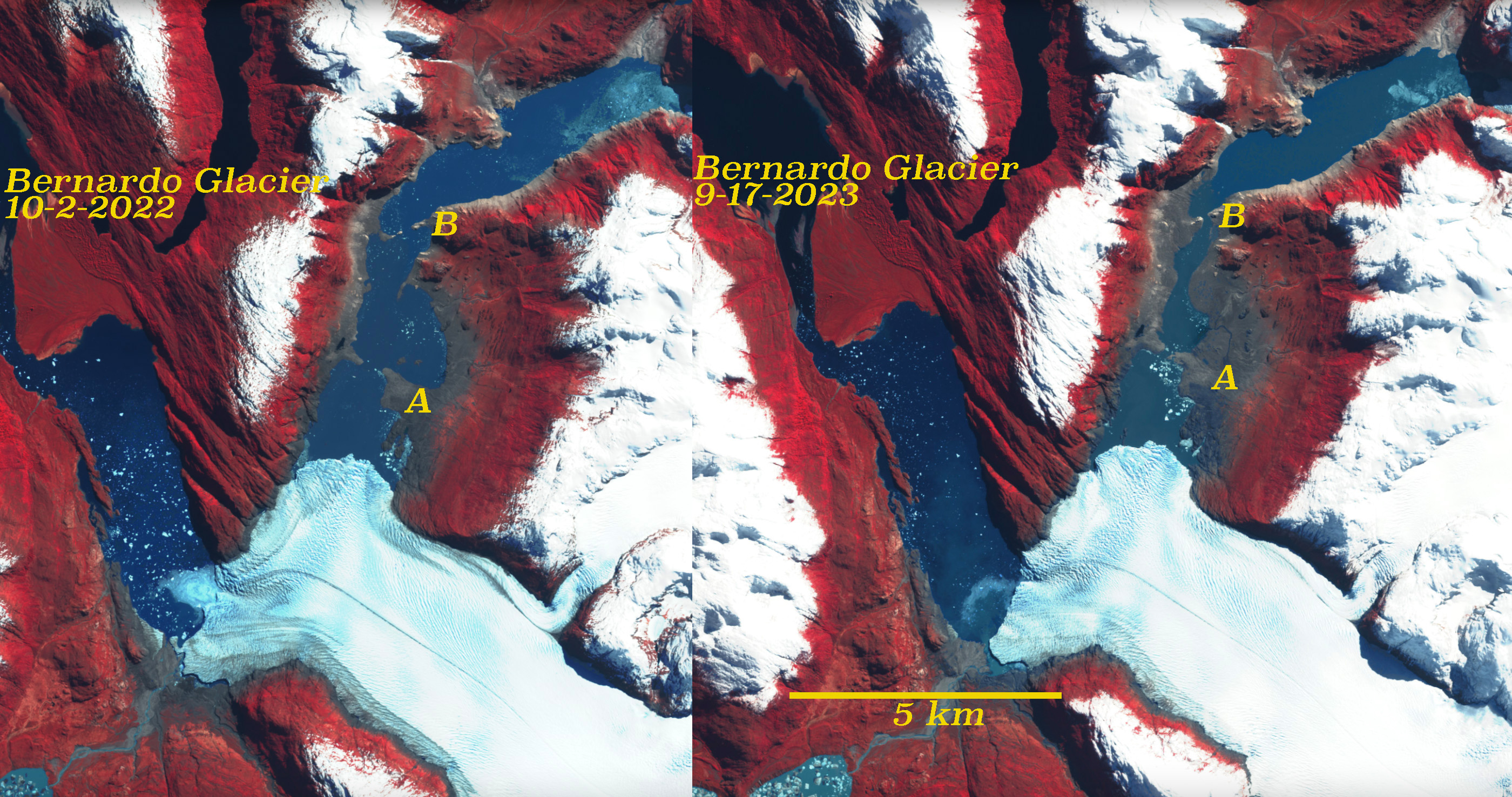
Bernardo Glacier in Landsat images from Oct. 16, 2022 and Sept. 17, 2023 illustrating the drainage of the southern end of the proglacial lake by the northern terminus (N). The lake was full in 2021, partially drained by Oct. 2022, further drained by March 2023 and has not signficantly refilled by Sept. 2023, still 8 km² of exposed lake bed. 

Bernardo Glacier in Landsat images from 1986 and 2021 illustrating retreat at the southern (S), middle (M) and northern (N) terminus respectively. Red arrows are 1986 terminus locations, yellow arrows are 2021 terminus locations. Separation from Tempano (T) occurs at southern terminus, while lake expansion occurs at M and N.

Bernardo Glacier is an outlet glacier on the west side of the Southern Patagonia Icefield (SPI) that currently ends in an expanding proglacial lake system, with three primary termini.  The northern terminus retreated 4.1 km from 1986-2021 leading to an 8.7 km² lake expansion. Total lake area which had remained filled during this period was Their was a significant drainage of the lake at the north terminus that by late summer of 2023 had left 8 km² of lake bed exposed, and as spring arrives in 2023 has yet to refill.  Davies and Glasser (2012) indicate that over the last century the most rapid retreat was from 2000 to 2011. Willis et a (2012)  note a thinning rate of 3.4 meters per year during this period of the Bernardo Glacier region, which drives the retreat. Eñaut Izagirre conducted fieldwork in this area in 2019 and provided two images from the middle terminus of Bernardo Glacier, see below.

Bernardo Glacier in Landsat images from 1998 and 2020 illustrating retreat at the southern (S), middle (M) and northern (N) terminus respectively. Proglacial lakes not yet signficant in 1998, expansive by 2020. Red arrows are 1986 terminus locations, yellow arrows are 2021 terminus locations. Separation from Tempano (T) occurs at southern terminus, while lake expansion occurs at M and N.

In 1986 Bernardo the southern terminus of the glacier was in tenuous contact with Tempano Glacier.  The middle terminus primarily ended on an outwash plain with a fringing proglacial lake developing.  The northern terminus had retreated a short distance south from a peninsula that had acted as a pinning point. A small lake developed completely separating Bernardo Glacier and Tempano Glacier. By 1998 the northern terminus had retreated into the wider,deeper portion of the lake basin that was now filled with icebergs. In 2015 the northern terminus had retreated 3.5 km since 1986. By 2021 the northern terminus had retreated 4.1 km.  This led to a 7.8 km² lake expansion at the northern terminus, with a total area of 17.5 km². On October 2, 2022 the water level had dropped some, with lake area falling slightly. The lake continued to fall through the summer season of 2023. The lake has not refilled through the winter and into the spring of 2023, with the lake having an area of 9.5 km², and 8 km² of lake bed still exposed. Will the lake refill this summer or drop even further? Gourlet et al (2016) identify Bernardo Glacier as having thinner ice than other large outlet glaciers such Jorge Montt or O’Higgins, which helps lead to rapid terminus change. Other glaciers experiencing singificant retreat in this region of the Souther Patagonia Icefield include Oriental Glacier, Lucia Glacier, and Ofhidro Glacier.

Southern Andean huemel an endemic deer on the foreland beyond Bernardo Glacier (photograph from Eñaut Izagirre).

Middle terminus of Bernardo Glacier in 2019 taken by Eñaut Izagirre who considers this a condor-view

Sentinel images illustrating drop in lake level and resulting lake drainage from Oct. 2, 2022 to Sept. 17, 2023.

Retreat of Bernardo Glacier in Landsat images from 2003 and 2015.

Glacier O’Higgins, Chile Rapid Calving Retreat 2016-2023

Glacier O’Higgins in February 16, 2023 Sentinel image with the 2002, 2016 and 2019 terminus also indicated. Point D marks a detached lobe on of ice on the northern margin in 2023. Point F marks the southern margin terminus front.

Glacier O’Higgins is a large outlet glacier of the Southern Patagonia Icefield (SPI) that terminates in Lago O’Higgins. Cassasa et al (1997) report that from 1896-1979 the glacier had retreated 13.8 km up an inlet of Lago O’Higgins.  The glacier remained stable in this position from 1979-1986 with a retreat of 800 m from 1986-1995.  Schaefer et al (2015) examined the mass balance of SPI and found Glacier O’Higgins had a calving flux of 2.15-2.97 cubic kilometers/year, and a calving front velocity of 2300 m/year. Malz et al (2018) noted a mean elevation change of -1.04 m/year for Glacier O’Higgins from 2000-2016, with the greatest thinning near the terminus.  Despite this thinning there is limited retreat during this period as the glacier terminated on a shallow bedrock sill (Gorlet et al 2016). They observed that the bed elevation of O’Higgins dropped off into a deeper basin beyond this ~1 km wide sill and remained below sea level for 15-20 km inland of the 2012 ice front location. Here we use 2016-2023 Landsat imagery to update changes observed from 1986-2018.

Topographic map of the terminus area of Glacier O’Higgins, with the ~2016 terminus. Note the elevation step at both the 2016 terminus sill and the sill just upglacier of the 2023 terminus.

From 2002-2016 retreat is limited with the terminus located on a sill, then in 2016 the glacier begins to retreat off of the sill into the deeper sub-glacial basin leading to a rapid retreat from January 2016 to February 2019 of  1900 m on the southern margin, 1800 m in the center and 600 m on the north side, with total recession of 3.0 km². The calving front was 1.75 km widenwith the glacier having retreated into a confined channel. From 2019-2023 the rapid retreat across the sub-glacial basin continued isolating a stagnant region on the north side of the terminus (Point D). The main calving front in 2023 is 1.6 km long with the stagnant region still calving as well. The recession from 2016-2023 has been 7 km² with 4 km² from 2019-2023.  The retreat since 2016 has been 3000 m on the northern margin, 3700 m in the center and 3500 m on the southern margin. The glacier along the southern margin in 2023 is near the next bedrock sill as identified by Millan et al (2019).  The sub-glacial basin between sills is ~4-5 km across, helping drive the rapid retreat across the basin. This is evident in the topographic map as well. The northern terminus still is over deep water, and has ~1 km to retreat to reach the sill crest.  Millan et al (2019) Figure 3 illustrates this is a wide sill that should provide short-term terminus stability until further thinning driven by mass balance losses leads to retreat much as occurred from 2000-2016. The retreat of this glacier is similar to that of Dickson Glacier and Upsala Glacier.

Glacier O’Higgins in Jnauary 9, 2016 Sentinel image Point D marks a detached lobe on of ice on the northern margin in 2023. Point F marks the southern margin terminus front in 2023.

Glacier O’Higgins in February 10, 2019 Sentinel image . Point D marks a detached lobe on of ice on the northern margin in 2023. Point F marks the southern margin terminus front in 2023.

Glacier O’Higgins in February 16, 2023 Sentinel image with the 2002, 2016 and 2019 terminus also indicated. Point D marks a detached lobe on of ice on the northern margin in 2023. Point F marks the southern margin terminus front. LM marks the lateral moraine from the Little Ice Age. FF is the forefield that has been deglaciated for ~50 years.

Upsala Glacier Separation from Bertacchi Glacier, Argentina

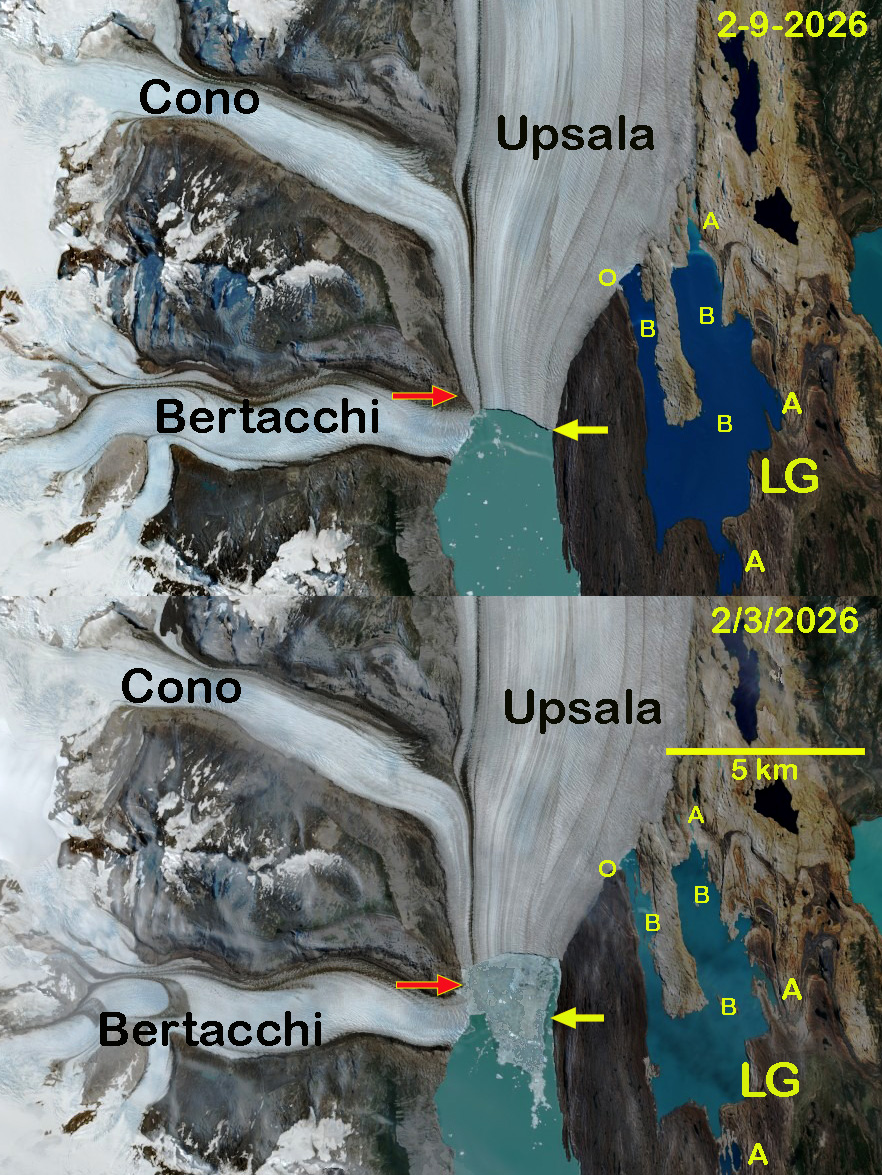
Upsala Glacier (U) in Landsat images from 1999, 2016 and 2021 illustrating both retreat and the separation from Bertacchi Glacier (B). Cono Glacier (C) is the next tributary to the north.

Upsala Glacier is a major outlet glacier of the Southern Patagonia Icefield. The glacier terminates in Lago Argentina and retreated substantially, 7.2 km from 1986-2014 (NASA, 2014). The retreat accelerated after 2008 (Sakakibara et al 2013). From 2014-2019 the rapid retreat had slowed, but given mass losses upglacier and consistent high snowlines ~1300 m in 2018-2021, not for long.

Landsat images from 1999-2021 illustrate the retreat of the glacier.  In 1999 the terminus is 3 km south of the junction.  By 2016 the terminus has retreated to the junction.  The combined calving front has a width of 2.8 km, and there is a 1.3 km long connection zone between Bertacchi and Upsala. By April and May 2021 the separation is nearly complete with a 0.3 km long connection zone, and in increase to 3.3 km wide calving front, in a Sentinel 2 image from May 5, 2021. The glaciers that have been joined for many centuries if not millenia, provide stability to each other at the junction, as there is converging flow that buttresses both.  As this buttressing is removed, the terminuses of both glaciers in the vicinity of the current terminus will be less stable.

De Angelis (2017)  noted the equilibrium line for Upsala Glacier was 1170 m based on 2002 and 2004 observations, which equates to an AAR of 65%.  On Feb 14, 2018 the TSL reached its highest observable elevation at 1275-1300 m. On March 14, 2019 the TSL reached 1300 m again. On April 8, 2020 the TSL reached 1325-1350 m upglacier of Point A and nearly to the Viedma Glacier divide. On April 17, 2020 the TSL had descended slightly to 1300 to 1325 m.  The ELA of ~1350 m is the highest annual observation for Upsala Glacier and equates to an AAR of ~48%. On April 17, 2021 the snowline on Upsala Glacier is again at ~1300 m. The consistently high snowlines drive mass balance losses, which leads to thinning and reduced flux to the terminus.  Malz et al (2018) indicated a 3.3 m thinning of Upsala glacier with significant thinning extending to the Viedma Glacier divide. Popken et al (2019) mapped the velocity at the confluence. The much slower Bertacchi has a low terminus velocity, in part due to the buttressing of Upsala.

The separation of Upsala Glacier due to rapid retreat parallels this pattern observed at other Southern Patagonia icefield outlet glaciers; Lago Onelli and  Dickson Glacier

May 5, 2021 Sentinel image of terminus zone of Upsala and Bertacchi Glacier.

Snowline on Upsala Glacier in April 2020 and 2021 Landsat images-pink dots, both years above 1300 m.

Terminus of Bertacchi and Upsala glacier in Apil 2020 and March 2021, note icebergs in March of 2021 from recent calving.

Gorra de Nieve East Glacier, Chile Retreat-Lake Expansion

Gorra de Nieve East Glacier in 1986 and 2021 Landsat images. Red arrow is the 1986 terminus location, yellow arrow is the 2021 terminus location, orange arrows the three main tributaries.

The Gorra de Nieve massif is 50 km southwest of Monte San Lorenzo, draining its eastern flank the largest glacier of this massif is unnamed and referred to here as Gorra de Nieve East Glacier. The glacier consists of three main tributaries that join shortly above the proglacial lake the glacier has terminated in, which drains into the Rio Bravo. In this region glaciers thinned by ~0.5 m/year from 2000-2012 with most of the thinning on  Gorra de Nieve East Glacier occurring on the lower sloped valley section below 1100 m (Falaschi et al 2017). The glacial history of the region is detailed in a visual map that includes moraines and trimlines including around the expanding proglacial lake discussed here Davies et al (2020).  Here we examine the changes of the glacier and the expanding proglacial lake from 1986 to 2020.

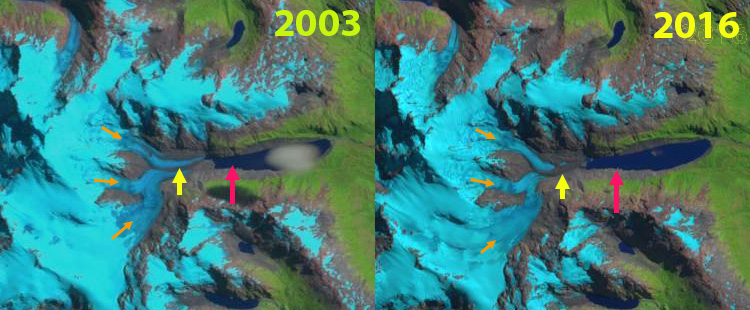
In 1986 the glacier terminated in a 3 km long proglacial lake, red arrow.  Three primary tributaries joined ~2 km above the terminus at 900 m, orange arrows. By 2003 the glacier has retreated ~500 m and the lateral moraines have become more prominent covering a majority of the glacier width.  By 2016 the glacier has retreated ~900 m from the 1986 position and lateral moraine debris covers nearly the entire lower 1 km of the glacier.  In 2021 the tributaries are separating with the northern tributary the only one feeding the terminus. The glacier has retreated 1500 m since 1986 and the proglacial lake is 4.5 km long.  The two southern tributaries will separate soon and the northern tributary will also retreat from the lake.

The retreat is similar to that  at San Lorenzo Sur Glacier or Calluqeuo Glacier.

Gorra de Nieve East Glacier in 2003 and 2016 Landsat images. Red arrow is the 1986 terminus location, yellow arrow is the 2021 terminus location, orange arrows the three main tributaries.

Tres Puntas Glacier, Chile Loses 50% of its Length this Century

Tres Puntas Glacier, Chile in 1999 and 2021 Landsat imagery. Red arrow is 1999 terminus location, yellow arrow the 2021 location, Point A is where tributaries joined in 1999 and Point B is where an adjacent glacier drains west.

Tres Puntas Glacier flow south from Cerro Tres Puntas draining south into Lago O’Higgins in Patagonia. The icefield is east of the Patagonia icefields where Davies and Glasser (2012) noted the nearby (50 km se) Lago Del Desierto glaciers lost 0.6% of its glacier area from 2001-2011, a much higher rate than from 1986-2000.

In 1999 the glacier is 5.6 km long with two significant tributaries joining at 850 m (Point A) before terminating in a proglacial lake at 600 m. The glacier shares a broad divide near Point B with glacier flowing west. In 2002 the snowline is at 1100 m, the terminus is still terminating in the proglacial lake. By 2020 the glacier tributaries have separated and now terminates at 900 m, above Point A. At Point B there is a separation between this glacier and the glacier draining west. By mid-February of 2021 the west tributary has retreated 2.8 km, 50% of its 1999 length, while the eastern tributary has retreated 2.4 km of its 5.0 km length. The snowline in mid-February of 2020 and 2021 has been at 1200 m, above the median glacier elevation. Further retreat of the eastern arm should lead to an additional alpine lake forming.

The retreat of this glacier is more extensive than that of the nearby Sierra Sangra glaciers,  Argentina.  The retreat from an expanding proglacial lake also has played out at Cordillera Lago General Carrera Icefield, Chile

Tres Puntas Glacier, Chile in 2002 and 2020 Landsat imagery. Red arrow is 1999 terminus location, yellow arrow the 2021 location, Point A is where tributaries joined in 1999 and Point B is where an adjacent glacier drains west.

Cachalote Glacier, Chile Retreats From Lake and Separates

Cachalote Glacier in a 1984 Landsat image and 2019 Sentinel Image.  Red arrow is 1984 terminus location, yellow arrow the 2019 terminus location and the pink arrow a tributary to the glacier in 1984 that separates.

Cachalote Glacier is on the western edge of the Southern Patagonia Icefield, Chile. The glacier is not fed by the main icefield, but is connected to glaciers that are.  The glaciers of the SPI have been experiencing significant mass loss and overall retreat. Willis et al (2012) observed significant mass loss from 2000-2012 of −20.0  Gt per year. Davies and Glasser (2012) indicate this area had its most rapid retreat of the 1870-2011 period after 1986.

In 1984 Cachalote Glacier terminated in a proglacial that was ~600 m long, red arrow.  The glacier was joined by a tributary from the west ~1 km from the terminus, pink arrow.  By 2001 the tributary had separated from the main glacier. The glacier still terminated in the proglacial lake, but had retreated 1.5 km and the proglacial lake was now just over 2 km long.  In 2017 the glacier no longer reached the proglacial lake. In 2019 the glacier has retreated 2.6 km from its 1984 position, 30% of its entire length lost in the span of 35 years. The glacier no longer terminates in a lake and ends near the top of a steep slope, both suggest that retreat should decline for the near future.

This is a less spectacular retreat than at HPS-12 Glacier which is a short distance to the norther and is the fastest retreating glacier in the region or Dickson Glacier on the east side of the icefield, but as a percent of glacier length lost is as substantial.

Cachalote Glacier in a 2001 and 2017 Landsat images.  Red arrow is 1984 terminus location, yellow arrow the 2019 terminus location and the pink arrow a tributary to the glacier in 1984 that separates by 2001.

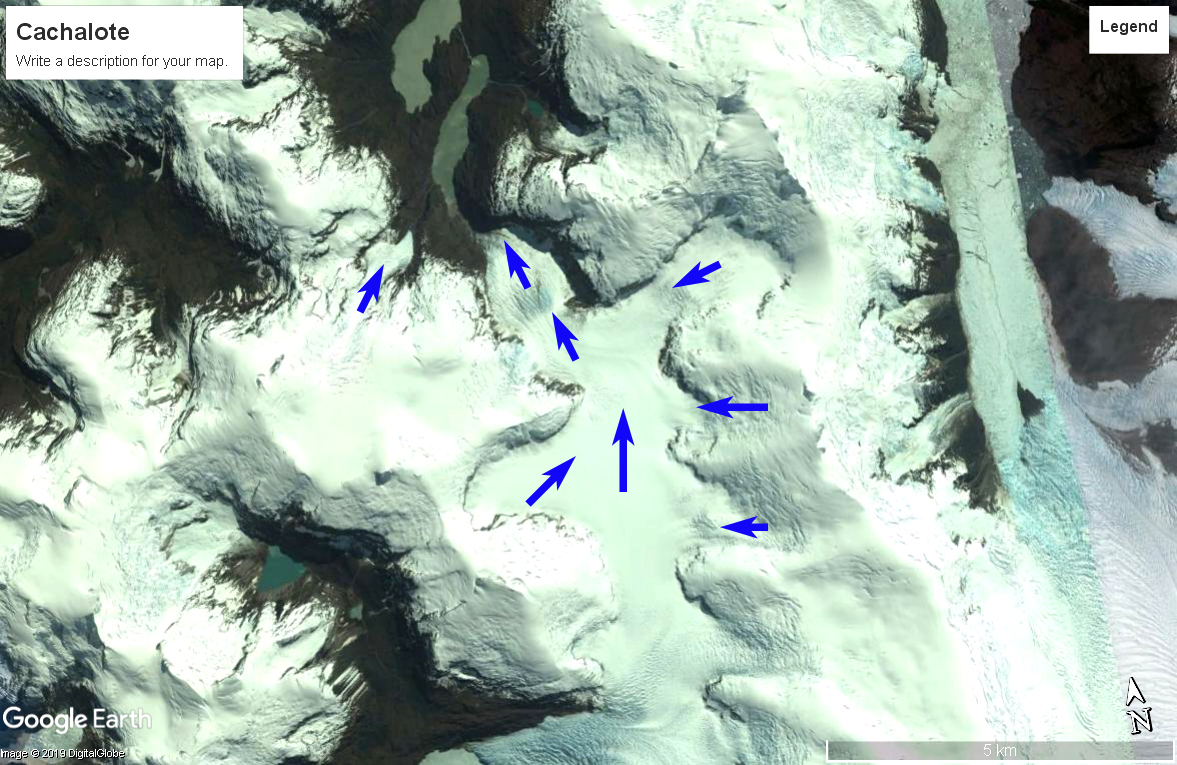
Cachalote Glacier with flow lines indicated. 

Erasmo Glacier, Chile Terminus Collapse and Aquaculture

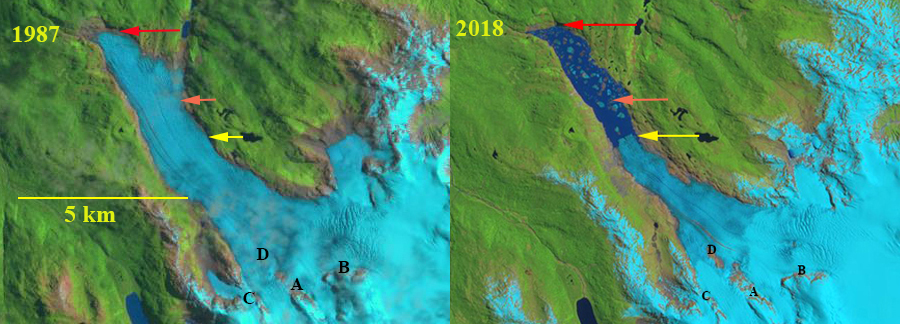
Erasmo Glacier retreat in Landsat image from 1987 and Sentinel image from 2018. Red arrow is 1987 terminus, orange arrow 2016 terminus and yellow arrow 2018 terminus. Points A-D mark areas of expanding bedrock exposure.

Cerro Erasmo at 46 degrees South latitude is a short distance north of the Northern Patagonia Icefield and is host to a number of glaciers the largest of which flows northwest from the mountain. This is referred to as Erasmo Glacier with an area of ~40 square kilometers.   Meltwater from this glacier enters Cupquelan Fjord, which is host to a large aquaculture project for Atlantic salmon, producing ~18,000 tons annually. This remote location allows Cooke Aquaculture to protect its farm from environmental contamination. Runoff from Erasmo Glacier is a key input to the fjord, while Rio Exploradores large inflow near the fjord mouth limits inflow from the south.  Davies and Glasser (2012) mapped the area of these glaciers and noted a 7% decline in glacier area from 1986-2011 of Cerro Erasmo. The recent retreat of the largest glacier in the Cerro Erasmo massif indicates this area retreat rate has increased since 2011. Meier et al (2018) note a 48% reduction in glacier area in the Cerro Erasmo and Cerro Hudson region, since 1870 with half of that occurring since 1986.

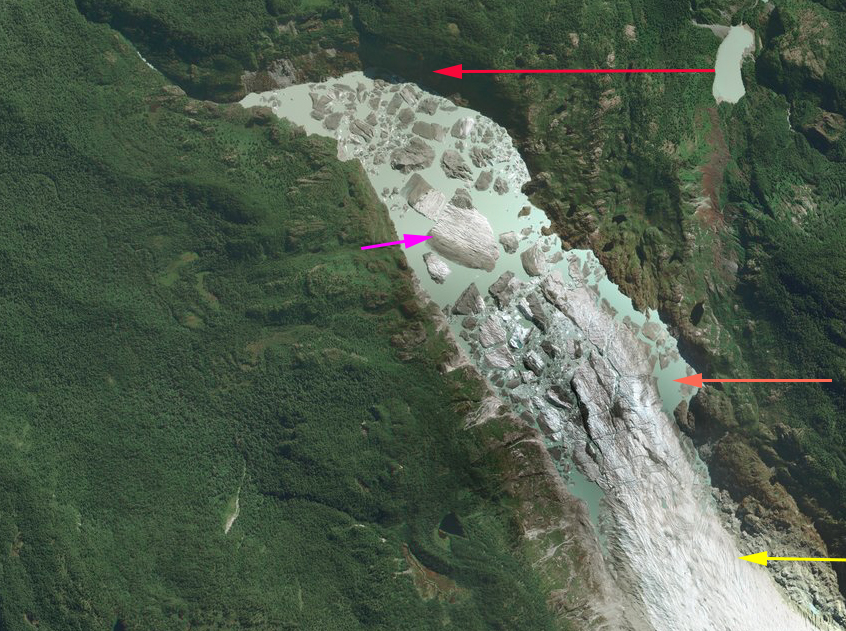
In 1987 Erasmo Glacier had a land based terminus at the end of a 6 km long low sloped valley tongue.  The snowline was at 1100 m.  In 1998 there is thinning, but limited retreat and the snowline is at 1250 m.  By 2013 a proglacial lake had formed and there are numerous icebergs visible in the lake, note Digital Globe image below.  The snowline is at 1200-1250 m in 2013 at the top of the main icefall. By 2016 a large lake had formed and the snowline is at 1200 m again at the top of the icefall.  By 2016 the terminus has retreated 2.9 km since 1987 generating a lake of the same length. The snowline in 2016 was at 1200 m at the top of the icefall  From 2016 to 2018 a further 0.9 km retreat occurred.  The 3.8 km retreat from 1998 to 2018 is a rate of ~200 m/year.  Thinning upglacier to the expanding ridge from Point A-D is evident. Thinning at Point C has eliminated the overflow into the distributary glacier that had existed. The collapse is ongoing as indicated by the number of icebergs in the lake in 2018.  there is an increased glacier surface slope 1 km behind the 2018 glacier front, suggesting the lake will not extend passed this point. The retreat is consistent with retreat documented at Reichert GlacierHornopirén Glacier and Cordillera Lago General Carrera Glacier. The impact on inflow to Cupquelan Fjord due to glacier retreat will be increased stream runoff during the wet winter season and reduced flow during the drier summer period December-February.  The summer season is still relatively wet.

Breakup of Erasmo Glacier terminus in Digital Globe image from 2013. Purple arrow indicates largest iceberg.

Erasmo Glacier retreat in Landsat image from 1998 and 2016. Red arrow is 1987 terminus, orange arrow 2016 terminus and yellow arrow 2018 terminus. 

Rio Engaño, Chile Headwater Glacier Retreat GLOF Threat Drops

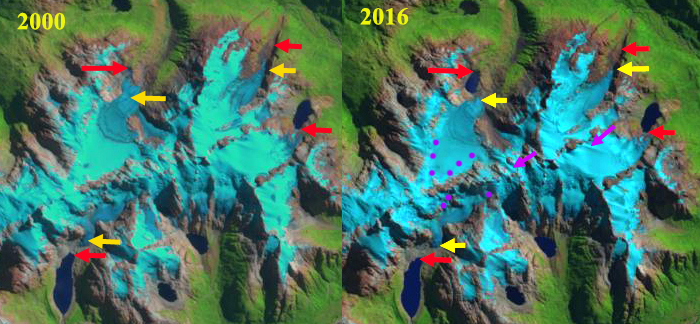
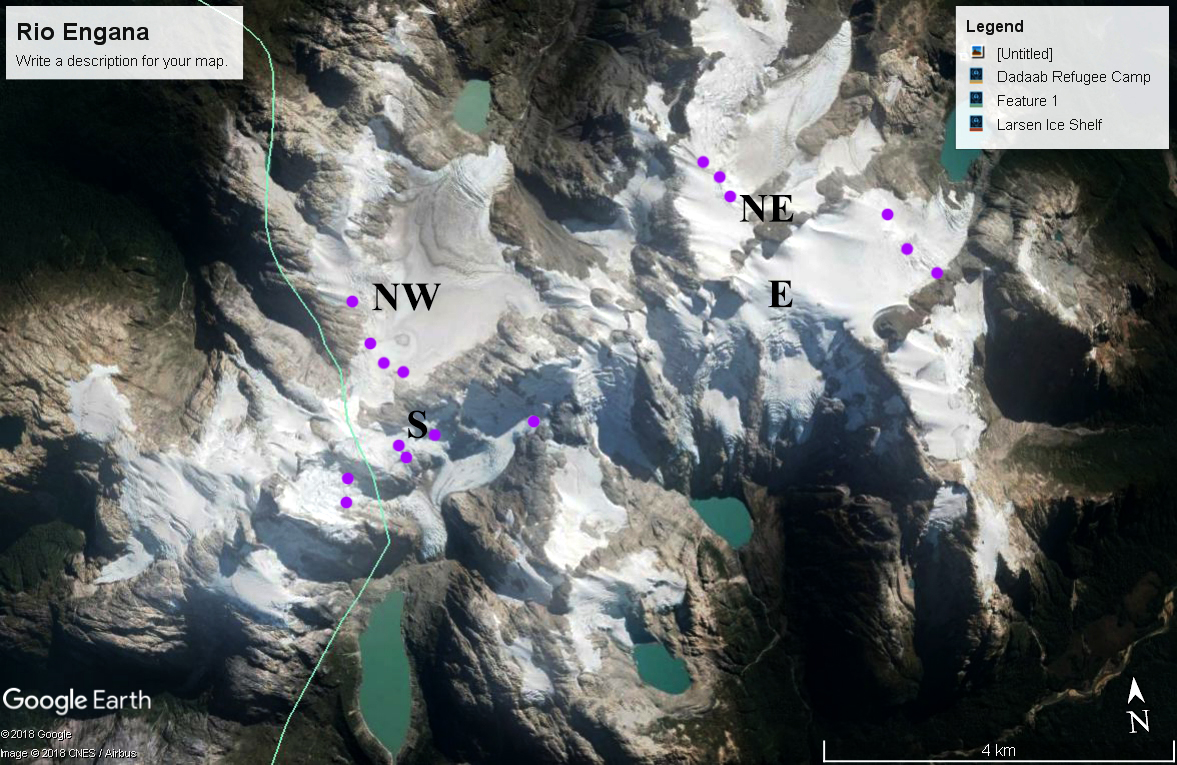
Comparison of glaciers at the headwaters of Rio Engaño in 1984 and 2018 Landsat images. The 1984 terminus location with red arrows, yellow arrows the 2018 terminus location, purple arrows wind drift patterns.

Rio Engaño drains into Lago General Carrera and its headwaters is a group of alpine glaciers.  In March of 1977 one of the glaciers, generated a glacier lake outburst flood (GLOF) that reached a depth of 1.5 m  at the small village of Bahía Murta Viejo 25 km down river (Anacona, et al 2015).  Davies and Glasser (2012) observe that glaciers just northeast of the Northern Patagonia Icefield lost area at a rate of 0.2% per year from 1986-2011.  Paul and Molg (2014) observed a more rapid retreat of 25% total area lost from glaciers in northern Patagonia from 1985-2011, the study area was north of the Northern Patagonia Icefield, including the Cordillera Lago General Carrera icefield.

Here we examine changes of four glaciers at the headwaters of Rio Engaño using Landsat imagery for the 1984 to 2018 period.

In 1984 the Northwest (NW) glacier had two terminus tongues and no lake at the terminus, red arrow. The Northeast (NE) glacier had a length of 4 km. The East (E) glacier terminated at the margin of a proglacial lake. The South (S) Glacier which experienced the GLOF, terminated on the northern end of a proglacial lake. By 2000 the NW glacier had lost its eastern terminus and a small lake is forming at the western terminus. The NE glacier had retreated 400 m. The S glacier no longer reaches the proglacial lake. In 2016 the snowline is quite high on the NW and S glacier, purple dots. The wind features, purple arrow indicate the strong wind sculpted features from the west winds. In 2018 the NW glacier no longer reaches the proglacial lake that began forming after 1984, total retreat 800 m. The NE Glacier has retreated 700 m and is now 3.3 km long. The E glacier terminates at the base of a steep slope 200 m from the proglacial lake it reached in 1984. The S glacier has retreated 600 m from the lake it reached in 1984. The NE and E glacier have substantial areas above 1600 m and have retained snowpack each year over a significant portion of the glacier. The NW and S glaciers have little area above 1600 m and in several years have retained minimal snowpack and will continue a rapid retreat.

Wilson et al (2018)  documented a 43% increase in the number of glacial lakes and 7% in the area of lakes in the central and Patagonian Andes. In the Rio Engaño headwaters both the area and number of lakes has increased. The threat of GLOF in for these specific glaciers appears to be declining as the glaciers retreat further from the lakes.  Iribarren et al (2014) list that glacier contact and glacier steepness adjacent to the lake are variables that raise GLOF hazards, and these factors are declining at the Rio Engaño headwaters.  They also noted that the GLOF in 1977 had a volume of 7.36 million cubic meters the second largest in their record of 16 GLOF’s.

Comparison of glaciers at the headwaters of Rio Engaño in 2000 and 2016 Landsat images. The 1984 terminus location with red arrows, yellow arrows the 2018 terminus location, purple arrows wind drift patterns and purple dots the snowline in 2016.

Google Earth image from 2017 indicating the snowline leaving limited snowcovered area on NW and S glacier. 

Bernal Glacier, Retreating from Chilean Fjord

Bernal Glacier terminus looking towards Estero las Montañas from Eñaut Izagirre and Camilo Rada.

Bernal Glacier drains east from the Sarmiento de Gamboa Range in Southern Patagonia terminating a short distance from the Estero las Montañas. The glacier is in the Alacalufes National Reserve and can be seen from boats traveling up the fjord. Davies and Glasser, (2012) indicate extensive recession of almost all glaciers in the range from 1870-2011. The fastest recession rate of recession of Bernal Glacier is from 2001-2011.  Melkonian et al (2013) observed that the Cordillera Darwin Icefield (to the south) had an average thinning rate of −1.5 m w.e/year from 2001-2011, while Willis et a (2012) quantify a rapid volume loss of the Southern Patagonia Icefield (SPI-to the north) from 2000-2012.  Incognita Patagonia has been exploring and mapping glaciers in the region since 2015 including a visit to Bernal Glacier in March 2017 that inspired this post Izagirre (2017)

In 1986 there is no proglacial lake evident at the terminus of the glacier, red arrow.  By 2013 the glacier has thinned and retreated enough to reveal a pair of proglacial lakes separated by a moraine where the glacier terminated in 1986, red arrow.  By 2017 the proglacial lake has further expanded and glacier thinning has revealed larger areas of bedrock at the purple arrows.  There is not significant calving in the shallow proglacial lake and the retreat is driven by surface melting. The revegetation of the proglacial outwash areas in 2017 is also apparent. The amount of retreat from 1986 to 2017 is best viewed in the Google Earth image below.  The vegetation trimline from the 1980’s is evident.  Total retreat from 1986 to 2017 is meters. It is The glacier drains the same ice field as the retreating Dama Blanca Glacier and Balmaceda Glacier.

Landsat comparison of Bernal Glacier in 1986, 2013 and 2017 with the red arrow indicating the 1986 terminus.  Purple arrows indicate two areas of bedrock that will be exposed.

Bernal Glacier in Google Earth image from 2015. Red arrow is the 1986 terminus, note the vegetation trimline at that point.

Looking at the Bernal Glacier  from the base camp Eñaut Izagirre and Camilo Rada.


Dama Blanca Glacier Retreat, Southern Chile

Dama Blanca Glacier in Landsat images from 1986 and 2017.  Red arrow is the 1986 terminus, yellow arrow the 2017 terminus, purple dots the snowline and purple arrows a bedrock ridge.

Dama Blanca Glacier drains west from Chile’s Sarmiento de Gamboa Range in Southern Patagonia. terminating in Lago Verde in the Alacalufes National Reserve. Alacalufes NR features kelp rich fjords, Northofagus coastal forests and glacier clad alpine zones. Davies and Glasser, (2012) indicated extensive recession of almost all glaciers in the range from 1870-2011. They indicate the fastest recession rate of  Dama Blanca is from 1986-2001. This range is between the Southern Patagonia Icefield to the north and the Cordillera Darwin Icefield to the south. Incognita Patagonia has been exploring and mapping glaciers in the region since 2015, and have provided a map shown below in coordination with Camilo Rada and Natalia Martinez of the UNCHARTED project . On Marinelli Glacier, in the Cordillera Darwin Icefield, Koppes et al (2009) indicated a retreat of 13 km from 1960 to 2005. More recently Marinellli Glacieri retreated ~3.75 km from 1998 to 2014. Melkonian et al (2013) observed that the Cordillera Darwin Icefield had an average thinning rate of −1.5 m w.e/year with more rapid losses north and west. This is a continuation of the trend noted by Holmund and Fuenzelida (1995) that glaciers on the northern side have a trend of receding fronts. On the southern side the present extent of some glaciers are similar to their 20th century maximum extents. The region is characterized by strong climatic gradients, with high rates of precipitation on the southwestern side of the range where glaciers are faring better and drier conditions on the northern side. Given that the Sarmiento de Gamboa Range is north of Cordillera Darwin it would be expected this area would have substantial recession.

Here we compare satellite images from 1986-2017 to determine the changes of Dama Blanca Glacier. In 1986, the glacier terminated at the end of a peninsula on the south side of Lago Verde, red arrow. The snowline was at 500m. In 2013 the terminus has retreated significantly from the peninsula and the snowline is at 650 m. By 2017 the terminus has retreated 700 m since 1986. The snowline is obscured by clouds in the Landsat image. In February 2017 the snowline is at 700 m. There is also expansion of a bedrock rib on the west side of the glacier that extends to 800 m, purple arrow. The glacier remains actively crevassed to the glacier front as illustrated by the Google Earth image. The glacier will continue to retreat as long as calving continues; however, there is an increase in slope 200-300 m from the current glacier front suggesting the limit for lake development. Izagirre (2017) and the UNCHARTED project explored a number of glaciers in the Sarmiento de Gamboa Range this spring, that will lead to a detailed current map. The retreat here is similar to that of Balmaceda Glacier.

Dama Blanca Glacier in Landsat imags from 2013 and Sentinel image from Dec. 2016  Red arrow is the 1986 terminus, yellow arrow the 2017 terminus, purple dots the snowline and purple arrows a bedrock ridge.

Map from the UNCHARTED Project indicating glaciers of the Sarmiento de Gamboa Range and exploration routes.

Google Earth image of Dama Blanca Glacier in 2013, with the 1986 terminus position at the red arrow.