Vera Glacier, Novaya Zemlya Retreat

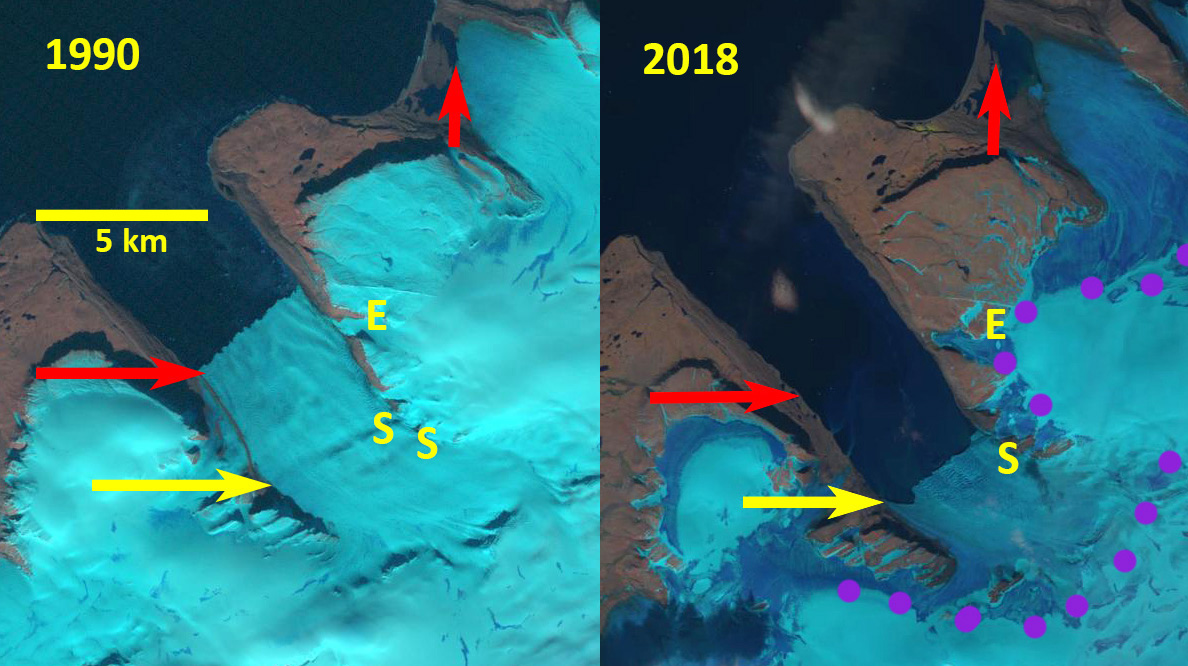
Vera Glacier in Landsat images from 1990 and 2018. Red arrow is the 1990 terminus and yellow arrow the 2018 terminus location.  Purple dots indicate the snowline, E indicates the eastern tributary and S the bedrock step.

Vera Glacier is on the west coast of Northern Noyaya Zemlya terminating in a fjord  Carr et al (2017) examined Novaya Zemlya glacier retreat between 1973/76 and 2015, finding that between 2000 and 2013, retreat rates were significantly higher on marine-terminating outlet glaciers than during the previous 27 years. Here we examine changes in Vear Glacier from 1990-2018 using Landsat imagery.

In 1990 the glacier terminated at the red arrow 1 km beyond a tributary entering from the east.  There is a marked rib at the yellow arrow in the 1990 image, suggesting a bedrock step beneath the glacier.   In 1995 the tributary from the east no longer reaches the main glacier, the terminus front has retreated several hundred meters and the snowline is at 300 m.  By 2016 the terminus has retreated well south of the eastern tributary nearly doubling the length of the fjord.  The terminus is now close to the bedrock step seen in the 1990 image.  By 2018 the glacier has retreated The snowline is again at  300 m. By 2018 Vera Glacier has retreated 3500 m since 1990, including past a second eastern tributary.  The fjord is now over10 km long.  The glacier is at the bedrock step with another bedrock step 500-1000 m upglacier.  Each step should indicate a reduced water depth and reduced calving.  The snowline in early August in 2018 is at 300 m, but rises to 600 m by the end of the month on neighboring Inostrantseva Glacier.  Pelto (2017) and Carr et al (2017)  discuss the role reduced Barents Sea Ice duration played in the retreat.  The retreat here is similar to that of other nearby Novaya Zemlya glaciers such as Mack and Velkena Glacier or  Inostrantseva Glacier.

The glaciers in this region are also a potential source for radiation from nuclear weapons testing by Russia from 1957-1962.

Vera Glacier in Landsat images from 1995 and 2016. Red arrow is the 1990 terminus and yellow arrow the 2018 terminus location.  Purple dots indicate the snowline and E indicates the eastern tributary.

Vilkitkogo Glacier Rapid Retreat, Novaya Zemlya 1990-2015

vilkitskogo compare

Figure 7.4.  Vilkitskogo South Glacier (Vs) and Vilkitskogo North Glacier (Vn) compared in 1990 and 2015 Landsat images.  Red arrows indicate 1990 terminus positions, yellow arrows 2015 terminus positions and purple arrows upglacier thinning.

Vilkitskogo Glacier has two termini that were nearly joined in Vilkitsky Bay in 1990.  The glacier flows from the Northern Novaya Zemlya Ice Cap to the west coast and the Barents Sea. The glacier has been retreating like all tidewater glaciers in northern Novaya Zemlya (LEGOS, 2006).  Carr et al (2014) identified an average retreat rate of 52 meters/year for tidewater glaciers on Novaya Zemlya from 1992 to 2010 and 5 meters/year for land terminating glaciers. For Vilkitskogo they indicate retreat into a widening fjord, and that the south arm has a potential bathymetric pinning point. The increased retreat rate coincides with the depletion of ice cover in the Barents Sea region and a warming of the ocean. Both would lead to increased calving due to more frontal ablation and notch development similar to at Svalbard (Petlicki et al. 2015)

The north and south glaciers both terminated at the mouth of their respective fjords in 1990, with the southern arm ending on a small island/peninsula extension. In 1994 there is limited evident retreat.  By 2001 embayments had developed particularly along the peninsula separating them.  By 2015 Vilkitskogo North has retreated 5000 m along the northern side of the fjord and 4000 m along the south side since 1990.  This fjord has no evident pinning points, and the rapid calving retreat should continue.  Vilkitskogo South has retreated 1000 m on the west side and 1800 m on the east side.The retreat has exposed a new island in the center of the glacier.  The glacier is currently terminating on another island.  Retreat from this pinning point will allow more rapid retreat to ensue.  Upglacier thinning is evident in the expansion of bedrock areas and medial moraine width, purple arrows. This indicates the retreat will be ongoing. There is still a large are of snowcover across the summit of the ice cap each year. The retreat has the same unfolding story as Krivosheina, Nizkiy and Glasova Glacier

vilkitskogo1994

1994 Landsat Image

vilkitskogo 2001

2001 Landsat image