North Cascade Glacier Climate Project 2025 Field Season Summary: Year 42

Core field team in 2025 Emmett Elsom, Mauri Pelto, Jill Pelto and Caitlin Quirk.

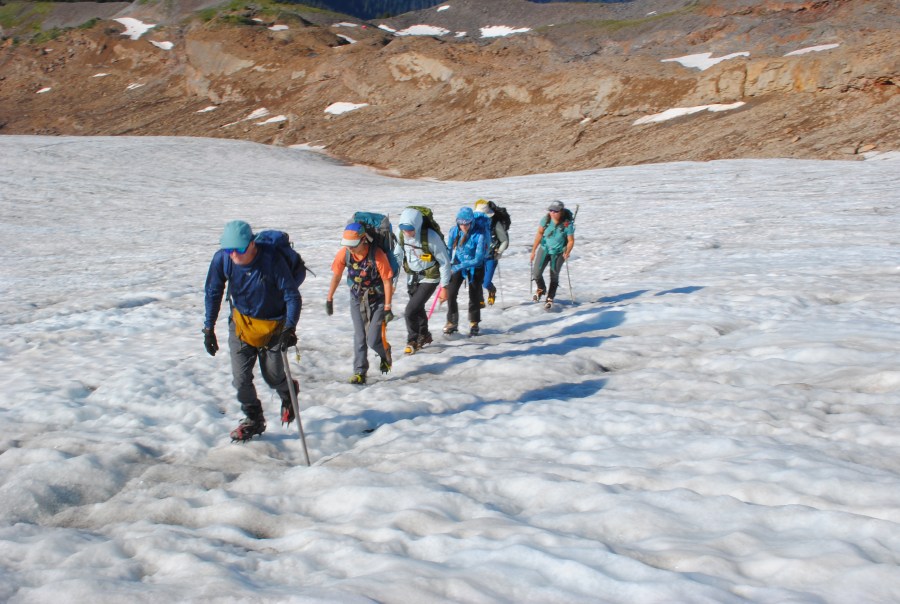
We hiked into North Cascade glacier to complete detailed observations for our 42nd consecutive year. These annual observations provide a detailed assessment of their response to climate change. For the third consecutive year North Cascade glacier on on average lost more than 2 m of glacier thickness. This cumulative loss of 7-8 m on most of the ranges glaciers that average 25-40 m in thickness represents 20% of their volume lost in just three years. On a few of the largest glaciers, such as those on Mount Baker that average 40-60 m in thickness the loss represents 12% of their volume lost.

The consequence is an acceleration of the collapse of the North Cascade glacier system. This landscape that has for long been shaped by ice is rapidly losing that glacier element. The rate of retreat for the glaciers we work on has accelerated so quickly that we are faced each year with changing terrain and new challenges. Beyond that, we are starting to really see the effect this retreat and the decrease in water has on the ecosystems both near the glaciers and further downstream. During the field season we love seeing the wildflowers, eating blueberries, and counting mountain goats. These are all parts of a habitat that is built around glaciers and snowpack. Seeing these shifts has been really difficult, but it helps to still return to these landscapes and continue to tell their stories through science and art. Below the story is told in images with captions by each of us who participated.

Two things that stood out during the 2025 field season were the strength of our collaborations, and the changing resources the glaciers are able to provide to the surrounding ecosystem. This visible change attracted the attention of KING5-Seattle NBC affiliate and CBS Morning News. At the bottom of this post the resulting footage is embedded. The film “Shaped By Ice” Jill and I worked on with Dan McComb has been a finalist in two recent film festivals, this footage also at bottom of this long read post.
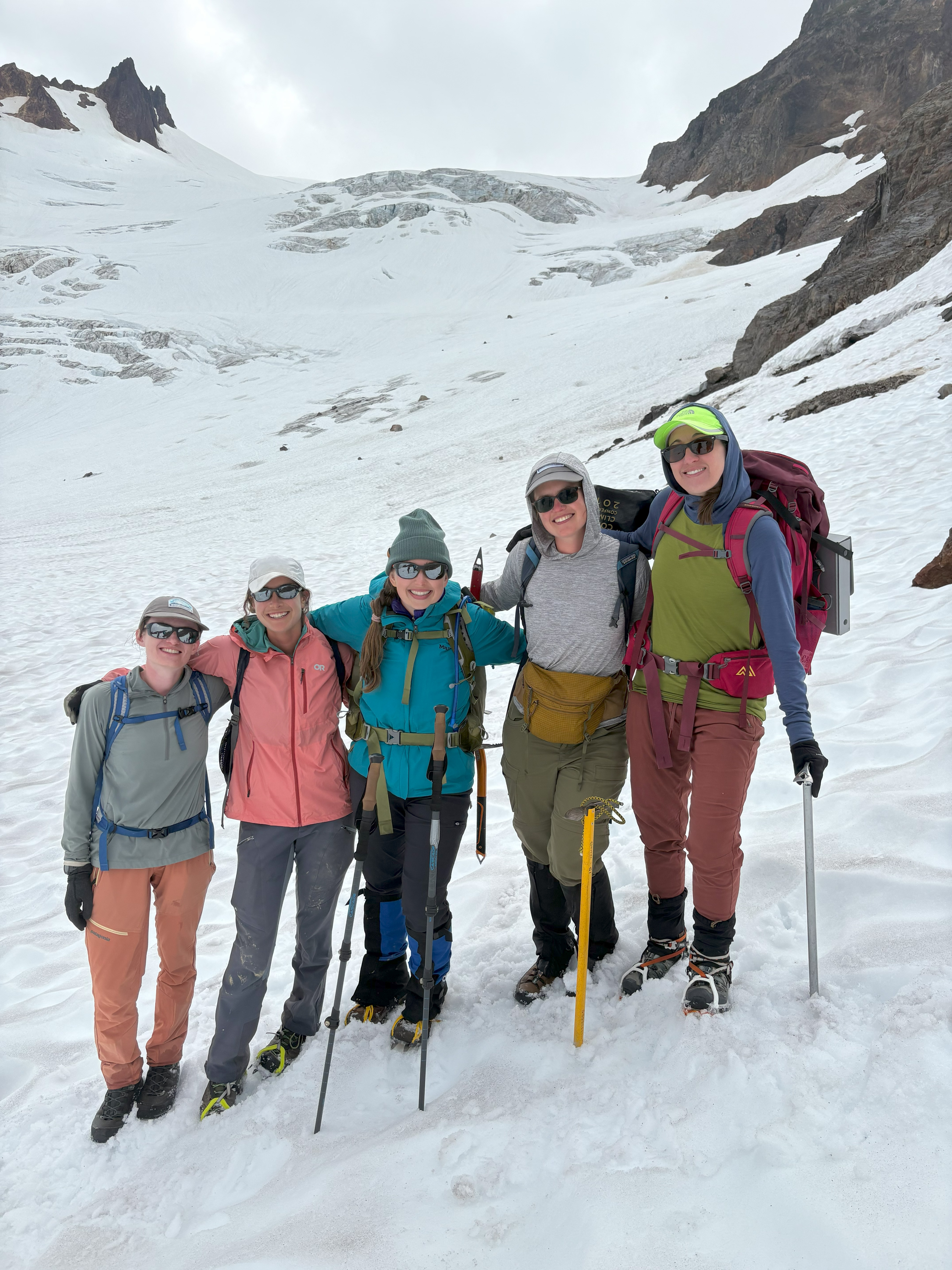
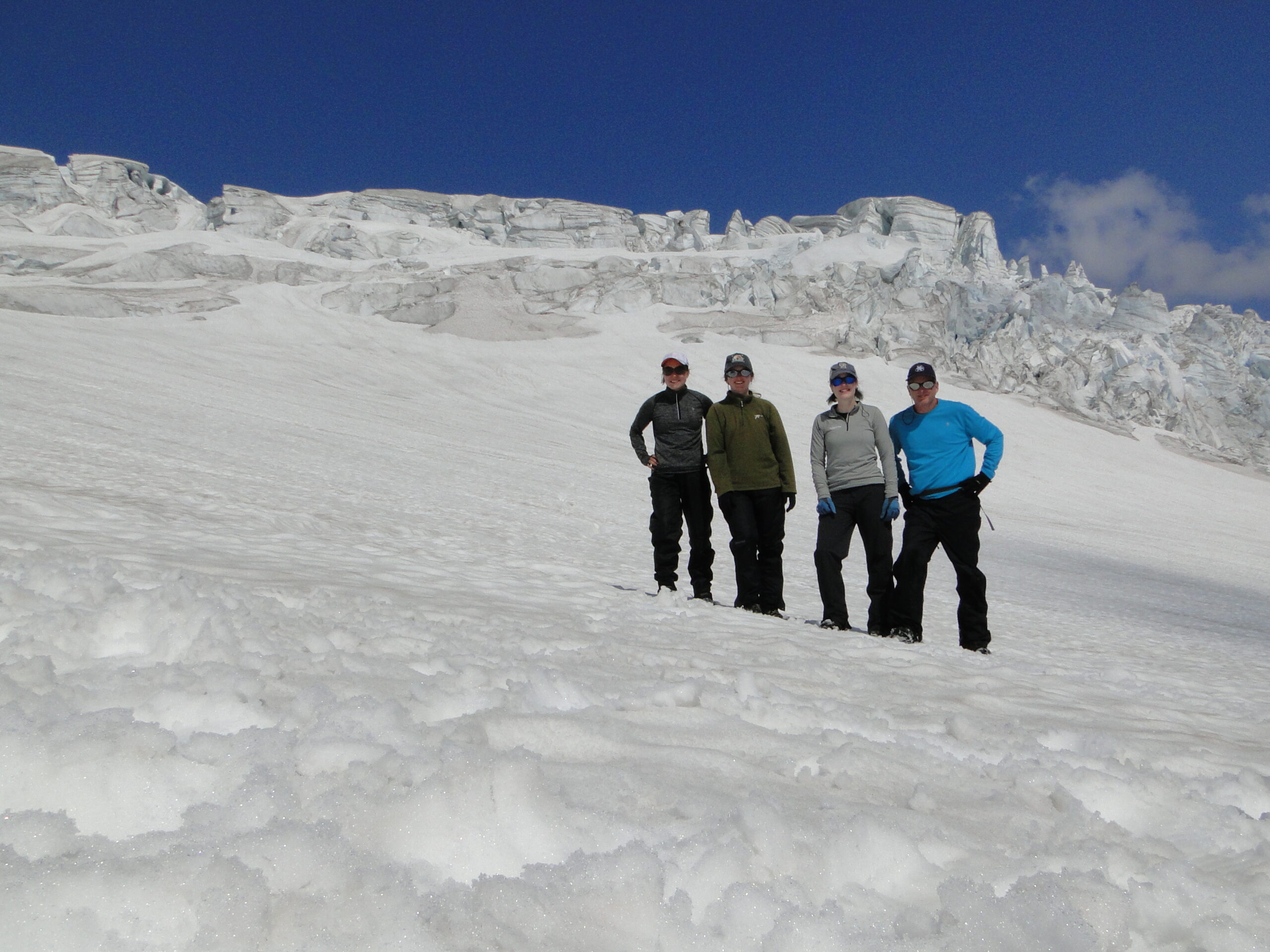
Working on Rainbow Glacier from left-Katie Hovind, Caitlin Quirk, Claire Seaman, Jill Pelto and Margaret Kingston

We worked with two oil painters, one watercolor painter, one printmaker, two news film crews, a team of botanists, and more. The result of all these collaborations has led to so many great stories being created and shared about our collective work. It also meant our core group of field assistants had to be flexible to a changing group and the sometimes difficult and imperfect logistics that accompany that. -Jill Pelto

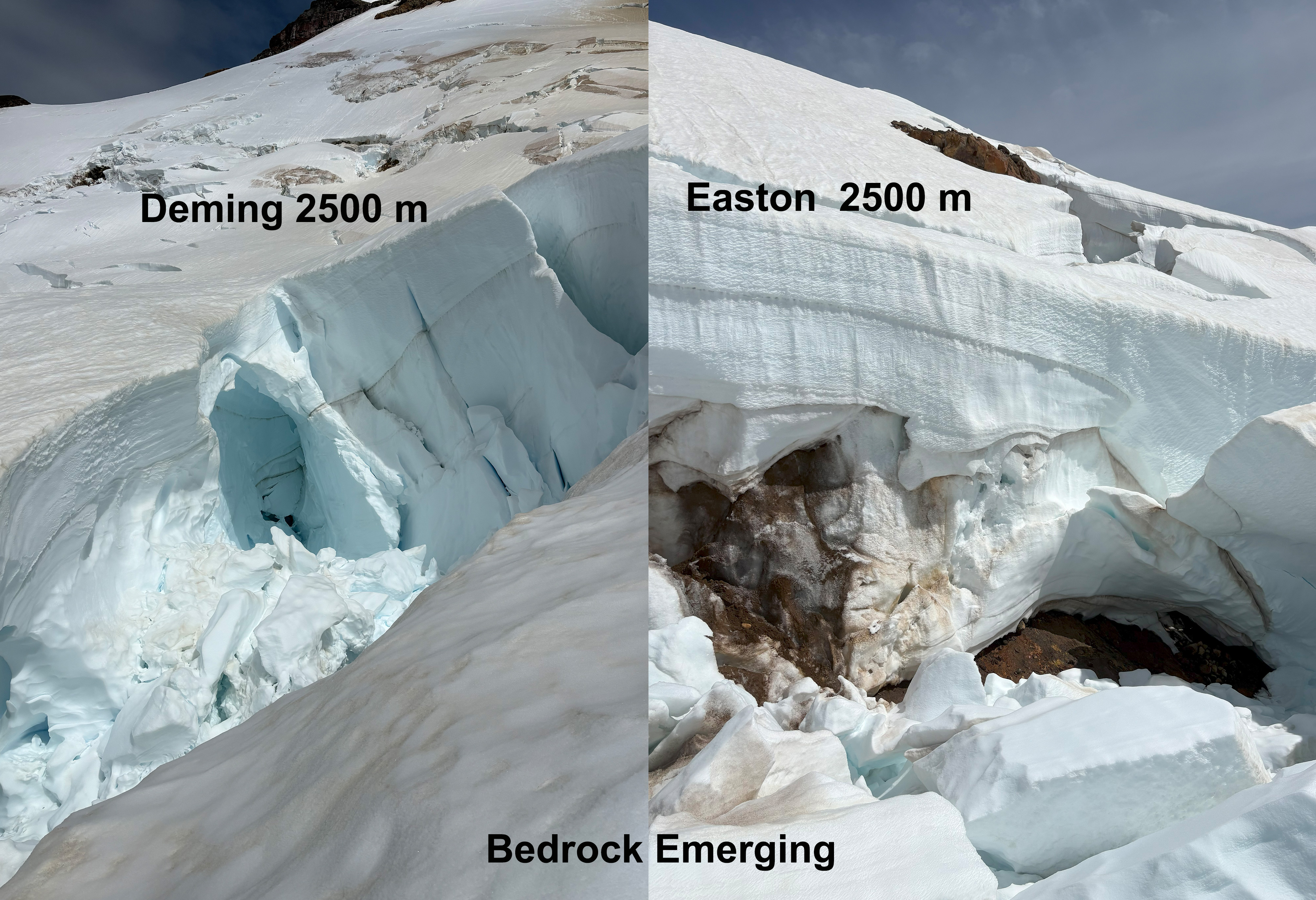
This photograph of an icefall at 2000 m (6700 ft) on the Easton glacier encompasses the wide range of emotions that I felt working on these glaciers this summer. The focal point of the picture is the wound inflicted upon the glacier by our changing climate. Bedrock and sediment creep through the gaping wound in the lowest icefall of the Easton, the opening visible for the first time in the project’s 42-year history. The place also holds a beauty, a sense of majesty that cannot be diminished by the tragic context of our work. The seracs at the top of the scene lean at impossible angles, destined to crash down onto the slope below, piercing the quiet of the snowy expanse in dramatic fashion. The dark annual layers in the glacier speak to the age of the ice, flowing down the flank of Mt. Baker over decades. The landscape has been a facet of my life for the past few years, as it falls upon the Easton Glacier route to the mountain’s summit. The icefall has always drawn me in as I pass, sparking a profound sense of wonder. It makes me deeply sad to see the beauty of such special places diminished, sad in a way that little else does. Over the past few years, I’ve come to like visiting these places to visiting an elderly loved one. While time may change them and even take them away from us, their beauty and meaning to me will hold true.-Emmett Elsom
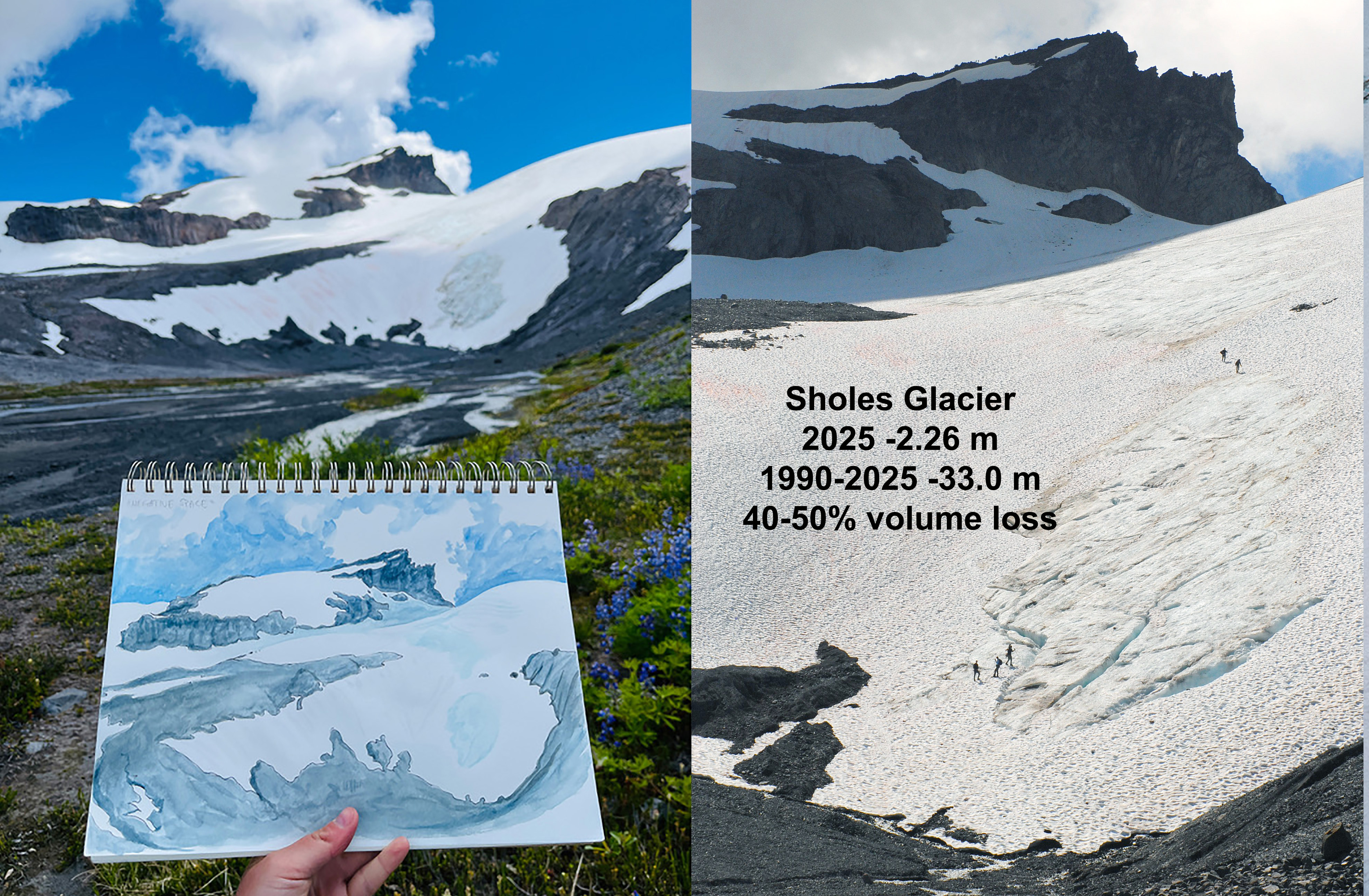
How does being present in a place shape our understanding? To the left is a view of Sholes Glacier, complete with my on-site rendition. I can’t express how lucky I feel to have had the chance to experience these places first hand. To interact with a place by attempting to capture its likeness — paying attention to the negative space not only between the white snowpack and black exposed rock, but in the empty, carved-out area that used to be filled with ice. Experiencing the texture of the glacier under your feet, the cool air drifting off the snow, the good tired feeling of your body after physically traversing top to bottom. This is what you don’t get from a photo. To know places such as these is to love them and see their role in the world, and want to protect them. But so many never get the chance to understand them this way.-Claire Seaman

This field season I focused on exploring the once-barren foreland a glacier leaves behind. Studying the plants growing in the wake of the Easton Glacier made me reflect on the way life responds to these major changes. This photo of a bright monkeyflower cluster in the streambed of the nearby Sholes Glacier exemplifies this resilience and optimism to me. The Sholes, in the background, drains a lifeblood that will feed the watershed downstream into the Nooksack, supporting people, fisheries, and a whole riparian ecosystem. The eventual loss of glacial ice feeding the river will be catastrophic, yet the scarred space left behind will blossom with vegetation. Witnessing firsthand how staggering the extent of glacial retreat is can be overwhelming, but that bright patch of flowers stands as encouragement. Alone in an altered landscape, those flowers will pave the way for more to follow. Change is nuanced, and as we watch it occur we can change, sharing stories of the beauty of this environment supported by ice, and adapting our lives and policies in a way that can be the difference which keeps glaciers flowing.-Katie Hovind
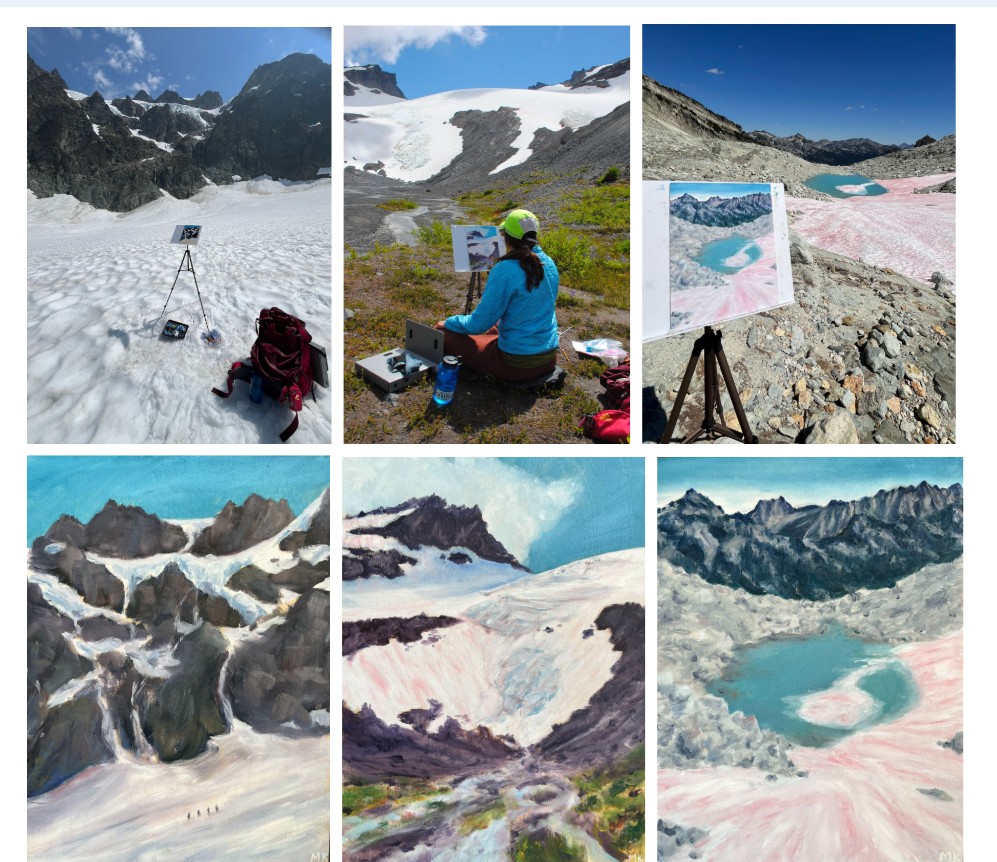
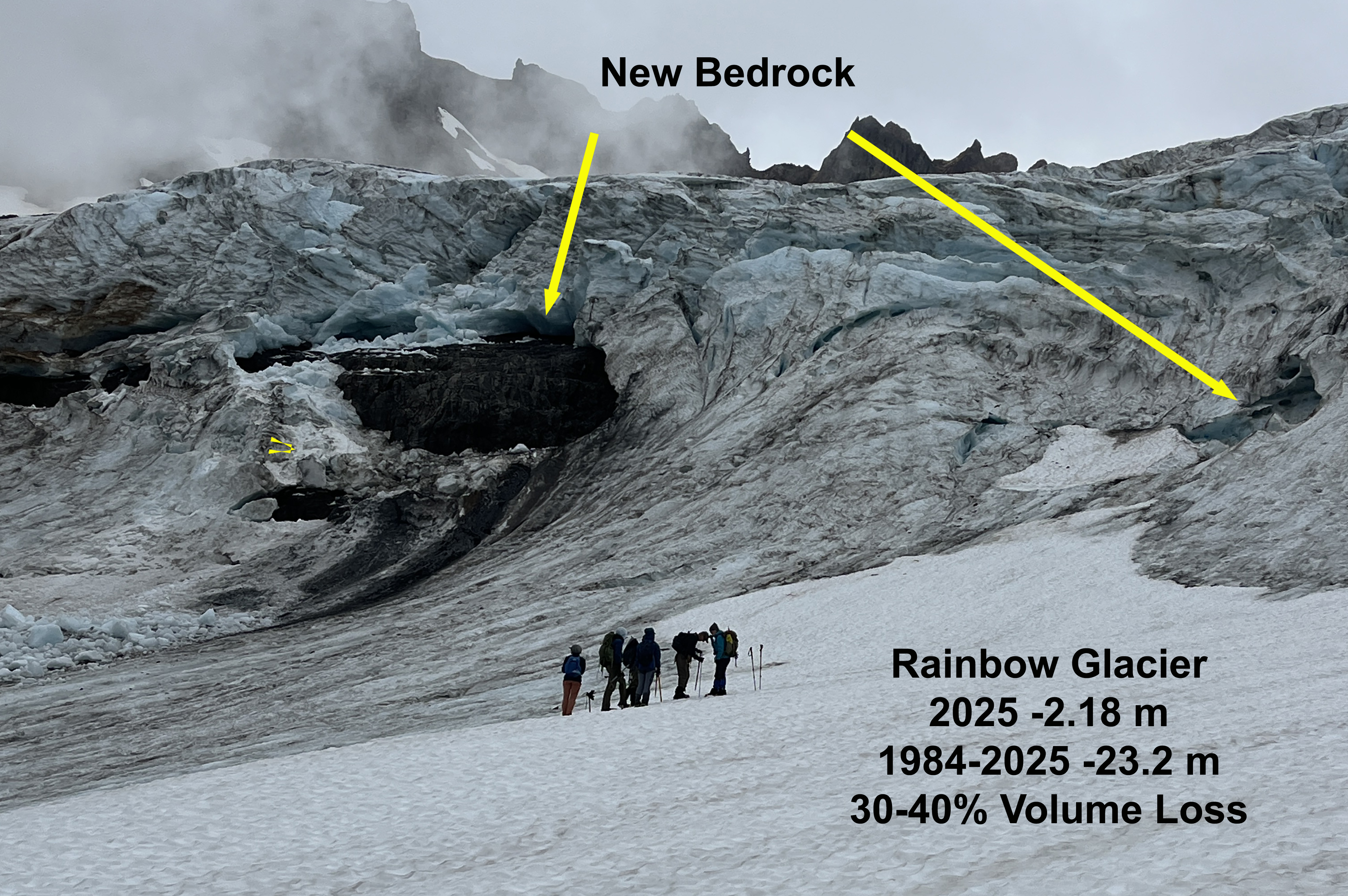
As a backcountry skier and oil painter focused on winter landscapes of the North Cascades, the idea of painting glaciers in the field was a dream come true! I knew what we would see and learn about the health of our glaciers from the scientists would be highly emotional, but the power of these environments disappearing in our lifetimes is something my words fail to communicate how devastating that feels. During the study on Rainbow glacier I caught on film the moment a serac collapsed, loudly crashing, crumbling from a newly melted out rock knob down the mountain splitting into smaller and smaller pieces. It looked sickly as it broke before our eyes. Another unique experience was going into a teal, translucent, otherworldly ice cave. I have started 2 paintings to capture this vanishing environment. My goal is to assist the project in translating the study’s findings through landscape paintings that communicate the beauty of these places with titles that call attention to the retreating glaciers in the North Cascades. We all have a responsibility as humans to make individual changes to combat climate change and vote like fresh water and air depends on it, because it does. -Margaret Kingston

The pace of glacier change struck me hard this summer. Never before have humans lived with such a deglaciated Cascades mountain range. Not the settlers, not the fur trappers, not the first people who have been here for 13,000 years or more. Cultures and ecosystems spawned from the retreating edge of the Cordilleran Ice sheet into the Puget Sound area. Alpine glaciers fed streams, rivers, salmon, all kinds of human projects in Washington State. Our societies are shaped by the ice and now we are experiencing glaciers disappear.

I write this at the end of the 2025 hydrological year, waiting for winter snow to shelter the land I love in a cool white blanket. The devastation of the alpine glaciers has surfaced so frequently in conversation these last couple months. Those who have seen the mountains are alarmed as beds of ice they once knew to be hundreds of feet thick look shallow and frail, ice pitches that were once climbed are now grey gullies of rock, and volcanoes which have always been white are unnervingly gray and shrouded in smoke. The realities of climate change in the Northwest are clear.

It is a painful time to care about the glaciers of the Cascades. Witnessing the erosion of something so much older and bigger and impactful than myself is staggering. There is much action to be done in this new terrain but for now, I come back to this: I sit in the dying glaciers warm light as the sun rises, summon the deepest snowfall in years and tell the glacier that we care, that we were grateful for all the help watering our food and feeding our oceans and making sure our salmon had somewhere to live. We are here because of you. 
-Cal Waichler
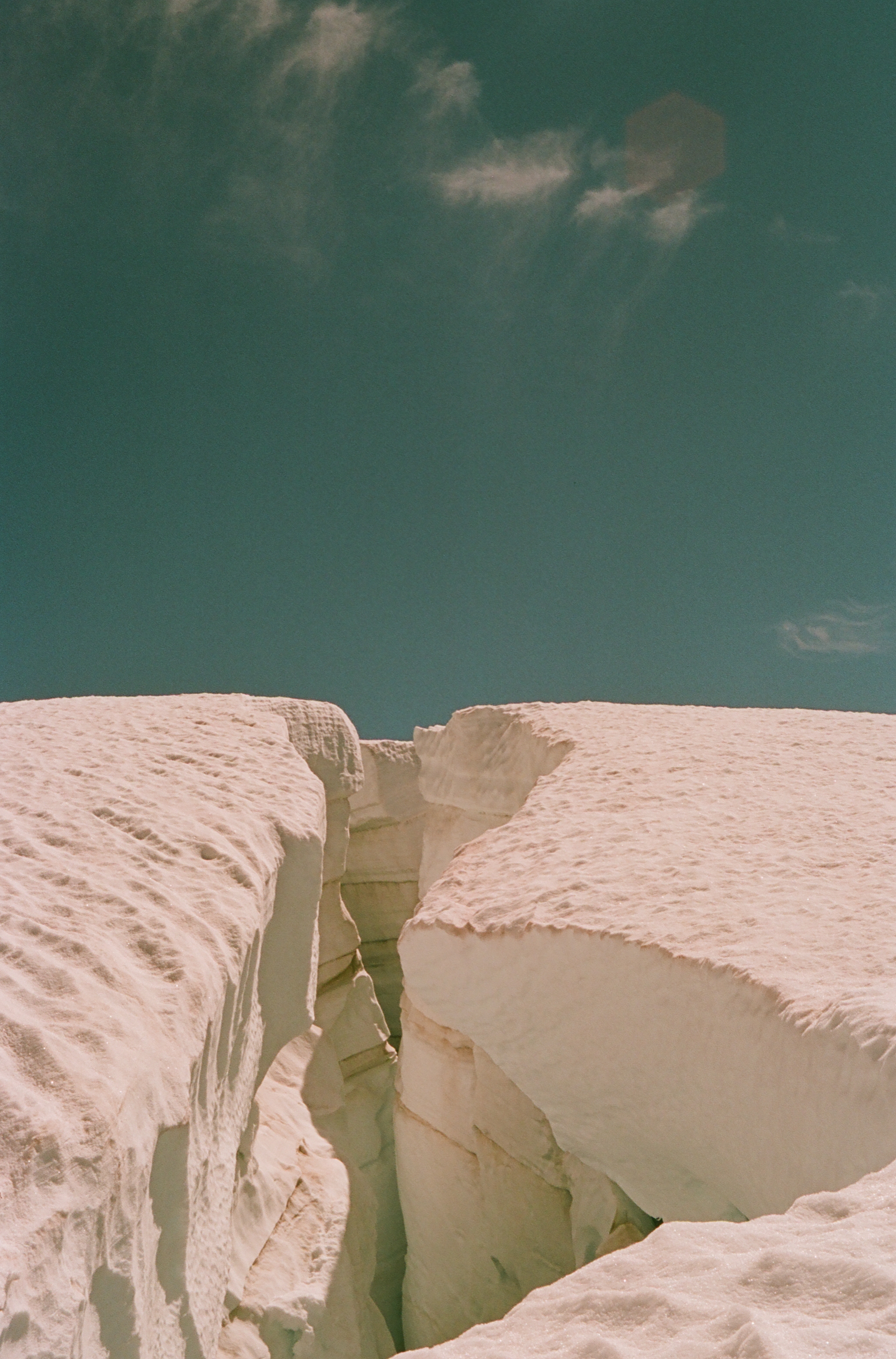
Image description: This image shows a crevasse on the Easton Glacier of Mount Baker. The saturation is distorted because I shot this photo on 35mm and pre-exposed the film to light and heat to parallel the material effects of global warming on our glacier systems. The Easton glacier is a source of water for Baker Lake, which provides recreation and hydropower to the region. When I see this photo, I think of the impacts of glacial melt to water, energy, cultural, and economic resources in Washington. -Caitlin Quirk
Columbia Glacier is one of sixty global reference glaciers. This summer it lost 5% of its volume.
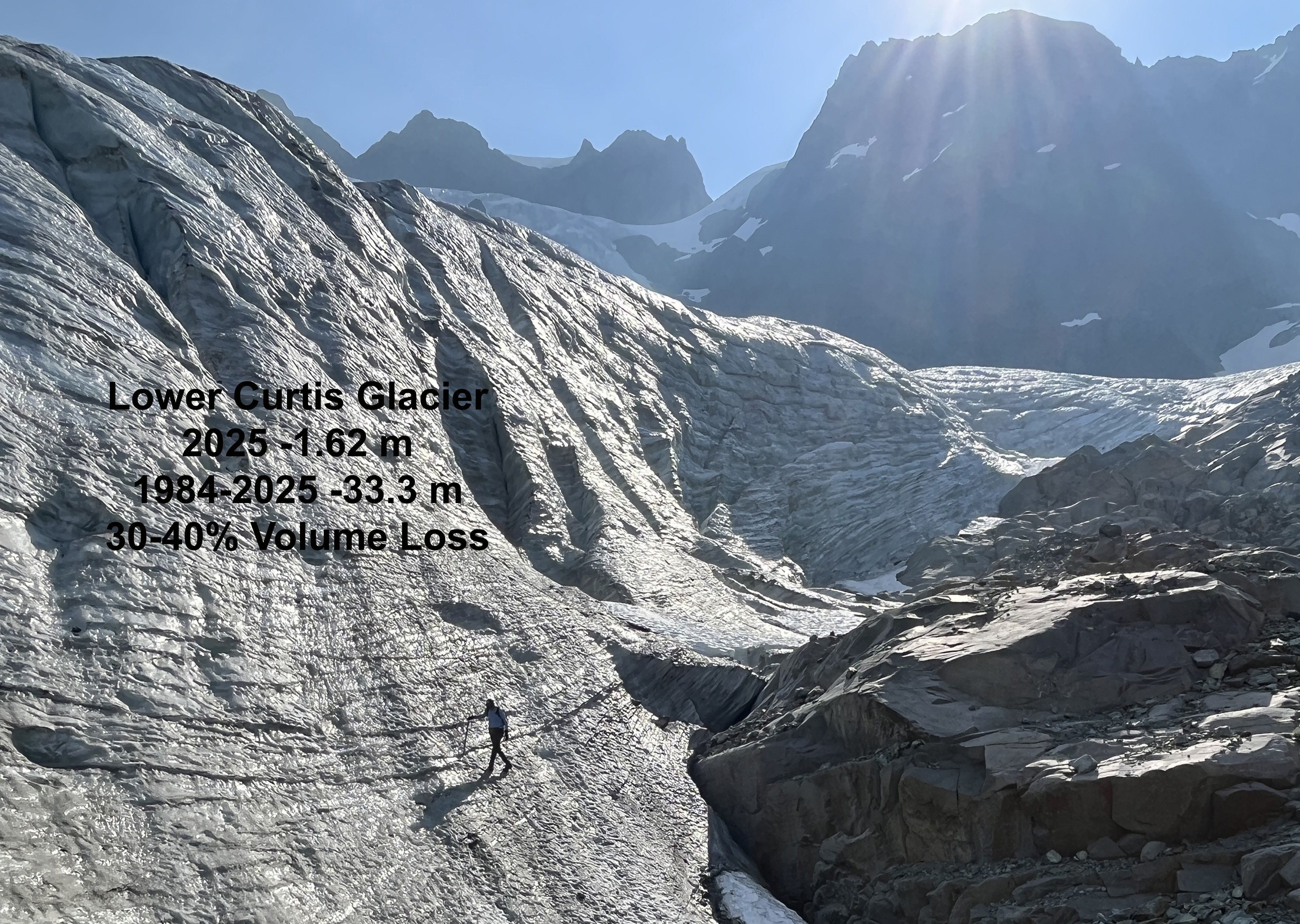
Lower Curtis Glacier continues to rapidly thin at the top of the glacier as well as at the terminus. The glacier retained additional avalanche accumulation, leading to a less negative balance than other glaciers.
Rainbow Glacier is one of the sixty global reference glaciers. This year new bedrock began to emerge and expand in several icefalls, leading to serac fall.
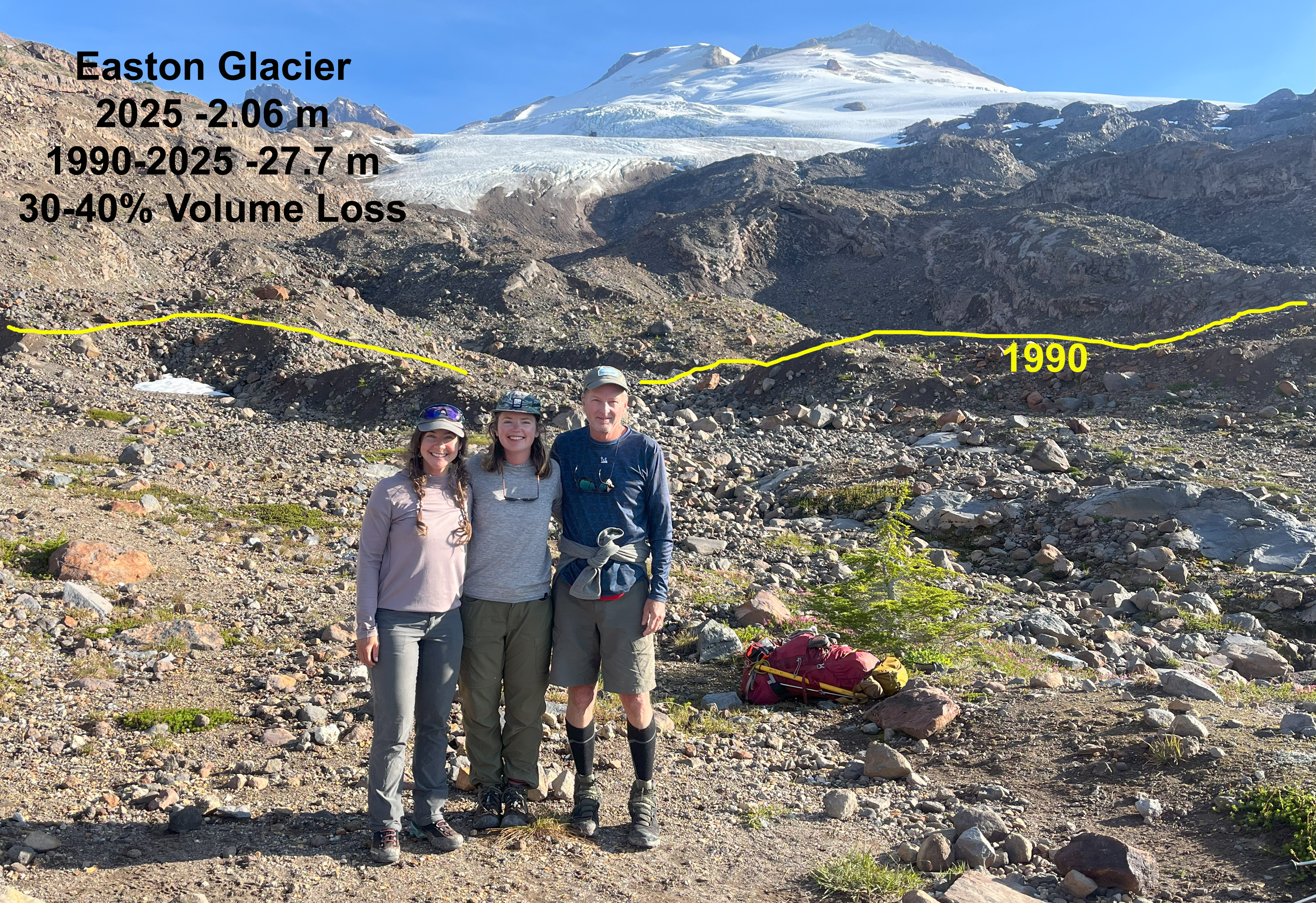
Easton Glacier has retreated 700 m since 1990 and has a number of bedrock areas emerging in icefall up to 2500 m.
Lynch Glacier east and west side are separating. The upper basin did retain some snow in 2025.
Daniels Glacier lost all snowpack by the end of the summer and bedrock is quickly expanding amongst the glacier.

The trajectory for most North Cascade glaciers is one of fragmentation. This is illustrated by Foss Glacier on the east flank of Mount Hinman, that we began observing annually in 1984 but stopped measuring as it fragmented. Foss Glacier from the top was a 1 km long and nearly 600 m wide glacier. In Sept. 2025 Cal Waichler captured view from the top with the two main fragments now less than 50 m wide and 300 m long.-Mauri Pelto

Leah Pezzetti KING5 meterologist hiked in with us to Lower Curtis Glacier.
The CBS team hiked into Sholes Glacier with us spending the night, and we had three generations of Pelto’s.

40th Field Season of North Cascade Glacier Climate Project Underway

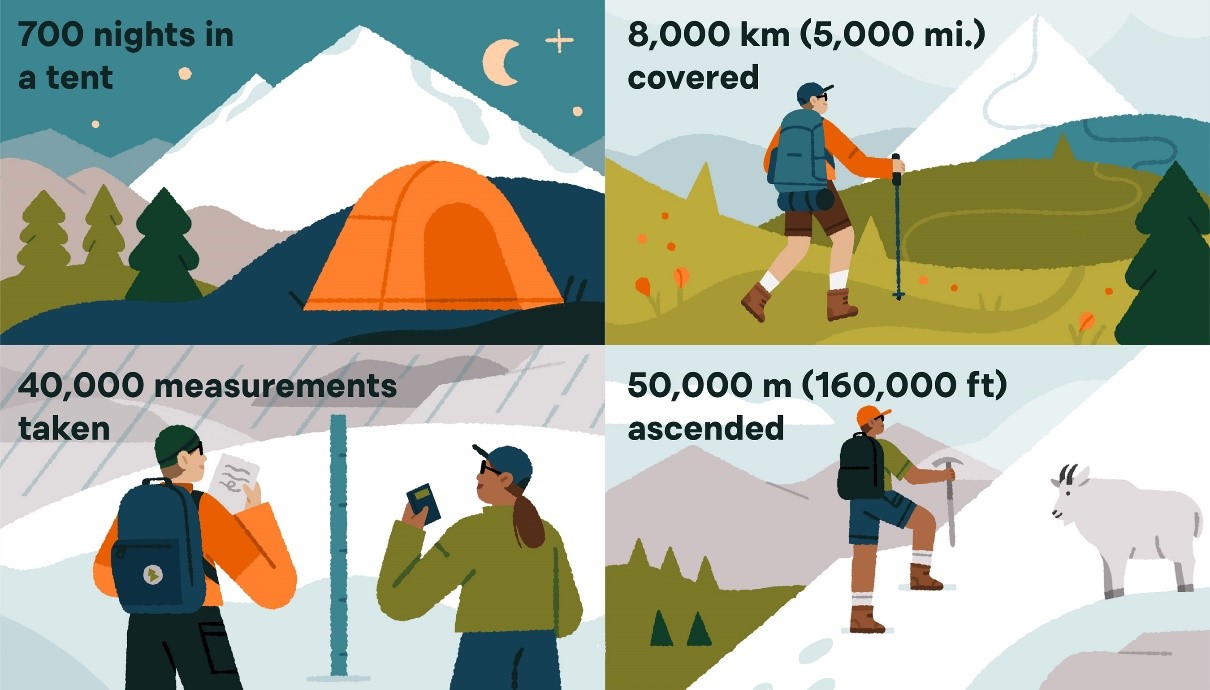
Illustration by Megan Pelto of key numbers behind what it takes to undertake a 40 year field study on glaciers.

For the 40th consecutive summer the North Cascade Glacier Climate Project is heading into the field to measure and communicate the impact of climate change on North Cascade glaciers. This field season follows the 2021 and 2022 seasons that featured a historic heat wave and periods of extended warm weather. The heat led to a greater exposure of bare ice on glaciers, particularly at higher elevations. For ice surfaces with a higher albedo and greater density the observed melt rates are 7-9 cm per day water equivalent during warm weather events vs 4-6 for snow surfaces. This led to substantial mass losses on North Cascade glacier for the two years of -2.5 m. Winter snowpack in the North Cascades in 2023 was 80-90% of normal on April 1 and May 1.

Science objectives: We will complete detailed measurements on 10 glaciers, three of which are part of the World Glacier Monitoring Service reference glacier network (42 glaciers globally), which have 30+ consecutive years of mass balance observations. This summer we will have an opportunity to assess the long-term ramifications of the 2021 and 2022 summers and measure the response of glaciers to the weather of 2023 with detailed mass balance, crevasse depths and glacier surface elevation profiling.

Art Objectives: We will collaborate with several artists who will join us for a portion of the field season. They will be able to create their own work about the landscape and the science or may join us for fieldwork and make plans for future artwork. Potential artists include painters, a podcast creator, a photographer, and a printmaker. We hope to use this art to share our research with a broader audience and highlight the beauty and importance of these places.

Communication Objectives: We are seeking expedition sponsors this year with brands who have a climate change focus. These organizations can help spread our message; we have two so far. We are looking to support the production of podcasts as well.

Terminus change at two World Glacier Monitoring Service reference glaciers. Columbia and Eastson Glacier. 

Field Team 2023:

Jill Pelto  (she/her)is an artist and scientist from New England who grew up loving winter sports and trips to the mountains. She incorporates scientific research and data into paintings and prints to communicate environmental changes. Her multi-disciplinary work weaves visual narratives that reveal the reality of human impacts on this planet. She completed both her B.A. degrees in Studio Art and Earth and Climate Science, and her M.S. focused on studying the stability of the Antarctic Ice Sheet at the University of Maine, spending two field seasons at a remote camp in the southern Transantarctic Mountains. Jill will be joining the project for her 15th field season. She is excited about continuing to document the change in North Cascade glaciers that she has witnessed each of the last ten years — through science and art.

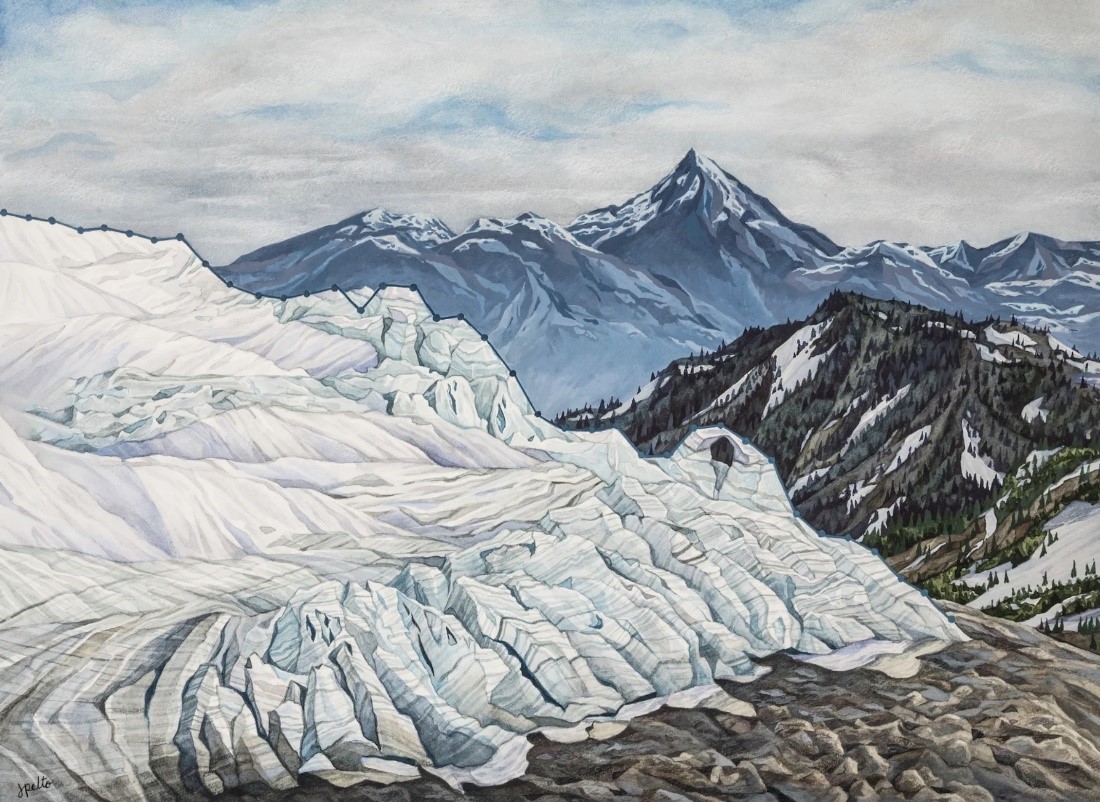
Painting by Jill Pelto that incorporates mass balance data from NCGCP from 1983-2022 along the top of the glacier.

Mauri Pelto (he/him) has directed the project since its founding in 1984, spending more than 800 nights camped out adjacent to these glaciers. He is the United States representative to the World Glacier Monitoring Service. For a decade he has been author of the AGU blog “From a Glacier’s Perspective,” and associate editor for three science journals.  He is on the Science Advisory Board for NASA’s Earth Observatory. His primary position is Associate Provost at Nichols College, where he has been a professor since 1989. He either runs on trails or ski’s on trails alpine and cross country everyday.

Mauri Pelto looking at deglaciated envioronment below Easton Glacier

Mariama Dryak-Vallies (she/her) is the Director for the Polar Science Early Career Community Office (PSECCO) hosted by CIRES at University of Colorado Boulder. Mariama grew up on a farm in west-central Wisconsin before earning her B.A. in physical geography and archaeology at Durham University (UK)—where her passion for studying, researching, and teaching about glaciers, climate change, and the natural environment was born. She completed her M.S. in Earth and Climate Sciences at the University of Maine, studying Antarctic glaciology and ice-ocean interactions. During graduate school she was actively involved advocating for polar early career scientists as board member and co-chair of the US Association of Polar Early Career Scientists (USAPECS). Mariama is passionate about working towards building accessible Earth and polar sciences spaces for all.

2018 field team including Jill, Mauri, Mariama and Erin

Kaiyuan Wang (he/himis a recent graduate from McGill University with a B.Sc in Honours Physical Geography, a minor in Geology. Originally from China, he developed an aspiration for Geoscience in the Great White North while living on the former bed of the Laurentide Ice Sheet. His passion for the cryosphere has led him to fieldwork on glaciers in the Kluane National Park in Yukon, Jasper National Park in Alberta, and a glaciological conference in Iceland. He will be doing his Ph.D. in Arctic Hydrology at the Northern Change Research Laboratory at Brown University. Kai is thrilled to be part of the 40-year-long effort of documenting glaciers as a living testimony to a warming world.

Shivaprakash Muruganandham (he/him) is currently a PhD candidate in Ocean Science and Engineering at the Georgia Institute of Technology, Atlanta, USA. He is back in school after a few years as a strategy consultant, during which time he specialized in satellites and space applications: earth observation and satellite communications in particular. Prior to this, he graduated with Master’s degrees in Space Technology and Cybernetic Systems/Control. Shiva is fascinated by ice, and his research focus on ice sheet/glacier modeling is motivated by his interests in the downstream impacts of cryosphere-climate interactions on coastal and mountain communities..

Field Partners 2023

Lizz Ultee (she/they) is an Assistant Professor of Earth & Climate Science at Middlebury College, Vermont.  They earned a B.Sc. in mathematical physics at Queen’s University (Canada) and a Ph.D. in climate science at the University of Michigan, specializing in mathematical methods to understand and predict glacier change.  Lizz finds ice endlessly inspiring.  Beyond inspiring, though, glaciers are important for downstream communities — motivating Lizz’s present research focus on glacier contributions to sea-level rise and water resource availability.

Alia Khan’s research team including grad students Sally Vaux, Colby Rand, and Anne Wilce focus on environmental chemistry in the cryosphere, including black carbon and snow algae to document global change of glacier and snow melt in mountainous and polar regions.Western Washington University Cryosphere Studies and Aquatic Biochemistry Lab.

Claire Giordano is an environmental artist, writer, and educator creatively telling the stories of science, climate change, and the modern experience of nature. From creating rain-dappled sketches in an old growth forest to filming a watercolor class beside a glacier, careful observation of nature inspires her goal is to connect people and place through art. In 2021 she founded the Adventure Art Academy – a series of virtual watercolor classes filmed outside – to invite others into the joy of painting outside.

Field study by Claire Giordano, artist in residence with the NCGCP for her 4th year. She creates these incredible pages with notes, paintings, and sketches from her days out exploring the landscape.

Kathleen Shannon is a freelance journalist & radio producer telling science and environmental justice stories across the West. She is based in Missoula and earned a master’s degree in Environmental Science and Natural Resource Journalism from the University of Montana in 2023. Her work has appeared on NPR, in High Country News and elsewhere.

Julia Ditto is a science illustrator from Anchorage, Alaska who specializes in environmental and ecological graphics. Julia spends much of her time recreating in the backcountry, which inspires much of her work. She has always used art as a tool for observing and communicating her experiences, both inand out of the field. She is currently attending CSU Monterey Bay’s Graduate Science Illustration Program.

Who are we? NCGCP was founded in 1983 to identify and communicate the response of North Cascade glaciers to regional climate change. NCGCP is a field project including scientists and artists that has a broad interdisciplinary scope and examines more glaciers than any other program in North America.  We do so cost effectively relying on no permanent camps or helicopter support. The field season includes no days off and each day is spent completing measurements on glaciers.  The focus is on glacier mapping, mass balance measurement, terminus observations, glacier runoff monitoring and capturing the environment with art.  

Why study glaciers in the North Cascades? Glaciers are one of the world’s best climate monitors and are a critical water resource to many populated glaciated regions. This is particularly true in the North Cascades where 700 glaciers yield 200 billion gallons of summer runoff and glaciers have lost 30 % of their area in the last century. This has reduced glacier runoff in late summer in the region as the reduction in glacier area has exceeded the increase in melt rate. During heat waves this role is even more profound with the glacier fed North Fork Nooksack River discharge rising ~24% due to greater melt, while unglaciated South Fork Nooksack River discharge declines by ~20%. The increased discharge limits the rise in river temperature during heat waves to 0.7 C in the North Fork, with the South Fork increasing by 2 C, increasing stress on the salmon in the South Fork (Pelto et al., 2022).

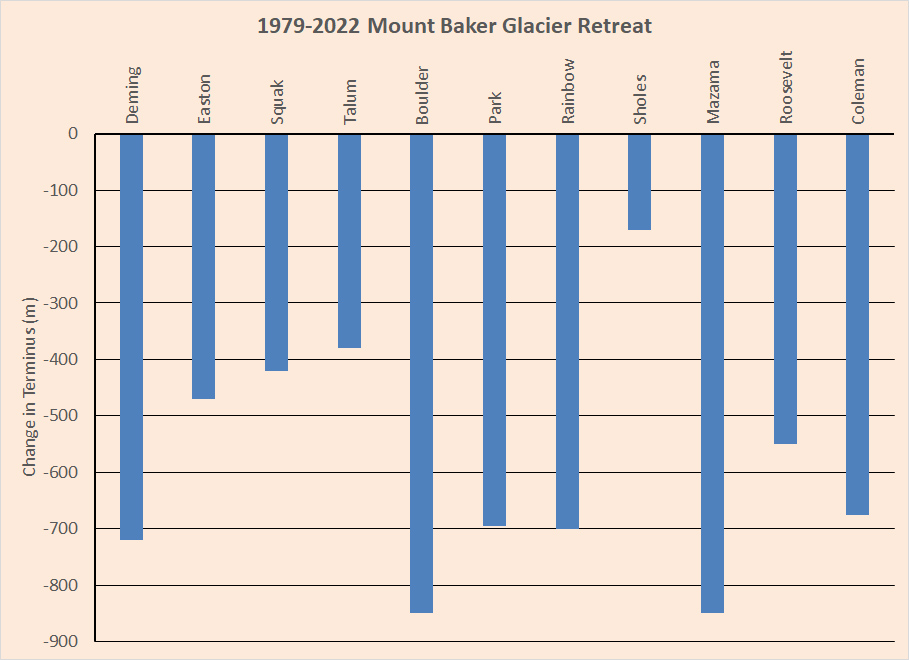
Retreat of Mount Baker glaciers documented by our program

The mass balance record we have compiled since 1984

Summer temperature records from NOAA WA Division 5

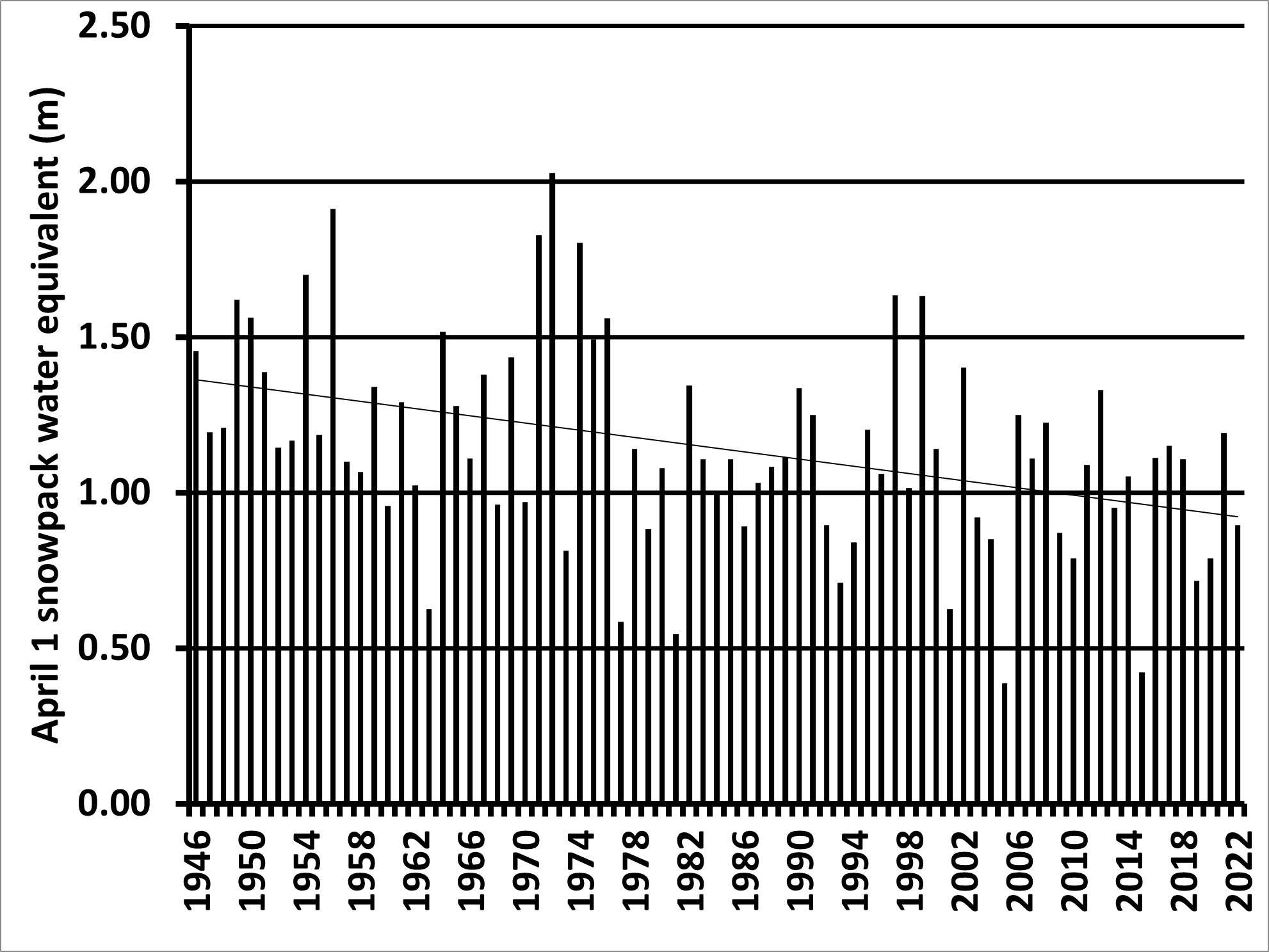
Winter Snowpack from North Cascade long term Snotel stations on April 1