


Steffen Glacier is the largest south flowing outlet of the 4000 km2 Northern Patagonia Icefield (NPI). On December Dec. 6, 2023 the terminus tongue has a narrow unsupported section that appears poised to calve (C). By Dec. 26, 2023 the glacier has calved berg C (0.4km2 ), joining other large bergs remaining from previous years D, E and F. Two more pieces A and B appear poised to calve. By Feb. 9 2024 berg B had calved, and by Feb. 24 berg A had calved, together they are 0.3 km2. On April 14 two more large bergs X and Y have calved from the terminus. Berg X is the largest of the year at 0.6 km2, berg Y is 0.2 km2 . Terminus retreat from Dec. 2023-April 2024 is 1.5 km. In noted in April that the terminus tongue was narrow and unsupported (Pelto, 2024) , indicating that more large icebergs should be expected in the 2025 summer season, and in December this happened releasing several icebergs Z1, Z2 and Z3 with a combined area of 3 km2 The glacier retreated 2.6 km as a result of this calving event.


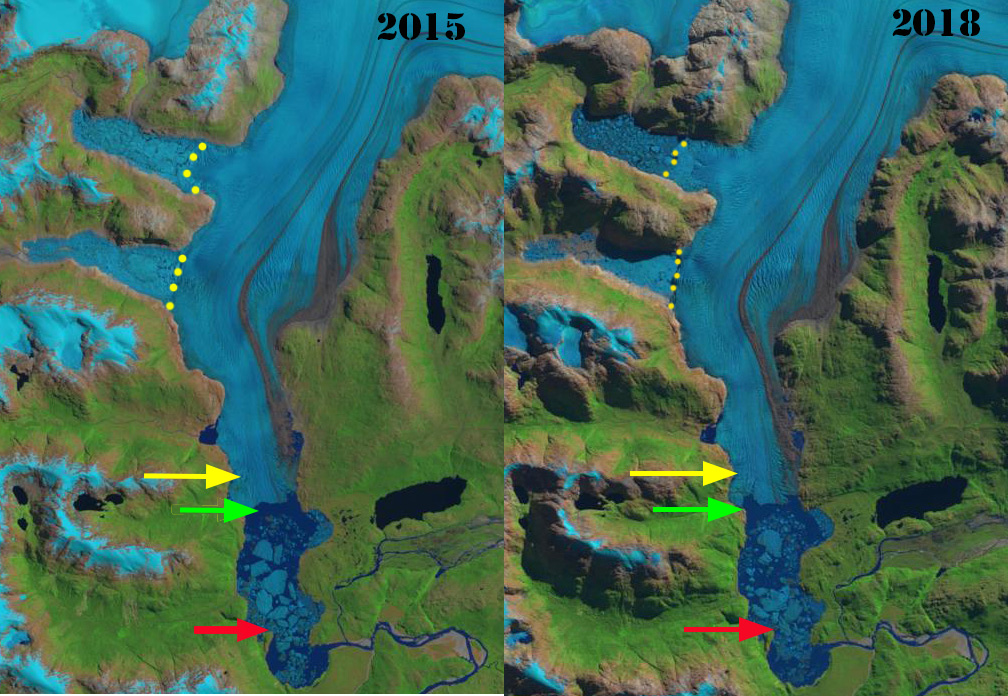
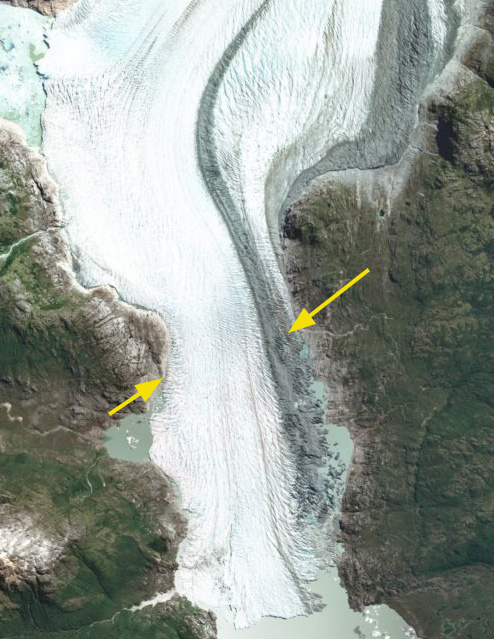
Exploradores Glacier is an northern outlet glacier of the Northern Patagonia Icefield. In 2016 Exploradores Glacier had a 12 km2 terminus lobe with a couple of small proglacial lakes with a total area of ~1 km2. The terminus lobe of the Exploradores Glacier is now collapsing, this is a process that has already occurred at Steffen Glacier, San Quintin Glacier and Colonia Glacier. The terminus lobe is relatively stagnant as indicated by the minimal surface slope. The result will be a new substantial proglacial lake. In 2023 and 2024 an active zone of calving has developed on the east side of the terminus, yellow dots, with an area of 2.1 km2. This appears ready to continue expanding west across the glacier tongue expanding this embayment.

Reichert Glacier is an outlet glacier of the Northern Patagonia Icefied that retreated 6.7 km from 1987-2015. Then was nearly stationary to 2023, with a 750 m retreat from 2022 to 2024 and an active calving period spring 2024 note new icebergs in the lake. The terminus is retreating into a narrower fjord reach,, with a pinch point 1.5 km behind the terminus, that should provide short term stability.





 From a Glaciers Perspective