Videla Glacier, Chile Retreat Generating Lake Expansion 1997-2025

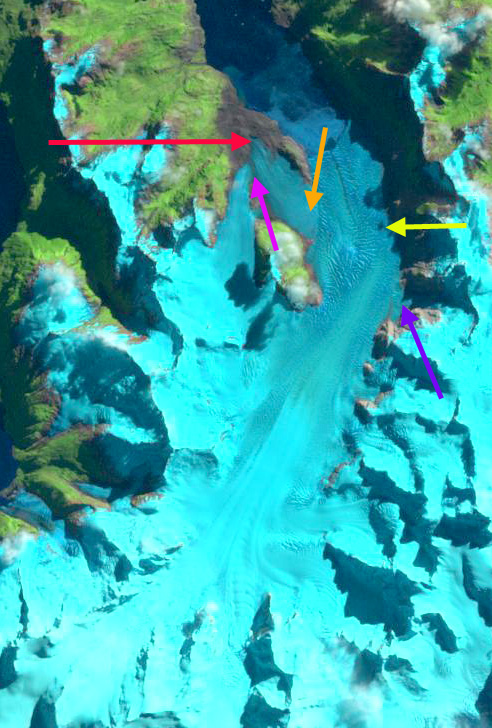
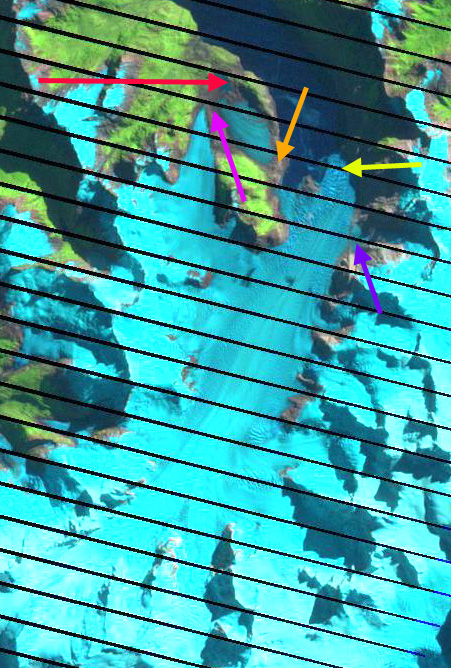
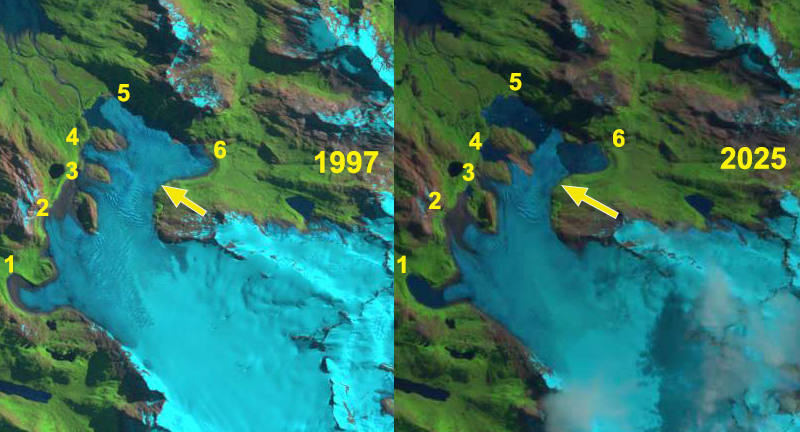
Videla Glacier, Chile is an outlet glacier of the Cordillera Darwin Icefield. The glacier has a number (Point 1-6) of terminus lobes where retreat has led to proglacial lake development between 1997 and 2025, as seen in these annotated Landsat images.

Videla Glacier is a land terminating glacier in the northwest portion of the Cordillera Darwin Icefield (CDI) in Tierra del Fuego, Chile. The glacier has terminates in several expanding proglacial lakes each in front of a different tongue of the glacier. The glacier flows northwest from Cerro Ambience towards Fiordo Profundo.  Meier et al (2018) identified area change of Patagonia glaciers from 1870-2016 with a ~16% area loss of CDI, with more than half of the loss occurring since 1985. They also noted that CDI glaciers were retreating fastest between 1986 and 2005. Izagirre et al (2025) identified a 124% increase in glacier lake area from retreat between 1945 and 2024. The retreat has been largest on tidewater glaciers such as Marinelli Glacier and Ventisquero Grande Glacier.

In 1997 of Videla Glacier’s six main terminus lobes, five did not exhibit a proglacial lake, only the two northern most lobes (Point 4, 5, and 6) ending in a fringing yet to develop proglacial lake. The terminus lobes at Point 2 and 3 were joined. By 2019 lobes 1 and 4 had developed significant proglacial lakes, while the main terminus at Point 5 and 6 had opened up two halves of the same proglacial lake. The terminus lobes at Point 2 and 3 had separated. A rib (yellow arrow) was developing upglacier of the main terminus indicating thinning and reduced flow. A new lake had developed just downstream of this rib.

In 2025 the terminus at Point 1 had receded 950 m creating a 0.75 km2 proglacial lake. Terminus Lobe 2 and 3 had separated by 400 m. At Point 4 a 0.5 km2 proglacial lake had formed with the 1050 m retreat. The main terminus at Point 5 and 6 extends across the lake basin in a narrow 350 m wide tongue. The lake has grown to 3 km2, with 1.5 km of recession from Point 6 and 1.8 km from Point 5. This narrow tongue may well break off this coming summer.
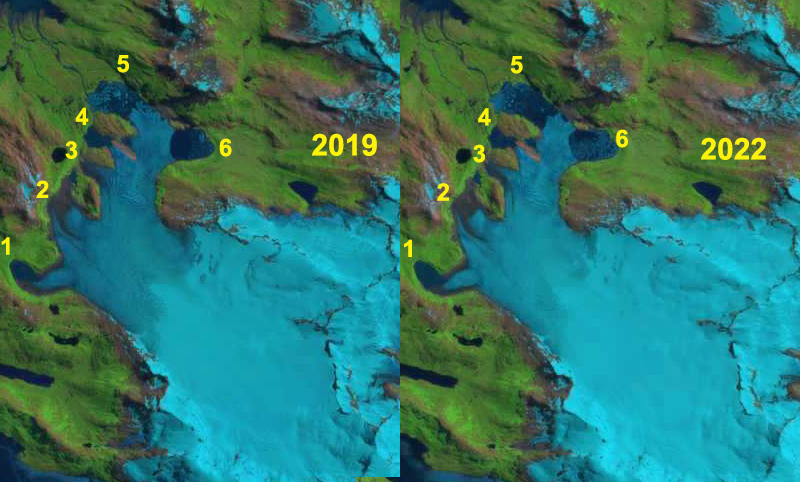
Videla Glacier, Chile ongoing retreat and proglacial lake growth at terminus lobes (1-6) illustrated by Landsat images from 2019 and 2022.
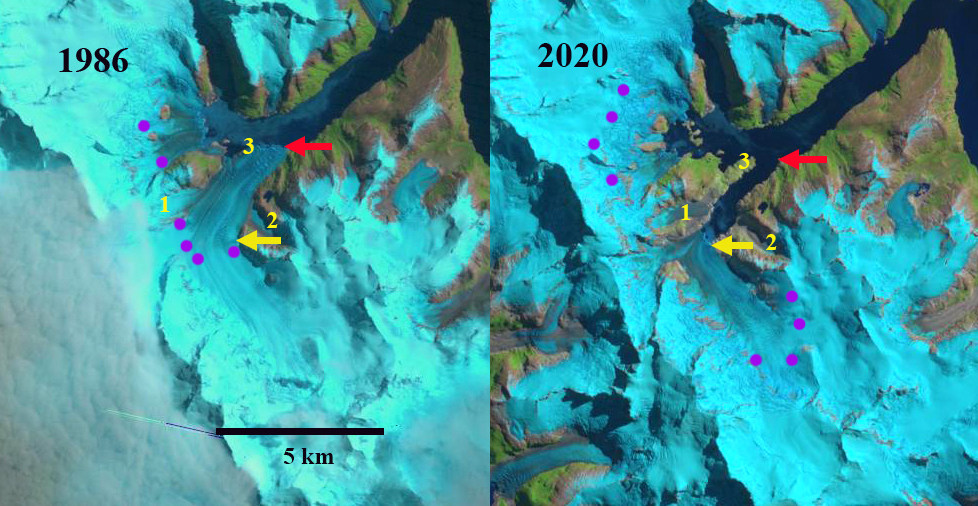
Darwin Glacier, Chile 1986-2020 Retreat Opens New Fjord Arm

Darwin Glacier in Landsat images from 1986 and 2020. Red arrow indicates 1986 terminus location, yellow arrow 2020 terminus location, purple dots the snowline.  Point 1,2 and 3 indicate the same specific location.

Darwin Glacier flows east from the main divide of the Cordillera Darwin entering the head of Fjord Parry. Here we examine changes illustrated by Landsat images from 1986-2020.   Melkonian et al (2013) note widespread thinning of four large glaciers in the Cordillera Darwin Range from 2000-2011; Ventisquero Grande, Marinelli, Darwin and Roncagli, while the Garibaldi Glacier increased in volume.  They note a maximum velocity of 9.6 m/day at Darwin Glacier and thinning of over 3 m/year during the 2000-2011 period, which emcompasses a period of rapid retreat noted below. Davies and Glasser (2012) note that during the 1870-2011 period the Cordillera Darwin area loss was most rapid from 1986 to 2001. Dussaillant et al (2019) note the mass loss for the central Cordillera Darwin at -0.4 to -0.6 m/year from 2000-2018.

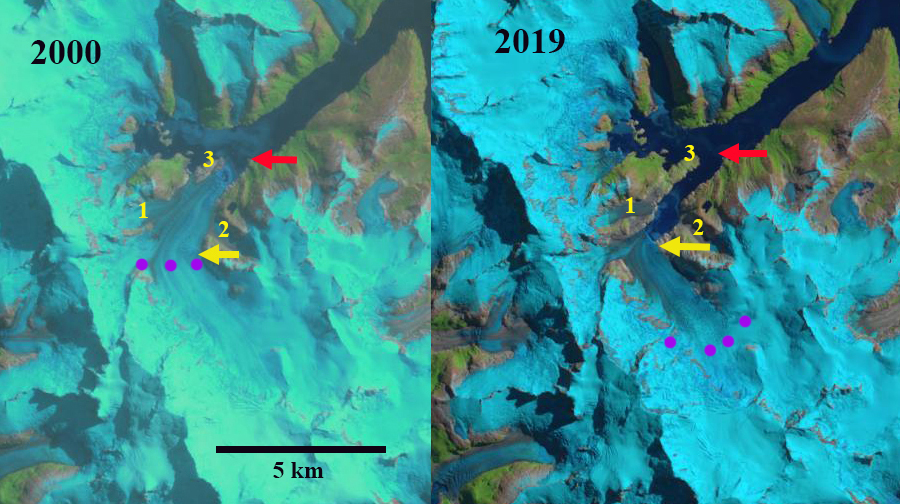
In 1986 Darwin Glacier extended beyond the end of a southwest trending valley (Point 3) and had fully separated from the former tributary flowing eastward. Tributaries at Point 1 and 2 join the main glacier within a 2 km of the current terminus. The snowline is at 500 m. By 2000 the glacier had retreated into the southwest trending valley, with a peninsula emerging on the west side at point 3.  The snowline is at 500 m. By 2019 the glacier had retreated beyond the former tributaries at Point 1 and 2. The snowline in 2018 is at 750 m.  In 2020 the peninsula at Point 3 has greened up with new vegetation, the glacier has retreated 3100 m since 1986 exposing a new fjord arm. Point 2 is largely a glacier free valley bottom.  The snowline is at 800 m.  A further 1 km retreat will lead to another tributary separation much as has happened at Ventisquero Grande.

Darwin Glacier in Landsat images from 2000 and 2019. Red arrow indicates 1986 terminus location, yellow arrow 2020 terminus location, purple dots the snowline.  Point 1,2 and 3 indicate the same specific location.

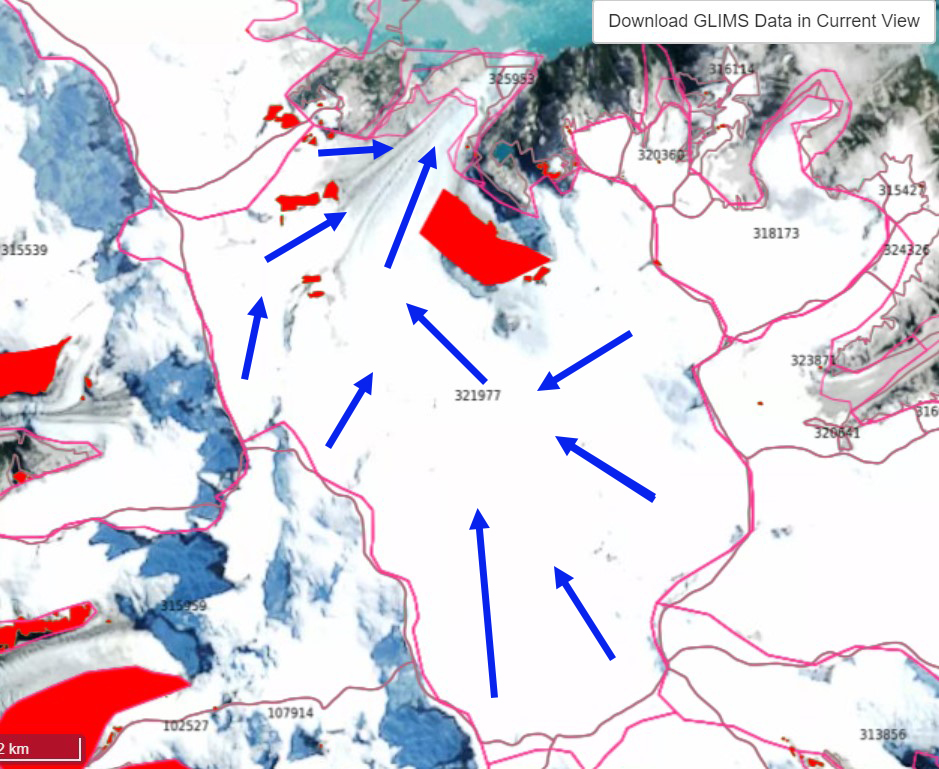
GLIMS view of Darwin Glacier with 1986-2007 margins indicated (Bethan Davies delineated margins).  Flow arrows added.

Videla Glacier Retreat, Tierra del Fuego, Chile Generates New and Expanding Lakes

Videla Glacier, Chile in 1997 and 2018 Landsat images. Red dots mark the 1997 terminus locations, yellow dots the 2018 terminus position and purple dots the snowline. 

Videla Glacier is a land terminating glacier in the northwest portion of the Cordillera Darwin Icefield (CDI). The glacier has terminates in several expanding proglacial lakes each in front of a different tongue of the glacier. The glacier flows northwest from Cerro Ambience towards Fiordo Profundo.  Meier et al (2018) identified area change of Patagonia glaciers from 1870-2016 with a ~16% area loss of CDI, with more than half of the loss occurring since 1985. They also noted that CDI glaciers were retreating fastest between 1986 and 2005; afterwards the rate of retreat has decreased. The retreat has been largest on tidewater glaciers such as Marinelli Glacier and Ventisquero Grande Glacier.

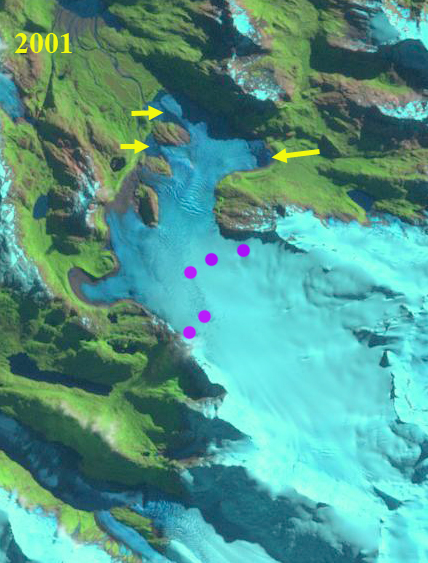
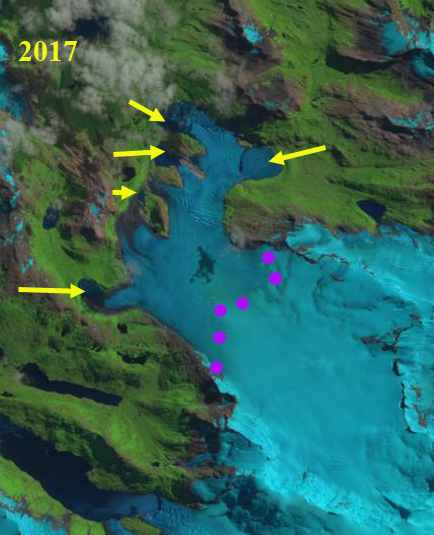
In 1997 of Videla Glacier’s six main terminus lobes, five did not exhibit a proglacial lake, only the two northern most lobes ended in a proglacial lake.  The northwestern lobe terminates in a 800 m long calving front, the northeastern lobe in the same basin exhibits a small fringing proglacial lake on its northern margin. The snowline in 1997 is at 600 m.  In 2001 the proglacial lake has expanded at both the northwestern and northeastern lobe.  A second proglacial lake has developed at the next most northern lobe.  The snowline in 2001 is at 550 m.  By 2017 Videla Glacier terminates in five expanding proglacial lakes and the snowline is the highest observed at 650 m. In December 2018 the terminus change from 1997 is evident at each lobe.  The main terminus is the northernmost that has both a northwestern and northeastern terminus.  In a Digital Globe image below the green arrows indicate areas where the terminus is rifted indicating partial flotation.  By 2018 the rifted terminus tongue of the northwestern lobe has been lost.  This image also reveals at the orange arrows newly exposed bedrock. The retreat has been 1.1 km for the northeastern lobe, 1.2 km for the northwestern lobe, 0.9 km for the next lobe to the south, and 0.7 km for the southern lobe. The initiation of significant retreat from the Little Ice Age maximum which led to moraine development impounding the most northern and southern proglacial lakes, was slow in this area. There has been more retreat since 1997 than since 1870.

Videla Glacier in 2001 Landsat image indicating proglacial lakes and the snowline.

Videla Glacier in 2017 Landsat image indicating proglacial lakes and the snowline.


Videla Glacier in a Digital Globe image indicating upglacier limit of weak rifted areas of the northeastern and northwestern lobe, green arrows.  Orange arrows indicate newly exposed bedrock.


Ventisquero Grande Glacier, Chile Retreats; Not so Grande in 2017

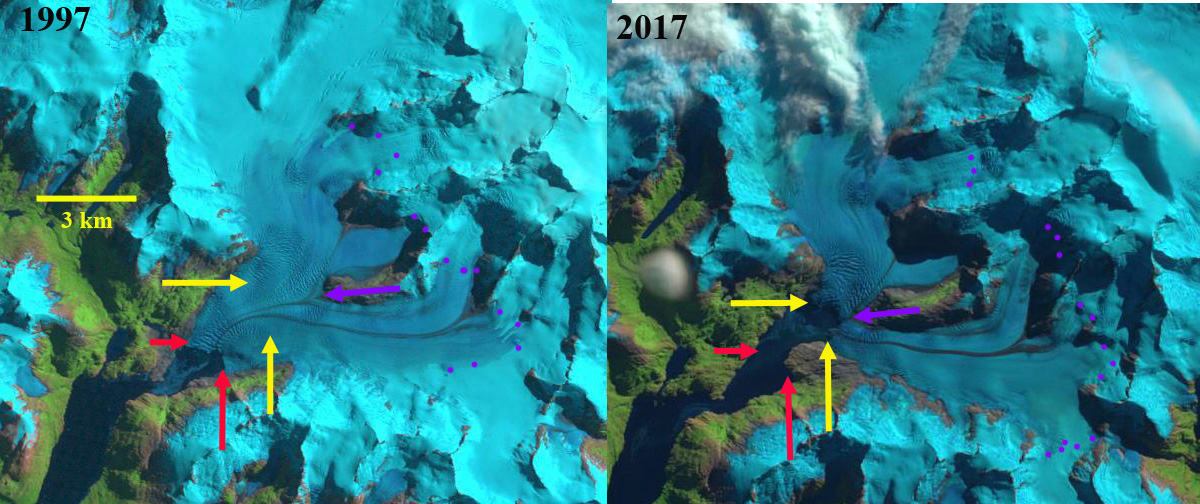
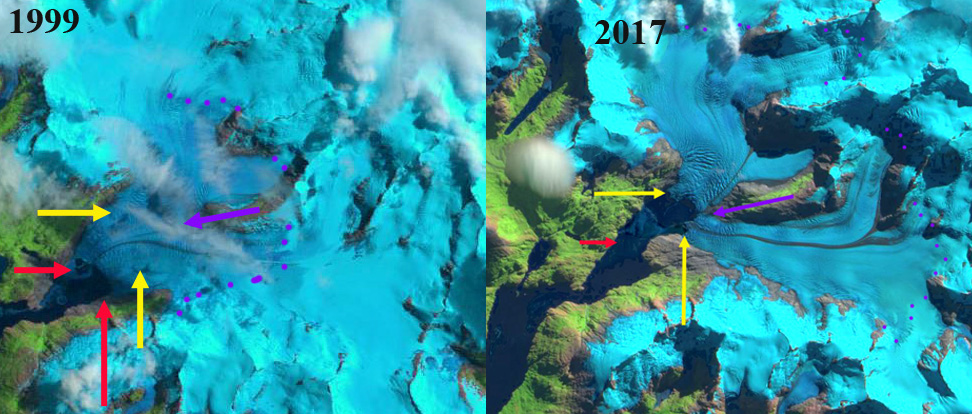
Ventisquero Grande Glacier comparison in Landsat images from 1997 and 2017.  Red arrows mark the 1997 terminus, yellow arrows the 2017 terminus, purple dots the snowline and purple arrow the junction of the tributaries. 

Ventisquero Grande Glacier is at the head of Ventisquero Seno in the Cordillera Darwin of Tierra del Fuego.  The fjord is just west of Garibladi Fjord and opens into Darwin Channel.  Melkonian et al (2013) note widespread thinning of four large glaciers in the Cordillera Darwin Range from 2000-2011; Ventisquero Grande (CDI-08), Marinelli, Darwin and Roncagli, while the Garibaldi Glacier increased in volume.  Here we examine changes in the glacier using Landsat and Sentinel Images from 1997 to 2017.

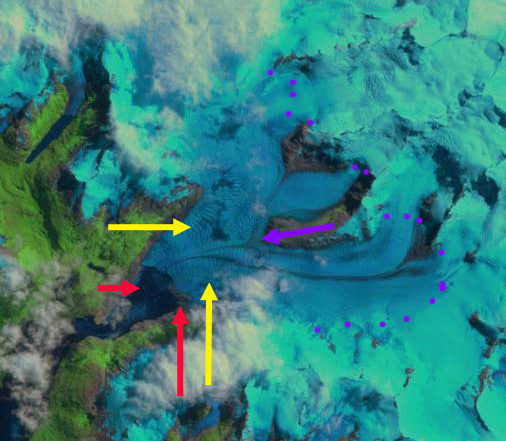
In 1997 two tributaries merged 3.2 km upglacier of the terminus, purple arrow, terminating in a 1.8 km wide calving front, red arrows.  In 1999 there is limited retreat and the calving front has extended to 2 km in length.  The transient snowline is at 700 m in 1997 and at 550 m in 1999, purple dots.  By 2002 the southern end of the terminus has retreated exposing a shoal.  By 2017 the  two tributaries have separated, purple arrow.  Retreat of the glacier has been 2100 m on the north side, 2800 m in the center and 2000 m on the south side. Both of the termini are still calving and extensive crevassing immediately upglacier of the terminus indicates significant glacier velocities.  The calving front is 2.1 km wide in 2017.  As Simon Gascoin has noted the addition of Sentinel imagery has helped expand the potential for images that are relatively cloud free. Melkonian et al (2013) note velocities of less than 2 m/day until right near the terminus. The transient snowline in 2017 is at 800 m on March 28, 2017. 

Ventisquero Grande Glacier comparison in Landsat image from 1999 and Sentinel 2 image from 2017.  Red arrows mark the 1997 terminus, yellow arrows the 2017 terminus, purple dots the snowline and purple arrow the junction of the tributaries. 

Ventisquero Grande Glacier  in 2002 Landsat image. Red arrows mark the 1997 terminus, yellow arrows the 2017 terminus, purple dots the snowline and purple arrow the junction of the tributaries. 


Ventisquero Grande Glacier in Sentinel 2 image from 2017.  Red arrows mark the 1997 terminus, yellow arrows the 2017 terminus,  and purple arrow the junction of the tributaries. 

Roncagli Glacier Retreat, Tierra del Fuego, Chile

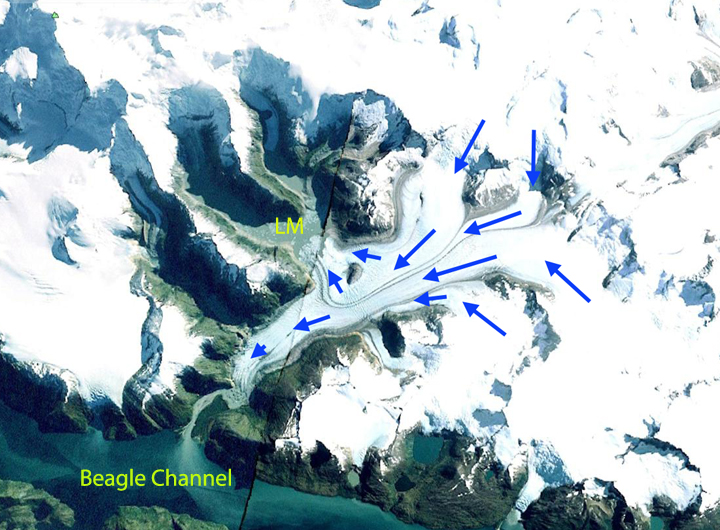
The Cordillera Darwin in Tierra Del Fuego, Chile is a remote area that is notorious for stormy, cloudy weather that makes for only a few good satellite images. Roncagli(Alemania) Glacier is the focus of this post and is an update to a previous post. The glacier has a terminus adjacent to the Beagle Channe(BC) and a secondary terminus in Lago Martinic (LM), 5 km upglacier. Velocity profiles by Melkonian et al (2013) indicate the highest velocities directed toward the LM terminus, making this the primary terminus. They also found that the glacier thinned by 5-10 m along most of its length from 2000-2011. Here we examine Landsat imagery from 1997 to 2014.

Roncagli ge
Googel Earth image
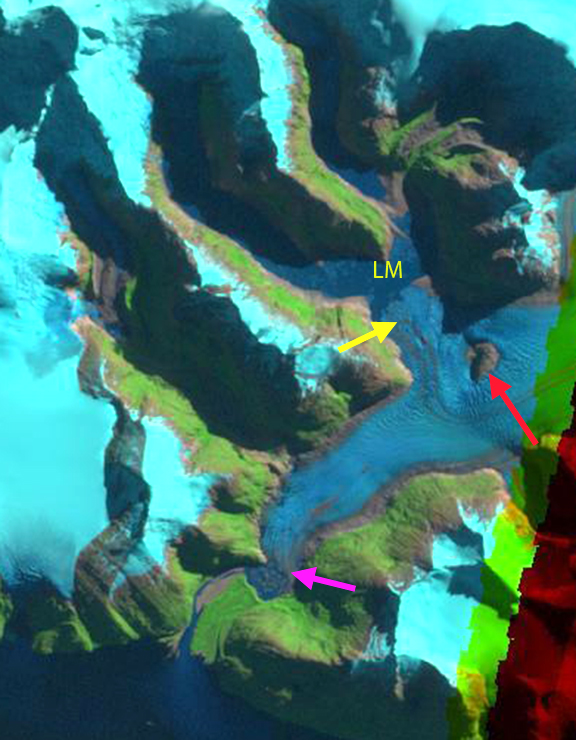
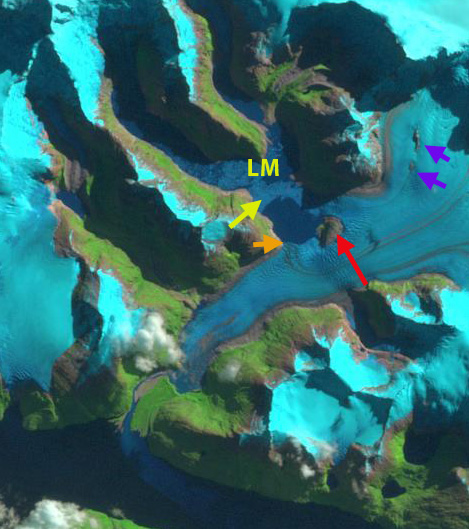
In 1997 the BC terminus at the pink arrow is at a narrowing of the valley. The LM terminus is at the yellow arrow with two primary glacier branches encircling the nunatak at the red arrow. In 2000 the terminus positions are relatively unchanged with the LM terminus actively releasing icebergs into Lago Martinic. Upglacier a single area of bedrock is emergent through the glacier, purple arrow. In 2001 the BC terminus remains unchanged, the water level in LM has declined exposing more bare rock surfaces around the LM terminus. By 2008 the LM terminus has separated, both still ending in the lake, the lake again is at a full stage on the date of the imagery. The lake experienced periodic filling and draining episodes during the 1997-2008 period. There are now two upglacier areas with exposed bedrock now. By 2014 the BC terminus has retreated 1 km along the southeastern margin and 200 m along the northwest side. This retreat from the pinning point that restricted calving at the pink arrow, suggests further retreat will occur in the near future. Lago Martinic has largely drained. The LM terminus has separated into two tongues and the former nunatak is no longer surrounded by glacier ice, red arrow. The retreat at LM terminus is 1500 m on the west side, orange arrow, and 800-1000 m on the east side. Upglacier both areas of bedrock that are emergent are expanding, purple arrows, indicating the thinning observed by Melkonian et al. (2013). The continued upglacier thinning indicates reduced flux to the terminus and continued retreat. The degree to which Lago Martinic can refill is uncertain, MODIS imagery from late 2014 shows the lake is still not filled. I have not seen imagery indicating even a nearly full lake in the 2011-2014 period. The rate of retreat is less than on Marinelli Glacier to the north or Glaciar Steffen.
racongli 1997
1997 Landsat image
racongli 2000
2000 Landsat image
racongli 2001
2001 Landsat image

roncagli 2008
2008 Landsat image
racongli 2014
2014 Landsat image

Marinelli Glacier Retreat, Chile

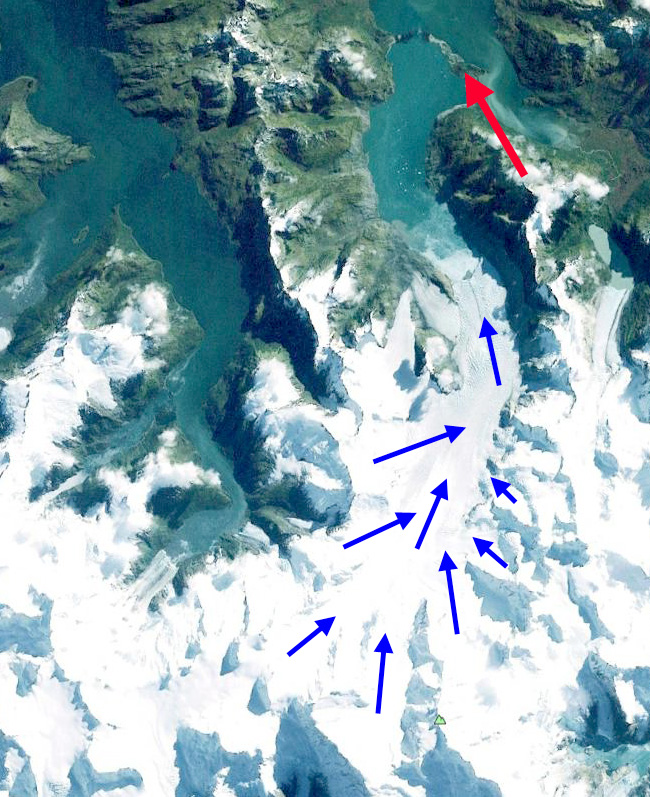
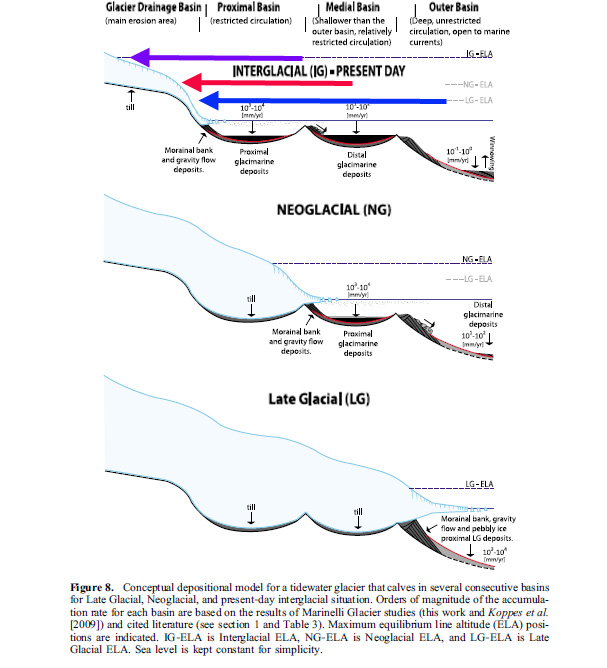
Marinelli Glacier, Chile is the largest glacier of the Cordillera Darwin Icefield. This ice cap is in Tierra del Fuego, a region famous for cloudy, stormy weather. Fernandez et al. (2011) indicate that rapid retreat particularly since 1945 has led to high erosion and sedimentation rates. They also provide an excellent diagram of the glacier from three time periods. The glacier extended to the Little Ice Age-Neoglacial moraine at the red arrow. Koppes et al (2009) indicate a retreat of  13 km from 1960 to 2005, 300 m/year.

marinelli ge
Marinelli Glacier in Google Earth

marinelli ela
Cross section of glacier from Fernandez et al (2011)
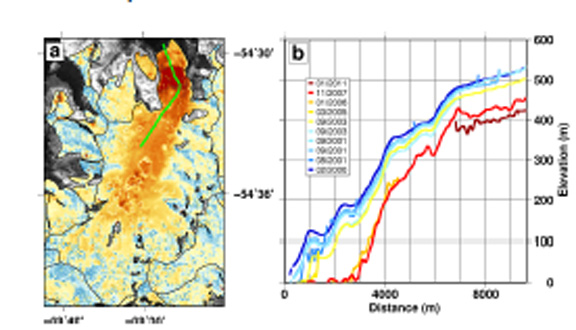
Melkonian et al (2013) note widespread thinning with a peak on Marinelli Glacier. They also note frontal velocities of 7.5 m/day to 10.5 m/day from 2000 to 2011. They note approximately a 4 km retreat during this period and an average accumulation area ratio (AAR) of 38 (Melkonian et al, 2013). A non-calving glacier needs an AAR over 50 and typically over 60, since calving is an additional loss, calving glaciers typically need an AAR above 70 (Pelto, 1987).

marinelli velocity
Change in thickness on Marinelli Glacier from Melkonian et al. (2013)

Here we examine Landsat imagery from 1998 to 2014. In 1998 Marinelli Glacier had a main calving tidewater terminus and a land based terminus, red arrow. The tidewater terminus extends beyond the land based terminus. The land based terminus is connected to a tributary at the pink arrow. A tributary from the east is connected to the main glacier at the purple arrow. The yellow arrow is the 2014 terminus position. By 2001 the tidewater terminus has retreated up fjord of the land terminating terminus. The tributary on the west is still connected with the land terminating section of the glacier. By 2008 the main terminus has retreated exposing a new island in the center of the calving front. The land terminating section is now separated from the main glacier and with no supply of new ice will melt away, orange arrow. The tributary from the west is separated from the land terminus now at the pink arrow. The east tributary sill has a connection at the purple arrow to the main glacier. By 2014 the island at the main terminus has expanded in size as the glacier has retreated. The east tributary at purple arrow is separated from the main glacier. The isolated stagnant former land based terminus section between the red and orange arrows continues to melt away. The tidewater terminus of the glacier has retreated about 3.75 km from 1998 to 2014.  This is a rate of less than 300 m/year the long term average. The glacier will not stop retreating until its AAR rises and the calving margin reaches a pinning point. In this case there is no lateral pinning point apparent, hence it will have to be a rise in the elevation of the base of the glacier. The velocity and thickness change profile indicate such a location may exist 3-4 km behind the current calving front.  This glacier is retreating faster than the other glaciers of this icefield and is more in line with glaciers in the Southern Patagonian Icefield such as, Onelli Glacier, Glaciar Steffen, Glaciar Chico and Jorge Montt Glacier.

marinelli 1998
Landsat image 1998

marinelli 2001
Landsat image 2001

marinelli 2008
Landsat image 2008

marinelli 2014
Landsat image 2014

Alemania Glacier Retreat, Lago Martinic expansion-contraction, Chile

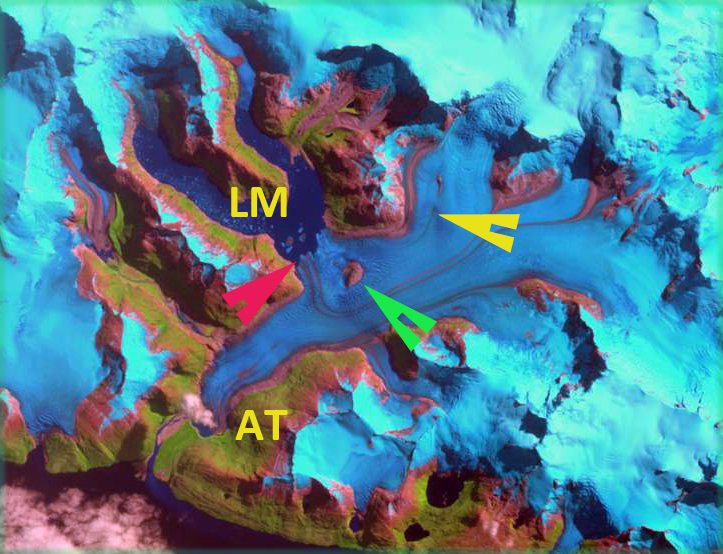
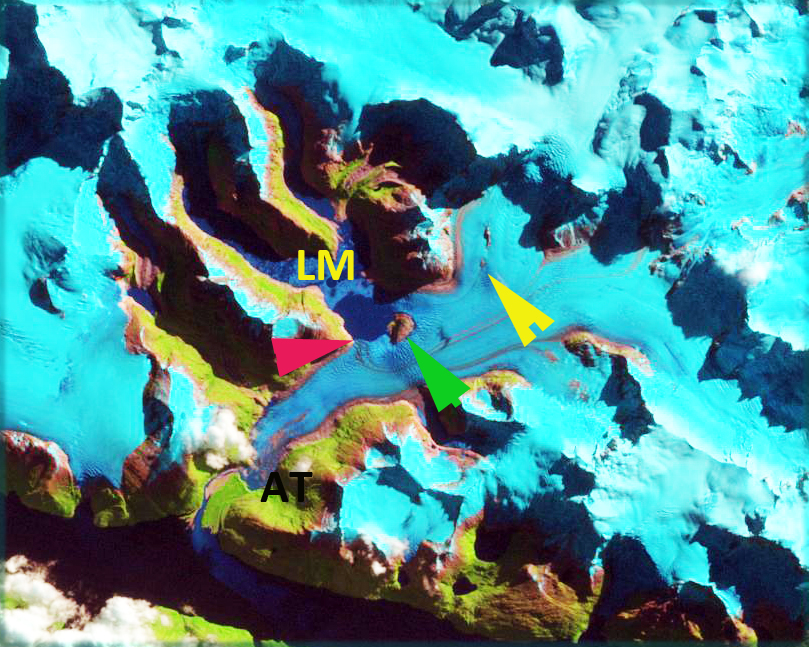
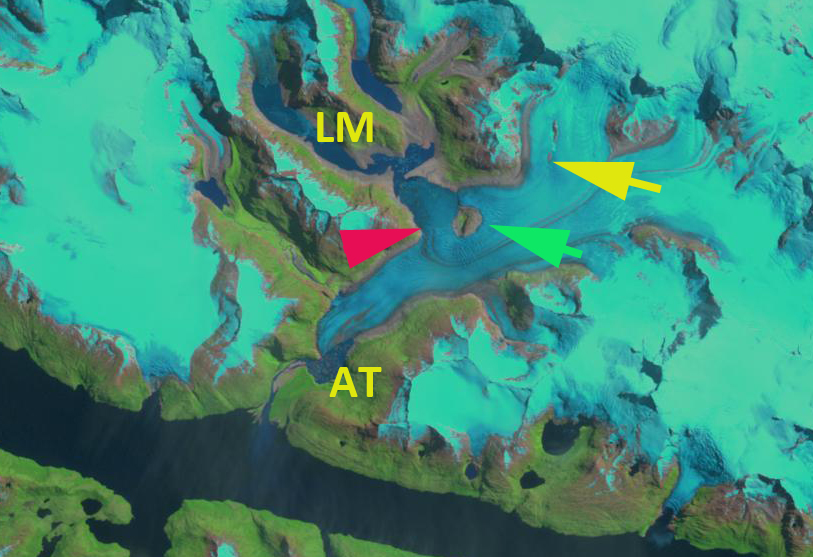
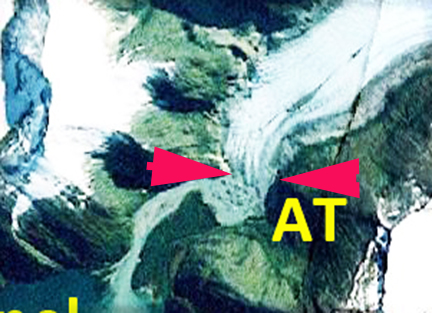
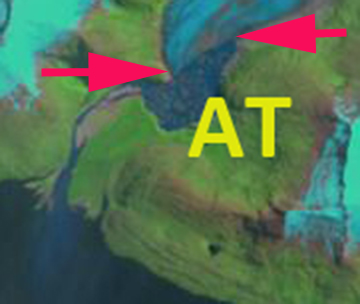
The Cordillera Darwin in Tierra Del Fuego Chile is a remote area. GLIMS (Glacier Land Ice Monitoring from Space) which has an inventory of glaciers showing at least size and boundaries, has nothing for this region in 2012. The USGS in their publication on South American glaciers just notes the lack of satellite imagery for assessing these remote glaciers. Chile is currently undertaking an inventory of these glaciers. The Alemania Glacier (Roncagli) is the focus of this post, the glacier can be seen from the Beagle Channel. The focus is not main terminus, but the terminus that ends in Lago Martinic (LM). In Google Earth imagery imagery this lake is trapped by the Alemania Glacier. There are two smaller glacier draining into the west end of the lake and Alemania’s secondary terminus ends in the lake. The red arrow points to the terminus, the green arrow to a nunatak near the Lago Martinic terminus and the yellow arrow to a developing nunatak upglacier, AT indicates the main terminus of the Alemania Glacier. The next three images are all from Landsat and indicate some spectacular changes from 2000 top image, 2008 middle image and 2011 bottom image. From 2000 to 2008 the Lago Martinic terminus of the glacier retreat 1300 meters, reaching the nunatak by 2008, this represents a significant expansion of the lake. In 2011 the terminus has retreated little but the lake has drained to an extent exposing the pink areas of the former lake bottom. In the future this maybe a lake that periodically fills in the Austral Spring and drains later in the Austral summer. The main terminus of the Alemania Glacier also exhibits a notably developing lake at the terminus compared to 2000, more on this below. The upglacier nunatak, yellow arrow, has also become more exposed indicating glacier thinning. A closeup of the main terminus of the Alemania indicates a 500 meter retreat of the east side of the glacier from the 2000 GE imagery to the 2011 Landsat imagery. The lake at the terminus has become significant, this should speed retreat in the near future. Though further south than the large Patagonia Icefields the glacier changes mirror those of the main icefields, Colonia, Tyndall, Gualas that are being intensively investigated by the Chilean Laboratorio de Glaciologia