Tulsequah Glacier, BC 2021 Glacier Lake Outburst Flood


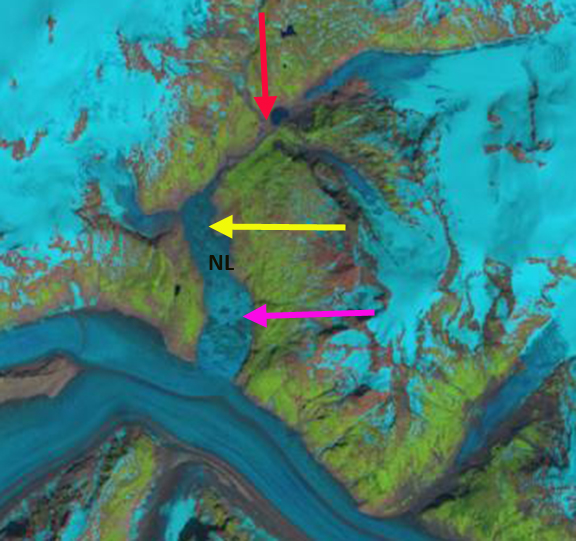
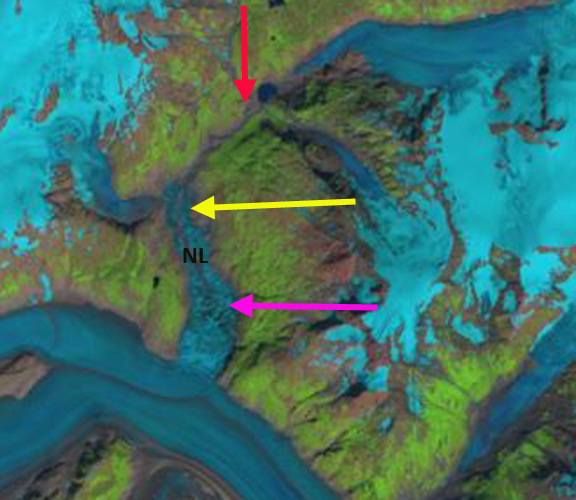
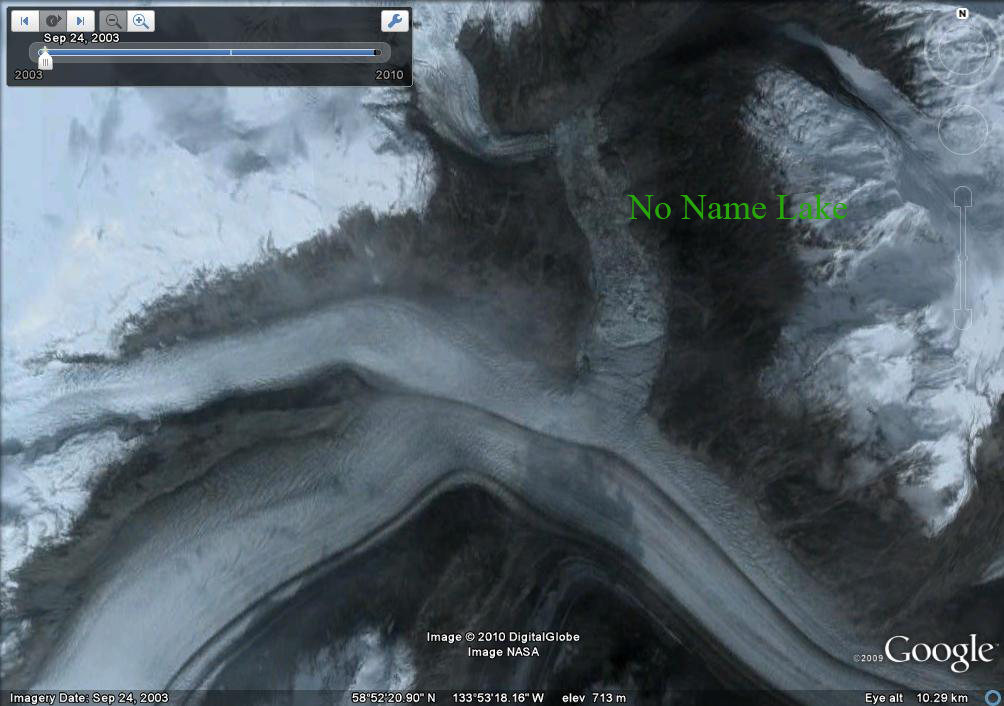
Landsat images of Tulsequah Glacier on June 22 and July 5, 2021.  Lake No Lake is between the yellow arrows with the margin of glacier extending upvally on June 22nd. By July it has receded back to main valley and lake has largely drained. The former location of Tulsequah glacier dammed lake is at red arrow.

Tulsequah Glacier, British Columbia drains east from the Juneau Icefield and is best known for its Jökulhlaups or glacier lake outburst floods (GLOF) from Tulsequah  Lake and Lake No Lake dammed by Tulsequah Glacier in northwestern British Columbia, Canada (Neal, 2007). The floods pose a hazard to the Tulsequah Chief mining further downstream. This glacier feeds the Taku River which has seen a significant decline in salmon in the last decade (Juneau Empire, 2017).The continued retreat of the main glacier at a faster rate than its subsidiary glaciers raises the potential for an additional glacier dammed lakes to form. The main terminus has disintegrated in a proglacial lake.  Pelto (2017) noted that by 2017 the terminus has retreated 2900 m since 1984, with a new 3 km long proglacial occupying the former glacier terminus. The USGS has a stream gage measuring a range of parameters including turbidity and discharge which can identify a GLOF. Neal (2007) examined the 1988-2004 period identifying 41 outburst floods from 1987-2004. Here we examine Landsat images and USGS records of Taku River to quantify the 2021 GLOF event between June 25 and July 3.

USGS records of turbidity and discharge on Taku River that indicate the onset on glacial lake drainage and of the GLOF event on July 3, note purple arrows.

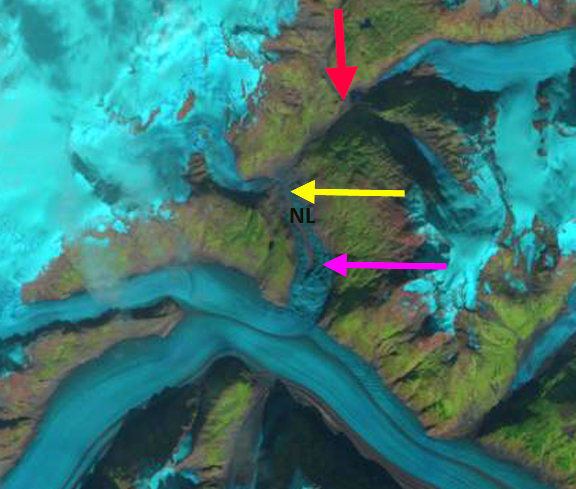
On June 22, 2021 the region between the yellow arrows is an iceberg choked lake. The red arrow indicates the location where Tulsequah Lake used to expand, it is limited. The terminus of the glacier reaching upvalley 600 m from the main glacier.  Discharge is at 60,000 cfs and the turbidity is at ~100 FNU. Starting on the June 25th through the 27th turbidity rises to 400 FNU, while discharge rises to 90,000 cfs.  This is during a protracted dry period and is the result of the beginning of increased glacier discharge from the lake. On July 27th-June 30th it is evident that the margin of the distributary glacier tongue has receded ~500 m back to the main glacier margin, representing a terminus collapse generating icebergs likely resulting from a fall in water level. There is no change in the small Tulsequah Lake at the red arrow. On July 3rd turbidity rises above 500 FNU and discharge exceeds 130,000 cfs, this is at the high end of the typical peak GLOF events from Lake No Lake as noted by Neal (2007)  from 90,000-130,000 cfs. This is the main event and was reported by the USGS. By July 5 Landsat imagery indicates the water level has dropped between the yellow arrows, resulting in more prominent icebergs. The Sentinel image illustrates the zone of iceberg stranding as well.  The icebergs continue to melt away by July 20. No change at the red arrow. If we look back to Sept. 2020 we see what Lake No Lake will appear like by the end of summer and that the distributary terminus margin does not extend upvalley at that time. The large proglacial lake that has formed after 1984 due to retreat helps spread out the discharge from ice dammed lake GLOF’s of Tulsequah Glacier.  This lake will continue to expand and the damming ability of the glacier will continue to decline, which will eventually lead to less of a GLOF threat from Lake No Lake.
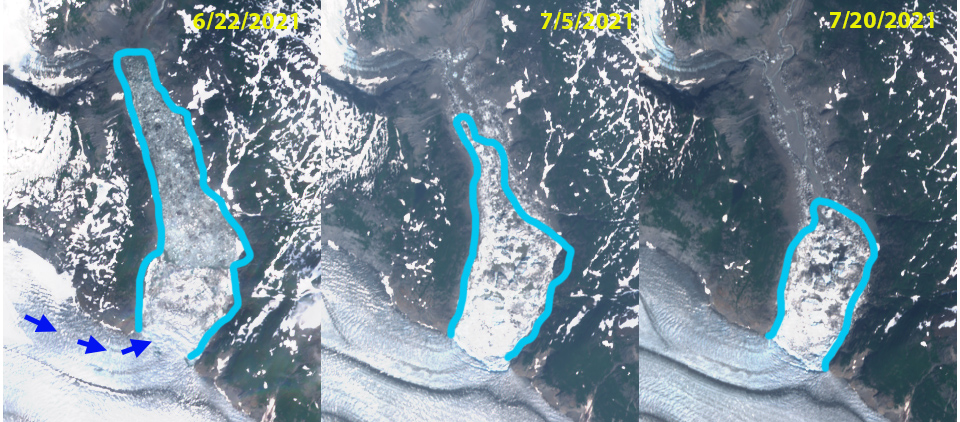
Sentinel images from June 22, July 5 and July 20 of the area of the lake and then the area of stranded icebergs.  Note how almost the entire width of a the northern tributary flows into this valley.


Landsat images of Tulsequah Glacier on June 27 and June 30.  Lake No Lake is between the yellow arrows. The former location of Tulsequah glacier dammed lake is at red arrow.

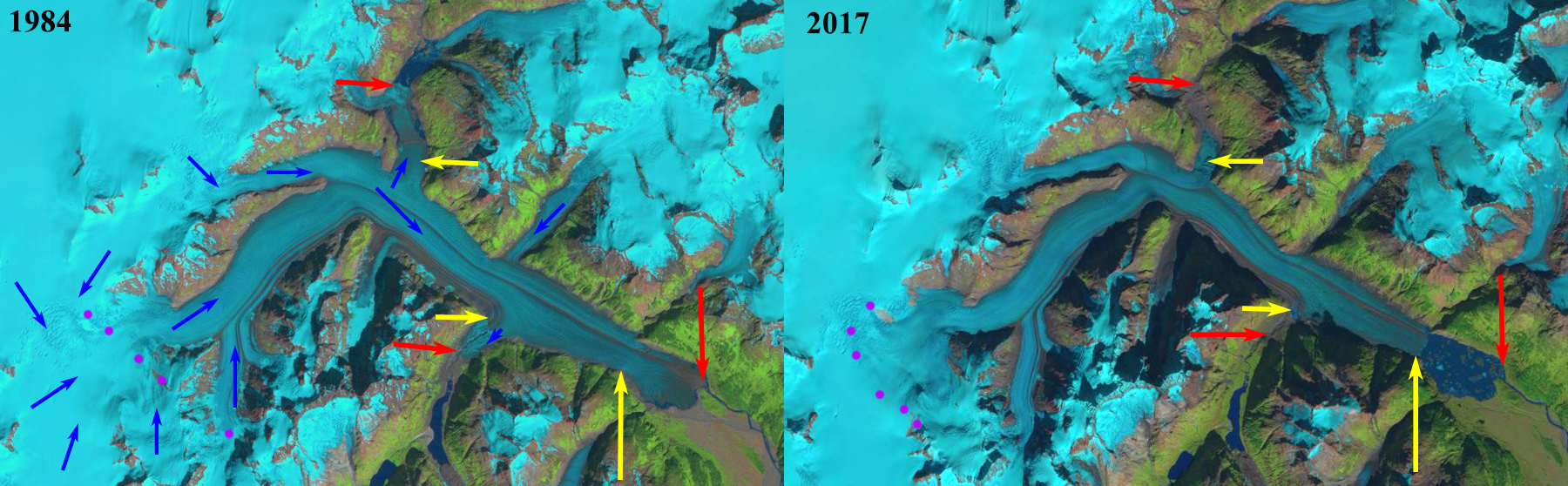
Tulsequah Glacier in 1984 and 2017 Landsat images.  The 1984 terminus location is noted with red arrows for the main and northern distributary tongue, southern distributary red arrow indicates lake margin.  The yellow arrows indicate the 2017 glacier terminus locations. The retreat of 2900 m since 1984 led to a lake of the same size forming. Purple dots indicate the snowline.


Landsat images of Tulsequah Glacier on Sept. 15, 2020.  Lake No Lake now drained fills between the yellow arrows. The former location of Tulsequah glacier dammed lake is at red arrow.
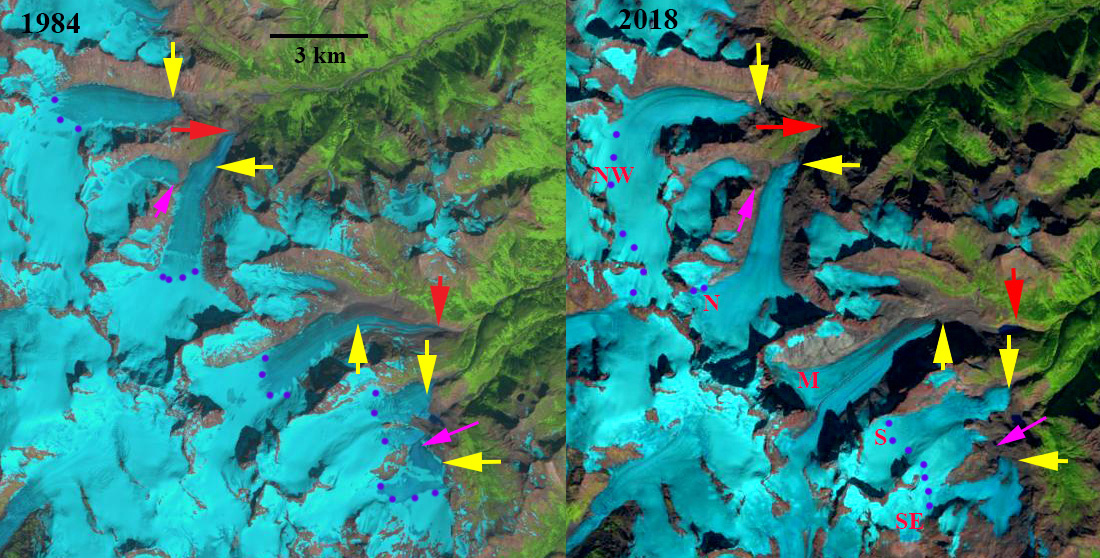
Nakonake Glaciers, BC Retreat Two are Disappearing

Nakonake Glaciers in 1984 and 2018 Landsat images. Nakonake Glaciers are NW=Northwest, N=North, M=Middle, S=South, SE=Southeast.  Red arrows indicate the 1984 terminus position of the North and Middle Nakonake Glaciers.  Yellow arrows indicate the 2018 terminus location of each. Purple dots indicate the snowline and the pink arrow indicates locations of glacier separation.

The Nakonake Glaciers are a group of unnamed glaciers at the headwaters of the Nakonake River in NW Britishc Columbia.  The range is just east of the Tulsequah Glacier-Juneau Icefield.  The Nakonake River flows into the Sloko River which joins the Taku River.  There are sockeye, coho and chinook salmon in the Sloko River.  The Sloko River below the junction with Nakonake River is known as a fun stretch of river to run. My only experience with this glacier group was watching a grizzly bear ascend from the lower Tulsequah Glacier into the Nakonake area. Menounos et al (2018) indicate this region of British Columbia had the largest mean annual mass balance losses from 2000-2018.

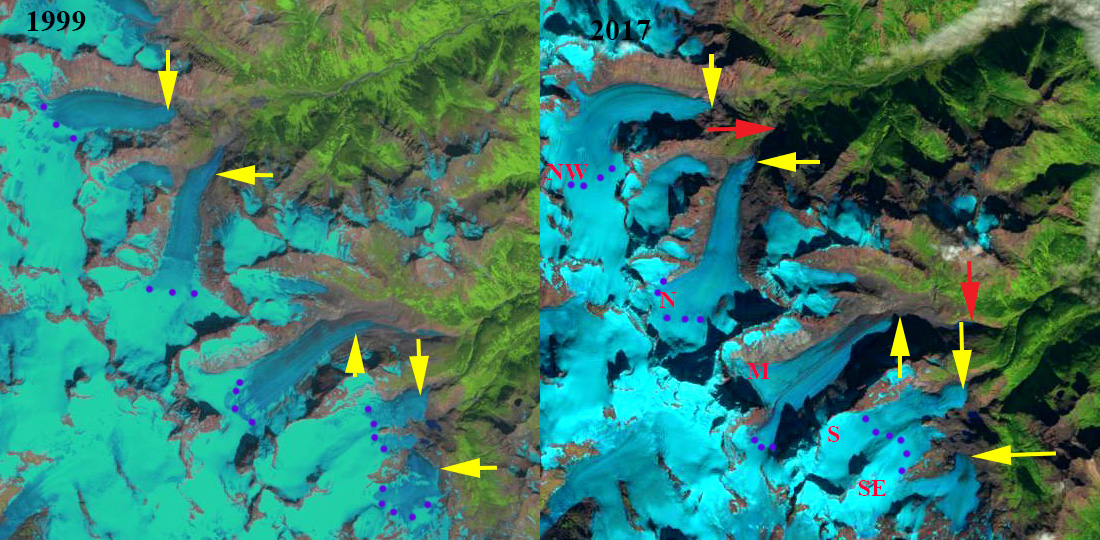
In 1984 the Norhtwest (NW) Nakonake terminated at the top of a steep slope at 1100 m.  North (N) Nakonake Glacier terminated at 800 m with a longer valley tongue than the NW glacier.  The Middle (M) Nakonake Glacier terminated at 900 m and had a substantial low slope terminus tongue. The South (S) Nakonak Glacier merged with the Southeast (SE) Nakonake Glacier at this time.  The snowline varied from 1500 m on NW to 1400 m on N and M and 1300 m on S and SE.  By 1999 the SE Nakonake Glacier had separated from the S Nakonake Glacier though it still had two terminus lobes that were connected. The snowline ranged from 1600 m on the NW Nakonake to 1400 m on the S and SE Nakonake. In 2017 the snowline was quite high ranging from 1700+ m on NW Nakonake to 1500+ m on South Nakonake Glacier.  In 2018 the Juneau Icefield regions saw the highest snowlines of the last 70 years (Pelto, 2018). The snowline was above the top of the M Nakonake and SE Nakonake Glacier. The snowline was above 1800 m on NW Nakonake and 1700 m on the S Nakonake Glacier. Retreat of the NW Nakonake from 1984-2018 was limited at 200 m, though recent high snowlines should accelerate this retreat.  The N Nakonake Glacier that had a low elevation terminus tongue still in 1984 and retreated 1400 m from 1984-2018.  The M Nakonake also had a low elevation tongue that melted away leading to  a retreat of 2200 m from 1984-2018. The retreat is 30+% of the glacier length lost.  This glacier lacks a significant accumulation and will not survive. The S Nakonake retreat like the NW was minor at ~200m.  The SE Nakonake Glacier was 700 m, which given a glacier length of just over 3 km is a substantial loss. This glacier lacks a significant accumulation zone and will not survive. This glacier has separated into two parts.

Tulsequah Glacier has experienced a more rapid retreat enhanced by proglacial lake development (Pelto, 2017).

Nakonake Glaciers in 1999 and 2017 Landsat images. Nakonake Glaciers are NW=Northwest, N=North, M=Middle, S=South, SE=Southeast.  Red arrows indicate the 1984 terminus position of the North and Middle Nakonake Glaciers.  Yellow arrows indicate the 2018 terminus location of each. Purple dots indicate the snowline.

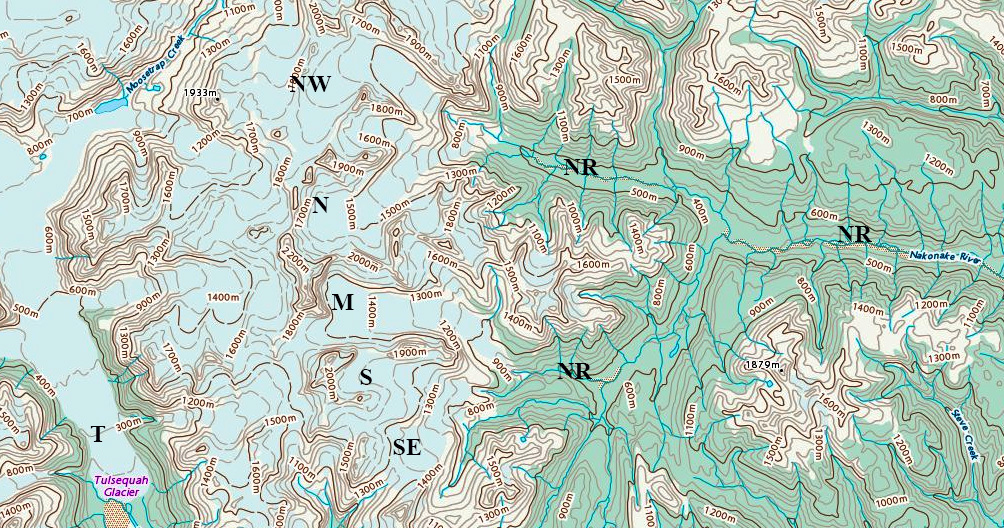
Map of the Nakonake Glaciers and headwaters of the Nakonake River (NR). Tulsequah Glacier (T) to the west is also noted.

Tulsequah Glacier, British Columbia 2900 m retreat 1984-2017

Tulsequah Glacier in 1984 and 2017 Landsat images.  The 1984 terminus location is noted with red arrows for the main and northern distributary tongue, southern distributary red arrow indicates lake margin.  The yellow arrows indicate the 2017 glacier terminus locations. The retreat of 2900 m since 1984 led to a lake of the same size forming. Purple dots indicate the snowline.

Tulsequah Glacier, British Columbia is a remote glacier draining from the Alaska-Canada boundary mountains of the Juneau Icefield. It is best known for its Jökulhlaups from lakes dammed by Tulsequah Glacier in northwestern British Columbia, Canada (Neal, 2007). The floods pose a hazard to the Tulsequah Chief mining further downstream. The continued retreat of the main glacier at a faster rate than its subsidiary glaciers raises the potential for an additional glacier dammed lakes to form. The main terminus has disintegrated in a proglacial lake. Retreat from 1890-1984 had been much slower than the last thirty years. This glacier feeds the Taku River which has seen a significant decline in salmon in the last decade (Juneau Empire, 2017). Here we utilize Landsat images from 1984-2017 to illustrate changes in this glacier, updating the retreat noted by Pelto (2017).

As part of the onoging Juneau Icefield Research Program we completed extensive snow pack measurements in the upper reach of the glacier in 1981-1984 and found that snow depths in August near the end of the melt season between 1700-2000 meters averaged 4-6 meters. This high snowfall accumulation is also indicated by modelling in a recent publication, in a project led by Aurora Roth, @ UAlaska-Fairbanks, that I participated in.

In 1984 the glacier has a low sloped terminus tongue with a narrow fringe of water indicating the initial formation of a lake. The northern distributary terminus extends 3.5 km north from the main glacier.  The southern distributary tongue that blocked the main glacier dammed lake in the past, extending south from the main glacier, now terminates near the main glacier, with the red arrow indicating the southern end of the lake basin. The snowline is at 1300 m. By 2001 the fringing lake extends along the margin for 3 km and is 200-400 m wide.  The northern distributary terminus extends just 500 m from the main glacier.  The southern distributary glacier dammed lake still forms as indicated by icebergs. The snowline is at 1450 m. The snowline is at ~1300 m. In a 2007 Google Earth image the collapsing terminus is still connected to the main glacier. By 2015 the terminus tongue has collapsed with the new proglacial lake still filled by numerous icebergs.  The southern distributary tongue no longer has icebergs indicating lake formation at this location. By 2017 the terminus has retreated 2900 m since 1984, with a new 3 km long proglacial occupying the former glacier terminus. Also note the first tributary entering the glacier from the north in 1984 no longer reaches the glacier in 2017.  The northern distributary tongue has icebergs indicating lake formation still occurs.    The snowline in 2017 is at 1450 m.  The issue driving the retreat is that the equilibrium line where melting equals accumulation and bare glacier ice is exposed has risen and is now typically at 1400 meters. Berthier et al (2018), in a paper I had the pleasure of reviewing, indicate thinning from 2000-2016 greater than 2.5 m per year below 1000 m, with some thinning extending right to the crest of the glacier in all but the northwest corner.  This will drive continued retreat. This retreat is not as spectacular as at Porcupine Glacier to the south. This is not unlike the situation at the Gilkey Glacier just delayed.

Tulsequah Glacier in 2001 and 2015 Landsat images.  The 1984 terminus location is noted with red arrows for the main and northern distributary tongue, southern distributary red arrow indicates lake margin.  The yellow arrows indicate the 2017 glacier terminus locations. Purple dots indicate the snowline.

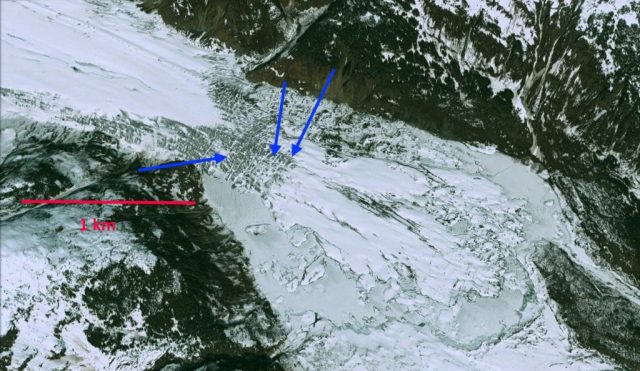
2007 Google Earth image indicating the fialing connection of the main glacier to the terminus tongue.

Retreat of Lake No Lake Glacier Junction, Juneau Icefield, British Columbia

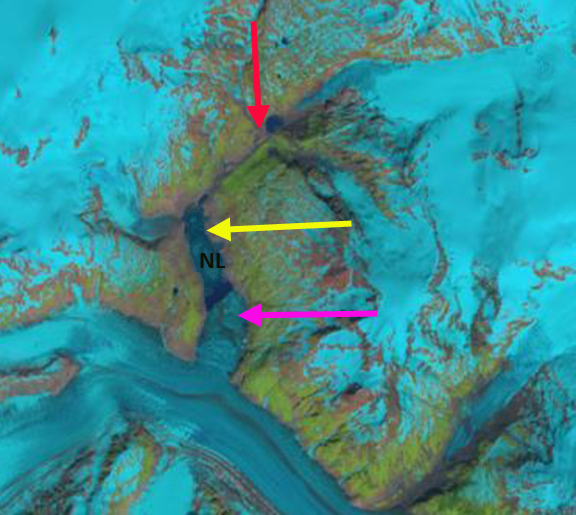
Lake No Lake is a glacier dammed lake that periodically drains under the retreating Tulsequah Glacier. Canadian topographic maps indicate that three glaciers coalesced to fill this valley: Tulsequah, No Lake East and No Lake West. By 1984 when I had a chance to see this lake had formed while working on Tulsequah Glacier. Here we examine the retreat of the three glaciers that has led first to lake formation and now to a reduction in lake size from 1984-2013. nolake map In 1984 the lake extended to the terminus of No Lake East Glacier at the red arrow, after that glacier separated from the other two. Most of the valley below this point is filled with the Tulsequah and No Lake West Glacier that are still connected. The retreat of No Lake East is 1.75 km and now filled by a lake. A series of five Landsat 8 images from 2013 indicates the progression of this lake during a summer. On June 14, 2013 the No Lake East Glacier and Tulsequah Glacier are now separated with a valley 2.5 km long in between. This segment of the valley is filled by the lake, but the lake does not extend upvalley from West to East No Lake Glacier. By June 21 the lake has extended another 400 m upvalley to the northeast as the lake fills. By June 30th the lake has expanded to a length of 3 km and an average width of 600 m. By August 1st the lake has largely drained, though there are many icebergs still on the lake bottom and there is certainly some water remaining. By September 28th the lake is completely drained. The retreat of No Lake East Glacier from the 1984 terminus location at the red arrow is 450 m. The retreat of No Lake West Glacier from the yellow arrow is 400m. The 30 year retreat of the arm of the Tulsequah Glacier from the yellow to the pink arrow is 1800 m. As the damming arm of Tulsequah Glacier continues to thin this glacier will continue to decline in both depth and area. A 2010 Google Earth image is used to indicate the lake margin as indicated by stranded icebergs after drainage. Geertsema and Clague (2012) observed that this lake grew rapidly and began having glacier outburst floods during the 1970’s, but is now declining in size.nolake 1984
1984 Landat image

nolake 6142013
6-14-2013 Landsat image

nolake6212014
6-21-2013 Landsat image

nolkae6302014
6-30-2013 Landsat image

nolake 812014
8-1-2013 Landsat image

nolake 9282013
9-28-2013 Landsat image

lake no lake 2010
Google Earth image, yellow dots lake outline

Tulsequah Glacier, British Columbia Jokuhlaups and Retreat

tulsequah glacier changeAbove is a paired Landsat image from 1984 left and 2013 right indicating the 2500 m retreat during this period of Tulsequah Glacier and formation of a new lake at the terminus. Tulsequah Glacier, British Columbia is a remote glacier draining from the Alaska-Canada boundary mountains of the Juneau Icefield. It is best known for its Jökulhlaups from lakes dammed by Tulsequah Glacier in northwestern British Columbia, Canada (Geertsema, 2000). This Tulsequah Glacier has retreated 1100 m since the Little Ice Age maximum in the 19th century. The continued retreat of the main glacier at a faster rate than its subsidiary glaciers raises the potential for an additional glacier dammed lake to form. The main terminus is disintegrating in a proglacial lake at present. This is not unlike the situation at the Gilkey Glacier just delayed. The images below are from Google earth in 2003 and 2007 and indicate the stagnant nature of the tongue in the lake, and lateral rifting that will be points of instability for a calving disintegration.
tulsequah terminus 2003

tulsequah terminus tongue 2007
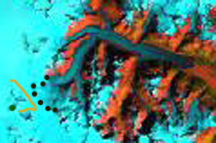
As part of the Juneau Icefield Research Program We completed extensive snow pack measurements in the upper reach of the glacier in 1981-1984 and found that snow depths by summers end between 1800-2000 meters averaged 4-6 meters. These observations completed along a transect across the glacier noted in the image below, provide a good example of the different sensitivities of the glacier to global warming. In 1981 a warm winter led to minimal snowpack at lower elevations in the Juneau Region, however, the upper regions of the icefield had above average snowpack. Jabe Blumenthal and I observed snowpack of over 5 meters on the upper Tulsequah Glacier. The areas above 1500 m are not very sensitive to winter temperatures as most as precipitation will fall as snow. In 1982 Juneau had good snowpack and the upper portion of the icefield was gripped by extended cold, the minimum thermometer at Camp 8 registered -44 F. In the images below the ELA for 1984 (right) and 2006 is indicated by a black dotted line, our Camp * a green dot and our accumulation profile is an orange line. In 2006 (left) the ELA is quite high and the accumulation are not large enough for an equilibrium balance. In 1984 the ELA was lower and mass balance was positive.

Such cold conditions indicate continental dry climate conditions persisting. The result good snowpack low on the glacier and below normal snowpack high on the glacier. From Camp 8 Brian Hakala and I surveyed the upper Tulsequah and found 4 meters of snowpack. In 1984 the highest snowpack of 6 m was noted as Wilson Clayton and I again measured the upper Tulsequah. The glacier still had healthy accumulation. The issue driving the retreat is that the equilibrium line where melting equals accumulation and bare glacier ice is exposed has risen and is now typically at 1400 meters.
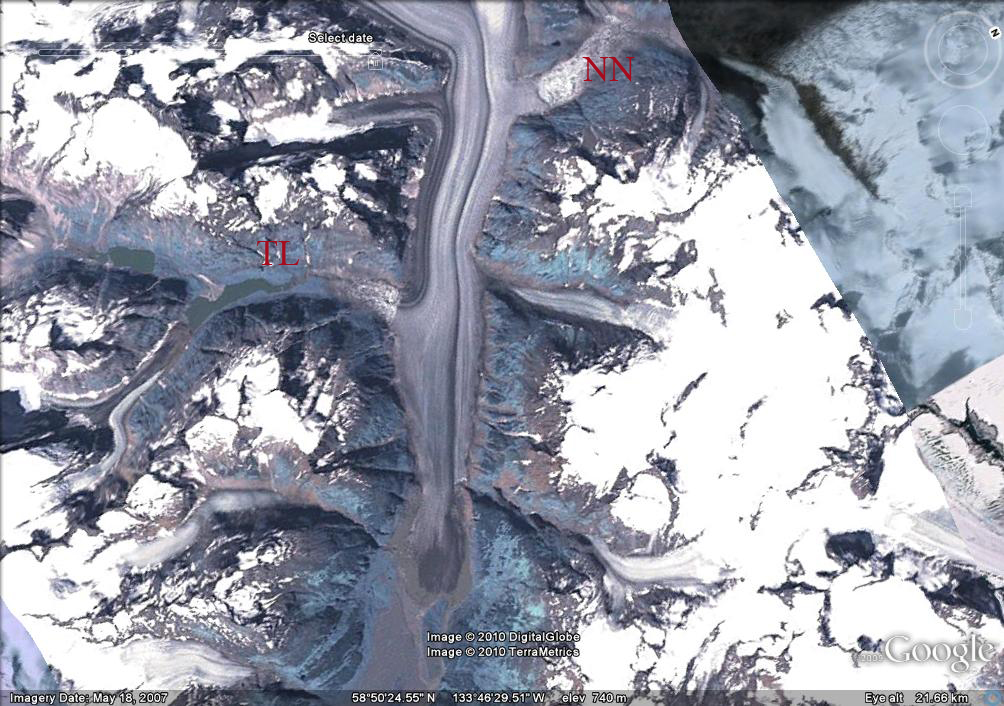
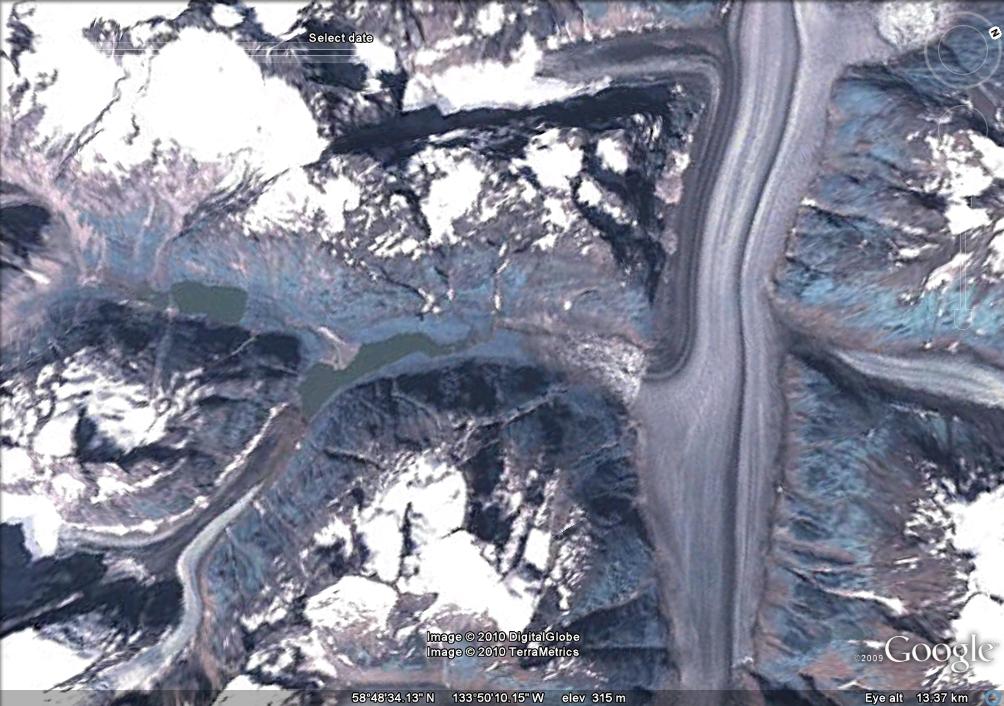
When water stored behind, on or under a glacier is released rapidly this outburst is referred to as a jökulhlaup. These outburst floods can pose a serious threat to life and property, but not from the modest floods of the Tulsequah system along this relatively undeveloped watershed. Tulsequah Glacier has a long history of often annual jökulhlaups since the early twentieth century documented by the USGS. The floods resulted after decades of downwasting and retreat of Tulsequah Glacier. In particular a tributary glacier feeding the Tulsdequah retreated and downwasted faster than the main glacier. This valley then was dammed by the main stem of the glacier. There is no surface drainage evident from either Lake No Lake or Tulsequah Lake (labelled TL and NN in image above), indicating all discharge is through a subglacial tunnel.the main stem of the glacier emerging at the terminus and causing modest downstream flooding. Each summer as the lake filled with meltwater, its area, level and volume would increase to the extent that the hydrostatic pressure would float the glacier enough to begin flowing, this water then would further melt the ice enlarging its conduit. Most of the release occurs within several days. Hydrologic data are used to reconstruct the times and peak discharges of floods from the glacier-dammed lakes The first jökulhlaups from Tulsequah Lake were the largest. The history of this these jökulhlaups has been declining peak and total discharges as the lake became smaller. Today, Tulsequah Lake is small, and it will disappear completely if Tulsequah Glacier retreats any further. From 1941-1971 Tulsequah Lake discharged annually. Since 1990 a Lake No Lake has been discharging annually. Lake No Lake), has formed and grown in size as Tulsequah Lake has diminished. Lake No Lake developed from a subglacial water body in a tributary valley, 7 km upglacier from Tulsequah Lake. Like Tulsequah Lake, Lake No Lake rapidly grew in area and volume during its youth, and in the 1970s it began to generate its own jökulhlaups. Lake No Lake appears to be following the same evolutionary path as Tulsequah Lake – its volume is now decreasing due to downwasting of Tulsequah Glacier, and its jökulhlaups are beginning to diminish. As Tulsequah Glacier continues to shrink in response to climatic warming, additional glacier-dammed lakes may form, renewing the cycle of outburst flood activity, the tributary where this is most likely is labeled Future New Lake in the final image.