Vern Ritchie-Battle Glacier, British Columbia Retreat, Lake Growth, Snowline Rise

Vern Ritchie (VR) and Battle Glacier (B) in 1987 and 2019 landsat images.  Three proglacial lakes have expanded at Points 2-5. WN=West Nunatak Glaier, Y=Yakutat Glacier N=Novatak Glacier, purple dots indicate snowline and green arrows indicate glacier flow direction.

Vern Ritchie and Battle Glacier flow from the Alaska/Canada border of the St. Elias Mountains towards the Alsek River. In 1987 the two glaciers that share both an accumulation zone and a terminus area terminated in small proglacial lakes at 240 m.  The main flow path of  Battle Glacier connects to West Nunatak Glacier and Novatak Glacier, Alaska at a low elevation saddle at 750-800 m. The Vern Ritchie Glacier is 45 km long and extends north parallel to the border to an elevation of 1800 m. A portion of this higher elevation accumulation is separated by a nunatak at Point 1  at ~850 m and joins the Battle Glacier 20 km from the terminus. Here we utilize Landsat images from 1987-2019 to identify the impact of climate change on these two glaciers. Trussel et al (2015) noted an extremely high thinning rate of 4.4 m/year on the adjacent Yakutat Glacier from 2000-2010, and it retreated 7 km losing 45 km2, of area from 2000-2018 (Pelto, 2018). Glaciers of the Glacier Bay region lost ~0.6 m/year from 1995-2011 (Johnson et al 2013).

Un 1987 Vern Rithcie Glacier’s northern terminus near Point 4 rested on an outwash plain. The southern terminus near Point 3 terminated in a 2.5 km2, proglacial lake. Battle Glacier terminated in a narrow fringing proglacial lake with an area of less than 1 km2.  The divide between Battle Glacier and West Nunatak Glacier was in the ablation zone.  The connection at Point 6 to Novatak Glacier is km wide. The snowline in 1987 on Vern Ritchie Glacier was at 1000 m.  In 1998 both lakes had expanded significantly as thinning and retreat accelerated.  The snowline is at 800 m in early August on Vern Ritchie Glacier and is at 750 m on Battle Glacier covering the divide with West Nunatak Glacier. At Point 6 the connection to Novatak Glacier remains wide. By 2015 a proglacial lake had formed at the northern terminus at Point 4 with an area of ~2 km2. The southern terminus glacial lake has expanded to ~6 km2, and has several large icebergs evident. Battle Glacier at Point 5 now terminated in a ~5 km2 lake that has a few icebergs. The snowline is at 1100 m on Vern Ritchie Glacier.

In 2018 and again in 2019 record snowline elevations since 1946 were noted at Taku Glacier near Juneau, AK (Pelto 2019).  In 2018 the nearby Lowell Glacier exhibited a substantial snow swamp (NASA, 2019).  The snowline was the highest observed on Vern Ritchie Glacier at 1340 m. At Point 6 the connection to Novatak Glacier continues to narrow.  The Vern Ritchie northern terminus lake has expanded to 2.7 km2.  The southern terminus lake in 2019 has an area of ~7 km2, a 225% increase since 1987, and again has several icebergs.  Battle Glacier has receded to Point 2 a retreat of 3800 m since 1987 and the lake now has an area of ~6 km2 . The lake also has several significant icebergs.

The main portion of Battle Glacier is fed by flow from the divide region with West Nunatak and Novatak Glacier, which is no longer retaining accumulation on a consistent basis and this portion will melt away.  The connection to Vern Ritchie at Point 1 remains wide, but there is a sill here, that is becoming more evident indicating a reduction in flow.  Vern Ritchis continues to retain snowpack on the upper reaches of the glacier. The retreat of this glacier is less spectacular than nearby Melbern Glacier or Yakutat Glacier.
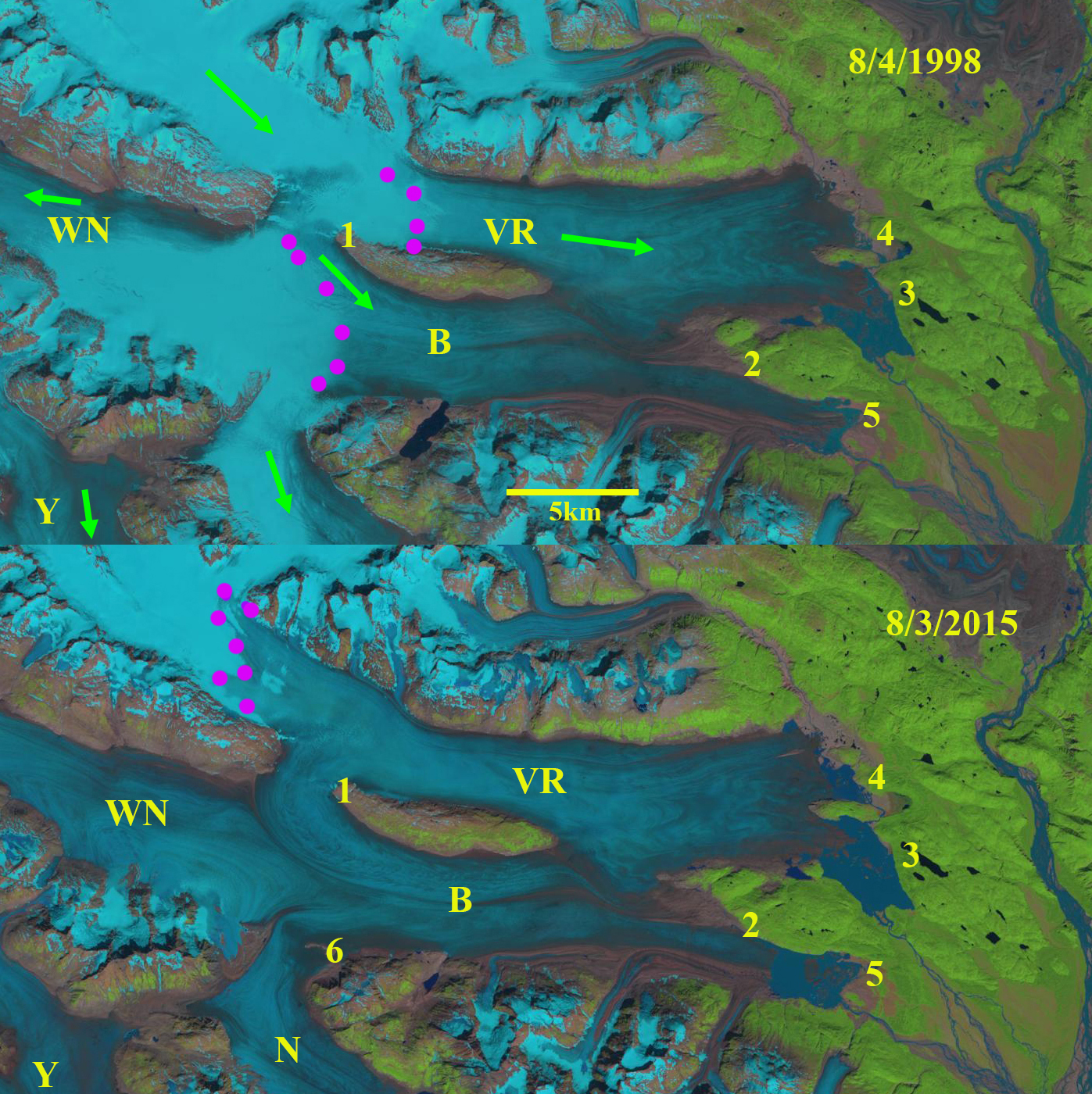
Vern Ritchie (VR) and Battle Glacier (B) in 1998 and 2015 landsat images.  Three proglacial lakes have expanded at Points 2-5. WN=West Nunatak Glaier, Y=Yakutat Glacier N=Novatak Glacier, purple dots indicate snowline and green arrows indicate glacier flow direction.

Canada Topographic map of the terminus region from Atlas of Canada 
Rogue River Icefield Rapid Retreat, Selwyn Mountains, Yukon

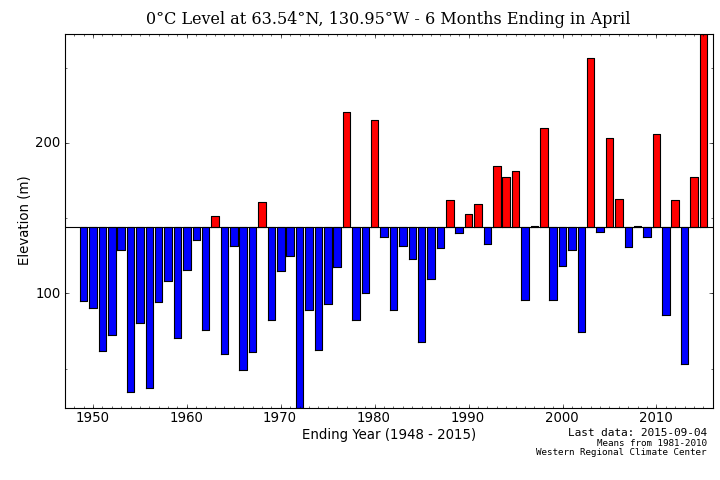
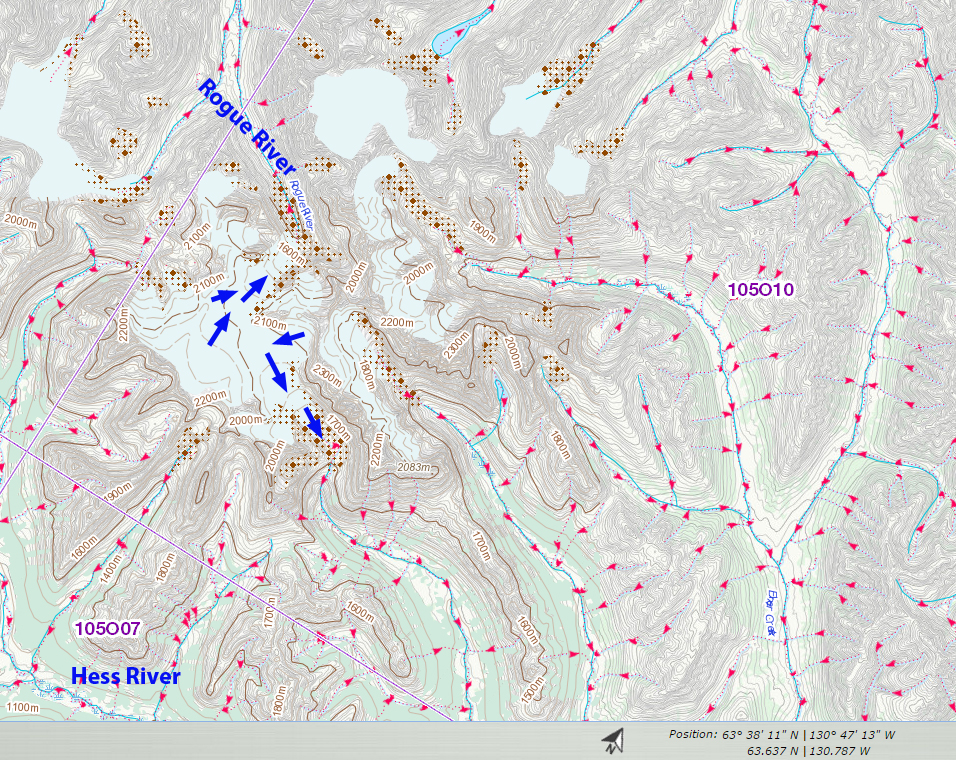
The Selwyn Mountains, Yukon Territory are host to numerous small alpine glaciers that have been rapidly losing area and volume. David Atkinson, atmospheric scientist at University of Victoria has been examining the weather conditions leading to the extensive melting and higher snowlines. From 1958-2007 glaciers lost 22% of their volume in the Yukon (Barrand and Sharp, 2010).  Due to the high snowlines Atkinson notes the rate of retreat has increased since then.  The freezing level as determined by the North American Freezing Level Tracker illustrates this point with 2015 being the highest winter freezing level. Here we examine response of the Rogue River Icefield using Landsat imagery from 1986-2015.  The icefield is at the headwaters of the Rogue River and also drains into the Hess River.

rogue river

Canada Toporama map of the region.

selwyn

Selwyn Mountain November-April freezing levels.

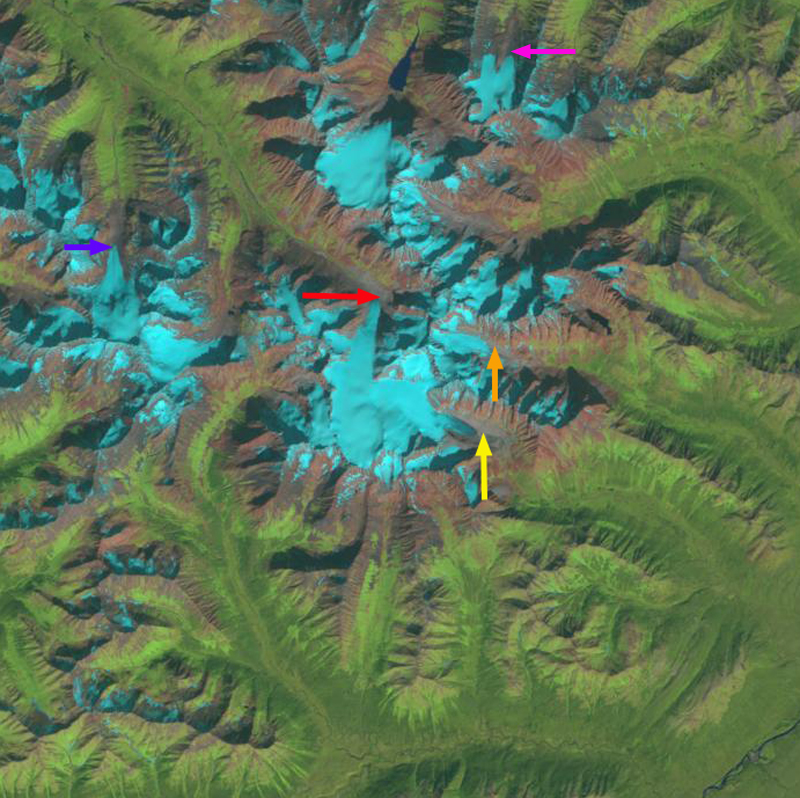
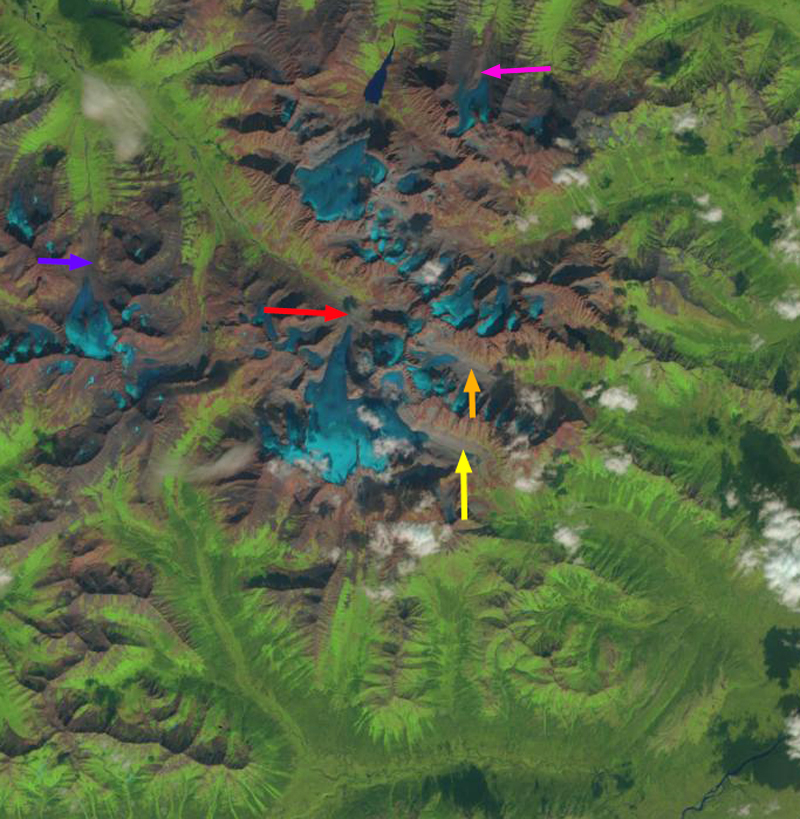
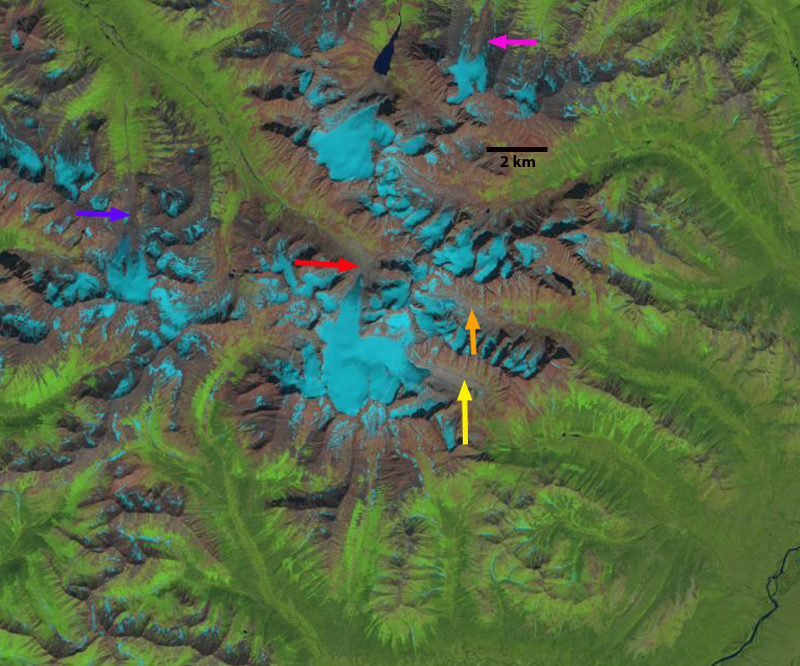
In 1986 the primary icefield glacier is shown with blue arrows above indicating flow direction towards both the north and southeast terminus.  The north terminus reached the valley bottom at the red arrow and the southeast terminus extended to the yellow arrow in 1986. All arrows are in fixed locations in every image. The purple and orange arrows indicate the terminus of smaller valley glaciers in 1986.  The pink arrow indicates a valley glacier that is split into two terminus lobes by a ridge. By 1992 the only significant change is the southeast terminus of the primary glacier at the yellow arrow. In 2013 the snowline is exceptionally high at 2200 meters, with glacier elevations only reaching 2300 m.  Retreat is extensive at each terminus.  In 2015 the satellite image is from early July and the snowline has not yet risen significantly.  Terminus retreat at the yellow arrow is 900 meters, at the red arrow 400 m, at the purple arrow 600 m, at the pink arrow 400 m and at the orange arrow 500 m.  Given the length of these glaciers at 1-3 km this is a substantial loss of every glacier.  Further south in the Yukon high snowlines are also a problem for Snowshoe Peak Glacier.

rogue river 1986

1986 Landsat image

rogue river 1992

1992 Landsat image

rogue river 2013

2013 Landsat Image

rogue river 2015

2015 Landsat image


Snowshoe Peak Glacier Retreat, Yukon

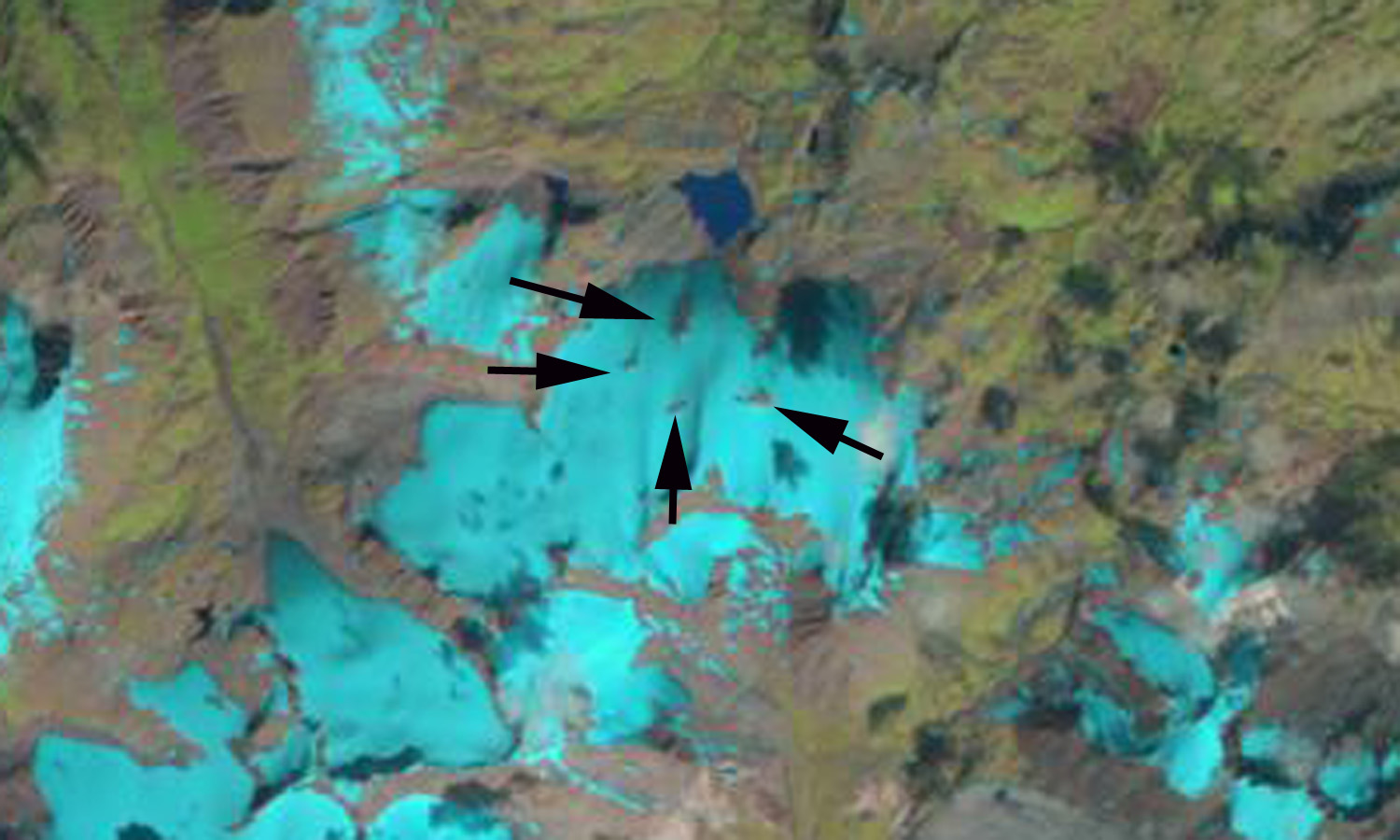
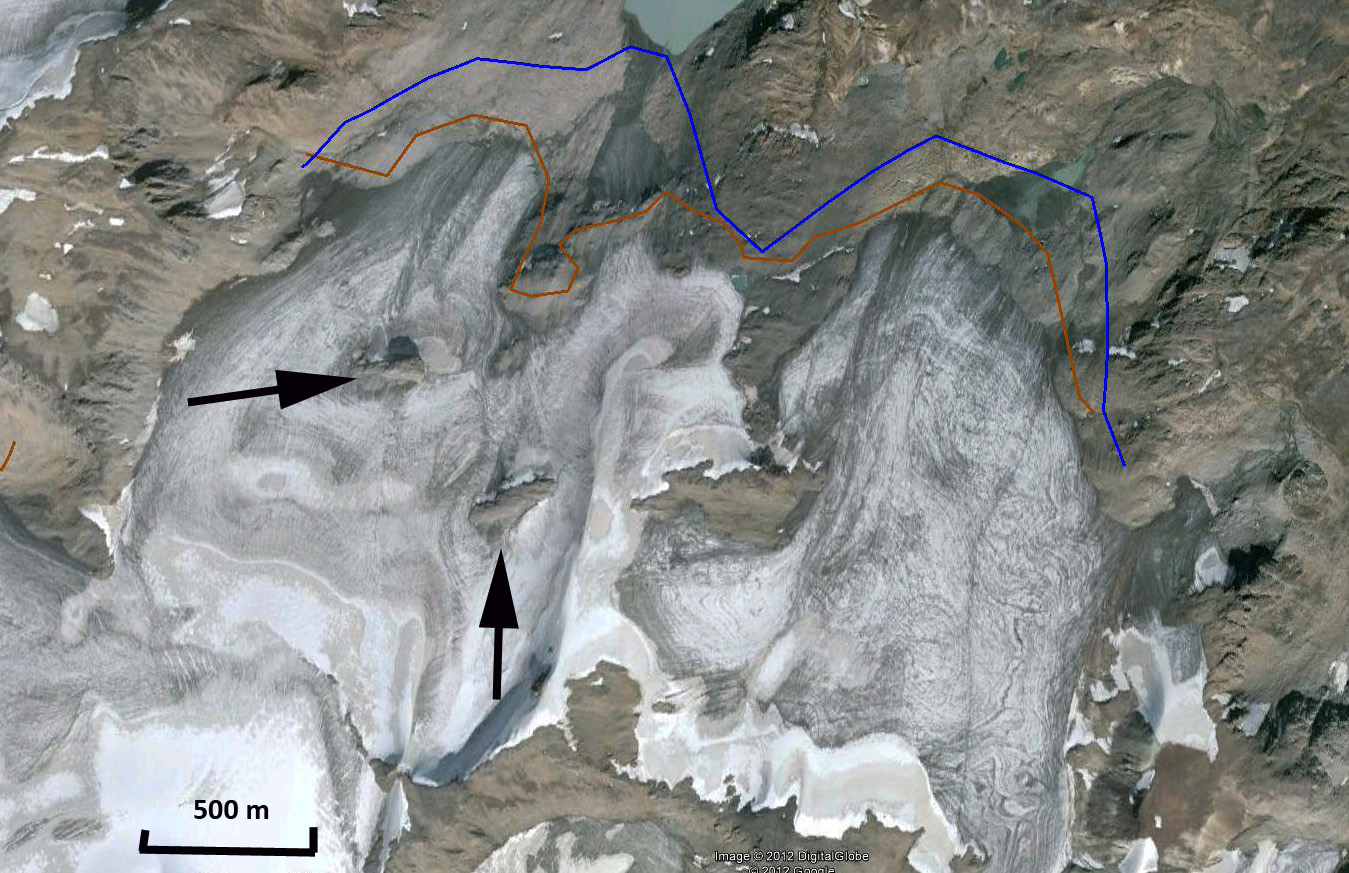
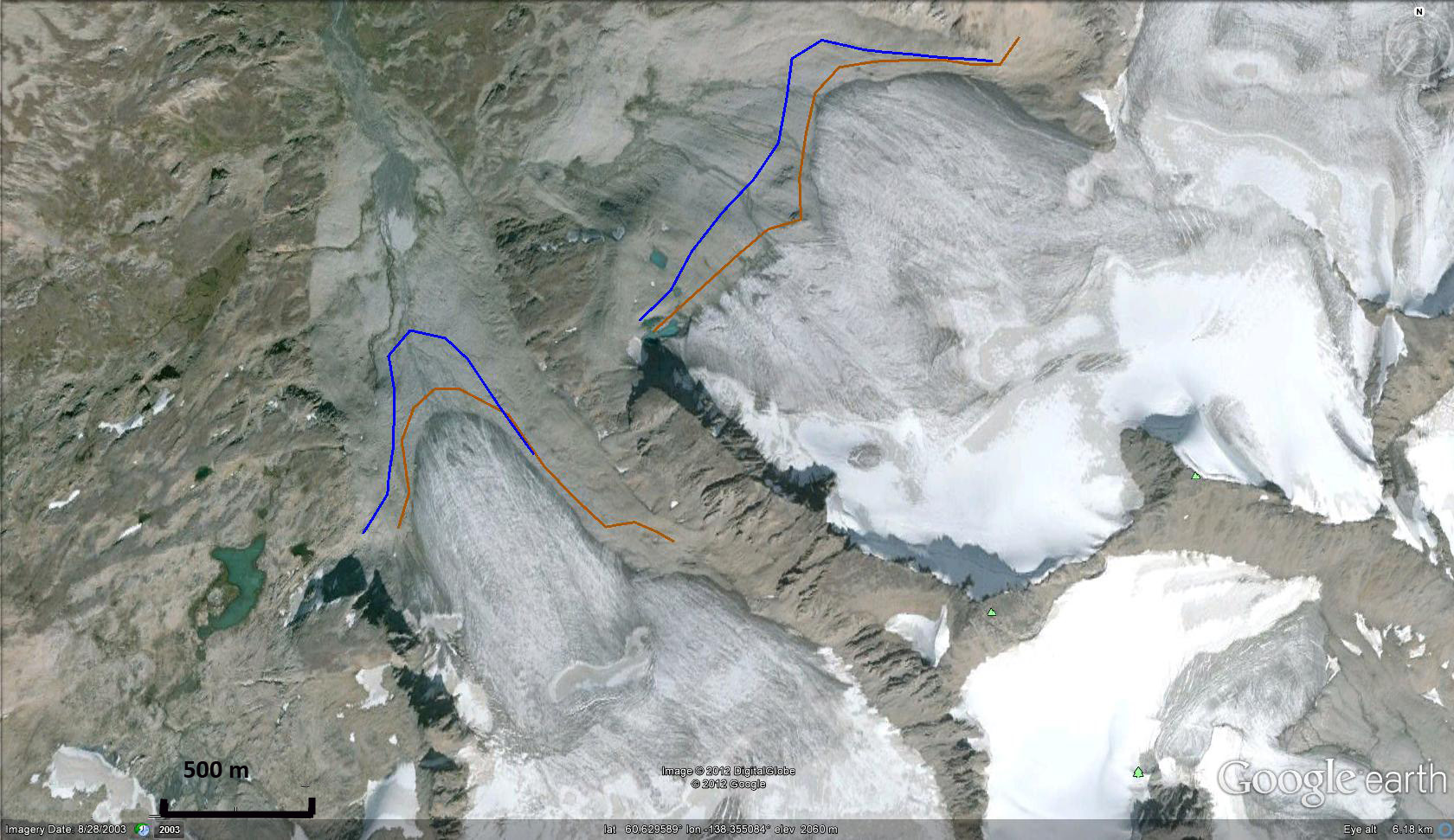
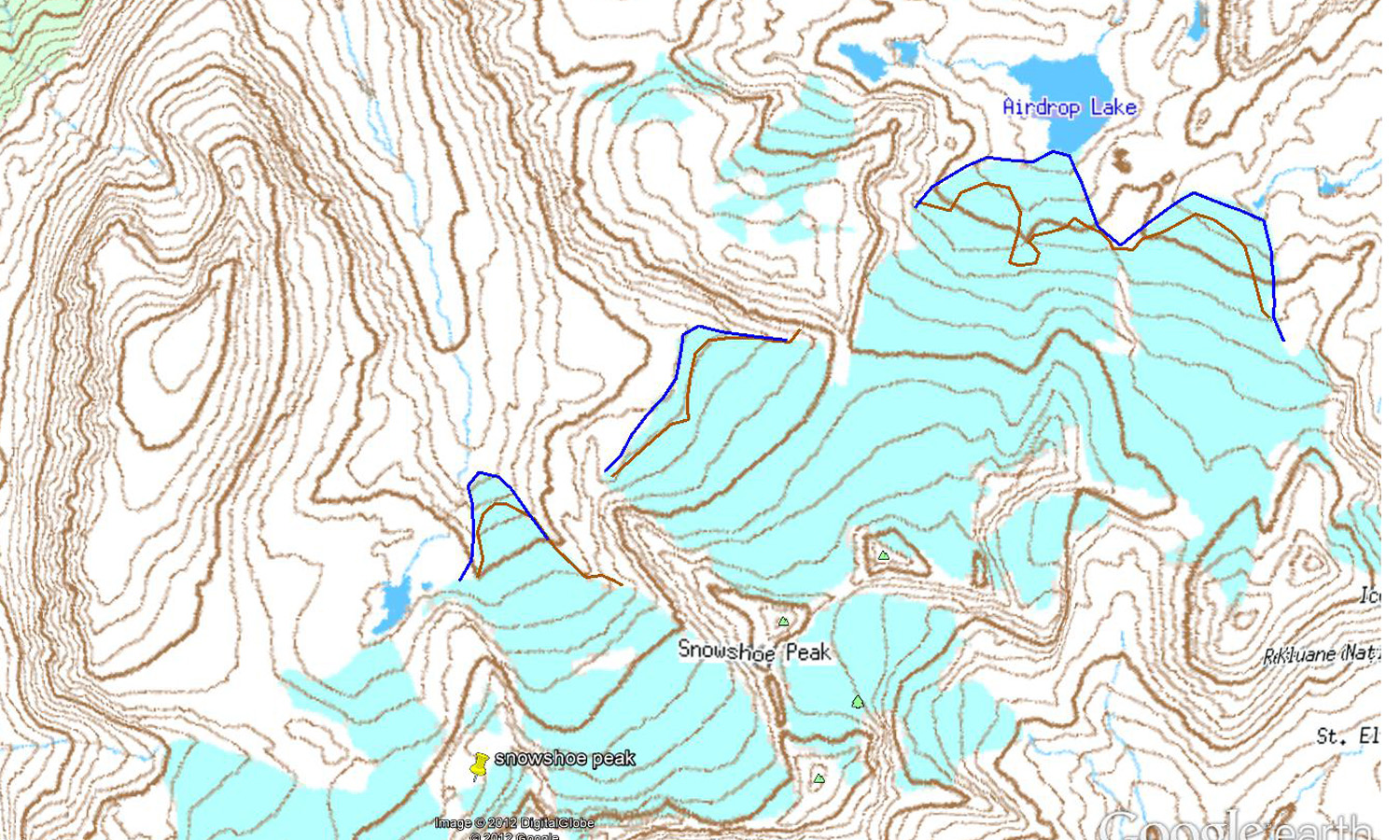
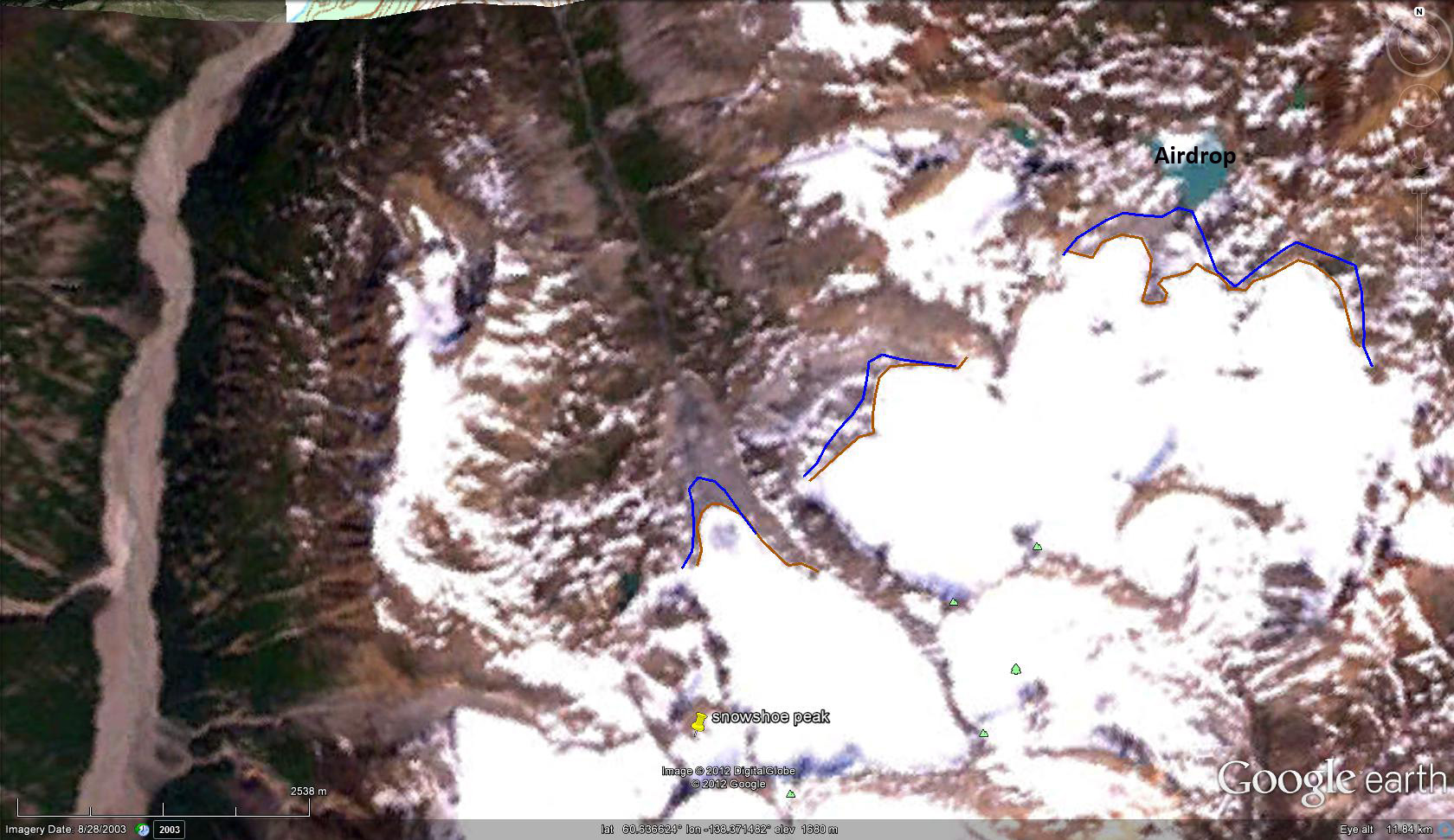
There was the Yukon Gold Rush and then there are a number of surging glaciers in the Yukon. These two have drawn our attention. In Kluane National Park, besides the large surging outlet glaciers draining the St. Elias Mountains (Donjek, Lowell, Kaskawulsh etc.) there are numerous smaller alpine glaciers in ranges just east of the St. Elias. In a recent ice core study in the Eclipse Icefield it was found that the Gold Rush led to higher fire activity (Yalcin et al., 2004). This post examines several of these glaciers that have not been the focus of any detailed study, in the are of Airdrop Lake and Snowshoe Peak. Each of the glaciers is 1.5 to 2.0 kilometers long, beginning near 2100 meters the summit area of Snow Peak and terminating between 1800 and 1900 m. This is relatively small elevation change for alpine glaciers. In the 2003 Google Earth Imagery the lack of snowcover is evident. The blue line is the terminus position from the map of 1970’s and the brown line a 1998 satellite image. There are a few outrops of rock in the midst of the glacier that formerly terminated at Airdrop Lake. Comparison of a 1987 (top), 2003 (middle) and a 2010 (bottom) Landsat image indicate that the two key outcrops that were in the midst of the glacier in 1990 are at the terminus in 2010. Two others have expanded and with terminus retreat are markedly closer to the margin of the glacier in just seven years from 2003-2010. The lower section of each glacier is quite thin and uncrevassed. The lack of snowcover during many recent years indicate a mass balance loss and glacier thinning that is driving the retreat. It does not appear the glacier that flows toward Airdrop Lake can survive, with thinning high on the glacier and limited retained snowcover. There are some patches of stagnant ice near the terminus of the Airdrop Lake Glacier, this glacier has retreated 250-450 meters from the map to 2003, 20-30% of the glacier length and is still retreating quickly as the 2010 imagery indicates. The Snowshoe Peak glaciers have retreated 150 m to 300 meters which is 10-20% of the glacier length. The retreat of the small glaciers here parallels that of the larger glaciers nearby such as Melbern Glacier.