Global Glacier Change Bulletin-Many Glaciers Same Story


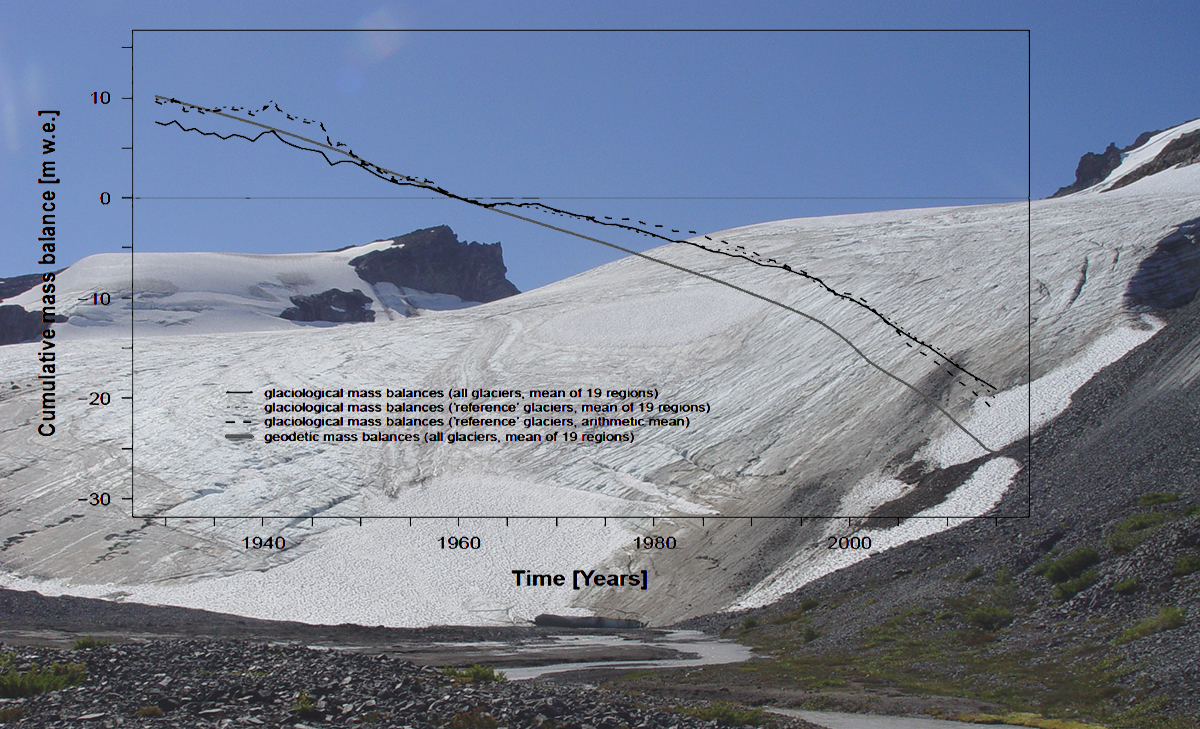
Cumulative glacier mass balance losses reported by WGMS by region, all glacier, reference glaciers and geodetic mass balance (Sholes Glacier, WA in background).  The data set size, location and type changes but the story remains the same, mass loss resulting from global temperature increase.

The World Glacier Monitoring Service has released the second bulletin of Global Glacier Change.  The bulletin provides detailed global and regional information on alpine glaciers particularly for 2014 and 2015.  There is data reported from 621 glaciers.  The glaciers vary in type and location, yet their response is the same retreat and mass balance loss as a result of the global temperature increases.  There are currently 41 reference glaciers with at least 30 consecutive years of detailed field measurement of mass balance.  Additionally mass balance is typically reported from 60-80 other glaciers.  The graph below indicates that the reference glacier network mass balance losses parallels the losses of all glaciers and that of geodetic assessment of mass loss from remapping.  The report indicates that alpine glaciers have lost 0.9 m w.e. per year.  This continues the unprecedented trend of mass loss that is driving glacier retreat as well. In 2014 and 2015 316 mass balance observations are reported from 166 glaciers.  There are 889 terminus change observations reported from 528 glaciers. The results in graph after graph illustrate that glaciers in all regions of the globe are experiencing mass loss and retreat.  As the United States representative to the WGMS, helping pull together each strand of data, is a key task.  The result unfortunately is a very strong line of data built of all these strands of glaciers losing mass.  The report also contains preliminary data from 2016, which was the 37th consecutive year of mass loss as reported in BAMS State of the Climate 2016 (Pelto, 2017).  The deadline for posting initial results on mass balance for reference glaciers in 2017 was Dec. 1 2017.  Reporting on the US glaciers it is clear that 2017 will be another year of substantial losses in this region. 


Annual glacier mass balance reported for each region.  The coloration indicates the increase in mass balance loss in each region with global temperature increase. 

There is a section of the bulletin on each region including graphs of terminus change and mass balance on selected glaciers. Below are examples from Western North America and Central Europe.  For reference glaciers data is submitted that includes maps of the mass balance, and then charts are derived from WGMS illustrating mass balance changes and the relationships between mass balance and the equilibrium line altitude, and between mass balance and the accumulation area ratio.  


Alsek Glacier, Alaska Retreat & Glacier Separation

Alsek Glacier in a 1984 Landsat image and 2017 Sentinel image.  Red arrows indicate 1984 terminus, yellow arrows 2017 terminus location, pink arrows tributaries that joined the glacier in 1984 and purple dots the snowline.  AR=Alsek River, G=Gateway Knob and P=Prow Knob.

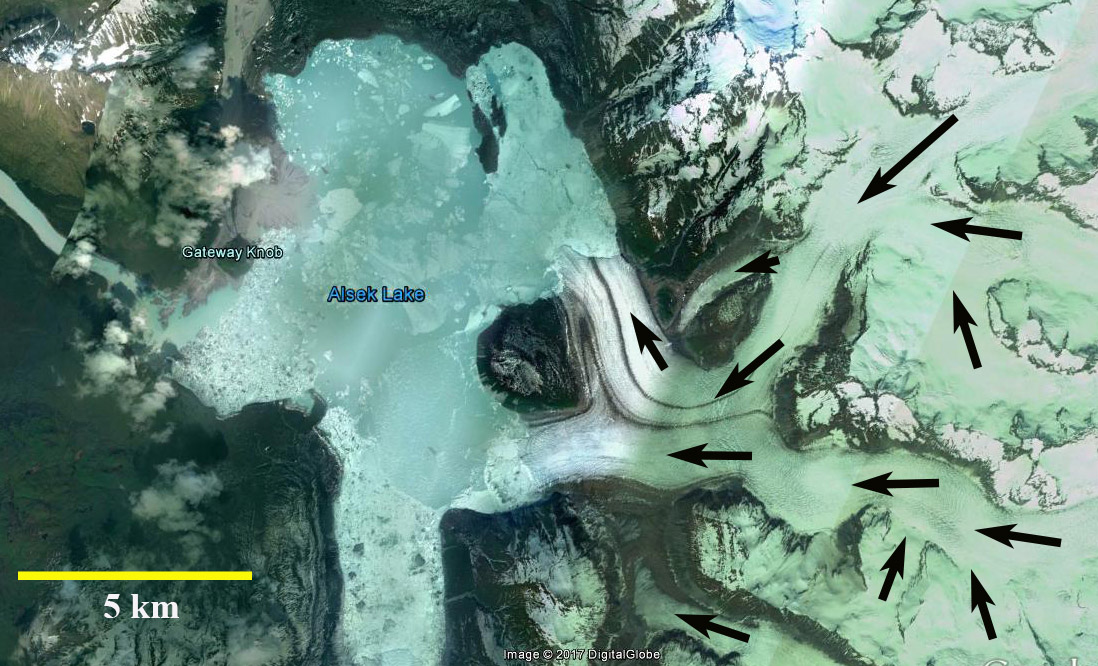
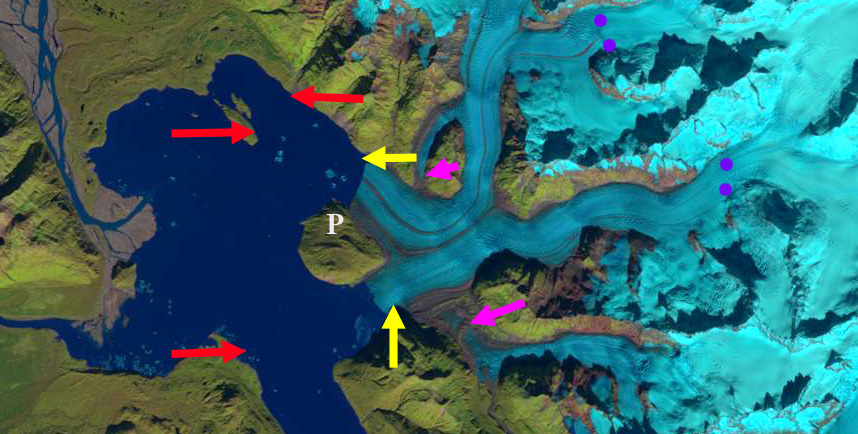
Alsek Glacier descends from the Fairweather Range terminating in Alsek Lake on the coastal plain. The glacier terminated at Gateway Knob (G) near the outlet of Alsek River from Alsek Lake in the early part of the 20th century (Molnia, 2005). At that time it had a joint terminus with Grand Plateau Glacier. The glacier retreated 5-6 km by 1984 along the central margin from Gateway Knob. The glacier remained connected with the Grand Plateau Glacier in 1984. In 1960 the glacier had a single terminus joining downstream of an unnamed island in Alsek Lake, that Austin Post told me reminded him of a boats prow. This “Prow Knob” (P) much like Gateway Knob a century ago stabilizes the terminus. Retreat from this knob will lead to an increase in retreat of Alsek Glacier. Here we examine the change from 1984-2017 with Landsat and Sentinel imagery.

In 1984 the terminus location is denoted with red arrows it has separated into two termini on either side of “Prow Knob”. The northern terminus tongue is located on a narrow island on the north side of Alsek Lake. The southern tongue merges with the northern arm of Grand Plateau Glacier. Two tributaries at the pink arrows merge with the main glacier. In 1984 the snowline is at 900 m. By 1999 the northern tongue has retreated from the narrow island, which exposes the terminus to enhanced calving. The southern terminus has separated from the Grand Plateau Glacier. In 1999 the snowline is at 900 m. By 2013 the northern terminus has retreated almost to the northern end of “Prow Knob” and the southern terminus is directly south of “Prow Knob” in a 1.8 km wide channel. By 2016 two tributaries of Alsek Glacier are fully detached from the glacier, pink arrows. In 2017 the northern terminus tongue has retreated 3.7 km since 1984 into the 2.0 km wide channel on the northeast side of “Prow Knob”. The center of the southern terminus has retreated 3.0 km since 1984 and remains in the channel on the south side of “Prow Knob”. The length of the calving front has declined from an 8 km long calving front in 1984 to a 4 km calving front in 2017. In both 2016 and 2017 the snowline is at 1200 m, at this elevation the mass balance of the glacier will be significantly negative driving further retreat. Larsen et al (2007) indicate thinning in the lower Alsek Glacier of 3+m/year in the last half of the 20th century, indicating the glacier is a in a long term adjustment to climate change.  The retreat of this glacier is similar to that of Walker Glacier and North Alsek Glacier, and less than that of the northern arm Grand Plateau Glacier to which it was connected in 1984 or Yakutat Glacier a short distance north.   

Alsek Glacier in a 1999 Landsat image .  Red arrows indicate 1984 terminus, yellow arrows 2017 terminus location, pink arrows tributaries that joined the glacier in 1984 and purple dots the snowline.   P=Prow Knob.

Alsek Glacier in 2014 Google Earth Image,indicating flow directions. 

Alsek Glacier in a 2016 Landsat image .  Red arrows indicate 1984 terminus, yellow arrows 2017 terminus location, pink arrows tributaries that joined the glacier in 1984 and purple dots the snowline.   P=Prow Knob.


Bridge Glacier, Southeast Alaska Retreat & Lake Formation

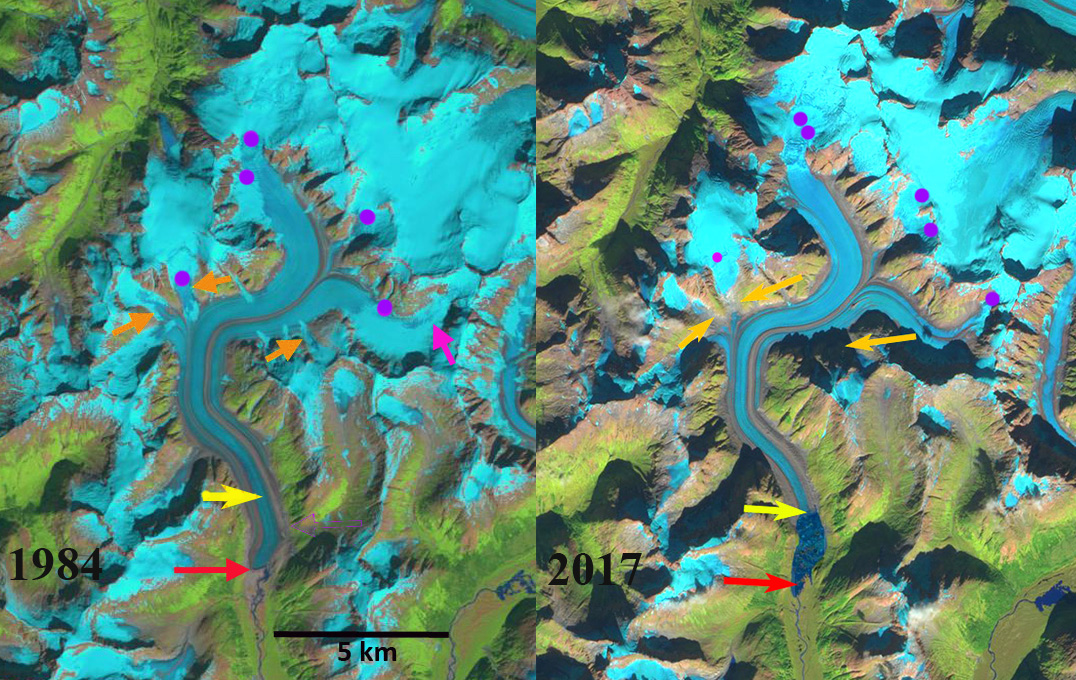
Bridge Glacier in Landsat image from 1984 and Sentinel image from 2017. The red arrow indicates the 1984 terminus where no lake exists, yellow arrow is 2017 terminus, orange arrows are selected tributaries and purple dots the snowline. 

Bridge Glacier drains the same icefield as the Wright and Speel Glacier 45 km southeast of Juneau, Alaska. Here we examine the changes in this glacier from 1984-2017 using Landsat and Sentinel imagery.

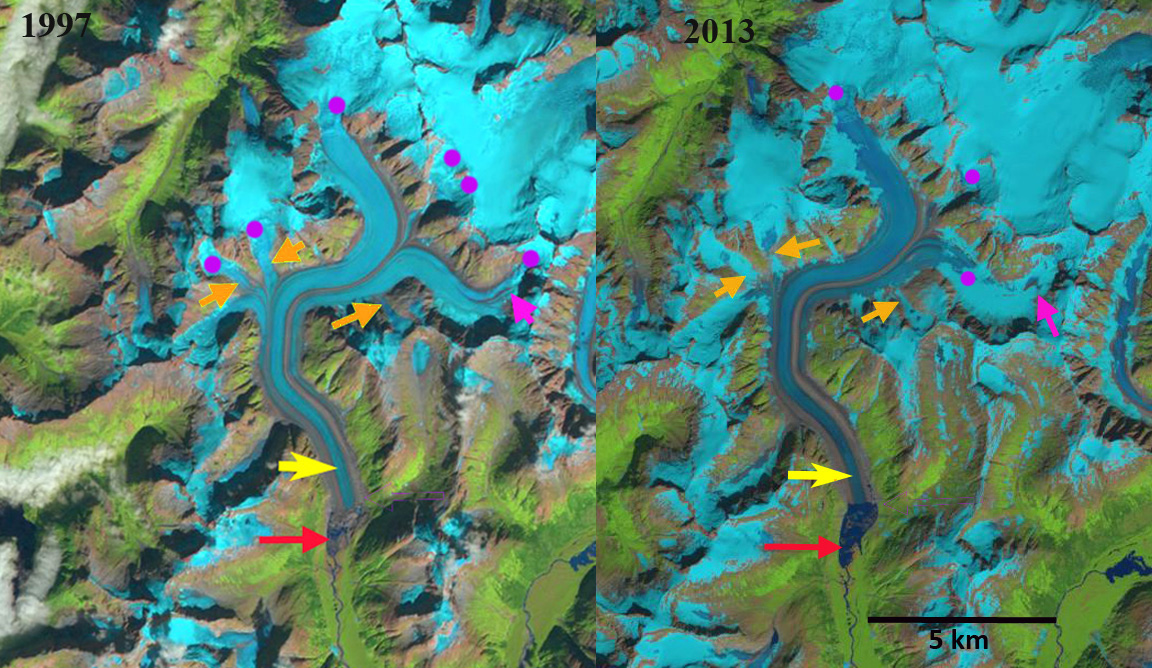
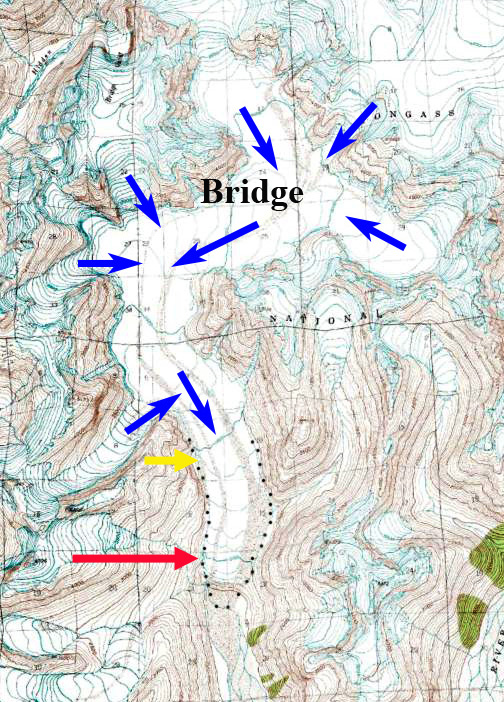
In 1984 the glacier ended on an outwash plain at the head of a branch of Speel River. The red arrow indicates the 1984 terminus for each image, the yellow arrow the 2017 terminus and the orange arrows three tributaries feeding the glacier.  The purple dots indicate the snowline at 1200 m. In 1984 all three tributary glaciers fed Bridge Glacier and the glacier has no proglacial lake at the terminus. In 1997 a lake basin is beginning to develop, though it is still largely filled by ice. The eastern tributary pink arrow, has lost all of its snowpack. The three tributaries at the orange arrows are connected to Bridge Glacier still and the snowline is at 1250 m. In 1999 the proglacial lake has formed and has length of 1 km, the lake has expanded south and north of the 1984 terminus position, and does not entirely represent glacier retreat.  In 2013 the glacier has retreated 1200 m from the 1984 position and the lake is still expanding. The orange arrows indicate that none of the three tributaries are still connected to the main glacier. The glacier in a sense is losing its income flow from these subsidiaries. The eastern tributary has retained some snowcover with six weeks left in the melt season in 2013, but this is mostly gone a month later, the snowline is at 1100 m. nbsp; Total retreat from 1984 to 2017 is 1900 m. In 2017 the snowline is at 1300 m, and the separation of the tributaries is by more than 500 m in each case. The snowline has been high by the end of each summer from 2014-2017 indicating retreat will continue. The retreat of this glacier is the same story as seen at nearby PattersonGilkey and Norris Glacier.

.

Bridge Glacier in Landsat images from 1997 and 2013. The red arrow indicates the 1984 terminus , yellow arrow is 2017 terminus, orange arrows are selected tributaries and purple dots the snowline. 

Bridge Glacier in USGS map when it ended on the outwash plain in 1948.


HPS-12, Chile Spectacular 13 km retreat 1985-2017

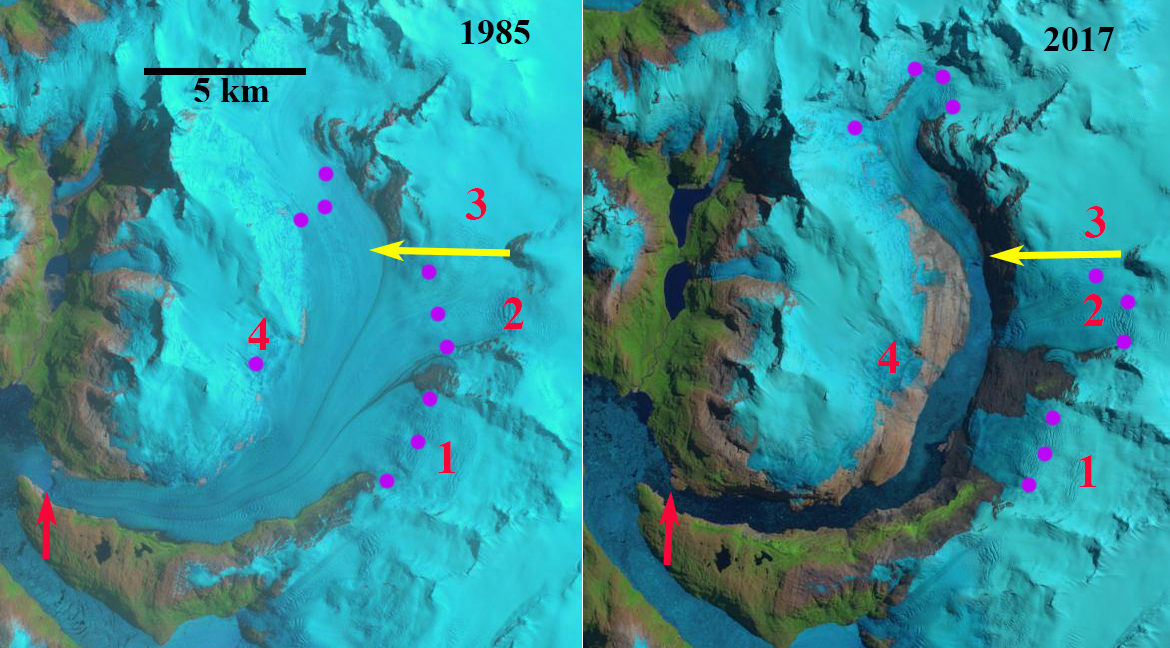
HPS-12 Glacier in 1985 and 2017 Landsat images.  The red arrow indicates 1985 terminus, yellow arrows the 2017 terminus, purple dots the snowline and 1-4 are tributaries.  By 2017 all tributaries have detached and the glacier has retreated 13 km. 

HPS-12 is an unnamed glacier draining the west side of the Southern Patagonia Ice Cap (SPI).  The glacier terminates in a fjord and is adjacent to Upsala Glacier to the east and Pio IX Glacier to the north. This developing fjord is also unnamed but feeds into Estero Falcon. The glaciers of the SPI have been experiencing significant mass loss and overall retreat. Willis et al (2012) observed significant mass loss from 2000-2012 of −20.0  Gt per year.  Willis et al (2012) indicate in Fig.1 that the majority of the ice cap has thinned during this period from 2-10 m, with the greatest thinning being in the lower portion of HPS-12. Schaefer et al (2015) indicate and ELA of 980 m and a calving velocity of 2290 m per year, which is quite high for this size of glacier.  Here we examine the retreat and fjord opening using Landsat imagery from 1985-2017.  Is it the fastest retreating glacier in Chile in the last three decades? 

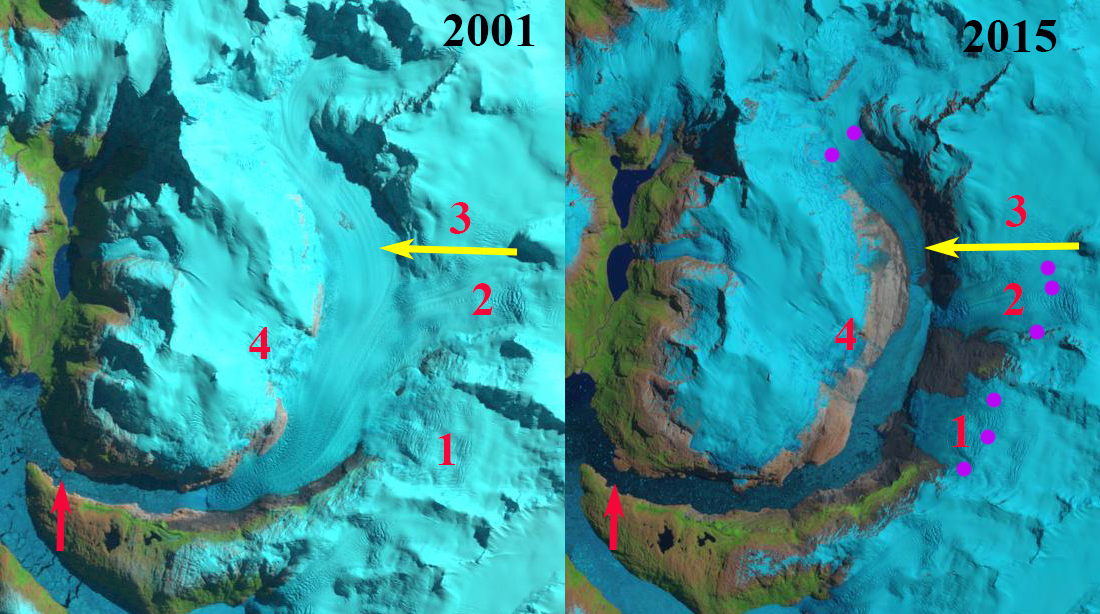
 In 1985 the HPS-12 terminates 1.5 km from the junction of two fjords that are occupied by HSP-12 and HSP-13.  These are separated by a peninsula.  The glacier is fed by four tributaries labelled 1-4. The snowline in 1985 is at 900 m.  In 2001 the four tributaries still join the main glacier, but the terminus has retreated 3.5 km.  In 2015 glacier retreat has led to separation of tributary 1, 2 and 4 from the main glacier, tributary 3 only feeds tributary 2 and not the main glacier.   The snowline in mid-January of 2015 is at 950 m.  The glacier retreat has continued to 2017, the current terminus is 800 m wide vesus 2800 m wide in 1985 at this location.  total retreat from 1985 to 2017 is 13 km.  The fjord is now nearly 15 km long.  HPS-12 was 26 km long in 1985 and is now less than  13 km long, it is 1/2 gone in three decades. This retreat along with Jorge Montt is the largest in Chile in the last 30 years. The retreat fits the pattern of large retreats of calving outlet glaciers of SPI such as Onelli Glacier, Bernardo Glacier and Lucia Glacier.

We also have a unique laboratory to examine a pristine fjord just created an the aquatic ecologic succession and physical oceanographic transitions that will occur. 

HPS-12 Glacier in 2001 and 2015 Landsat images.  The red arrow indicates 1985 terminus, yellow arrows the 2017 terminus, purple dots the snowline and 1-4 are tributaries.  By 2015 all tributaries have detached. 

HPS-12 in 2015 Digital Globe image. Red dots indicate 1985 terminus and yellow dots 2015 terminus location for main glacier and tributaries. 


Storbreen, Svalbard Major Retreat Opens New Fjord

Storbreen, Svalbard in 1990 and 2017 Landsat images.  The red arrows indicate 1990 terminus , yellow arrow the 2017 terminus and purple dots the snowline in 1990.  A recent snow storm has obscured the actual snowline in Aug 2017. 

Storbreen Glacier (ST) terminates on the north side of Hornsund in southern Svalbard.  From 1990 to 2017 Storbreen has experienced a substantial retreat opening a new fjord and separating from Hornbreen (H).  Svalbard is host to 163 tidewater glaciers with a collective calving front of 860 km Błaszczyk et al, (2009). Nuth et al (2013) determined that the glacier area over the entire archipelago has decreased by an average of 80 km per year over the past 30 years, a 7% reduction. In the most recent period 1990-2007, terminus retreat was larger than in an earlier period from 1930-1990, while area shrinkage was smaller. Hornsund is a fjord that in 2014 almost cuts through the southern Island of Svalbard, and eventually will. The Institute of Geophysics Polish Academy has maintained a Polish Research Station in Hornsund since 1957.  The 1984 map, from the University of Silesia, of the glaciers and geomorphology document the extent of the glaciers in 1983. A more detailed examination by the same researchers, Blaszczyk et al. (2013) reported the total area of the glacier cover lost in Hornsund Fjord area from 1899–2010 was approximately 172 square kilometers. Pelto (2017) reported significant retreat of all 10 major tidewater glaciers of Hornsund Fjord.

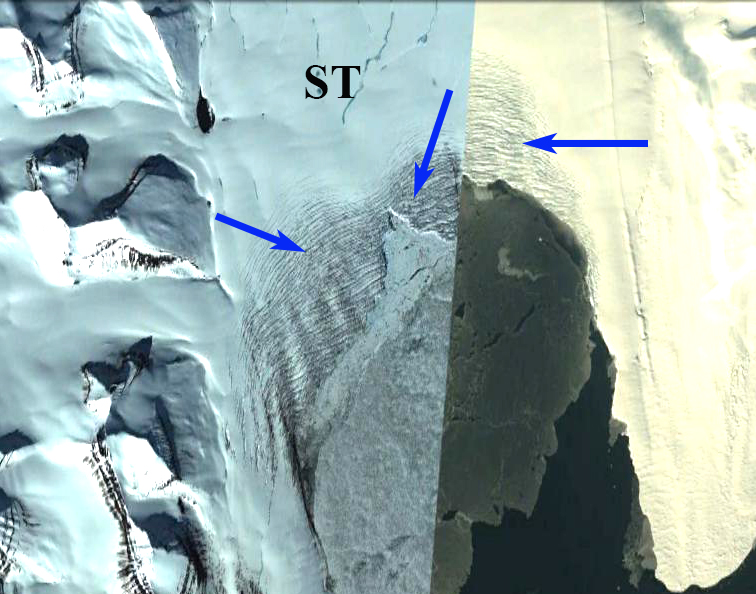
In 1990 the terminus of Storbreen on the east side is shared with Hornbreen Glacier (H), joining near the tip of a peninsula that will emerge between the glaciers with retreat.  On the west side the glacier terminates at the southern end of a peninsula.  The snowline is at 400 m in 1990.  In 2002 the glacier has separated from Hornbreen and terminates in a newly opening fjord, with the snowline at 350 m.  In 2013 and 2015 the glacier has retreated substantially up the new fjord with the snowline at 450 m in 2013 and 500 m in 2015.  By 2017 the glacier has retreated 8.7 km in the glacier center from the west margin in 1990, 6.0 km on the centerline and 4.8 km from the east margin of 1990.  The glacier terminus is still tidewater and is 4.7 km wide.  The extensive crevassing at the glacier front in Google Earth imagery, below, indicates continued rapid flow at the terminus.  The retreat continues with significant cahnge after 2013.  The crevassing may indicate a steeper surface slope too.  The topography at TopoSvalbard suggests limited change in surface slope based on older mapping.  The head of the fjord is not likely to occur until at least the junction point of several tributaries. The retreat here is similar to that of adjacent Hornbreen and Paierbreen.

Storbreen, Svalbard in 2013 and 2015 Landsat images.  The red arrows indicate 1990 terminus , yellow arrow the 2017 terminus and purple dots the snowline.   

The crevassed front of Storbreen in 2014 on left.  Indicating active calving but also suggestive of a steeper slope than before.  The Fjord head does not appear to be near though. 


Storbreen, Svalbard in 2002 Landsat image.  The red arrows indicate 1990 terminus , yellow arrow the 2017 terminus and purple dots the snowline. 


Ryan Glacier, South Georgia Retreats from Tidewater

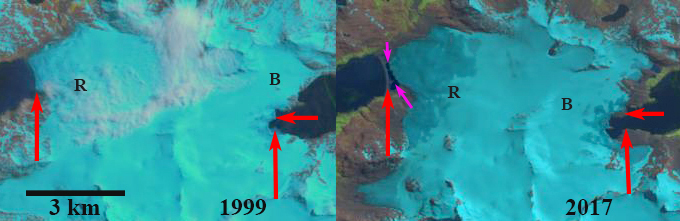
Ryan (R) and Brunonia Glacier (B) in 1999 and 2016 Landsat images.  Red arrows indicate the 1999 terminus and pink arrows a new proglacial lake. 

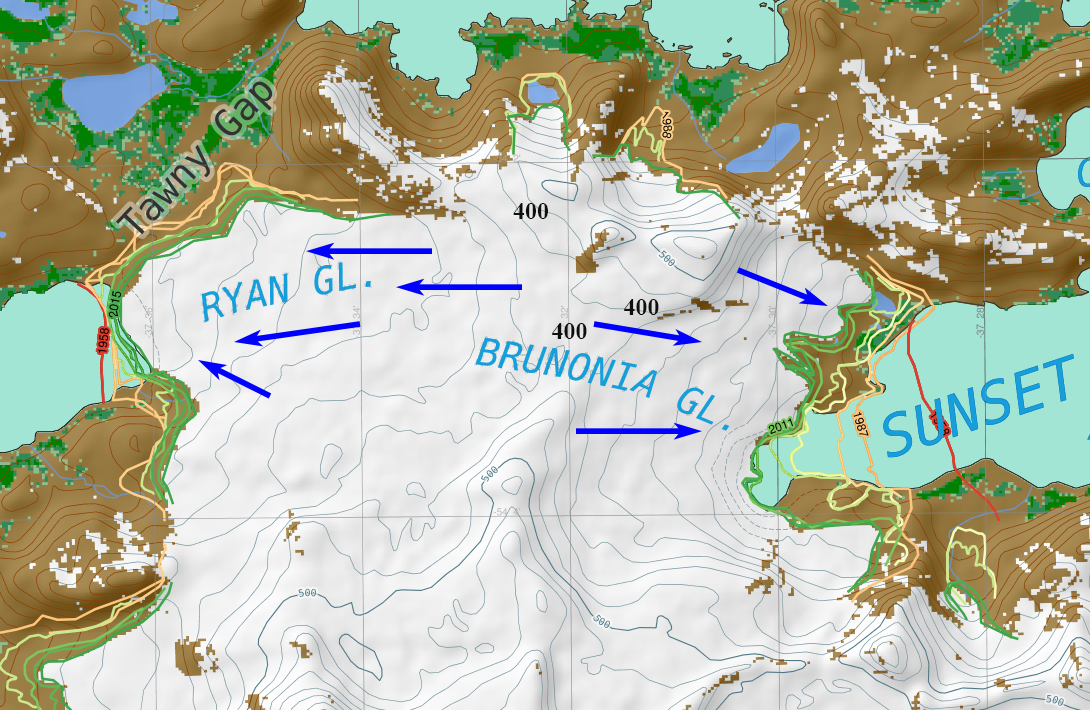
Ryan Glacier and Bunonia Glacier span the width of South Georgia near its northwestern tip.  Brunonia Glacier flow east and terminates in Sunset Fjord and Ryan Glacier flows to the west into Ice Fjord, which seems more viable as a “Sunset” Fjord.  The glacier divide is a very low 400 m.  The British Antarctic Survey (BAS) has generated an excellent online map of South Georgia that includes many layers including glacier frontal change since 1958 in this region.  BAS work by Cook et al (2010) and Gordon et al (2008) have emphasized that there is a island wide pattern of calving glaciers having faster retreat.  Gordon et al., (2008) observed that larger tidewater and calving outlet glaciers generally remained in relatively advanced positions from the 1950’s until the 1980’s. After 1980 most glaciers receded; some of these retreats have been dramatic a such as Hindle and Neumayer.   Here we examine 1999-2016 Landsat imagery to identify glacier change. 

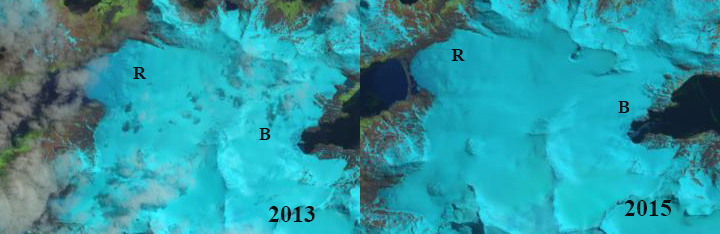
In 1999 Ryan Glacier reaches tidewater across a 1.2 km glacier front.  Brunonia Glacier terminates in Sunset Fjord pinned on what is a bedrock prominence under the ice. In 2013 and 2015 Landsat imagery from early in the melt season indicates the melt zone is below 200 m. In 2015 it is evident that Ryan Glacier no longer reaches tidewater.  In 2016 Ryan Glacier is separated from Ice Fjord by a barrier beach and a narrow developing proglacial lake, pink arrow.  The glacier has retreated 200 m since 1999.  Brunonia Glacier has experienced a 400 m retreat exposing 2 new peninsulas.  The first is on the north side of the fjord and the other is mid glacier. Both had been under the ice in 1999. The snowline in 2016 on Ryan Glacier is also higher reaching 250 m in mid-February.  Retreat of Ryan Glacier from 1958 to 1999 was 100 m, while the retreat on Brunonia in the same period was 700-800 m.

British Antarctic Survey map of frontal change 1958-2015.

Ryan and Brunonia Glacier in 2013 and 2015 Landsat images. The 2015 image indicates Ryan Glacier is no longer tidewater. 


Gråfjellsbrea, Norway Retreat Forms New Lake

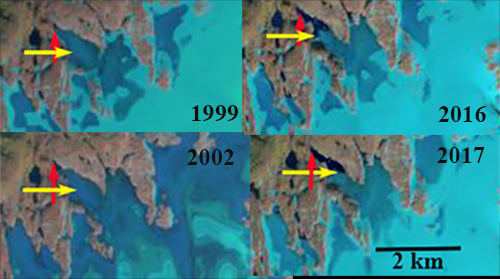
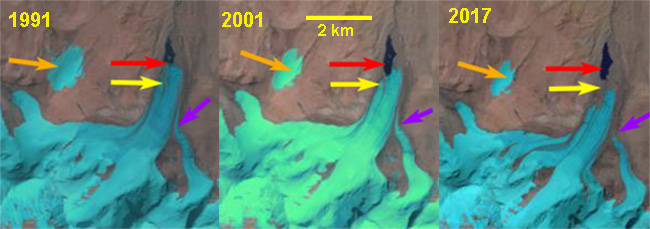
Gråfjellsbrea Retreat in Landsat images from 1999 to 2017.  Red arrow indicates 1999 terminus, yellow arrow the 2017 terminus location. 

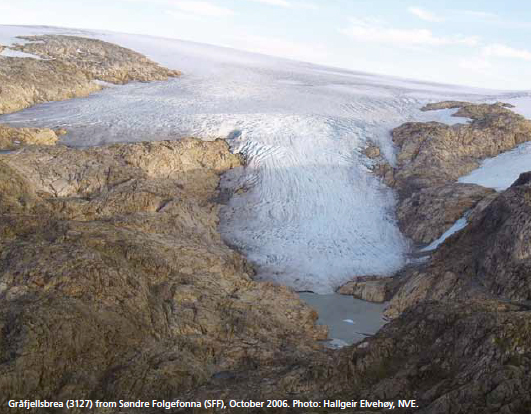
Gråfjellsbrea is an outlet glacier on the northwest side of the Folgefonna  Icefield that drains into Mysevatnet.  The 2012 Norwegian Glacier Inventory notes the glacier having an area of 8.77 square kilometers in 2002.  In 2016 the Norwegian Water Resources and Energy Directorate (NVE) reported this glacier to have the greatest retreat in 2016 of the 36 glaciers where they measure terminus fluctuations annually.  The NVE report indicates a 550 m retreat from 2002-2016.  Here we examine Landsat imagery  from 1999-2017 that indicates the formation of three new lakes at the terminus of the glacier.

In 1999 the glacier terminated in a bedrock valley east of Grafjellsvatnet.  By 2002 minor retreat had led to formation of a proglacial lake.  The snowline was quite high that year with only a few pockets of retained accumulation.  By 2016 the glacier had receded 550 m since 2002 exposing a narrow length of similar length.  The terminus did retreat significantly~100 m in 2017, the exact distance will be reported by NVE in the coming months.  

Mysevatnet is a reservoir impounded for hydropower production. The lake through a tunnel falling 825 m to produce 250 MW at the Statkraft operated Mauranger Plant  NVE (2014) reports there have been no Jokulhlaups from Grafjellsbrea.This glacier is one of many in Norway supplied by glacier runoff, where the glacier is retreating, Storglombreen is another example.

Digital Globe image of Grafjellsbrea and adjacent lakes.

Grafjellsbrea in 2006 with the lake much smaller, NVE image in the Norwegian Glacier Inventory

Chaxiqudong Glacier, Tibet Retreat From Lake & Tributary Separation

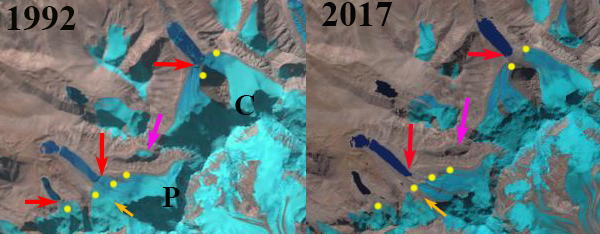
Chaxiqudong Glacier (C) at right and Paqu Glacier (P) at left in Landsat images from 1992 and 2017.  The red arrow indicates the terminus in 1992 and the yellow dots the 2017 margin.  Purple arrow indicates a glacier that disappeared and orange arrow separation of Paqu Glacier. Both glaciers no longer reach the lake. 

Chaxiqudong Glacier and Paqu Glacier are located in a sub-range north of the Nepal-China border.  Chaxiqudong Glacier is adjacent to Longmiojian Glacier. The glaciers drain into Nepal entering the Bhote Khosi River.  The Bothe Khosi had a hydropower project that has been put out of service by a 2015 earthquake and 2016 flood event.    King et al (2017) observe significant surface lowering in the ablation zone of both glaciers (Figure 2), though less than on neighboring larger glaciers.  Zhang et al (2010) observed the loss of glacier area and lake expansion in the region from 1976-2006. Here we examine Landsat imagery from 1992 to 2017 to observe changes. 

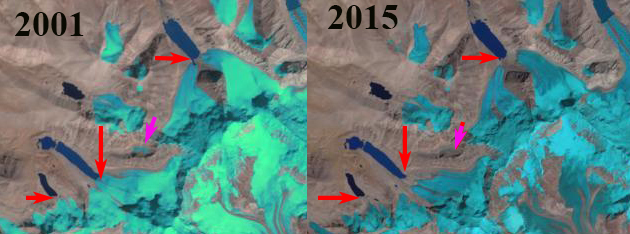
Chaxiqudong Glacier terminus in 1992 is in a proglacial lake at the junction of a pair of tributaries red arrow). Paqu Glacier has a wide terminus in a proglacial lake (red arrow).  By 2001 Chaxiqudong Glacier has separated with the eastern tributary still at the margin of the proglacial lake and the western tributary having receded from the lake. Paqu Glacier still is in contact with the lake on a narrow front on the west margin of the lake. By 2015 both tributaries of the Chaxiqudong Glacier have receded significantly from the lake.  Paqu Glacier has retreated from the lake and has separated into two sections, orange arrow.  By 2017 Chaxiqudong Glacier has retreated 400 m since 1992, no longer terminates in a lake and has separated into two glaciers (yellow arrow).  Paqu Glacier has retreated 5oo m no longer terminates in a lake and has separated into two glaciers (yellow arrow).  The retreat of each glacier has occurred without significant calving indicating a retreat driven by negative surface mass balance.  The retreat is less than on the larger Yanong and North Yanong Glacier to the east that also end in lakes still. The retreat of these glaciers from the lakes also reduces the threat of glacier lake outburst floods, as both the risk of  calving and avalanches caused rapid water level change have declined. At the purple arrow is a small cirque glacier in 1992.  This glacier still exists in 2001, but has disappeared by 2015. 

Chaxiqudong Glacier at right and Paqu Glacier at left in Landsat images from 2001 and 2015.  The red arrow indicates the terminus in 1992.  Purple arrow indicates a glacier that disappeared. Both glaciers no longer reach the lake. 

Yanong Glacier, Tibet Retreat Lake Expansion 1992-2017

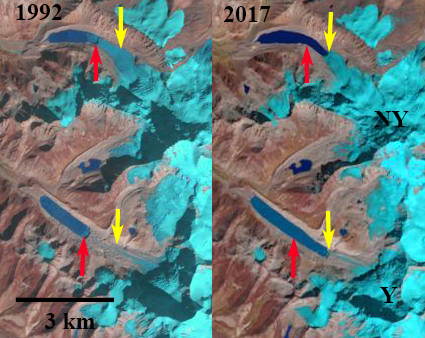
Yanong Glacier and North Yanong glacier in Landsat images form 1992 and 2017.  Red arrows indicate 1992 terminus and yellow arrows the 2017 terminus. 

Yanong Glacier  and North Yanong Glacier drain northwest from the western flank of Cho Oyu on the Nepal-China border and are in the Tama Khosi watershed.  The glacier terminates in an expanding proglacial lake like a number of neighboring glaciers Drogpa NagtsangRongbuk Glacier and Lumding Glacier King et al (2017) observe that both Yanong and North Yanong have had large negative balances of -.76 m/year and -0.62 m/year respectively.  They also note surface lowering of 3 m per year in the lower ablation zone.  Zhang et al (2010) observed the loss of glacier area and lake expansion in the region from 1976-2006. Here we examine Landsat imagery from 1992 to 2017 to observe changes.

In 1992 the Yanong Glacier and North Yanong Glcier terminate at the red arrows.  The proglacial lake at Yanong is 1.7 km long and is 1.3 km long at North Yanong. By 2001 significant retreat of 200-200 m has occurred on each glacier.  By 2015 Yanong Glacier has retreated east of the a former tributary from the north. The North Yanong glacier is now wider at the terminus than in 2001. In 2017 the proglacial lake at Yanong Glacier is 2.8 km long indicating a retreat since 1992 of 1100 m.  The North Yanong Glacier proglacial lake is 2.1 km long indicating a retreat since 1992 of 800 m.  The steep crevassed nature of North Yanong Glacier right to the terminus suggests the glacier is nearing the end of the lake basin.  The Yanong Glacier has a low slope terminus area that suggests the lake will continue to expand.  The Upper Tamakoshi Hydropower project is a 456 MW peaking run of river  is a hydropower project on the Tamakoshi that is just to be finished in 2018.

Yanong Glacier and North Yanong glacier in Landsat images form 2001 and 2015.  Red arrows indicate 1992 terminus and yellow arrows the 2017 terminus. 

Digital Globe image of Yanong Glacier note the low slope terminus tongue below steep crevassed icefall section, red arrows.

Digital Globe image of  North Yanong Glacier note the l steep crevassed icefall section, red arrows that leads right to the terminus. 

Gangge’er Glacier, Retreat & Tributary Separation Qilian Mt. China

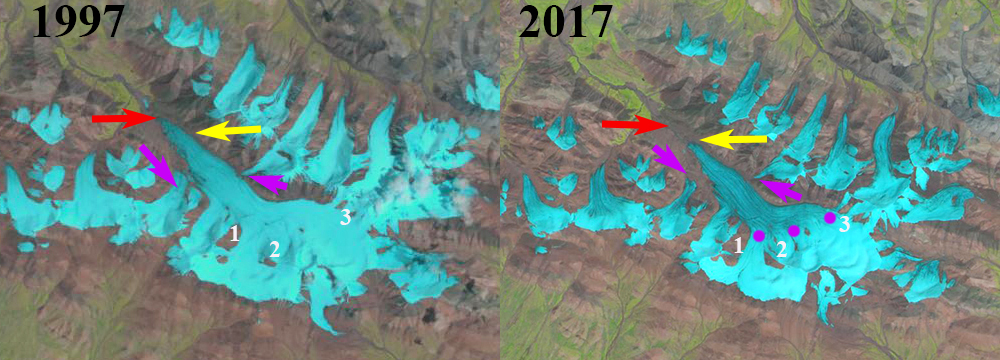
Gangge’er Glacier, Qilian Mt., China comparison in 1997 and 2017 Landsat Images.  Yellow arrows indicates 2017 terminus, red arrows the 1990 terminus, and purple arrows tributaries that have detached.  The snowline is  purple dots and Points 1-3 indicate bare rock areas amidst the glacier.

The largest glacier in the Gangge’er Xiaoheli Shan range of the the Qilian Mountains in China, here referred to as Gangge’er Glacier, drains northwest into the Shule River.   Glaciers in the Qilian Mountains in northwest China’s Gansu Province have shrunk by 36 square kilometers, a 4.2 percent loss, during the past decade Quiang (2016).  Tian et al (2014) report Qilian Mountain glacier area shrank by 30% from 1956 to 2010 and the shrinkage accelerated remarkably in the past two decades.  Yang et al (2015)  Results show that mountain glaciers in China are very vulnerable to climate change with 41% of glaciers having had a high vulnerability in the period 1961–2007. For the Upper Shule Basin the impact of glaciers on the overall water resource is not known as Li  and Yang (2017) observe that  that the basic features of precipitation in the upper reaches of the Shule River were unexplored prior to their study and there is no national weather station in the basin.  They found that most of the precipitation occurred during the summer. 

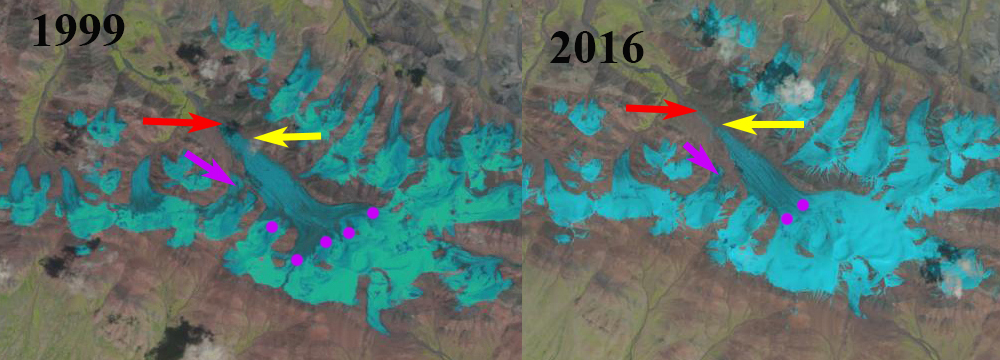
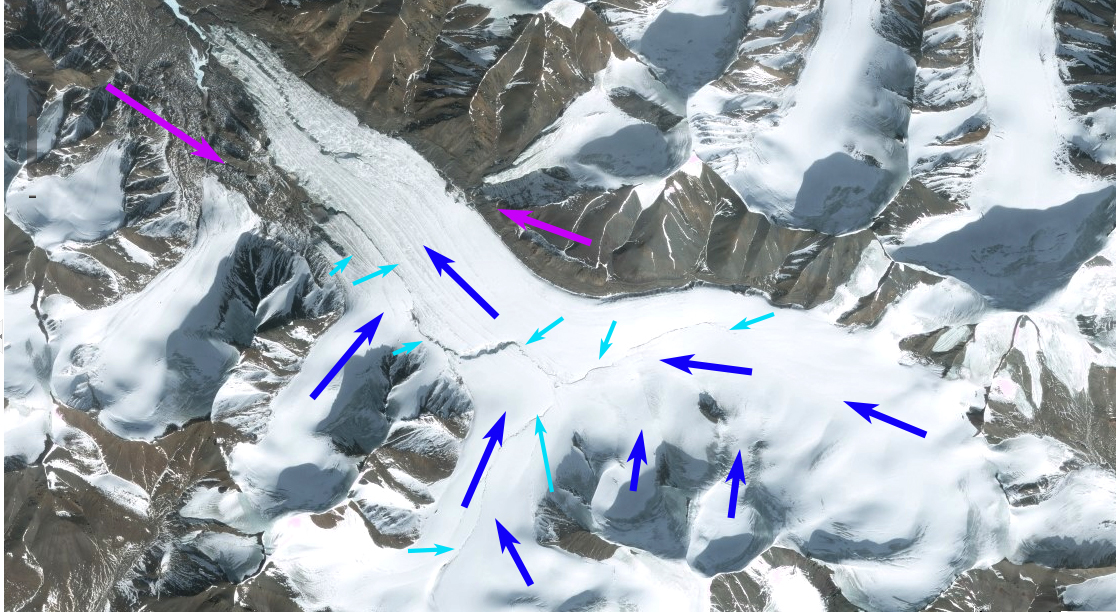
What is apparent in a comparison of Landsat images from 1997-2017 is the changes in the glacier.  In 1997 the glacier is joined by three main tributaries from the south and four from the north.  The western most from the north and south are noted by the purple arrow.  The glacier terminates at the red arrow and the snowline is low on the glacier at 4600 m, likely after a summer snowstorm. The areas of bedrock amidst the glacier at Points 1-3 are limited.  In 1999 the snowline is above the main stem of the glacier at 4800 m.  There has been limited change since 1997, there is a small cloud causing a ground shadow right at the terminus.  By 2016 and 2017 the westernmost tributary from the north and south have detached from the glacier , purple arrows.  The areas of bedrock amidst the glacier at Point 1-3 have all expanded indicating upglacier thinning.  The terminus has retreated to the yellow arrow a distance of 900 m in 20 years.  In the digital globe image below extensive surface streams indicate significant meltwater drainage up to 4900 m, above the snowline in both images. The surface streams indicate a cold layer of ice preventing surface meltwater infiltration.  


Gangge’er Glacier, Qilian Mt., China comparison in 1999 and 2016 Landsat Images.  Yellow arrows indicates 2017 terminus, red arrows the 1990 terminus, and purple arrow tributary that has detached.   Points 1-3 indicate bare rock areas amidst the glacier.


Google Earth image of the glacier indicating flow directions dark blue arrows, surface streams light blue arrows and separated tributaries purple arrows.

Glacier Retreat Generating New Islands List

Climate change has been driving the recession of glaciers and ice sheets, which in turn has been changing our maps.  One notable category of physical geographic features indicative of the change due to the retreat is the formation of new islands.  Below is a list of new islands that this blog has identified and reported.  This is not a comprehensive list of all islands that have been formed.  

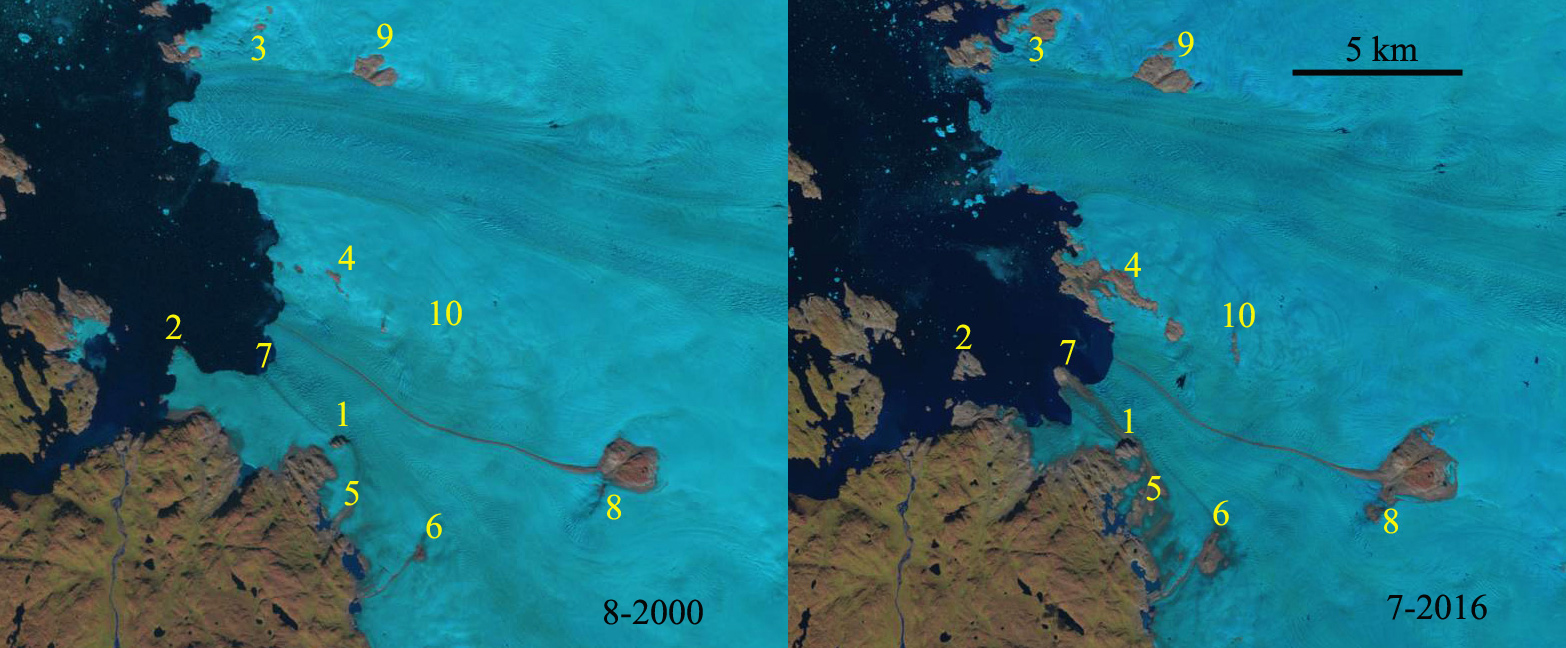
Upernavik Glacier, Greenland in Landsat images from August 2000 and August 2016.  Each Point is at the same location in both image, and the changes are noted in the discussion below.  The same locations are also identified in the July 2001 and Aug. 2016 image below. 

Kong OscarGreenland: Island A forms with B and C on the verge.

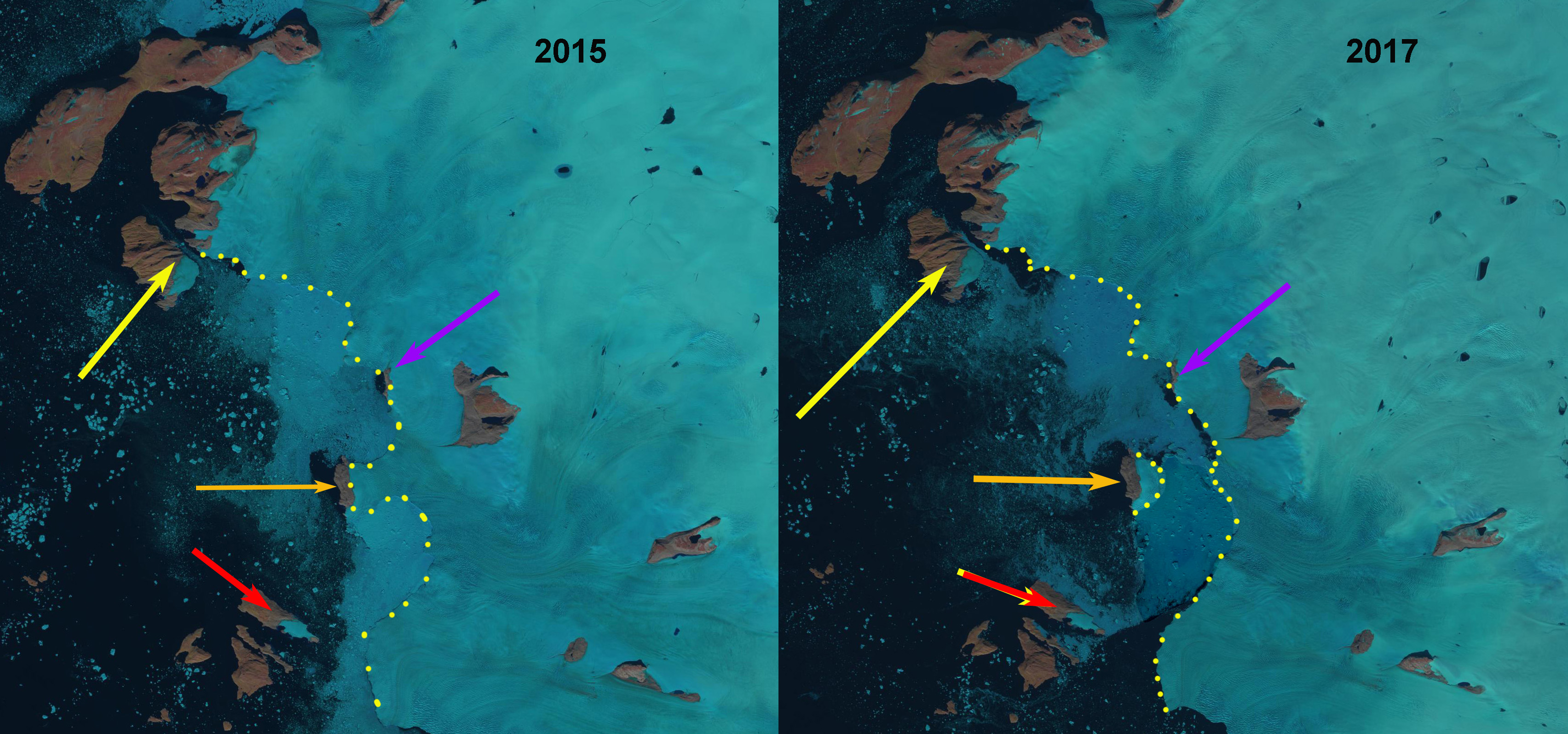
Steenstrup Glacier, Greenland front in 2015 and 2017 illustrating location with respect to the new islands at: Red Head-red arrow, Tugtuligssup Sarqardlerssuua at yellow arrow , and the 2017 new island at orange arrow.  Yellow dots indicate icefront and purple arrow another future island to be released from the glacier.  

corontation-compare-copy

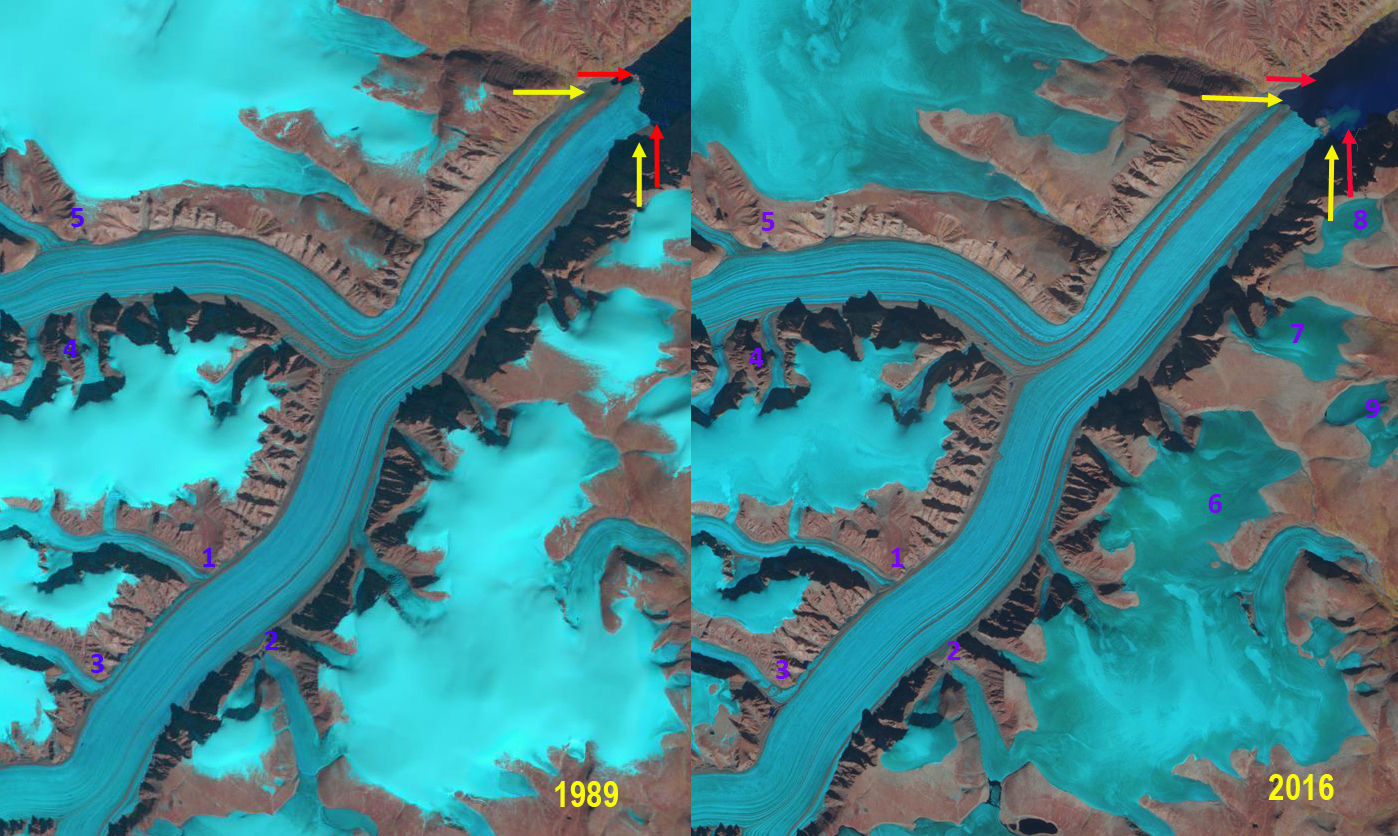
Coronation Glacier, Canada: A Landsat image from 1989 and a Sentinel 2 image from 2016 illustrate the retreat of Coronation Glacier.  Red arrows indicate the 1989 terminus and yellow arrows the 2016 terminus location.  Purple numbers 1-5 indicate locations of tributary retreat or thinning. Purple numbers 6-9 are icecaps that did not retain snowcover in 2016. 

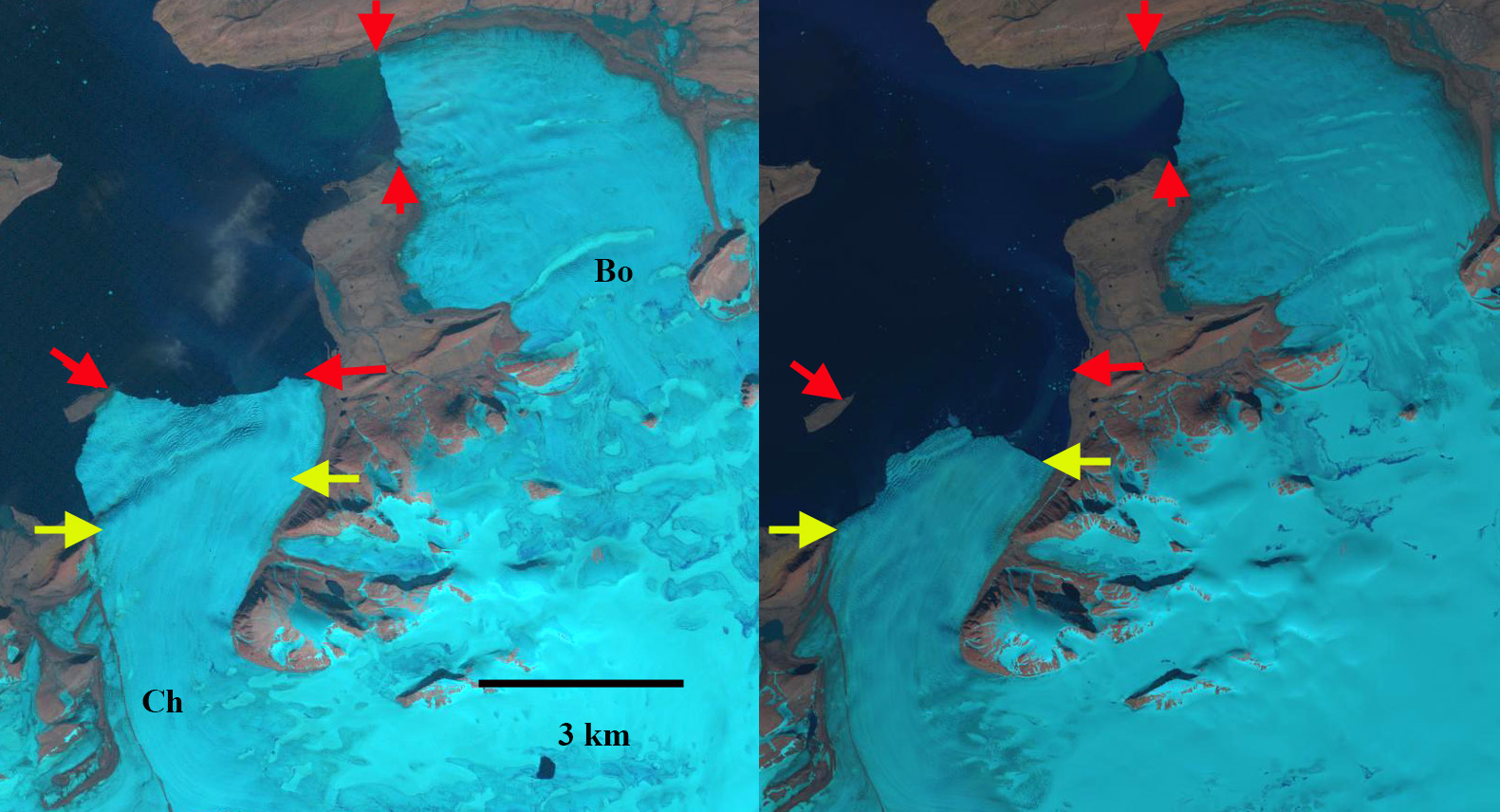
Chernysheva Glacier and Borozova, Novaya Zemlya comparison in 1990 and 2015 Landsat images. Red arrows indicates 1990 terminus and yellow arrow 2015 terminus position. Island has formed at the 1990 terminus position of Chernysheva.

Tasija and Krayniy GlacierNovaya Zemlya: Tasija Glacier (T) and Krayniy Glacier (Ky) compared in 1990 and 2015 Landsat images.  Red arrows indicate 1990 terminus positions, yellow arrows 2015 terminus positions and purple arrows upglacier thinning. A new island formed upper right red arrow.

Nizkiy Glacier, Novaya ZemlyaNizky Glacier (N) and Glasnova Glacier (G) compared in 1990 and 2015 Landsat images.  Red arrows indicate 1990 terminus positions, yellow arrows 2015 terminus positions and purple arrows upglacier thinning.  An island has formed at the second red arrow from the bottom.

Krivosheina GlacierNovaya Zemlya:  Krivosheina Glacier compared in 1990 and 2015 Landsat images.  Red arrows indicate 1990 terminus positions, yellow arrows 2015 terminus positions and purple arrows upglacier thinning.  Point A indicates a new island that has formed.

Vilkitskogo GlacierNovaya ZemlyaVilkitskogo South Glacier (Vs) and Vilkitskogo North Glacier (Vn) compared in 1990 and 2015 Landsat images.  Red arrows indicate 1990 terminus positions, yellow arrows 2015 terminus positions and purple arrows upglacier thinning.


Vasilievebreen, Svalbard: retreat from 1990-2017 has led to the creation of one island at the pink arrow, while the island at the orange arrow has eroded and an island at the white arrow is on the verge of being released by the glacier.  

Samarinbreen, Svalbard: Landsat imagery from 1990-2014 illustrates that the retreat of the glacier has been 2.1 km including the formation of an island.

Chako Glacier, Tibet Retreats From Proglacial Lake

Chako Glacier, Tibet in Landsat images from 1991, 2001 and 2017.  Red arrow indicates 1991 terminus, yellow arrow 2017 terminus, purple tributary glacier connection and orange arrow nearby icecap.

Chako Glacier flows north from Chako Peak on the Nepal-Tibet, China border, in the Lugula Himal.  Glacier runoff eventually reaches the Yarlung Tsangpo and then the Brahmaputra River. Gardelle et al, (2013) identified this glacier as part of their West Nepal region, which experienced mass loss averaging -0.32 m/year from 1999-2011. This mass loss has driven wide spread retreat of glaciers along the border ranges between India/Nepal and Tibet.  In Tibet west and east of Chako Glacier are the retreating Menlung Glacier, West Ganglung Glacier and Chutenjima Glacier.

In 1991 the glacier terminated in a proglacial lake at 5450 m red arrow, with a key tributary entering from the east, purple arrow. An ice cap just west of the glacier has a width of 700 m. In 1994 there is little evident change. By 2001 the glacier has retreated to the southern end of the lake basin, with the eastern tributary still connected.  In 2005 the terminus remains heavily crevassed and still in contact with the lake.  By 2016 the eastern tributary no longer connected with Chako Glacier and the glacier no longer reaches the lake.  In 2017 the glacier has retreated 600-700 m since 1991 with limited crevassing at the terminus.  The terminus is notably thinner as well.  The loss of crevassing and connection with the tributary from the east indicates retreat is ongoing. The icecap to the west has been reduced in area, the width being 450 m in 2017. The images are typically from September-November and do not show the snowline at the highest elevation. The expansion of three bedrock areas separating tributaries and generating lateral moraines indicate upglacier thinning as well.


Chako Glacier, Tibet in Landsat images from 1994 and 2016.  Red arrow indicates 1991 terminus, yellow arrow 2017 terminus, purple tributary glacier connection and orange arrow nearby icecap.

Google Earth image of Chako Galcier terminus in 2005 and 2017.  Note difference in crevassing.  red arrow 2005 terminus and yellow arrow 2017 terminus.

Chako Glacier, with Chako Peak indicated by green triangle.