Novatak Glacier, Alaska Rifting in 2025 Reveals Forthcoming Rapid Lake Development in 2025

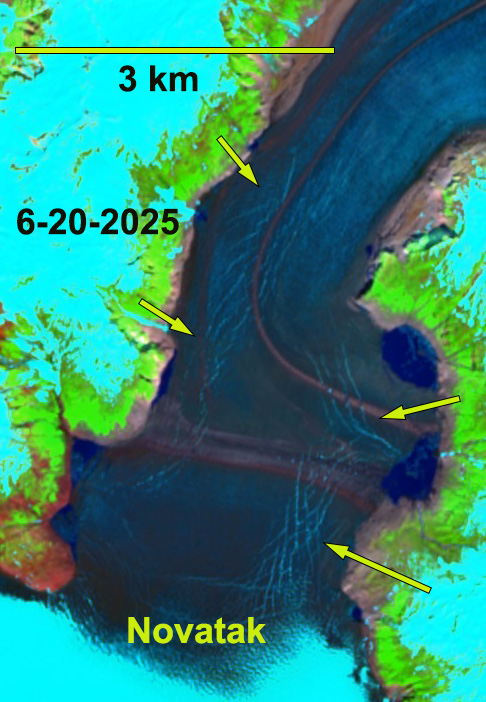
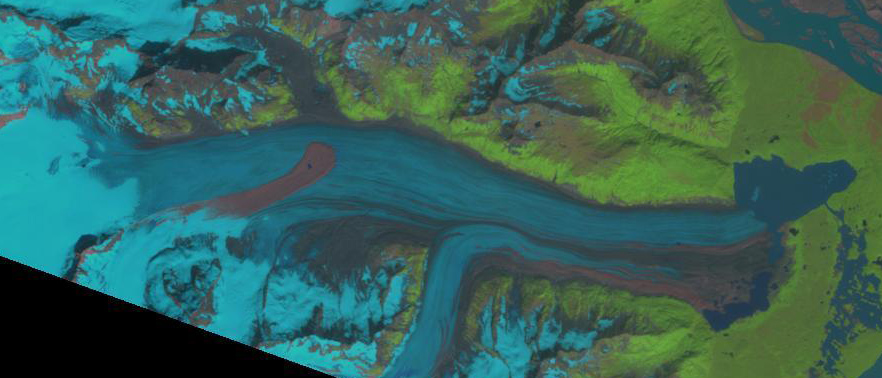
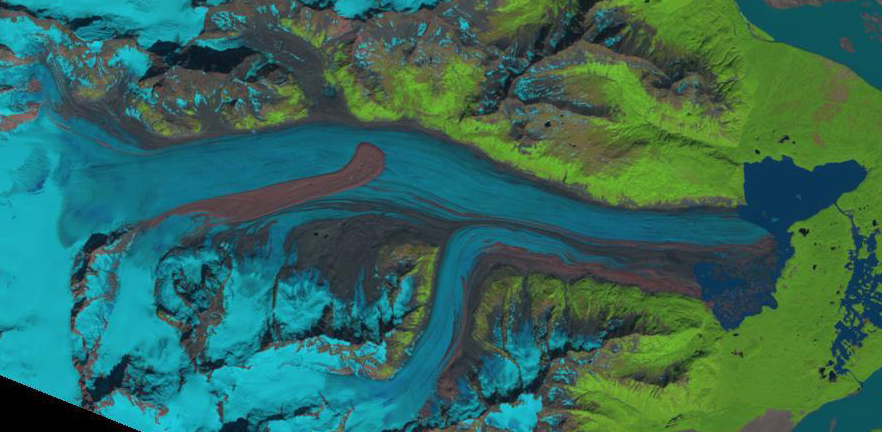
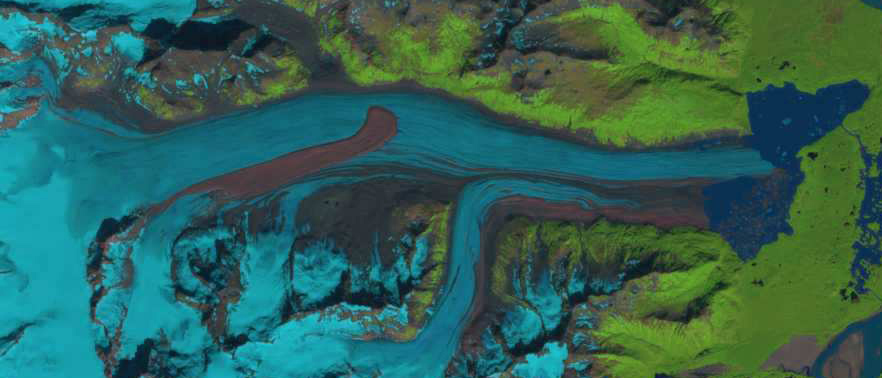
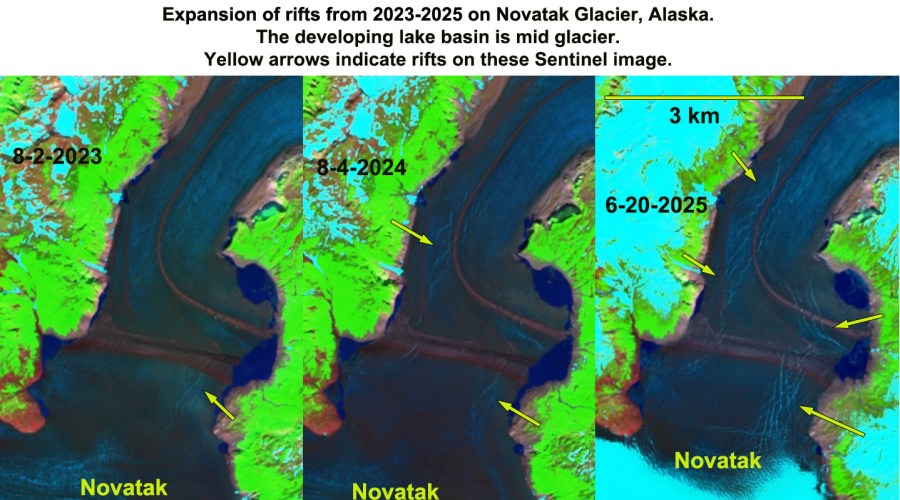
A network of extensive rifts have developed since 2023, yellow arrows. The fringing proglacial lake has not expanded. Rifting indicates uplift from partially floating glacier area.

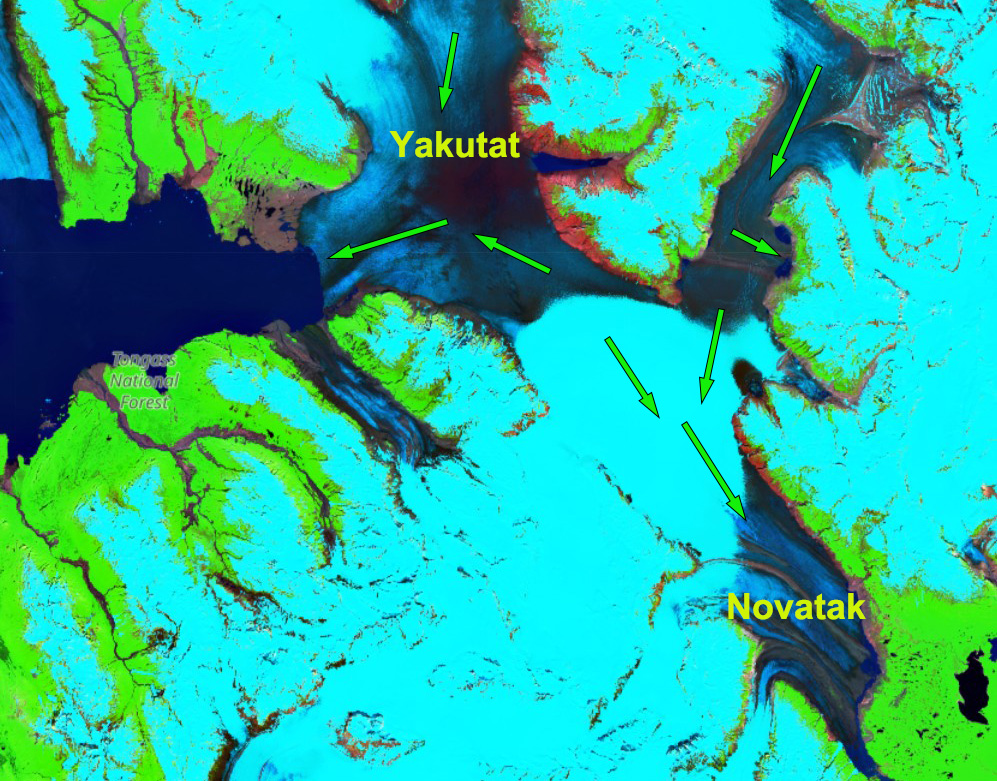
Ice flow in the region around the developing lake, which is near the boundary with Yakutat Glacier in Sentinel Image from June 20, 2025

Novatak Glacier is between the Yakutat and East Novatak Glacier in southeast Alaska. The glacier retreated 1 km from 1987-2023 (NASA EO, 2015). The majority of the accumulation zone of these three glaciers is below 1000 m, which has made them particularly vulnerable to the warming climate. The result has been expansion of the proglacial lake, Harlequin Lake, at Yakutat Glacier from 1984 to 2024 from 50 km2 to 108 km2 (Pelto & NASA EO, 2024). There was no lake in 1908.

Novatak Glacier has been slow to form a substantial terminus lake unlike its neighbors, possibly because it lacks a sufficient basin. This has limited the retreat of this glacier as it thins. The developing rifts does show a large lake will form, with an area of 10-12 km2 . This will isolate the terminus from the main inflow to Novatak’s terminus, which will hasten a rapid meltdown. The rifts represent places where water level change causes flexure of the glacier, leading to their formation and expansion. They are not related to flow, but to uplift and down fall of ice where it is somewhat afloat. Rapid meltwater inflow to this basin will raise water level further stressing this region this summer. The degree of rifting indicates the ice is thin, but none are open enough to see water. This suggests breakup will not happen this summer. This type of rifting in 2010 and 2015 led to further breakups at Yakutat Glacier.

June 20, 2025 rifting of Novatak Glacier. The rifts represent places where water level change causes flexure of the glacier, leading to their formation and expansion. They are not related to flow, but to uplift and down fall.

Berg Lake, Alaska Evolution Driven by Steller Glacier Retreat

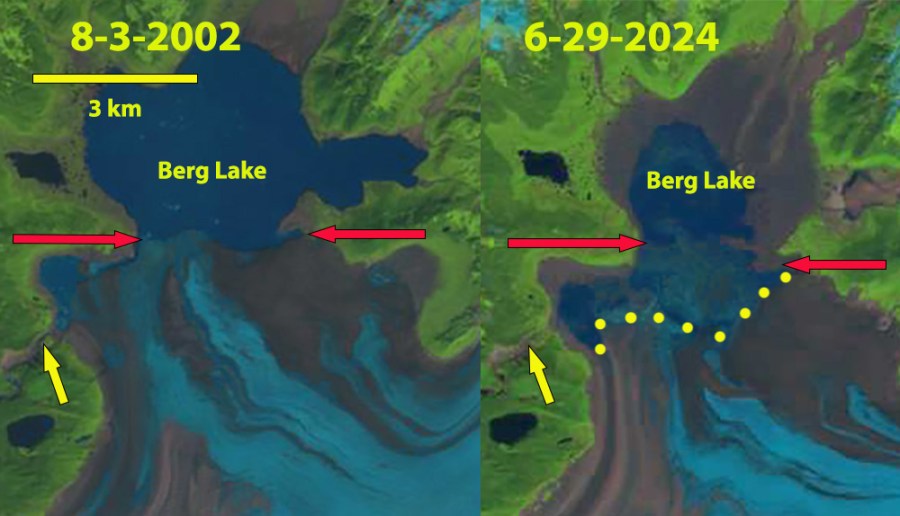
Berg Lake in 2002 and 2024 Lands at images. Red arrows illustrate 2002 margin, and yellow dots the 2024 margin after a retreat. Yellow arrows indicate the gorge that drained the lake periodically from the 1980s through 2013. Now it drains south sub-glacially into Pacman Lake and then into Bering Lake

Berg Lake is impounded by the Steller Glacier terminus. During the latter half of the 20th century and early 21st century this lake periodically drained west through a gorge to the Bering River. With retreat and thinning this outlet has been abandoned. Vegetation has regrown in portions of this channel area by 2024 illustrating this.

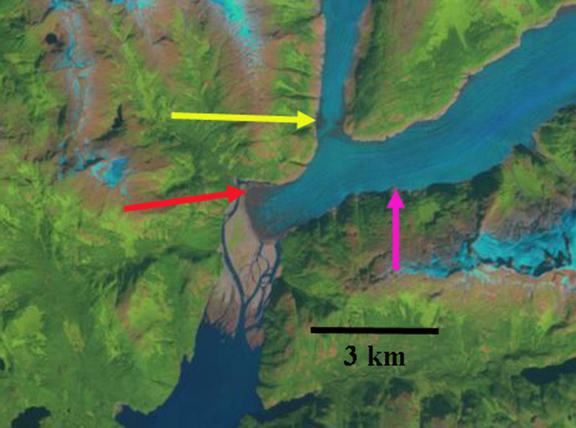
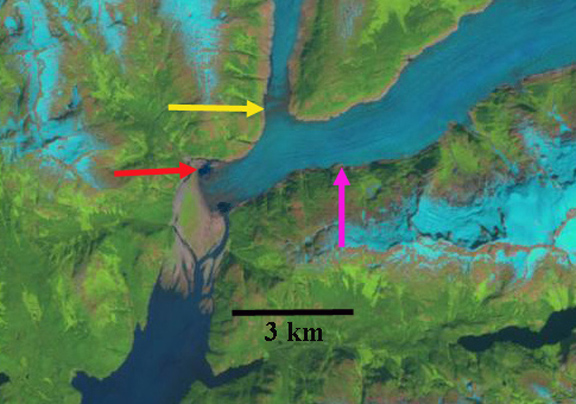
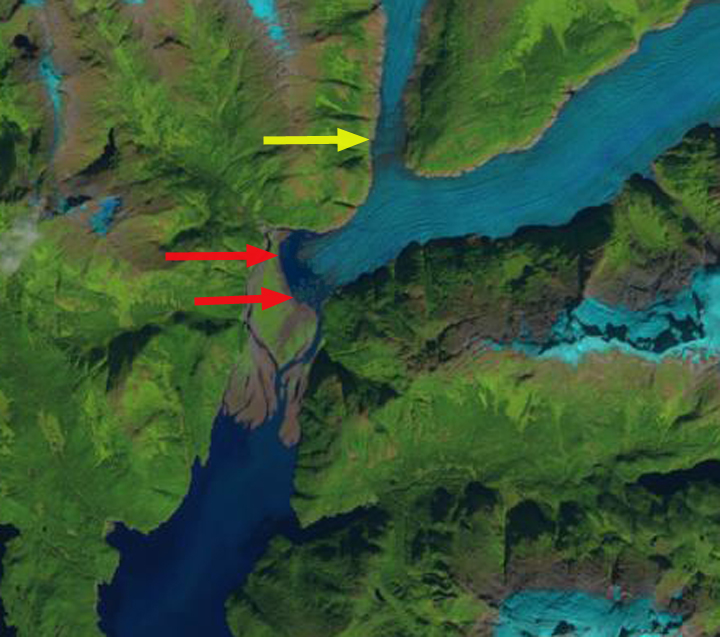
Berg lake and Steller Glacier terminus retreat from 2016 to 2018 in Landsat images exposing the former gorge exit, red arrow.

During the 1986-2022 period the full lake level declined, but the filled area of the lake remained close to 25 km2. The lake level decline led to abandonment of the gorge outlet and drainage south into Lake Ivanov (NWS, 2024). In 2019 this channel was also abandoned, and now the drainage goes directly from Pacman Lake into the Gandil River and then into the Bering River watershed (NWS, 2024). The rapid retreat of Steller Glacier terminus particularly on the western half of more than a kilometer from 2016 to 2018 has driven the continuation of outlet location shift. The speed of drainage from 2018-2021 caused significant flooding in the floodplain of the Bering and Gandil River, that has not been observed in 2022-2024.

Map of Berg Lake drainage path in 2024-yellow dots, false color Sentinel image.

The lake continues to fill each summer and drain in late summer, with drainage being in August of 2021 and 2022, and late July of 2023 and 2024 (NWS, 2024). It is evident that since the 2022 fill of 25 km2, that in 2023 and 2024 the lake did not completely fill before drainage, reducing flood hazards. The minimum lake size has declined as the water level has been reduced to 4 km2 by fall in 2022, 2023 and 2024. The lake depth is greatest in the glacier center, which drives greater calving and retreat. On May 19, 2025 filling is underway and the lake has an area of 6 km2.

Berg Lake in 2022 full in June and drained in October, false color Sentinel images.
Berg Lake drained in September 2023, and filling in June 2024, false color Sentinel images.
Berg Lake in fall 2024 drained and filling in May 2025, false color Sentinel images.

Burroughs Glacier, Alaska Vanishing

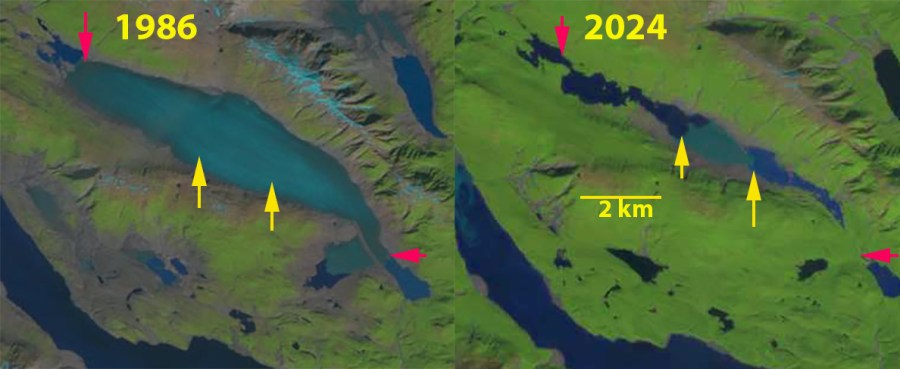
Burroughs Glacier in 1986 and 2024 Landsat images. The red arrow marks terminus in 1986 and yellow arrows the 2024 terminus. Yellow dots mark the outline of the glacier in 2022. Glacier area declined from 12.5  km² to 1.2 km² during this 38 year period.

Burroughs Glacier in Glacier Bay National Park, Alaska has been retreating since 1892 when it was part of the Muir Glacier complex. The glacier is named for naturalist John Burroughs, who accompanied John Muir to the areain 1899 on the Harriman Expedition. The glacier is unusual in that it has not had an accumulation zone this century, where snow persists through the year. Without an accumulation zone a glacier cannot survive (Pelto, 2010)Mickelson (1971) summarized the retreat of the glacier from 1892-1960. In 1892 the Burroughs ice plateau was assessed as a 10 km by 25 km ice cap. By 1960 it had thinned by as much as 750 m and its calving margin had retreated 27 km. In the 1960s crevasse extension were still active (Taylor, 1963). By the end of the 1970’s the glacier was essentially stagnant (Molnia, 2008). In 1982 I briefly visited the western terminus, which provided a still imposing slope, made more so by the rain and clouds lowering onto its surface, active crevasses were still evident indicating some movement. John Burroughs in writing the narrative of the Harriman Expedition noted about vanishing glaciers “It is dead or motionless, and is therefore free from crevasses. Its rim comes down to the gravel like a huge turtle shell and we stepped up on it without difficulty. (page 45)”.

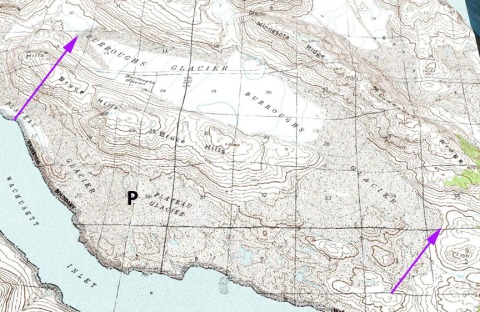
Here we examine the glacier in Landsat imagery from 1986 to 2024to illustrate the retreat, the lack of snowcover  and the thinning. In the 1948 map of Burroughs Glacier, the glacier is 12.1 km long, and much of the glacier is already stagnant, the glacier has both a north and south terminus, purple arrows.

burroughs map

Burroughs Glacier in 1948 USGS map. Purple arrow indicate terminus locations. Former Plateau Glacier (P).

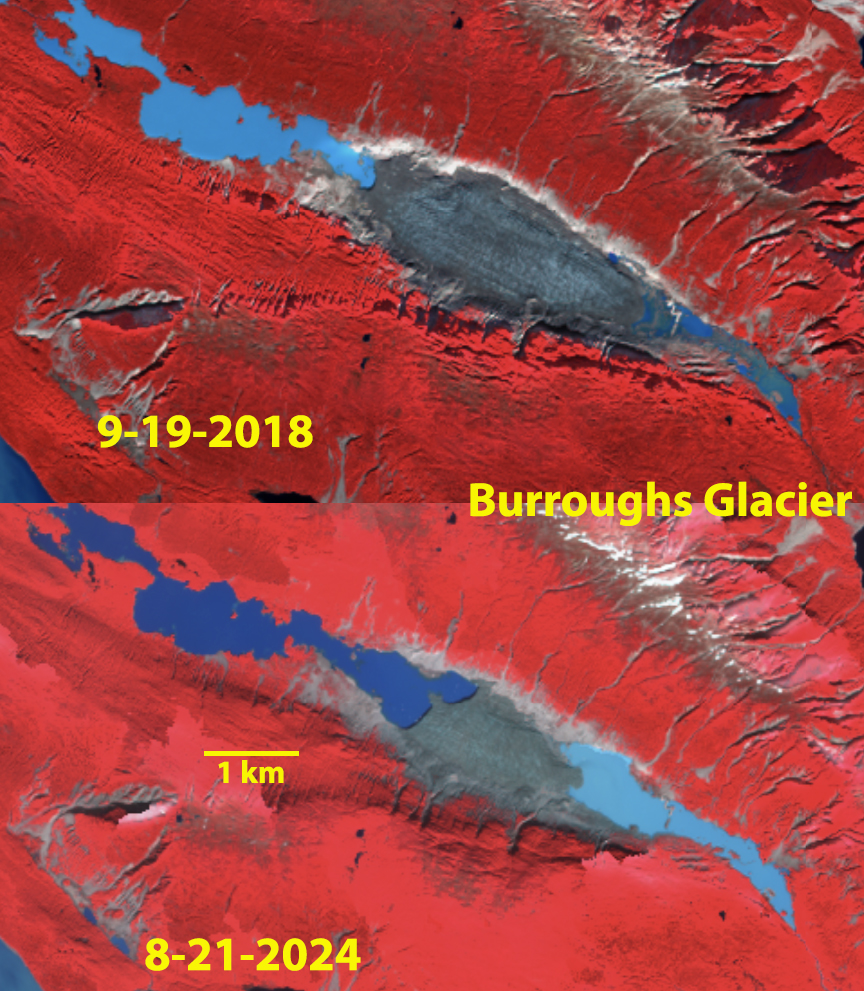
In 1948 Burroughs Glacier has an area of 22 km² and is 12.5 km long, with the crest of the glacier at 425 m. In 1986 Burroughs Glacier has an area of 12.5 km² and has no snowcover by mid-summer. The glacier terminates in proglacial lakes at both the north and south terminus and is 9 km long, purple arrows indicate 1948 terminus. In 2004 Burroughs Glacier again lacks any snowcover. The southern terminus has retreated 2.2 km from the lake, and the northern terminus has retreated into a second lake basin. The glacier is 6.3 km long, half of its length in 1948. In 2010 snowcover is lacking and retreat has continued shrinking the glacier to 5.4 km in length.  The glacier was assessed with an area of 2.9 km² and a median elevation of  313 m (1025 feet) by GLIMS, in 2010.  In 2013 the glacier lacks snowcover in this September Landsat image even though snow has returned to the surrounding mountains. This indicates how far below the snowline the glacier lies. Portions of a glacier are supposed to be the first locations that receive snowcover. The terminus has continued to retreat and the glacier was 4.6 km long in 2013. The northern terminus was retreating into a third basin of the proglacial lake. By 2018 the glacier area has been reduced to 2.7 km², then 1.5 km² in 2022 and 1.2 km² in 2024., 5.5% of its area remaining from 1948, 10% of its area from 1986 and 1% of the 1892 area.  The length of the glacier in 2024 is 2.3 km, only 50% of the length just a decade ago, and ~20% of the 1948 length.

Thinning of this glacier from 1948-2016 is evident from a comparison of topographic maps. Thinning in remaining glacier are averages 225 m during this period, that is a rate of ~3.3 m/year. Larsen et al (2007) had found a thinning rate of ~3 m/year for the 1948-2000 period. Satellite imagery allows identification of glacier area, which declined at a linear rate from 2004-2024, correlation coefficient of 0.98. This his linear rate indicates the glacier will disappear in 2029 or 2030.

Burroughs Glacier has not been in equilibrium with climate the past century. Its retreat has been hastened by the rising snowline of the last decade note by Pelto et al (2013) on Brady Glacier. This glacier area has declined by 90% since 1986, with volume loss being even larger.  Retreat usually increases as elevation declines and as the size of the remnant ice declines. There is no debris cover or persistent snowcover to slow the loss.

Overlay of 1948 (blue labeled contours) and 2014 elevation map (brown labeled contours) for Burroughs Glacier.

Burroughs Glacier area from Landsat and Sentinel images from 2004 to 2024. This is a strongly linear decrease, that projected beyond 2024 hits bottom in 2029 or 2030.

2004 Landsat image of Burroughs Glacier. The red arrow marks the west margin in 1986 and the yellow arrow the east margin.

2010 Landsat image of Burroughs Glacier. The red arrow marks the west margin in 1986 and the yellow arrow the east margin.

2013 Landsat image of Burroughs Glacier. The purple arrows mark the 1948 margin, red arrow the west margin in 1986 and the yellow arrow the east margin in 1986, pink arrows the 2013 margin.

2022 false color Sentinel image of Burroughs Glacier. The ice is dirty but not debris covered at this point, glacier area 1.5 km2.

2018 and 2024 false color Sentinel image of Burroughs Glacier. The ice is dirty but not debris covered. Area declined from 2.7 km2 to 1.2 km2

Glacier Retreat on Yakutat Foreland, Alaska Generates Fastest Lake Growth in United States

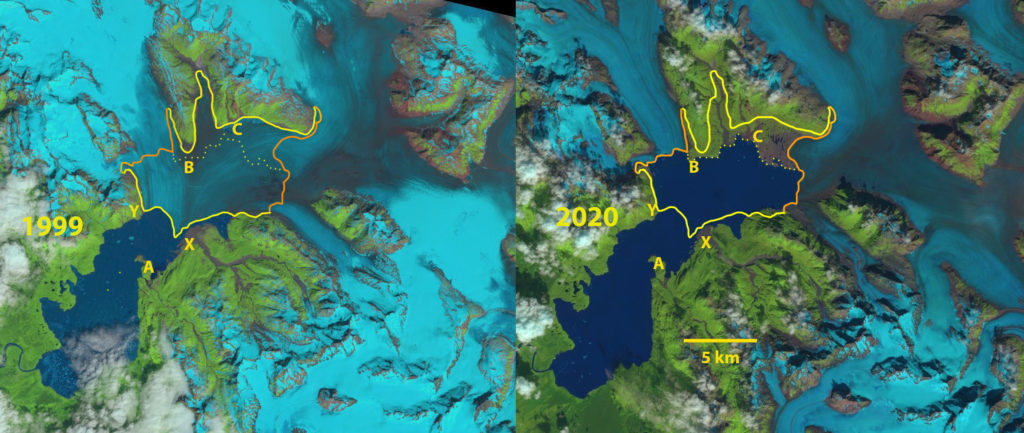
Yakutat, Alsek and Grand Plateau Glacier retreat from 1984 to 2024 has led to the three lakes expanding from 130 km2 to 240 km2 as illustrated by this pair of Landsat images. Fastest lake expansion in the nation in this period.

Three adjacent glaciers terminating on the coastal plain near Yakutat, Alaska have had a spectacular retreat in the last 40 years leading to rapid lake growth; Yakutat Glacier, Alsek Glacier and Grand Plateau Glacier. This is the story of the most rapid area of lake growth in the United States this century.

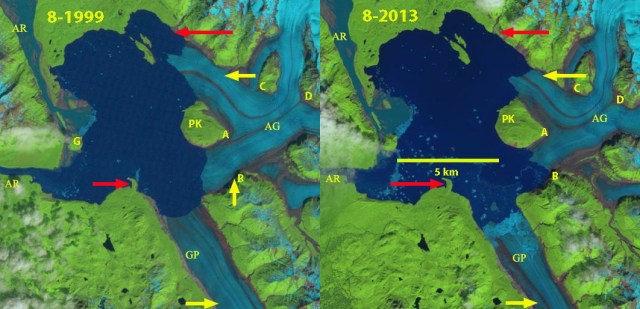
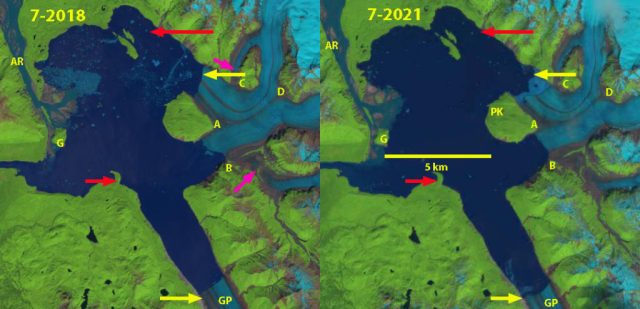
Alsek Glacier descends from the Fairweather Range terminating in Alsek Lake on the coastal plain. In the early part of the 20th century the glacier terminated at Gateway Knob (G) near the outlet of Alsek River from Alsek Lake, with just a small fringing lake present (Molnia, 2005). At that time it had a joint terminus with Grand Plateau Glacier. In 1960 the glacier had a single terminus downstream of an unnamed island in Alsek Lake, that Austin Post (USGS Glaciologisst) told me reminded him of a boats prow. This “Prow Knob” (P) much like Gateway Knob a century ago stabilized the terminus (Pelto, 2017).  The glacier retreated 5-6 km by 1984 from Gateway Knob with the lake growing to an area of 45 km2. From 1984-2024 the retreat has been: 5.3 km for the northern terminus,  5.5 km for the southern terminus and 7.8 km for the northern arm of Grand Plateau Glacier. Alsek Lake has grown from 45 km2 to 75 km2 since 1984. In Octobrer 2024 there remains a narrow connection to Prow Knob that will not survive another year.

Alsek Glacier retreat from 1999-2013 in Landsat images. Red arrows mark the 1984 terminus location, yellow arrows the 2022 terminus location, AR=Alsek River, GP=Grand Plateau, PK=Prow Knob, G=Gateway Knob, A=glacier junction, B=tributary separation, C=tributary separation, D=tributary confluence.

Alsek Glacier retreat from 2018-2021 in Landsat images. Red arrows mark the 1984 terminus location, yellow arrows the 2022 terminus location, pink arrows indicate tributary separation, AR=Alsek River, GP=Grand Plateau, PK=Prow Knob, G=Gateway Knob, A=glacier junction, B=tributary separation, C=tributary separation, D=tributary confluence.

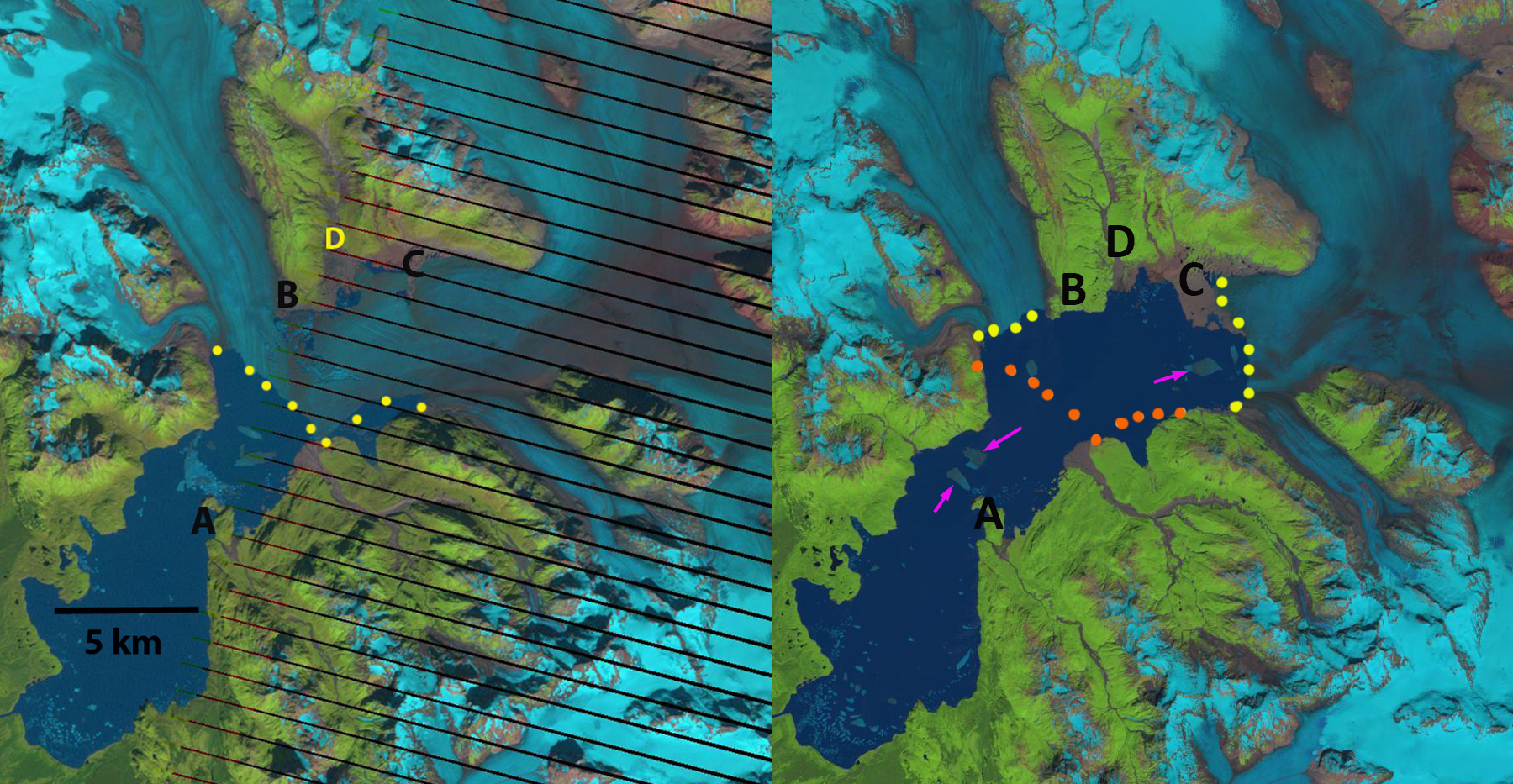
Yakutat Glacier, Alaska experienced a spectacular retreat losing 45 km² from 2010-2018, as a result of rising ELA leading to rapid thinning of the lower glacier (Truessel et al, 2013).  The Yakutat Glacier during the 1894-1895 Alaskan Boundary Survey ended near a terminal moraine on a flat coastal outwash plain. By 1906 the glacier had retreated from the moraine and a new lake was forming, Harlequin Lake.  By 1984 the lake had expanded to an area of 50 km2. The 2018 image compares the 2010 position (yellow dots) with 2018 (orange dots), indicating an area of 45 km² lost in less than a decade (NASA EO, 2018). There are some small icebergs in 2018.  By 2024 further retreat has expanded the total lake area to 105 km2.  The main terminus retreated 7 km. The ability to produce icebergs as large as in 2015 has been lost as the calving front has been restricted by the Peninsula which is now 3 km long, leaving less than a 3 km wide calving front.   The narrower calving front and reduced water depth should in the short term reduce retreat. Truessel et al (2015) modelling indicated a reduced rate of retreat from 2020-2030, which supports the expected reduced calving.  Their model also indicates the glacier will disappear between 2070 and 2110 depending on the warming scenario.  

Expansion of Harlequin Lake due to retreat of Yakutat Glacier indicated on these 2010 and 2018 Landsat images. Yellow dots mark the ice front, orange dots the 2010 margin in 2018.
Expansion of Harlequin Lake due to retreat of Yakutat Glacier, yellow boundary marks the deglaciated region on these Landsat images from 1999 and 2020.

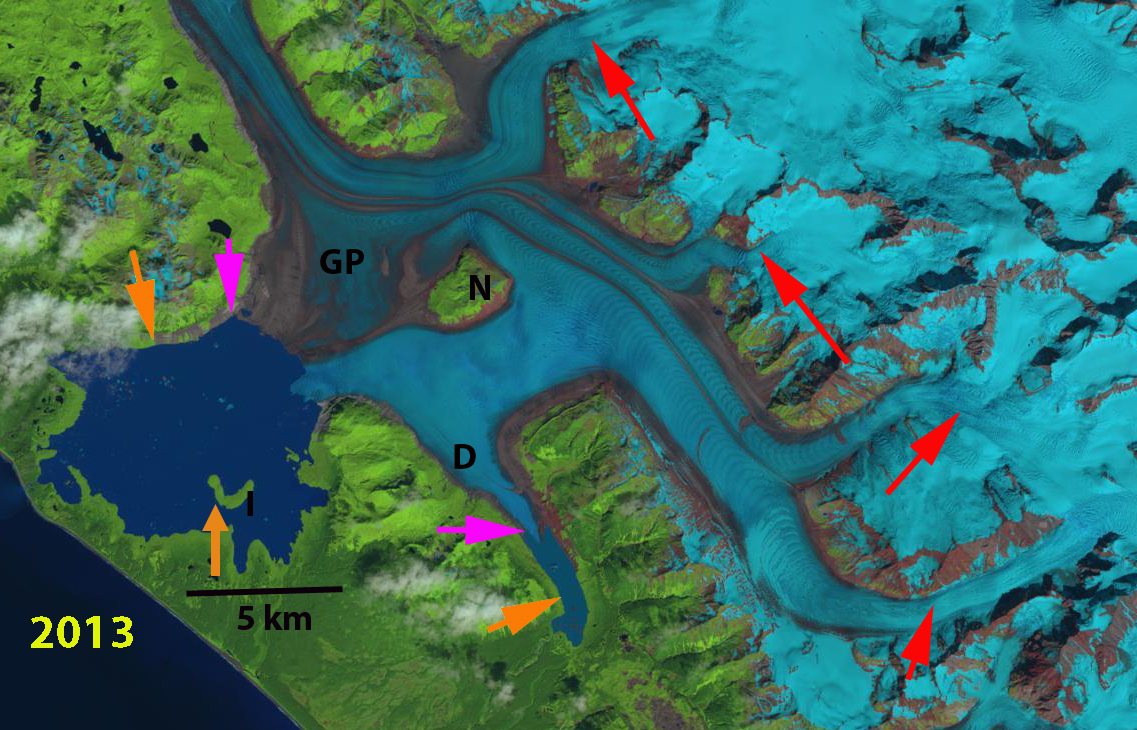
Grand Plateau Glacier drains southwest from Mount Fairweather in southeast Alaska. The glacier advanced during the Little Ice age to the Alaskan coastline. Early maps from 1908 show no lake at the terminus of the glacier. The 1948 map (below) shows three small distinct lakes at the terminus of the main glacier and a just developing lake at the terminus of the southern distributary terminus (D). The distance from the Nunatak (N) to the terminus was 11 km in 1948. The lake at D is 400 m wide.In 2024 the lake area has grown further to 49 km2, as a result of a retreat of 8 km since 1948 and 5.5 km since 1984. Today a second island is emerging at the terminus, Point A. The distributary tongue to the southeast now terminates in a lake that is now 5.2 km long, a 4.8 km retreat since 1948 and 2.6 km since 1984. The combination of higher snowlines and increased calving into the terminus lake will continue to lead to retreat of this still mighty river of ice (Pelto, 2024).

There will be continued glacier retreat and lake expansion in 2025, as the new lake district continues to expand as a result of climate change.  Loso et al (2021) note that retreat of Grand Plateau Glacier will change the outlet of Alsek Lake from Dry Bay to the Grand Plateau Lake, creating one larger lake. 

Grand Plateau Glacier retreat from 1984 to 2013 in Landsat images. Main tributaries indicated by red arrows also showing snowline. Orange arrows indicate 1984 terminus and pink arrows 2013 terminus.

Allen Glacier, Alaska Terminus Tongue Breakoff 8-21-2023

allen glacier comparison 2023

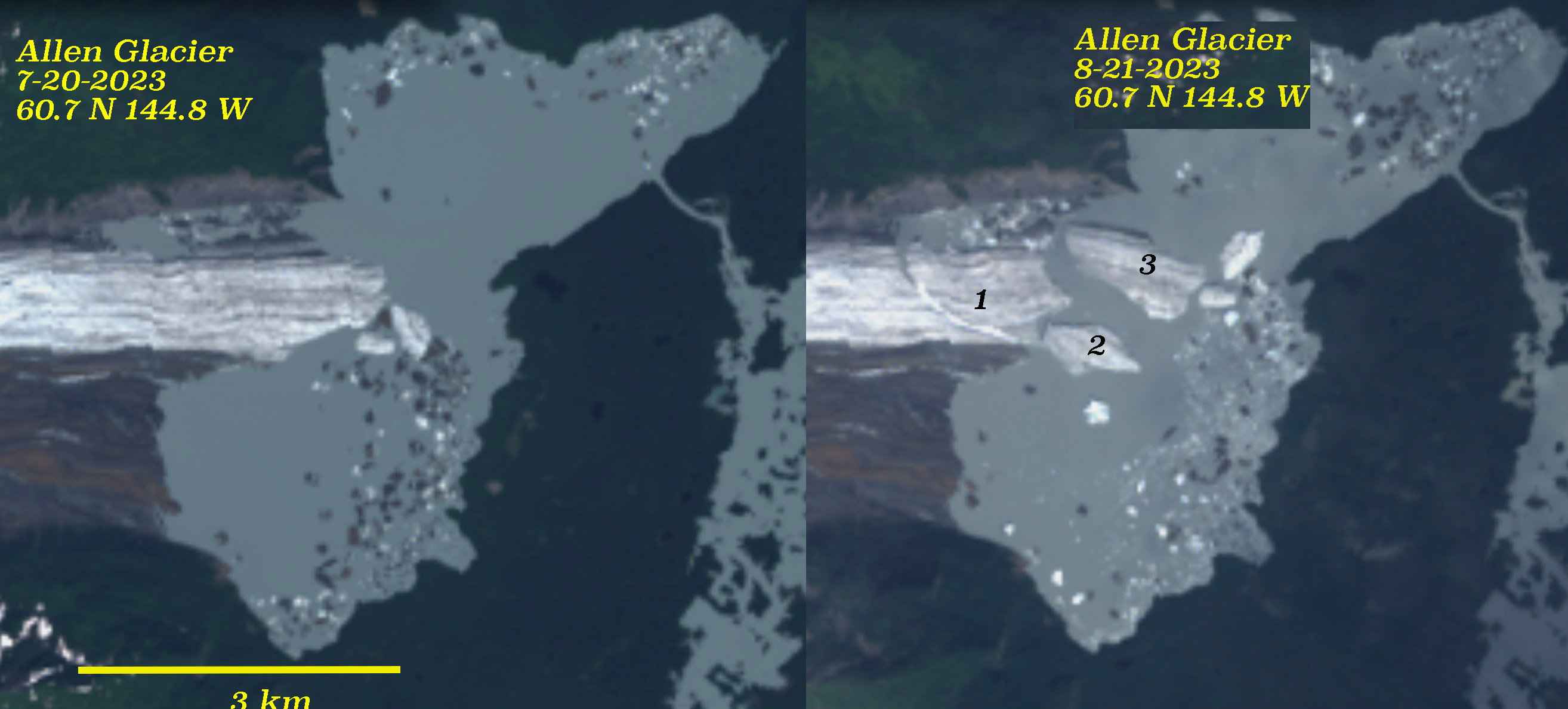
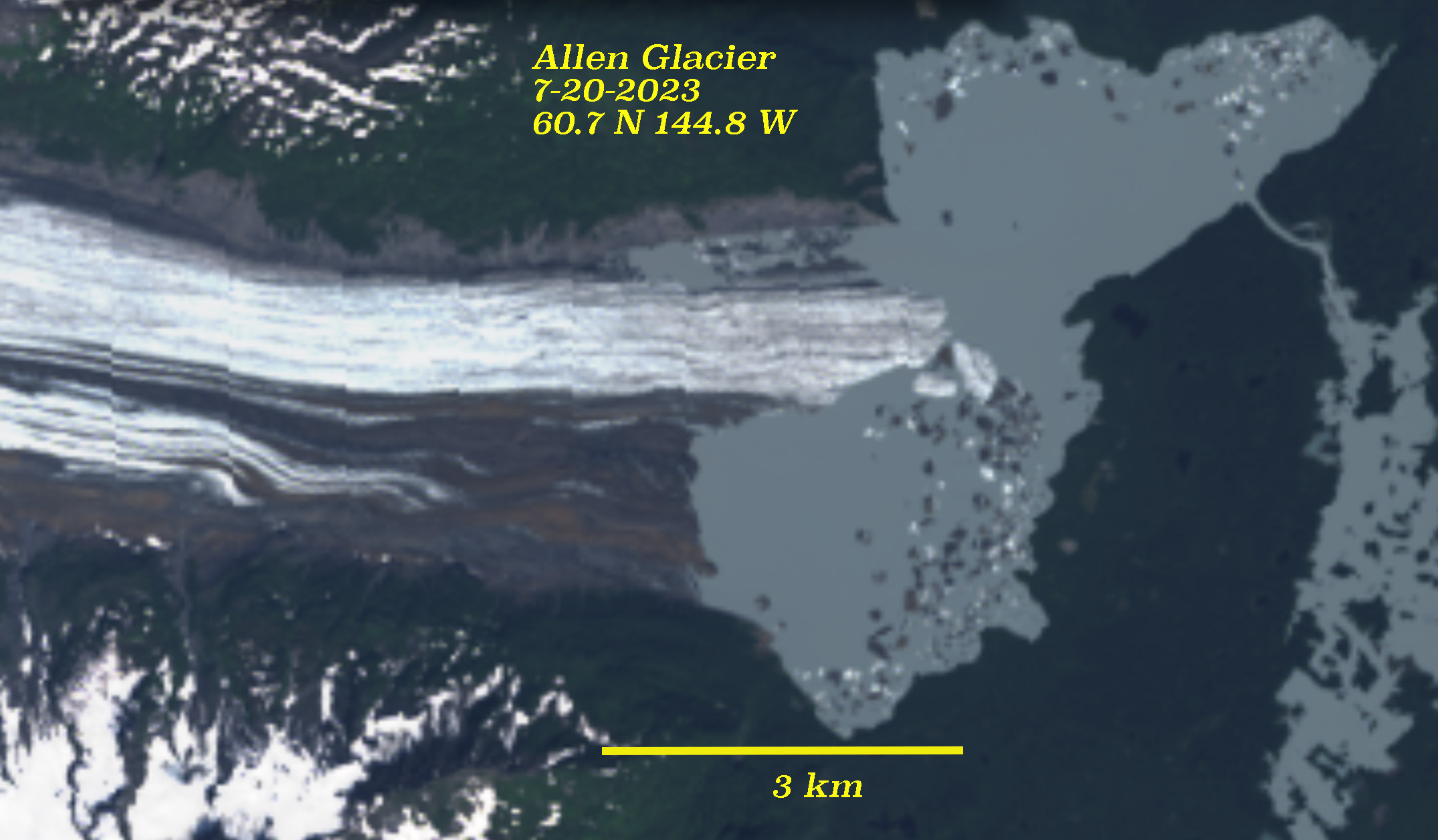
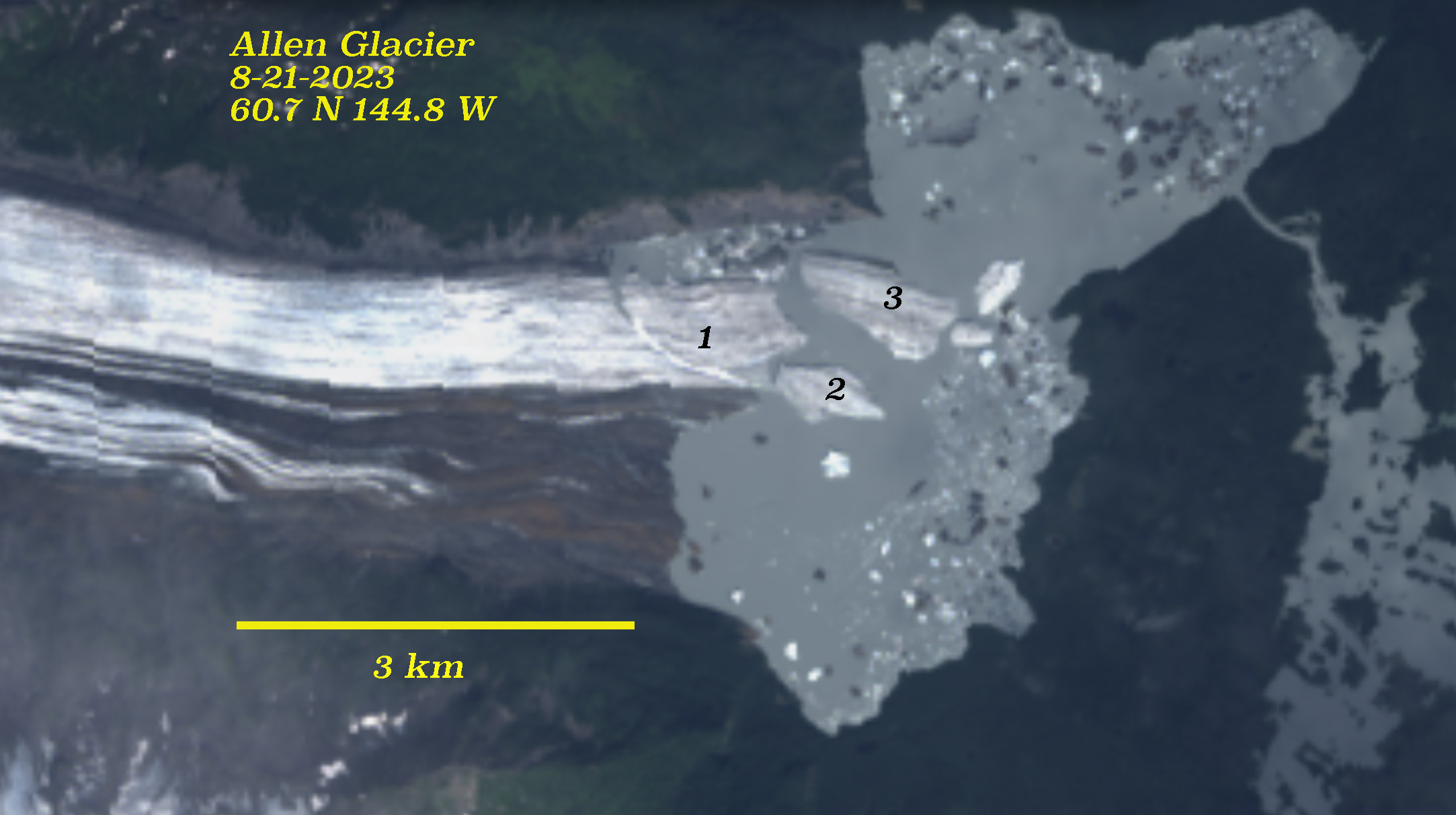
Allen Glacier terminus in Landsat image from 8-21-2023 indicating the three new icebergs with an area of 1.5 km² that calved. Lake area is now 14 km².

allen glacier 1987

Allen Glacier drains east from the Chugach Mountains terminating in an expanding proglacial lake adjacent to the Copper River. In 1987 the terminus filled most of the proglacial with only the northeast corner open, lake area 2 km². A landslide is also evident spreading below across the snowline in this Landsat image below.

allen glacier 2002

By 2002 the lake had expanded with the northern bay ice free and a fringing area of open water along entire margin. In this Landsat image below lake area 6 km².

allen glacier 2017

In 2017 a southern bay had opened and become ice free, with a central tongue separating the northern and southern bays of the proglacial lake, lake area 11 km². The Landslide continues to move downglacier in this Landsat image below.

allen glacier 2021In 2021 rifting had developed 2 km upglacier of the terminus, with the central tongue calving some smaller icebergs ~01. km² in this Landsat image below.

Screenshot
Screenshot

In July 2023 the central tongue continued to calve small icebergs in this Landsat image, with a rift evident that had developed in 2022.

Screenshot
Screenshot

On August 21 2023 a calving event occurred along the rift that had been visible for over a year. This generated several icebergs with the 3 primary icebergs having a combined area of 1.5 km². The proglacial lake has expanded from 2 km² to 14 km² since 1987. Terminus retreat has been ~3 km in this interval.

Baird Glacier, Alaska Retreat Generates Proglacial Lake

Baird Glacier on 8-11-1990 and 7-6-2023 Landsat images indicating initiaton of retreat and formation of proglacial lake (PGL). The lake is now 3.25 km², retreat has been 2600 m since 1990-yellow dots indicate margin.

Baird Glacier drains the west side of the Stikine Icefield in southeast Alaska. It is the only glacier of the Stikine Iceifield that did not retreat significantly from 1960-2010. Pelto et al (2013) predicted the onset of significant retreat of this glacier, which like Brady Glacier had been slow to begin retreat despite thinning. From 1887 to 1941, the advance totaled ~1 km and from 1941-1980 it advanced ~1 km. The terminus location did not change from 1980-2010. In 1984 I had a closeup look at the terminus from the outwash plain, it was heavily debris covered and lacked crevassing. This indicated a limited velocity, yet the ice was clearly quite thick, and it would take considerable melting to initiate retreat. In this post we examine Landsat images from 1990, 2005, 2013, 2015 and 2023 along with Sentinel images from 2022 and 2023 to identify how the terminus is responding to climate change.

Baird Glacier in false color Sentinel images from July 2022 and July 2023. Proglacial lake (PGL) expanded from 3.00 to 3.25 km² width of tongue extending upvalley toward North Baird Glacier (NB) has declined from 700 m to 400 m.

In 1990 the Baird Glacier was sitting on an outwash plain, with no lake at the terminus. The North Baird Glacier was 1100 meters wide at the yellow arrow, just before joining the Baird Glacier. The main Baird Glacier is 1350 m wide at the pink arrow. By 2005 the North Baird Glacier is 900 m wide at the yellow arrow, and the Baird Glacier 1200 m wide at the pink arrow. The terminus appears unchanged in 2005. By 2013 the North Baird Glacier is just 700 m wide at its junction at the yellow arrow and the Baird Glacier just 1100 m wide at the pink arrow. In 2013 two small marginal lakes have appeared at the terminus, red arrows indicating a measurable retreat, had begun, the lakes are 400-600 m across. By 2015 the glacier has retreated 750 m and the lake has an area of ~1 km².  In 2022 the glacier has retreated leading to a lake expansion to 3.00 km². In July 2023 the tongue of ice extending across the front of the North Baird Glacier valley has thinned 40% since July 2022. This tongue is poised to breakup later this summer or next. The North Baird Glacier is separated by ~1 km from the Baird Glacier. The proglacial lake has an area of 3.25 km2 and the glacier retreat is 2600 m from 1990-2023.

Larsen et al (2007) using repeat laser altimetry note that North Baird Glacier in its lowest 10 km from the junction with Baird Glacier was losing 2 m per year in ice thickness. From 2000-2009 the thinning rate is even higher, with Baird Glacier main trunk losing 10-20 m in thckness in the lowest 20 km Larsen et al (2009)  Baird Glacier is joining the rest of the Stikine Icefield is already in retreat, Dawes GlacierPatterson Glacier and Great Glacier. With Sawyer Glacier retreating from tidewater in 2023.

2005 Landsat image of Baird Glacier indicating terminus still on outwash plain. and the Baird and North Baird Glacier firmly connected.

2013 Landsat image of Baird Glacier indicating terminus still reaches outwash plain, with two new lakes forming. and the Baird and North Baird Glacier still connected.

2015 Landsat image of Baird Glacier indicating terminus no longer reaches outwash plain, with proglacial lake now formed. Baird and North Baird Glacier no longer connected.

Rodman Glacier, Alaska Retreat Expands Lake Ustay

Rodman Glacier in Landsat images from 1987 to 2021 indicating 1987 terminus=red arrow, A=Akwe Lake, U=Ustay Lake, B=glacier base exposed,  C=expanding nunatak

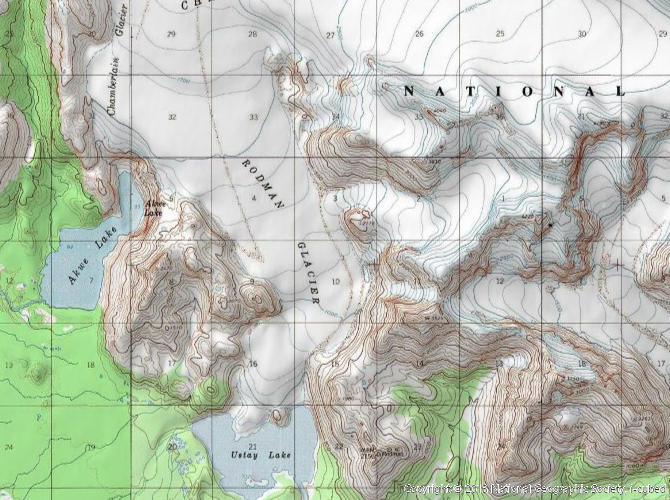
Rodman Glacier flows south from the Brabazon Range ending in Ustay Lake at the margin of the Yakutat Foreland. In the 1906 International Boundary Commission survey of the region Ustay Lake does not yet exist, Akwe Lake has just started to form with the terminus ending in it named Chamberlain Glacier. Chamberlain Glacier was a distributary terminus from Rodman Glacier and by 1948, the thinning Rodman Glacier no longer generated this second terminus. In the 1950’s the glacier terminated on an island in Ustay Lake. By 1968 Austin Post indicated that it had retreated 1400 to 2000 m from its maxiuum Little Ice Age position, but was still grounded on the island.

In 1987 the glacier had retreated 200 m from the island. In 2021 the glacier had retreated 800 m from the island. A slow retreat compared to nearby Yakutat Glacier, 21 km since 1906 and 10+ km since 1987) or East Novatak Glacier (2.75 km snce 1987). By Sept. 2022 the glacier had developed a 1 km long 0.4 km² terminus tongue that has significant rifts and will break up in the next year or two. This condition persists into June 2023. The glacier has also developed a significant area of 1.25 km² around Point B where bedrock is exposed in Sept. 2022 and an occasional glacial lake forms filling part of the basin such as in June 2023. At Point C an expanding nunatak indicates extensive thinning up to 800-900 m on this glacier.

.

Rodman Glacier in Sept. 2022 and June 2023 Sentinel Images indicating the terminus tongue with open water on both sides that is poised to breakup, yellow arrows. At Point B is an expanding area of bedrock in Sept. 2022 that is partially water filled in June 2023.

Rodman Glacier in 1950’s topographic map no Island yet in Ustay Lake.

Sawyer Glacier, Tracy Arm Alaska Retreats from Tidewater

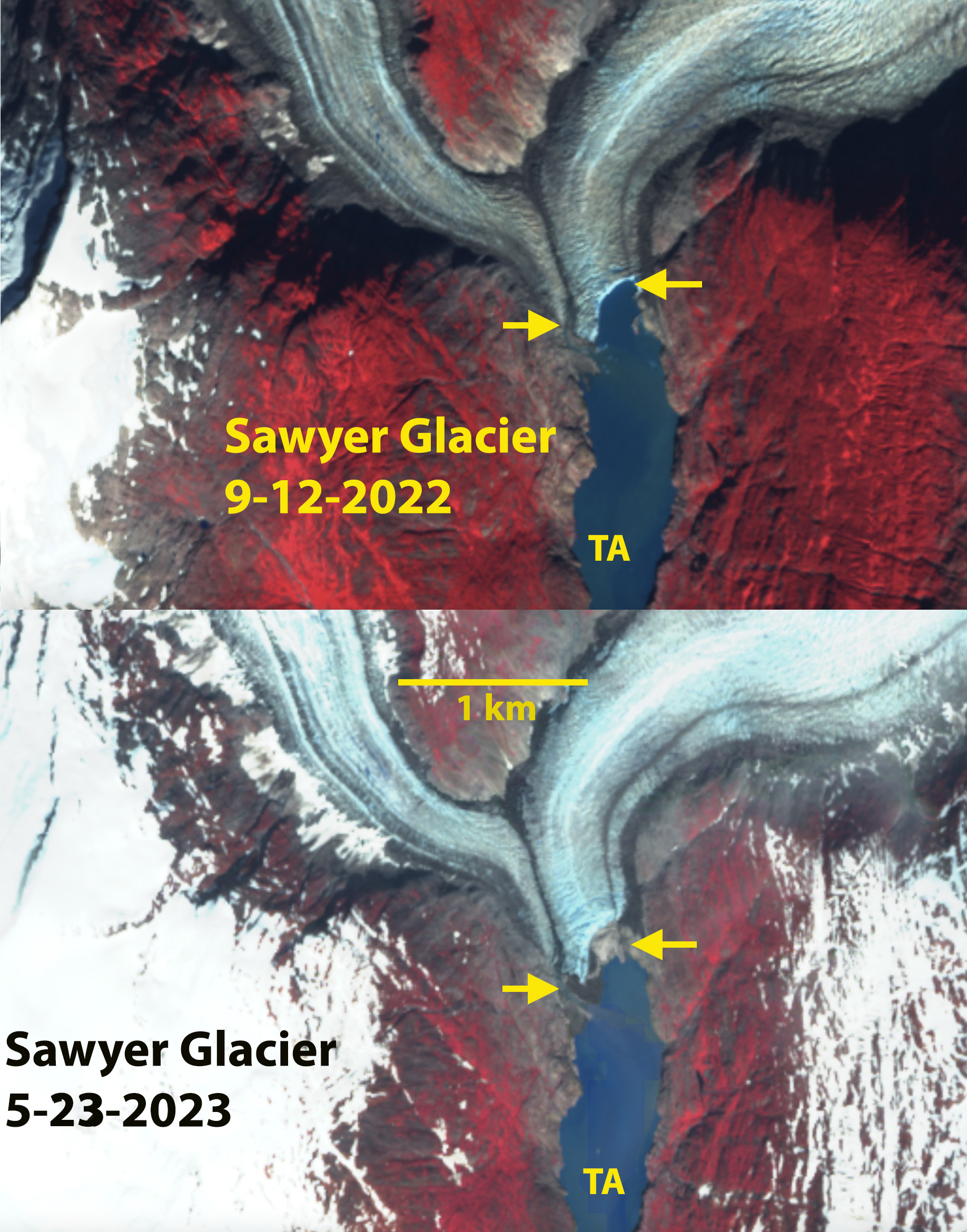
Sawyer Glacier Alaska in False Color Sentinel images from Sept. 12, 2022 and May 23, 2023. Note the the calving face in 2022 between the yellows arrows has become bare ground by May 23, 2023. TA=Tracy Arm

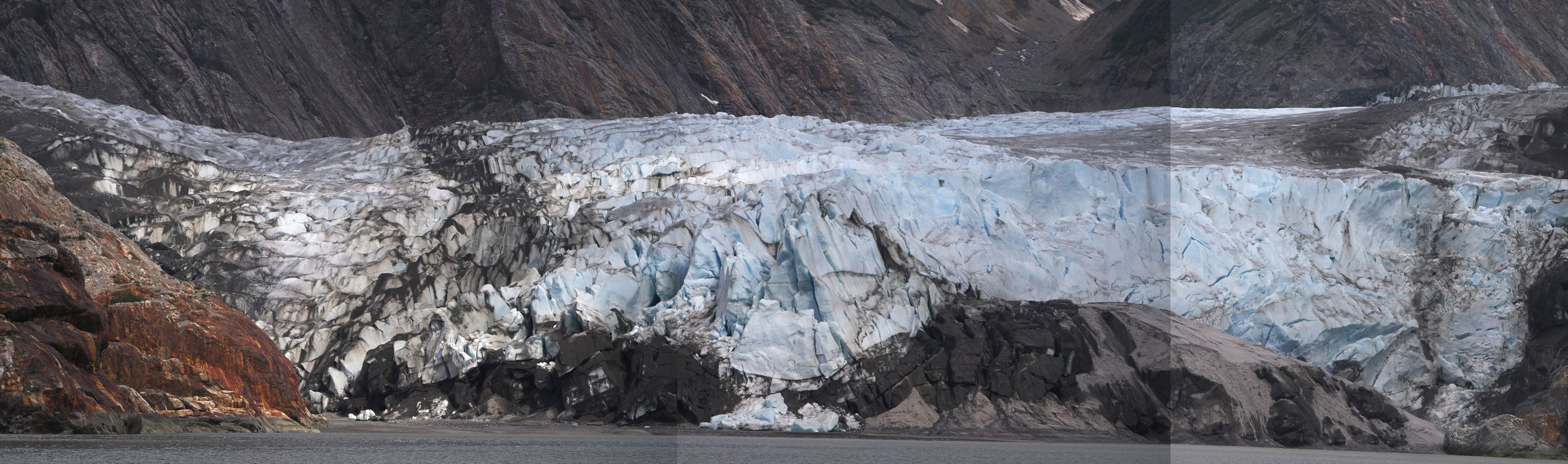
Sawyer Glacier in May 19, 2023, taken by Steve Backus (Lindblad Expeditions Naturalist), not touching tidewater.

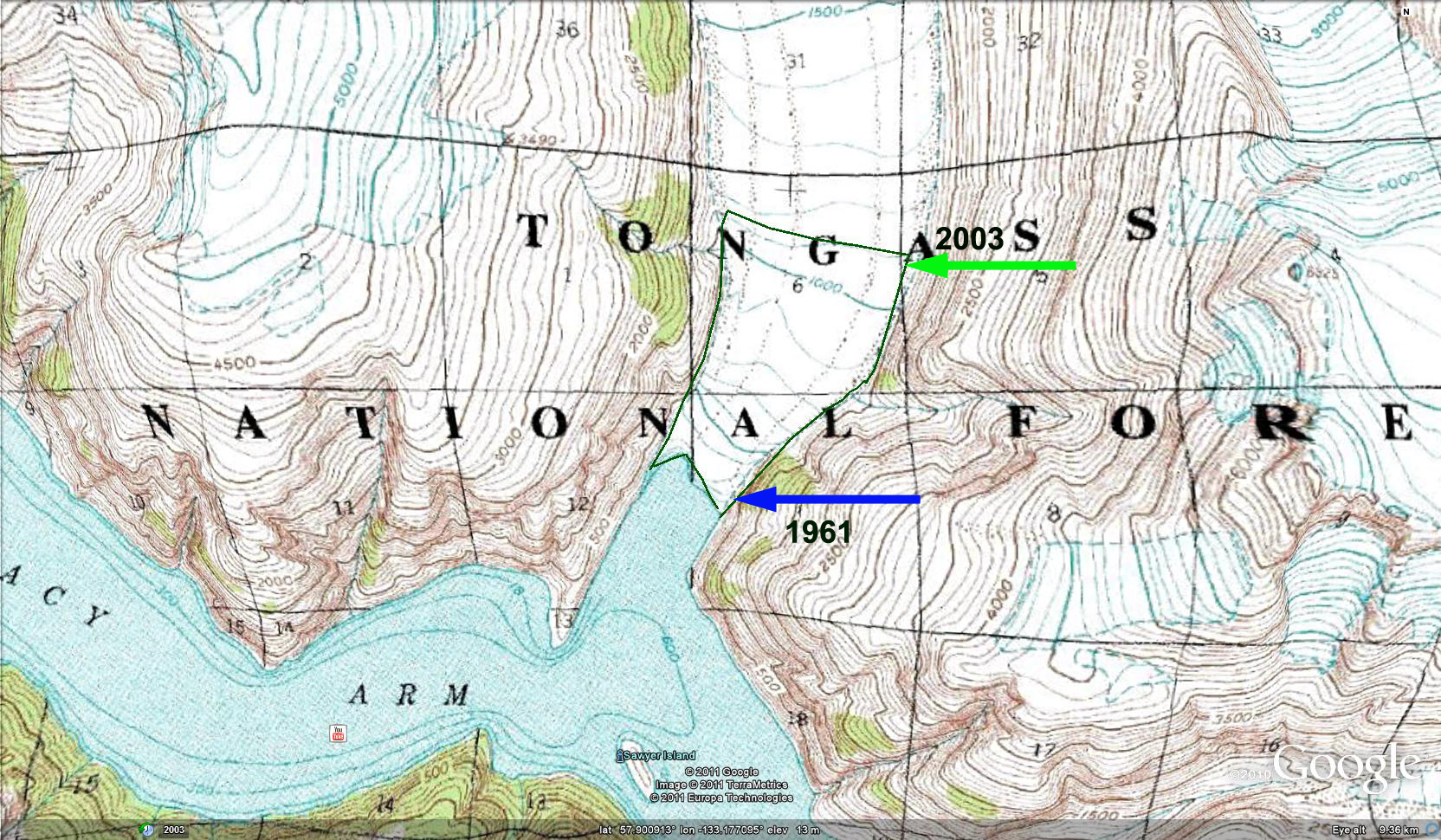
Sawyer Glacier, is an Alaskan glacier where the retreat has long been viewed by many visitors. It is one of  the two primary glaciers that calves into Tracy Arm fjord, that is often visited by cruise ships. The 3.3 km retreat from 1961-2022 has made approach to the actual terminus difficult for larger cruise ships (Lindblad Expeditions, Allen Marine Tours or Holland Amreica) . The terminus of the glacier was almost to the main arm of the fjord in 1961, USGS map below.  Landsat images from 1990 to 2013 indicate retreat from the 1990 terminus, red arrow, to the 2013 terminus, yellow arrow is 2800 km, 120m/year. From 2013-2022 the retreat has been slower with ~500 m retreat, 50 m/year.

Sawyer Glacier retreat from 1990 to 2013 in Landsat images. Yellow arrow=2013 terminus; Red arrow=1990 terminus; purple arrow

Sawyer Glacier retreat from 1990 to May 10, 2023 in Landsat images. Green Arrow=2023 terminus Yellow arrow=2013 terminus; Red arrow=1990 terminus; purple arrow

From 1874 when John Muir first enthused about the calving glaciers of this fjord through 2022 their has been a calving front in the fjord.  This was true as the cruise ship season ended in 2022. False color Sentinel images in Sept. and Oct. 2022 indicate a calving front that is 250 m wide. False color Sentinel images on May 10 and 23, 2023 indicate the front of the glacier entirely resting above fjords waters. High tide may touch the glacier at ts southernmost point. When I first visited the in 1982 I could not imagine it retreating from the fjord in my lifetime. Melkonian et al (2016) observed a rapid thinning of the Stikine Icefield of -0.57 m/year from 2000-2014. This loss has been driving by rising snowlines.  Pelto (1987) reported a snowline of 1125 m the 1980’s, that now averages over 1300 m. The retreat here is similar to that of nearby Dawes and South Sawyer Glacier. This loss of iceberg  production will impact harbor seals as they prefer icebergs to haul out on. (Alaska Department of Fish and Game ).

May 10 and 23, 2023 Sentinel images indicating bare ground across entire terminus front.

Sawyer Glacier Alaska in False Color Sentinel images from Sept 12, 2022 and Aug. 7, 2016. Note the the calving face in 2016 and 2022 between the yellows arrows.

USGS 1961 topographic map showing location of terminus in 1961 and 2003.

Burroughs Glacier, Alaska Down to Last 1%

Burroughs Glacier in 1986 and 2022 Landsat images. The red arrow marks the west margin and the yellow arrow the east margin in 1986. Yellow dots mark the outline of the glacier in 2022. Glacier area declined from 12.5  km² to 1.5 km² during this 36 year period.

Burroughs Glacier in Glacier Bay National Park, Alaska has been retreating without pause since 1892 when it was part of the Muir Glacier complex. The glacier is unusual in that it has not had an accumulation zone over the last century, where snow persists through the year. Without an accumulation zone a glacier cannot survive (Pelto, 2010). Mickelson (1971) summarized the retreat of the glacier from 1892-1960. In 1892 the Burroughs ice plateau was assessed as a 10 km by 25 km ice cap. By 1960 it had thinned by as much as 750 m and its calving margin had retreated 27 km.. By the 1970’s the glacier was essentially stagnant (Molnia, 2008). In 1982 I briefly visited the western terminus, which provided a still imposing slope, made more so by the rain and clouds lowering onto its surface.

Here we examine the glacier in Landsat imagery from 1986 to 2022 to illustrate the retreat, the lack of snowcover  and the thinning. In the 1948 map of Burroughs Glacier, the glacier is 12.1 km long, and much of the glacier is already stagnant, the glacier has both a north and south terminus, purple arrows. To the west of Burroughs Glacier is Plateau Glacier (P).
burroughs map

Burroughs Glacier in 1948 USGS map.

In 1948 Burroughs Glacier has an area of 22 km² and is 12.5 km long, with the crest of the glacier at ~1500 feet. In 1986 Burroughs Glacier has an area of 12.5 km² and has no snowcover by mid-summer. The glacier terminates in proglacial lakes at both the north and south terminus red and yellow arrow respectively, and is 9 km long, purple arrows indicate 1948 terminus. By 1986 Plateau Glacier has only three small remnants marked by P, surrounding these vegetation is still limited, with considerable expanse of bare glacial sediments. By 2003 Plateau Glacier is gone and vegetation is filling in most of the area that was still bare sediment in 1986. In 2003 Burroughs Glacier again lacks any snowcover. The southern terminus has retreated 2.2 km from the lake, and the northern terminus has retreated into a second lake basin. The glacier is 6.3 km long, half of its length in 1948. In 2004 snowcover is again lacking anywhere on the glacier. In 2010 snowcover is lacking and retreat has continued shrinking the glacier to 5.4 km in length.  The glacier was assessed with an area of 2.8 km² and a median elevation of  313 m (1025 feet) by GLIMS. In 2013 the glacier lacks snowcover in this September Landsat image even though snow has returned to the surrounding mountains. This indicates how far below the snowline the glacier lies. Portions of a glacier are supposed to be the first locations that receive snowcover. The terminus has continued to retreat and the glacier was 4.6 km long in 2013. The northern terminus was retreating into a third basin of the proglacial lake. Vegetation has reclaimed almost all of the Plateau Glacier area and has reclaimed the region deglaciated by Burroughs Glacier before 2003. By 2022 the glacier area has been reduced to 1.5 km², this is just 12% of its area remaining from 1986 and 1% of the 1892 area.  The length of the glacier in 2022 is 2.3 km, only 50% of the lenght just a decade ago, and ~20% of the 1948 length.

Thinning of this glacier from 1948-2016 is evident from a comparison of topographic maps. Thinning in remaining glacier are averages 225 m during this period, that is a rate of ~3.3 m/year. Larsen et al (2007) had found a thinning rate of ~3 m/year for the 1948-2000 period.

Overlay of 1948 (blue labeled contours) and 2014 elevation map (Brown labeled contours) for Burroughs Glacier.

Burroughs Glacier has not been in equilibrium with climate since the end of the Little Ice Age. Its retreat has been hastened by the rising snowline of the last decade note by Pelto et al (2013) on Brady Glacier. This glacier area has declined by 88% since 1986, with volume loss being even larger.  Retreat usually increases as elevation declines and as the size of the remnant ice declines. There is no debris cover or persistent snowcover to slow the loss. Thus, it seems likely this glacier will be gone within 25 years. The 2011 Google Earth image at bottom indicates no snow, the reduced albedo from the dirty surface and a few crevasses near the margin that are collapse features. This is unlike nearby glaciers that are retreating significantly but not disappearing, like Brady Glacier, Geikie Glacier, Yakutat Glacier and Riggs Glacier. 

r.

1986 Landsat image of Burroughs Glacier. The  purple arrows mark the 1948 margin, red arrow the west margin in 1986 and the yellow arrow the east margin.

2003 Landsat image of Burroughs Glacier. The red arrow marks the west margin in 1986 and the yellow arrow the east margin.

2004 Landsat image of Burroughs Glacier. The red arrow marks the west margin in 1986 and the yellow arrow the east margin.

2010 Landsat image of Burroughs Glacier. The red arrow marks the west margin in 1986 and the yellow arrow the east margin.

2013 Landsat image of Burroughs Glacier. The purple arrows mark the 1948 margin, red arrow the west margin in 1986 and the yellow arrow the east margin in 1986, pink arrows the 2013 margin.

2022 false color Sentinel image of Burroughs Glacier. The ice is dirty but not debris covered at this point.

 

Brady Glacier Retreat Causes Ice Dammed Spur and Trick Lake Drawdown

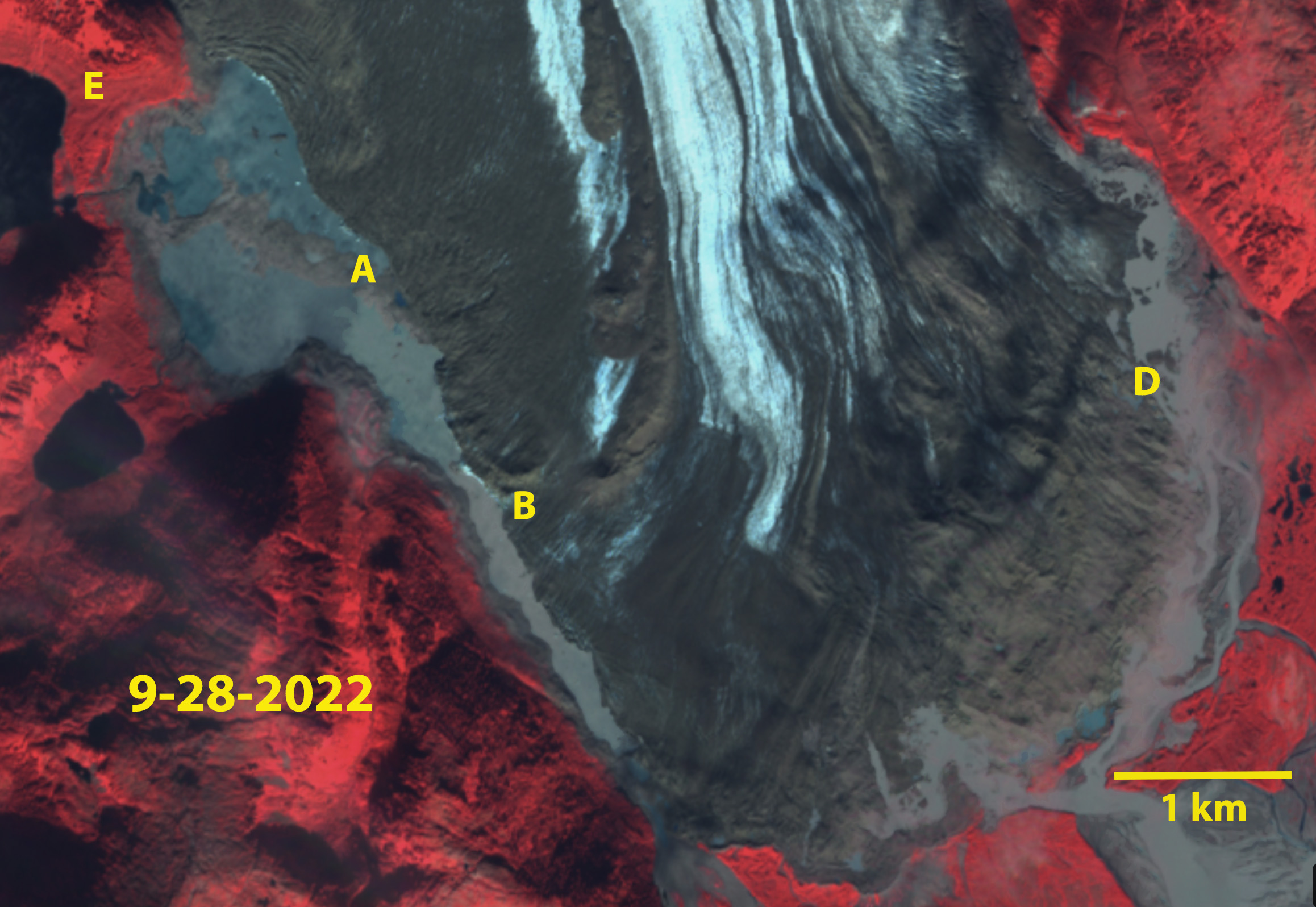
Brady Glacier terminus region in September 28, 2022 Sentinel image. Red dots indicate the 2016 margin. Point A marks the new isthmus exposed by falling lake water level. Point B-D are the expanded drainage channels.

Brady Glacier is a large Alaskan tidewater glacier in the Glacier Bay region that is beginning phase of substantial retreat that was forecast by Pelto et al (2013). The glacier has seven secondary termini in marginal ice dammed proglacial lakes. There was a consistent pattern in the change in position of the glacier margin at each of the lakes between 1948 and 2010. The rate of retreat of the glacier margin at all seven ice dammed lakes accelerated later during this period; the mean retreat rate was 13 m/a from 1948 to 2004 and 42 m/a from 2004 to 2010 (Pelto et al 2013). Lake area and calving fronts were measured for each lake: Spur, Abyss, North Deception, Bearhole, Oscar, and East Trick based on the September 2010 imagery, with earlier measurements from Capps  et al (2010). Lake areas can increase as a result of Brady Glacier marginal retreat, and can decrease due to declines in surface water levels as previously ice-dammed conduits form to drain the lake (Pelto 2016). Here we examine the changes in area of  Spur and Trick Lake from 2016-2022 during development of substantial marginal drainage channels. During this period the terminus of the glacier has retreated on average 175 m, with 300 m of retreat from its maximum position advance position.

Brady Glacier terminus region in September 29 2016 Sentinel image. Yellow dots indicate the 2022 margin. East and North Trick lakes are connected basins. Spur Lake still has an eastward extension.

Trick Lakes: In 1986 North and South Trick Lake were proglacial lakes in contact with the glacier. By 2016 the two lakes were no longer in contact with the glacier, water levels had fallen and a third lake East Trick Lake had formed. North Trick Lake  and South Trick Lake are currently relatively stable moraine-dammed lakes. The more recently developed East Trick Lake is the current proglacial Trick Lake, a large glacier river exits this lake and parallels the glacier to the main Brady Glacier terminus. In 2016 this river was narrow and flowed beneath the glacier in several spots.  By 2022 the channel has expanded to a width that seldom is less than 200 m, and is tranisitioning to an ice marginal lake. East Trick Lake has an area of 1.25 km²  in 2016, expanding to 1.4 km² in 2019, before declining to 1.0 km² in 2022 with the lake separating into two parts by a narrow peninsula exposed by falling water levels. The water level decline resulting from a  200 m marginal retreat from 2016 to 2022 has led to a narrow isthmus running across the lake from the glacier to be exposed. At Point E below the trimlines from reduced water levels are evident.

Spur Lake: It is likely that retreat toward the main valley of the Brady Glacier will lead to increased water depths at Spur Lake. a marginal retreat of 600 m led to a lowering lake water level from 2010-2016. The lake had an area of 0.6 km2 in 2010, 0.5 km² in 2016, o.5 km² and 0.5 km² in 2022. The lake area decline due to falling water level has been matched by lake area increase due to marginal retreat of Brady Glacier. This marginal retreat has also opened a marginal channel along the east edge of the glacier, draining Spur Lake. This drainage has led the lake shoreline to migrate west. Marginal retreat has been ~100 m from 2016-2022. The marginal river on the east side of the glacier was narrow and occasionally went beneath the glacier in 2016. In 2022 the channel has expanded so that the upper 2.5 km and lower 1.5 km is more of a marginal lake.

North Deception Lake has been expanding as the glacier has retreated 600 m, 100m/year from 2016-2022 while maintaining its water level. At present there is not a marginal channel developed that can reduce the water level. How long until a channel opens?

In Alaska the glacial lakes have expanded in area by 58% from 1984-2018 (Field et al 2021), however the ice dammed lakes declined by 0.4%. The latter indicates the competing impacts of water level reduction due to glacier recession of ice dammed lakes, and the expansion due to retreat as well.

Brady Glacier terminus region in September 28, 2022 Sentinel image. Point A marks the new isthmus exposed by falling lake water level. Point B and D are the expanded drainage channels. Point E is where trimlines are evident.

Tebenkof Glacier, Alaska Snowcover Loss Exposes Century of Annual Layers

Tebenkof Glacier in 2018 ESRI World Image with annual layers numbered. from near the divide to near the terminus. A couple of layers of layers buried near top of glacier by snowcover. This indicates 90-100 annual layers exposed at the surface as they emerge at the surface.

Tebenkof Glacier is a land terminating glacier on the Kenai Peninsula just west of Blackstone Bay. WGMS (2021) documented the retreat rate from 1910-2009 as ~20 m/year. Black and Kurtis (2022) examined 19 tidewater glaciers on the Kenia Peninsula identifying a 42 km² area loss from 1984-2021.  From 1986-2022 Landsat imagery indicates a retreat of 1100 m. During the summers of 2018-2020 the glacier lost all or nearly all snowpack, this allowed atellite imagery to reveal ~90-100 annual layers exposed from divide to near the terminus during years when the glacier was stripped of snowpack such as in 2018-2020.

Tebenkof Glacier retreat from 1986-2022 generating proglacial lake as it retreated 1100 m.

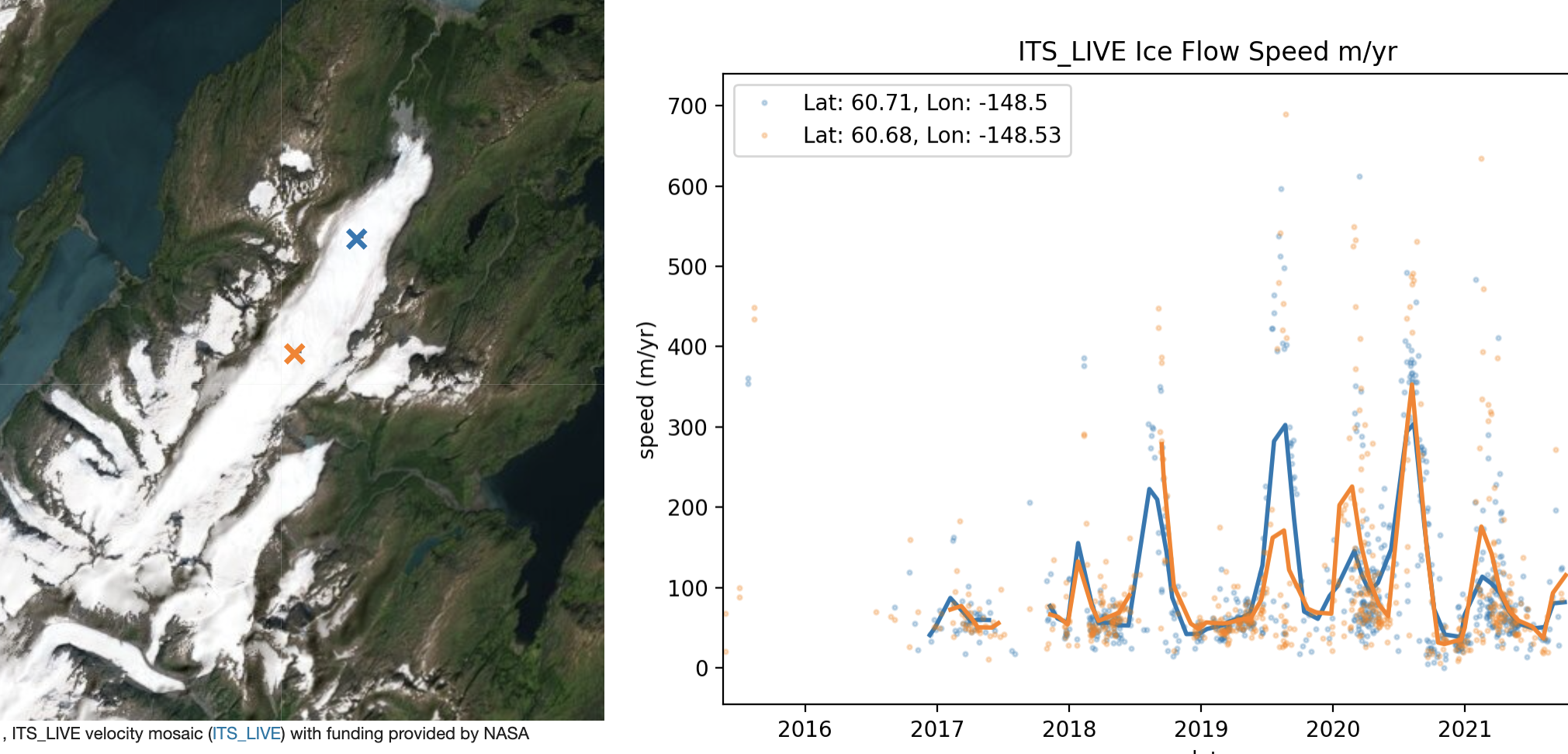
Tebenkof Glacier has an unsually low elevation and consistent gentle slope with the main glacier divide at 650 m and terminus at 200 m, with a length of 9 km. From 650 m where the first annual line layer is visible to 275 m where the last annual layer is visible is a distance of 6.5 km, with an average slope of 3.3 degrees. Above the equilbrium annual layers are submergent and below this line annual layers are emergent.The observed velocity at the blue and orange X show a remarkable consistency just as the slope with the 2017-2021 average fron the NASA ITS_LIVE of 60.72 at the orange point and 60.68 m/year at the blue x. This translates to travel time of 100 years from the divide to the end of the annual layer area. This is slightly more than the number of visible annual layers, however a few years have had no retained accumulation and hence no layer would form.

Tebenkof Glacier in Landsat images in 2018 and 2020 with less than 2% retained snowcover exposing annual layers.

Tebenkof Glacier velocity data at two locations, both averaging 60 m/year, velocity from NASA ITS_LIVE

Speel Glacier Retreats out of Alaska

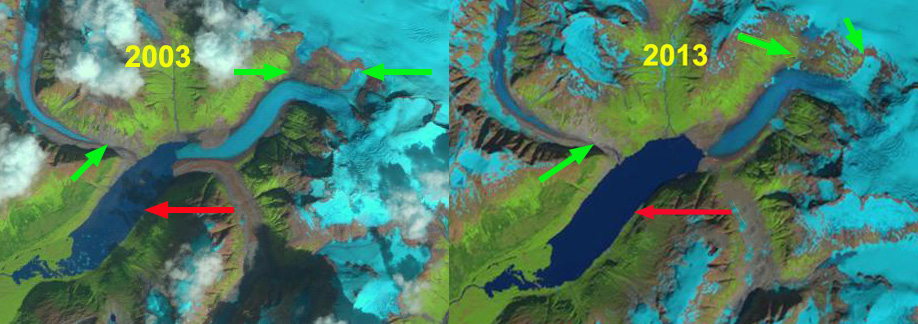
Speel Glacier in 1984 and 2022 Landsat images illustrating lake expansion and detachment of tributaries A-C. Red arrow is 1984 terminus location and yellow arrow is 2022 terminus location.

In 1984 I observed Speel Glacier while flying into Juneau, AK to work with the Juneau Icefield Research Program. Speel Glacier is south of the Taku Inlet and the Juneau Icefield draining west from a shared accumulation area with Wright Glacier. Unlike the map on my lap, there was now a big lake at the terminus of the glacier. This post examines the retreat of this glacier across the international boundary, out of Alaska, and the expansion of the unnamed lake at its terminus using Landsat images.

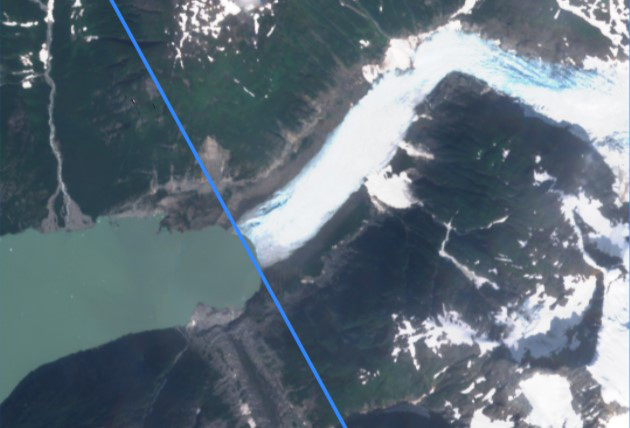
Speel Glacier terminus on 8-18-2022 with the Alaska/British Columbia boundary in blue.

In 1948 Speel Glacier ended at the head of a braided outwash plain, generated by the Speel River. Upglacier in 1948 there was a small side valley lake impounded by the glacier, Speel Lake. The lower part of the glacier was heavily debris covered and stagnant in 1948.  I  In the 1984 Landsat image the glacier had retreated 3 kilometers from the 1948 position and was fed by four separate tributaries flowing into the glacier A-D.  n 1984 the original Speel Lake had drained and a new lake had formed filling the valley that the glacier had filled in 1948. The proglacial lake was 2.2 km long. By 2003 the glacier had retreated an additional 1.8 km from 1984 to where the lake bends east, and the main tributary from the north separated from the glacier prior to 1984. By 2013 tributaries A and B had been completely separated.  In 2022 the glacier has retreated  6.35 km since 1948, 3.3 km since 1984 and the connection with the three of the four tribuaries had been lost A-C.  The tributary detachments have led to continued retreat, have reduced input to the main glacier, which by the summer of 2022 resulted in the glacier retreating across the international boundary from Alaska into British Columbia. The new lake is now over 7 km long, and should be called Speel Lake again. The retreat of this glacier fits the pattern of other glaciers in the region Field, Gilkey, and Tulsequah Glacier  (Pelto (2017). The  detachments are frequent and significanly impact ice dynamics on the Juneau Icefield (Davies et al 2022). There we found 176 such detachments/disconnections in the outlet and valley glaciers of the Juneau Icefield Davies et al (2022).

Speel Glacier in 1948 USGS map.

.

Speel Glacier in 2003 and 2013 Landsat images illustrating lake expansion and detachment of tributaries A-C. Red arrow is 1984 terminus location and green arrows are detachment of tributaries.