Alsek Glacier, Alaska Releases its own Fireworks-Iceberg Discharge July 2022

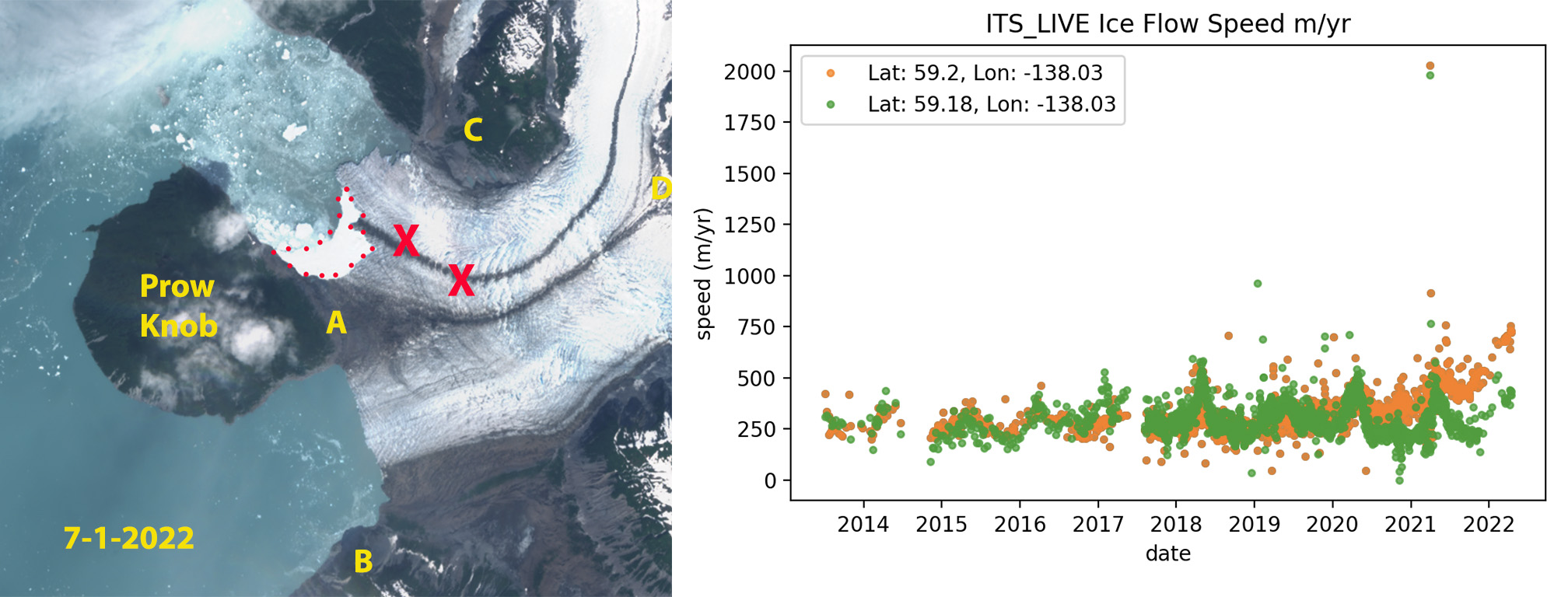
Alsek Glacier, Alaska in a Sentinel Image from July 1, 2022 indicating an area of rapid recent calving, red dots. The northern tongue has accelerated in the last six year (NASA ITS_Live).

Alsek Glacier descends from the Fairweather Range terminating in Alsek Lake on the coastal plain. The glacier terminated at Gateway Knob (G) near the outlet of Alsek River from Alsek Lake in the early part of the 20th century (Molnia, 2005). At that time it had a joint terminus with Grand Plateau Glacier. The glacier retreated 5-6 km by 1984 along the central margin from Gateway Knob. In 1960 the glacier had a single terminus joining downstream of an unnamed island in Alsek Lake, that Austin Post told me reminded him of a boats prow. This “Prow Knob” (P) much like Gateway Knob a century ago stabilizes the terminus.  Retreat from this knob will lead to an increase retreat of Alsek Glacier.  Loso et al (2021) note that retreat of Grand Plateau Glacier will change the outlet of Alsek Lake from Dry Bay to the Grand Plateau Lake. Here we examine the change from 1984-2022 with Landsat and Sentinel imagery updating Pelto (2017)
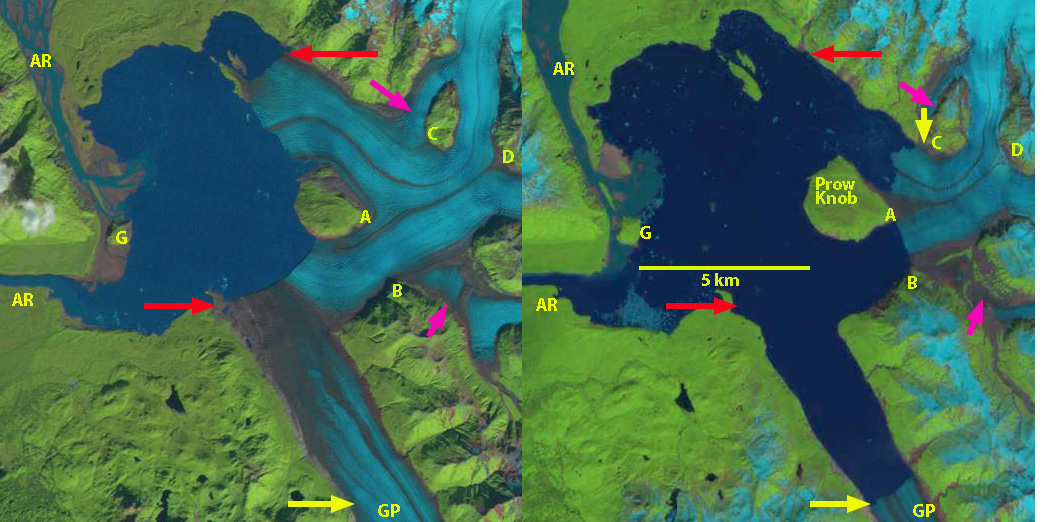
Alsek Glacier retreat from 1984-2022 in Landsat images. Red arrows mark the 1984 terminus location, yellow arrows the 2022 terminus location, pink arrows indicate tributary separation, AR=Alsek River, GP=Grand Plateau, G=Gateway Knob, A=glacier junction, B=tributary separation, C=tributary separation, D=tributary confluence.

In 1984 the terminus location is denoted with red arrows it has separated into two termini on either side of “Prow Knob”. The northern terminus tongue is located on a narrow island on the north side of Alsek Lake. The southern tongue merges with the northern arm of Grand Plateau Glacier in 1984. Two tributaries at the pink arrows merge with the main glacier. By 1999 the northern tongue has retreated from the narrow island, which exposes the terminus to enhanced calving. The southern terminus has separated from the Grand Plateau Glacier. By 2013 the northern terminus has retreated to the northern end of “Prow Knob” and the southern terminus is directly south of “Prow Knob” in a 1.8 km wide channel.  By 2018 two tributaries of Alsek Glacier are fully detached from the glacier, pink arrows. In 2018 the northern terminus tongue has retreated 3.7 km since 1984 into the 2.0 km wide channel on the northeast side of “Prow Knob”. The center of the southern terminus has retreated 2.5 km since 1984 and remains in the channel on the south side of “Prow Knob”. The length of the calving front has declined from an 8 km long calving front in 1984 to a 4 km calving front in 2018. By 2021 further retreat has led to a 2.8 km wide calving front, and a 1.6 km long contact with Prow Knob. From 1984-2022 the retreat and loss of area has been: 4.3 km and 8.6 km2 respectively for the northern terminus,  2.7 km and 5.1 km2 for the southern terminus and 7 km and 13.1 km2 for the northern arm of Grand Plateau Glacier.

In 2022 the northern terminus arm has accelerated within 1 km of the calving front, note the two red X, marking velocity locations. This has generated additional calving and rifting, that is evident in the June 28 image. The NASA ITS_LIVE velocity measurement tool uses Landsat and Sentinel images to determine velocity using feature tracking. The rifting and acceleration is producing enhanced calving and retreat. The area of enhanced calving on July 1 is 0.3 km2. The acceleration and rifting is typically an indication of a greater degree of terminus flotation that can be due to thinning and/or reduced contact with Prow Knob. This will lead to additional calving events this summer as the glacier progressively detaches from Prow Knob.
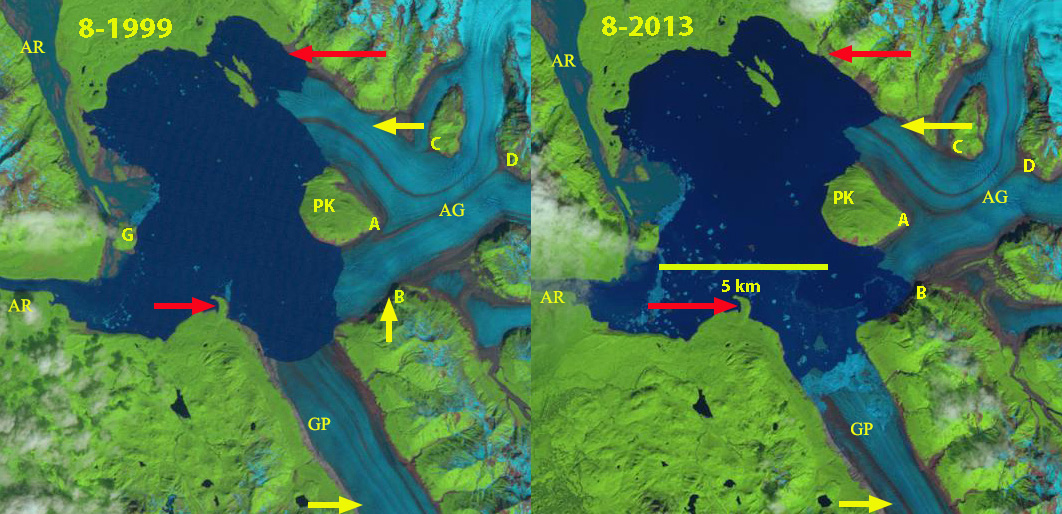
 

Alsek Glacier retreat from 1999-2013 in Landsat images. Red arrows mark the 1984 terminus location, yellow arrows the 2022 terminus location, AR=Alsek River, GP=Grand Plateau, PK=Prow Knob, G=Gateway Knob, A=glacier junction, B=tributary separation, C=tributary separation, D=tributary confluence.
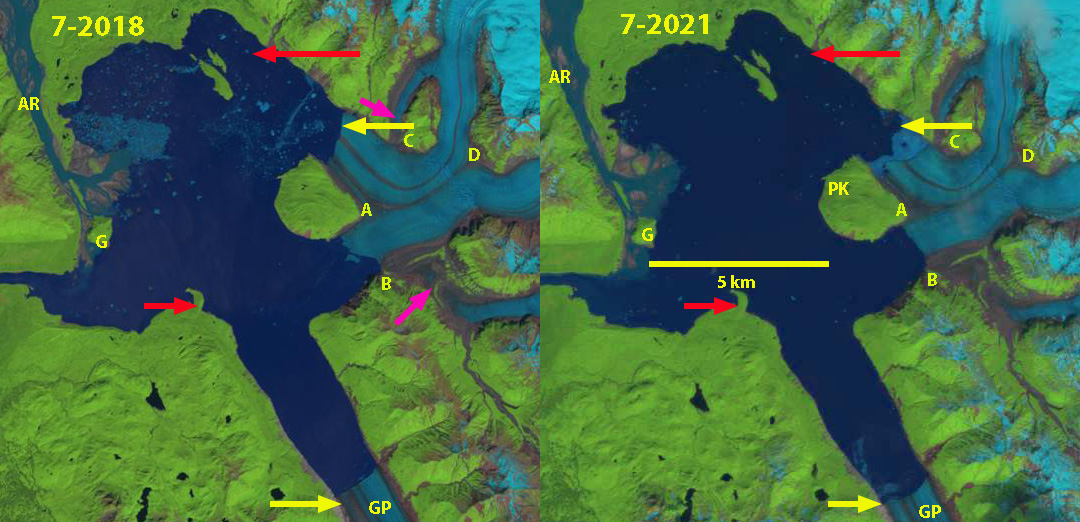
Alsek Glacier retreat from 2018-2021 in Landsat images. Red arrows mark the 1984 terminus location, yellow arrows the 2022 terminus location, pink arrows indicate tributary separation, AR=Alsek River, GP=Grand Plateau, PK=Prow Knob, G=Gateway Knob, A=glacier junction, B=tributary separation, C=tributary separation, D=tributary confluence.
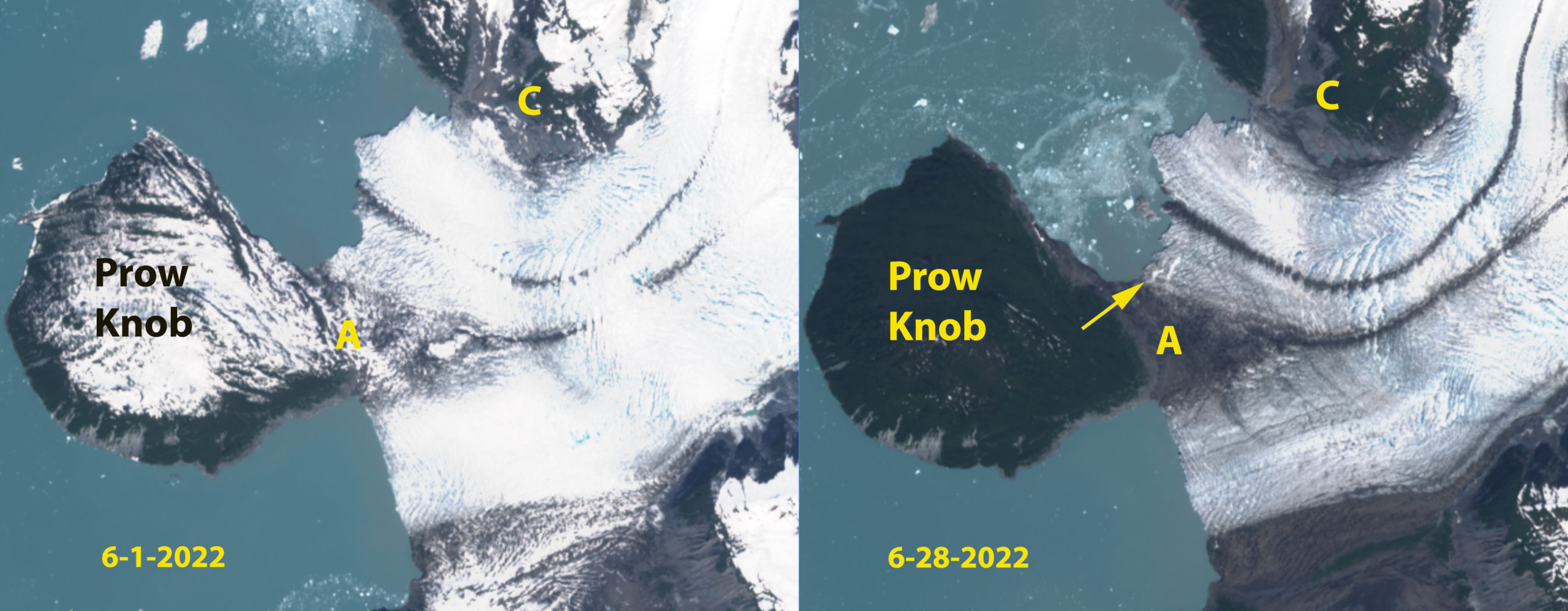
Sentinel images from June 2022 illustrating the development of rifting at yellow arrow, that leads to the July 1 calving event. A=glacier junction, B=tributary separation, C=tributary separation

 

Grand Pacific Glacier Losing its Grand and Pacific Connection

Grand Pacific Glacier in 1984 and 1999 Landsat images. Red arrow indicates the front of the clean ice flow of the Grand Pacific that also marks its lateral boundary with Ferris Glacier.  B and C indicate locations where tributary tongues have been retreating from the main glacier. M is the Margerie Glacier.

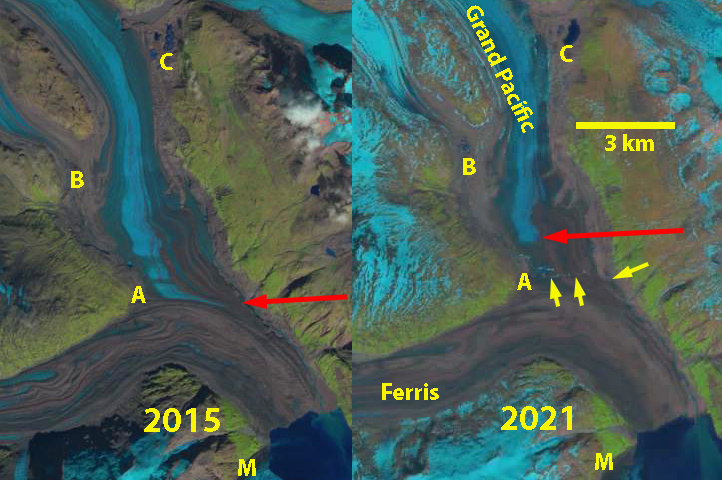
Grand Pacific Glacier in 2015 and 2021 Landsat images. Red arrow indicates the front of the clean ice flow of the Grand Pacific that also marks its lateral boundary with Ferris Glacier and the front of its active ice. Yellow arrow indicates outlet stream that is now beginning to separate the glaciers. B and C indicate locations where tributary tongues have been retreating from the main glacier. M is the Margerie Glacier.

The Grand Pacific joins with Ferris Glacier before ending at the head of Tarr Inlet in a ~1.9 km wide glacier front and 20-50 m high ice front. William Field observed the glacier advancing steadily from the 1930’s-1968 at 35 m/year , extending ~.0.5 km across the US/Canada boundary.  This advance continued behind its protective shoaling moraine/outwash plain until it was 1.5-1.6 km across the national boundary and just meeting the Margerie Glacier. A slow recession of 200 m has occurred since, with the current terminus having a width of 1.8 km, most in shallow water or terminating on a tidal flat. The Grand Pacific Glacier has been thinning for more than 50 years, which is leading to the recession, though not nearly as significant at for Melbern Glacier which it shares a divide with. Clague and Evans (1993) noted a 7 km retreat of Melbern Glacier from 1970-1987, and a 5.25 km retreat from 1986-2013 (Pelto, 2011-2017). The mass loss of the Grand Pacific Glacier system is part of the 75 Gt annual loss of Alaskan glaciers that make this region the largest alpine glacier contributor to sea level rise  from 1984-2013 (Larsen et al 2015).

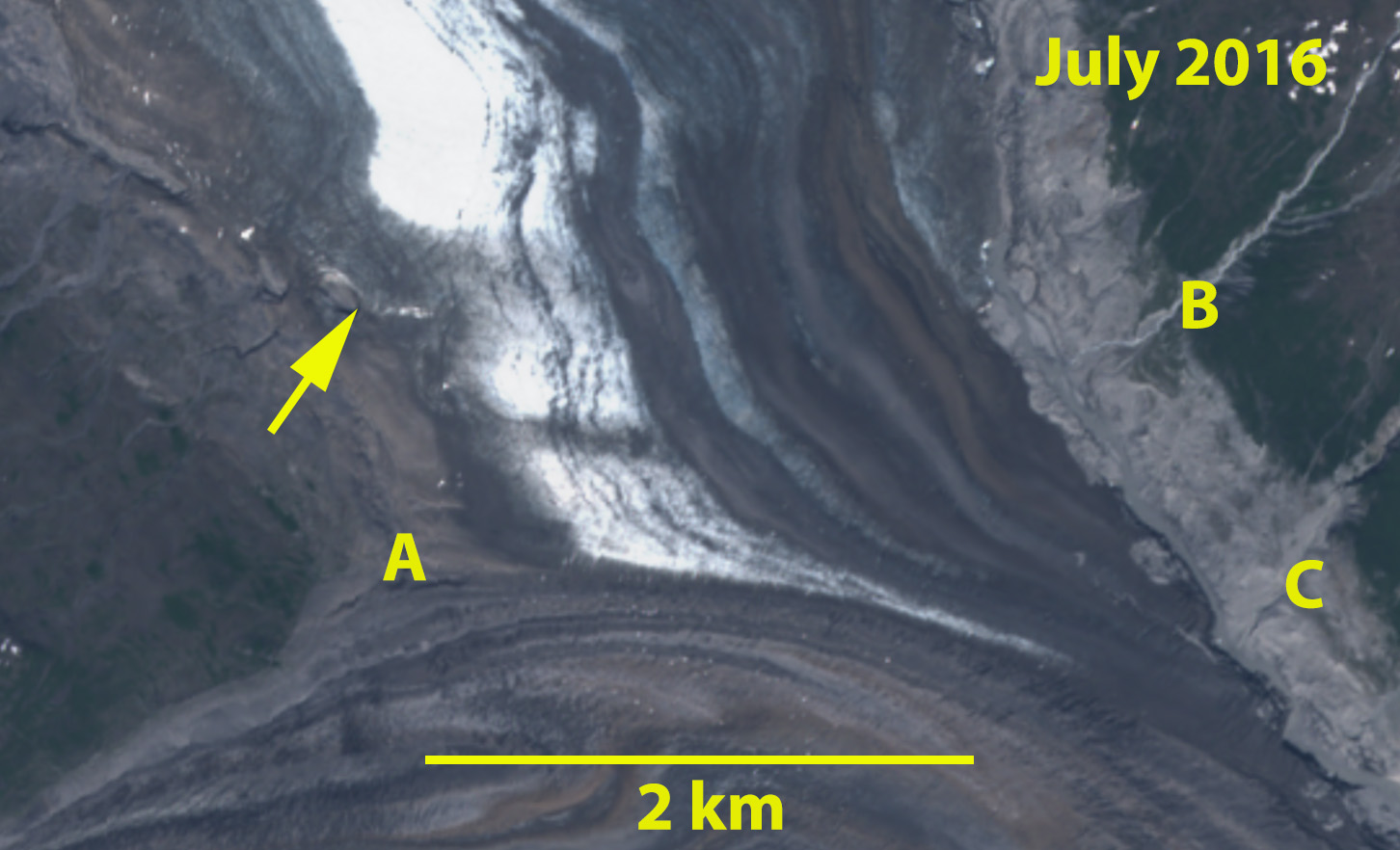
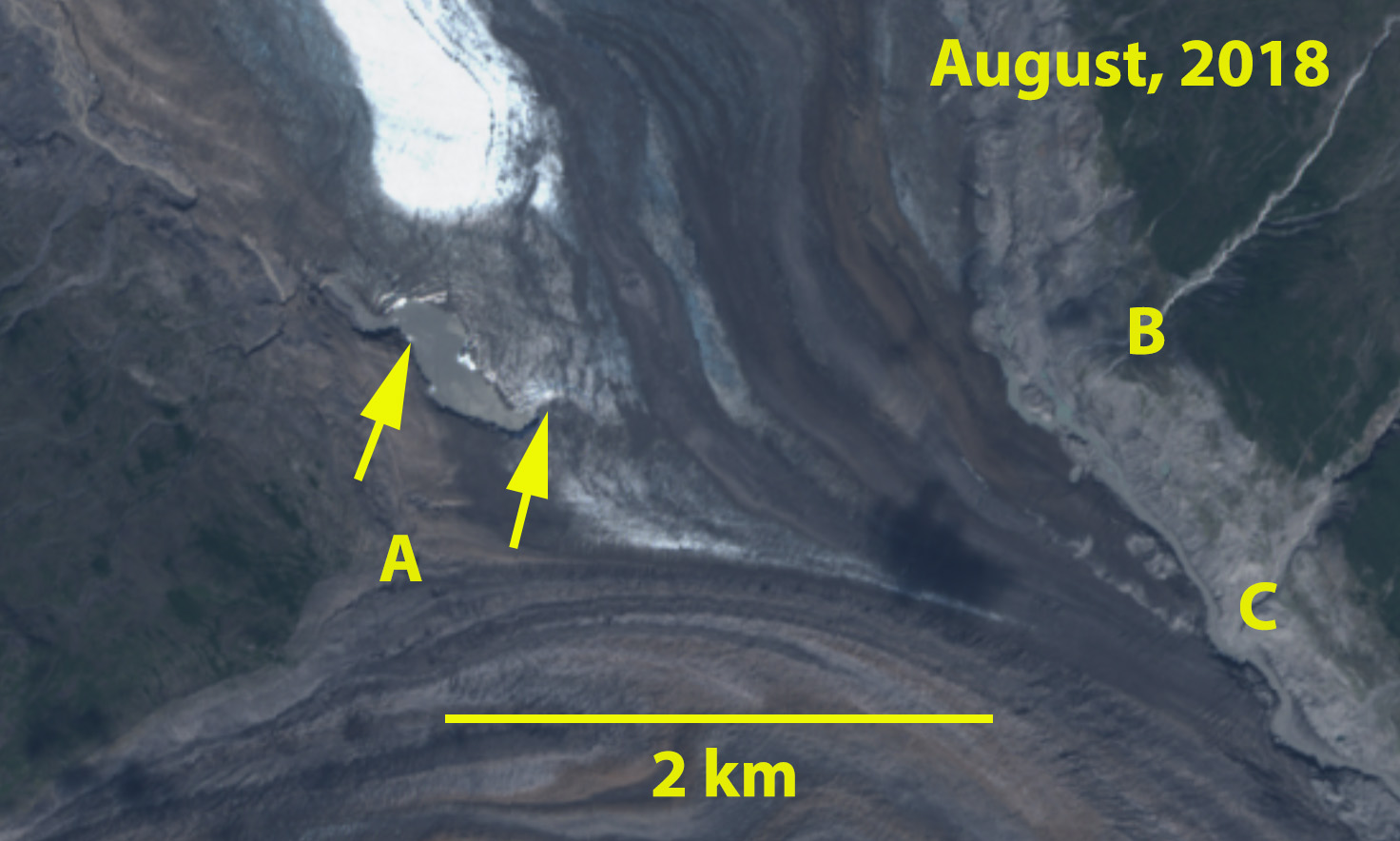
William Field reported that Grand Pacific Glacier comprised 80% of the joint glacier front with Ferris Glacier in 1941, declining to 40% in 1964.  In 1984 Landsat imagery illustrates that the Grand Pacific is still supplying ice to the glacier front but only comprises 25% of the ice front. In 1999 this has diminished to 20% of the ice front, that is now entirely on an outwash plain above the tidal level.  Tributary C has disconnected from Grand Pacific Glacier between 1984 and 1999, and tributary B has retreated substantially from the Grand Pacific. By 2015 the junction of the Ferris and Grand Pacific Glacier indicates all flow of the latter is diverted east along the Ferris margin and does not reach the ice front. There is a band of clean glacier ice that reaches the junction in 2015 and in the 2016 Sentinel image, but no longer reaches the eastern margin. In 2016 the glacier outlet stream along the west side of the Grand Pacific goes under the glacier to the east margin near the junction. By 2018 the surface exposed section of the stream extends ~700 m across the Grand Pacific Glacier before going beneath the glacier along the Ferris/Grand Pacific margin. In 2021 the glacier outlet stream cuts halfway across the glacier before going beneath and emerges prior to reaching the east margin, note yellow arrows below on the Sentinel image . The clean ice area no longer reaches the junction with the Ferris Glacier in 2021. The rapid expansion of the surficial outlet stream that is physically separating the two glacier will continue to cut across the entire width of the Grand Pacific Glacier. This glacier no longer has a connection to the Pacific Ocean, and no longer presents a grand front. The retreat is limited in distance compared to Grand Plateau or Fingers Glacier, but the separation is dramatic.

Sentinel 2 image of Grand Pacific Glacier in July 2016, yellow arrow indicates glacier outlet stream beginning to transect glacier. 

Sentinel 2 image of Grand Pacific Glacier in August 2018, yellow arrow indicates glacier outlet stream expanding across glacier. 

Sentinel 2 image of Grand Pacific Glacier in July 2016, yellow arrow indicates glacier outlet stream nearly transecting the entire width of the Grand Pacific Glacier front/margin with Ferris Glacier.


Lake Fork Knik River Headwater Glaciers, Alaska Retreat, Separation and Lake Expansion

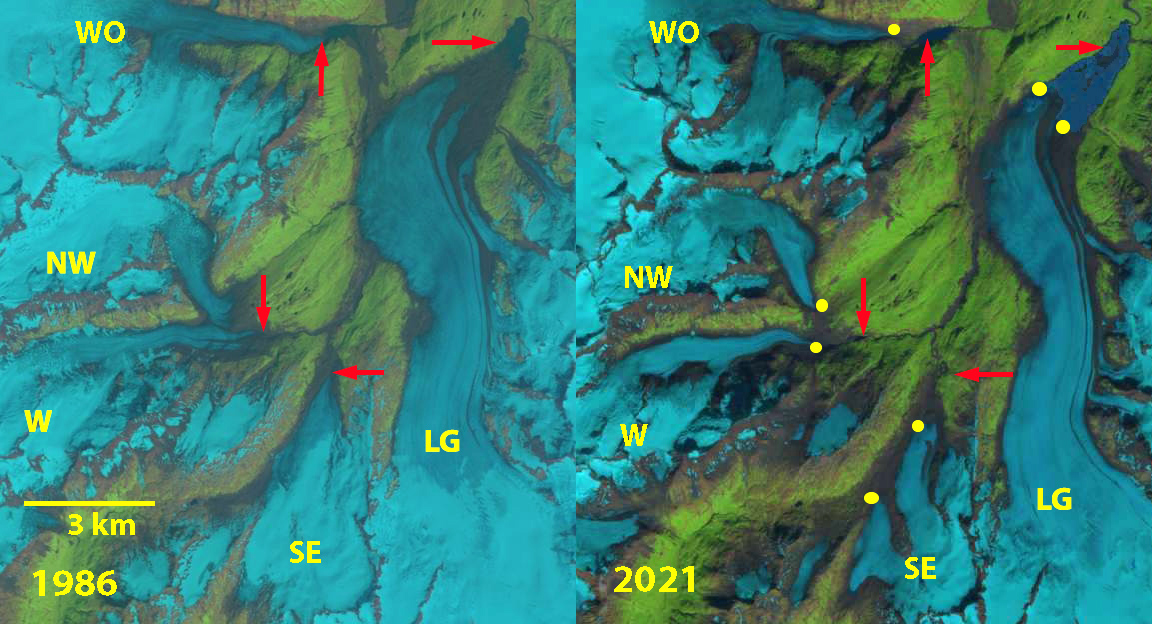
Glaciers in the Lake Fork Knik River watershed  in 1986 and 2021 Landsat images. LG=Lake George Glacier and WO=Whiteout Glacier with the remainder unnamed, labelled here as W=West, NW=Northwest and SE=Southeast. Red arrows mark 1986 terminus locations and yellow dots the 2021 terminus locations.

At the headwaters of the Lake Fork of the Knik River are a series of glaciers undergoing retreat and separation. The headwaters is dominated by the Lake George Glacier, which had terminated in the large proglacial Lake George that periodically drained past/beneath Knik Glacier (Stone, 1963), after 1966 the lake no longer filled (Post and Mayo, 1971). A new smaller proglacial lake began to form due to the retreat of Lake George Glacier by. Here we examine the changes in this headwater glacier group from 1986-2021 with Landsat imagery. The proglacial lake at the terminus of Lake George Glacier is moraine dammed and has expanded from 1986-2021, this is representative of the expansion of moraine dammed lakes in Alaska with an 87% areal increase from 1984-2019 noted by Rick et al (2022).

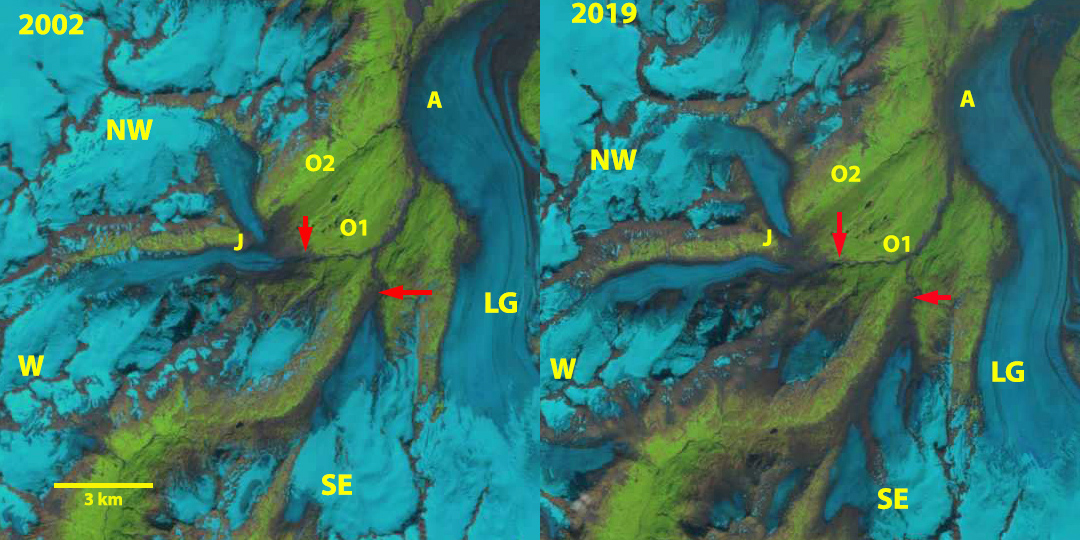
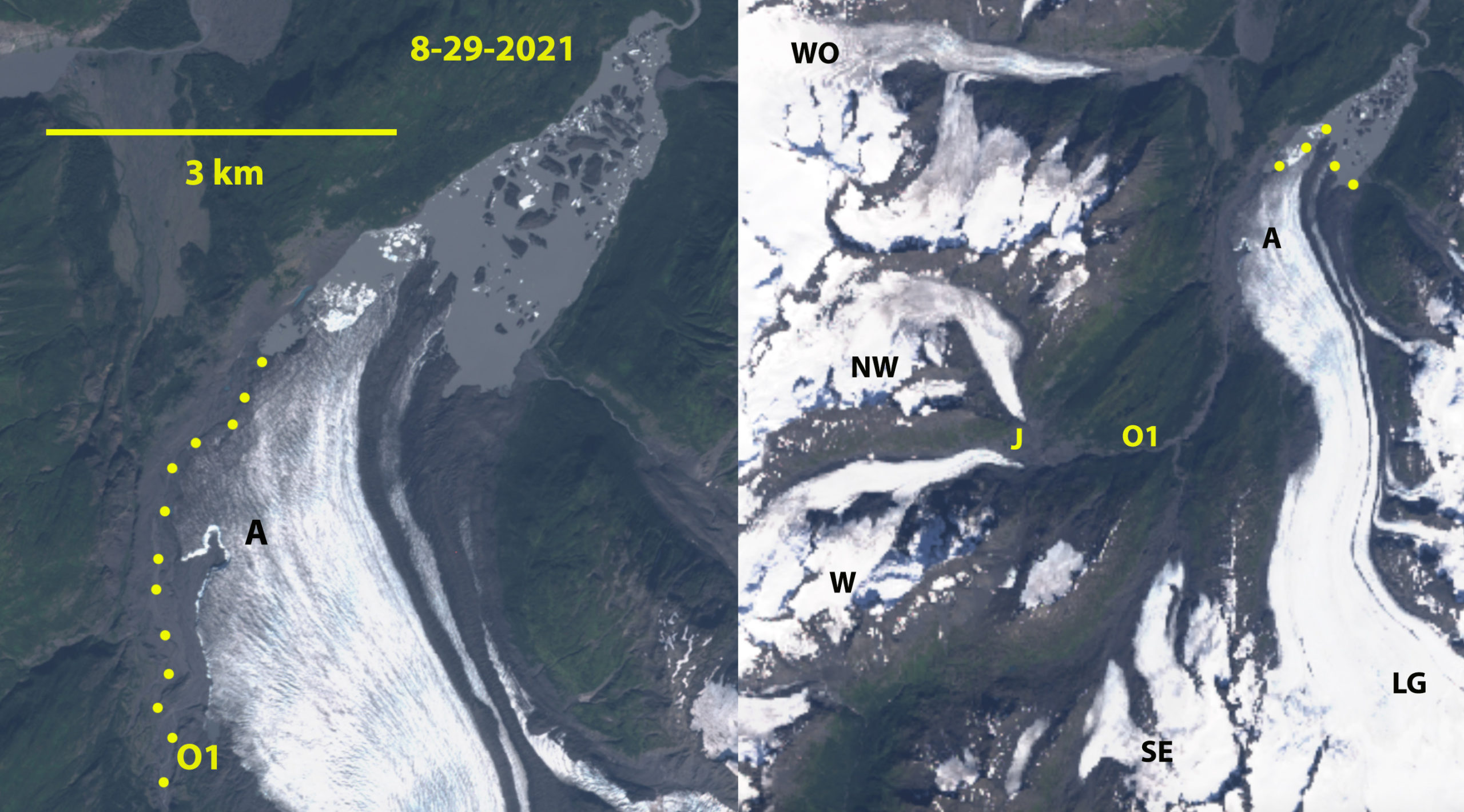
In 1986 Lake George Glacier terminated in a small proglacial lake with an area of 0.3k m2,. Whiteout Glacier terminated at 300 m, within 3 km of LG. West and Northwest Glacier had a joint terminus (Point J) at 600 m, with two outlet streams O1 and O2. Southeast Glacier had a single terminus at 500 m and had an area of 18.4 km2,.  In 2002 the main change was the separation of West and Northwest Glacier. The snowline on LG was at 900 m in August 2002. By 2019 Southeast Glacier has two separate termini, with the ridge just north of SE dividing the glacier, with the snowline at 1100 m in August. The proglacial lake at the end of Lake George had an area of 4.0 km2,. By 2021 the proglacial lake had expanded to an area of 4.3 km2,, a 4.0 km2, increase since 1986.  Terminus retreat has been  2100 m for Lake George Glacier 1100 m for Whiteout Glacier, 1250 m for West Glacier,  1000 m for Northwest Glacier and 1100 m for Southeast Glacier. Southeast Glacier now has an area of 12 km2, a 33% area loss since 1986, ~1% per year.  In 2021 the Outlet Stream from W, NW, and SE glacier parallels the margin of Lake George Glacier, but no longer goes under or is in contact.  A notch at Point A has developed, from a meltwater runoff channel. Icebergs occupy much of the lake in 2021 indicating there is still active development of the lake.  The lake development and separation of glaciers is similar to that observed at Field Glacier, Sheridan Glacier and Excelsior Glacier.
Glaciers in the Lake Fork Knik River watershed  in 2002 and 2019 Landsat images. LG=Lake George Glacier with the remainder unnamed, labelled here as W=West, NW=Northwest and SE=Southeast. O1 and O2 are the  outlet streams of the W and NW Glacier in 1986, with O2 abandoned by 2002. 

Glaciers in the Lake Fork Knik River watershed  in August 29, 2021 Landsat image. LG=Lake George Glacier  and WO=Whiteout Glacier, with the remainder unnamed, labelled here as W=West, NW=Northwest and SE=Southeast. O1 is the outlet streams of the W and NW Glacier, yellow dots at right indicate the course. Note the notch in Lake George glacier at Point A. 

East Twin Glacier Retreats from Twin Lake with Developing Icefield Disconnection

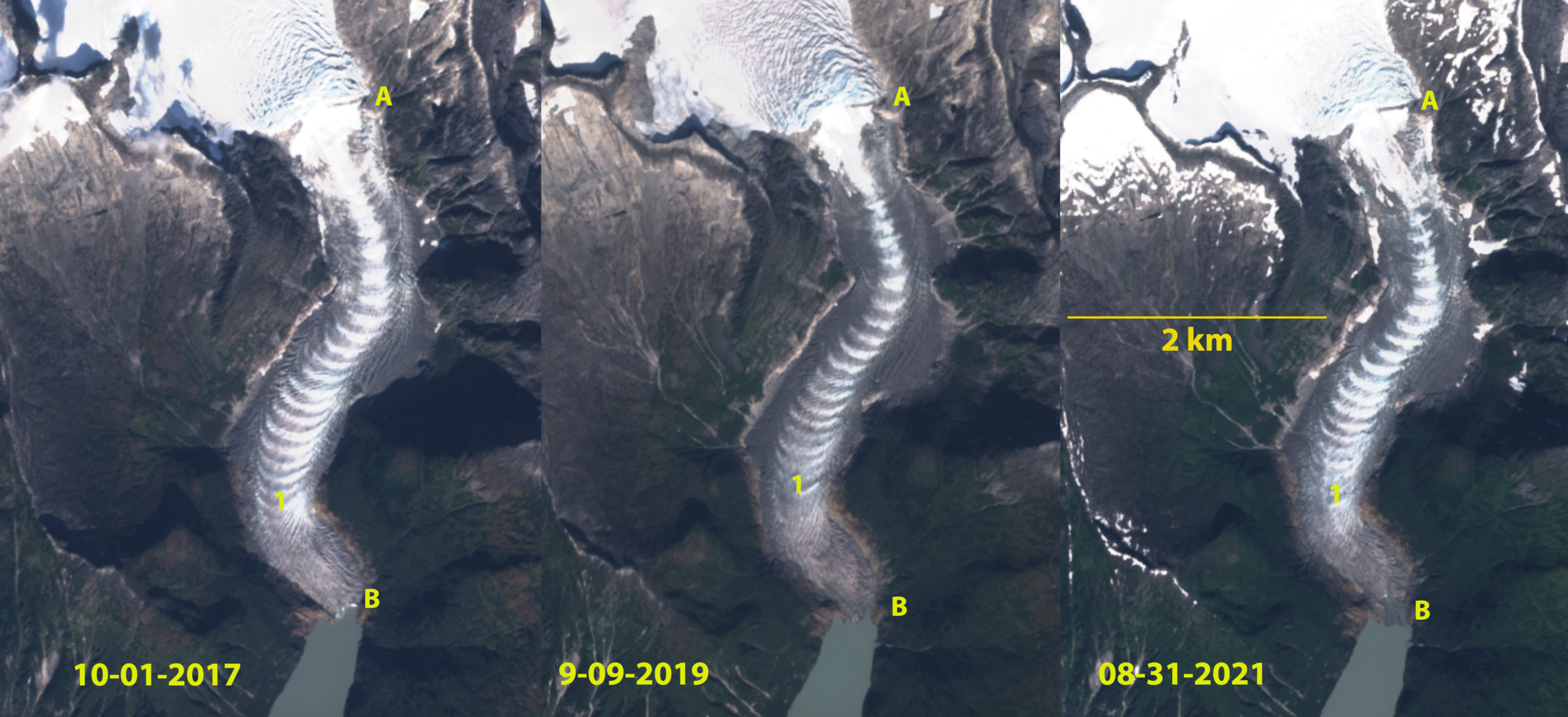
East Twin Glacier in Sentinel 2 images from 2017, 2019 and 2021. Point A marks the threshold, B the terminus contact with lake in 2017, Point 1 is the first ogive above the terminus.

East Twin Glacier is a narrow valley outlet glacier from the Juneau Icefield.  The glacier descends from the icefield through an icefall at 975 m- 600 m that generate ogives at the icefall base. The extensive crevassing begins at 975 m with a threshold at 900 m.  Davies et al (2022) examination of the Juneau Icefield found 63 glaciers had disappeared since a 2005 inventory, with a 10% reduction of glacier area. This study noted the importance of glacier disconnections occurring which separates the accumulation and ablation zones,  leading to stagnation of the glacier segment below.  We found 176 such disconnections in the outlet and valley glaciers of the Juneau Icefield Davies et al (2022). The focus of this post is on the development of a disconnection on the main stem of the East Twin Glacier.

In 1984 I had a chance to complete mass balance observations on the glacier.  The terminus in the lake was 600 m wide,  and the threshold at 900 m was also 600 m wide in 1984. The glacier retreated 900 m from 1984 to 2015 (Pelto, 2017). The terminus has calved into Twin Lake for over a century, but by 2015 the width of the terminus calving into the lake has declined by 75% since 1984, to 150 m. In 2017 there is still a very narrow steepened calving front. By 2019 the terminus no longer has a calving front, but was in contact with the lake.  By 2021 the glacier terminates 200 m from the lake on the west side and 100 m from the lake on the east side. The total retreat from 1984-2021 is 650 m.  In 2018 the snowline reached ~1250 m, 300 m higher than the long term average.  In 2019 the snowline again reached this level. The result is an accelerated reduction in accumulation flowing towards the top of the icefall, along with glacier thinning at the threshold, which enables the disconnection to rapidly develop. The high snowline elevations and exceptional melt in 2018 and 2019 helped to further narrow the glacier at the threshold to 240 m in 2021. The bedrock threshold is quickly cutting across the glacier, this is limiting flow through the icefall and may have shut off the production of new ogives.

The declining mass balance of the Juneau Icefield indicated by the high snowlines is driving thinning, disconnections and  retreat (Pelto 2019).

East Twin Glacier in 2018 and 2019 the highest snowlines since observations began on the Juneau Icefield in 2018. Snowline is the purple dots at 1250-1275 m, well above the threshold at Point A which had just below the mean 950 m snow line position from 1946-2000. 

East Twin Glacier terminus change from 1984-2021 in Landsat images. Red arrow is the 1984 terminus, yellow arrow the 2021 terminus.

Field Glacier, Alaska Retreat, Separation and Rapid Lake Development 1984-2021

Field Glacier on Aug. 31, 2021 in a Sentinel image. Note former glacier junctions A and B where the glacier has separated this century. The 7.5 km2 lake did not exist when I first visited this glacier.

The Field Glacier flows from the northwest side of the Juneau Icefield, and is named for Alaskan glaciologist and American Geographical Society leader William O. Field. Bill along with his work around Glacier Bay helped initiate the Juneau Icefield Research Program, which Maynard Miller then ably managed for more than 50 years. The JIRP program is still thriving today led by Seth Campbell. In 1981, as a part of JIRP, I had my first experience on Field Glacier completing a snowpit in its upper accumulation area. In the summer of 1983 I met with Bill to discuss where to setup a long term glacier mass balance program. I ended up selecting the North Cascade Range. In 1984 we skied back to the same snowpit site on Field Glacier, finding 3.8-4.1 m of retained snowpack in crevasses. At the end of our 11th field season in the North Cascade Range I spent a couple of nights at Austin Post’s (USGS) house and he reviewed his choice for a glacier to name after Bill, who had passed earlier that month. This was truly a remote area, which was why it had remained unnamed.

In 1984 the glacier began from the high ice region above 1800 meters, with two main branches joining at Point A and one significant tributary joining from the northern branch at Point B. There are icefalls near the snowline at 1350 meters on both the southern branch and the tributary entering at Point B. In 1984 the glacier descended the valley ending at 100 meters on the margin of an outwash plain. The meltwater feeds the Lace River which flows into Berners Bay. This post focusses on the changes from 1984-2021 using primarily Landsat imagery.

Field Glacier in Landsat images from 1984 and 2021 illustrating lake development, glacier separation at Point A and B and progressive detachment/separation at Point C,D and E. Purple dots indicate the snowline elevation at 1350-1400 m.
The USGS map from 1948 imagery and the 1984 imagery indicate little change in the terminus position. There is a narrow fringing proglacial lake along the southern edge of  the terminus in 1984 with most of the margin resting on the outwash plain. In 1997 the proglacial lake was still a narrow fringing lake, though clearly poised to expand as it extended nearly the full perimeter of the terminus. By 2006 the proglacial lake at the terminus averaged 1.6 km in length, with the east side being longer. There were several small incipient lakes forming at the margin of the glacier above the main lake. In 2009 the lake had expanded to 2.0 km long and was beginning to incorporate the incipient lake on the west side of the main glacier tongue. There was also a lake on the north side of this tributary. This lake was noted as being poised to soon fill the valley of the south tributary and fully merge with the main lake at the terminus (Pelto, 2017).   In 2013 Landsat imagery indicates the fragile nature of the terminus tongue that was about to further disintegrate, retreat from 1984-2013 was 2300 m and the lake had an area of 4.0 km2 (Pelto, 2017). This disintegration led to the separation of the two branches by 2017.
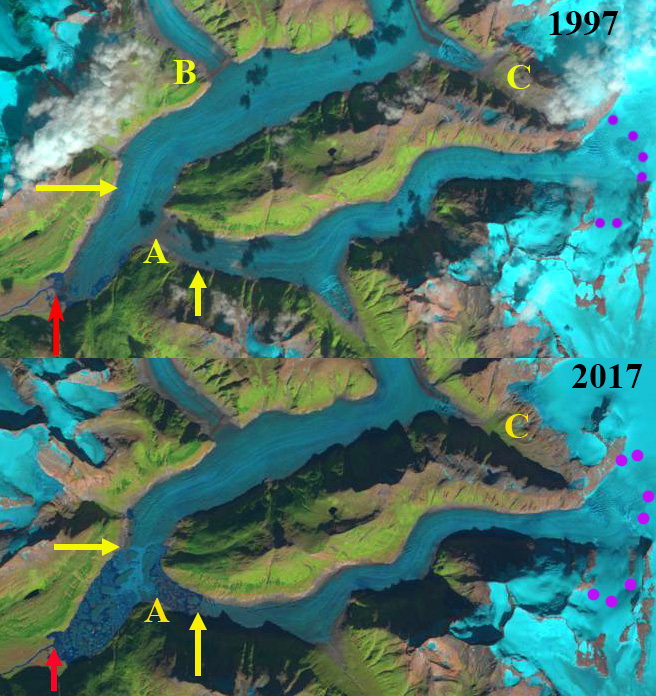
In 2021 the Field Glacier has two main branches are separated by 4 km, Point A. The tributary at Point B is also separated, no longer joining the main glacier. There is another separation imminent at the junction-Point E, 5 km of this former tributary.  At Point C and D progressive detachment of smaller tributaries are evident. From 1984 to 2021, Field Glacier has experienced a retreat of 5500 m of the southern branch and 4100 m of the northern branch. The lake has expanded to 7.5 km2.  Fringing lake on the northern branch indicates the lake will expand at least another 1 km. For the southern branch the glacier is close to what will be the lake margin. The record snowline elevation on the icefield in 2018 and 2019 (Pelto, 2019), has led to a continuation of the rapid mass balance loss, retreat, and lake development at Field Glacier. This glacier is experiencing retreat and lake expansion like several other glaciers on the Juneau Icefield, Gilkey Glacier, Llewellyn Glacier, and Tulsequah Glacier (Pelto, 2017).

Field Glacier in Landsat images from 1997 and 2017 illustrating lake development, glacier separation at Point A and B and progressive detachment/separation at Point C,D and E.


Field Glacier terminus in Landsat images from 1984 and 2013, dots indicate terminus, with pink arrows in 2013 indicating where marginal lakes have developed.

Field Glacier terminus in Landsat images from 2006 and 2009, red line is terminus with orange arrows indicating fringing lake development.

Tulsequah Glacier, BC 2021 Glacier Lake Outburst Flood


Landsat images of Tulsequah Glacier on June 22 and July 5, 2021.  Lake No Lake is between the yellow arrows with the margin of glacier extending upvally on June 22nd. By July it has receded back to main valley and lake has largely drained. The former location of Tulsequah glacier dammed lake is at red arrow.

Tulsequah Glacier, British Columbia drains east from the Juneau Icefield and is best known for its Jökulhlaups or glacier lake outburst floods (GLOF) from Tulsequah  Lake and Lake No Lake dammed by Tulsequah Glacier in northwestern British Columbia, Canada (Neal, 2007). The floods pose a hazard to the Tulsequah Chief mining further downstream. This glacier feeds the Taku River which has seen a significant decline in salmon in the last decade (Juneau Empire, 2017).The continued retreat of the main glacier at a faster rate than its subsidiary glaciers raises the potential for an additional glacier dammed lakes to form. The main terminus has disintegrated in a proglacial lake.  Pelto (2017) noted that by 2017 the terminus has retreated 2900 m since 1984, with a new 3 km long proglacial occupying the former glacier terminus. The USGS has a stream gage measuring a range of parameters including turbidity and discharge which can identify a GLOF. Neal (2007) examined the 1988-2004 period identifying 41 outburst floods from 1987-2004. Here we examine Landsat images and USGS records of Taku River to quantify the 2021 GLOF event between June 25 and July 3.

USGS records of turbidity and discharge on Taku River that indicate the onset on glacial lake drainage and of the GLOF event on July 3, note purple arrows.

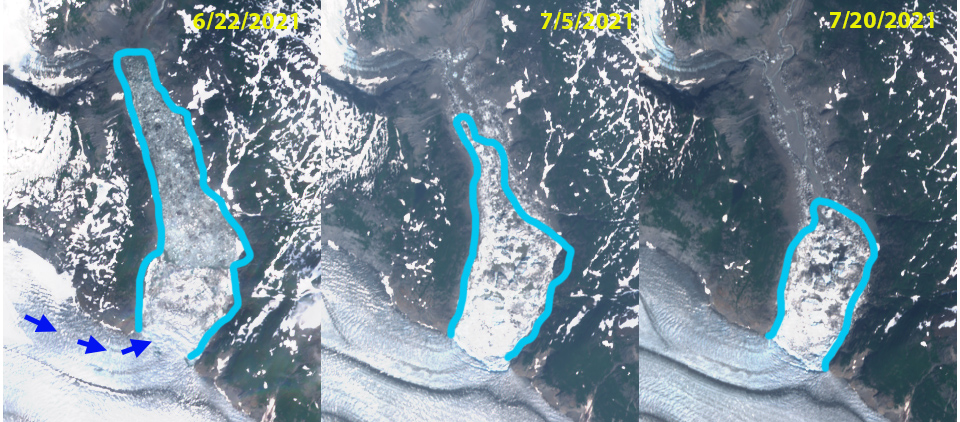
On June 22, 2021 the region between the yellow arrows is an iceberg choked lake. The red arrow indicates the location where Tulsequah Lake used to expand, it is limited. The terminus of the glacier reaching upvalley 600 m from the main glacier.  Discharge is at 60,000 cfs and the turbidity is at ~100 FNU. Starting on the June 25th through the 27th turbidity rises to 400 FNU, while discharge rises to 90,000 cfs.  This is during a protracted dry period and is the result of the beginning of increased glacier discharge from the lake. On July 27th-June 30th it is evident that the margin of the distributary glacier tongue has receded ~500 m back to the main glacier margin, representing a terminus collapse generating icebergs likely resulting from a fall in water level. There is no change in the small Tulsequah Lake at the red arrow. On July 3rd turbidity rises above 500 FNU and discharge exceeds 130,000 cfs, this is at the high end of the typical peak GLOF events from Lake No Lake as noted by Neal (2007)  from 90,000-130,000 cfs. This is the main event and was reported by the USGS. By July 5 Landsat imagery indicates the water level has dropped between the yellow arrows, resulting in more prominent icebergs. The Sentinel image illustrates the zone of iceberg stranding as well.  The icebergs continue to melt away by July 20. No change at the red arrow. If we look back to Sept. 2020 we see what Lake No Lake will appear like by the end of summer and that the distributary terminus margin does not extend upvalley at that time. The large proglacial lake that has formed after 1984 due to retreat helps spread out the discharge from ice dammed lake GLOF’s of Tulsequah Glacier.  This lake will continue to expand and the damming ability of the glacier will continue to decline, which will eventually lead to less of a GLOF threat from Lake No Lake.

Sentinel images from June 22, July 5 and July 20 of the area of the lake and then the area of stranded icebergs.  Note how almost the entire width of a the northern tributary flows into this valley.


Landsat images of Tulsequah Glacier on June 27 and June 30.  Lake No Lake is between the yellow arrows. The former location of Tulsequah glacier dammed lake is at red arrow.

Tulsequah Glacier in 1984 and 2017 Landsat images.  The 1984 terminus location is noted with red arrows for the main and northern distributary tongue, southern distributary red arrow indicates lake margin.  The yellow arrows indicate the 2017 glacier terminus locations. The retreat of 2900 m since 1984 led to a lake of the same size forming. Purple dots indicate the snowline.


Landsat images of Tulsequah Glacier on Sept. 15, 2020.  Lake No Lake now drained fills between the yellow arrows. The former location of Tulsequah glacier dammed lake is at red arrow.

Sheridan Glacier, Alaska Retreat Causes Rapid Lake Expansion

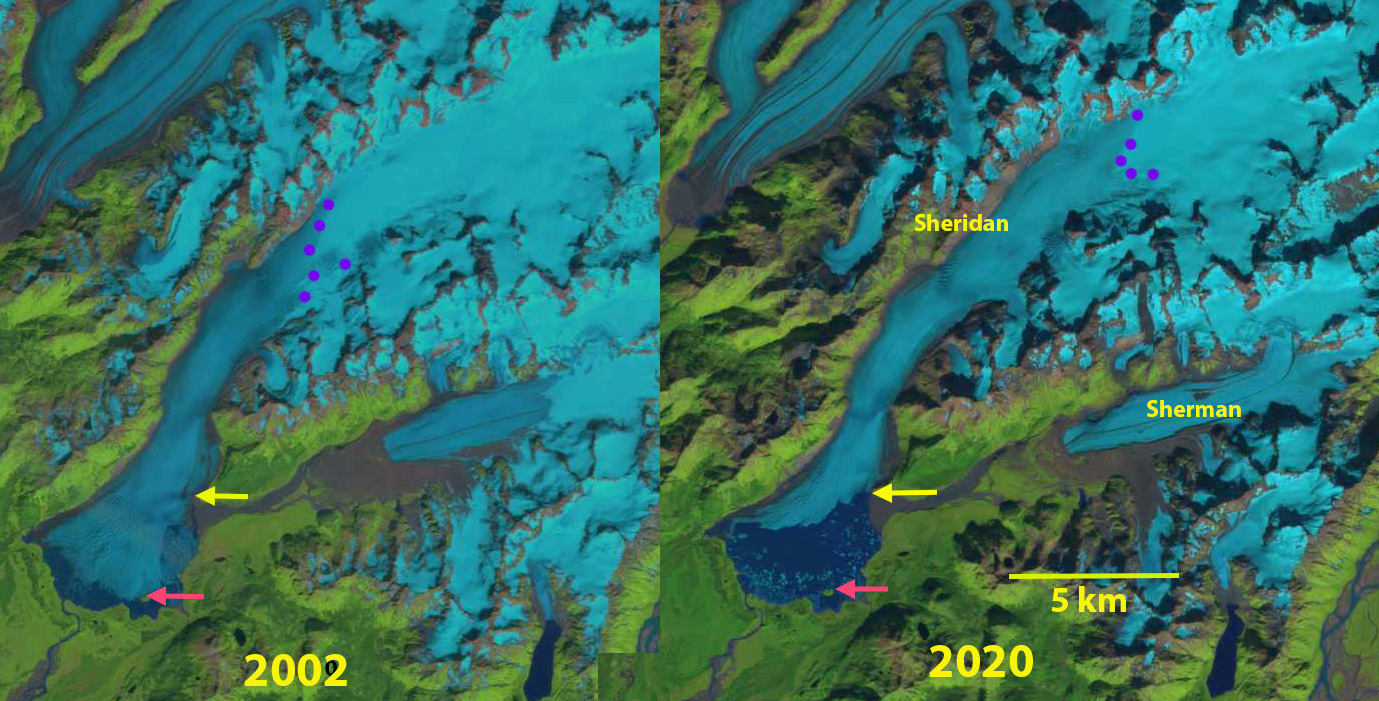
Sheridan Glacier in 2002 and 2020 Landsat images illustrating retreat of the margin and expansion of the lake. Red arrow is 2002 margin on small island, yellow arrow is 2020 terminus location just north of Sherman Glacier stream and purple dots are the snowline.

Sheridan Glacier in the Chugach Mountains of Alaska begins at 1500 m and flow southwest out of the mountains with the terminus spreading out in a  lake basin on the low slope coastal plain.  Sheridan Lake is a proglacial lake at the terminus that drains into the Sheridan River which 12 km later reaches tidewater. From 1950 to 2000 Sheridan Glacier experienced modest retreat, with the terminus, with a fringing proglacial Sheridan Lake persisting, followed by a terminus disintegration from2000-2016. (Shugar et al 2018). Here we examine Landsat imagery from 2002-2020 to identify the retreat and resultant lake expansion.

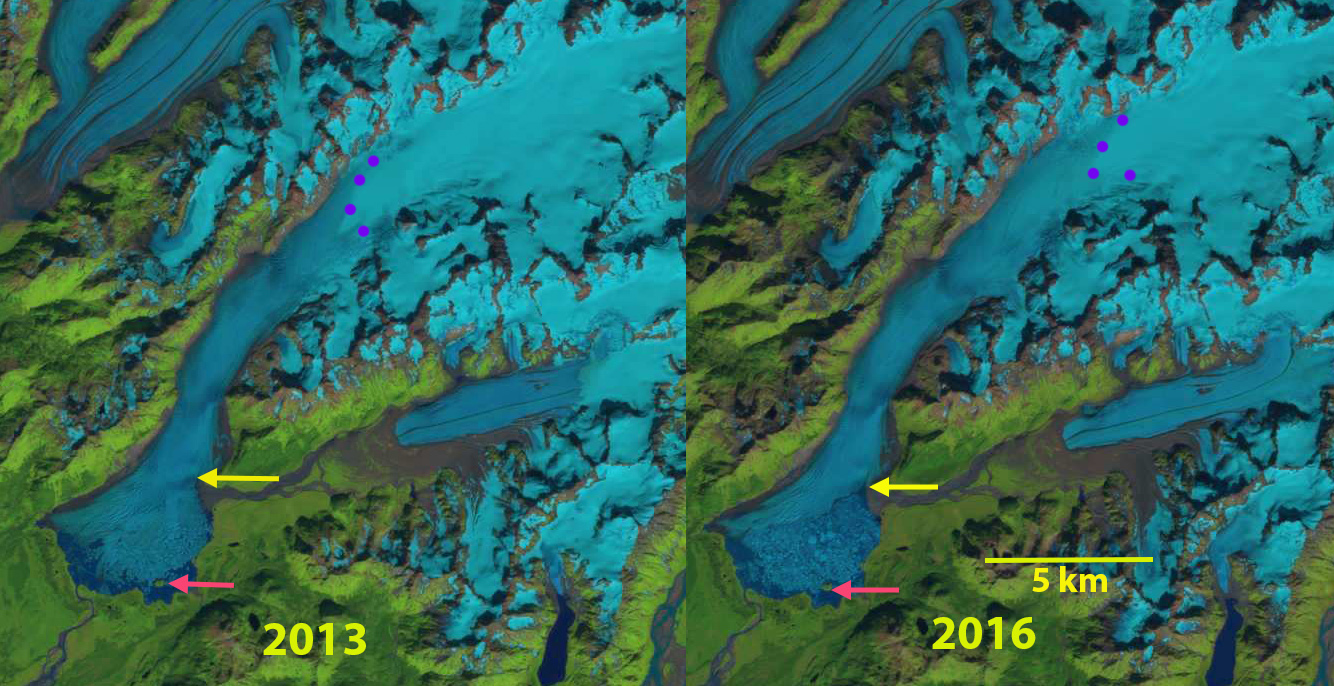
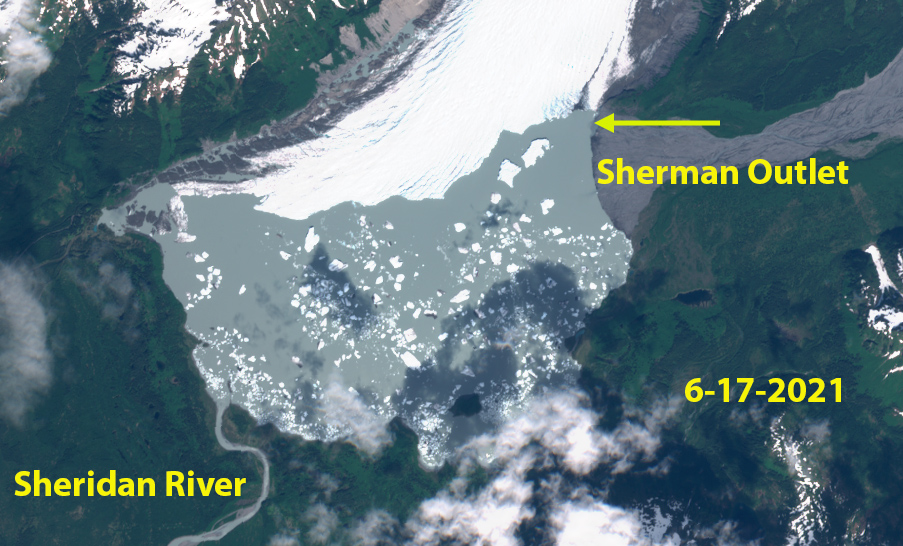
In 2002 the proglacial lake has an area of 3.8 km2, with the terminus crossing one small island in the lake.  The snowline is at 750 m. In 2013 there is a 4 km2 terminus area that has disintegrated, the terminus has retreated off of the island.  The snowline is at 850 m. By 2016 the terminus has retreated north of the glacier stream from Sherman Glacier entering from the east, though much of the lake is still filled with an iceberg melange.  The snowline is at 925 m.  In 2020 the Sheridan Lake area has expanded to 11.2 km2, representing a retreat of 7.4 km2 since 2002.  The snowline in 202o is at 970 m.  In June 2021 there are a significant number of new icebergs indicating ongoing lake expansion during 2021.  Sheridan Lake is not a large glacial lake by Alaskan standards, but is bigger than any glacial lake in most alpine regions such as the Himalaya.  The ability to be so large is in large part due to the ability to develop larger basin on low sloped terrain near the coastline.

The amount of terminus retreat here is less than that at Excelsior Glacier or Yakutat Glacier, but the lake expansion rate is comparable to Excelsior Glacier.

Sheridan Glacier in 2013 and 2016 Landsat images illustrating the breakup of a large terminus region generating a melange of icebergs. Red arrow is 2002 margin on small island, yellow arrow is 2020 terminus location just north of Sherman Glacier stream and purple dots are the snowline.

June 2021 Sentinel Image indicating considerable new iceberg activity leading to ongoing lake expansion in 2021.


Dawes Glacier, Alaska Retreat Driven Separation

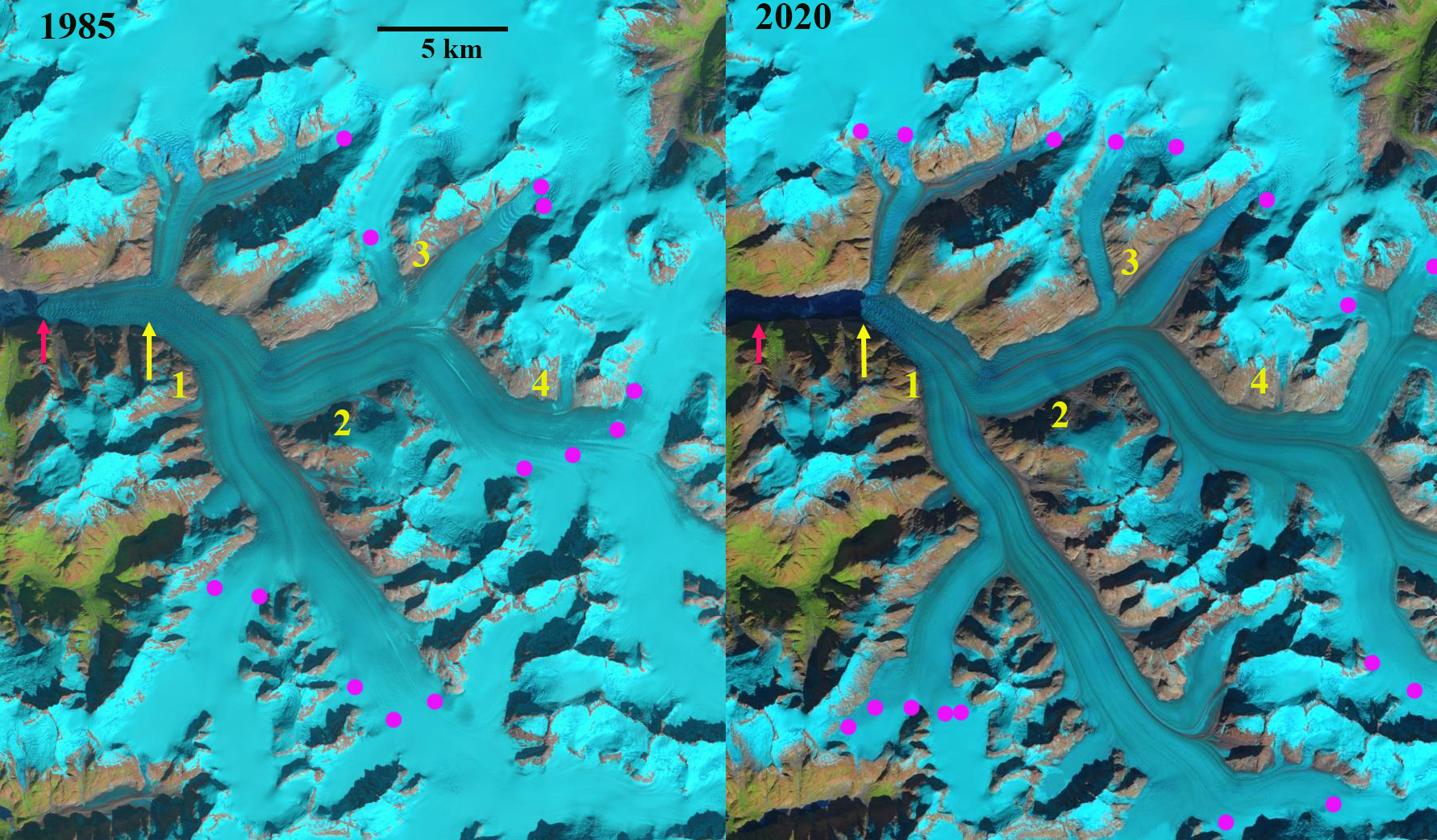
Dawes Glacier retreat in 1985 and 2020 Landsat images. Red arrow 1985 terminus, yellow arrow 2020 terminus. Point 1-3 are tributaries joining the main glacier. The glacier is about to separate into two calving termini.

Dawes Glacier terminates at the head of Endicott Arm in the Tracy Arm-Fords Terror Wilderness of southeast Alaska. Endicott Arm is a fjord that has been extending with glacier retreat, and is now  58 km long.  Dawes is a major outlet glacier of the rapidly thinning Stikine Icefield. Melkonian et al (2016) observed a rapid thinning of the Stikine Icefield of -0.57 m/year from 2000-2014.  Here we compare Landsat imagery to identify changes from 1985-2020. Endicott Arm is host to a population of harbor seals that prefer hauling out on icebergs during the day supplied by Dawes Glacier (Blundell and Pendleton, 2015)

In 1985 the glacier terminated at the red arrow in each image, the tributaries at points 1,2 and 4 connected with the main glacier. Point 3 is the junction point of two tribuataries. The northern arm is 1.3 km wide and the eastern arm is  2.5 km wide.  The snowline was at 1100 m.  In 1987 the snowline on the glacier was at 1150 m.  By 1999 the glacier had retreated 900 m since 1985 and the snowline was at  1300 m.  In 2019 the tributaries at Point 1, 2 and 4 have detached from the the main glacier. At Point 3 the northern arm has declined to 0.7 km wide and the eastern arm is  1.8 km wide.  In 2019 the snowline is at a record 1450-1500 m.This fragmentation of Dawes Glacier will continue, which leads to a reduced ice flux to the terminus reach. By 2020 Dawes Glacier has retreated 3.8 km since 1985, a rate of 105 m/year. The snowline is again exceptionally high at 1400-1450 m. Of equal importance the glacier terminus is separating into two individual calving termini, that could become fully separate this summer of 2021.

McNabb et al (2014) reported a thinning of 62 m/year from 1985-2013. The reduced inflow and up glacier thinning is ongoing and has driven the increased retreat rate despite a reduction in water depth at the cavling front. A key mechanism for retreat over the last century has been calving. The 2007 Hydrographic map of the area indicates water depth at the calving front still over 100 m, with a depth of 150 m 1 km down fjord of the terminus (see bottom image). The  depth more recently has declined to 60 m at the calving front in 2013 (Melkonian et al 2016), yet retreat has increased driven by enhanced melting. The glacier thinning is continuing, but the retreat rate will decline as the fjord head is approached.

At the glacier front the velocity was 13 m/day in 1985, increasing to 18 m/day by 1999 and declining to 5 m/day by 2014 (Melkonian et al 2016).

This reduction will reduce calving and iceberg production. As icebergs are reduced harbor seals will be disappointed as they prefer icebergs to haul out on. The Alaska Department of Fish and Game has been monitoring harbor seals in the fjord and noting that females travel to pup on the icebergs in the spring and also utilize them for mating.  ADFG attached satellite tags to harbor seals to monitor their movements beyond the breeding and puppin season finding  that that adult and sub-adult seals captured in Endicott Arm spent the late summer and fall months in Stephens Passage, Frederick Sound, and Chatham Strait. How will a reduction in icebergs affect this population overall?

The retreat leading to separation is also happening at other outlets of Stikine Icefield such as Baird Glacier and Sawyer Glacier.

Dawes Glacier retreat in 1985 and 2020 Landsat images. Red arrow 1985 terminus, yellow arrow 2020 terminus and purple dots the snowline. Point 1-4 are tributaries joining the main glacier.

Dawes Glacier retreat in 1985 and 2020 Landsat images. Red arrow 1985 terminus, yellow arrow 2020 terminus and purple dots the snowline. Point 1-4 are tributaries joining the main glacier.

Dawes Glacier in June 2021 Sentinel image. Indicating the impending separation of the terminus.

Hydrograh of Endioctt Arm from 2007.

Valdez Glacier, Alaska Significant Calving Retreat in 2020


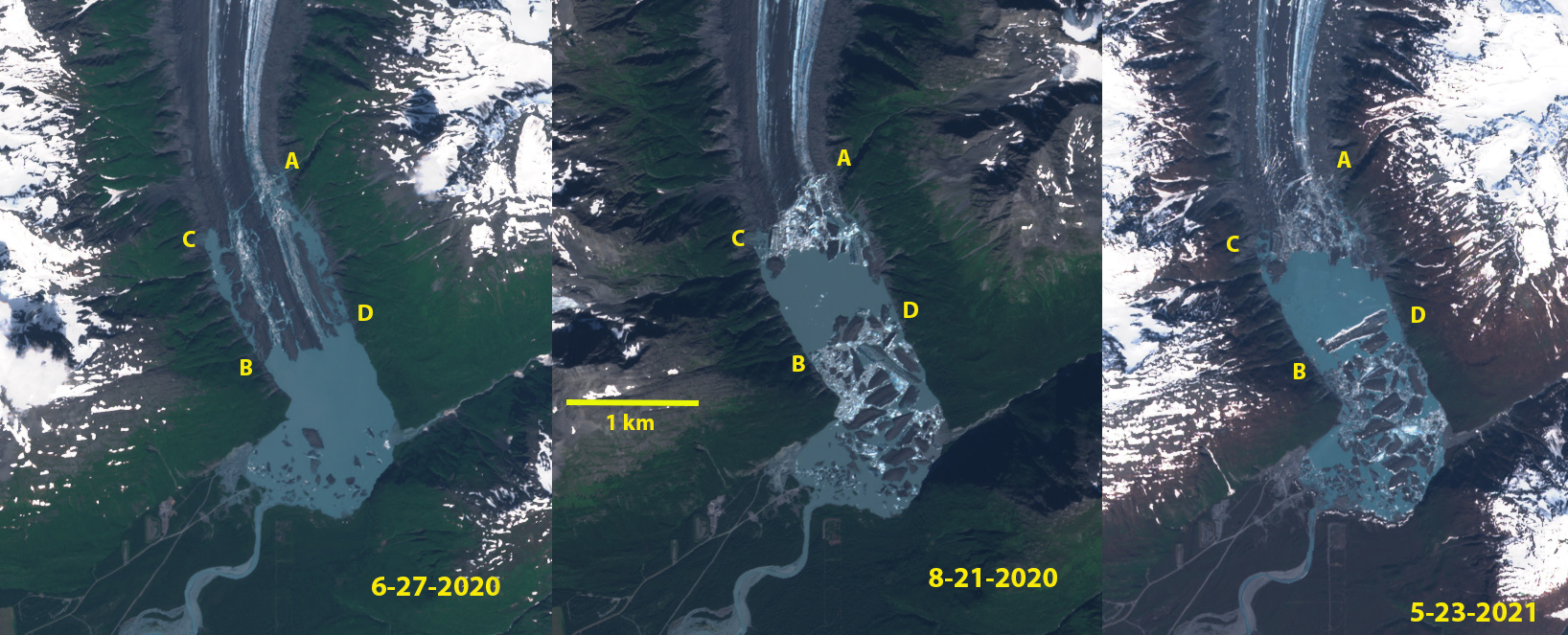
Valdez Glacier terminus in Sentinel images from 6-27-2020, 8-21-2020 and 5-23-2021. In June the glacier’s terminus area is poised to collapse with extensive rifting and marginal proglacial lakes along the east and west margins. In July the terminus breaks up and in August the lake is filled by a flotilla of icebergs.  The May image indicates the icebergs are still present.  

Valdez Glacier is an outlet glacier from the Chugach Mountains that in the early 20th century descended onto a glacial outwash plain that the city of Valdez, Alaska is built upon. Today the glacier has retreated into a mountain valley and is calving into an expanding lake. David Arnold in the Double Exposure project documenting climate change photographically has a pair of images from 1938 and 2007 of the glacier. This post examines Landsat, Sentinel and Digital Globe images from 1986-2021 to document the retreat and lake expansion.

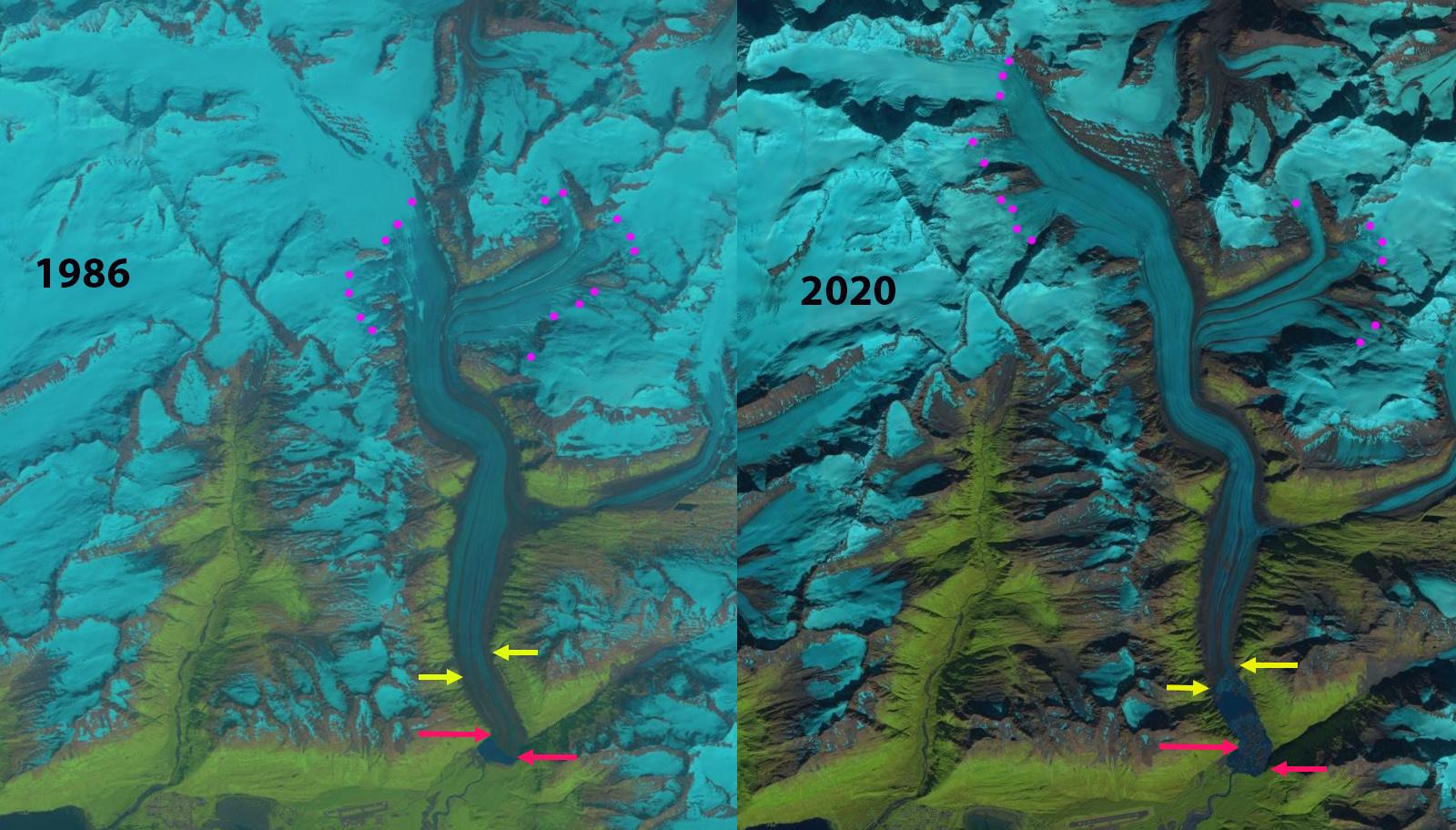
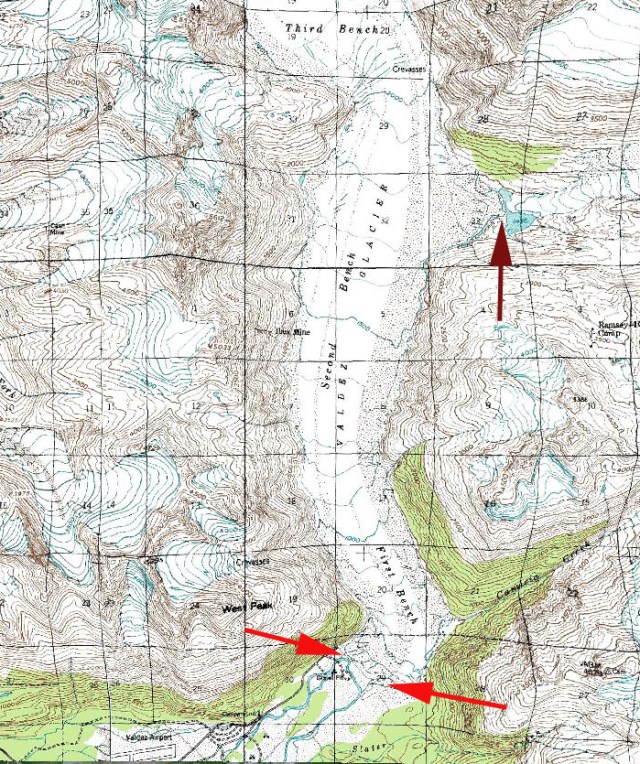
The 1948 map of the glacier indicates no lake at the terminus of the glacier, and the braided glacier emanating from the end of the glacier still building the outwash plain, note airport just southwest of terminus on plain.The terminus is marked by red arrows in map below. Seven kilometers upglacier of the terminus is a secondary terminus in a side valley. In the 1948 map, see bottom image, this glaciers is just in contact with Valdez Glacier, dark red arrow. With time both glacier termini retreat. By 1986 Landsat imagery indicates the development of a lake at the terminus and that the outwash plain is stabilizing, as indicated by complete vegetation development. The lake has an area of  1.1 km2, and it is 1 km from the southern shore of the lake to the glacier. In 1986 and the snowline on the glacier is at 1000 m. By 2002 the west side of the lake is 1.5 from north to south and has an area of  1.8 km2, the east side still extends to the southern shore of the lake. The snowline in 2002 is at 1300 m.

In 2011 the lake is 2 km from north to south.  The snowline in 2011 is at 1300 m.  In 2019 the lake is  2.3 km from north to south. Indicating a slow expansion continuing from 2011-2019. The snowline is at 1300 m in 2019. In June of 2020 the terminus is still in the same location though rifting and expansion of marginal open water indicates the terminus is poised to collapse.  It does collapse in July and by August the significant calving event that occurred has generated numerous icebergs. The lake is now 4.4 km2 and 3.4 km from the southern shore. The main terminus has retreated 2.8 km since 1986 and the tributary that was just separating in 1948 from the east has retreated 3 km from Valdez Glacier. The lake has increased 300% in area with, 30-40% of this change occurring in 2020. The snowline in 2020 was again at ~1300 m.

In the May 23 Sentinel image the icebergs are still filling a good portion of the lake. As summer 2021 commences anticipate more calving retreat as several significant rifts exist within 0.5 km of the calving front.  The snowline elevation at 1300 m in late summer has been a common feature, which leaves 70% of the glacier in the ablation zone. Wouters et al (2019) report that Alaskan mountain glaciers have contributed more to sea level rise than any other region. The retreat at Valdez Glacier is not as large as that at Ellsworth Glacier that also had a significant calving in 2020.  The retreat is much less than at Excelsior Glacier or Yakutat Glacier.

Valdez Glacier terminus in 1986, 2002, 2011 and 2020 Landsat images. Red arrow indicates 1986 terminus location and yellow arrows the 2020 terminus locations.  Slow lake expansion from 1986-2019. The iceberg flotilla is evident in the middle of the lake in 2020.

Valdez Glacier in 1986 and 2020 Landsat images. Red arrow is the 1986 terminus, yellow arrow the 2020 terminus and purple dots the snowline.

Valdez Glacier in 2002 and 2019 Landsat images. Red arrow is the 1986 terminus, yellow arrow the 2020 terminus and purple dots the snowline.


1948 USGS Topographic map before a lake had formed. Red arrows indicate the terminus.

Geikie Glacier, Alaska Lofty No More


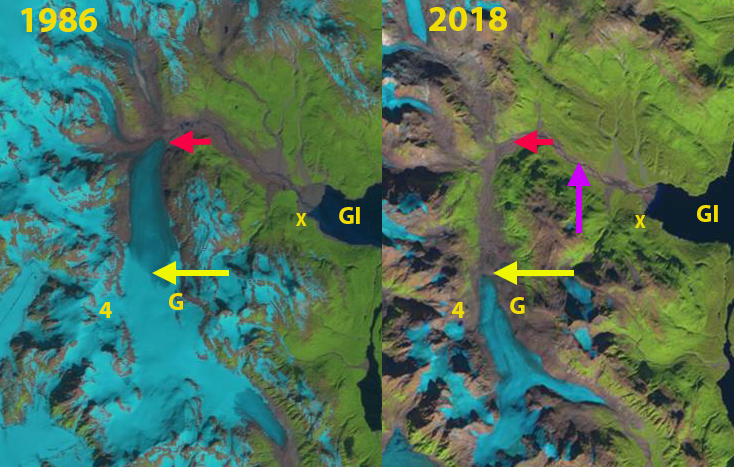
Geikie Glacier (G) in 1986 and 2018 Landsat images. Pink arrow is the 1954 terminus, red arrow the 1986 terminus and yellow arrow the 2018 terminus location. GI is Geikie Inlet which the glacier withdrew from 110 years ago.

Geikie Glacier is on the west side of Glacier Bay, Alaska. John Muir in October 1879 observed Geikie Glacier in Geikie Inlet, which had separated from Muir Glacier within the last 20 years.  He wrote in John Muir Travels in Alaska, “Its lofty blue cliffs, looming through the dragged skirts of the clouds, gave a tremendous impression of savage power, while the roar of the newborn icebergs thickened and emphasized the general roar of the storm.” By 1892 when surveyed by  H.F. Reid it had retreated to within several kilometers of the head of the inlet.  It retreated from tidewater in ~1910 (Field, 1966), with the full inlet being 15 km in length. I had the opportunity to visit the glacier in 1982 arriving by float pane at the X at the head of the inlet. There was no glacier even in sight, where a century before was buried beneath thick glacier ice.  It took us four hours to reach the terminus through what was a mixed outwash plain with developing shrubs. Today that same journey would be much more difficult as the shrubs, trees and undergrowth have thickened. William O. Field with the American Geographical Society visited Geikie Glacier in 1935, 1941, 1950 and 1958, noting limited retreat from tidewater up to 1935. though considerable frontal thinning was evident. Here we examine the changes using Landsat images from 1986, 2018 and 2019 combined with the 1961 USGS Mount Fairweather C-2 topographic map based on 1948 and 1955 photographs.

By ~1950 the glacier had retreated 2.1 km from tidewater, a rate of 50 m/year. The retreat had been interrupted by a small advance around 1920 (Field, 1966). In 1950 the glacier is fed by four tributary glaciers, with three feeding in, as the glacier makes an eastward turn. By 1986 the terminus had retreated 4.3 km from tidewater, no longer rounding the eastward bend, the retreat rate since ~1950 had been ~60 m/year.  Tributaries 1-3 had separated from the glacier.

In 2014 and 2015 the glacier lost all of its snowcover (see below). In 2018 the glacier had retreated 4.1 km since 1986 and 8.3 km from the inlet.  The rate had increased to ~125 m/year. Tributary 4 had separated from the glacier. The glacier shares a divide at ~600 m with a south flowing glacier and the head of the glacier is at ~1000 m.  In 2014, 2015, 2018 and 2019 the entire glacier lost all of its snowcover, indicating a glacier that cannot survive, as a consistent accumulation zone is essential (Pelto, 2010). The demise of Geikie Glacier is less complete than that of nearby Burroughs Glacier, but with current climate no less certain.  The glacier was ~14.5 km long when I journeyed there in 1982 and in 2018/19 is just 6.1 km long, a loss of 58% of its length in 36 years.

In 2018 and 2019 the snowlines were the highest of any year since at least 1946 on nearby Taku Glacier (Pelto, 2019) and on Brady Glacier. The rising snow lines on Brady Glacier had been observed in recent years by Pelto et al (2013). which has led to the start of a retreat.  The lack of retained accumulation has also been noted at Lemon Creek Glacier and similar to Brady Glacier, Taku Glacier has now began a retreat ( McNeil et al, 2020).

Geikie Glacier (G) in 1961 USGS map and 2019 Landsat image. Red arrow the 1986 terminus and yellow arrow the 2018 terminus location. GI is Geikie Inlet which the glacier withdrew from 110 years ago.


US Navy aerial photograph of Geikie Glacier terminus in 1948, tributaries 1-3 labeled. Digital Globe Image of the glacier in 2014, Point A in both is head of eastward turn. 


Nellie Juan Glacier Loses Contact with Contact Glacier, Alaska

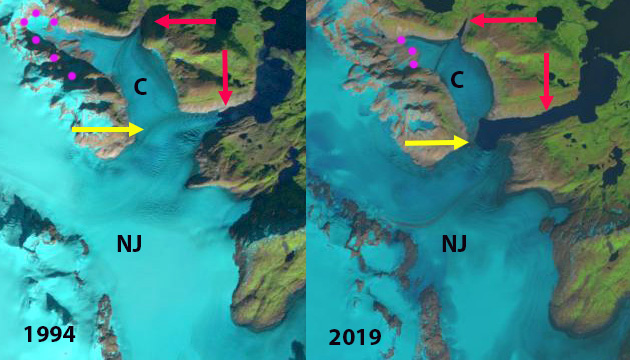
Nellie Juan Glacier (NJ) and Contact Glacier (C) in 1986 and 2020 Landsat images. Red arrow is the 1986 terminus location of both glaciers. Yellow arrow marks the terminus location in 2020 after glacier separation and purple dots mark the upper limit of Contact glacier at that time.

Nellie Juan Glacier is a tidewater outlet glacier of the Sargent Icefield, Alaska. Just after 1935 the glacier retreated from moraine shoal into deeper water of the fjord leading to a rapid calving retreat of 2250 m from 1950-2000, a rate of ~45 m/year (Barclay et al 2003).  The rate of retreat increased to ~124 m/year from 2006-2018 (Maraldo, 2020).  Harbor seals enjoy Port Nellie Juan and the icebergs from the glacier, with a population of ~44,000 identified in 2019 for the greater Prince William Sound region. From 1950-2018 Port Nellie Juan was fed in part by the Contact Glacier, a tributary that also had a separate terminus.  Here we examine the changes of Nellie Juan and Contact Glacier using Landsat imagery from 1986-2020.

In 1986 the glacier terminated in a 0.5-km-wide calving front 1 km down fjord from the junction with Contact Glacier, which was 2 km wide. The snowline is at 500 m, the upper margin of Contact Glacier is indicated by purple dots and ranges from 400-500 m.  The retreat by 1994 is ~300 m, the snowline is at 500 m and Contact Glacier has almost no snowcover. In 2000 the connection with Contact Glacier is 1.9 km wide. By 2018 terminus retreat in the center of Nellie Juan Glacier since 1986 is 2500 m.  There is fringing connection of ice 300 m wide with Contact Glacier. Contact Glacier upper margin is now at 250 m, resulting in a more rapid retreat of the head of the glacier on the northern arm 1800 m since 1986, than that of the main terminus of Contact Glacier of 500 m. The snowline in 2018 is at 900 m, leaving the primary accumulation zone of Nellie Juan Glacier without snowcover.  In 2019 there is still a narrow connection between Nellie Juan and Contact Glacier. In 2020 the two glaciers have separated.  Contact Glacier, which had an area of 6.5 km2 in 1986, in 2020 has an area of 3.5 km2.  Contact Glacier has lacked an accumulation zone during most years in this period and cannot be sustained. Nellie Juan Glacier has retreated 2800 m along the former centerline and what is now its northern margin since 1986.  In 2020 the main accumulation area of Nellie Juan Glacier is again without snowcover, with a snowline above 900 m.

The glacier is terminating near a region of prominent crevassing indicating a bedrock step that may mark the head of the fjord. This will lead to an end to calving retreat and iceberg production, which will impact harbor seal haul out in the fjord (Jansen et al 2015). The retreat of Nellie Juan is less extensive than at Excelsior Glacier or Ellsworth Glacier draining the south side of the icefield. The percent loss in area of Contact Glacier is greater than other regional examples.

Nellie Juan Glacier (NJ) and Contact Glacier (C) in 1994 and 2019 Landsat images. Red arrow is the 1986 terminus location of both glaciers. Yellow arrow marks the terminus location in 2020 after glacier separation and purple dots mark the upper limit of Contact glacier at that time. In 2019 the glaciers are still connected.

Nellie Juan Glacier (NJ) and Contact Glacier (C) in 2000 and 2018 Landsat images. Red arrow is the 1986 terminus location of both glaciers. Yellow arrow marks the terminus location in 2020 after glacier separation and purple dots mark the upper limit of Contact glacier at that time. In 2018 the glaciers are still connected

Is Harlequin Lake, Alaska the fastest Growing Glacier Lake in North America this Century?

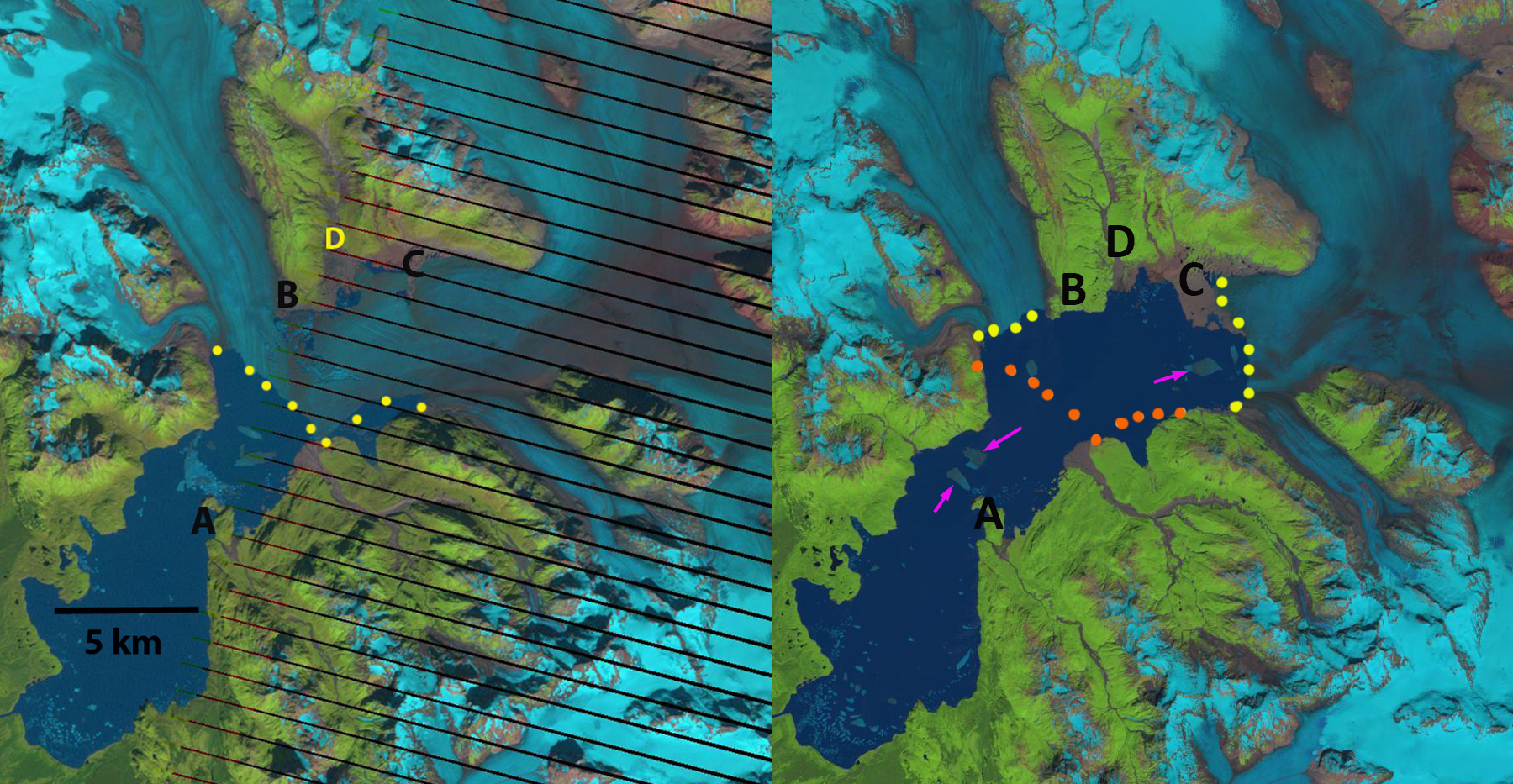
Yakutat Glacier, Alaska in 1999 and 2020 Landsat image illustrating expansion of Harlequin Lake by 40.5 km². Yellow line is the 1999 margin, orange line is the 2020 margin, and yellow dots indicate the margin of the lake shoreline. Point A indicates the 1987 terminus location, Point X and Y the 1999 terminus location. Main terminus now extends south near Point C. Northern terminus extends west from Point B.

Yakutat Glacier, Alaska has experienced a spectacular retreat in the last decade losing 45 km² from 2010-2018 (Pelto, 2018).  During the  1894-1895 Alaskan Boundary Survey Yakutat Glacier ended on a flat coastal outwash plain. A decade later the glacier had retreated from the plain and a new lake was forming, Harlequin Lake.  From 1906-1987 the glacier retreated  ~10.5  km. From 2000-2010 the terminus area thinned ~10 m/year, the glacier retreated ~1200 m losing 5.8 km² of area (Trussel et al 2013).  Here we examine Landsat imagery to quantify the retreat from 1999-2020 to identify Harlequin Lake expansion during this century.

In 1999 the glacier has a single terminus extending 4.1 km across the lake from Point Y to Point X.  Point B is under the glacier near the junction of the tributaries, while Point C is in the midst of the glacier.  A ~1.4 km retreat up to 2010 with faster retreat on the north side and an expansion of the lake along the southern margin led to a 5.7 km long main calving front, and a 4 km long southern margin. An aerial image of the glacier in 2010 indicates significant rifting, blue arrows,  that pre-conditioned the glacier for a substantial 2013 breakup.  The rifts extend through the width of the glacier and typically form when thinning has led to a glacier region reaching approximate flotation (Benn, Warren and Mottram, 2007). In 2013 the glacier has separated into two separate calving fronts. The calving front extending west from Point B is  3 km wide, and the calving front extending south from Point B is  6.5 km long. There is a large area of icebergs and ice melange in front of the terminus, yellow dots in image below, resulting from the collapse.  In 2015 the snowline is quite high at 2200 m, leaving very little of the glacier in the accumulation zone. In 2015 a large iceberg detached pink arrow, that is  ~3.7 km², indicating continued rapid calving retreat. From 2013 to 2018 the glacier retreated from Point B to Point C on the northern side  a distance of 4.6 km in five years 920 m/year. By 2018 the Peninsula extending across the lake from Point C is 2.5 km long. The terminus is resting on this and adjacent shoals across 50% of its width.   The northern terminus extending west from Point B has changed little from 2013-2018. The 2018 image compares the 2010 position (yellow dots) with 2018 (orange dots)  indicating an area of 45 km² lost in eight years, though not all of it is lake (Pelto, 2018; NASA 2018).  The comparison of 1999 to 2020 illustrates the area of lake expansion between the 1999 (yellow) terminus position, 2020 terminus position (orange) and yellow dots along the lake shoreline.  The lake area growth is 40.5 km² since 1999 with an overall area loss of ~56 km².

Landsat images from 2010 and 2018 with terminus indicated by yellow dots in both, the orange dots indicate 2010 margin on 2018 image, and pink arrows indicate icebergs. 

The ability to produce icebergs as large as in 2015 has been lost as the calving front has been restricted by the Peninsula which is now 3 km long, leaving less than a 3 km wide calving front.   The narrower calving front and reduced water depth should in the short term reduce retreat of the main terminus.  The northern terminus is at a narrow point, as it recedes further the embayment widens and the retreat should increase.

The glacier thinned at a rate of ~4 m/year from 2000-2010 indicating how far out of equilibrium the glacier has been (Trussel et al 2013). The Yakutat Glacier does not have a high accumulation zone and the recent increase in the snowline elevation and thinning of the glacier have led to a substantial shrinking of the accumulation zone and thinning of the glacier in the accumulation (Truessel et al 2013). This glacier does not have a persistent significant accumulation zone in 2015, 2016 and 2018 and 2019 cannot survive (Pelto, 2010; NASA 2018).

2010 image of the Yakutat Glacier terminus reach with blue arrows indicating rifts.

Yakutat Glacier in 2013 Landsat image.

Yakutat Glacier in 2015 Landsat image.