Field Glacier, Alaska Retreat, Leads to Glacier Separation

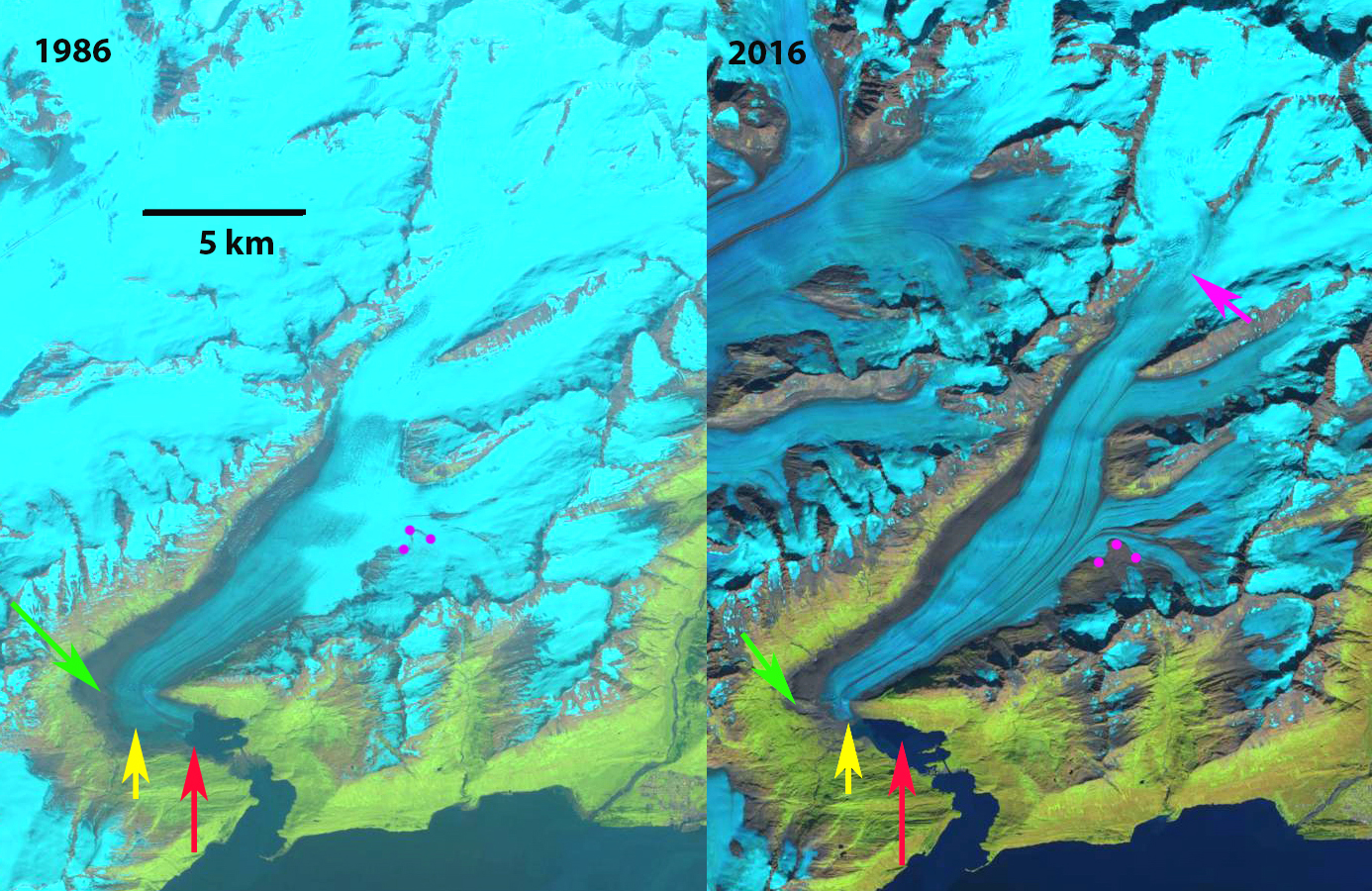
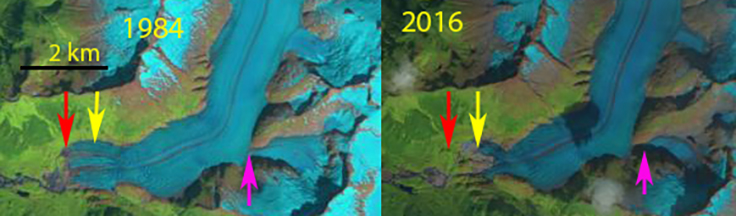
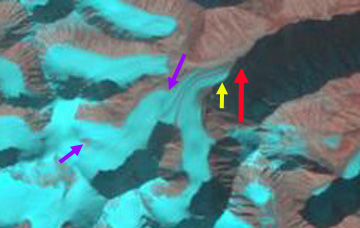
Field Glacier in Landsat images from 1984, 2013 and 2017.  The red arrow indicates the 1984 terminus, the yellow arrows the 2013 terminus and the yellow dots the 2017 terminus.  The purple arrows indicate developing lateral margin lakes in 2013 and purple dots the transient snowline.

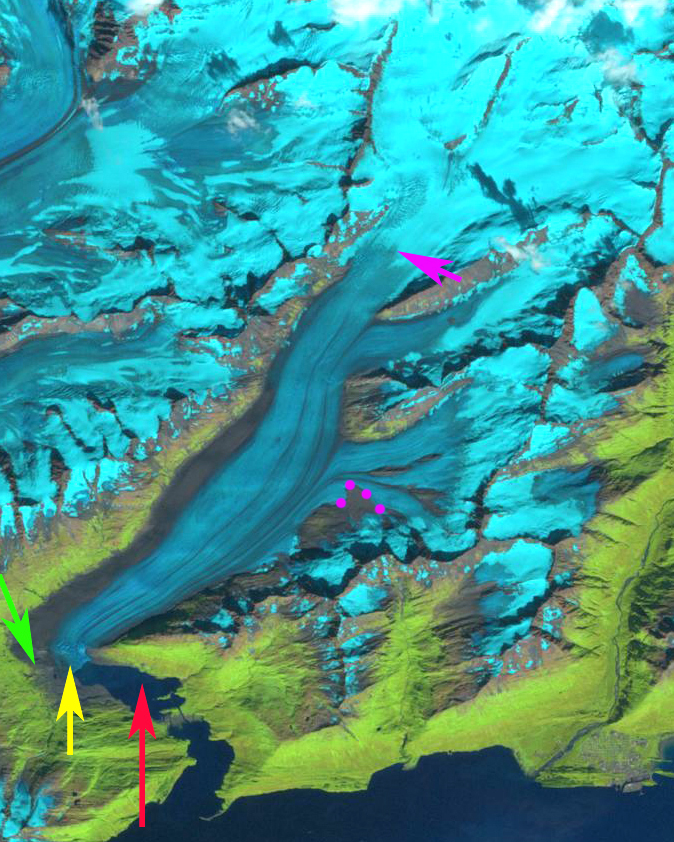
The Field Glacier flows from the northwest side of the Juneau Icefield, and is named for Alaskan glaciologist and American Geographical Society leader William O. Field. Bill also helped initiate the Juneau Icefield Research Program, which Maynard Miller then ably managed for more than 50 years. The JIRP program is still thriving today. In 1981, as a part of JIRP, I had my first experience on this glacier. It was early August and there was new snowfall everyday that week. Jabe Blumenthal, Dan Byrne and myself undertook a ski journey to examine the geology on several of the exposed ridges and peaks, note the burgundy line and X’s on image below. This was truly a remote area. The glacier begins from the high ice region above 1800 meters, there are several icefalls near the snowline at 1350 meters, and then it descends the valley ending at 100 meters. The runoff descends the Lace River into Berners Bay.This post focuses on the significant changes occurring at the front of the Field Glacier. The development of a proglacial lake at the terminus is accelerating and spreading into the main southern tributary of the glacier.  In 2013 it was observed that the lake was going to quickly expand and develop a second arm in that valley, as the two main tributaries separate.

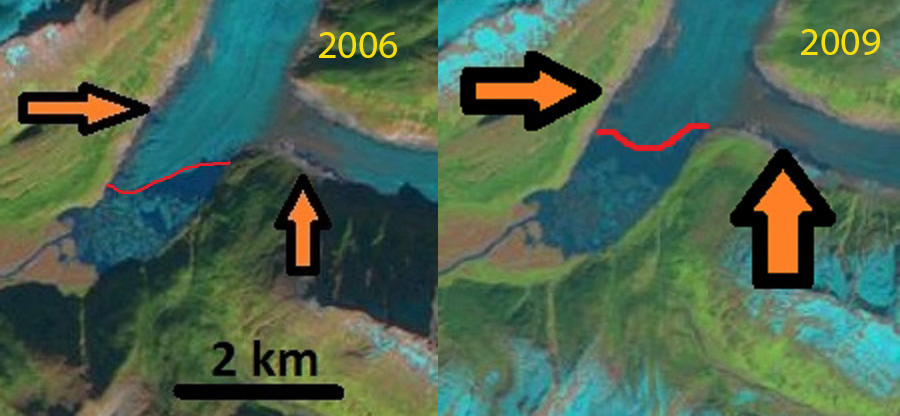
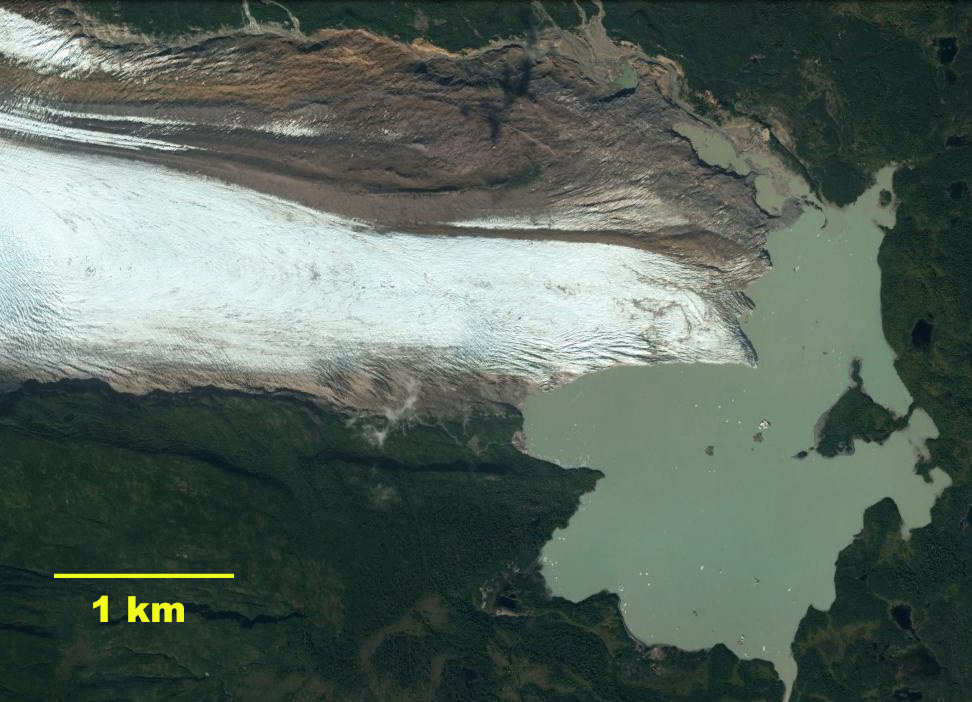
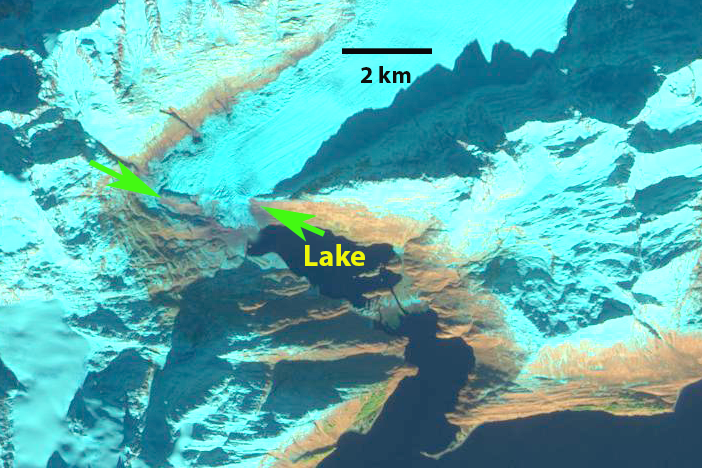
The USGS map from 1948 imagery and the 1984 imagery indicate little change in the terminus position, with only a small lake at the terminus in 1984 with most of the margin resting on the outwash plain.  The Field Glacier by 2006 had developed a proglacial lake at the terminus that averaged 1.6 km in length, with the east side being longer. There are several small incipient lakes forming at the margin of the glacier above the main lake, each lake indicated by black and orange arrow. In 2009 the lake had expanded to 2.0 km long and was beginning to incorporate the incipient lake on the west side of the main glacier tongue. There was also a lake on the north side of this tributary. This lake was noted as being poised to soon fill the valley of the south tributary and fully merge with the main, as yet unnamed lake at the terminus, maybe this should be Field Lake.   In 2013 Google Earth imagery indicates the fragile nature of the terminus tongue that is about to further disintegrate. From 1984 to 2017 Field Glacier has experienced a retreat of 5300 m of the southern branch and 4050 m of the northern branch. This glacier is experiencing retreat and lake expansion like several other glaciers on the Juneau Icefield, Gilkey GlacierEagle Glacier, and Antler Glacier.

.

Development of proglacial lakes from 2006 to 2009.

Terminus noted for 1984 and 2011 and the snowline in 2011.  JIRP camp locations noted by X’s.
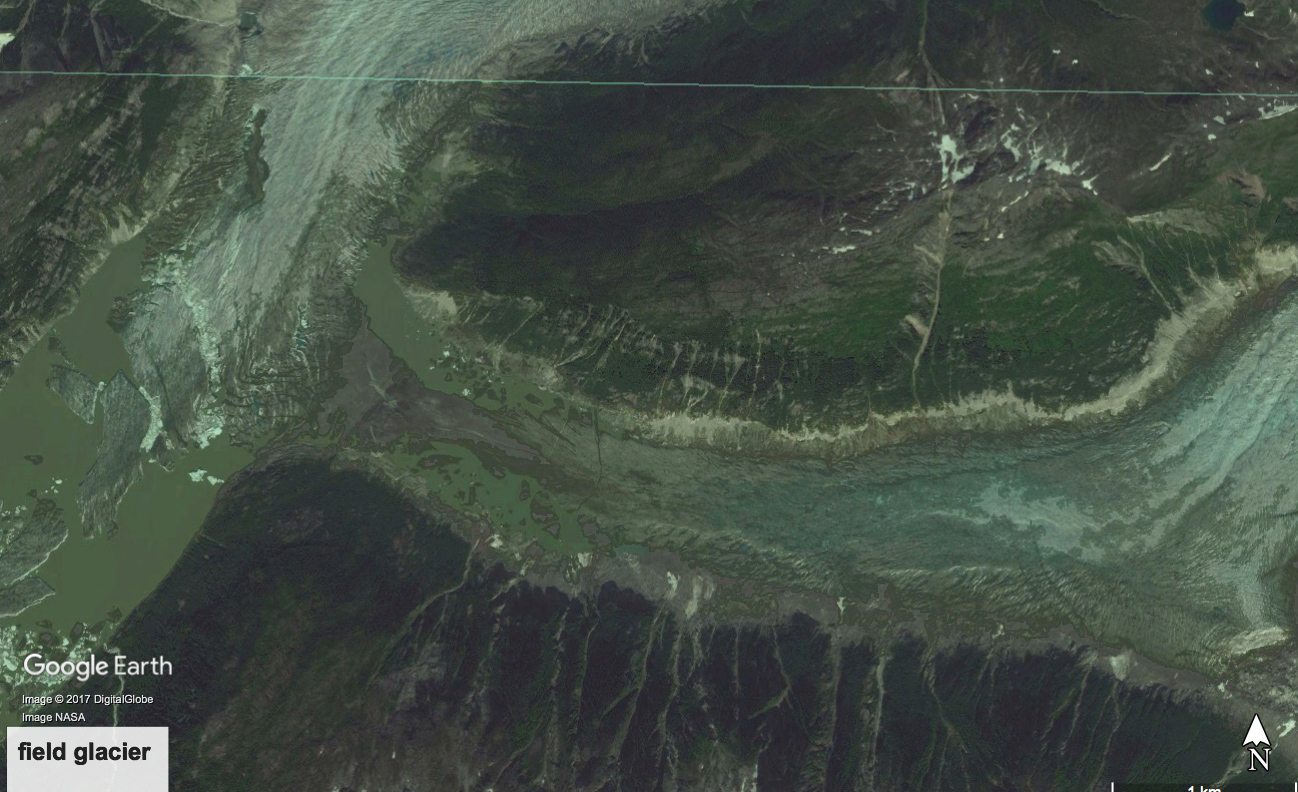
2013 Google Earth image of the terminus. Many small icebergs already separating.
 

Ellsworth Glacier Retreat & Lake Expansion, Alaska

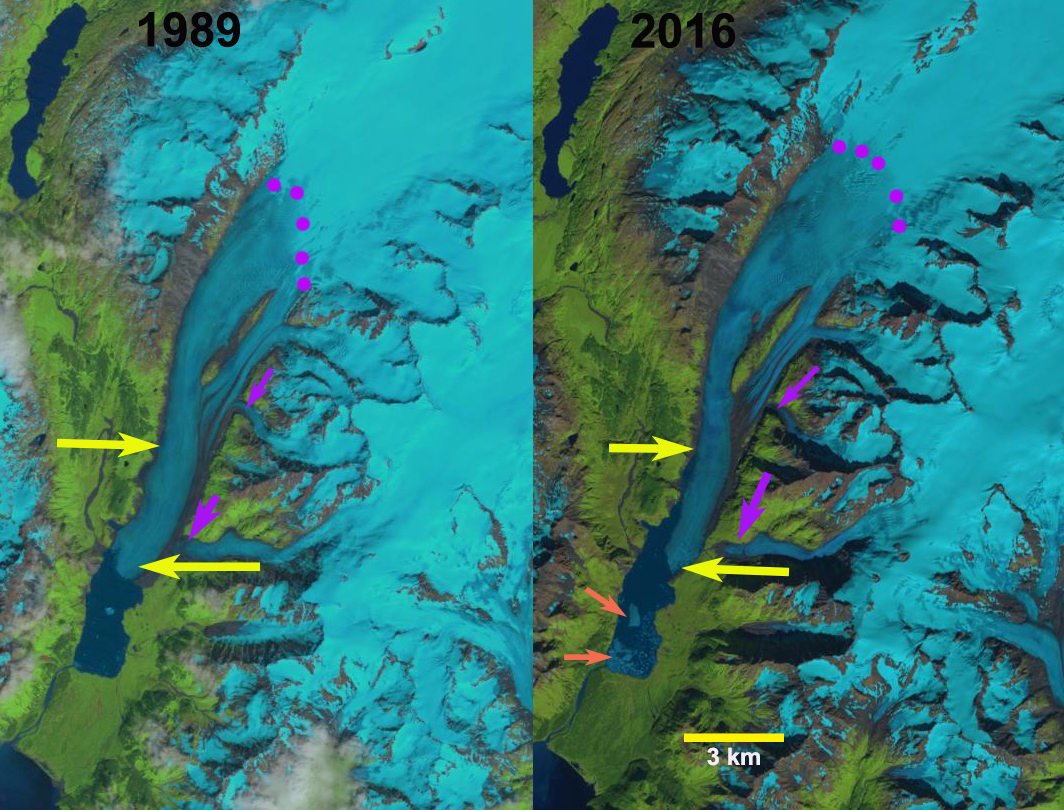
Ellsworth Glacier in 1989 and 2016 Landsat images.  Upper yellow arrow marks the west terminus in 2016 and the lower yellow the 2016 east margin.  Purple dots mark the snowline and purple arrows tributaries from the east that are thinning and disconnecting.  Orange arrow marks icebergs in the lake. 

Ellsworth Glacier is a valley glacier draining south from Sargent Icefield on the Kenai Peninsula in Alaska. Along with the Excelsior Glacier it has been the longest glacier of the icefield.  The glacier retreated into an expanding proglacial lake in the early 20th century (USGS-Molnia, 2008). The terminus in 2000 was reported to be  3.5 to 4.5 km from the 1908 position (USGS-Molnia, 2008).  Here we examine Landsat images to document changes from 1989 to 2016. 

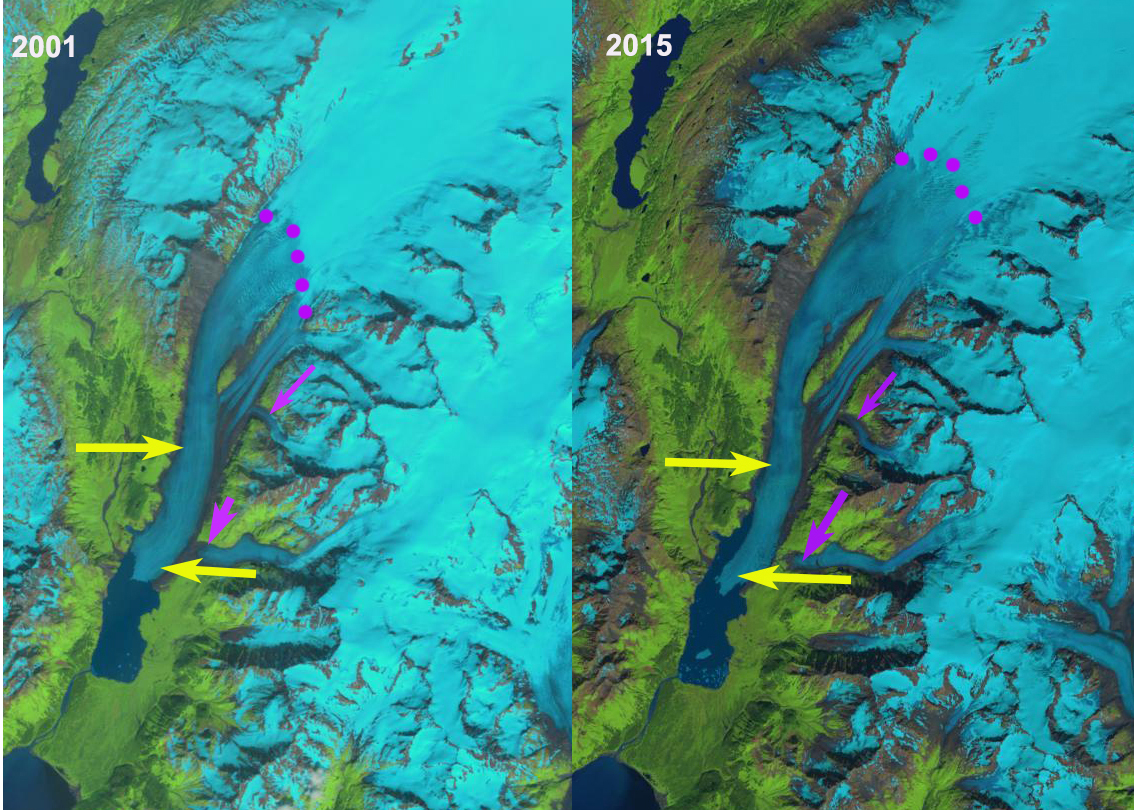
In 1989 the snowline was at 925 m, purple dots, a tributary from the east joined just above the terminus, lower yellow arrow.  The terminus had a small embayment on the west side.  In 2001 the snowline was at 875 m, with little evident change in the terminus position.  By 2015 the tributary from the east has detached from the main glacier, the snowline is at 1000 m.  The lake has expanded considerably along the western margin and the tongue of the glacier has narrowed in the lower 2 km.  In 2016 the snowline is at 975 m, the lake has now extended 3 km along the western edge.  This rapid lake expansion indicates that the lower 3 km of the glacier occupies a basin that will become a lake and that the tongue is partially afloat and given the narrowing thinning tongue is poised for collapse, see below.  The number of icebergs in 2016 indicates that significant ice calved during that year. The retreat of the eastern margin has been 500 m, with a 3.4 km retreat on the west side.  The main tongue in the lower two kilometers is 800 m wide versus 1200 m wide in 1989.  It is also worth noting the greening of the elongated nuntak in the middle of the glacier several kilometers above terminus.  Along with the rapid 3.5 km retreat of the adjacent Excelsior Glacier, leaves the longest glacier from the icefield up for grabs. 

Ellsworth Glacier in 2001 and 2015 Landsat images.  Upper yellow arrow marks the west terminus in 2016 and the lower yellow the 2016 east margin.  Purple dots mark the snowline and purple arrows mark tributaries from the east that are thinning and disconnecting. 
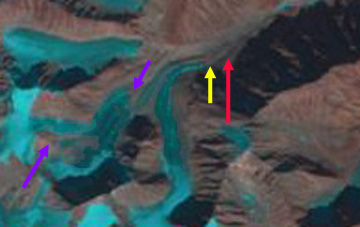
Ellsworth Glacier in2016 Landsat image.  Upper yellow arrow marks the west terminus in 2016 and the lower yellow the 2016 east margin.  Purple arrows mark tributaries from the east that are thinning and disconnecting.  Orange arrow marks icebergs in the lake. 

Pedersen Glacier, Alaska Rapid Retreat 1994-2015

Pedersen Glacier Kenia Peninsula, Alaska retreat from Landsat images in 1994 and 2016. The red arrow indicates 1994 terminus, yellow arrow is 2016 terminus, orange arrow indicates northern tributary and purple dots indicates snowline. 

Pedersen Glacier is an outlet glacier of the Harding Icefield in Kenai Fjords National Park near Seward, Alaska. The glacier drops quickly from the plateau of the icefield through a pair of icefalls terminating in a lake at 25 meters above sea level.  The Harding Icefield glaciers that drain east are in the Kenai Fjords National Park, which has a monitoring program.  Giffen et al (2014) observed that from 1950-2005 all 27 glaciers in the Kenai Icefield region examined retreated.  Giffen et al (2014) observed that Pedersen Glacier retreated slow but steady from 1951-1986 at 706 m (20 m/a) and 434 m (23 m/year) from 1986-2005. Here we compare a 1994, 2013, 2015 and 2016 Landsat imagery illustrating a rapid increase in retreat rate from the previous periods.

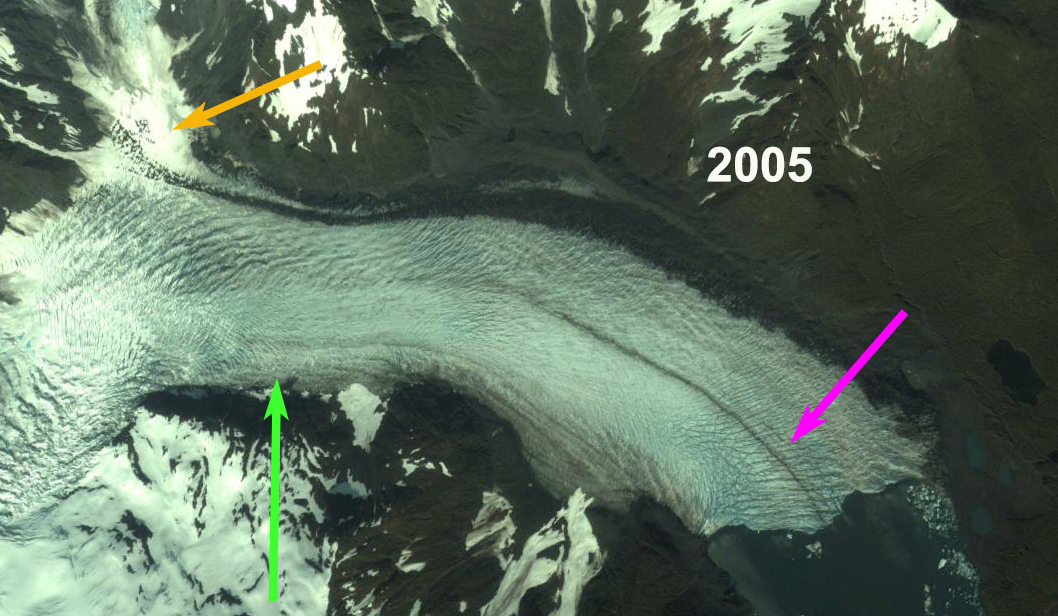
In 1994 the terminus proglacial lake at the terminus is small and much of the terminus is on land.  The snowline in 1994 is at 550 m.  The tributary entering from the north, orange arrow, is 400 m wide as it reaches Pedersen Glacier.  In 2005 the Google Earth image below indicates extensive terminus crevassing, indicating substantial terminus velocity, and that the retreat is driven by calving.  In 2005 the lake is now 1.1 km long on its center axis.  By 2015 the glacier has retreated 2600 m since 1994, a rate of 125 m/year, much faster than before.  The snowline is average 800 m.  The northern tributary is now barely reaching the main glacier and has a width of 150 m. Note there was a medial moraine separating the tributary from the main glacier in 1994 and now this is merely a lateral moraine. This tributary is not particularly impacted by calving losses and indicates a rising snowline is also a source of mass loss for the glacier. A comparison of the 2013, 2015 and 2016 terminus indicates the recession has remained rapid.  The glacier is approaching the base of an icefall that would represent the inland limit of the lake and the end of rapid retreat.  The snowline in 2013 averages 850 m and is at 800 m on Sept. 30 2016. The glacier follows the pattern of nearby Bear GlacierYakutat GlacierHarris Glacier and the inital phase of retreat on Brady Glacier.
Pedersen Glacier Kenia Peninsula, Alaska retreat from Landsat images in 2013 and 2015. The red arrow indicates 1994 terminus, yellow arrow is 2015 terminus, green arrow indicates 2016 terminus and purple dots indicates snowline. 

Pedersen Glacier in 2005, note crevassing at the terminus, pink arrow. The northern tributary is indicated by orange arrow and green arrow indicates 2016 terminus position. 

Fasset Glacier, Alaska Retreats from Tanis Lake

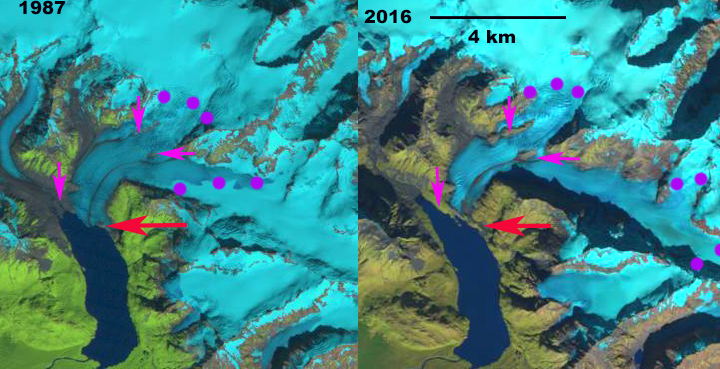
Fasset Glacier in 1987 and 2016 Landsat images.  Red arrow indicates glacier front in 1987, pink arrows indicates areas where glacier retreat has exposed rock/bare ground and purple dots indicate snowline.

Fasset Glacier drains west from The Brabazon Range near Yakutat and had terminated in Tanis Lake for the entire 20th century.  (Truessel et al 2013) and Truessel et al (2015) note the rapid retreat and thinning of nearby Yakutat Glacier. Here we examine Landsat imagery that illustrates the retreat from 1987 to 2016. 

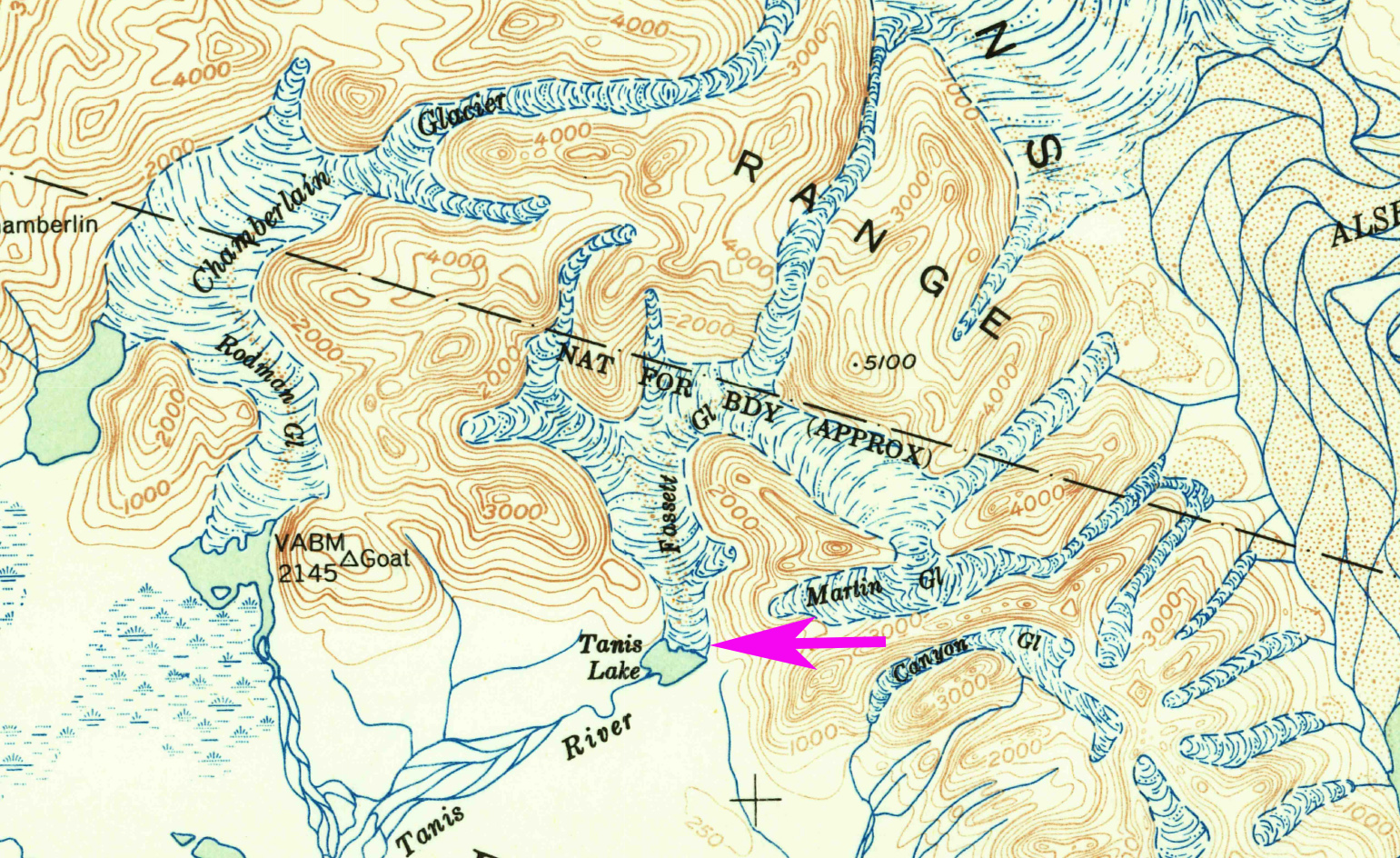
The glacier extended most the way to the southern end of the Tanis Lake in the 1951 Yakutat map.  In 1987 the glacier terminated on the northeast shore of Tanis Lake. The calving front in the lake was 800 m wide.  The snowline was at 600 m.  In mid-June of 2014 the snowline was already at 600 m, by the end of the melt season it was at 900 m. In 2016 the terminus of the glacier no longer reaches Tanis Lake. The eastern side of the terminus is stagnant and ends 200 m from the shore of the lake.  The western edge terminates in a new lake that is forming.  The average retreat has been 250 m for the glacier from 1987-2016. The larger changes are upglacier of the terminus where large areas of bedrock have been exposed due to retreat, and several segments of the glacier that used to be joined have separated. The snowline is at 850 m in 2016. There are three large areas of bedrock denoted in the 2014 Google Earth image below.  The two at 500 m well above the terminus appeared as medial moraines in 1987 and are now bedrock ridges 600 m and 1100 m long. There is a group of ogives extending below these two locations indicating the annual flow rate is 100 m/year in this reach of the glacier.  The new lake is also evident in the Google Earth image. 

Walker Glacier, Yakutat Glacier and East Novatak Glacier are nearby glaciers that have experienced greater recent retreat than Fasset Glacier.  Fasset Glacier is poised to continue a moderate rate of retreat. 

USGS Yakutat map from 1951

2014 Google Earth image, pink arrows indicate three areas of thinning. 

2014 Google Earth image.

2014 June Landsat image indicating snowline. 

Yakutat Glacier Terminus Collapse, 10 km retreat 1987-2016

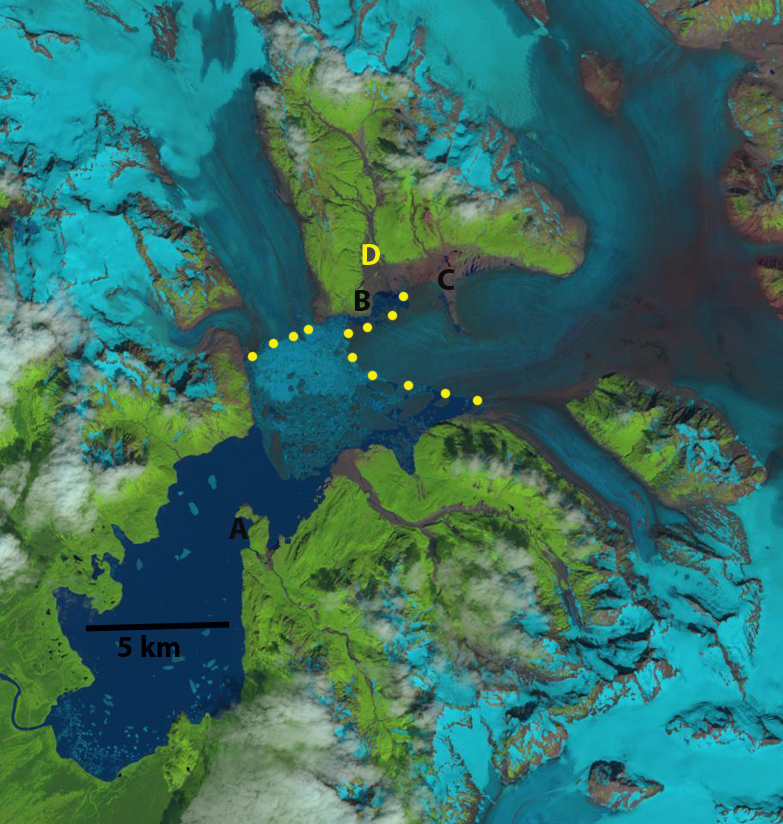
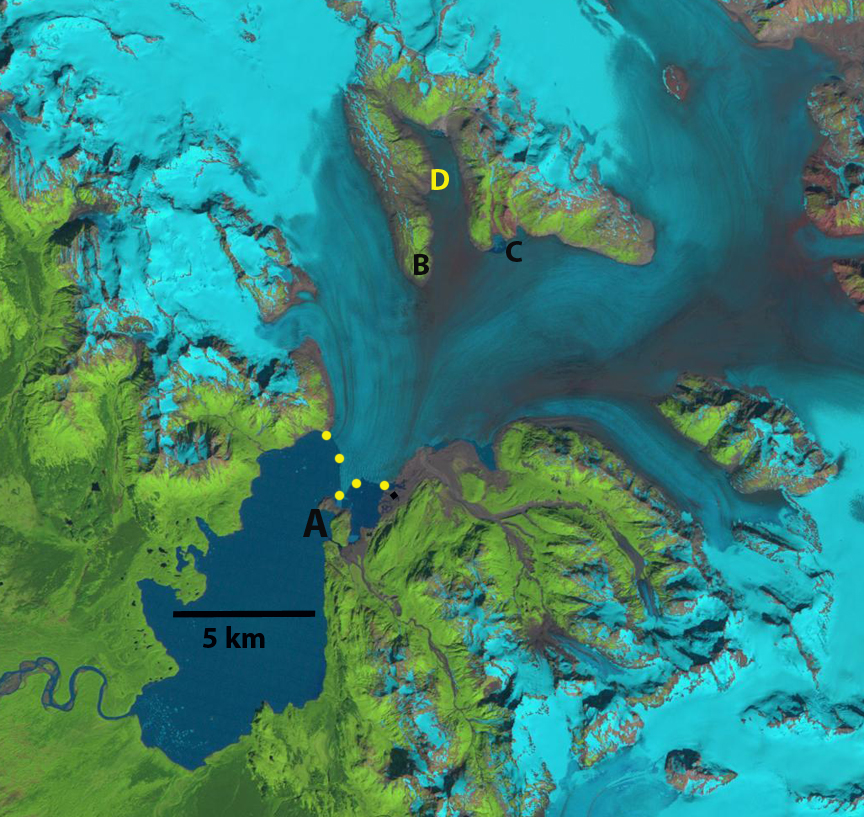
Landsat images from 1987 and 2016 with terminus indicated by yellow dots. Point A indicates the 1987 terminus location and Point E the 2016 terminus location. 

The Yakutat Glacier during the 1894-1895 Alaskan Boundary Survey ended near a terminal moraine on a flat coastal outwash plain. By 1906 the glacier had retreated from the moraine and a new lake was forming. Harlequin Lake. Surveys of the terminus of the glacier indicated a retreat of 1 kilometer in that decade. From 1906-1948 the glacier retreated an additional 5 km. From 1948-1958 the glacier retreated 3.6 km. The retreat is evident in comparing the Yakutat B-3 quadrangle, from 1958 photography, and Landsat imagery from 1987, 2010, 2013 and 2016. Points A-E are the same in each image and the yellow dots are the terminus. In 1987 the terminus was just retreating from a peninsula marked A, the valley at D was filled with ice, there was no break in the surface at C and B was well inland of the terminus. By 2010 the glacier had retreated from A, the valley at D was deglaciated, a small strip of bedrock-sediment was exposed at C from what had been beneath the glacier, and B was still well inland of the terminus. By 2013 the northern arm of the glacier had retreated 6.4 km from the peninsula at A toward the peninsula at B. The central arm of the glacier toward C had retreated 7.5 km and the retreat on the southern edge of the glacier was 6.5 km. The glacier had retreated on average more than 6.6 km in 27 years, a rate of 240 m/year.  From 2013 to 2016 the glacier had retreated from Point B to Point C on the northern side and to Point E on the southern side this is a distance of 10.2 km in thirty years 340 m/year. 

Recently the glacier has been the focus of a study by the University of Alaska, Faribanks they have set up a time lapse camera to record frontal changes. The goal is to understand the controls on calving into Harlequin Lake of this glacier. More amazing than the retreat has been the observed thinning of the glacier. The glacier has thinned by more 200 m on average according to the preliminary thickness change maps from the UAF project (Truessel et al 2013) and updated by Truessel et al (2015). The Yakutat Glacier does not have a high accumulation zone and the recent increase in the snowline elevation and thinning of the glacier have led to a substantial shrinking of the accumulation zone and thinning of the glacier in the accumulation (Truessel et al 2013). This glacier does not have a persistent significant accumulation zone and cannot survive (Pelto, 2010), Truessel et al (2015). modelling suggests the glacier will disappear between 2070 and 2110 depending on the warming scenario.  For a calving glacier to be in equilibrium it needs to have at least 60 % of its area snowcovered at the end of the summer. The glacier is in the midst of a large ongoing retreat. The retreat rate and calving mechanism is similar to that of Grand Plateau Glacier, Bear Lake Glacier and Gilkey Glacier. However, unlike these Yakutat Glacier lacks an accumulation zone, a better analog is East Novatak Glacier, which also has a lower elevation accumulation zone.


Yakutat terminus map


2010 Landsat image with terminus indicated by yellow dots.


2013 Landsat image with terminus indicated by yellow dots.


Hallo Glacier Retreat, Katmai Alaska

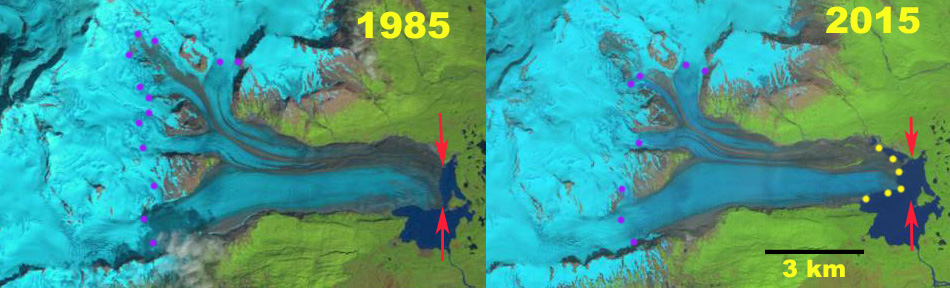
Landsat images of Hallo Glacier in 1985 and 2015 indicating the 1985 terminus position red arrows and yellow dots indicate 2015/2016 terminus location.  Purple dots show the snowline

Hallo Glacier is one of the larger glaciers in Katmai National Park draining east from Mount Steller and ending in an expanding proglacial lake east of Hallo Bay.  Hallo Bay is well known as a good location for brown bear watching (NPS).  Arendt and Larsen (2012) assess the glacier changes in Alaska National Parks they provide a map of the change in glacier extent from 1956-2009, Figure 7.  This indicates a significant retreat but it is not quantified. They further note a 15% decrease in areal extent of Katmai Region glaciers from 1956-2009.  Giffen et al (2015) indicate the glacier retreated 900 m from 1951-1987 and then advanced 150 by 2000. Here we utilize Landsat imagery to examine retreat from 1985 to July 2016 to examine the glaciers response.

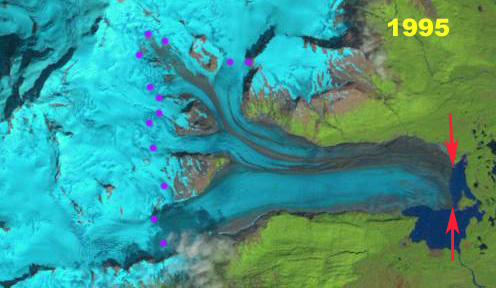
In 1985 the glacier terminated just off the western shore of a small island in the lake.  The terminus front in the lake measured 3000 m in length.  The snowline averaged 1050 m across the glacier. By 1995 little retreat had occurred, the snowline was averaged 1050 m. In 2000 the glacier terminus had changed little from 1985.  The average snowline was at 1100 m. In 2015 the terminus had retreated 600 m from the island and 800 m along the northern shore of the lake.  The snowline is at 2000 m.  In 2016 the snowline is averages 1150 m , the highest observed. The terminus front in the lake remains 3000 m long.  The rate of retreat increased after 2000, and the glacier is poised for additional retreat. A 2013 Google Earth image illustrates that the lower 3.5 km of the glacier has a low slope and limited crevassing, except for minor crevassing along southern calving front.  This indicates the lake is likely to expand at least to this point.  Further that the glacier is poised for continued significant retreat and lake expansion.  The retreat is less than, but similar to that of nearby  FourPeaked  and  Spotted Glacier.


1995 Landsat image of Hallo Glacier indicating the 1985 terminus position red arrows.  Purple dots show the snowline

2000 Landsat image of Hallo Glacier indicating the 1985 terminus position red arrows and yellow dots indicate 2015/2016 terminus location.  Purple dots show the snowline

2016 Landsat image of Hallo Glacier indicating the 1985 terminus position red arrows.  Purple dots show the snowline.

2013 Google Earth image of Hallo Glacier, note low uncrevassed terminus tongue in lower 3.5 km.


Shoup Glacier, Alaska Retreat, Thinning, Velocity Decline

Shoup Glacier comparison in 1986 and 2016 Landsat images.  The glacier retreated 1900 m in this interval.  Red arrow is 1986 terminus, yellow arrow the 2016 terminus, green arrow rock rib emerging from beneath glacier, purple dots a landslide deposit, and purple arrow the snowline.

Shoup Glacier is between the Columbia Glacier and Valdez draining from the Chugach Mountains in southern Alaska.  The glacier was a tidewater terminating glacier until 1953 (McNabb et al, 2014).  From 1985 to 2011 McNabb et al (2014) noted a 1.7 km retreat.  The retreat was enhanced by significant lacustrine calving in an expanding tidal lagoon.  Here we examine Landsat and Sentinel images from 1986-2016 to identify recent and potential future changes.

In 1986 the glacier extends to the red arrow in the midst of a tidal lagoo. The glacier is 2.5 km wide at the sharp bend in the glacier 2.5 to 3 km from the terminus, green arrow.  There is significant crevassing at this bend indicating an increase in slope.  There is an landslide/avalanche deposit near the junction with a tributary, purple dots.  By 2002 the glacier has retreated 1.5 km since 1986, the minor ice cliff at the terminus indicates the glacier ends in shallow water near the end of the tidal lagoon.  The glacier is now 2 km wide at the sharp bend.  The landslide deposit, purple dots,  has shifted little since 1986. The snowline is at 1200 m in 2002.  By 2016 the glacier has retreated an additional 400 m since 2002, 1900 m since 1986.  The glacier no longer terminates in the lagoon.  A bedrock rib at the sharp bend has been exposed and the glacier is only 500 m wide now and this bend is just 500 m from the terminus, green arrow.  A closeup of this rib in a 2016 Sentinel image indicates why the crevassing had occurred, it is also clear this is an extension of the ridge that runs east from the glacier.  This is a band of erosion resistant rock.  This suggests that a basin exists above the this bedrock rib/ridge and a new lake will form.  The glacier slope from the green arrow for the next 2 km upglacier is quite low 1/40, again indicative of a basin beneath the lower glacier.  There is an increase in crevassing 2 km above the current terminus,  suggesting another increase in surface slope and the probable limit of the basin.  In 2016 the snowline is at 1250 m.  The landslide deposit remains little changed since 2002, indicating a low velocity in this region.  Burgess et al (2013) indicates the velocity of the Shoup Glacier near the terminus is in the range of 100 m annually.  The tributary is clearly significantly less. The low velocity, thinning and retreat indicates the glacier is continuing to lose volume via surface melting, despite no longer calving as Larsen et al (2015) have indicated is the prime mechanism for ice loss.  The retreat of this glacier is similar to that of nearby Valdez Glacier.

Shoup Glacier comparison in 2002 Landsat image.  Red arrow is 1986 terminus, yellow arrow the 2016 terminus, green arrow rock rib emerging from beneath glacier, purple dots a landslide deposit, and purple arrow the snowline.

Shoup Glacier terminus in 2016 Sentinel 2 image.  Green arrows indicate rock rib. 

Desolation Valley, Alaska, Conversion from Glacier to Lake


desolation-compare

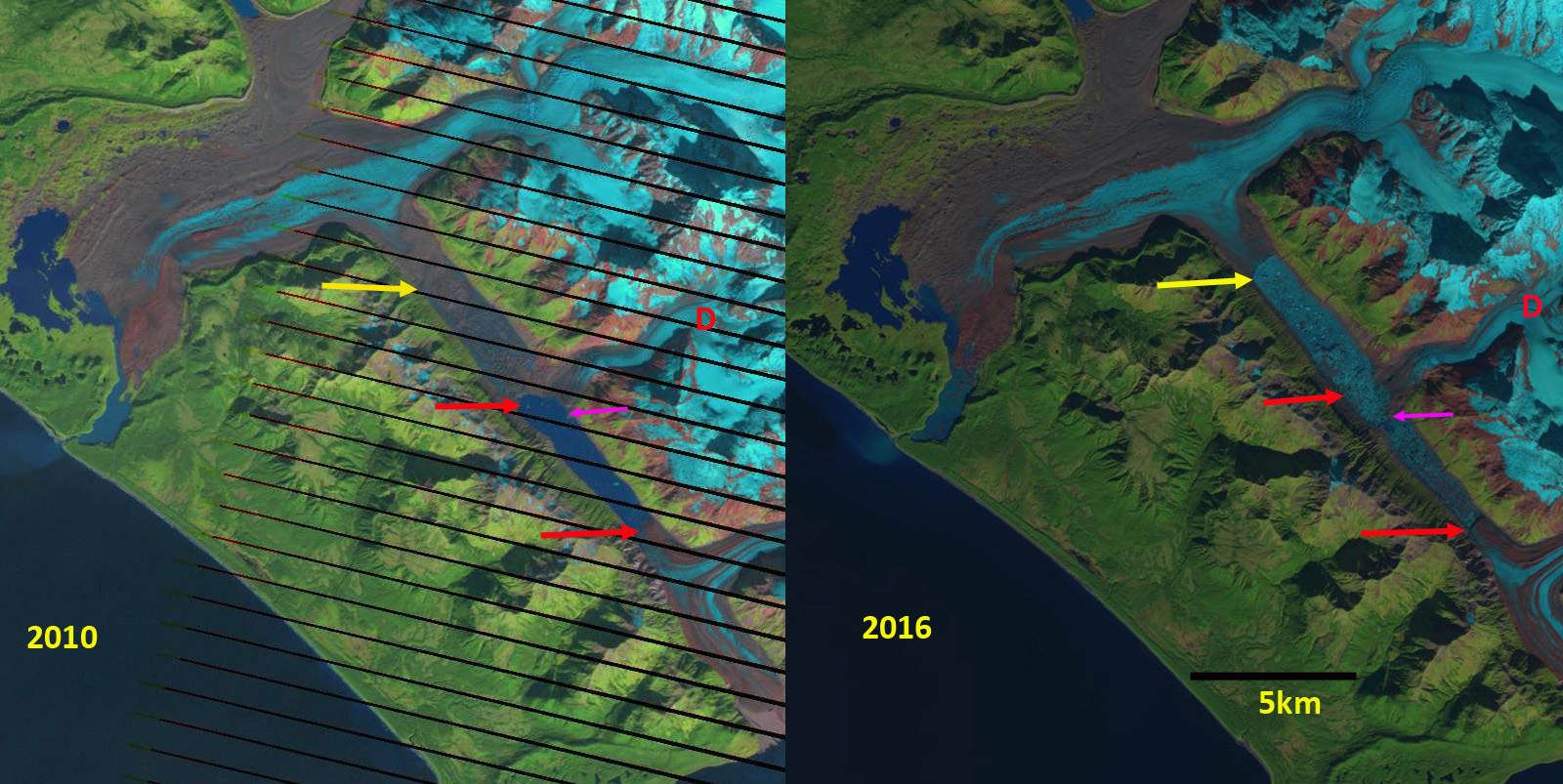
Retreat of Desolation-Fairweather Glacier from 2010-2016 in Landsat images.  The red arrow indicates 2010 terminus positions, yellow arrow the 2016 terminus. Pink arrow a delta exposed by lake level lowering. D=Desolation Glacier.

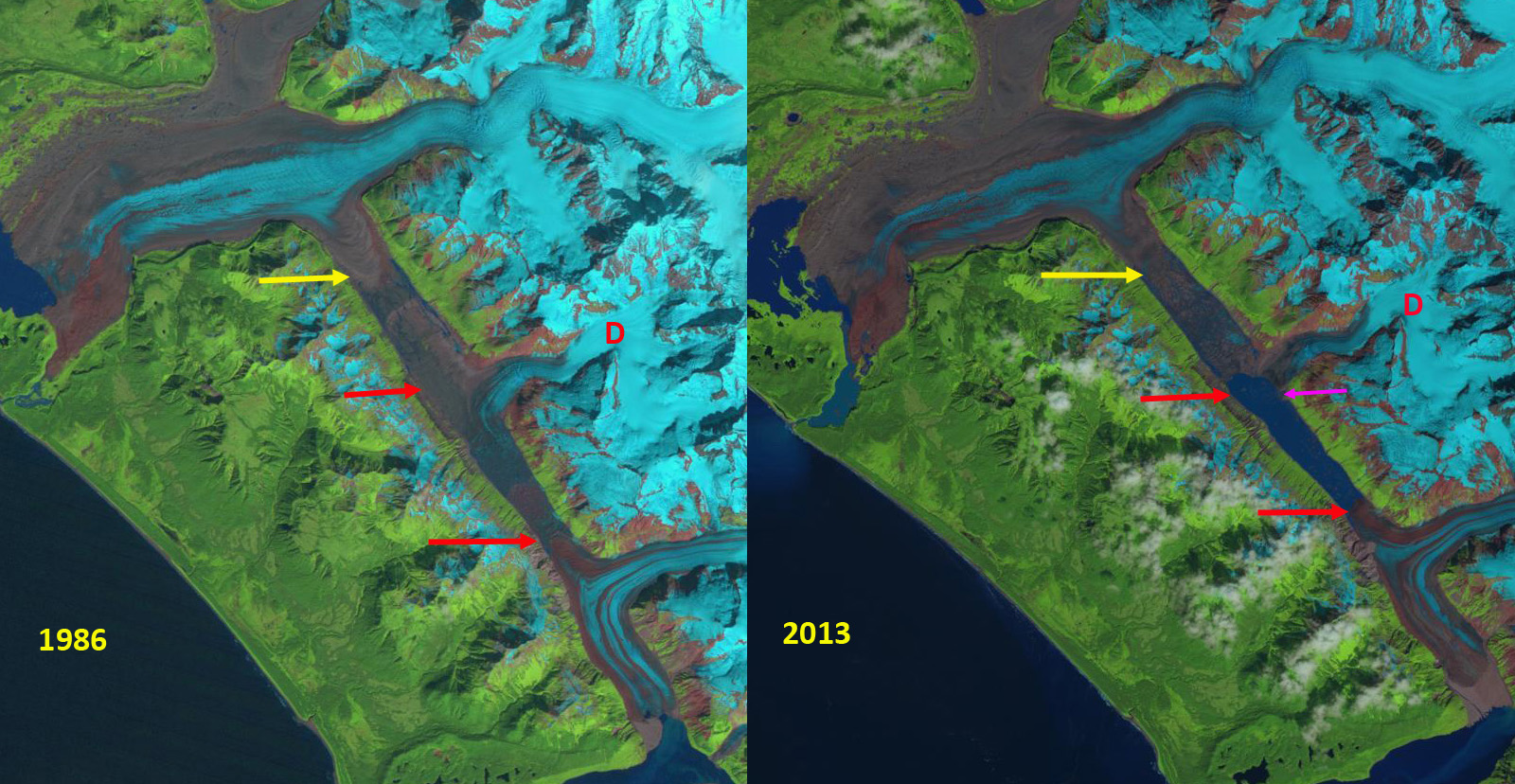
Desolation Glacier flows west from the Fairweather Range into Desolation Valley where in 1986 it joined with the Fairweather Glacier flowing from the north and the Lituya Glacier flowing from the south to fill the valley with glacier ice.  This is no longer the case, the valley once known for its long relatively flat area of largely debris covered ice, is mostly a lake now.  The valley has developed along the Fairweather Fault. Molnia (2007) noted that the tidewater termini of Lituya Glacier advanced ∼ 1 km since 1920 and continued to advance up to 2000 as it built an outwash plain reducing calving. Larsen et al (2015) noted thinning rates of 3 m per year for the Desolation Valley from Desolation Glacier north to Fairweather Glacier in the last decade (1994-2013).  Alifu et al (2016) identified that Desolation Glacier and Fairweather Glacier have lost 2.6% and 2.2% of their glacier area, respectively from 2000-2012. Only minor surface area changes were seen in Lituya Glacier during this period. They also noted that the mean snow line altitude of Fairweather, Lituya and Desolation increased by 120–290 m. Since 2012 extensive ice loss of the Desolation-Fairweather complex has occurred.  This is similar to the large rise in the transient snowline/equilibrium line noted by Pelto et al (2013) on nearby Brady Glacier.

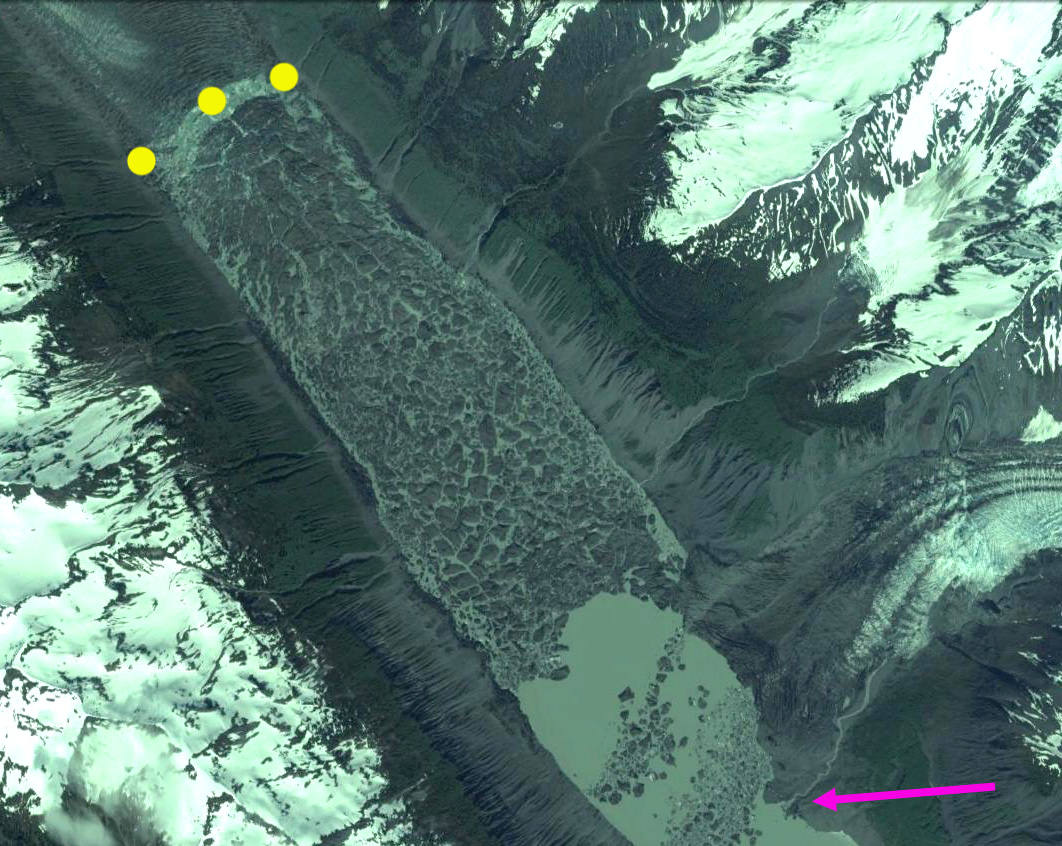
In 1986 The Desolation Valley was filled with glacier ice from Fairweather Glacier to Liutya Bay.  By 2010 the southern half of the valley from Lituya Glacier to the outlet of Desolation Glacier into the valley had opened up and the terminus of Desolation Glacier and Lituya Glacier were at the red arrows, this represented a 5.3 km section of glacier lost. In 2013 the northern half of the valley filled by the Desloation-Fairweather Glacier was breaking up but still ice filled.  The Google Earth image from 2014 illustrates how broken up.  By 2016 the collapse was total and the new terminus is at the yellow arrow a 5.5 km retreat since 2010, this is a loss of 6.5 square kilometers of ice. The lake level also dropped which led to exposure of a lacustrine delta that had been submerged in 2013 and 2014, pink arrow. The lake has expanded in area, but lost in mean depth.  Will this continue to be a lake with continued retreat or become a braided river valley as the Fairweather Glacier continues to thin and retreat?  Desolation Glacier is no longer calving and its retreat rate should slow.  The terminus of the Fairweather Glacier should continue to retreat via calving in a fashion similar to glaciers around the world terminating in extensive lakes. Just to the north the North Fork Grand Plateau Glacier also experienced a large recent retreat with Landsat imagery in 2013 and 2014 indicating extensive calving from 2013 to 2015 and a retreat of 3.0 km, 1.5 km/year.  Fingers Glacier  is another nearby glacier that also is experiencing widespread retreat.  More images of the region are in a field blog on the region.

desolatiion-1986-2013

Retreat of Desolation-Fairweather Glacier from 1986 and 2013 in Landsat images.  The red arrow indicates 2010 terminus positions, yellow arrow the 2016 terminus. Pink arrow a delta exposed by lake level lowering. D=Desolation Glacier.

desolation-breakup

Google Earth image from 2014 of the disintegrating debris covered glacier.


South Sawyer Glacier Retreat and Separation, Alaska

south sawyer terminus compare

Comparison of South Sawyer Terminus position and unnamed glacier just to the south.  Red arrows are the 1985 terminus and yellow arrows the 2016 position of each terminus. 

South Sawyer Glacier is a 50 km long tidewater glacier terminating at the head of Tracy Arm fjord in Southeast Alaska.  The winding fjord surrounded by steep mountains is fed by Sawyer and South Sawyer Glacier is home to stellar sea lions, humpback whales and harbor seals.  This combination makes it attractive for cruise ships.  Mike Greenfelder a Naturalist/Photography Instructor with Lindblad Expeditions suggested I examine this glacier, and he provided several images. I had a chance to observe the glacier in 1982 and 1984 and noted that the snowline of the glacier at 1125 meters by Pelto (1987), using Landsat images.  We also identified the water depth at the glacier front was 180-200 m and the velocity of the calving front in the 1980’s was 1800 m/year (Pelto and Warren, 1990).  Today the velocity had declined  to less than half of this, which is expected given that water depth at the front in the most recent charts from 1999 indicate 1985 terminus position water depth is 110 m (Elliot et al, 2012). This is deep but not as deep as in the 1980’s, the greater the water depth, the greater the degree of buoyancy at the front and the higher the calving rate. The glacier retreated 3.5 km from 1899-1967 and then experienced little retreat from 1967 to 1985 (Molnia et al, 2008). Larsen et al (2007) observed a rapid thinning of the Stikine Icefield during the 1948-2000 period.The retreat has been driven by rising snowlines in the region that has driven the retreat of North Dawes, Baird, Dawes and Sawyer Glacier. Here we use Landsat images to indicate from 1985-2016 to identify terminus change and recent snowline elevation.

The terminus has retreated 2300 m from 1985 to 2016, with little retreat from 1985 to 1996.  Of equal importance is the glacier now appears to be near the tidewater limit of Tracy Arm.  In the gallery of terminus images below from Mike Greenfelder, the 2005 and 2012 images illustrate a sharp increase in slope at Point B and red arrows in 2015 just the red arrows, 300 m from the ice front.  In 2016 the ice front is nearly to the base of this icefall. This represents a sharp rise in the bed of glacier causing an icefall.  Whether the bed is entirely above sea level is not clear. Just south of the main terminus is a separate glacier that in 1985 was the combination of two tributaries.  By 2016 the two glaciers have separated with a retreat of  4.5 km for the western arm and 3.8 km for the eastern arm.

In the gallery of snowline images it is evident that upglacier there are two tributaries that joined the main glacier in 1985, that no longer reach the glacier in 2016.  This is indicative of the higher snowlines and thinning glacier. The gallery of snowlines  indicate the last date during the melt season with clear imagery of the snowline.  In 1985 the snowline was at 1250 m, in 1996 the snowline was at 1400 m, in 2013 1400 m, in 2014 1600 m, in 2015 at 1400 m and in 2016 at 1650 m.  The images are close to the end of the melt season, but are a minimum elevation for the equilibrium line.  The snowline is averaging 300 m higher than it did in the 1980’s. The retreat of South Sawyer Glacier and its iceberg production will slow as the water depth at the front declines in the near future.  The retreat will continue due to the sharp rise in snowlines that has occurred which has led to significant thinning up to 1500 m noted by Larsen et al (2007). The retreat of neighboring non-calving glaciers emphasizes this point.

[ngg_images source=”galleries” container_ids=”27″ display_type=”photocrati-nextgen_basic_imagebrowser” ajax_pagination=”1″ template=”/nas/wp/www/sites/blogsorg/wp-content/plugins/nextgen-gallery/products/photocrati_nextgen/modules/ngglegacy/view/imagebrowser-caption.php” order_by=”sortorder” order_direction=”ASC” returns=”included” maximum_entity_count=”500″]


Herbert Glacier Retreat, Alaska 1984-2016

herbert compare 2016

Comparison of Herbert Glacier terminus position in Landsat images from 1984 and 2016. Red arrow 1984 terminus, yellow arrow 2016 terminus and pink arrow a tributary that has separated. 

Herbert Glacier drains the west side of the 4000 square kilometer Juneau Icefield in Southeast Alaska.  It is the glacier just north of the more well known Mendenhall Glacier and just south of Eagle Glacier.  It is also the first glacier I ever visited, July 3, 1981 during my first field season with the Juneau Icefield Research Program.  Here we examine the changes from the August 17, 1984 Landsat 5 image to a Sept. 1, 2016 Landsat 8 image.

The glacier descended out of the mountains ending on the coastal plain in 1948.  In 1984 we examined the terminus of this glacier, which was in the small proglacial lake at 150 m.  Herbert Glacier has retreated 600 m since 1984.  The width of the terminus has also declined. The pink arrow indicates a tributary that no longer feeds the main glacier.  The retreat has not been enhanced by iceberg calving as is the case at Mendenhall Glacier. The overall retreat is also less than Eagle Glacier. In the Google Earth images below from 2005 and 2013 the retreat is 200 m, the terminus has fewer crevasses in 2013 suggesting a reduced velocity and faster retreat to come. The annual equilibrium line on the glacier has averaged 1150 m from 2003-2016. By contrast in August 1984 I skied to the top of the icefall and could see the snowline was at 1000 m. This leaves the glacier with an AAR of 0.45, too low to sustain equilibrium, retreat will continue. In 2015 and 2016 the snowline rose to over 1400 m by the end of the melt season, indicating two years of large mass loss, which will drive further retreat. The higher snow line elevation has been observed across the icefield Pelto et al (2013).herbert tsl

Transient snow line in Early Sept. of 2015 and 2016.  The snow line is at the top of the icefalls, at 1400-1450 m. 

herbert 2005

2005 Google Earth Image, red line is 2005 margin, yellow line is 2013.

herbert 2013 ge

2005 Google Earth Image, red line is 1984 margin, yellow line is 2005.herbert glacier 2012

Herbert Glacier Terminus in 2012 

Sater Glacier, Alaska Not Retaining Snowcover

sater glacier ge
2012 Google Earth Image. Purple arrows indicate areas where the margin is receding well above the lowest terminus.

Sater Glacier is in the Okpilak River watershed of the Brooks Range, Alaska. It is named for John Sater an early geologist working in the Brooks Range and on the nearby McCall Glacier. Here we examine Landsat imagery from 1987-2016 to identify changes in the glacier. Matt Nolan, U. Alaska-Fairbanks,  has provided links to the recent research and publications at McCall Glacier. These glacier have suffered increased mass loss since 1990 as a result of an increase in the equilibrium line altitude that has reduced accumulation area and is indicative of increased ablation (Delcourt al , 2008) as noted at Slender Glacier.

In 1987 Sater Glacier extended from 2300 m to 1600 m with two main tributaries joining 1 km above the terminus. Retained snowcover blankets most of the glacier in this early August image.  In 1995 the main change is the lack of retained snowcover on the glacier, with a month left in the melt season.  The retained snowcover is the accumulation area ratio (AAR), which needs to be above 50% for a glacier to be in equilibrium, but is less than 10% in 1995. The 2012 Google Earth image above indicates very little retained snowcover on the glacier in mid-July, AAR of 15%. Likely no retained snowcover by summer’s end. In 2015 a late July image again indicates limited retained snowcover, the AAR less than 10%.  In 2016 the late July image again indicates limited snowcover though slightly better than in 2015 with an AAR of 25%. This persistent failure to retain snowcover indicates a glacier than cannot survive (Pelto, 2010).  This has also led to the near separation of the tributaries, retreat of the upper margins of the glacier and terminus retreat of 250 m. The retreat of the terminus has been much less than Okpilak Glacier, but the prognosis due to the lack of retained snowcover is much worse, it cannot survive current climate.

sater glacier 1987
1987 Landsat image red arrow indicates 1987 terminus, yellow arrow 2015 terminus and purple arrows upglacier thinning.

sater glacier 1995
1995 Landsat image red arrow indicates 1987 terminus, yellow arrow 2015 terminus and purple arrows upglacier thinning.

sater glacier 2015
2015 Landsat image red arrow indicates 1987 terminus, yellow arrow 2015 terminus and purple arrows upglacier thinning.
sater 2016

2016 Landsat image red arrow indicates 1987 terminus, yellow arrow 2015 terminus and purple arrows upglacier thinning.

Lamplugh Glacier Recent Behavior and Landslide Source Area, Alaska

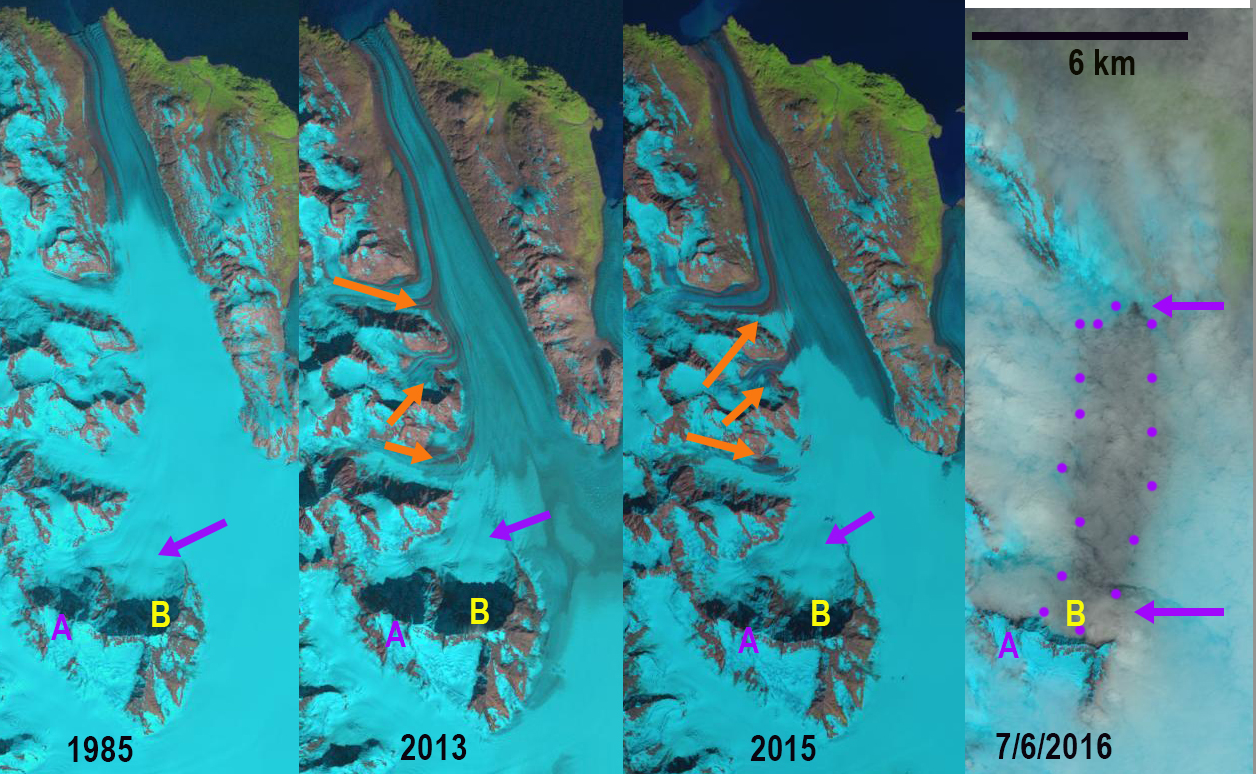
Lamplugh Glacier before and after landslide, in Landsat 8 images, which is 7.5 km long and covers 17 square kilometers. L=Lamplugh, R=Reid and B=Brady Glacier.

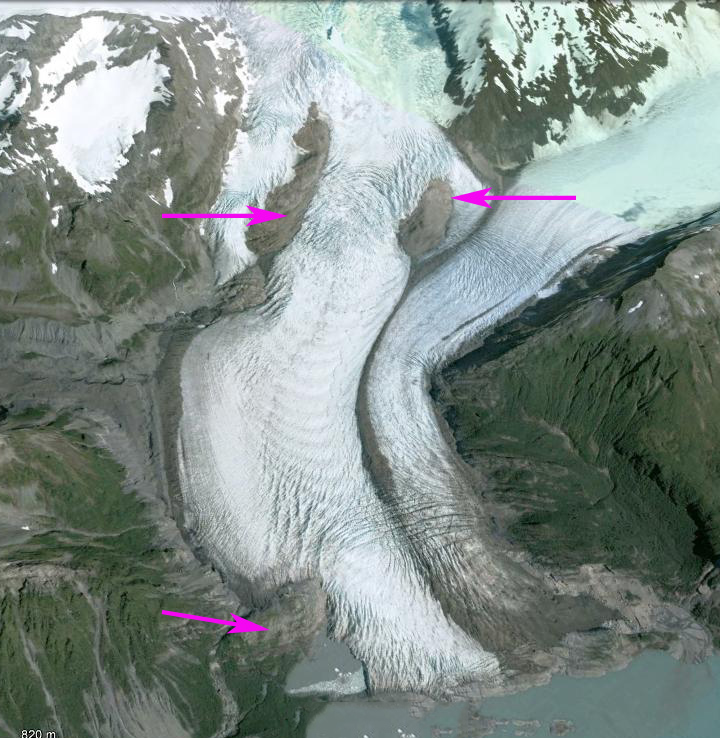
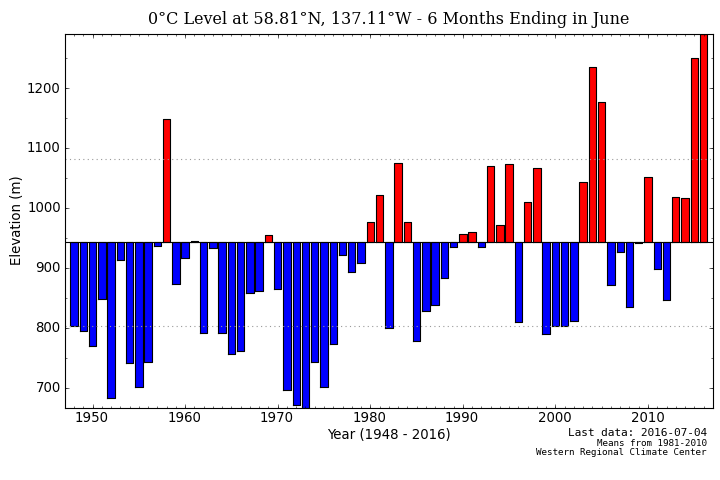
A recent large landslide onto Lamplight Glacier on June 28, 2016 has been reported by KHNS.  The landslide was triggered on the north slope of a steep unnamed mountainside on the west side of the Lamplugh Glacier, Glacier Bay, Alaska. The landslide has been estimated at  120 million tons by Colin Stark from Lamont Doherty .  The region has been experiencing substantial retreat and glacier thinning such as on Brady Glacier,  McBride Glacier. and Muir Glacier Loso et al (2014).   However retreat on Lamplugh Glacier has been minimal since 1985, with USGS photographs from 1941 and 2003 indicating a 0.5 km advance.  The glacier terminus in the last decade has thinned, narrowed and begun a slow limited retreat.The thinning of the glacier has been mapped by University of Alaska Fairbanks aerial flights since 1995 (Johsnon et al, 2013).  They found from 1995 to 2011 that Lamplugh Glacier lost the least ice thickness per year compared to neighbors Ried and Brady Glacier, at -0.32 m/year, Ried at  -0.5 m/year and Brady Glacier at -1.4 m/year Loso et al (2014).  Because the glacier has been receding less than the neighbors it is not a natural choice for a retreat/thinning driven landslide.  The snowline that is shared with Brady Glacier has risen 150 m during the 2003-2015 period  (Pelto et al, 2013).  This indicates increased melting at higher elevations.  The greater melting on the north face of the failed slope could be a factor in the landslide. Southeast Alaska had its warmest spring ever this year, which is leading to higher area snowlines for this time of year on glaciers as noted at this blog three weeks ago on Brady Glacier.  The North American Freezing Level Tracker notes an average freezing line 35 m above the mean  for 1948-2015 and the highest on record in 2016 averaging nearly 1300 m.

lamplugh compare

Landsat image comparison of Lamplugh Glacier 1985, 2013, 2015 and 2016.  The orange arrows indicate extensive surface moraine deposits.  purple arrows the region below the slope where landslide was triggered.  Point B trigger location and Point A a nearby cloud free location in each image.

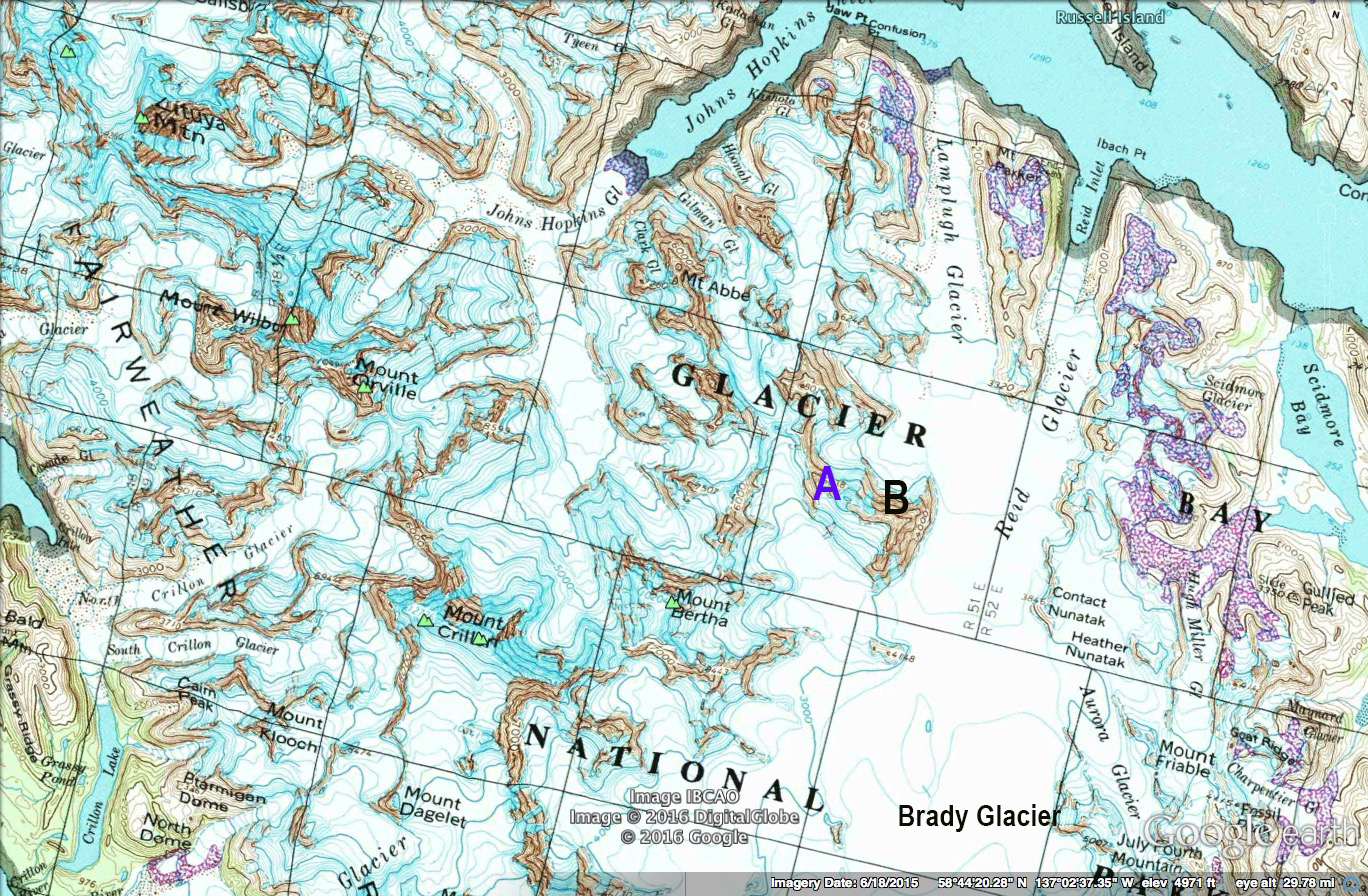
A comparison of Landsat images indicates the trigger location Point B, with Point A being a location that is not cloud covered in any image for reference. The landslide through thin clouds is marked  by purple arrows and purple dots on the July 6, 2016 image. The landslide extends approximately 9 km down glacier from the trigger site.  Orange arrows indicate locations of extensive medial moraines due to erosion and possibly previous landslides.  It is apparent that these areas stem from he west side of the glacier lower on the glacier than the current landslide trigger area.  This area has not been the source of significant surface debris in the last 30+ years.  Pelto et al (2013) noted that the snowline on neighboring Brady Glacier has risen by 150 m, this is the most pronounced impact of climate change to date for Lamplugh Glacier.  The rising rate of landslides has been tied to increase melt in the Swiss Alps as permafrost on rock faces thaws. This post will be updated when clear Landsat imagery is available.

lamplugh ge copy

USGS Topographic map of the region overlay in Google Earth.  Point B is the trigger point.
bargraph
Freezing Level Tracker for Glacier Bay, AK