Pacific Northwest Glaciers: Widespread early Melt Season Arrival

[ngg_images source=”galleries” container_ids=”43″ display_type=”photocrati-nextgen_basic_imagebrowser” ajax_pagination=”1″ template=”/nas/wp/www/sites/blogsorg/wp-content/plugins/nextgen-gallery/products/photocrati_nextgen/modules/ngglegacy/view/imagebrowser-caption.php” order_by=”sortorder” order_direction=”ASC” returns=”included” maximum_entity_count=”500″]


The 2016 melt season is off to an early start in Greenland, but this is not the only location.  This winter proved to be warm, but relatively wet across much of the Pacific Northwest.  A look at the average freezing level (determined by North American Freezing Level Tracker-Developed by John Abatzoglou and Kelly Redmond) from January 1 to April 20 indicates freezing levels well above average on Mount Baker North Cascades, Washington, Bugaboo Mountains British Columbia and Juneau Icefield Alaska.  Reports from the field in British Columbia, Alaska and Washington identify a peak snowpack in late March instead of early May at glacier elevations.

In British Columbia the University of Northern British Columbia field team is currently on Conrad Glacier in the Bugaboos, having just finished Kokanee Glacier. This is part of a five-year study led by Dr. Brian Menounos, UNBC Canada research chair in glacier change, funded by the Columbia Basin Trust. UNBC PhD student Ben Pelto heads the research team. They have found that despite snowpack observations for the region from the BC River Forecast Centre of slightly above average snowpack on April 1, the high winter freezing levels and very warm April conditions have left the Kokanee Glacier snowpack quite similar to the low 2015 snowpack, with close to 4.5 m of retained snowpack.  The snowmelt season was noted by the River Forecast Centre as starting several weeks early. The freezing level from January-April 20 was a record for the 1948-2016 period by over 100 m for the Bugaboo mountains.  The region based on the warm spring causing rapid snow melt at lower elevations is leading many, Including John Pomeroy, to expect high forest fire danger and low streamflow during the summer across the Western Canada. 
zillmer snowpit

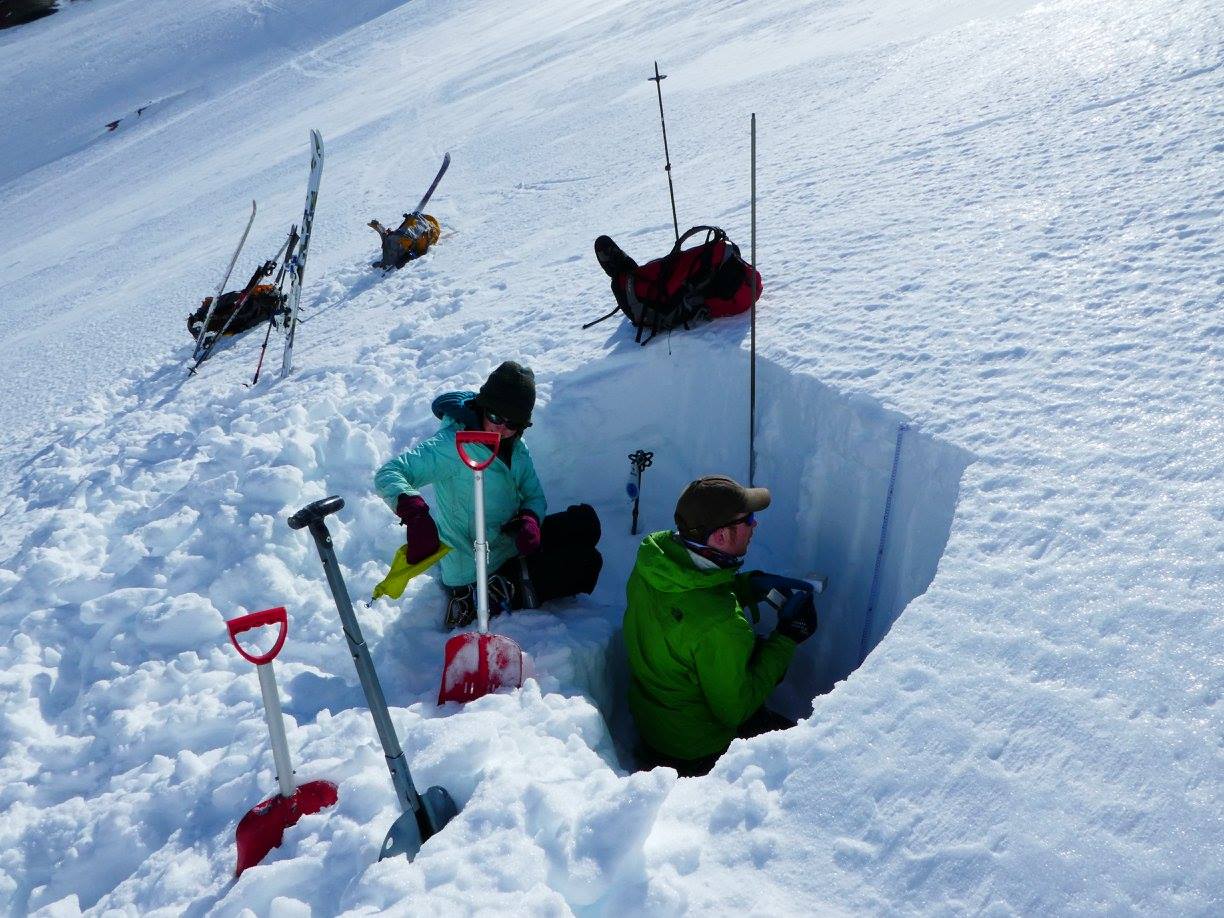
Snowpit being excavated on Zillmer Glacier April 2016, Jill Pelto and Micah May. (Ben Pelto)

BenPelto-and-JillPelto-BCGlacierClimateProject-Kokanee-April2016-TomHammond

Jill Pelto and Ben Pelto measuring density of firn core on Kokanee Glacier. (Tom Hammond)

In Alaska  USGS-Glaciology has been completing GPR surveys of their benchmark glaciers in recent weeks.  On the Juneau Icefield Lemon Creek Glacier is a reference for the World Glacier Monitoring Service.  Mass balance records exist since 1953 for this glacier (Pelto et al, 2013). In April the glaciers are typically covered head to toe by snow.  The last four months indicate a freezing level of nearly 900 m a record for the 1948-2016 period of record. An April 19th Landsat image indicates the snowline on Herbert and Mendenhall Glacier at 600 m. This is below the terminus of Lemon Creek Glacier at 800 m.  Near the Juneau Icefield the Long Lake Snotel site at 260 m in elevation had its snowpack drop from 64 cm water equivalent to 38 cm water equivalent in the last month.
wolverine base camp

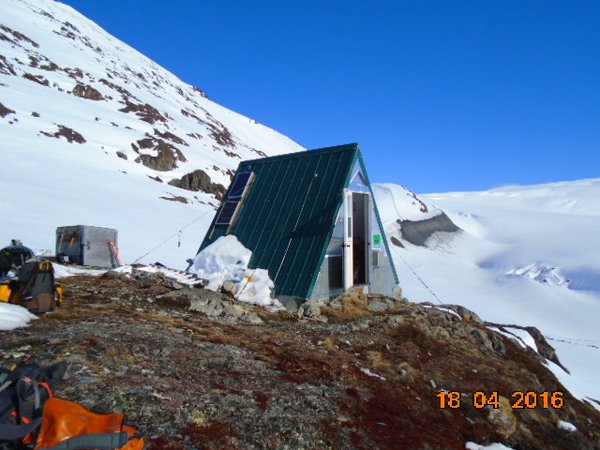
USGS Wolverine Glacier Base Camp last week with field work underway. 

juneau icefield april 2016

April 19 Landsat image of the southwest side of the Juneau Icefield.  Snowline indicated by Purple arrows. M=Mendenhall, H=Herbert, L=Lemon Creek and T=Taku Glacier.

For Mount Baker, Washington the freezing level from January-April 20 was not as high as the record from 2015, but still was 400 m above the long term mean.  Observations at the base of Easton Glacier, one of our key glaciers in the North Cascades, indicate that the snowpack has declined from a depth of 4.8 m to 3.4 m during the first three weeks of April. This is mainly due to compaction, versus snow water equivalent loss, but still represents the rapid densification that occurs as snowmelt begins in earnest.

easton 2016 snowpack april

April 2016 image from icefall on Easton Glacier at 2500 m above (Adam Dunn) and in August below same area (Jill Pelto). 

DSC07209


Kiwa Glacier Retreat, British Columbia 1986-2015

compare kiwa

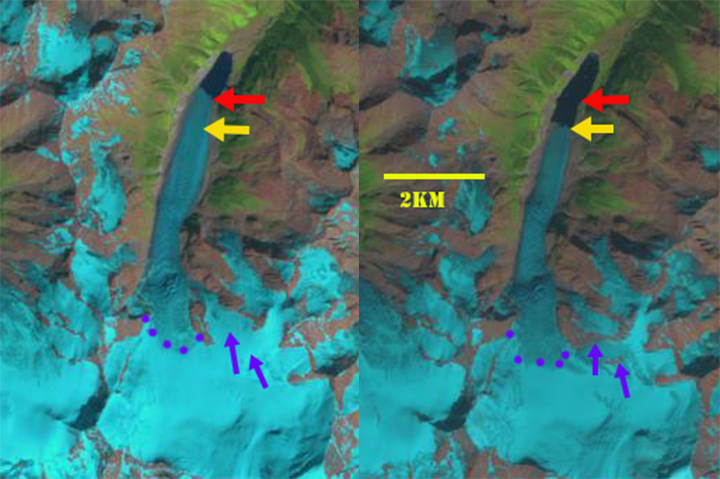
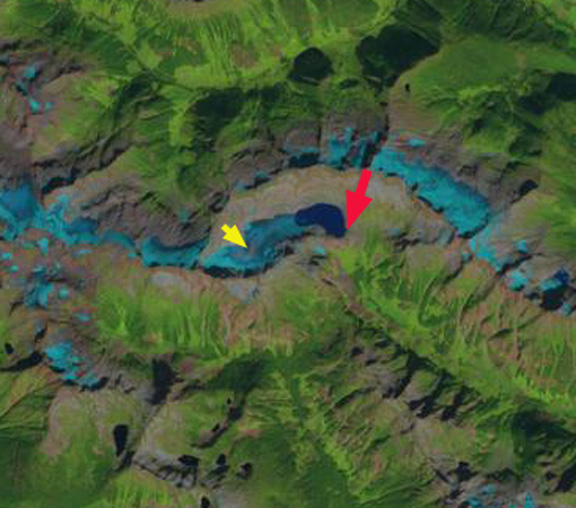
Kiwa Glacier retreat from 1986 to 2015 in Landsat images.  Red arrow is 1986 terminus and yellow arrow 2015 terminus location. Purple arrow indicates upglacier thinning where more bedrock is exposed.  Purple dots indicate the transient snowline

Kiwa Glacier is the longest glacier, at 9 km, in the Cariboo Mountains of  British Columbia.  The glacier drains northwest from Mount Sir Wilfred Laurier and is near the headwaters of the Fraser River, where it terminates in an expanding lake at 1465 m. Here we examine glacier change from 1986 to 2015. In 1986 the glacier terminated in the 700-800 m long proglacial lake.  The glacier has two significant icefalls above the terminus at 2300 m and 1800 m.   The lower icefall generating a series of ogives that are generated annually due to seasonal velocity fluctuations.  The ogives indicate the glacier velocity below this icefall.  There are 20 ogives in the span of approximately 1 km indicating a velocity of 50 m/year.  In 2015 the glacier still terminates in the proglacial lake that is now 1400-1500 m long indicating a retreat of 700 m in the thirty years from 1986-2015.  The lower 300 m of the glacier is nearly flat suggesting the lake will extend at least that far, note 2010 image from Reiner Thoni, Canadian Mountaineer.  This is also the extent that will be lost relatively quickly via iceberg calving and continued surface melt.  Above this point flow remains vigorous and retreat could diminish. Upglacier thinning has expanded bedrock areas even separating sections of the glacier, purple arrows. The transient snowline in mid-August in the Landsat images is at 2550 m. Driving through the area last week, the snowline is at 1000 m, quite high for mid-March.

Beedle et al (2015) note that glaciers in the Cariboo Mountains were close to equilibrium from 1952 to 1985 : 9 glaciers advanced, 12 receded, and 11 did not change. After 1985 they noted that all glacier retreated in the Cariboo Mountains. The response time of the glaciers to climate change is the main cause for the differing response of individual glaciers in the region as has been noted in other Pacific Northwest regions (Pelto and Hedlund, 2001 & Tennant et al, 2012).  Response times are faster for glaciers with steeper slopes, higher velocity/length ratios and a higher ratio of accumulation-ablation/ ice thickness.  The decline of glaciers, warm weather and reduced snowpack combined in 2015 to place a stress of Fraser River salmon due to lower discharge and higher temperature.  This could be an issue in 2016 as well.
adamant 2004 ge copy

Kiwa Glacier in 2004 Google Earth image

kiwa glacier rt

2010 Image from Reiner Thoni.  Well defined trimlines above the lake.  Note flat lower section of the glacier. 

Dismal Glacier, British Columbia Prospects Match Name

dismal
Landsat image comparison from 1988 and 2015, red arrow indicates 1988 terminus and yellow arrows 2015 terminus. Purple arrows indicate thinning upglacier.

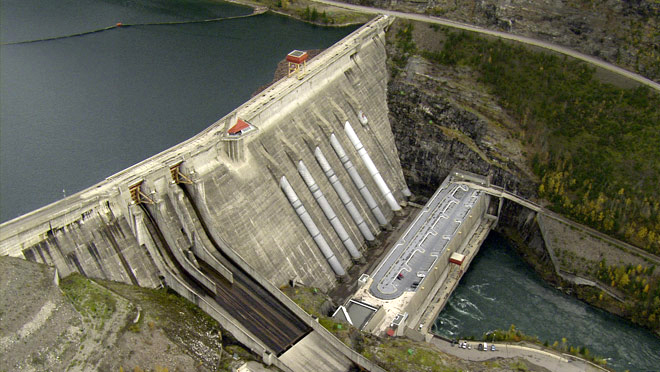
Dismal Glacier flows north from Mount Durrand in the Selkirk Range of British Columbia.  It drains from 2500 m to 1950 m and its runoff flows into Downie Creek that is a tributary to the Columbia River and Revelstoke Lake.  This lake is impounded by the BCHydro Revelstoke Dam which is 2480 MW facility.  Here we examine Landsat images from 1988 and 2015 to identify changes in this glacier.  The glacier snowline in the mid-August image of 2015 is at 2400  m just above a substantial icefall.  The glacier has retreated 640 m from 1988 to 2015.  The eastern extension at 2200 to 2300 m of the glacier noted by a purple arrow, has lost considerable area, indicating thinning even well above the terminus  elevation. Note thinning of this section of the glacier by 2015 after it joins the main glacier, it is separated by a medial moraine. The terminus in the 2009 Google Earth image has a low slope and is uncrevassed.  This indicates the terminus reach is relatively inactive, but does not appear stagnant.   Tennant and Menounos (2012) examined changes of the Rocky Mountain glaciers just east of this region and found between 1919 and 2006 that glacier cover decreased by 590 square kilometers, 17 of 523 glaciers disappeared and 124 glaciers fragmented into multiple ice masses. This will happen at Dimsal Glacier as it has at Cummins Glacier.  Bolch et al (2010)  observed a 15% area loss from 1985-2005 in this region.  The snowline has been above the icefall at 2400+ m in 2013, 2014 and 2015, indicative of negative mass balance that will lead to continued retreat.  The glaciers name is not due to its future prospects, but its future prospects are indeed dismal.
dismal glacier ge
revelstoke-dam-powerhouse-columbia-river-place
BCHydro image of Revelstoke Dam

dismal glacier
Google Earth image of Dismal Glacier terminus in 2009. Red arrow indicates 1988 terminus position, black arrows various recessional moraine features.

Cummins Glacier Fragmentation, British Columbia


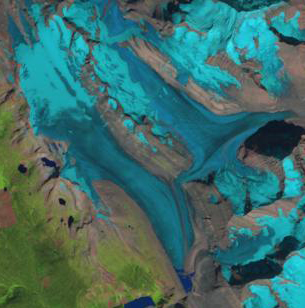
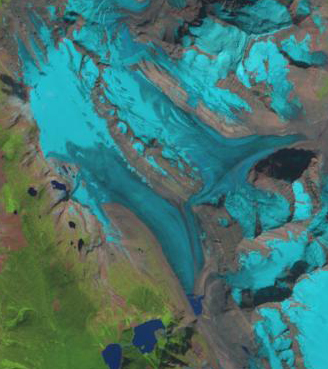
cummins compare 2015Comparison of the Cummins Glacier from 1986 to 2015.  Purple arrows indicate upglacier thinning and disconnection. Red arrow indicates 1986 terminus position.  Note the lack of snowcover in 2015. 

The Cummins Glacier is part of the Clemenceau Icefield Group in the Rocky Mountains of British Columbia. The Cummins Glacier via the Cummins River feeds the 430 square kilometer Kinbasket Lake, on the Columbia River.  The lake is impounded by the 5,946 MW Mica Dam operated by BCHydro.  Jiskoot et al (2009) examined the behavior of Clemenceau Icefield and the neighboring Chaba Icefield. They found that from the mid 1980’s to 2001 the Clemenceau Icefield glaciers had lost 42 square kilometers, or 14% of their area.  Tennant and Menounos (2012) examined changes of the Rocky Mountain glaciers and found between 1919 and 2006 that glacier cover decreased by 590 square kilometers, 17 of 523 glaciers disappeared and 124 glaciers fragmented into multiple ice masses.  Here we examine the Landsat images from 1986-2015 to illustrate that Cummins is one of those fragmenting glaciers.

cummins map

Cummins Glacier on the western side of the Clemenceau Icefield shares a connection with Tusk Glacier.

In 1986 Cummins Glacier had a joint terminus with the main southeast flowing branch and the west flowing branch terminating at the red arrow.  The glacier also had a substantial connection, purple arrow,  with Tusk Glacier that flows east terminating northeast of Tusk Peak.  There are other connections with other high elevation accumulation areas, purple arrows.  In 2013 and 2014 Cummins Glacier had less than 20% retained snowcover by the end of the melt season.  Typically 50-65% of a glacier must be snowcovered at the end of the summer season to be in equilibrium.  In 2015 conditions were even worse with no retained snowcover, in fact there is only minor patches of retained firn from previous years.  The lack of a persistent accumulation zone indicates a glacier that cannot survive the climate conditions (Pelto, 2010).  By 2015 a proglacial lake had formed at the terminus that is 500 m long, representing the retreat during the thirty year period.  The west flowing portion of the Cummins has detached from the larger branch.  The connection to Tusk Glacier is nearly severed, and in terms of flow is effectively ended. Retreat of the margin higher on the glacier is also evident at each purple arrow. Tusk Glacier is no longer connected to Duplicate Glacier, and has retreated to the north side of Tusk Peak.  The dominant change in Cummins Glacier has been thinning, it should now be poised for a more rapid retreat.

The result for Kinbasket Lake of the loss of the collective large area is a reduction in summer glacier melt and summer glacier runoff. The annual runoff which will be dominated by annual precipitation would not change just because of the glacier loss as noted in cases like the Skykomish Basin (Pelto, 2011) and on Bridge River (Stahl et al 2008).

cummins 2013

2013 Landsat image indicating 20% retained snowcover with a month left in the melt season.

cummins 2014

Landsat image 2014 about 25% retained snowcover with three week left in the melt season.

apex-watershed

Google Earth Image of Cummins Glacier location to Kinbasket Lake.

Yoho Glacier, British Columbia Accumulation Zone Woes

yoho glacier melt

Yoho Glacier in 2005 no accumulation zone in sight.

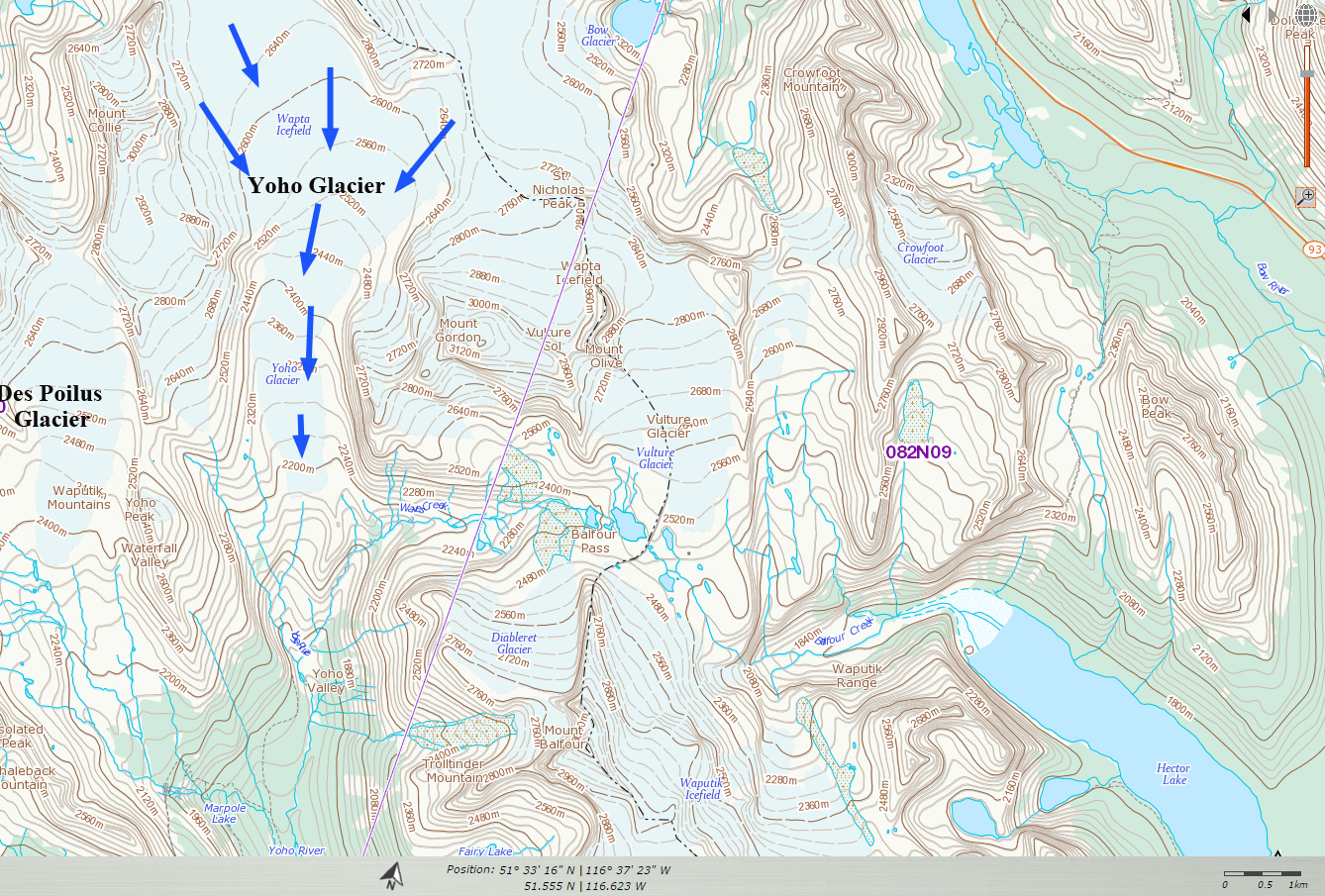
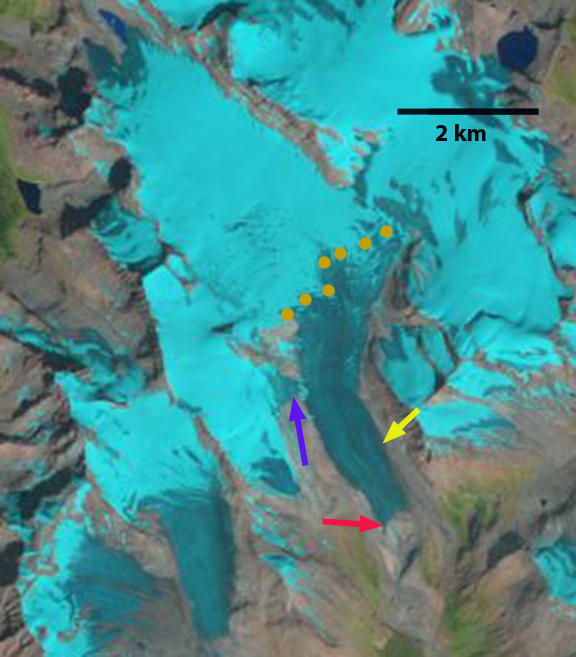
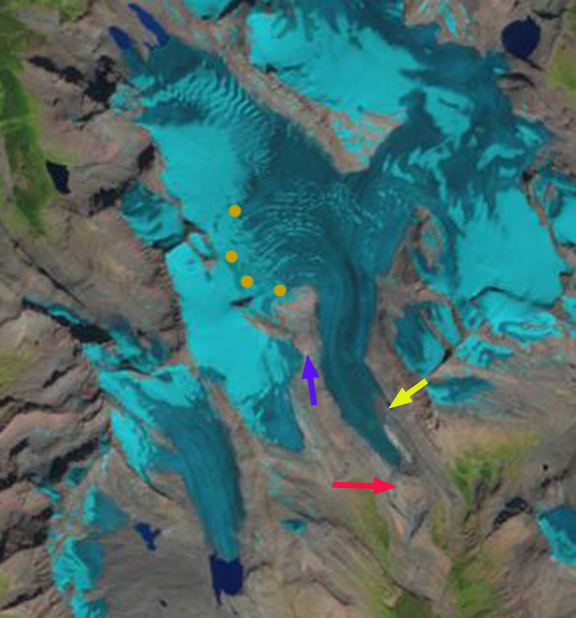
Yoho Glacier is the largest southern outflow draining the south from the Wapta Icefield in the Kootenay region of British Columbia. It flows 6.5 km from the 3125 m to a terminus at 2200 m. The glacier terminus reach is thin, gently sloping  and uncrevassed poised for continued retreat. An exploration of Mount Balfour in 1898 a party led by Professor Jean Habel with the packer Ralph Edwards as a guide were the first to visit and describe Yoho Glacier. There descriptions of the magnificent Takakkaw Falls down river of the glacier quickly led to it becoming a frequent destination of visitors. The glacier was also accessible. Retreat up a steep slope at 2000 m made actually visiting the glacier difficult in the middle of the 20th century.  The glacier has retreated 2.1 km in the last century leaving a vast area of bare terrain, dotted by several small new alpine lakes. Here we examine changes in the glacier from 1986 to 2015 with Landsat imagery.

yoho map final
CanadianTopographic map

In 1986 the glacier terminated in a broad 500 m wide glacier terminus at 2150 m, red arrow, the glacier tongue remained wide up to the yellow arrow, 800 m. A tributary connected to the glacier at the purple arrow, and the glacier snowline, orange dots was at 2550 m. In 1998 the terminus had not retreated significantly, but had narrowed noticably. The tributary at the purple arrow was no longer connected and the snowline was at 2750 m, leaving little of the glacier snowcovered, which equates to a significant mass loss. In 2013 the snowline again was high at 2700 m. In 2015 the glacier terminus has retreated 300 m since 1986 and is only 250 m wide. The width at the yellow arrow is 450 m. The width reduction is an indicator of how much the glacier has thinned. The snowline is at 2800 m in this mid-August image, clinging only to the high slopes of Mount Collie, and would still rise for several more weeks in the summer. The nearby Peyto Glacier has an annual mass balance record indicating a thinning of 25 m during this period (Kerhl et al, 2014).  A glacier typically needs more than 50% of its area to be in the accumulation zone at the end of the summer to be in equilibrium.  In recent years when the snowline exceeds 2700 m less than 10% of the Yoho Glacier is in the accumulation zone. If the snowline is as high as it has been recently on Yoho Glacier, that indicates the lack of a significant accumulation zone and it cannot survive even current climate.  However, in both cases the Peyto and Yoho Glacier are rapidly losing volume, but remain substantial in size and are not on the verge of disappearing in the next few decades. The retreat is similar to that of Des Poilus Glacier shown in the lower left of the Landsat images here.

yoho glacier 1986
1986 Landsat Image

yoho glacier 1998
1998 Landsat Image

yoho glacier 2013
2013 Landsat image
yoho glacier 2015
2015 Landsat image

Hess Mountain Glacier Retreat, Yukon

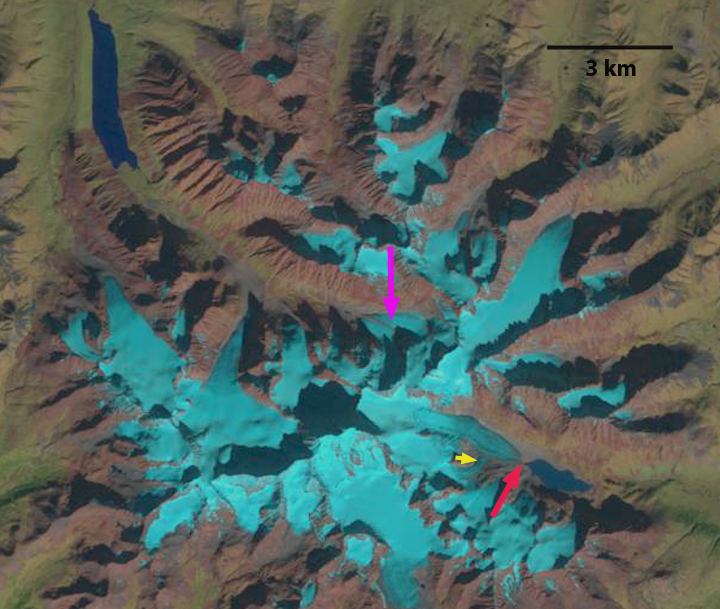
In the Selwyn Mountain Range, Yukon at the headwaters of the Hess River is the Hess Mountains and Keele Peake the highest peak in the region. A series of glacier radiate from this region. The Yukon Territory is host to numerous small alpine glaciers that have been rapidly losing area and volume.  From 1958-2007 glaciers lost 22% of their volume in the Yukon (Barrand and Sharp, 2010).  Due to the high snowlines David Atkinson, at University of Victoria notes the rate of retreat has increased since then, and is using weather stations to identify the specific conditions driving the ice loss. Semmes and Ramage (2013 ) observed in the Yukon River Basin from 1988 to 2010 a significant lengthening of melt duration t with earlier melt onset in high elevations  and significant later end of melt refreeze in theintermediate elevations ( 600 to 1600 m). Here we examine in particular a glacier draining southeast from the Hess Mountains that feeds the Hess River using Landsat imagery from 1986 to 2015.
hess map

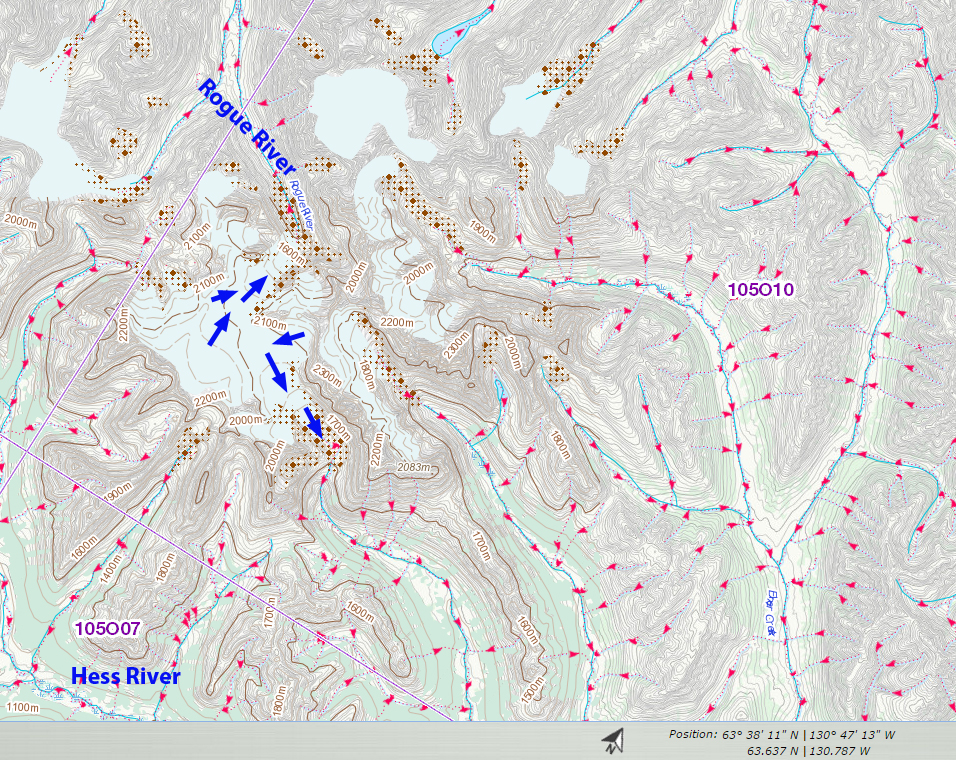
In this Canadian Toporama image the glacier of primary interest has flow indicated by the blue arrows.

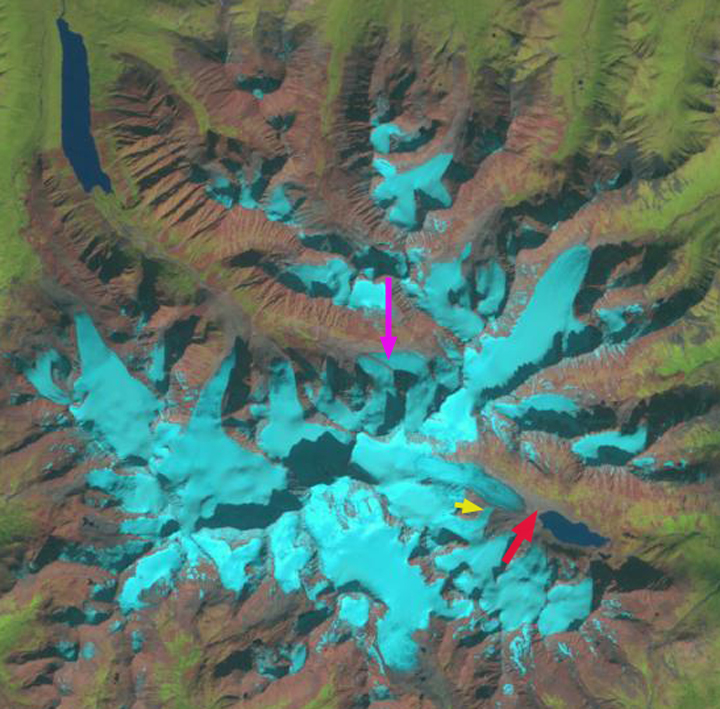
In 1986 the glacier extended to within a 100 meters of an alpine lake, with the terminus indicated by the red arrow.  The glacier was joined near the terminus by a tributary at the yellow arrow.  At the pink arrow a separate glacier terminus is formed by the merging of two glaciers.  In 1992 the main glacier tongue has retreated further from the lake.  By 2015 the tributary no longer is connected to the main glacier and terminates 600 meters above the valley.  The main glacier terminus has retreated 800 meters since 1986, and is now just over 3 km long. The terminus area at the glacier flowing north at the pink arrow, is no longer formed by the merging of two glacier termini, as two distinct termini exist.hess 1986

1986 Landsat Image

hess 1992

1992 Landsat Image

hess 2015

2015 Landsat Image


Rogue River Icefield Rapid Retreat, Selwyn Mountains, Yukon

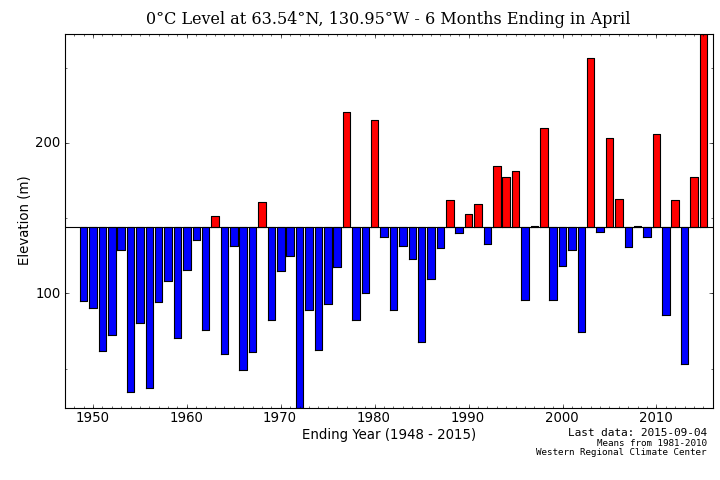
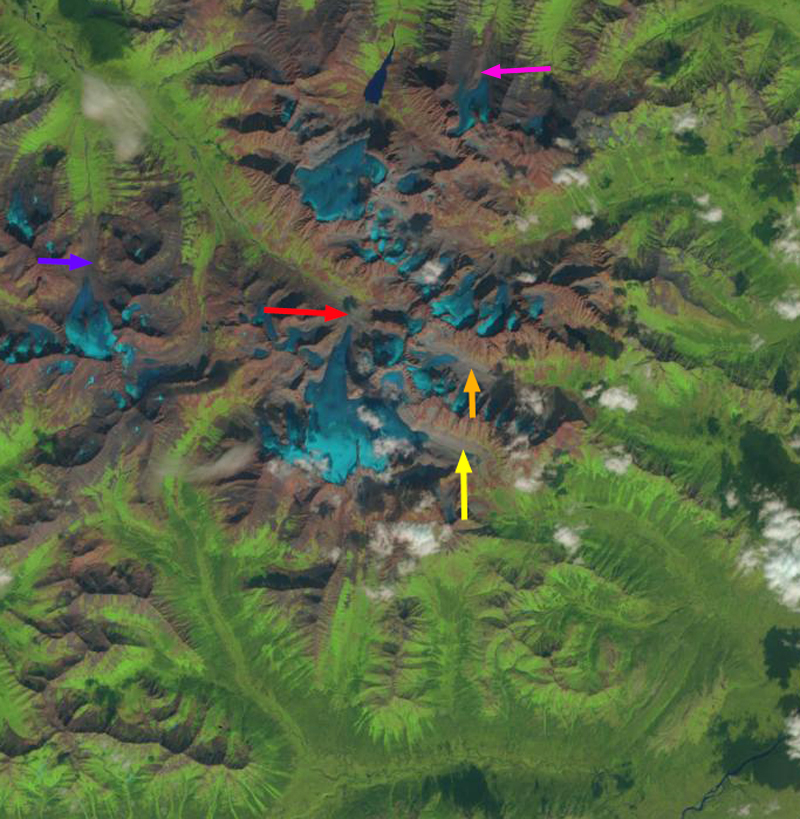
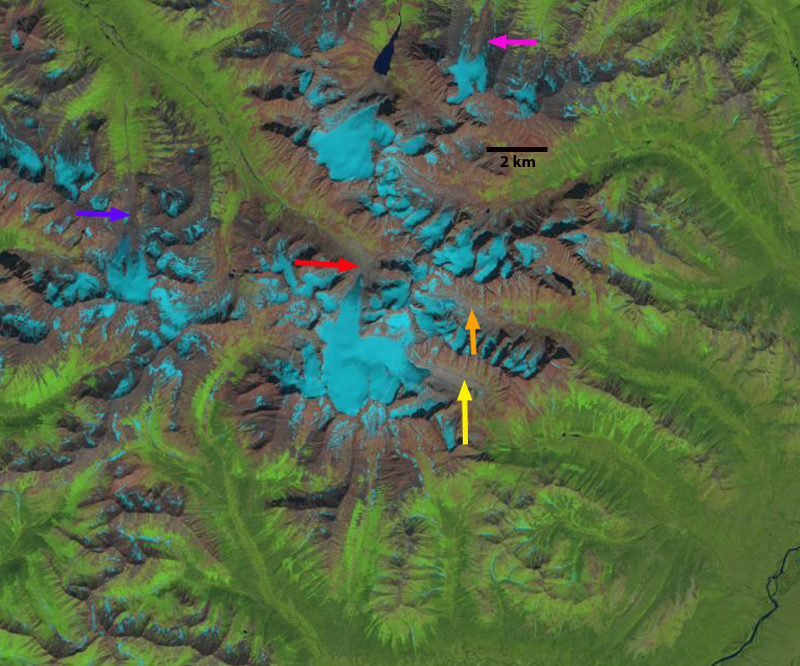
The Selwyn Mountains, Yukon Territory are host to numerous small alpine glaciers that have been rapidly losing area and volume. David Atkinson, atmospheric scientist at University of Victoria has been examining the weather conditions leading to the extensive melting and higher snowlines. From 1958-2007 glaciers lost 22% of their volume in the Yukon (Barrand and Sharp, 2010).  Due to the high snowlines Atkinson notes the rate of retreat has increased since then.  The freezing level as determined by the North American Freezing Level Tracker illustrates this point with 2015 being the highest winter freezing level. Here we examine response of the Rogue River Icefield using Landsat imagery from 1986-2015.  The icefield is at the headwaters of the Rogue River and also drains into the Hess River.

rogue river

Canada Toporama map of the region.

selwyn

Selwyn Mountain November-April freezing levels.

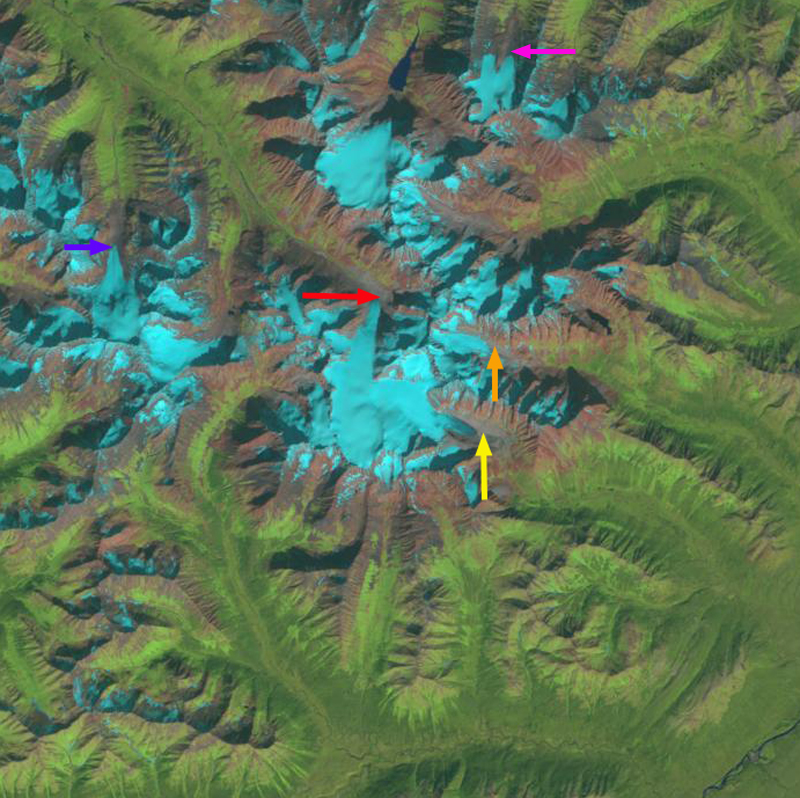
In 1986 the primary icefield glacier is shown with blue arrows above indicating flow direction towards both the north and southeast terminus.  The north terminus reached the valley bottom at the red arrow and the southeast terminus extended to the yellow arrow in 1986. All arrows are in fixed locations in every image. The purple and orange arrows indicate the terminus of smaller valley glaciers in 1986.  The pink arrow indicates a valley glacier that is split into two terminus lobes by a ridge. By 1992 the only significant change is the southeast terminus of the primary glacier at the yellow arrow. In 2013 the snowline is exceptionally high at 2200 meters, with glacier elevations only reaching 2300 m.  Retreat is extensive at each terminus.  In 2015 the satellite image is from early July and the snowline has not yet risen significantly.  Terminus retreat at the yellow arrow is 900 meters, at the red arrow 400 m, at the purple arrow 600 m, at the pink arrow 400 m and at the orange arrow 500 m.  Given the length of these glaciers at 1-3 km this is a substantial loss of every glacier.  Further south in the Yukon high snowlines are also a problem for Snowshoe Peak Glacier.

rogue river 1986

1986 Landsat image

rogue river 1992

1992 Landsat image

rogue river 2013

2013 Landsat Image

rogue river 2015

2015 Landsat image


Mount Caubvick Glacier Retreat, Labrador

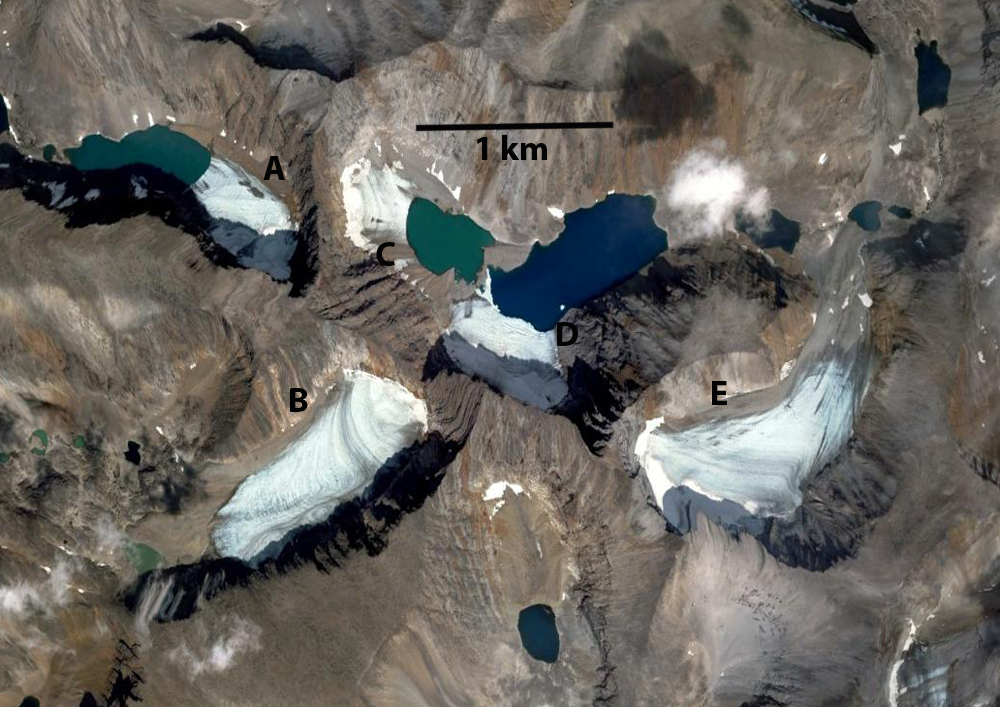
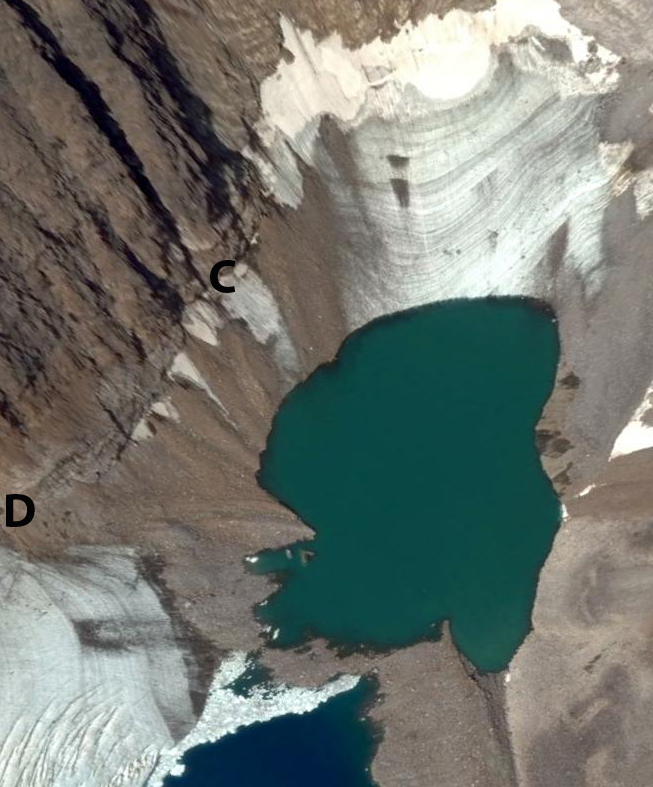
Mount Caubvick is in the Torngat Mountains of Labrador 35 km inland of the Atlantic Ocean and south of Nachvak Fjord. Way et al (2014) identified 105 active glaciers that had flow indicators in these mountains.  The mean elevation of these glaciers is quite low at 776 meters above sea level. The radiational shading and higher accumulation from protected cirque locations and proximity to the ocean are key to the low elevations. The elevation of the glaciers around Mount Caubvick is higher. Here we use Landsat images from 1992, 1997 and 2015 to identify response to climate change. The annual layers preserved in the glacier ice are evident in glacier B,C and E.

caubvick

2013 Google Earth image of Mount Caubvick, Torngat Mountains, Labrador.

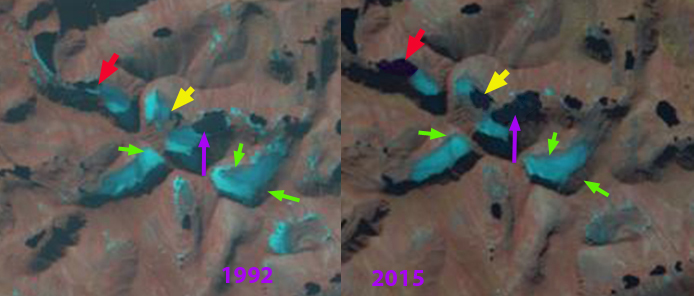
In 1992 Glacier A terminates at the red arrow in an expanding lake. Glacier C terminates at the yellow arrow in a just forming glacial lake.  Glacier E terminates at the purple arrow in a glacial lake that is similar in length to the glacier. In 2015 each lake has notably expanded.  The arrows are in the same locations in the 2015 image.  At the red arrow, Glacier A has retreated 200 m, which is 20% of its entire length. Glacier C, yellow arrow has retreated 250 m, 40% of the total glacier length.  At the purple arrow, Glacier D has retreated 225 m, which is 35% of its total length.  The retreat of Glacier B and E is less clear as the terminus locations are hard to determine in 1992.  What is most evident is the reduction in ice area at the higher elevations of the glaciers noted by the green arrows. In 1997 there is little expansion of the three lakes since 1992, indicating most of the retreat has been in the last 18 years.  Glacier B provides a good snapshot of annual layers.  The black arrow indicates the lack of an accumulation zone, without which a glacier cannot survive (Pelto, 2010). The red arrow indicates a band of annual layers that marks what had been the typical snowline Indeed none of the glaciers in 2015 in either the 2013 Google Earth image or 2015 Landsat have significant retained accumulation, indicating none can survive current climate. Way et al (2014) figure 4 indicates an example of the same snowline setup on a different glacier near Ryans Bay. .  it is evident that in the last decade firn and snow are not retained consistently. Sharp et al (2014) indicate in Figure 52 the mass loss of Canadian Arctic glaciers in general, that parallels that of Labrador.

caubvick compare

1992-2015 Landsat comparison of Mount Caubvick glaciers

torngat 2014 annual layers

Glacier B with numerous annual layers with the snowline indicates by red arrow and lack of accumulation black arrow.

torngat cirque layers


Glacier C annual layers. 

Auyuittuq National Park Ice Cap Downwasting, Baffin Island

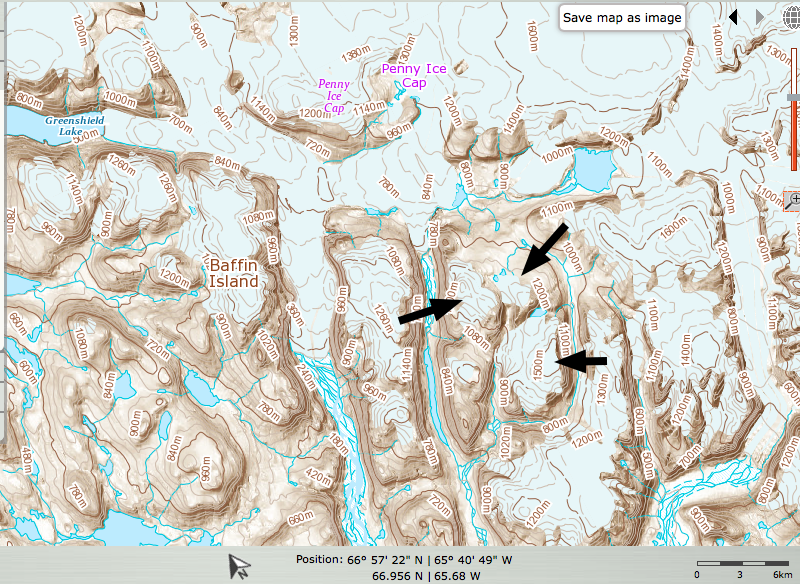
Just south of the Penny Ice Cap on Baffin Island in Auyuittuq National Park there are a large number of small ice caps.  We focus on three of these ice caps east of Greenshield Lake.  The region has been experiencing rapid ice loss, with 50 % of the ice cap area lost in the last few decades (Miller et al, 2008).  Miller et al (2008) also observe that these are thin and cold glaciers frozen to their beds with limited flow. Way et al (2015) observed the loss of 18-22% of two larger ice caps on Baffin Island, Grinnell and Terra Incognita.  The ice cap losses are due to reduced retained snowpack. Zdanowicz et al (2012)  found that starting in the 1980s, Penny Ice Cap entered a phase of enhanced melt rates related to rising summer and winter air temperatures across the eastern Arctic. In recent years they observed that 70 to 100% of the annual accumulation is in the form of refrozen meltwater. However, if the snowline rises above the ice cap consistently, as happened at Grinnell Ice Cap than there is no firn to retain the meltwater and superimposed ice formation is limited.  Meltwater has difficulty refreezing on a glacier ice surface. The rise in temperature is illustrated by a figure from Way et al (2015), below

penny ice cap map

Map of region south of Penny Ice Cap from Canadian Topographic maps.

gic summer climate

Figure From Way et al; (2015)

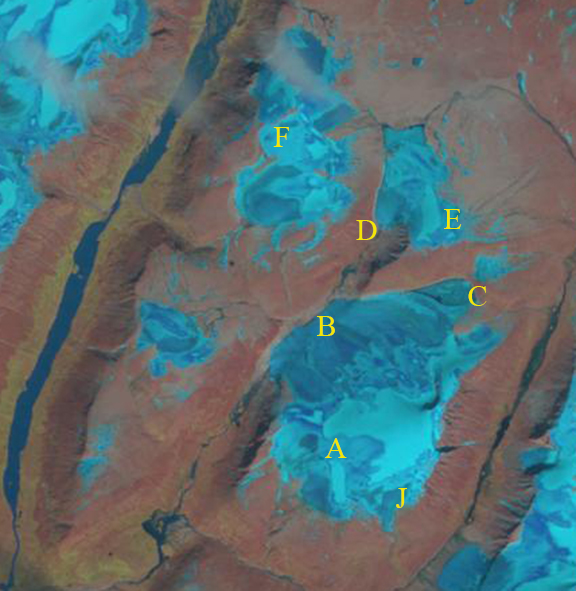
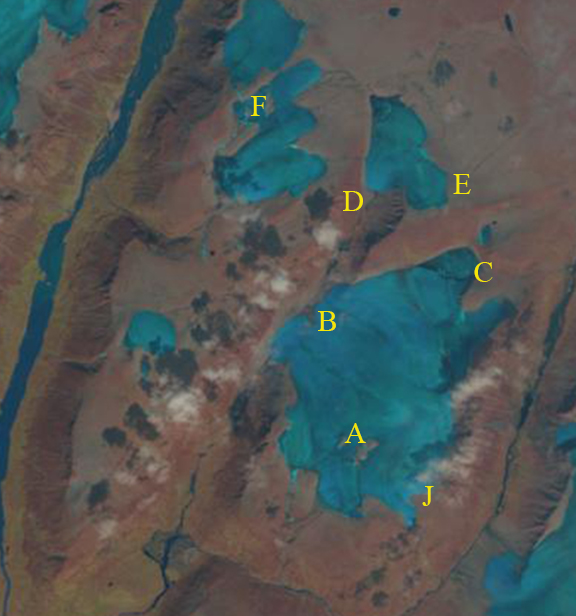
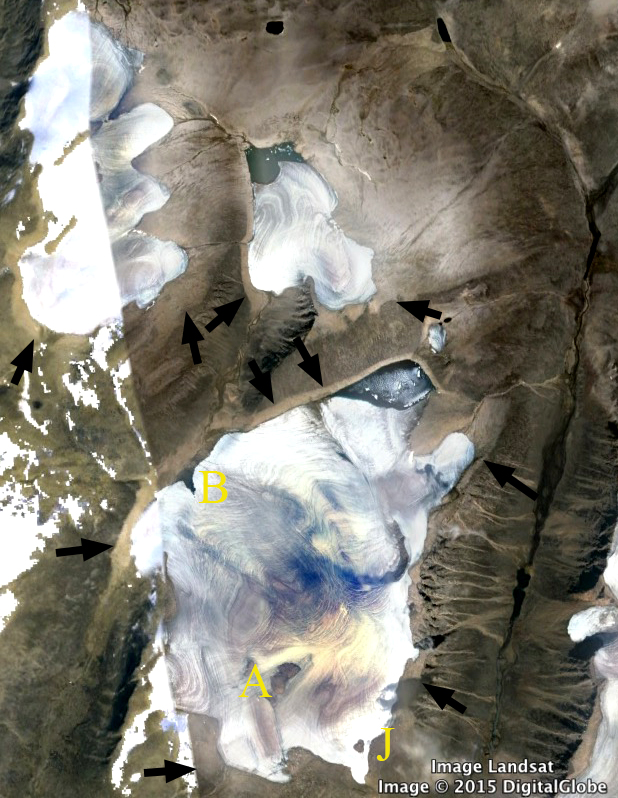
In the 1998 Landsat image the two northern ice caps, with E and F on them, have very little retained any snowpack, but significant firn areas.  The larger ice cap has retained snowpack adjacent to Point A and considerable firn area as well. There is a trimline beyond the glacier margin apparent west of Point B due to recent retreat, but otherwise trimlines are not immediately evident.  In 2000 the two northern ice caps again have very little retained snow, and the larger ice cap retained snow near Point A.  In the 2013 Google Earth image black arrows on the image indicate trimlines recently exposed by glacier retreat.  There is no evident retained snow, and no retained firn is even evident. This suggests the ice caps lacks an accumulation zone.  A close up view, illustrates many years of accumulation layers now exposed, note the linear dark lines, black arrows.  The second closeup view illustrates the area around Point E and D that has been deglaciated.  There also are some new areas of expanded bedrock such as near Point A on the larger ice cap.  The 2014 Landsat image indicates the bedrock has expanded at Point A.  At Point B an area of bedrock is expanding into the ice cap.  At Point C the lake has expanded at.  Ice has melted away from Point D and E. At Point F a new area of bedrock has emerged within the ice cap.  At Point J the new bedrock seen in the 2013 Google Earth image has now expanded to the margin of the ice sheet.  These changes are a result of a thinning ice cap, largely due to increased ablation.  The lack of retained snow cover or firn confirms there is not a consistent accumulation zone and that these ice caps cannot survive current climate (Pelto, 2010).

baffin smi 1998 copy

1998 Landsat image

baffin smi 2000 copy

2000 Landsat image

baffin smi 2013ge copy

2013 Google Earth Image

baffinsmi closeup copy

Google Earth Closeup

baffinsmi closeup2 copy

Google Earth Closeup

baffin smi 2014 copy

2014 Landsat image


Kokanee Glacier Spring 2015 Assessment, British Columbia

Guest Post by Ben Pelto

Kokanee Glacier is located in the Selkirk Mountains of southeastern B.C., 30 km northeast of Nelson in Kokanee Glacier Provincial Park. Kokanee Glacier drains into the Joker Lakes, the uppermost of which are turquoise due to glacier flour input. Joker Creek carries the water downstream, eventually feeding into the Kootenay Lake and the Kootenay River, which flows to meet the Columbia River in Castlegar, B.C. In the last few years a decline in the number of fish inventoried in feeder streams to the lake caused cancellation of the Fishing Derby in 2015. The Meadow Creek spawning channel usually supports 500,000 to one million kokanee spawners, declined to less than 200,000 annually. In fall 2014, their numbers were down to 60,000. A drop of snow melt from this glacier also would pass through 16 hydroelectric facilities before reaching the ocean.

kokannee AZ

Kokanee Glacier looking west towards camp. April 20th, 2015 Photo: Ben Pelto

A research team from the University of Northern British Columbia and the University of Calgary began visiting the glacier each spring and fall beginning in 2013. Fall access to the glacier is via the Gibson Lake trailhead, which is a 7.5 km hike to Kaslo Lake and the new Kokanee Glacier Cabin (Slocan Chief cabin is only 1 km farther up the trail, but is no longer in use as a backcountry cabin). Spring access is via helicopter under a research permit. The Kokanee Glacier is north-facing and extends from 2800 meters at the summit of Kokanee Peak, to 2230 m where it terminates in an unnamed lake.  This lake is a recent addition to the Joker Lakes, due to glacier retreat in the past two decades. The Kokanee Glacier covers about 1.7 km2.
Kokanee map

Contour map of the Kokanee Glacier, with the uppermost Joker Lake. Approximate current terminus position purple-dashed line. Oval indicates new proglacial lake.

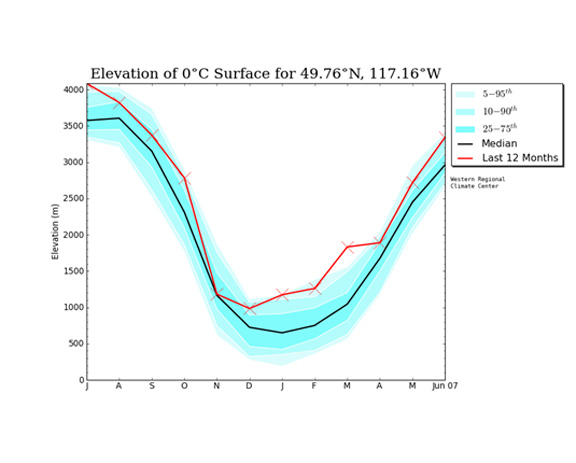
Our spring visit to the glacier documented snowpack deposited during an anomalously warm winter, as shown in the image below from the North American Freezing Level Tracker. The tracker is run by Idaho State University and estimates freezing levels based on the NCEP/NCAR Global Reanalysis, which is determined every six hours. Freezing level is the elevation where air temperature is 0°C at a given time. Freezing levels are important to mountain hydrology and determine whether precipitation falls as rain or snow, the elevation of the rain/snow line, whether the ground is frozen when snow falls in the autumn, the efficiency of snowpack accumulation through the winter (melt events, rain on snow), the internal temperature of the snowpack (which drives melt and metamorphosis of the snowpack), and the length of snow free season at a given elevation. What is immediately apparent is that freezing levels were elevated throughout the accumulation season, which generally begins in late September. Freezing levels were highest relative to the median in the key winter months of January through March. Local skiers and ski guides complained of rain during many storms, which reached to or near the mountain tops and left poor skiing conditions.kokanee fl
Estimated freezing levels for Kokanee Glacier for July 2014 to June 2015 North American Freezing Level Tracker

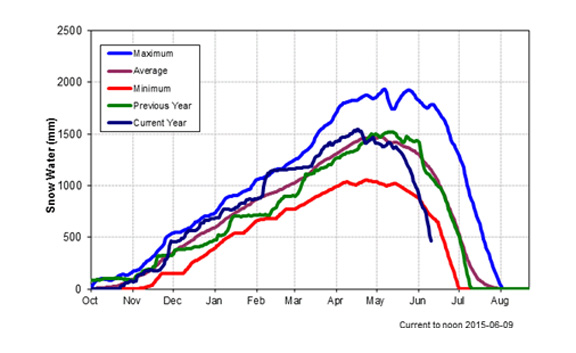
The Redfish Creek snow pillow is the nearest snow pillow site (see below), and is located 7 km southeast of the glacier at 2086 m. The Kokanee Glacier extends from around 2230 m to 2800 m so the snow pillow site may not accurately represent the amount and type of precipitation on the glacier. Regardless, this winter featured a fairly average snowpack, generally hovering above the mean SWE (snow water equivalent), which is calculated from 2001, when the gauge was installed, to present. A precipitous drop in SWE marked an early and strong start to the melt season, with maximum snowpack coinciding with our visit (April 19-21, 2015), roughly two weeks ahead of the usual SWE maximum date (in the first week of May) as seen by the purple line.

kokannee snowdepth

Redfish Creek snow pillow site of the B.C. River Forecast Center for 2014-2015.

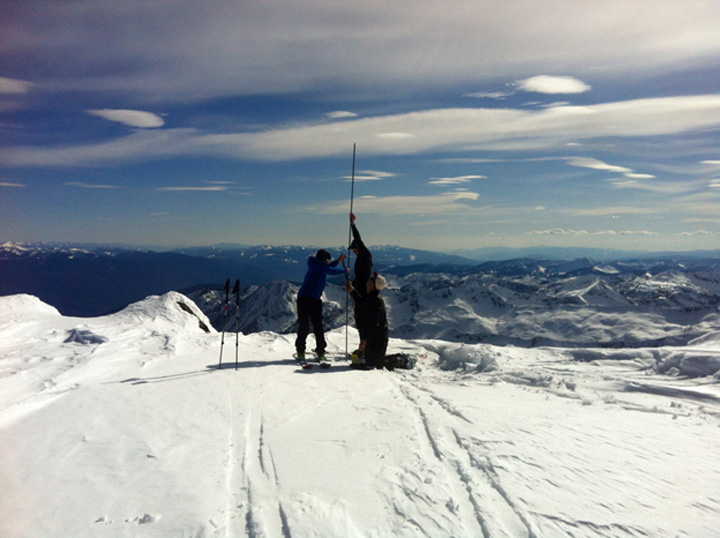
The primary goal of our trip was to assess winter accumulation. Our measurements consisted of probing snow depth and digging snow pits. We took 80 probe measurements at 20 locations, and dug two snow pits, one at 2475 m and one at 2675 m. While snow depth was lowest near the terminus at 3 to 3.5 m, there was no correlation between elevation and accumulation from 2300 m and above, which accounts for a majority of the glacier area. Above 2300 m, snow depth ranged from 4.3 to 6.3 m with an average of 4.8 m.

kokanee probing
Probing snow depth on the Kokanee Glacier, April 20th, 2015. Photo: Alison Criscitiello.

Our measurements revealed that this year’s snow pack was a dense one, likely due to mid-winter melt events, rain-on-snow events, and increased temperature during snow events. Given that snowpack was low across B.C. in the winter of 2014-2015, it would have been reasonable to assume that the glacier fared poorly. However, the winter balance was precisely halfway between the healthy winter balance of 2013 and the weak winter balance of 2014. Our data indicate that freezing levels played a large role in this year’s snowpack for the Kokanee Glacier given that the surrounding region is below 50% of normal snowpack, yet the glacier is much closer to normal as it was still above even the high 2015 winter freezing levels. Given our limited sample size, with this being the third measured winter accumulation, it is beyond the scope our data to assess how close to or far from normal this winter’s snowpack was for the Kokanee Glacier.

Standing on the glacier looking down valley, we observed that bare ground began around 1800 m where there should have still been a couple meters of snow. This highlighted the stark contrast between high and low elevations. Clearly, rain dominated below 1800 m this winter. This winter may be a potential model for the immediate future climate, where increased winter temperatures lead to a higher snowline, lower snowpack at lower elevations, and near average snowpack at higher elevations. Given the early start to fire season in B.C. and the Yukon, similar winters will come at a high cost for fire fighting, forest productivity, and water resources.

kokanee twilight

View looking west from Kokanee Glacier April 19, 2015. Approximate snow line yellow dashed line ~1800 m. Red J indicates location of uppermost Joker Lake. Red T is just beyond the terminus, which cannot be seen due to the slope. Photo: Ben Pelto

kokanee snowpit

4.5 m deep snow pit at 2675 m on the Kokanee Glacier, April 20th, 2015. Photo: Alison Criscitiello.

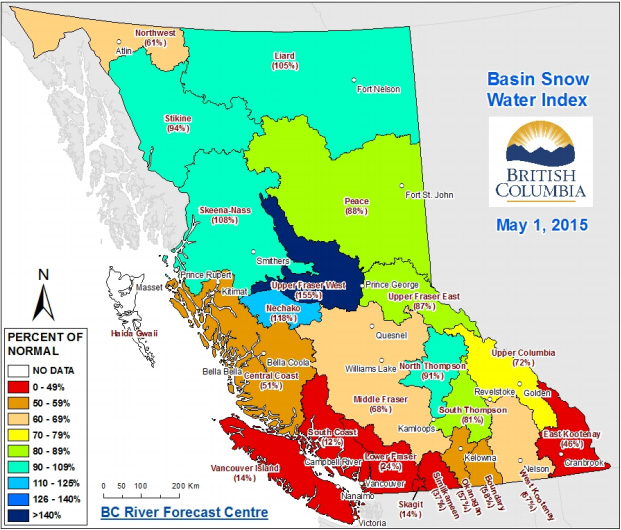
The B.C. River Forecast Center releases a monthly snow report, and stated that temperatures in the Kootenay Region, where the Kokanee Glacier is located, were 3 to 5°C above average. The image below shows that by May 1, snowpack was 67% of average. The June 1st map has all but three sub-regions of B.C. exhibiting less than 50% of normal snowpack, with the West Kootenay region at 30% of normal. The result will be less snowpack across southern BC this summer. At the end of August last year there was considerable bare ice and firn exposed on Kokanee Glacier, this year we anticipate even more upon our return at the end of the melt season. Of course the snow report is critical for hydropower in BC.  For the Kokanee Glacier, meltwater goes through a series of hydropower dams on the Kootenay River.
bcsnowpack

May 1, 2015 Snow Report Map, B.C. River Forecast Center.  Kokanee Glacier located by Nelson in SE B.C.

kokanee 2014

Kokanee Glacier, Aug. 27th 2014. the darker areas are either firn that has survived more than one summer or bare glacier ice. 

kootenay river hydro


Kootenay River Hydropower. 

Salmon Challenges From Glaciers to the Salish Sea

The Salish Sea includes Puget Sound, the Strait of Georgia, and the Strait of Juan de Fuca of Washington and British Columbia. The Salish Sea supports all seven species of Pacific salmon, chinook, chum, coho, cutthroat, pink, sockeye and steelhead. Population declines have prompted initiation of the Salish Sea Marine Survival Project. This project reports that: chinook, coho, and steelhead have experienced tenfold declines in survival during the marine phase of their lifecycle, with total abundance remaining well below levels of 30 years ago. The conditions in the Salish Sea have changed and salmon survival has been declining, Zimmerman et al (2015) observed the primary pattern within the Salish Sea is declining smolt survival from 1977-2010.  Of course the salmon begin and end their life cycle in the streams, many glacier fed, and these too have experienced changes that are not favorable for salmon. The Salish Sea is fed by numerous glacier fed streams, all of which have experienced substantial retreat in the last 30 years, with many already experiencing significant summer declines in overall and glacier runoff (Stahl and Moore, 2006; Pelto, 2008). The largest input river is the Fraser River (FR), Padilla et al (2014) note an increasing variability in summer flow, and with a warming climate greater variability in annual streamflow, and hence in hydrological extremes is anticipated, which is not favorable to salmon. This post provides selected specific examples of observed changes on glaciers in the Salish Sea watershed.

.salish sea map

Modified Map from Environment Canada

Decline-of-Marine-Survival-in-the-Salish-Sea2


Salmon Changes from the Salish Sea Marine Survival Project 

whitechuck change

The loss of the north branch of the Whitechuck Glacier

The Whitechuck Glacier supplies flow to the headwaters of the Whitechuck River. Its white expanse has graced these headwaters for thousands of years. The Whitechuck Glacier retreated slowly from its advanced Little Ice Age position until 1930, while rapidly thinning. Thus, prepared it began a rapid retreat in 1930. This rapid retreat culminated in the total disappearance of the north branch of the glacier in 2001, our third visit to the glacier. No more does this glacier dominate the headwaters, and its demise has and will continue to alter the hydrology of the Whitechuck River headwaters.The amount of runoff entering the Whitechuck River has declined substantially in the summer. For thousands of years each square meter of glacier has contributed 3 cubic meters of runoff from July I-October 1. With the loss of glacier ice, this contribution should drop by 65-80% based on observations at two other sites where glaciers have disappeared (Pelto, 1993 & 2008). The change since 1950 in glacier area has reduced summer glacier runoff by 5.7 million cubic meters annually. This represents a loss of between 0.55 to 0.65 cubic meters/second for the Whitechuck River during the July-September period. The water will also be less sediment laden and warmer. The impact will be less water for the fall salmon runs, and less food in amount and processing for stream invertebrates on which salmon feed downstream in the Sauk and Skagit Rivers.  Milk Lake Glacier also fed this watershed before disappearing in the 1990’s.

milk lake change

Milk Lake Glacier on USGS map from 1979 and in 2009.

Nooksack River: For 31 years we have completed measurements of ablation, glacier area change and runoff in this basin, all are losing mass and retreating (Pelto and Brown, 2012). During stressful warm weather events in the last five years we have measured ablation on and runoff from glaciers in the basin. In addition the USGS gages record discharge and stream temperature in the South Fork, Middle Fork and North Fork Nooksack. During these events runoff measurements below Sholes Glacier and ablation measurements on Sholes Glacier indicate daily ablation ranging from 0.05-0.06 meters per day, which for the North Fork currently yields 9.5-11 cubic meters/second. This is 40-50% of the August mean discharge of 24 cubic meters/second, despite glaciers only covering 6% of the watershed. In the unglaciated South Fork all 12 warm weather events generated a rise in stream temperature of at least 2 C, only 2 event in the North Fork generated this rise. Discharge rose at leasts 15% in 10 of the 12 events in the North Fork and none of the events in the South Fork. As the glaciers continue to retreat the North Fork will trend first toward the more limited impact of the Middle Fork and then the highly sensitive South Fork where warm weather leads to declining streamflow and warming temperatures. Our ongoing measurements of daily runoff and daily streamflow below Sholes Glacier allow determination of the contribution of glaciers to the North Fork Nooksack, which peaked in 2014 at 80% of total streamflow. Glacier runoff surpassed 40% of the total streamflow on 26 days after Aug. 1 in 2014. The Nooksack Salmon Enhancement Association has completed numerous salmon restoration efforts, but climate is one challenge that cannot be restored locally.

deming terminus 2011
Deming Glacier Retreat 1984-2011-headwaters Middle Fork Nooksack River

nooksack response
Response of watersheds to warm weather events.

Skykomish RiverThe reduction of the glacial melt component augmenting summer low flows is already resulting in more low-flow days in the North Cascade region. In the Skykomish River watershed from 1958-2009 glacier area declined from 3.8 km2 to 2.1 km2, a 45% decline (Pelto, 2011). A key threshold of in-stream flow levels considered insufficient to maintain short term survival of fish stocks is below 10% of the mean annual flow (Tennant, 1976). For the Skykomish River 10% of mean annual flow is 14 cubic meter/second. In the Skykomish River from 1950-2013 there have been 230 melt season days with discharge below 14 cubic meter/second. Of these 228, or 99% of the low flow days, have occurred since 1985. The loss of 30-40% of the glacier runoff is a key reason for the onset of more critical low flow days. Of more concern for aquatic life is the occurrence of extended periods of low flow (Tennant, 1976). From 1929-2009 in the Skykomish River basin there have been eight years where streamflow dropped below 14 cubic meter/second. for 10 consecutive days during the melt season, 1986, 1987, 1992, 1998, 2003, 2005, 2006 and 2007. It is likely that 2015 will join this list

lynch change

Lynch Glacier, Skykomish Basin in 1978 (Bill Prater, Photograph) when Pea Soup Lake was filled with ice and in 2007 with the glacier no longer reaching the lake.

Fraser River-Southern BC: Koch et al,(2009) observed a widespread retreat and glacier area loss in Garibaldi Provincial Park just to the west, with 20% area loss from 1988-2005. Bolch et al (2010) noted that from 1985-2005 that glaciers in the southern Coast of British Columbia lost 10% of their area, 0.6% per year and that the rate was increasing. By 2015 this area loss is certainly greater than 15%. For a longer time span Tennant et al (2012) noted that from 1919-2006 the glaciers in the central and southern Canadian Rocky Mountains lost 40% of their area. Of the 523 glaciers they observed 17 disappeared and 124 separated. Many of these do not drain into the Salish Sea, but does give a sense that the overall change is larger than 20%.

The change in glacier area is key because observed melt rates increases have been less than 20%. Hence, as glacier area declines at a greater rate than glacier melt rate, glacier runoff declines.  The Helm Glacier below exemplifies the change from a shrinking area of ice available for summer melt, since 1928 the glacier has lost 78% of its area. Helm Glacier drains into the Cheakamus River, which supplies Daisy lake Reservoir and the BCHydro 157 MW Cheakamus Power Plant.  The Cheakamus River has the Dave Marshall Salmon Reserve with over 14 kilometres of winding, re-enhanced salmon spawning river channels off the Cheakamus.

helm-glacier-20091

Helm Glacier, Garibaldi Provincial Park, BC 1928 extent on 2009 Google Earth image

Snowcap Creek Glacier has retreated 900 m since 1992 with a new lake forming at its terminus.  This glacier drains into Harrison Lake.  Harrison Lake is considered a location where salmon populations have remained stronger and features five species of salmon – sockeye, chinook, pink, coho, and chum that pass through the lake in the summer enroute to spawning grounds.

Snowcap Creek Glacier shares a divide with Stave Glacier at the headwaters of Stave Lake which is the part of the 205 MW Stave Lake-Hayward Reservoir-Ruskin Dam Hydropower facility.  The dams do not have fish passages cutting off salmon from most of the watershed.  There are kokanee salmon a landlocked version of the sockeye salmon.This glacier has retreated at a rate of 100 meters per year from 1996 to 2012. This is the fastest rate of retreat since 1900 (Koch et al, 2009).

snowcap creek glacier 2012

Red and Yellow Arrow indicate new lakes formed in the last six years by retreat of Snowcap Creek Glacier.

stave ge

Stave Glacier Retreat Koch et al (2009) documented retreat from 1952-1996. 

Overall salmon are being faced with increasing climate stress in rivers on top of long term habitat alteration at the beginning and end of their life cycle, then mature in the changing and challenging conditions of the Salish Sea. Our Nooksack Indian Tribe partners Oliver Grah and Jezra Beaulieu discuss glacier runoff measurement, runoff changes and salmon in an interview completed during work at the runoff gage below Heliotrope Glacier on Mount Baker.

Big Bend Glacier, British Columbia Transitions to Alpine lake

“Big Bend” Glacier is an unnamed glacier west of Big Bend Peak north of Harrison Lake in Southwest British Columbia.  In 1985 the glacier was 2.6 km long filling a low valley with a surface elevation of 1600-1800 m elevation, the topographic map indicates this basic size. Here we utilize Landsat imagery to identify the changes in the glacier from 1985-2014 due to climate change. In essence the glaciated basin is transitioning to an alpine lake basin, quickly.

bigbendpeak ge


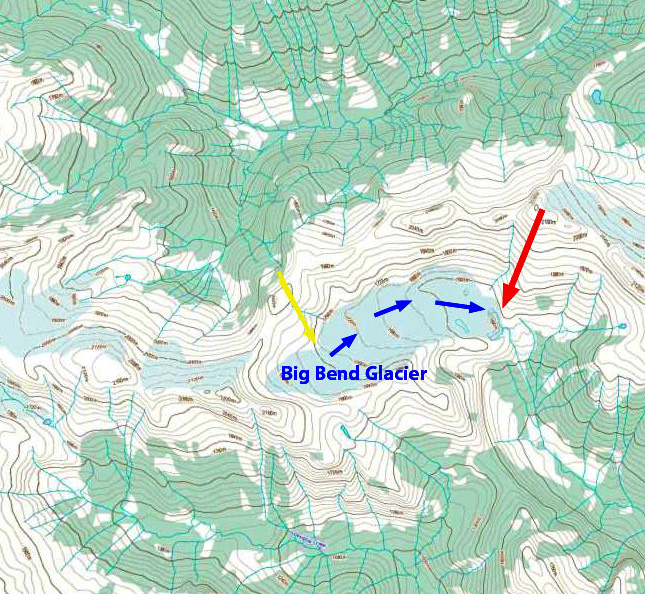
Topographic map of the Big Bend Glacier area.

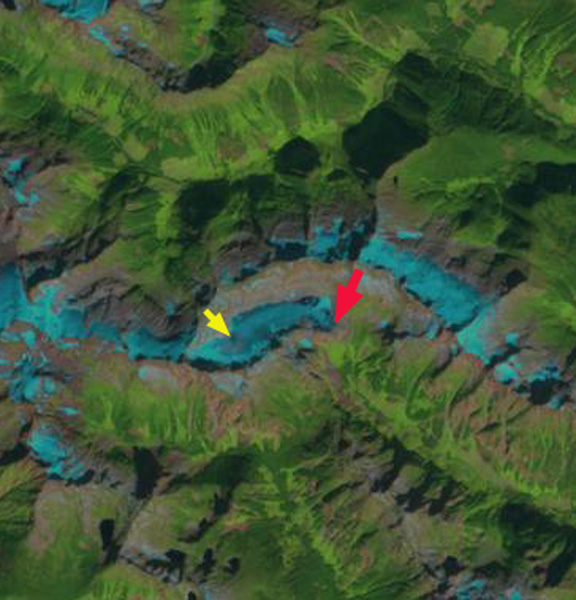
In 1985 the glacier extends to the big bend in the valley marking its eastern end, red arrow.  the yellow arrow indicates an area near 1800 m where the glacier extends across the valley.  In 1992 there has been little retreat but evident thinning is leading to lake formation at the terminus and narrowing of the glacier at the red arrow. In 2002 thinning is leading to expansion of a proglacial lake both west and south of the red arrow.  The terminus retreat has still been limited, thinning is evident at the yellow arrow.  

In 2013 a new alpine lake that is approximately 1 km long has formed, as the terminus area of the glacier has collapsed. In 2014 an area of bedrock and a small lake has developed at the yellow arrow.  There is no retained snowpack below the yellow arrow in 2013, and no retained snowpack in at all in 2014.  This will likely be the case in 2015 as well.  This glacier has a lower top elevation than most in the region and will be more impacted by the warm winter conditions and high snowline of 2015. The retreat from 1985 to 2014 has been 1.1 km. This is 40% of the entire glacier length gone in 30 years. The lake itself has a deep blue color suggesting limited glacier sediment input, further indicating a lack of motion of the glacier currently or in the near past.

The glacier retreat has been more extensive than Stave Glacier or Snowcap Glacier to its east.  Koch et al,(2009) observed a widespread retreat and glacier area loss in Garibaldi Provincial Park just to the west, with 20% area loss from 1988-2005. Place Glacier is a short distance north of Big Bend Glacier has its mass balance has lost an average of 25 m of water equivalent (28 m ice) thickness since 1984, see bottom chart. This has been higher but similar in trend to other glaciers in the region.  Big Bend will disappear soon just as we obsserved already happened at Milk Lake Glacier, North Cascades, Washington.

bigbendpeak1985
1985 Landsat Image

bigbendpeak1992
1992 Landsat Image

bigbendpeak2002
2002 Landsat Image

bigbendpeak 2013
2013 Landsat Image

bigbendpeak2014
2014 Landsat Image

nam-ba-2013
North American cumulative glacier mass balance graph