Lednik Midagrabin Retreat, Caucasus, Russia

Lednik Midagrabin is a large glacier draining northwest from Gora Dzhimara in North Ossetia, Russia.  Stokes et al (2006)  examined Caucasus glaciers during the 1985-2000 period and found that 94% of the glaciers have retreated, 4% exhibited no overall change and 2% advanced. The mean retreat rate is 8 m/year, with the largest glacier retreating the fastest. Shahgedanova et al (2009) observed that the retreat was driven by a large rise in summer temperature in the alpine zone, and that this will continue and generate substantial changes in the timing and amount of glacier runoff.  Here we examine the changes in this glacier from 1989-2015. This region has had a particularly warm start to the melt season in 2015 prompting this examination, note the NOAA temperature anomaly for the Caucasus Region.

midagrabin 2010 ge

Google Earth Image

201506


NOAA 2015 Temperature departure map for June 2015 with the Caucasus region indicated.

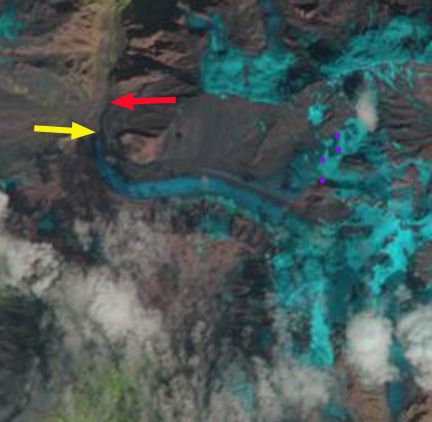
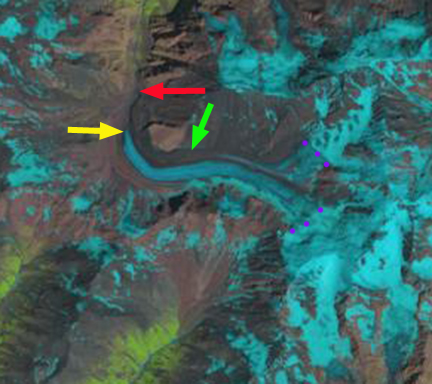
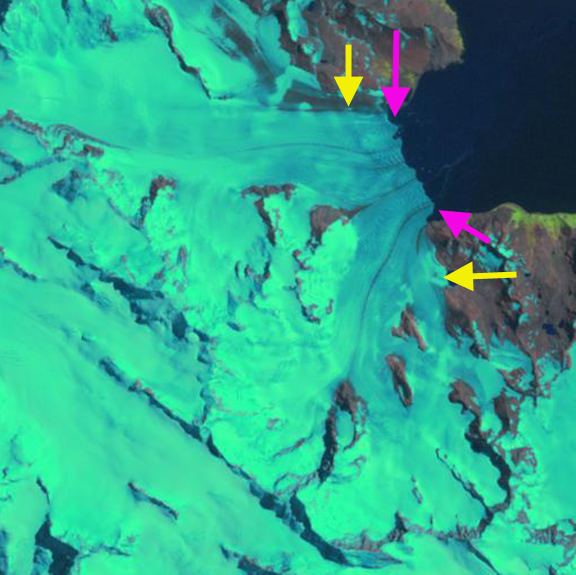
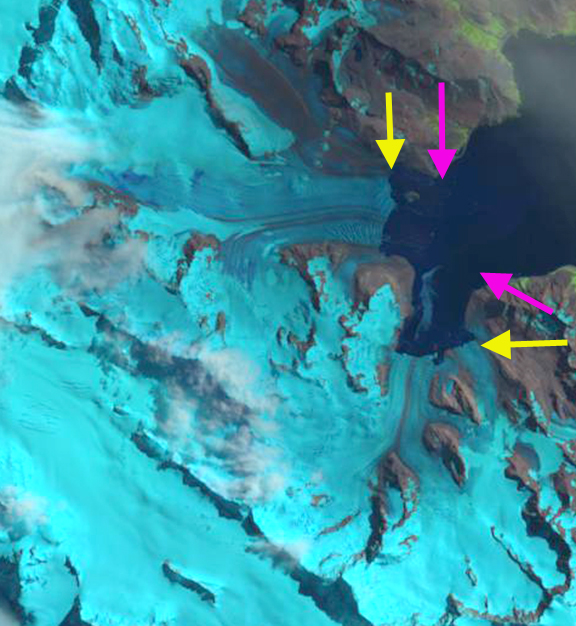
The glacier begins on the slopes of Dzhimarra at 4200 m and in 1989 the glacier terminated at the red arrow at 2950 m.  The snowline at the end of August, 1989 was 3700 m.  The green arrow indicates the extent of the clean blue glacier ice of the tributary from the north  In 2014 the glacier had retreated to a terminus location at the red arrow.  The snowline at the end of August 2014 was at 3800 m.  In mid-July of 2015 the snowline has already reached 3700 m, with the melt season only half over.  This will lead to substantial mass loss.  The main terminus has retreated to the yellow arrow a distance of 900-1000 m since 1989 and now terminates at 3050 m.  This is close to the maximum rate of 38 m/year identified by Stokes et al (2006) for the any glacier in the mountain range from 1985-2000.  This indicates Midagrabin is one of the faster retreating glaciers in the Caucasus and that the rate of retreat has increased.  The northern tributary clean ice zone has been reduced in length and width, now terminating 600 m further upglacier.  The northern tributary has had little retained snowpack in 2014 and again in 2015.  The tributary begins at 4000 m, which is not high enough in recent years to sustain this arm of the glacier.  The high snowlines of recent years will lead to continued retreat. The glacier poses little geologic hazards of flooding compared to some other retreating glaciers in the area such as Bashkara Glacier.

Midagrabin 1989

August 1989 Landsat Image

midAGRABIN 2014

August 2014 Landsat Image

midagrabin 2015

July 2015 Landsat image


Auyuittuq National Park Ice Cap Downwasting, Baffin Island

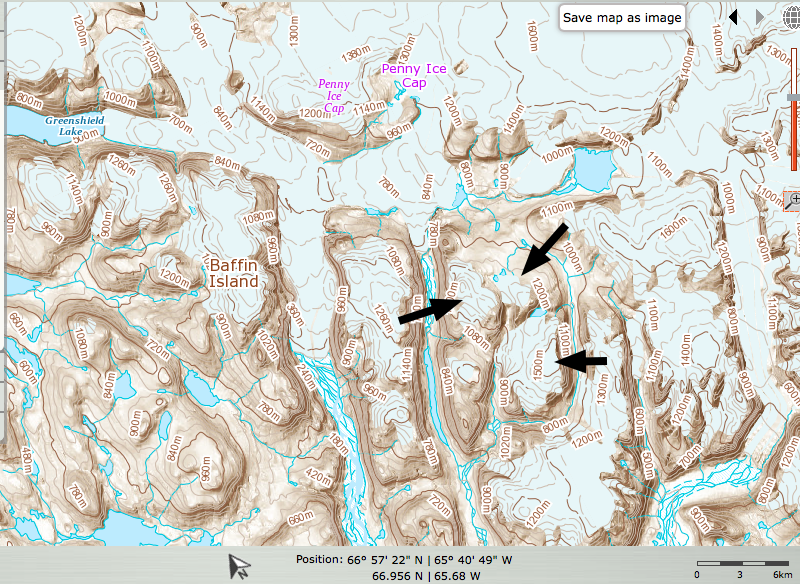
Just south of the Penny Ice Cap on Baffin Island in Auyuittuq National Park there are a large number of small ice caps.  We focus on three of these ice caps east of Greenshield Lake.  The region has been experiencing rapid ice loss, with 50 % of the ice cap area lost in the last few decades (Miller et al, 2008).  Miller et al (2008) also observe that these are thin and cold glaciers frozen to their beds with limited flow. Way et al (2015) observed the loss of 18-22% of two larger ice caps on Baffin Island, Grinnell and Terra Incognita.  The ice cap losses are due to reduced retained snowpack. Zdanowicz et al (2012)  found that starting in the 1980s, Penny Ice Cap entered a phase of enhanced melt rates related to rising summer and winter air temperatures across the eastern Arctic. In recent years they observed that 70 to 100% of the annual accumulation is in the form of refrozen meltwater. However, if the snowline rises above the ice cap consistently, as happened at Grinnell Ice Cap than there is no firn to retain the meltwater and superimposed ice formation is limited.  Meltwater has difficulty refreezing on a glacier ice surface. The rise in temperature is illustrated by a figure from Way et al (2015), below

penny ice cap map

Map of region south of Penny Ice Cap from Canadian Topographic maps.

gic summer climate

Figure From Way et al; (2015)

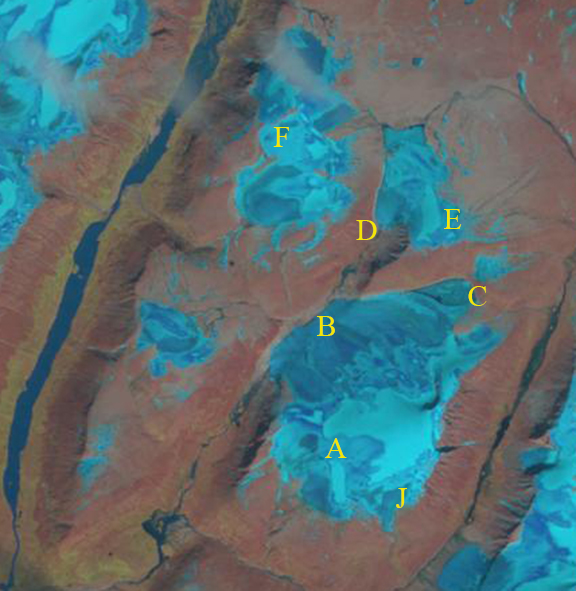
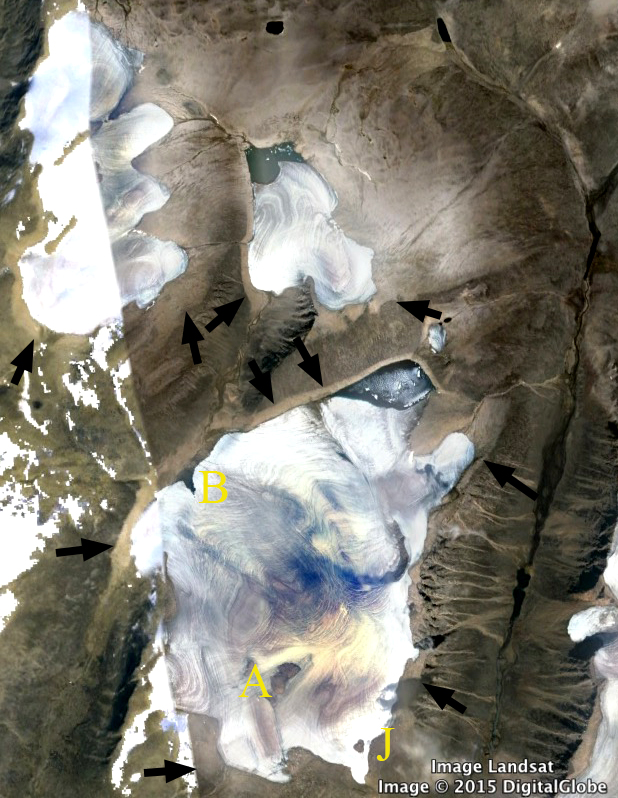
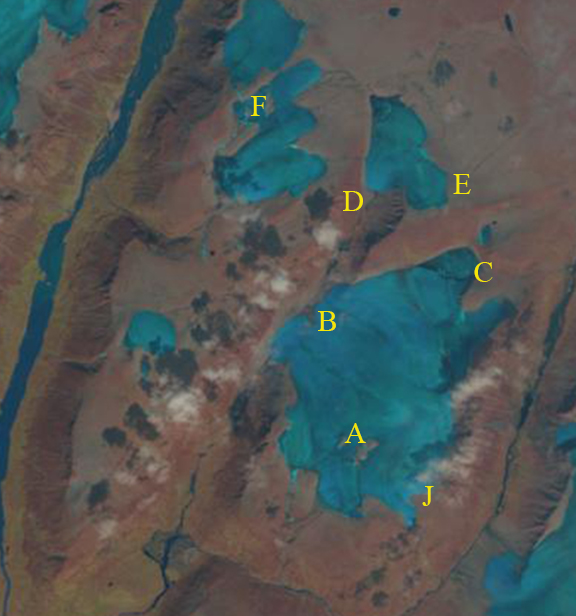
In the 1998 Landsat image the two northern ice caps, with E and F on them, have very little retained any snowpack, but significant firn areas.  The larger ice cap has retained snowpack adjacent to Point A and considerable firn area as well. There is a trimline beyond the glacier margin apparent west of Point B due to recent retreat, but otherwise trimlines are not immediately evident.  In 2000 the two northern ice caps again have very little retained snow, and the larger ice cap retained snow near Point A.  In the 2013 Google Earth image black arrows on the image indicate trimlines recently exposed by glacier retreat.  There is no evident retained snow, and no retained firn is even evident. This suggests the ice caps lacks an accumulation zone.  A close up view, illustrates many years of accumulation layers now exposed, note the linear dark lines, black arrows.  The second closeup view illustrates the area around Point E and D that has been deglaciated.  There also are some new areas of expanded bedrock such as near Point A on the larger ice cap.  The 2014 Landsat image indicates the bedrock has expanded at Point A.  At Point B an area of bedrock is expanding into the ice cap.  At Point C the lake has expanded at.  Ice has melted away from Point D and E. At Point F a new area of bedrock has emerged within the ice cap.  At Point J the new bedrock seen in the 2013 Google Earth image has now expanded to the margin of the ice sheet.  These changes are a result of a thinning ice cap, largely due to increased ablation.  The lack of retained snow cover or firn confirms there is not a consistent accumulation zone and that these ice caps cannot survive current climate (Pelto, 2010).

baffin smi 1998 copy

1998 Landsat image

baffin smi 2000 copy

2000 Landsat image

baffin smi 2013ge copy

2013 Google Earth Image

baffinsmi closeup copy

Google Earth Closeup

baffinsmi closeup2 copy

Google Earth Closeup

baffin smi 2014 copy

2014 Landsat image


Artesonraju Glacier, Peru Retreat & Lake Development

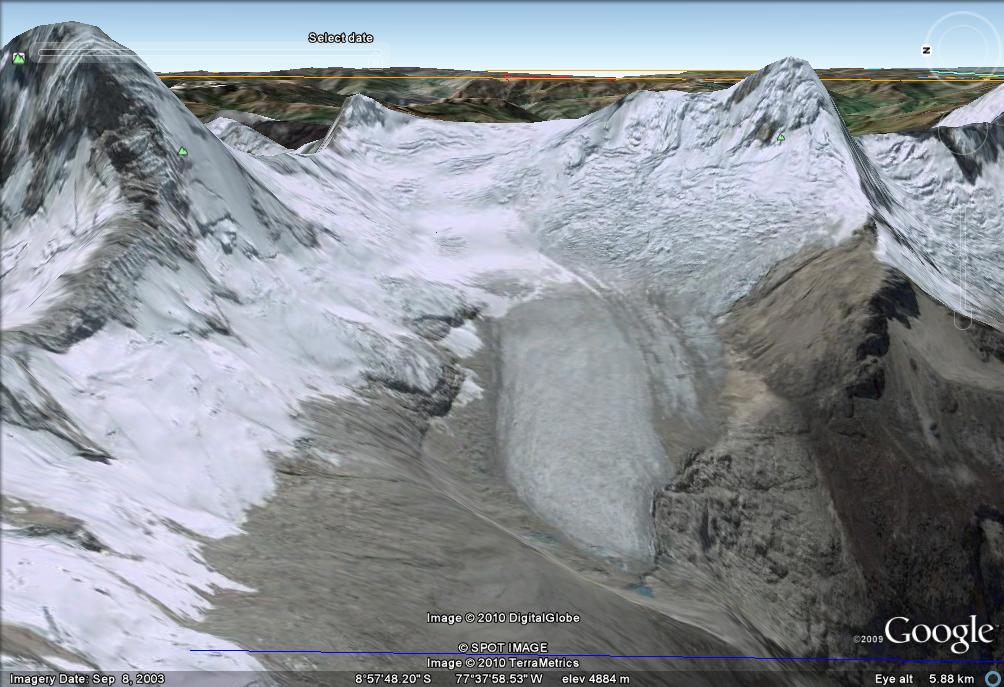
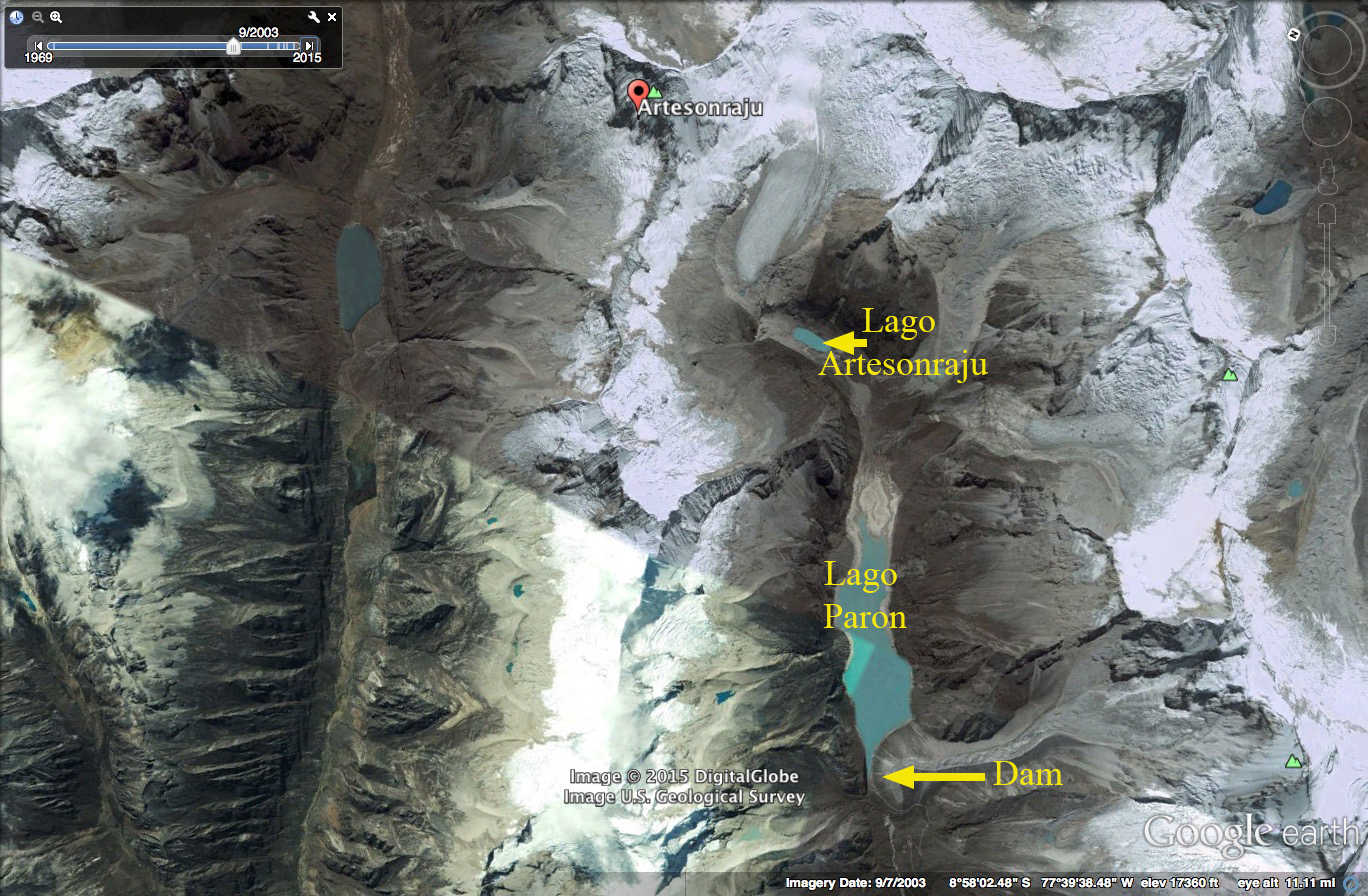
Artesonraju Glacier is a 3.3 km long glacier in the Cordillera Blanca of Peru drains west from Nevado Artesonraju. It is fed by steep heavily crevassed slopes. The glacier feeds both Lake Artesonraju, a new lake that formed after 1930 and Lago Paron. The two lakes are dammed by glacier moraines and together have posed a hazard of a glacier dammed lake outburst. In 1951 an outburst of water and alluvium traveled from the upper Artesonraju Lake into Lago Paron, raising the water level in Paron causing downstream flooding and concern about the strength of its moraine dam.  Mass balance is measured on this glacier annually and reported to the World Glacier Monitoring Service.  The glacier lost 0.4 m thickness in 2012 and 2013.


Google Earth Image 2003 of Artesonraju Glacier

artesonraju copy

Lago Paron Watershed 2015

There are numerous moraine dammed lakes in Peru, the dams are just comprised of gravel, sand and clay dumped by the glacier. High water levels caused by upstream floods, avalanches or landslides can cause failure of these moraine dams and down stream flood damage prompted the Peruvian government to develop a strategy to address the problem. They began  by building tunnels concrete pipes, through the moraine to allow drainage to a safe level, they then rebuilt the moraine over the drainage system and strengthened it. Since development these systems have worked preventing serious flood issues from the lakes.

,

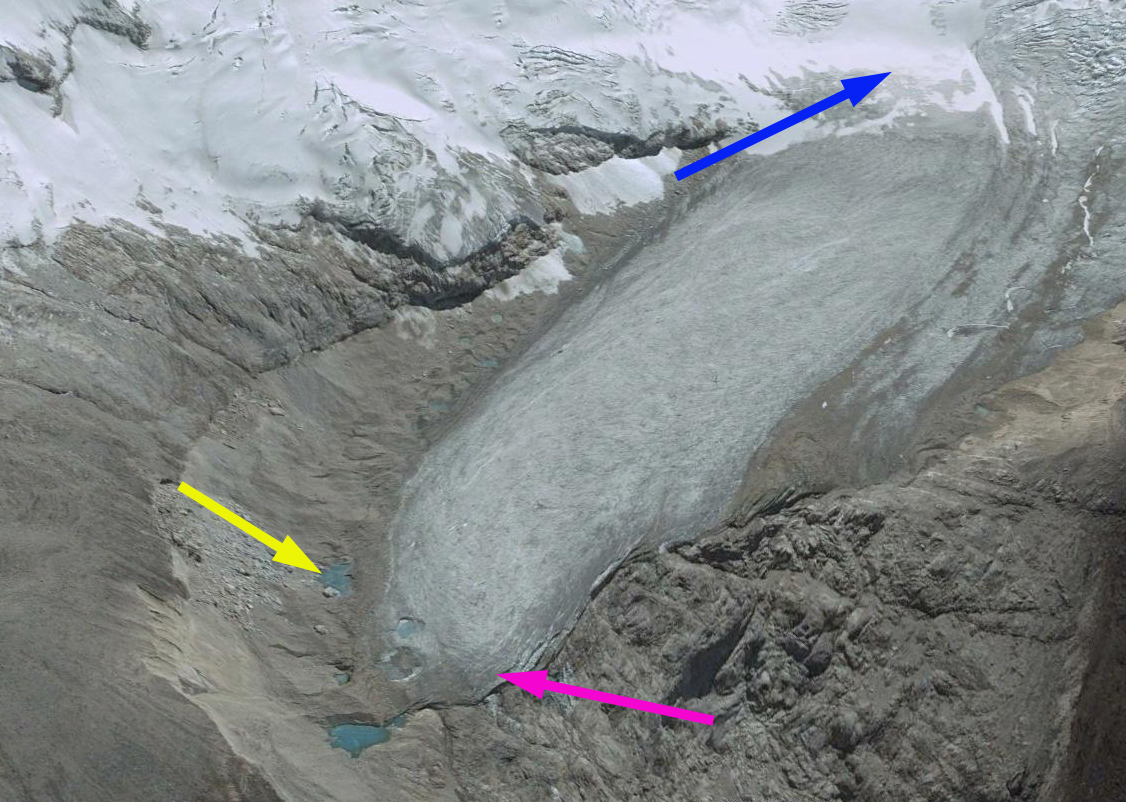
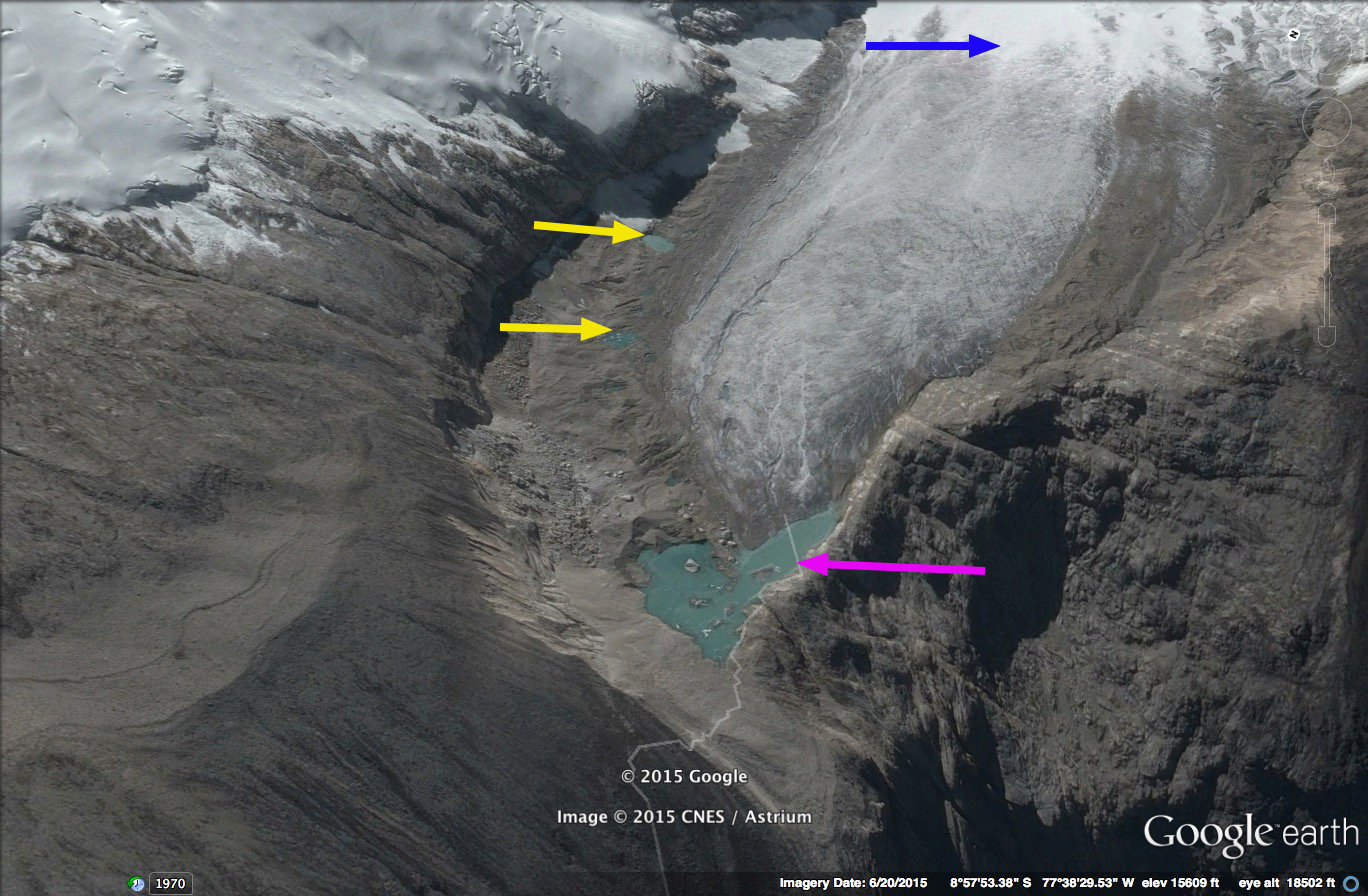
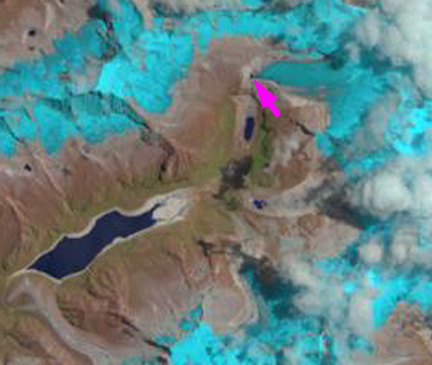
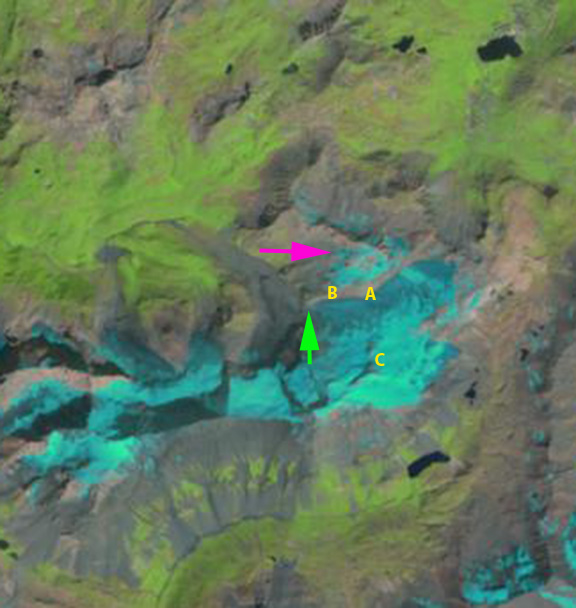
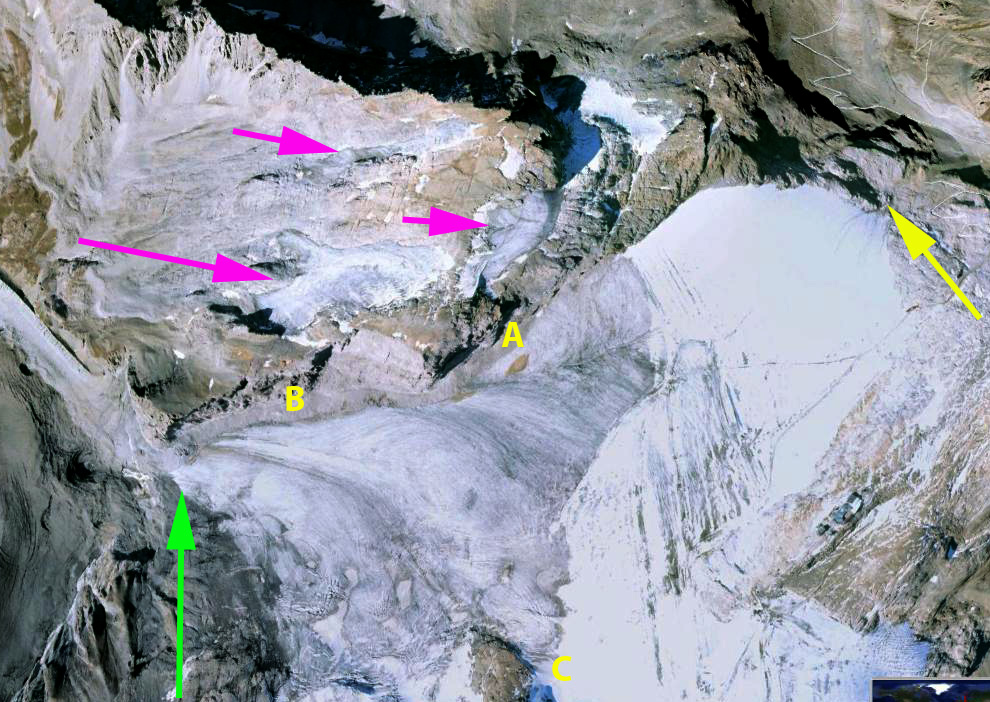
At Lago Paron a hydropower project has been built that is fed by the tunnel drainage system and Lago Paron has been partially drained to service the hydropower facilities needs. The hydropower faility is owned by Egenor, owned largely by Duke Energy. The lake level has declined substantially by 2003 as the trimline indicates in the image above. This had led to a battle over water resources with local farmers. This Artesonraju Glacier that is the principal feeder to the two lakes retreated 1140 meters from 1932-1987 and by 2003 had retreated another 200 meters. From 2003 to 2015 the glacier continued to retreat 160 meters and the terminus to narrow. An expanding lake at the terminus is evident in the Google Earth images of 2003 and 2015, pink arrow. A pair of melt ponds have also formed on the glacier margin at the yellow arrow as the glacier thinned. In the 2013 Landsat image the terminus has further narrowed and the new lake at the terminus is evident. This is 30% of its length gone in the last 75 years.The lower section of the glacier is flat, uncrevassed and is continuing to thin and melt. Chisholm et al 2014 observed glacier thickness of 20 m near the terminus to a maximum of 160 m, with the potential for the new lake to expand and be 60-80 m deep.  The upper reaches of the glacier are heavily crevassed indicating continued vigorous flow fed by healthy accumulation on the flanks of Nevado Artesonraju and Nevado Piramide. The equilibrium line of this glacier is at 5150 m, according to investigations by the Tropical Glaciology Group, Innsbruck, Austria and Hydrology Resources and Glaciology group in Huarez, Peru.  They also noted in  2005, that the surface on many parts of the flat tongue had significant sublimation when short wave radiation is limited, and short wave radiation dominates melting during the day.  Sublimation occurs when the air is dry and represents a less efficient means of ablating a glacier.

A  book by Mark Carey, In the Shadow of Melting Glaciers, examines the history of the impact of these glaciers on Andes towns in the Cordillera Blanca.

artesonraju 2003
2003 Google Earth image
artesonraju 2015

2015 Google Earth image

artesonraju 2013
2013 Landsat Image


Hindle Glacier, Accelerating Retreat, South Georgia

hindle 89-15

Landsat Image of Ross Hindle Glacier 1989 left and 2015 right.  Something changed.

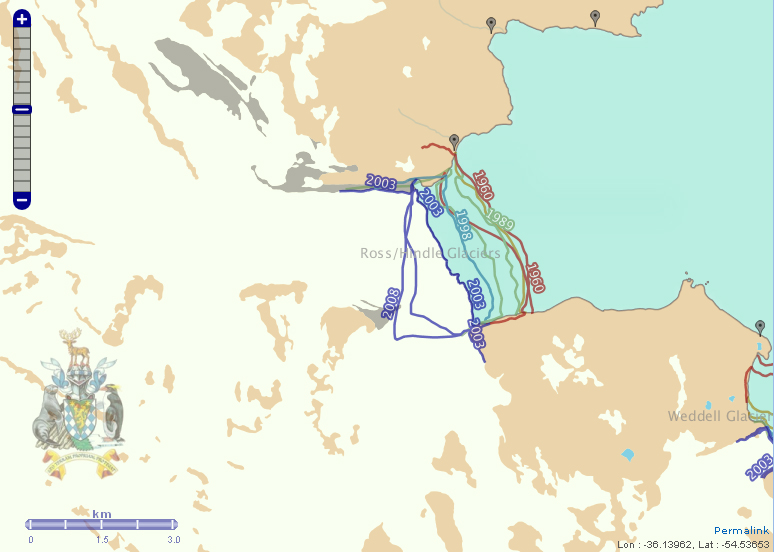
South Georgia sits amidst the furious if not screaming fifties latitude belt, the circum Antarctic westerlies. This region is famous for the endless march of storms parading around Antarctica. The island is south of the Antarctic Convergence, preventing any truly warm season from persisting. The cool maritime climate leads to numerous glaciers covering a majority of the island and quite low equilibrium line altitudes.  Ross-Hindle Glacier enters Royal Bay on the east coast of South Georgia Island has now separated into the Ross and Hindle Glaciers. Hindle Glacier could do well  in a new international Olympic event, “Fastest Retreating Glacier” The tidewater glaciers of South Georgia in general maintained fairly advanced positions unitl 1980. Gordon et al., (2008) observed that larger tidewater and sea-calving valley and outlet glaciers generally remained in relatively advanced positions until the 1980s. For Ross-Hindle the retreat was minimal from 1960 to 1989. The change in glacier termini position have been documented by Alison Cook at British Antarctic Survey in a BAS retreat map.  By 2008 the glaciers had separated. Here we examine Landsat imagery from 1989 to 2015 to identify recent change.

hindle area2

Region of Hindle Glacier on South Georgia.

BAS map of glacier front change.

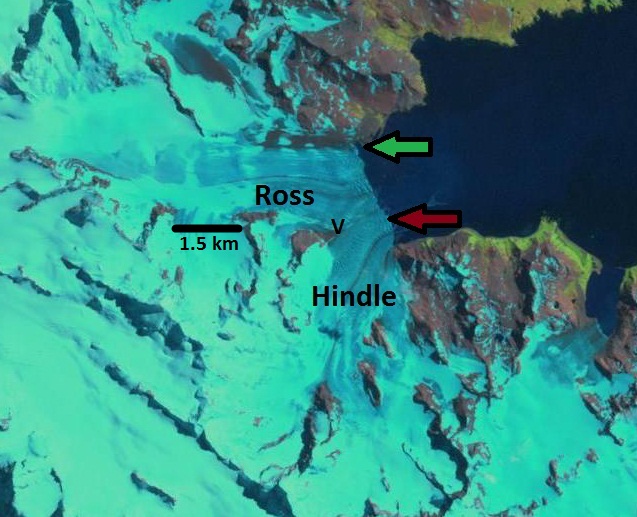
In 1989 the glacier extends to the green arrows with a joint terminus that is three kilometers long. This is quite close to the 1960 terminus location. By 2003 the glacier has retreated  800 m with the south side nearly reaching a Point where the Hindle Glacier turns south  By 2008 the glaciers have separated, with a further retreat  of 1.5 km along the southern margin of Ross Glacier and western margin of Hindle Glacier. Retreat is much less on the northern side of Ross Glacier and the eastern side of Hindle Glacier.  By 2015 a new fjord has opened, as Hindle Glacier retreats south 1.7 km on the east margin and 2.1 km on the west side in just seven years.Ross Glacier continues to retreat west with a retreat of 600-700 m since 2008.

In Google Earth by 2010 there is  added crevassing near the ice front of Hindle Glacier that indicates an acceleration of the glacier. This suggests the Ross Glacier was impeding its flow previously and that Hindle is in a rapid retreat mode.The rapid recent retreat parallels that of Neumayer Glacier and Twitcher Glacier during the 1989-2014 period. The BAS research effort on glacier front retreat has been documented by Alison Cook . Her comparison of glacier fronts from old aerial photographs and comparing them with satellite images — she identified that 212 of the Peninsula’s 244 marine glaciers have retreated over the past 50 years and that rates of retreat are increasing.

hindle 1989

1989 Landsat Image

ross hindle 2003

2003 Landsat Image


2008 Landsat Image

ross Hindle 2015

2015 Landsat Image


Alpine Glacier-BAMS State of the Climate 2014


Each year I have the pleasure of writing the Alpine Glacier section of the BAMS State of the Climate report, which covers all aspects of climate during 2014 and is the most significant annual climate report published.. The report was published yesterday. Below is the section on Alpine Glaciers with some added figures. There was also a highlight section published by NOAA based on this section.

Alpine Glaciers – Mauri S. Pelto

The World Glacier Monitoring Service (WGMS) record of mass balance and terminus behavior (WGMS, 2015) provides a global index for alpine glacier behavior.  Mass balance was -887 mm for the 37 long term reference glaciers and -653 mm for all monitored glacier globally in 2013, negative for the 26th consecutive year.  Preliminary data for 2014 from Austria, Canada, Nepal, New Zealand, Norway, and United States indicate that 2014 will be the 27th consecutive year of negative annual balances with a mean loss of -853 mm for glaciers. Globally, the loss of glacier area is leading to declining glacier runoff.  Since globally 370 million people live in river basins where glaciers contribute at least 10% of river discharge on a seasonal basis (Schaner et al, 2012) this requires continued efforts at monitoring.

Alpine glaciers have been studied as sensitive indicators of climate for more than a century, most commonly focusing on changes in terminus position and mass balance.  The worldwide retreat of mountain glaciers is one of the clearest signals of ongoing climate change (Haeberli et al, 2000).  Glacier mass balance is the difference between accumulation and ablation.  The retreat is a reflection of strongly negative mass balances over the last 30 years (WGMS, 2013).  The Randolph Glacier Inventory version 3.2 (RGI) was completed in 2014 compiling digital outlines of glaciers, excluding the ice sheets using satellite imagery from 1999-2010. The inventory identified 198 000 glaciers, with a total extent estimated at 726 800+34 000 km2 (Pfeffer et al, 2014).  An earlier version (RGI 2.0) has been used to estimate global alpine glacier volume at ~150,000 Gt (Radic et al, 2014), quantifying the important role as a water resource and potential sea level rise contributor.

The cumulative mass balance loss since 1980 is 16.8 m water equivalent (w.e.), the equivalent of cutting a 18.5 m thick slice off the top of the average glacier (Figure 1).  The trend is remarkably consistent from region to region (WGMS, 2013).  WGMS mass balance results based on 37 reference glaciers with 30 years of record is not appreciably different, -16.4 m w.e.  The decadal mean annual mass balance was -198 mm in the 1980’s, -382 mm in the 1990’s, and 740 mm for 2000’s.  The declining mass balance trend during a period of retreat indicates alpine glaciers are not approaching equilibrium and retreat will continue to be the dominant terminus response. The recent rapid retreat and prolonged negative balances has led to some glaciers disappearing and others fragmenting (Pelto, 2010).

global ba 2014

Annual mass balance of global glaciers submitted to the World Glacier Monitoring Service

In South America Argentina and Chile the mass balance of all six reported glaciers were negative with a mean of -1205 mm.

In the European Alps, mass balance has been reported for 11 glaciers from Austria, France, Italy and Switzerland, 10 had negative balances, with a mean of -454 mm w.e.. The European Alps experienced its warmest year (NOAA, 2015).

Montage_Gepatschferner_Vergleich-2012-13-14-d5af962467101b3bf7dbe256b73d4b66

Gepatschferner Retreat 2012-2013-2014.  Image from Austrian Alpine Club annual terminus survey report, Andrea Fischer.

In Norway terminus fluctuation data from 38 glaciers for 2014 with ongoing assessment indicate, 33 retreating, and 3 were stable.  The average terminus change was -12.5 m (Elverhoi, 2014).  Mass balance surveys with completed results are available for seven glaciers; all have negative mass balances with an average loss exceeding -1063 mm.    In 2014 Norway experienced its warmest year (NOAA, 2015).  In Iceland the mass balance of Hofsjokull was -970 mm. Svalbard was a location of positive mass balance with all four glaciers having a small positive mass balance.

In Washington and Alaska mass balance data from 13 glaciers indicate a loss of -1185 mm. In Washington the melt season was exceptional with the mean June-September temperature tied with the highest for the 1989-2014 period and had the highest average minimum daily temperatures.  The result in the North Cascade Range, Washington was a significant negative balance on all nine glaciers observed, with an average of -1000 mm w.e. and, unsurprisingly, all experienced retreat.  In Alaska all three glaciers with mass balance assessed had significant negative mass balances.
Lemon Creek Glacier 2014-Chris McNeil

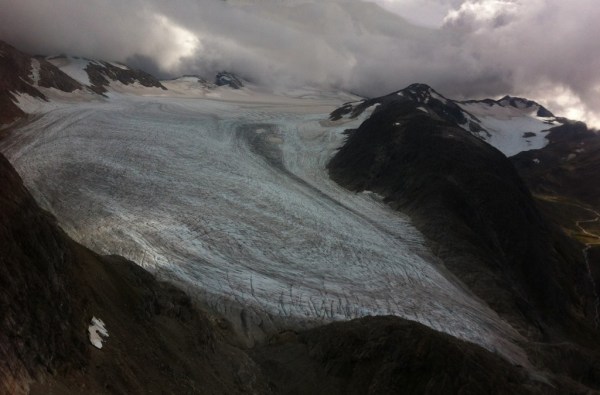
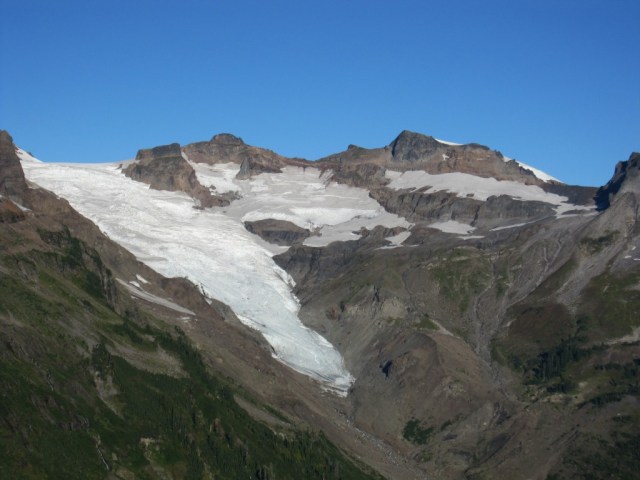
Lemon Creek Glacier, Alaska in 2014.  Note the lack of snowpack in early September.  The accumulation area ratio is 10 % coverage, and 62% coverage is needed for equilibrium.  Picture taken by Chris McNeil
Rainbow Glacier 2014-Pelto

Rainbow Glacier September 2015, lack of snowcover again evident.

In the high mountains of central Asia five glaciers from four nations reported data were negative with a mean of -870 mm.   Gardelle et al (2013) noted that mean mass balance in the eastern and central Himalaya was -275 mma-1 and losses in the western Himalaya were 450 mma-1 during the last decade.

References

Carturan, L., Baroni, C., Becker, M., Bellin, A., Cainelli, O., Carton, A., Casarotto, C., Dalla Fontana, G., Godio, A., Martinelli, T., Salvatore, M. C., and Seppi, R. 2013: Decay of a long-term monitored glacier: Careser Glacier (Ortles-Cevedale, European Alps). The Cryosphere, 7, 1819-1838, doi:10.5194/tc-7-1819-2013.

Elverhoi, H., 2014: Norwegian water resources and energy directorate 2013 glacier length change Table. http://www.nve.no/en/Water/Hydrology/Glaciers/

Fischer, A. 2013: Gletscherbericht 2012/2013. http://www.alpenverein.at/portal/news/aktuelle_news/2015/2015_04_03_gletscherbericht.php

Gardelle, J., Berthier, E., Arnaud, Y., and Kääb, A.: Corrigendum to “Region-wide glacier mass balances over the Pamir-Karakoram-Himalaya during 1999–2011” published in The Cryosphere, 7, 1263–1286, 2013, The Cryosphere, 7, 1885-1886, doi:10.5194/tc-7-1885-2013, 2013.

Haeberli, W., J. Cihlar and R. Barry 2000: Glacier monitoring within the Global Climate Observing System.  Ann. Glaciol, 31, 241-246.

NOAA, 2015: State of the Climate: Global Analysis-2014:  http://www.ncdc.noaa.gov/sotc/global/.

Pelto, M. 2010:  Forecasting temperate alpine glacier survival from accumulation zone observations.  The Cryosphere, 4, 67–75.

Pfeffer, W.T., and the Randolph Consortium 2014: The Randolph Glacier Inventory: a globally complete inventory of glaciers, J. Glaciol., 60 (221), 537-551 (doi: 10.3189/2014JoG13J176)

Radic´ V, Bliss A, Beedlow AC, Hock R, Miles E and Cogley JG (2014) Regional and global projections of twenty-first century glacier mass changes in response to climate scenarios from global climate models. Climate Dyn., 42(1–2), 37–58 (doi: 10.1007/s00382-013-1719-7)

Schaner, N., Voisin, N., Nijssen, B. and Lettenmaier, D. 2012: The Contribution of Glacier Melt to Streamflow. Environmental Research Letters 7  (doi:10.1088/1748-9326/7/3/034029.

WGMS, 2013: Glacier Mass Balance Bulletin No. 12 (2010–2011). Zemp, M., Nussbaumer, S. U., GärtnerRoer, I.,  Hoelzle, M., Paul, F., and Haeberli, W. (eds.),  ICSU(WDS)/IUGG(IACS)/UNEP/UNESCO/WMO, World Glacier Monitoring Service, Zurich, Switzerland.

WGMS, 2015: Latest Glacier Mass Balance data. http://www.geo.uzh.ch/microsite/wgms/mbb/sum13.html

Samarinbreen, Svalbard Rapid Retreat 1990-2014

samarinbreen compare
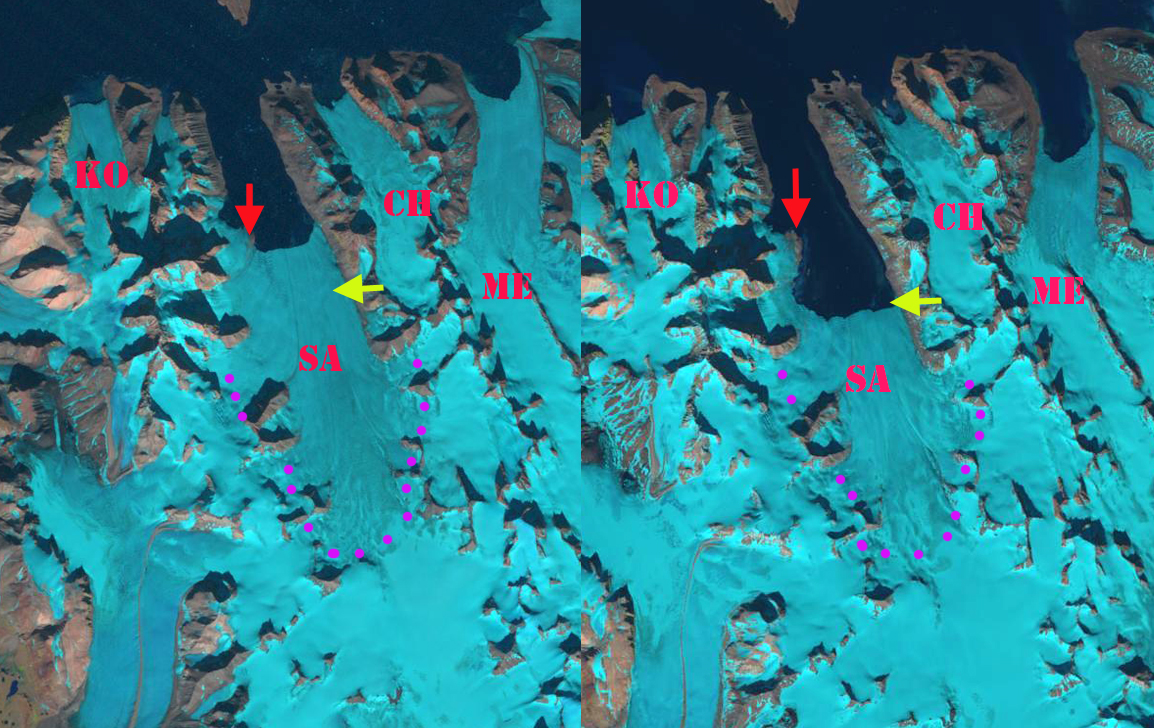
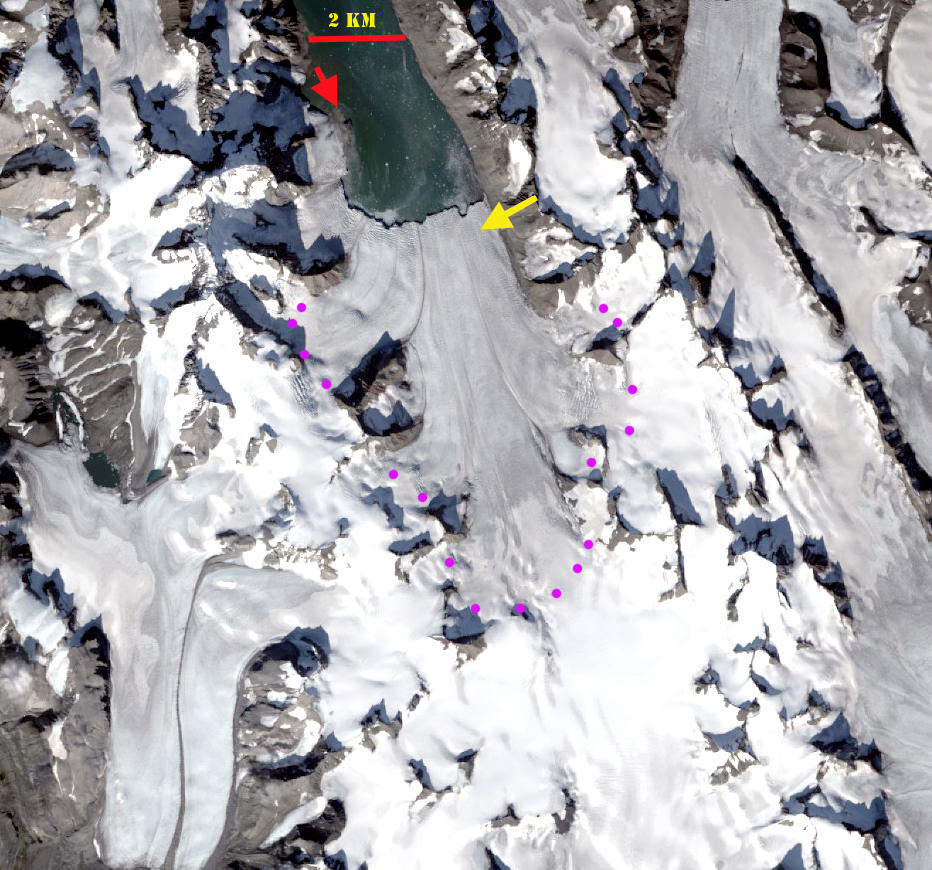
Samarinbreen (SA) 1990 left, and 2014 right, Landsat image comparison.  KO=Korberbreen, CH=Chomjakovbreen,
ME=Mendeleevbreen Red arrows indicate 1990 terminus position, yellow arrows 2014 terminus. and purple dots the snowline.

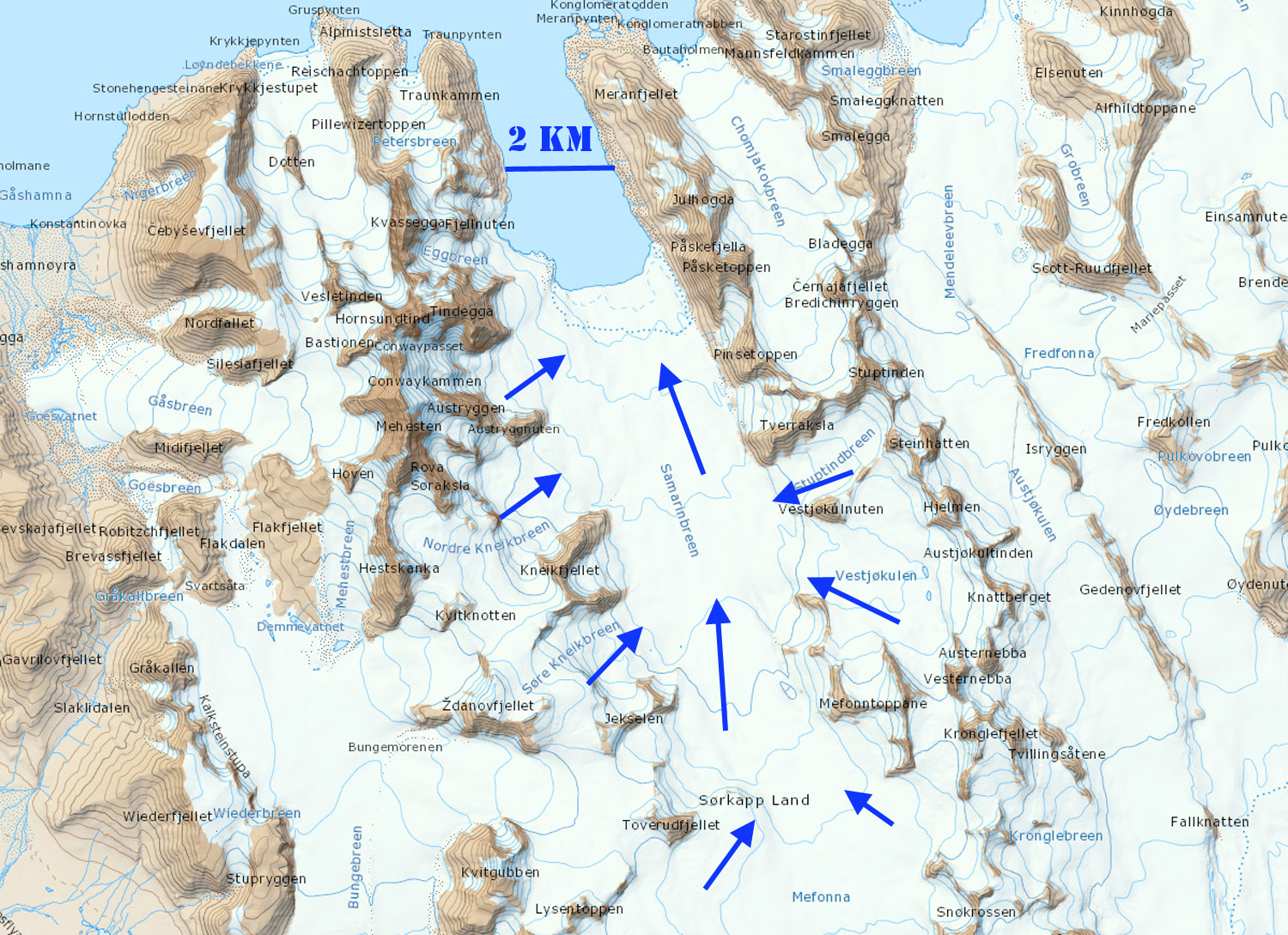
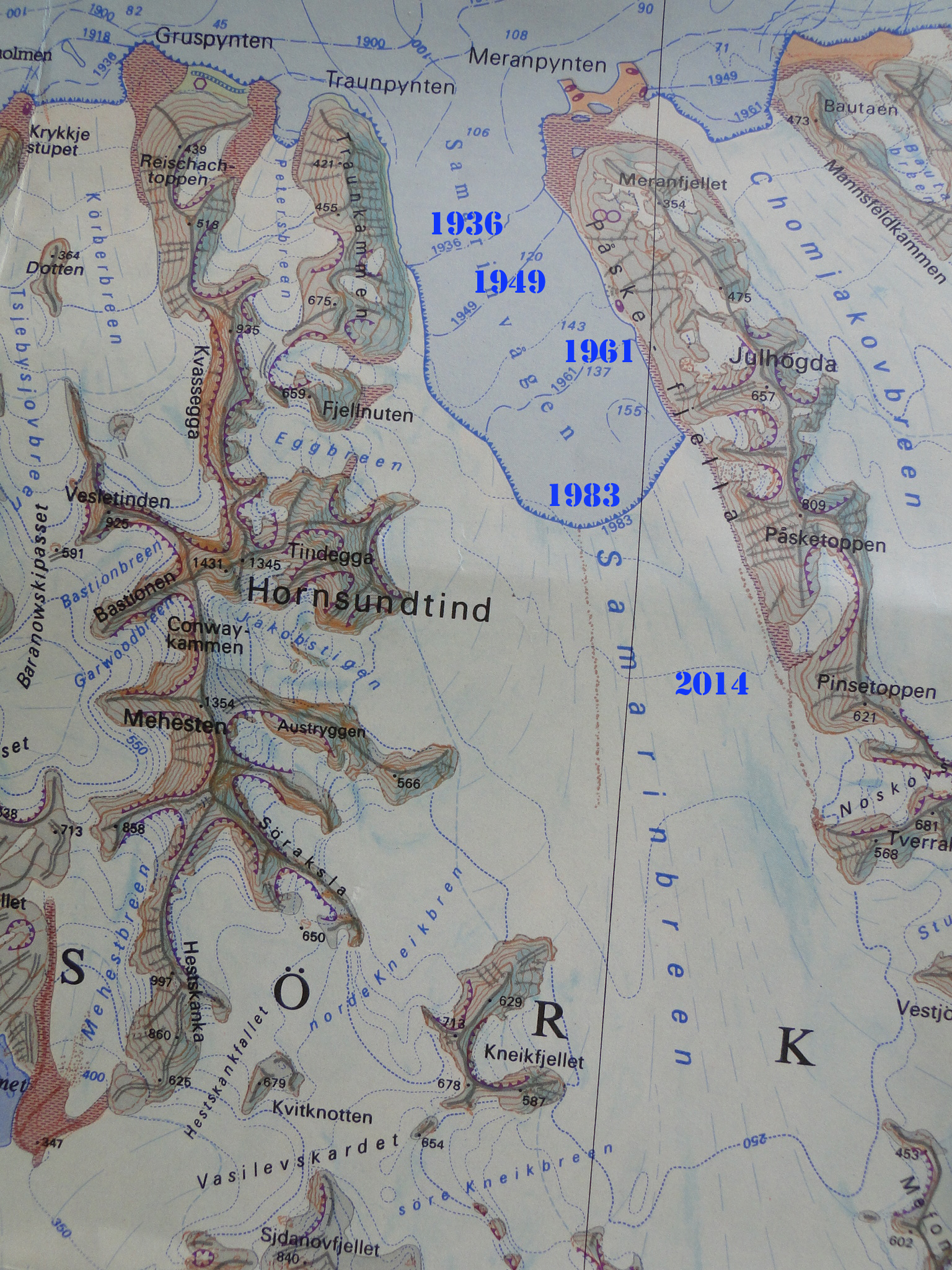
Samarinbreen terminated in a calving front in Samarinvagan, a bay on the southern side of Hornsund Fjord. Hornsund is a fjord that in 2015 almost cuts through the southern Island of Svalbard, due to the retreat of Hamberbergbreen and Hornbreen. The Institute of Geophysics Polish Academy have maintained a Polish Research Station in Hornsund since 1957. The 1984 map, from the University of Silesia, of the glaciers and geomorphology document the extent of the glaciers in 1983 in the region. Blaszczyk et al (2009) analysis identified 163 Svalbard glaciers that are tidewater with the total length calving ice−cliffs at 860 km for the 2001-2006 period. They observed that 14 glaciers had retreated from the ocean to the land over the last 3-4 decades. Nuth et al (2013) determined that the glacier area over the entire archipelago has decreased by an average of 80 km2/year over the past 30 years, a 7% reduction.In the most recent period 1990-2007, terminus retreat was larger than in an earlier period from 1930-1990, while area shrinkage was smaller. A more detailed examination by the same researchers, Blaszczyk, Jania and Kolondra (2013) reported the total area of the glacier cover lost in Hornsund Fjord area from 1899–2010 was approximately 172 km2. The average glacier area retreat increased from a mean of 1.6 square kilometers per year to 3 square kilometers per year since 2000. Samarinbreen begins near the height of land of Sorkappland sharing the divide with Olsokbreen at an elevation of below 400 m.
samarinbreen map
Map from Topo Svalbard
Samarinbreen retreat is documented by the map produced by the University of Silesia; 1936-1949 retreat equals 750 m, 1949-1961 retreat equals 1200 m, 1961-1983 retreat equals 1700 m. Landsat imagery from 1990-2014 illustrates that the retreat of the glacier has been 2.1 km. The 1990 terminus is indicated by the red arrow, and the 2014 terminus is the yellow arrow. The tidewater front shows limited icebergs from calving in all images I have reviewed, yet calving must be a key means of volume loss.   The snowline in 1990 is between 300 m in 1900. In 2014 the image is earlier in the melt season, but is at at 275 m.  The 2012 image of the terminus region illustrates the snowline again near 300 m. There is limited glacier area above 400 m, indicating the high snowfall and low melt rate of the region allowing a glacier to have such a low mean elevation. That the snowline is consistently so close in elevation to the highest section of the glacier indicates that mass loss will continue as will retreat.

samarinbreen silesia map

University of Silesia Map of Hornsund


saraminbreen image
Samrinbreen 2012 image from Topo Svalbard, red arrow indicates new island.

Russell Glacier, Greenland Rapid Snowline Rise K-Transect 2015

kang runoff
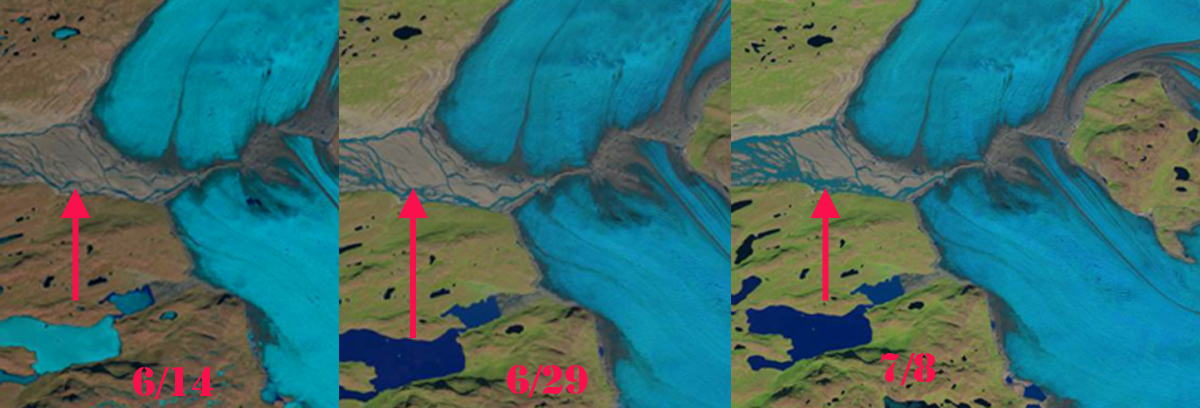
Landsat Image based Watson River discharge sequence June 14-July 8, 2015

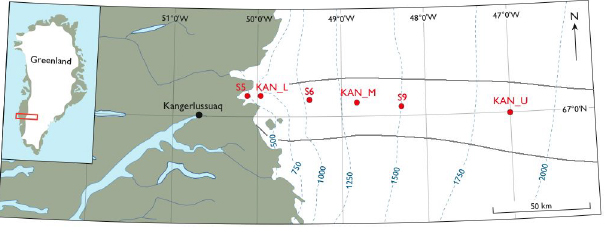
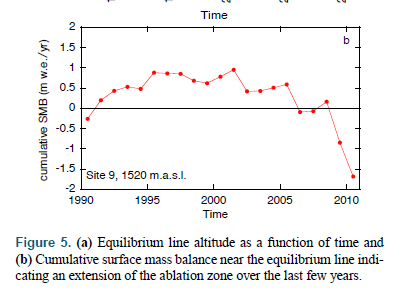
It was 30 years ago I first participated in Greenland Ice Sheet research, there was not much of it at the time.  However, there was the recognition of the importance for sea level rise with global warming, and this was driving an increase in research at that time. The level of research has increased exponentially in the last decade. One long standing and remarkable program that indicates the long term thinking that has helped us develop an understanding of ice sheet changes, is the K-Transect of ablation stakes emplaced in the Russell Glacier Catchment.  Here we examine the changing snowline from Mid-June to early July of 2015, as well as the longer term record.  The Institute for Marine and Atmospheric Research Utrecht has maintained the best long term field based ablation record on the GIS, the K-Transect. This resulted in  van de Wal  et al., (2012) reporting on 21 years of surface mass balance in the region.  At one site, S9 (1520 m) near the equilibrium line altitude (ELA), the long term record indicates a rise in the ELA in recent years, see figure below, and a more negative surface mass balance. This record has also been crucial in helping to build surface mass balance models for the GIS. The results updated daily from one such model, is at the Polar Portal, maintatined by the DMI – Danish Meteorological Institute, GEUS – The Geological Survey of Denmark and Greenland and DTU Space – National Space Institute. This summer the Automatic Weather Station on this transect Kan M, at 1270 m did not experience temperatures above 0 C until June 19th and they have been consistently above that since, (PROMICE, 2015).  At S9 temperatures have been reaching 4 C most days in July (IMAU, 2015).

So Thank You to PROMICE, Polar Portal, IMAU, NASA and others for the remarkable progress and sharing of data.

k transect map
K-Transect map from van As et al (2012)

kang ela
Surface mass balance at S9 on the K-Transect from van de Wal (2012).
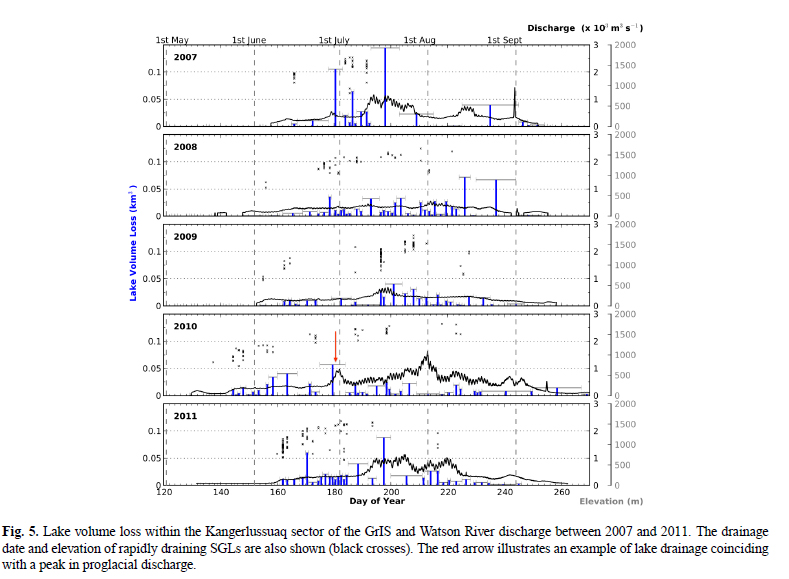
Supraglacial lakes were mapped in detail for the period by Fitzpatrick et al (2014), who found the lakes were forming several weeks earlier in 2010-2012 and at higher elevations than before.  They also observed as seen in graph below that Watson River except for in 2010 had a distinct rise in flow in mid-July.  Notice the lag between initial melt that fills lakes, volume loss shown, and the rise in Watson River.
watson river
Watson River discharge and lake volume loss in K-Transect region from Fitzpatrick et al (2014)

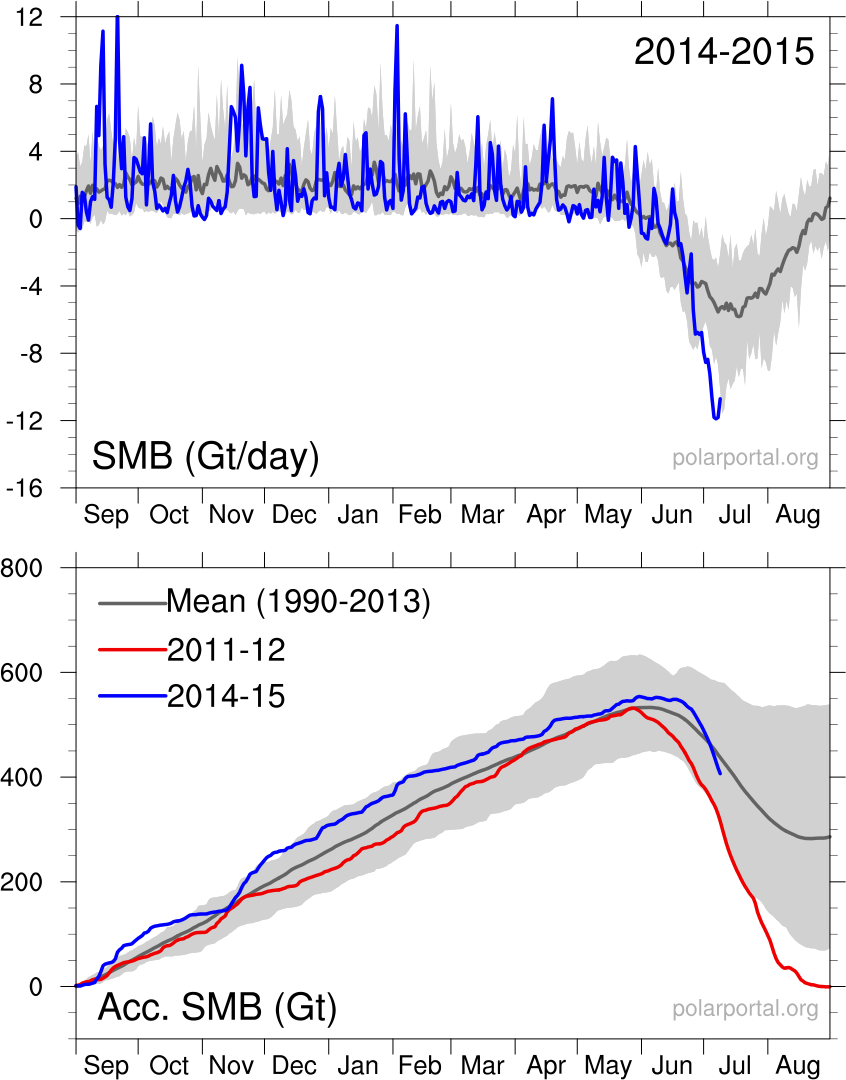
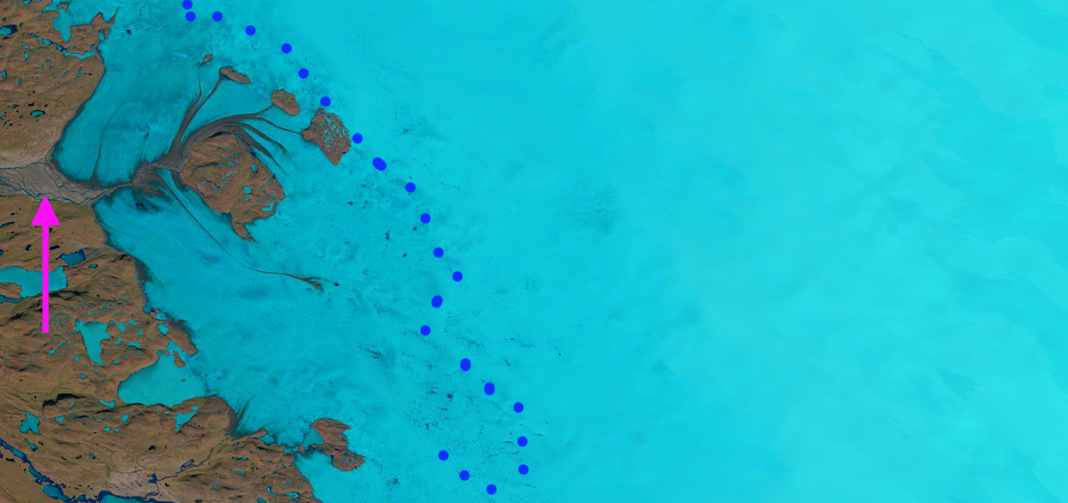
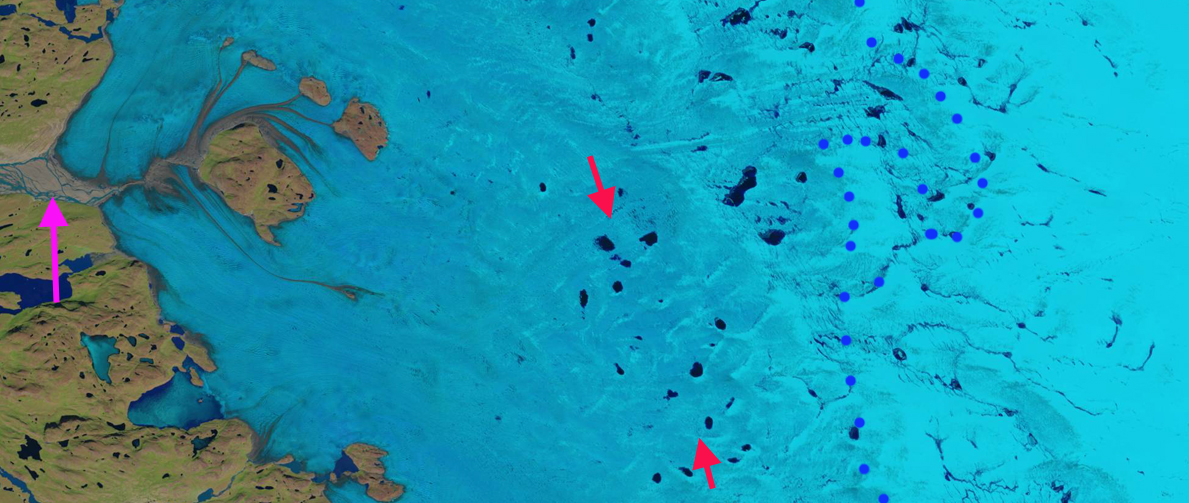
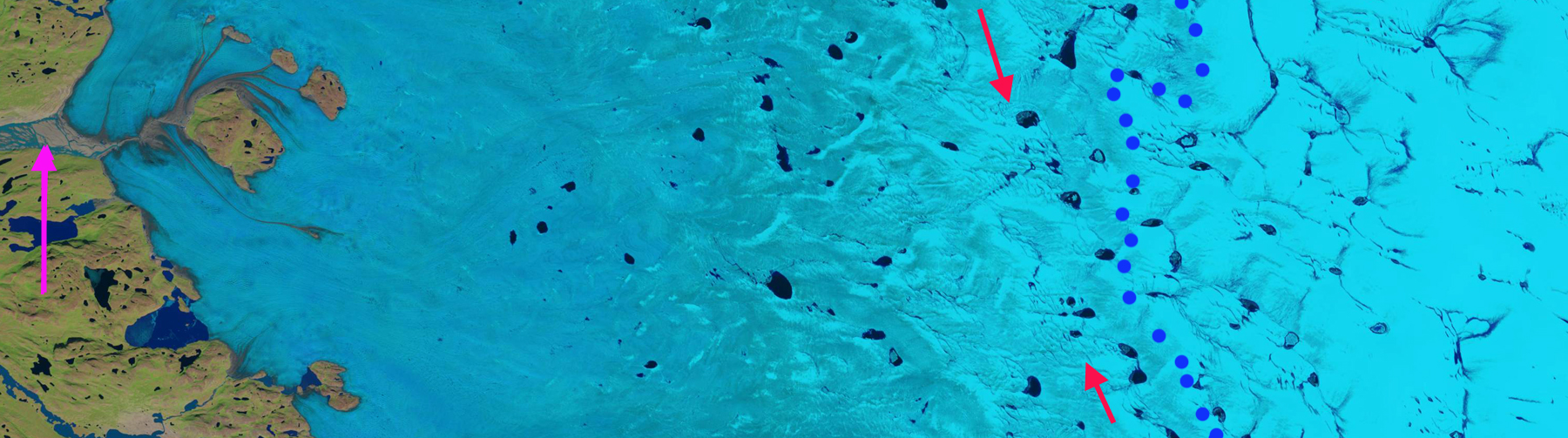
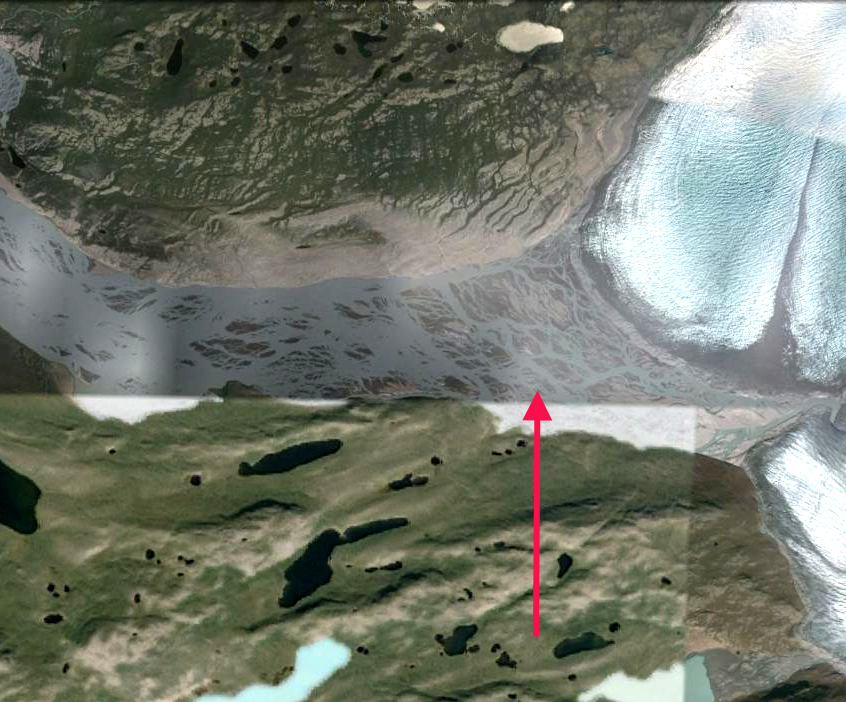
This all played out in the last few weeks.  The melt season was off to a slow start in 2015 as indicated both by the Polar Portal and Landsat imagery, note on June 14th that lakes beyond the GIS had ice cover still, the snowline was at 750 m, blue dots, with spotty snow patches below this. The lack of melt in also evident in the lack of supraglacial lakes.  Note the lack of discharge in Watson River, pink arrow. By June 29th melt had begun in earnest with the snowline moving inland 25 kilometers and rising to 1150 m.  Discharge was greater, but still limited in Watson River.  The main belt of supraglacial lakes, red arrow was at m. By July 8th, the snowline had moved more than 50 km inland since June 14th to an altitude of 1450 m.  This is close to S9.  The snowline is not the ELA on the GIS as there are zones of superimposed ice below the snowline.  However, with the transient snowline this high in early July, the ELA will inevitably be higher than S9 at 1520 m.  The discharge in Watson River will continue to rise and become more variable as the glacial hydorologic system matures van As et al (2012). This post will be updated with imagery from later in the 2015 ablation season.
gismelt2015
Surface Mass Balance from model data

kang 164
June 14, 2015 Landsat Image

kang 180
June 29, 2015 Landsat Image
<a href="http:/
kang 189July 8, 2015 Landsat Image

kang ge
Google Earth image showing late summer discharge of Watson RIver.

Big Four Glacier & Ice Caves, WA: a short future?

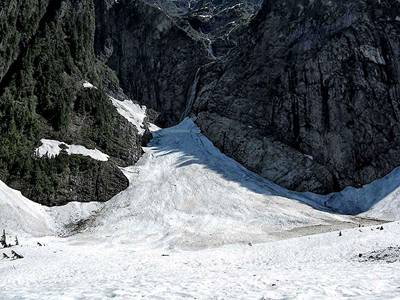
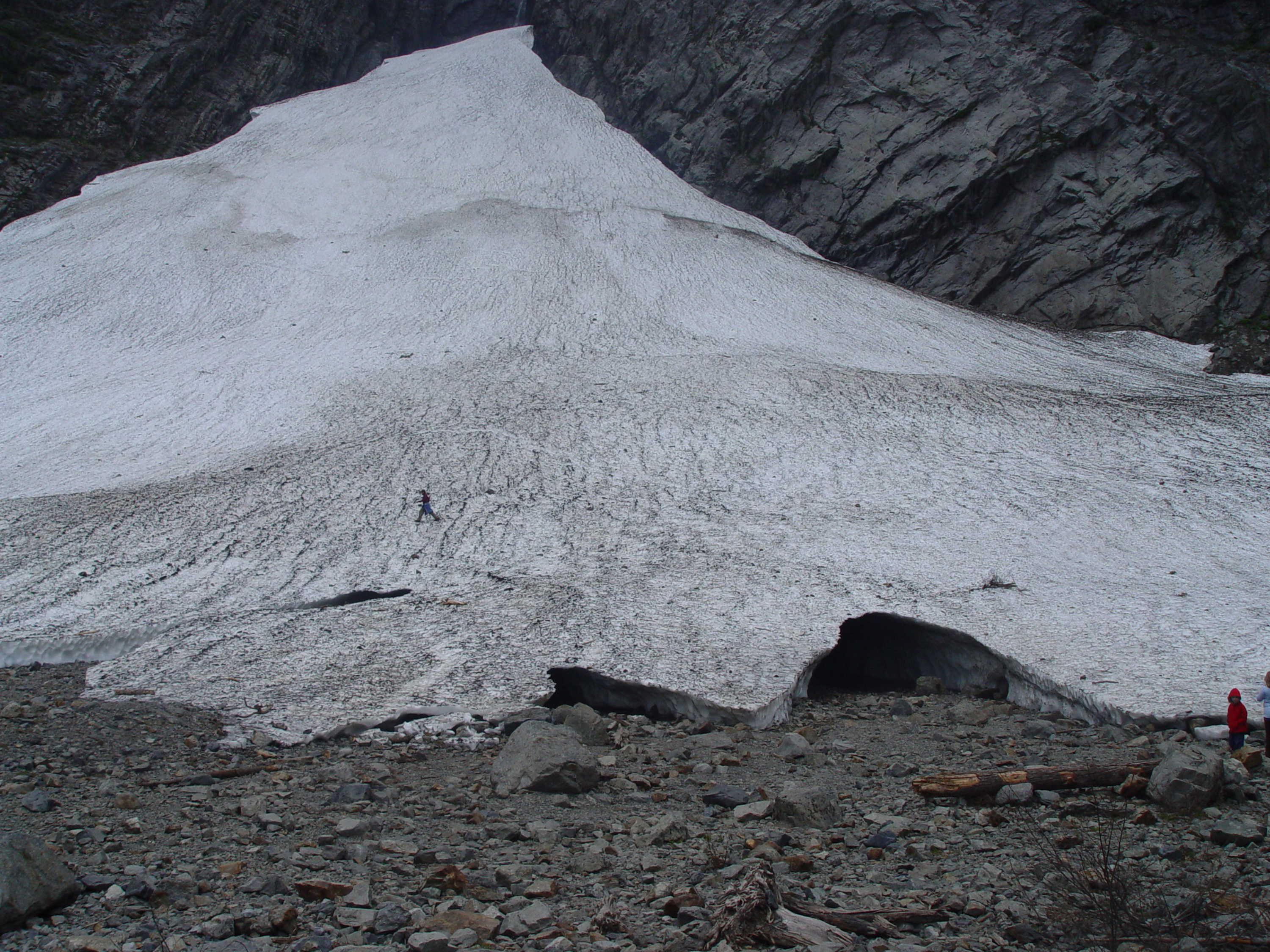
The Big Four ice caves area popular hiking destination 90 minutes northeast of Seattle in the North Cascades.  This ice mass is currently the lowest elevation glacier in the lower 48 states. It is fed by tremendous avalanching from higher on Big Four Mountain.  During the winter the snow piles up on the avalanche fan.  In the summer the waterfall from above carves tunnels under the snow-ice mass.  At some point in June or July the tunnels are enlarged enough to allow people, but also warm air to enter.  This leads to further tunnel expansion.  In warm summers the tunnels get large enough by late summer that collapses of the roof occur.  Unfortunately this year the caves are already in late summer form and an expected collapse tragically led to the 1 person killed and five injured this week.  Here we examine the formation and now demise of this odd glacier in the last decade. There are no pictures of the ice caves in this post, as it is not a place to enter this year.

The 1999-2002 period featured heavy winter snowpack and avalanching boosting Big Four.  The summer of 2003 was the first of three cruel seasons to Big Four.  In this image you cannot note the blue case to all but the very top of the avalanche cone, indicating it is older snow.  There is further two layers that look  to be annual layers on the right side of the image.  This suggests to me, the base is a 1999, layer, than a 2000 layer, than a broader dirty band and a 2002 layer, followed by a 2003 snowpack,.  The summer of 2001 was warm and no snowpack would have survived, causing the wider dirt band. In 2003-2005 a series of dismal winters and warm summers led to the near total loss of the Big Four Avalanche fan, at this point it was not a glacier.

From 2006-2012 a series of good summers led to redevelopment, which prompted David Head to contact me to investigate in 2009 if it was a glacier.  He provided a series of images from 2005-2008 indicating the changes.  We then headed to the glacier in 2009 to investigate in detail. In 2009 we mapped the glacier, from above and below. We found it had an area of 0.07 square kilometers, the glacier had a center length of 370 m, had a width at the toe of 270 m, an average slope of 22 degrees an average depth of 32 m a maximum depth of 55 m, and a volume of ~2 million cubic meters. There was blue glacier ice evident and a few crevasses on the upper portion. It was a glacier. The glacier gained at least 30 m in thickness over the majority of its area from 2005-2008, which is an extraordinarily short period. This year for the first time no avalanches reached the avalanche fan. Last summer was at record warmth, with the snowmass ablated to its smallest extent since 2005. The ice cave entrances were wide with a rainbow shaped arch, not an engineering setup for stability. This did not change over the winter. Hence, it is like having two summers in a row without winter. Contrast the June 2008 image to April 2015 (from Kellbell), quite a difference. There is no snow on Big Four even in April this year, the blue glacier ice is exposed and ablating starting then. The ice mass is rapidly ablating in the warm early summer of 2015 and will reach its smallest size since 2005 by the end of the summer. It is likely too thick to melt it all this year, but it may well surpass the 2005 minimum size. It will no longer be a glacier by the end of the summer. That is unusual to watch a glacier form and melt away in a decade. There will be more collapses in the ice caves this summer as it recedes to a meager size.

big four time lapse

2003-2007 Time lapse of Big Four
big four June 2008
June 2008 image
big four 10202008
October 2008 image
big four 2009
August 2009 image

big four20150327
April 2015 (Kellbell)

Otemma Glacier Retreat & Snowline Rise, Switzerland

Otemma Glacier is in the Upper Rhone River watershed and feeds Lac de Mauvoisin. Climate change is altering this glacier, with terminus change not being the main story it is the rising snowline and separation from tributaries. The lake fed by the glacier is impounded by Mauvoisin Dam one of the 10 largest concrete arch dams in the world. The reservoir can store 200 million cubic meters of water. The dam provides hydropower and protection against natural hazard. In 1818, an advance of the Gietro Glacier, now retreated high above the reservoir, generated ice avalanches which blocked the flow of the river. When the ice barrier was breached, 20 million cubic meters of flood water was released devastating the valley (Collins, 1991).There are several other large glaciers in the basin Gietro, Mont Durand and Brenay that provide runoff to power what is today a large hydropower project. The Mauvoisin Dam can produce 363 MW of power.

Otemma Glacier is one of the glaciers where the terminus is monitored annually by the Swiss Glacier Monitoring Network (SCNAT). Here we examine changes in this glacier from 1985 to 2014 including changes in the terminus, snowline elevation and tributary connection during this period using Landsat Imagery. SCNAT reports that the glacier retreated at a rate of 27 m/year from 1985-1999, to 40 m/year from 2000-2014.
otemma glacier gearth
Google Earth view of the glacier indicating glacier flow direction.

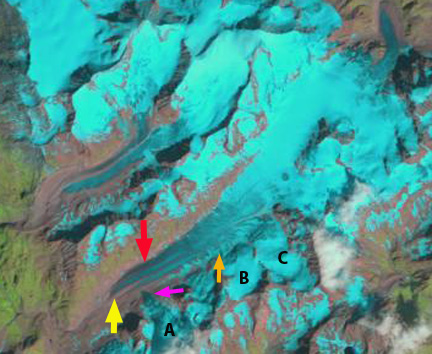
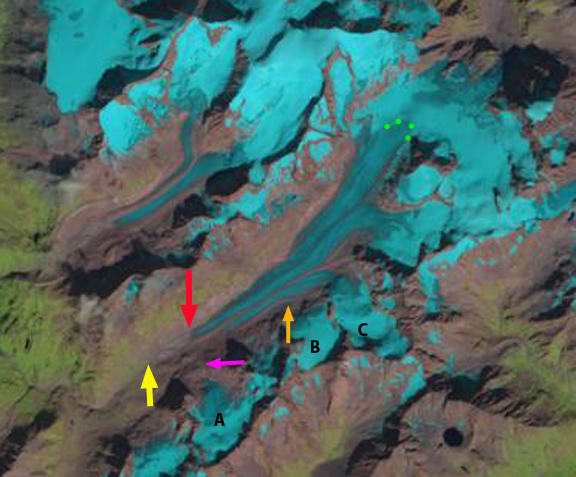
In 1985 the glacier terminates at the yellow arrow, with tributaries A,B & C all joining the main glacier. The snowline is at 2800 m, green dots. In 1988 the snowline extends to the divide with Bas Glacier d’Arolla at 3050 m. In 1999 the snowline also extends to the divide with Glacier d’Arolla. Tributary A no longer connects to the glacier, pink arrow, and the terminus has retreated 300 m.

By 2013 Tributary B is also detached from the main glacier (orange arrow). The terminus has retreated to the red arrow a distance of 1010 m over the thirty year period. The snowline in 2013 and 2014 almost reaches the divide with Bas Glacier d’Arolla with a few weeks left in the ablation season. The area of persistent snowcover is thus restricted to the region above 3050 m. This region is not large as the Bas Glacier d’Arolla captures most of the upper basin. That the snowline is consistently reaching the highest divide for this large glacier is noteworthy. The retreat of the large valley tongue of Otemma Glacier will remain rapid given the consistent high snowlines indicative of limited retained accumulation. Even with current climate not much of the Otemma Glacier can survive. The rising snowline is observed on most glaciers including nearby Rutor Glacier, Italy.

otemma 1985
1985 Landsat Image
otemma 1988
1988 Landsat Image
otemma 1999
1999 Landsat Image
otemma 2013
2013 Landsat Image
otemma 2014
2014 Landsat Image

Disintegration of Pramecou Glacier, France

Pramecou Glacier is on the Dome de Pramecou above the Grande Motte Glacier, which is a key portion of the Tignes Ski area in France. The Grande Motte area is open for summer skiing this year from June 27th to Aug. 9th. The glaciated landscape in this area is changing dramatically, Gardent and Deline, (2011) noted a 33% loss in glacier area since the 1960’s. The Tignes Ski area has responded by adding snowmakers for the lower portion of Grande Motte Glacier. In the hot summer of 2015 the melt is still causing issues for skiing at Tignes. Here we examine the impact on Pramecou Glacier and Grande Motte Glacier.

STGM Ski été automne 18
Grand Motte Summer Glacier Ski Map
pramecou map
Topographic map of area.

In 2006 the Pramecou Glacier had separated into three sections that did not retain snowcover, each outlined with black dots in Google Earth image below. This had been the case in 1999 and 2003 as well losing all of the snowcover.   In the 1988 Landsat image below the Grande Motte Glacier west terminus is at the green arrow at the top of a steep slope that falls to the Rosolin Glacier below.  The yellow arrow is the east terminus ending at the base of a rock knob yellow arrow.  Points A and B are along the margin of the Grande Motte Glacier.  The pink arrow indicates the Pramecou Glacier that consists of the larger two segments still merged. In 1999 the Landsat image indicates the loss of snowcover on both glaciers and the near separation of the two main Pramecou sections. The Grande Motte terminus has not retreated noticably yet. The 2002 Landsat image indicates the west terminus of the Grande Motte Glacier has retreated from the green arrow.  There is only modest thinning and marginal change at Point A and B.

The large change occurs between 2002 and 2014.  By 2014 both the east and west terminus of Grande Motte have retreated from the yellow and green arrows.  Each has retreated 200-250 m since 1999.  The larger change is the thinning evident at Point A and B. At Point A a large area of rock has been exposed extending from the north margin well into the glacier.  At Point B thinning has exposed a much wider ice free belt along the northern margin of the glacier.  At Point C the northeast ridge of  Grand Motte bare rock area is expanding.  It is clear the Pramecou Glacier will quite soon be lost.  The Grande Motte Glacier is thinning along its upper margins and is losing its snowcover by summer’s end, both are signs of a glacier that cannot survive (Pelto, 2010).  That is unless the Tignes ski area takes greater measures to preserve the glacier. This trend is following the behavior of Glacier Blanc and Mer De Glace. Those larger glaciers are not currently threatened, as these are with melting away.

pramecou image
2006 Google Earth image of Pramecou Glacier segments

Pramecou 1988
1988 Landsat image

pramecou 2014
1999 Landsat image

pramecou 2002
2002 Landsat image

pramecou 2014real
2014 Landsat Image

pramecou ge
2006 Pramecou Glacier and Grande Motte Glacier

Rutor Glacier, Italy Retreat and Rising Snowline

The Rutor (Ruitor) Glacier is one of the 10 largest in Italy and is on the France-Italy border draining into the Aosta River valley.  The glacier has three termini with the main terminus being the eastern one. The position of the glacier snout has been surveyed though not every year by the Italian Glaciological Committee since 1900. The glacier has a long series of terminus and volume observations compiled by Villa et al (2007) at the University of Milano-Bicocca, that indicate a 27% loss in area from the LIA maximum in the mid 19th century to 1975.  The glacier than increased slightly (1%) to 1988, followed by a loss of 5% from 1988 to 2004 (Villa et al, 2007). They further observe that the equilibrium line altitude (height of snowline at end of summer) was 2775 m during the Little Ice Age and 2850 m during the 1975-1992 period. Here we examine landsat imagery from 1988 to 2014 to identify the current trend in both ELA and terminus change.
ruitor ge 2011
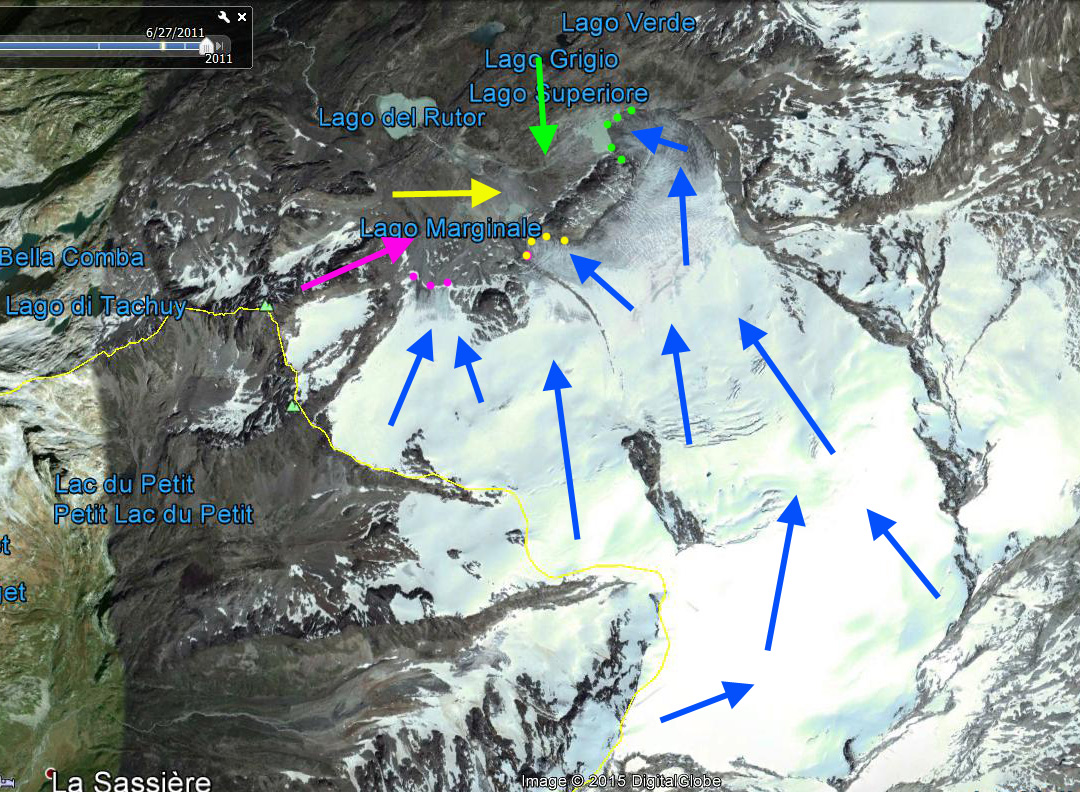
Google Earth image indicating the three terminus of the Rutor glacier, arrows indicate 1988 terminus position, dots the 2011 terminus position of each.

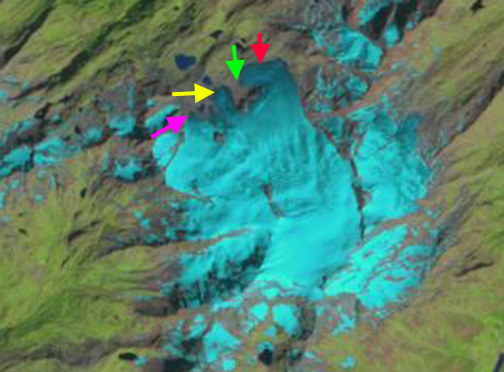
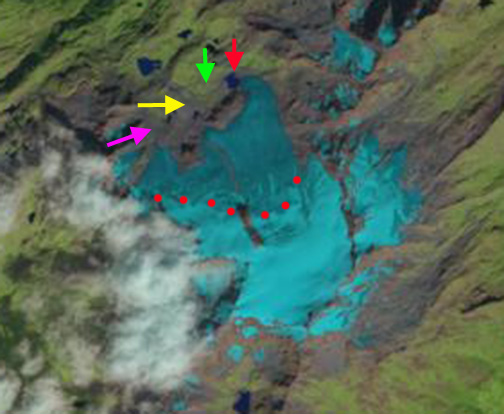
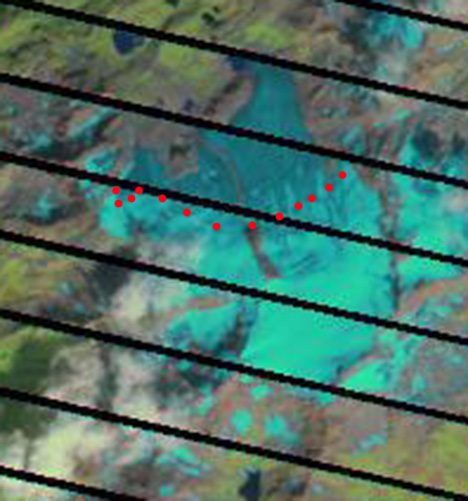
In 1988 the eastern terminus, green arrow, had expanded slightly occupying the same location as it had in 1975, this left a trimline do the lack of retreat from 1975 to 1991, the area down valley had been deglaciated an additional 20 years. All three termini descended below 2600 m in 1988. The eastern and central terminus (yellow arrow) were separated by only 400 m. There was a small nunatak shortly above the terminus between the central and western (pink arrow) terminus. By 2014 a lake, red arrow, has formed due to retreat of the eastern terminus. The retreat is 500 m. Additionally between the eastern and central terminus the glacier margin has pulled back from a series of bedrock knobs. The central terminus, yellow arrow, has receded 400 m, and no longer reaches the lower slope foreland below 2650 m. The nunatak between the central and western terminus is now a substantial bedrock knob beyond the glacier margin. the western terminus has receded the least 300 m, but this is a greater percentage of the full length of the glacier feeding this terminus. Further there is negligible retained snowpack in 2014. The 2011 Google Earth image has stagnant areas evident at the terminus, red arrows, that lack of crevassing or other features of movement.

The snowline in 2014, red dots, extends east and west from a prominent rib, and is at 3000-3050 m. In 2011  the snowline is at 3050 m-3100 m and in 2013 the snowline is at 2950-3000 m.  The average snowline of the last four years is 150 -200 m higher than during the 1975-1991 period and 250 m higher than during the LIA.  This is substantial and will drive further continued rapid retreat.  This is the same climate that is driving retreat throughout the Alps from Verra Grande Glacier to Sabbione Glacier to Presena Glacier, that needed a blanket.

rutor Glacier 1988
1988 Landsat image
rutor Glacier 2014
2014 Landsat image
ruitor terminus
Google Earth image of new lake formed and retreat of eastern terminus
rutor 2011
2011 Landsat image

rutor 2013
2013 Landsat image

Gepatsch Glacier Retreat, Austria 1984-2013

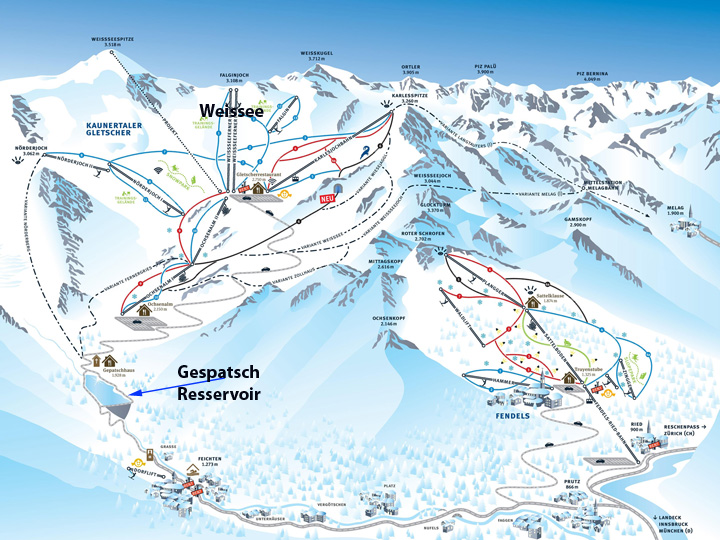
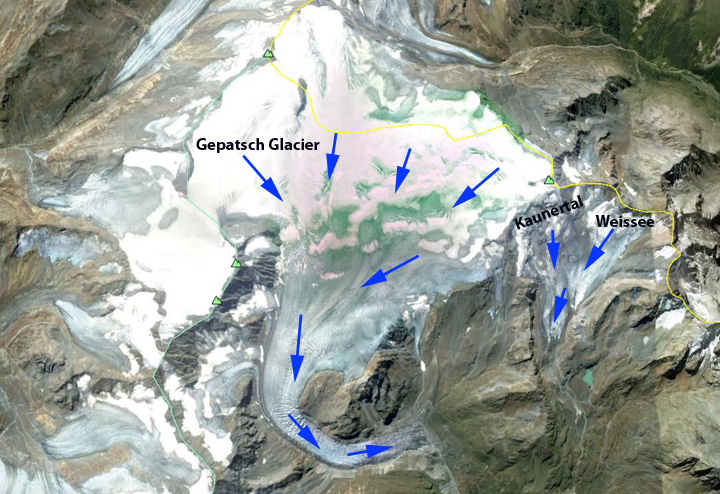
Gepatsch Glacier (Gletscher), Austria the runoff from this glacier drains into the Gespatsch Reservoir, which has a storage volume of 140 million cubic metres of water and an annual electricity production of 620 million kwh. The glacier is Austria’s second largest with an area of over 16 square kilometers. The adjacent Weißsee-Kaunertal Gletscher is host to Kaunertal Gletscher ski area and in the summer a key destination of the Gletscherpark.  The ski area map below indicates several lifts on the Weißsee-Kaunertal Gletscher. This glaciers retreat will reduce summer water supply to the reservoir, as it provides 50 million cubic meters of runoff each summer. With climate change that runoff will no longer peak in the warmest-driest part of the summer. The retreat is similar to that of Obersulzbachkees, Austria the third largest in Austria.

kaunertaler-gletscher_trail_map_l3 (1)
Ski Area Map

gepatch 2007

2007 Google Earth image

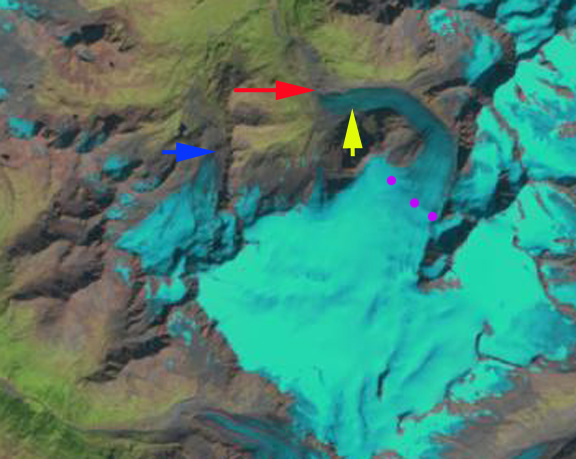
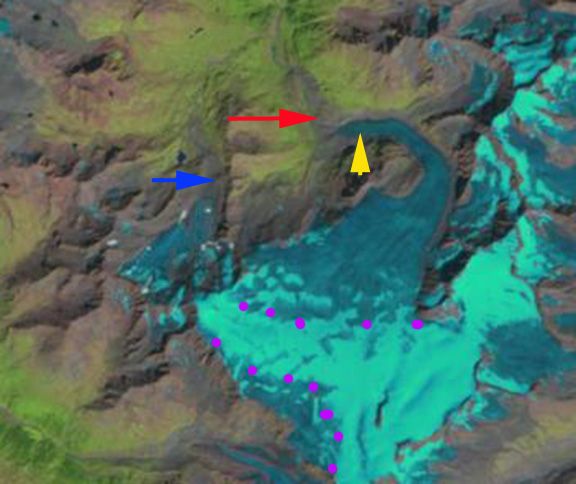
In 1985 the glacier terminated at the red arrow, expanding across the bottom of the valley where it turns south. The Weißsee-Kaunertal Gletscher terminus is at the blue arrow and the snowline is just above the icefall at the purple dots.  In 1990 there is little evident change, the snowline is higher above the icefall, the glacier in fact ended a decade of advance in 1988. By 2000 Gespatch Gletscher has retreated 200-300 meters from the red arrow. Weißsee-Kaunteral Gletscher has retreated 100-150 m from the blue arrow.  In 2010 most of the glacier has lost its snowcover, which was frequently the case from 2000-2010.  The terminus has retreated up the westward oriented side valley several hundred meters.  There is essentially no snow on the Weißsee-Kaunertal Gletscher.   By 2013 Gepatsch Gletscher has retreated 800-900m from its 1985 position, with most of the retreat since 1990. Much of this retreat occurred from 2010-2013 of 240 m of retreat and another 120 m in 2014, 52 meters per year, as noted in the annual reports of the Austrian Alpine Club glacier report completed by Andrea Fischer each year (Fischer, 2015).

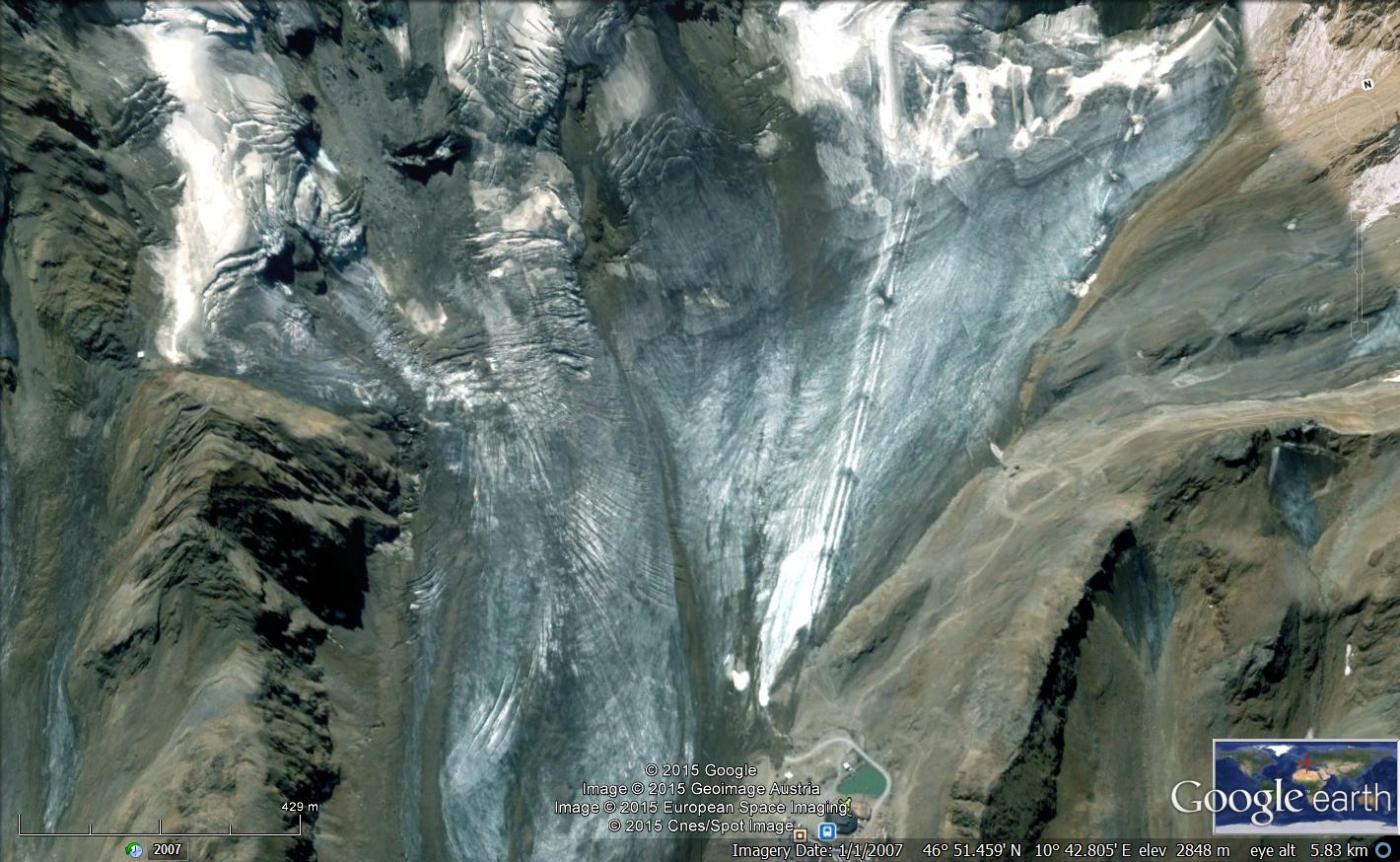
It is evident in the 2003 Google Earth image that rapid retreat was imminent as the terminus of the galcier was stagnant. The Weißsee-Kaunertal Gletscher has retreated 300 m and has thinned even more from 1990-2013.  The   Alpine club also observes this glacier and notes typical retreat rates in the last five years ranging from 15-25 meters/year.   Given the ski lifts emplaced on this glacier, continued thinning and retreat will increasingly impact ski area operation.  The ski area has not resorted to artificial means to sustain Weißsee-Kaunertal Gletscher as has been done at nearby Pitzal Glacier ski area.

gespatch 1985
1985 Landsat Image

gespatch 1990
1990 Landsat Image

gespatch 2000
2000 Landsat Image

gespatch 2010
2010 Landsat Image

gespatch 2013
2013 Landsat Image

gepatch terminus 2003
2003 Google Earth Image
weissee lifts
Google Earth Images ski lifts evident as the linear feature on the nearly snowless galcier. 

Weisee 2003