Svalbard Ice Cap Fragmentation and RecessionAccelerates with Snow Free Conditions Again in 2025

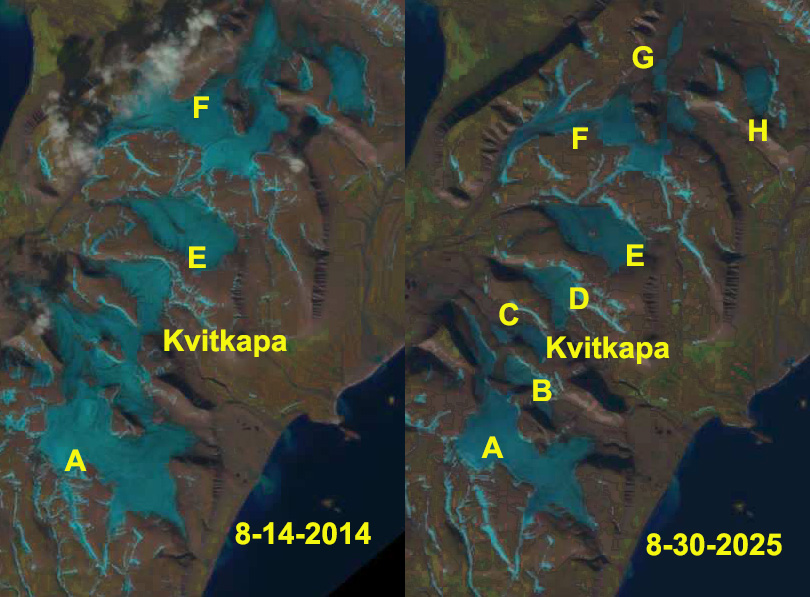
Kvitkapa in Landsat images from 2014 and 2025 indicating the fragmentation from 3 to 8 different glacier parts.

In 2022, 2023 and 2024 a number of ice caps and glaciers across Svalbard lost all snow cover, ie. Edgeøya 2022. The result by 2024 was that all firn cover had been lost as well on many of the ice caps of Edgeoya, such as on Digerfonna. This largely removes the ability of meltwater to refreeze. In 2025 we again see this playing out on the ice caps of Edgeøya. This all too familiar story indicates these glaciers lack a consistent accumulation zone that is essential for their survival
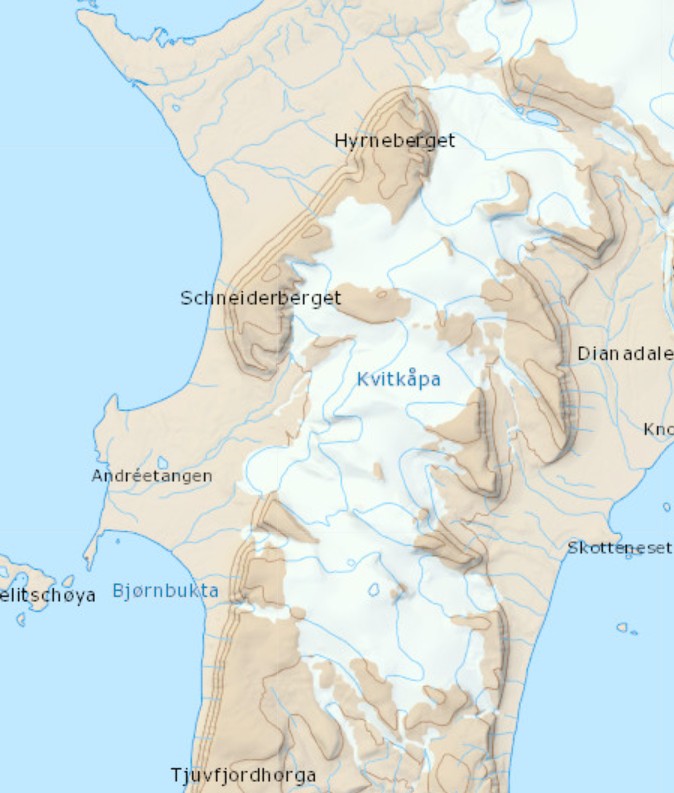
Map of Kvitkapa from TopoSvalbard indicating one interconnected ice cap in 2000.

Kvitkapa is an ice cap on a peninsula on the south coast of Edgeøya Island. In a map of this region from TopoSvalbard this is a single interconnected system of glaciers. By 2014 Landsat imagery indicates the ice cap has separated into three sections. By 2025 the ice cap has fragmented into eight different parts.

On the next peninsula to the east Kvalpyntfonna has also lost all snow cover again 2025.

Kvalpyntfonna in Landsat image from 2025 having lost all its snow cover and has no residual firn from previous winters either.

Further north and east on Edgeøya the Stonebreen ice cap has also losts its snow cover and firn cover driving thinning and retreat. The consistes loss of snow cover and resultant loss of firn cover, indicates that most ice caps Edgeøya cannot be sustained.
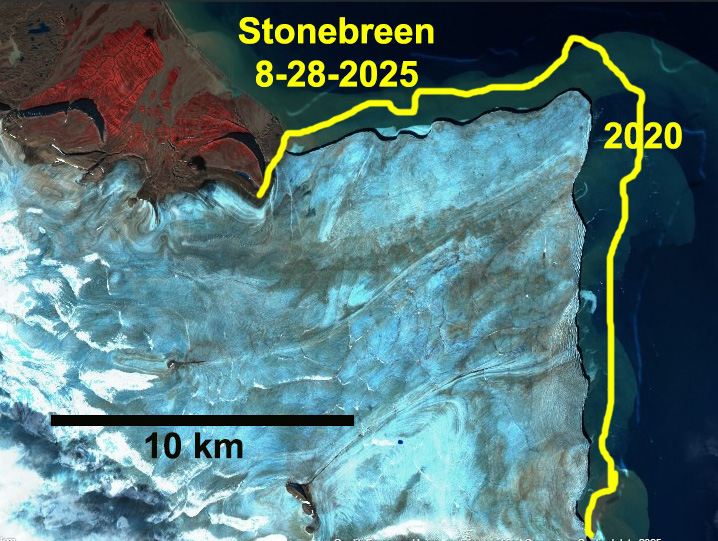
Stonebreen in false color Sentinel image illustrating retreat from 2020-2025. The lack of retained snow cover and residual firn will lead to continued rapid thinning and retreat.

Volcan Peteroa Glaciers Argentina/Chile Fragment During Snow Cover Free Summers

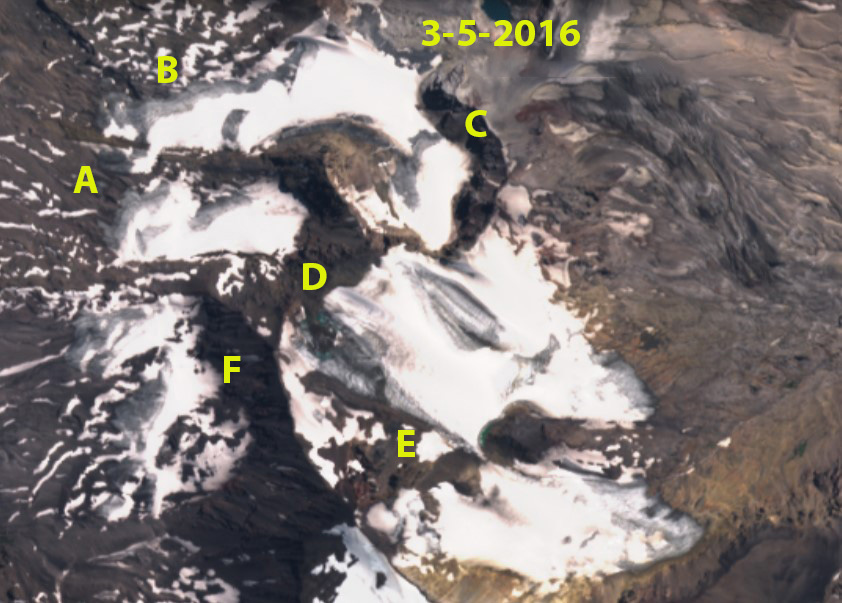
Volcan Peteroa glaciers in Sentinel images from March 2016 (below) and March 2023 (above). This illustrates fragmentation, 50% area loss, and a new lake formation. All the result of repeated snowcover free glaciers. 

For an alpine glacier to survive it must remain mostly snowcovered throughout the year, even at the end of the summer. This is one reason for the majesty of glaciated mountains, they shine brightly even in summer.  This summer in the Central Andes of Argentina and Chile, just as in 2022, I have chronicled the near total loss of snowpack due to summer heat waves, leading to dirty/dark glaciers (Pelto, 2022).  The heat wave this summer led to maximum temperature anomalies 3-5 C during the first half of March in the Central Andes of Argentina (SMN Argentina, 2023). An ice surface melts faster than a snow surface and the darker surface of the glacier also enhances melt rate leading to more rapid area and volume loss. This includes fragmentation and rapid expansion of bedrock areas amidst the glacier, other regional glacier obsrvations include: Sollipulli Glacier, Rio Atuel Glaciers, Palomo-Cipreses Glacier and Volcan Overo Glaciers,Here we examine Volcan Peteroa glaciers on its north flanks, which straddles the Chlile-Argentina border during the 2016-2023 period using Sentinel images. Reinthaler et al 2019 observed a ~2% annual area loss of Volcan Peteroa glaciers.

Here we examine the impact of several years of snow cover loss on the Volcan Peteroa glaciers. In 2016 it is evident there are six key ice masses on the north flank of the glacier A-F, with a combined area of 4.5 km².  In 2022 early snowcover loss led to rapid glacier thinning and lake formation, see below.  In 2023 the glacier at Point A has contracted by 50% to 0.22 km². At Point B and C the glacier has separated and is now two fragments with area of 0.36 km²  and 0.12 km² respectively. At Point D a new lake has expanded rapidly in 2022 and 2023, the lake has an area of 0.12 km² and the glacier a area of  1.21 km².  At Point E the glacier fragmented and pulled away from D and its two fragments have an of 0.36 km². At Point F the glacier has melted away. The combined area of 2.27 km² is ~50% of the glacier area just seven years prior. This is much faster than the 2% loss of the 1986-2015 period. The significant darkening of the snowfree surface will speed the loss of this glacier that no longer has a consistent accumulation zone.

Volcan Peteroa Glacier in false color Sentinel image continues to fragment with ~2% retained snowcover in 2022.  New lake at Point D. A small fragment of ice is apparent at Point F. and bedrock expansion at Point A. New lake has also formed.

Rio Atuel Glaciers, Argentina Stripped of Snowcover February 2023

Snowcover loss on Cofto, Fiero and Del Humo Glacier in Sentinel images from January 13 and February 9, 2023, snowpack diminished from 45% to less than 3%.

Rio Atuel drains from the high Central Andes in Western Argentina and is a snow and glacier fed system In the headwaters region there are a series of glaciers that have been losing mass and retreating.The most negative mass balance rates from 2000–2018 in this region of Argentina were in the  Atuel basin at −0.70  m/year (Ferri et al 2020). Both minimum and annual discharge in the Rio Mendoza has diminished from 1980-2010 (Lauro et al 2019).

Here we examine the snowcover loss between January 13 and February 9, 2023 on four of these glaciers from south to north Fiero, Corto, Del Humo and La Laguna. In mid-January snowcovered 40-50% of these glaciers. After a significant heat wave from January 28-Feb. 9. the snowcover had declined to less than 3% with six weeks left in the melt season.  This is the second year in a row these glaciers have lost all snowcover. This has further concentrated light absorbing particles at the surface, decreasing albedo, and increasing glacier melt. The glaciers simply put look quite dirty.  This is a cumulative process that is enhanced by consecutive high melt years and causes rapid volume loss.  Shaw et al (2020) found a significant ongoing decline in ice albedo in these region of the Andes that is impacting their overall mass loss.  The increased frequency of heat events continues to enhance melting of Central Andean glaciers. This process is playing out this year on Sollipulli Glacier and in 2022 on many Central Andean glaciers.

Snowcover loss on La Laguna Glacier in Sentinel images from January 13 and February 9, 2023, snowpack diminished from 40% to less than 3%.

Volcan Overo is a 4619 m high Andean mountain in Argentina with a relatively low sloped broad summit region above 4000 m. The summit region is host to a glacier complex that is shrinking and fragmenting. In mid-January, 2022 the glacier has lost all of its snow cover. Volcan Overo in February 2023 the glacier complext has again lost all snowcover, which is leading to furtherfragmentation at the yellow arrows, even since 2022.

Volcan Overo in 2022 and 2023 having lost all of its snowcover. Expanding lakes at blue arrows.