
The Big Four ice caves area popular hiking destination 90 minutes northeast of Seattle in the North Cascades. This ice mass is currently the lowest elevation glacier in the lower 48 states. It is fed by tremendous avalanching from higher on Big Four Mountain. During the winter the snow piles up on the avalanche fan. In the summer the waterfall from above carves tunnels under the snow-ice mass. At some point in June or July the tunnels are enlarged enough to allow people, but also warm air to enter. This leads to further tunnel expansion. In warm summers the tunnels get large enough by late summer that collapses of the roof occur. Unfortunately this year the caves are already in late summer form and an expected collapse tragically led to the 1 person killed and five injured this week. Here we examine the formation and now demise of this odd glacier in the last decade. There are no pictures of the ice caves in this post, as it is not a place to enter this year.
The 1999-2002 period featured heavy winter snowpack and avalanching boosting Big Four. The summer of 2003 was the first of three cruel seasons to Big Four. In this image you cannot note the blue case to all but the very top of the avalanche cone, indicating it is older snow. There is further two layers that look to be annual layers on the right side of the image. This suggests to me, the base is a 1999, layer, than a 2000 layer, than a broader dirty band and a 2002 layer, followed by a 2003 snowpack,. The summer of 2001 was warm and no snowpack would have survived, causing the wider dirt band. In 2003-2005 a series of dismal winters and warm summers led to the near total loss of the Big Four Avalanche fan, at this point it was not a glacier.
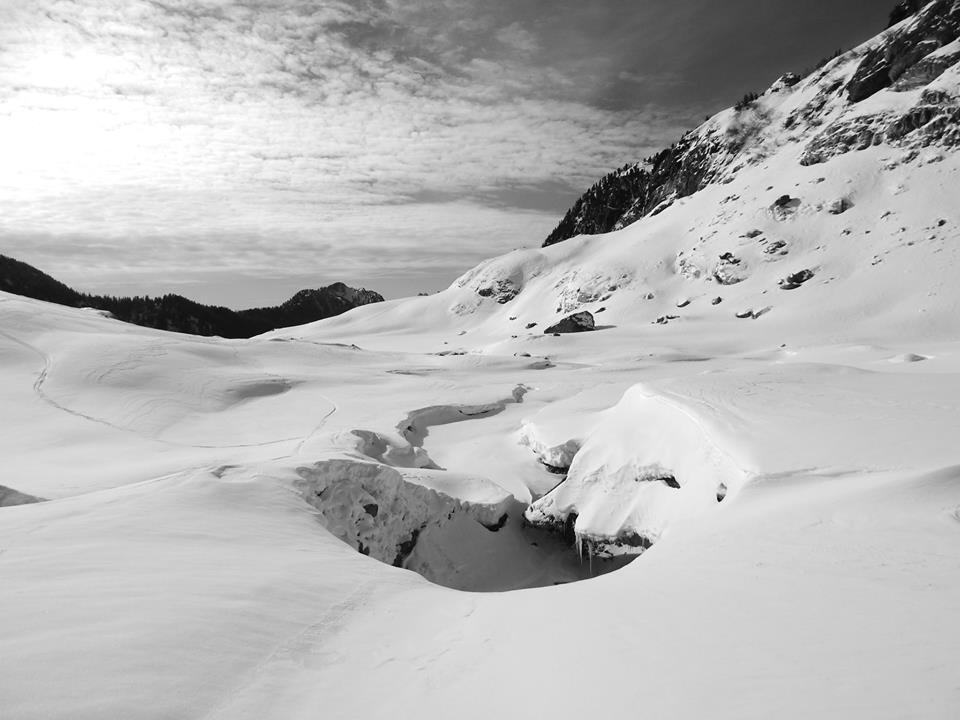
From 2006-2012 a series of good summers led to redevelopment, which prompted David Head to contact me to investigate in 2009 if it was a glacier. He provided a series of images from 2005-2008 indicating the changes. We then headed to the glacier in 2009 to investigate in detail. In 2009 we mapped the glacier, from above and below. We found it had an area of 0.07 square kilometers, the glacier had a center length of 370 m, had a width at the toe of 270 m, an average slope of 22 degrees an average depth of 32 m a maximum depth of 55 m, and a volume of ~2 million cubic meters. There was blue glacier ice evident and a few crevasses on the upper portion. It was a glacier. The glacier gained at least 30 m in thickness over the majority of its area from 2005-2008, which is an extraordinarily short period. This year for the first time no avalanches reached the avalanche fan. Last summer was at record warmth, with the snowmass ablated to its smallest extent since 2005. The ice cave entrances were wide with a rainbow shaped arch, not an engineering setup for stability. This did not change over the winter. Hence, it is like having two summers in a row without winter. Contrast the June 2008 image to April 2015 (from Kellbell), quite a difference. There is no snow on Big Four even in April this year, the blue glacier ice is exposed and ablating starting then. The ice mass is rapidly ablating in the warm early summer of 2015 and will reach its smallest size since 2005 by the end of the summer. It is likely too thick to melt it all this year, but it may well surpass the 2005 minimum size. It will no longer be a glacier by the end of the summer. That is unusual to watch a glacier form and melt away in a decade. There will be more collapses in the ice caves this summer as it recedes to a meager size.

2003-2007 Time lapse of Big Four
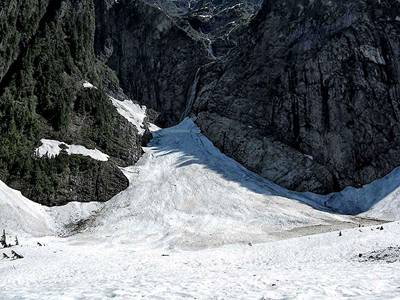
June 2008 image

October 2008 image
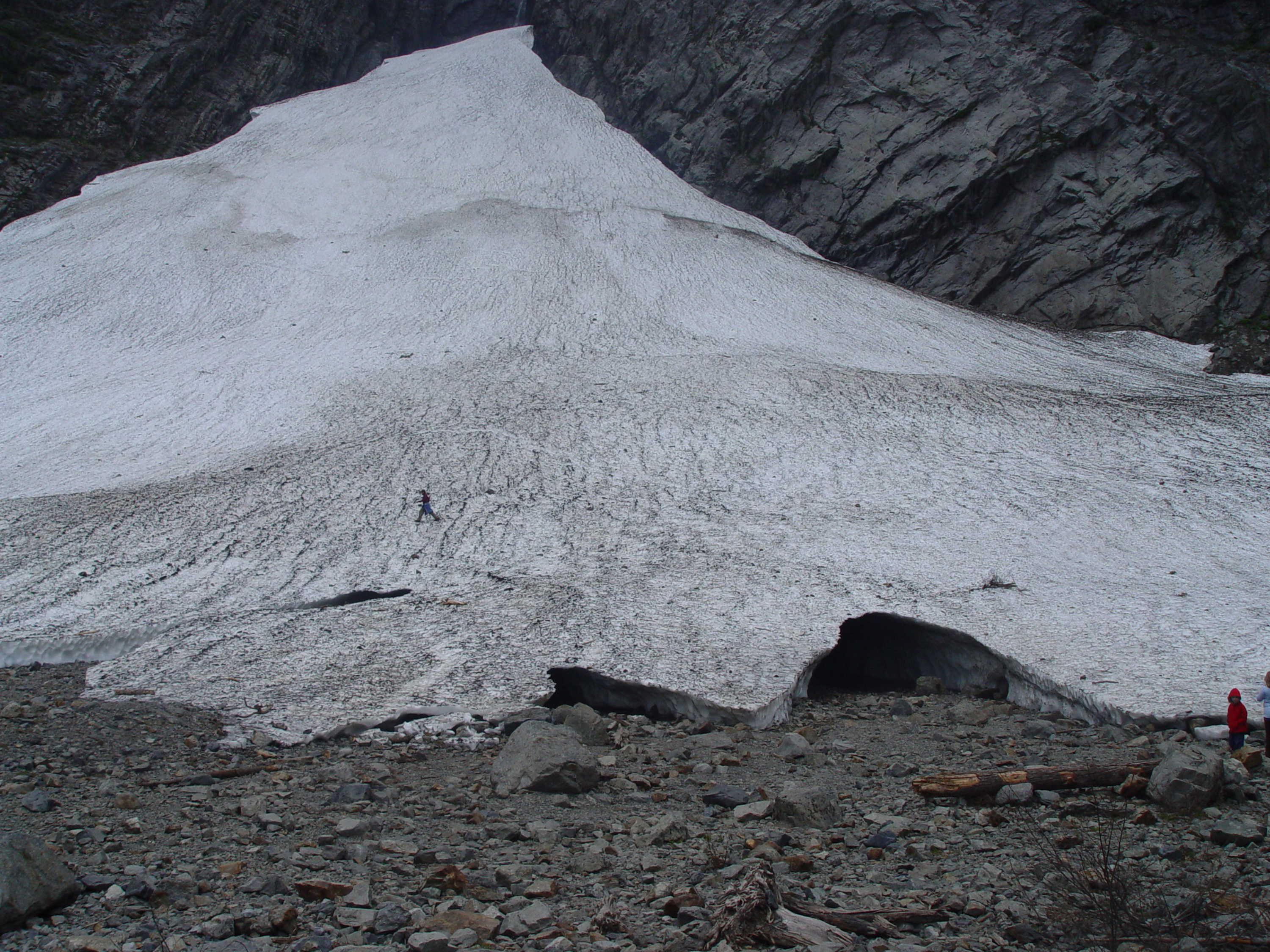
August 2009 image

April 2015 (Kellbell)


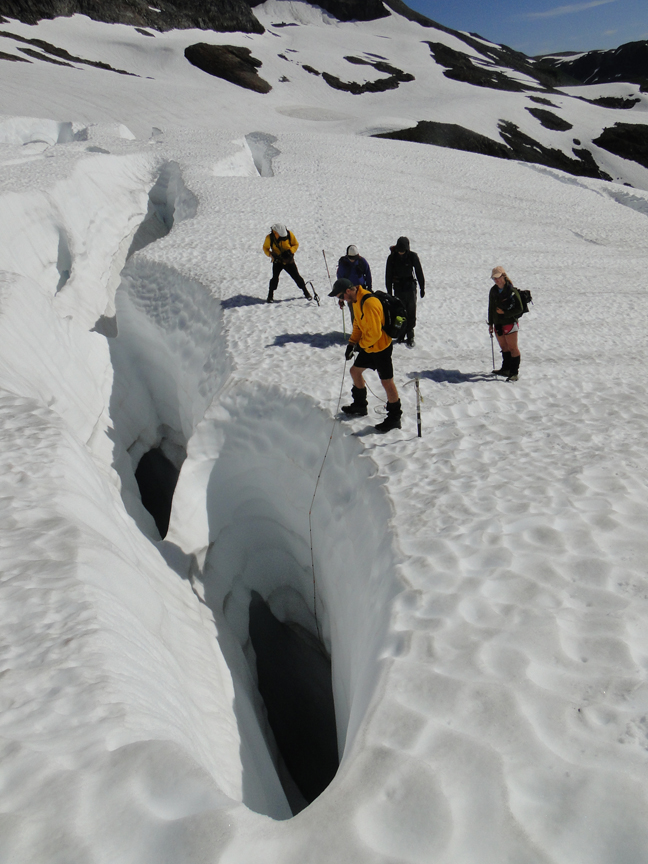
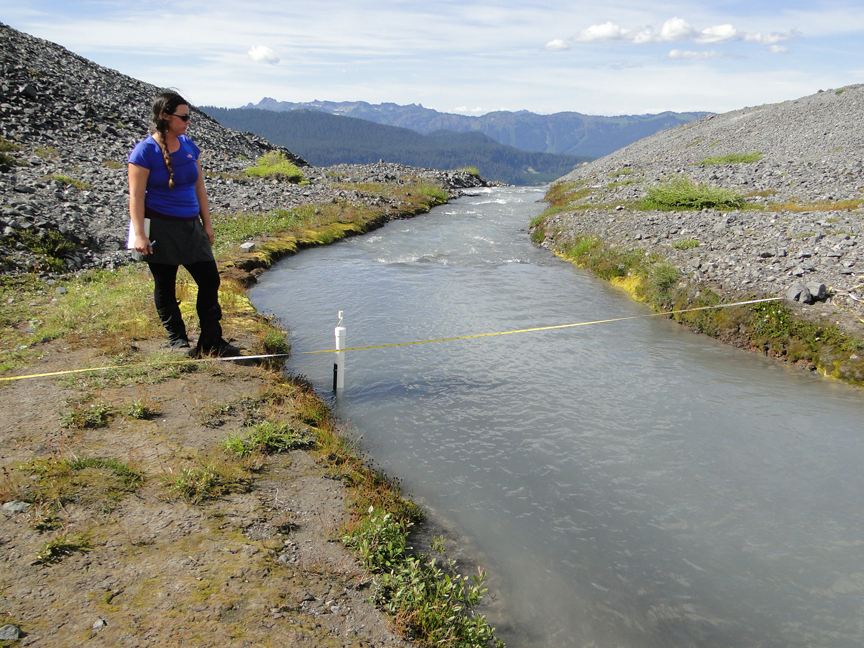












 Despite the advantages of snow accumulation the glaciers mass balance since 1984 has average -0.5 m a year for a cumulative loss of 13 m. For a glacier that averages 60 m in thickness this is over 20% of its volume. Details of the
