Vilkitkogo Glacier Rapid Retreat, Novaya Zemlya 1990-2015

vilkitskogo compare

Figure 7.4.  Vilkitskogo South Glacier (Vs) and Vilkitskogo North Glacier (Vn) compared in 1990 and 2015 Landsat images.  Red arrows indicate 1990 terminus positions, yellow arrows 2015 terminus positions and purple arrows upglacier thinning.

Vilkitskogo Glacier has two termini that were nearly joined in Vilkitsky Bay in 1990.  The glacier flows from the Northern Novaya Zemlya Ice Cap to the west coast and the Barents Sea. The glacier has been retreating like all tidewater glaciers in northern Novaya Zemlya (LEGOS, 2006).  Carr et al (2014) identified an average retreat rate of 52 meters/year for tidewater glaciers on Novaya Zemlya from 1992 to 2010 and 5 meters/year for land terminating glaciers. For Vilkitskogo they indicate retreat into a widening fjord, and that the south arm has a potential bathymetric pinning point. The increased retreat rate coincides with the depletion of ice cover in the Barents Sea region and a warming of the ocean. Both would lead to increased calving due to more frontal ablation and notch development similar to at Svalbard (Petlicki et al. 2015)

The north and south glaciers both terminated at the mouth of their respective fjords in 1990, with the southern arm ending on a small island/peninsula extension. In 1994 there is limited evident retreat.  By 2001 embayments had developed particularly along the peninsula separating them.  By 2015 Vilkitskogo North has retreated 5000 m along the northern side of the fjord and 4000 m along the south side since 1990.  This fjord has no evident pinning points, and the rapid calving retreat should continue.  Vilkitskogo South has retreated 1000 m on the west side and 1800 m on the east side.The retreat has exposed a new island in the center of the glacier.  The glacier is currently terminating on another island.  Retreat from this pinning point will allow more rapid retreat to ensue.  Upglacier thinning is evident in the expansion of bedrock areas and medial moraine width, purple arrows. This indicates the retreat will be ongoing. There is still a large are of snowcover across the summit of the ice cap each year. The retreat has the same unfolding story as Krivosheina, Nizkiy and Glasova Glacier

vilkitskogo1994

1994 Landsat Image

vilkitskogo 2001

2001 Landsat image
Dismal Glacier, British Columbia Prospects Match Name

dismal
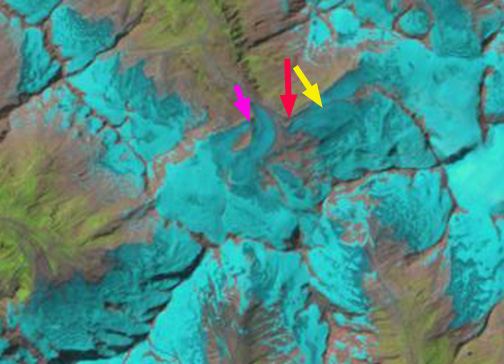
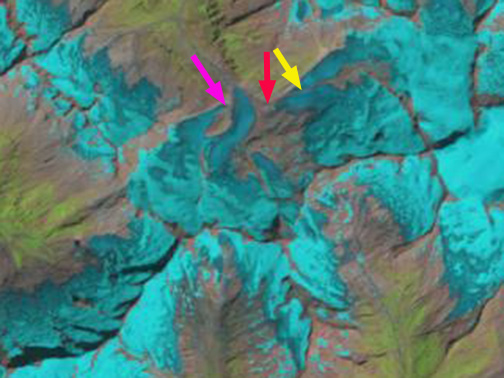
Landsat image comparison from 1988 and 2015, red arrow indicates 1988 terminus and yellow arrows 2015 terminus. Purple arrows indicate thinning upglacier.
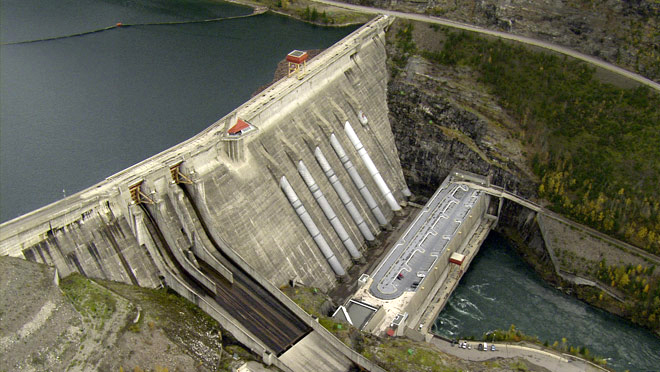
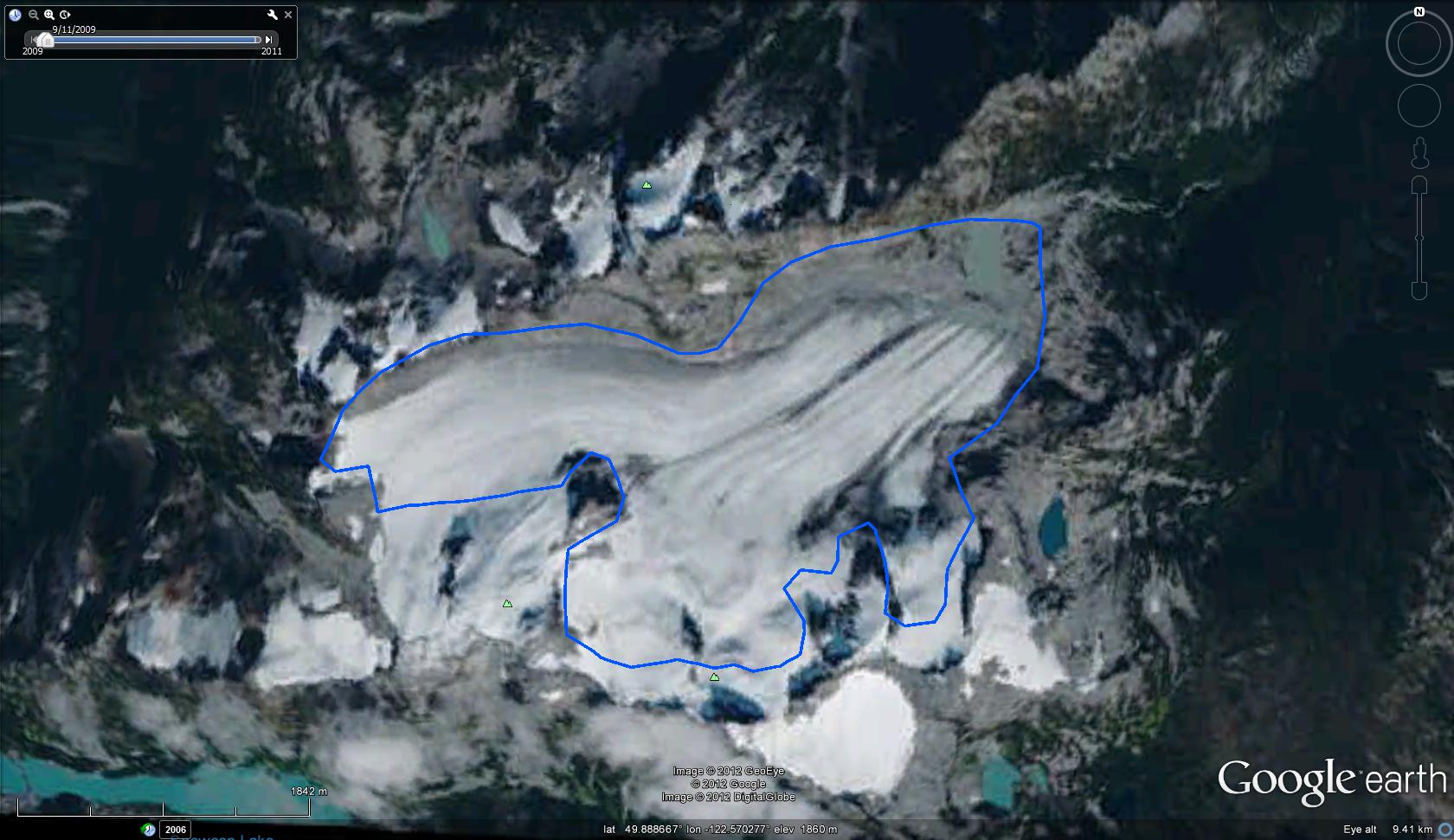
Dismal Glacier flows north from Mount Durrand in the Selkirk Range of British Columbia.  It drains from 2500 m to 1950 m and its runoff flows into Downie Creek that is a tributary to the Columbia River and Revelstoke Lake.  This lake is impounded by the BCHydro Revelstoke Dam which is 2480 MW facility.  Here we examine Landsat images from 1988 and 2015 to identify changes in this glacier.  The glacier snowline in the mid-August image of 2015 is at 2400  m just above a substantial icefall.  The glacier has retreated 640 m from 1988 to 2015.  The eastern extension at 2200 to 2300 m of the glacier noted by a purple arrow, has lost considerable area, indicating thinning even well above the terminus  elevation. Note thinning of this section of the glacier by 2015 after it joins the main glacier, it is separated by a medial moraine. The terminus in the 2009 Google Earth image has a low slope and is uncrevassed.  This indicates the terminus reach is relatively inactive, but does not appear stagnant.   Tennant and Menounos (2012) examined changes of the Rocky Mountain glaciers just east of this region and found between 1919 and 2006 that glacier cover decreased by 590 square kilometers, 17 of 523 glaciers disappeared and 124 glaciers fragmented into multiple ice masses. This will happen at Dimsal Glacier as it has at Cummins Glacier.  Bolch et al (2010)  observed a 15% area loss from 1985-2005 in this region.  The snowline has been above the icefall at 2400+ m in 2013, 2014 and 2015, indicative of negative mass balance that will lead to continued retreat.  The glaciers name is not due to its future prospects, but its future prospects are indeed dismal.
dismal glacier ge
revelstoke-dam-powerhouse-columbia-river-place
BCHydro image of Revelstoke Dam

dismal glacier
Google Earth image of Dismal Glacier terminus in 2009. Red arrow indicates 1988 terminus position, black arrows various recessional moraine features.

Bionnassay Glacier Terminus Tongue Detaches, Mont Blanc, France

Bionnassay Glacier drains west from Dôme du Goûter and Aiguille de Bionnassay of the Mont Blanc Massif in France. The glacier has a heavily debris covered terminus and has experienced less retreat from 1980-2010 then other Mont Blance glaciers. Bionnassay retreated 200 m (Moreau et al , 2012), while Mer de Glace retreated 500 m in the interval 1998 to 2008. Gardent et al (2014) observed a 25% decline in the area of glaciers in the French Alps from 1970 to 2009, with the rate increasing significantly recently.  Bionnassay is now in rapid retreat as the stagnant terminus tongue is detached from the active glacier tongue.

bionnassay overview

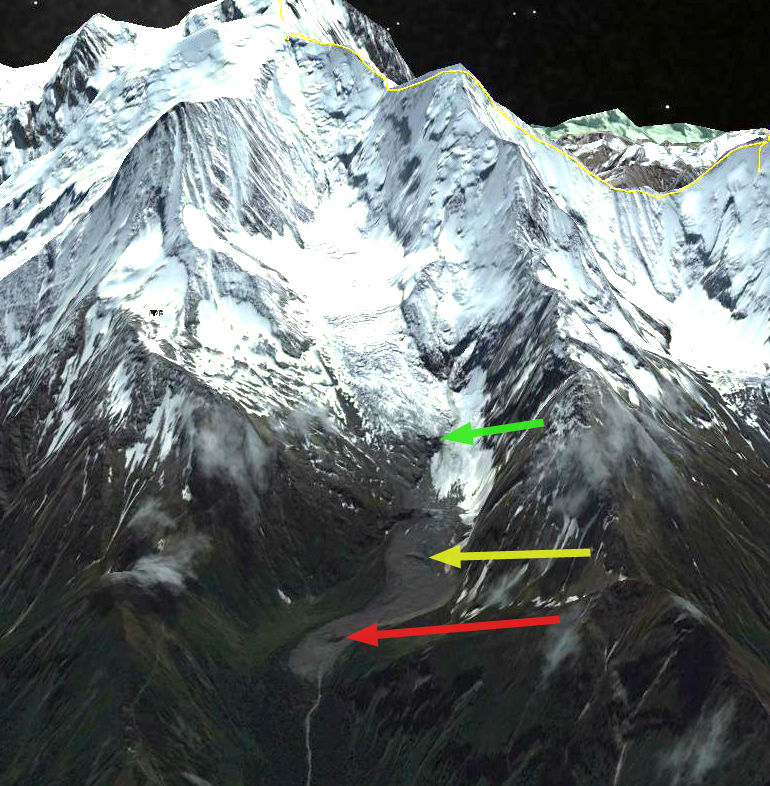
Bionnassay Glacier.  Red arrow indicates terminus of stagnant region.  Yellow arrow indicates bedrock emerging that is separating stagnant terminus tongue.  Green arrow indicates lower limit of active glacier. 

In 1985 the glacier terminus is at the yellow arrow. The debris covered ice is crevassed and covers the entire region at the red and green arrow. Points B and C are ice covered and Point A has a small exposure of bedrock. In 1999 retreat from the yellow arrow is evident the glacier still covering the region at the red and green arrow. In 2001 Google Earth image the terminus is evident at the red arrow, the region at the green and yellow area are covered by glacier ice. In 2011 the terminus has retreated 180 m since 2001, bedrock has emerged at the green arrow, beginning to separate the stagnant debris covered terminus tongue. At the yellow arrow the crevassing has diminished greatly. In 2015 the terminus has retreated to the pink arrow. Bedrock has been exposed from below the glacier terminus tongue at the yellow arrow. The active glacier terminus is now at the green arrow. At Point B and C glacier thinning has led to marginal retreat and exposure of bedrock where there was glacier ice. At Point A the expanse of exposed bedrock has greatly expanded.  The retreat of the main glacier terminus is around 200 m.  However, the retreat to the newly emergent bedrock separating the glacier is 750 m.  The active terminus is now 1700 m from the 1985 terminus position at the green arrow.  In the next few years this will become a well defined terminus, as the lower stagnant zone melt away.

Bionnassay Glacier is just south of Taconnaz Glacier, which is also retreating.
bionnassay 1985
1985 Landsat image
bionnassay 1999
1999 Landsat image
bionnassay glacier ge 2001
2001 Google Earth Image
bionnassay glacier ge 2011
2011 Google Earth Image
bionnassay 2015
2015 Landsat image
500 m

Auyuittuq National Park Ice Cap Downwasting, Baffin Island

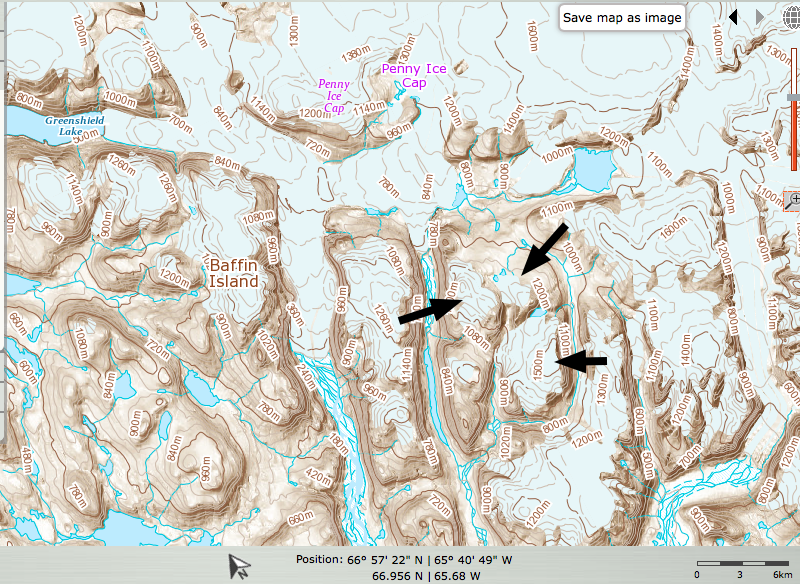
Just south of the Penny Ice Cap on Baffin Island in Auyuittuq National Park there are a large number of small ice caps.  We focus on three of these ice caps east of Greenshield Lake.  The region has been experiencing rapid ice loss, with 50 % of the ice cap area lost in the last few decades (Miller et al, 2008).  Miller et al (2008) also observe that these are thin and cold glaciers frozen to their beds with limited flow. Way et al (2015) observed the loss of 18-22% of two larger ice caps on Baffin Island, Grinnell and Terra Incognita.  The ice cap losses are due to reduced retained snowpack. Zdanowicz et al (2012)  found that starting in the 1980s, Penny Ice Cap entered a phase of enhanced melt rates related to rising summer and winter air temperatures across the eastern Arctic. In recent years they observed that 70 to 100% of the annual accumulation is in the form of refrozen meltwater. However, if the snowline rises above the ice cap consistently, as happened at Grinnell Ice Cap than there is no firn to retain the meltwater and superimposed ice formation is limited.  Meltwater has difficulty refreezing on a glacier ice surface. The rise in temperature is illustrated by a figure from Way et al (2015), below

penny ice cap map

Map of region south of Penny Ice Cap from Canadian Topographic maps.

gic summer climate

Figure From Way et al; (2015)

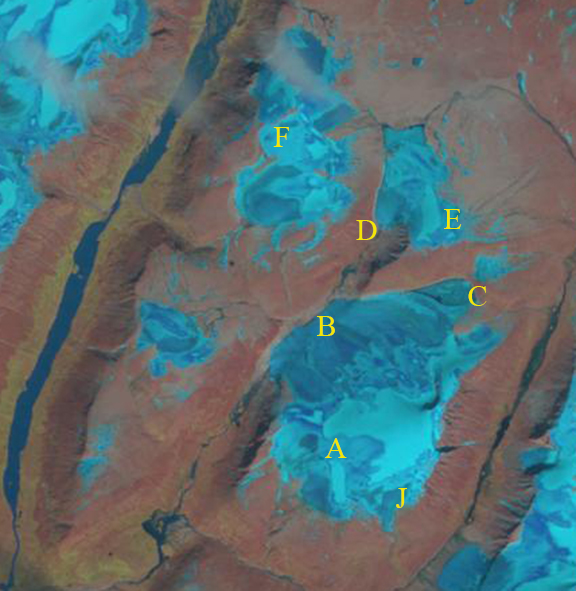
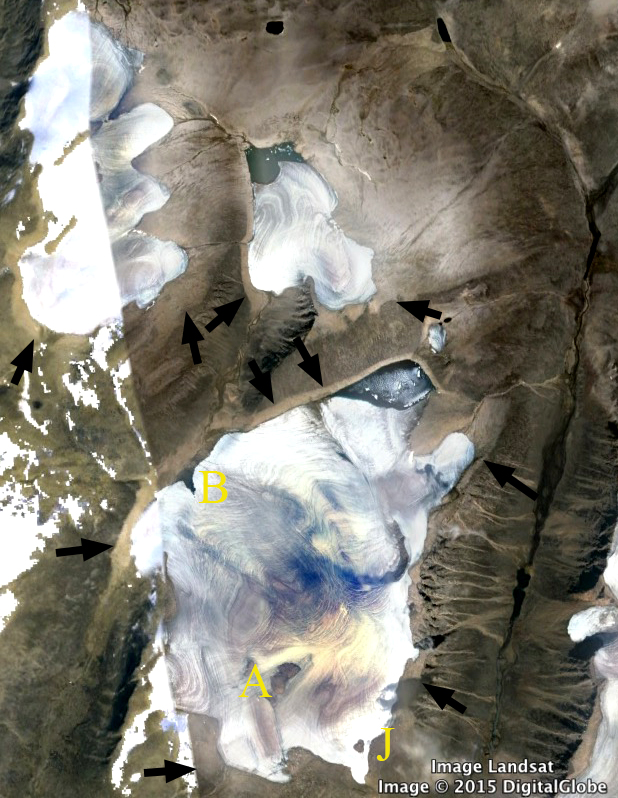
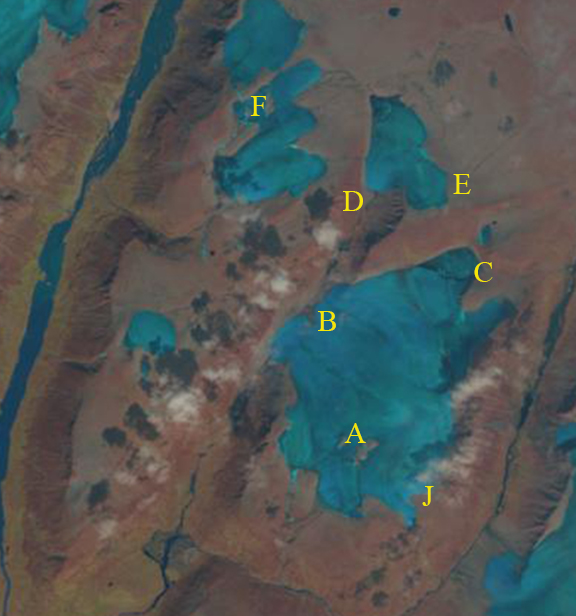
In the 1998 Landsat image the two northern ice caps, with E and F on them, have very little retained any snowpack, but significant firn areas.  The larger ice cap has retained snowpack adjacent to Point A and considerable firn area as well. There is a trimline beyond the glacier margin apparent west of Point B due to recent retreat, but otherwise trimlines are not immediately evident.  In 2000 the two northern ice caps again have very little retained snow, and the larger ice cap retained snow near Point A.  In the 2013 Google Earth image black arrows on the image indicate trimlines recently exposed by glacier retreat.  There is no evident retained snow, and no retained firn is even evident. This suggests the ice caps lacks an accumulation zone.  A close up view, illustrates many years of accumulation layers now exposed, note the linear dark lines, black arrows.  The second closeup view illustrates the area around Point E and D that has been deglaciated.  There also are some new areas of expanded bedrock such as near Point A on the larger ice cap.  The 2014 Landsat image indicates the bedrock has expanded at Point A.  At Point B an area of bedrock is expanding into the ice cap.  At Point C the lake has expanded at.  Ice has melted away from Point D and E. At Point F a new area of bedrock has emerged within the ice cap.  At Point J the new bedrock seen in the 2013 Google Earth image has now expanded to the margin of the ice sheet.  These changes are a result of a thinning ice cap, largely due to increased ablation.  The lack of retained snow cover or firn confirms there is not a consistent accumulation zone and that these ice caps cannot survive current climate (Pelto, 2010).
baffin smi 1998 copy

1998 Landsat image

baffin smi 2000 copy

2000 Landsat image

baffin smi 2013ge copy

2013 Google Earth Image

baffinsmi closeup copy

Google Earth Closeup

baffinsmi closeup2 copy

Google Earth Closeup

baffin smi 2014 copy

2014 Landsat image


Disaggregation of Austria’s Third Largest Glacier, Obersulzbach Kees

The Obersulzbach Glacier, is situated in the uppermost part of the Obersulzbach Valley, which feeds the Salzach River system in Austria. The glacier drains the northeastern flank of Großvenediger. The glacier was the third largest glacier in Austria in the 1980’s, but in the last several decades separated into five distinct sections. Now that it is in five parts, should it be listed as such?

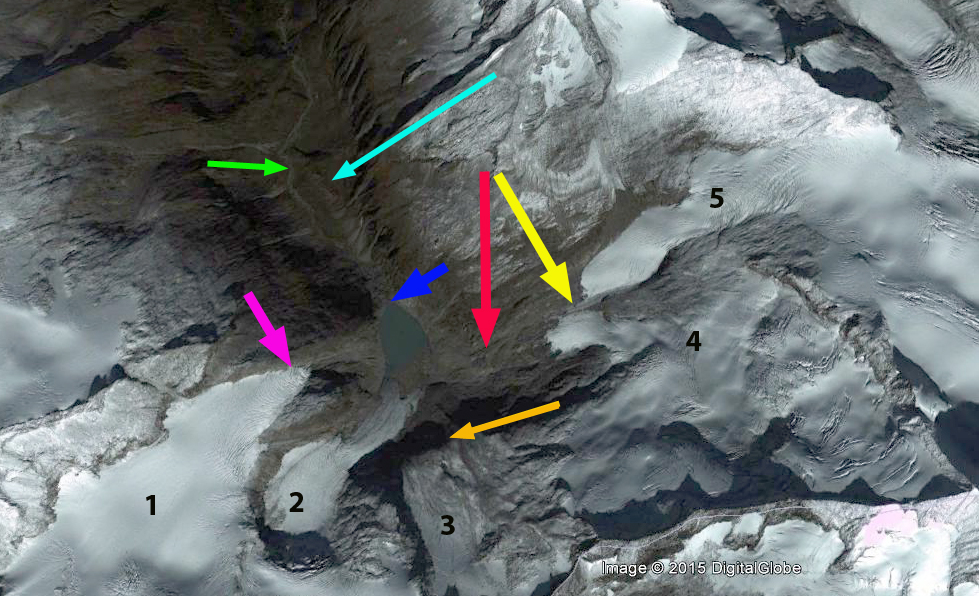
Yes, given that the Austrian Glacier Inventory has reclassified the glacier as five separate glaciers (Fischer et al, 2014). In this post they are numbered 1=Krimmlertorl Kees, 2=Obersulzbach Kees, 3=Bleidacher Kees, 4=Sulzbacher Kees, 5=Venediger Kees.

Nick Fisher sent me a map of the glacier prepared by the Austrian Military in the early 1930’s this is compared to the GE image of the glacier from 2012, below. According to this map, in 1934 the ice was at least 150 m deep over the current lake surface, where all the glacier streams united before heading down the ice fall. In 1934 the five branches of the Obersulzbach all joined and continued downglacier past a prominent rib on the east side of the glacier, light blue arrow, to terminate at 1980 meters, green arrow. The two western most glaciers Krimmerlertorl and Obersulzbach on the images, were joined at the pink arrow in 1934 and are well separated in 2012.  At the orange arrow in 1934 Bleidacher (3) flowed over a steep cliff and joined the other segments.  Today the glacier section ends at the top of a steep cliff.  Glacier Sulzbacher and Venediger are the largest and easternmost draining the actual slopes of Großvenediger.  They joined the other segments in 1934. By 1988 they had retreated to the red arrow but the two were still joined, by 2012 they had separated at the yellow arrow.  Hence, we now have separate glaciers that formerly joined together. The World Glacier Monitoring Service reports indicate this glacier retreated 140 meters from 1991-2000 and 345 m from 2001-2010, a substantial increase. Here we examine Landsat imagery from 1988, 1998, 2012, 2013 and 2014 to identify the retreat andand separation of the glacier into.  By 1998 a small lake less than 100 m long has formed at the end of the glacier, blue arrow.

obersulzbachkees map
Map of the Obersulzbach Region in 1934 from Nick Fisher
obersulzbach ge 2012
Google Earth image from 2012

In 1988 there is no lake visible at the end of the main terminus. The glacier has retreated 1.4 km since 1934. At the pink arrow glacier Krimmerlertorl and Obersulzbach are still joined in 1988. Glacier Sulzbacher and Venediger are also still joined at the yellow arrow and terminate at the red arrow. Glacier section Bleidacher has become detached.

By 1998 Krimmerlertorl and Obersulzbach are separated but the eastern glaciers Sulzbacher and Venediger are still joined at the yellow arrow. No lake yet exists at the terminus. Obersulzbach Glacier receded in a narrow bedrock basin since the late 1990’s and a shallow lake, Obersulzbach-Gletschersee, has formed since 1998 (Geilhausen et al, 2012). They observed that in 2009, the lake had an area of 95,000 m2 with a maximum depth of 42 m.

By 2013 all the glacier segments are separate. By 2013 the lake, Obersulzbach-Gletschersee,has grown to a length of 450 m and a with of over 200 meters. The retreat from 1988-2013 of glaciers Krimmerlertorl=0.8 km, Obersulzbach=0.6 km, Bleidacher=1.3 km, Sulzbacher=1.4 km, Venediger=1.6 km. The 2014 image is not as clear, but further retreat did occur.  The Austrian Alpine Club 124th annual survey indicated 86% of Austrian glaciers retreated from 2013-2014.
The Salzach is fed by many glaciers covering over 100 square kilometers (Koboltschnig and Schoner, 2011). These glaciers melt all summer providing considerable runoff to the numerous hydropower projects along the Salzach, that can produce 260 MW of power. The Verbund Power Plant producing 13 MW is seen below, at blue arrow. Glacier area loss will lead to declines in summer runoff.  A mass balance program has been started on Venediger Kees.

This glaciers retreat fits the pattern of other glaciers in the Austrian Alps, Oberaar Glacier, Rotmoosferner and Ochsentaler.

obersulzbachkees 1988
1988 Landsat image
obersulzbachkees 1998
1998 Landsat image
obersulzbachkees 2013
2013 Landsat image
obersulzbachkees 2014
2014 Landsat image
salzbach hydro


Verbund Power Station, blue arrow.

Snow Deficit on Grinnell Ice Cap, Baffin Island, Canada

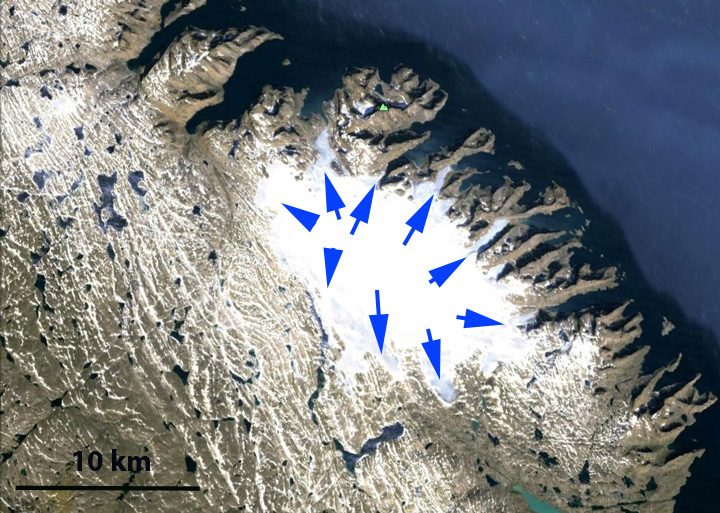
The Grinnell Ice Cap Is located on the Terra Incognita Peninsula on Baffin Island. The name suggests the reality that this is a not often visited or studied region. Two recent studies have changed our level of knowledge. Way (2015) notes that the ice cap has lost 18% of its area from 1974 to 2013 and that the rate of loss has greatly accelarated and is due to summer warming, declining from 134 km2 in 1973-1975 imagery to 110 square kilometers in 2010-2013 images. Papasodoro et al (2015) report the area in 2014 at 107 km2 with a maximum of elevation of close to 800 m. The location on a peninsula on the southern part of the island leads to higher precipitation and cool summer temperatures allowing fairly low elevation ice caps to have formed and persisted. Way (2015) in the figure below indicates the cool summer temperatures have warmed more than 1 C after 1990. Recent satellite imagery of snowcover and ICESat elevation mapping suggest little snow is being retained on the Grinnell Ice Cap since 2004. Papasodoro et al (2015) identify a longer mass loss rate of -0.37 meters per year from 1952-2014, not exceptionally different from many alpine glaciers. They further observed that from 2004-2014 this rate has accelerated to over -1 meter per year, including a thinning rate above 1.5 meters along the crest of ice cap. This can only be generated by net melting not ice dynamics. Further such rapid losses will prevent retaining even superimposed ice. Here we examine Landsat imagery from 1994 to 2014 to illustrate glacier response.

grinnell ice cap ge
Grinnell Ice Cap in Google Earth

gic summer climate
From Way (2015)

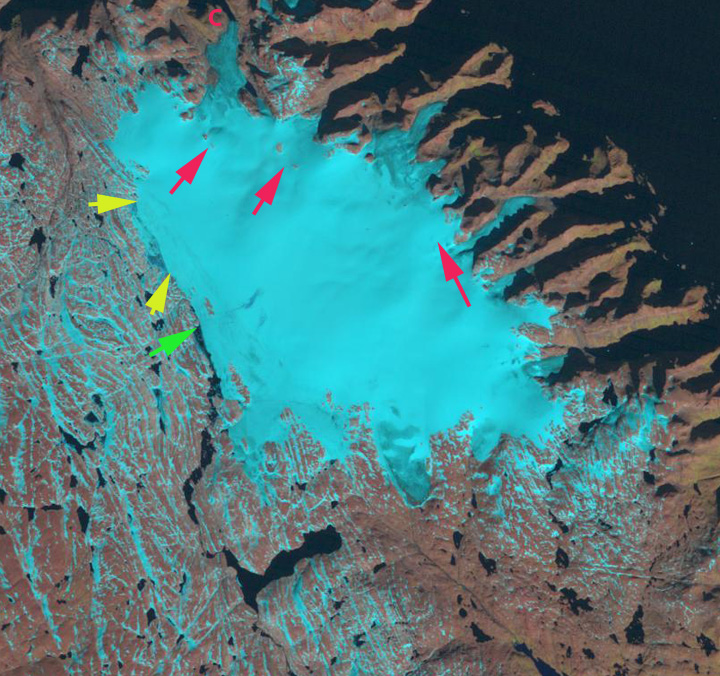
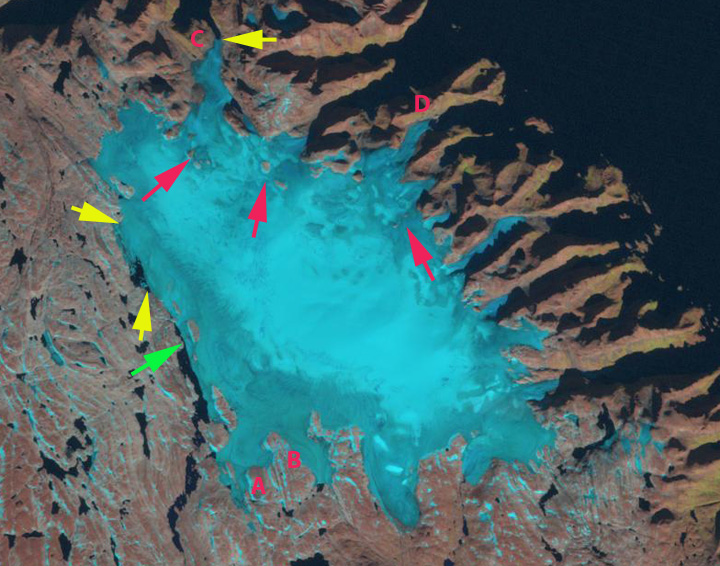
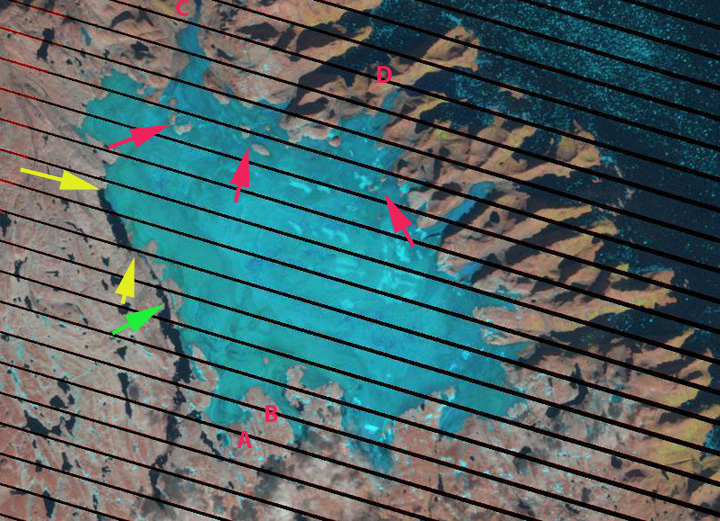
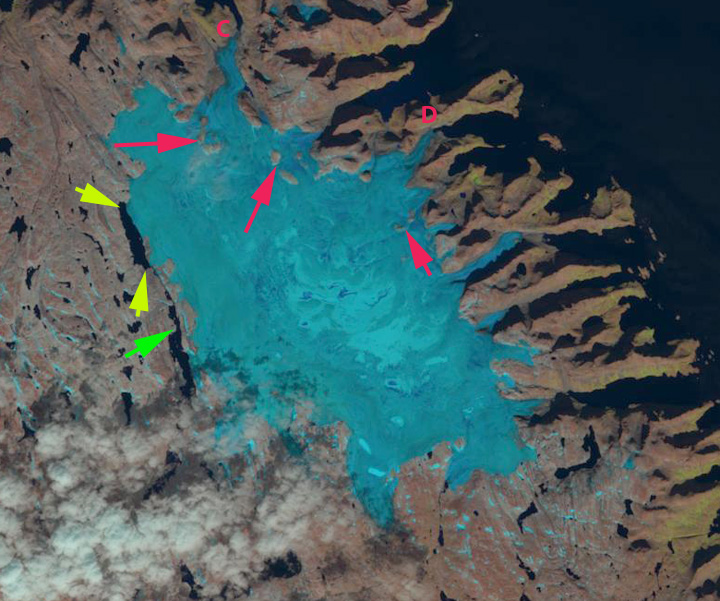
The red arrows in each image indicate areas of small nunataks that have begun to expand in the last decade. The yellow and green arrows indicate specific locations on the western margin of the ice cap where lakes are developing. Point A-D note specific locations adjacent to ice cap outlet glaciers. In 1994 the late August image indicates snowcover across most of the ice cap. The green arrow is at the northern end of a narrow lake. The yellows arrows are at the northern and southern end of a narrow ice filled depression. The nunatak area exposed at the red arrows is limited. At Point C the terminus is tidewater. In 2000 snow pack covers 40% of the ice cap. A small lake is developing at the yellow arrows. The glacier reaches the ocean at Point C and D. The glacier extends south of Point A and the outlet glacier at Point B is over a 1.2 km wide. In 2012 a warm summer led to the loss of all but snowpack on the glacier. At the red arrows the nunataks have doubled in size. At the yellow arrows a 2.5 km long lake has developed. At the green arrow a lake that has developed, is now separated from the glacier margin by bedrock. The glacier now terminates north of Point A. In 2014 again snowcover is minimal with two weeks left in the melt season. The outlet glaciers at Point C and D are no longer significantly tidewater. At Point B the outlet glacier is less than 0.5 km wide. The lake at the yellow arrows is 3 km long and 400 m wide. Some nunataks are coalescing with each other or the ice cap margin. The majority of the western margin of the ice cap has retreated 300-500 m. This retreat is surpassed at outlet glaciers by Point A and C. What is of greatest concern is the loss in thickness of over 1.5 per year on the highest portions of the ice cap, indicating no consistent accumulation zone. This results from the persistent loss of nearly all snowcover in the summer. This pattern of limited end of summer retained snowcover seen in most years since 2004, is a snow deficit that this ice cap cannot survive in our current warmer climate (Pelto, 2010). Way (2015) projects that that if the observed ice decline continues to AD 2100, the total area covered by ice at present will be reduced by more than 57%. Given the recent increases and lack of retained snowcover, suggests an even faster rate is likely.

GIC 1994
1994 Landsat image

gic 2000
2000 Landsat image

gic 2012 late2
2012 Landsat image

gic 2014 late2
2014 Landsat image

Langfjordjokulen, Norway Retreat-Thinning

Langfjordjokulen is in the Finnmark region of northern Norway. This is a plateau glacier with a valley glacier extending east toward Langfjordhamm. The Norwegian Water Resources and Energy Directorate has monitored the length change and mass balance of this glacier from 1989-2014. The mean mass balance has been significantly negative averaging -0.7 m/year, with every year being a net loss since 1997. This is no way to sustain a glacier or a business. Retreat of the glacier has averaged 27 m/year from 2000-2014. Here we examine Landsat imagery of the glacier from 1989-2014 to identify key changes.
langford ge

In 1989 the glacier terminated at the red arrow, two glacier tongues descended from the plateau and merged below the purple arrow indicating the northern arm. A ridge extends some distance into the main plateau separating the catchment areas of the two glacier tongues, marked by the letter A.  The glacier is mainly snowcovered in August 1989 and had a negative mass balance of -0.55 m.  In 1994 the two glacier tongues are still joined,  and snowcover is extensive, retreat is limited since 1989.  In 2000 snowpack is quite limited at the time of the image, the two glacier tongues have separated and the main terminus has retreated from the red arrow. In 2014, Norway’s warmest year, snowpack retained is minimal, the glacier mass balance reported by NVE to the World Glacier Monitoring Service was -0.78 m, an improvement over the record low year of 2013, -2.61 m.  A new area of bedrock is emerging near Point A, due to glacier thinning in the plateau area which should be the accumulation zone.  The two glacier tongues are further separated.  The main terminus is at the yellow arrow a retreat of 600-700 m since 1989.  This retreat rate is faster than other periods since 1900. The retreat is similar to that of  the larger nearby Strupbreen and Koppangsbreen.  The cumulative mass loss experienced by Langfjordjokulen is a significant portion of its total volume, 25-35% assuming typical glacier thickness for a glacier with this area.  In 2014 NVE reported In Norway terminus fluctuation data from 38 glaciers  with ongoing assessment indicate, 33 retreating, and 3 were stable.  The average terminus change was -12.5 m

langford 1989
1989 Landsat image

lanford 1994
1994 Landsat image

langford 2000
2000 Landsat image

langford 20142014 Landsat image

Glacier Index of Posts

Glacier Index List
Below is a list of the individual glacier posts examining our warming climates impact on each glacier. This represents the first 2.7 years of posts, 180 total posts, 166 different glaciers. I have worked directly on 40. The others are prompted by fine research that I had come across, cited in each post or inquiries from readers and other scientists. I then look at additional often more recent imagery to expand on that research. The imagery comes either from MODIS, Landsat, Geoeye or Google Earth.

United States
Columbia Glacier, Washington
Lyman Glacier, Washington
Boulder Glacier, Washington
Ptarmigan Ridge Glacier, Washington
Anderson Glacier, Washington
Milk Lake Glacier, Washington
Paradise Glacier, Washington
Easton Glacier, Washington
Redoubt Glacier, Washington
Honeycomb Glacier, Washington
Vista Glacier, Washington
Rainbow Glacier, Washington
Daniels Glacier, Washington
Colonial Glacier, Washington
Quien Sabe Glacier, Washington
Mazama Glacier
Fairchild Glacier, Washington
White Glacier, Washington
Banded Glacier, Washington
Borealis Glacier, Washington
Hinman Glacier, Washington
Lower Curtis Glacier, Washington
McAllister Glacier, Washington
Lewis Glacier, Washington
Kennedy Glacier, Washington
Fremont Glacier, Wyoming
Minor Glacier, Wyoming
Grasshopper Glacier, Wyoming
Grasshopper Glacier, Montana
Harrison Glacier, Montana
McDonald Glacier, Montana
Sperry Glacier, Montana
Hopper Glacier, Montana
Old Sun Glacier, Montana
Yakutat Glacier, Alaska
Grand Plateau Glacier, Alaska
Eagle Glacier, Alaska
Gilkey Glacier , Alaska
Gilkey Glacier ogives, Alaska
Lemon Creek Glacier, Alaska
Taku Glacier, Alaska
Bear Lake Glacier, Alaska
Chickamin Glacier, Alaska
Okpilak Glacier, Alaska
Sawyer Glacier, Alaska
Antler Glacier, Alaska
Field Glacier
East Taklanika Glacier, Alaska
Brady Glacier, Alaska
Brady Glacier Retreat lake expansion 2004-2010
Thiel Glacier, Alaska
Speel Glacier, Alaska

Canada
Icemantle Glacier, BC
Bridge Glacier, British Columbia
Washmawapta Glacier, British Columbia
Bubagoo Glacier, British Columbia
Hector Glacier, Alberta
Helm Glacier, British Columbia
Melbern Glacier
Warren Glacier, British Columbia
Castle Creek Glacier, British Columbia
Hoboe Glacier, British Columbia
Tulsequah Glacier, British Columbia
Decker and Spearhead Glacier, British Columbia
Columbia Glacier, British Columbia
Freshfield Glacier, British Columbia
Apex Glacier, British Columbia
Devon Ice Cap, Nunavut
Penny ice Cap, Nunavut
Penny Ice Cap SW, Nunavut
Snowshoe Peak, Yukon

New Zealand
Tasman Glacier
Murchison Glacier
Donne Glacier
Mueller Glacier, NZ
Gunn Glacier, NZ

Africa
Rwenzori Glaciers

Himalaya
Ngozumpa Glacier, Nepal
Samudra Tupa, India
Zemu Glacier, Sikkim
Theri Kang Glacier, Bhutan
Zemestan Glacier, Afghanistan
Khumbu Glacier, Nepal
Imja Glacier, Nepal
Gangotri Glacier, India
Milam Glacier, India
Satopanth Glacier, India
Kali Gandaki Headwaters, Nepal
Menlung Glacier, Tibet
Boshula Glaciers, Tibet
Urumquihe Glacier, Tibet
Sara Umaga Glacier, India
Dzhungharia Alatau, Kazakhstan
Petrov Glacier,Kyrgyzstan
Hailuogou Glacier, China

Europe
Taconnaz GLacier, France
Mer de Glace, France
Dargentiere Glacier, France
Grand Motte and Pramort Glacier Tignes Ski area, France
Saint Sorlin, France
Sommelier Glacier
Obeeraar Glacier, Austria
Ochsentaler Glacier, Austria
Pitzal Glacier, Austria
Dosde Glacier, Italy
Maladeta Glacier, Spain
Presena Glacier, Italy
Triftgletscher, Switzerland
Rotmoosferner, Austria
Stubai Glacier, Austria
Hallstatter Glacier, Austria
Ried Glacier, Switzerland
Cavagnoli Glacier, Switzerland
Chuebodengletscher and Ghiacciaio-del-Pizzo-Rotondo
Forni Glacier, Italy
Peridido Glacier, Spain
Engabreen, Norway
Midtdalsbreen, Norway
Tunsbergdalsbreen, Norway
TungnaarJokull, Iceland
Gigjokull, Iceland
Skeidararjokull, Iceland
Kotlujokull, Iceland
Lednik Fytnargin, Russia
Rembesdalsskaka, Norway
Irik Glacier, Mount Elbrus, Russia

Greenland and European Arctic
Mittivakkat Glacier
Ryder Glacier
Humboldt Glacier
Petermann Glacier
Kuussuup Sermia
Jakobshavn Isbrae
Umiamako Glacier
Kong Oscar, Glacier
Upernavik Glacier
Sortebrae Glacier, Greenland
Severnaya Zemlya, Russian Arctic
Hansbreen, Svalbard
Nannbreen, Svalbard
Hornbreen and Hambergbreen, Svalbard
Roze and Sredniy Glacier, Novaya Zemyla

South America
Colonia Glacier, Chile
Artesonraju Glacier, Peru
Nef Glacier, Chile
Tyndall Glacier, Chile
Zongo Glacier, Bolivia
Llaca Glacier, Peru
Seco Glacier, Argentina
Onelli Glacier, Argentina
Quelccaya Ice Cap, Peru
Glacier Gualas, Chile

Antarctica and Circum Antarctic Islands
Pine Island Glacier
Fleming Glacier
Hariot Glacier
Amsler Island
Stephenson Glacier, Heard Island
Neumayer, South Georgia
Ampere, Kerguelen
Nordenskjold Coast, Antarctic Peninsula
Prospect Glacier, Antarctic Peninsula
Ross Hindle Glacier, South Georgia
Vega Island Ice Cap
Rohss Bay, James Ross Island, Antarctica

North Cascade Glacier Climate Project Reports

Forecasting Glacier Survival
North Cascade Glacier Mass Balance 2010
Columbia Glacier Annual Time Lapse
North Cascade Glacier Climate Project 2009 field season
28th Field Season Schedule of the North Cascade Glacier Climate Project
North Cascade Glacier Climate Project 2011 Field Season
BAMS 2010
2011 Glacier mass balance North Cascades and Juneau Icefield
Taku Glacier TSL Paper

McDonald Glacier, Montana Retreat

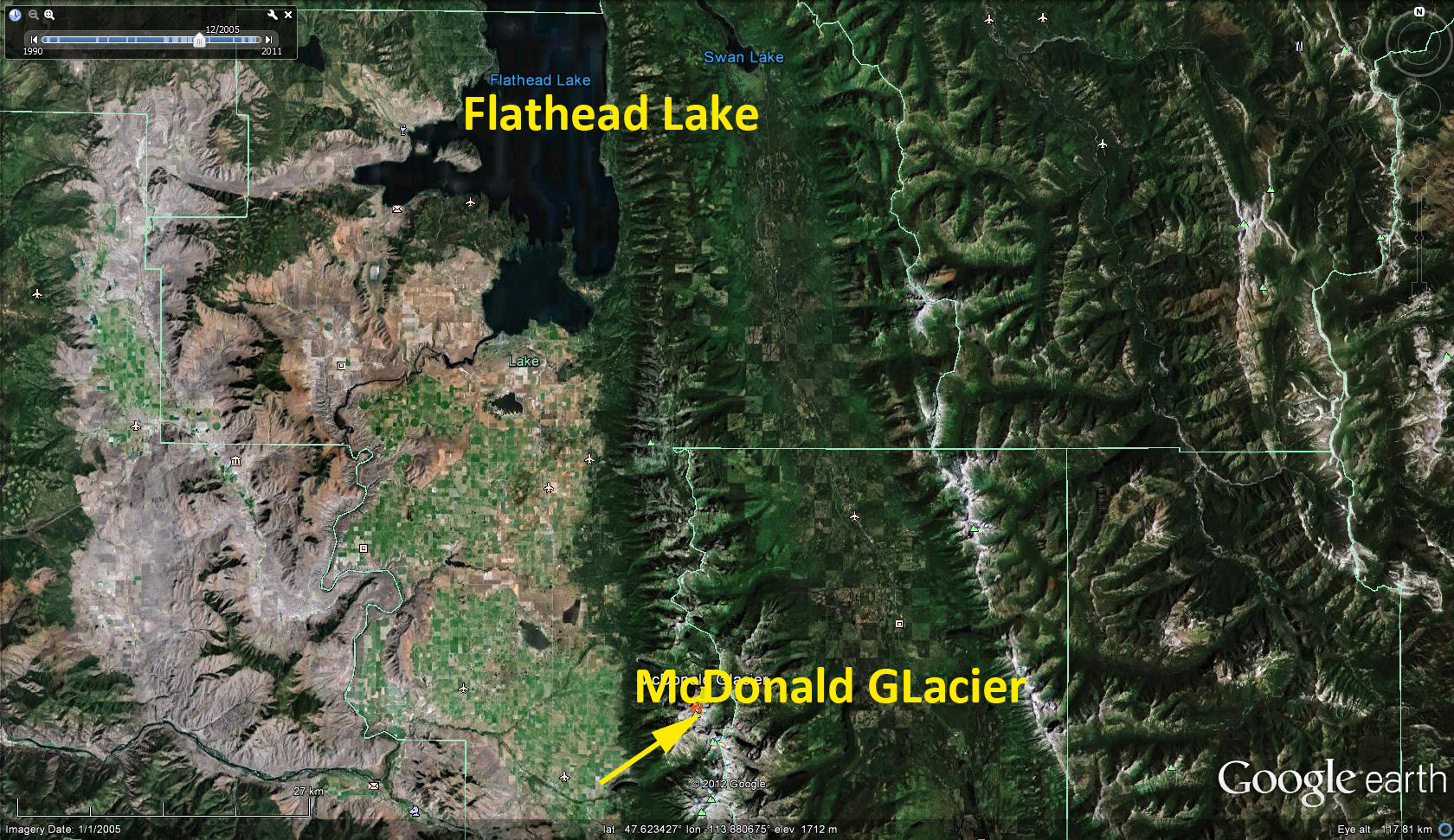
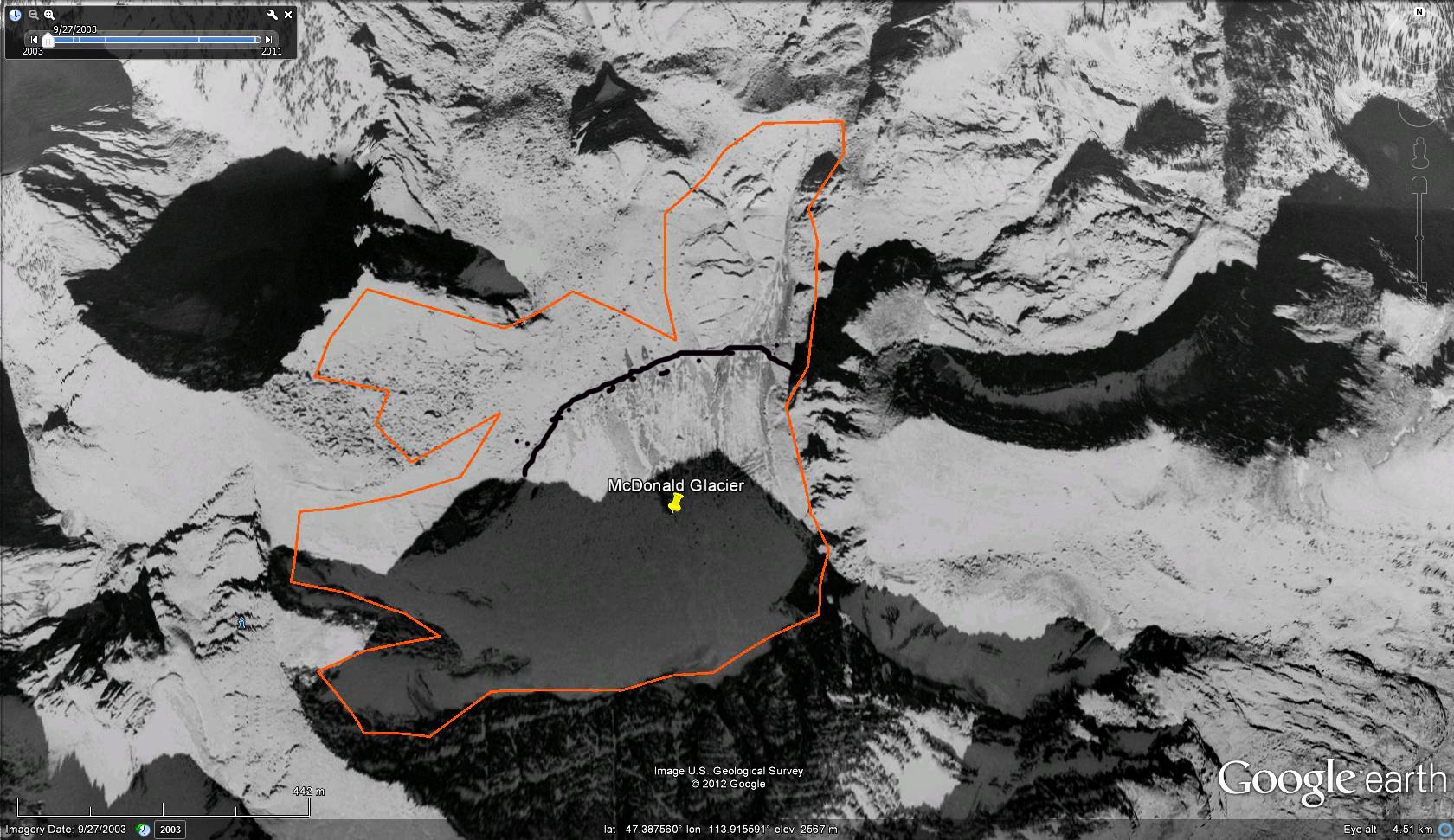
McDonald Glacier is in the Mission Range of the Montana southeast of Flathead Lake. It is the largest and one of only two significant glaciers in this range. The glacier is tucked under the north side of McDonald Peak. The glacier was over 1 kilometer long in the 1966 USGS map of the region. By 2005 the glacier has lost 45% of its area, retreating 200 meters on average and losing one of its accumulation areas. A comparison of the map image, 2003 and 2005 image illustrate this retreat, orange line is the map terminus, black lines the terminus in 2003 and 2005. Two closeup views indicate a key exposure of rock in the midst of the glacier, black arrow. Three former areas of accumulation A,B and C are also noted. At this point area C is no longer part of the glacier. A and B both still indicate some minor crevassing indicating the glacier is not stagnant, and that these areas have been an accumulation area in the years prior to 2005. Accumulation area B in the first closeup looks to have a minimal connection to the main glacier, and is such a small area, that it is on the path of accumulation area C to disappearance. In Montana there are many glaciers that are rapidly disappearing (Hopper Glacier, and a few that are only shrinking slowly (Harrison Glacier). McDonald Glacier is in between these two paths retreating steadily, but not on the verge of disappearing, Sperry Glacier is another example of this response type.

Snowshoe Peak Glacier Retreat, Yukon

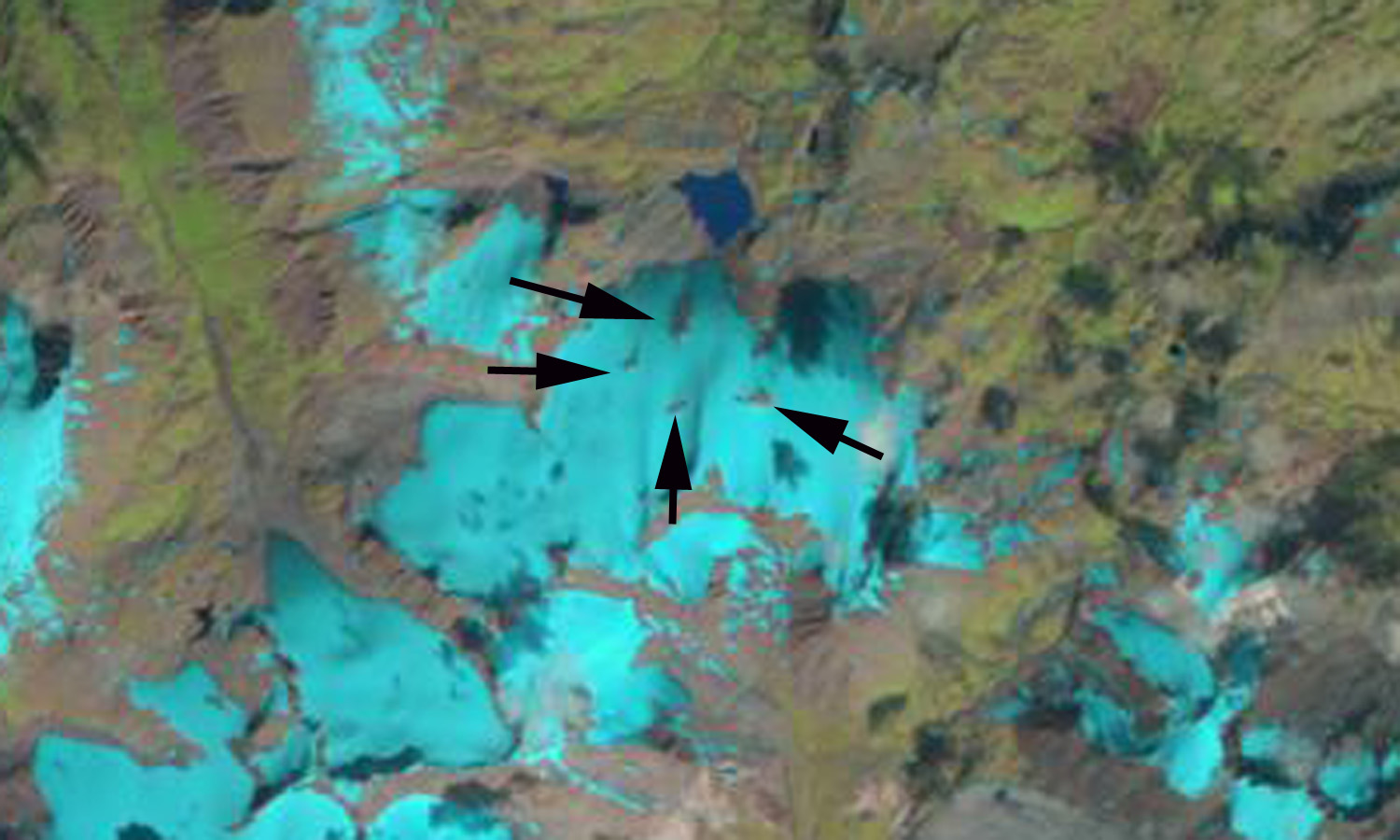
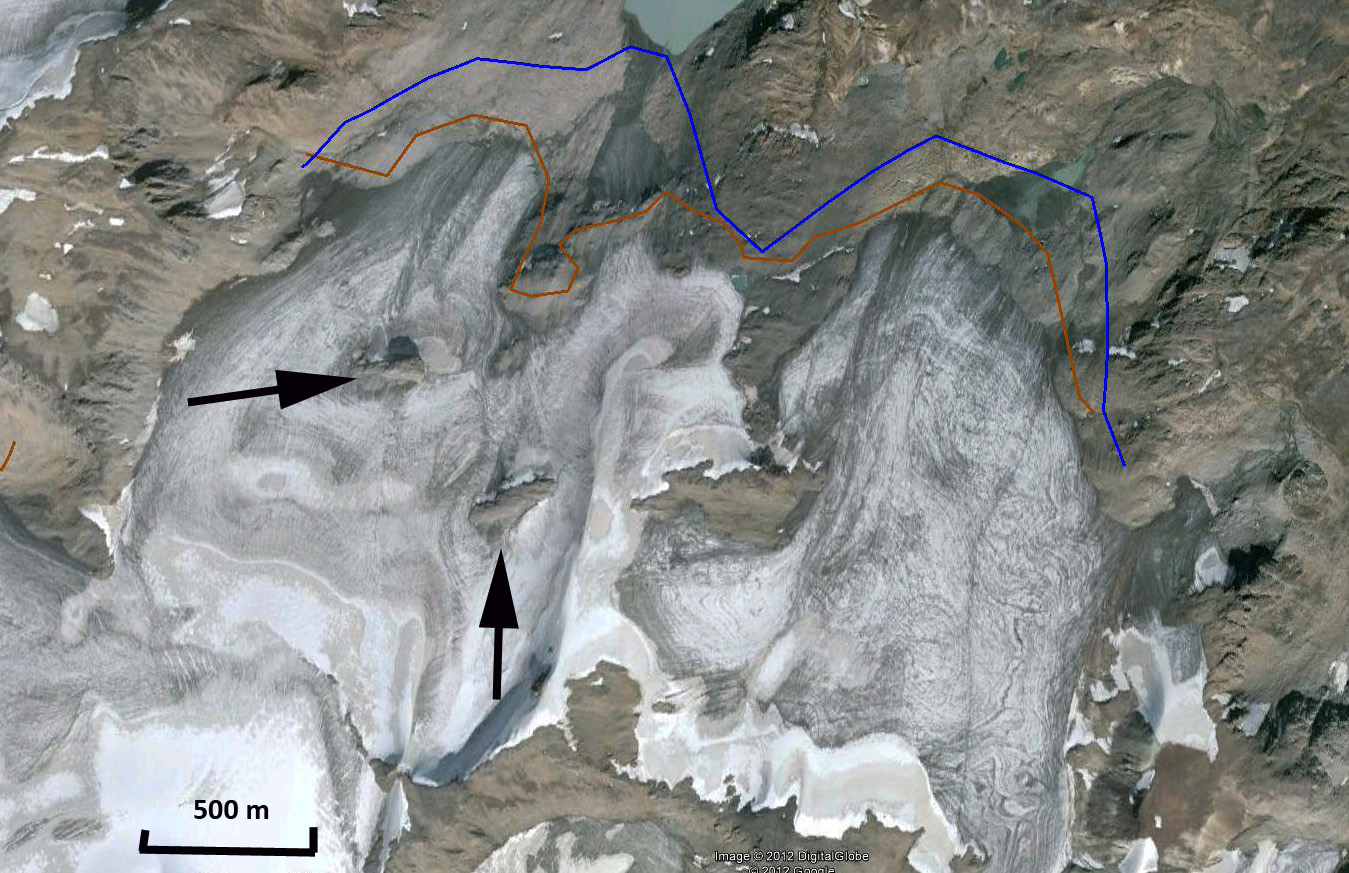
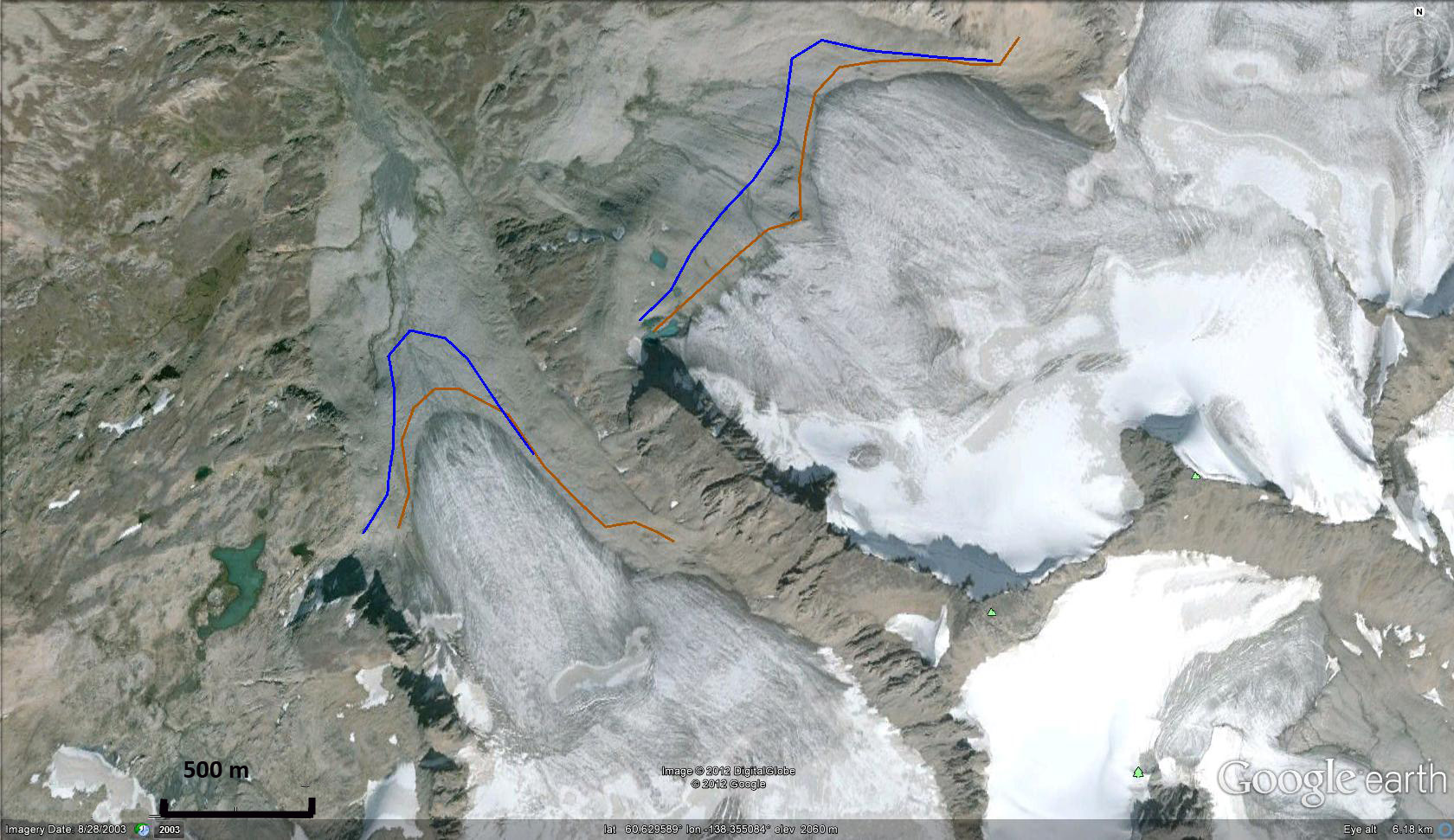
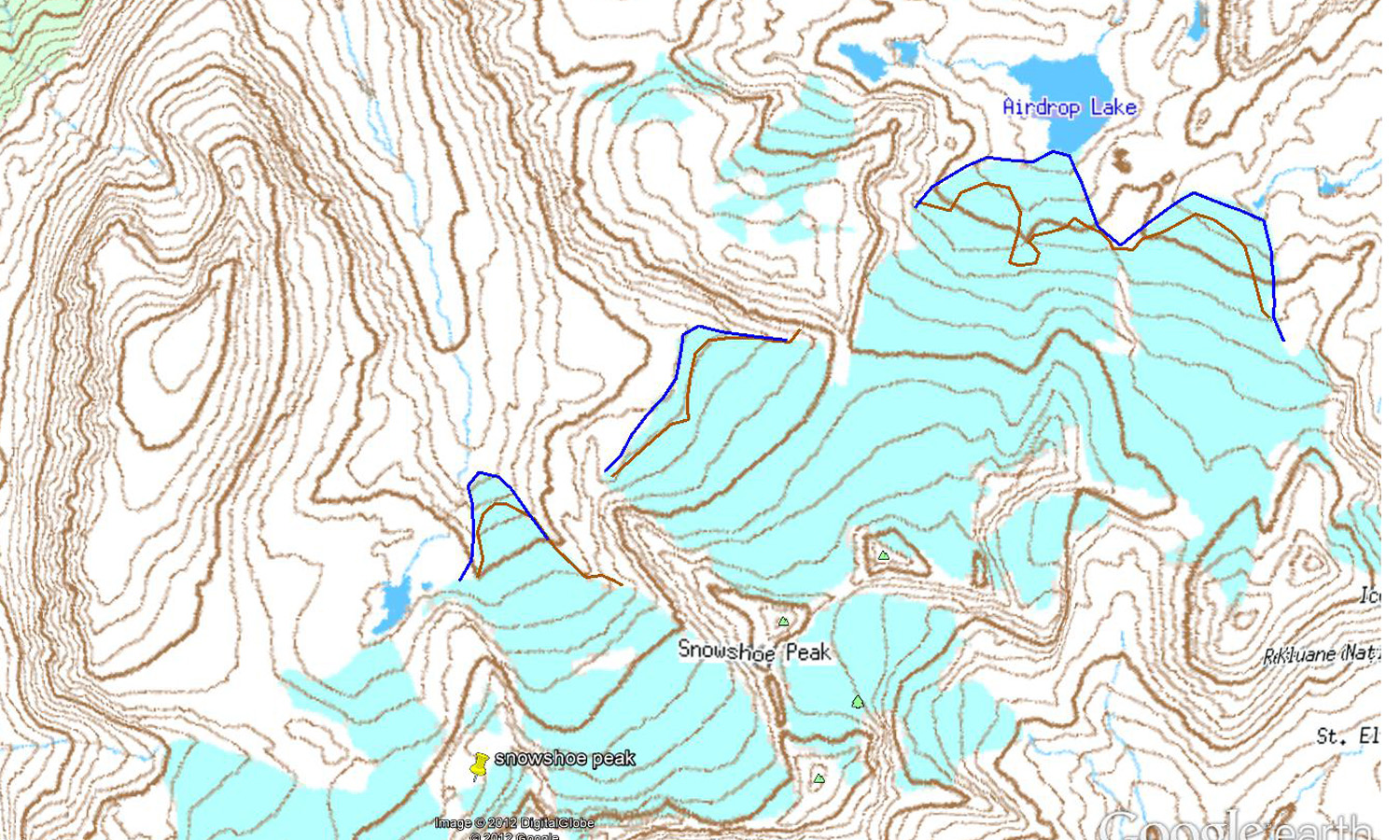
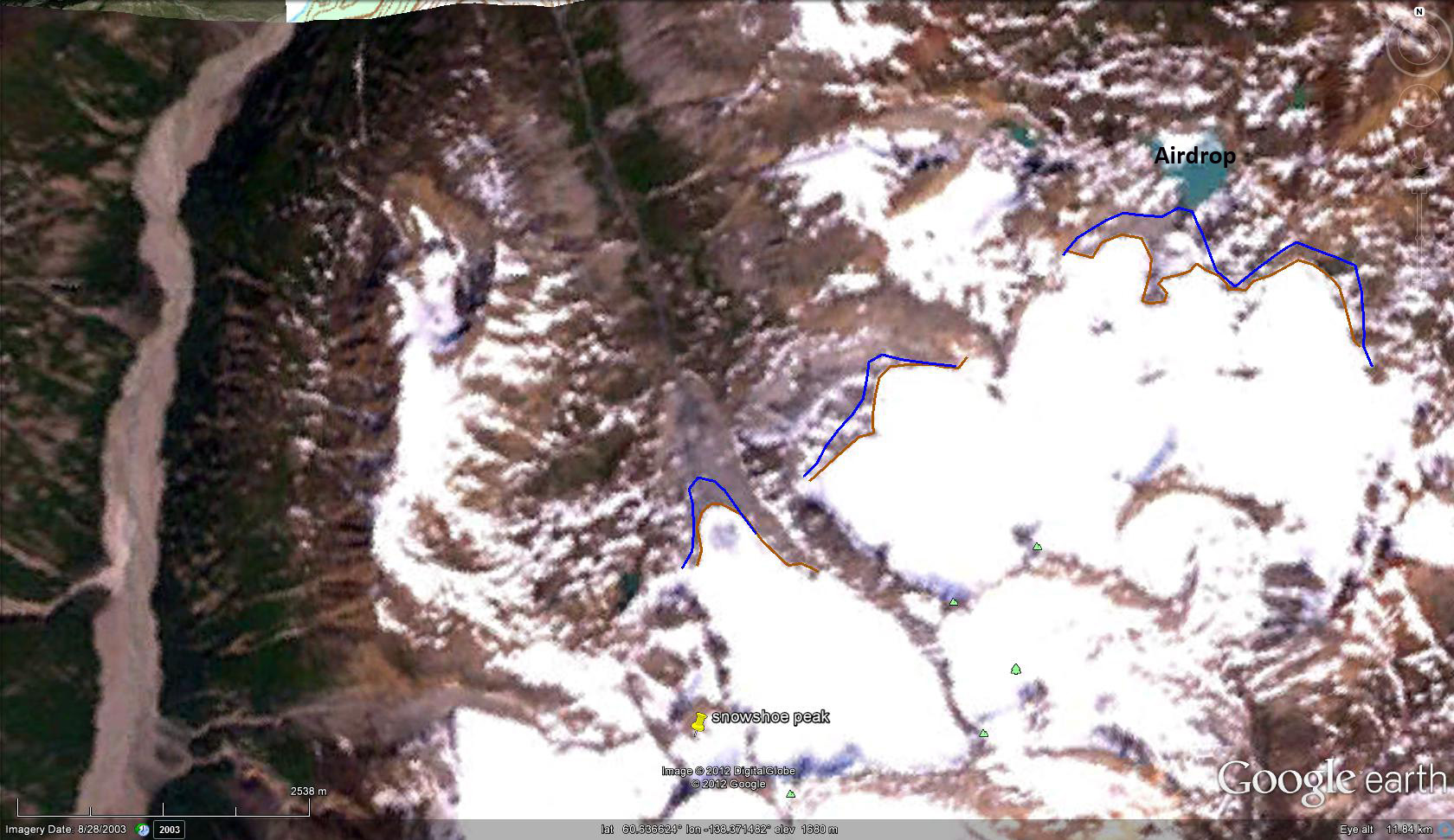
There was the Yukon Gold Rush and then there are a number of surging glaciers in the Yukon. These two have drawn our attention. In Kluane National Park, besides the large surging outlet glaciers draining the St. Elias Mountains (Donjek, Lowell, Kaskawulsh etc.) there are numerous smaller alpine glaciers in ranges just east of the St. Elias. In a recent ice core study in the Eclipse Icefield it was found that the Gold Rush led to higher fire activity (Yalcin et al., 2004). This post examines several of these glaciers that have not been the focus of any detailed study, in the are of Airdrop Lake and Snowshoe Peak. Each of the glaciers is 1.5 to 2.0 kilometers long, beginning near 2100 meters the summit area of Snow Peak and terminating between 1800 and 1900 m. This is relatively small elevation change for alpine glaciers. In the 2003 Google Earth Imagery the lack of snowcover is evident. The blue line is the terminus position from the map of 1970’s and the brown line a 1998 satellite image. There are a few outrops of rock in the midst of the glacier that formerly terminated at Airdrop Lake. Comparison of a 1987 (top), 2003 (middle) and a 2010 (bottom) Landsat image indicate that the two key outcrops that were in the midst of the glacier in 1990 are at the terminus in 2010. Two others have expanded and with terminus retreat are markedly closer to the margin of the glacier in just seven years from 2003-2010. The lower section of each glacier is quite thin and uncrevassed. The lack of snowcover during many recent years indicate a mass balance loss and glacier thinning that is driving the retreat. It does not appear the glacier that flows toward Airdrop Lake can survive, with thinning high on the glacier and limited retained snowcover. There are some patches of stagnant ice near the terminus of the Airdrop Lake Glacier, this glacier has retreated 250-450 meters from the map to 2003, 20-30% of the glacier length and is still retreating quickly as the 2010 imagery indicates. The Snowshoe Peak glaciers have retreated 150 m to 300 meters which is 10-20% of the glacier length. The retreat of the small glaciers here parallels that of the larger glaciers nearby such as Melbern Glacier.

Samudra Tupa Glacier Retreat and Himalaya glacier mass losses

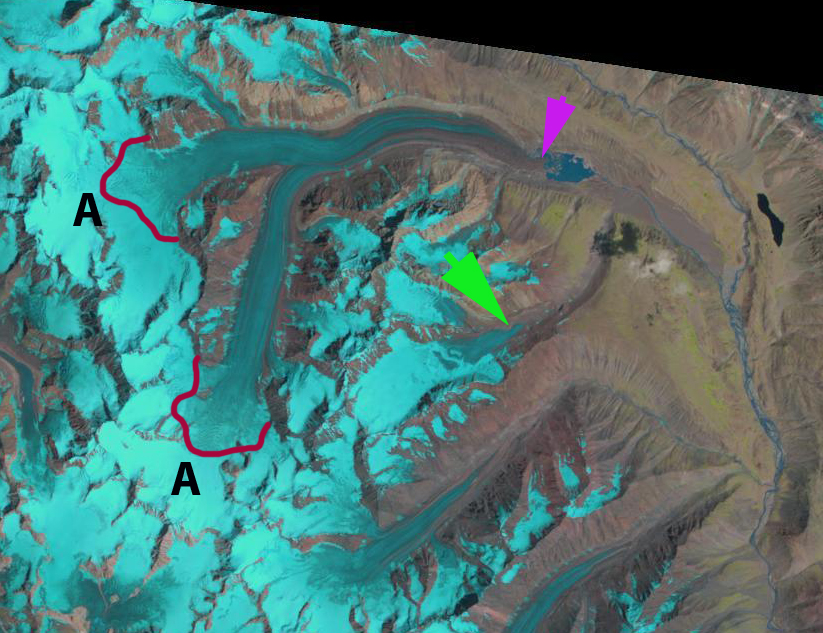
Samudra Tupa Glacier is one of the largest in the Chenab Basin, India. Pink arrow indicates the terminus in a glacier lake and A mark the accumulation zone with the red line indicating the equilibrium line in 1998. In a glacier inventory in the basin by Kulkarni et al (2007) the 466 glaciers in the basin were observed to have lost 21% of their total area from 1962 to 2001. This program coordinated by the Space Applications Centre of the Indian Space Research Organization, has combined field observations of the glacier with remote sensing to observe the changes in area and length of the glaciers, immediately below is a 2006 picture of the glacier terminus and proglacial lake from Kulkarni. . The terminus ends in an expanding proglacial lake. The lower glacier is heavily debris covered, has a low slope and is essentially stagnant. These factors will lead to continued retreat. In this post we use 1998, 2002 and 2011 Landsat imagery to examine the terminus of this glacier. The glacier terminates at 4225 meters, the snowline in 1998 is 5200 meters and 2002 is 5300 meters, neither of the images is at the end of the ablation season. An ELA of 5200-5300 meters leaves an accumulation area insufficient to maintain the current glacier size. In 1970 the ELA was at 4900 meters Kulkarni et al (2007) . A close up view of the termini of Samudra Tupa-pink arrow and a nearby unnamed glacier-green arrow indicate the changes in 1998, 2002 and 2011 in that order. The green arrow points not to the terminus but to a prominent knob near the end of the glacier in each image, it is the control point. The last two images illustrate the changes from 2002 to 2011 in an image overlay. The last image is the 2011 termini of Samudra Tupa Glacier from (Kulkarni, 2009). The retreat is noted by Kulkarni, 2009 as 13 meters/year during the study period. From 2002 to 2011 the glacier retreated nearly 200 m, closer to 20 meters/year. The retreat of this glacier is less than that of other large glaciers nearby Sara Umaga and Gangotri. The loss in glaciated area in the basin of 21% is also similar to other areas in the Altai, Tibet, Nepal Himalaya, Khumbu Nepal and Tien Shan.

Icemantle Glacier Retreat, British Columbia

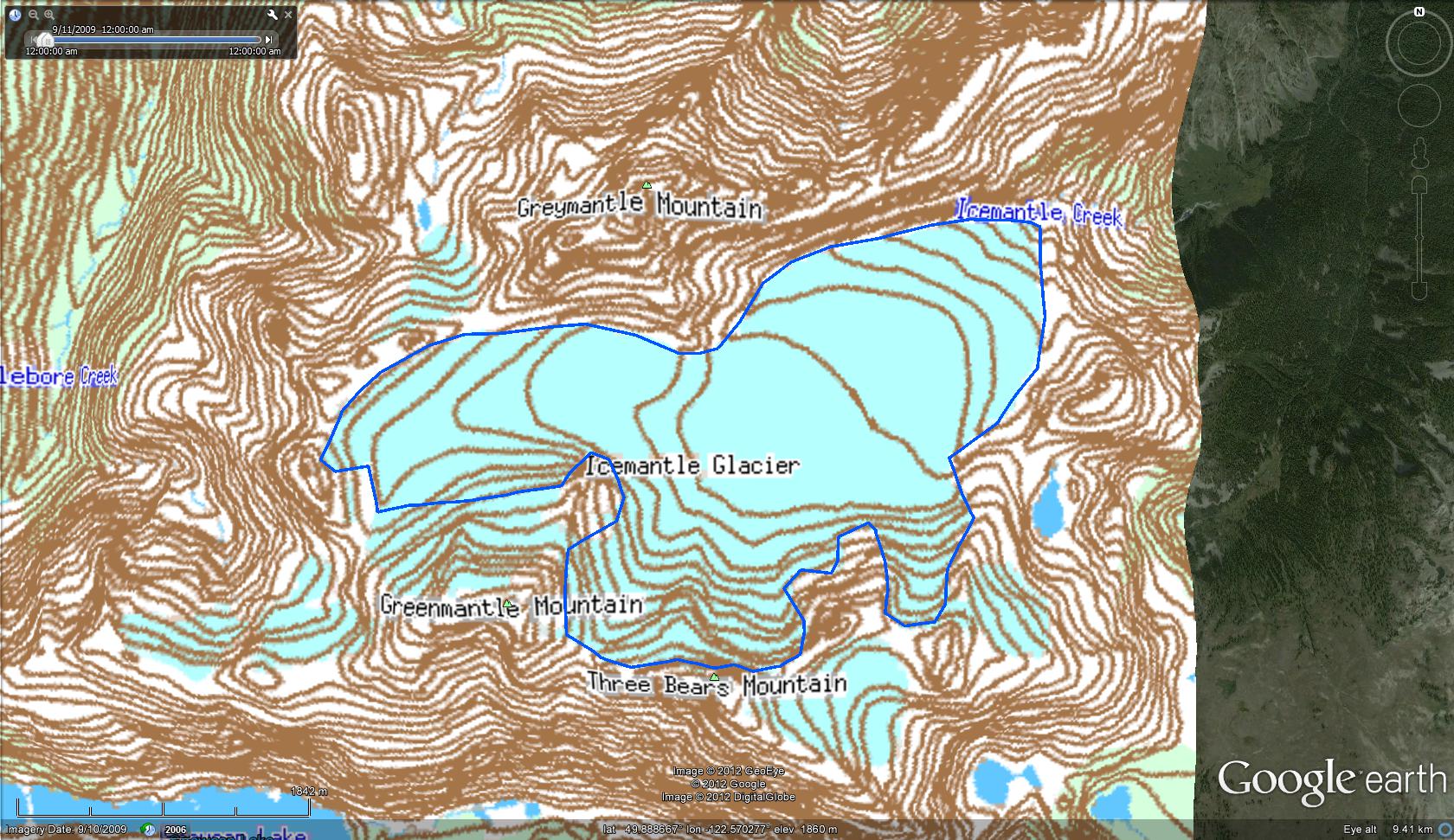
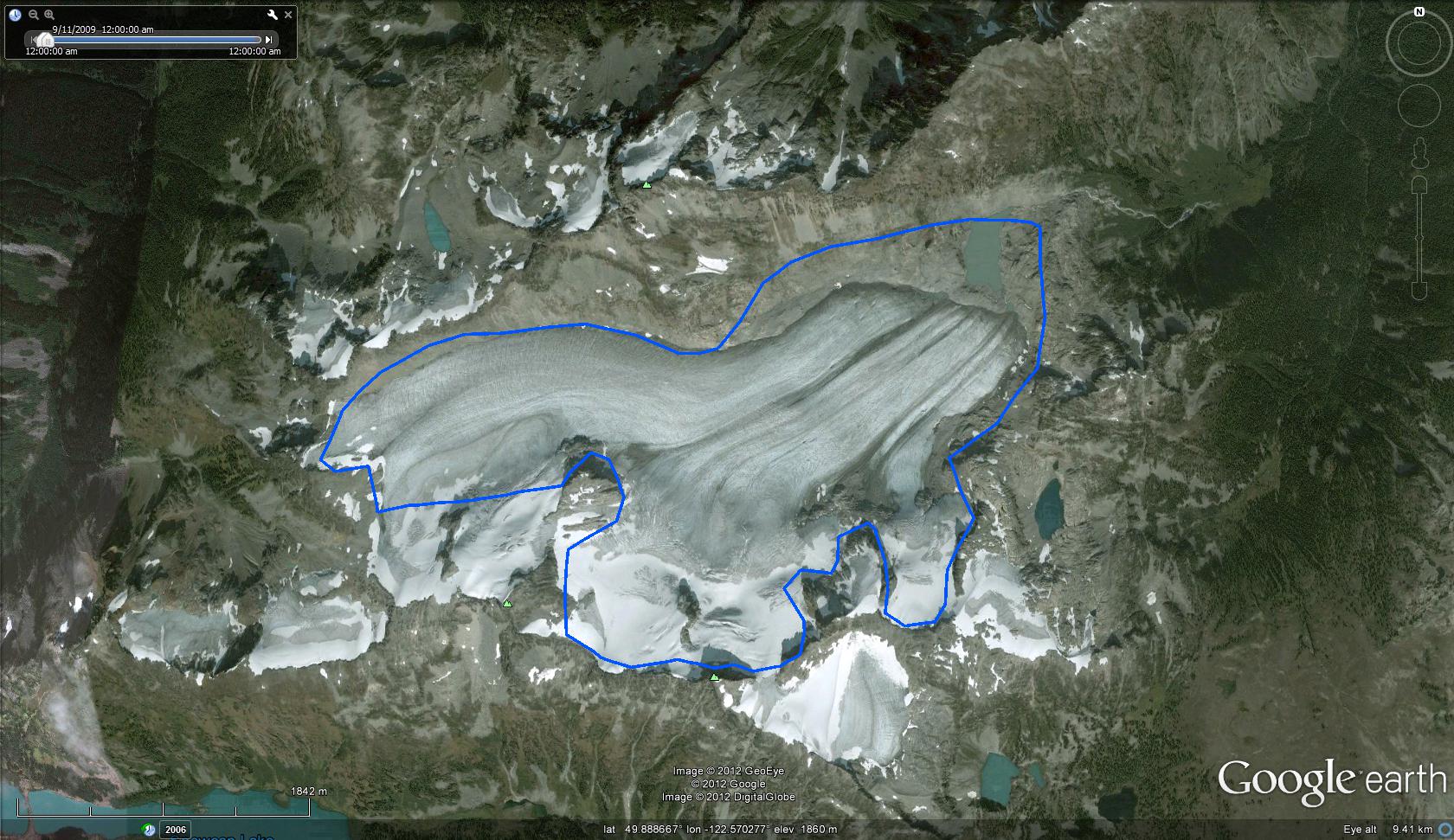
Icemantle Glacier is on the north side of Greenmantle Peak just north of Snowcap lake in southern British Columbia, viewed from the northeast in the Google Earth image below. It is not an often visited area and the glacier has not been previously assessed for its response to climate change. Other glaciers in the area have, the outlet glaciers of Snowcap Icefield lost 17% of there area in from 1987-2007. Stave Glacier has retreated 840 meters from 1977-2002 (Koch et al, 2009) . Just to the north Freshfield Glacier has retreated since. The glacier was mapped in 1987 and at that time no lake existed close to the terminus. The lake in 2006 is 500 meters across. The glacier is 160 meters from the lake, indicating a retreat of 660 meters from 1987, blue line. In a 2009 Ikonos image the glacier has retreated an additional 75 meters. The last image in the sequence indicates the 1987 terminus position blue and 2009 terminus red. The snowline on the glacier has been at least as high as 2000 meters in 2003-2006 and 2009. This leaves less than 35% of the glacier in the accumulation zone consistently. This is insufficient to maintain equilibrium and will drive continued retreat. The ongoing retreat is also evident from the thin nature of the current terminus, a small lake is also forming at the current terminus.