Lekhziri Glacier, Georgia Retreat Leads to Separation 1996-2022

Lekhrziri Glacier in 1996 and 2022 Landsat images illustrating the retreat and separation of the three tributaries central (Lc), eastern (Le) and western (Lw). Red arrow indicates 1996 terminus and yellow arrows the 2022 terminus locations

Lekhrziri Glacier has been the largest glacier in Georgia, and was until 2011 a compound glacier comprised of three tributaries joining a short distance from the terminus (Tielidze et al 2016).  Tielidze et al (2015) observed in 2011 that the central tributary separated from the east and west tributary that year at the headwaters of  the Mestiachala River Basin. From 2000-2020 Lekhziri Glacier experienced the largest retreat, of 1395 m, of 16 large Caucasus glaciers examined by (Tielidze et al 2022). Here we examine Landsat and Sentinel imagery from 1996-2022 to illustrate the changing nature of this glacier.

In 1996 the three tributaries joined at 2300 m and then flowed jointly south for 1 km to the terminus, red arrow on Landsat image. The August snowline is at 3300 m. By 2013 the central glacier has visibly separated by 500 m from the other tributaries. The primary terminus has had a retreat of ~500 m since 1996. The August snowline is at 3400 m in 2013. In 2022 additional retreat as separated the east and west tributaries, with an evident river emanating from each tributary, yellow arrows, feeding into the Mestiachala River. The central tributary terminates 800 m from the former junction. The retreat of the east tributary has been 1.3 km since 1996 and the west tributary 1.25 km since 1996. There is also a small lake that is evident, green arrow, in 2022 that will fill in with sediment.  The snowline at the end of August 2022 is at 3450 m. The persistent high snowlines due to warm melt season conditions has led to ongoing mass loss that will lead to continued declines in the Lekhziri Glacier system. This is one example of the widespread retreat of glaciers in the region chronicled by Levan Tielidze. The high snowlines of 2017 and 2022 have been noted for Gora Gvandra glaciers and Zeno Svaneti glaciers.

Lekhrziri Glacier in 2013 Landsat image illustrating the retreat and separation of the three tributaries central (Lc), eastern (Le) and western (Lw). Red arrow indicates 2013 terminus and purple dots the snowline.

Lekhrziri Glacier in 2022 Sentinel image illustrating the retreat and separation of the three tributaries central (Lc), eastern (Le) and western (Lw). Yellow arrows the 2022 terminus locations aand green arrows the small lake at headwaters of Mestiachala River Basin.

Zemo Svaneti Glaciers, Georgia Not Poised for Survival

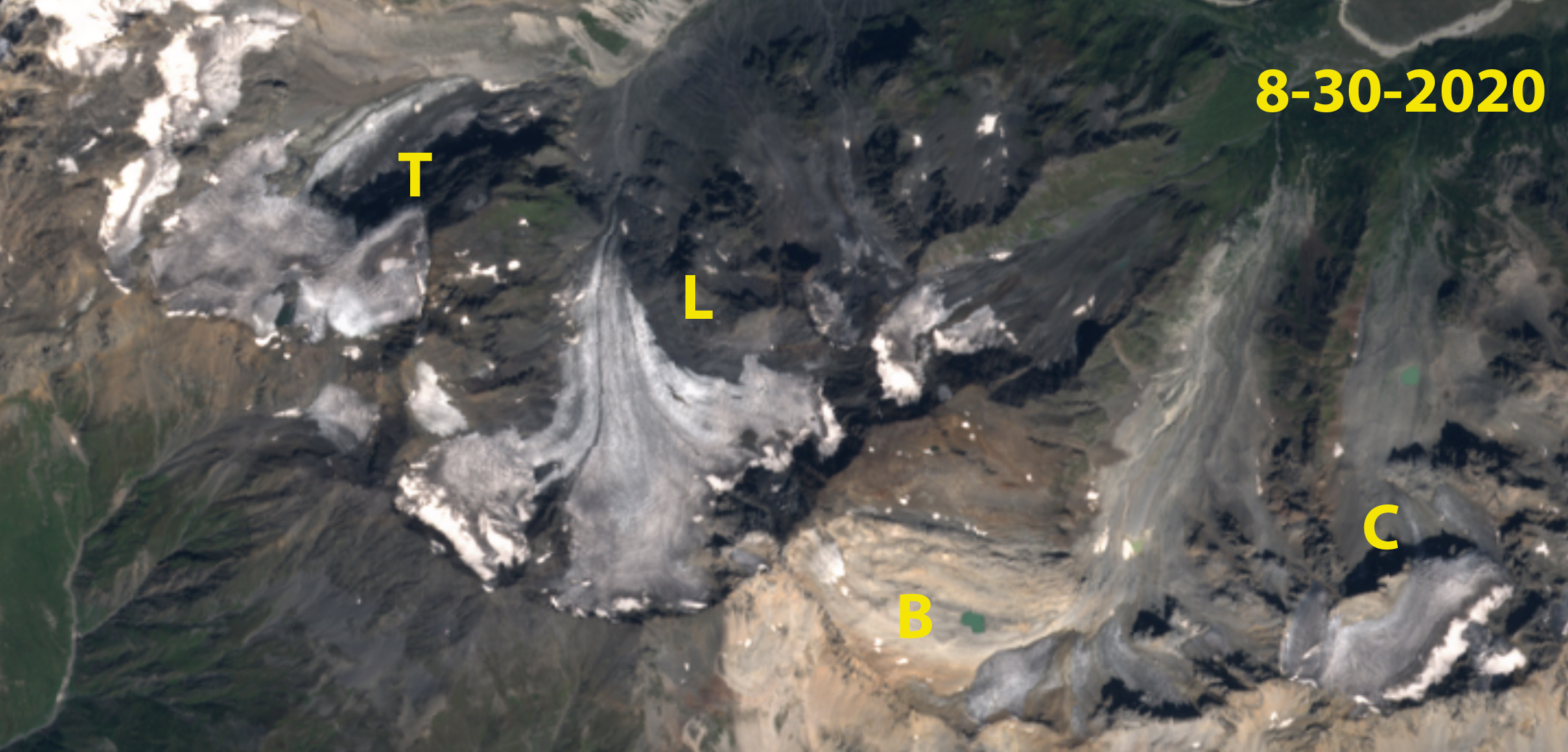
Ladevali (L), Tsaigmili (T), Baki (B), and Cherinda Glacier (C) in Sentinel false color image from August 30, 2022. Illustrating that each has 10% or less of the glacier surface retaining snowcover.

Several glaciers at the headwaters of the Doira River in the Zemo Svaneti Planned National Park in the Georgian Caucasus have been stripped of snowpack during recent summers. A glacier without a zone a persistent snowcover throughout the year has no accumulation zone and cannot survive (Pelto, 2010). Here we examine Ladevali, Tsaigmili, Baki and Cherinda Glaciers during August of 2016, 2018, 2020 and 2022 using Sentinel imagery. Tielidze and Wheate (2018)  completed an inventory of Caucasus glaciers documenting the 1986 glacier surface area at 1482 square kilometers decreasing to 1193 square kilometers by 2014, a 20% decline in this 28 year period. Tielidze et al ( 2022) update this inventory identifying a 23% decline in area from 2000 to 2020, greater than 1% per year.

In 1998 ther Ladvali and Tsaigmili Glacier nearly join at the terminus. Baki Glacier spans the entire upper basin and no lake is evident near Point B. Cherinda Glacier descends a bedrock step to form a lower section. In mid-August of 2018 Baki Glacier has lost nearly all snowcover and a new lake has formed adjancent to Point B. Cherlinda Glacier has a fringe 15% along its upper margin and is no longer connected to lower relict ice below the bedrock step. Ladevali and Tsaigmili Glacier have snow cover above 3200 m covering 15-20% of the glacier and the termini are now separated by ~1 km.  At the end of August in 2020 Baki Glacier is snow free. Cherinda has a fringe on its upper maring covering less than 10% of the glacier. Ladevali and Tsaigmili Glacier have snow cover above 3300 m covering ~5% of the glacier. At the end of August 2022 Baki Glacier is again snow free, while Cherinda has a fringe on its upper margin covering 10% of the Glacier. Ladevali and Tsaigmili Glacier have snow cover above 3250 m covering ~10% of the glacier. In 2022 the glaciers also exhibit a lack of retained firn from any recent year, illustrating a consistent lack of retained accumulation.  This consistent minimal retained snowcover illustrates that the glaciers cannot survive current climate. A similar situation has been observed further east at Gora Gvandra. The mass balance in the region has continued to decline with a mean annual loss of ~-0.5 m/year from 2000-2019, (Tielidze et al 2022) with 2020-2022 likely even worse

Ladevali (L), Tsaigmili (T), Baki (B), and Cherinda Glacier (C) in Sentinel true color image from August 30, 2020. Illustrating that each has 10% or less of the glacier surface retaining snowcover.


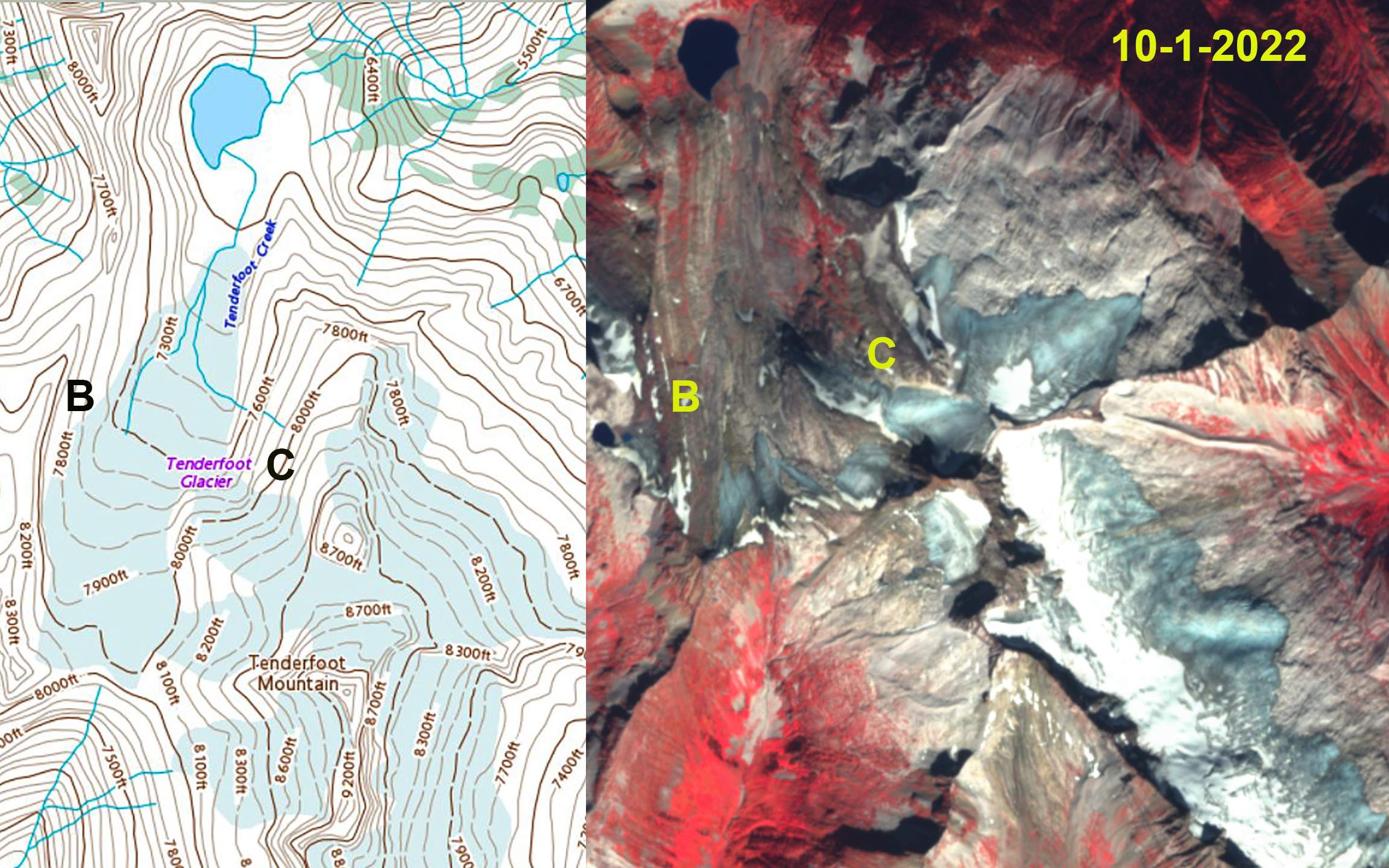
Ladevali (L), Tsaigmili (T), Baki (B), and Cherinda Glacier (C) in Sentinel false color image from August 16, 2018. Illustrating that each has 20% or less of the glacier surface retaining snowcover with several weeks left in the melt season.

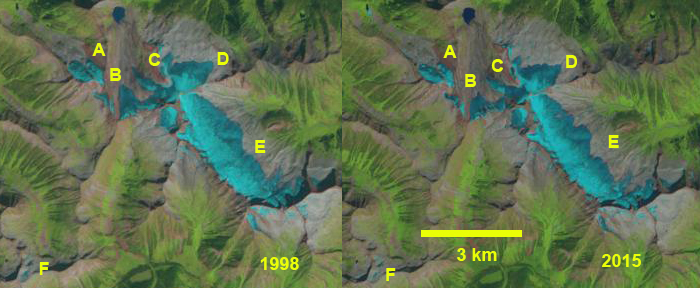
Ladevali (L), Tsaigmili (T), Baki (B), and Cherinda Glacier (C) in Landsat image from mid-August 1998. Ladvali and Tsaigmili nearly join in 1998. Baki Glacier expands across the entire basin and Cherlinda descends below a bedrock step.


North Annapurna Glacier, Nepal Retreat and Lake Development

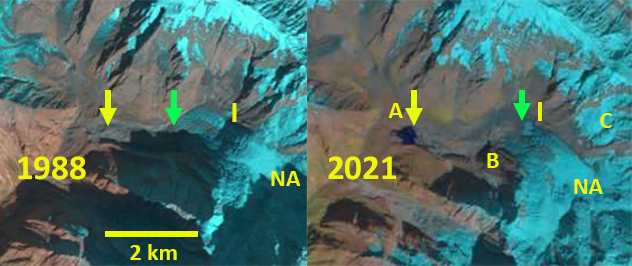
North Annapurna Glacier in August 2022 Sentinel image. A=North Annapurna Base Camp, I=icefall base,  B= Prominent Knob, C=tributary that has separated by 2022. The green arrow marks the end of the active ice which is now 1.5 km upglacier of the terminus. Note Diki Cho (lake) is relatively free of icebergs that were plentiful in 2018.

North Annapurna Glacier drains the northeast side of Annapurna (8091 m). The North Annapurna climbers base camp (NABC) for the original ascent in 1950 was opened to trekking in 2020 via the new Maurice Herzog Trail. The NABC is located near the terminus of the North Annapurna Glacier, when first located there was no lake at the terminus of the glacier. Today glacier thinning and retreat has led to development of DikiCho. The glacier has also become stagnant in its lower reaches. Here we examine Landsat imagery from 1988-2022 to identify the long term changes, and Sentinel imagery from 2018-2022 along with trekking images from 2020-2021 to look at the lake development in details.
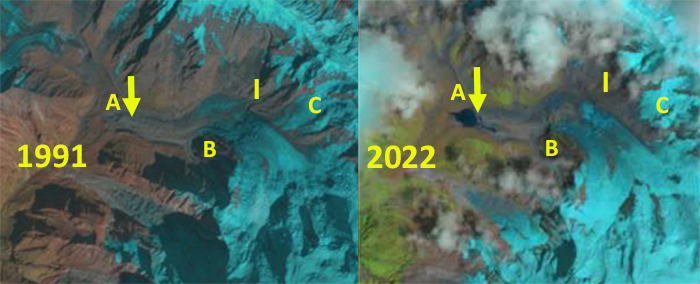
North Annapurna Glacier in 1988 and 2022 Landsat images.   Yellow arrow indicates 2022 terminus location. A=North Annapurna Base Camp, I=icefall base,  B= Prominent Knob, C=tributary that has separated.

In 1988 North Annapurna Glacier extended to the end of what has become Diki Cho (lake) and into the main north/south valley of the Miristi Khola. The tributary at Point C connects to the glacier above the icefall. The area of active blue ice extends 1.5 km beyond the icefall, including a series of ogives. The only evident change is the increase debris cover below the icefall. In 2001 the first sign of a lake at the terminus is evident and active blue ice extends beyond Point B. By 2018 Diki Cho has expanded to an area of 0.15 km² and has considerable stranded icebergs amidst the lake.  The area of active ice ends just below Point B.  By 2021 most of the ice amidst Diki Cho has melted. Tributary C no longer connects to the main glacier and the zone of blue ice extends just beyond the base of the icefall. The wam summer of 2022 led to further lake expansion particularly along the southern margin of the glacier, with an area of 0.27 km². The lower 1.5 km of the glacier is stagnant. North Annapurna Glacier has retreated 600 m from 1988-2022. The lower 1.5 km of the glacier is no longer being actively fed by the glacier and will be lost, though with thick debris cover this will not happen quickly. This section of the glacier also has a low surface gradient indicating that lake expansion will continue. The retreat here has been slower than at Lumding Glacier or Barun Glacier, but is increasing in the last decade.

North Annapurna Glacier in 1991 and 2022 Landsat images.   Yellow arrow indicates 2021 terminus location and green arrow the end of the blue ice. A=North Annapurna Base Camp, I=icefall base,  B= Prominent Knob, C=tributary that has separated.

North Annapurna Glacier in August 2018 Sentinel image. A=North Annapurna Base Camp, I=icefall base,  B= Prominent Knob, C=tributary that has separated. The green arrow marks the end of the active ice which is now 1.5 km upglacier of the terminus. Note Diki Cho has many icebergs.

Annotated image of Diki Cho from near the North Annapurna Base Camp, image from Nepal Trek Hub.

North Annapurna Glacier in 2001 Landsat image.   Yellow arrow indicates 2021 terminus location and green arrow the end of the blue ice. A=North Annapurna Base Camp, I=icefall base,  B= Prominent Knob, C=tributary that is separating.


Suru Basin, Ladakh India Glaciers Bare of Snowcover in August 2022

Suru Basin glaciers in 1998 and 2022 Landsat images.  Red arrow marks the 1998 terminus location, yellow arrow the 2022 terminus location. S=Shafat Glacier, D=Dilung Glacier. Glacier 1-4 are unnamed glaciers that lost almost all snowcover in 2022.

Glaciers of the Suru Basin, draining the Ladakh Range, a drier region of the Himalaya, was significantly by the 2022 pre-monsoon and monsoon season warmth. Here we focus on a group of glaciers near Shafat and Dilung Glacier that lost snowcover in 2022. We also look at the retreat of Shafat and Dilung Glacier.  Shafat Glacier occupies the northeast flank of Nun Kun Peak in Ladakh India and drains into the Suru valley. The main valley glacier has suffered from detached tributaries leading to terminus area stagnation (Pelto, 2021). Dilung Glacier retreat has led to an expanding proglacial lake.  Shukla et al (2020) identified an increase in annual temperature has driven a 6% loss in regional glacier area and a 62% expansion in debris cover from 1971-2017. Here we compare Landsat imagery from 1998-2022 to identify this glaciers response to climate change.

In 1998 the terminus of Shafat Glacier was at the red arrow near a junction with a key tributary, with clean active ice reaching to the terminus.  By 2022 the active ice is 2.5 km upglacier from this point at the yellow arrow, though there is stagnant debris covered ice below this point. Dilung Glacier in 1998 terminates in a 1.1 km long proglacial lake. By 2022 the glacier has retreated 900 m, resulting in a 2.0 km long lake.  Rashid and Majeed (2018) indicate nearby Drang Drung Glacier has retreated 925 m since 1971, with a sharp increase after 2014.

For an alpine glacier to have a balanced annual budget it has to be 50-60 snowcovered at the end of the melt season. On Sept. 1, 2022 there are four glaciers 1-4 in this region that have  0-10% snowcover left. The snowcover is above 5300 m. This is illustrative of significant mass losses in 2022. On Dilung Glacier and Shafat Glacier the snowcover is ~20% and is confined to the regions above 5300 m. There is some cloudcover over the top of the Shafat Glacier in the 9-1-2022 Landsat image.

Suru Basin glaciers in September 1, 2022 Landsat image. Glacier 1-4 are unnamed glaciers that lost almost all snowcover in 2022.  S=Shafat Glacier, D=Dilung Glacier. The snowline is above 5300 m. 

Jiangpu and Daoge Glacier Retreat and Lake Expansion, China

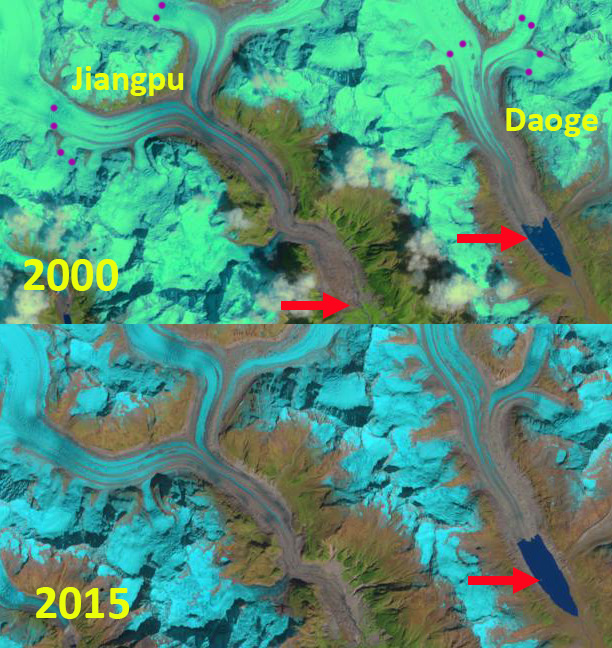
Daoge and Jiangpu Glacier retreat and proglacial lake expansion in Landsat images from 1988 and 2022. Yellow arrow is the 2022 terminus location, red arrow the 1988 terminus location and purple dots the snowline.

The Jiangpu Glacier and Daoge Glacier are the second and third largest glaciers in the Nyainqentanglha East Range. They flow south in adjacent valleys that feed the Yi’ong Tsangpo, which joins the Parlung Zangbo. Draining north from the same mountains is Jiongla Glacier, which retreated 3200 m from 1988-2015. Qin ji et al (2018) noted glacier recession of 1.24% per year from 1999-2015 in this range, in response to rising annual air temperature. Here we examine satellite imagery from 1988, 2000, 2015 and 2022 to identify the changes in these glaciers.

In 1988 Daoge Glacier terminates in a proglacial lake at ~4000 m that is 1.3 km long. Jiangpu Glacier terminates at a moraine complex at ~3250 m.  The snowline in 1988 is at 4600-4700 m. By 2000 there is limited retreat evident at both glaciers and the snowline is at 4500-4600 m. In 2015 the lake at the terminus of Daoge has expanded to 2.5 km, while there is still no lake at the terminus of Jiangpu, with the snowline at 4800 m. In 2022 the summer heat wave experienced by the region pushed the snowline up to 5100-5200 m on Aug. 11, 2022. The lake at the terminus of Daoge Glacier has expanded to 3.2 km in length. For Jiangpu Glaicer a 0.4 km² lake has formed at the terminus due to a landslide triggered by an earthquake swarm in 2020 (Sheth, 2020). Glacier retreat from 1988-2022 has been 1900 m at Daoge Glacier and 2050 m at Jiangpu Glacier.

The high snowline in recent years will continue the retreat of both glaciers, which both have stagnant terminus regions for ~3 km above the current terminus location. There is no slope change at Daoge Glacier indicating lake expansion is near and end. At Jiangpu Glacier the lake is not expanding upvalley, and appears likely to fill in with sediment. This is not surprising given this is not a erosional basin, but a shallow valley fill lake impounded by landslide sediments.

Daoge and Jiangpu Glacier retreat and proglacial lake expansion in Landsat images from 2000 and 2015.  Red arrows the 1988 terminus location and purple dots the snowline.

Bara Shigri Glacier, India Separation of Tributaries

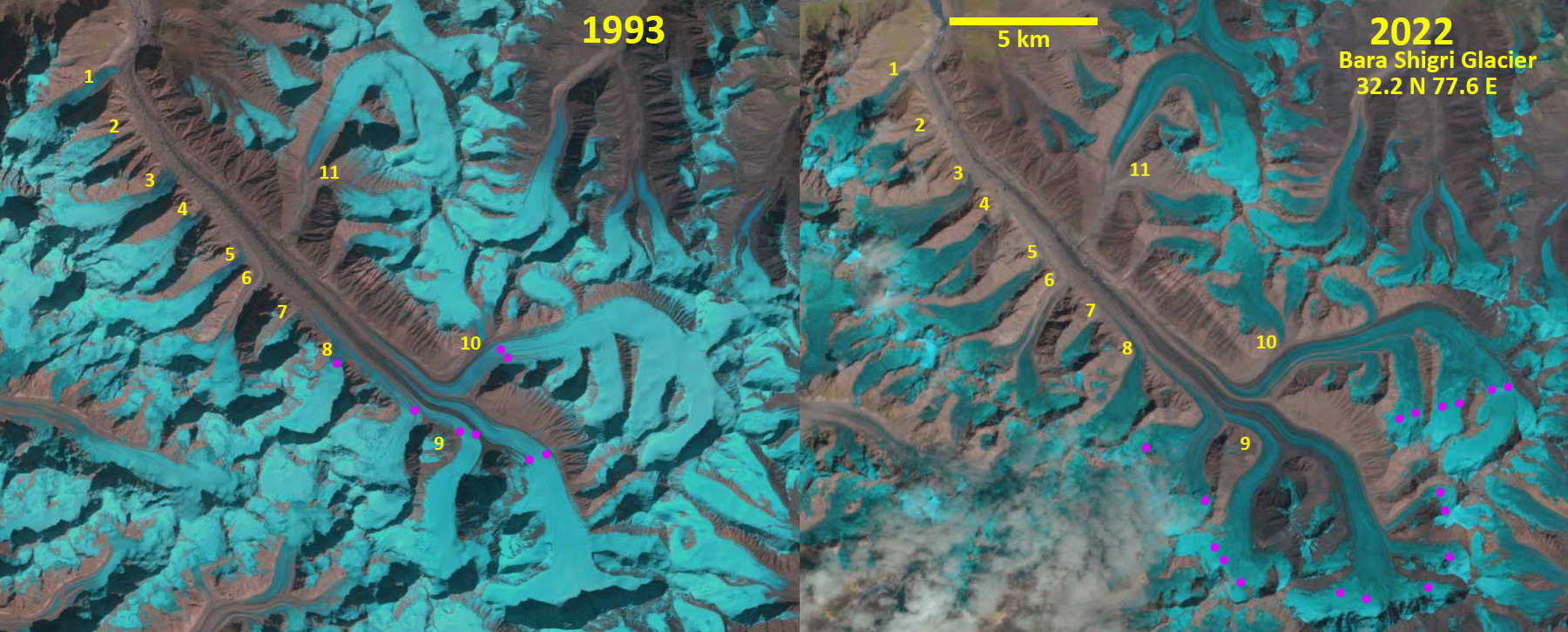
Bara Shigri Glacier in 1993 and 2022 Landsat images indicating the separation of a number of tributaries. Purple dots mark the snowline 1993=5050 m and 2022=5600 m.

Bara Shigri Glacier, India is in Chandra Valley of the Western Himalaya. Chand et al (2017) report on the behavior of the glacier from the Little Ice Age to 2014 noting a retreat of 255 m from 1992-2002 and 168 m from 2002-2014. This 26 km long glacier had an average snowline maximum elevation of 5340 m for the 2000-2014 period.  The glacier has been fed by a number of significant tributaries feeding from the southwest, here labeled 1-9. The snowline has risen above 5400 m with increasing frequency resulting in a limited accumulation area as observed in Landsat images from 2002, 2016, 2020 and 2022.

In 1993 tributary 1, 3, 4, 5, 6, 8 and 9 feed the main stem, while tributary 2 does not reach the main stem and tributary 7 just meets it without apparent contribution. In 2002 the same tributaries continue to contribute ice to the main stem as in 1993.  The snowline is much higher at 5400 m. In 2022 tributaries 1, 4 and 5 no longer contribute to the mainstem of the glacier, leaving Only tributaries 3, 6, 8 and 9 connecting. The snowline in 2020 averaged 5600 m as well, with higher snow levels on the southwest tributaries and a lower snowline on the northeast arm of the glacier.

The detachment of tributaries illustrates mass balance loss of these glaciers and consequence decrease in volume flux into Bara Shigri Glacier which will lead to continued retreat. Patel et al (2021) noted a mass loss rate of -0.59 m w.e. per year from 2013-2019 indicating the basin wide nature of mass loss. This mass loss is also leading to retreat of nearby Samudra Tapu Glacier.

Bara Shigri Glacier in 2002 Landsat image indicating the separation of a number of tributaries. Purple dots mark the snowline 1993=5050 m and 2022=5400 m.

Bara Shigri Glacier in 2020 Landsat image indicating the separation of a number of tributaries. Purple dots mark the snowline 1993=5050 m and 2022=5600 m.

Suiattle, White River, Whitechuck and Honeycomb Glaciers North Cascade Range Diminishing Rapidly

USGS Map of the four glacier from 1984, with none of the seven lakes existing.

In 1988 we mapped four glaciers arrayed around the Kololo Peaks just south of Glacier Peak; Honeycomb and White River feeding into Wenatchee Lake watershed, while Whitechuck and Suiatlle fed into the Suiattle River watershed. They had a combined area of 9.2 km². The glaciers had not developed a series of proglacial terminus lakes at that time. We visited each glacier and completed observations in 1995 and 2002 illustrated the formation of six proglacial lakes, with one more developing after that, Lake #7. Further details and image for Whitechuck Glacier . In 2022 the glaciers have retreated away from each of these lakes that had not even begun to form in 1988. The combined area of the four glaciers in 2022 is 5.6 km², a 40% decrease in 34 years.

Whitechuck Glacier in 1988, with the North Branch and South Branch joined and terminating at Lake #5.

Whitechuck Glacier in 2002 with a detached glacier segment at Lake #5.

White River Glacier in 1988 with no lake yet formed at #3 or #4.

White River Glacier terminus with Lake #3 having formed, but still largely snowcovered in early August.

Honeycomb Glacier in 1995 with no lake #1 at the terminus yet.

Honeycomb Glacier in 2002 still in contact with Lake #1.

Kololo Peak glaciers in Sept. 9 2022 Sentinel image.  H=Honeycomb, S=Suiattle, WC=Whitechuck, WR=White River, purple dots are the snowline and Point 1-7 proglacial lakes that formed after 1988 and are no longer in constact with glacier.

In 2022 we had the most extensive melting we have observed after September 1, with active significant melt extending to October 19. The result is striking in Sentinel images from Sept. 7 and Oct. 19 indicating the reduction in snowcovered area, the percentage of a glacier covered by snow is its accumulation area ratio (AAR). On September 9 the AAR of these glaciers was 45% diminishing to 10% by October 19. With negligible retained snowpack on Whitechuck and White River Glacier. Since 1988 Honeycomb Glacier has retreated 950 m, White River Glacier 475 m, Whitechuck Glacier 950 m and Suiattle Glacier 450 m.

Kololo Peak glaciers in Oct. 19, 2022 Sentinel image.  H=Honeycomb, S=Suiattle, WC=Whitechuck, WR=White River, purple dots are the snowline and Point 1-7 proglacial lakes that formed after 1988 and are no longer in constact with glacier.

Icemantle Glacier, British Columbia Declinining Rapidly

Icemantle Glacier in Landsat images from 2000-2022 illustrating the retreat exposing a new lake (Point A)  and separation at Point D. Also the lack of snowcover in 2009, 2015 and 2022 indicative of mass balance loss that drives retreat.

Icemantle Glacier is on the north side of Greenmantle Peak just north of Snowcap Lake in the Lilloet River Basin of southwest British Columbia. Here we focus on the retreat and thinning of the glacier this century using Landsat imagery and then lack of snowcover extending into mid-October in 2022 using Sentinel images.

In 2000 the glacier extended across the basin where the new lake would soon form. The Landsat image from July 31, indicates near complete snowcover at the halfway point of themelt season. By 2009 a frining lake is evident between Point A and B. Snowcover is limited to the upper reaches above 2100 m. By 2015 the lake is evident and has numerous icebergs. Below Point B a bedrock knob is just emerging. At Point D the tributary is completing separation.  In 2022 the glacier is receding from the lake basin. The bedrock knob below Point B in Landsat image and at Point A in Sentinel image has emerged. The snowline rises from 2000-2050 m in early September to 2100-2150 m by mid-October. At this point the glacier should have new snowcover, and not still be actively melting.

The lake has an area of 0.3 km2 and will not expand much more. The glacier has retreated 600 m this century and given the lack of consistent retained snowcover cannot survive current climate (Pelto, 2010).  The thinning of this glacier has led to expansion and emergence of bedrock knobs at Point A-C. The retreat of this glacier fits the local pattern seen at nearby Stave Glacier. The surface darkening due to less snowcover and snowcover that has more light absorbing particles at its surfaces enhances melt. Forest fires do result in some darkening of the glacier surface (Orlove, 2020).

Icemantle Glacier in early September, when snow melt is usually largely offset by occassional new snowfall, and mid-October 2022 after a month of continue ablation reduced snowcover significantly. Notice the expansion and emergence of bedrock at Point A-C.


Brady Glacier Retreat Causes Ice Dammed Spur and Trick Lake Drawdown

Brady Glacier terminus region in September 28, 2022 Sentinel image. Red dots indicate the 2016 margin. Point A marks the new isthmus exposed by falling lake water level. Point B-D are the expanded drainage channels.

Brady Glacier is a large Alaskan tidewater glacier in the Glacier Bay region that is beginning phase of substantial retreat that was forecast by Pelto et al (2013). The glacier has seven secondary termini in marginal ice dammed proglacial lakes. There was a consistent pattern in the change in position of the glacier margin at each of the lakes between 1948 and 2010. The rate of retreat of the glacier margin at all seven ice dammed lakes accelerated later during this period; the mean retreat rate was 13 m/a from 1948 to 2004 and 42 m/a from 2004 to 2010 (Pelto et al 2013). Lake area and calving fronts were measured for each lake: Spur, Abyss, North Deception, Bearhole, Oscar, and East Trick based on the September 2010 imagery, with earlier measurements from Capps  et al (2010). Lake areas can increase as a result of Brady Glacier marginal retreat, and can decrease due to declines in surface water levels as previously ice-dammed conduits form to drain the lake (Pelto 2016). Here we examine the changes in area of  Spur and Trick Lake from 2016-2022 during development of substantial marginal drainage channels. During this period the terminus of the glacier has retreated on average 175 m, with 300 m of retreat from its maximum position advance position.

Brady Glacier terminus region in September 29 2016 Sentinel image. Yellow dots indicate the 2022 margin. East and North Trick lakes are connected basins. Spur Lake still has an eastward extension.

Trick Lakes: In 1986 North and South Trick Lake were proglacial lakes in contact with the glacier. By 2016 the two lakes were no longer in contact with the glacier, water levels had fallen and a third lake East Trick Lake had formed. North Trick Lake  and South Trick Lake are currently relatively stable moraine-dammed lakes. The more recently developed East Trick Lake is the current proglacial Trick Lake, a large glacier river exits this lake and parallels the glacier to the main Brady Glacier terminus. In 2016 this river was narrow and flowed beneath the glacier in several spots.  By 2022 the channel has expanded to a width that seldom is less than 200 m, and is tranisitioning to an ice marginal lake. East Trick Lake has an area of 1.25 km²  in 2016, expanding to 1.4 km² in 2019, before declining to 1.0 km² in 2022 with the lake separating into two parts by a narrow peninsula exposed by falling water levels. The water level decline resulting from a  200 m marginal retreat from 2016 to 2022 has led to a narrow isthmus running across the lake from the glacier to be exposed. At Point E below the trimlines from reduced water levels are evident.

Spur Lake: It is likely that retreat toward the main valley of the Brady Glacier will lead to increased water depths at Spur Lake. a marginal retreat of 600 m led to a lowering lake water level from 2010-2016. The lake had an area of 0.6 km2 in 2010, 0.5 km² in 2016, o.5 km² and 0.5 km² in 2022. The lake area decline due to falling water level has been matched by lake area increase due to marginal retreat of Brady Glacier. This marginal retreat has also opened a marginal channel along the east edge of the glacier, draining Spur Lake. This drainage has led the lake shoreline to migrate west. Marginal retreat has been ~100 m from 2016-2022. The marginal river on the east side of the glacier was narrow and occasionally went beneath the glacier in 2016. In 2022 the channel has expanded so that the upper 2.5 km and lower 1.5 km is more of a marginal lake.

North Deception Lake has been expanding as the glacier has retreated 600 m, 100m/year from 2016-2022 while maintaining its water level. At present there is not a marginal channel developed that can reduce the water level. How long until a channel opens?

In Alaska the glacial lakes have expanded in area by 58% from 1984-2018 (Field et al 2021), however the ice dammed lakes declined by 0.4%. The latter indicates the competing impacts of water level reduction due to glacier recession of ice dammed lakes, and the expansion due to retreat as well.

Brady Glacier terminus region in September 28, 2022 Sentinel image. Point A marks the new isthmus exposed by falling lake water level. Point B and D are the expanded drainage channels. Point E is where trimlines are evident.

Lyman Glacier Lost Half its area from 1979-2022

Map illustrating changes in Lyman Glacier 1890-2017- losing 87% of its area.

Lyman Glacier which feeds into Lyman Lake and then Railroad Creek in the Lake Chelan drainage of the North Cascade Range, Washington has retreated a total of 1330 m from the 1890 moraine. In 1929 year the terminus position was mapped by the Washington Water Power Company. The Washington Water Power Company emplaced a benchmark from which to measure retreat of the glacier which they monitored from 1929-1940. They found the glacier retreated 195 m from 1929-1940, and 530 m from the Little Ice Age Maximum to the 1940 position. William Long  (Bill) visited the glacier with this party in 1940 and again in 1944 on leave from the 10th Mountain Division. In 1988 and 1990 Bill retured for the first times since 1944, with us, pointing out the benchmark. From 1986-2022 we have surveyd the terminus of this glacier in the field during 15 different summers. Lyman Glacier retreated 11 m/year 1940-1986, 11 m/year from 1986 to 2008, and 5.5 m/year retreat from 2008-2022. Retreat since our first field observations in 1986 has been 298 meters, 800 meters since 1940.

The area of the glacier in 2022 is 0.22 km², which is less than 13% of the 1890 area of 1.72 km².  The glacier has been losing ~1% of its area per year since 1979. The glacier was noted to be in disequilibrium with climate and would melt away with current climate by Pelto (2010). From 1986-2008 the glacier reamined  thick in the middle, over 40 m, as evidenced by a significant ice cliff into the lake. In 1986 this ice cliff maximum height was 15 m. The height increased to more than 20 m by 2003 and reached a maximum of 24 m high in 2008.. By 2011 the ice cliff had diminished to 15 m, and by 2022 to 2.5 m. The current glacier length is 360 m on the eastern portion and 400 m on the western portion. With retreat the slope in the glacier center has increased from 16 to 25 degrees from 1986-2022. The continued retreat at the 50 year retreat rate would eliminate the glacier in 35-50 years, but a simple extrapolation is typically not a good approach to determine when a glacier disappears. In 2008 we noted that the “glacier was still quite thick and should slow its retreat once the bedrock slope begins to increase, and the minor lake calving ceases.” Without a terminus ice cliff crevassing near the front has greatly diminished indicating that the terminus acceleration due to the ice cliff no longer exists. This retreat rate has slowed, while the rate of thinning due to mass balance loss has remained high ~1 m/year. The headwall also is the location of greatest avalanche accumulation, which also will slow retreat.

Additional details and images on Lyman Glacier.

1921 Mountaineers Expedition view of Lyman from the first upper Lyman Lakes shoreline (University of Washington Library), near the 1890 terminus position. Note the glacier is connected to the arm leading to Spider Gap top center. 


Lyman Glacier in 1979 (USGS) no longer connected to spider gap section. A second upper Lyman lake has formed and the glacier terminates in this lake. The glacier is connected to upper Lyman Glacier extending top right.

Lyman Glacier in 1986. Debris pile from 1930’s avalanche just reaching front, calving front at terminus narrow and only 5-8 meters high, Mauri Pelto in foreground.

Lyman Glacier 2006 with very active crevassing behind 15-20 m high calving front. Glacier is disconnected from upper Lyman Glacier, top center.

Lyman Glacier in 2007 from far end of newest upper Lyman Lake near the 1940 terminus position.

2008 Terminus ice cliff that is 18-24 m high above and below.

Lyman Glacier 2011 most extensive snowpack in the 2000’s, ice cliff 10-15 m.

Lyman Glacier in 2022 from east margin reduced slope and size compared to similar viewpoint in 1988, Jill Pelto in foreground (Kevin Duffy-image)

Lyman Glacier 2022 with annotated measurements from the 2008 terminus locations and of terminus condition. Kevin Duffy on the terminus rock. (Jill Pelto-Image)

Tebenkof Glacier, Alaska Snowcover Loss Exposes Century of Annual Layers

Tebenkof Glacier in 2018 ESRI World Image with annual layers numbered. from near the divide to near the terminus. A couple of layers of layers buried near top of glacier by snowcover. This indicates 90-100 annual layers exposed at the surface as they emerge at the surface.

Tebenkof Glacier is a land terminating glacier on the Kenai Peninsula just west of Blackstone Bay. WGMS (2021) documented the retreat rate from 1910-2009 as ~20 m/year. Black and Kurtis (2022) examined 19 tidewater glaciers on the Kenia Peninsula identifying a 42 km² area loss from 1984-2021.  From 1986-2022 Landsat imagery indicates a retreat of 1100 m. During the summers of 2018-2020 the glacier lost all or nearly all snowpack, this allowed atellite imagery to reveal ~90-100 annual layers exposed from divide to near the terminus during years when the glacier was stripped of snowpack such as in 2018-2020.

Tebenkof Glacier retreat from 1986-2022 generating proglacial lake as it retreated 1100 m.

Tebenkof Glacier has an unsually low elevation and consistent gentle slope with the main glacier divide at 650 m and terminus at 200 m, with a length of 9 km. From 650 m where the first annual line layer is visible to 275 m where the last annual layer is visible is a distance of 6.5 km, with an average slope of 3.3 degrees. Above the equilbrium annual layers are submergent and below this line annual layers are emergent.The observed velocity at the blue and orange X show a remarkable consistency just as the slope with the 2017-2021 average fron the NASA ITS_LIVE of 60.72 at the orange point and 60.68 m/year at the blue x. This translates to travel time of 100 years from the divide to the end of the annual layer area. This is slightly more than the number of visible annual layers, however a few years have had no retained accumulation and hence no layer would form.

Tebenkof Glacier in Landsat images in 2018 and 2020 with less than 2% retained snowcover exposing annual layers.

Tebenkof Glacier velocity data at two locations, both averaging 60 m/year, velocity from NASA ITS_LIVE

Nizkiy Glacier, Novaya Zemlya Embayment Drains via Terminus Breach

Nizkiy Glacier in Sentinel images from July 15 and Sept. 17 2022, before and after the breach of the terminus. Point A-D indicate emerging land due to falling water level as the embayment drains. The former outlet (O) is also noted.

Nizkiy  Glacier is on the west coast of the island reaching the Barents Sea Coast.  Carr et al (2014) identified an average retreat rate of 52 meters/year for tidewater glaciers on Novaya Zemlya from 1992 to 2010 and 5 meters/year for land terminating glaciers. Pelto, (2016) noted the contined expansion of an empbayment between the central teminus and a peninsula.


Nizkiy Glacier in Landsat images from 1990, 2015 and 2022 indicating the reduction in width of the terminus ice dam for the embayment. Red arrows=1990 terminus, yellow arrow the 2015 terminus.

In 1990 the Nizkiy Glacier has several termini in lakes and one in the Barents Sea. The main terminus extends north beyond the end of a peninsula in 1990, with an embayment developing from the peninsula across to the northern edge of the terminus. The middle terminus ends in a proglacial lake and in 1990 the terminus largely envelops an island in the lake. The southernmost terminus is in a proglacial lake shown is indicated by a red arrow as well. The 2015 Landsat image indicates the continued reduction in Nizkiy Glacier width reaching the peninsula at the yellow arrow, from 4 km in 1990 to 1.5 km in 2015, having retreated 1200 m from the 1990 position on the northern edge. Hence, it will likely be quite soon when the proglacial lake with the island joins with the Barents Sea. In early July 2022 the terminus tongue width impounding the lake had been reduced to 600 m, the embayment water level was higher than sea level indicating limited drainage under the glacier tongue with the main outlet still being at the southern end of the embayment, Point O. By early September the glacier tongue had been breached and the embayment had drained lowering water level. The drainage channgel is 200 m wide. This has exposed ~2 km2 of new land after embayment drainage. The glacier has lost 15 km2 of area from 1990-2022. The retreat of this glacier has been less than at Vilkitskogo Glacier, will the loss of this pinning point accelerate retreat now?

Closeup view in Sentinel 2 image from 2022. The breach is 200 m wide and has lowered water level in the embayment exposing 2 km2 of new land.