
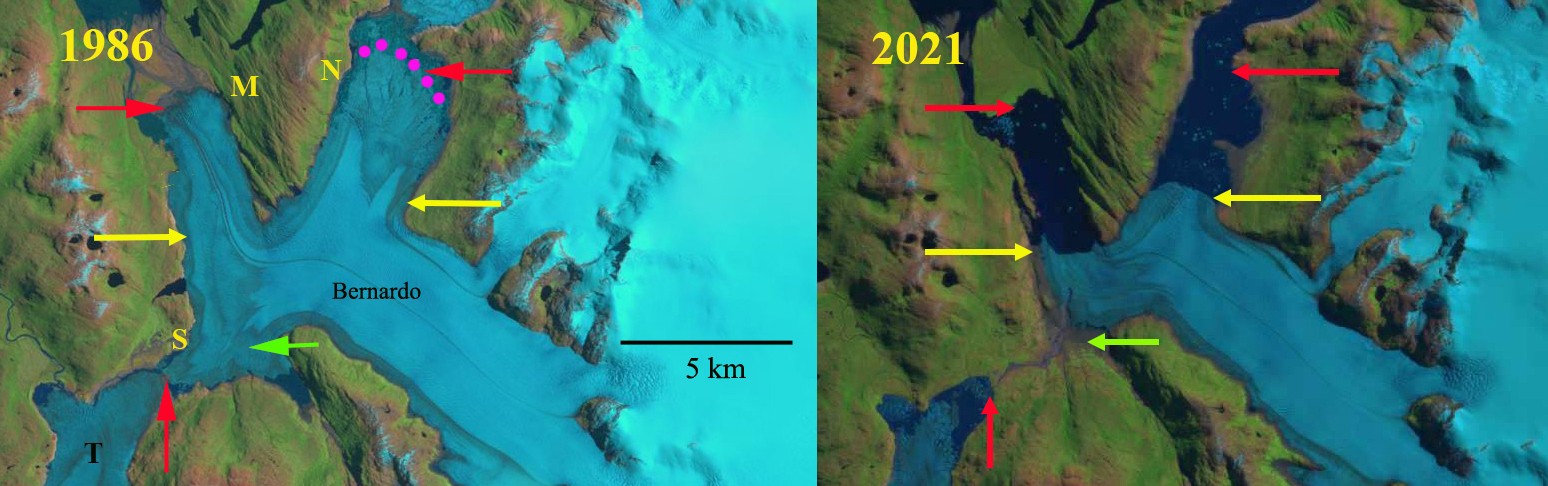
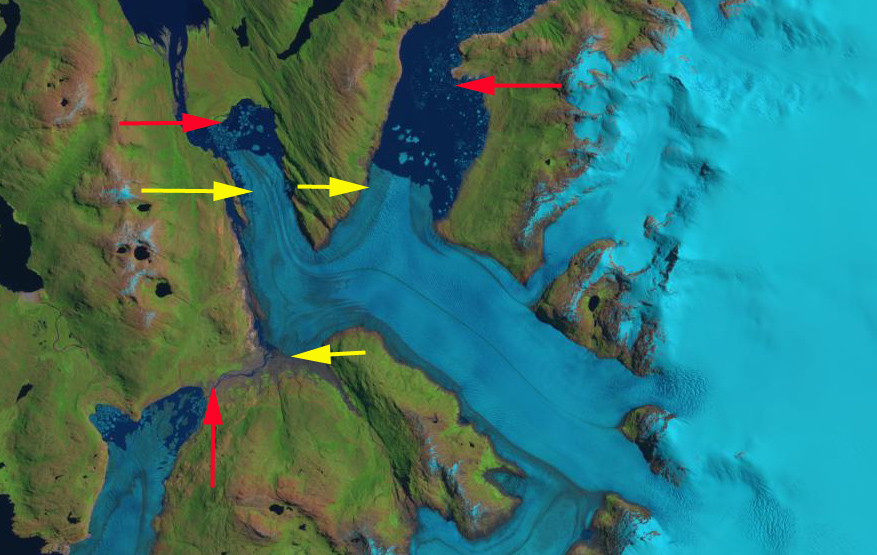
Bernardo Glacier in Landsat images from 1986 and 2021 illustrating retreat at the southern (S), middle (M) and northern (N) terminus respectively. Red arrows are 1986 terminus locations, yellow arrows are 2021 terminus locations. Separation from Tempano occurs at S, while lake expansion occurs at M and N.
Bernardo Glacier is an outlet glacier on the west side of the Southern Patagonia Icefield (SPI) that currently ends in an expanding proglacial lake system, with three primary termini. Here we examine changes from 1986 to 2021 using Landsat images. Davies and Glasser (2012) indicate that over the last century the most rapid retreat was from 2000 to 2011. Willis et a (2012) note a thinning rate of 3.4 meters per year during this period of the Bernardo Glacier region, which drives the retreat. Mouginot and Rignot (2014) illustrate that velocity remains above 200 m/year from the terminus to the accumulation zone on Bernardo Glacier. Eñaut Izagirre visited the glacier in 2019 and provided images of the middle terminus of Bernardo Glacier, below.

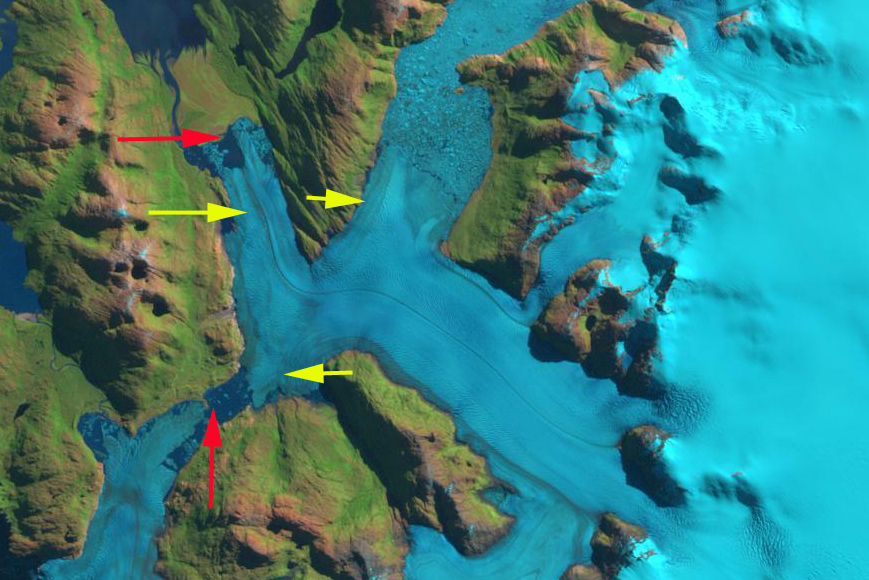
Bernardo Glacier in Landsat images from 1998 and 2020 illustrating retreat at the southern (S), middle (M) and northern (N) terminus respectively. Red arrows are 1986 terminus locations, yellow arrows are 2021 terminus locations. Separation from Tempano occurs at S, while lake expansion occurs at M and N.
In 1986 Bernardo the southern terminus of the glacier was in tenuous contact with Tempano Glacier. The middle terminus primarily ended on an outwash plain with a fringing proglacial lake developing. The northern terminus had retreated a short distance south from a peninsula that had acted as a pinning point. By 1998 the northern terminus had retreated into the wider,deeper portion of the lake basin that was now filled with icebergs. The middle terminus remained grounded on an outwash plain, with proglacial lake expansion at the NW corner of the terminus. A small lake has developed completely separating Bernardo Glacier and Tempano Glacier. By 2003 the northern terminus had retreated 2 km from 1986, the middle terminus 1.5 km and the southern terminus 1.2 km in an expanding proglacial lake. By 2015 the lake between Tempano and Bernardo Glacier had drained, but a fringing proglacial lake at the margin of Bernardo Glacier was forming. In 2015 the northern terminus had retreated 3.5 km since 1986, the middle terminus 2.5 km and the southern terminus 2.75 km. From 2015 to 2020 the change of the southern terminus was limited to a limited expansion of the fringing proglacial lake, a limited retreat of the the northern terminus, while the middle terminus had retreated significantly into a wider portion of the lake basin. By 2021 the southern terminus had retreated 3 km since 1986, the middle terminus 4.6 km and the norther terminus 4.1 km. This led to a 8.7 km2 lake expansion at the middle terminus and a 7.8 km2 lake expansion at the northern terminus. Gourlet et al (2016) identify Bernardo Glacier as having thinner ice than other large outlet glaciers such Jorge Montt or O’Higgins, which helps lead to rapid terminus change. The retreat is similar to the extensive retreat observed at Dickson Glacier and Upsala Glacier.

Southern Andean huemel an endemic deer on the foreland beyond Bernardo Glacier (photograph from Eñaut Izagirre).
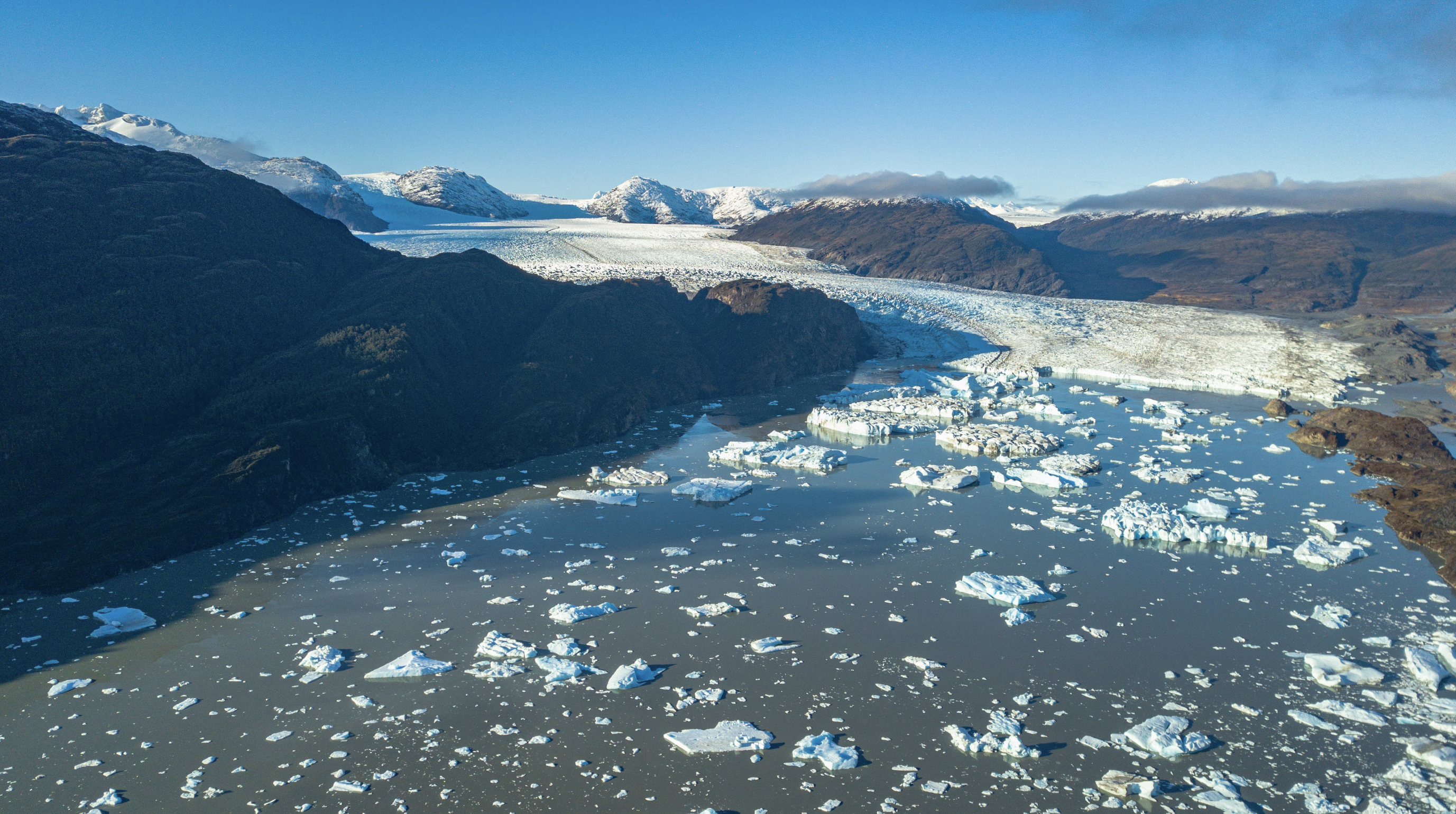
Middle terminus of Bernardo Glacier in 2019 taken by Eñaut Izagirre who considers this a condor-view.
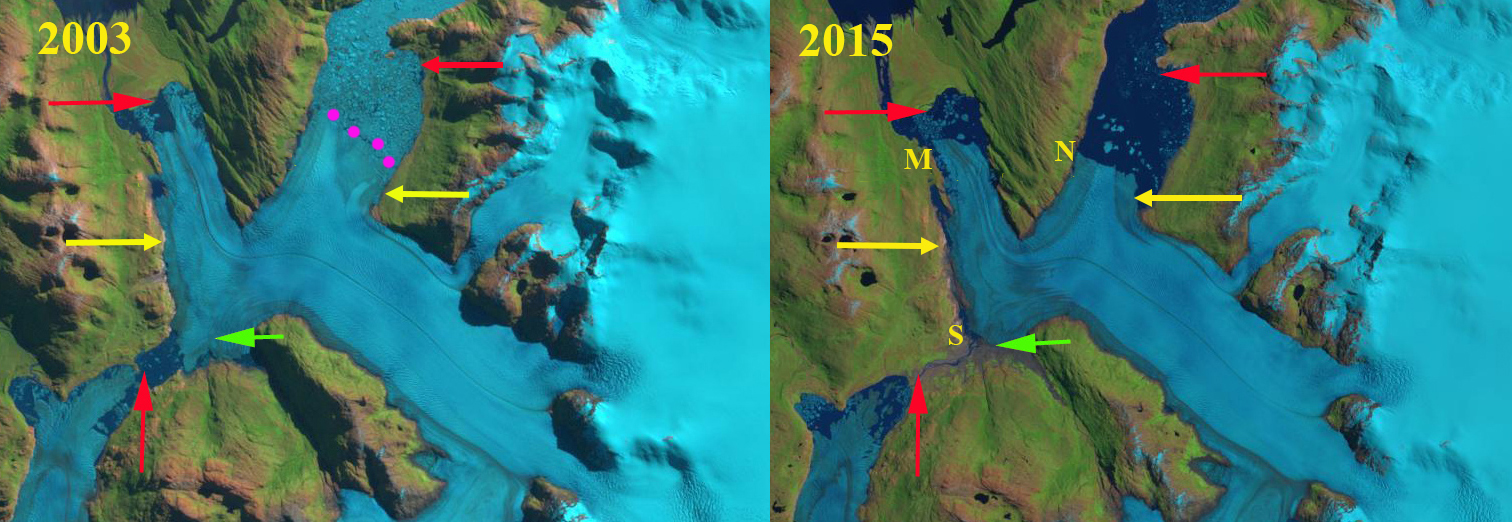
Bernardo Glacier in Landsat images from 2003 and 2015 illustrating retreat at the southern (S), middle (M) and northern (N) terminus respectively. Lake expansion and then drainage occurs at S. Red arrows are 1986 terminus locations, yellow arrows are 2021 terminus locations.


 From a Glaciers Perspective