Vern Ritchie-Battle Glacier, British Columbia Retreat, Lake Growth, Snowline Rise

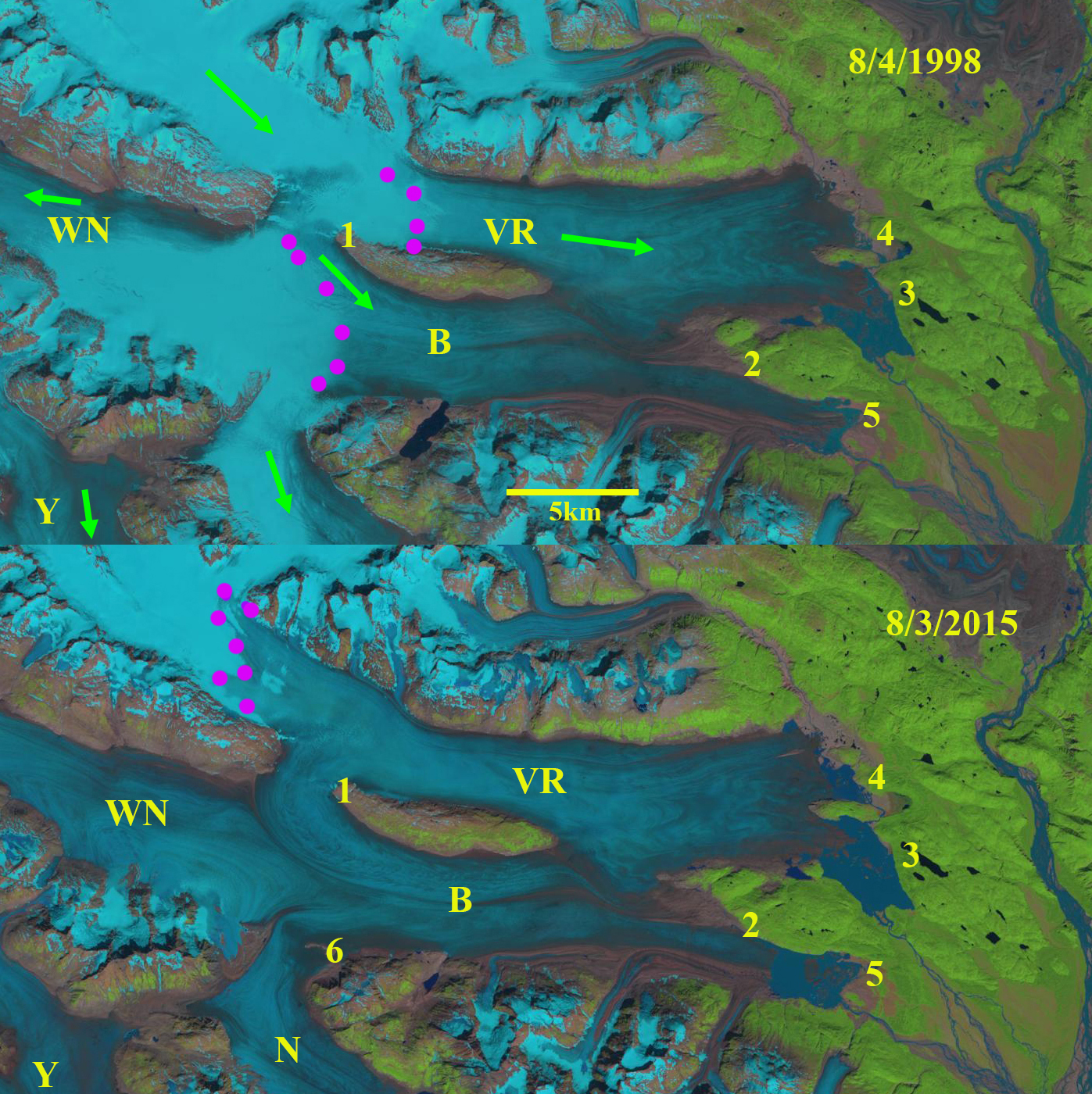
Vern Ritchie (VR) and Battle Glacier (B) in 1987 and 2019 landsat images.  Three proglacial lakes have expanded at Points 2-5. WN=West Nunatak Glaier, Y=Yakutat Glacier N=Novatak Glacier, purple dots indicate snowline and green arrows indicate glacier flow direction.

Vern Ritchie and Battle Glacier flow from the Alaska/Canada border of the St. Elias Mountains towards the Alsek River. In 1987 the two glaciers that share both an accumulation zone and a terminus area terminated in small proglacial lakes at 240 m.  The main flow path of  Battle Glacier connects to West Nunatak Glacier and Novatak Glacier, Alaska at a low elevation saddle at 750-800 m. The Vern Ritchie Glacier is 45 km long and extends north parallel to the border to an elevation of 1800 m. A portion of this higher elevation accumulation is separated by a nunatak at Point 1  at ~850 m and joins the Battle Glacier 20 km from the terminus. Here we utilize Landsat images from 1987-2019 to identify the impact of climate change on these two glaciers. Trussel et al (2015) noted an extremely high thinning rate of 4.4 m/year on the adjacent Yakutat Glacier from 2000-2010, and it retreated 7 km losing 45 km2, of area from 2000-2018 (Pelto, 2018). Glaciers of the Glacier Bay region lost ~0.6 m/year from 1995-2011 (Johnson et al 2013).

Un 1987 Vern Rithcie Glacier’s northern terminus near Point 4 rested on an outwash plain. The southern terminus near Point 3 terminated in a 2.5 km2, proglacial lake. Battle Glacier terminated in a narrow fringing proglacial lake with an area of less than 1 km2.  The divide between Battle Glacier and West Nunatak Glacier was in the ablation zone.  The connection at Point 6 to Novatak Glacier is km wide. The snowline in 1987 on Vern Ritchie Glacier was at 1000 m.  In 1998 both lakes had expanded significantly as thinning and retreat accelerated.  The snowline is at 800 m in early August on Vern Ritchie Glacier and is at 750 m on Battle Glacier covering the divide with West Nunatak Glacier. At Point 6 the connection to Novatak Glacier remains wide. By 2015 a proglacial lake had formed at the northern terminus at Point 4 with an area of ~2 km2. The southern terminus glacial lake has expanded to ~6 km2, and has several large icebergs evident. Battle Glacier at Point 5 now terminated in a ~5 km2 lake that has a few icebergs. The snowline is at 1100 m on Vern Ritchie Glacier.

In 2018 and again in 2019 record snowline elevations since 1946 were noted at Taku Glacier near Juneau, AK (Pelto 2019).  In 2018 the nearby Lowell Glacier exhibited a substantial snow swamp (NASA, 2019).  The snowline was the highest observed on Vern Ritchie Glacier at 1340 m. At Point 6 the connection to Novatak Glacier continues to narrow.  The Vern Ritchie northern terminus lake has expanded to 2.7 km2.  The southern terminus lake in 2019 has an area of ~7 km2, a 225% increase since 1987, and again has several icebergs.  Battle Glacier has receded to Point 2 a retreat of 3800 m since 1987 and the lake now has an area of ~6 km2 . The lake also has several significant icebergs.

The main portion of Battle Glacier is fed by flow from the divide region with West Nunatak and Novatak Glacier, which is no longer retaining accumulation on a consistent basis and this portion will melt away.  The connection to Vern Ritchie at Point 1 remains wide, but there is a sill here, that is becoming more evident indicating a reduction in flow.  Vern Ritchis continues to retain snowpack on the upper reaches of the glacier. The retreat of this glacier is less spectacular than nearby Melbern Glacier or Yakutat Glacier.

Vern Ritchie (VR) and Battle Glacier (B) in 1998 and 2015 landsat images.  Three proglacial lakes have expanded at Points 2-5. WN=West Nunatak Glaier, Y=Yakutat Glacier N=Novatak Glacier, purple dots indicate snowline and green arrows indicate glacier flow direction.

Canada Topographic map of the terminus region from Atlas of Canada 

Stave River, BC Run of River Hydropower Changes with Glacier Retreat

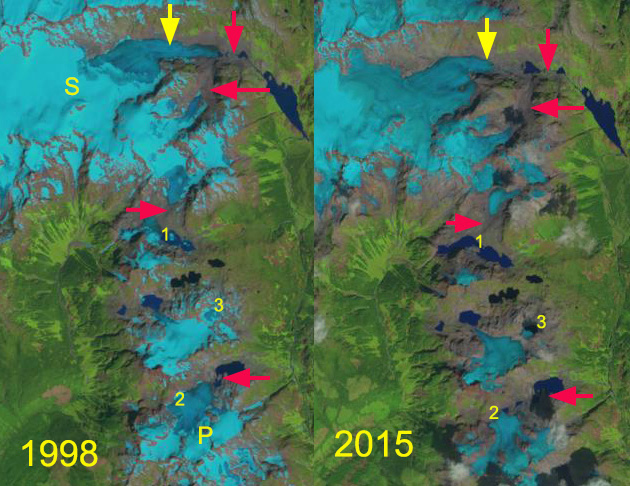
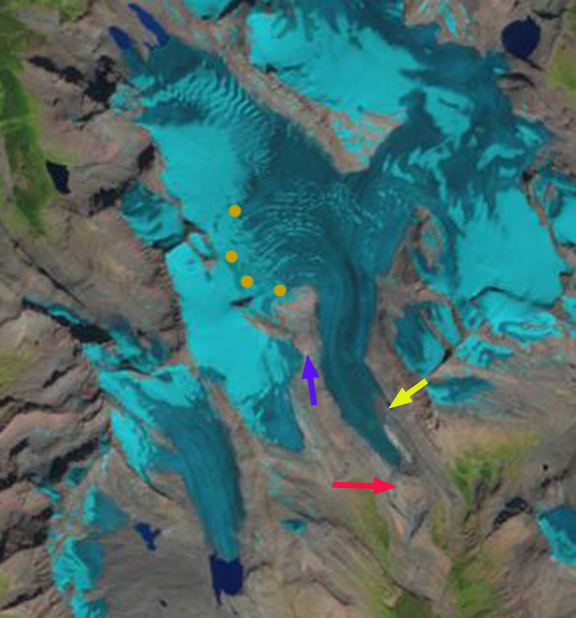
Stave Glacier area in 1992 and 2019 Landsat images illustrating the loss of glacier area.  Red arrows indicate 1992 terminus location, yellow arrow 2019 terminus location, Point 1-3 are proglacial lake that are evolving, P=Piluk Glacier and S=Stave Glacier.

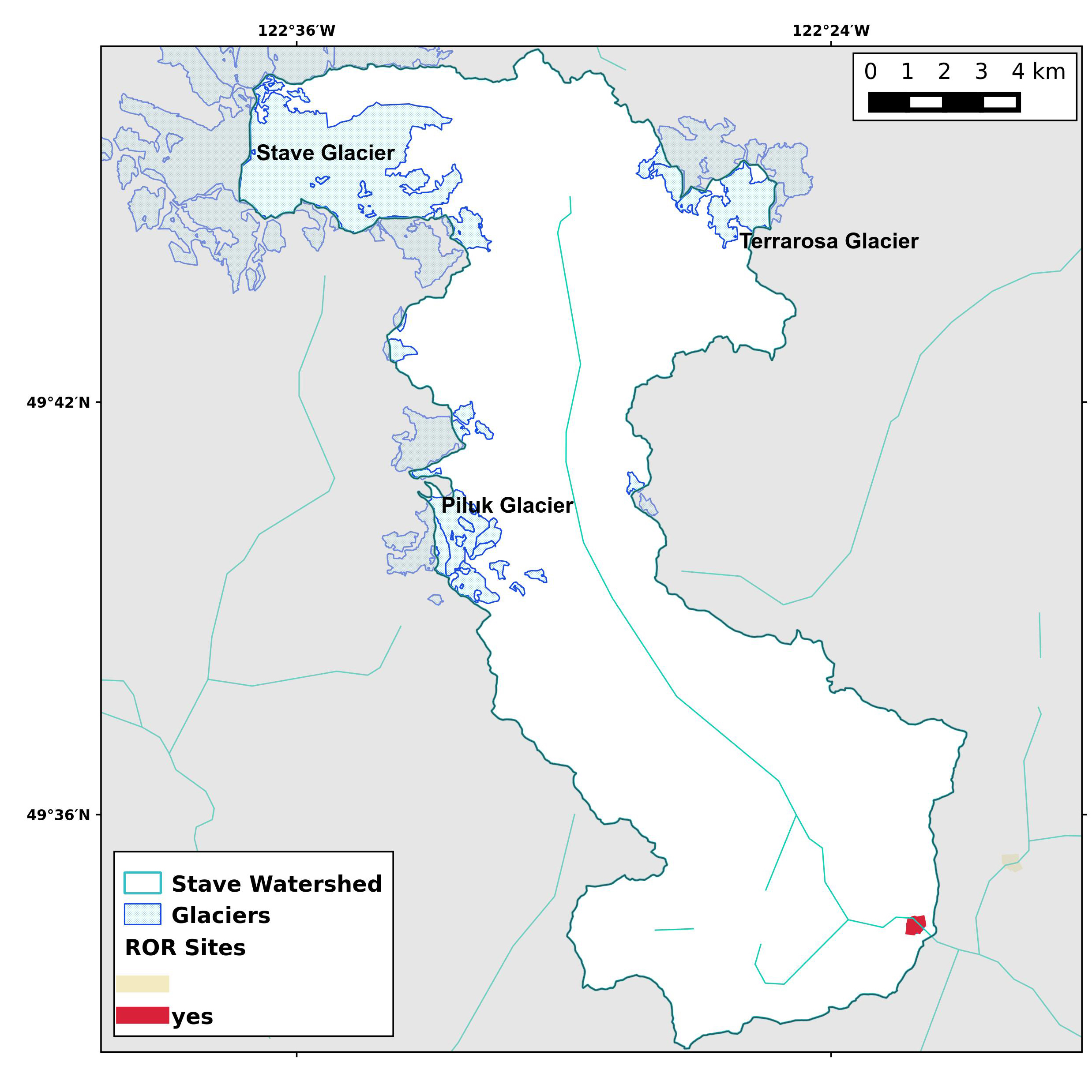
Stave River drains into Stave Lake and has a 40 km length above the lake.  The basin has a glaciated area of 32 km2. The basin above Stave Lake has two Run of River Hydropower plants (RORH) .  The 17.5 MW RORH project on the Northwest Stave River was built by Innergex Resources and was opened in 2013. The facility is 18 km upstream of Stave Lake and has 1.9 km long diversion reach. The 33 MW RORH project on the Upper Stave River was built by Innergex Resources and was opened in 2011.  Stave River has a substantial fall run of Coho and Chum.  A decline in the salmon runs beginning in 2000 led to development of a Lower Stave river water use plan to reduce blockage at the Ruskin Dam hydropower site, which is not an RORH.  This has not led to a recovery of salmon, in fact the 2008-2012 population numbers are lower than prior [Ladell and Putt, 2015].  Stave River has a peak flow in June and mean July-September runoff is 37.4 m3s-1.

RORH lack significant reservoirs by definition and as a result cannot alter the discharge of a river or store water, including glacier runoff.  RORH divert a portion of a rivers discharge through the power system, reducing discharge for the diversion reach of the power system, before returning the water to the river. Mountainous nations with substantial hydropower potential and glaciers are expanding their use of RORH [Orlove, 2009].  The growth of RORH has been due to the lower cost of development and reduced environmental impact, which result from the absence of a large storage reservoir.

Peak streamflow in the alpine regions of the Pacific Northwest occur during the spring snow melt season. Glacier runoff peaks in the mid to late summer during the height of the ablation season, coincident with minimum streamflow of late summer and early fall.  The loss of glacier area from these watersheds thus reduces streamflow primarily during late summer minimum flow periods.  This has been observed in several Pacific Northwest basins where a decline of more than 20% in glacier area has led to a decrease in glacier runoff [Stahl and Moore, 2006; Pelto, 2011].  In such basins RORH will have a reduced seasonal production capacity.

Stave Glacier, the largest glacier in the watershed, declined from 11.38 km2 in 1988 to 9.45 km2 in 2005 [Koch et al 2009] and 8.6 km2 in 2019. The terminus retreated 1900 m during the 1992-2019 period.  Piluk Glacier terminated in a proglacial lake in 1992.  By 1998 it had retreated from this lake and by 2015 a new proglacial lake was forming at Point 2. The glacier retreated 800 m from 1992 to 2019, and the area was reduced from 3.5 km2 to 2.0 km2 . The glacier lost all of its snowcover in 2015, and more than 90%in 2016 and 2019, indicating it cannot survive current climate. Point 1 indicates where a glacier terminates in a proglacial lake in 1992 at what is more of a pass than a valley.  This is still the case in 1998, but in 2015 the lake is no longer proglacial and only 20% of the 1992 glacier remains. Point 3 in 1992 is a glacier filled basin that is narrowly attached to an adjacent glacier. In 1998 the glacier still fills the basin but is no longer attached to the adjacent glacier. By 2015 the basin is mainly a proglacial lake.  In 2019 only a small section of glacier remains at the southwest edge of the lake.  There are two other glaciers between Stave Glacier and Piluk Glacier that are unnamed where red arrows indicate the 1992 terminus location.  The northern flowing of these glaciers has retreated 850 m, while the south flowing glacier retreated 400 m.  In both cases this represents more than 30% of the total glacier length.

Stave River Basin, British Columbia indicating hydropower plants and glaciers in the basin (Map created by Ben Pelto)

Future Glacier Runoff and Hydropower Implications

Recent glacier runoff is determined from a mean observed regional summer balance of -2.9 m w.e.  Summer glacier runoff is 98.6 million m3, yielding a mean summer discharge of 7.5 m3s-1, which is 20 to 24% of total stream discharge.The rate of glacier area loss was 0.53%/year from 1985-2005 [Bolch et al 2010].  A continuation of this trend up to 2050 would yield a 24% area decline, with glacierized area in the basin of approximately 26 km2 in 2050.  Since 2005 the area loss has accelerated to ~1% /year.  This would lead to an area of  22.4 km2. A greater decline is likely however, as modeled warming of 2.2 ˚C by 2050 would lead to higher ablation rates [Clarke et al 2015].  Using the temperature index model and applying the increased temperature yields a mean summer balance of -3.5 m w.e., yielding 78.4 million m3.  This is equivalent to mean summer discharge of 5.9 m3s-1, a 20% decline from present glacier runoff. in 2050. The reduced glacier runoff will add to the earlier snowmelt runoff in the region through 2050 leading to significantly reduced late summer discharge and hydropower potential in the Stave River basin. Peak glacier runoff has passed and an ongoing decline will occur as is the case at many basins in the region including the Nooksack Basin in Washington (Pelto, 2015).

Stave Glacier area in 1998 and 2015 Landsat images illustrating the loss of glacier area.  Red arrows indicate 1992 terminus location, yellow arrow 2019 terminus location, Point 1-3 are proglacial lake that are evolving, P=Piluk Glacier and S=Stave Glacier.


Nakonake Glaciers, BC Retreat Two are Disappearing

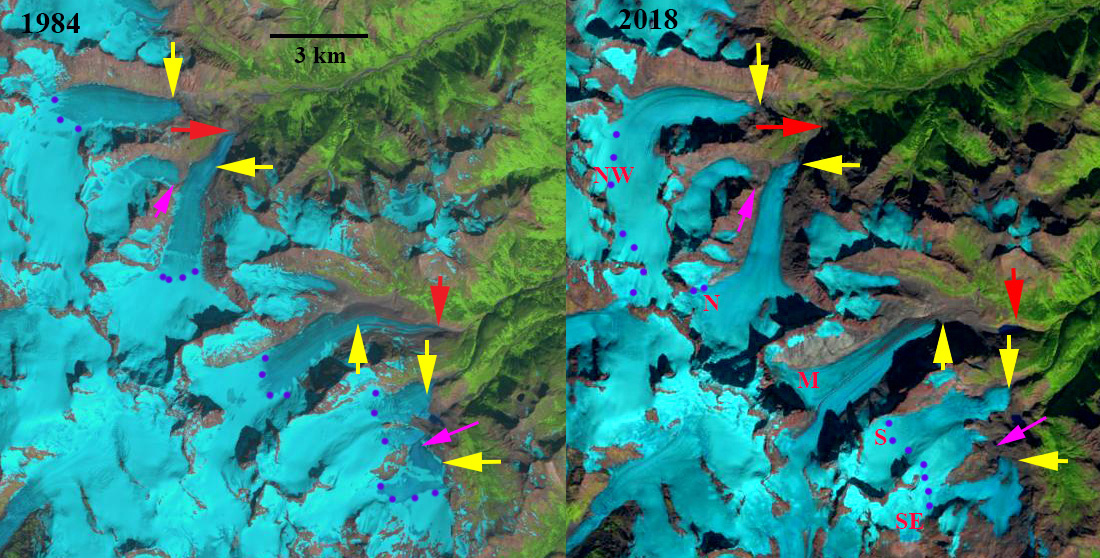
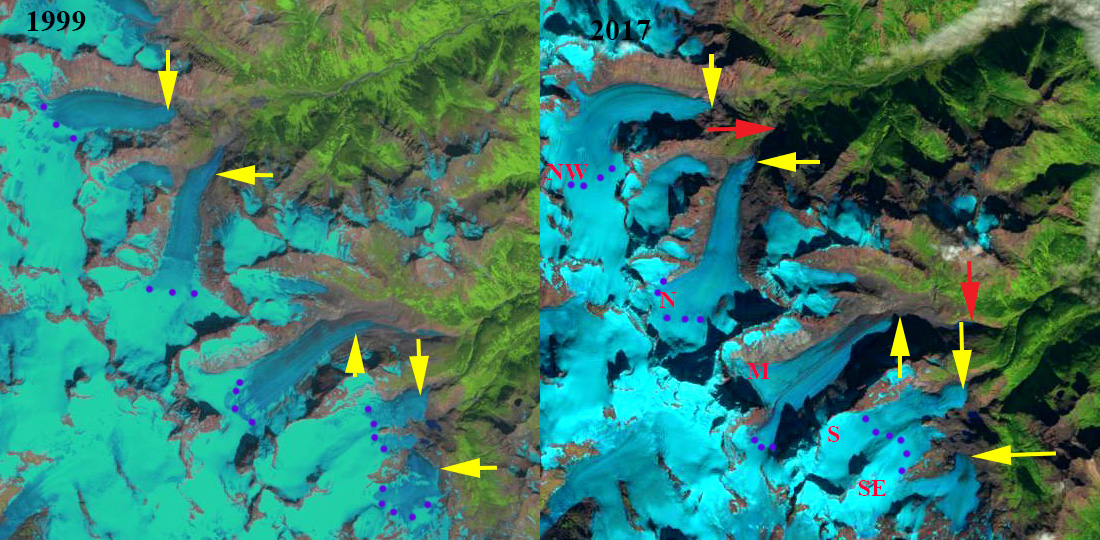
Nakonake Glaciers in 1984 and 2018 Landsat images. Nakonake Glaciers are NW=Northwest, N=North, M=Middle, S=South, SE=Southeast.  Red arrows indicate the 1984 terminus position of the North and Middle Nakonake Glaciers.  Yellow arrows indicate the 2018 terminus location of each. Purple dots indicate the snowline and the pink arrow indicates locations of glacier separation.

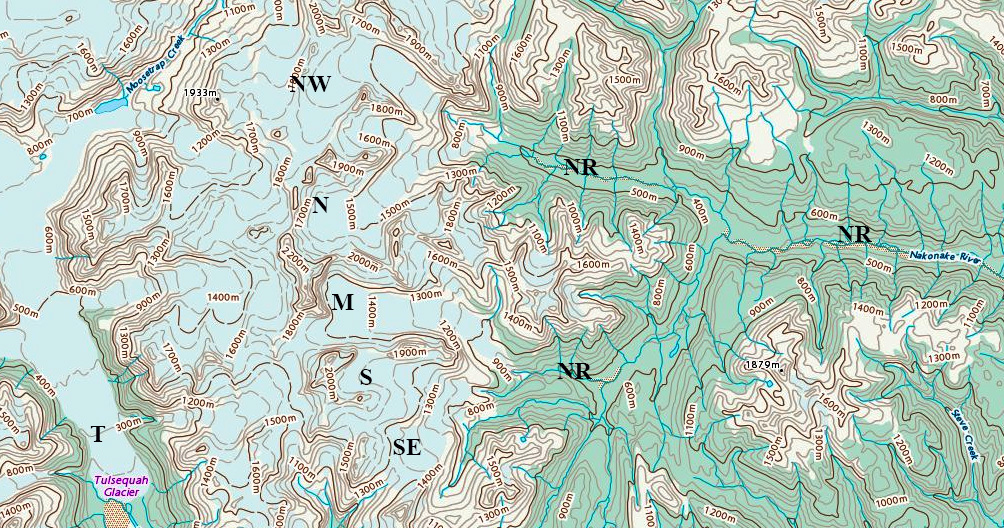
The Nakonake Glaciers are a group of unnamed glaciers at the headwaters of the Nakonake River in NW Britishc Columbia.  The range is just east of the Tulsequah Glacier-Juneau Icefield.  The Nakonake River flows into the Sloko River which joins the Taku River.  There are sockeye, coho and chinook salmon in the Sloko River.  The Sloko River below the junction with Nakonake River is known as a fun stretch of river to run. My only experience with this glacier group was watching a grizzly bear ascend from the lower Tulsequah Glacier into the Nakonake area. Menounos et al (2018) indicate this region of British Columbia had the largest mean annual mass balance losses from 2000-2018.

In 1984 the Norhtwest (NW) Nakonake terminated at the top of a steep slope at 1100 m.  North (N) Nakonake Glacier terminated at 800 m with a longer valley tongue than the NW glacier.  The Middle (M) Nakonake Glacier terminated at 900 m and had a substantial low slope terminus tongue. The South (S) Nakonak Glacier merged with the Southeast (SE) Nakonake Glacier at this time.  The snowline varied from 1500 m on NW to 1400 m on N and M and 1300 m on S and SE.  By 1999 the SE Nakonake Glacier had separated from the S Nakonake Glacier though it still had two terminus lobes that were connected. The snowline ranged from 1600 m on the NW Nakonake to 1400 m on the S and SE Nakonake. In 2017 the snowline was quite high ranging from 1700+ m on NW Nakonake to 1500+ m on South Nakonake Glacier.  In 2018 the Juneau Icefield regions saw the highest snowlines of the last 70 years (Pelto, 2018). The snowline was above the top of the M Nakonake and SE Nakonake Glacier. The snowline was above 1800 m on NW Nakonake and 1700 m on the S Nakonake Glacier. Retreat of the NW Nakonake from 1984-2018 was limited at 200 m, though recent high snowlines should accelerate this retreat.  The N Nakonake Glacier that had a low elevation terminus tongue still in 1984 and retreated 1400 m from 1984-2018.  The M Nakonake also had a low elevation tongue that melted away leading to  a retreat of 2200 m from 1984-2018. The retreat is 30+% of the glacier length lost.  This glacier lacks a significant accumulation and will not survive. The S Nakonake retreat like the NW was minor at ~200m.  The SE Nakonake Glacier was 700 m, which given a glacier length of just over 3 km is a substantial loss. This glacier lacks a significant accumulation zone and will not survive. This glacier has separated into two parts.

Tulsequah Glacier has experienced a more rapid retreat enhanced by proglacial lake development (Pelto, 2017).

Nakonake Glaciers in 1999 and 2017 Landsat images. Nakonake Glaciers are NW=Northwest, N=North, M=Middle, S=South, SE=Southeast.  Red arrows indicate the 1984 terminus position of the North and Middle Nakonake Glaciers.  Yellow arrows indicate the 2018 terminus location of each. Purple dots indicate the snowline.

Map of the Nakonake Glaciers and headwaters of the Nakonake River (NR). Tulsequah Glacier (T) to the west is also noted.

Shatter & Shudder Glacier Retreat, British Columbia Lakes Form

shattter-terminus-compare

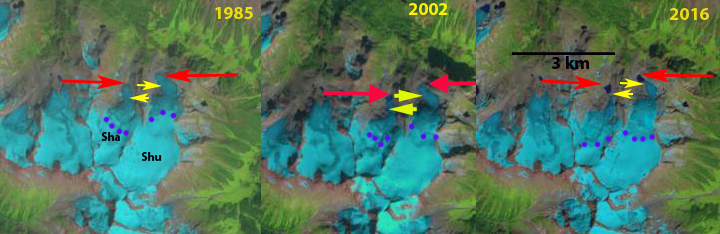
Red arrow is the 1985 terminus location and yellow arrow the 2016 terminus location.  Note the formatiion of new lakes at end of both glaciers. Purple dots is the transient snowline in August of each year.

Shatter and Shudder Glacier are at the eastern end of the Spearhead Range in Garibaldi Provincial Park, British Columbia. Osborn et al (2007) mapped the Little Ice Age extent of the glaciers compared to the 1990’s margins indicating a retreat of 300 m for Shatter Glacier and 700 m for Shudder Glacier (see below).  Koch et al (2009) identified the recession in area from 1928 to 1987 noting a 6% loss in Shatter Glacier and 22% loss for Shudder Glacier.  Koch et al (2009) identify an 18% loss in area from 1987-2005, indicating considerable recent change in the Park. Here we use Landsat imagery from 1985-2016 to update glacier change.

In 1985 there are no lake at the terminus of either Shatter or Shudder Glacier.  In 2002 a lake has formed at the terminus of Shudder Glacier, but not Shatter Glacier.  In 2016 both glaciers have proglacial lakes that have formed, and the terminus of both glaciers have retreated from the lakes.  This marks a retreat of 325 m on Shudder Glacier and 275 m on Shatter Glacier since 1985. Shudder Glacier retreated more rapidly in the first half of this period, while Shatter Glacier has experienced most of the retreat since 2005.

On Shatter and Shudder Glacier In 1987 the late August image indicates the snowline is at 2040 m, in mid-August 2015 the snowline is at 2250 m. In late August of 2014 the snowline was at 2120 m. In mid-August 2016 the snowline is at 2080 m. The higher snowlines are an indicator of mass loss for these glaciers that in turn drives retreat.  The region continues to experience significant loss in glacier area and development of many new alpine lakes with glacier retreat, five new lakes since 1987 just in this range with seven glaciers.  Spearhead and Decker Glacier are two other glaciers in the range that have developed new lakes since 1987. Nearby Helm Glacier is faring even worse.


shatter-tsl-compare

Landsat images from 1987, 2014 and 2015 indicating the transient snowline position at the purple dots on Shatter and Shudder Glacier.

spearhead-range-alpine-lakes-87-15

Pink Arrows indicate five new alpine lakes that have developed since 1987 as Spearhead Range glaciers have retreated

spearhead

Map of Spearhead Range glacier extent for LIA-Bold lines and 1987, light lines from Osborn et al (2007)

Canadian Columbia Basin Glacier Spring 2016 Field Season (winter 2015-2016 Assessment)

Guest Post by Ben Pelto, PhD Candidate, UNBC Geography, pelto@unbc.ca

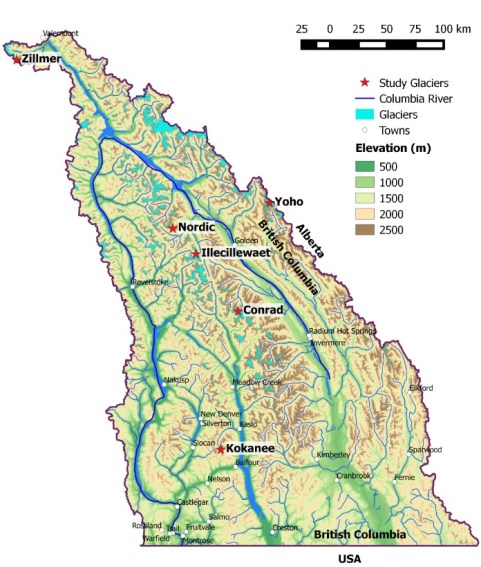
During the spring season we visited our four study glaciers (Figure 1), which form a transect of the Columbia Mountains from the Kokanee Glacier in the Selkirk Range to the south, to the Conrad (Purcells) and Nordic (Selkirks) in the center, to the Zillmer of the Premier Range in the north. This post will explore the snowpack of winter 2016 across the Columbia Basin of British Columbia. For a video of the work this spring see here.
1

Figure 1. Map of the Columbia watershed basin in Canada. Our four study glaciers are red stars, and other glaciers are teal, per the Randolph Glacier Inventory. Major rivers and lakes are blue.

Winter 2015-2016 Snowpack Summary: Early winter, September-December, 2015 brought a number of Pacific storms, in contrast to 2013 and 2014 which featured few storms and relatively dry conditions. By January 1st, snowpack across the province was near-normal, though a strong north-south gradient was observed, with above average snowpack in the south, average snowpack in central BC and well below average snowpack in the north (provincial snowpack was below normal Jan. 1st, 2015; BC River Forecast Centre). February was warm and wet, with daily temperatures 1 to 5˚C above normal. By the beginning of March, snowpack was below average over most of the province north of Prince George and Bella Coola and near or above average to the south.

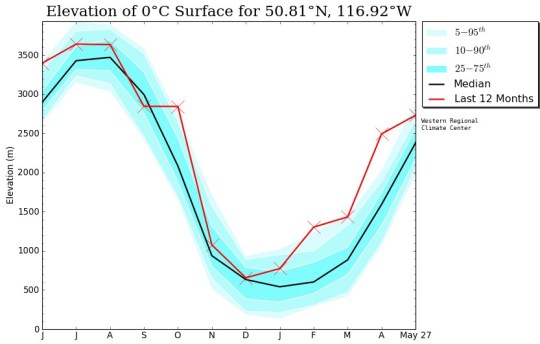
Snow continued to accumulate in March, but primarily at higher elevations due to above average freezing level heights. The height of freezing levels determines whether precipitation falls as snow or rain at a given elevation. Figure 2 shows that median freezing level height is 600 m above sea level for February at the Conrad Glacier, yet this February featured an average freezing level of 1300 m. This means that on average, in the month of February, snow fell above 1300 m and rain below 1300 m (of course this is an average and any one storm may be different).  Most glaciers in the Columbia Mountains are located above 2000 m elevation, and in the winter of 2014-2015, freezing levels were often near or above the height of many of the peaks in the Columbia Mountains (3000 m), allowing for rain on snow events. Such events were reportedly rare in 2015-2016 winter until April/May, despite the fact that freezing level heights were record high for December-April (Figure 3).
2

Figure 2. Estimated freezing level height (elevation of 0˚C) for the Conrad Glacier from June 2015-May 2016. Note that February-April 2016 were at or above the 95th percentile, meaning that there is less than a 5% chance that the freezing level heights will be that high given the data from 1948-2016 from which the median height is derived. Freezing levels are estimated from NCEP/NCAR Global Reanalysis data determined every six hours from 1948-present (North American Freezing Level Tracker).

3

Figure 3. Estimated mean freezing level height (elevation of 0˚C) for December-April from 1948-present for the Conrad Glacier (North American Freezing Level Tracker). Note that 2016 is the year of record. Freezing levels are estimated from NCEP/NCAR Global Reanalysis data determined every six hours from 1948-present.

Warm temperatures experienced in February continued through March and April across the province. By April 1st, provincial snowpack was near-normal at 91% of average (Figure 4). The north-south gradient in snowpack grew, with the southern half of the province at or above average, and the northern half below average. Typically, May 1st marks the peak of snow accumulation, and the melt season ensues. In 2015, the melt season began in mid-April, 1-3 weeks early. The 2016 melt season began earlier still, coming in late March/early April, 4-6 weeks early. Figure 5 shows that for the East Creek snow pillow near the Conrad Glacier, snowpack peaked in late March at around 120% of normal. Early maximum snow depth occurred due to a combination of dry, warm conditions. Typically, small precipitation events continue to add snow to alpine environments through April, and by swapping precipitation for dry, warm conditions, the snowpack began to decline in earnest in late March/early April.

4

Figure 4. British Columbia Snow Survey Map for April 1st, 2016 (BC River Forecast Centre). Note that snowpack is roughly average in the south and 50-75% of average to the north.

5

Figure 5. Automated snow pillow data showing snow water equivalent (SWE, amount of water obtained if all the snow were to be melted per unit area) for East Creek, near the Conrad Glacier at 2004 m elevation. Note that peak SWE was 4-6 weeks early, but was around 120% of normal at the time, followed by rapid melting (BC River Forecast Centre).

By May 15th, provincial snowpack was 39% of normal (Figure 6), a rapid decline from near average mid-winter snowpack. The north-south gradient also largely disappeared, though the three basins doing the best were the North and South Thompson, and the Upper Columbia at 70-86% of normal. Interestingly the Upper Columbia contains three of our four study glaciers. The May 15th provincial average of 39% is a new record low (measured since 1980, BC River Forecast Centre). May 15th snowpack is more typical of mid-June, indicating that snow melt is about four weeks ahead of normal. Most rivers are past the spring freshet, and discharge has begun to recede. The early freshet will put pressure on summer low flows across the province in snow-melt dominated rivers.

6

Figure 6. British Columbia Snow Survey Map for May 15th, 2016 (BC River Forecast Centre). Note that snowpack that was roughly average in the south as of April 1st is now well below average, and 50-75% of average to the north.

Field Work Overview—What we do: The primary goal of the spring field season is to determine how much snow fell over the winter on the four study glaciers. To do so, we take snow depth measurements using a heavy-duty avalanche probe. Snow depth is valuable information, but snow water equivalent (SWE; if you melted the snow in a given location, this would be the depth of water left behind per unit area) is the key to understanding how much water the snow contains. As you can imagine, a meter of powdery snow may contain only 10 cm of water, whereas a meter of wet snow may contain 30 cm of water. To measure density, we either take a snow core (think a tube of snow…like an ice core, except snow instead) and cut samples to weigh, or we dig a snow pit and then take samples from a wall in the snow pit. By combining measurements of density and depth, we are able to calculate SWE over the entire glacier. A typical end of winter SWE for a Columbia Basin glacier would be around 2 meters water equivalent, which would be roughly 4.5 meters of snow. By knowing how much snow covers the glacier, we know how much mass the glacier gained during the winter. At the end of the summer, we visit the glaciers again, and we measure how much melt occurred. By combining the winter accumulation of snow, and summer melt of snow and ice, we can determine how much the glacier gained or lost during the year. Figure 7 is an illustration of the product of depth and density measurements, and displays the relationship of elevation and accumulation over the Conrad Glacier. To see what we do watch: https://www.youtube.com/watch?v=wWYJdQnRq5k

8

Figure 7. Winter balance gradient for the Conrad Glacier in millimeters water equivalent per meter of elevation. Snow depth increases with elevation linearly, except in topographically complex areas, and nearest the top of the glacier (3200 m). Most of the glacier area is between 2000-3000 m.

We also are flying LiDAR surveys of our study glaciers. LiDAR is a laser sensor mounted on the bottom of an aircraft. The LiDAR unit essentially shoots rapid laser pulses, each pulse hits the surface and returns to the sensor. The time it takes for the signal to travel to the surface and back tells us the distance from the plane to the ground. With this data, we can make a detailed 3-D map of the glacier surface. This map is accurate to 10-25 cm in the vertical, and 50 cm laterally. By collecting this data biannually (spring and fall) we can determine how much snow fell, or melt occurred by subtracting subsequent 3-D maps from one another (e.g. by subtracting a September map from an April map of the same year, we can determine how much melt happened between the two flights). This data offers the ability to be able to cover far larger areas than is feasible for fieldwork.

By comparing our field data with the LiDAR data, we can determine whether the LiDAR is capturing the reality on the ground, and if the field data is able to represent spatial variability in snow depth. Our LiDAR flights occur over a day or two, whereas our field data are collected over a month. In order to directly compare both, we conduct a GPS survey of the glacier surface along the center of the glacier. We then compare the difference in elevation between the survey and the LiDAR and thus can account for any melt or accumulation that occurred in the intervening days or weeks.

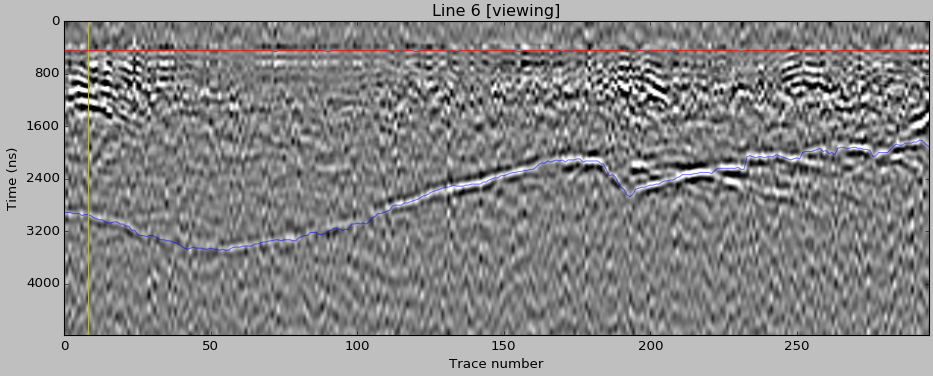
This spring we also collected data using a Ground Penetrating Radar (GPR) which transmits high-frequency radio waves into the ice. When the radio waves encounter a buried object or a boundary between materials, then it is reflected back to the surface where a receiving antenna records the signal. In our case, the bedrock surface below the ice is the surface/boundary we are looking for. Once we pick out the bedrock surface from the data, then the signal and travel time are used to then determine the ice thickness (Figure 8). Ice thickness is important for determining how long a glacier will survive as well as putting current rates of ice loss in perspective. We still have a lot of data to collect and process, but it seems that smaller glaciers like the Nordic and Zillmer (~5 km2) are 50-90 m thick in general, larger glaciers like the Conrad (16 km2) average 100-200 m thick.

7

Figure 8. Ground Penetrating Radar data from the Conrad Glacier. The blue line marks the bedrock surface and the red line marks the airwave, which defines the glacier surface. Between the lines is glacier ice. The longer the signal travel time, the deeper the ice. For this line, the deepest point is 220 m ice depth, and the shallowest 115 m.

Field Season Stats:

  • Snow Depth Measurements: 161 discrete locations, 600+ individual measurements
  • Snow Pits and Cores (Density): 15
    • The combination of snow depth and density allow for calculation of SWE
  • Ground Penetrating Radar (GPR) Distance (Ice thickness, Figure 3): Roughly 75 km
    • GPR data allows for the calculation of ice thickness and ice volume
  • Distance Skied: 200+ km
  • Field Team Members: 8; UNBC, CBT, UBC, ACMG.
  • Glaciers with both field and LiDAR data: 4/4
  • GPS Surveys (to corroborate field/LiDAR data comparison): 4
  • Days on a Glacier: 18

Season Summary: Our data indicate that winter mass balance featured a north-south trend, with the Kokanee Glacier in the south equaling last year’s mass balance, the central region was 85% of 2015 (Conrad and Nordic), and the Zillmer in the north was around 80%. The 4-6 week head start on melt season led to higher snow density in 2016 than observed in 2015. This summer melt season will determine whether the record/near record negative mass balance seen across the region in 2015 will be rivaled or exceeded in 2016. The hot, early spring has primed the region to again break records.

Cummins Glacier Fragmentation, British Columbia


cummins compare 2015Comparison of the Cummins Glacier from 1986 to 2015.  Purple arrows indicate upglacier thinning and disconnection. Red arrow indicates 1986 terminus position.  Note the lack of snowcover in 2015. 

The Cummins Glacier is part of the Clemenceau Icefield Group in the Rocky Mountains of British Columbia. The Cummins Glacier via the Cummins River feeds the 430 square kilometer Kinbasket Lake, on the Columbia River.  The lake is impounded by the 5,946 MW Mica Dam operated by BCHydro.  Jiskoot et al (2009) examined the behavior of Clemenceau Icefield and the neighboring Chaba Icefield. They found that from the mid 1980’s to 2001 the Clemenceau Icefield glaciers had lost 42 square kilometers, or 14% of their area.  Tennant and Menounos (2012) examined changes of the Rocky Mountain glaciers and found between 1919 and 2006 that glacier cover decreased by 590 square kilometers, 17 of 523 glaciers disappeared and 124 glaciers fragmented into multiple ice masses.  Here we examine the Landsat images from 1986-2015 to illustrate that Cummins is one of those fragmenting glaciers.

cummins map

Cummins Glacier on the western side of the Clemenceau Icefield shares a connection with Tusk Glacier.

In 1986 Cummins Glacier had a joint terminus with the main southeast flowing branch and the west flowing branch terminating at the red arrow.  The glacier also had a substantial connection, purple arrow,  with Tusk Glacier that flows east terminating northeast of Tusk Peak.  There are other connections with other high elevation accumulation areas, purple arrows.  In 2013 and 2014 Cummins Glacier had less than 20% retained snowcover by the end of the melt season.  Typically 50-65% of a glacier must be snowcovered at the end of the summer season to be in equilibrium.  In 2015 conditions were even worse with no retained snowcover, in fact there is only minor patches of retained firn from previous years.  The lack of a persistent accumulation zone indicates a glacier that cannot survive the climate conditions (Pelto, 2010).  By 2015 a proglacial lake had formed at the terminus that is 500 m long, representing the retreat during the thirty year period.  The west flowing portion of the Cummins has detached from the larger branch.  The connection to Tusk Glacier is nearly severed, and in terms of flow is effectively ended. Retreat of the margin higher on the glacier is also evident at each purple arrow. Tusk Glacier is no longer connected to Duplicate Glacier, and has retreated to the north side of Tusk Peak.  The dominant change in Cummins Glacier has been thinning, it should now be poised for a more rapid retreat.

The result for Kinbasket Lake of the loss of the collective large area is a reduction in summer glacier melt and summer glacier runoff. The annual runoff which will be dominated by annual precipitation would not change just because of the glacier loss as noted in cases like the Skykomish Basin (Pelto, 2011) and on Bridge River (Stahl et al 2008).

cummins 2013

2013 Landsat image indicating 20% retained snowcover with a month left in the melt season.

cummins 2014

Landsat image 2014 about 25% retained snowcover with three week left in the melt season.

apex-watershed

Google Earth Image of Cummins Glacier location to Kinbasket Lake.

Yoho Glacier, British Columbia Accumulation Zone Woes

yoho glacier melt

Yoho Glacier in 2005 no accumulation zone in sight.

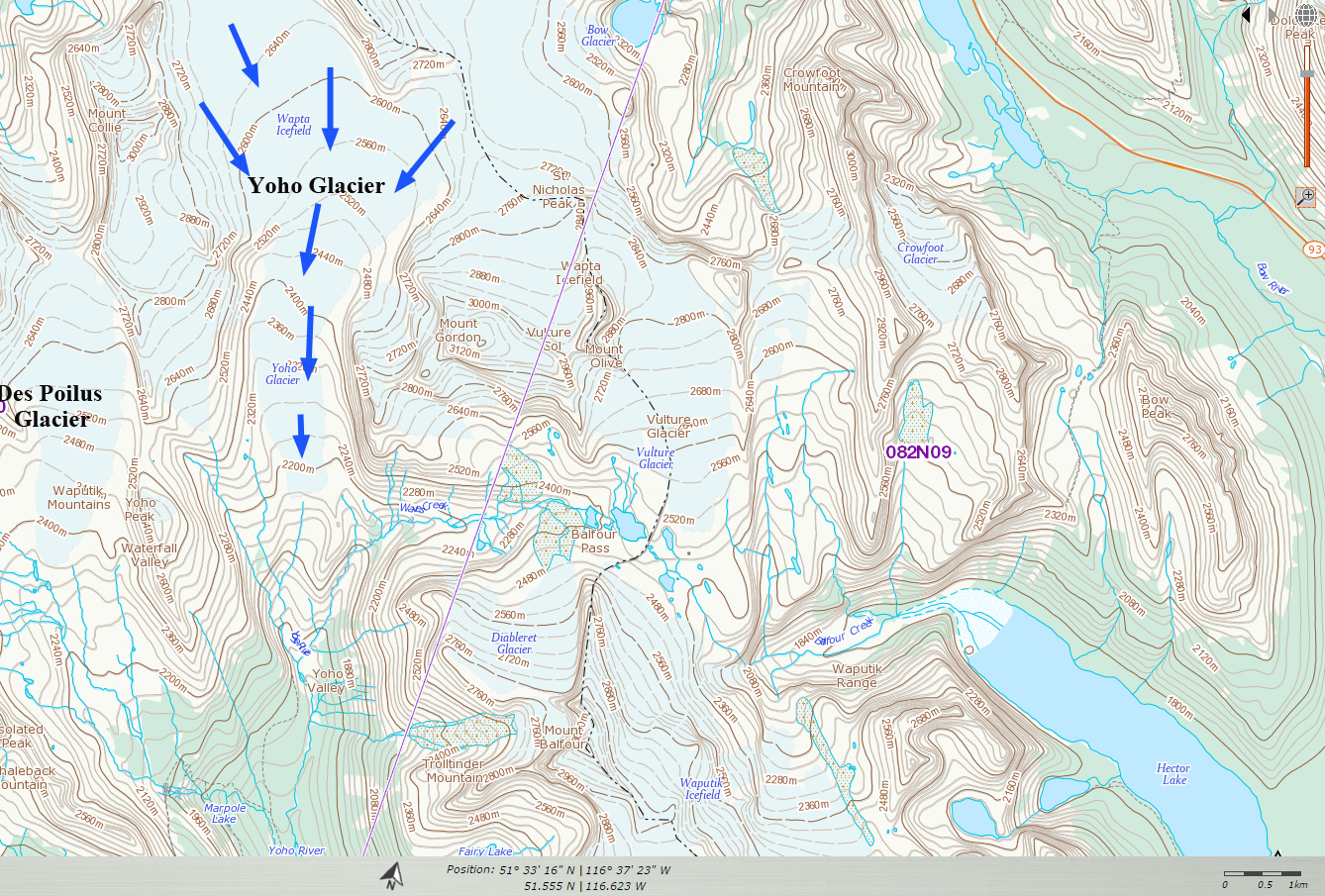
Yoho Glacier is the largest southern outflow draining the south from the Wapta Icefield in the Kootenay region of British Columbia. It flows 6.5 km from the 3125 m to a terminus at 2200 m. The glacier terminus reach is thin, gently sloping  and uncrevassed poised for continued retreat. An exploration of Mount Balfour in 1898 a party led by Professor Jean Habel with the packer Ralph Edwards as a guide were the first to visit and describe Yoho Glacier. There descriptions of the magnificent Takakkaw Falls down river of the glacier quickly led to it becoming a frequent destination of visitors. The glacier was also accessible. Retreat up a steep slope at 2000 m made actually visiting the glacier difficult in the middle of the 20th century.  The glacier has retreated 2.1 km in the last century leaving a vast area of bare terrain, dotted by several small new alpine lakes. Here we examine changes in the glacier from 1986 to 2015 with Landsat imagery.

yoho map final
CanadianTopographic map

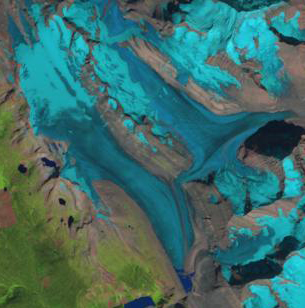
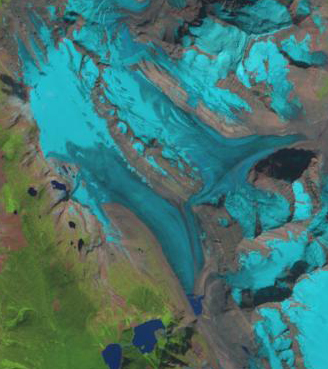
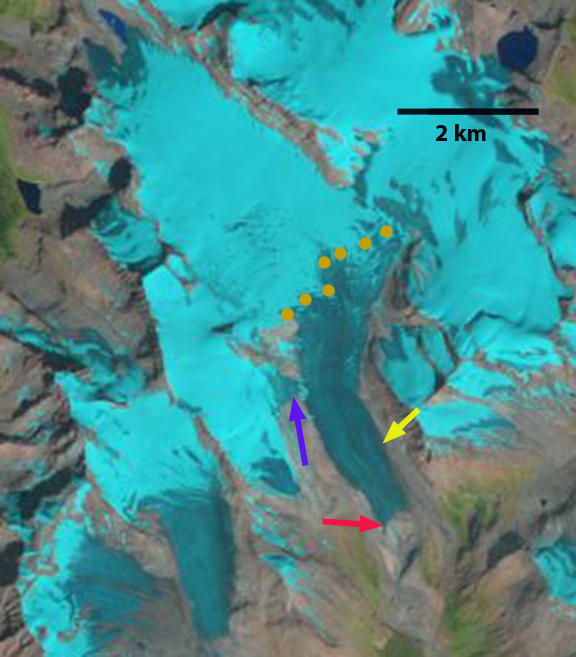
In 1986 the glacier terminated in a broad 500 m wide glacier terminus at 2150 m, red arrow, the glacier tongue remained wide up to the yellow arrow, 800 m. A tributary connected to the glacier at the purple arrow, and the glacier snowline, orange dots was at 2550 m. In 1998 the terminus had not retreated significantly, but had narrowed noticably. The tributary at the purple arrow was no longer connected and the snowline was at 2750 m, leaving little of the glacier snowcovered, which equates to a significant mass loss. In 2013 the snowline again was high at 2700 m. In 2015 the glacier terminus has retreated 300 m since 1986 and is only 250 m wide. The width at the yellow arrow is 450 m. The width reduction is an indicator of how much the glacier has thinned. The snowline is at 2800 m in this mid-August image, clinging only to the high slopes of Mount Collie, and would still rise for several more weeks in the summer. The nearby Peyto Glacier has an annual mass balance record indicating a thinning of 25 m during this period (Kerhl et al, 2014).  A glacier typically needs more than 50% of its area to be in the accumulation zone at the end of the summer to be in equilibrium.  In recent years when the snowline exceeds 2700 m less than 10% of the Yoho Glacier is in the accumulation zone. If the snowline is as high as it has been recently on Yoho Glacier, that indicates the lack of a significant accumulation zone and it cannot survive even current climate.  However, in both cases the Peyto and Yoho Glacier are rapidly losing volume, but remain substantial in size and are not on the verge of disappearing in the next few decades. The retreat is similar to that of Des Poilus Glacier shown in the lower left of the Landsat images here.

yoho glacier 1986
1986 Landsat Image

yoho glacier 1998
1998 Landsat Image

yoho glacier 2013
2013 Landsat image
yoho glacier 2015
2015 Landsat image