Cape Longing, Antarctica Transitioning to Island via Glacier Retreat

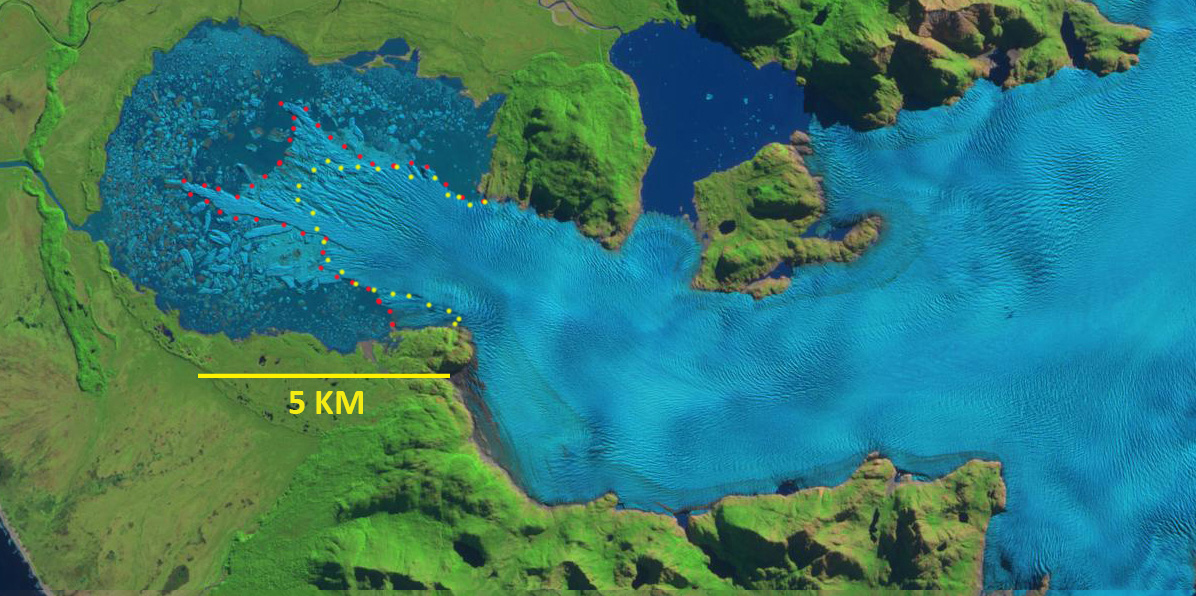
Cape Longing, Antarctica in 2001 and 2018 Landsat images. Point A-G are at specific locations. Yellow dots mark the margin of the glacier connecting the Cape to the main Antarctic Peninsula.

Cape Longing is on the Antarctic Peninsula between Larsen Inlet and Prince Gustav Channel.  Larsen Inlet along the south shore of Cape Longing was covered by the Larsen A Ice Shelf until its collapse in 1995. The Prince Gustav Ice Shelf extended across the channel from the north shore of Cape Longing until the 1980’s.  This 1600 square kilometer ice shelf disintegrated in the mid-1990’s and was gone by 1995 (Cook and Vaughan, 2010).   Here we examine changes in the glacier connecting Cape Longing to the Antarctic Peninsula from 2000 to 2018 using Landsat imagery.

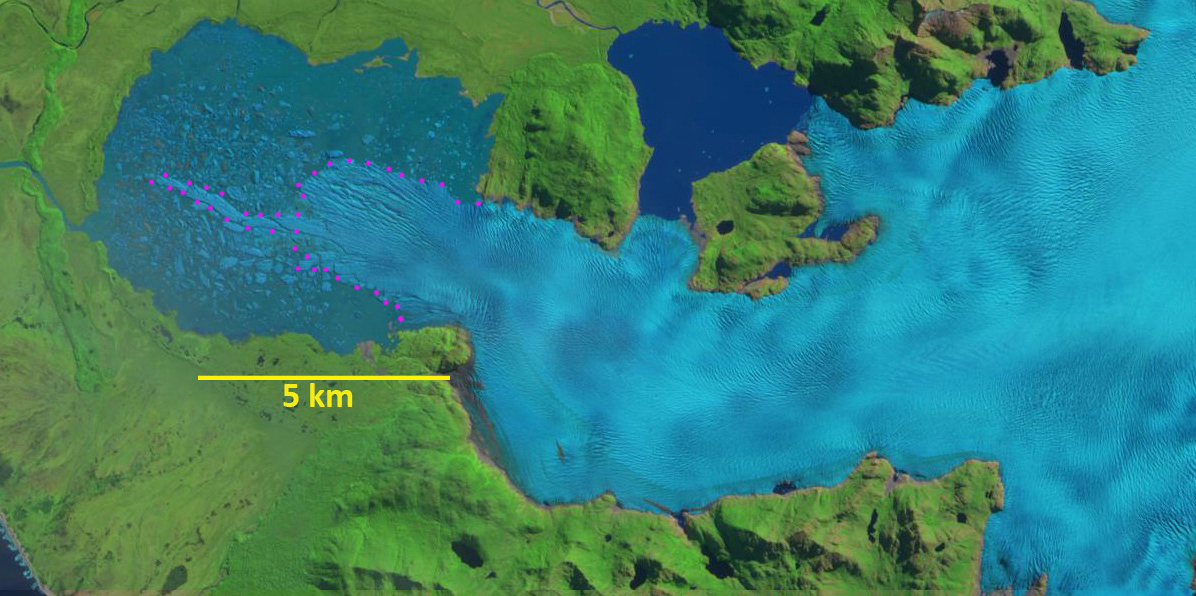
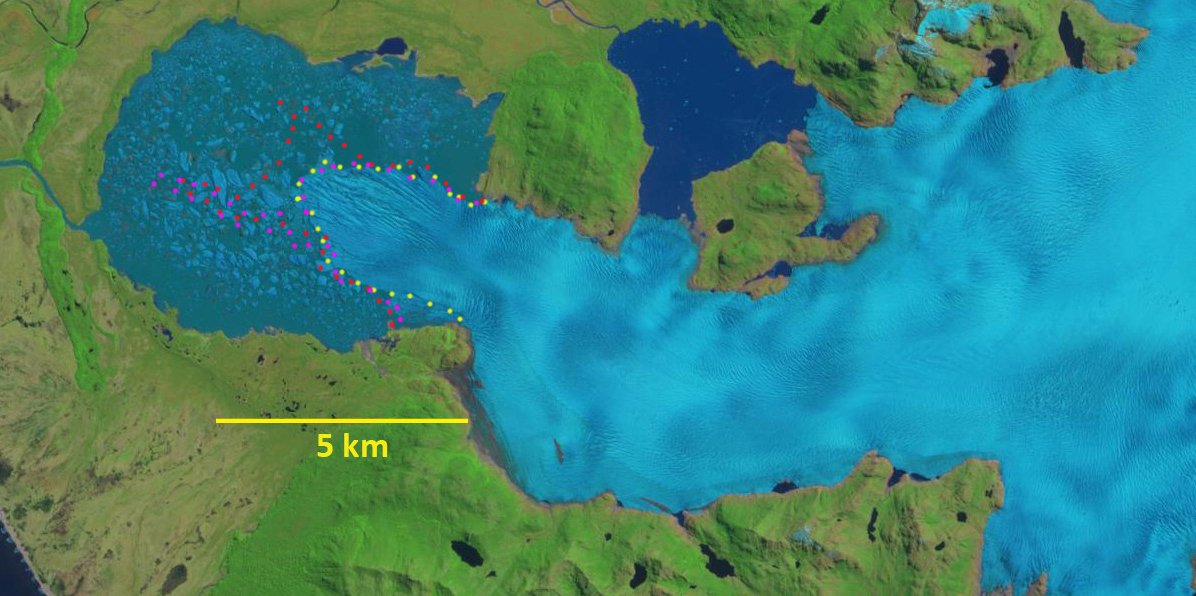
In 2000 the glacier connecting Cape Longing with the main peninsula extended along a front from Point F to Point E. Northeast of Point G there is an area of rifted ice indicative of ice that had been grounded going afloat. On the southern margin the ice front extends southwest from Point A.  The glacier from the northern to the southern margin is ~9 km across.  In 2001 the southern margin has not changed, but the northern margin indicates an expanded ice melange between the active glacier and the ice front, making the exact terminus difficult to pinpoint.  By 2017 the northern ice margin has retreated to a line between Point B and Point G.  The southern margin extends west from Point A.  In 2018 it is 3.5 km from the northern to southern margin, more than 60% of this glacier connection to Cape Longing has been lost since 2000.  This connection appears to have a below sea level bed though the glacier is grounded.  This grounding should lead to a slower retreat. The ice shelf/glacier retreat at Cape Longing is significant though much less than the more dynamic nearby Sjogren Glacier.

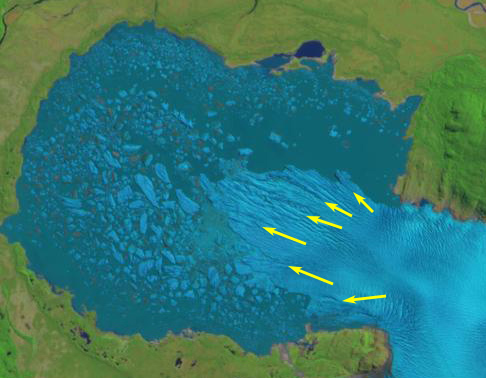
View of Cape Longing in REMA Antarctic Explorer, which is the 2000 Landsat image.

Cape Longing, Antarctica in 2000 and 2017 Landsat images. Point A-G are at specific locations. Yellow dots mark the margin of the glacier connecting the Cape to the main Antarctic Peninsula.


Drogpa Nagtsang Glacier, China Mass Balance Loss, Separation, Slow Down

Drogpa Nagtsang Glacier change in Landsat image from 1989 and 2018.  Yellow arrow indicates 2018 terminus location, red arrow 1989 terminus location, red dot the lowest elevation of clean glacier ice. Points A-E are the same locations for comparison.

Drogpa Nagtsang Glacier, China is a glacier that is 30 km west of Mount Everest that terminates in an expanding proglacial lake. The glacier begins on the Nepal border at 6400 m, and its meltwater enters the Tamakoshi River. The Upper Tamakoshi Hydropower project is a 456 MW peaking run of river  is a hydropower project on the Tamakoshi that is to be finished in 2019.  King et al (2017) observed the mass balance of 32 glaciers in the Mount Everest area including Drogpa Nagtsang and found a mean mass balance of all glaciers was −0.52 m water equivalent/year, increasing to -0.7 m/year for lake terminating glaciers. Dehecq et al (2018) in an exceptional paper examined velocity changes across High Mountain Asia from the 2000-2017 period identifying a widespread slow down in the region.  The key take away is the same we see for alpine glaciers around the globe, warming temperatures lead to mass balance losses, which leads to velocity slow down, Mass balance is the key driver in glacier response, a sustained negative mass balance leads to thinning, which leads to a glacier velocity declines whether the glacier is in the Himalaya, Alps or Andes. This study simply could not have been completed without the availability and affordability of Landsat imagery.  Here we look at one example in the region that highlights the important findings.

In 1989 Drogpa Nagtsang Glacier had a substantial number of coalescing supraglacial ponds on its relatively flat stagnant debris covered terminus.  At Point A the former tributary is are no longer contributing to the main glacier, while at B, C, D and E there is a still a contribution.  The snowline in 1989 is at ~5450 m.  The clean glacier ice extends almost to the tributary glacier at Point B at 5200 m, red dot. In 1992 the supraglacial ponds have further expanded, but a true proglacial lake has not formed. The snowline is at~5500 m. Quincey et al (2009) observed flow of less than 10 m/a in lower 5 km of glacier in 1996 and peaking at 20-30 m/a 8 km from terminus. By 2015 a 2.7 km long lake has developed.  The clean glacier ice now extends just past Point E at 5350 m.  The snowline is at 5600 m. The tributaries at Point B, C and E no longer reach the main glacier.  At Point D the medial moraines indicate that flow from this tributary has been reduced and now is a smaller contributor to the valley tongue. In 2018 the clean glacier ice extends to just 5400 m.  The lake has expanded to a length of 2.9 km indicating a retreat of the same distance from 1989-2018.  The snowline is exceptionally high at 5700 m. The former tributaries at B, C and E have also markedly retreated away from the main glacier. Only the tributary at Point D is still contributing to the main glacier. The high snowline observed in recent years are an indication that mass balance losses are even larger in this region, which causes further thinning, reduction in velocity, retreat and expansion of debris cover.  King et al (2018) observed the thinning and velocity profile on Drogpa Nagtsang and noted the velocity decreased over time and was stagnant in the debris covered zone, thinning occurred along the entire profile, which began close to the ELA. The stagnant nature of the terminus tongue is evident in the Digital Globe image below from 2017.  The red arrows show a deeply incised supraglacial stream that is over 2 km long, that would only develop on stagnant ice.  This process has played out on other nearby glaciers such as Yanong Glacier  and Lumding Glacier.  The high snowlines have also been observed at the nearby Nup La on Ngozumpa Glacier in recent years and on many glaciers in the Mount Everest region in recent winters such as in 2018.  This indicates continuing mass losses through a greater period of the year.

Drogpa Nagtsang Glacier change in Landsat image from 1992 and 2015.  Yellow arrow indicates 2018 terminus location, red arrow 1989 terminus location, red dot the lowest elevation of clean glacier ice. Points A-E are the same locations for comparison.

Digital Globe image with yellow dots indicating terminus, red arrows a supraglacial stream, blue arrows ice flow direction.  B is the same tributary has noted in the Landsat images above.

Muller Ice Shelf, Antarctica 2018 Calving Event

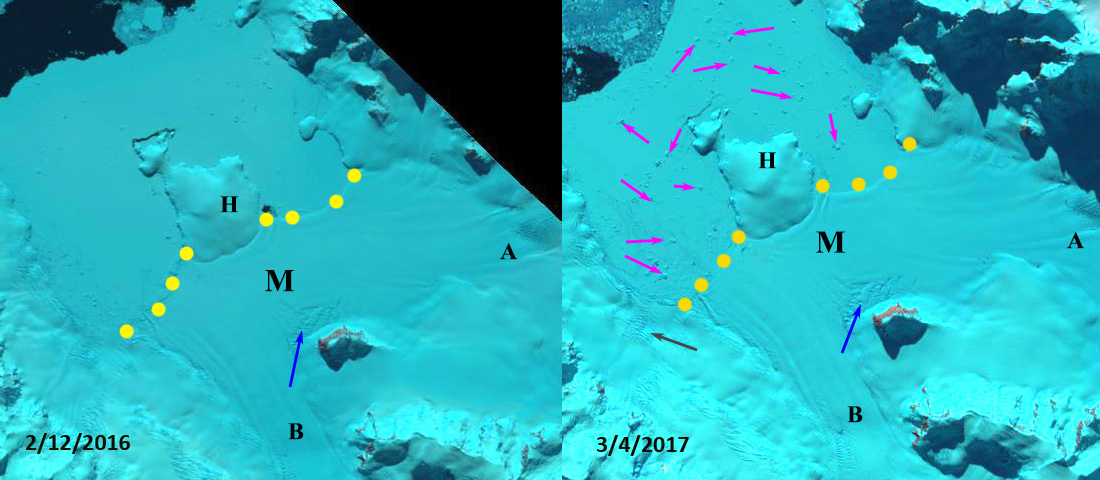
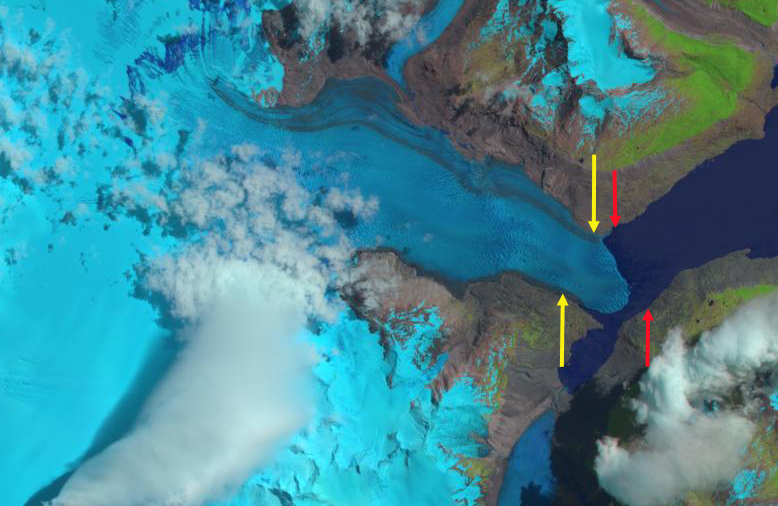
Comparison of the ice front-yellow dots, icebergs-pink arrow and rifting-blue arrow in March 2018 and November 2018 Landsat images. A=Antevs Glacier, B=Bruckner Glacier, H=Humphreys Island and M=Muller Ice Shelf. New iceberg is at the lowest pink arrow adjacent to western calving front.

Muller Ice Shelf is on the west side of the Antarctic Peninsula and  is one of the smallest remaining ice shelves covering 40 km2 in 2007. It is the northernmost ice shelf on the western side of the Peninsula and is fed by Bruckner Glacier (B) and Antevs Glacier (A), and is pinned on Humphreys Island (H). The glacier advanced from 1947 to 1956 with subsequent retreat until  another advance period from 1974-1986 when the ice front advance led to a 4 square kilometer expansion (Cook and Vaughan, 2010).  Retreat has since ensued Domack et al. (1995) suggested that warm CDW that is currently within the fjord may be contributing to the rapid bottom melting and retreat of the ice-shelf  in recent years.    From 1989 to  2017 the western margin has retreated 2.5 km and the eastern margin 1.5 km (Pelto, 2017). Here we use Landsat imagery to identify changes from 2016 to 2018, focussing in particular on a large 2018 calving event. I noticed the iceberg first in the Antarctica REMA Explorer.  This is a wonderful viewer for exploring the region. REMA is a Reference Elevation Model of Antarctica that is time stamped and has an 8 m spatial resolution.

In 2016 the both the eastern and western margin are near the southern end of Humphreys Island, which acts as a pinning point, but this connection is becoming tenuous.  Of equal importance is the development of an area of substantial rifting north of the bluff on the southern margin of the ice shelf between Antevs and Bruckner Glacier at the blue arrow.  In 2017 the rifting has further expanded, the ice melange now covering an area of ~1 square kilometer.   The retreat due to calving is ongoing as indicated by the number of new icebergs in the Feb. 2017 image, pink arrows.  In March of 2018 there is one substantial new iceberg several kilometers beyond the western terminus. There is not a significant rift across the western calving front. By Nov. 9, 2018 an iceberg that spans 80% of the western calving front of Muller Ice Shelf has been released.  The sea ice is still keeping the iceberg in place adjacent to the calving front.  The iceberg is  1.6 km long and 0.4 km wide. This is small by Antarctic standards, but large for the Muller Ice Shelf. The decreased connection to Humphreys Island and the expanding rift area indicates that the Muller Ice Shelf is poised for disintegration like what occurred on nearby Jones Ice Shelf and what is poised to occur on Verdi Ice Shelf.

Antarctica DEM explorer view of the new Iceberg from the 11/9/2018 Landsat imagery.

Comparison of the ice front-yellow dots, icebergs-pink arrow and rifting-blue arrow in 2016 and 2017 Landsat images. A=Antevs Glacier, B=Bruckner Glacier, H=Humphreys Island and M=Muller Ice Shelf.

Chaba Glacier, Alberta Retreat and Icefall Separation

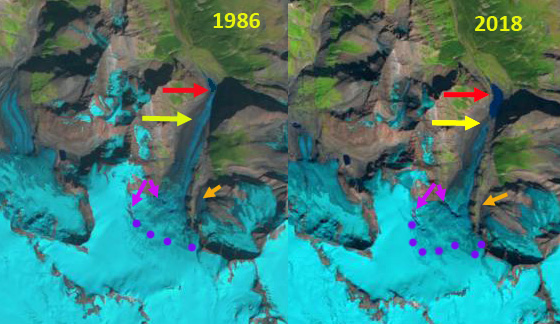
Chaba Glacier in 1986 and 2018 Landsat images.  Red arrow is 1986 terminus location, yellow arrow 2018 terminus location, pink arrows bedrock steps in icefall area, orange arrow, adjacent glacier and purple dots the snowline.

Chaba Glacier is a valley glacier descending from the Chaba-Clemenceau Icefield ending in the headwaters regions of the Athabasca River in Alberta.  Jiskoot et al (2009) examined the behavior of the Clemenceau Chaba Icefield and found that from the mid 1980’s to 2001 the Clemenceau Icefield glaciers had lost 42 square kilometers, or 14% of their area. During this same period terminus retreat averaged 21 meters per year on the glaciers. A short distance to the southeast is the better known Columbia Icefield. Tennant and Menounos (2013) examined changes in the Columbia Icefield 1919-2009 and found a mean retreat of 1150 m and mean thinning of 49 m for glaciers of the icefield, with the fastest rate of loss from  2000-2009. Here we examine the changes of Chaba Glacier from 1986-2018 using Landsat images.
Chaba Glacier has a substantial accumulation zone above 2600 m in the upper basin, the glacier then flows down an icefall from 2600 m to 2000m where it levels off in a lower slope valley tongue. In 1986 Chaba Glacier terminated in a 200 m wide proglacial lake at 1600 m, red arrow. The valley tongue below the icefall was 3.5 km long.  The icefall featured one exposure of rock at the pink arrow on the right. The snowline in 1986 is at ~2500 m.  The orange arrow indicates a separate glacier that flows down an icefall into the valley below and almost connects with Chaba Glacier.  In 1988 the snowline is lower at ~2450 m the proglacial lake.  In 1998 the glacier has retreated 200 m, leading to lake expansion. The snowline is at ~2550 m and only the upper bedrock rib is evident in the icefall, pink arrow. By 2016 the proglacial lake has doubled in size. The adjacent glacier that had terminated at the orange arrow, no longer descends below the icefall into the valley.  The lower bedrock rib in the icefall is now evident, right pink arrow.  The snowline is above ~2600 m, with a month left in the melt season. JuSt across the divide in the Columbia River Basin, measurements by  Ben Pelto of UNBC, indicated negative mass balance from 2014-2018 on glaciers in the northern portion of the basin closer to Chaba Glacier. In 2018 the proglacial lake is 900 m across and the glacier no longer terminates in the lake.  This Aug. 20 2018 image indicates the snowline is at ~2650 m.  The developing step in the icefall, right pink arrow at 2200 m, indicates a lack of strong flow through the icefall to the valley tongue, this will accelerate downwasting of the valley tongue. Retreat from 1986-2018 is ~900 m.  The valley tongue has narrowed at its 1986 halfway point, from the icefall to the terminus, from 700 m to 400 m. Chaba Glacier has experienced similar retreat to the adjacent Apex Glacier that experienced a retreat of 800 m from 1986-2010.  Cummins Glacier retreated 500 m  from 1986-2015, but also fragmented from adjacent glaciers.  A short distance southeast, Columbia Glacier an outlet of Columbia Icefield retreated 3000 m from 1986-2015> the rapid rate of retreat is more than three times as fast relative to the Chaba, due to mass loss through ice calving in the large proglacial lake at the terminus.

Chaba Glacier in 1998 and 2016 Landsat images.  Red arrow is 1986 terminus location, yellow arrow 2018 terminus location, pink arrows bedrock steps in icefall area, orange arrow, adjacent glacier and purple dots the snowline.

Canadian Topographic map of  the Chaba Glacier area, the accumulation zone=A, icefall=I and valley tongue=V, with flow arrows.  The map is from ~1990.

Erasmo Glacier, Chile Terminus Collapse and Aquaculture

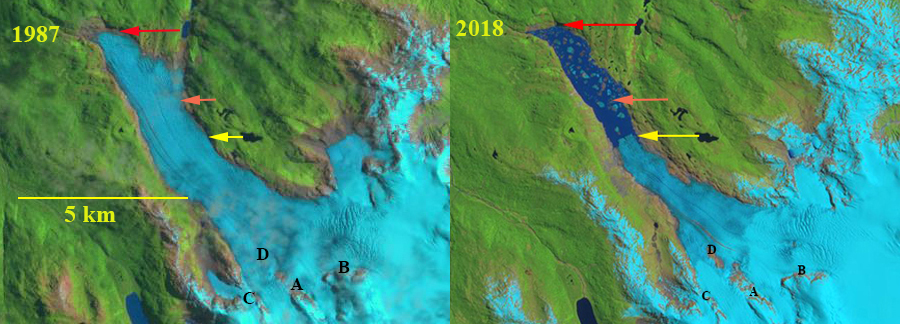
Erasmo Glacier retreat in Landsat image from 1987 and Sentinel image from 2018. Red arrow is 1987 terminus, orange arrow 2016 terminus and yellow arrow 2018 terminus. Points A-D mark areas of expanding bedrock exposure.

Cerro Erasmo at 46 degrees South latitude is a short distance north of the Northern Patagonia Icefield and is host to a number of glaciers the largest of which flows northwest from the mountain. This is referred to as Erasmo Glacier with an area of ~40 square kilometers.   Meltwater from this glacier enters Cupquelan Fjord, which is host to a large aquaculture project for Atlantic salmon, producing ~18,000 tons annually. This remote location allows Cooke Aquaculture to protect its farm from environmental contamination. Runoff from Erasmo Glacier is a key input to the fjord, while Rio Exploradores large inflow near the fjord mouth limits inflow from the south.  Davies and Glasser (2012) mapped the area of these glaciers and noted a 7% decline in glacier area from 1986-2011 of Cerro Erasmo. The recent retreat of the largest glacier in the Cerro Erasmo massif indicates this area retreat rate has increased since 2011. Meier et al (2018) note a 48% reduction in glacier area in the Cerro Erasmo and Cerro Hudson region, since 1870 with half of that occurring since 1986.

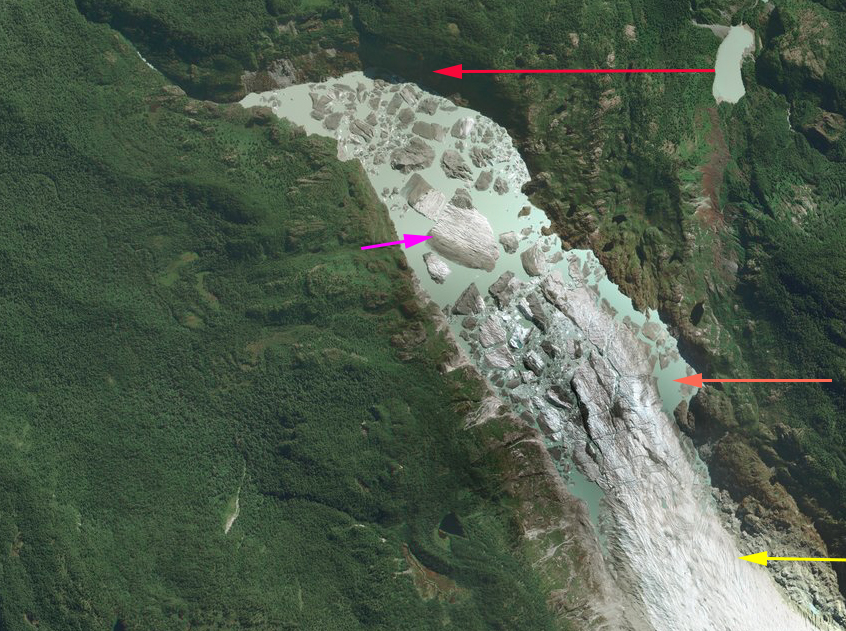
In 1987 Erasmo Glacier had a land based terminus at the end of a 6 km long low sloped valley tongue.  The snowline was at 1100 m.  In 1998 there is thinning, but limited retreat and the snowline is at 1250 m.  By 2013 a proglacial lake had formed and there are numerous icebergs visible in the lake, note Digital Globe image below.  The snowline is at 1200-1250 m in 2013 at the top of the main icefall. By 2016 a large lake had formed and the snowline is at 1200 m again at the top of the icefall.  By 2016 the terminus has retreated 2.9 km since 1987 generating a lake of the same length. The snowline in 2016 was at 1200 m at the top of the icefall  From 2016 to 2018 a further 0.9 km retreat occurred.  The 3.8 km retreat from 1998 to 2018 is a rate of ~200 m/year.  Thinning upglacier to the expanding ridge from Point A-D is evident. Thinning at Point C has eliminated the overflow into the distributary glacier that had existed. The collapse is ongoing as indicated by the number of icebergs in the lake in 2018.  there is an increased glacier surface slope 1 km behind the 2018 glacier front, suggesting the lake will not extend passed this point. The retreat is consistent with retreat documented at Reichert GlacierHornopirén Glacier and Cordillera Lago General Carrera Glacier. The impact on inflow to Cupquelan Fjord due to glacier retreat will be increased stream runoff during the wet winter season and reduced flow during the drier summer period December-February.  The summer season is still relatively wet.

Breakup of Erasmo Glacier terminus in Digital Globe image from 2013. Purple arrow indicates largest iceberg.

Erasmo Glacier retreat in Landsat image from 1998 and 2016. Red arrow is 1987 terminus, orange arrow 2016 terminus and yellow arrow 2018 terminus. 

Videla Glacier Retreat, Tierra del Fuego, Chile Generates New and Expanding Lakes

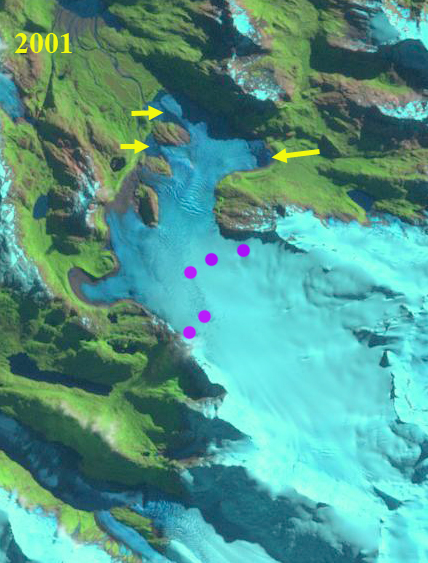
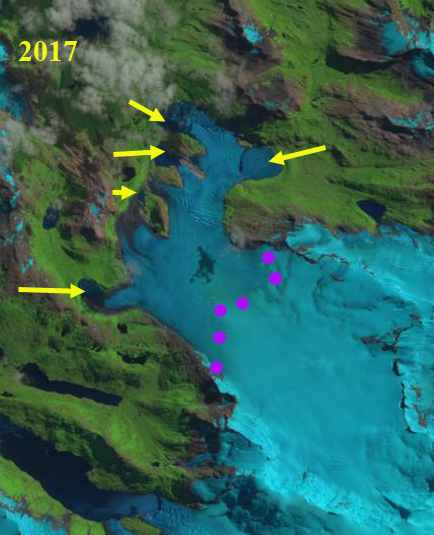
Videla Glacier, Chile in 1997 and 2018 Landsat images. Red dots mark the 1997 terminus locations, yellow dots the 2018 terminus position and purple dots the snowline. 

Videla Glacier is a land terminating glacier in the northwest portion of the Cordillera Darwin Icefield (CDI). The glacier has terminates in several expanding proglacial lakes each in front of a different tongue of the glacier. The glacier flows northwest from Cerro Ambience towards Fiordo Profundo.  Meier et al (2018) identified area change of Patagonia glaciers from 1870-2016 with a ~16% area loss of CDI, with more than half of the loss occurring since 1985. They also noted that CDI glaciers were retreating fastest between 1986 and 2005; afterwards the rate of retreat has decreased. The retreat has been largest on tidewater glaciers such as Marinelli Glacier and Ventisquero Grande Glacier.

In 1997 of Videla Glacier’s six main terminus lobes, five did not exhibit a proglacial lake, only the two northern most lobes ended in a proglacial lake.  The northwestern lobe terminates in a 800 m long calving front, the northeastern lobe in the same basin exhibits a small fringing proglacial lake on its northern margin. The snowline in 1997 is at 600 m.  In 2001 the proglacial lake has expanded at both the northwestern and northeastern lobe.  A second proglacial lake has developed at the next most northern lobe.  The snowline in 2001 is at 550 m.  By 2017 Videla Glacier terminates in five expanding proglacial lakes and the snowline is the highest observed at 650 m. In December 2018 the terminus change from 1997 is evident at each lobe.  The main terminus is the northernmost that has both a northwestern and northeastern terminus.  In a Digital Globe image below the green arrows indicate areas where the terminus is rifted indicating partial flotation.  By 2018 the rifted terminus tongue of the northwestern lobe has been lost.  This image also reveals at the orange arrows newly exposed bedrock. The retreat has been 1.1 km for the northeastern lobe, 1.2 km for the northwestern lobe, 0.9 km for the next lobe to the south, and 0.7 km for the southern lobe. The initiation of significant retreat from the Little Ice Age maximum which led to moraine development impounding the most northern and southern proglacial lakes, was slow in this area. There has been more retreat since 1997 than since 1870.

Videla Glacier in 2001 Landsat image indicating proglacial lakes and the snowline.

Videla Glacier in 2017 Landsat image indicating proglacial lakes and the snowline.


Videla Glacier in a Digital Globe image indicating upglacier limit of weak rifted areas of the northeastern and northwestern lobe, green arrows.  Orange arrows indicate newly exposed bedrock.


Gandbreen Retreat and Lake Expansion, Svalbard

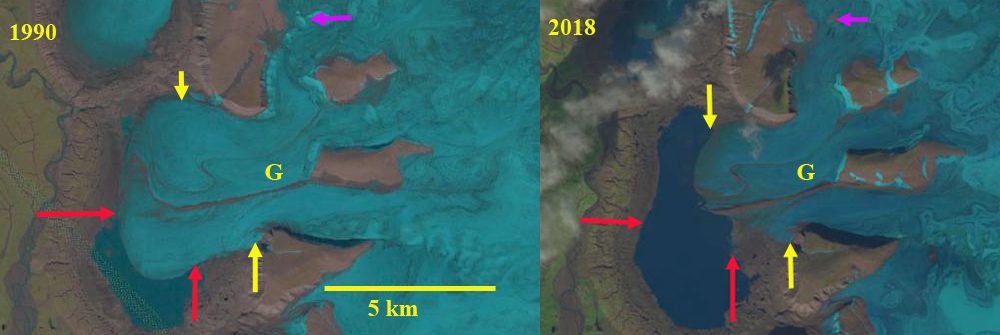
Gandbreen in 1990 and 2018 Landsat images.  The red arrow indicates 1990 terminus location, yellow arrows the 2018 terminus location, and purple arrow a location where bedrock emerges. 

Gandbreen is a western outlet of the Edgeøya Ice Cap, Svalbard.  This is a surging glacier, that has not had an observed surge.  Deltabreen a larger adjacent glacier to the south has no observed either.  Strozzi et al (2017) noted that the western outlet of Edgeøya Ice Cap, Stonebreen had slowly retreating glacier front from 1971 until 2011, followed by a large increase in  velocity since 2012.  This is less of a true surge and potentially a change in frontal dynamics.  Glaciers in Svalbard have experienced significant retreat and volume loss, including surging glaciers. Edgeøya Ice Cap has lost 18% of its area from 1936-2006 (Nuth et al 2013).  ( Möller and Kohler (2018) identified this region as having had an increasing and significant mass loss from 1900-2010 driven largely by ablation increases. Here we examine the glacier changes from 1990-2018 using Landsat images.

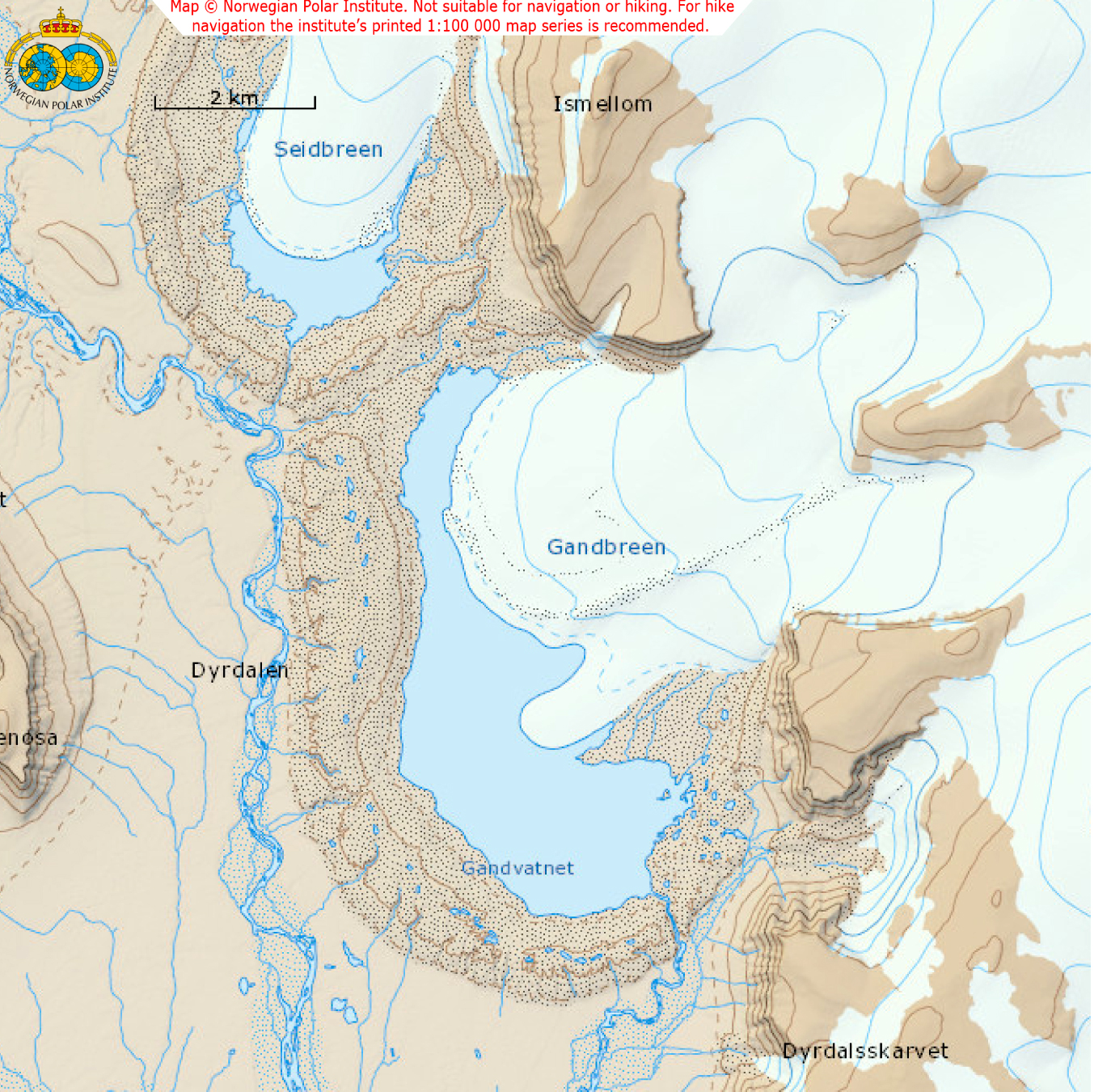
In 1990 Gandbreen’s southern margin terminated in the Gandvatnet proglacial lake, while the northern margin was grounded.  The area of the lake was 3.7 square kilometer and the length of the glacier front in contact with the glacier was 3.4 km. There is not a substantial area of retained snowpack on the ice cap in 1990.  By 2002 the entire margin of the glacier had retreated into the lake and the glacier front in the lake was now 7 km long.  The northern half of the lake was narrow at 100-400 m wide.  By 2016 further retreat and reduced the glacier front in the lake to ~5 km.  A new area of bedrock had appeared, pink arrow, had appeared at an elevation of  300 m, the ice cap divide is at 400-450 m. By 2018 the southern margin of the glacier is grounded on the eastern shore of the lake.  Gandvatnet has expanded to an area of 10.7 square kilometers and the margin of the glacier in the lake is 4.5 km. The terminus has retreated 1800 m on the southern margin, 1250 m in the center, and 2400 m on the north margin.  There is not a substantial area of retained snowpack on the ice cap in 1990, indicating that expanded ablation has driven the retreat.  The retreat of Gandbreen is less significant than at Besselbreen.  Fridtjovbreen has potentially surged for the last time, has Gandbreen?

Gandbreen in 2002 Landsat image.  The red arrow indicates 1990 terminus location and yellow arrows the 2018 terminus location. 

Toposvalbard map of Gandbreen

Gandbreen in 2016 Landsat image.  The red arrow indicates 1990 terminus location, yellow arrows the 2018 terminus location, and purple arrow a location where bedrock emerges. 

AGU Poster Hall-Cryosphere Perspectives

The American Geophysical Union Fall meeting’s Cryosphere section continues to grow as seen in the Poster hall.  The poster hall is where most of the research is presented and is dominated by student work.  Here are some examples of this work.

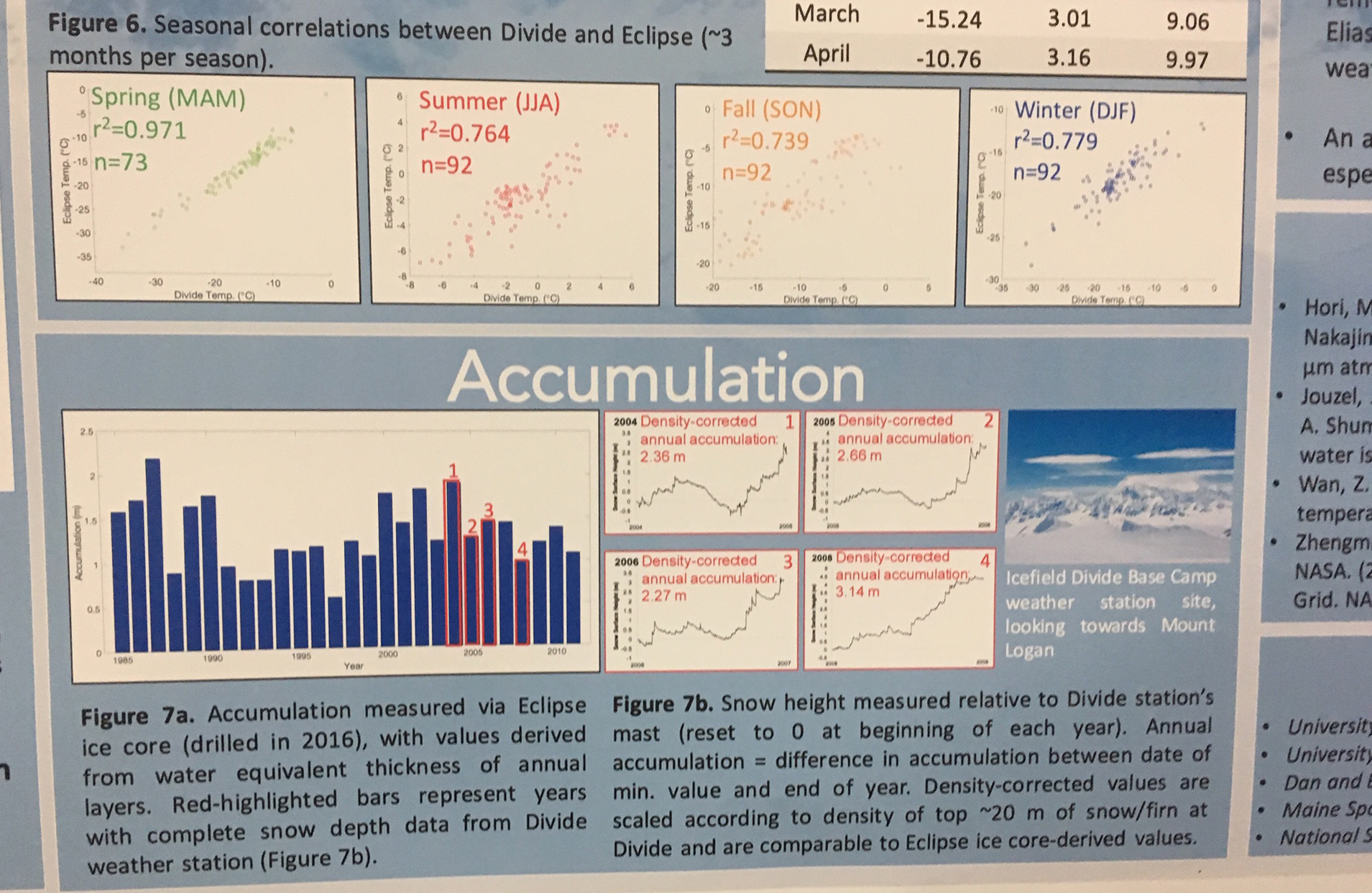
Erin McConnell, UMaine and others examined shallow ice cores from glaciers in the St. Elias Mountains of Canada’s Yukon as part of a project to reconstruct past climate variability using ice cores. The study quantified the relationships between meteorological data and ice core records in the St. Elias. The focus was on Icefield Divide, 2,900 m and Eclipse Icefield, 3,017 m. In June 2018 they extracted two ice cores (10 m and 20 m) from Divide. at Eclipse. In addition they did a 400 MHz radar transect at Divide which showed a strong reflectance at ~30 m depth, that likely indicates a firn aquifer, that develops from meltwater percolation and causes the isotope signal to deteriorate below the 2017/2018 snowpack (~6 m depth).  GPR data from Eclipse Icefield shows no evidence of an aquifer, suggesting the process in the St. Elias may occur only below ~3,000 m elevation.  The results pictured contrast annual accumulation at the two sites.

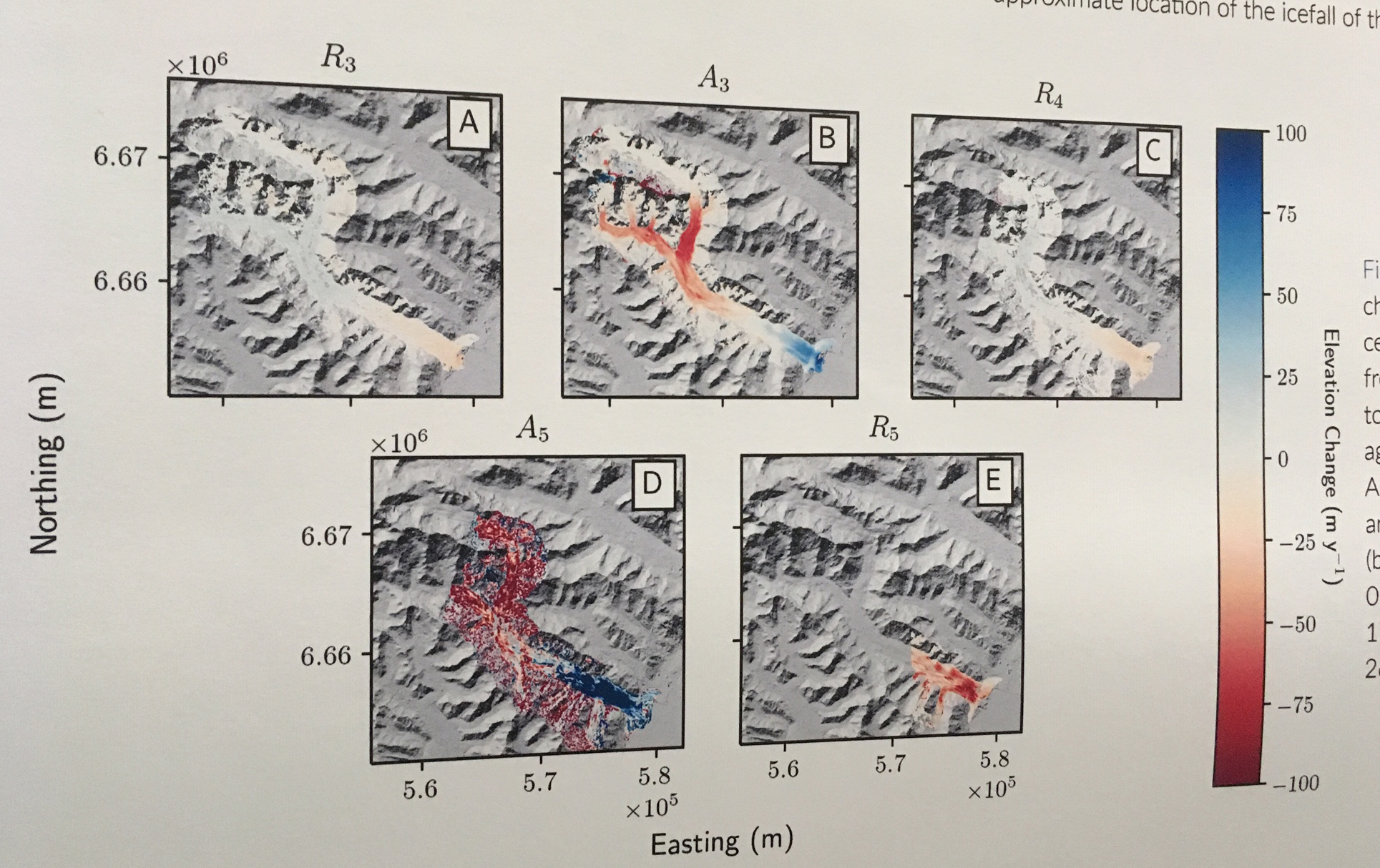
Andrew Nolan and others, from UMaine examined the surging Turner Glacier. Surge glaciers exhibit a short active phase of rapid ice velocity followed by a longer quiescent phase of slower flow.  Turner Glacier  is in the St. Elias Mountains, Alaska adjacent to Hubbard Glacier. Using a Landsat archive for the 1984 to 2017 period they found five previously unexamined surge events. Surge events occurred in 1985-1986, 1991-1993, 1999-2002, 2006-2008, and 2011-2013. This indicates a ~5-year surge repeat interval.  They used ASTER digital elevation models from the 2006-2007 and 2011-2013 to show mass build up in the reservoir zone which initiates the surge, prior to the surge. The surge then redistributes the mass to the terminus zone. The reservoir zone surface elevation increased 50 meters preceding the 2005-2008 surge event and then subsided 100 meters and the terminus zone rose 75 meters. The image below indicates thinning in red upglacier and thickenning in blue downglacier.

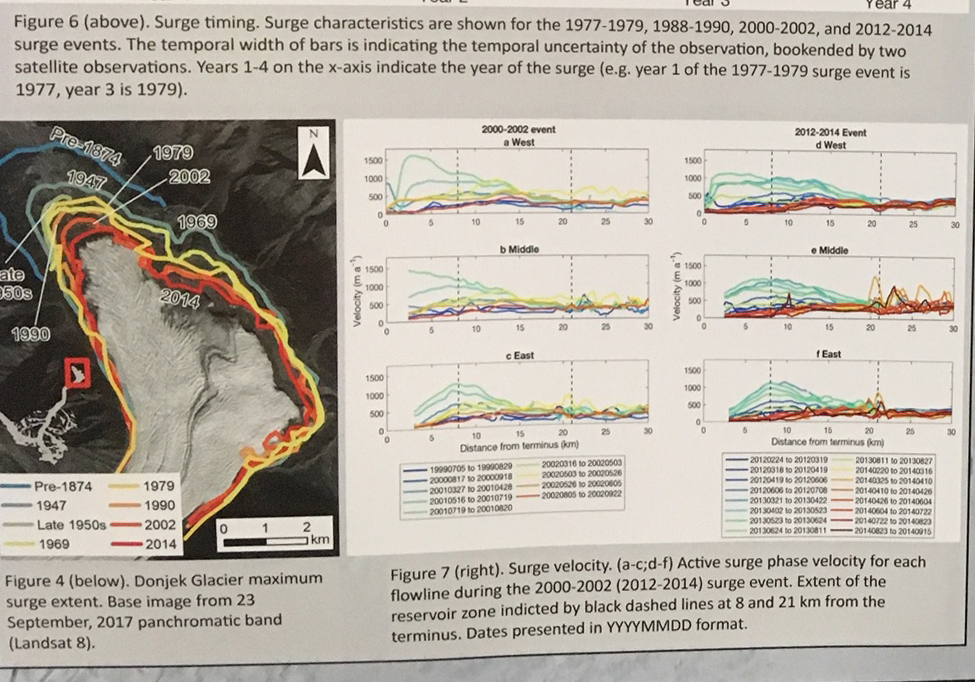
Wiiliam Kochtitzky, UMaine and others examined Donjek Glacier  a surging glacier in the St. Elias range, Yukon. They examined velocity and ice elevation changes since 2000 on this 65 km long glacier to understand the beginning and end of surges. The glacier has surged eight times since 1935 with a 12 year repeat rate.  The glacier has had a negative mass balance and has retreated 2.5 km since ~1874. Each successive surge of Donjek Glacier has featured a more limited advance than the previous. This akin to waves on a falling tide.  To map ice motion before, during, and after the 2001 and 2013 surge events they used  Landsat scenes to measure monthly ice velocity.  During these events they observed maximum uplift of ~75 m in the terminus (receiving) zone and maximum subsidence of ~65 m in the reservoir zone, 8-21 km above the terminus. The most negative mass balance occurred in the lower 32 km of the glacier after the 2013 surge, with Donjek losing an average of -6.65 m year. The upper 40 km of the glacier is not involved in the surge.  This glacier has important implications for larger ice masses, such as ice streams, that could have strong negative mass balances even if they surge and/or are land terminating superimposed on the surge cycle.

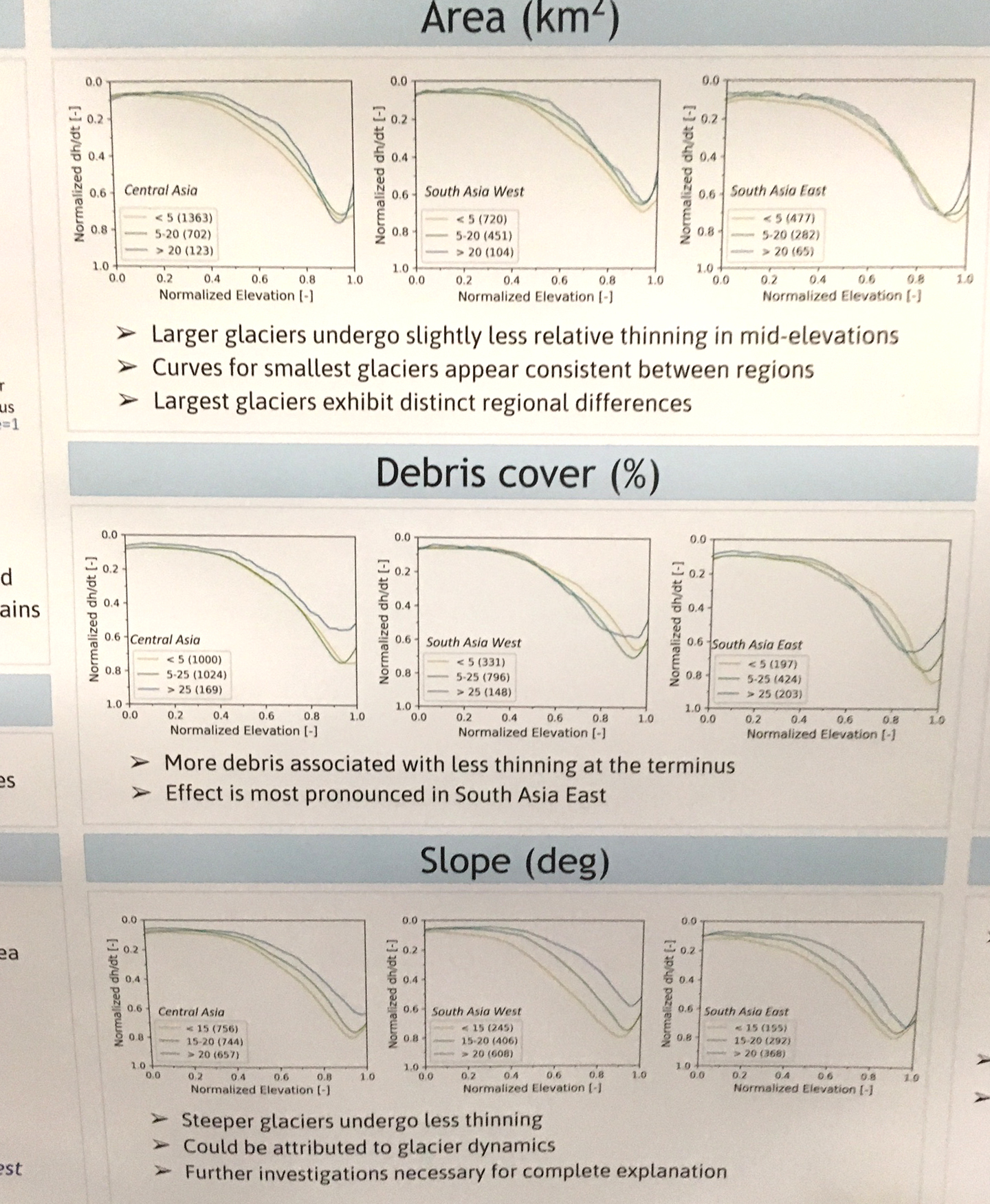
Pacifica Askitrea Takata-Glushkoff of University of Alaska Fairbanks and others examined the glacier dynamics of High Mountain Asia (HMA) glaciers.  She used a glacier evolution model to account for geometry changes from surface mass-balance feedback.  Previously used scaling methods are simpler than flow models, but they do not account for glacier thinning. Glaciers typically show most thinning at lower elevations and least thinning at higher elevations, with various factors influencing these relative thinning patterns. She investigated glacier thinning variability with elevation, in order to account for retreat . Using geodetic data from 170 glaciers in the High Mountain Asia region, they determined for each glacier how normalized changes in ice thickness vary with elevation. They investigated whether those normalized curves are impacted by factors such as glacier area, slope, aspect, debris cover, length, and glacier terminus elevation. Results indicate that shallow slopes and less debris cover are both associated with more relative glacier thinning toward the glacier terminus.

Andrew Hengst and others from Appalachian State University mapped pro-glacial lakes in Northwestern North America to better understand .  They used a semi-automated algorithm to delineate proglacial lakes and analyze proglacial lake area change over the satellite record to investigate lake growth rates and physical controls. This approach allows robust identification and analysis of proglacial lake area change utilizing the complete Landsat satellite record . The use of an object-based processing algorithm enabled automatic location and tracking proglacial lakes over large spatial and temporal scales to increase understanding of the dynamics of these complex and changing systems, such as in the examples below that show lake area change. The algorithm had the most difficulty with lakes that had high suspended sediments and debris covered termini with a complex ending in the lake.

San Quintin Glacier High Calving Rate Observations in 2018

San Quintin Glacier in 4-16-2017 Sentinel image, red dots indicate terminus location then. Yellow dots the terminus location  on 11-10-2018.

San Quintin Glacier in 3-20-2018 Sentinel image, pink dots indicate terminus position. 

San Quintin Glacier in 11-10-2018 Sentinel image. Yellow dots the terminus location  on 11-10-2018, pink dots from 3-30-2018 and red dots from 4-16-2017. 

San Quintin is the largest glacier of the NPI at 790 km2 in .  The glacier extends 50 km from the ice divide in the center of the ice cap.  The peak velocity is 1100 m/year near the ELA (Rivera et al 2007), declining below 350 m/year in the terminus region.  San Quintin Glacier terminated largely on land until 1991 (Davies and Glasser, 2012). The velocity at the terminus has increased from 1987 to 2014 as the glacier has retreated into the proglacial lake (Mouginot and Rignot, 2015).  The high velocity zone extends more than 40 km inland an even greater distance than at San Rafael (Mouginot and Rignot, 2015).  Thinning rates in the ablation zone of the glacier are 2.3 m/year (Willis et al, 2012).  The glacier has a low slope rising 700 m in the first 22 km.

In 1987 it is a piedmont lobe with evident minimal marginal proglacial lake development beginning (Pelto, 2016).  Progressive retreat of the glacier into the expanding proglacial lake has led to an increasingly chaotic, disintegrating front of the glacier (Willis et al, 2012).  The large evident crevasses/rifts perpendicular to the front suggest the terminus tongue is largely afloat.  Here we examine Sentinel Images from April 2017 to November 2o18 to identify changes. NASA’s Earth Observatory has high resolution images indicating the terminus in June 2014 and April 2017

On April 16, 2017 there were four icebergs with an area greater than 0.1 kmin the San Quintin Lagoon. The narrow terminus tongue extending from the main terminus had an area of 0.6 km2 and extended to within 3.3 km of the lagoons western shore. On March 20, 2018 this tongue remains tenuously connected to the main terminus, and has extended to within 1.5 km of the western shore.  There are six icebergs with an area greater than 0.1 km2.  By November 10, 2018 this narrow tongue had disintegrated.  There are eight icebergs with an area greater than 0.1 km2.  The icebergs are slow to melt in the lagoon compared to a fjord setting. The overall terminus area loss from April 2017 to November 2018 is 1.8 to 2.0  km2. There has been additional detachment on the southern shore where the glacier enters the main lagoon basin.  This should further destabilize the glacier tongue.  In  the coming years the lagoon will continue to expand to a size of at least 40 square kilometers.

As Pelto (2017) noted 19 of the 24 main outlet glaciers of the Northern Patagonia Icefield ended in a lake in 2015, all the lake termini retreated significantly in part because of calving losses. Glasser et al (2016) observed that proglacial and ice-proximal lakes of NPI increased from 112 to 198 km2. A collapse of the terminus tongue on Steffen, Gualas and Reichert Glacier are examples.

October 31, 2018 Sentinel image indicating extensive rifts that have developed and are areas of weakness for further calving.

Landsat comparison of San Quintin Glacier in 1987 and 2015: red arrow indicates 1987 terminus location, yellow arrow indicates 2015 terminus location of the three main termini, and the purple arrow indicates upglacier thinning.


Glacier O’Higgins Calving Front Changes 1986-2018

Glacier O’Higgins in 1986 and 2018 Landsat images. Red arrow and line is the 1986 terminus position, pink line the 2002 terminus, green line the 2013 terminus, yellow arrows the 2018 terminus location, purple dots the snowline. Point A, B and C are locations at the margin of the glacier.

Glacier O’Higgins is a large outlet glacier of the Southern Patagonia Icefield (SPI) that terminates in Lago O’Higgins. Cassasa et al (1997) report on terminus changes from 1986 to 1995. In 1896 the glacier terminated on Isla Chica. By 1979 the glacier had retreated 13.8 km up an inlet of Lago O’Higgins.  The glacier was stable in this position through 1986 and had retreated 14.6 km by 1995. At this point the terminus had a 2.7 km east facing calving front, with the southern end of the terminus resting on the southern shore of the Lago O’Higgins Inlet. Meier et al (2018) note an 8 % area loss from 1985-2016 for the east side of the SPI.  Schaefer et al (2015) examined the mass balance of SPI and found Glacier O’Higgins had a calving flux of 2.15-2.97 cubic kilometers/year, and a calving front velocity of 2300 m/year. Malz et al (2018) note a mean elevation change of -1.04 m/year for Glacier O’Higgins from 2000-2016, with the greatest thinning near the terminus.  Here we use 1986-2018 Landsat imagery to identify changes.

In 1986 the terminus is firmly grounded on the south shore of the Lago O’Higgins inlet, with a 2.7 km long calving front, red arrows.  There is some melange in front of the south side of the terminus. There is debris covered ice between the terminus and tributary from the southwest that no longer quite reaches the main glacier.  By 2002 a new inlet has formed as the southwest tributary retreat and it debris covered terminus area melts away.  The southern margin has retreated into Lago O’Higgins and the calving front is now 3.5 km long.  In 2013 terminus retreat has been limited, but a narrow finger of open water has spread further along the southern margin of the glacier.  The calving front is now 4.0 km long.  In 2016 Google Earth imagery there is little change from 2013.  From 2016 to 2018 there is a substantial loss of terminus area as the glacier retreats 2500 m on the southern margin, 2100 m in the center and 1100 m on the north side. The calving front is now 2.6 km long.  The calving front is less vulnerable.  As the glacier retreats there is potential for the calving front to widen one kilometer upglacier of the calving front.  There also is an increase in crevassing and surface slope suggesting a reduction in water depth, which would reduce calving. At Point A you can see the expansion of the bedrock ridge that had been an isolated knob in 1986.  At Point B this area has been deglaciated as the tributary from the north has contracted.At Point C a narrow finger of glacier ice remained between bedrock and a knob, today it is just part of the ridge. The retreat of this glacier has been rapid from 2016 to 2018, but over the larger period the retreat is much less than the spectacular 13 km retreat of HSP-12 on the western side of the icefield or Onelli Glacier to the north.

Geoeye view of Glacier O’Higgins, yellow arrows indicate the 2018 terminus. Tr indicates the Little Ice Age trimline and IC is the Isla Chica where the glacier terminated in 1896.

Glacier O’Higgins in 2002 landsat image, red arrow is the 1986 terminus position and yellow arrows the 2018 terminus location.

Glacier O’Higgins in 2013 landsat image, red arrow is the 1986 terminus position and yellow arrows the 2018 terminus location.

Google Earth 2016 image of Glacier O’Higgins, note the extent of crevassing that indicates vigorous flow to the calving front in 2016. Several pockets of upwelling at the calving front.


35th Annual Field Observations of North Cascade Glaciers

The 2018 field season observations, conditions and summary. Field team Mariama Dryak, Erin McConnell, Jill Pelto and Mauri Pelto.

For the 35th consecutive year I headed to the North Cascade Range, Washington to monitor the response of glaciers to climate change.  Two of the glaciers the North Cascade Glacier Climate Project (NCGCP) monitors are now part of the 42 glaciers comprising the World Glacier Monitoring Service  (WGMS) reference glacier network, where annual mass balance has been assessed for more than 30 years consecutively.

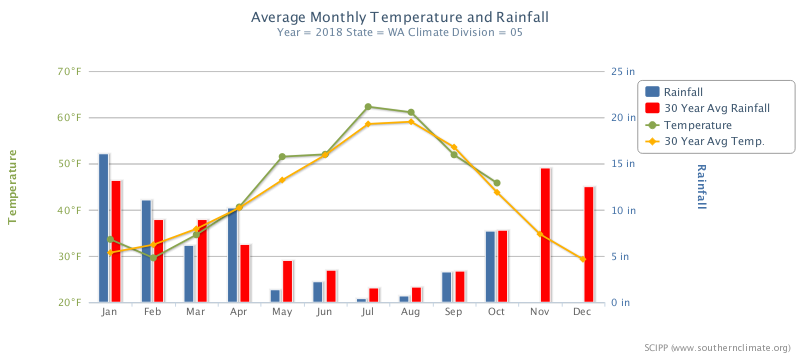
The 2018 winter season featured relatively normal snowpack despite a winter of wide temperature fluctuations, February freezing levels 400 m below the mean and December 500 m above the mean. Summer melt conditions featured temperatures 1.1 C above the 1984-2017 mean. The summer melt season through August was warm and exceptionally dry, which has also helped foster forest fires. The melt rate during the August field season was 35% above normal.

Washington Climate Division Five, western North Cascades

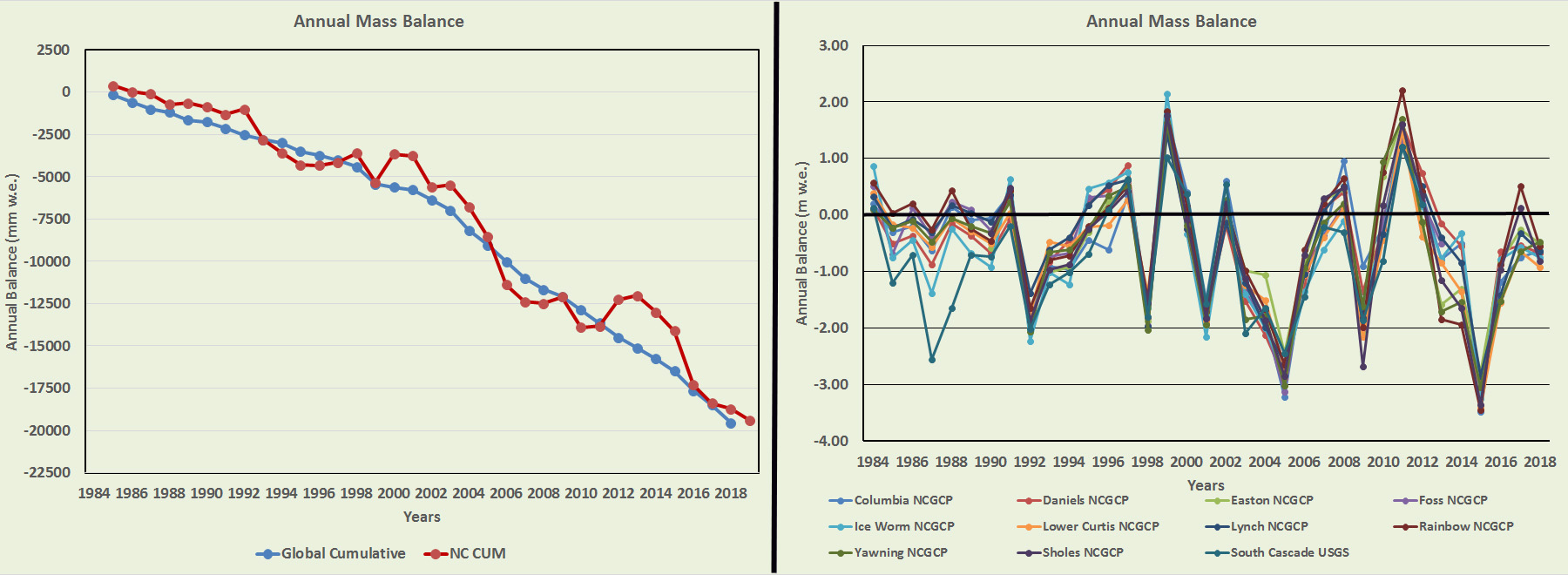
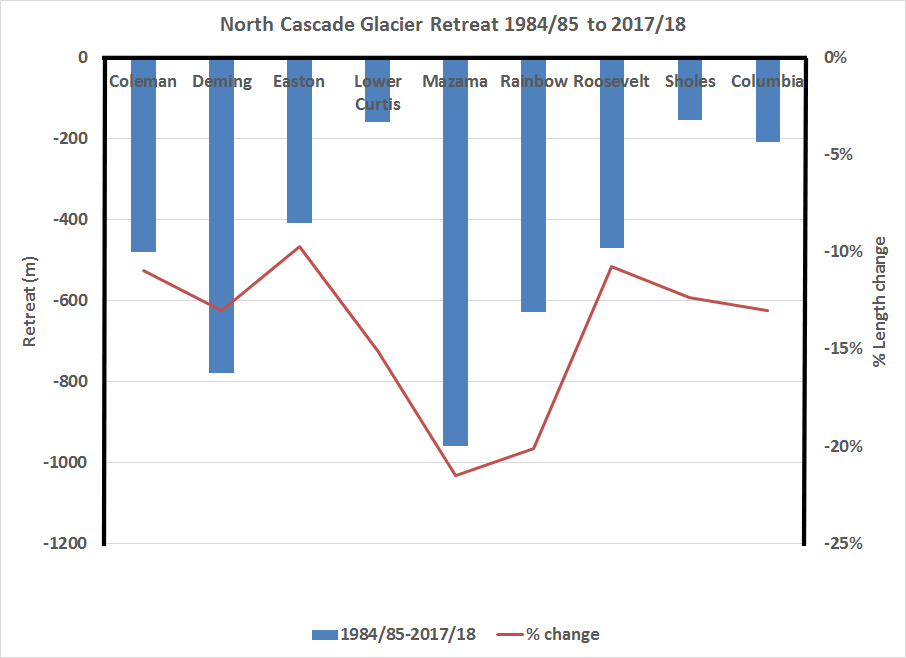
We assessed the mass balance of eight glaciers.  All eight will have significant negative mass balances in 2018, between -0.5 m and -1.0 m.  Retreat was measured on seven of the glaciers where the terminus was exposed, all had retreated since 2017 with the retreat ranging from 7-21 m. This continues the pattern of significant retreat each year that began in 2014. The overall length loss as a percentage of total length falls into a relatively narrow range of 10-22%.  The mass balance losses has also led to additional rock outcrops emerging in what had been the elevation of the accumulation zone.  We continued to measure runoff below Sholes Glacier and to assess crevasse depth.  The average crevasse depth in 2018 was 10 m, with the deepest at 16 m on Lower Curtis Glacier.

Annual  mass balance of North Cascade glaciers 1984-2018 (right).  Cumulative glacier mass balance from NCGCP compared to WGMS global cumulative mass balance.  Below is the retreat of selected North Cascade glaciers during the last 35 years, in meters and as a percentage of the total length.  Locations for all but Columbia Glacier are in image below. 

Mount Baker and Mount Shuskan glaciers identified in a Landsat image from 8-9-2018. Blue indicates mass balance and terminus change are observed.  Orange indicates only terminus change is observed. C=Coleman, D=Deming, E=Easton, LC=Lower Curtis, M=Mazama, N=Nooksack, P=Price, R=Rainbow, Rv=Roosevelt, SH=Sholes. 

Cerro Tronador Glacier, Argentina Retreat and Lake Formation

Cerro Tronador glaciers in Landsat images from 1985, 1998 and 2018.  A=Alerce, CO=Castana Overo, VN=Ventisquero Negro.  Red arrows mark the 1985 glacier terminus locations, yellow arrows the 2018 terminus location of VN, pink arrow the location of the 2009 dam breach outwash plain deposit, and purple arrow location of a bedrock outcrop. 

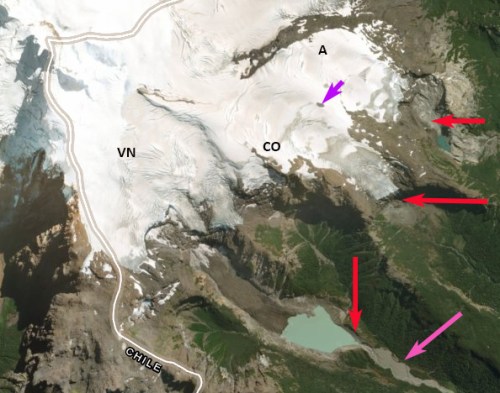
Cerro Tronador with a summit elevation of 3428 m straddles the Chile/Argentina border east of Lago Todos los Santos.  The peak is heavily glaciated including three glaciers that flow into the Alerce River basin of Argentina, Ventisquero Negro (VN), Castana Overo (OV) and Alerce (A).  Paul et al (2014) observed a 25% decrease in glacier area and the formation of over 100 new proglacial lakes in Northern Patagonia. Worni et al (2014) report on a moraine dam breach below Ventisquero Negro in 2009 and model this event. Here we examine Landsat imagery from 1985 -2018 to identify changes.

In 1985 there is no lake at the terminus of Ventisquero Negro with the debris covered terminus extending across the entirre basin.  The pink arrow indicates the vegetated valley below the moraine.  Alerce Glacier extends over a topographic step at 1600 m and extends to a proglacial lake at 1350 m. Castana Overo Glacier terminus broadly extends over the topographic step at 1600 m.  By 1998 Ventisquero Negro has developed a small fringing proglacial lake.  Alerce Glacier has lost its lowest valley tongue that extended to the proglacial lake.  The width of the Castana Overo Glacier terminus has been reduced.

By 2012 below the moraine dam breach has occurred depositing a significant outwash plain that is evident at the pink arrow just downstream of Ventisquero Negro.  A substantial proglacial lake has also formed that is 1.2 km long, Lago Manso.  Alerce Glacier has retreated to the top of the 1600 m step. A new bedrock outcrop, purple arrow has appeared on the ridge between Alerce and Castana Overo Glacier at 2100 m.  In 2016 the snowline extends to the new bedrock outcrop. By 2018 Ventisquero Negro has retreated 1450 m since 1985, with the proglacial lake still growing.  Alerce Glacier has retreated 800 m since 1985 and Castana Overo Glacier has retreated 400 m.  All three glaciers have significant crevassing indicating substantial retained accumulation being transported down slope. The debris covered tongue of Ventisquero Negro will continue to disintegrate and the Lago Manso will continue to expand.

Cerro Tronador glaciers in 2012 Google Earth image.  A=Alerce, CO=Castana Overo, VN=Ventisquero Negro.  Red arrows mark the 1985 glacier terminus locations, , pink arrow the location of the 2009 dam breach outwash plain deposit, and purple arrow location of a bedrock outcrop. 

Cerro Tronador glaciers in 2016 Digital Globe image.  A=Alerce, CO=Castana Overo, VN=Ventisquero Negro.  Red arrows mark the 1985 glacier terminus locations, , pink arrow the location of the 2009 dam breach outwash plain deposit, and purple arrow location of a bedrock outcrop.