Bionnassay Glacier Terminus Tongue Detaches, Mont Blanc, France

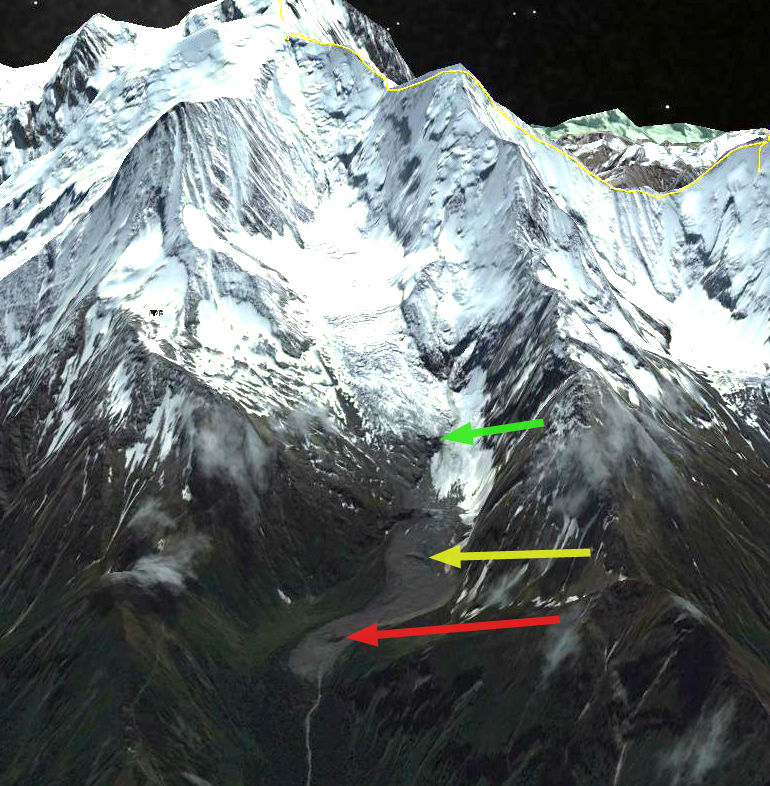
Bionnassay Glacier drains west from Dôme du Goûter and Aiguille de Bionnassay of the Mont Blanc Massif in France. The glacier has a heavily debris covered terminus and has experienced less retreat from 1980-2010 then other Mont Blance glaciers. Bionnassay retreated 200 m (Moreau et al , 2012), while Mer de Glace retreated 500 m in the interval 1998 to 2008. Gardent et al (2014) observed a 25% decline in the area of glaciers in the French Alps from 1970 to 2009, with the rate increasing significantly recently.  Bionnassay is now in rapid retreat as the stagnant terminus tongue is detached from the active glacier tongue.
bionnassay overview

Bionnassay Glacier.  Red arrow indicates terminus of stagnant region.  Yellow arrow indicates bedrock emerging that is separating stagnant terminus tongue.  Green arrow indicates lower limit of active glacier. 

In 1985 the glacier terminus is at the yellow arrow. The debris covered ice is crevassed and covers the entire region at the red and green arrow. Points B and C are ice covered and Point A has a small exposure of bedrock. In 1999 retreat from the yellow arrow is evident the glacier still covering the region at the red and green arrow. In 2001 Google Earth image the terminus is evident at the red arrow, the region at the green and yellow area are covered by glacier ice. In 2011 the terminus has retreated 180 m since 2001, bedrock has emerged at the green arrow, beginning to separate the stagnant debris covered terminus tongue. At the yellow arrow the crevassing has diminished greatly. In 2015 the terminus has retreated to the pink arrow. Bedrock has been exposed from below the glacier terminus tongue at the yellow arrow. The active glacier terminus is now at the green arrow. At Point B and C glacier thinning has led to marginal retreat and exposure of bedrock where there was glacier ice. At Point A the expanse of exposed bedrock has greatly expanded.  The retreat of the main glacier terminus is around 200 m.  However, the retreat to the newly emergent bedrock separating the glacier is 750 m.  The active terminus is now 1700 m from the 1985 terminus position at the green arrow.  In the next few years this will become a well defined terminus, as the lower stagnant zone melt away.

Bionnassay Glacier is just south of Taconnaz Glacier, which is also retreating.
bionnassay 1985
1985 Landsat image
bionnassay 1999
1999 Landsat image
bionnassay glacier ge 2001
2001 Google Earth Image
bionnassay glacier ge 2011
2011 Google Earth Image
bionnassay 2015
2015 Landsat image

500 m
Disintegration of Pramecou Glacier, France

Pramecou Glacier is on the Dome de Pramecou above the Grande Motte Glacier, which is a key portion of the Tignes Ski area in France. The Grande Motte area is open for summer skiing this year from June 27th to Aug. 9th. The glaciated landscape in this area is changing dramatically, Gardent and Deline, (2011) noted a 33% loss in glacier area since the 1960’s. The Tignes Ski area has responded by adding snowmakers for the lower portion of Grande Motte Glacier. In the hot summer of 2015 the melt is still causing issues for skiing at Tignes. Here we examine the impact on Pramecou Glacier and Grande Motte Glacier.

STGM Ski été automne 18
Grand Motte Summer Glacier Ski Map
pramecou map
Topographic map of area.

In 2006 the Pramecou Glacier had separated into three sections that did not retain snowcover, each outlined with black dots in Google Earth image below. This had been the case in 1999 and 2003 as well losing all of the snowcover.   In the 1988 Landsat image below the Grande Motte Glacier west terminus is at the green arrow at the top of a steep slope that falls to the Rosolin Glacier below.  The yellow arrow is the east terminus ending at the base of a rock knob yellow arrow.  Points A and B are along the margin of the Grande Motte Glacier.  The pink arrow indicates the Pramecou Glacier that consists of the larger two segments still merged. In 1999 the Landsat image indicates the loss of snowcover on both glaciers and the near separation of the two main Pramecou sections. The Grande Motte terminus has not retreated noticably yet. The 2002 Landsat image indicates the west terminus of the Grande Motte Glacier has retreated from the green arrow.  There is only modest thinning and marginal change at Point A and B.

The large change occurs between 2002 and 2014.  By 2014 both the east and west terminus of Grande Motte have retreated from the yellow and green arrows.  Each has retreated 200-250 m since 1999.  The larger change is the thinning evident at Point A and B. At Point A a large area of rock has been exposed extending from the north margin well into the glacier.  At Point B thinning has exposed a much wider ice free belt along the northern margin of the glacier.  At Point C the northeast ridge of  Grand Motte bare rock area is expanding.  It is clear the Pramecou Glacier will quite soon be lost.  The Grande Motte Glacier is thinning along its upper margins and is losing its snowcover by summer’s end, both are signs of a glacier that cannot survive (Pelto, 2010).  That is unless the Tignes ski area takes greater measures to preserve the glacier. This trend is following the behavior of Glacier Blanc and Mer De Glace. Those larger glaciers are not currently threatened, as these are with melting away.

pramecou image
2006 Google Earth image of Pramecou Glacier segments

Pramecou 1988
1988 Landsat image

pramecou 2014
1999 Landsat image

pramecou 2002
2002 Landsat image

pramecou 2014real
2014 Landsat Image

pramecou ge
2006 Pramecou Glacier and Grande Motte Glacier

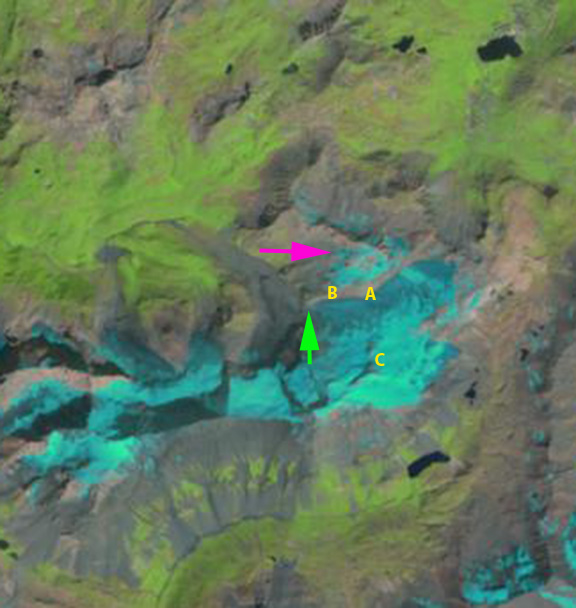
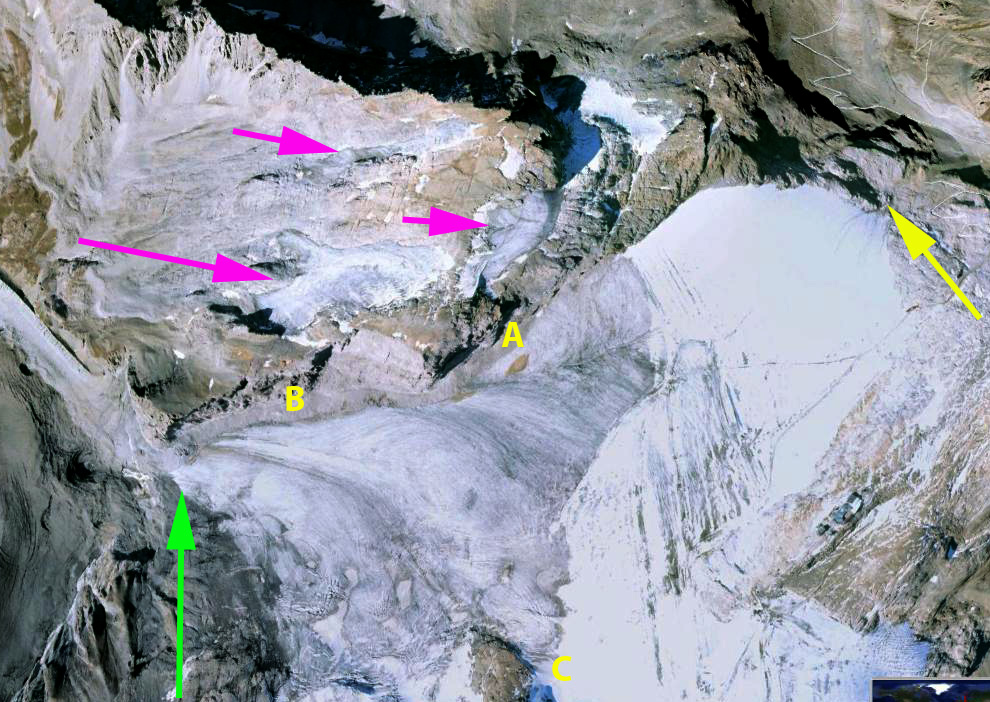
Portillon Glacier, French Pyrenees- Retreating and Disappearing

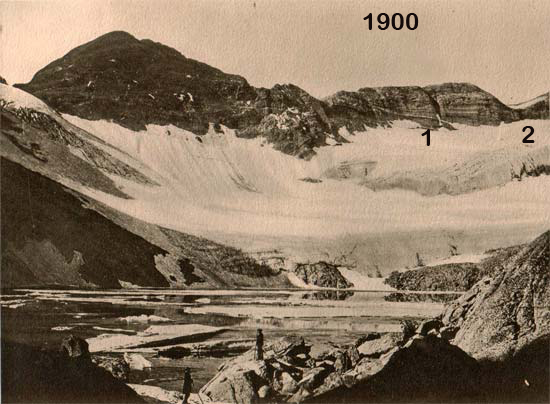
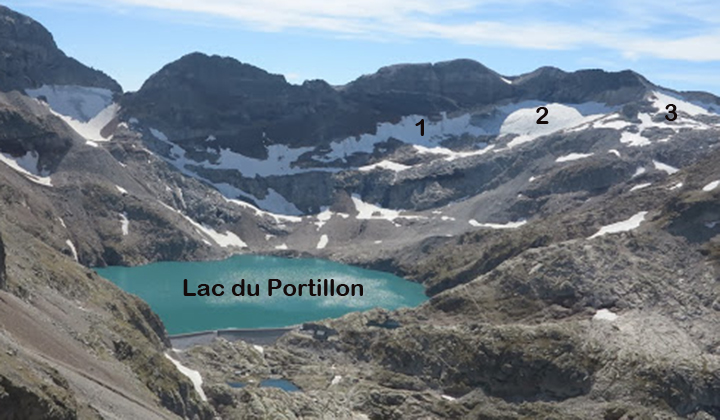
Portillon Glacier is in the Luchon-Bagneres region of the French Pyrenees, just north of the border with Spain. This currently small, and becoming smaller glacier drains into Lac du Portillon, which has a dam impounding it for hydroelectric generation. Like the nearby Aneto Glacier, Portillon Glacier has been thinning, retreating and separating. First a comparison of photographs from 1900 and 2013. In 1900 the glacier fills most of the cirque and nearly reaches the shore of the lake. The lake level is lower at this time also. By 2013 the glacier occupies a few small niches near the head of the cirque.

portillon lac 1900
1900 image from the Lakes of the Pyrenees web forum

portillon 2013
2013 image from Julien Lacrampe

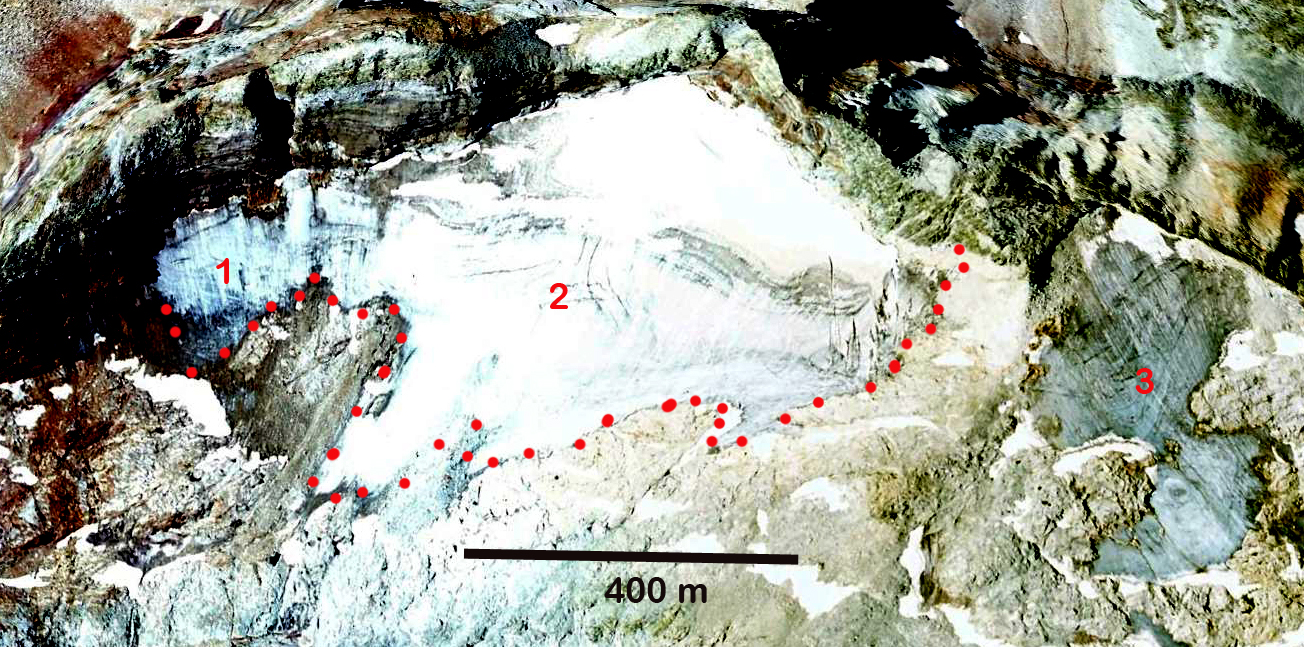
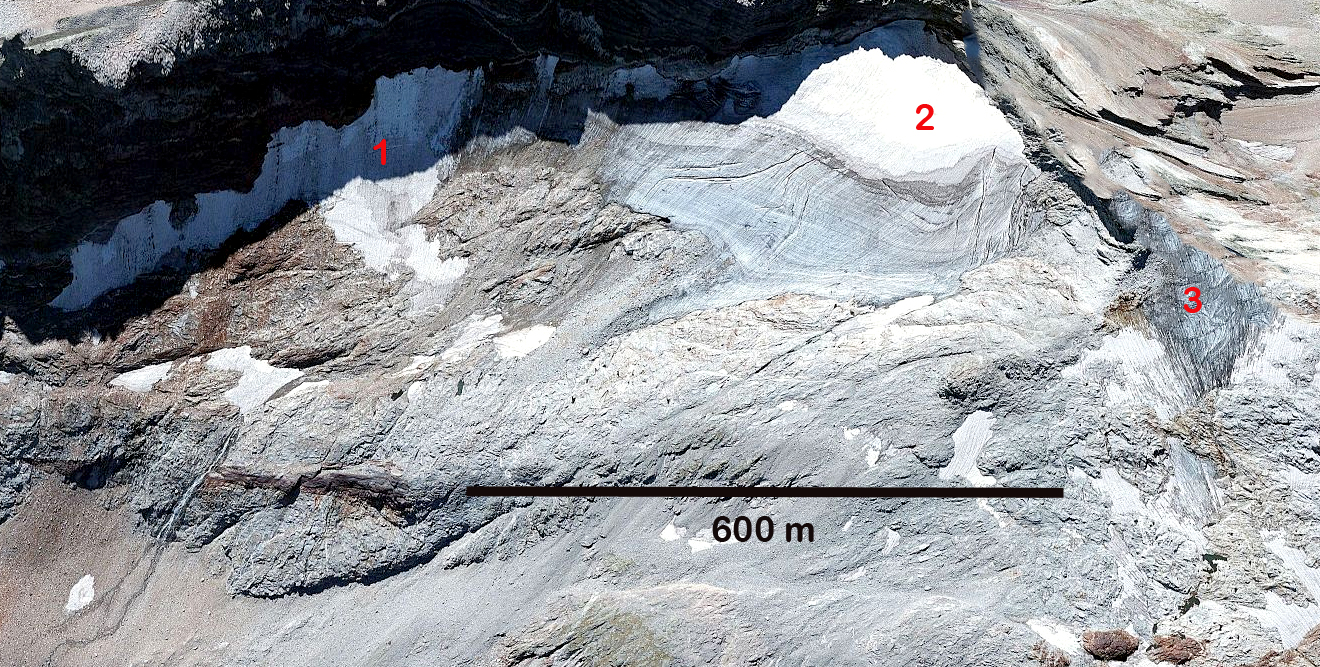
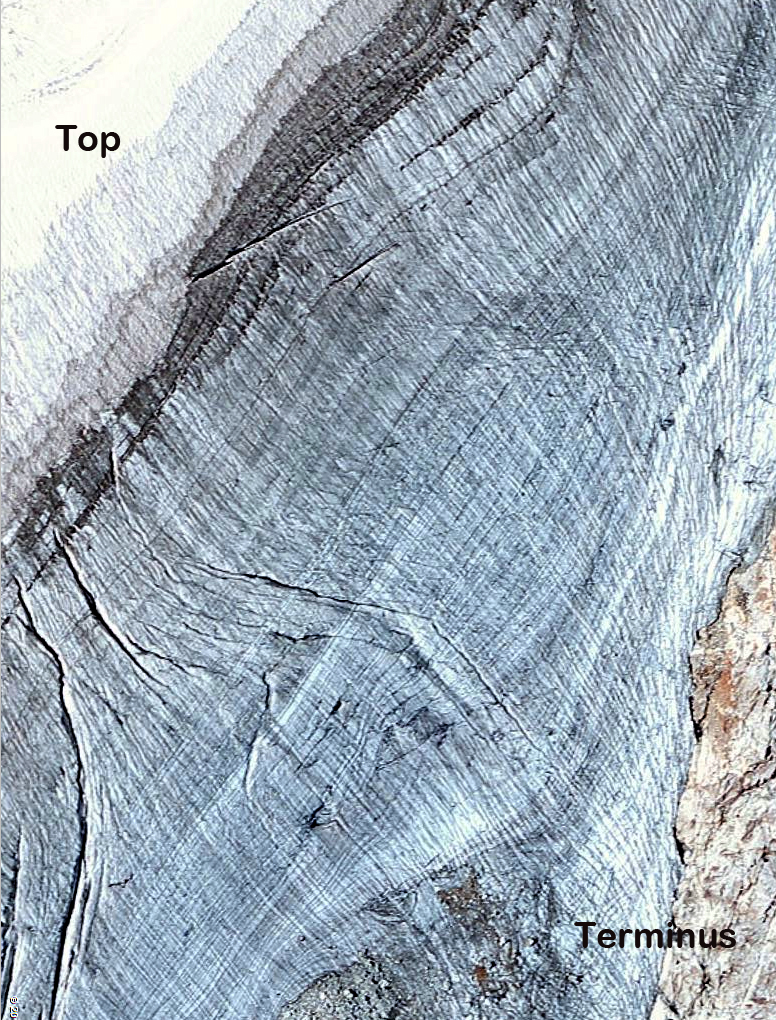
By 2006 Google Earth imagery indicates a glacier with an area of 0.12 square kilometers, red dots indicate the terminus of the glacier. Section 3 of the glacier has separated from the main section, 2. Section 1 is a narrow avalanche fed fringe beneath the cliffs. This section is too steep to retain good snow. In the 2008 image The glacier also is notably thin with few crevasses, and several bedrock outcrops amidst the thinning ice. Both the 2006 and 2008 image indicate the lack of snowcover on the glacier. This has exposed up to 75 annual layers in a closeup transect from head to terminus of the glacier. There are only a few crevasses on this relatively steep glacier, indicating the lack of movement, which can only come from thin ice on a steep slope.

The lack of persistent snowcover at the end of the melt season indicates a glacier,, like the Aneto and Maladeta Glacier, that will not survive current climate (Pelto, 2010). Its area is much less than Aneto Glacier, and it will disappear sooner. As SOER (2010) indicates more than 80% of the area of glaciers in the Pyrenees has been lost since the start of the 20th century. The color of Lac du Portillon and the loss of glacier in the basin reminds me of the Milk Lake Glacier, Washington that I watched disappear recently.
portillon glacier 2006
Google Earth image

portillong glacier best
2008 Digital Globe image

portillon annual layers

Glacier de la Girose Retreat, France

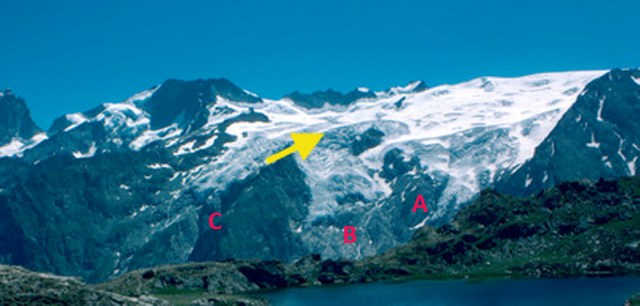
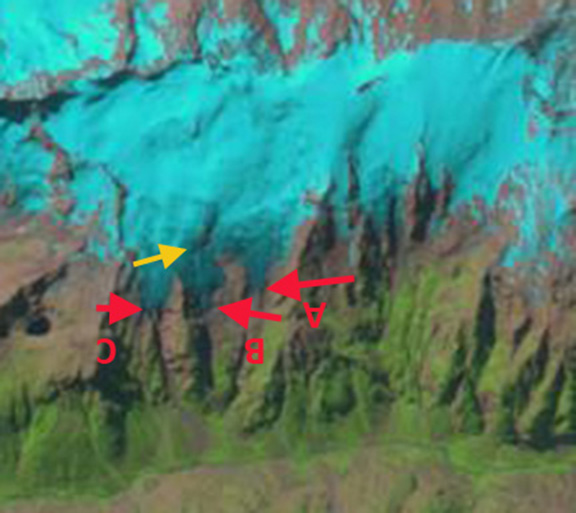
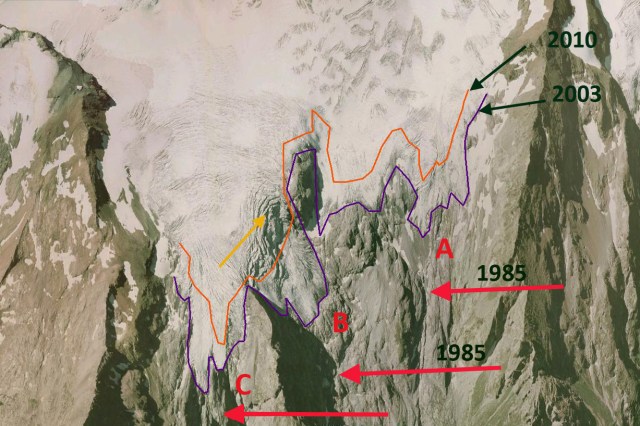
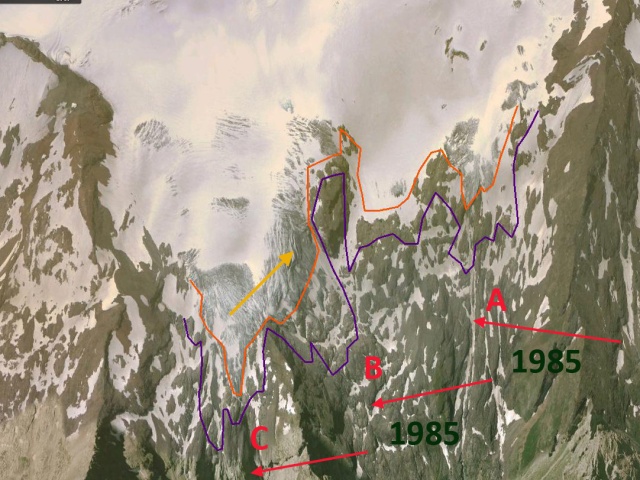
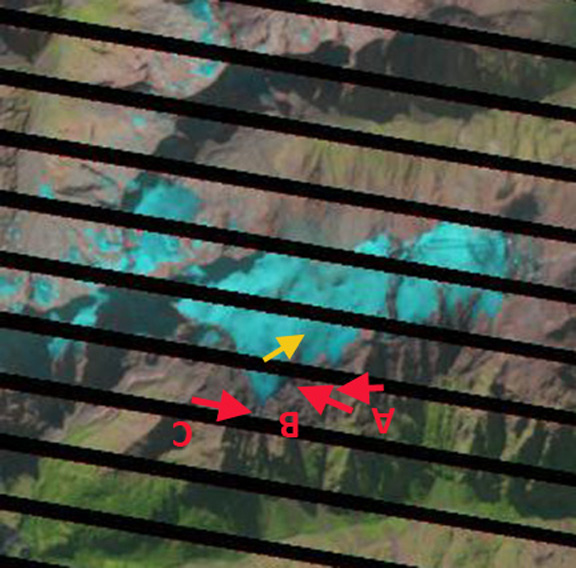
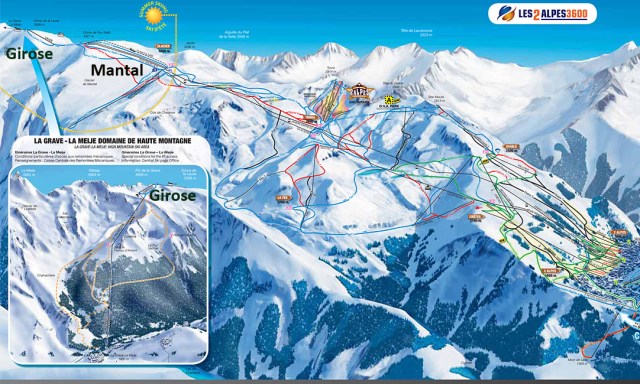
Glacier de la Grirose (Girose) is one of the most travelled glaciers in the Alps. It is part of the Les 2 Alpes ski resort, used primarily for summer skiing. The main glacier serviced by a lift is Glacier Mantel just to the west of Girose. 2alpes_plan-de-pistes Despite the frequent visits to the glacier by skiers it has not been the focus of much study. The glacier is smaller than often visited but seldom skied Mer De Glace, similar to Glacier Blanc 15 km south and larger than the Grande Motte at Tignes ski area. Here we examine changes from 1984-2012 using Landsat images, Google Earth images and two photographs. Girose has three termini from west to east labelled A-C. The 1985 terminus location is marked by red arrows, the 2003 terminus is indicated by a purple line, the 2009 terminus by an orange line adn the lip of a key icefall here the middle branch (B) separates from the main branch (C). In 1985 this icefall lip is 500 m above the terminus. The two western termini A and B both extend well below the main icefield of Girose in 1985, by 2012 the tongues barely extend beyond the main glacier. The views of the terminus are in order a 1984 photograph, a 1985 Landsat, 2003 Google Earth, 2010 Google Earth and 2012 Landsat image. They are all viewed from the north. Retreat from 1985 to 2010 has been 420 m at terminus a, 500 m at terminus B and 350 m at terminus C. The overall rate is 15 meters/ year. girose glacier 1984

girose glacier 1985

glacier girose terminus 2003

girose glacier terminus 2010

girose glacier 2012

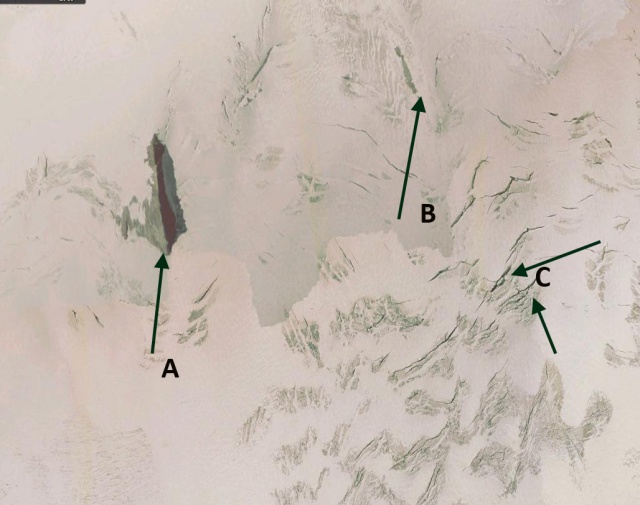
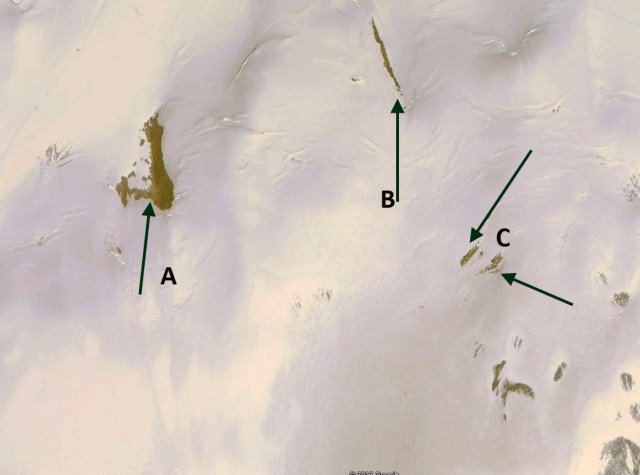
Of greater concern is the expansion of outcrops amidst the accumulation zone of the glacier from 2003 to 2010. This indicates thinning in the accumulation zone, which indicates the lack of a persistent snowcover even for many regions high on the glacier. The two images below identify three locations, at A and B the expansion of bedrock is evident. The scale is the same, at point A the rock outcrop is no longer a narrow linear feature. At Point B the rock outcrop is much longer. At point C there is a sharp reduction in crevassing, and the glacier surface is quite dark colored, this is not a rock amidst the glacier, instead the dark area indicates a portion of the glacier surface that has persistently lost its snowcover and where dirt at the surface has been preferentially enriched. This helps speed thinning, but in the former accumulation zone is a sign it is no longer an accumulation zone. The ski season is supposed to extend from mid- June to Sept. 1 for Les 2 Alpes on the glaciers, in many recent years the season is cut short on Girose. girose glacier acc zone 2003

girose glacier acc zone 2010

Saint Sorlin Glacier Retreat, France

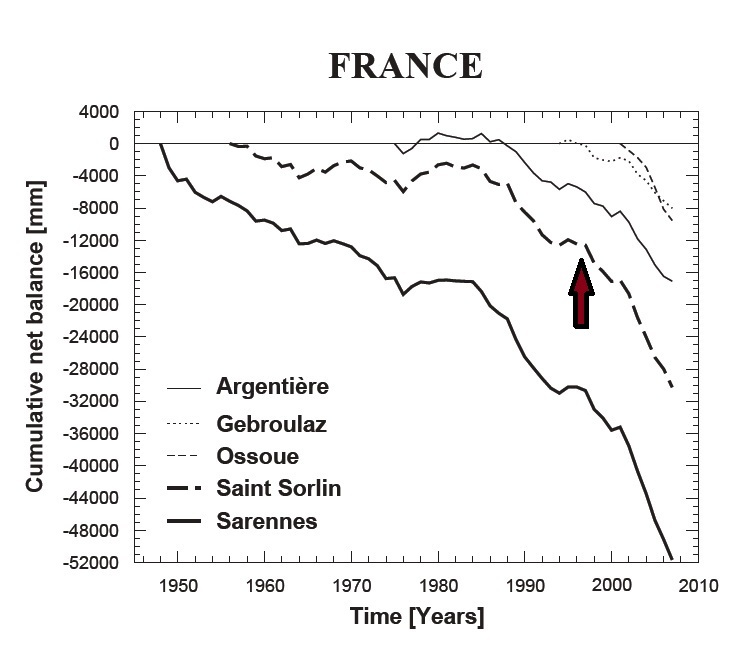
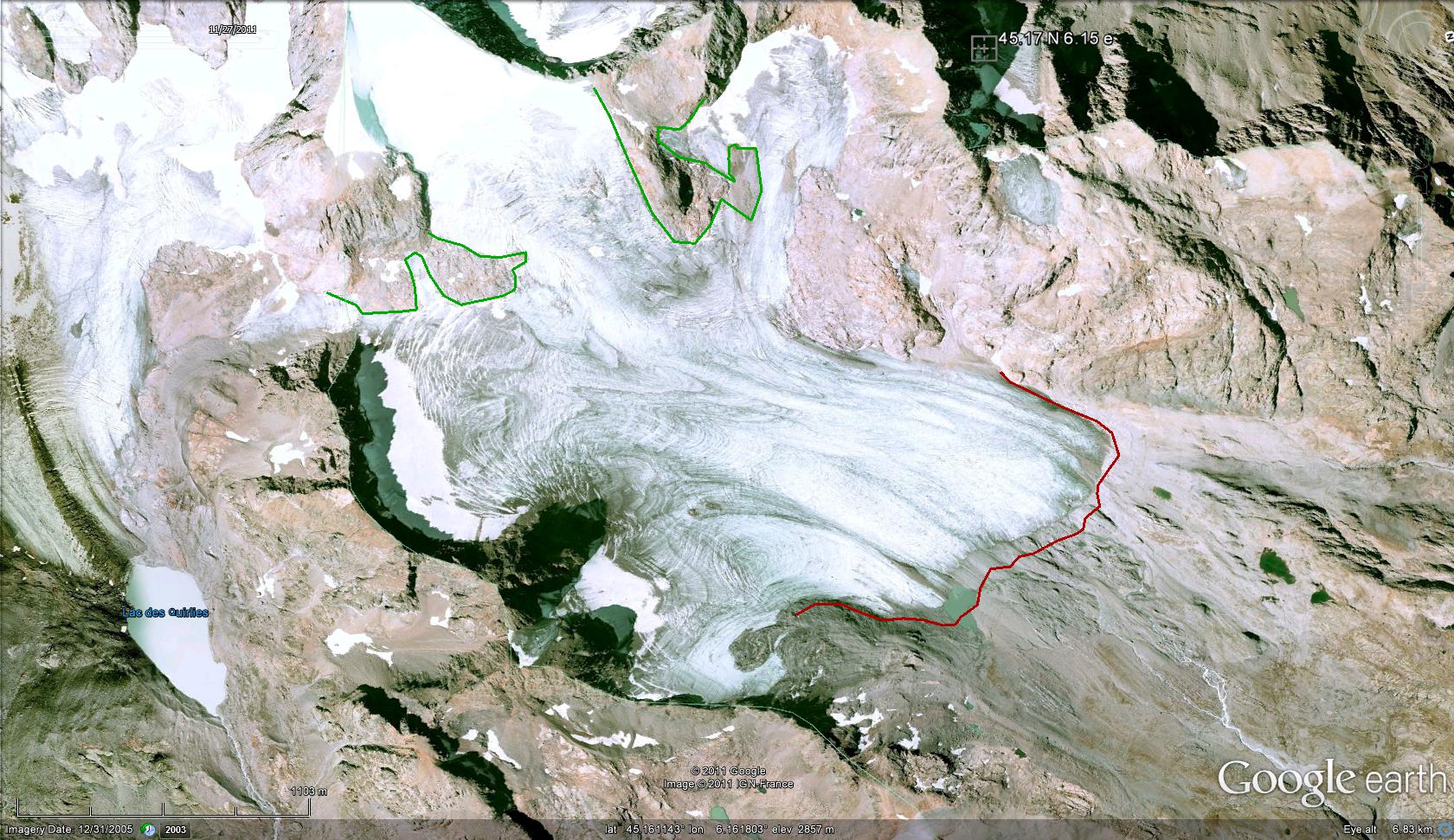
The Saint Sorlin glacier above the resort of Saint-Sorlin d’Arves has lost over 50% of its surface area since 1870. The mass balance of the glacier is measured and reported annually to the World Glacier Monitoring Service, since 1980 the glacier’s cumulative mass balance is -28 meters water equivalent, equivalent to an average loss of over 30 meters in thickness The glacier is measured as part of the GLACIOCLIM program by the Laboratory of Glaciology and Geophysics of the Environment (LGGE) at the Université Grenoble. The LGGE has applied a glacier model that forecasts the disappearance of the glacier before 2100. The glacier retreat and accumulation zone thinning from 2002 to 2006 are evident in Google Earth Imagery. The average retreat during the four years is 60 meters, the red line in both images is the 2002 terminus position. More worrisome for the glacier is the expansion of bare rock areas high on the glacier, green lines outline the bare rock margins in 2006, which cross significant glacial ice just four years previous. . A view of the glacier from the hut beyond the terminus, from Lakiki, affords a view of both the thinning terminus (blue arrow) and rock outcrops emerging on the upper glacier (red arrows) that are a sign of a glacier that is thinning in its former accumulation zone. This is not a sign of a glacier that can survive (Pelto, 2010).