Bridge Glacier, Southeast Alaska Retreat & Lake Formation

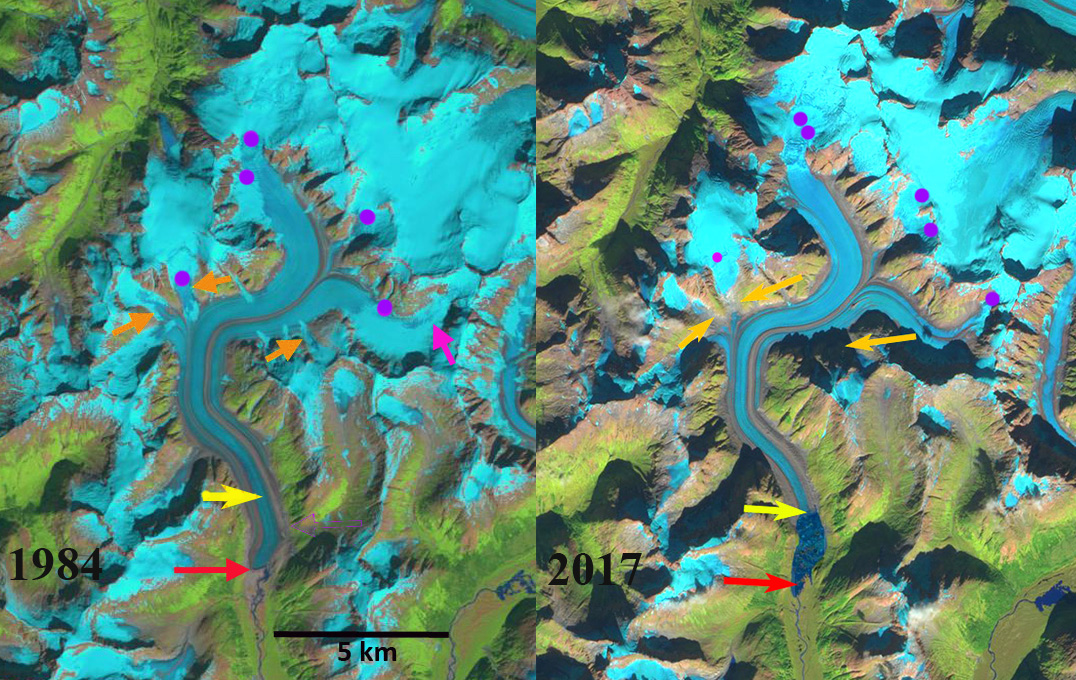
Bridge Glacier in Landsat image from 1984 and Sentinel image from 2017. The red arrow indicates the 1984 terminus where no lake exists, yellow arrow is 2017 terminus, orange arrows are selected tributaries and purple dots the snowline. 
Bridge Glacier drains the same icefield as the Wright and Speel Glacier 45 km southeast of Juneau, Alaska. Here we examine the changes in this glacier from 1984-2017 using Landsat and Sentinel imagery.

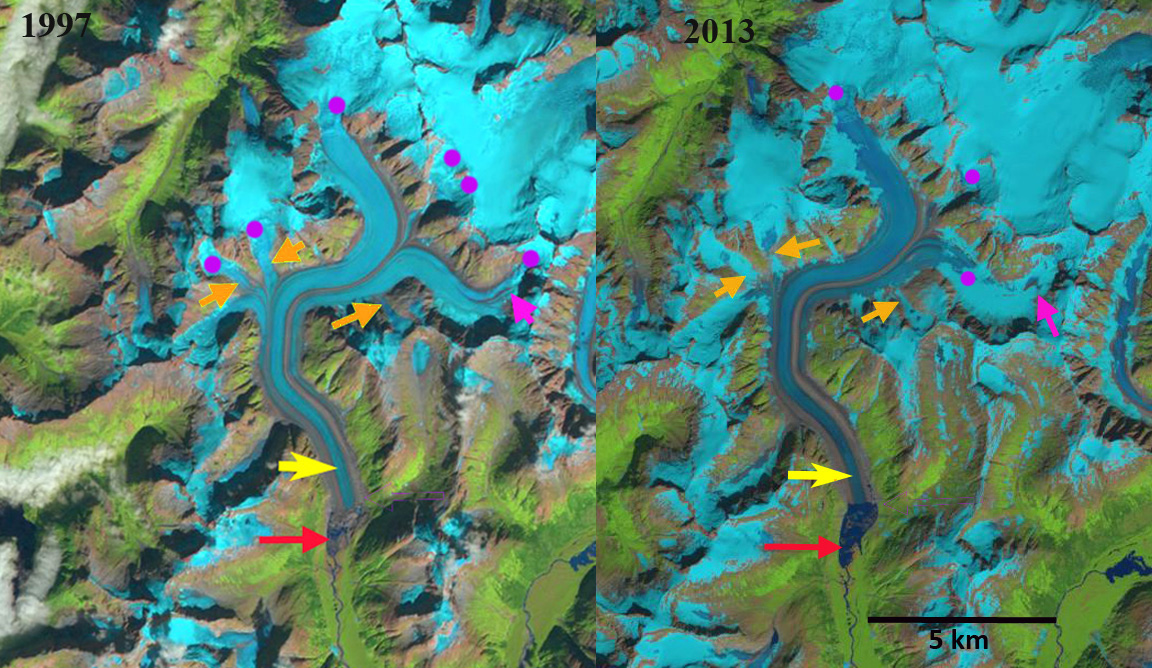
In 1984 the glacier ended on an outwash plain at the head of a branch of Speel River. The red arrow indicates the 1984 terminus for each image, the yellow arrow the 2017 terminus and the orange arrows three tributaries feeding the glacier.  The purple dots indicate the snowline at 1200 m. In 1984 all three tributary glaciers fed Bridge Glacier and the glacier has no proglacial lake at the terminus. In 1997 a lake basin is beginning to develop, though it is still largely filled by ice. The eastern tributary pink arrow, has lost all of its snowpack. The three tributaries at the orange arrows are connected to Bridge Glacier still and the snowline is at 1250 m. In 1999 the proglacial lake has formed and has length of 1 km, the lake has expanded south and north of the 1984 terminus position, and does not entirely represent glacier retreat.  In 2013 the glacier has retreated 1200 m from the 1984 position and the lake is still expanding. The orange arrows indicate that none of the three tributaries are still connected to the main glacier. The glacier in a sense is losing its income flow from these subsidiaries. The eastern tributary has retained some snowcover with six weeks left in the melt season in 2013, but this is mostly gone a month later, the snowline is at 1100 m. nbsp; Total retreat from 1984 to 2017 is 1900 m. In 2017 the snowline is at 1300 m, and the separation of the tributaries is by more than 500 m in each case. The snowline has been high by the end of each summer from 2014-2017 indicating retreat will continue. The retreat of this glacier is the same story as seen at nearby PattersonGilkey and Norris Glacier.

.

Bridge Glacier in Landsat images from 1997 and 2013. The red arrow indicates the 1984 terminus , yellow arrow is 2017 terminus, orange arrows are selected tributaries and purple dots the snowline. 

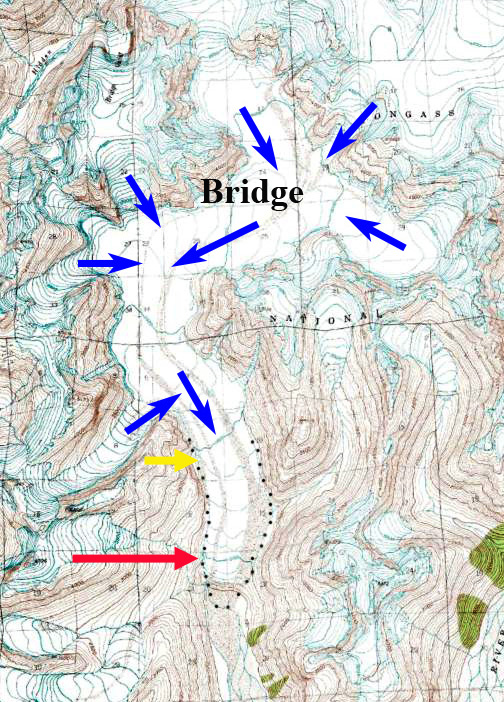
Bridge Glacier in USGS map when it ended on the outwash plain in 1948.


Gabriel Quiroz Glacier, Chile Retreat Forms New Lake

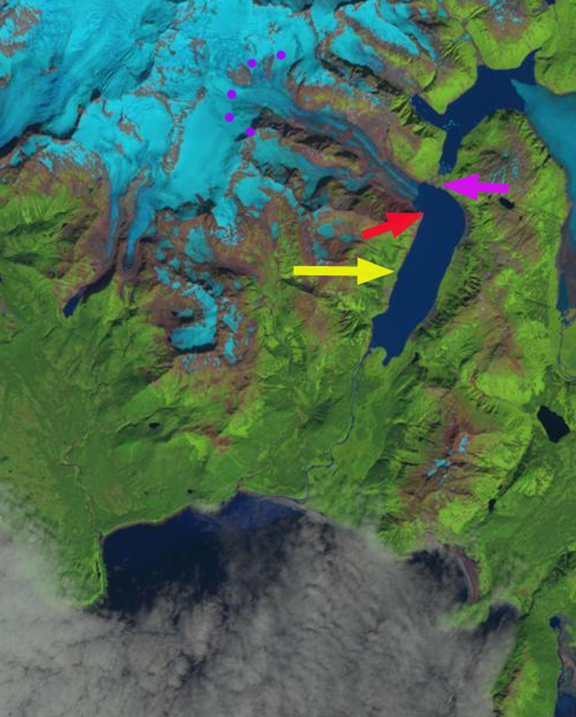
Gabriel Quiroz Glacier, Chile in 1987 and 2016 Landsat images illustrates the retreat.  Red arrow is 1987 terminus, yellow arrow the 2016 terminus, purple arrow a retreating northern tributary and purpe dots the snowline.

Gabriel Quiroz Glacier is a northern outlet glacier of the Southern Patagonia Icefield that drains into the Rio Pascua.  The glacier in 1987 terminated within 250 m of Lago Gabriel Quiroz.  Willis et al (2012) observed that between February 2000 and March 2012 that the Southern Patagonia Icefield is rapidly losing volume and that thinning extends even to high elevations.  The overall retreat has been driven by increasing calving rates from the 1975-2000 to the 2000-10 period (Schaefer et al, 2015). The pattern of retreat is consistent between these glaciers and the region as noted by Davies and Glasser (2012), annual rates of shrinkage in the Patagonian Andes increased in from 0.10% year from 1870-1986, 0.14% year from 1986-2001, and 0.22% year from 2001-2011, though they note Gabriel Quiroz Glacier retreat rate from 1870-2011 was low.  Glasser et al (2016) observed both an increase in glacier proximal lakes and in debris cover on glaciers with glacier retreat from 1987-2015. In this case the glacier is now terminating in a new and expanding proglacial lake, but has limited debris cover.

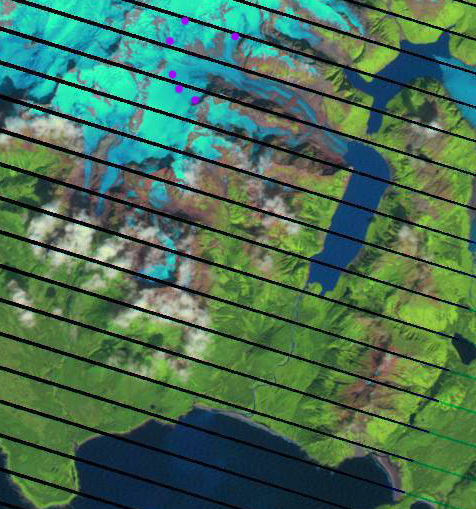
In 1987 the glacier terminates 250 m beyond the western shore of Lago Gabriel Quiroz there is no sign of a proglacial lake at the terminus.  The snowline is at 950 m in 1987,  A tributary from the north almost joins the main glacier, purple arrow.  In 2000 a small proglacial lake is evident at the terminus, which has retreated 300 m. The snowline is at 950 m. By 2015 a substantial proglacial lake has formed with an island in it.  The lake is 1.6 km long, which represents the retreat of the glacier since 1987. The snowline in 2015 is at 1050 m.  In 2016 the proglacial lake is filled with icebergs indicating continue calving driven terminus retreat totaling 2.1 km since 1987. The snowline in 2016 is at 950 m. The terminus remains poised for additional calving retreat, though the calving front has narrowed.  The upper limit of the lake basin is not evident.  The northern tributary has retreated up valley away from the main glacier.  This indicates that even without calving the mass balance of the glacier would be negative and there would be retreat. The retreat is similar to that seen at Balmaceda Glacier,  Bernardo Glacier and Glacier Onelli.   

Gabriel Quiroz Glacier, Chile in 2000 and 2015 Landsat images illustrates the retreat.  Red arrow is 1987 terminus, yellow arrow the 2016 terminus, purple arrow a retreating northern tributary and purpe dots the snowline.

Palma Glacier, Alaska Retreat Opens Lake Passage

Palma Compare
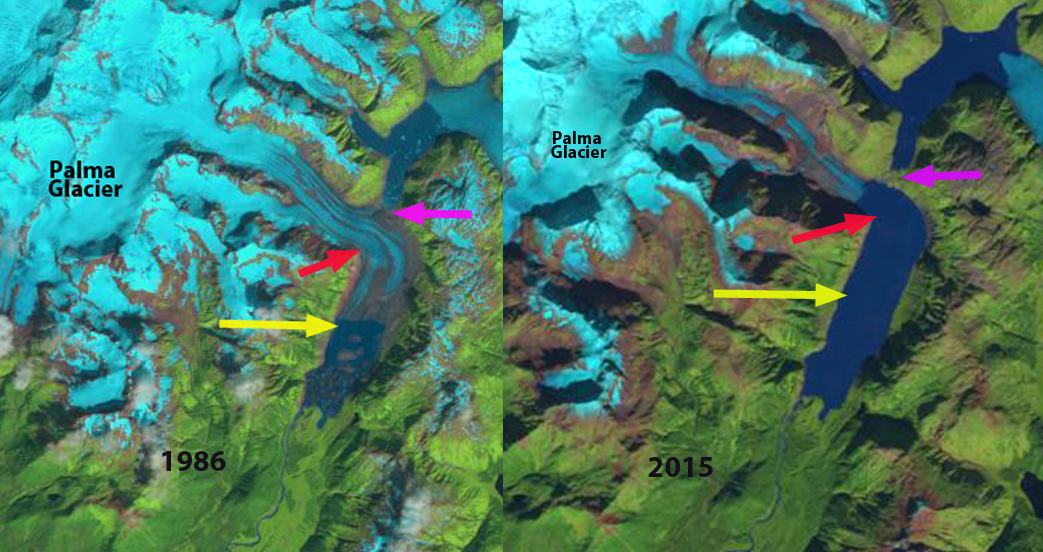
An August 1986 and September 2015 Landsat Image of Palma Glacier, 1986 terminus yellow arrow.
Palma Glacier is an unnamed glacier just west of Brady Glacier and Glacier Bay that is the principal glacier draining into Palma Bay.  Here we examined the changes in this glacier from 1986 to 2015 with Landsat Imagery.  The glacier has terminated in a lake at the head of a river draining into Palma Bay at least since the 1950 USGS map was prepared.The neighboring Brady Glacier advanced for much of the 20th century,  its tributary lobes began to retreat after 1970.  The main Brady Glacier terminus did not begin to retreat until 2009 and is poised to begin a rapid retreat as lake development at the terminus continues due to ongoing thinning (Pelto et al, 2013)..

palma glacier ge

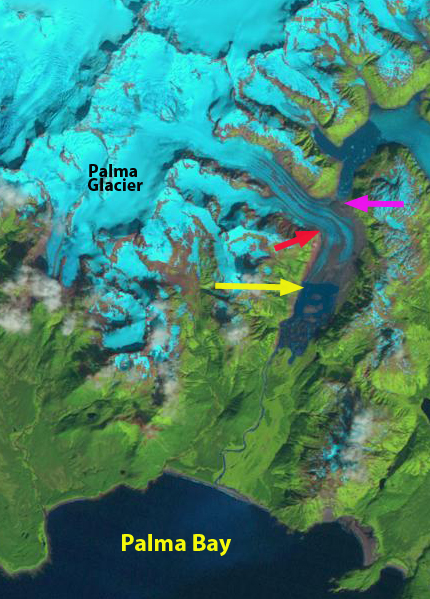
Google Earth image of the Palma Bay and Palma Glacier region

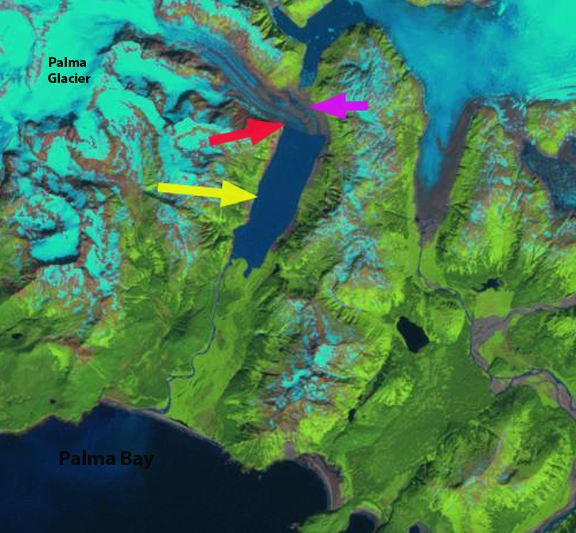
In 1986 Palma glacier flowed south out of the mountains before turning sharply west for 2 km before terminating in a lake at the yellow arrow. The lake had considerable debris covered ice bergs that had recently calved. By 1999 the glacier had retreated to the westward turn, red arrow, but did extend to the south side of the lake.  By 2014 the glacier had retreated from the westward turn, red arrow, and the strip of land between the two lakes at the purple arrow has been exposed and vegetated. it is now possible to paddle up one lake and portage to the next. The snowline purple dots is at 1000 m.  In 2015 this September image at top is after an early season snowfall, the last image below is an August image indicating the snowline is again at 1000 m with several weeks left in the melt season.  The glacier has retreated 2100 meters from 1986 to 2015 and still terminates in the lake. The retreat has slowed since 1999 after the lake narrowed at the westward turn. Retreat will continue as a snowline at 1000 m is to high to sustain even the current size of Palma Glacier.

palma Glacier1986
1986 Landsat image

palma glacier1999
1999 Landsat Image
palma glacier 2014
2014 Landsat Image
Palma snowline Aug 2015
2015 Landsat Image