Melt Severs Northern Patagonia Icefield Glacier Connections

Loss of glacier connection between HPN1 and HPN2 in Landsat images from 2000 and 202o at Point A and B. Glacier tongue retreat at Point A from HPN1 and at Point C from HPN2. Formation of 1.4 km2 lake at HPN1.

HPN1, HPN2 and HPN3 drain adjacent sections of the the Northern Patagonia Icefield (NPI).  HPN2 and HPN3 comprise the Acodado Glacier, with HPN1 being the next glacier to the north is. The lakes at the terminus of HPN2 and HPN3 were first observed in 1976 and had an area of 2.4 and 5.0 km2 in 2011, while HPN1 had no lake in 2000 (Loriaux and Casassa, 2013).   Davies and Glasser (2012) noted that the Acodado Glacier termini, HPN2 and HPN3, had retreated at a steadily increasing rate from 1870 to 2011. Pelto, 2017 reported a retreat from 1987-2015 of 2100 m for HPN2 and 3200 m for HPN3. From 1987-2020 Acodado Glacier terminus HPN2 has retreated 2700 m and HPN3 has retreated 4100 m.  The result of this retreat is an increase in lake area at HPN2 from 2.1 km2 in 1987 to 7.1 km2 in 2020 (Pelto, 2020). Glasser et al (2016) identified a 40% increase in lake area for the NPI from 1987-2015,  and a 100 m rise in the snowline.  Dussailant et al (2018) identified a mass loss rate of -2–2.4 m/year for HPN1, with thinning of over 4 m/year in the lower reaches in the vicinity of Point A and B. Here we examine the impact of the rising snowline, increased melt and resultant thinning on two glacier tongues that connected HPN1 to the accumulation zone region of HPN2 in 2000 and are now disconnected.

In the 2000 Landsat image glacier tongues extending from the accumulation zone region of HPN2 connect with HPN1 at Point A and Point B. At Point C an ice tongue extends 2.7 km upvalley from HPN2. By 2016 there is a disconnection at Point A with ice flowing south from HPN1 no longer joining the north flowing tongue.  Point B is still connected. At Point C the ice tongue extends 1.8 km upvalley.  By 2020 the connection at Point B has also been severed. At Point A ice no longer flows south into the valley from HPN1 and there is a 3.25 km long deglaciated valley between the two formerly connected ice tongues. At Point C the ice tongue from HPN2 has also been lost, a 2.7 km retreat.  From 2000-2021 HPN1 has retreated 1.8 km leading to the formation of a 1.4 km2 lake. We can anticipate the rapid retreat of the glacier tongue from HPN1 at Point B during this decade.  There is potential of short term formation of glacier dammed lakes at Point A and C now, and Point B in the future.  There is not a hazard from drainage of these lakes that both reach tidewater via Rio Acodado within 15 km.

Loss of glacier connection between HPN1 and HPN2 in Landsat images from 2016 and 2021 at Point B. Glacier tongue retreat at Point A from HPN1 and at Point C from HPN2. Expansion of 1.4 km2 lake at HPN1.

HPN1 in Sentinel 2 image from Nov. 9, 2021 illustrating the 1.4 km2 lake at HPN1 that has formed this century and the deglaciated valley at Point A.

Is San Quintin Glacier Lake the fastest expanding lake this century in South America?

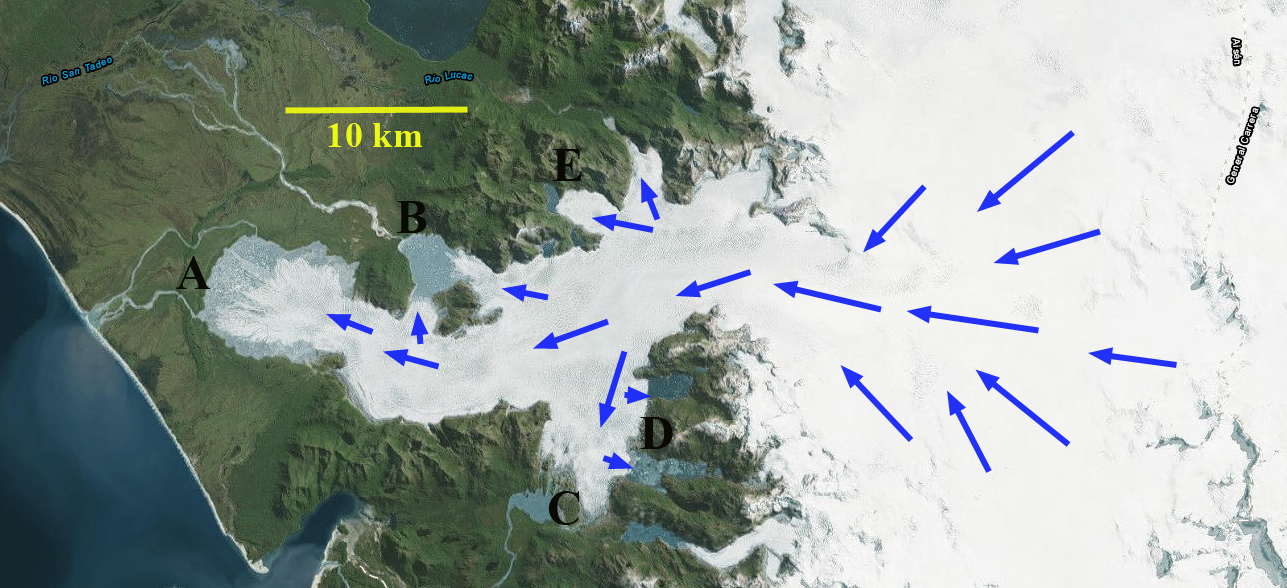
Landsat images of San Quintin Glacier from 2001 and 2020 indicate the expansion of both Lake A and Lake B due to glacier retreat. The Lake A basin as defined by the transect at the eastern narrow point, yellow line, has a total area of 41 km2 with the lake surface area now comprising 35.1 km2.

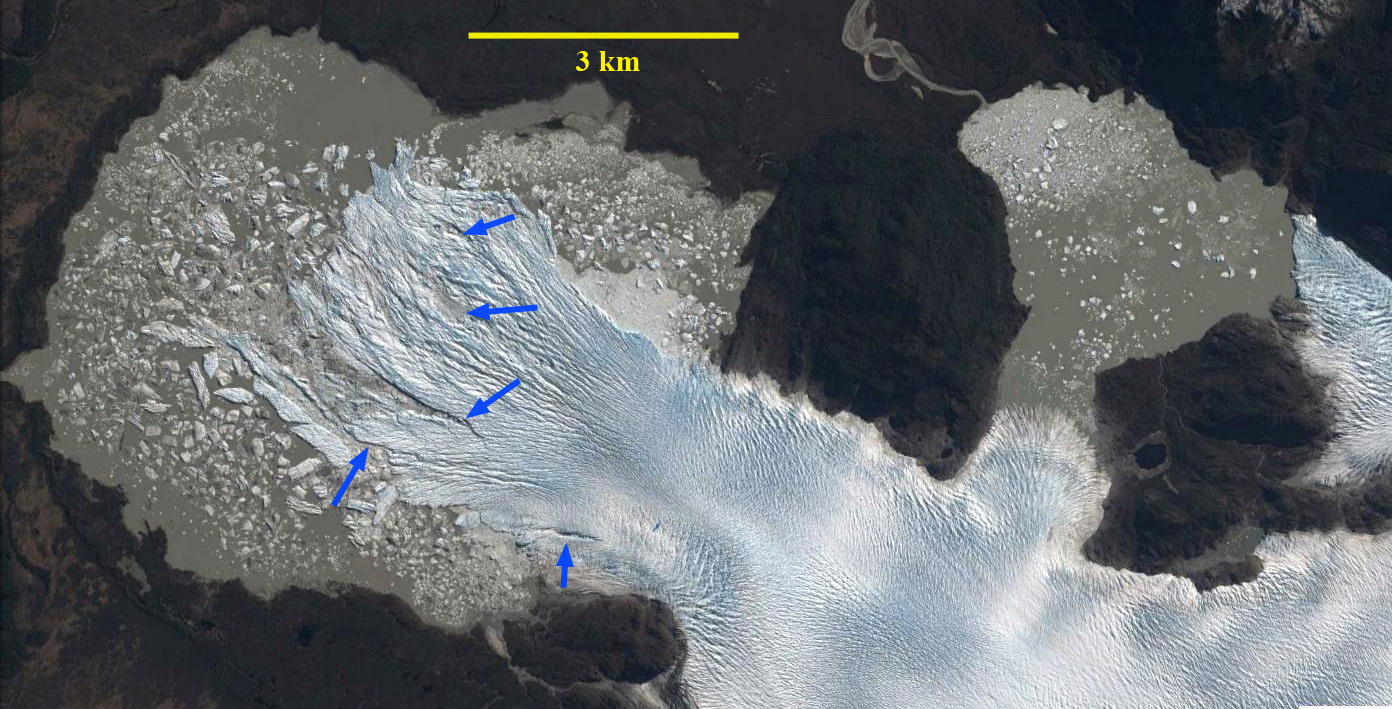
San Quintin is the largest glacier of the Northern Patagonia Icefield (NPI) at 790 km2 in 2001, flowing ~50 km west from the ice divide in the center of the ice cap.  San Quintin Glacier terminated largely on land until 1991 (Davies and Glasser, 2012). The velocity at the terminus has increased from 1987 to 2014 as the glacier has retreated rapidly into the expanding proglacial lake (Mouginot and Rignot, 2015).  As Pelto (2016) noted 19 of the 24 main outlet glaciers of the Northern Patagonia Icefield ended in a lake in 2015, all the lake termini retreated significantly in part because of calving losses leading to lake expansion in all cases. Glasser et al (2016) observed that proglacial and ice-proximal lakes of NPI increased from 112 to 198 km2. Loriaux and Cassasa (2013) reported that the combined area of the multiple San Quintin Glacier lakes expanded the most of any NPI from 1945-2011 increasing by 18 km2. The large evident crevasses/rifts perpendicular to the front indicate the terminus tongue has been partially afloat since at least 2014  Here we examine Landsat images from 1987-2020 to illustrate the changes. NASA’s Earth Observatory has high resolution images indicating the terminus in June 2014 and April 2017

In 1987 it is a piedmont lobe with evident minimal marginal proglacial lake development beginning, with an area in Lake A of  3.2 km2 and Lake B of 2.2 km2.  The main lake, Lake A, in 2001 had expanded to an area of 14 km2, while Lake B had expanded to 6.5 km2. The main lake, Point A, had an area of 23.8 km2 in 2011 (Loriaux and Cassasa, 2013) . Lake B developing on the north side of the glacier, due to a 3500 m retreat, by 2015 had an area of 9.2 km2.  For Lake A the main terminus retreat of  2200 m from 1987-2015 and led to lake expansion to 34.3 km2. The southern terminus at Point C, has a narrow fringing lake and a retreat of 1100 meters from 1987-2015.

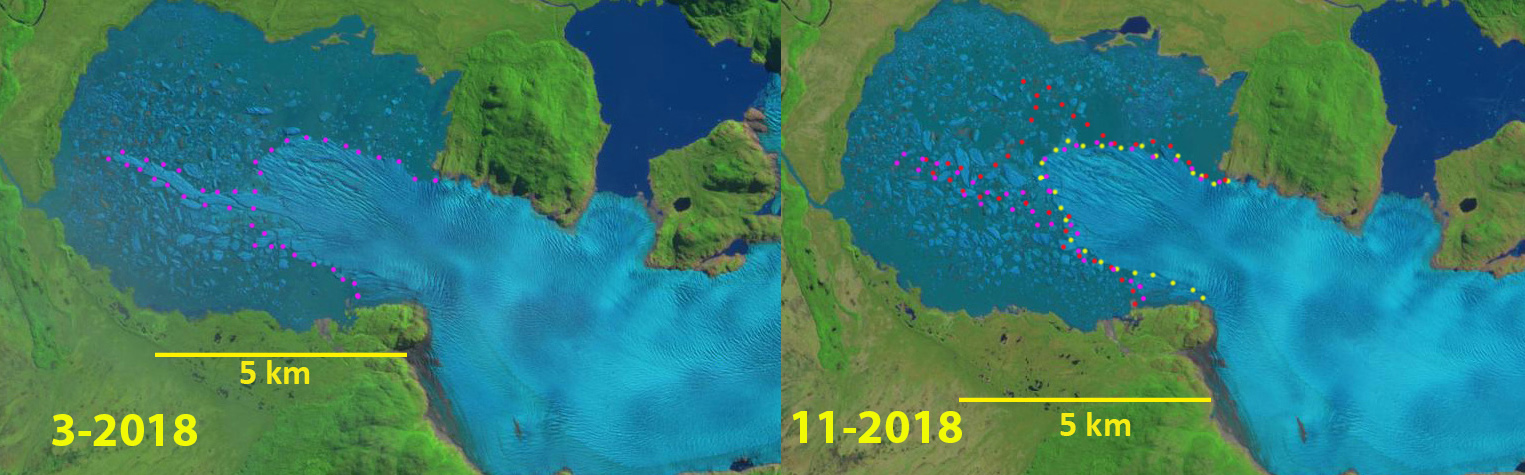
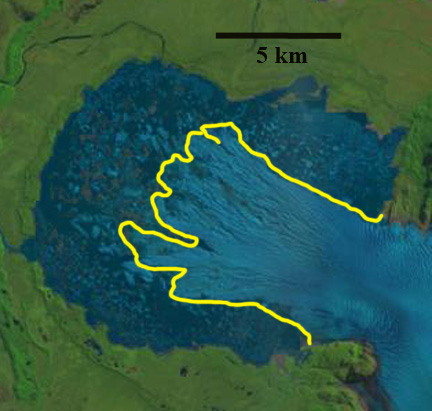
A narrow terminus tongue extending from the main terminus had an area of 0.6 km2 and extended to within ~1.5 km of  the Lake A western shore in March 2018.   By November 10, 2018 this narrow tongue had disintegrated.   In February 2020 the area of Lake A is 35.1 km2 and Lake B is 9.7 km2, a combined area of 44.8 km2 vs 20.5 km2 in 2001.  Gourlet et al (2015) examined the thickness across sections of the NPI, weather prevented the survey of the terminus area of San Quintin Glacier, but there results do hint that the bed is below sea level between Lake A and B basins, and they should connect. In the Landsat images of 2001 and 2015 a transect across the narrow point at the east end of Lake A indicates an area of 41 km2 if the entire main terminus tongue collapses. The ~24 km2 lake expansion at the two main terminus locations of San Quintin Glacier from 2001-2020 represent the fastest lake expansion from glacier retreat, is it the fastest overall for South America? Steffen Glacier is another example of rapid retreat and lake expansion. The retreat is much less than at HPS-12, but that is an example of fjord expansion.

Landsat images of San Quintin Glacier from 1987 and 2015 indicate the expansion of both Lake A and Lake B due to glacier retreat as well as retreat at Point C.

San Quintin in  March and November 2018 Landsat images indicating loss of narrow terminus tongue pink dots.

Northern Patagonia Icefield High Equilibrium Line Altitude in 2019

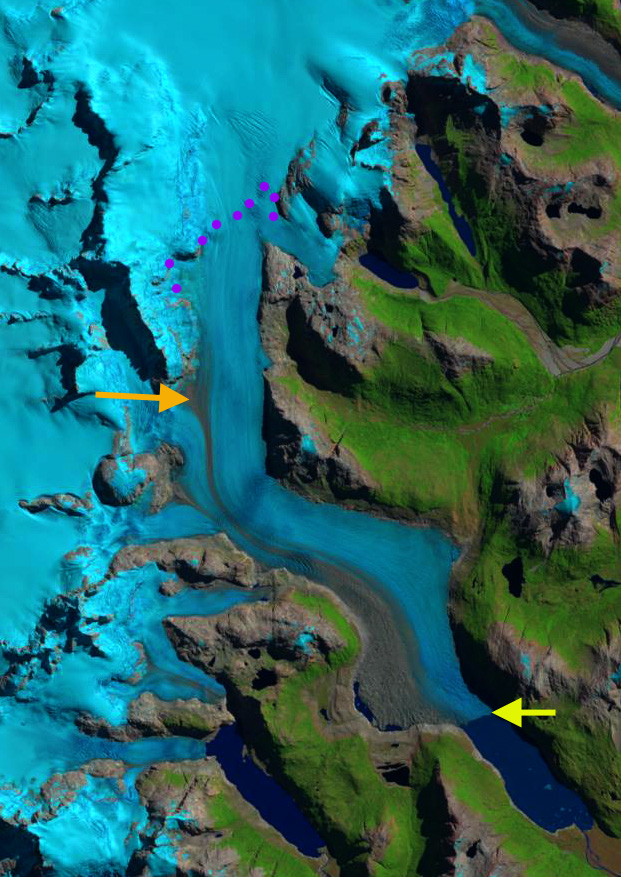
Northern Patagonia Icefield Landsat view on 4/6/2019. Transient snowline indicated on individual glaciers with purple dots. Clockwise, L=Leones, So=Soler, N=Nef, Ca=Cachet, Co=Colonia,  PN=Pared Nord, PS=Pared Sur, H4=HPN4, St=Steffen, A=Acodado, B=Benito, H1=HPN1, Sq=San Quintin.

The Northern Patagonia Icefield from 1987-2015 decreased in area, while debris cover area expanded and the size of proglacial lakes expanded (Glasser et al 2016).  The icefield area declined from 4113 to 3887 km2, debris cover increased from 168 to 307  km2 and lake area expanded from 112 to 198 km2 In this paper we also examined the recent rise in the transient snow line (TSL). The TSL is the location of the transition from snow cover to bare glacier ice at a particular time during the ablation season, while the Equilibrium Line Altitude (ELA) is the altitude of the snow line at the end of the ablation season. The TSL at the end of the melt season is the ELA.  In recent years the ELA has been rising, and the highest annually observed TSL in the period 2013-2016 averaged 1215 m (Glasser et al 2016). This is an ELA rise of  at least 103 m compared with the  observed  1979-2003 ELA.  Landsat 8 imagery from April 6, 2019 reveals the TSL for most NPI glaciers, this is typically beyond the end of the melt season, but not in 2019, hence the TSL from this date will be the approximate annual ELA.  How does it compare and what does that mean for icefield mass balance in 2019?

On April 6, 2019 the TSL was highest on glaciers on the east side of the icefield decreasing for the western outlet glaciers. Clockwise from Leones Glacier in the Northeast to San Quintin Glacier on the west side the TSL observed ranged from 1525 m on Leones Glacier and Soler Glacier to a low of 1075 m on San Quintin Glacier.  The mean TSL is 1260 m for the glaciers reported by Glasser et al (2016) and 1300 m for all glaciers.  TSL on April 6, 2019 on glaciers on the east side of the icefield averaged 1425 m, while on the east side of the icefield the average was 1200 m.

Willis et al (2012) noted the ELA of NPI glaciers for the 2001-2011 period, a glacier by glacier comparison to 2019  indicates the ELA is  ~150 m higher in 2019.  This is the highest mean TSL observed for the NPI and suggests a strong negative surface mass balance year for the icefield in 2019.  This does not include the calving losses such as observed at San Quintin Glacier.  Dussaillant et al (2018) reported negative mass balances of NPI glaciers of ~-1 m using two different methods for the 2000-2012 period. TSL observations since indicate the ELA has been higher in recent years driving even more negative balances.  As Pelto (2017) noted 19 of the 24 main outlet glaciers of the Northern Patagonia Icefield ended in a lake in 2015, all the lake termini retreated significantly in part because of calving losses. Surface mass balance losses in 2019 will lead to continued retreat such as observed at San Quintin Glacier, Nef Glacier, and Acodado Glacier. This will also increase the debris covered area, which increases albedo and ablation further.

Northern Patagonia Icefield ELA reported by Willis et al (2012), Glasser et al (2016) and for 2019. 

Gualas Glacier (G) and Reichert Glacier (R) TSL on 4/6/2019 in Landsat image.


Pared Nord Glacier, Chile Retreat & Landslide Transport 1987-2018

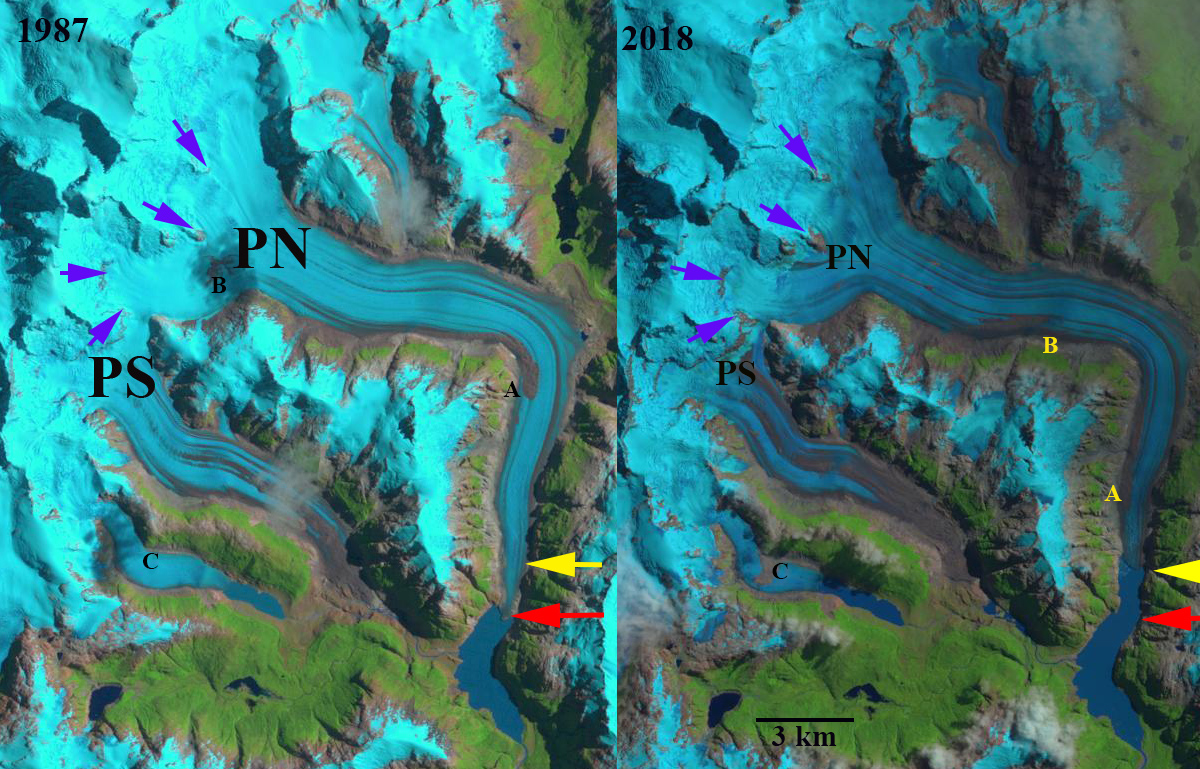
Pared Nord Glacier, Chile in 1987 and 2018 Landsat images.  The red arrow indicates the 1987 terminus location, yellow arrow the 2018 terminus location and purple arrows areas of expanding rock in the lower accumulation zone.  Point A is the front of a wide debris zone from a former landslide, Point B is the front of another landslide deposited debris zone. Point C is a recent landslide deposit on a an unnamed glacier.  The movement f debirs at Point A and B indicate glacier velocity

Pared Nord (Norte) Glacier is a southeast outlet glacier of the Northern Patagonia Icefield (NPI).  Davies and Glasser, (2012)  identify this region of the icefield as retreating faster from 1975-1986 than during any measured period since 1870, the retreat since 2001 has been relatively rapid.   Loriaux and Casassa (2013) examined the expansion of lakes of the Northern Patagonia Ice Cap. From 1945 to 2011 lake area expanded 65%, 66 square kilometers.   Glasser et al (2016) note on Pared Nord that ice-surface debris was transported and redistributed down-ice by glacier flow merging with marginal supraglacial debris.

In 1987 Pared Nord Glacier terminates at a narrow point in the proglacial lake, red arrow.  The debris band at Point A has just turned the corner south towards the terminus and the debris at Point B is near the snowline at the base of the icefall. By 2001 Point B had shifted 4 km downglacier entering the main glacial valley and Point A had shifted 2.5 km towards the terminus.  The terminus had retreated some but was still at the narrow pinning point of the valley.  In 2015 at Point C a landslide had spread across the unnamed glacier. The debris band at Point B had reached the head of a valley from the south side of  the glacier.  In 2018 the purple arrows indicate substantial expansion of bedrock areas near the snowline indicating a rising snowline and glacier thinning.  Glasser et al (2016) note the recent 100 m rise in snowline elevations for the NPI, which along with landslide transport explains the large increase in debris cover since 1987 on Pared Nord.  The main glacier terminus has retreated 1400-1500 m and is currently one kilometer from a widening of the valley, which should lead to an increased calving retreat. The glacier  in 2013 has numerous glacial drainage features, purple arrow in Google Earth image below and substantial crevassing which will lead to calving at the terminus, green arrow. The movement of Point B has been ~4.8 km in 31 years, and of Point A ~3.3 km in 31 years, a velocity of 160 m/year and ~100 m/year respectively.

The retreat of this glacier is less than that of Colonia Glacier to the north and  more than HPN4 glacier to the west.  All the outlet glaciers of NPI have retreated in the last 30 years most leading to expanding proglacial lakes (Pelto, 2017).

Pared Nord Glacier, Chile in 2001 and 2015 Landsat images.  The red arrow indicates the 1987 terminus location and yellow arrow the 2018 terminus location. Point A is the front of a wide debris zone from a former landslide, Point B is the front of another landslide deposited debris zone. Point C is a recent landslide deposit on a an unnamed glacier.  The movement of debris at Point A and B indicate glacier velocity.

Pared Nord terminus in 2013 Google Earth image.  Purple arrows indicate relict glacial drainage features and green arrow large crevasses near the calving front.

Glacier Nef, Patagonia, Chile retreat 1987-2016.

nef compare

Comparison of 1987 and 2015 Landsat images of Nef Glacier at right and Cachet Glacier at left.  Indicating retreat of Nef Glacier from red arrows to yellow arrows of 1.8 km and development of a new lake at the terminus. Purple arrows indicate upglacier thinning leading to separation of glacier tributaries. 

Glacier retreat and thinning is particularly strong in the Patagonian icefields of South America. The two largest temperate ice bodies of the Southern Hemisphere are the Northern Patagonia Icefield 4,000 km2 and the Southern Patagonia Icefield, 13,000 km2. It has been estimated that the wastage of the two icefields from 1995–2000 has contributed to sea level rise by 0.105 ± 0.011 mm year,which is double the ice loss calculated for 1975-2000 (Rignot et al. 2003).   Davies and Glasser (2012) work, has an excellent figure indicating two periods of fastest recession since 1870, are 1975-1986 and 2001-2011 for NPI glaciers, which suggests that ice volume loss increased after 2000. They noted the loss was 0.07% from 1870-1986, 0.14% annually from 1986-2001 and 0.22% annually from 2001-2011. Glasser et al (2011) find the recent ice volume rate loss is an order of magnitude faster than at other time intervals since the Little Ice Age. Baker River (Rio Baker) is located to the east of the Northern Patagonia Icefield and is fed mainly by glacier melt water originating from the eastern outlet glaciers of the icefield Leones, Soler, Nef, Colonia. Rio Baker is the most important Chilean river in terms of runoff, with an annual mean discharge of about 1000 m3/s Lopez and Casassa (2009). Glacier Nef is one of the main glaciers feeding Rio Baker. Rio Baker was a proposed critical hydropower resource for Chile. Hidroaysen Project had proposed 5 dams on the Baker and Pascua River generating 2750 MW of power, all three proposed dams on the Rio Baker have been cancelled.

Glacier Nef began to retreat into a moraine dammed proglacial lake in 1945 (Loriaux and Casassa, 2014). By 1987 the lake remained less than 1 km long, with glacier thinning predominating over retreat. From 1987 to 2015 the glacier has retreated 1.8 km calving into the growing lake.  The lake width was essentially uniform during this phase of retreat There is not significant retreat from 2015 to 2016. The lake is currently about 5.4 square kilometers and has a mean depth of ~125 m (Loriaux and Casassa, 2014).  In 2015 Glacier Nef has not reached the head of this proglacial lake and will continue to retreat. The west side of the terminus is debris covered and has a fringing proglacial lake that has developed after 2000 and will aid in the continuing retreat. The terminus is currently at a pinning point, where the valley is constricted providing greater terminus stability. Further retreat will lead to an expansion of the embayment and calving front, leading to a further increase in glacier retreat. The lack of elevation change of the lower glacier and the isolated proglacial lake here suggests the lake will expand laterally as well as in length. The debris cover is slowing the thinning and retreat of the western margin. The purple arrows indicate thinning upglacier in a former tributary glacier. The 2016 Landsat image indicates a high snowline at 1350 m, purple dots.  Willis et al (2011) observed that the thinning rate of NPI glaciers below the equilibrium line has increased substantially from 2000-2012, partly an indication of a higher snowline indicative of greater ablation and a longer snow free period lower in the ablation zone. For example on Nef Glacier by January 8, 2016  the snowline was at 1300 m and remained high up until at least the mid-march image below. The retreat follows the pattern of enhanced calving in a proglacial lake for NPI glaciers such as Gualas GlacierReichert Glacier, Steffen Glacier, and Colonia Glacier.
nef 2016

2016 Landsat image of Nef Glacier indicating terminus yellow arrow and source of the debris for the debris covered terminus. 

nef terminus

Closeup of Nef Terminus from Chile Topographic Application.  Notice the widening valley just above terminus.  Debris cover is insulating ice on west side of terminus.  

San Quintin Glacier, Chile terminus disintegration 1987-2015

san quentin compare

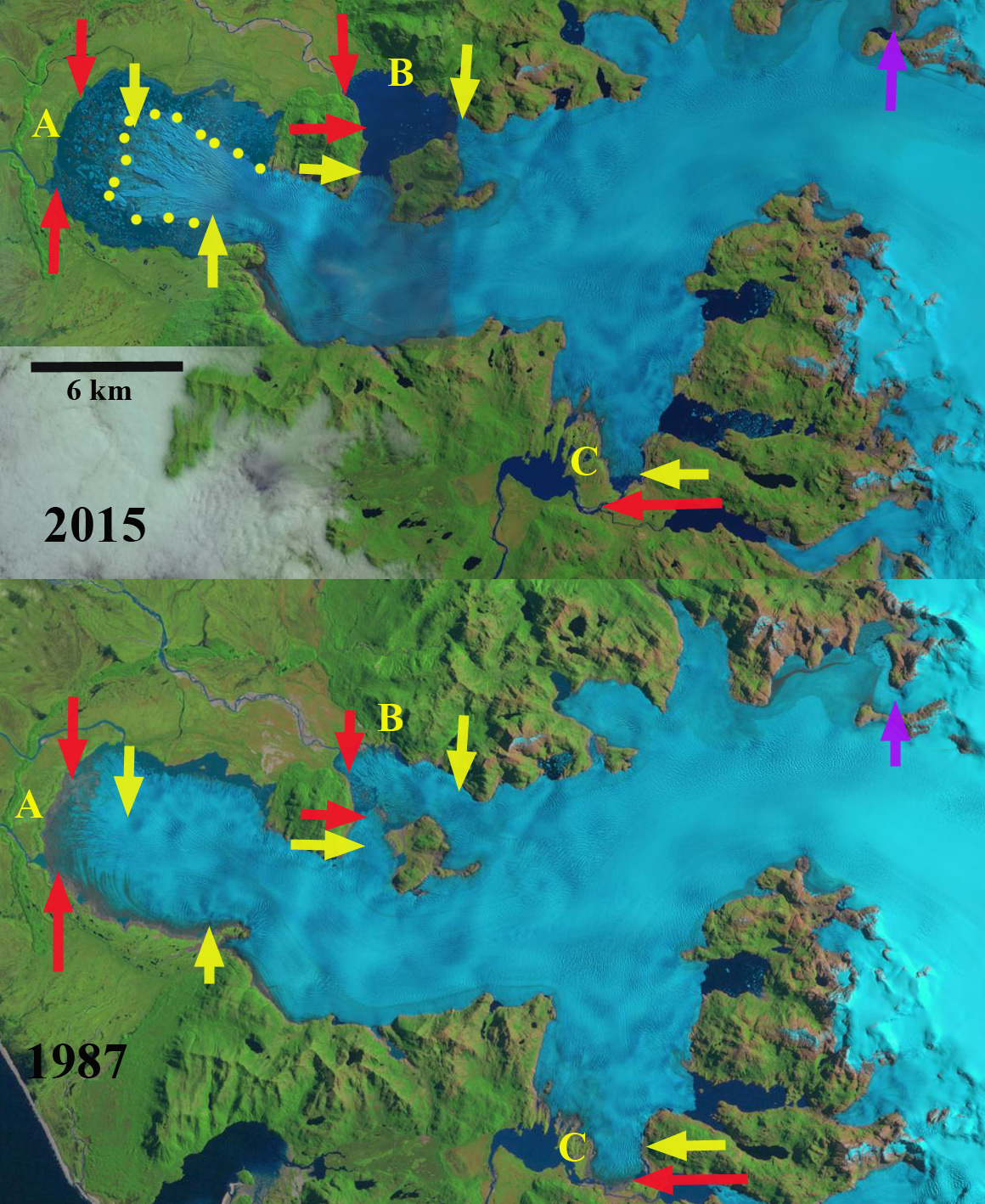
Landsat comparison of San Quintin Glacier in 1987 and 2015: red arrow indicates 1987 terminus location, yellow arrow indicates 2015 terminus location of the three main termini, and the purple arrow indicates upglacier thinning.

San Quintin is the largest glacier of the NPI at 790 km2 in 2001 (Rivera et al, 2007).  The glacier extends 50 km from the ice divide in the center of the ice cap.  The peak velocity is 1100 m/year near the ELA (Rivera et al 2007), declining below 350 m/year in the terminus region.  The velocity at the terminus has increased from 1987 to 2014 as the glacier has retreated into the proglacial lake (Mouginot and Rignot, 2015).  The high velocity zone extends more than 40 km inland an even greater distance than at San Rafael (Mouginot and Rignot, 2015).  Thinning rates in the ablation zone of the glacier are 2.3 m/year (Willis et al, 2012).  The glacier has a low slope rising 700 m in the first 22 km. The low slope, broad piedmont lobe and many distributary terminus lobes is like the Brady Glacier, Alaska.

Davies and Glasser (2012) note that San Quintin Glacier terminated largely on land until 1991. The glacier has lost 15 % of its area in the last century (Davies and Glasser, 2012).  The glacier has a main terminus and many subsidiary termini.  In 1987 it is a piedmont lobe with evident minimal marginal proglacial lake development beginning. There is limited lake development at the main southern and northern terminus Point C and B respectively. Harrison et al (2001) observed that in 1993 the glacier terminus was advancing strongly into vegetated ground, while from 1996 to May 2000 the glacier underwent a transition between advance and retreat.  The high rates of thinning are leading to the retreat not just of main terminus but the distributary terminus areas extending north and south into lake basins from the main glacier. From 1987 to 2015 the main terminus retreated 2200 m, almost all after 2000, largely through a disintegration of the terminus tongue in a proglacial lake.  Extensive rifting of the terminus lobe in 2013 and 2015 is still apparent in imagery below, indicating this rapid area loss is not finished.  The main lake, Point A, had an area of 23.8 square kilometers in 2011 (Loriaux and Cassasa, 2013) . The lake at Point B developing on the north side of the glacier, due to a 3500 m retreat, is now over 8 square kilometers.  The southern terminus at Point C, has a narrow fringing lake and a retreat of 1100 meters from 1987-2015. The retreat here follows the pattern of Fraenkel GlacierAcodado Glacier and Steffen Glacier to the south.

san quintin overview

Digital Globe image of San Quintin Glacier in 2011.

san quintin terminus 2013

2013 Google Earth image, with the large rifts indicating glacier weakness noted with blue arrows. 

san quintin terminus 2015

2015 Landsat image, yellow line indicates terminus. Note the tongue is surrounded on three sides by water.