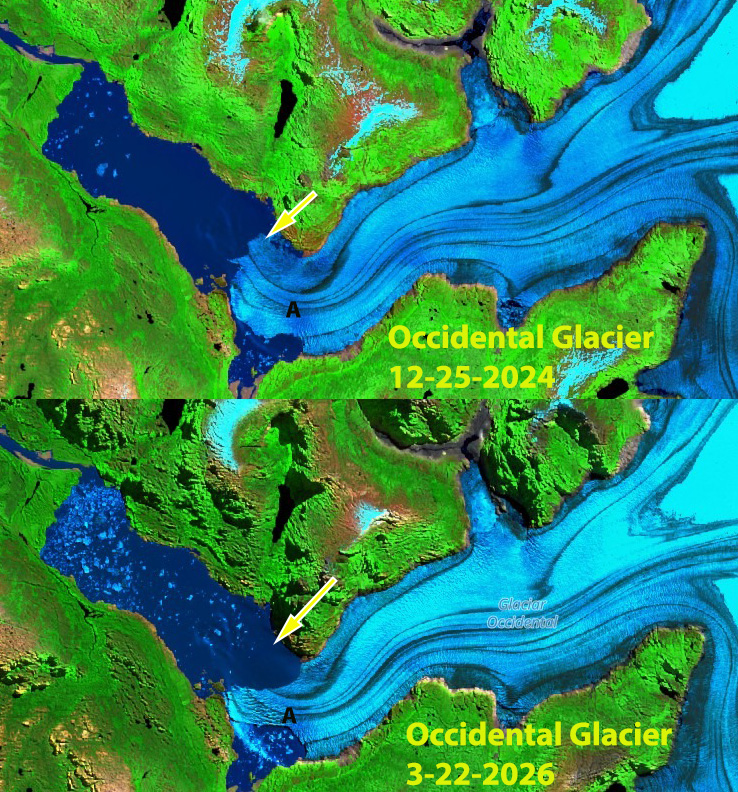
Occidental Glacier in Sentinel images from Dec. 2024 and March 2026 indicating the rapid narrowing of the terminus tongue A, that from the numerous icebergs is actively underway.
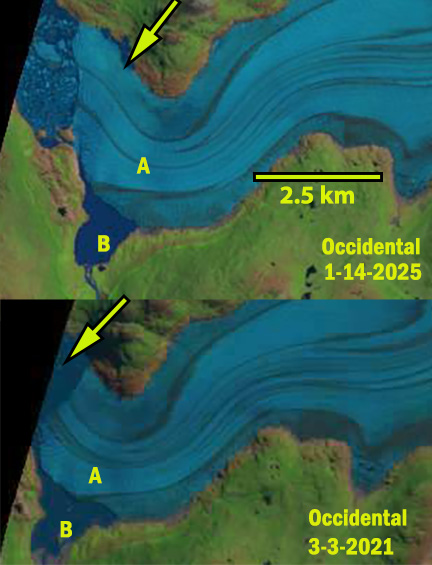
Occidental Glacier is an outlet glacier draining west from the Southern Patagonia Icefield. In 2015 the glacier terminus rested on the western shore of a proglacial lake where it bends to the northwest. At Point B a glacier lake was dammed by the ice front. From 2015 to 2021 the northwestern margin of the terminus retreated along the northern shore of the lake. By 2021 the lake at Point B was no longer ice dammed and its water level had declined. The terminus tongue (A) continued to extend to the western shore providing a stable pinning point through 2025.
In 2026 the connection to the western shore has narrowed with the embayment at Point B extending north and east. The terminus tongue (A) on March 22, 2026 is just 850 m wide and actively narrowing, note fresh icebergs. This connection is not stable and will not endure, which will generate significant terminus retreat. This glacier follows neighbors to the north Tempanos and Bernardo Glacier in this process each retreat leading to lake expansion, but also drainage of ice dammed lakes.
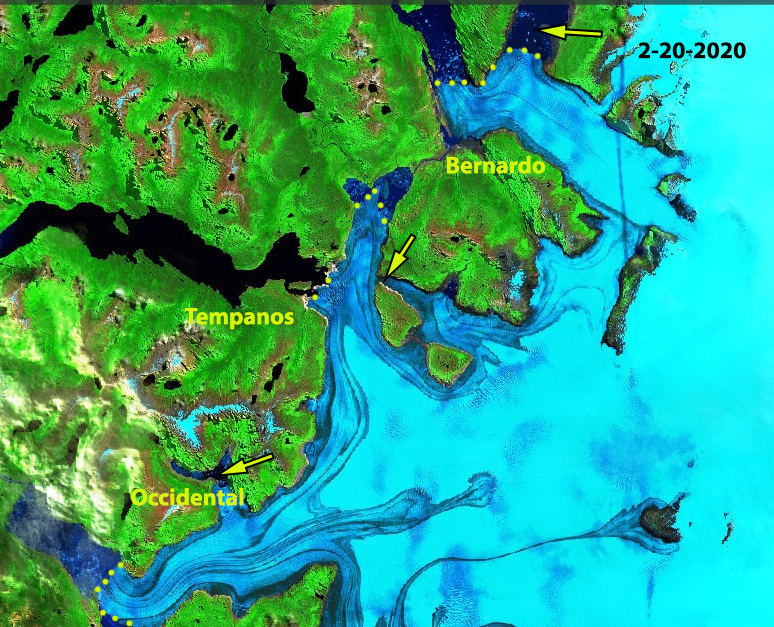
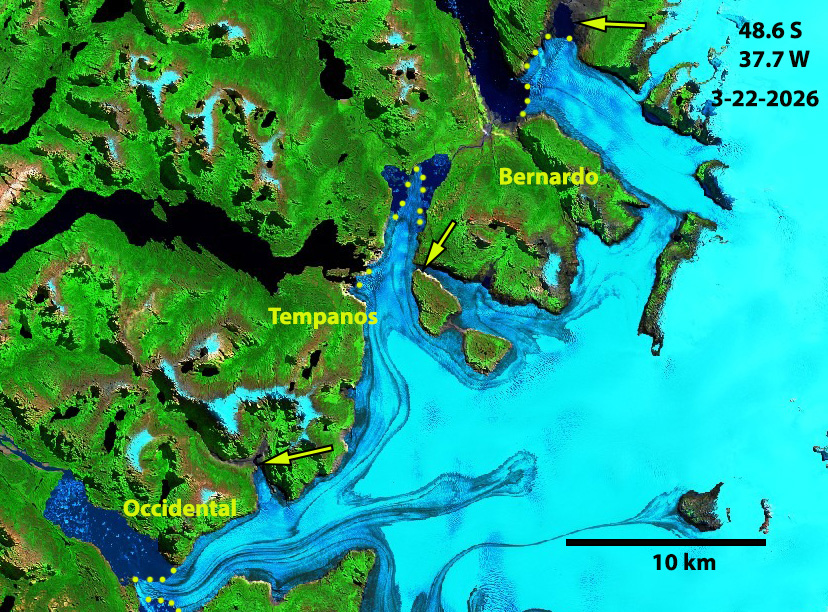
Occidental Glacier in Landsat images indicating the retreat of the terminus along the northern shore, the drainage of the embayment at B indicating diminished connection to the western shore of the lake.In 2020 Bernardo, Tempanos and Occidental Glacier had wide terminus tongues terminating in proglacial lakes.By 2026 Bernardo, Tempanos and Occidental Glacier terminus tongues had retreated and narrowed leading to both expansion of proglacial lakes and drainage of a couple ice dammed lakes that the terminus had impounded.
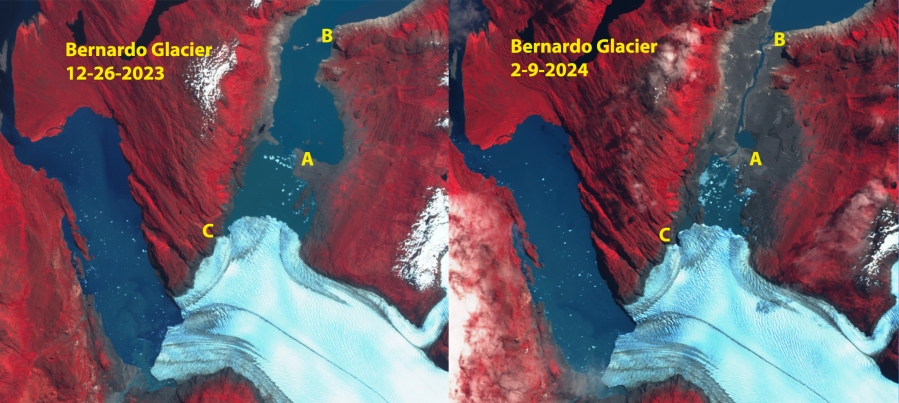
Bernardo Glacier in Sentinel images from Dec. 26, 2023 and Feb. 9, 2024 illustrating the drainage of the southern end of the proglacial lake by the northern terminus. The lake was full in 2021, partially drained by Oct. 2022, further drained by March 2023 and did not refill through Sept. 2023. The lake refilled between September and December 2023 . And drained again by Feb. 9,2024. Channel location appears to be at Point C. There is 9 km2 of exposed lake bed.
Bernardo Glacier in Sentinel images from Oct. 16, 2022 and Sept. 17, 2023 illustrating the drainage of the southern end of the proglacial lake by the northern terminus (N). The lake was full in 2021, partially drained by Oct. 2022, further drained by March 2023 and has not significantly refilled by Sept. 2023, still 8 km² of exposed lake bed.
Bernardo Glacier in Landsat images from 1986 and 2021 illustrating retreat at the southern (S), middle (M) and northern (N) terminus respectively. Red arrows are 1986 terminus locations, yellow arrows are 2021 terminus locations. Separation from Tempano (T) occurs at southern terminus, while lake expansion occurs at M and N.
Retreat of Bernardo Glacier in Landsat images from 2003 and 2015.
In 1986 Bernardo the southern terminus of the glacier was in tenuous contact with Tempano Glacier. The middle terminus primarily ended on an outwash plain with a fringing proglacial lake developing. The northern terminus had retreated a short distance south from a peninsula that had acted as a pinning point. A small lake developed completely separating Bernardo Glacier and Tempano Glacier. By 1998 the northern terminus had retreated into the wider, deeper portion of the lake basin that was now filled with icebergs. In 2015 the northern terminus had retreated 3.5 km since 1986. By 2021 the northern terminus had retreated 4.1 km. This led to a 7.8 km² lake expansion at the northern terminus, with a total lake area of 17.5 km².
On October 2, 2022 the water level had dropped some, with lake area falling slightly. The lake continued to fall through the summer season of 2023. The lake did not refill through the winter and into the spring, September 2023, with the lake having an area of 9.5 km², and 8 km² of lake bed still exposed. The lake did refill by December 2023, and then drained to an even greater extent then in 2023 as of Feb. 2024. Continue glacier thinning and retreat will reduce the ability of the glacier to continue to dam this lake. Gourlet et al (2016) identify Bernardo Glacier as having thinner ice than other large outlet glaciers such Jorge Montt or O’Higgins, which helps lead to rapid terminus change.
Southern Andean huemel an endemic deer on the foreland beyond Bernardo Glacier (Photograph from Eñaut Izagirre