Upsala Glacier Separation from Bertacchi Glacier, Argentina

Upsala Glacier (U) in Landsat images from 1999, 2016 and 2021 illustrating both retreat and the separation from Bertacchi Glacier (B). Cono Glacier (C) is the next tributary to the north.

Upsala Glacier is a major outlet glacier of the Southern Patagonia Icefield. The glacier terminates in Lago Argentina and retreated substantially, 7.2 km from 1986-2014 (NASA, 2014). The retreat accelerated after 2008 (Sakakibara et al 2013). From 2014-2019 the rapid retreat had slowed, but given mass losses upglacier and consistent high snowlines ~1300 m in 2018-2021, not for long.

Landsat images from 1999-2021 illustrate the retreat of the glacier.  In 1999 the terminus is 3 km south of the junction.  By 2016 the terminus has retreated to the junction.  The combined calving front has a width of 2.8 km, and there is a 1.3 km long connection zone between Bertacchi and Upsala. By April and May 2021 the separation is nearly complete with a 0.3 km long connection zone, and in increase to 3.3 km wide calving front, in a Sentinel 2 image from May 5, 2021. The glaciers that have been joined for many centuries if not millenia, provide stability to each other at the junction, as there is converging flow that buttresses both.  As this buttressing is removed, the terminuses of both glaciers in the vicinity of the current terminus will be less stable.

De Angelis (2017)  noted the equilibrium line for Upsala Glacier was 1170 m based on 2002 and 2004 observations, which equates to an AAR of 65%.  On Feb 14, 2018 the TSL reached its highest observable elevation at 1275-1300 m. On March 14, 2019 the TSL reached 1300 m again. On April 8, 2020 the TSL reached 1325-1350 m upglacier of Point A and nearly to the Viedma Glacier divide. On April 17, 2020 the TSL had descended slightly to 1300 to 1325 m.  The ELA of ~1350 m is the highest annual observation for Upsala Glacier and equates to an AAR of ~48%. On April 17, 2021 the snowline on Upsala Glacier is again at ~1300 m. The consistently high snowlines drive mass balance losses, which leads to thinning and reduced flux to the terminus.  Malz et al (2018) indicated a 3.3 m thinning of Upsala glacier with significant thinning extending to the Viedma Glacier divide. Popken et al (2019) mapped the velocity at the confluence. The much slower Bertacchi has a low terminus velocity, in part due to the buttressing of Upsala.

The separation of Upsala Glacier due to rapid retreat parallels this pattern observed at other Southern Patagonia icefield outlet glaciers; Lago Onelli and  Dickson Glacier

May 5, 2021 Sentinel image of terminus zone of Upsala and Bertacchi Glacier.

Snowline on Upsala Glacier in April 2020 and 2021 Landsat images-pink dots, both years above 1300 m.

Terminus of Bertacchi and Upsala glacier in Apil 2020 and March 2021, note icebergs in March of 2021 from recent calving.
Upsala Glacier, Argentina Limited Snowcover Cloak as 2020 Melt Season Ended

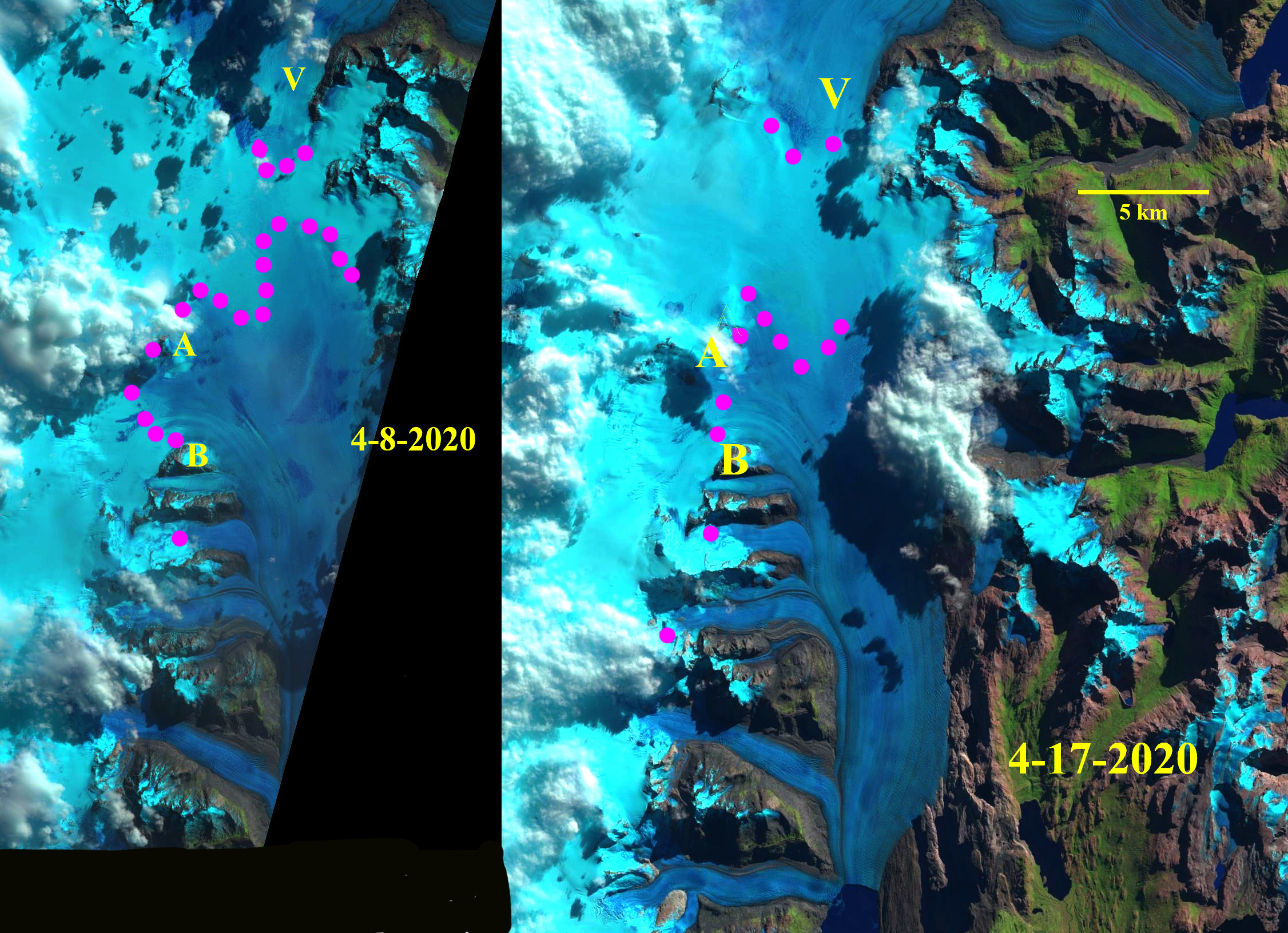
Upsala Glacier transient snowline (TSL) in Landsat images from April 8 and April 17, 2020. TSL is indicated by purple dots, Point A and B are the same nunataks in each image. On April 8 the TSL almost reaches the divide with Viedma Glacier (V). 

Glaciers exist and survive when the majority of the glacier is always snow covered even at the end of the summer melt season. For a calving glacier the percentage of the glacier in the accumulation zone (accumulation area ratio: AAR) required to be in equilibrium is at least 65%, depending on calving rate. At the end of the melt season the transient snow line (TSL) is the equilibrium line where melting equals accumulation, above this point accumulation is retained. In the last year we have observed a number of glaciers with exceptionally limited retained snow cover at then end of summer in 2019. The limited AAR is a driver of mass balance loss and future terminus retreat. Here we report on the TSL on Upsala Glacier, Argentina in April 2020. This glacier flows south from a divide with Viedma Glacier and is fed from the crest of the Southern Patagonia Icefield. The glacier terminates in Lago Argentina and has retreated substantially, 7.2 km from 1986-2014 (NASA, 2014).

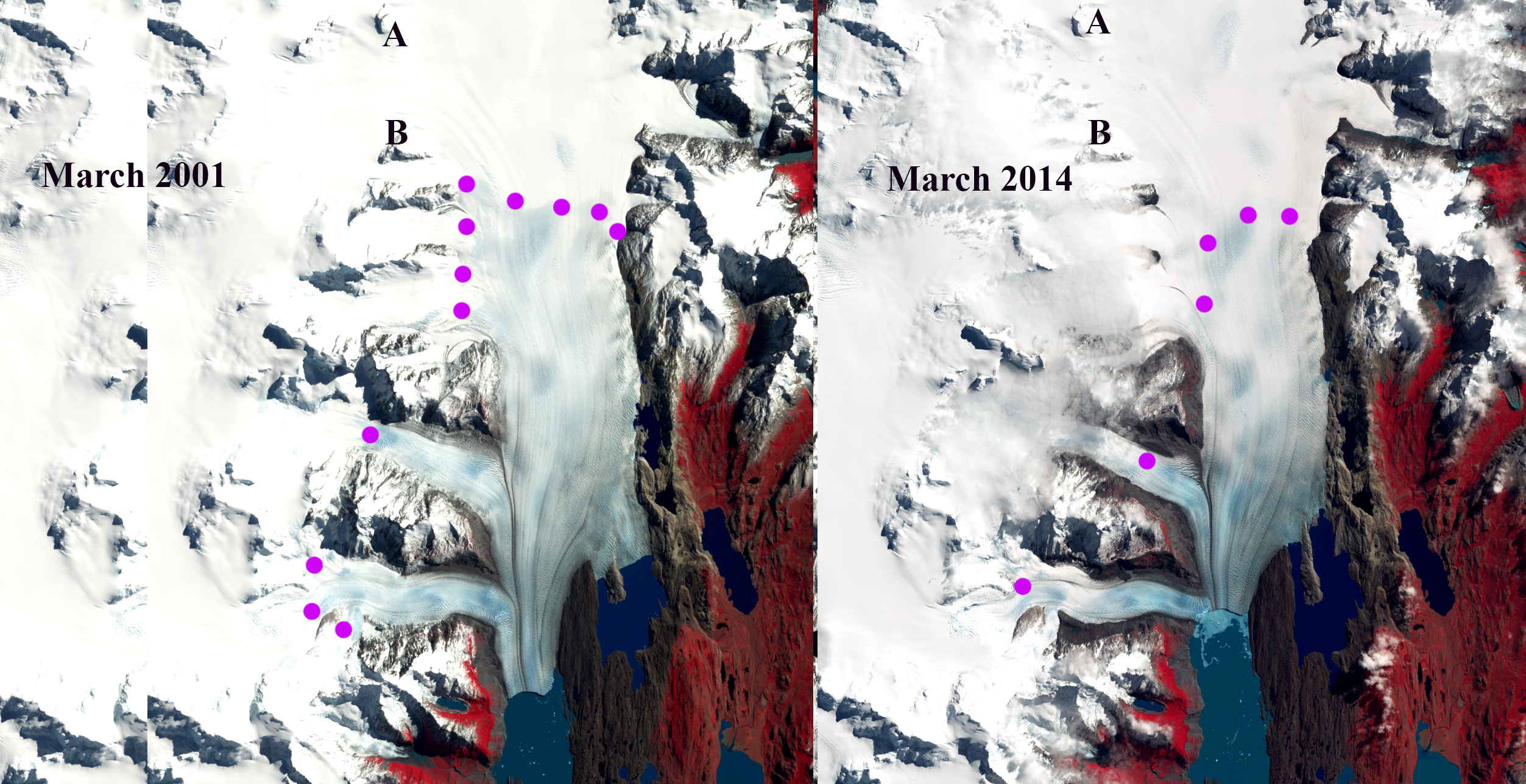
De Angelis (2017)  noted the equilibrium line for Upsala Glacier was 1170 m based on 2002 and 2004 observations, which equates to an AAR of 65%. Landsat images from 2001 and 2014 both from March indicate a TSL at 1075 m in 2001 and 950 m in 2014. With the snowline downglacier of Point B. On Feb 14, 2018 the TSL reached its highest observable elevation at 1275-1300 m. On March 14, 2019 the TSL reached 1300 m. On April 8, 2020 the TSL is between 1325 and 1350 m upglacier of Point A and nearly to the Viedma Glacier divide. On April 17, 2020 the TSL has descended slightly to 1300 to 1325 m.  The ELA of ~1350 m is the highest annual observation for Upsala Glacier and equates to an AAR of ~48%. Malz et al (2018) indicated a 3.3 m thinning of Upsala glacier with significant thinning extending to the Viedma Glacier divide. Since 2014 retreat has largely paused, but given mass losses upglacier and consistent high snowlines ~1300 m in 2018-2020, not for long.

The unusually high snowlines in 2019 were observed at the Northern Patagonia IcefieldTaku Glaicer, Alaska and on Penny Ice Cap, Baffin Island.

Upsala Glacier transient snowline (TSL) in Landsat images from March 2001 and March 2014. TSL is indicated by purple dots, Point A and B are same location on each map.

Upsala Glacier transient snowline (TSL) in Landsat images from February 14, 2018 and March 14, 2019. TSL is indicated by purple dots, Point A and B are same location on each map.

Map from GLIMS of the glacier divide of Upsala and Viedma Glacier with contours in meters noted.

Lucia Glacier, Chile Retreat Opens New Embayment

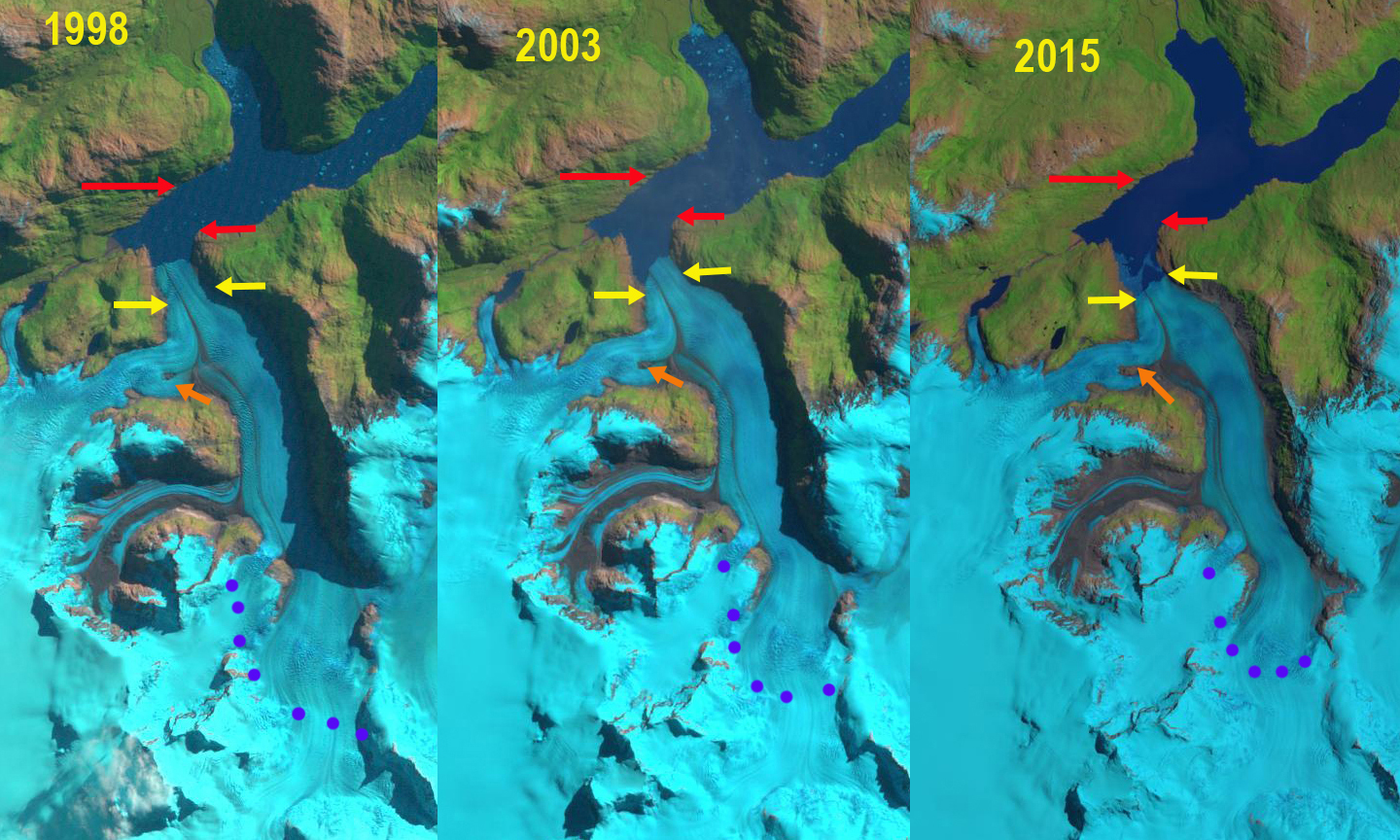
Lucia Glacier retreat from 1987 to 2016 in Landsat images.  Red arrows mark 1987 terminus, yellow arrows 2016 terminus, orange arrow an emerging bedrock area, pink arrow a tributary with increased debris cover and purple dots the snowline.

Lucia Glacier terminates in Lago Berguez at the northern margin of the Southern Patagonia Icefield.  The lake drains into the Rio Pascua.   Willis et al (2012) observed that between February 2000 and March 2012 the Southern Patagonia Icefield rapidly lost volume and that thinning extends even to high elevations.   Mouginot and Rignot (2014) illustrate that velocity peaks at 1 km/year and reamins above 500 m/year  from the terminus to the accumulation zone on Lucia Glacier. The overall retreat has been driven by increasing calving rates from the 1975-2000 to the 2000-10 period (Schaefer et al, 2015). The pattern of retreat is consistent between these glaciers and the region as noted by Davies and Glasser (2012).  They note Lucia Glacier terminus retreat rate from 1870 to 2011 was highest from 1986-2001.  Glasser et al (2016) observed both an increase in glacier proximal lakes and in debris cover on glaciers with glacier retreat from 1987-2015. In this case the glacier is now terminating in an expanding proglacial lake, and except for one western tributary that has had increased significant debris cover, the glacier has limited debris cover.

In 1987 the glacier terminated in a north south front in the lake, at red arrows.  The snowline was at 1050 m.  The western tributary at the pink arrow had 25% debris cover, while the orange arrow indicates a location covered by ice. By 1998 the glacier has retreated into a new arm of Lake Berguez and has an east west front. The snowline is at  1275 m.  The western tributary now has 55% debris cover.  In 2003 the snowline is at 1250 m and the orange arrow indicates and emerged bedrock area forming a new lateral moraine. By 2016 the glacier has retreated 3600 m on the west side and 1700 m on the east side.  The mean frontal retreat is ~2700 m in the 30 year period, 90 m/year   The snowline is at 1150 m in 2015 and 1300 m in 2016.  The western tributary is now 80% debris covered.  The terminus itself in 2003 was 1.3 km wide.  In 2016 the calving front is 1.1 km wide.  Upglacier of the current terminus the calving front will expand to 2 km in width  with a ~1.5 km  retreat.  This indicates the glacier is at a narrow point now that minimizes calving and that continued retreat will soon lead to an increase in calving.  The retreat has exposed steep unstable slopes particularly on the east side of the glacier note below and NASA image.  The retreat is greater than neighboring Gabriel Quiroz Glacier and less than Bernardo Glacier.

Lucia Glacier retreat from 1987 to 2016 in Landsat images.  Red arrows mark 1987 terminus, yellow arrows 2016 terminus, orange arrow an emerging bedrock area, and purple dots the snowline.


Google Earth image indicating the front of Lucia Glacier (yellow dots) and slopes destabilized by glacier retreat and thinning, pink arrows.

Bernardo Glacier, Patagonia, Chile Accelerated Retreat in Expanding Lake Complex

bernardo compare

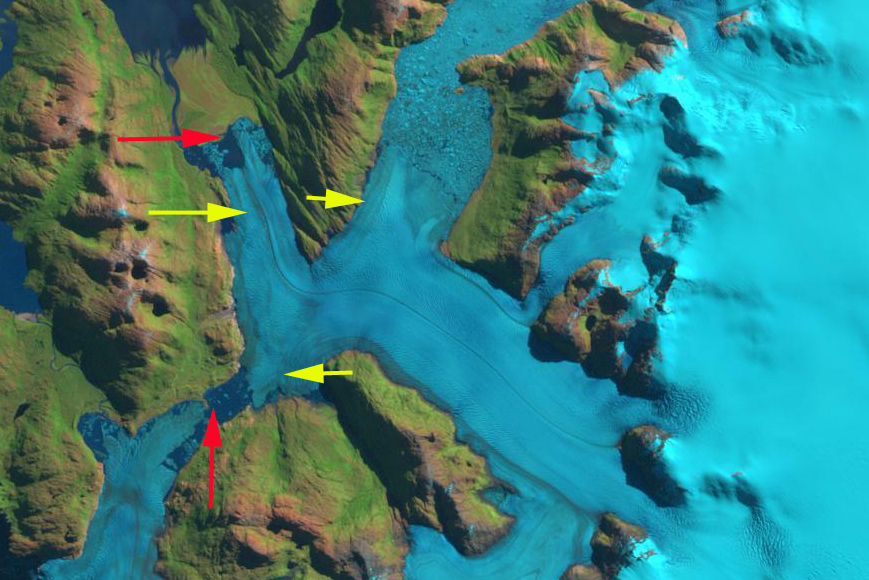
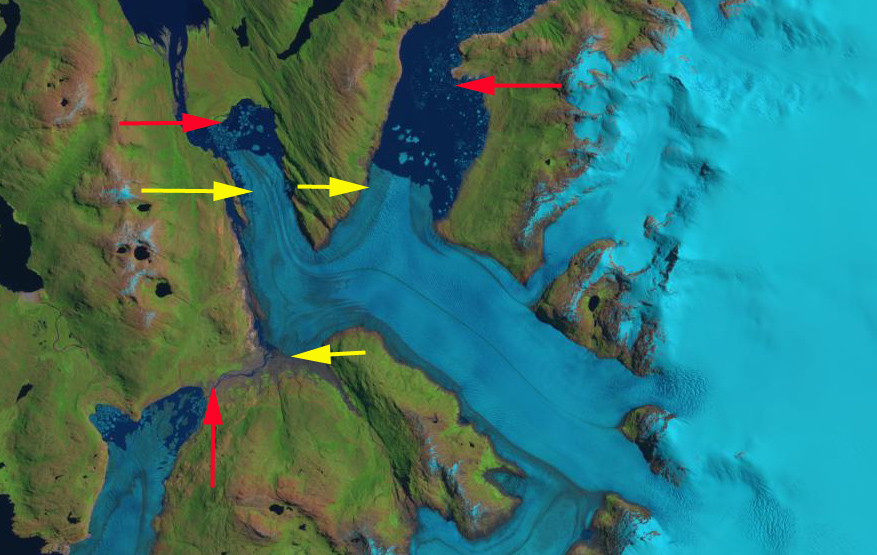
Comparison of 1986 and 2015 Landsat image of Bernardo Glaciers three termini, north, main and south. Red arrows indicate 1986 terminus location and yellow arrows the 2016 terminus location.  Indicating the substantial retreat of each terminus and lake expansion for the north and main terminus, while the lake drained at the southern terminus. 

Bernardo Glacier is a difficult to reach outlet glacier on the west side of the Southern Patagonia Icefield (SPI).  It The glacier currently ends in an expanding proglacial lake system, with three primary termini.  Here we examine changes from 1986 to 2016 using Landsat images. Willis et a (2012) quantify a rapid volume loss of the SPI from 2000-2012 of 20 giga tons per year mainly from rapid retreat of outlet glaciers. They note a thinning rate of 3.4 meters per year during this period of the Bernardo Glacier region. Mouginot and Rignot (2014) illustrate that velocity remains high from the terminus to the accumulation zone on Bernardo Glacier.  They also indicate the accumulation zone does not extend as far east toward the crest of the SPI as previously mapped. Davies and Glasser (2012) indicate that over the last century the most rapid retreat was from 2000 to 2011.

In 1986 Bernardo the southern terminus of the glacier was nearly in contact with Tempano Glacier.  The main terminus primarily ended on an outwash plain with a small proglacial lake developing.  The northern terminus had retreated a short distance south from a peninsula.  By 1998 the northern terminus had retreated into a wider, deeper lake basin, filled with icebergs. The main terminus is still mainly grounded on an outwash plain.  A small lake has developed between Bernardo Glacier and Tempano Glacier to the south. By 2003 the northern terminus had retreated 2 km from 1986, the main terminus 1.5 km and the southern terminus 1.2 km.  By 2015 the lake between Tempano and Bernardo Glacier had drained.  The main terminus had retreated 1.5 km since 1986.  In 2016 the northern terminus had retreated 3.5 km since 1986, the main terminus 2.5 km and the southern terminus 2.75 km.  The largest change is the loss of the lake between Tempano and Bernardo Glacier which slow the retreat of the southern terminus. If this terminus retreat into the another lake basin that shared with the main and north terminus, this would likely destabilize the entire confluence region.  The nearly 1 km retreat in a single year from 2015 to 2016 of the main terminus indicates the instability that will lead to further calving enhanced retreat. The retreat of this glacier fits the overall pattern of the SPI outlet glaciers, for example Chico Glacier and Lago Onelli Glaciers

.bernardo 1998

1998 Landsat image.  Red arrows indicate 1986 terminus location and yellow arrows the 2016 terminus location.

bernardo 2003

2003 Landsat image.  Red arrows indicate 1986 terminus location and yellow arrows the 2016 terminus location.  Main terminus beginning to retreat from outwash plain. 

bernardo 2015

2015 Landsat image.  Red arrows indicate 1986 terminus location and yellow arrows the 2016 terminus location.  Note the considerable difference in main terminus versus one year later in 2016.