Oriental Glacier, Chile Retreats from Island Poised for Rapid Lake Expansion

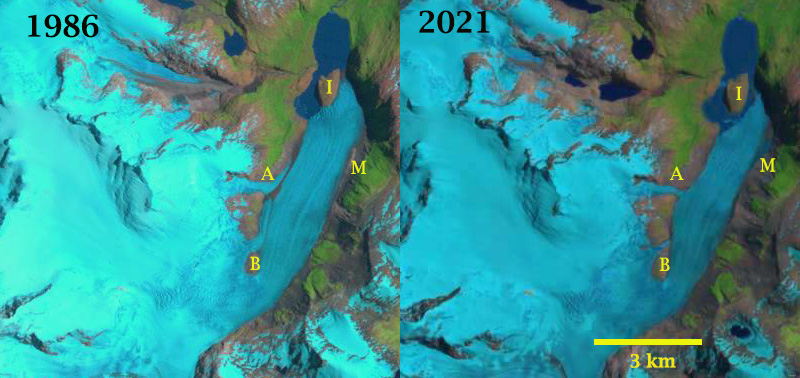
Oriental Glacier in 1986 and 2021 Landsat imagery illustrating retreat from the island (I) and diminishing width and flow of tributaries at P0int A and B. A marginal lake has formed at Point M as the glaciers terminus section has thinned and narrowed.

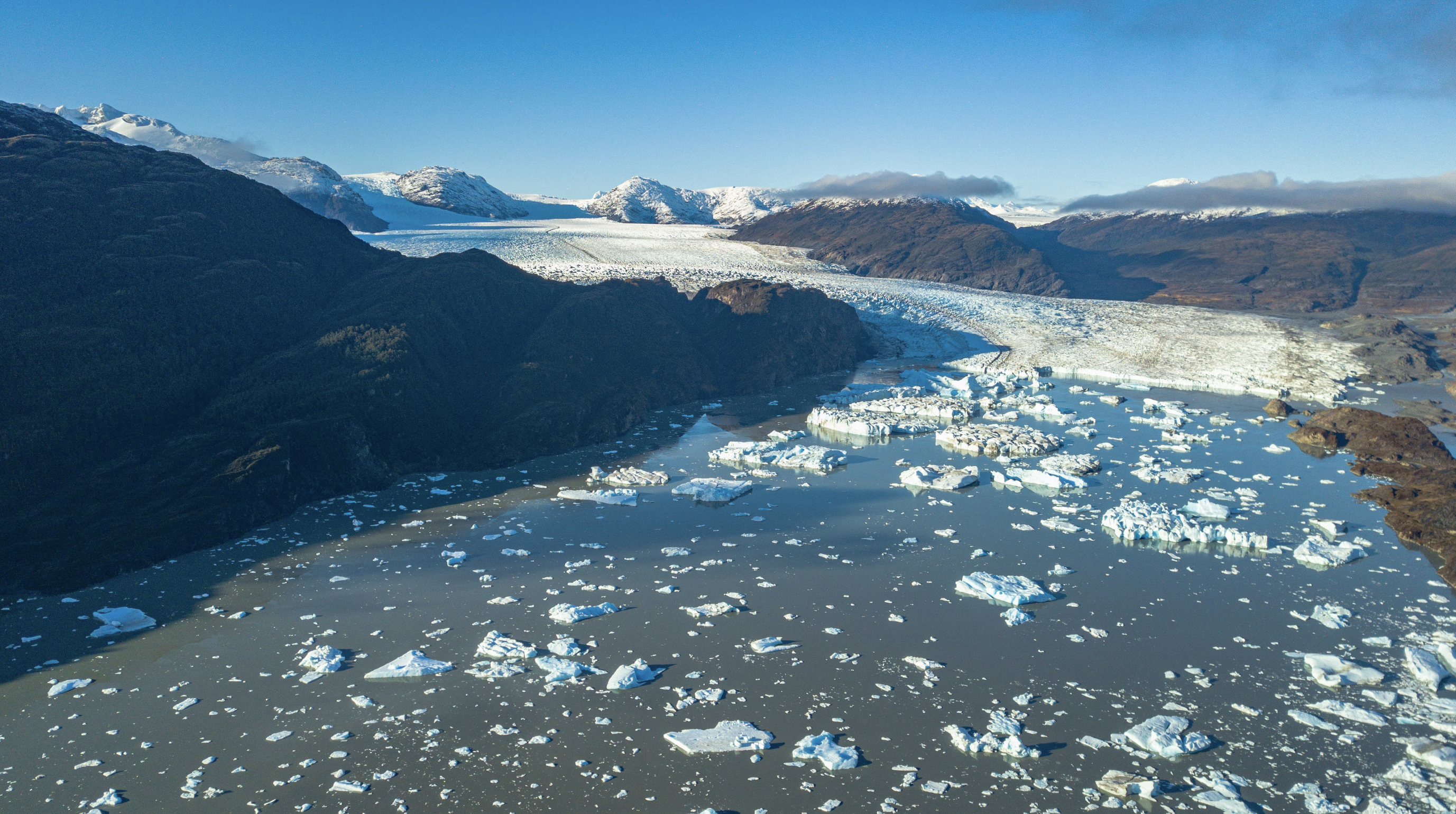
Oriental Glacier terminates in an expanding proglacial Lago Oriental at the northeastern margin of the Southern Patagonia Icefield (SPI). The glacier had terminated on an island in this lake for several decades until 2019. In this region glaciers thinned ~0.5 m/year from 2000-2012 with Oriental Glacier thinning 0.5-1.0 m/a (Falaschi et al 2017)..  Mouginot and Rignot (2014) identified a velocity peak at 1 km/year extending from the Cerro Azul (3018 m) eastward to the northward terminus bend.  Oriental Glacier had a slower retreat than most SPI  glaciers from 1870-2011 at 0.1-0.15 km/a, and the fastest rate from 2001-2011 Davies and Glasser (2012). Here we examine Landsat imagery from 1986 to 2021 to illustrate glacier changes and Sentinel imagery from 2020 and 2021 illustrating island separation and retreat acceleration.

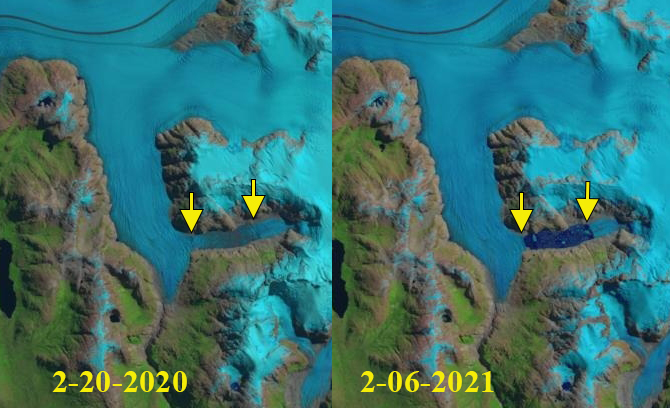
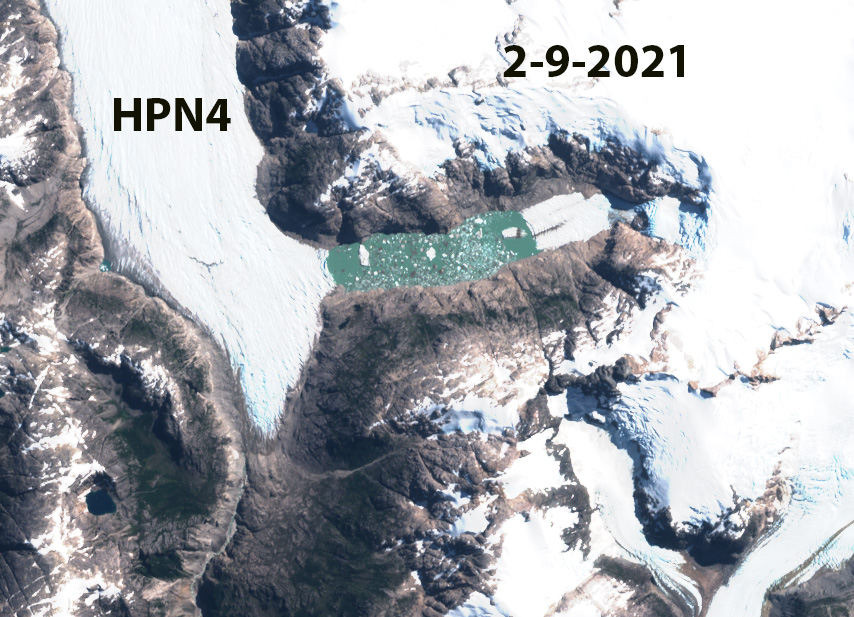
In 1986 the glacier terminates on the island with a small proglacial outwash plain in front of the eastern tongue, marginal connection is 1.5 km long. Tributary A and B are both significant contributors to the terminus tongue. At Point M the glacier is 1.75 km wide.  The surface slope of the lower 6 km of the glacier in from 1986-2002 is ~4-5%, this is a low surface slope, suggesting this section of the glacier occupies a basin, a continuatin of the current Lago Oriental.  In 1998 there is little evident change.  By 2002 the glacier connection to the island has a similar length, but the ice is thinner than in 1986. In 2015, tributary A and B are narrower, contributing less ice to the terminus region. The connection to the island is reduced to ~1 km, while the proglacial outwash plain is still similar in size. In January of 2019 the connection to the island is almost gone and the proglacial outwash plain is significantly reduced. The marginal lake is ~0.05 km2. By February of 2020 the connection to the island has been lost and the marginal lake has expanded to 0.1 km2. In 2021 the glacier has retreated 150 m from the island and a rift has formed that will lead to a signficant calving event ~0.125 km2, probably this summer. The marginal lake has expanded to 0.2 km. Tributary B has essentially separated from the main glacier in 2021.

Calluqueo Glacier retreat and Lucia Glacier retreat have been significantly larger; however, Oriental Glacier is poised for a rapid retreat and lake expansion. The lake basin likely extends at least 5 km from the present terminus. At that point Lago Oriental would be 9 km long.
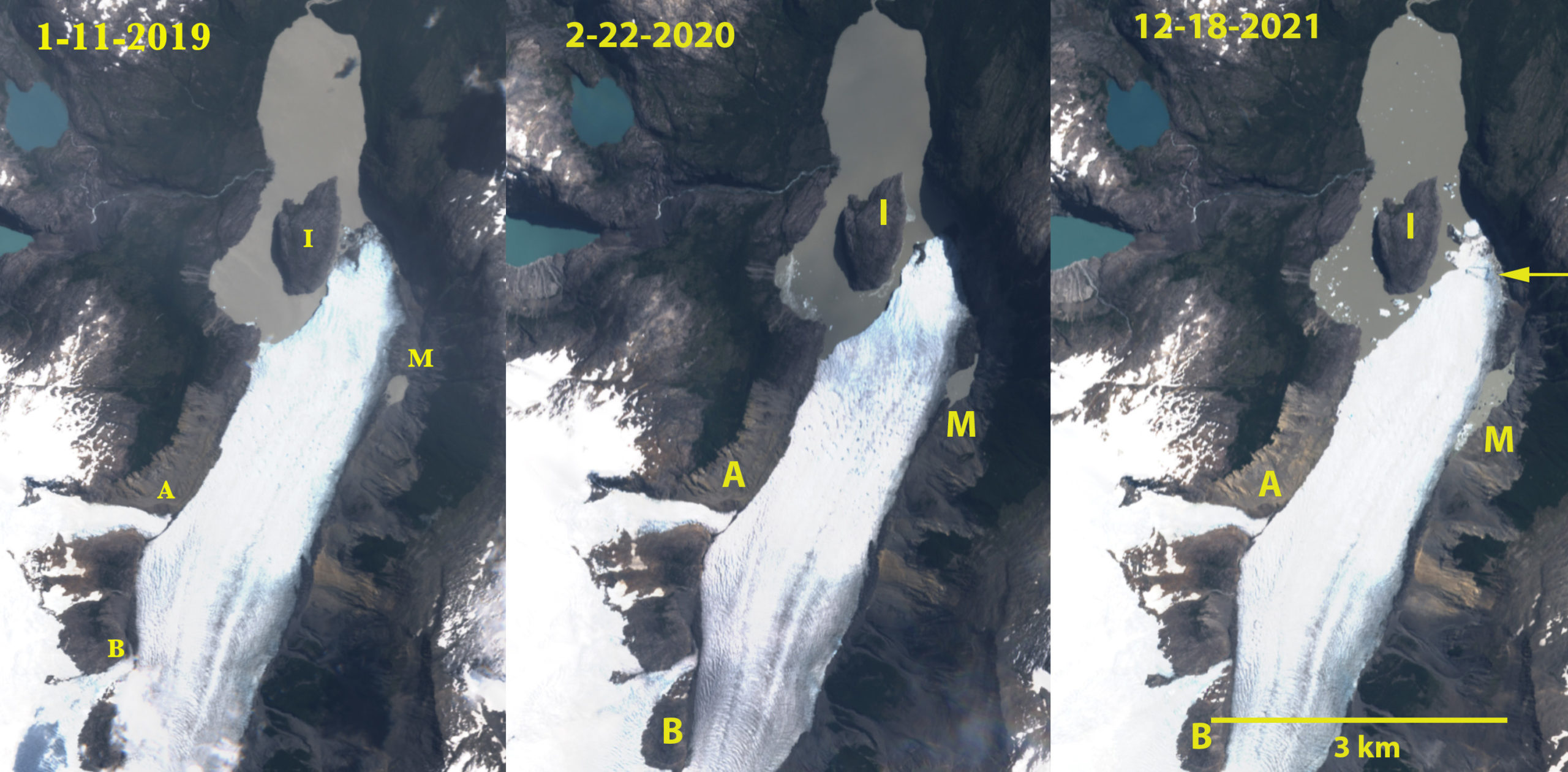
Oriental Glacier terminus reach in 2019, 2020 and 2021 Sentinel 2 imagery illustrating retreat from the island (I) and expansion of the marginal lake at Point M. Note tributary B has essentially disconnected in 2021. A rift is forming at yellow arrow, poised for a calving event this summer.
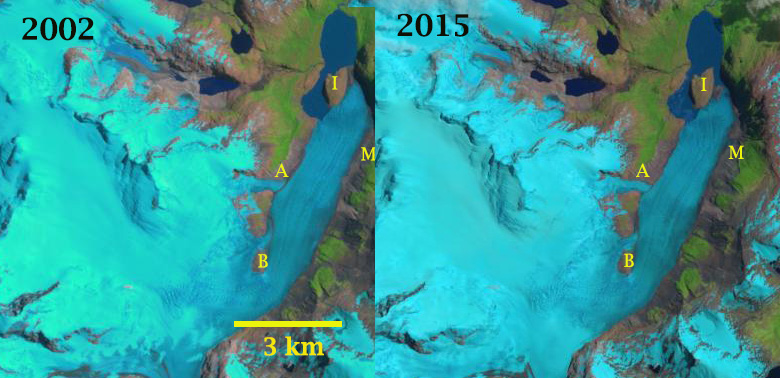
Oriental Glacier in 2002 and 2015 Landsat imagery illustrating connection remaining to the island (I). A small marginal lake has formed at Point M as the glaciers terminus section has thinned and narrowed.

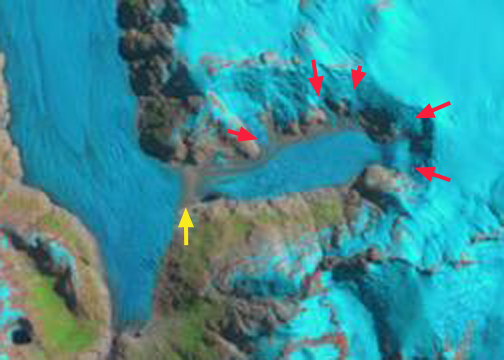
Oriental Glacier in 1998  Landsat image and topographic map of area. Elevation contours indicates low slope of termius reach from 600 m to terminus. Blue arrows indicate glacier flow. 
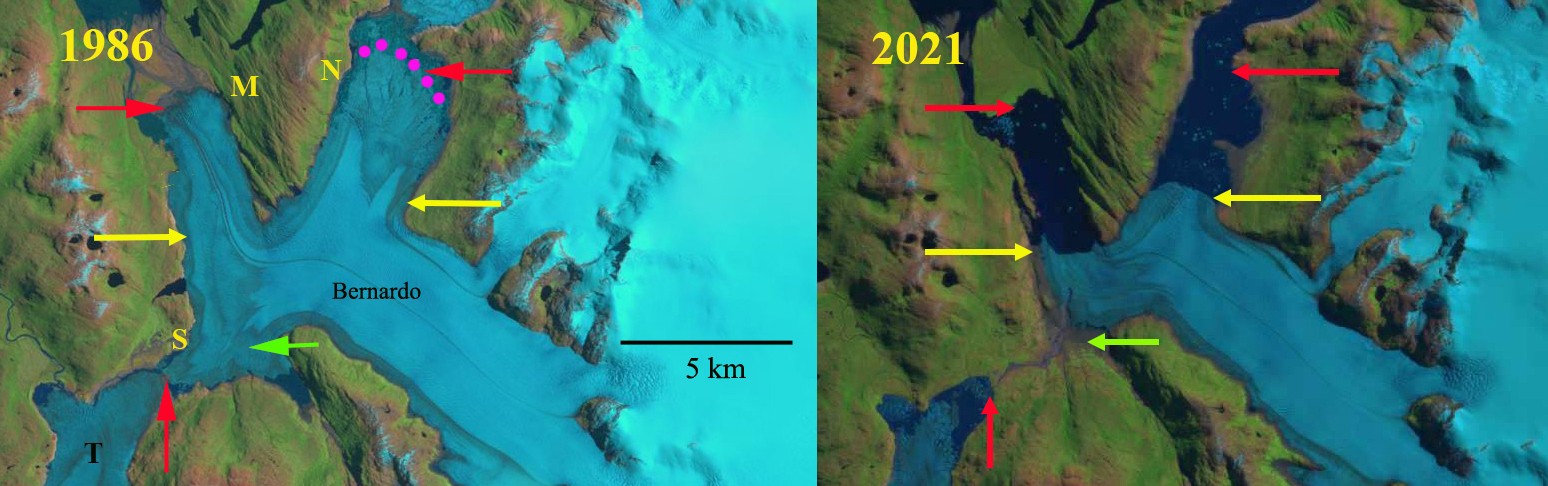
 

Bernardo Glacier, Chile Retreat Yields 15 km2 Lake Expansion 1986-2021

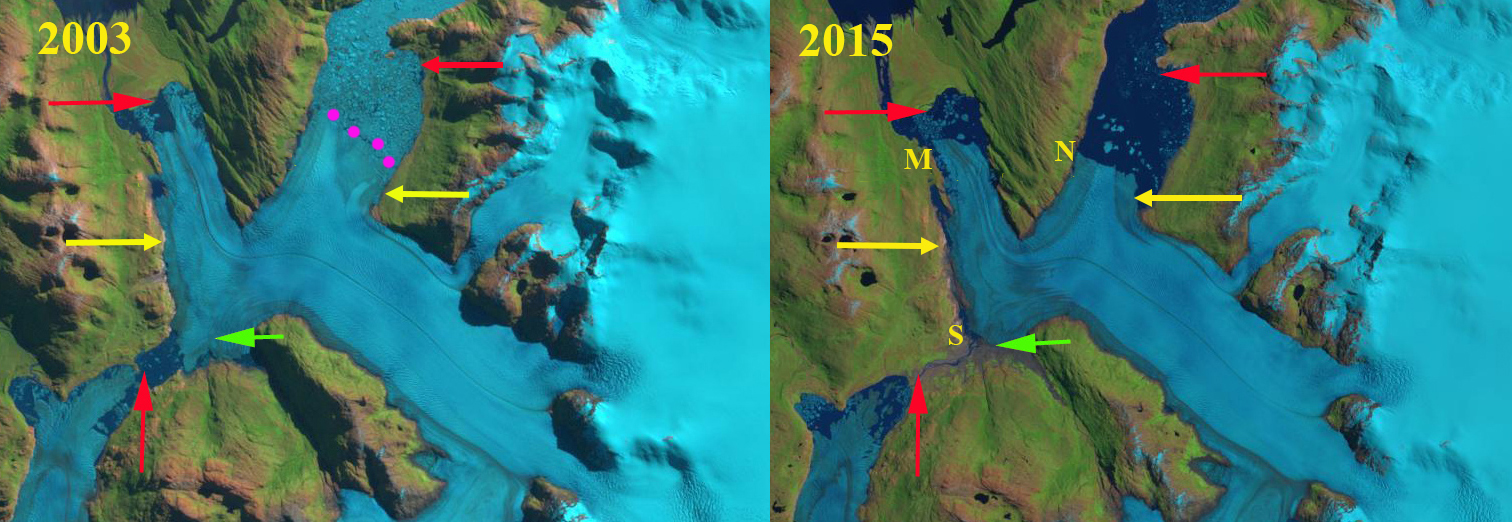
Bernardo Glacier in Landsat images from 1986 and 2021 illustrating retreat at the southern (S), middle (M) and northern (N) terminus respectively. Red arrows are 1986 terminus locations, yellow arrows are 2021 terminus locations. Separation from Tempano occurs at S, while lake expansion occurs at M and N.

Bernardo Glacier is an outlet glacier on the west side of the Southern Patagonia Icefield (SPI) that  currently ends in an expanding proglacial lake system, with three primary termini.  Here we examine changes from 1986 to 2021 using Landsat images. Davies and Glasser (2012) indicate that over the last century the most rapid retreat was from 2000 to 2011. Willis et a (2012)  note a thinning rate of 3.4 meters per year during this period of the Bernardo Glacier region, which drives the retreat. Mouginot and Rignot (2014) illustrate that velocity remains above 200 m/year from the terminus to the accumulation zone on Bernardo Glacier. Eñaut Izagirre visited the glacier in 2019 and provided images of the middle terminus of Bernardo Glacier, below.

Bernardo Glacier in Landsat images from 1998 and 2020 illustrating retreat at the southern (S), middle (M) and northern (N) terminus respectively. Red arrows are 1986 terminus locations, yellow arrows are 2021 terminus locations. Separation from Tempano occurs at S, while lake expansion occurs at M and N.

In 1986 Bernardo the southern terminus of the glacier was in tenuous contact with Tempano Glacier.  The middle terminus primarily ended on an outwash plain with a fringing proglacial lake developing.  The northern terminus had retreated a short distance south from a peninsula that had acted as a pinning point.  By 1998 the northern terminus had retreated into the wider,deeper portion of the lake basin that was now filled with icebergs. The middle terminus remained grounded on an outwash plain, with proglacial lake expansion at the NW corner of the terminus.  A small lake has developed completely separating Bernardo Glacier and Tempano Glacier. By 2003 the northern terminus had retreated 2 km from 1986, the middle terminus 1.5 km and the southern terminus 1.2 km in an expanding proglacial lake.  By 2015 the lake between Tempano and Bernardo Glacier had drained, but a fringing proglacial lake at the margin of Bernardo Glacier was forming.  In 2015 the northern terminus had retreated 3.5 km since 1986, the middle terminus 2.5 km and the southern terminus 2.75 km.   From 2015 to 2020 the change of the southern terminus was limited to a limited expansion of the fringing proglacial lake, a limited retreat of the the northern terminus, while the middle terminus had retreated significantly into a wider portion of the lake basin.  By 2021 the southern terminus had retreated 3 km since 1986, the middle terminus 4.6 km and the norther terminus 4.1 km.  This led to a 8.7 km2 lake expansion at the middle terminus and a 7.8 km2 lake expansion at the northern terminus. Gourlet et al (2016) identify Bernardo Glacier as having thinner ice than other large outlet glaciers such Jorge Montt or O’Higgins, which helps lead to rapid terminus change. The retreat is similar to the extensive retreat observed at Dickson Glacier and Upsala Glacier.

Southern Andean huemel an endemic deer on the foreland beyond Bernardo Glacier (photograph from Eñaut Izagirre).

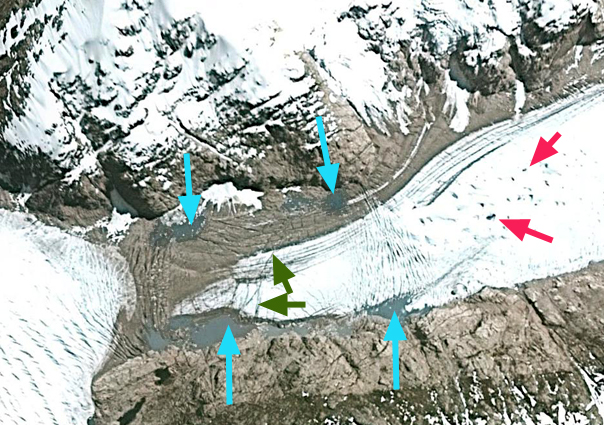
Middle terminus of Bernardo Glacier in 2019 taken by Eñaut Izagirre who considers this a condor-view.

Bernardo Glacier in Landsat images from 2003 and 2015 illustrating retreat at the southern (S), middle (M) and northern (N) terminus respectively. Lake expansion and then drainage occurs at S. Red arrows are 1986 terminus locations, yellow arrows are 2021 terminus locations.

Jacobsen Glacier, BC Separation Nearly Complete

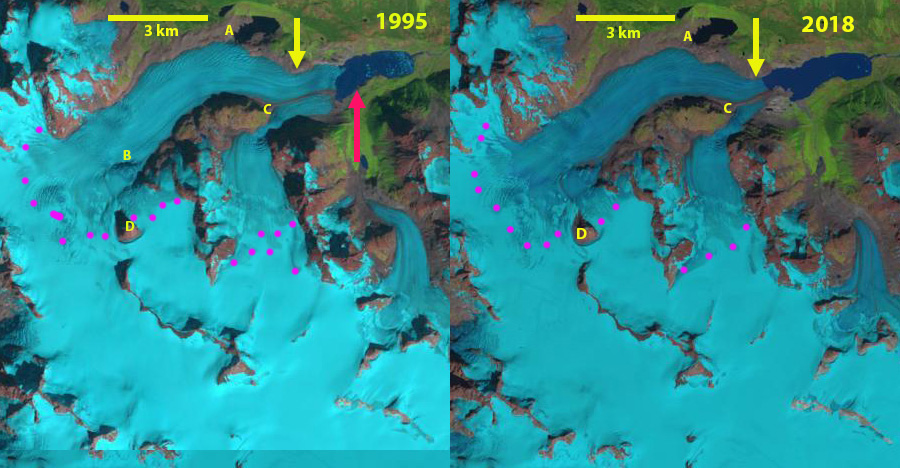
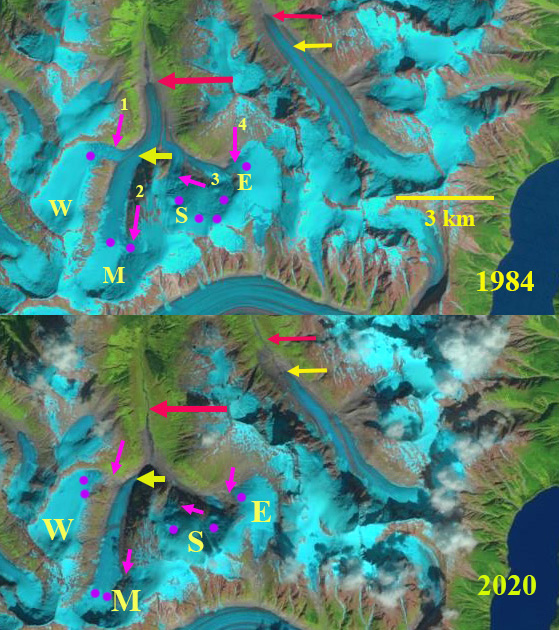
Jacobsen Glacier in Landsat images from 1987 and 2019. Red arrow 1987 terminus location, yellow arrow 2019 terminus location and pink dots the snowline. Point A indciates ice marginal lake in 1987, Point C is the glacier junction, Point B an emerging rock rib and Point D a nunatak.

Jacobsen Glacier is part of the Monarch Icefield of the Coastal Range of British Columbia. VanLooy and Forster (2008) noted that the glacier retreated at a rate of 30 meters/year from 1974 to 1992 and 47 meters/year from 1992-2000. Menounos et al (2018) identified a mass loss for glaciers in this region of ~0.5 m year from 2000-2018 which is driving retreat. The glacier is at the headwaters of jacobsen Creek, which joins the Talchako River and then Bella Coola River.  The Bella Coola River is one of the most important salmon producing rivers on the British Columbia’s central coast. It supports the largest chinook and chum salmon populations, surveyed at 23k and 190k in surveys during the last decade (Pacific Salmon Foundation, 2021)  The sockeye and pink salmon runs have largely collapsed this century (Pacific Salmon Foundation, 2021). In this post we examine Landsat satellite imagery from 1987-2019 and Sentinel imagery from 2021 to illustrate the changes.

In 1987 the glacier terminated in a 1.8 km long proglacial lake at an altitude of ~1080 m .  The north margin had a separate terminus in the proglacial lake at Point A.  The terminus in the main proglacial lake 900 m wide. At Point B there is an icefall, but not exposed bedrock. The snowline was at 2050 m.  By 1995 the glacier had retreated 500 m.  The glacier was in contact with the proglacial lake at Point A.  The snowline was at 2100 m. By 2000 the glacier has retreated from the proglacial lake at Point A, due to thinning.  In 2016 the snowline is at 2150 m.  The glacier is now separated from the proglacial lake at Point A by ~500 m.  The southern tributary no longer reaches the expanding proglacial lake. In 2018 there is bedrock exposed at Point B.  The snowline is at 2100 m.  In 2019 the proglacial lake has expanded to a length of  3.3 km, a retreat of 1500 m from 1987-2019. The retreat and lake expansion has been 1500 m from 1987-2019, a rate of 47 m/year, only a slight change from the 1990-2000 reported rate. The snowline is at 2100 m. In May 2021 the Sentinel image indicates the medial moraine has widened to the point there is no interaction between the northern and southern tributary of Jacobsen Glacier.  The terminus in the expanding lake is now 400 m wide. The lake basin likely ends before Point C, based on surface slope changes of Jacobsen Glacier.

The retreat rate during this period is  less than the ~120-130 m/year at Bridge Glacier, Franklin Glacier or Klinaklini Glacier, and slightly more than at Bishop Glacier and Klippi Glacier. The combined loss in glacier area impacts glacier runoff particularly in late summer. Moore et al (2020) examining the Columbia River basin headwaters of Canada noted, “that glacier-melt contributions to August runoff have already have passed peak water, and that these reductions have exacerbated a regional climate-driven trend to decreased August streamflow contributions from unglacierized areas.”

Jacobsen Glacier in Landsat images from 1995 and 2018. Red arrow 1987 terminus location, yellow arrow 2019 terminus location and pink dots the snowline. Point A indciates ice marginal lake in 1987, Point C is the glacier junction, Point B an emerging rock rib and Point D a nunatak.

Jacobsen Glacier in Landsat images from 2000 and 2016. Red arrow 1987 terminus location, yellow arrow 2019 terminus location and pink dots the snowline. Point A indciates ice marginal lake in 1987, Point C is the glacier junction, Point B an emerging rock rib and Point D a nunatak.

Sentinel Image from May 2021