Bionnassay Glacier Terminus Tongue Detaches, Mont Blanc, France

Bionnassay Glacier drains west from Dôme du Goûter and Aiguille de Bionnassay of the Mont Blanc Massif in France. The glacier has a heavily debris covered terminus and has experienced less retreat from 1980-2010 then other Mont Blance glaciers. Bionnassay retreated 200 m (Moreau et al , 2012), while Mer de Glace retreated 500 m in the interval 1998 to 2008. Gardent et al (2014) observed a 25% decline in the area of glaciers in the French Alps from 1970 to 2009, with the rate increasing significantly recently.  Bionnassay is now in rapid retreat as the stagnant terminus tongue is detached from the active glacier tongue.
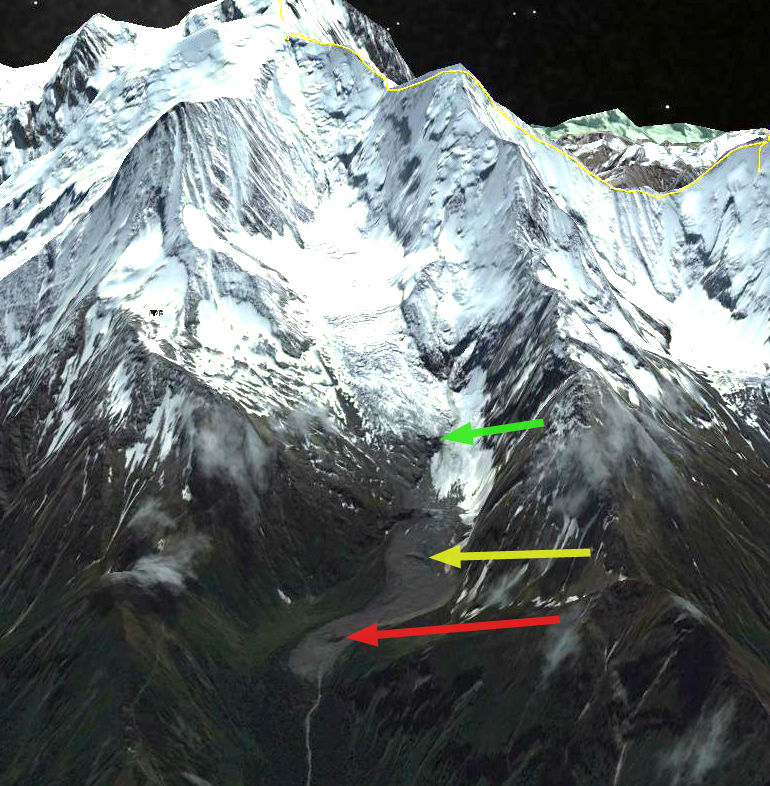
bionnassay overview

Bionnassay Glacier.  Red arrow indicates terminus of stagnant region.  Yellow arrow indicates bedrock emerging that is separating stagnant terminus tongue.  Green arrow indicates lower limit of active glacier. 

In 1985 the glacier terminus is at the yellow arrow. The debris covered ice is crevassed and covers the entire region at the red and green arrow. Points B and C are ice covered and Point A has a small exposure of bedrock. In 1999 retreat from the yellow arrow is evident the glacier still covering the region at the red and green arrow. In 2001 Google Earth image the terminus is evident at the red arrow, the region at the green and yellow area are covered by glacier ice. In 2011 the terminus has retreated 180 m since 2001, bedrock has emerged at the green arrow, beginning to separate the stagnant debris covered terminus tongue. At the yellow arrow the crevassing has diminished greatly. In 2015 the terminus has retreated to the pink arrow. Bedrock has been exposed from below the glacier terminus tongue at the yellow arrow. The active glacier terminus is now at the green arrow. At Point B and C glacier thinning has led to marginal retreat and exposure of bedrock where there was glacier ice. At Point A the expanse of exposed bedrock has greatly expanded.  The retreat of the main glacier terminus is around 200 m.  However, the retreat to the newly emergent bedrock separating the glacier is 750 m.  The active terminus is now 1700 m from the 1985 terminus position at the green arrow.  In the next few years this will become a well defined terminus, as the lower stagnant zone melt away.

Bionnassay Glacier is just south of Taconnaz Glacier, which is also retreating.
bionnassay 1985
1985 Landsat image
bionnassay 1999
1999 Landsat image
bionnassay glacier ge 2001
2001 Google Earth Image
bionnassay glacier ge 2011
2011 Google Earth Image
bionnassay 2015
2015 Landsat image

500 m

Glacier du Tour Retreat, France

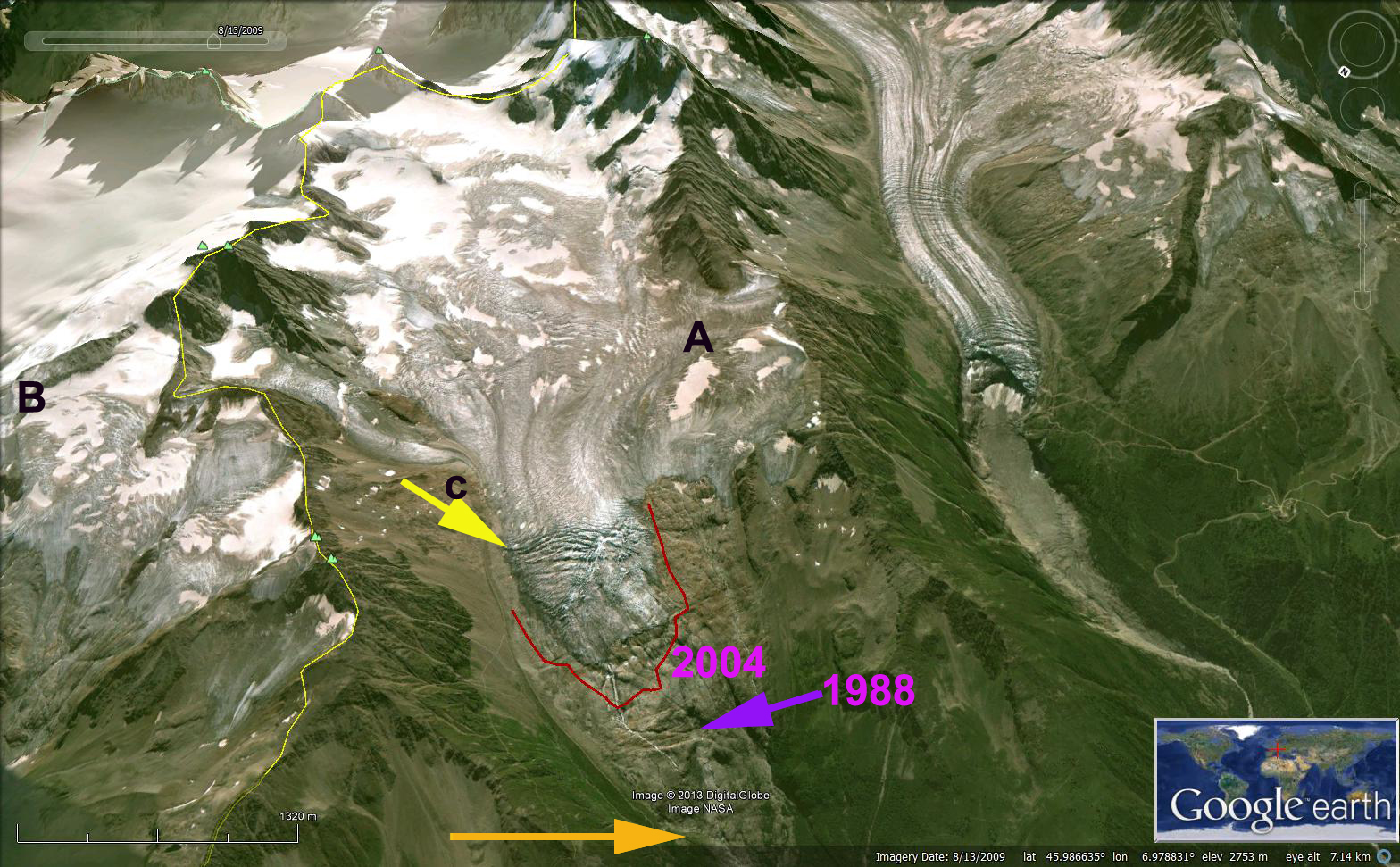
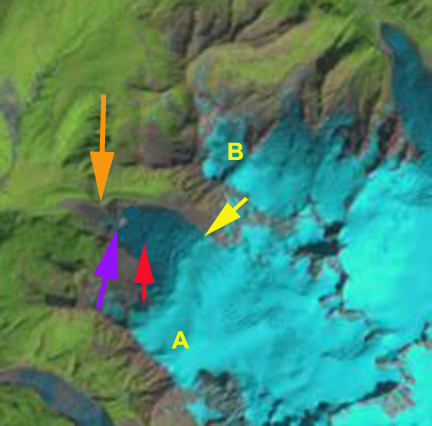
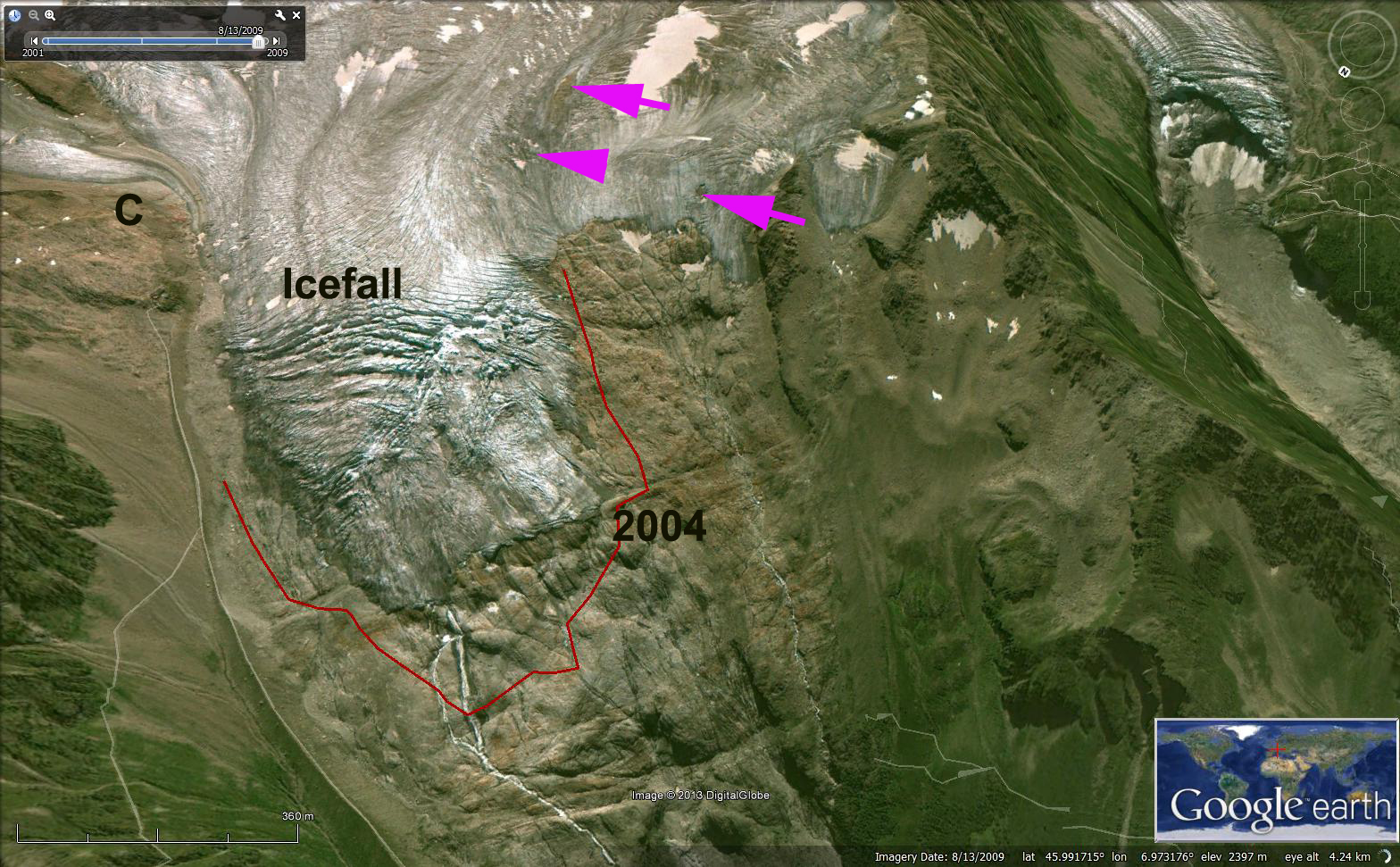
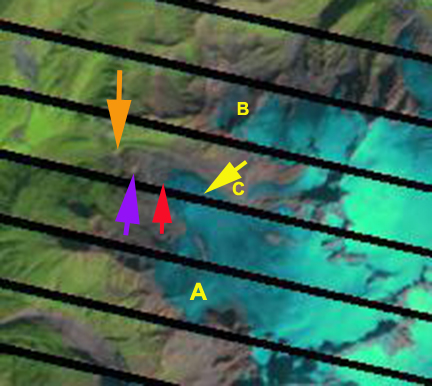
Tour du Glacier is in the Valle de Chamonix and is one valley north of D’Argentiere Glacier and two north of Mer de Glace. Here we examine the retreat of Glacier du Tour from 1988 to 2011 using Landsat imagery and Google Earth. In each image the purple arrow indicates the 1988 terminus. The yellow arrow the top of an icefall at 2650 m. The orange arrow a prominent turn in the Little Ice Age lateral moraine. The red arrow a location along the 2011 ice front. Point A is an area on the south side of the glacier that is thinning, and shows little residual snow accumulation. Point B is another location near the top of a small glacier across the border in Switzerland where ice is being lost at the top of the glacier. Point C is where the tributary flowing from below Aiguille du Tour joins the Glacier du Tour.tour de glacier ge. In 1988 the glacier terminated at 2200 m, the icefall was 1 km above the terminus and the Aiguille du Tour tributary flowed into the Glacier du Tour. At Point B glacier ice still crosses the ridge at the top of the glacier. By 1999 the had retreated 100 meters, the Aiguille du Tour tributary still reaches the main glacier but is less than 200 m wide. By 2004 the terminus had retreated 200 m (red line) and the glacier is still quite crevassed near the terminus. In 2009 the area of the glacier around Point A has lost nearly all of its ice cover. Several rock knobs are protruding through the ice, purple arrows. The glacier has retreated another 200 m since 2004. At Point C the Aiguille du Tour tributary has a narrow finger that reaches the main glacier. In the 2011 Landsat image the Aiguille du Tour tributary no longer reaches the main glacier. At Point B the ridge that had been ice covered connecting two glaciers is now exposed. There is no snow left on the southern section of the glacier above and flowing down to Point a. The icefall region is now just 500 m above the terminus. The activity of the icefall indicates a continued active flow. The Aiguille du Tour tributary and portion of the glacier feeding Point A do not have significant retained snowcover and are not in equilibrium. tour de glacier 1988
Landsat image 1988, purple arrow indicates the 1988 terminus.

tour de glacier 1999
1999 Landsat image.

tour de glacier 2004
2004 Google Earth image with a red line indicating terminus.

tour de glacier 2009
2009 Google Earth image. Purple arrows indicate bedrock knobs emerging from beneath the ice.

tour de glacier 2011
2011 Landsat image with a red arrow indicating the terminus.