Conway Glacier Separation and Retreat, Alberta

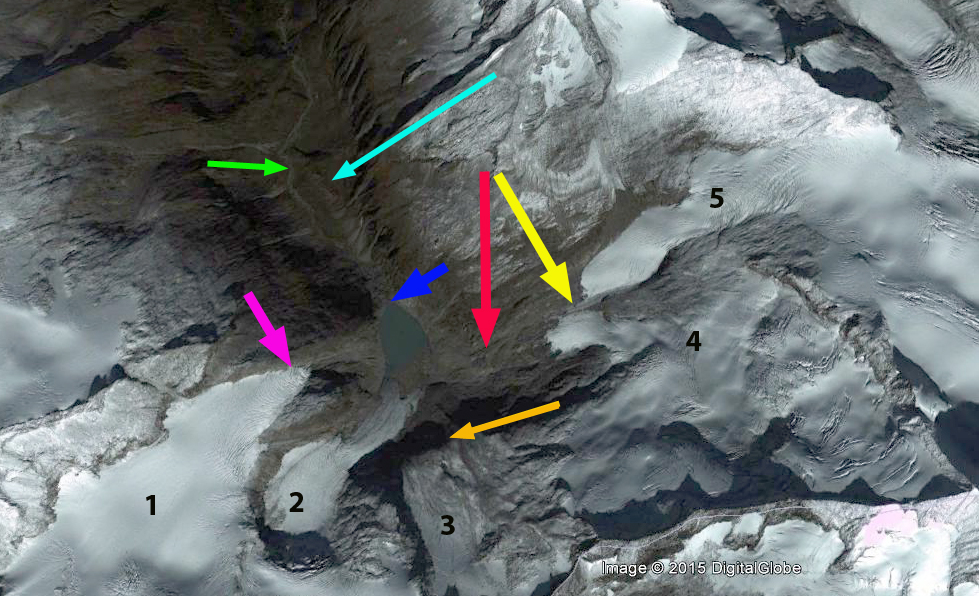
Conway Glacier drains east from the border with British Columbia into the Howse River. The Howse River joins the Saskatchewan River upstream of the Bighorn Hydropower project, which impounds Lake Abraham and produces 120 MW of power. The map of this area was updated based on 1990 images which indicate Conway Glacier is comprised of two lobes that join near the terminus.   An inventory of glaciers in the Canadian Rockies indicate area loss of 15% from 1985 to 2005 (Bolch et al, 2010).  The more famous Columbia Icefield, 50 km north, has lost 23 % of its area from 1919-2009 with ice loss at a minimum during the 1970′s (Tennant and Menounos, 2013)Here we examine Landsat imagery from 1986 to 2014 to see the impact of recent climate change.

conway glacier map

Map of Conway Glacier area from 1990 image.

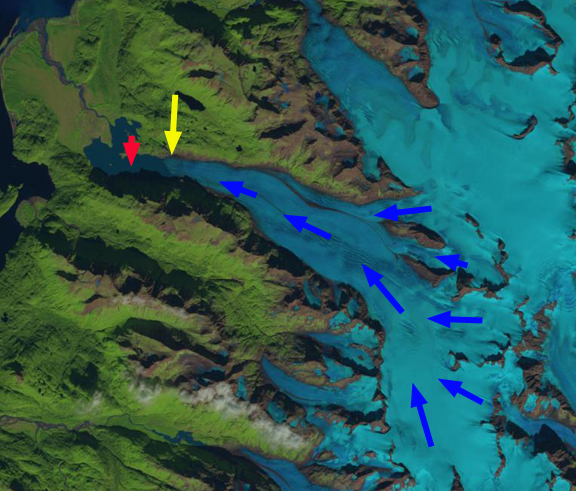
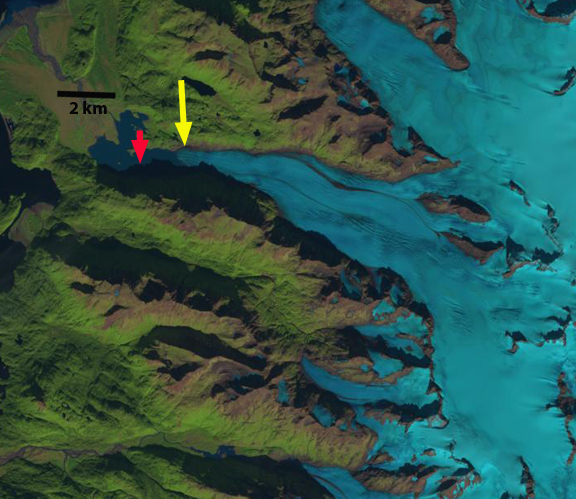
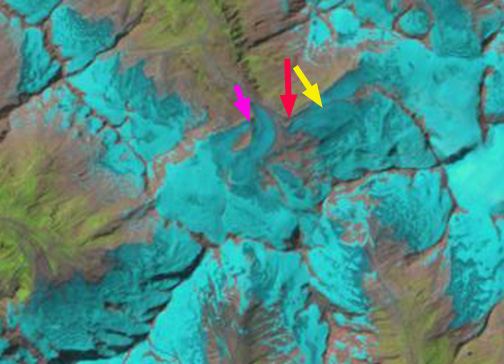
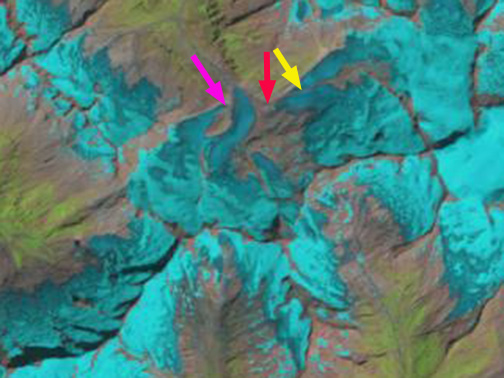
In 1986 the two glaciers are still joined, with a surface lateral moraine at their junction, orange dots indicate this narrow surface rock band eroded from the ridge between the two lobes. The yellow arrow in each image indicates the 1986 terminus location of the northern lobe, the red arrow indicates a bedrock step near the southern lobe terminus, green arrow indicates an ice filled basin, and the purple arrow a small tributary joining the main glacier.  In 1986 the southern lobe extends 300 meters beyond the bedrock step.  By 1994 a small lake is developing at the basin indicated by the green arrow and the northern lobe is reduced in width.  Overall less than 40% of the glacier is snowcovered.  By 1998 the southern lobe has retreated to the bedrock step and the northern lobe has retreated from the end of the lateral moraine.  The glacier again is less than 40% snowcovered.  The 2013 image has better resolution thanks to the better Landsat 8 imagery, and has been sharpened using a higher resolution panchromatic image layer by Ben Pelto (Technique will be explained in a future post).  The glaciers are no longer joined.  The northern lobe has retreated 500-550 m since 1986 and a small lake has formed at the 1986 terminus location, another yellow arrow indicates 2013 terminus.  The northern lobe has retreated above the bedrock step, a total retreat of 500-600 m since 1986.  Two additional red arrows have been added to indicate 1986 and 2013 terminus location.  The small lake at the green arrow has expanded.  The tributary connection at the purple arrow is nearly severed.   Retained snowpack on the glacier is also limited in area with most of the glacier in 2013 being bare glacier ice. This indicates that snow was not retained in recent previous years either.  For a glacier to be in equilibrium it needs more than 50% of its area to be covered by snow at the end of the melt season, not  35% with a few weeks left in the melt season. as in 2013. This glaciers retreat and volume loss mirrors that of the region including Saskatchewan Glacier and Fraser Glacier.   Peyto Glacier is the nearest glacier, just 20 km southeast, with a long term mass balance record, which indicates a cumulative loss or over 28 m w.e or 30 m of glacier thickness.

conway glacier 1986a

1986 Landsat image

conway glacier 1994

1994 Landsat image

conway glacier 1998

1998 Landsat Image

Red Channel|Green Channel|Blue Channel 2013 Landsat image-Pan sharpened by Ben Pelto (Univ. Northern British Columbia)

Demise of Antler Glacier, Juneau Icefield, Alaska

“What is wrong with this map?” . Was my first comment about the Antler Glacier in 1981, while surveying the geology in the region with the Juneau Icefield Research Program, during light snow flurries in August.  The map I had was the most up to date USGS topographic map based on 1948 images, indicating Antler Glacier terminating in a small lake.  By 1981 the lake was quite long and the glacier no longer reached it, though this was not perfectly evident  through the snow flurries. If I returned to the same location today, looking  at the updated USGS topographic map from 1979 my comment would be the same.  Climate is changing our glaciers and our maps of these regions. The Antler Glacier is an outlet glacier of the Juneau Icefield. It is actually a distributary glacier of the Bucher Glacier. It splits from the Bucher Glacier 8.5 km above where the Bucher Glacier joins the Gilkey Glacier as a tributary. In 1948 it spilled over the lip of the Antler River valley from the Bucher Glacier and flowed 6 kilometers downvalley to end in a proglacial lake. The glacier was 6200 m long in 1948, red arrow is 1984 terminus, yellow arrow indicates 2014 terminus.  Here we examine satellite imagery from 1984 to 2014 to identify changes in the Antler and other small glaciers in the area.

Antler_Glacier map

USGS map showing 1948 position of Antler Glacier.

antler 1985 map


Antler Glacier in 1979

In each Landsat image the arrows indicate the same location, red arrow 1984 Antler Glacier terminus location, yellow arrow 2014 terminus of Antler Glacier, green arrow small glacier adjacent to Antler Glacier and purple arrow tributary glacier to Antler glacier.  In 1984 Antler Glacier no longer reached Antler Lake which had expanded from a length of 1.6 km  in 1948 to 4.2 km. The glacier was still 2.7 km long. Though I was in the area in 1984 I did not see Antler Glacier.  The small glacier at the green arrow terminated at the edge of a small lake.  The tributary at the purple arrow joined the Bucher Glacier.  By 1997 the lower 2 km of the Antler Glacier were gone and the glacier ended near the base of the steep eastern entrance to the valley. The glacier at the green arrow no longer reached the lake and at the purple arrow the tributary has separated from Bucher Glacier.  By 2013 Antler Glacier extended only 400-500 m over the lip of the valley entrance from Bucher Glacier.   The glacier at the purple arrow was separated by more than a kilometer from the Bucher Glacier.  There is little change of course from 2013 to 2014, Antler Glacier has retreated 2.2 km since 1984 and 5.8 km since 1948.  The small glacier at the green arrow has receded 300 m from the lake shore.  The former Bucher tributary at the purple arrow now terminates 1.4 km from Bucher Glacier. 

The lake is gorgeous, and the valley once filled by the glacier is now nearly devoid of glacier input. The retreat is largely a result of reduced flow from the thinning Bucher Glacier which no longer spills over the valley lip significantly. As the Bucher Glacier continues to thin, the Antler Glacier will cease to exist. This thinning is due to increased ablation of the glacier.  The mass balance loss at nearby Lemon Creek Glacier from 1953-2011 was -26.6 m  Pelto et al (2013), this equals a thinning of at least 29 m.  Gilkey Glacier which is fed by Bucher Glacier has retreated  3.2 km from 1984-2013 and  4 km from 1948-2013 (Pelto, 2013).  Continued losses and separation of tributaries from the Bucher Glacier could lead to formation of glacier dammed lakes such as on Tulsequah Glacier.   The Juneau Icefield Research Program directed by Jeff Kavanaugh will again be in the field in 2015., I will be interested to see their observations after the exceptionally warm but wet winter in the regioneantler glacier 1984


1984 Landsat image

antler glacier 1997

1997Landsat image


antler glacier 2013a

2013 Landsat image

antler glacier 2014


2014 Landsat image 
Cordillera Lago General Carrera Glacier Retreat, Chile

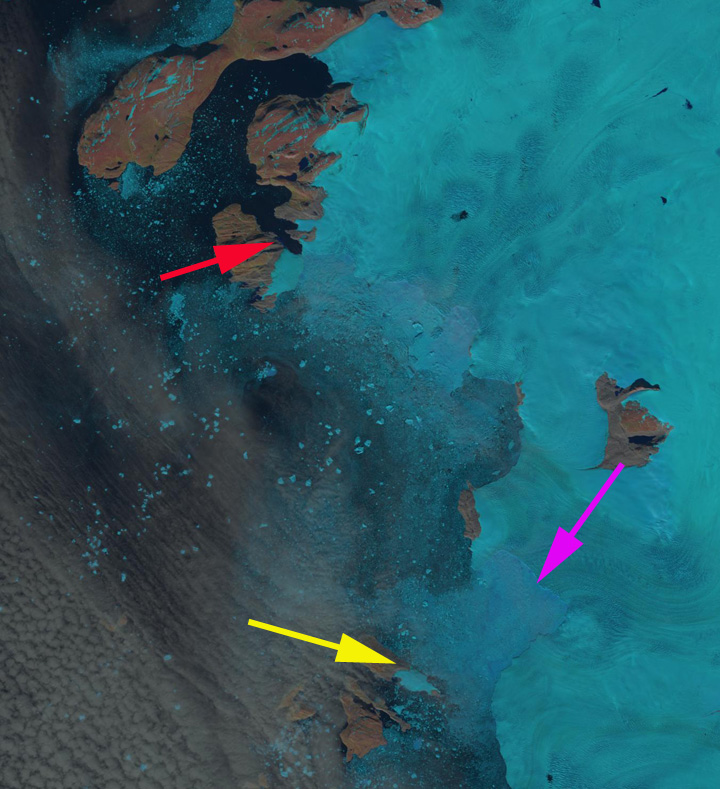
You know southern Chile has lots of glaciers when an icefield with an area of 132 square kilometers has no named glaciers.  Davies and Glasser (2012) referred to this icefield as Cordillera Lago General Carrera, since it drains into that lake, the icefield is just east of the Northern Patagonia Icefield.   Davies and Glasser (2012)  noted that the icefield has a mean elevation of 1670 m and has declined from an area of 190 square kilometers in 1870, to 139 square kilometers in 1986, and 132 square kilometers in 2011.  They further noted that the area loss of Patagonia glaciers has been most rapid from 2001 to 2011.  Paul and Molg (2014) observed a more rapid retreat of 25% total area lost from glaciers in northern Patagonia from 1985-2011, the study area was north of the Northern Patagonia Icefield. Lago General Carrera drains into the Baker River, which is fed by most glaciers on the east side of the Northern Patagonia Icefield.  This river had a series of proposed hydropower projects that have now been cancelled by the Chilean government.

clcg

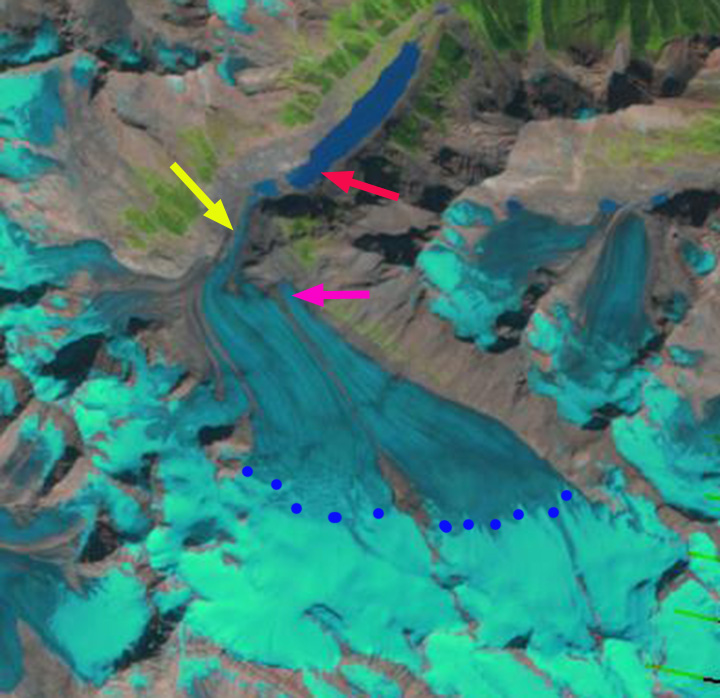
Here we examine Landsat imagery from 1987 to 2014 to identify the changes in a pair of outlet glaciers that drain the eastern side of the icefield, images below. In 1987 both outlet glaciers terminated in an unnamed lake that drains into the Leones River. The southern glacier is 5.5 km long beginning at 2400 m and terminates at the yellow arrow, with the snowline marked by purple dots, in the images below.  The northern glacier is 5.0 km long beginning at 2200 m with the terminus at the red arrow. In 1987 the glaciers were in shallow enough water  that calving was limited and no icebergs are evident. By 2001 both glaciers are no longer terminating in the lake.  The retreat can no longer be enhanced by calving into the lake.  By 2014 both glaciers have retreated several hundred meters from the lake.  It is easier to measure the retreat in the 2013 Google Earth image.  The retreat from the 1987 to 2013 position are indicated by the pair of arrows.  The northern glacier has retreated 400 m and the southern glacier 600 m from 1987 to 2013.  In both cases this is approximately 10% of the glacier length.  The beautiful green color of the lake is indicative of the contribution of glacier flour from actively moving and eroding glaciers.  This glaciers retreat is similar to that of the nearby Nef Glacier and Verde Glacier.

clgc 1987
1987 Landsat image
clgc icefield 2001

2001 Landsat image
clgc 2014

2014 Landsat image

clgc ge 2013
2013 Google Earth image.  With arrows indicating terminus change from 1987 to 2013.

Moving to AGU Blogosphere

As of today this blog is shifting to the AGU Blogosphere.  The blog has the same name and will have the same approach with two blogs a week on a the response of glaciers to climate change, one glacier at a time.  If you have been a follower of this blog, please follow there.  Note all the posts have been migrated there too.

Thanks for the continued support and interest.

http://blogs.agu.org/fromaglaciersperspective/

DSC02908

Mauri Pelto

Field Observations on Lower Curtis Glacier

This is a visual introduction to our 31 years of work on Lower Curtis Glacier complimented with Google Earth imagery to illustrate the changes.  Each year since 1984 this glacier has received an annual checkup from us, North Cascade Glacier Climate Project.  The mass balance and retreat of this glacier is reported to the World Glacier Monitoring Service.  Many nights have been spent camped below this glacier. Unfortunately in the last seven years we have had mostly wet weather at this site, that hopefully will not be repeated this coming summer. 

Zongo Glacier Retreat, Bolivia 1994-2014.

Zongo Glacier, Bolivia extends 2.9 km down the south side of Huayna Potosi from 6000 m to 4900 m. Zongo Glacier is a small valley glacier located 30 km north-east of La Paz, and its runoff is directed to an important hydraulic power station which supplies La Paz. Note Laguna Milluni in foreground of the first image. The dam is visible as is the power station to the right and below the lake. The glacier has considerable snowcover on its upper section and crevassing. This indicates a persistent accumulation zone. In 1991 a glaciological research program was established on Zongo Glacier to monitor mass balance, understand its hydrology and energy balance. The long term director of this research Bernard Francou has been called the glacier guardian. The cumlative mass balance of the glacier from 1991-2013 has been -6.5 m water equivalent. The typical Alpine glaciers undergoes a long accumulation period in winter and a short ablation season in summer. The glaciers of the tropical Andes experience snow accumulation during the wet season, austral summer on their upper regions and maximum ablation during the same season low on the glacier. In the dry season winter there is a period of low ablation over the whole glacier. Mean annual air temperature at the long term snowline at 5250 m is -1.5 °C. Mean precipitation is about 0.9 m/year. zongo laguna
Google Earth image-Huayna Potosi and Zongo Glacier

Since 1991 the glacier has lost more than 7 m of thickness and has retreated significantly. The mass balance loss has been most pronounced during El Nino periods. La Nina’s are associated with positive or only slightly negative mass balance. Here we examine Landsat imagery and Google Earth imagery form 1994 to 2014.

In 1994 there is no lake at the terminus of the glacier, red arrow. By 2004 the Google Earth image indicates the glacier terminating along the northeast shore of the lake, a 90 m retreat in a decade. By 2008 the glacier no longer reaches the edge of the lake, but the front is still crevassed. In 2014 the glacier terminates 100 meters from the lake. Total retreat during the 20 year period is 220 m. The current terminus in 2014 is dirtier and less crevassed than in 2004, and less crevassed than in 2008. The lower 200 m of the glacier is thin, narrow and lacks active crevassing. This relatively stagnant area will melt away in the next decade.

Zongo Glacier continues to have an accumulation zone, a necessary essential for glacier survival, and unlike the nearby Chacaltaya Glacier which disappeared in 2009, it will exist for sometime. The Chacaltaya Glacier is a small glacier, like 80% of the glaciers in this region of the Cordillera Real, and its disappearance puts more pressure on the water resources provided by the larger remaining glaciers such as Zongo Glacier. Rabatel et al (2013) note the striking rise in the freezing levels in the region due both to higher temperatures and more convective activity that is a particular threat to glacier survival.

zongo ls 1994
1994 Landsat image

zongo 2004
2004 Google Earth image

zongo 2008
2008 Google earth image

zongo 2014
2014 Google Earth image

zongo ls 2014
2014 Landsat image
Mahsa Icefield Retreat and Separation, Baranof Island, Alaska

The Mahsa Icefield is at the headwaters of Takatz Creek.  This is a small glacier, not an actual icefield.  Five kilometers to the west is another small unnamed glacier at the headwaters of Sawmill Creek.  Here we focus on changes in the two glacier using Landsat images from 1986 to 2014.mahsa icefield ge

Google Earth image

In 1986 the Mahsa Icefield is a contiguous glacier that extended 5 km from east to west, red arrow indicates  the mid-section of the icefield.  A separate glacier in Sawmill Creek, yellow arrows, was 2.1 km long and has no lake at its terminus.  In 1997 the Mahsa Icefield has separated into an east and west half, at the red arrow, and has lost all of its snowcover.  The glacier in Sawmill Creek is still a single ice mass, but has lost all of its snowcover, which happened in 1998, 2003 and 2004. In 2014 the Mahsa Icefield’s east and west half are separated by 300 m, red arrow.  There is very little snowcover remaining despite there is a month left in the melt season.  At the headwaters of Sawmill Creek a lake has formed as the glacier has retreated, the lake is 600 m long in 2014.  The glacier has also separated into a small upper and lower section.  This glacier has lost half of its area since 1986.  The retreat of these glaciers on Baranof Island is similar to the retreat of nearby Carbon Lake Glacier,Lemon Creek Glacier, and Sinclair Glacier. Lemon Creek Glacier has lost more than 25 m of glacier thickness during the 1953-2014 period when its mass balance has been observed by the Juneau Icefield Research Program, and has retreated more than 1 km (Pelto et al, 2014).

mahsa icefield 1986

Landsat image 1986

mahsa icefield 1997

Landsat Image 1997

mahsa icefield 2014

Landsat image 2014
 

Carbon Lake Glacier Retreat, Alaska

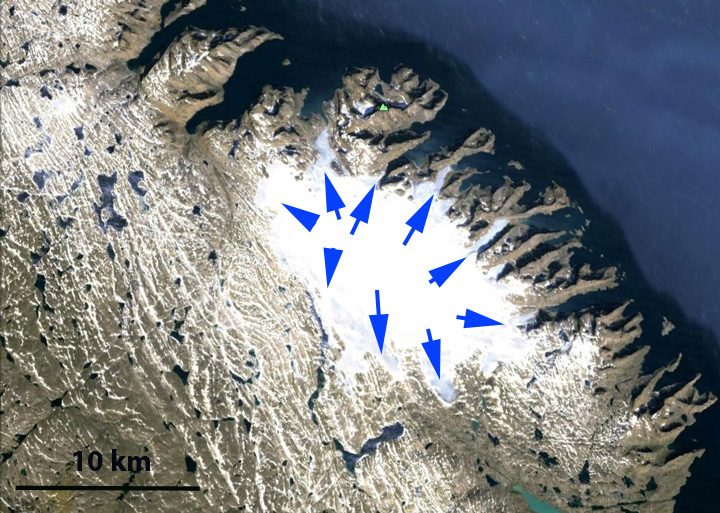
On Baranof Island in southeast Alaska there are a pair of unnamed glaciers at the headwaters of the Carbon Lake watershed, that then drains into Chatham Strait.  Here we examine changes in these glacier from 1986 to 2014 using Landsat imagery.  The blue arrow indicates the northern glacier terminus and the yellow arrow the southern glacier terminus region.

carbon lake ge

In 1986 the southern glacier terminus, yellow arrow consisted of three main tributaries combining to form a low sloped terminus region.  The northern glacier had a single terminus.  By 1997 a lake has formed at the southern glacier, which now has two separate termini, the red arrow indicates a new terminus area and the pink arrow the eastern portion of this glacier.  The northern glacier, blue arrow, is retreating but still joined.  By 2014 the southern glacier has separated into three parts.  There is a terminus at the red arrow, this represents a 900 m retreat since 1986.  This portion of the glacier has further separated since 1997 into two parts.  The eastern glacier, pink arrow has retreated 700 m since 1986.  The new alpine lake is 600 m long.  The northern glacier, blue arrow, has separated into two main termini and the glacier has retreated 200 m.   The retreat of these glaciers paralells the observed losses of other smaller glacier in the region most notably Lemon Creek Glacier, which is a World Glacier Monitoring Service reference glacier, 30 km west on the edge of the Juneau Icefield.  Another nearby example is Sinclair Glacier.  Lemon Creek Glacier has lost more than 25 m of glacier thickness during the 1953-2014 period when its mass balance has been observed by the Juneau Icefield Research Program, and has retreated more than 1 km.

carbon lake 1986
1986 Landsat image Carbon Lake Glaciers
carbon lake 1997
1997 Landsat image Carbon Lake Glaciers
carbon lake 2014
2014 Landsat image of Carbon Glacier


Chickamin Glacier Retreat, North Cascade Range, Washington

Chickamin Glacier covers the north slope of Sinister Peak in the North Cascade Range of Washington.  The glacier has a valley tongue that descends to an outwash plain.  Here we examine retreat of the glacier from 1979 to 2012. The glacier had advanced from 1955-1975, before commencing retreat.

CHICKAMIN_GLACIER05
Chickamin Glacier (Tom Hammond)

chickamin map

USGS Map of Chickamin Glacier

In 1979 the glacier terminus was at the pink arrow, several hundred meters beyond a prominent buttress, red arrow, where the glacier turns west.  The lowest icefall is indicated by a green arrow. In 1991 the glacier has retreated from the pink arrow, but still is turning the corner beyond the buttress.  The lower icefall is still extensively crevassed.  By 1998 in a Google Earth image the terminus is outlined with yellow dots and has retreated 230 m from the 1979 position.  The lower icefall is still crevassed.  By 2005 in a photograph from Tom Hammond (North Cascades Conservation Council), the glacier has retreated to the buttress. in a 2006 Google Earth image the terminus position is indicated by yellow dots, with a retreat of 50 m since 1998.  The lower portion of the glacier has limited crevassing.  In the 2012 image the glacier terminus no longer reaches the buttress and has retreated 360 m since 1979. We observed exceptional ablation conditions in the North Cascades in 2013 and 2014, which combined with exceptionally low snowpack in 2015 will lead to a continued significant retreat of this glacier.  The crevassing in the lowest icefall has declined and is now superficial. All 47 glaciers observed by the North Cascade Glacier Climate Project have been retreating and four have disappeared (Pelto, 2011). This glacier is similar in size and retreat to Boston Glacier and Honeycomb Glacier.

chickamin79

Chickamin Glacier 1979 (Austin Post)chickamin glacier1991

1991 Chickamin Glacierchickamin 1998 geterminus

1998 Google Earth image

CHICKAMIN_GLACIER05

2005 Chickamin Glacier (Tom Hammond)chickamin 2006 geterminus

2006 Google Earth imagechickamin 2012 geterminus

2012 Google Earth Image

Eiriksjökull Retreat, Iceland

Eiriksjökull  is an ice cap just west of Langjökull In central Iceland.  Here we examine its main western outlet the Braekur using Landsat imagery from 1989 to 2014.  The Icelandic Glaciological Society website on terminus variations is the source of the map for the glacier. The IGS program monitors 50 glaciers, all of them are currently retreating.  Eiriksjökull ,  is not one that is in this monitoring program. eiriksjokull map

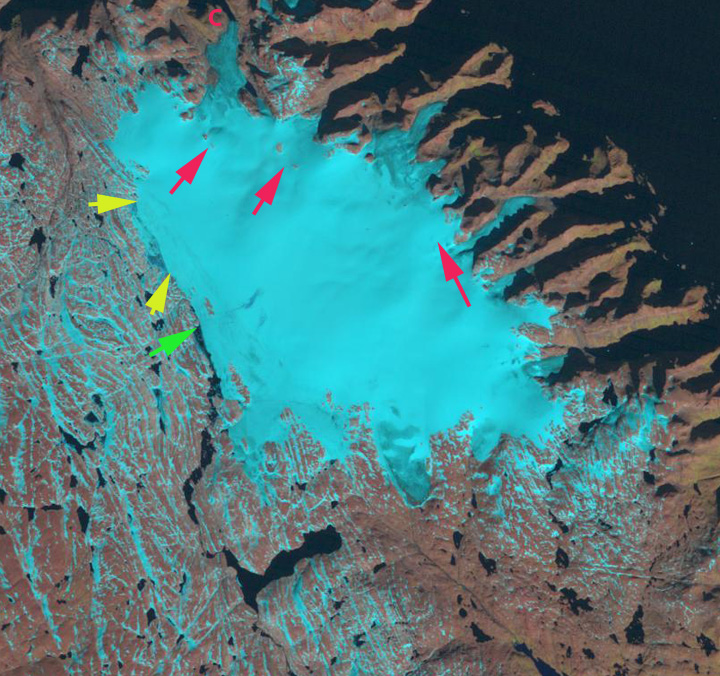
In 1989 the Braekur outlet flowed over the edge of a lava cliff at the red arrow.  The glacier terminated on the bench between the upper and lower cliff.  In 1994 the glacier still extended  to the edge of the cliff.  By 2010 the Google Earth images indicates a retreat from the edge of the cliff.  In 2014 the glacier has receded 200 m from the edge of the cliff and 300 m from is 1989 position and terminates at the yellow arrow. The high snowlines in recent years will lead to continued retreat. The retreat and area loss of Eiriksjökull is less than on nearby Norðurjökull a primary outlet of Langjökull or on Porisjokull a small ice cap just south of Langjökull.

eiriksjokull 1989

1989 Landsat image

eiriksjokull 1994

1994 Landsat image
eiriksjokull 2010

2010 Google Earth image

eiriksjokull 2014

2014 Landsat image
Eiriksjökull Reeat, Iceland

Eiriksjökull  is an ice cap just west of Langjökull In central Iceland.  Here we examine its main western outlet the Braekur using Landsat imagery from 1989 to 2014.  The Icelandic Glaciological Society website on terminus variations is the source of the map for the glacier. The IGS program monitors 50 glaciers, all of them are currently retreating.  Eiriksjökull ,  is not one that is in this monitoring program. eiriksjokull map

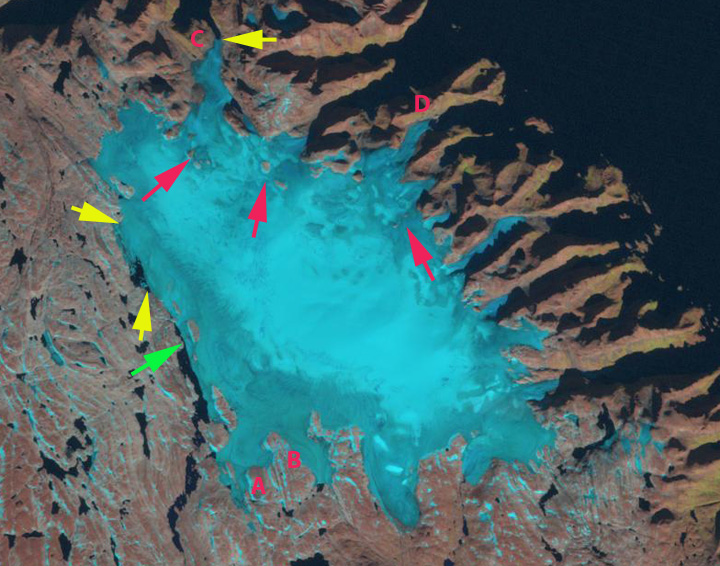
In 1989 the Braekur outlet flowed over the edge of a lava cliff at the red arrow.  The glacier terminated on the bench between the upper and lower cliff.  In 1994 the glacier still extended  to the edge of the cliff.  By 2010 the Google Earth images indicates a retreat from the edge of the cliff.  In 2014 the glacier has receded 200 m from the edge of the cliff and 300 m from is 1989 position and terminates at the yellow arrow. The high snowlines in recent years will lead to continued retreat. The retreat and area loss of Eiriksjökull is less than on nearby Norðurjökull a primary outlet of Langjökull or on Porisjokull a small ice cap just south of Langjökull.

eiriksjokull 1989

1989 Landsat image
eiriksjokull 1994

1994 Landsat image
eiriksjokull 2010

2010 Google Earth image

eiriksjokull 2014

2014 Landsat image

Weddel Glacier Thinning-Retreat, South Georgia Island

Weddel Glacier is on the southeast coast of South Georgia Island.  It terminates in Beaufoy Cove just north of Gold Harbor.The change in glacier terminus position has been documented by Alison Cook at British Antarctic Survey in a BAS retreat map.  In 1958 it reached within 400 m of the coast at the outlet of Beaufoy Cove. Gordon et al., (2008) observed that larger tidewater and sea-calving valley and outlet glaciers generally remained in relatively advanced positions until the 1980s. For Weddel Glacier the retreat was rapid from 1960 to 1974 and was slow from 1992-2003.  Here we examine Landsat imagery from 1989 to 2015 to visualize and update this change.
bertrab ge
Google Earth Image

weddell-bertrab map
BAS map of glacier terminus position

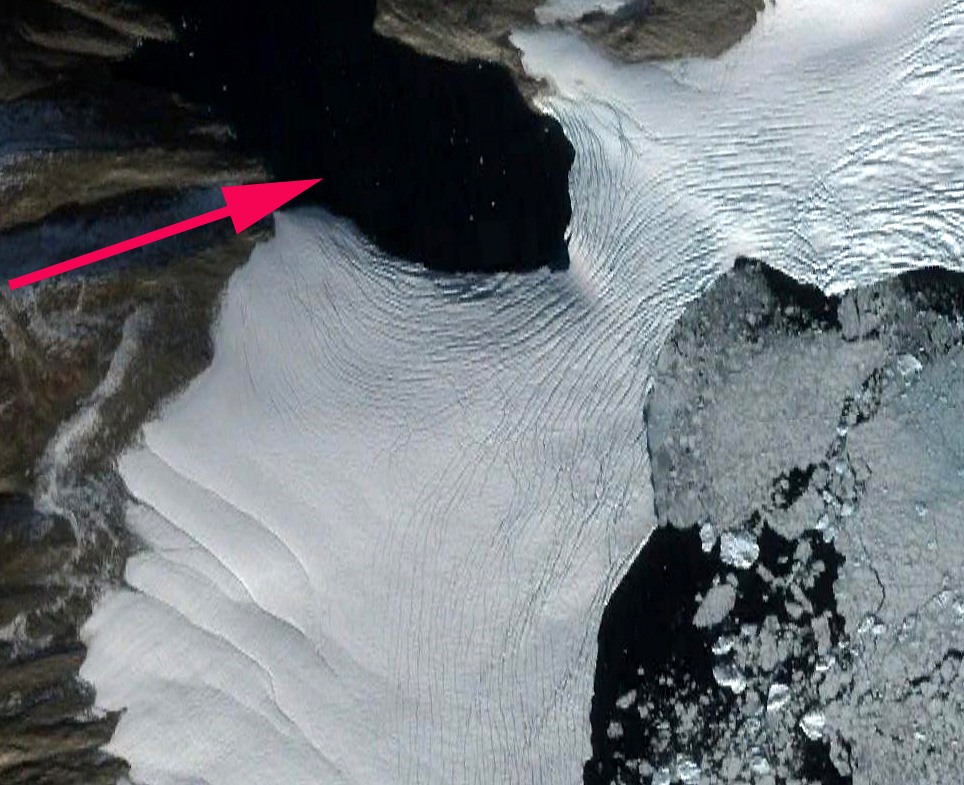
In 1989 the glacier terminates near the tip of a peninsula, red arrow in each image. The calving front extends southeast, orange dots. At the yellow arrow the glacier fills a small side valley adjacent to the main glacier. At the purple arrow is a small extension of the main icefall flowing down the bedrock step.
In 2002 there is only minor retreat at the red and yellow arrow, but thinning has led to the small extension of the main icefall being almost cutoff by bedrock. By 2015 the glacier has retreated 200-300 meters from the 1989 position and the main terminus is narrower. At the yellow arrow the side valley no longer has ice. At the purple arrow this is just bedrock now, there is no glacier extension flowing down the bedrock step. A close up the icefall in a 2009 Google Earth image indicates both the extensive crevassing but also the lack of glacier ice at the purple arrow, where an extension of the icefall formerly flowed. A Google Earth closeup of the terminus indicates that only a small section is still in contact with Beaufoy Cove in 2009, with land exposed at the orange arrows. This glacier is almost not tidewater and has terminated in shallow water since 1989, which helps explain a slower rate of retreat. The glacier has thinned more rapidly than it has retreated in the last 25 years. The retreat rate is less than nearby Bertrab Glacier, Konig Glacier and Neumayer Glacier on the same coast of South Georgia.

weddel glacier 1989

Landsat Image 1989

weddell glacier 2002

Landsat image 2002

weddel glacier 2015
Landsat image 2015
weddel icefall
Google Earth icefall image
weddel terminus
Google Earth 2009 image