McBride Glacier Increased Retreat and Harbor Seals, Glacier Bay, Alaska

mcbride compare

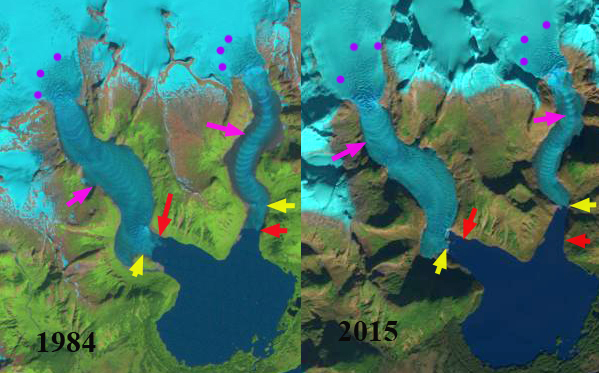
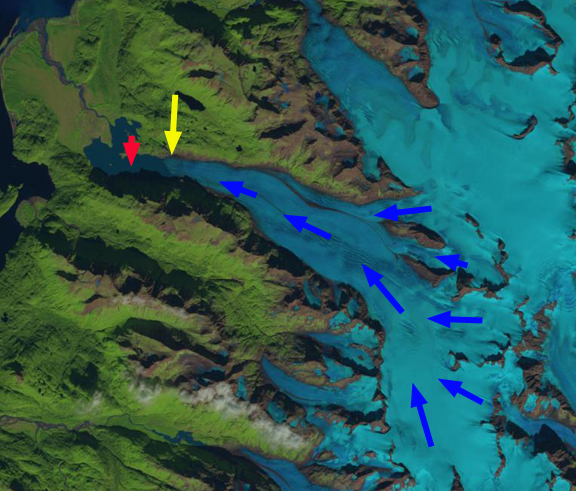
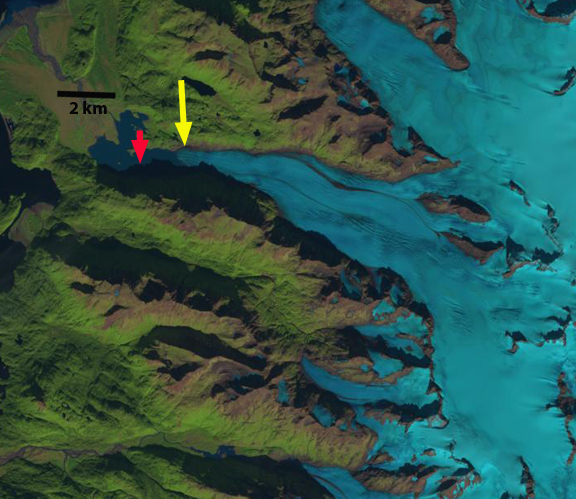
McBride Glacier (M), its secondary terminus (Ms), MCbride Inelt (MI) and Riggs Glacier (R) in Landsat image comparison from 1985 and 2015.  The red arrows indicate the 1985 terminus location and the yellow arrows the 2015 terminus location.  Main terminus 4.4 km retreat, secondary terminus 2.7 km retreat.

McBride Glacier was part of the Muir Glacier complex in Glacier Bay, Alaska, until the 1960’s when it separated from Muir and adjacent Riggs Glacier.  Riggs Glacier and Muir Glacier are no longer calving tidewater glaciers, while McBride has continues to terminate in a tidewater inlet.  Riggs Glacier’s retreat from the sea was complete by 2009.The continued rapid retreat of McBride Glacier is enhanced by calving. Calving generates icebergs, the number of icebergs has had a direct relationship with number of harbor seals. The number of harbor seals observed has declined substantially in Glacier Bay since 1993 (Glacier Bay NPS).  In particular the population has declined in front of Muir Glacier which no longer calves, while a smaller population has remained in front of McBride Glacier (Womble et al, 2010).  Here we examine Landsat imagery from 1985 to 2015 to quantify the retreat and estimate how long until this glacier too will no longer calve.

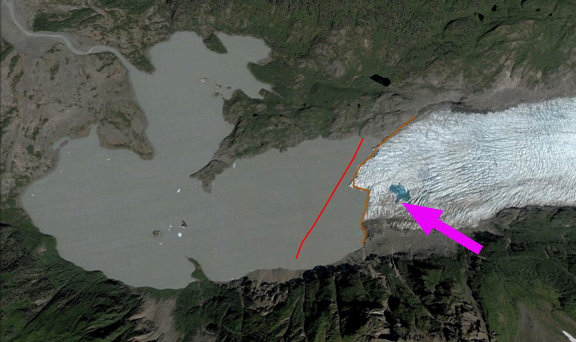
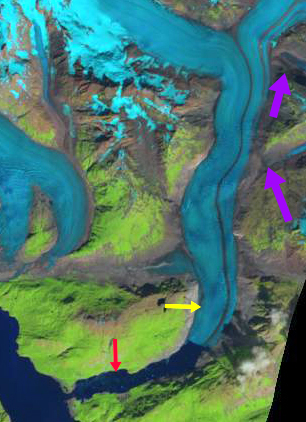
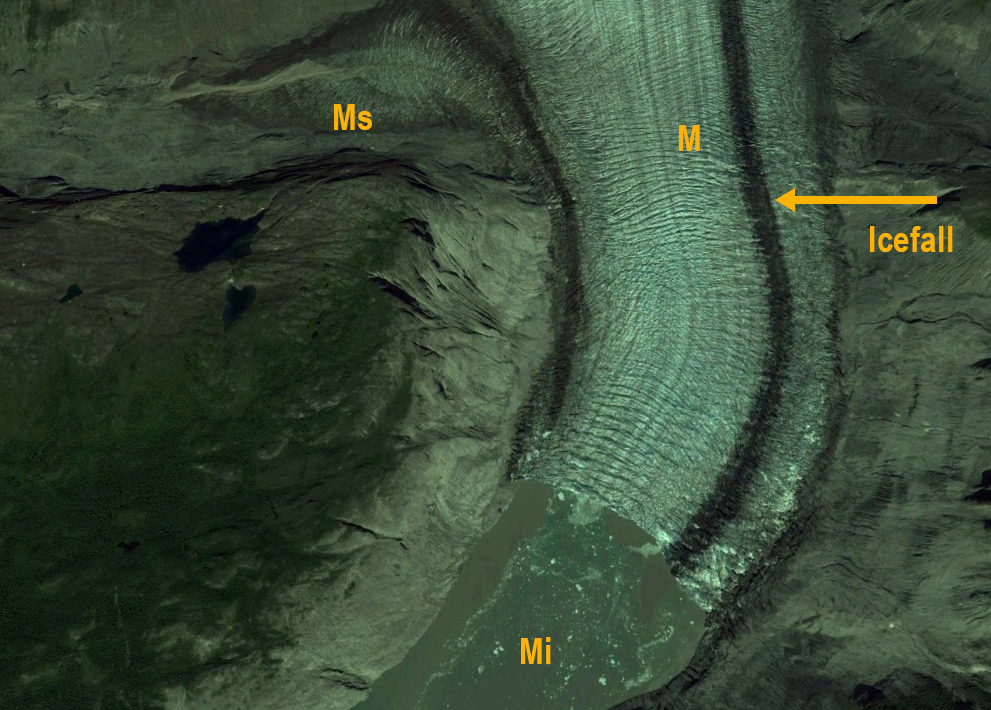
Inn 1985 the main glacier terminated 1.3 km from Muir Inlet, with a narrow connecting stream to Muir Inlet.  The secondary terminus extended west down a separate valley, 3.75 km from the main glacier nearly reached the Riggs Glacier. The snowline was at 900 m.  By 1996 the main terminus had retreated 1.1 km, and the connection with Muir Inlet had expanded to 200 m.  The secondary terminus had narrowed but still nearly reached Riggs Glacier. There are two tributaries from the east at purple arrows connected to main glacier. By 2013 the glacier has retreated an additional 2.0 km and reached a northward turn in the inlet, The secondary terminus had mostly disappeared extending only 1.25 km from the main glacier.  The eastern tributaries, purple arrows, had both retreated and detached from main glacier. By 2015 the glacier had retreated 4.4 km since 1985 including 1.3 km since 2013.  The glacier now terminates at the head of a 6 km long inlet. The glacier is still actively calving, which is good for the harbor seals.  However, a small icefall 0.8-1.1 km from the current terminus indicates a possible location for the end of the tidewater portion of this valley, note orange arrow in Google Earth image below. The retreat of the secondary terminus has been 2.7 km during this same period, without any calving. In 2013 and 2015 the snow line was above 1000 m, which as on nearby Brady Glacier is well above the equilibrium average which will continue to drive retreat Pelto et al, 2013).  In 2016 southeast Alaska has had its hottest spring, which will continue this chapter.

Counting harbor seals is a task completed by the Glacier Bay NPS, they follow two populations the larger in John Hopkins Inlet off of Glacier Bay and the other in Glacier Bay proper.  Both have declined by over 80% since 1992.  In 2009 there were 200 harbor seals in McBride inlet Glacier Bay NPS.  Glaciers are part of the local ecosystem where they exist, glacier changes do result in broader ecosystem changes, in this case harbor seals is one monitored example.  The NPS prepares annual reports on glacier change in the region and notes widespread thinning in the region since 1995 and a 15% decline in glacier area in the last half century Loso et al (2014). The team of N.Loso, A.Arendt, C Larsen, N.Murphy and J.Rich have produced annual reports in recent years with valuable detail on changes of glaciers across Alaskan National Parks.
mcbride Glacier 2013

1996 Landsat image indicating terminus positions from 1985, read arrow and 2015 yellow arrow.  The purple arrow indicates tributaries attached to main glacier.
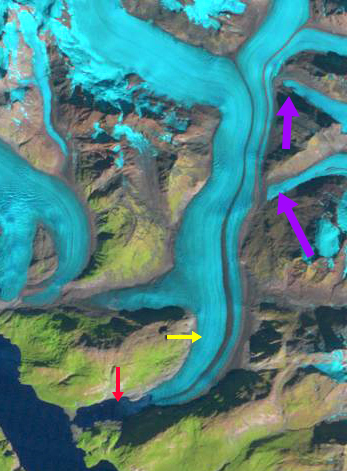
mcbride Glacier 1996

2013 Landsat image indicating terminus positions from 1985, read arrow and 2015 yellow arrow.  The purple arrow indicates tributaries detached from main glacier.
mcbride ge

2014 Google Earth image indicating the icefall in relation to 2014 terminus.  The icefall has increased calving and a 100 m increase in elevation.  This is certainly a location where the valley bottom rises, and may be the end of the tidewater reach of the inlet.

Brady Glacier, Alaska 2016 Early Melt Season & Lake Expansion

brady lake compare 2016

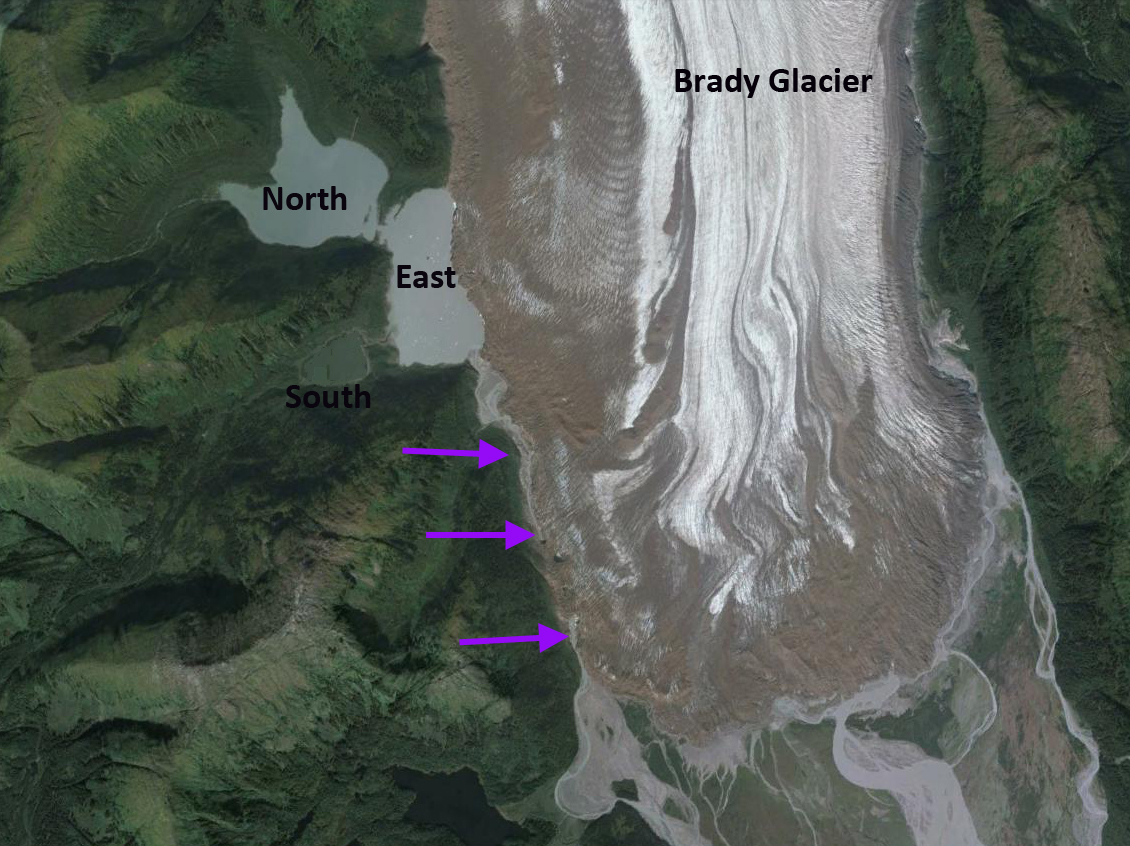
Comparison of Brady Glacier in 1986 and 2016 Landsat images.  The snowline is similar in May 2016 and August 1986. Lakes noted are: A=Abyss, B=Bearhole, D=Dixon, N=North Deception, O=Oscar, Sd=South Dixon, Sp=Spur, T=Trick.

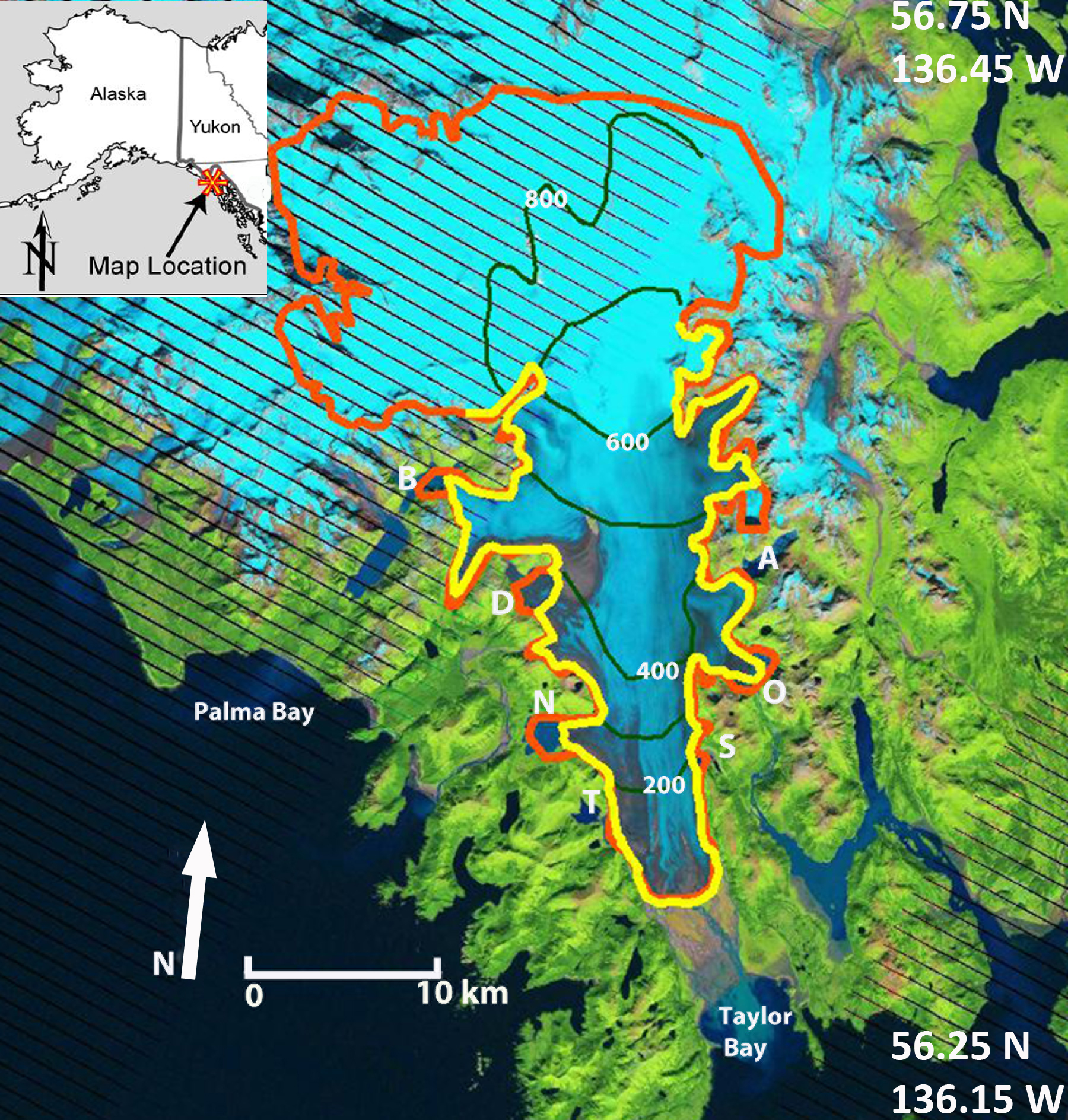
Brady Glacier,  is a large Alaskan tidewater glacier, in the Glacier Bay region that is beginning a period of substantial retreat Pelto et al (2013). In 2016 the melt season has been intense for the Brady Glacier in Alaska. Pelto et al (2013) noted that the end of season observed transient snowline averaged 725 m from 2003-2011, well above the 600 m that represents the equilibrium snowline elevation. On May 20, 2016 the transient snowline (TSL) is at 500 m. Typically the TSL reaches 500 m in early July: 7/13/2004=530; 7/8/2005=550, 7/3/2006=500, 7/22/2007=520, 7/3/2009=500; 7/10/2013=500. The high early season snowline is indicative of an early opening and filling of the many proglacial lakes that secondary termini of the glacier end in. The lakes Trick, North Deception, Dixon, Bearhole, Spur, Oscar, and Abyss continue to evolve. In addition two new lakes have developed. The changes are evident in a comparsion of 1986 and 2016 Landsat images. The TSL on May 20/2016 is remarkably similar to the August 20, 1986 TSL.
base figure

2010 Landsat image of the glacier indicating the 1948 margin in Orange and the 2016 margin in yellow. Lakes noted are: A=Abyss, B=Bearhole, D=Dixon, N=North Deception, O=Oscar, S=Spur, T=Trick.

There is a consistent pattern in the change in position of the glacier margin at each of the lakes between 1948 and 2010. The rate of retreat of the glacier margin at all seven lakes accelerated later during this period; the mean retreat rate is 13 m/a from 1948 to 2004 and 42 m/a  from 2004 to 2010 (Pelto et al, 2013). Lake area and calving fronts were measured for each lake: Spur, Abyss, North Deception, Bearhole, Oscar, and East Trick based on the September 2010 imagery, with earlier measurements from Capps et al. (2010). Lake areas have increased as a result of glacier retreat, and can decrease due to declines in surface water levels as previously ice-dammed conduits form to drain the lake. Lake water levels have fallen in Abyss, Bearhole, Dixon, North Deception, Spur, and Trick since 1948 Capps et al (2010). Only Oscar Lake, the most recent to form, has maintained its surface level. Retreat of the glacier margin has been greatest at Bearhole, North Deception Lake, and Oscar Lake, which as a consequence have expanded substantially in area. Lake water level declines at Abyss, Spur, and Trick have offset the increase in area resulting from glacier retreat, leading to small changes in lake area. The seven lakes have changed dramatically in response to this acceleration in retreat.

Trick Lakes: In 1986 North and South Trick Lake are proglacial lakes in contact with the glacier. By 2016 the two lakes are no longer in contact with the glacier, water levels have fallen and a third lake East Trick Lake has formed. The more recently developed East Trick Lake is the current proglacial Trick Lake, a large glacier river exits this lake and parallels the glacier to the main Brady Glacier terminus, going beneath the glacier for only several hundred meters.

trick 2014

2014 Google Earth image of Trick Lakes, and the glacier river exiting to the main terminus, purple arrows.

North Deception Lake had a limited area in 1986 with no location more than 500 m long. By 2016 retreat has expanded the lake to a length over 2 km. The width of the glacier margin at North Deception Lake will not change in the short term, but the valley widens 2 km back from the current calving front, thus the lake may grow considerably in the future.

South Dixon Lake This new lake does not have an official name. It did not exist in 1986, 2004, 2007 or 2010. It is nearly circular today and 400 m in diameter.

Dixon Lake: It is likely that retreat toward the main valley of the Brady Glacier will lead to increased water depths at Dixon Lake, observations of depth of this lake do not exist. Retreat from 1986 to 2016 has been 600 m.

Bearhole LakeBearhole Lake is expanding up valley with glacier retreat, and there are no significant changes in the width of the valley that would suggest a significant increase in calving width could occur in the near future. Currently the lake is 75 m deep at the calving front and there has been a 1400 m retreat since 1986 Capps et. al. (2013).

Spur Lake:It is likely that retreat toward the main valley of the Brady Glacier will lead to increased water depths at Spur Lake. the depth has fallen as the surface level fell from 1986-2016 as the margin retreated 600 m, leaving a trimline evident in the 2016 imagery.

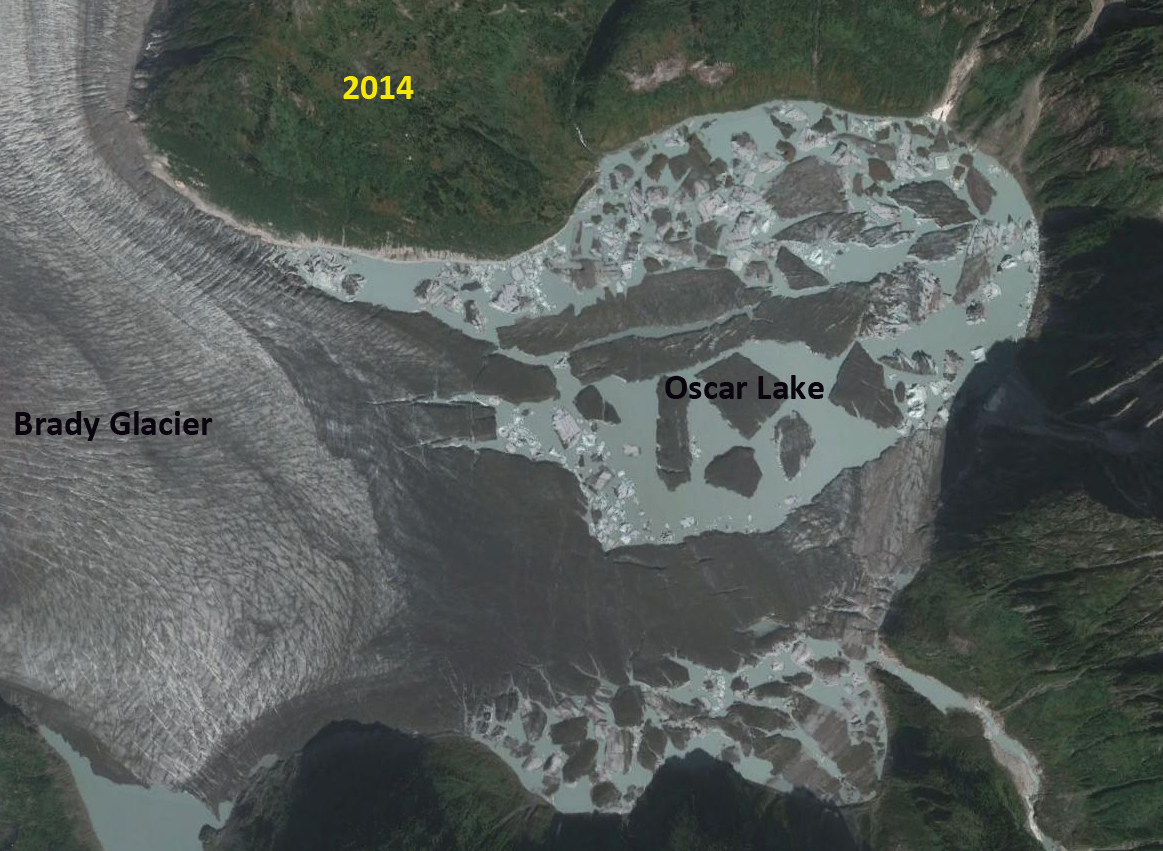
Oscar Lake has experienced rapid growth with the collapse of the terminus tongue. Depth measurements indicate much of the calving front which has increased by an order of magnitude since 1986 is over 100 m. The tongue as seen in 2014 Google Earth image will continue to collapse and water depth should increase as well. The central narrow tongue has retreated less than 200 m since 1986, but the majority of the glacier front has retreated more than 1 km since 1986.

oscar 2014

Google Earth image of Oscar Lake, illustrating the number of large icebergs of this ongoing terminus collapse.

Abyss Lake: Continued retreat will lead to calving width expansion> The retreat from 1986 to 2016 has been 400 m. The water depth has been above 150 m at the calving front for sometime and should remain high.

Glacier thinning and retreat near the lakes dammed by Brady Glacier have led to changes in the widths of calving fronts between. The combined increase in the width of the six secondary calving fronts is 34% from 1948 to 2004, and 15% from 2004 to 2010 (Pelto et al, 2013) With the inclusion of South Dixon Lake and continued expansion of Dixon and Oscar Lake the calving width has continued to increase up to 2016. Calving widths at Bearhole Lake, Spur Lake, and Trick Lake will not change appreciably. Spur Lake and Trick Lake parallel the margin of the glacier, and although this margin will likely continue to recede, the length of the depression filled by the two lakes probably will not change.

Water depth is an important factor affecting the calving rate of glaciers in lacustrine environments; velocity and calving rate increase with water depth by a factor of 3.6 (Skvarca et al., 2002). Capps et. al. (2013) determined the bathymetry and calving depths of five of the lakes at Brady Glacier. Water depths increase toward the calving fronts at Abyss Lake, Bearhole Lake, Oscar Lake, and Trick Lake; only at North Deception Lake does the water not currently become deeper towards the calving front; however it almost certainly will as the east margin moves into the main Brady Glacier valley. The observations suggest that mean calving depths of proglacial lakes, at least in the short term, will increase with continued retreat. Increases in calving width and depth will lead to increased calving at the secondary termini in the near future (Pelto et al, 2013).

Harris Glacier Retreat, Kenai Fjords, Alaska

harris compare

Landsat images of Harris Glacier from 1986 and 2015.  The red arrow indicates 1986 terminus location, yellow arrow the 2015 terminus position.  The orange arrow indicates a key eastern tributary and the pink arrow a smaller eastern tributary. 

Harris Glacier flows from the northwest corner of the Harding Icefield, Alaska and it drains into Skilak Lake.  The glaciers that drain east toward are in the Kenai Fjords National Park, which has a monitoring program.  Giffen et al (2014) observed the retreat of glaciers in the region. From 1950-2005 all 27 glaciers in the Kenai Icefield region examined  are retreating. Giffen et al (2014) observed that Harris Glacier (A Glacier) retreated 469 m from from 1986-2005.  Here we examine Landsat imagery from 1986-2015 to illustrate the retreat of this glacier and other upglacier changes. The glacier supplies meltwater to Skilak Lake which is a critical salmon habitat for the Kenai. Chinook Salmon spawn on a section of the Kenai River between Kenai Lake and Skilak Lake. With Skilak Lake being the resulting home for ninety percent of the salmon fry for the Kenai River, and with the most of any nursery in the Cook Inlet area. Escapements of chinook in the Kenai River exceed 50,000 annually in two runs (Heard et al 2007).

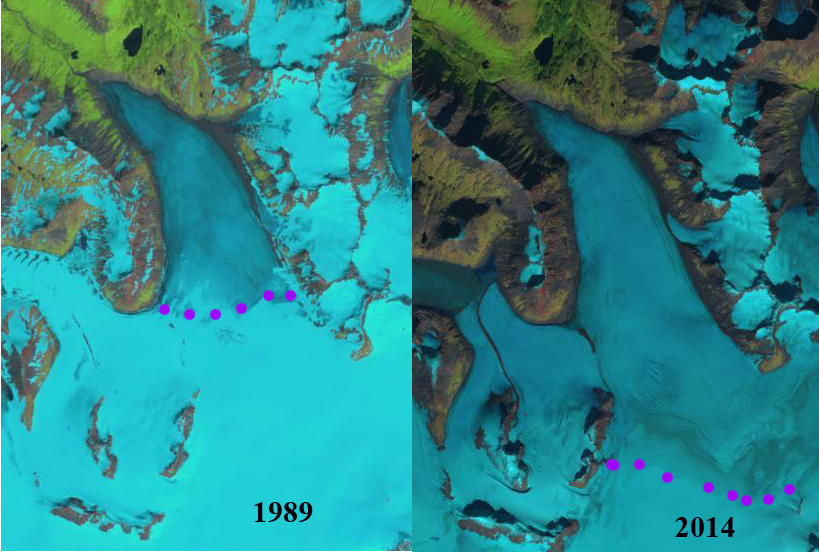
In 1986 the glacier extended to an elevation of 590 m, on the east side of the glacier there were two smaller tributaries reaching the glacier at the orange and pink arrow.  By 2015 the terminus had retreated 600 m from 1986.  The eastern tributary at the pink arrow had detached from the main glacier.  The tributary at the orange arrow still reaches the main glacier, but the blue ice extent after joining the glacier has diminished significantly. Below is a closeup of the terminus from 1996 and 2015 illustrating a 225 m retreat and associated thinning.  It is also interesting to note the prominent ash layer has shifted little.  This suggests the terminus area is relatively stagnant. There is no active crevassing in the lower 1 km suggesting retreat will be ongoing.   In 1989 the snowline is at 975 m whereas in 2014 the snowline is at 1125 m.  This higher snowline is too high to maintain the glacier. The snowline in 2015 was again above 1100 m, though it is lower in the mid-August image at 1050 m. The retreat of this glacier is less than neighboring glaciers such as Grewingk, Pederson and Bear Glacier that have calving termini.

harris snowline

Landsat images from 1989 and 2014, with the snowline indicated by purple dots. 

harris terminus

Terminus of Harris Glacier in Google Earth images from 1996 and 2015.  Margin with purple dot, purple arrow indicates 1996 terminus lcoation, with a 225 m retreat by 2015. Note the prominent ash layer

Eagle Glacier, Alaska Retreat Losing a Wing

eagle glacier change

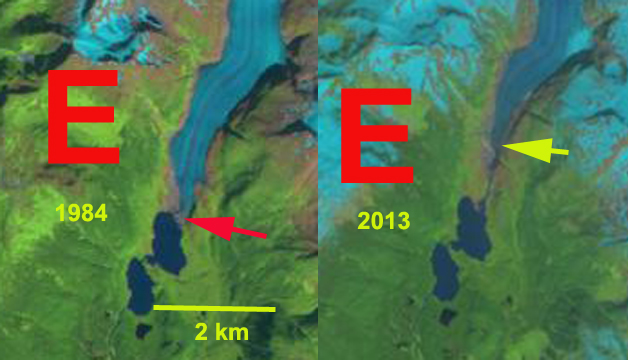
Above is a paired Landsat image from 1984 left and 2013 right indicating the 1100 m retreat during this period of Eagle Glacier.

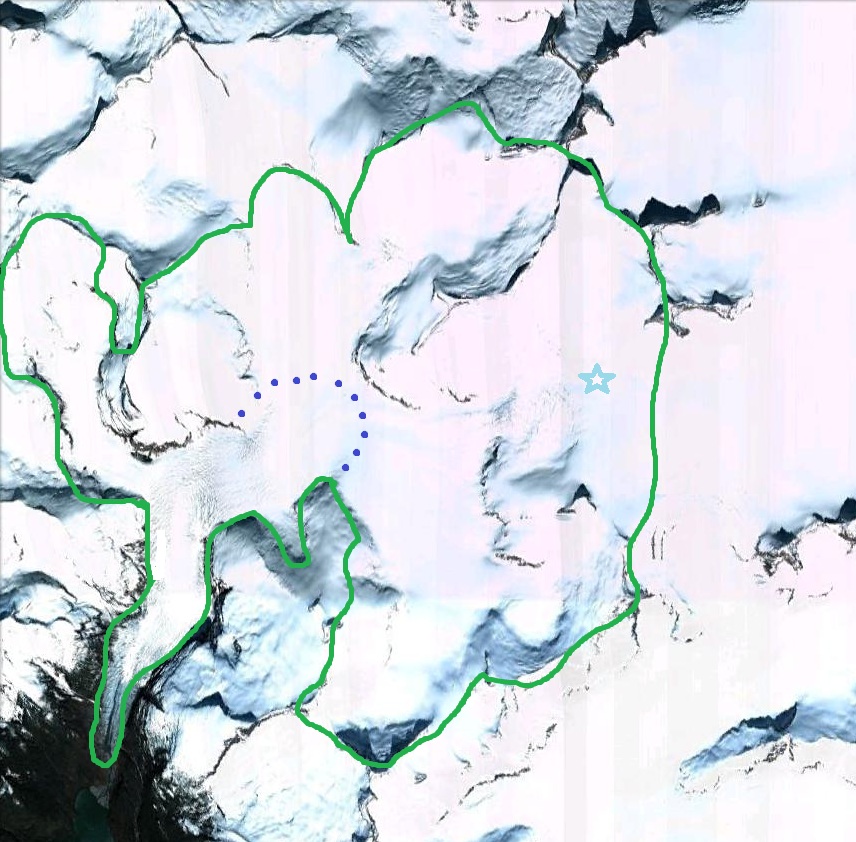
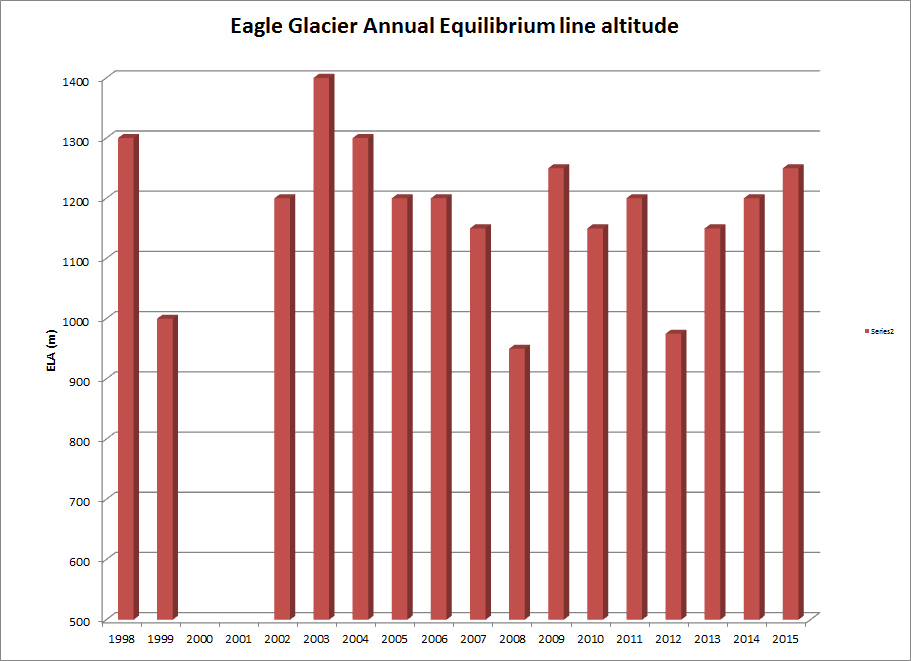
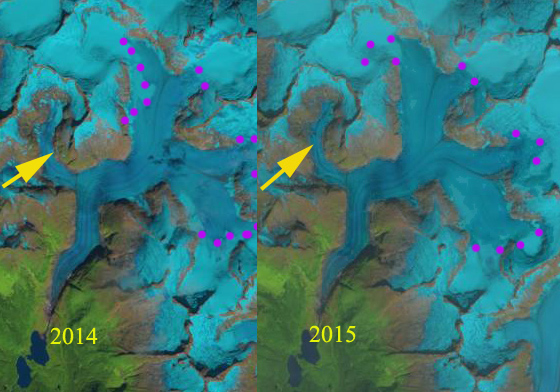
My first visit to the Eagle Glacier was in 1982 with the, ongoing and important, Juneau Icefield Research Program, that summer I just skied on the glacier. In 1984 we put a test pit at 5000 feet near the crest of the Eagle Glacier to assess the snowpack depth. This was in late July and the snowpack depth both years was 4.3 meters, checking this depth in nearby crevasses yielded a range from 4-4.5 meters.In 1984 the snowline at the end of the summer melt season in early September was at 1050 meters.The equilibrium line altitude (ELA) which marks the boundary between the accumulation and the ablation zone each year. On Eagle Glacier to be in equilibrium the glacier needs to have an ELA of 1025 meters. In the image below the glacier is outlined in green, the snowpit location is indicated by a star and the snowline that is needed for the glacier to be in equilibrium at 1025 meters is indicated. The number of years where the ELA is well above 1050 meters dominate since 2002, all but two years see chart below, leading to mass loss, thinning and glacier retreat. This follows the pattern of Lemon Creek Glacier that is monitored directly for mass balance, which has lost 26 meters of thickness on average since 1953.The more rapid retreat follows the pattern of more negative balances experienced by the glaciers of the Juneau Icefield (Pelto et al. 2013). The high snowlines have left the western most tributary with no retained snowpack in 2013, 2014 and 2015, yellow arrow in the 2014 and 2015 Landsat image.  This will lead to the rapid downwasting of this tributary.

Eagle Glacier has experienced a significant and sustained retreat since 1948 when it terminated near the northern end of a small lake.  By 1982 when I first saw the glacier and when it was mapped again by the USGS the glacier had retreated to the north end of a second and new1 kilometer long lake. In the image below the red line is the 1948 terminus, magenta line the 1982 terminus, green line 2005 terminus and orange line the 2011 terminus. From 1984 to the 2005 image the glacier retreated 550 meters, 25 meters/year. From 2005-2015 retreat increased to 60 meters/year. Going back to the 1948 map the terminus in 2011 is located where the ice was 150-175 m thick in 1948. The high snowlines in 2014 and 2015 along with extended melt season continued the rapid retreat.  Total retreat from 1984-2015 is now 1200 m. The retreat hear is less rapid than on nearby Gilkey Glacier or Antler Glacier, but the upglacier downwasting is more severe than at Gilkey Glacier.

Snowline location and snowpit location in 1984

eagle ela
ELA of Eagle Glacier from Landsat images.

eagle wing compare

2014 and 2015 Landsat image indicating snowline on Eagle Glacier, purple dots. Yellow arrow indicates tributary that lacks any retained snowpack,

Terminus change map on 2005 Google Earth image.  Red line is 1948, magenta line is 1982, green line is 2005 and orange line is 2011. 

North Fork Grand Plateau Glacier, Alaska-Spectacular 3 km Retreat 2013-15

south alsek glacier compare

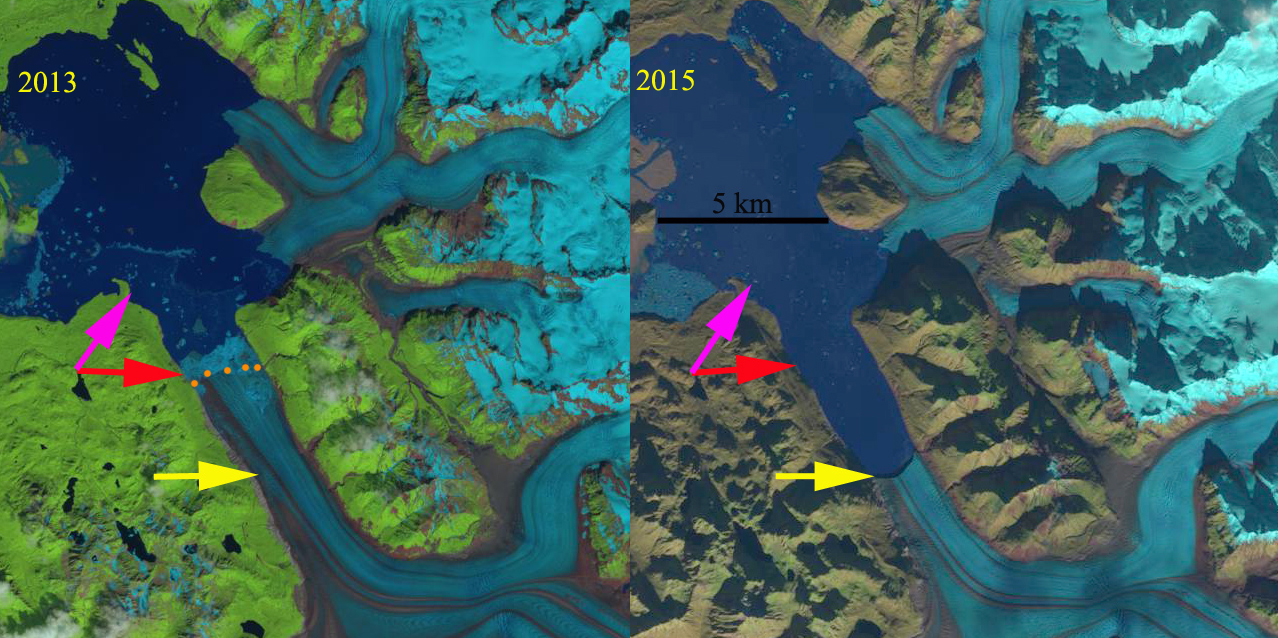
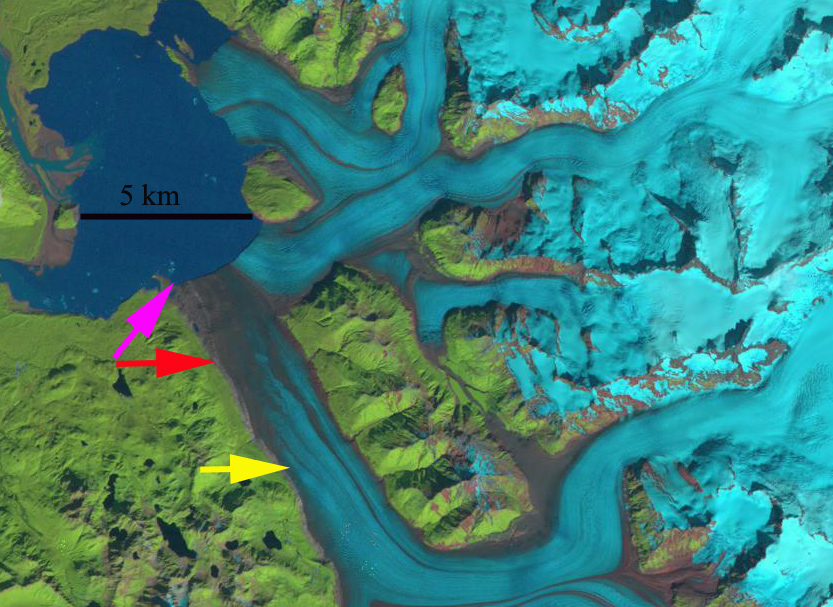
North Fork Grand Plateau Glacier comparison in 2013 and 2015 Landsat images.  Illustrating the rapid retreat and lake expansion in just two years. Pink arrow is 1984 terminus, red arrow is the 2013 terminus and yellow arrow 2015 terminus. The orange dots are the 2013 terminus. 

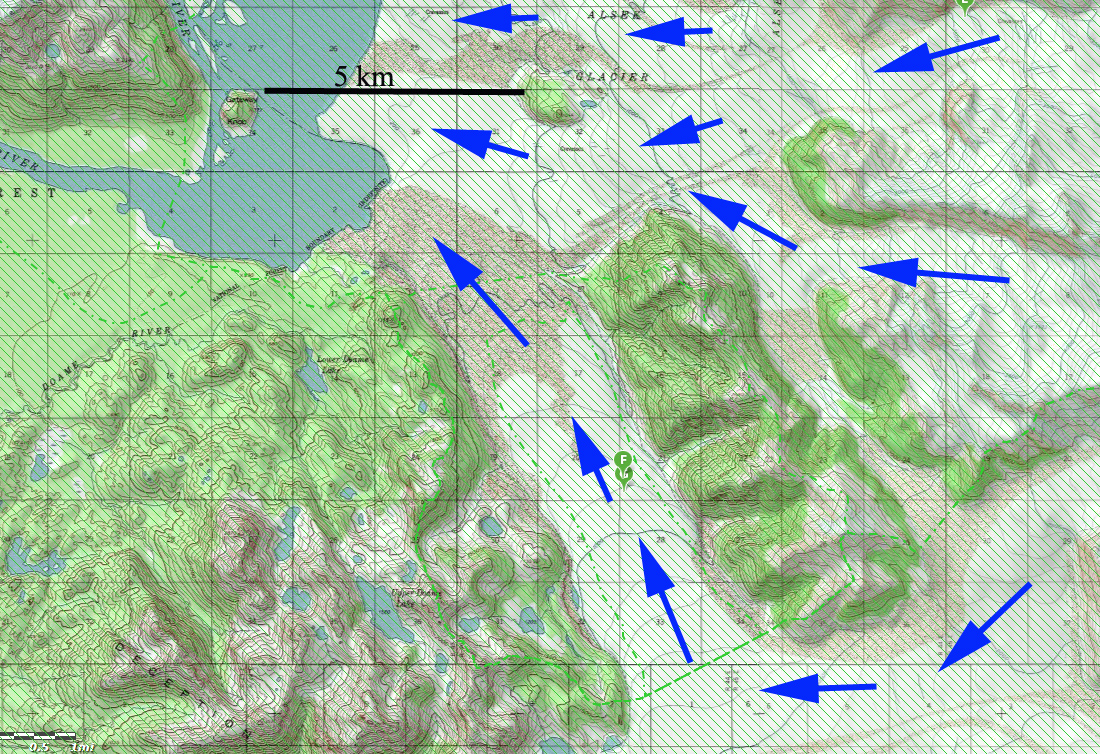
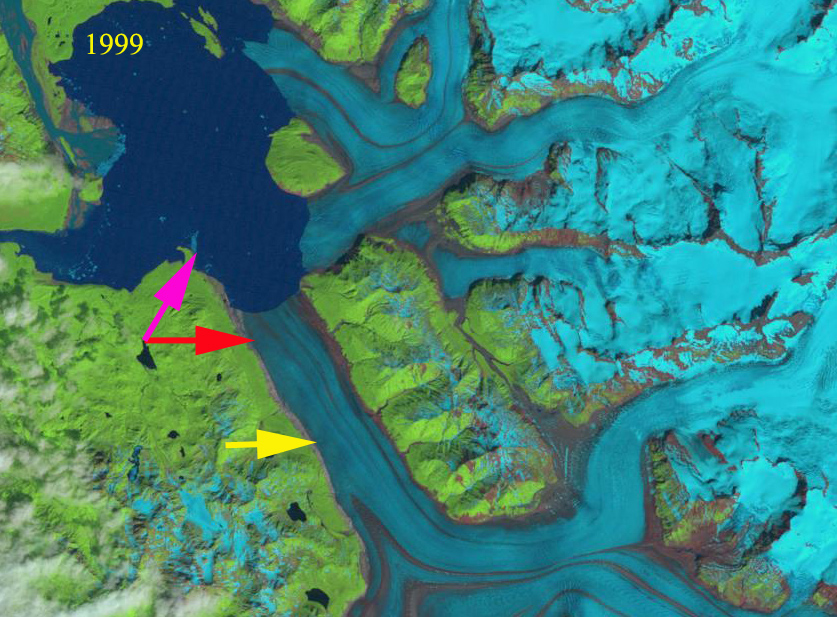
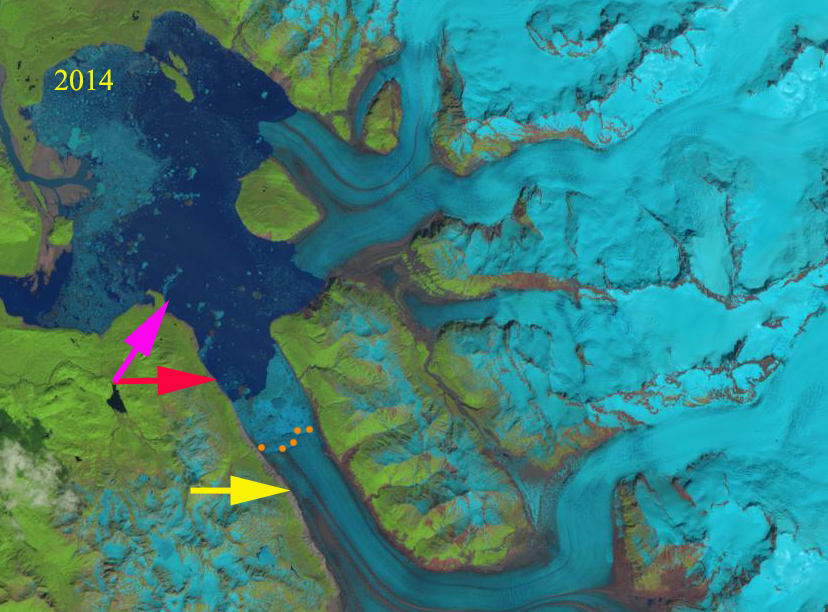
The Alsek Glacier is a large glacier draining into Alsek Lake and the Alsek River in southeast Alaska  Its neighbor the Grand Plateau Glacier has one fork  flows north and joins the Alsek Glacier terminating in Alsek Lake. The USGS topographic map compiled from a 1958 aerial image indicates a piedmont lobe spread out into a proglacial lake that is less than 3 km wide, with a combined ice front of the Alsek Glacier and North Fork Grand Plateau Glacier.. There is a 10.5 km wide calving front in the lake.  By 1984 the glacier had separated into a northern and southern calving front on either side of an island and had a 13 km wide calving front.   Here we focus on the southern lobe, which is comprised of a lobe of  the Alsek Glacier and a the North Fork Grand Plateau Glacier that merges with Alsek Glacier.  From 1984 and 1999 the two lobes separated as the North Fork retreated 2.2 km.  From 1999 to 2013 the North Fork retreated 1.5 km up a newly forming southern arm of Alsek Lake.  The retreat over the 30 period of 3.7 kilometers averaged ~120 meters/year. Landsat imagery in 2013 and 2014 indicate extensive calving from the North Fork Grand Plateau Glacier.  From 2013 to 2015 the terminus has retreated 3.0 km, 1.5 km/year.  This is likely the fastest retreat rate in recent years of any Alaskan glacier. The calving front in Alsek Lake has been reduced to 5.4 km in three separate sections.

The retreat has been similar in timing to nearby Alsek River watershed glaciers Walker GlacierEast Novatak Glacier and North Alsek Glacier..  The rapid retreat is enhanced by calving in proglacial lakes, a common issue increasing area loss of Alaskan glaciers.  Yakutat Glacier is an example of rapid lake expansion. In the case of Yakutat Glacier unlike the Alsek or Grand Plateau Glacier the glacier lacks any high elevation accumulation zone and cannot survive without an accumulation zone (Trüssel et al 2015).  Grand Plateau Glacier and Alsek Glacier both have large accumulation areas above 2000 m, that are well above the snowline at all times.  The Alsek River is a destination for sockeye salmon fishing and river rafting, see Chilkat Guides or Colorado River and Trail Expeditions.  Continued expansion of lake area as glaciers retreat in the watershed, is changing the nature of the Alsek River.

alsek map

USGS Topographic map of region from 1958 aerial images indicating merging of Alsek Glacier and North Fork Grand Plateau Glacier. 

alsek 1984

1984 Landsat image indicating terminus locations. Pink arrow is 1984 terminus, red arrow is the 2013 terminus and yellow arrow 2015 terminus.

alsek 1999

1999 Landsat image indicating terminus locations. Pink arrow is 1984 terminus, red arrow is the 2013 terminus and yellow arrow 2015 terminus.

alsek 2014

2014 Landsat image.  indicating terminus locations. Orange dots indicate the ice front. Pink arrow is 1984 terminus, red arrow is the 2013 terminus and yellow arrow 2015 terminus.

Pacific Northwest Glaciers: Widespread early Melt Season Arrival

[ngg_images source=”galleries” container_ids=”43″ display_type=”photocrati-nextgen_basic_imagebrowser” ajax_pagination=”1″ template=”/nas/wp/www/sites/blogsorg/wp-content/plugins/nextgen-gallery/products/photocrati_nextgen/modules/ngglegacy/view/imagebrowser-caption.php” order_by=”sortorder” order_direction=”ASC” returns=”included” maximum_entity_count=”500″]


The 2016 melt season is off to an early start in Greenland, but this is not the only location.  This winter proved to be warm, but relatively wet across much of the Pacific Northwest.  A look at the average freezing level (determined by North American Freezing Level Tracker-Developed by John Abatzoglou and Kelly Redmond) from January 1 to April 20 indicates freezing levels well above average on Mount Baker North Cascades, Washington, Bugaboo Mountains British Columbia and Juneau Icefield Alaska.  Reports from the field in British Columbia, Alaska and Washington identify a peak snowpack in late March instead of early May at glacier elevations.

In British Columbia the University of Northern British Columbia field team is currently on Conrad Glacier in the Bugaboos, having just finished Kokanee Glacier. This is part of a five-year study led by Dr. Brian Menounos, UNBC Canada research chair in glacier change, funded by the Columbia Basin Trust. UNBC PhD student Ben Pelto heads the research team. They have found that despite snowpack observations for the region from the BC River Forecast Centre of slightly above average snowpack on April 1, the high winter freezing levels and very warm April conditions have left the Kokanee Glacier snowpack quite similar to the low 2015 snowpack, with close to 4.5 m of retained snowpack.  The snowmelt season was noted by the River Forecast Centre as starting several weeks early. The freezing level from January-April 20 was a record for the 1948-2016 period by over 100 m for the Bugaboo mountains.  The region based on the warm spring causing rapid snow melt at lower elevations is leading many, Including John Pomeroy, to expect high forest fire danger and low streamflow during the summer across the Western Canada. 

zillmer snowpit

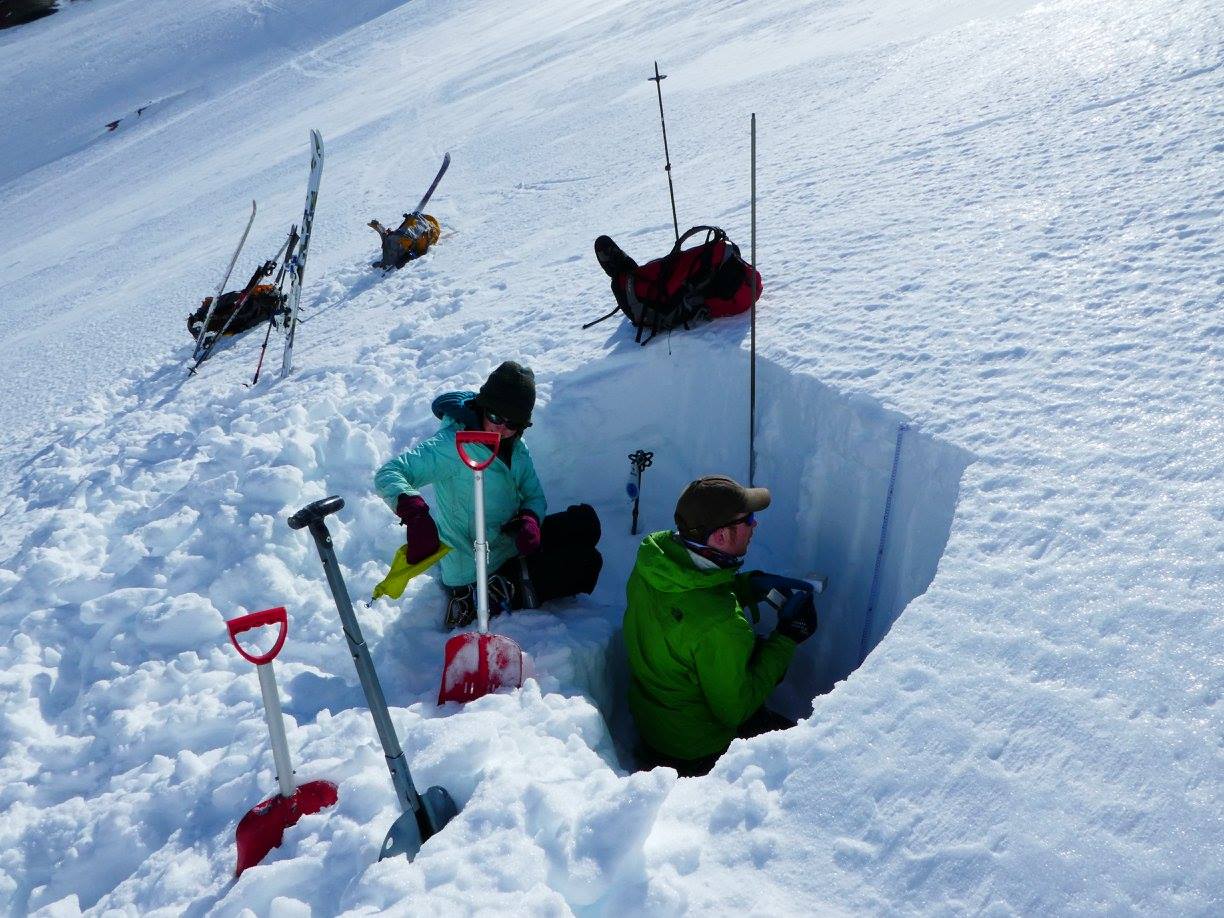
Snowpit being excavated on Zillmer Glacier April 2016, Jill Pelto and Micah May. (Ben Pelto)

BenPelto-and-JillPelto-BCGlacierClimateProject-Kokanee-April2016-TomHammond

Jill Pelto and Ben Pelto measuring density of firn core on Kokanee Glacier. (Tom Hammond)

In Alaska  USGS-Glaciology has been completing GPR surveys of their benchmark glaciers in recent weeks.  On the Juneau Icefield Lemon Creek Glacier is a reference for the World Glacier Monitoring Service.  Mass balance records exist since 1953 for this glacier (Pelto et al, 2013). In April the glaciers are typically covered head to toe by snow.  The last four months indicate a freezing level of nearly 900 m a record for the 1948-2016 period of record. An April 19th Landsat image indicates the snowline on Herbert and Mendenhall Glacier at 600 m. This is below the terminus of Lemon Creek Glacier at 800 m.  Near the Juneau Icefield the Long Lake Snotel site at 260 m in elevation had its snowpack drop from 64 cm water equivalent to 38 cm water equivalent in the last month.

wolverine base camp

USGS Wolverine Glacier Base Camp last week with field work underway. 

juneau icefield april 2016

April 19 Landsat image of the southwest side of the Juneau Icefield.  Snowline indicated by Purple arrows. M=Mendenhall, H=Herbert, L=Lemon Creek and T=Taku Glacier.

For Mount Baker, Washington the freezing level from January-April 20 was not as high as the record from 2015, but still was 400 m above the long term mean.  Observations at the base of Easton Glacier, one of our key glaciers in the North Cascades, indicate that the snowpack has declined from a depth of 4.8 m to 3.4 m during the first three weeks of April. This is mainly due to compaction, versus snow water equivalent loss, but still represents the rapid densification that occurs as snowmelt begins in earnest.

easton 2016 snowpack april

April 2016 image from icefall on Easton Glacier at 2500 m above (Adam Dunn) and in August below same area (Jill Pelto). 

DSC07209


Shamrock Glacier, Alaska Loses Terminus Tongue

shamrock glacier compare
Shamrock Glacier comparison in 1987 and 2014 Landsat images. Red arrow 1987 terminus, yellow arrow 2014 terminus, purple arrows upglacier thinning and purple dots the snowline. The terminus tongues extending into the lake has been lost.

Shamrock Glacier flows north from the Neacola Mountains into Chakachamna Lake in the Lake Clark National Park of Alaska. This lake is transited by several species of salmon, mainly sockeye, heading into spawning  areas upriver. The lake had been the site of a proposed hydropower plant, that would not have required building of a dam, but this project is currently not being developed. The National Park Service completed a Southwest Alaska Network mapping project that identified the changes of glaciers in the region. Lake Clark NP has 1740 glaciers which have lost 12% of their total area from 1950 to 2009 (Loso et al, 2014). Here we examine Landsat imagery from 1987 to 2014 to identify recent change of Shamrock Glacier.

shamrock glacier profile
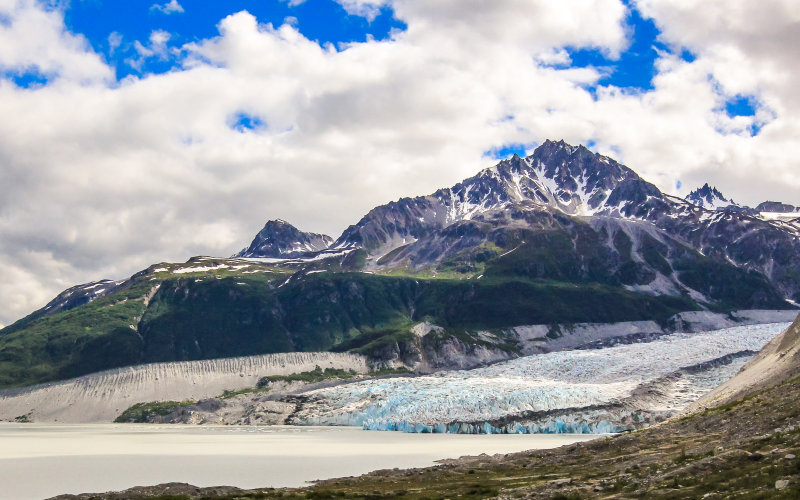
July 2015 image looking across Shamrock Lake to Shamrock Glacier, taken by Jerry Pillarelli, note he has many more gorgeous images of area. The trimline on the far side of the glacier between sediment and vegetation indicates the 1950 margin. There is an elevation step several hundred meters inland of the terminus indicating Shamrock Lake will expand little.

In 1987 Shamrock Glacier had receded from a terminal moraine in Chakachamna Lake that it had terminated on in the 1950’s map. The new proglacial lake was less than 500 m across. The snowline was at 1200 m. In 2000 seen below the snowline was at 1350 m, and the terminus had narrowed more than it had retreated. By 2014 the terminus had retreated 900 m leaving the new Shamrock Lake within Chackachamna Lake. The new Shamrock Lake has an area of 4 square kilometers. This is the majority of the loss in glacier area since 1950 as well. In 2014 the snowline is quite high at 1450 m. A snowline that is consistently above 1300 m will drive continued retreat. Thinning upglacier is evident with expanded bedrock areas adjacent to the glacier margin above 1200 m at the purple arrows, indicating the snowline has been consistently higher than this. The retreat is similar to other glaciers in the region South Sheep Glacier, Sovereign Glacier and Fourpeaked Glacier.  With the glacier retreating out of the lake basin soon, the rate of retreat should decline.

shamrock glacier 2000
2000 Landsat image

shamrock glacier ge 2013
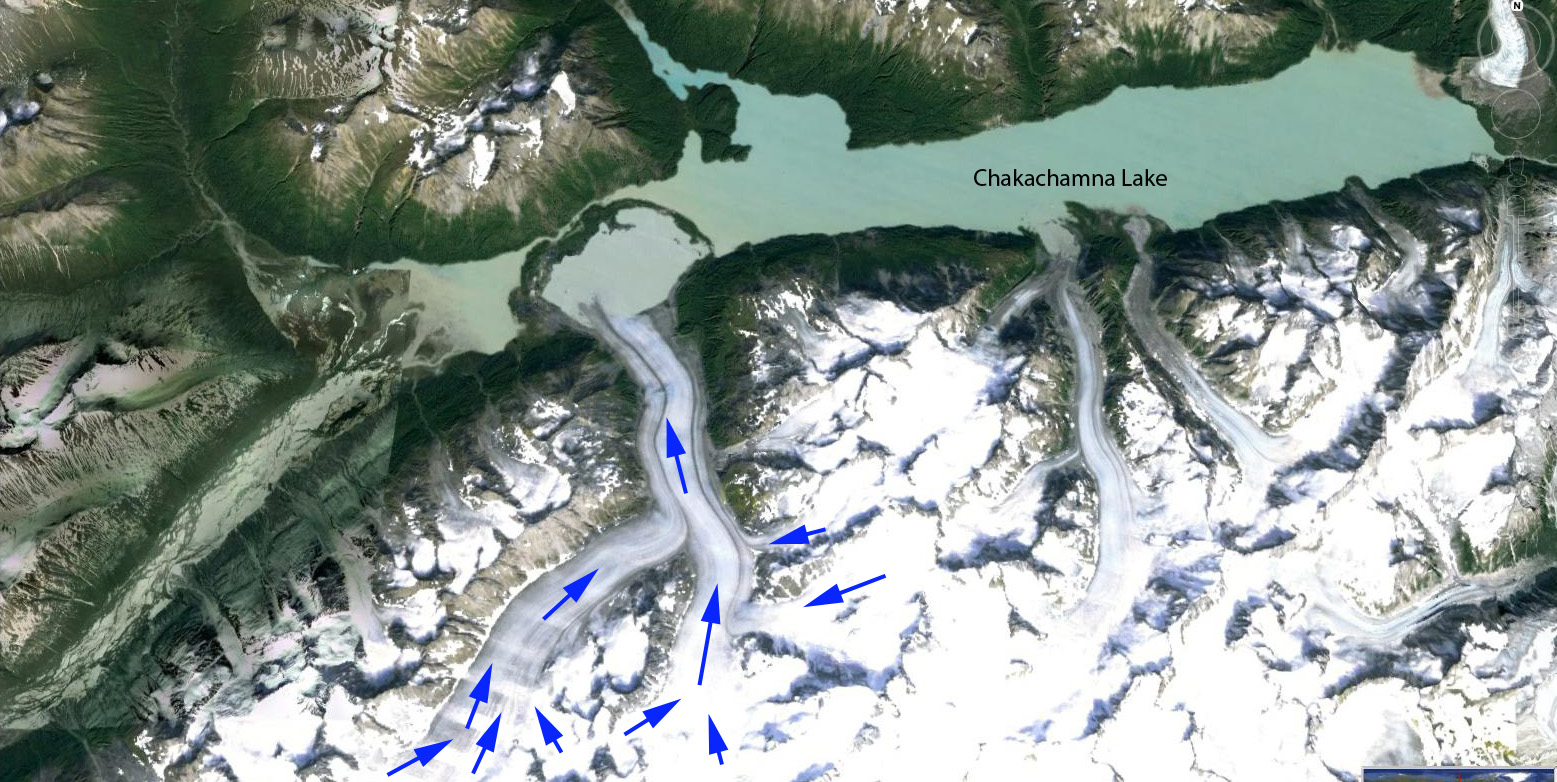
2013 Image of Shamrock Glacier, Shamrock Lake and Chakachamna Glacier.


Twin Glacier, Alaska Retreats from Twin Lake

twin glacier compare

Landsat image comparospm pf 1984 and 2015.  The yellow arrow indicates 2015 terminus, red arrow the 1984 terminus, pink arrows the ogives and purple dots the snowline on the day of the image.

Twin Glacier is an outlet glacier of the Juneau Icefield flowing south into the Taku River valley, terminating in Twin Lake.  There are two terminus arms the East and West Twin Glacier are receding up separate fjords, though they are fed from a joint accumulation zone.  The Juneau Icefield has been a focus of study by the Juneau Icefield Research Program since 1946.  This program led to my first visit to the glacier as a member of the program in 1982 and again in 1984. Both glacier arms have pronounced ogives formed in the icefall that descends from the accumulation zone into the valley reach ablation zone. Ogives form annually from the seasonal variation of velocity through the icefall. An examination of the change in Juneau Icefield glaciers using Landsat images from 1984 and 2013 identify a significant retreat that has continued into 2015.

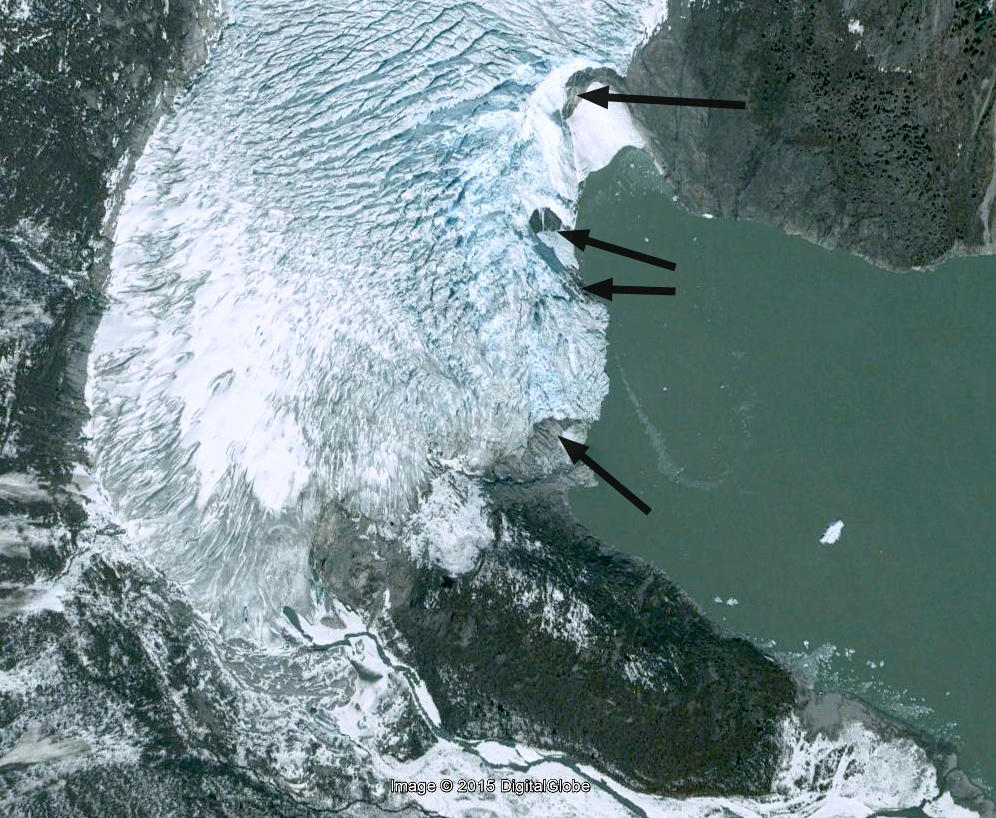
The West Twin has retreated 600 m from 1983 to 2013, at an elbow in the fjord. Elbows like this are often good pinning points that are a more stable setting.  This elbow also represents the point at which the glacier terminus is pulling out of the lake that it is calved into for over a century.  The bedrock at the terminus is evident in both 2006 imagery and a 2015 image from the Wings Airways five glacier seaplane discovery tour, black arrows.  The glacier will no longer be calving, which should also slow the retreat rate.

west twin 2006 ge
Google Earth Image 2006
west twin float plane
2015 Wings Airways image

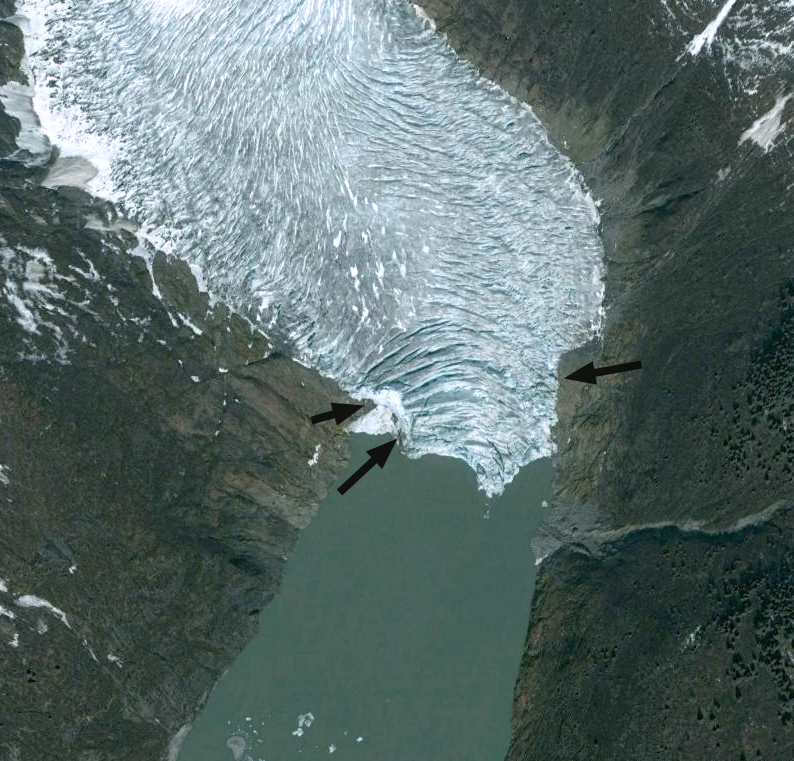
The East Twin is the  narrower glacier and drops more quickly in elevation. The glacier has retreated 900 m from 1984 to 2015. The terminus has calved into Twin Lake for over a century, but in 2015 the width of the terminus calving into the lake has declined to 150 m from 600 m in 1984.  The bedrock exposed on either side of the terminus indicates the terminus is on the verge of retreating from the lake.  The black arrows indicate both bedrock at the glacier front, but also the trimlines left from recent thinning.  The Google Earth image from 2006 and the 2015 image from the Wings Airways five glacier seaplane discovery tour.

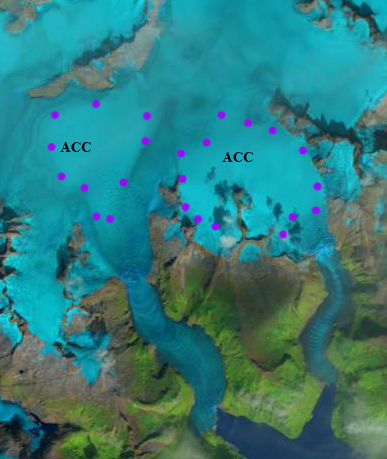
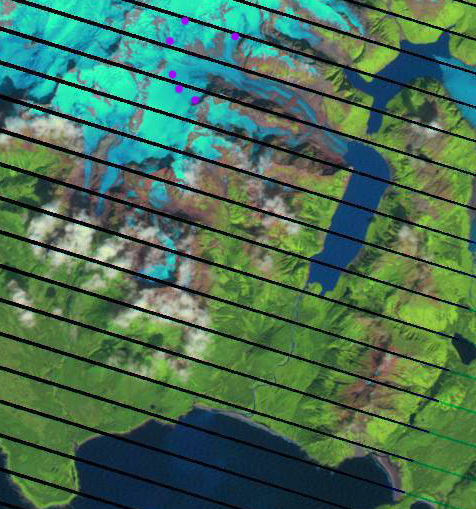
In 2015 the snowline was particularly high, the accumulation zone usually covers the entire reach of the broad high elevation accumulation zone, not the pockets indicated by the purple dots. The declining mass balance identified by the Juneau Icefield ongoing mass balance program, which the high snowlines is indicative of is what is driving the retreat (Pelto et al, 2013).

east twin 2006
Google Earth Image
east twin float plane
Wings Airways Image

twin glacier 2015 acc

August 2015 Landsat image of Twin Glacier.  The purple dots outline the accumulation zone where snowpack was retrained from 2015.

Fingers Glacier, Alaska loses a finger to melting

finger compare
Landsat comparison of terminus area of Fingers Glacier 1986 and 2015

Fingers Glacier flows from the southern end of the Fairweather Range to the coastal plain, where is expands into a segmented piedmont lobe. The southernmost finger is heavily debris covered. In the Mount Fairweather B-4 quadrangle USGS map based on 1951 aerial photographs the glacier has four prominent fingers each eroding its own basin.  Here we examine Landsat imagery to illustrate the changes in this glacier from 1951 to 2015.  From 1950-1980  glacier’s just to the north In Lituya Bay were advancing. The La Perouse Glacier its immediate neighbor to the north was stable. Palma Glacier directly to the southeast has retreated throughout the 1950-2015 period.  Larsen et al (2015) identify that from 1994-2013 this region of Alaska is a significant source of glacier volume loss and hence contributor to sea level rise.  The loss of 75 gigatons per year from glaciers in southern Alaska was determined in this study to be largely from surface melt not from calving losses.  The mass balance of both Taku and Lemon Creek Glacier of the Juneau Icefield have had a notable decline in mean mass balance from 1986-2015 versus the 1951-28985 period (Pelto et al, 2013).  The nearby Brady Glacier also experience a higher snowline (Pelto et al, 2013b) which led to volume losses quantified by Larsen et al (2015).
fingers map

USGS map based on 1951 images

By 1986 the glacier still had four fingers with retreat from the 1951 position yellow arrow to the 1986 position red arrows.  Retreat was 900 m for the first finger, 400 m for the second finger, 300 meters for the third and 400 meters for the fourth southernmost finger.   A new lake had developed at the second finger, well lake expansion occurred at the first and third finger.  By 1999 a lake is beginning to form at the fourth finger.  In 2015 the first finger has retreated 600 meters in 30 years.  The second finger has disappeared after a 700 m retreat from 1986-2015..  The third finger has lost half of its length to the expanding lake, a retreat of 600 m in 30 years.  The fourth finger which is the most debris covered, leading to slower thinning, has retreated 600 meters since 1986, with a lake at the terminus that is continuing to expand.

fingers 1986

1986 Landsat Image

fingers 1999

1999 Landsat Image

fingers 2015

2015 Landsat Image
fingers glacier

Google Earth Image indicating flowlines.

Palma Glacier, Alaska Retreat Opens Lake Passage

Palma Compare
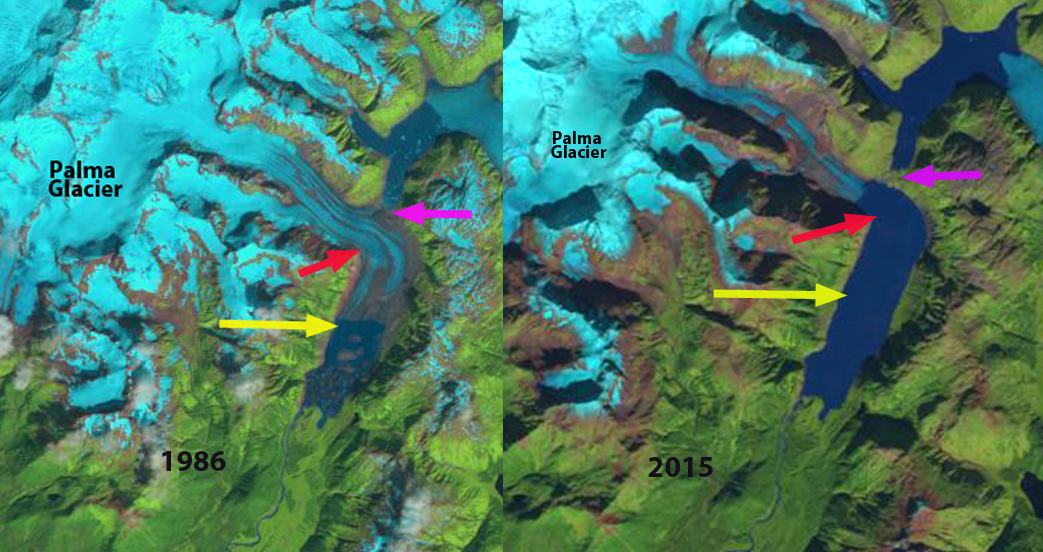
An August 1986 and September 2015 Landsat Image of Palma Glacier, 1986 terminus yellow arrow.
Palma Glacier is an unnamed glacier just west of Brady Glacier and Glacier Bay that is the principal glacier draining into Palma Bay.  Here we examined the changes in this glacier from 1986 to 2015 with Landsat Imagery.  The glacier has terminated in a lake at the head of a river draining into Palma Bay at least since the 1950 USGS map was prepared.The neighboring Brady Glacier advanced for much of the 20th century,  its tributary lobes began to retreat after 1970.  The main Brady Glacier terminus did not begin to retreat until 2009 and is poised to begin a rapid retreat as lake development at the terminus continues due to ongoing thinning (Pelto et al, 2013)..

palma glacier ge

Google Earth image of the Palma Bay and Palma Glacier region

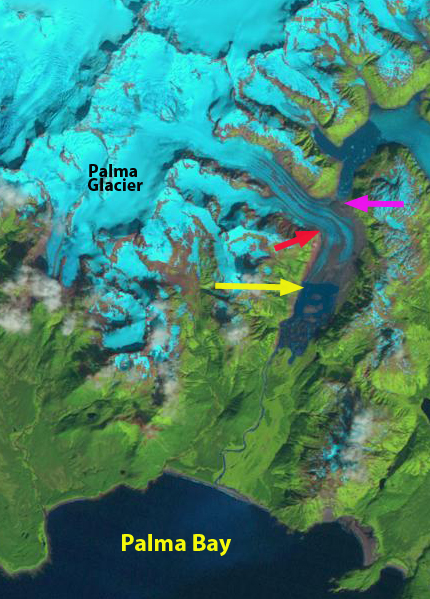
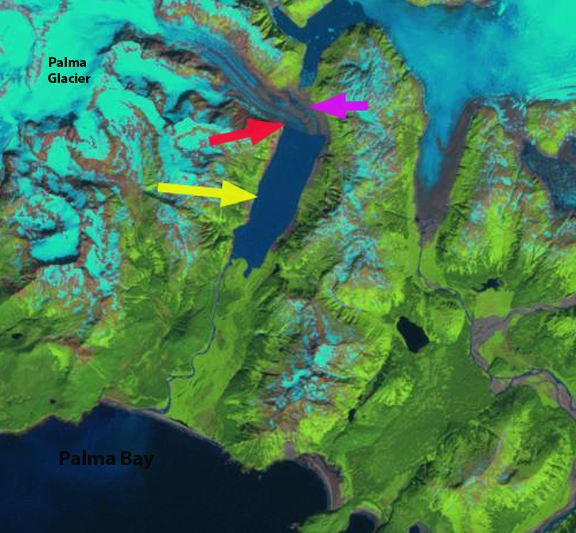
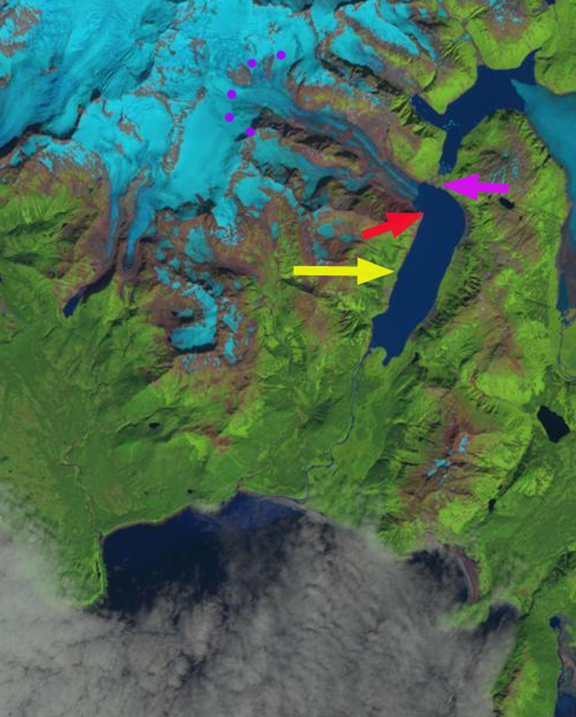
In 1986 Palma glacier flowed south out of the mountains before turning sharply west for 2 km before terminating in a lake at the yellow arrow. The lake had considerable debris covered ice bergs that had recently calved. By 1999 the glacier had retreated to the westward turn, red arrow, but did extend to the south side of the lake.  By 2014 the glacier had retreated from the westward turn, red arrow, and the strip of land between the two lakes at the purple arrow has been exposed and vegetated. it is now possible to paddle up one lake and portage to the next. The snowline purple dots is at 1000 m.  In 2015 this September image at top is after an early season snowfall, the last image below is an August image indicating the snowline is again at 1000 m with several weeks left in the melt season.  The glacier has retreated 2100 meters from 1986 to 2015 and still terminates in the lake. The retreat has slowed since 1999 after the lake narrowed at the westward turn. Retreat will continue as a snowline at 1000 m is to high to sustain even the current size of Palma Glacier.

palma Glacier1986
1986 Landsat image

palma glacier1999
1999 Landsat Image
palma glacier 2014
2014 Landsat Image
Palma snowline Aug 2015
2015 Landsat Image

Slender Glacier, Brooks Range, Alaska: Rapid Retreat 1992-2014

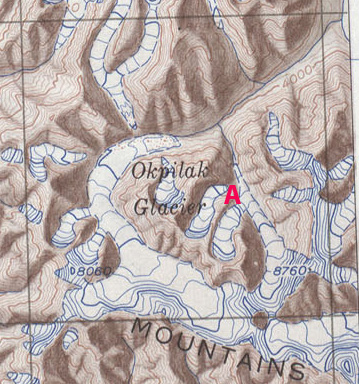
Slender Glacier is not an official name, but a well suited name to this glacier in the Romanzof Mountains of the Brooks Range of Northern Alaska.  It is adjacent to the Okpilak Glacier and drains into the Okpilak River, which is host to arctic grayling. Here we examine Landsat imagery from 1992-2014 to identify changes. U-Alaska-Fairbanks has an ongoing program in the nearby Jarvis Creek Watershed examining in part how will the anticipated future increase in glacier wastage and permafrost degradation affect lowland hydrology.  Matt Nolan (U-AK-Fairbanks) reports on changes of nearby McCall and Okpilak Glacier. These glacier have suffered increased mass loss since 1990 as a result of an increase in the equilibrium line altitude that has reduced accumulation area and is indicative of increased ablation (Delcourt al , 2008)

mt_michelson-1956
USGS 1951 map

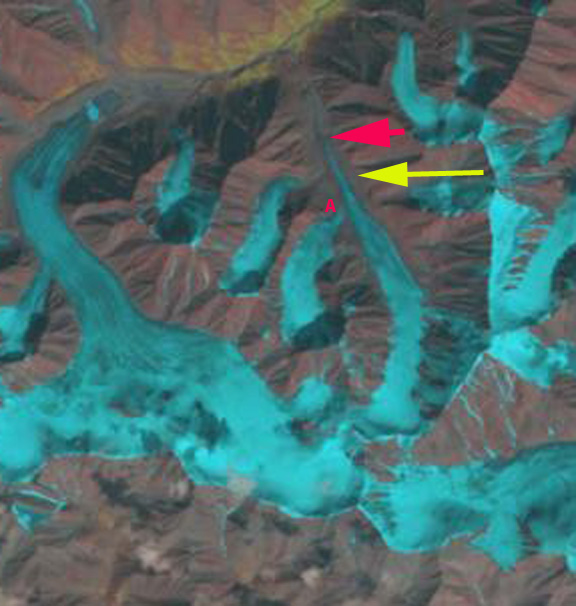
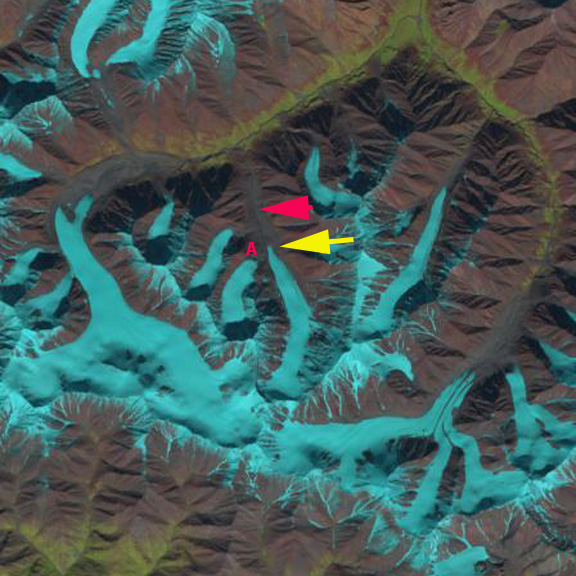
In 1992 the glacier extended downvalley to the red arrow at 1530 m. The glacier also received contribution from a tributary glacier at Point A. By 2002 the glacier had receded a short distance from the red arrow and still received input from the tributary glacier at Point A. By 2013 the glacier had receded to the yellow arrow 1100 meters from the 1992 terminus position, and now terminates at an altitude of 1675 m. The tributary glacier is no longer connected to Slender Glacier at Point A. The percent of snowcover is better than on Okpilak Glacier immediately to the west, or East Okpilak Glacier to the southeast. The first tributary entering the glacier on the east side is also disconnecting from Slender Glacier.   In 2014 the Landsat image is after a light snowfall that has endured only on the glacier ice, helping outline the glaciers. The continued decline in retained snowfall and contributed snowfall from tribuatry glaciers will lead to an even more slender glacier.

slender glacier 1992
1992 Landsat Image

slender glacier 2002
2002 Landsat Image

slender glacier 2013
2013 Landsat Image

slender glacier 2014
2014 Landsat Image

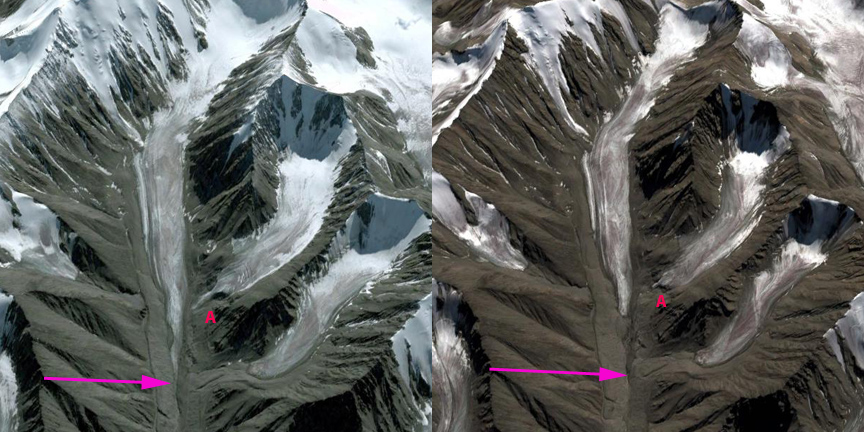
Google Earth images from 2006 and 2012 indicate a rapid retreat of the thin main terminus, and the loss of contact with the tributary glacier at Point A. The retreat is similar to that of Fork Glacier and Romanzof Glacier in the same region. The retained snowcover in 2012 is minimal on Slender Glacier and its tributaries. Tributary A lost almost all snowcover in 2012 and 2013 suggesting a lack of a consistent accumulation zone, which a glacier cannot survive without (Pelto, 2010)

slender comparison
2006 Google Earth Image and 2012 Google Earth image

Retreat of Grewingk Glacier, Alaska 1986-2014

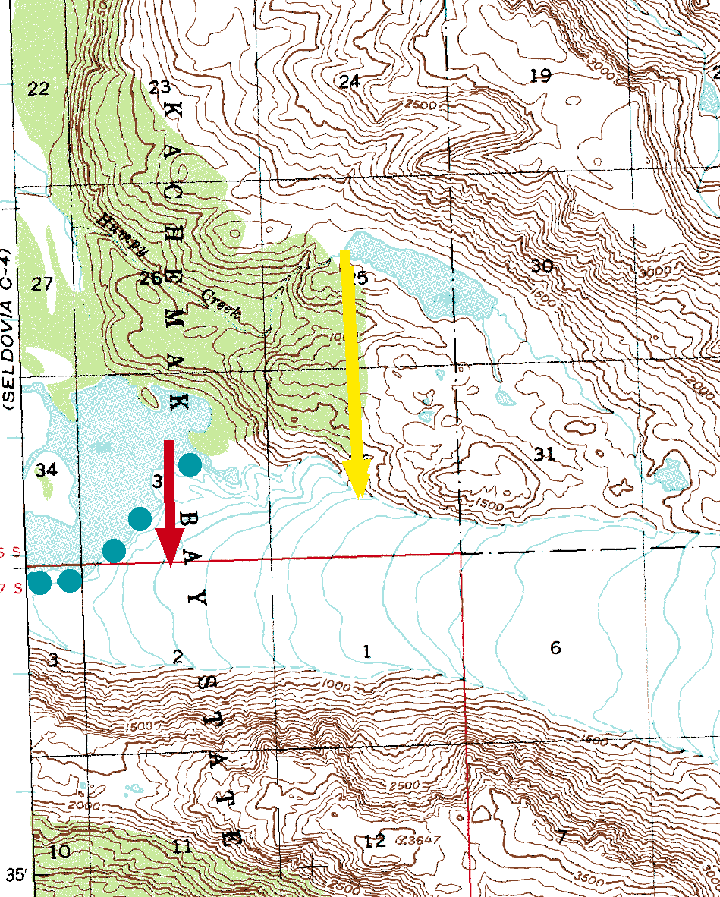
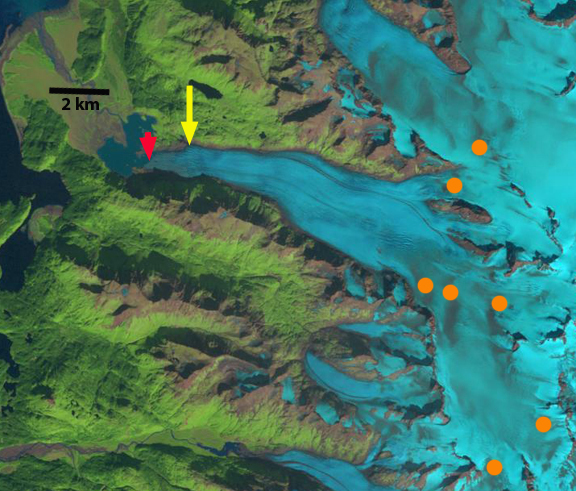
Grewingk Glacier drains west toward the Kachemak Bay, Alaska terminating in a proglacial lake in Kachemak Bay State Park.  The glacier drains an icefield on the Kenai Peninsula, glaciers draining west are in the Kenai Fjords National Park. The glaciers that drain east toward are in the Kenai Fjords National Park, which has a monitoring program.  Giffen et al (2008) observed the retreat of glaciers in the region. From 1950-2005 all 27 glaciers in the Kenai Icefield region examined  are retreating. Giffen et al (2008)observed that Grewingk Glacier retreated 2.5 km from 1950-2005.  Here we examine Landsat imagery from 1986-2014 to illustrate the retreat of the glacier.  The icefront continues to calve into the expanding pro-glacial lake.

grewingk map

1951 based USGS Topographic map Seldovia C-3

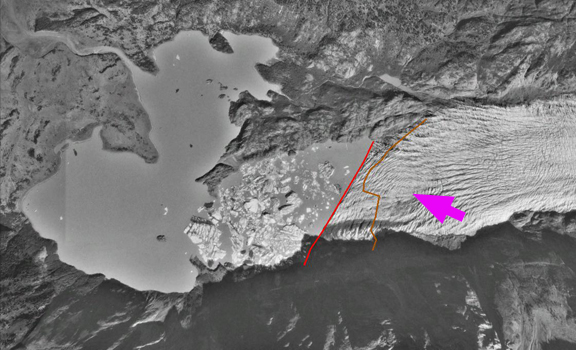
The red arrow is the 1986 terminus location at the midpoint, the yellow arrow is the 2014 mid-point terminus location. In 1951 the glacier extended beyond the peninsula at the red arrow into the wider portion of the lake. By 1986 the glacier had retreated into the narrow section of the lake extending east into the mountains, the southern margin of the terminus is further advanced than the northern margin.  The orange dots indicate discoloration of the glacier surface from volcanic ash deposited on the glacier surface from Augustine Volcano in 1986. In 1989 there is not a marked change. In a 1996 Google Earth image, there is considerable icebergs indicating a recent collapse of a section of the terminus. The pink arrow indicates concentric crevasses, indicating a depression, the red line is the terminus in 1996 and the brown line the 2003 terminus.

By 2001 the terminus has retreated m, and the glacier front is now oriented north-south across the lake. In 2003 the depression from 1996 now has a small supraglacial lake, the terminus has retreated 500 m on the southern margin and 200 m on the northern margin. In 2013 the glacier has retreated an additional 600 m and the southern margin has now receded further upvalley than the northern margin. Blue arrows indicate direction of glacier flow.  By 2014 the glacier has retreated 1.4 km since 1986, 50 m per year. There is an increase in the glacier slope 2.5 km above the terminus where crevassing increases.  This suggests the lake will end by or at this point, which would then lead to a reduction in retreat rate.

This retreat follows that of Pederson Glacier, Four-Peaked Glacier and Spotted Glacier. The continued reduction in glacier size leads to changes to the Kachemak Bay estuary. Kachemak Bay is the largest estuarine reserve in the National Estuarine Research Reserve System. It is one of the most productive, diverse estuaries in Alaska, with an abundance of Steller sea lions, seals, sea otters, five species of Pacific salmon, halibut,herring, dungeness crabs and king crabs (NERRS, 2009). The estuary salmon fishing industry is, one of Kachemak Bay’s most important resources and livelihoods.

grewingk Glacier 1986a
1986 Landsat Image

Grewingk 1989
1989 Landsat Image

grewingk 1996 ge
1996 Google Earth Image

grewingk glacier 2001
2001 Landsat Image

grewingk 2003 ge
2003 Google Earth Image

grewingk glacier 2013a
2013 Landsat Image

grewingk glacier 2014
2014 Landsat Image