Central Andes Glaciers of Chile and Argentina Nearly Snow Free Again in 2025

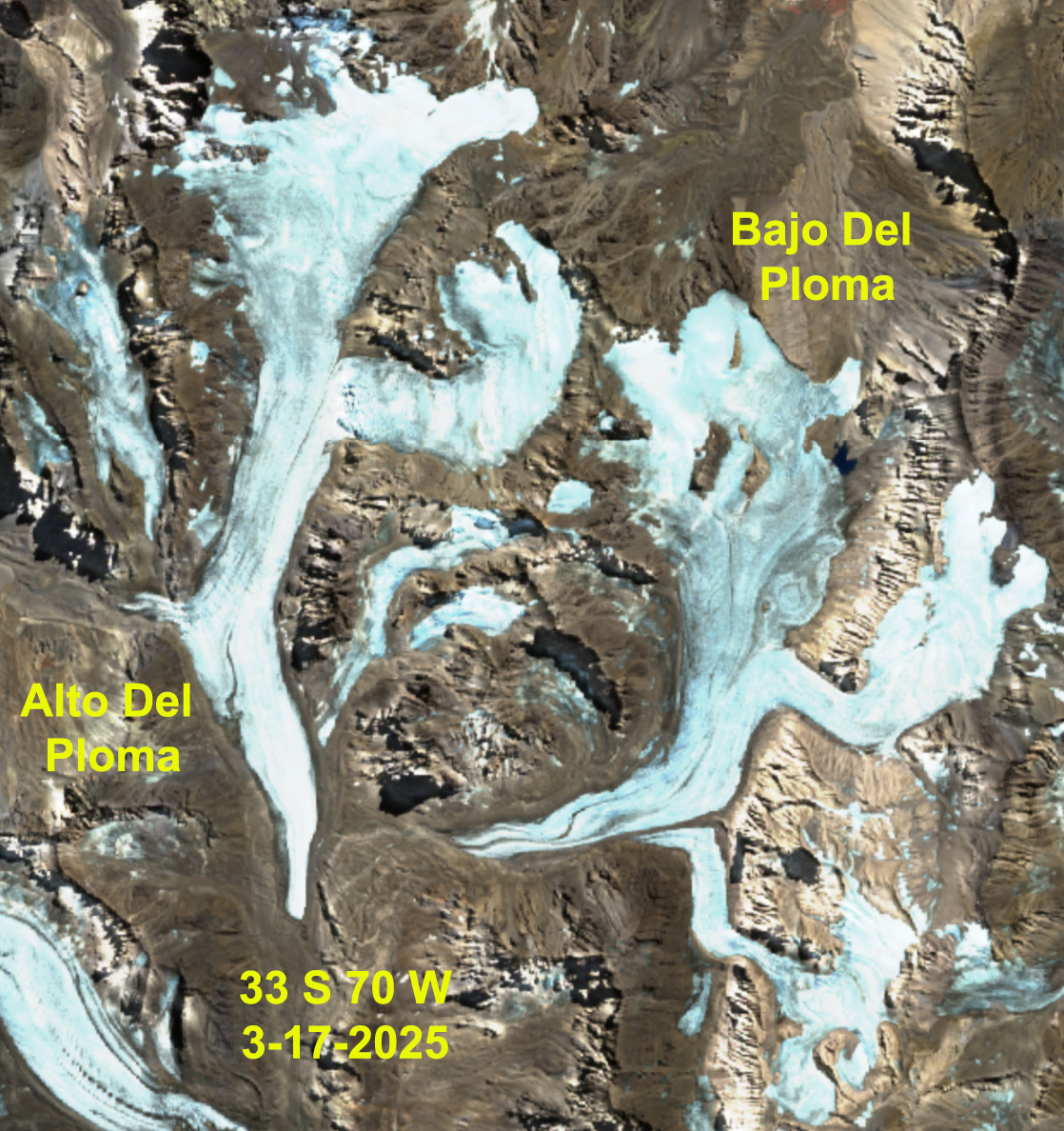
Alto and Baja del Plomo Glacier in false color Sentinel image from 3-17-2025, expanding bedrock areas amidst upper Baja del Plomo Glacier.

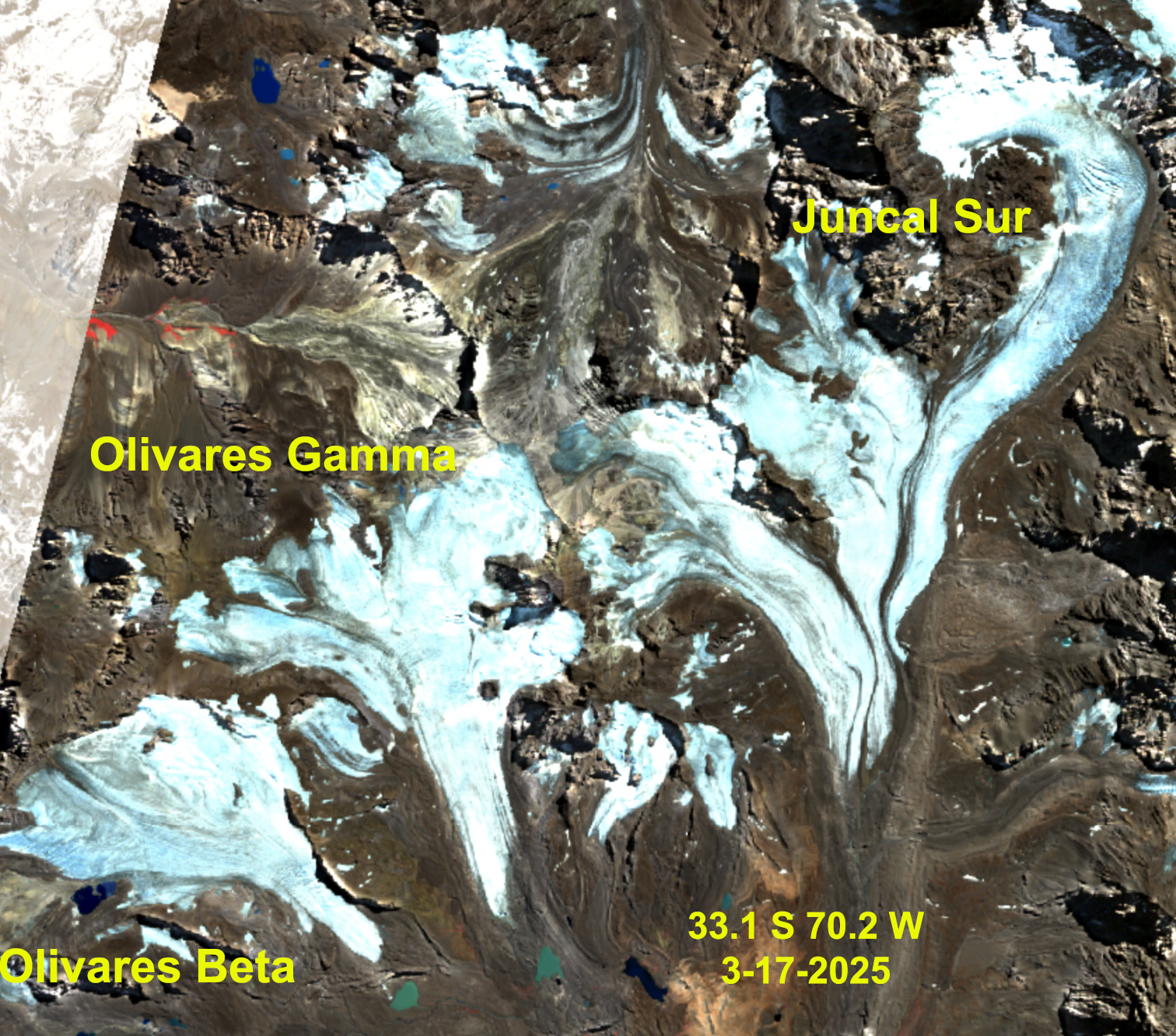
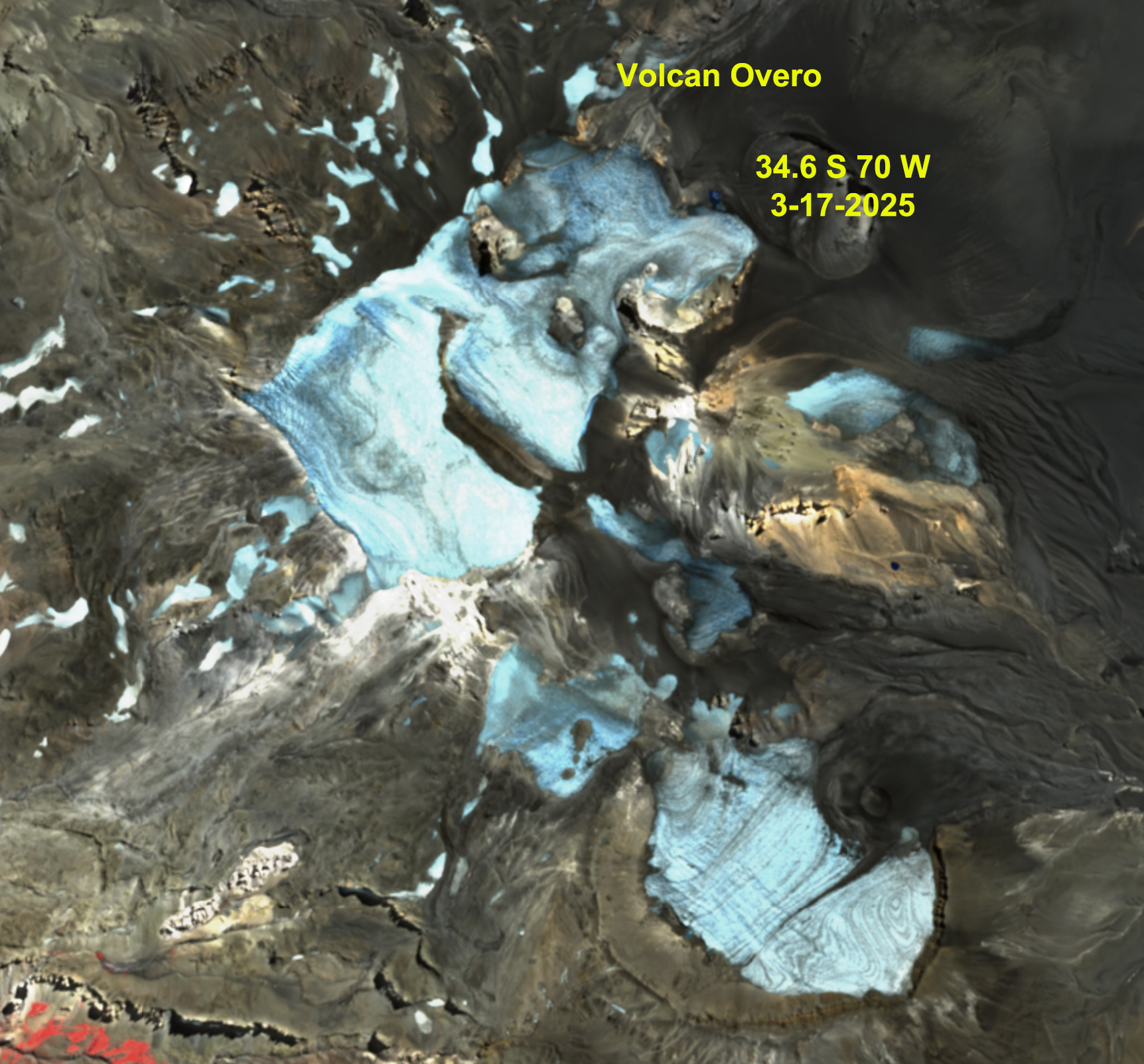
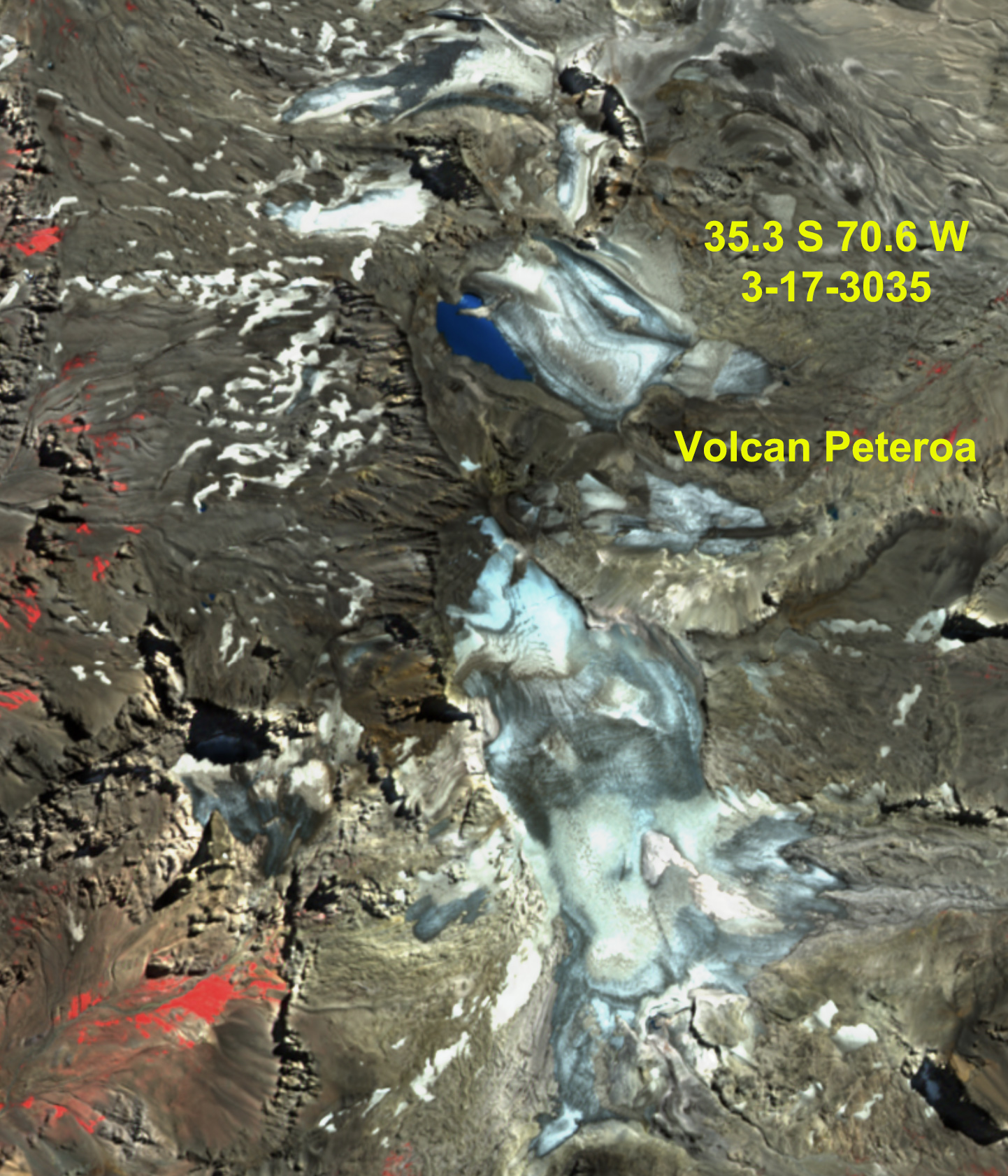
For an alpine glacier to thrive it must remain 50-60% snowcovered throughout the year, even at the end of the summer. To survive it must have consistent significant snowcover at the end of summer, indicative of a persistent accumulation zone (Pelto, 2010). In the Central Andes of Argentina and Chile I have chronicled the near total loss of snowpack, leading to dirty/dark snowcover free glaciers. in 2022 and 2023 (Pelto, 2023). In 2025 this pattern is again apparent. From north of Santiago at Olivares Glaciers and Alta/Baja de Plomo Glacier to east of Santiago at Volcan Overo adn Fiero Glacier to south of the Santiago region at Cobre Glacier and Volcan Peteroa we see glaciers in mid-March with less than 10% snowcover remaining. This is indicative that the 2024/25 mass balance period for the Central Andes will be one of significant loss.

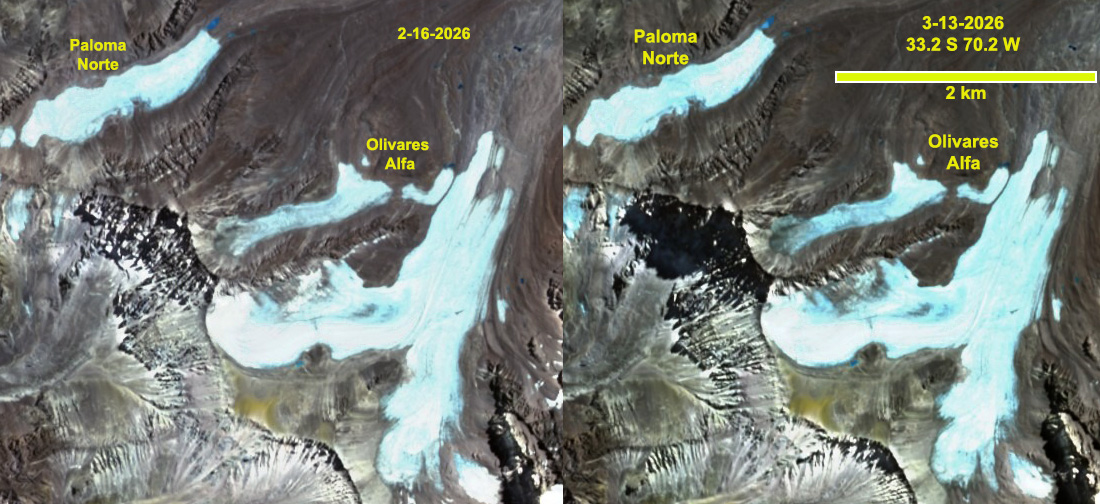
Olivares Glaciers and Juncal Sur in in false color Sentinel image from 3-17-2025,
Volcan Overo Glaciers in false color Sentinel image from 3-17-2025, continued fragmentation and expanded bedrock area amidst glaciers evident.
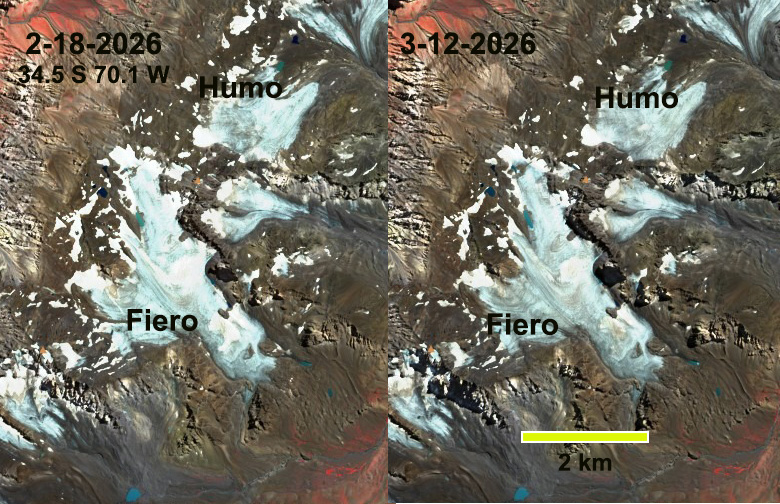
Del Humo and Fiero Glacier in false color Sentinel image from 3-17-2025.
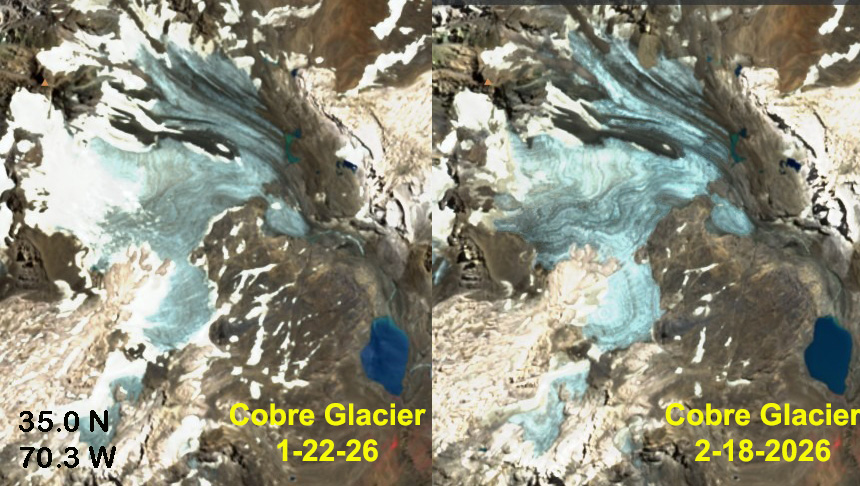
CobreaGlacier in false color Sentinel image from 3-17-2025, is retreating both at the top (northwest) and terminus (southeast) of the glacier.
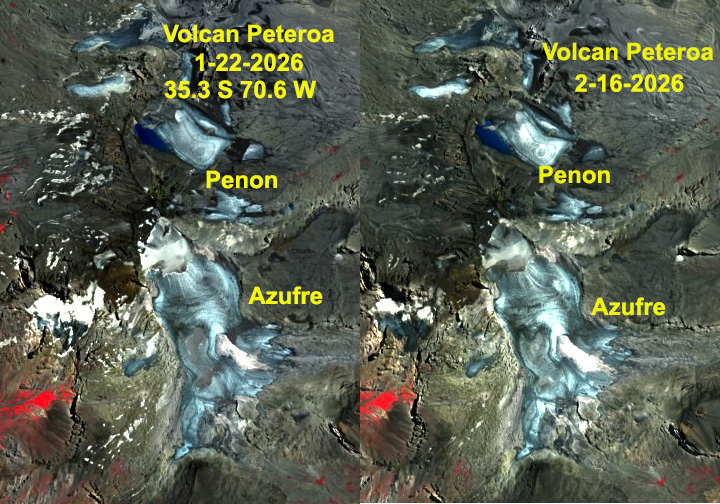
Volcan Peteroa Glaciers in false color Sentinel image from 3-17-2025.

Glaciers Across the Central Andes Snowcover Free Summer 2023

Bajo del Plomo Glacier, Argentina in Sentinel image with no retained snowcover this summer, and rapid bedrock expansion at Point A-C. This is 2nd consecutive year without retained snowcover for this glacier at the head of the Rio Plomo.

For an alpine glacier to thrive it must remain 50-60% snowcovered throughout the year, even at the end of the summer. To survive it must have consistent significant snowcover at the end of summer, indicative of a persistent accumulation zone. This year in the Central Andes of Argentina and Chile I have chronicled the near total loss of snowpack through February, leading to dirty/dark snowcover free glaciers. This is a same story we observed in 2022, though snowcover was lost in January last year (Pelto, 2022). The consecutive summers with glaciers laid bare results in significant losses. The darker bare surfaces of the glacier melt faster leading to more rapid area and volume loss.  This includes fragmentation and rapid expansion of bedrock areas amidst the glacier. We saw in the Pacific Northwest two consecutive summers with limited snowcover retained. Hopefully the Central Andes region will experience a good winter much as the Mount Shasta, CA area has in winter 2023.

Here is an update at the end of the summer using false color Sentinel imagery to highlight a sample of these glaciers that have remained largely bare for two months.  Individual posts during 2022 or 2023 include: Volcan Peteroa glaciers, Rio Atuel glaciers, Sollipulli Glacier, Palomo-Cipreses Glacier,  Bajo del Plomo Glacier Cortaderal Glacier, Volcan San Jose Glaciers , Cobre Glacier, Olivares Beta and Gamma Glaciers and Volcan Overo Glaciers,

Olivares Beta and Gamma Glacier, Chile  in Sentinel image with no retained snowcover this summer, retreating away from proglacial lakes and bedrock expansion. This is 2nd consecutive year without retained snowcover for these glaciers.
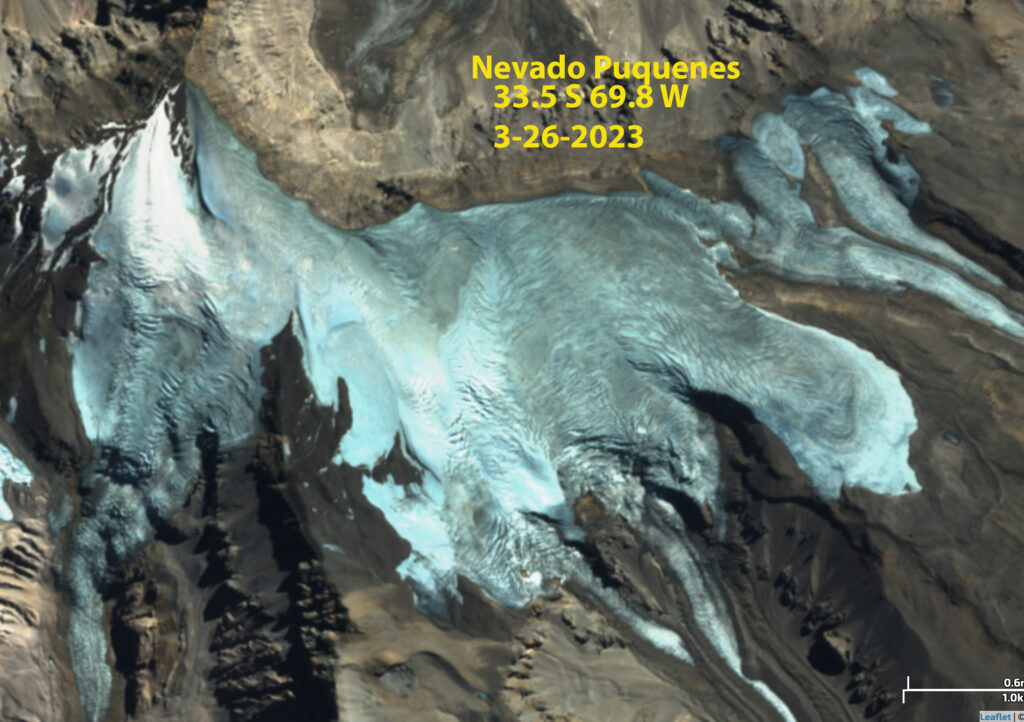
Nevado Piquenes, Argentina has less than 5% snowcover retained in this Sentinel image, right near the 6000+ m summit.

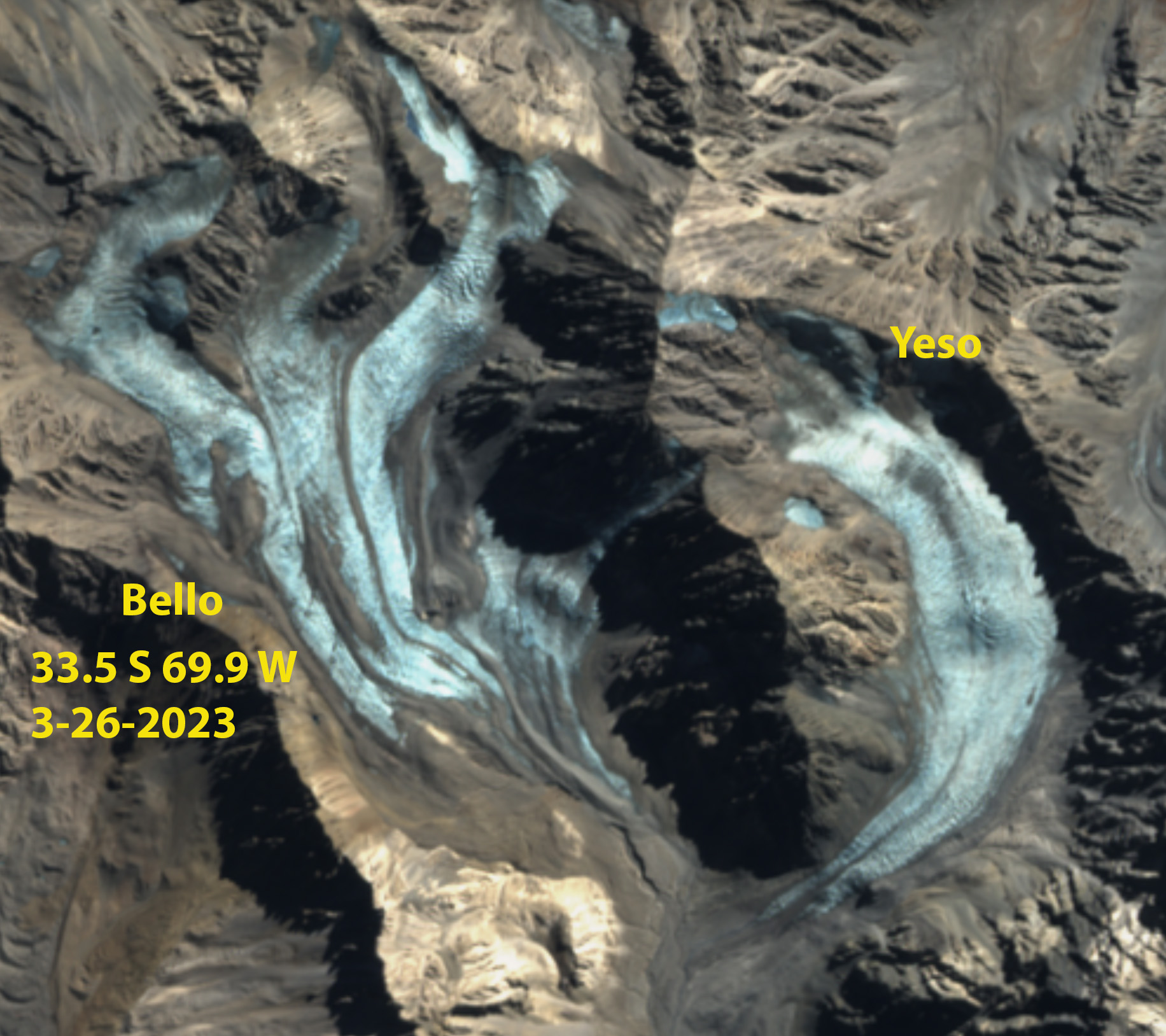
Bello and Yeso Glacier, Chile have no trace of snowcover for 2nd consecutive summer. The dirtier surface is leading to faster melt.
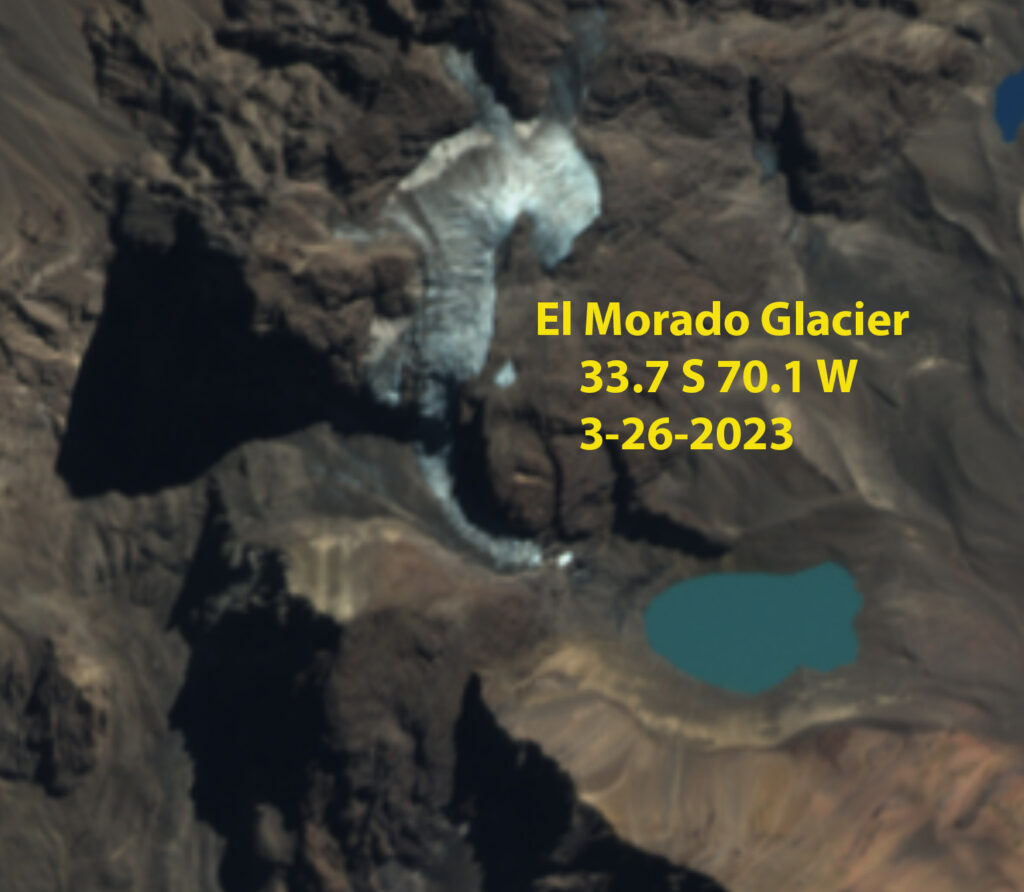
El Morado Glacier, Chile has no trace of snowcover for 2nd consecutive summer. The dirtier surface is leading to faster melt, and fragmenting.

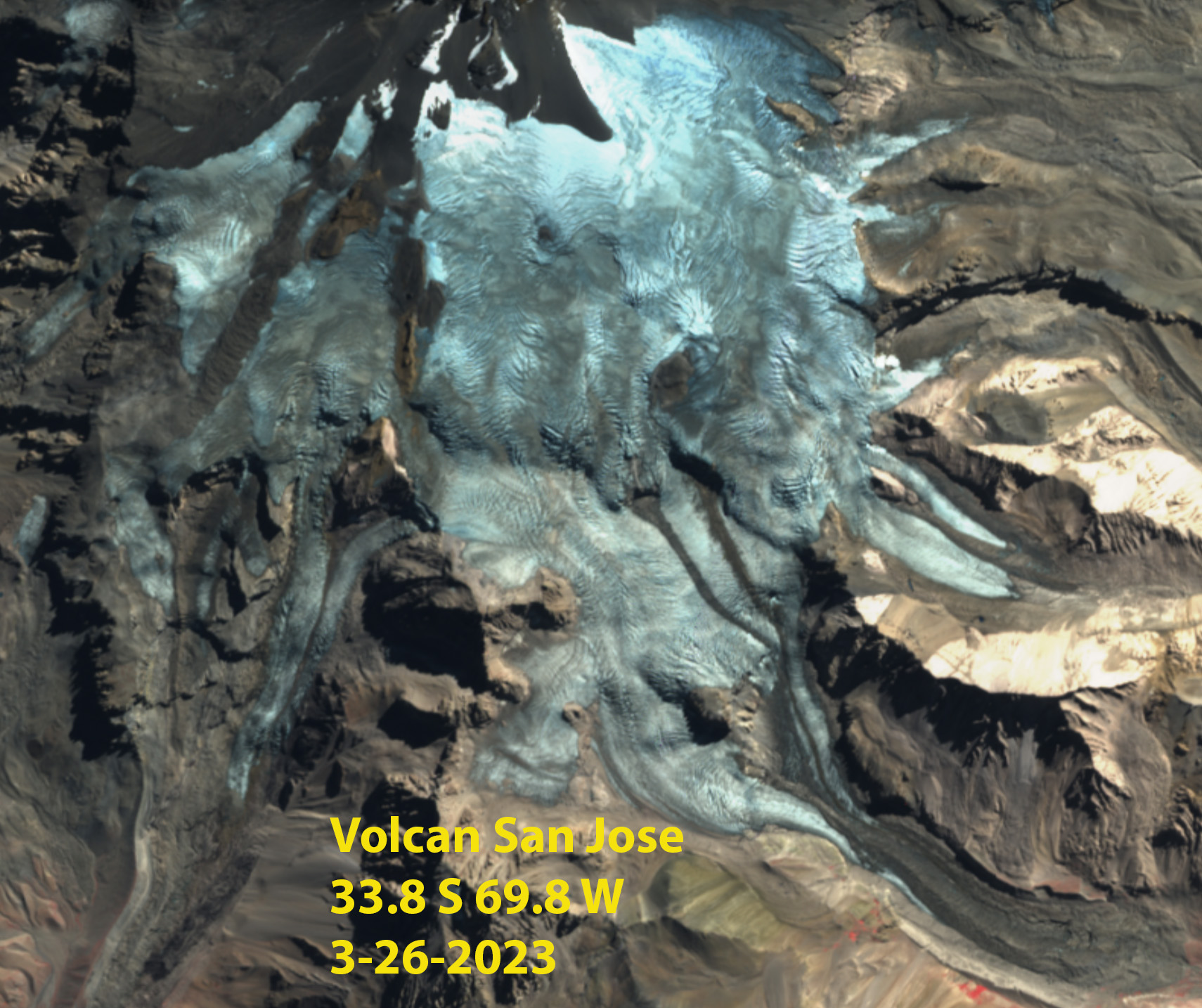
Volcan San Jose Glaciers in Sentinel image continues to fragment with a 2nd consecutive year without retained snowcove.
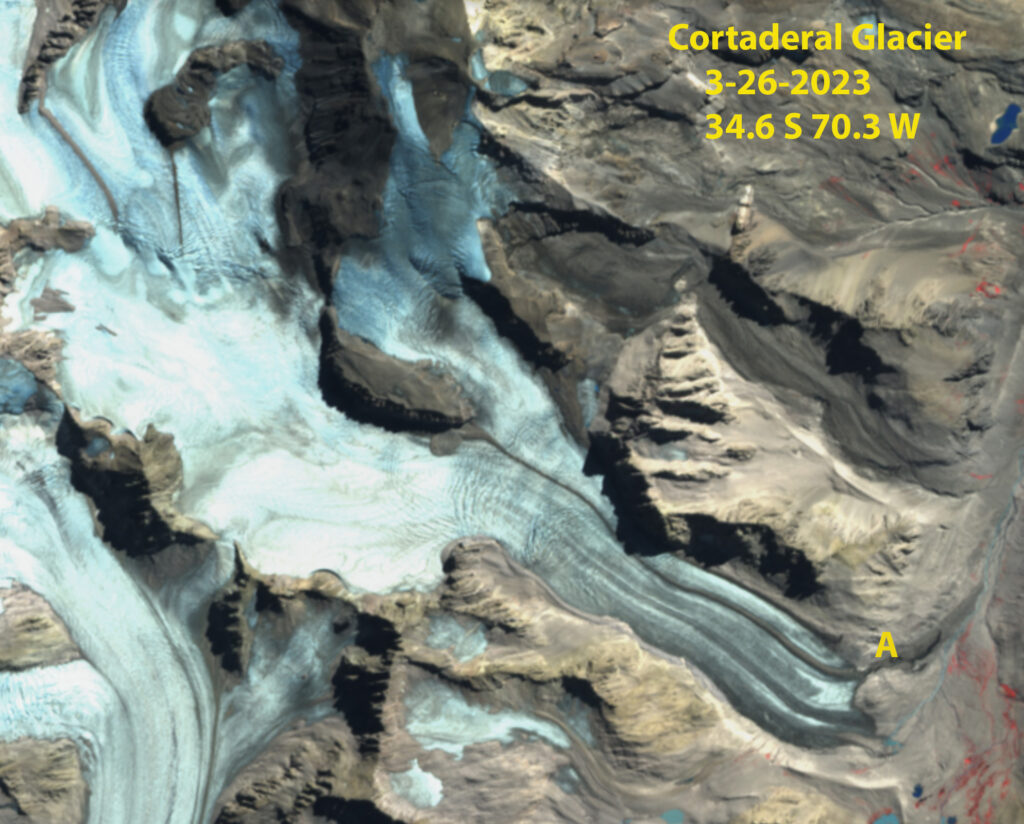
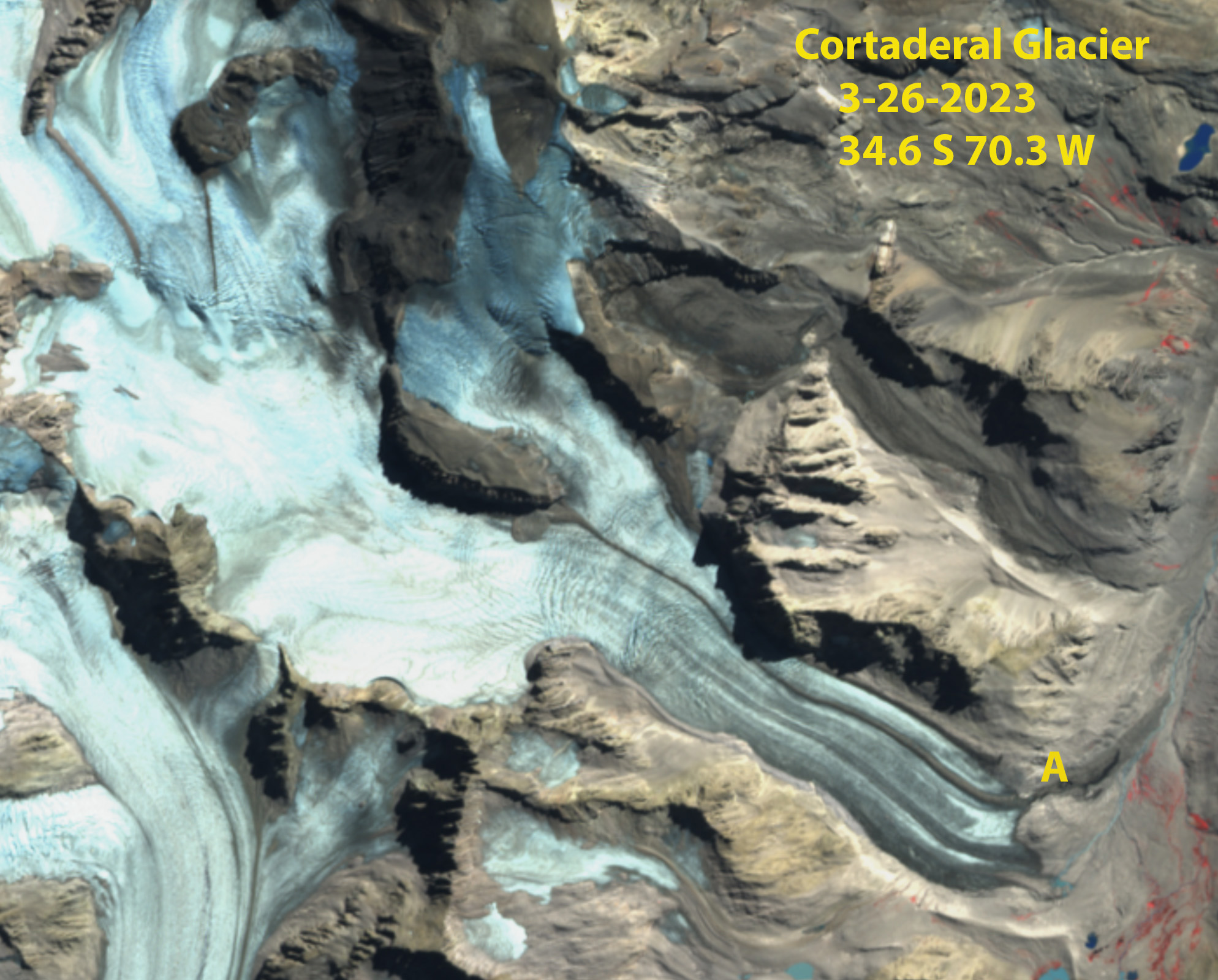
Cortaderal Glacier, Chile in Sentinel image with no retained snowcover this summer, leading to terminus tongue loss at Point A.
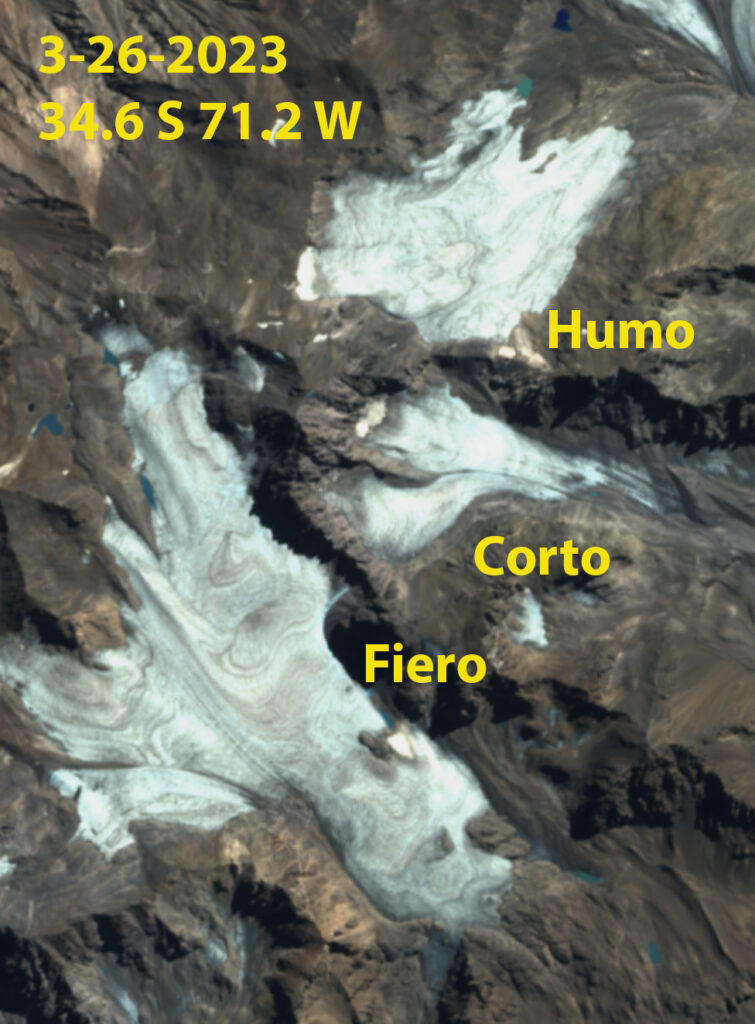
Corto, Fiero and Humo Glacier, Argentina with no retained snowcover in 2023, for 2nd consecutive summer. These glaciers feed the Rio Atuel, and their rapid retreat will lead to less summer glacier runoff.


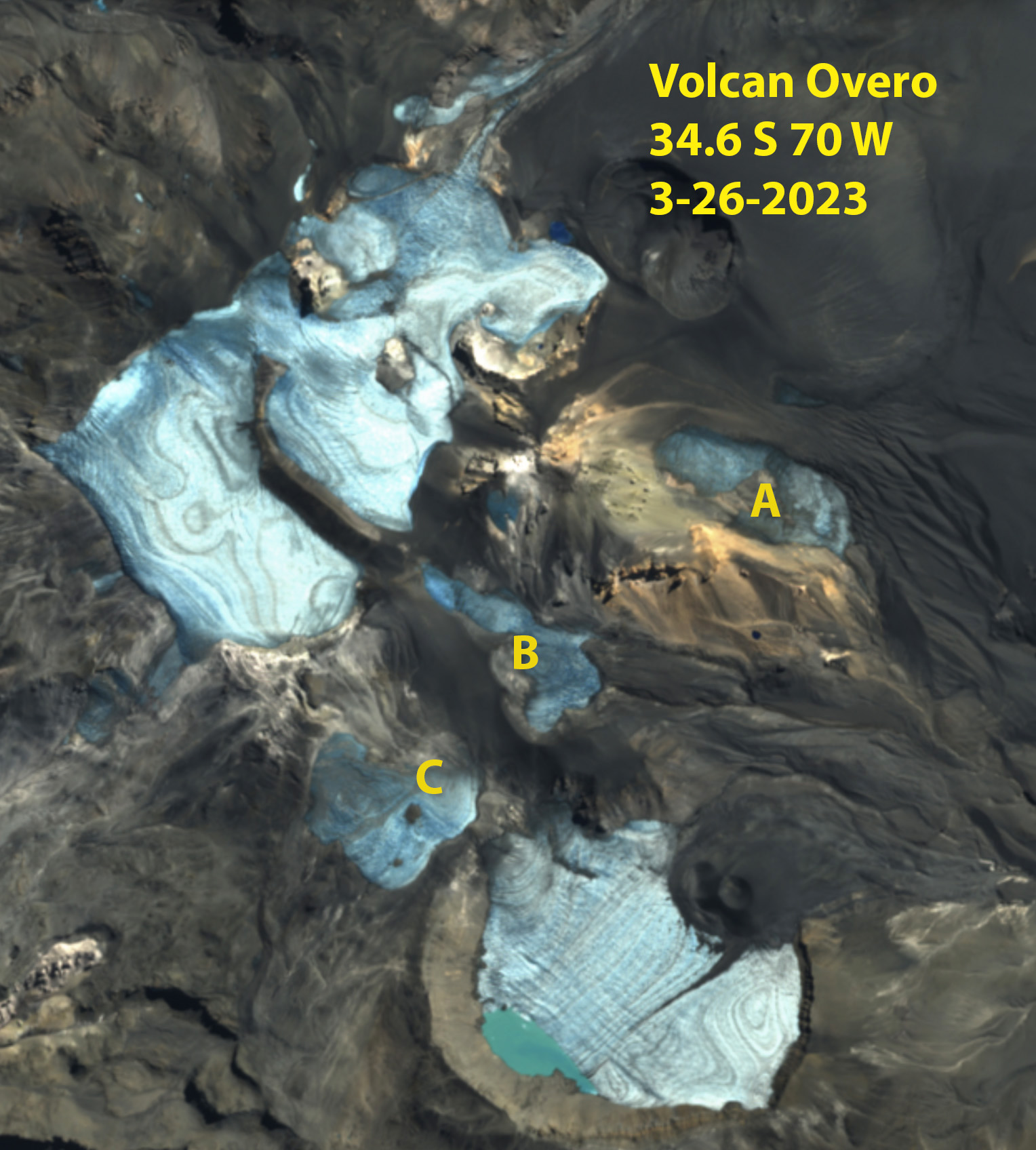
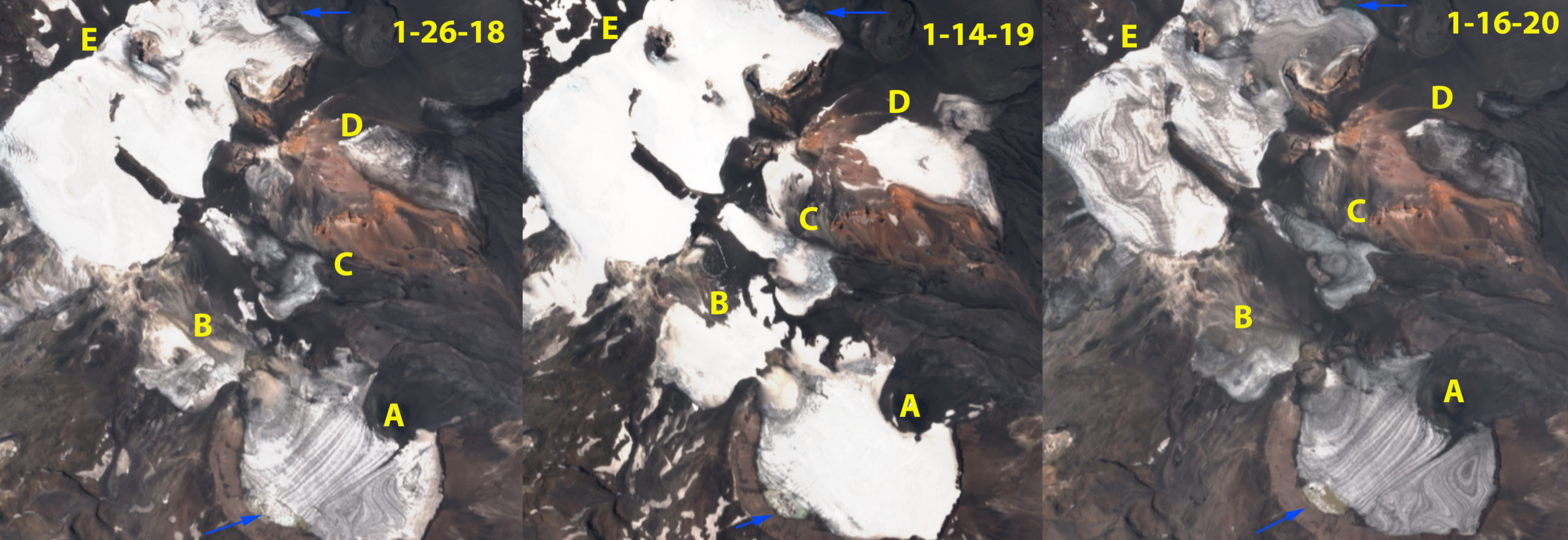
Volcan Overo in Sentinel image continues to fragment with no retained snowcover this summer, and bedrock expansion causing fragementation at Point A, B and C.
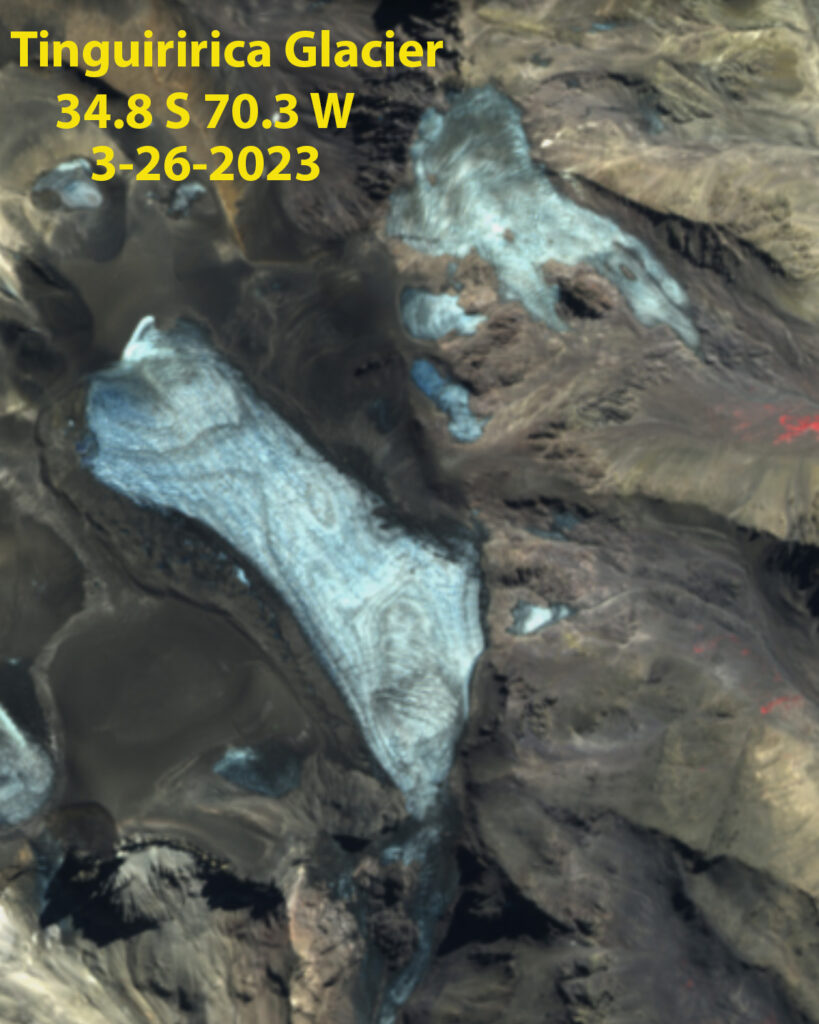
Tinguiririca Glacier, Chile drains into the river of the same name. In 2023 this fragmenting glacier lost all its snowcover for 2nd consecutive summer.


Cobre Glacier, Argentina lost all its snowcover in 2023, just like 2022. Here it has separated at Point B and nearly so at Point A.

Volcan Peteroa Glacier, Chile/Argentina border in Sentinel image continues to fragment at Point A with no retained snowcover, this is also leading to lake expansion at Point B.
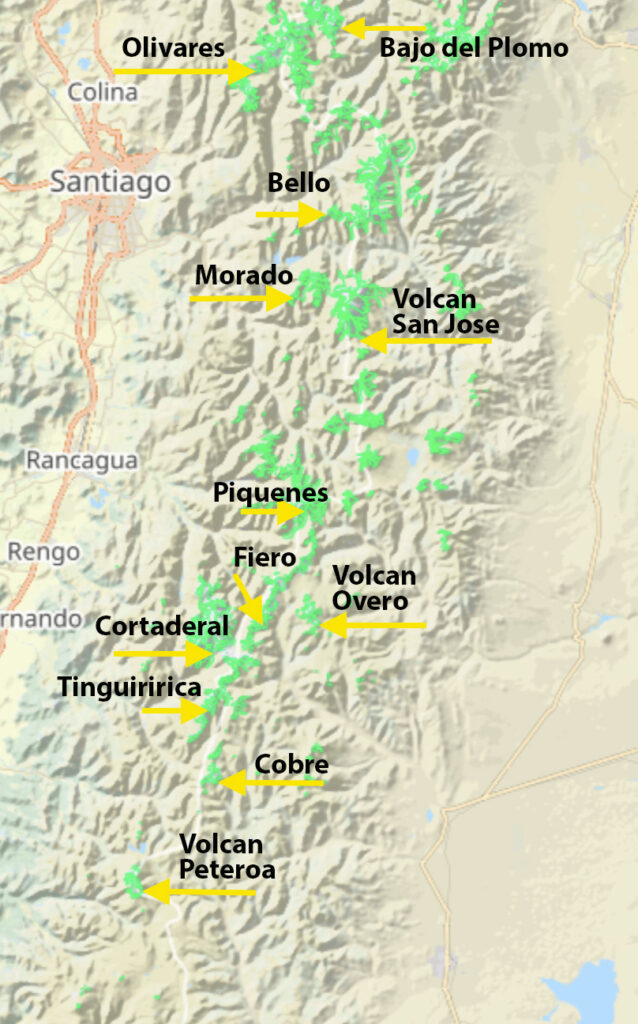
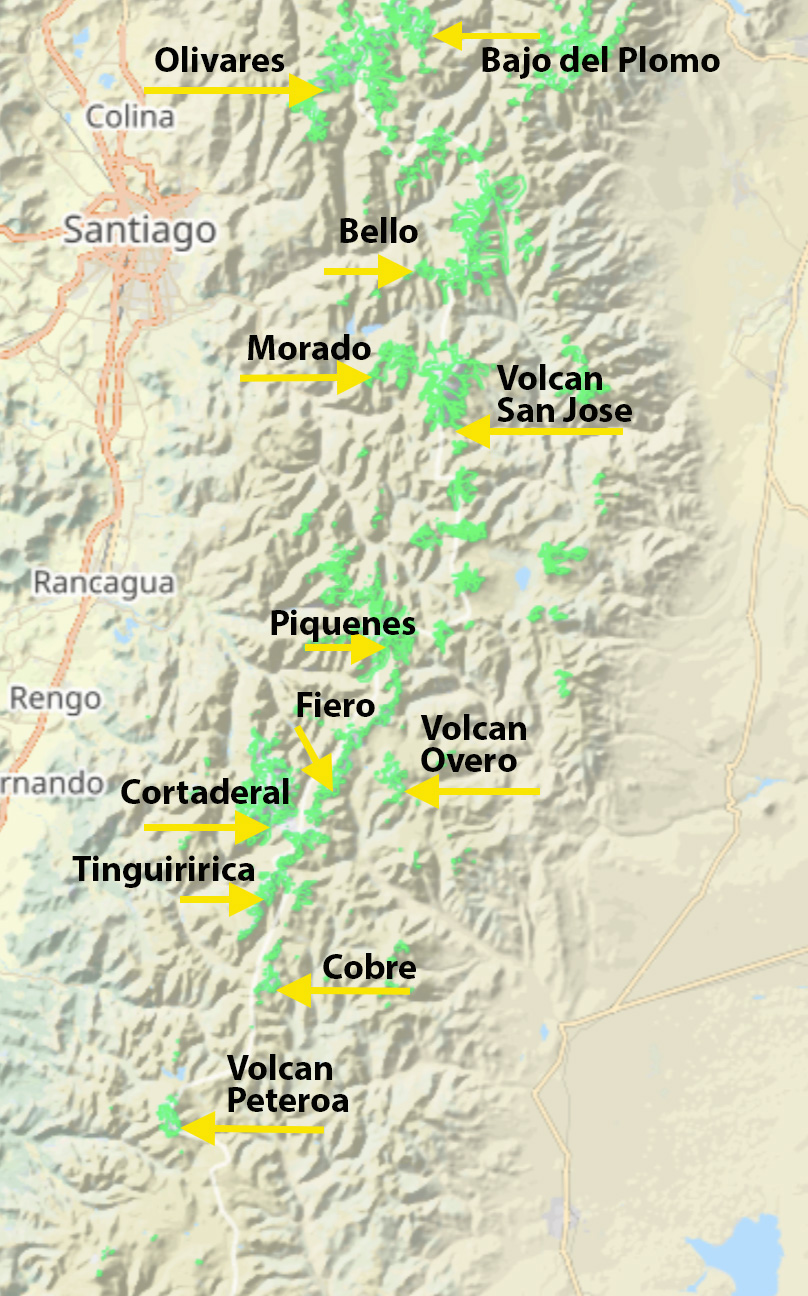
Map of Central Andes indicating glacier locations from 33-36° S that we focus on here.

Volcan Peteroa Glaciers Argentina/Chile Fragment During Snow Cover Free Summers

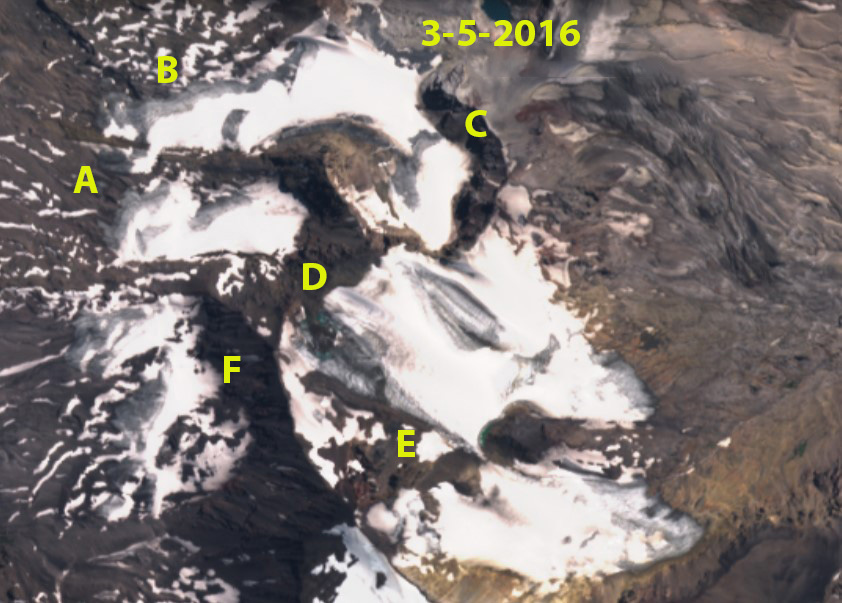
Volcan Peteroa glaciers in Sentinel images from March 2016 (below) and March 2023 (above). This illustrates fragmentation, 50% area loss, and a new lake formation. All the result of repeated snowcover free glaciers. 

For an alpine glacier to survive it must remain mostly snowcovered throughout the year, even at the end of the summer. This is one reason for the majesty of glaciated mountains, they shine brightly even in summer.  This summer in the Central Andes of Argentina and Chile, just as in 2022, I have chronicled the near total loss of snowpack due to summer heat waves, leading to dirty/dark glaciers (Pelto, 2022).  The heat wave this summer led to maximum temperature anomalies 3-5 C during the first half of March in the Central Andes of Argentina (SMN Argentina, 2023). An ice surface melts faster than a snow surface and the darker surface of the glacier also enhances melt rate leading to more rapid area and volume loss. This includes fragmentation and rapid expansion of bedrock areas amidst the glacier, other regional glacier obsrvations include: Sollipulli Glacier, Rio Atuel Glaciers, Palomo-Cipreses Glacier and Volcan Overo Glaciers,Here we examine Volcan Peteroa glaciers on its north flanks, which straddles the Chlile-Argentina border during the 2016-2023 period using Sentinel images. Reinthaler et al 2019 observed a ~2% annual area loss of Volcan Peteroa glaciers.

Here we examine the impact of several years of snow cover loss on the Volcan Peteroa glaciers. In 2016 it is evident there are six key ice masses on the north flank of the glacier A-F, with a combined area of 4.5 km².  In 2022 early snowcover loss led to rapid glacier thinning and lake formation, see below.  In 2023 the glacier at Point A has contracted by 50% to 0.22 km². At Point B and C the glacier has separated and is now two fragments with area of 0.36 km²  and 0.12 km² respectively. At Point D a new lake has expanded rapidly in 2022 and 2023, the lake has an area of 0.12 km² and the glacier a area of  1.21 km².  At Point E the glacier fragmented and pulled away from D and its two fragments have an of 0.36 km². At Point F the glacier has melted away. The combined area of 2.27 km² is ~50% of the glacier area just seven years prior. This is much faster than the 2% loss of the 1986-2015 period. The significant darkening of the snowfree surface will speed the loss of this glacier that no longer has a consistent accumulation zone.

Volcan Peteroa Glacier in false color Sentinel image continues to fragment with ~2% retained snowcover in 2022.  New lake at Point D. A small fragment of ice is apparent at Point F. and bedrock expansion at Point A. New lake has also formed.

Rio Atuel Glaciers, Argentina Stripped of Snowcover February 2023

Snowcover loss on Cofto, Fiero and Del Humo Glacier in Sentinel images from January 13 and February 9, 2023, snowpack diminished from 45% to less than 3%.

Rio Atuel drains from the high Central Andes in Western Argentina and is a snow and glacier fed system In the headwaters region there are a series of glaciers that have been losing mass and retreating.The most negative mass balance rates from 2000–2018 in this region of Argentina were in the  Atuel basin at −0.70  m/year (Ferri et al 2020). Both minimum and annual discharge in the Rio Mendoza has diminished from 1980-2010 (Lauro et al 2019).

Here we examine the snowcover loss between January 13 and February 9, 2023 on four of these glaciers from south to north Fiero, Corto, Del Humo and La Laguna. In mid-January snowcovered 40-50% of these glaciers. After a significant heat wave from January 28-Feb. 9. the snowcover had declined to less than 3% with six weeks left in the melt season.  This is the second year in a row these glaciers have lost all snowcover. This has further concentrated light absorbing particles at the surface, decreasing albedo, and increasing glacier melt. The glaciers simply put look quite dirty.  This is a cumulative process that is enhanced by consecutive high melt years and causes rapid volume loss.  Shaw et al (2020) found a significant ongoing decline in ice albedo in these region of the Andes that is impacting their overall mass loss.  The increased frequency of heat events continues to enhance melting of Central Andean glaciers. This process is playing out this year on Sollipulli Glacier and in 2022 on many Central Andean glaciers.

Snowcover loss on La Laguna Glacier in Sentinel images from January 13 and February 9, 2023, snowpack diminished from 40% to less than 3%.

Volcan Overo is a 4619 m high Andean mountain in Argentina with a relatively low sloped broad summit region above 4000 m. The summit region is host to a glacier complex that is shrinking and fragmenting. In mid-January, 2022 the glacier has lost all of its snow cover. Volcan Overo in February 2023 the glacier complext has again lost all snowcover, which is leading to furtherfragmentation at the yellow arrows, even since 2022.

Volcan Overo in 2022 and 2023 having lost all of its snowcover. Expanding lakes at blue arrows.


Marconi Glacier, Chile Fragmentation and Retreat 1986-2022

Marconi Glacier in Landsat images from 1986 and 2022. Red arrows=1986 terminus locations, yellow arrow=2022 terminus location. Tributaries labelled 1-6, bedrock divides A-D and LE=Lago Electrico. In 1986 Lago del Marconi does not exist, by 2022 it is apparent at red arrow.

Marconi Glacier, Argentina is one of the more common routes onto the Southern Patagonia Ice Cap (SPI) via Marconi Pass. The glacier is no longer fed by the ice cap itself. The glacier drains into Electrico Lake and Rio Electrico. The good news is despite the name Rio Electrico will not be developed, since it is in Parque Nacional Los Glaciares, Argentina.  A decade ago I wrote about the retreat of this glacier, noting an overall retreat from 1986 to 2012 of 800-850 m. Here we update the changes in the glacier observed in Landsat imagery from 1986 to 2022. This encompasses nearly the entire history of nearby Argenitne trekking captial El Chalten, created in 1985, with routes to Lago Electrico.

In 1986 the glacier ends in the valley bottom, without a proglacial lake km from Electrico Lake, red arrow.  The glacier has one connection to the SPI with Tributary 2 at Point D. The glacier has already separated from Tributary 1. Tributary 4 and 5 are not separated at this time. In 2002 the glacier retreat has exposed a new developing proglacial lake, Lago del Marconi and a lateral moraine is developing at Point B.  By 2012 the glacier has retreated from the Lago del Marconi  it ended in. In 2015 there is exposed bedrock at Point B, Tributary 6 is still only separated by a lateral moraine from Tributary 5. In 2022 the glacier is no longer connected to the SPI. The bedorck areas at Point A-C have significantly expanded further separating Tributaries 3-6. Tributary 6 has fragmented no longer connecting to the main glacier. From 1986-2022 Marconi Glacier has separated from two key tributaries, this fragmentation a common result of signficiant retreat and glacier thinning. Retreat from 1986-2022 of Marconi Glacier is 1200 m, and for Tributary 1 is 1000 m.

Average thinning of this glacier from 2000-2015 was reported as 1.5 m/year by Malz et al (2018). From 2011-2017 Forestra et al (2018) found a similar rate of thinning. The rising snowlines, drive thinning and then retreat similar to other SPI glaciers such as San Lorenzo Sur Glacier , Oriental Glacier and Lucia Glacier.

Marconi Glacier in Landsat images from 2002 and 2015. Red arrows=1986 terminus locations. Tributaries labelled 1-6, bedrock divides A-D and LE=Lago Electrico.

Marconi Glacier in Sentinel image from 2-24-2022.  Tributaries labelled 1-6, bedrock divides A-D and LE=Lago Electrico.

Central Andean Glaciers Laid Bare for Last Half of Summer 2022

Volcan Overo in Sentinel image continues to fragment with no retained snowcover this summer, and bedrock expansion at Point A.

For an alpine glacier to survive it must remain mostly snowcovered throughout the year, even at the end of the summer. This is one reason for the majesty of glaciated mountains, they shine brightly even in summer.  This year in the Central Andes of Argentina and Chile I have chronicled the near total loss of snowpack in January due to early summer warmth, leading to dirty/dark glaciers.  This is a similar story to what we saw in the Pacific Northwest last summer. Here is an update at the end of the summer using Sentinel imagery to highlight that these glaciers have remained largely bare for two months. The darker surfaces of the glacier melt faster leading to more rapid area and volume loss.  This includes fragmentation and rapid expansion of bedrock areas amidst the glacier. Earlier observations indicate this is a regional issue this summer with snowpack lost from Bajo del Plomo Glacier Cortaderal GlacierPalomo Glacier, Volcan Overo Glaciers, Volcan San Jose Glaciers , Cobre Glacier and Olivares Beta and Gamma Glaciers across the Central Andes of Chile and Argentina

Cortaderal Glacier in Sentinel image with no retained snowcover this summer, and bedrock expansion at Point A.

Volcan San Jose Glaciers in Sentinel image continues to fragment with ~5% retained snowcover this summer, and bedrock expansion at Point A.

Las Vacas Glaciers in Sentinel image continues to fragment with no retained snowcover this summer, and bedrock expansion at Point A.

Olivares Beta and Gamma Glacier  in Sentinel image with no retained snowcover this summer, retreating away from proglacial lakes and bedrock expansion at Point A.

Bajo del Plomo Glacier in Sentinel image with no retained snowcover this summer, and rapid bedrock expansion at Point A.

Palomo Glacier in Sentinel image with no retained snowcover this summer, and bedrock expansion at Point A.

Volcan Peteroa Glacier in Sentinel image continues to fragment with ~2% retained snowcover this summer, and bedrock expansion at Point A.

Cobre Glacier, Argentina Rapid Retreat and Area Loss in 2022

Cobre Glacier, Argentina in false color Sentinel 2 images from Jnauary 13, 2022 and March 16, 2022. Note the expansion of bedrock area amidst the glacier at Point A, glacier fragmenting at Point B and Point C.

Cobre Glacier drains east from Cerro Orejas a 3949 m peak on the Chile-Argentina border and discharges into the Rio Tordillo. The summer of 2022 has been a difficult season for glaciers in the Central Andes of Chile and Argentina as has been observed with early snowpack loss on Bajo del Plomo Glacier,  Cortaderal GlacierPalomo Glacier, Volcan Overo Glacier and Olivares Beta and Gamma Glaciers.  Here we can utilize Sentinel 2 satellite imagery to observe the retreat from 2016-2022 and the area losses apparent during the summer of 2022.

In March 2016 Cobre Glacier terminated on the northern shore of a proglacial lake at ~3000m.  By March 2022 the glacier had retreated 700 m from the lake in just six years. During this period thinning of the glacier had narrowed the connections at Point A-C, while a new lake basin is evolving at Point D.  Early summer warmth led to a rapid loss of snowpack on Cobre Glacier in 2022. By January 13, 2022 ~5% of the glacier had small pockets of snowcover above 3800 m. Bare ice glacier surfaces melt more rapidly than snow covered surfaces. After over two months of bare ice ablation the small areas of emergent bedrock on January 13, near Point A have enlarged and merged with the margin of the glacier by March 16. At Point B a small ice cap is separating from the main glacier. At Point C a narrow tongue of ice that had connected the main glacier to a small terminus segment has been severed.  At Point D margin retreat is leading to expansion of the proglacial lake along the margin of the glacier.  In just two summer months the impact of a single warm summer is evident on Cobre Glacier.  It is also evident that with no persistent accumulation zone this glacier cannot survive current climate( Pelto, 2010). Dussaillant et al (2019) identified slower mass loss  -0.28 m/year in this region from 2000-2018, than further south in the Patagonia Andes or north in the Tropical Andes. In 2022 the Central Andes are experiencing a rapid loss.

Cobre Glacier in Sentinel 2 images from March 2016 and March 2022. Illustrating retreat from 2016 terminus (red arrow) to 2022 terminus (yellow arrow). Fragmentation of the glacier underway at Point A-C is evident. A new evolving lake is at Point D.

Volcan San Jose, Central Andes Glacier Decline and Snowcover Loss in 2022.

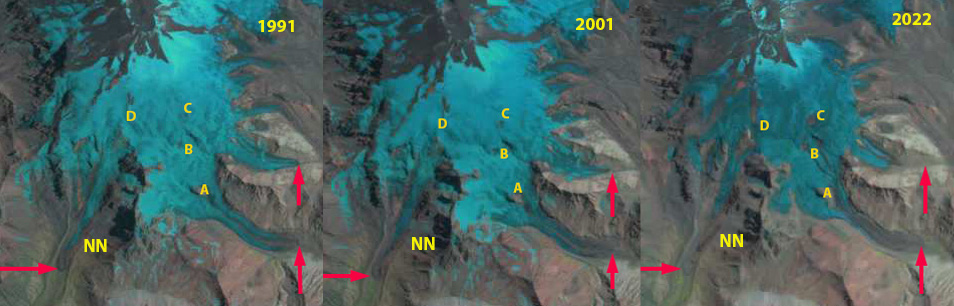
Volcan San Jose, Chile/Argentina Glacier change in Landsat 5-7-9 images from 1991, 2001 and 2022. Red arrows indicate the 1991 terminus location of three glaciers draining from the summit region, including Nieves Negras Glacier (NN). Point A-D are locations of expanding bedrock amidst the glacier.  Snowpack very limited in 2022.

Volcan San Jose is a 5850 m glacier draped volcano that straddles the Argentina-Chile border. Here we focus on the glaciers on its souther flank including the Nieves Negras Glacier. Nieves Negras drains into Rio Volcan a tributary of Rio Maipo, while the Argentina terminating glaciers drain into Rio Salinillas.  Ayala et al (2020)  examined glacier change from 1955–2016 in the Rio Maipo Basin and found a decreasing glacier mass balance trend and that glacier volume decreased by 20%. Dussaillant et al (2019) identified slower mass loss  -0.28 m/year in this region from 2000-2018, than further south in the Patagonia Andes or north in the Tropical Andes. Here we examine glacier changes from 1991 to 2022 with Landsat imagery and the low snowpack conditions of 2022 with Landsat and Sentinel images.

In 1991 Nieves Negras and the Rio Salinillas headwater glaciers terminated between 3100 and 3200 m.  The snowline is at 4500 m, and there is insignificant bedrock exposed at Point B and C.  By 2001 limited retreat had occurred, while bedrock exposure is apparent at Point B. The snowline is at 4600 m in 2001. In February of 2022, the glacier has retained less than 10% snowcover, with the snowline at 5200 m. The surface is notably dirty, which has enhanced melting during this summer.  Bedrock area at Point A is now 0.25 km2. Bedrock exposed at Point B has now generated two medial moraines. The bedrock exposed at Point C now has an area of 0.1 km2. At Point D there is nearly continuous bedrock extending along the ridge that marks the International boundary and the east margin of Nieves Negras. Glacier retreat of Nieves Negras is 1.7 km, there is stagnant ice below the current terminus. The debris cover obscures the actual terminus of the glacier at the headwaters of Rio Salinillas. While the northern terminus location indicates a retreat of 900 m.

The lack of snowcover matches that seen in other glacier of the Central Andes in summer 2022 such as ate the runoff into the Rio Plomo  Earlier observations indicate this is a regional issue this summer with snowpack lost from Bajo del Plomo Glacier,  Cortaderal GlacierPalomo Glacier, Volcan Overo Glacier and Olivares Beta and Gamma Glaciers across the Central Andes of Chile and Argentina

Volcan San Jose glaciers in Feb. 17, 2022 Sentinel image. This highlights just how dirty the ice surface is and how limited the retained snowcover is.

Bajo del Plomo Glacier, Argentina is 100% Bare Ice in February 2022

Bajo del Plomo Glacier in 2018 and 2022 Sentinel images illustrating the lack of any retained snowpack in 2022 and the expansion and emergence of bare rock areas amidst the glacier at Point A-D.

Bajo del Plomo Glacier at 7 km in length is one of two large glaciers at the headwaters of the Rio Plomo, Argentina, which is a tributary to Rio Tupungato and then Rio Mendoza. Glaciers in this region have lost ~30% of their area since 1955 (Malmros et al 2016). The majority of runoff to the Rio Plomo in summer is from snowmelt, with glaciers becoming more critical by late summer (Masiokas et al 2006)..  In February of 2022 with no snow evident in the upper basin on or off the glaciers, glaciers will dominate the runoff into the Rio Plomo  Earlier observations indicate this is a regional issue this summer with snowpack lost from Cortaderal Glacier, Palomo Glacier, Volcan Overo Glacier and Olivares Beta and Gamma Glaciers across the Central Andes of Chile and Argentina. Here we examine Sentinel and Landsat imagery to identify the lack of snowpack in summer 2021/22 on Bajo del Plomo Glacier and the expansion of bare rock areas.

Bajo del Plomo Glacier terminates at 4100 m and has two main accumulation zones that extend from 4600-5000 m near PointB and C respectively. In February 2018 there is limited bedrock expose near Point B and C, while Point A has two principal bedrock exposures with an area of   0.12 km2. In 2018 the snowline is at 4600 m.  The Dec. 21, 2021 Sentinel image indicates that the snowline is already at 4800 m. By January 18, 2022 Sentinel imagery indicates less than 10% of the upper glacier above 4900 m has retained snowcover.  By February 8, 2022  a Landsat 9 images indicates that all the snowpack on the glacier and surrounding area has been lost. The darker ice/firn surface of the glacier melts faster than a snow covered glacier surface leading to thinning and expansion of bedrock area including new exposures at Point B and D.  The area of exposed rock at Point A has doubled to 0.24 km2, and bedrock exposed at Point C is notably expanded too. The emergence of bedrock amidst the accumulation zone of a glacier is indicative of a glacier that cannot survive current climate as it is not consistently retaining snowpack (Pelto, 2010).

With a month left in the melt season Bajo del Plomo will continue to lose area and volume.

Bajo del Plomo Glacier in 2021 and 2022 Sentinel images illustrating the loss of snowpack from Dec. 21, 2021 to January 18, 2022 and the expansion and emergence of bare rock areas amidst the glacier at Point A-D.

Landsat 9 Image from Feb. 8, 2022 illustrating lack of retained snowpack.


Volcan Overo, Argentina Glaciers No Retained Snowcover at Midsummer

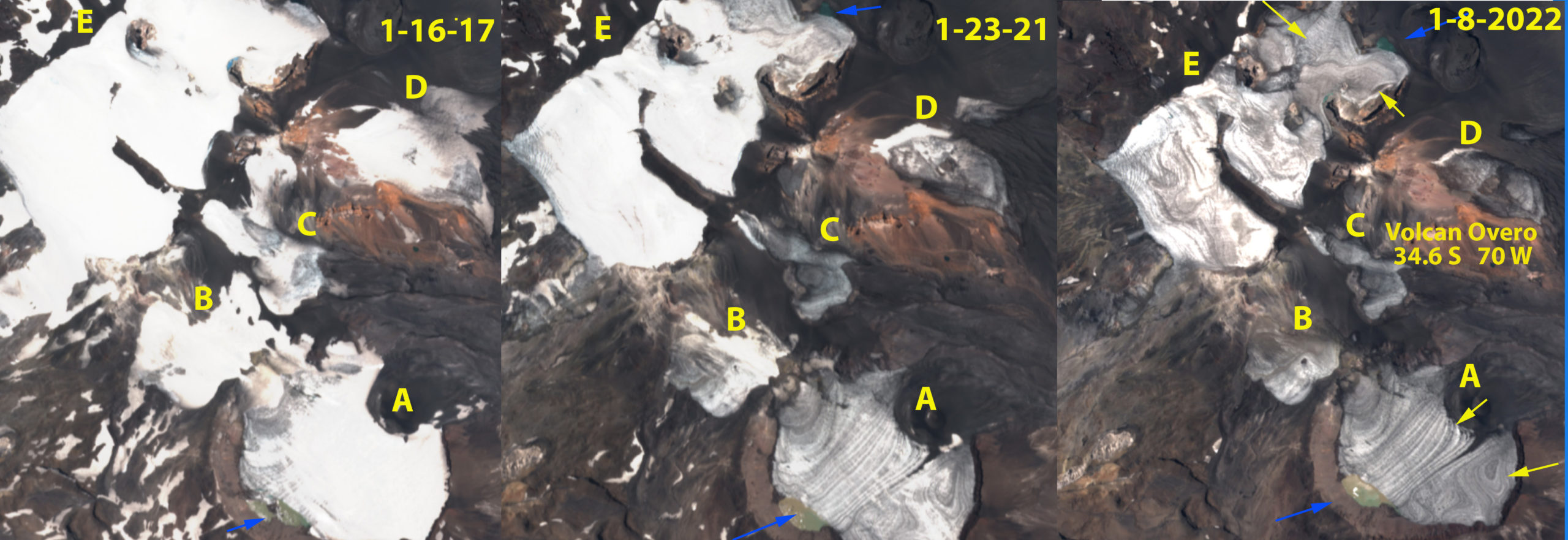
Volcan Overo glaciers in Sentinel images from January-2017, 2021 and 2022 illustrating fragmentation and no retained snowcover in 2022 with half the summer to go.

Volcan Overo is a 4619 m high Andean mountain in Argentina with a relatively low sloped broad summit region above 4000 m. This mountain has been the site of sulfur mining, with both an old tram and mining road leading to the summit region. The summit region is host to a glacier complex that is shrinking and fragmenting. In mid-January, 2022 the glacier has lost all of its snow cover.  La Quesne et al (2009) reported significant annual thinning in the latter half of the 20th century on nearby glaciers in Argentina and Chile. Dussaillant et al (2019) identified a slower mass loss  -0.28 m/year in this region from 2000-2018, than further south in the Patagonia Andes or north in the Tropical Andes. Here we examine Landsat images from 1986-2022 to identify longer term changes and with Sentinel images from 2017-2022 the recent changes including the impact of the recent January heat wave (Washington Post, 2022).

In 1986 there are four discrete glaciers around the caldera, covering ~12 km2 the largest E around the summit ranges in elevation from 4200-4500 m.  D is an isolated area at 4000-4100 m. A,B and C is a single glacier extending from 3900-4300 m. F is an area of rapidly diminishing glacier ice. In the early February image snowcover is good across all ice areas except F. In 2003 there is limited evident change with good snowcover across all except D. By 2013 A, B and C have fragmented into three separate glaciers and F is nearly gone. Only E has significant snowcover. In 2022 C and D have declined to less than 50% of their 1986 area, the overall Volcan Overo glaciated area has decline to ~8.1 km2.  It is not quite mid-summer on January 8, 2022 yet all snowcover has been lost from the glaciers of Volcan Overo. The glacier remnants at F are now gone.

Sentinel images in January of 2017 indicate good snowcover across the caldera glaciers with a total glacier area of 9.4 km2.  In January 2018 snowpack has been lost from A-D, exposing annual layers on A. Only the higher elevation E has retained snowcover. In January 2019 snowcover is good across all of the glaciers. In January 2020 snowcover is minimal on all glaciers except E. In January 2021 A, C and D have lost nearly all snowcover while B and E both are at least 50% snowcovered. In January 2022 there is no retained snowcover on any of the glaciers. The glacier area has been reduced as well. Glacier A, B, C and D no longer retain snowcover consistently and cannot survive current climate. Glacier B, C and D will continue rapidly diminishing.  Glacier A is much thicker and will take longer to disappear. The persistent lack of an accumulation zone indicates the glacier cannot survive (Pelto, 2010). Glacier E continues to recede at a slower rate, and continues to maintain snowcover most summers, but not in 2022.

The minimal snowcover of January 2022 on Volcan Overo matches that of Corataderal Glacier, Chile 30 km due west.

.

Volcan Overo glaceir complex in Landsat images from 1986-2022. The three main glaciers in 1986 have fragmented into five glaciers by 2022 and one glacier (F) has disappeared. Glacier area declined by ~30% and no snowcover is retained in mid-January of 2022.

Volcan Overo glaciers in Sentinel images in January-2018, 2019 and 2020 illustrating fragmentation and snowcover.

Upsala Glacier Separation from Bertacchi Glacier, Argentina

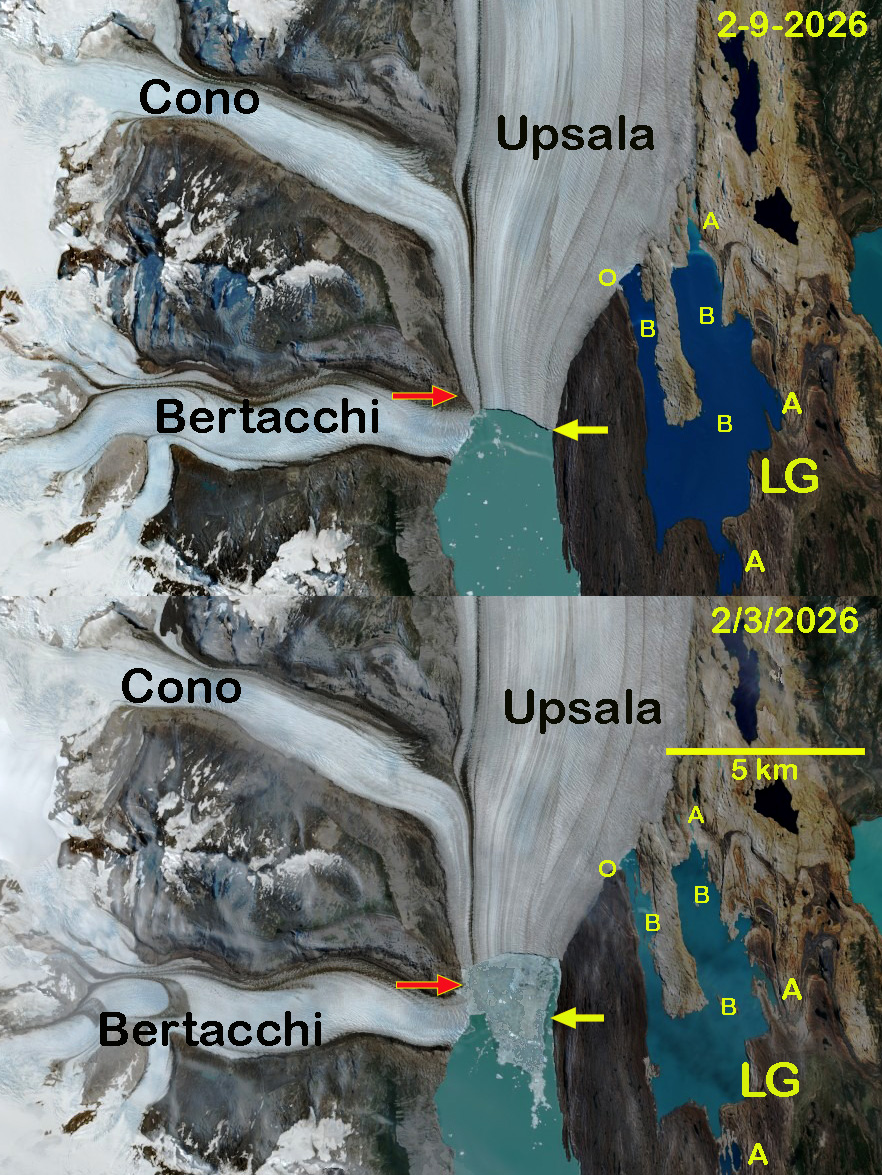
Upsala Glacier (U) in Landsat images from 1999, 2016 and 2021 illustrating both retreat and the separation from Bertacchi Glacier (B). Cono Glacier (C) is the next tributary to the north.

Upsala Glacier is a major outlet glacier of the Southern Patagonia Icefield. The glacier terminates in Lago Argentina and retreated substantially, 7.2 km from 1986-2014 (NASA, 2014). The retreat accelerated after 2008 (Sakakibara et al 2013). From 2014-2019 the rapid retreat had slowed, but given mass losses upglacier and consistent high snowlines ~1300 m in 2018-2021, not for long.

Landsat images from 1999-2021 illustrate the retreat of the glacier.  In 1999 the terminus is 3 km south of the junction.  By 2016 the terminus has retreated to the junction.  The combined calving front has a width of 2.8 km, and there is a 1.3 km long connection zone between Bertacchi and Upsala. By April and May 2021 the separation is nearly complete with a 0.3 km long connection zone, and in increase to 3.3 km wide calving front, in a Sentinel 2 image from May 5, 2021. The glaciers that have been joined for many centuries if not millenia, provide stability to each other at the junction, as there is converging flow that buttresses both.  As this buttressing is removed, the terminuses of both glaciers in the vicinity of the current terminus will be less stable.

De Angelis (2017)  noted the equilibrium line for Upsala Glacier was 1170 m based on 2002 and 2004 observations, which equates to an AAR of 65%.  On Feb 14, 2018 the TSL reached its highest observable elevation at 1275-1300 m. On March 14, 2019 the TSL reached 1300 m again. On April 8, 2020 the TSL reached 1325-1350 m upglacier of Point A and nearly to the Viedma Glacier divide. On April 17, 2020 the TSL had descended slightly to 1300 to 1325 m.  The ELA of ~1350 m is the highest annual observation for Upsala Glacier and equates to an AAR of ~48%. On April 17, 2021 the snowline on Upsala Glacier is again at ~1300 m. The consistently high snowlines drive mass balance losses, which leads to thinning and reduced flux to the terminus.  Malz et al (2018) indicated a 3.3 m thinning of Upsala glacier with significant thinning extending to the Viedma Glacier divide. Popken et al (2019) mapped the velocity at the confluence. The much slower Bertacchi has a low terminus velocity, in part due to the buttressing of Upsala.

The separation of Upsala Glacier due to rapid retreat parallels this pattern observed at other Southern Patagonia icefield outlet glaciers; Lago Onelli and  Dickson Glacier

May 5, 2021 Sentinel image of terminus zone of Upsala and Bertacchi Glacier.

Snowline on Upsala Glacier in April 2020 and 2021 Landsat images-pink dots, both years above 1300 m.

Terminus of Bertacchi and Upsala glacier in Apil 2020 and March 2021, note icebergs in March of 2021 from recent calving.

Upsala Glacier, Argentina Limited Snowcover Cloak as 2020 Melt Season Ended

Upsala Glacier transient snowline (TSL) in Landsat images from April 8 and April 17, 2020. TSL is indicated by purple dots, Point A and B are the same nunataks in each image. On April 8 the TSL almost reaches the divide with Viedma Glacier (V). 

Glaciers exist and survive when the majority of the glacier is always snow covered even at the end of the summer melt season. For a calving glacier the percentage of the glacier in the accumulation zone (accumulation area ratio: AAR) required to be in equilibrium is at least 65%, depending on calving rate. At the end of the melt season the transient snow line (TSL) is the equilibrium line where melting equals accumulation, above this point accumulation is retained. In the last year we have observed a number of glaciers with exceptionally limited retained snow cover at then end of summer in 2019. The limited AAR is a driver of mass balance loss and future terminus retreat. Here we report on the TSL on Upsala Glacier, Argentina in April 2020. This glacier flows south from a divide with Viedma Glacier and is fed from the crest of the Southern Patagonia Icefield. The glacier terminates in Lago Argentina and has retreated substantially, 7.2 km from 1986-2014 (NASA, 2014).

De Angelis (2017)  noted the equilibrium line for Upsala Glacier was 1170 m based on 2002 and 2004 observations, which equates to an AAR of 65%. Landsat images from 2001 and 2014 both from March indicate a TSL at 1075 m in 2001 and 950 m in 2014. With the snowline downglacier of Point B. On Feb 14, 2018 the TSL reached its highest observable elevation at 1275-1300 m. On March 14, 2019 the TSL reached 1300 m. On April 8, 2020 the TSL is between 1325 and 1350 m upglacier of Point A and nearly to the Viedma Glacier divide. On April 17, 2020 the TSL has descended slightly to 1300 to 1325 m.  The ELA of ~1350 m is the highest annual observation for Upsala Glacier and equates to an AAR of ~48%. Malz et al (2018) indicated a 3.3 m thinning of Upsala glacier with significant thinning extending to the Viedma Glacier divide. Since 2014 retreat has largely paused, but given mass losses upglacier and consistent high snowlines ~1300 m in 2018-2020, not for long.

The unusually high snowlines in 2019 were observed at the Northern Patagonia IcefieldTaku Glaicer, Alaska and on Penny Ice Cap, Baffin Island.

Upsala Glacier transient snowline (TSL) in Landsat images from March 2001 and March 2014. TSL is indicated by purple dots, Point A and B are same location on each map.

Upsala Glacier transient snowline (TSL) in Landsat images from February 14, 2018 and March 14, 2019. TSL is indicated by purple dots, Point A and B are same location on each map.

Map from GLIMS of the glacier divide of Upsala and Viedma Glacier with contours in meters noted.