Gepatsch Glacier Retreat, Austria 1984-2013

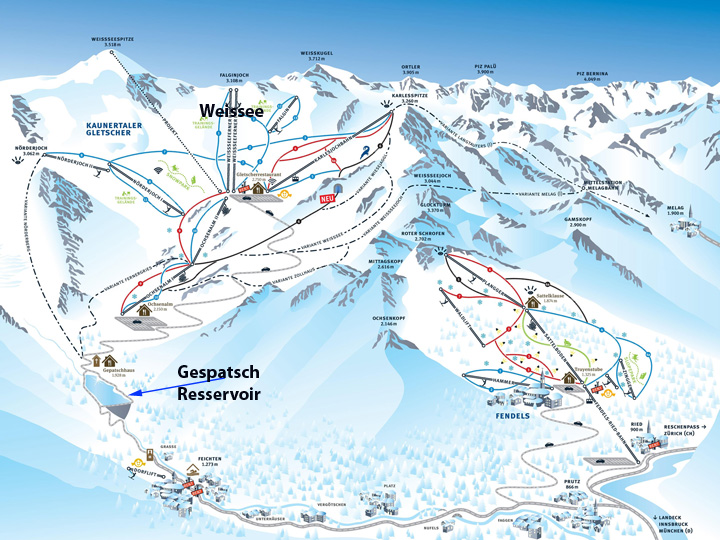
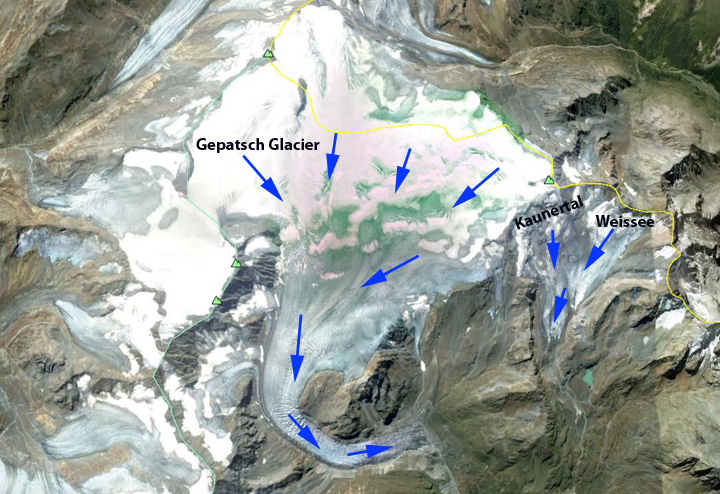
Gepatsch Glacier (Gletscher), Austria the runoff from this glacier drains into the Gespatsch Reservoir, which has a storage volume of 140 million cubic metres of water and an annual electricity production of 620 million kwh. The glacier is Austria’s second largest with an area of over 16 square kilometers. The adjacent Weißsee-Kaunertal Gletscher is host to Kaunertal Gletscher ski area and in the summer a key destination of the Gletscherpark.  The ski area map below indicates several lifts on the Weißsee-Kaunertal Gletscher. This glaciers retreat will reduce summer water supply to the reservoir, as it provides 50 million cubic meters of runoff each summer. With climate change that runoff will no longer peak in the warmest-driest part of the summer. The retreat is similar to that of Obersulzbachkees, Austria the third largest in Austria.
kaunertaler-gletscher_trail_map_l3 (1)
Ski Area Map

gepatch 2007

2007 Google Earth image

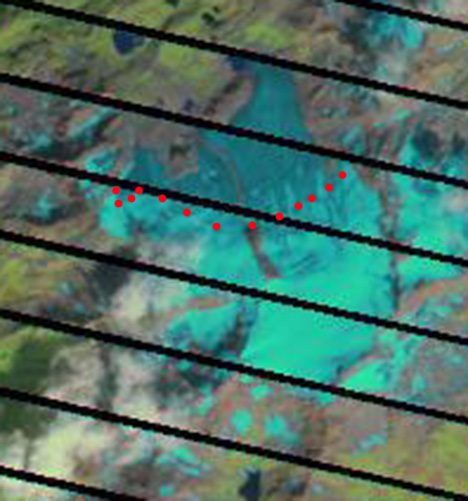
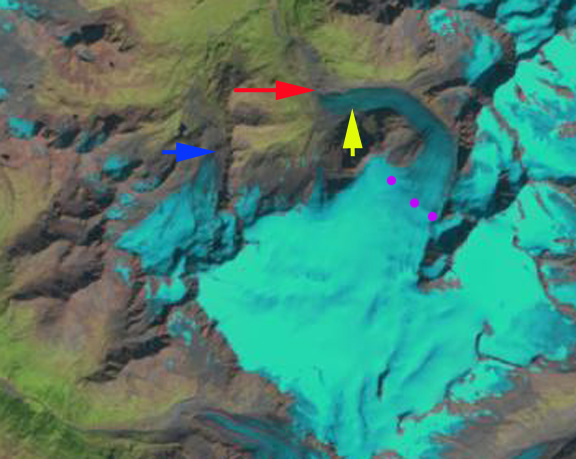
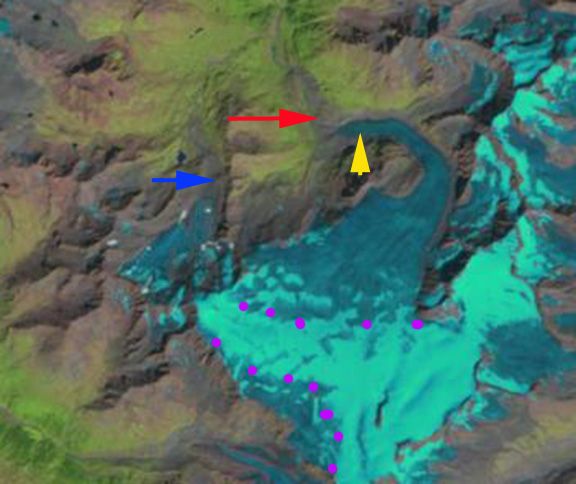
In 1985 the glacier terminated at the red arrow, expanding across the bottom of the valley where it turns south. The Weißsee-Kaunertal Gletscher terminus is at the blue arrow and the snowline is just above the icefall at the purple dots.  In 1990 there is little evident change, the snowline is higher above the icefall, the glacier in fact ended a decade of advance in 1988. By 2000 Gespatch Gletscher has retreated 200-300 meters from the red arrow. Weißsee-Kaunteral Gletscher has retreated 100-150 m from the blue arrow.  In 2010 most of the glacier has lost its snowcover, which was frequently the case from 2000-2010.  The terminus has retreated up the westward oriented side valley several hundred meters.  There is essentially no snow on the Weißsee-Kaunertal Gletscher.   By 2013 Gepatsch Gletscher has retreated 800-900m from its 1985 position, with most of the retreat since 1990. Much of this retreat occurred from 2010-2013 of 240 m of retreat and another 120 m in 2014, 52 meters per year, as noted in the annual reports of the Austrian Alpine Club glacier report completed by Andrea Fischer each year (Fischer, 2015).

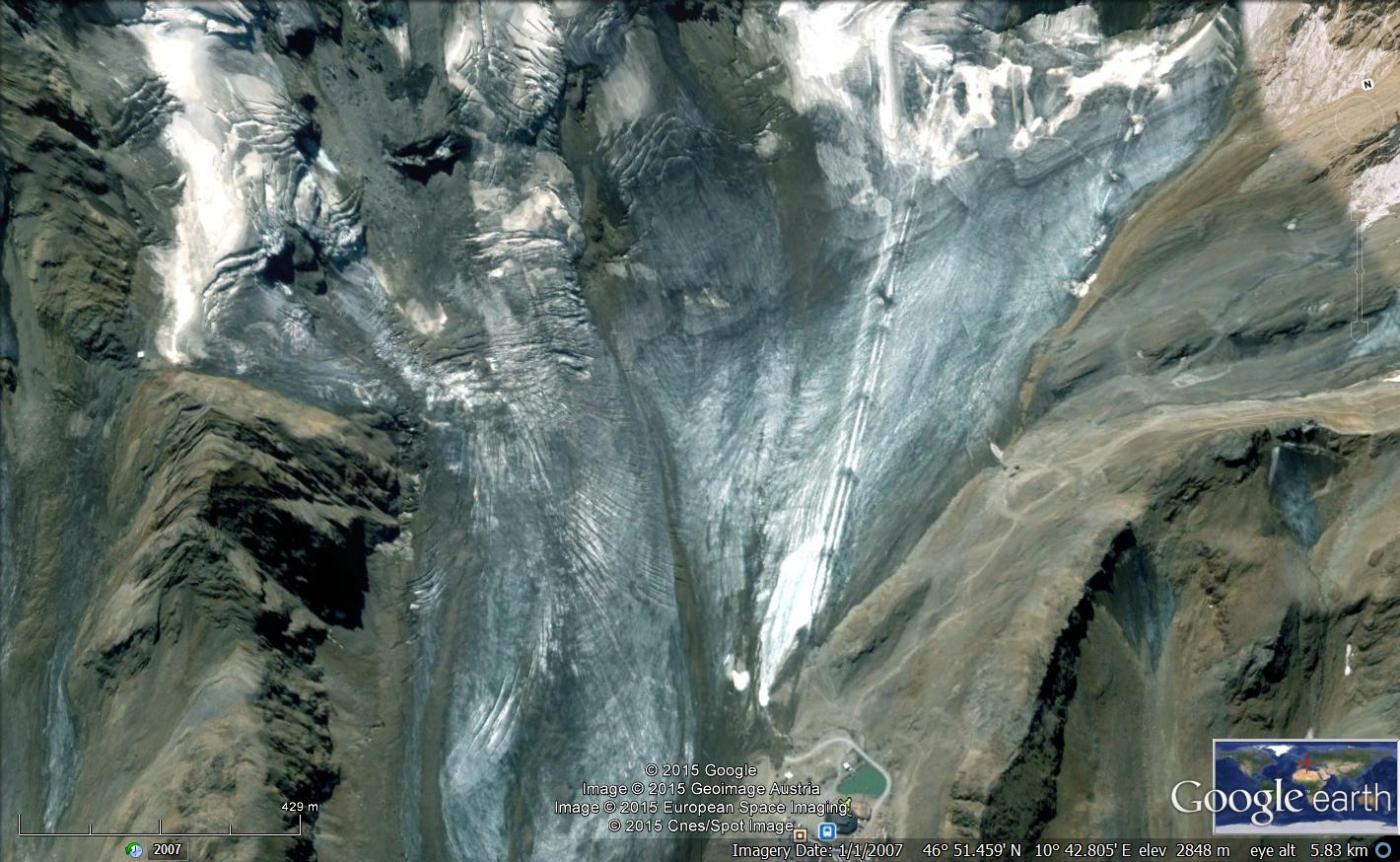
It is evident in the 2003 Google Earth image that rapid retreat was imminent as the terminus of the galcier was stagnant. The Weißsee-Kaunertal Gletscher has retreated 300 m and has thinned even more from 1990-2013.  The   Alpine club also observes this glacier and notes typical retreat rates in the last five years ranging from 15-25 meters/year.   Given the ski lifts emplaced on this glacier, continued thinning and retreat will increasingly impact ski area operation.  The ski area has not resorted to artificial means to sustain Weißsee-Kaunertal Gletscher as has been done at nearby Pitzal Glacier ski area.

gespatch 1985
1985 Landsat Image

gespatch 1990
1990 Landsat Image

gespatch 2000
2000 Landsat Image

gespatch 2010
2010 Landsat Image

gespatch 2013
2013 Landsat Image

gepatch terminus 2003
2003 Google Earth Image
weissee lifts
Google Earth Images ski lifts evident as the linear feature on the nearly snowless galcier. 

Weisee 2003

Slender Glacier, Brooks Range, Alaska: Rapid Retreat 1992-2014

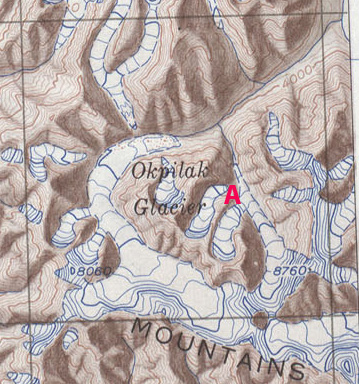
Slender Glacier is not an official name, but a well suited name to this glacier in the Romanzof Mountains of the Brooks Range of Northern Alaska.  It is adjacent to the Okpilak Glacier and drains into the Okpilak River, which is host to arctic grayling. Here we examine Landsat imagery from 1992-2014 to identify changes. U-Alaska-Fairbanks has an ongoing program in the nearby Jarvis Creek Watershed examining in part how will the anticipated future increase in glacier wastage and permafrost degradation affect lowland hydrology.  Matt Nolan (U-AK-Fairbanks) reports on changes of nearby McCall and Okpilak Glacier. These glacier have suffered increased mass loss since 1990 as a result of an increase in the equilibrium line altitude that has reduced accumulation area and is indicative of increased ablation (Delcourt al , 2008)

mt_michelson-1956
USGS 1951 map

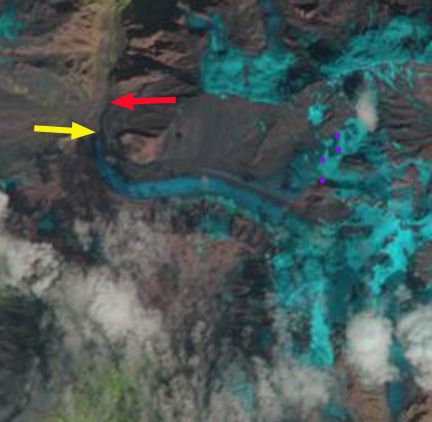
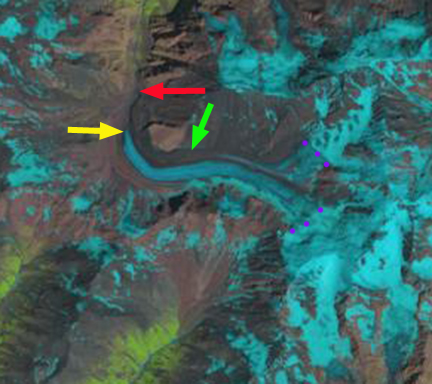
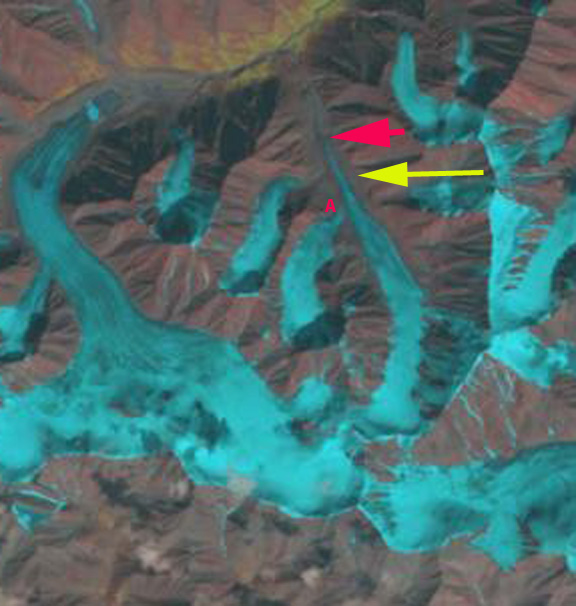
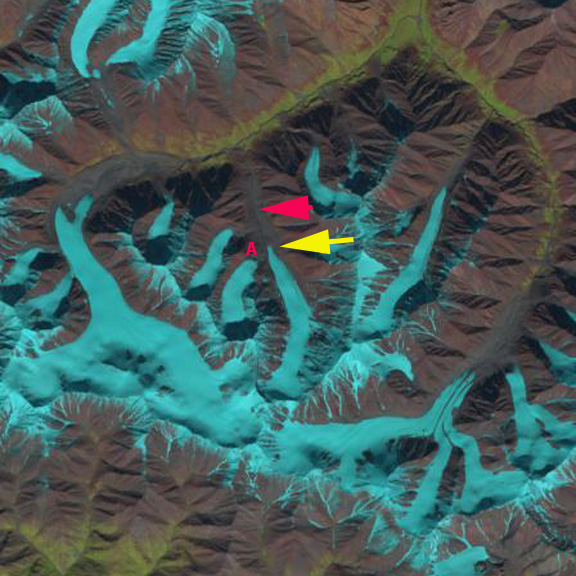
In 1992 the glacier extended downvalley to the red arrow at 1530 m. The glacier also received contribution from a tributary glacier at Point A. By 2002 the glacier had receded a short distance from the red arrow and still received input from the tributary glacier at Point A. By 2013 the glacier had receded to the yellow arrow 1100 meters from the 1992 terminus position, and now terminates at an altitude of 1675 m. The tributary glacier is no longer connected to Slender Glacier at Point A. The percent of snowcover is better than on Okpilak Glacier immediately to the west, or East Okpilak Glacier to the southeast. The first tributary entering the glacier on the east side is also disconnecting from Slender Glacier.   In 2014 the Landsat image is after a light snowfall that has endured only on the glacier ice, helping outline the glaciers. The continued decline in retained snowfall and contributed snowfall from tribuatry glaciers will lead to an even more slender glacier.

slender glacier 1992
1992 Landsat Image

slender glacier 2002
2002 Landsat Image

slender glacier 2013
2013 Landsat Image

slender glacier 2014
2014 Landsat Image

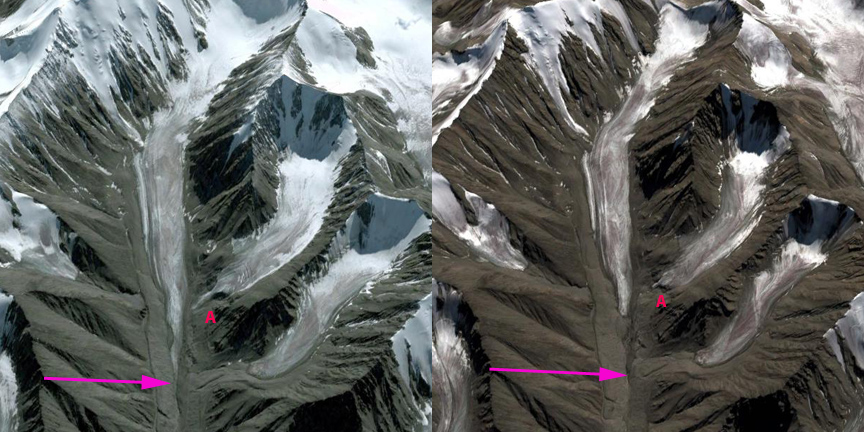
Google Earth images from 2006 and 2012 indicate a rapid retreat of the thin main terminus, and the loss of contact with the tributary glacier at Point A. The retreat is similar to that of Fork Glacier and Romanzof Glacier in the same region. The retained snowcover in 2012 is minimal on Slender Glacier and its tributaries. Tributary A lost almost all snowcover in 2012 and 2013 suggesting a lack of a consistent accumulation zone, which a glacier cannot survive without (Pelto, 2010)

slender comparison
2006 Google Earth Image and 2012 Google Earth image

Big Bend Glacier, British Columbia Transitions to Alpine lake

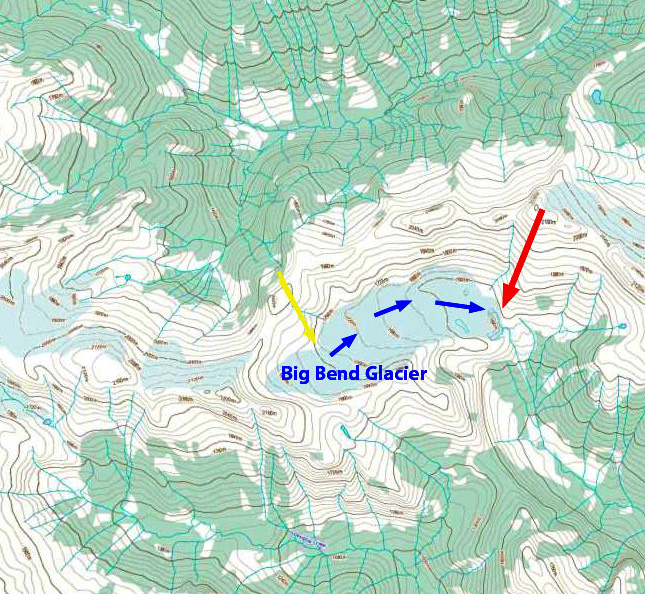
“Big Bend” Glacier is an unnamed glacier west of Big Bend Peak north of Harrison Lake in Southwest British Columbia.  In 1985 the glacier was 2.6 km long filling a low valley with a surface elevation of 1600-1800 m elevation, the topographic map indicates this basic size. Here we utilize Landsat imagery to identify the changes in the glacier from 1985-2014 due to climate change. In essence the glaciated basin is transitioning to an alpine lake basin, quickly.

bigbendpeak ge


Topographic map of the Big Bend Glacier area.

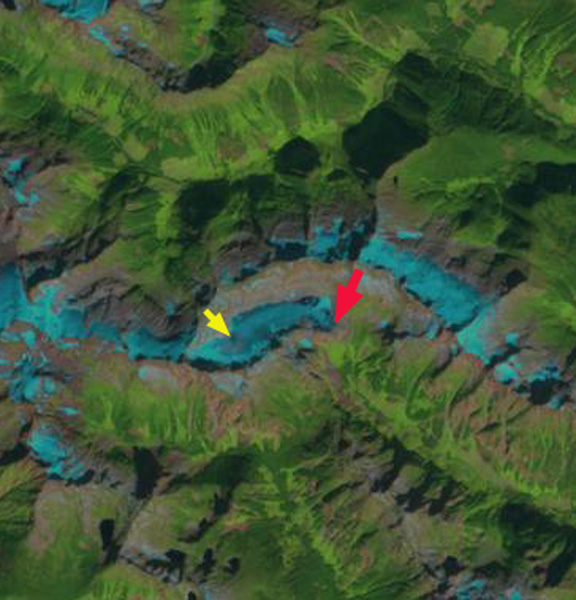
In 1985 the glacier extends to the big bend in the valley marking its eastern end, red arrow.  the yellow arrow indicates an area near 1800 m where the glacier extends across the valley.  In 1992 there has been little retreat but evident thinning is leading to lake formation at the terminus and narrowing of the glacier at the red arrow. In 2002 thinning is leading to expansion of a proglacial lake both west and south of the red arrow.  The terminus retreat has still been limited, thinning is evident at the yellow arrow.  

In 2013 a new alpine lake that is approximately 1 km long has formed, as the terminus area of the glacier has collapsed. In 2014 an area of bedrock and a small lake has developed at the yellow arrow.  There is no retained snowpack below the yellow arrow in 2013, and no retained snowpack in at all in 2014.  This will likely be the case in 2015 as well.  This glacier has a lower top elevation than most in the region and will be more impacted by the warm winter conditions and high snowline of 2015. The retreat from 1985 to 2014 has been 1.1 km. This is 40% of the entire glacier length gone in 30 years. The lake itself has a deep blue color suggesting limited glacier sediment input, further indicating a lack of motion of the glacier currently or in the near past.

The glacier retreat has been more extensive than Stave Glacier or Snowcap Glacier to its east.  Koch et al,(2009) observed a widespread retreat and glacier area loss in Garibaldi Provincial Park just to the west, with 20% area loss from 1988-2005. Place Glacier is a short distance north of Big Bend Glacier has its mass balance has lost an average of 25 m of water equivalent (28 m ice) thickness since 1984, see bottom chart. This has been higher but similar in trend to other glaciers in the region.  Big Bend will disappear soon just as we obsserved already happened at Milk Lake Glacier, North Cascades, Washington.

bigbendpeak1985
1985 Landsat Image

bigbendpeak1992
1992 Landsat Image

bigbendpeak2002
2002 Landsat Image

bigbendpeak 2013
2013 Landsat Image

bigbendpeak2014
2014 Landsat Image

nam-ba-2013
North American cumulative glacier mass balance graph

Midui Glacier, Tibet, China: Retreat and Terminus Collapse 1995-2014

Midui Glacier is 7 km from the G318 National Highway in China and 2 km from Midui village, hence the lake near the terminus is often visited. The glacier is near the headwaters of Yarlung Tsangpo. Glaciers in this region have experienced significant retreat and area loss as noted by the second China Glacier inventory. This compared glacier area from the 1950’s, 2002 and 2010, Liu et al (2013) noted that glacier area has declined 13%. The Midui Glacier was advancing as recently as 1964 when it emplaced an advance moraine (Xu et al, 2012).  This is a region where Li et al (2011) noted that increasing temperature, especially at altitude, the fronts of 32 glaciers have retreated, mass losses of 10 glaciers have been considerable, glacial lakes in six regions have expanded and melt water discharge of four basins has also increased. This is further documented by an inventory of 308 glaciers in the Nam Co Basin, Tibet, where an increased loss of area for the 2001-2009 period, 6% area loss (Bolch et al., 2010) was observed. The nearby Yemayundrung Glacier retreat is similar. Here we examine changes in this glacier using Landsat imagery and Google Earth from 1995-2014.

midui glacier 1995
1995 Landsat image

midui glacier 2014 landsat
2014 Landsat image

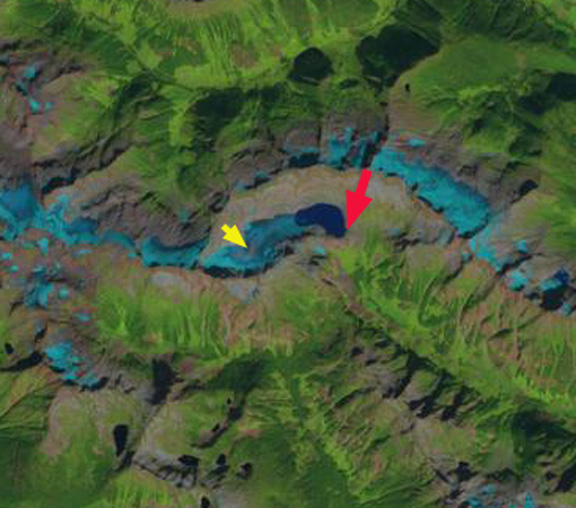
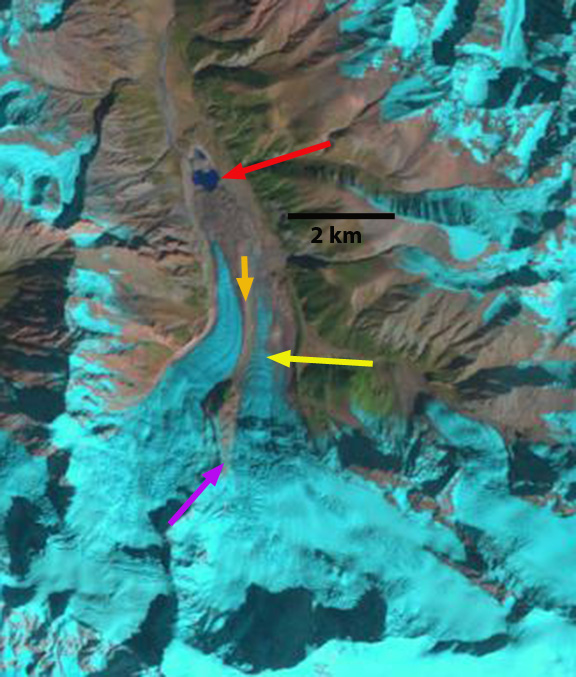
In the Landsat images above in 1995 the glacier terminates in a proglacial lake at the red arrow. A ridge separates two tributaries each with an icefall creating ogives, purple arrow. There are ogives below a pair of icefalls at the yellow arrow. The tributaries are separated by a medial moraine orange arrow. By 2014 retreat has led to expansion of the lake at the terminus. The retreat is 300 meters during this 20 year period. The icefall on the right, east side of the glacier, is no longer producing significant ogives and the bare glacier ice has been replaced with extensive debris cover, yellow arrow. Both the ridge and medial moraine separating the tributaries have expanded in width as the glacier has thinned.

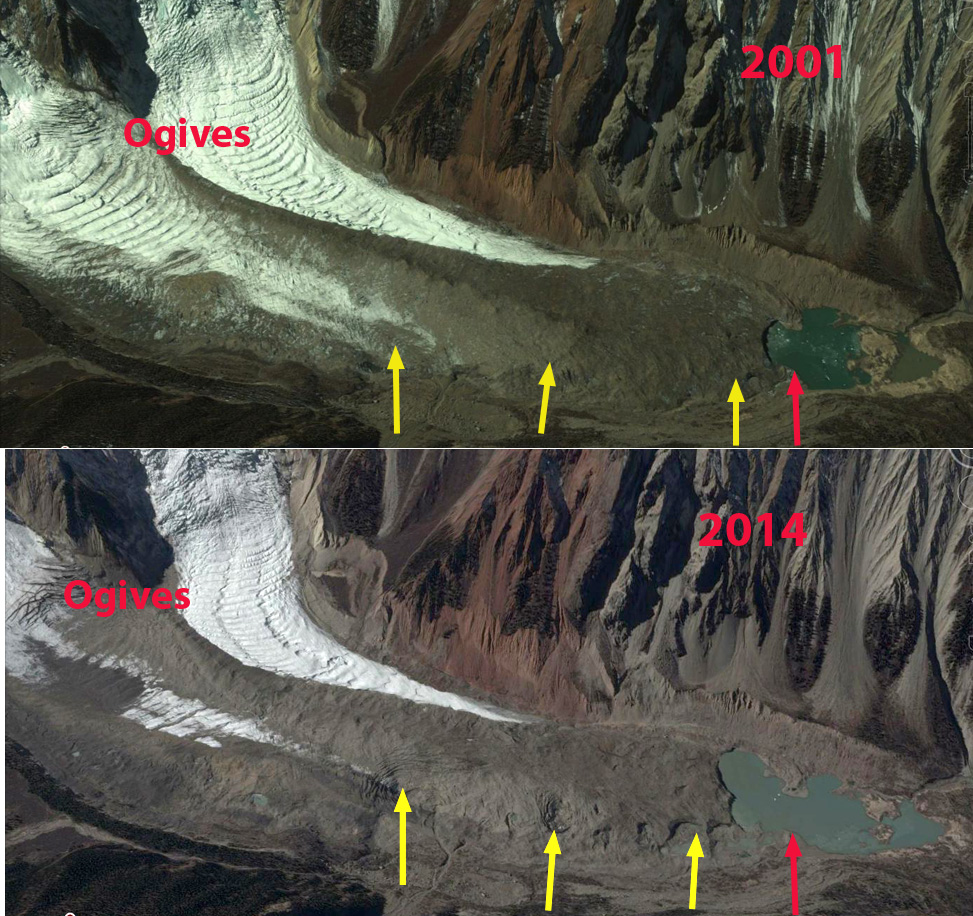
A series of comparison images from Google Earth in 2001 and 2014 further illustrate the changes noted above.

In the first pair the terminus change and lake expansion is evident at the red arrow. Debris cover expansion at the lateral moraine area with thinning of the eastern tributary is notable at the yellow arrow.

The second pair is the terminus reach. A series of depressions are noted with each yellow arrow, indicated by concentric crevassing. This indicates collapse due to a subglacial basin/lake. Further this indicates a stagnant collapsing terminus area in the lower 1.5 km of the glacier.

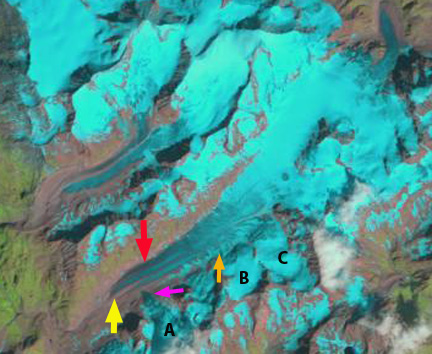
The last pair is the icefall region indicating reduced crevassing below the lefthand icefall, pink arrow and the expanding medial moraine yellow arrow. It is clear that this glacier is going to continue to retreat in the coming decades, and the rate is going to increase in the near future as the collapsing sections of the terminus melt away. There is still considerable glacier area that remains snowcovered each year, and it can survive current climate and some additional warming. The snowline on the glacier is at 5000-5100 m and the head of the glacier is at 6100 m.
midui glacier comp
Midui Glacier comparison from Google Earth

midui terminus comp
Midui Terminus comparison from Google Earth

midui icefall
Midui Icefall comparison from Google Earth

Retreat forms Embayment at Kropotkina Glacier in Novaya Zemlya

Kropotkina Glacier is a tidewater glacier on the southeast coast of Novaya Zemlya that drain into Vlaseva Bay.  The glaciers terminate in the Kara Sea and has been retreating like all tidewater glaciers in Novaya Zemlya LEGOS, 2006 .  The map shown below from this project indicate the lack of an embayment in 1952, red dashed line and limited retreat from 1952-1988, with 1988 being the yellow line. Carr et al (2014) identified an average retreat rate of 52 meters/year for tidewater glaciers on Novaya Zemlya from 1992 to 2010 and 5 meters/year for land terminating glaciers.   Here we examine Landsat imagery from 1988 to 2013 to identify changes in Kropotkina Glacier.

kropots map

In each image the colored arrows are in the same location. In 1988 the terminus is just beyond the red arrow indicating a peninsula on the east side of the terminus. The yellow arrow indicates a lake beyond an eastern terminus lobe with limited drainage down a river adjacent to the glacier, purple arrow. Two smaller glacier termini are joined at the green arrow. By 1998 there is a minor retreat of the main terminus on both the east and west side. Little change is seen elsewhere. By 2011 a substantial embayment has developed above the red arrow. Retreat is limited on the western side of the terminus. The eastern terminus lobe has retreated as well and the drainage channel adjacent to the glacier is less restricted leading to a less extensive lake. The lake is mostly filling the region occupied by ice 13 years before.

In 2014 there is cloud cover over much of the glacier but the terminus is clear. The easternmost terminus lobe is collapsing, and is not surrounded by a lake, yellow arrow. The purple arrow drainage river is no longer necessary as there is lake connectivity. The main terminus to the east has retreated to the entrance to the lake for the eastern terminus lobe, this a 2.8 km retreat. The western side of the glacier remains aground on a peninsula, but has receded 500 m. How long before this part of the terminus to retreats into the expanding embayment. An are of more 7 square kilometers has gone from glacier ice to embayment in the last 25 years, almost all within the last 13 years. The retreat has mainly been via calving, and with an expanding calving front and reduced pinning points along the margin, the rapid retreat and area loss is not over. The beginning of rapid retreat coincides with the onset of rapid decline in sea ice extent in the Kara Sea (Perovich et al., 2014).

This ongoing retreat is illustrated by Krivosheina, Chernysheva, Roze and Sredniy and Taisija Glacier also in northern Novaya Zemlya.

kropots 1988b

1988 Landsat image

kropots 1998
1998 Landsat image
kropots 2011
2011 Landsat image
kropots 2014
2014 Landsat image

Retreat of Grewingk Glacier, Alaska 1986-2014

Grewingk Glacier drains west toward the Kachemak Bay, Alaska terminating in a proglacial lake in Kachemak Bay State Park.  The glacier drains an icefield on the Kenai Peninsula, glaciers draining west are in the Kenai Fjords National Park. The glaciers that drain east toward are in the Kenai Fjords National Park, which has a monitoring program.  Giffen et al (2008) observed the retreat of glaciers in the region. From 1950-2005 all 27 glaciers in the Kenai Icefield region examined  are retreating. Giffen et al (2008)observed that Grewingk Glacier retreated 2.5 km from 1950-2005.  Here we examine Landsat imagery from 1986-2014 to illustrate the retreat of the glacier.  The icefront continues to calve into the expanding pro-glacial lake.

grewingk map

1951 based USGS Topographic map Seldovia C-3

The red arrow is the 1986 terminus location at the midpoint, the yellow arrow is the 2014 mid-point terminus location. In 1951 the glacier extended beyond the peninsula at the red arrow into the wider portion of the lake. By 1986 the glacier had retreated into the narrow section of the lake extending east into the mountains, the southern margin of the terminus is further advanced than the northern margin.  The orange dots indicate discoloration of the glacier surface from volcanic ash deposited on the glacier surface from Augustine Volcano in 1986. In 1989 there is not a marked change. In a 1996 Google Earth image, there is considerable icebergs indicating a recent collapse of a section of the terminus. The pink arrow indicates concentric crevasses, indicating a depression, the red line is the terminus in 1996 and the brown line the 2003 terminus.

By 2001 the terminus has retreated m, and the glacier front is now oriented north-south across the lake. In 2003 the depression from 1996 now has a small supraglacial lake, the terminus has retreated 500 m on the southern margin and 200 m on the northern margin. In 2013 the glacier has retreated an additional 600 m and the southern margin has now receded further upvalley than the northern margin. Blue arrows indicate direction of glacier flow.  By 2014 the glacier has retreated 1.4 km since 1986, 50 m per year. There is an increase in the glacier slope 2.5 km above the terminus where crevassing increases.  This suggests the lake will end by or at this point, which would then lead to a reduction in retreat rate.

This retreat follows that of Pederson Glacier, Four-Peaked Glacier and Spotted Glacier. The continued reduction in glacier size leads to changes to the Kachemak Bay estuary. Kachemak Bay is the largest estuarine reserve in the National Estuarine Research Reserve System. It is one of the most productive, diverse estuaries in Alaska, with an abundance of Steller sea lions, seals, sea otters, five species of Pacific salmon, halibut,herring, dungeness crabs and king crabs (NERRS, 2009). The estuary salmon fishing industry is, one of Kachemak Bay’s most important resources and livelihoods.

grewingk Glacier 1986a
1986 Landsat Image

Grewingk 1989
1989 Landsat Image

grewingk 1996 ge
1996 Google Earth Image

grewingk glacier 2001
2001 Landsat Image

grewingk 2003 ge
2003 Google Earth Image

grewingk glacier 2013a
2013 Landsat Image

grewingk glacier 2014
2014 Landsat Image


Snow Deficit on Grinnell Ice Cap, Baffin Island, Canada

The Grinnell Ice Cap Is located on the Terra Incognita Peninsula on Baffin Island. The name suggests the reality that this is a not often visited or studied region. Two recent studies have changed our level of knowledge. Way (2015) notes that the ice cap has lost 18% of its area from 1974 to 2013 and that the rate of loss has greatly accelarated and is due to summer warming, declining from 134 km2 in 1973-1975 imagery to 110 square kilometers in 2010-2013 images. Papasodoro et al (2015) report the area in 2014 at 107 km2 with a maximum of elevation of close to 800 m. The location on a peninsula on the southern part of the island leads to higher precipitation and cool summer temperatures allowing fairly low elevation ice caps to have formed and persisted. Way (2015) in the figure below indicates the cool summer temperatures have warmed more than 1 C after 1990. Recent satellite imagery of snowcover and ICESat elevation mapping suggest little snow is being retained on the Grinnell Ice Cap since 2004. Papasodoro et al (2015) identify a longer mass loss rate of -0.37 meters per year from 1952-2014, not exceptionally different from many alpine glaciers. They further observed that from 2004-2014 this rate has accelerated to over -1 meter per year, including a thinning rate above 1.5 meters along the crest of ice cap. This can only be generated by net melting not ice dynamics. Further such rapid losses will prevent retaining even superimposed ice. Here we examine Landsat imagery from 1994 to 2014 to illustrate glacier response.

grinnell ice cap ge
Grinnell Ice Cap in Google Earth

gic summer climate
From Way (2015)

The red arrows in each image indicate areas of small nunataks that have begun to expand in the last decade. The yellow and green arrows indicate specific locations on the western margin of the ice cap where lakes are developing. Point A-D note specific locations adjacent to ice cap outlet glaciers. In 1994 the late August image indicates snowcover across most of the ice cap. The green arrow is at the northern end of a narrow lake. The yellows arrows are at the northern and southern end of a narrow ice filled depression. The nunatak area exposed at the red arrows is limited. At Point C the terminus is tidewater. In 2000 snow pack covers 40% of the ice cap. A small lake is developing at the yellow arrows. The glacier reaches the ocean at Point C and D. The glacier extends south of Point A and the outlet glacier at Point B is over a 1.2 km wide. In 2012 a warm summer led to the loss of all but snowpack on the glacier. At the red arrows the nunataks have doubled in size. At the yellow arrows a 2.5 km long lake has developed. At the green arrow a lake that has developed, is now separated from the glacier margin by bedrock. The glacier now terminates north of Point A. In 2014 again snowcover is minimal with two weeks left in the melt season. The outlet glaciers at Point C and D are no longer significantly tidewater. At Point B the outlet glacier is less than 0.5 km wide. The lake at the yellow arrows is 3 km long and 400 m wide. Some nunataks are coalescing with each other or the ice cap margin. The majority of the western margin of the ice cap has retreated 300-500 m. This retreat is surpassed at outlet glaciers by Point A and C. What is of greatest concern is the loss in thickness of over 1.5 per year on the highest portions of the ice cap, indicating no consistent accumulation zone. This results from the persistent loss of nearly all snowcover in the summer. This pattern of limited end of summer retained snowcover seen in most years since 2004, is a snow deficit that this ice cap cannot survive in our current warmer climate (Pelto, 2010). Way (2015) projects that that if the observed ice decline continues to AD 2100, the total area covered by ice at present will be reduced by more than 57%. Given the recent increases and lack of retained snowcover, suggests an even faster rate is likely.

GIC 1994
1994 Landsat image

gic 2000
2000 Landsat image

gic 2012 late2
2012 Landsat image

gic 2014 late2
2014 Landsat image

31 years of observations on Retreating Columbia Glacier, Washington

For the last 31 years the first week of August has found me on the Columbia Glacier in the North Cascades of Washington. Annual pictures of the changing conditions from 1984 to 2014 are illustrated in the time lapse video below. This is the lowest elevation large glacier in the North Cascades. Columbia Glacier occupies a deep cirque above Blanca Lake and ranging in altitude from 1400 meters to 1700 meters. Kyes, Monte Cristo and Columbia Peak surround the glacier with summits 700 meters above the glacier. The glacier is the beneficiary of heavy orographic lifting over the surrounding peaks, and heavy avalanching off the same peaks. This winter has been the lowest year for snowpack in the North Cascades in the 32 years we have worked here.  Below is a comparison from August 1, 2011 with Blanca Lake below the glacier still frozen and a beautiful scene on April 4, 2015 with the lake not frozen taken by Karen K. Wang.  The winter in the region was unusually warm, but not as dry as in California; however, in the snowmelt and glacier fed river basins summer runoff will be low this year.


Blanca Lake Aug. 1, 2011 on left and April 4, 2015 on right (Karen K. Wang, www.karenkwang.com)
Blanca Lake Aug. 1, 2011 on left,  and April 4, 2015 on right (Karen K. Wang, www.karenkwang.com)

Over the last 31 years the annual mass balance measurements indicate the glacier has lost 14 meters of thickness. Given the average thickness of the glacier of close to 75 meters in 1984 this represents a 20% loss in glacier volume. During the same period the glacier has retreated 135 meters, 8% of its length. Most of the loss of volume of this glacier has been through thinning not retreat.  To survive a glacier must have a persistent and consistent accumulation zone (Pelto, 2010).  On Columbia Glacier in 1998, 2001, 2003, 2004, 2005, 2009 and 2013 limited snowpack was retained, resulting in thinning even on upper part of the glacier.  This thinning of the upper glacier indicates the lack of a persistent accumulation zone such as in 2005, note the exposed annual ice and firn layers green arrows, this indicates the lack of retained accumulation in recent years.  This indicates the glacier is in disequilibrium and cannot survive. Mapping of the glacier from the terminus to the head indicates a similar thinning along the entire length of the glacier.  The overall mass balance loss parallels that of the globe and other North Cascade glaciers in the last three decades.

columbia accumulation zone 2005

2005 Accumulation zone of Columbia Glacier


On left cumulative mass balance of Columbia Glacier compared to the WGMS global record and other North Cascade glaciers. On right change in surface elevation along the glacier from terminus to head indicating a 14-15 m thinning on average.

A comparison of images from  1986, 2007 and 2013 photograph provide a view of  glacier change at the terminus. The blue arrows indicate moraines that the glacier was in contact with in 1986, and now are 100 meters from the glacier. The green arrow indicates the glacier active ice margin in 1986 and again that same location in 2007 now well off the glacier. The red arrow indicates the same location in terms of GPS measurements, this had been in the midst of the glacier near the top of the first main slope in 1986. In 2007 this location is at the edge of the glacier in a swale. The changes are more pronounced in 2013 as the terminus slope continues to decrease. The low snowpack in 2015 on the glacier in March, 2-3 m versus 6-8 m, will lead to considerable changes in the terminus this summer, that we will assess.

1986 Terminus Columbia Glacier

columbia 2007 comp

2007 Terminus Columbia Glacier

columbia glacier2013 comp.

2013 Terminus Columbia Glacier

Jill Pelto painted the glacier as it was in 2009 (top) and then what the area would like without the glacier in the future, at least 50 years in the future (middle), and Jill at the sketching location (bottom), turned 180 degrees to view Blanca Lake. The lake is colored by the glacier flour from Columbia Glacier to the gorgeous shade of jade.

Clearly the area will still be beautiful and we will gain two new alpine lakes with the loss of the glacier. After making over 200 measurements in 2010 we completed a mass balance map of the glacier as we do each year. This summer we will be back again for the 32nd annual checkup.  There will be likely be record low snowpack, comparable to 2005 the worst year from 1984-2014.

2010 Mass Balance map of Columbia Glacier

Widespread Retreat Gilkey Glacier System, Alaska

Gilkey Glacier drains the west side of the Juneau Icefield and has experienced widespread significant changes since I first worked on the glacier in 1981.    Here we examine the changes from the August 17, 1984 Landsat 5 image to the August 21, 2014 image from newly launched Landsat 8.  Landsat 5 was launched in 1984, Landsat 8 launched in 2013. The Landsat images have become a key resource in the examination of the mass balance of these glaciers (Pelto, 2011). The August 17th 1984 image is the oldest Landsat image that I consider of top quality. I was on the Llewellyn Glacier with the Juneau Icefield Research Program (JIRP) on the east side of the icefield the day this image was taken. JIRP was directed by Maynard Miller at that time and by Jeff Kavanauagh now. The Gilkey Glacier is fed by the famous Vaughan Lewis Icefall at the top of which JIRP has its Camp 18 and has monitored this area for 60 years. Here I examine changes both in images and text below. The same analysis in a more depth is contained in the screen capture video of the same images.  Choose the format you prefer and let me know which works for you.

There are seven locations noted in the 1984 and 2014 image that are the focus of more discussion in a set of three more focused images

gILKEY gLACIER 1984 SOURCE

1984 Landsat Image

Gilkey Glacier 2014 source

2014 Landsat image

Arrow #1 indicates the Gilkey Glacier terminus  area.  Gilkey Glacier had begun to retreat into a proglacial lake by 1984, the lake was still just 1 km long. A short distance above the terminus the Gilkey was joined by the sizable tributaries of the Thiel and Battle Glacier. By 2014 the main glacier terminus has retreated 3200 m, the lake is now 4 km long.  A lake that did not exist in USGS maps from 1948. Thiel and Battle Glacier have separated from the Gilkey Glacier and from each other. Thiel Glacier retreated 2600 m from its junction with Gilkey Glacier from 1984-2014 and Battle Glacier 1400 m from its junction with Thiel Glacier and 3500 m from the Gilkey Glacier.  Melkonian et al (2013) note the fastest thinning in the Gilkey Glacier system from to is near the terminus and in the lower several kilometers of Thiel Glacier.

Gilkey terminus retreat

Above: 1984-2014 Comparison of Gilkey Glacier terminus area with Landsat imagery

Arrow #3 and #4 indicates valleys which tongues of the Gilkey Glacier flow into.  In 1984 at #3 the glacier extended 1.6 km upvalley ending where the valley split. The portion of the Gilkey flowing into the valley had a medial moraine in its center.  At arrow #4 the glacier extended 1.5 km up Avalanche Canyon.  In 2014 at  #3 the glacier tongue ends 1.2 km from the valley split, and the medial moraine does not enter the valley.  At #4 the glacier has retreated 1.3 km, leaving this valley nearly devoid of a glacier.

avalanche canyon retreat

Above: Comparison of the Avalanche Canyon area 1984-2014.

Further upglacier arrow #5 indicates a side glacier that in 1984 featured an unending system of glacier flowing down the steep mountain sides into the valley bottom.  By 2014 two rock ribs extend along most of the east and west valley walls separating the glaciers on mountain side from the main valley glacier, which has as a result been reduced in width and velocity. At arrow #6 a tributary glacier is seen merging with Gilkey Glacier in 1984.  By 2014 this tributary no longer reaches the Gilkey Glacier, ending 300 m up the valley wall.  At arrow #7 the Little Vaughan Lewis Icefall in 1984 is seen merging with the Gilkey Glacier across a 300 m wide front.  This I can attest from seeing the glacier that summer to be an accurate observation.  By 2014 at arrow #7 the Little Vaughan Lewis Icefall no longer feeds ice directly to the Gilkey Glacier.  There is still avalanching but not  a direct flow connection. JIRP has Camp 19 in this area, a spectacular area of ongoing research by JIRP.   The main Vaughan Glacier Icefall is still impressive, just south of the rib beyond arrow #7. Measurements of snowpack are made annually by JIRP above the icefall, and indicate a mean snow depth exceeding 3 m in early August, note image below of measuring annual snow layers in a crevasse at head of the icefall. Pelto et al (2013) summarize the results of this ongoing research that Chris McNeil (USGS) is working to enhance with newer technology.  The terminus change of all Juneau Icefield glaciers from 1984-2013 has been summarized in a previous post. The 2015 season will be of interest, since the area had a remarkably warm yet wet winter.  This will lead to high ablation at lower elevations, likely a higher snowline than usual, but above the Vaughan Lewis Icefall will those warm wet events dumped snow? The 2014 winters season was warm and the snowline seen in the 2014 satellite imagery was at 1500 m, yet snowpack at 1760 m on the Vaughan Lewis Glacier was 3.3 m deep in late July.  This has been the case in the past with warm wet winters featuring heavy snow above 1600 meters on the icefield. JIRP will be in the field answering this question in 2015.

little vaughan

Above: Comparison 1984-2014 of the Vaughan Lewis Glacier area

Untitled-24

Crevasse stratigraphy Vaughan Lewis Glacier.

Conway Glacier Separation and Retreat, Alberta

Conway Glacier drains east from the border with British Columbia into the Howse River. The Howse River joins the Saskatchewan River upstream of the Bighorn Hydropower project, which impounds Lake Abraham and produces 120 MW of power. The map of this area was updated based on 1990 images which indicate Conway Glacier is comprised of two lobes that join near the terminus.   An inventory of glaciers in the Canadian Rockies indicate area loss of 15% from 1985 to 2005 (Bolch et al, 2010).  The more famous Columbia Icefield, 50 km north, has lost 23 % of its area from 1919-2009 with ice loss at a minimum during the 1970′s (Tennant and Menounos, 2013)Here we examine Landsat imagery from 1986 to 2014 to see the impact of recent climate change.

conway glacier map

Map of Conway Glacier area from 1990 image.

In 1986 the two glaciers are still joined, with a surface lateral moraine at their junction, orange dots indicate this narrow surface rock band eroded from the ridge between the two lobes. The yellow arrow in each image indicates the 1986 terminus location of the northern lobe, the red arrow indicates a bedrock step near the southern lobe terminus, green arrow indicates an ice filled basin, and the purple arrow a small tributary joining the main glacier.  In 1986 the southern lobe extends 300 meters beyond the bedrock step.  By 1994 a small lake is developing at the basin indicated by the green arrow and the northern lobe is reduced in width.  Overall less than 40% of the glacier is snowcovered.  By 1998 the southern lobe has retreated to the bedrock step and the northern lobe has retreated from the end of the lateral moraine.  The glacier again is less than 40% snowcovered.  The 2013 image has better resolution thanks to the better Landsat 8 imagery, and has been sharpened using a higher resolution panchromatic image layer by Ben Pelto (Technique will be explained in a future post).  The glaciers are no longer joined.  The northern lobe has retreated 500-550 m since 1986 and a small lake has formed at the 1986 terminus location, another yellow arrow indicates 2013 terminus.  The northern lobe has retreated above the bedrock step, a total retreat of 500-600 m since 1986.  Two additional red arrows have been added to indicate 1986 and 2013 terminus location.  The small lake at the green arrow has expanded.  The tributary connection at the purple arrow is nearly severed.   Retained snowpack on the glacier is also limited in area with most of the glacier in 2013 being bare glacier ice. This indicates that snow was not retained in recent previous years either.  For a glacier to be in equilibrium it needs more than 50% of its area to be covered by snow at the end of the melt season, not  35% with a few weeks left in the melt season. as in 2013. This glaciers retreat and volume loss mirrors that of the region including Saskatchewan Glacier and Fraser Glacier.   Peyto Glacier is the nearest glacier, just 20 km southeast, with a long term mass balance record, which indicates a cumulative loss or over 28 m w.e or 30 m of glacier thickness.

conway glacier 1986a

1986 Landsat image

conway glacier 1994

1994 Landsat image

conway glacier 1998

1998 Landsat Image

Red Channel|Green Channel|Blue Channel 2013 Landsat image-Pan sharpened by Ben Pelto (Univ. Northern British Columbia)

Lys Glacier Rapid Retreat, Italy

Lys Glacier drains south from Lyskamm in the Monta Rosa Group of Italy.  This glacier has a long history of observations that have indicated two short term advances in the 20th century 1912-21 and 1973-85 amidst a broader retreat.  The net change for the 1915-2004 interval was a 600 meter retreat (Smiraglia et al, 2006). They also noted a 10% area extent loss from 1975-2003, and since the glacier was advancing up to 1985 this change occurred more rapidly.  The Italian Glacier Commission report on terminus change of this glacier annually in the two latest reports Lys Glacier retreated 10 m in 2012 and 20 m in 2011. The total reported retreat from 2005-2012 was 186 m, more than 20 m per year. Here we examine Landsat images from 1990 to 2014.

lys ge

Google Earth Image

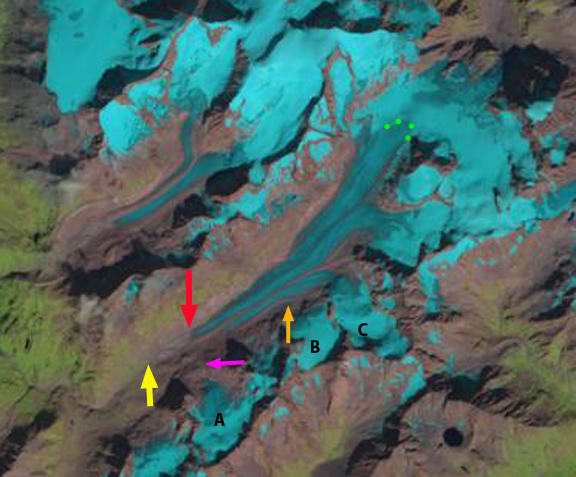
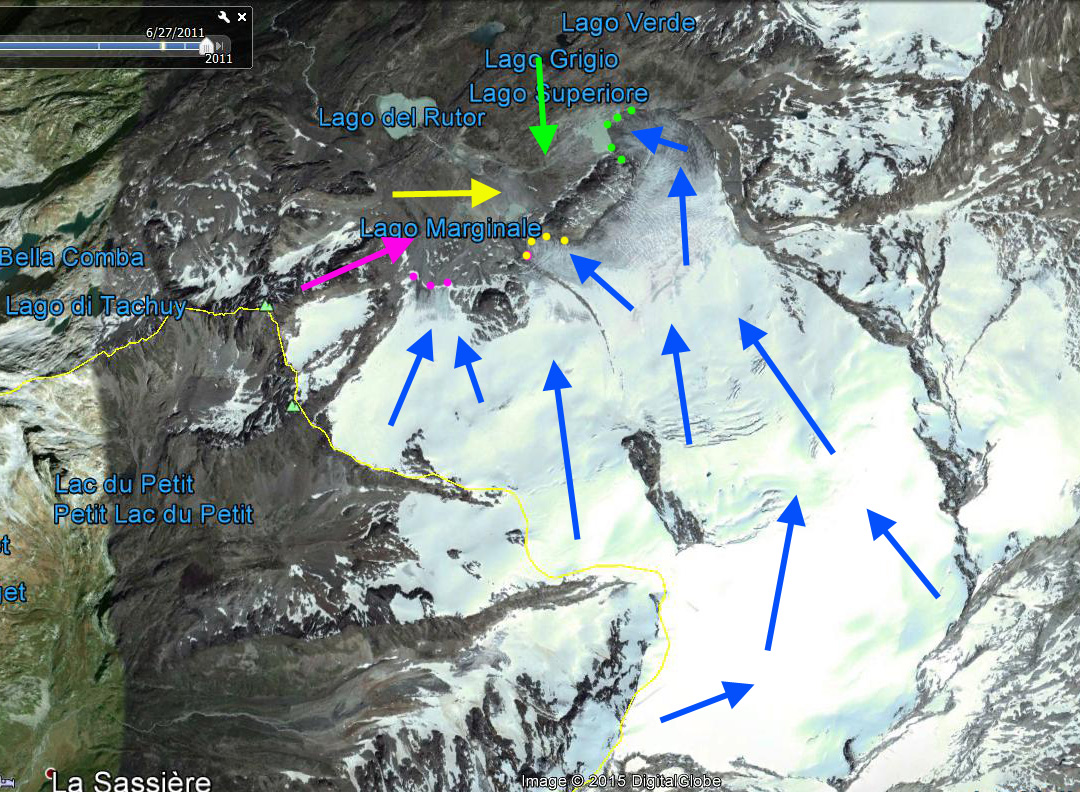
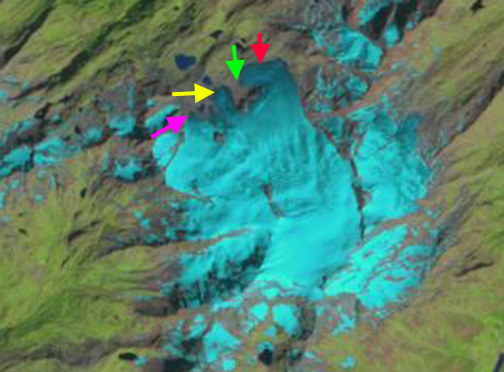
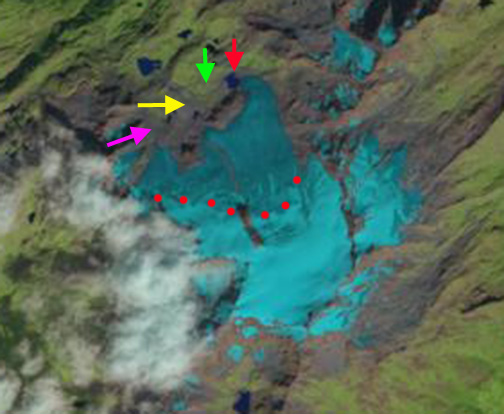
In 1990 two branches of the glacier merged in the valley bottom and extended to the red arrow marking the terminus of the glacier at that time.  The yellow arrow indicates the 2014 terminus position, and the yellow A indicates a prominent bedrock knob that a branch of the glacier encircles, pink arrows.  By 2013 the glacier in the main valley have separated, there are a few small lakes forming amidst the decaying stagnant ice tongue between the yellow and red arrow.  The bedrock knob at Point A has greatly expanded. In 2014 none of the termini reach the floor of the main valley.  As the stagnant ice melts, the lake area is expanding indicating that a new alpine lake will likely form.  The retreat from 1990-2014 is 1300 meters.  A closeup in 2009 from Google Earth indicates the two tongues with bedrock below separating them from the main valley floor, red arrows. There is still some relict ice below on the valley floor detached from the active glacier, blue arrows, that has small lake developing amid the stagnant ice. There is substantial crevassing above both actual termini, but not immediately. The retreat should slow now that the glacier has retreated onto steeper slopes, having lost the low elevation low slope valley tongue.
The retreat of this glacier is similar to that of nearby Verra Grande Glacier. lys glacier 1990
1990 landsat image
lys glacier 2013
2013 Landsat image
lys glacier 2014
2014 Landsat Image
lys glacier terminus
Google Earth Image

Stephenson Glacier Retreat and Lagoon Development, Heard Island

The Australian Antarctic Division manages Heard Island Island and has undertaken a project documenting changes in the environment on the island. One aspect noted has been the change in glaciers. The Allison, Brown and Stephenson Glacier have all retreated substantially since 1947 when the first good maps of their terminus are available. Fourteen Men by Arthur Scholes (1952) documents a year spent by fourteen men of the Australian National Antarctic Research Expedition that documented the particularly stormy, inclement weather of the region. Their visit to the glacier noted that they could not skirt past the glacier along the coast. After crossing Stephenson Glacier they visited an old seal camp and counted 16,000 seals in the area. It is a rich area for wildlife, that should benefit from the lagoon formation overall.  Thost and Truffer (2008) noted a 29% reduction in area of the Brown Glacier from 1947-2003. They also observed that the volcano Big Ben that the glaciers all drain from has shown no sign of changing geothermal output to cause the melting and that a 1 C warming has occurred over the same time period.
HIMI_general.pdf
Hear Island Map from the Australian Antarctic Division

Stephenson Glacier extends 8-9 km down the eastern side of Big Ben. In 1947 it spread out into a piedmont lobe that was 3 km wide and extended to the ocean in two separate lobes around Elephant Spit. A picture from the Australian Antarctic Division taken in 1947 shows the glacier reaching the ocean and then in 2004 from the same location. Kiernan and McConnell (2002) identified an order of magnitude increase in the rate of ice loss from Stephenson Glacier after 1987. Retreat from the late 19th century to 1955 had been limited. As Kiernan and McConnell observed retreat began that by 1971 the glacier had retreated 1 km from the south coast and several hundred meters from the northern side of the spit. This retreat by 1980 caused the formation of Stephenson Lagoon and by 1987 Doppler Lagoon had formed as well. After 2000 the two lagoons have joined. The first image below shows the terminus locations over the last 60 years from the Australian Antarctic Division 1947-2008.

Here we examine a series of Landsat images from 2001 to 2013 to update the response of this glacier.
In 2001 the glacier has two separate termini, pink arrows,in two different lagoons, Doppler to the south and Stephenson to the east. There are numerous icebergs in Doppler lagoon but none in Stephenson Lagoon, indicating the retreat is underway. In 2008 the two lagoons are well joined, icebergs are even more numerous obscuring in this view the true location of the terminus, orange arrows. By 2010 the glacier has retreated from the main basin of the lagoon, and is at red arrow, and the lagoon is free of ice for the first time in several hundred if not several millenium. In 2013 the glacier has retreated into a narrower valley that feeds into Stephenson Lagoon. The northern arm of the glacier experienced a 1.7 km retreat from 2001 to 2013 and the southern arm as 3.4 km retreat. The period of rapid retreat due to calving of icebergs into the lagoon is over and the retreat rate will now be slower. There is still rapid glacier flow toward the terminus as indicated by extensive crevassing.  The overall glacier slope is steep and accumulation rates high, which would also generate rapid glacier flow.

The AAD has a number of images in their gallery of Heard Island glaciers including Stephenson Glacier. The climate station at Atlas Cove indicates a 1 C temperature rise in the last 60 years.  The AAD will also certainly be looking at how this new lagoon impacts the local seal and penguin communities. The map above indicates the importance of Stephenson Lagoon for wildlife, king penguins and cormorants are noted by AAD.  The retreat of this glacier follows the pattern of glacier retreat at other glaciers on islands in the circum-Antarctic region Cook Ice Cap, Kerguelen Island , Purvis Glacier, South Georgia and Neumayer Galcier, South Georgia.

stephenson map
Map of retreat from superimposed on Google Earth image.

stephenson 2001
2001 Landsat image

stephenson 2008
2008 Landsat image

stephenson 2010
2010 Landsat image

stephenson 2013
2013 Landsat image